Scarbrough v. State Court Opinion
Annotated Secondary Research
November 30, 1934
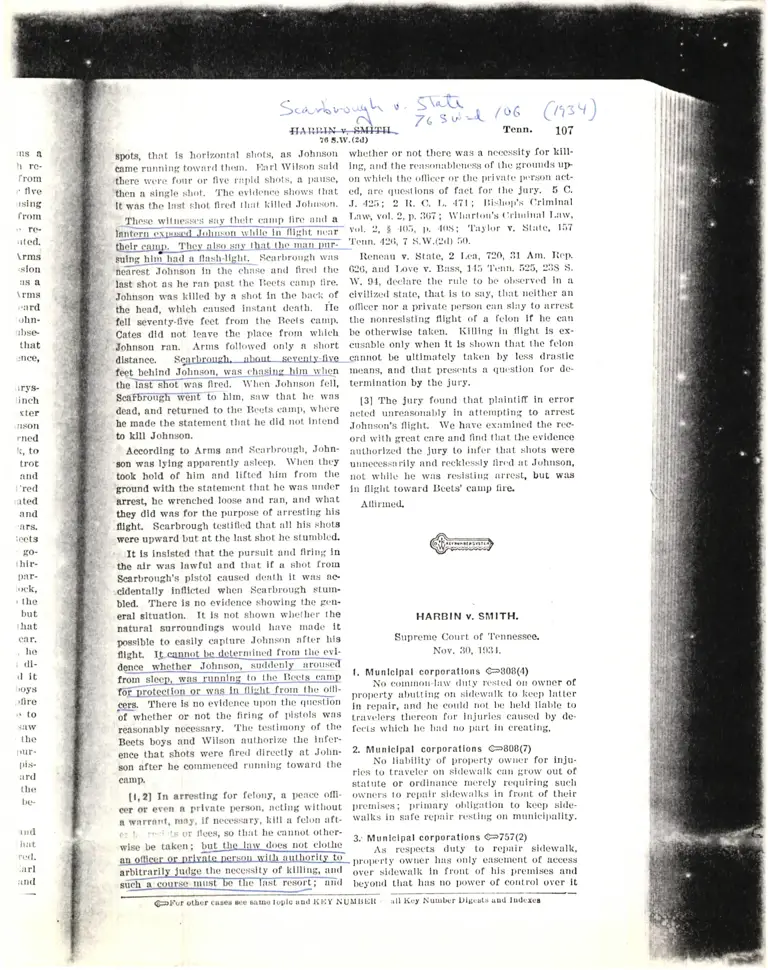
1 page
-
Case Files, Garner Working Files. Scarbrough v. State Court Opinion, 1934. 282a5df3-34a8-f011-bbd3-000d3a53d084. LDF Archives, Thurgood Marshall Institute. https://ldfrecollection.org/archives/archives-search/archives-item/9ee9d2c2-1dd2-4764-8314-fe2067e377c4/scarbrough-v-state-court-opinion. Accessed September 26, 2026.
Copied!
111(1
r(Ml.
^arl
■111(1
■ ■̂
V-O'
rA 7 6 s i / - ^ X
Teiin.
7(5 » .W .(S(1)
spots, tl(,'(t Is l(oclzoi(li(l stiols, a.s .Toli((.S(>ii
Canie rni(ii(((!i toward ll((‘j((. [''/arl Wilson said
there were four or five cKiild sleds, a i(ause,
then a single sl((d. 'I'iie evlde((ee sl(Ows ll(!(t
It was (he last !d(Ot fired lied killed .lolnison.
Tl(ese wllnesses si(,v ll(elr ea((([) lin> ((((d a
)ni(t(‘ri( ('XMiised J((l(i(son widle in fil};l(t near
their ei(i[(0 . 'I'lnw .also s.ay lliat ll((* ii(;((( lair-
sulng hl[(i l(ad a lli[sli-Hgl(l. Sea('l(ro([)j;l( was
nearest .Tol(nson in the el(i(se a((d tired tl(e
last shot as l(e ran pi(st (he Ifeets camp lire.
Johnson was killed l)y a sI(ot in the liael; of
the head, whicli e!(nsed l((stant dea(l(. He
fell seventy-five feet fron( tl(e Heels cai((i).
Cates did not leave the place from which
Johnson ran. Arn(s followed only a short
distance. sem-in-o'iph, niaad— seveiil.yJive
107
J
feet behind John.son, was chasing him when
the"lnst shot was fired. \Vl(('n Johnson fell,
Scalbrongh went to him, saw that he was
dead, and returned to tl( 0 Heels cami), where
he made the statem ent tl(at he did not inlend
to kill Johnson.
According to Arms and Scarhr(n(gh, John
son was lying apparcrdly aslee[). Wl(on they
whether or not there was a nec.'cssity for kill
ing, and the re;(so[(alilenes.s of Ihe grounds ni>-
on whicl( tin; officer or tl(e privale person i(ct-
ed, i(ro (i((eslions of fact for the jury, fi 6I-
.1. -Iliri; 2 K. C. H. 171; l!isho|)’s f’rlmlnal
l.aw', vol. 2, j). !!IJ7 ; \Vl(arl(((('s ( 'i'i(id((;(l l.!(w,
vol. 2, S Id'"', p. Id'S; T.aylor v. Klale, 1.77
Te([n. •12ii, 7 S.W.(2d) .'id.
Uenean v. Slate, 2 I.ea, 720, .'ll Am. l!('p.
020, and Ix)ve v. Hi(ss, 1 1.7 Te((n. .725, 20S S.
W. 01, (ha-lare tl(e nde to he oliserved in i(
civilized stale, that is to s:(y, find ((eitlier an
officer nor a privale person ea(( slay to arrest
the nonresisting flight <[f a felo(( if he can
he otherwise taken. Killing in flight Is ex
cusable only when it is shown find the felon
cannot be ultimately taken by less draslic
means, at(d tl(at presents a ((((estion for de
termination by the jury.
[31 The jury fonnd that phUntiff in error
acted ((nreasonably in atte(n[)ting to arrest
Johnson’s flight. Wo have exan(i((ed the rec
ord with great care and fi((d lhat the evidence
a((thorlzed the jury to infer that shots were
U((neeess!( rily and reckh.'ssly fired id Joh((son,
not wddle ho wiis resisli((g arrest, but wastook hold of him and lifted him froui the
ground wlfJi the statement that he w!(s u((der ju njjriit toward Heets’ camp fire,
arrest, ho wrenched loose n((d ran, and what Allirmed.
they did was for the purpose of arresting his
flight. Scarbrough testifhid that all his sliols
were upward but a t the hist shot he stumbled.
I t is insisted that the pursuit and firing in
the air was lawful and tlnd if a shot from
Scarbrough’s idstol caused death it was ac
cidentally Infllcrted when .Scarbrough stum
bled. There is no evidence showing the gen
eral situation. It is not shown whether Ihe
natural surroundings would have inadi' It
possible to easily capture Johnson after his
flight, t t cannot be determined from Hie evi
dence whether John.son, suddenly i(rousecI
f r o m sleep, was running to the H(»ets cidup
foF ^ ro tcc tio n ^ r was In flight from Ihe otli-
eers. There is no evidence upon the (|uestion
of whether or not the firing of pistols was
rea.sonably necessary. ’I'he testimony of the
Beets boys and Wilson authorize Ihe infer
ence that shots were fired directly at Jolni-
son after he commenced running toward the
camp.
(1,21 In arresting for felony, a peace offi
cer or even a pi Ivate person, acting witl(out
a w arrant, may, if necessary, kill a felon aft-
, I ■ : ts or flees, so that he cannot other
wise be taken ; but the law does not clothe
an oflicer or private iierson with anlliority to
arbitrarily judge tlie necessity of killing, and
s(uh~a course must be tlie last' re so rt; and
HARBIN V. SMITH.
Supreme Court of Tennessee.
Nov. fit), 11K!I.
1. Municipal corporations O=80f!(4)
No conunon-law duly rested on owner of
property abutting on sidewalk to Iceep latter
in repair, and he could not lie held liable to
travelers thereon for Injuries caused by de
fects wliich l(e bad no part in creating.
2. Municipal corporations (0=808(7)
iN'o liability of property owner for inju
ries to traveler on sidewalk can grow out of
stalute or ordinj(uce merely reipiiring sucli
owners to repair sidewjdks in front of their
preiid.ses; primary obligation to keep side
walks in safe repair resting on municipality.
3. Municipal corporations <0=757(2)
As resiiects duty to re]iair sidewalk,
liroperly owner lias only easement of aceess
over sidewalk In front of his premises and
beyond tl(Ut has no power of control over it
iii
<^;s3Kor othor cuseu Baiuo lotilc uiul KlOY all K ey K m uber iJliji'sts uuU luilcxea