Correspondence from Lado to Tegeler and Stone Re: List of Expert Witnesses with Draft
Correspondence
January 14, 1991
5 pages
-
Case Files, Sheff v. O'Neill Hardbacks. Correspondence from Lado to Tegeler and Stone Re: List of Expert Witnesses with Draft, 1991. ecc42e9f-a346-f011-877a-002248226c06. LDF Archives, Thurgood Marshall Institute. https://ldfrecollection.org/archives/archives-search/archives-item/9f406a5f-82ae-4189-a9ef-bf42eb53c834/correspondence-from-lado-to-tegeler-and-stone-re-list-of-expert-witnesses-with-draft. Accessed October 21, 2026.
Copied!
    -— a . a" —

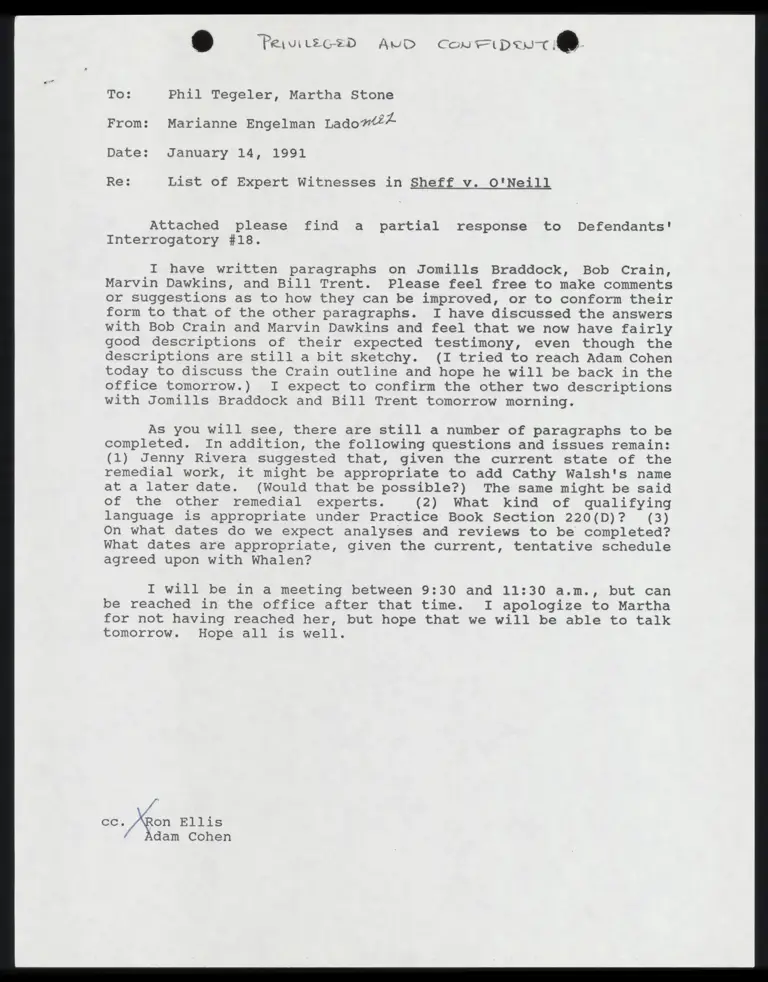
To: Phil Tegeler, Martha Stone

From: Marianne Engelman Lado #4

Date: January 14, 1991

Re: List of Expert Witnesses in Sheff v. O'Neill


Attached please find a partial response to Defendants’
Interrogatory #18.

I have written paragraphs on Jomills Braddock, Bob Crain,
Marvin Dawkins, and Bill Trent. Please feel free to make comments
or suggestions as to how they can be improved, or to conform their
form to that of the other paragraphs. I have discussed the answers
with Bob Crain and Marvin Dawkins and feel that we now have fairly
good descriptions of their expected testimony, even though the
descriptions are still a bit sketchy. (I tried to reach Adam Cohen
today to discuss the Crain outline and hope he will be back in the
office tomorrow.) I expect to confirm the other two descriptions
with Jomills Braddock and Bill Trent tomorrow morning.

As you will see, there are still a number of paragraphs to be
completed. In addition, the following questions and issues remain:
(1) Jenny Rivera suggested that, given the current state of the
remedial work, it might be appropriate to add Cathy Walsh's name
at a later date. (Would that be possible?) The same might be said
of the other remedial experts. (2) What kind of qualifying
language is appropriate under Practice Book Section 220(D)? (3)
On what dates do we expect analyses and reviews to be completed?
What dates are appropriate, given the current, tentative schedule
agreed upon with Whalen?

I will be in a meeting between 9:30 and 11:30 a.m., but can
be reached in the office after that time. I apologize to Martha
for not having reached her, but hope that we will be able to talk
tomorrow. Hope all is well.

4
es. fm Ellis

/ Adam Cohen


¥

LRA
T

.

Expert Witnesses


18. Please specify the name and address of each and every
person the plaintiffs expect to call as an expert witness at trial.
For each such person please provide the following:

a) The date on which that person is expected to complete the
review, analysis, or consideration necessary to formulate the
opinions which that person will be called upon to offer at trial;

b) The subject matter upon which that person is expected to
testify; and

C) The substance of the facts and opinions to which that person
is expected to testify and a summary of the grounds for each
opinion.

RESPONSE: Experts whom the plaintiffs expect to call at trial are
listed below, pursuant to Practice Book Section 220(D):


Dr. Jomills Henry Braddock, II, Center for Social
Organization of Schools, Johns Hopkins University, 3505
North Charles Street, Baltimore, Maryland, 21218. Dr.
Braddock is expected to testify to (1) the adverse
educational and long-term effects of racial, ethnic, and
economic segregation; (2) the adverse effects of racial,
ethnic, and economic segregation on the educational
process within schools. Specifically, Dr. Braddock is
expected to testify that school segregation tends to
perpetuate segregation in adult 1life, that school
desegregation helps to transcend systemic reinforcement
of inequality of opportunity, and that segregation
affects the educational process within schools. In his
testimony, the materials on which Dr. Braddock is
expected to rely include his published works, as well as
research currently being conducted on the educational and
long-term effects of racial, ethnic, and economic
segregation by Dr. Marvin P. Dawkins and Dr. William
Trent. (See descriptions, below) Dr. Braddock is
expected to base his testimony on (1) Braddock, "The
Perpetuation of Segregation Across Levels of Education:
A Behavioral Assessment of the Contact-Hypothesis," 53
Sociology of Eduction 178-186 (1980); (2) Braddock,
Crain, McPartland, "A Long-Term View of School
Desegregation: Some REcent Studies of Graduates as
Adults," Phi Delta Kappan 259-264 (1984); (3) Braddock,
"Segregated High School Experiences and Black Students’
College and Major Field Choices," Paper Presented at the
National Conference on School Desegregation, University
of Chicago (1987); (4) Braddock, McPartland, "How
Minorities Continue to be Excluded From Equal Employment
Opportunities: Research ' on Labor Market and
Institutional Barriers," 43 Journal of Social Issues 5-


é E
4

39 (1987); and (5) Braddock, McPartland, "Social-
Psychological Processes That Perpetuate Racial
Segregation: The Relationship Between School and
Employment Desegregation, 19 Journal of Black Studies
267-289 (1989). Dr. Braddock is expected to complete his
review on April 1, 1991.


Collier: MS

Dr. Robert IL. Crain, Professor of Sociology and
Education, Teachers College, Columbia University, 525
West 120th Street, Box 211, New York, New York, 10027.
Dr. Crain is expected to testify to the adverse
educational and long-term effects of racial, ethnic, and
economic segregation in the Hartford metropolitan area.
Specifically, Dr. Crain is expected to testify that the
effects of Project Concern participation for students in
the Hartford metropolitan area have been to reduce the
likelihood of (1) dropping out of high school, (2) early
teenage pregnancy, and (3) unfavorable interactions with
the policy. Dr. Crain is expected to testify, further,
that the effects of Project Concern participation for
students in the Hartford metropolitan area have been to
increase (1) college retention, (2) the probability of
working in private sector professional and managerial
jobs, (3) the probability of interracial contact, and
(4) favorable attitudes toward whites. In his testimony,
Dr. Crain is expected to base his testimony on his
published works and his analyses of Project Concern.
Specifically, Dr. Crain is expected to rely on (1) Crain,
Strauss, "School Desegregation and Black Occupational
Attainments: Results from a Long-Term Experiment,"
Center for Social Organization of Schools, Report No. 359
(1985); (2) Crain, Hawes, Miller, and Peichert, "Finding
Niches: Desegregated Students Sixteen Years Later,"
Unpublished Manuscript, Institute for Urban and Minority
Education, Teachers College (revised 1990); and (3)
Gable, Thompson, Iwanicki, "The Effects of Voluntary
Desegregation on occupational Outcomes," The Vocational
Guidance Quarterly 230-239 (1983). Dr. Crain is expected
to complete his review on April 1, 1991.


Dr. Marvin P. Dawkins, 17627 N.W. 62nd Place, North,
Hialeah, Florida, 33015. Dr. Dawkins is expected to
testify to the adverse educational and long-term effects
of racial, ethnic, and economic segregation on African
Americans. Specifically, Dr. Dawkins is expected to
testify that African Americans who have attended
segregated schools have a lower probability of attending
predominantly white colleges and universities,
maintaining interracial contacts, and working in
desegregated settings. Dr. Dawkins is expected to base
his testimony on (a) his analysis of data from the
National Survey of Black Americans, a nationally


%

representative survey of African Americans conducted over
a period of seven months between 1979 and 1980 at the
Survey Research Center, Institute for Social Research,
University of Michigan, and funded by the Center for the
Study of Minority Group Mental Health, at the National
Institute of Mental Health; (b) Dawkins, "Black Students!
Occupational Expectations: A National Study of the
Impact of School Desegregation,"™ 18 Urban Education 98-
113 (1983); (c) Braddock, Dawkins, "Predicting Black
Academic Achievement in Higher Education," 50 Journal of
Negro Education 319-327 (1981); (d) Braddock, Dawkins,
"Long-Term Effects of School Desegregation on Southern
Blacks," 4 Sociological Spectrum 365-381 (1984); and (e)
Dawkins, "Persistence of Plans for Professional Careers
Among Blacks in Early Adulthood," 58 Journal of Negro
Education 220-231 (1989). Dr. Dawkins is expected to
complete his analysis on March 15, 1991.


Dr. Mary Kennedy: MS

Yale Rabin: PT

Swaminathan: 2?


Dr. William Trent, EPS, 368 Education Building,
University of Illinois, 1310 South Sixth Street,
Champagne, Illinois, 61820. Dr. Trent is expected to
testify to the adverse educational and long-term effects
of racial, ethnic, and economic segregation on Latinos,
African Americans, and white Americans. Specifically Dr.
Trent is expected to testify that the economic school
segregation has adverse long-term outcomes for Latinos,
African Americans, and white Americans, that
desegregation has beneficial results on the aspirations
and expectations of Latino students and on their
likelihood of working in interracial environments, and
that white Americans who have experienced desegregated
schools are more likely to work with and to have positive
attitudes toward African American co-workers. Dr. Trent
is expected to base his testimony on his published work
and his analysis of data from (a) the National
Longitudinal Survey of Labor Force Behavior =-- Youth
Cohort, an annual survey sponsored by the U.S.
Departments of Labor and Defense of 12,686 young persons
throughout the United States, with data available for
1979-1987; (b) the High School and Beyond Study, a
national longitudinal probability sample of more than
58,000 1980 high school sophomores and seniors, conducted
in 1980, 1982, 1984, and 1986; and (c) the National
Longitudinal Survey of Employers, a national probability
sample of 4,087 employers, conducted in the 1970's. Dr.
Trent is expected to complete his analysis on April 1,
19921. : i


® Sp »


Willie/Alves/Walsh/Castellanos: Omit, for now?

To add: qualifying language that will apply to all of the above.