Motion to Dismiss and Memorandum in Support
Public Court Documents
August 19, 1977
36 pages
-
Case Files, Hatcher v. Methodist Hospital - Hardbacks. Motion to Dismiss and Memorandum in Support, 1977. 26b115b0-5484-f111-ab0f-7c1e527d528a. LDF Archives, Thurgood Marshall Institute. https://ldfrecollection.org/archives/archives-search/archives-item/a0673966-259e-4622-a6fc-8da850699090/motion-to-dismiss-and-memorandum-in-support. Accessed October 10, 2026.
Copied!
     [||8cf88b0e-76ba-46c5-afab-56638c0f7555||] * »
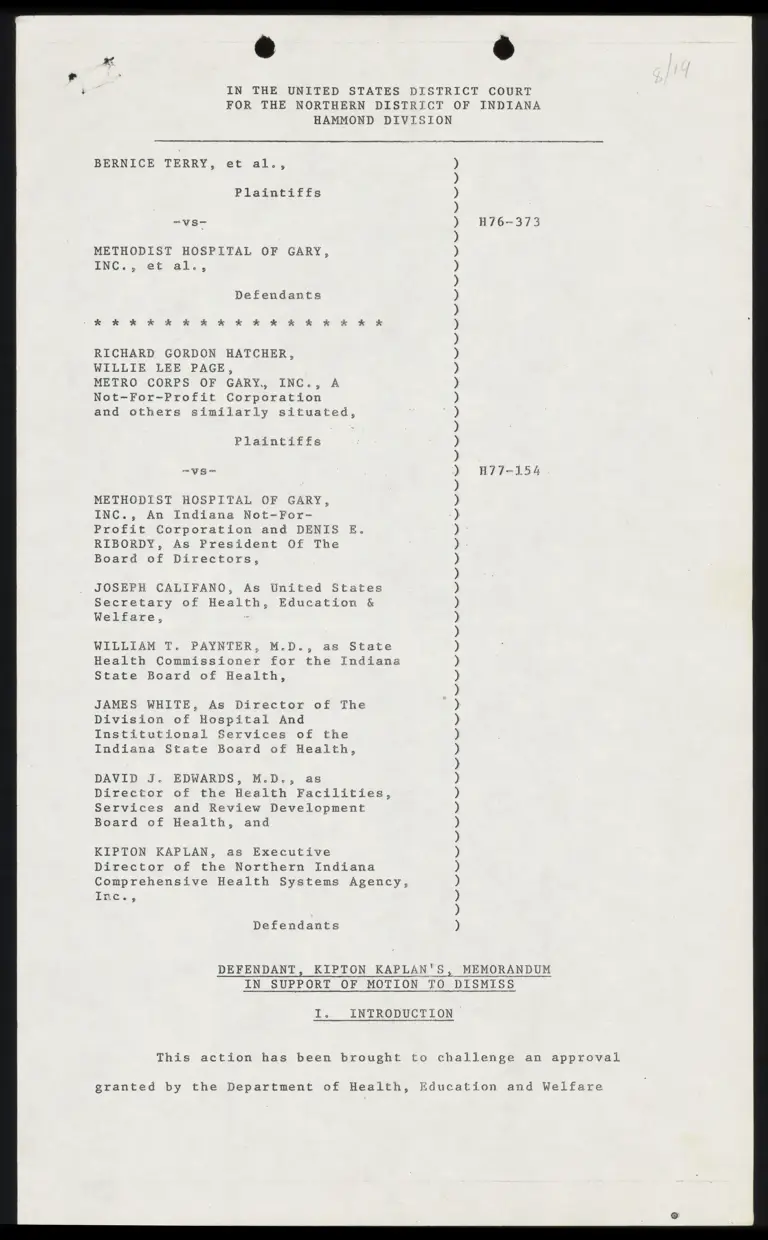
IN THE UNITED STATES DISTRICT COURT

FOR THE NORTHERN DISTRICT OF INDIANA

HAMMOND DIVISION


BERNICE TERRY, ect al.,

Plaintiffs

-V8- H76-373

METHODIST HOSPITAL OF GARY,

INC. , et al.

Defendants

oy deo donde Leite de de luis sh id Sige dit ge

RICHARD GORDON HATCHER,

WILLIE LEE PAGE,

METRO CORPS OF GARY, INC., A
Not-For-Profit Corporation

and others similarly situated,

Plaintiffs

METHODIST HOSPITAL OF GARY,

INC., An Indiana Not~For-

Profit Corporation and DENIS E.
RIBORDY, As President Of The

Board of Directors,

JOSEPH CALIFANO, As United States

Secretary of Health, Education &
Welfare, :

WILLIAM T. PAYNTER, M.D., as State

Health Commissioner for the Indiana

State Board of Health,

JAMES WHITE, As Director of The
Division of Hospital And
Institutional Services of the
Indiana State Board of Health,

DAVID J. EDWARDS, M.D., as
Director of the Health Facilities,

Services and Review Development
Board of Health, and

KIPTON KAPLAN, as Executive

Director of the Northern Indiana

Comprehensive Health Systems Agency,
Inc.,

Defendants

DEFENDANT, KIPTON KAPLAN'S, MEMORANDUM

IN SUPPORT OF MOTION TO DISMISS


Ye INTRODUCTION


This action has been brought to challenge an approval

granted by the Department of Health, Education and Welfare


(HEW) of government Medicare/Medicaid reimbursements and loan

guarantee for a construction project of the Methodist Hospital

of Gary, Inc. This project contemplates the construction of two

health service buildings, one to be located at the Gary, Indiana

site of Methodist Hospital and the other to be constructed

adjacent to the hospital's faciltiy, Broadway Methodist

Hospital, in suburban Merrillville, Indiana. In addition,

the project includes the construction of a laundry at the

Merrillville site.

The plaintiffs have alleged that HEW, the State Board

of Health, and other co-defendants have failed to comply

with Title VI of the Civil Rights Act of 1964 (42 U.S.C.

2000d), Section 504 of the Rehabilitation Act as amended in

1973 ( 29 U.S.C. 794), the Civil Rights Act of 1871 (42 U.S.C.

1983) and the Fifth and Fourteenth Amendmentsto the Constitution

2} of the United States, in the course of.and as a result of U

the approval of Methodist's construction project for

Medicare, Medicaid and Maternal and Child Health reimbursement

under Section 1122 of the Social Security Act (42 U.S.C.

13209-1) and federal assistance and loan guarantees for

hospital construction under the "Hill Burton Act”

(42 U.S.C. 29 et.seq.). These decisions were made after a

process of application, hearings, and recommendations

embraced by "The Partnership for Health Act", Section 314

of the Public Health Service Act , (42 U.S.C. 246) and

"The National Health Planning and Resources Development Act

of 1974" (42 1.8.0. 300 X et.seq.).

This motion to dismiss is on behalf of defendant,

KIPTON KAPLAN, in his capacity as Executive Director of the

Northern Indiana Health Systems Agency, Inc. (NIHSA), a non-

profit corporation designated by HEW and authorized under

Section 1122 of the Social Security Act to perform reviews

of health facility capital expenditure projects and to make


recommendations concerning same to appropriate state and

federal authorities. This memorandum addresses only those

causes of action specified by the plaintiffs against NIHSA

to wigs

"28. Defendant Kaplan, Director of the
HSA has violated Title VI by:

(a) approving the §1122 application
of defendant, Methodist Hospital of Gary

which is in violation of Title V and

§504;

(b) performing their functions pur-
suant to §314(b) and Title XV without
consideration of and in violation of
Title VI." (Complaint page 13)

Matters leading to the institution of this action, are

described in other pleadings to the court, and need not be

again reviewed. However, a detailed summary of the involvement

of the Northern Indiana Health Systems Agency, Inc. (NIHSA) is

advisable in order to develop the factual background against

which this litigation was commenced.

A. BACKGROUND OF THE PROCEEDINGS.


Methodist Hospital of Gary, Inc. operates two hospitals

in Lake County, Indiana. Its Gary, Indiana facility is an inner

city institution and has been serving the residents of Gary

for several decades. The Broadway Methodist Hospital, located in

Merrillville, Indiana, opened in late 1975. Merrillville is a

suburban community located immediately south of the City of

Gary.

In 1974 Methodist made application to the Northwest

Indiana Comprehensive Health Planning Council, Inc. for

approval of full Medicare/Medicaid reimbursements for capital

expendi tures and for Hill Burton assistance for plans for the

construction of health services buildings both at the Gary,

Indiana hospital and at its Broadway Methodist Hospital

facility in Merrillville. The Comprehensive Health Planning


Council at the time of the 1974 application of Methodist,was a

not-for-profit corporation organizaed under the laws of the

State of tndiana and under contract to the Indiana State Board

of Health and the Department of Health; Education, and Welfare

to perform reviews of proposed capital projects pyhueleh facilities

and make recommendations to the State Board of Health and to

HEW as to whether such projects were consistent with local and

regional health plans,standards, and criteria. The 1974 applica-

tion of Methodist also included the construction of a laundry

facility at the Broadway site. The Methodist proposal was duly

considered by the Council and approval was recommended to the

State Board of Health which in turn reviewed the project,

approved it, and notified HEW of that approval. Subsequently,

HEW approved both reimbursement for capital expenditures ander

Section 1122 and a Hill Burton Loan Guarantee and subsidy

for construction of the facilities.

Under Section 1122 of the Social Security Act (42 U.S.C.

13202-1) and the regulations adopted thereunder (42 CFR 100.101

et.seq.), health facilities securing approval for capital

projects must implement those projects in a substantial fashion

within one (1) year of the date of final approval thereof.

In the event that the applicant facility fails to do so,

re-review of the application is necessary to extend the period

of approval. In mid-1975, Methodist made clear its desire

for an extension of time in which to implement the previously

approved project. The State Board of Health, as the

designated planning agency for Indiana under Section 1122

of the Social Security Act, required Methodist to seek a full

review of the project a second time and in conformance with


that ruling Methodist submitted a second application to

the Northern Indiana Health Systems Agency, Inc. (NIHSA) for

that review. The Health Systems Agency had been designated

pursuant to Public Law 93-641, the National Health Planning

& Resources Development Act (42 U.S.C. 300K et.seq.) to take

over the responsibility for local review of health

facility capital expenditure applications under Section 1122

of the Social Security Act. The Secretary of HEW had designated

NIHSA, Inc. as the Health Systems Agency for Northern Indiana

in May of 1976. The Health Systems Agency, after holding

public hearings, recommended approval of the application for

Section 1122 and Hill Burton assistance to the State Board

of Health which subsequently approved the application and

notified the Department of Health, Education and Welfare

of such approval. HEW then approved both Section 1122 reimburse-

ment and Hill Burton assistance.

It is essentially as a result of these later approvals

that this action has been brought.

Although the application presented for review to the

Health Systems Agency in 1976 included health services

buildings at both Gary and Broadway Hospitals, and a laundry,

the application was significantly different from the previously

approved 1974 application in several respects. The size and

character of services to be housed in the respective health

services buildings were changed with the result that certain

of these services weve deleted and still others reduced in

scope. The cost of the project had also increased from

$4,800,000.00 in the 1974 application to $8,143,370.00 tn

the application reviewed by the Health Systems Agency.

These issues were brought to the attention of

the relevant officials at the State Board of Health and the


Department of Health, Education and Welfare by the staff of

NIHSA, and were discussed in the course of the review of the

project by the HSA. The executive committee of the Health

Systems Agency also heard statements discussing the impact

of these changes on the residents of Gary, particularly

on those dependent on inner-city health facilities.

Subsequent to these discussions, and as noted above,

the application was eventually recommended for approval by

NIHSA and was in fact approved by the State Board of Health

HEW ©

B., THE STATUTORY SCHEME OF HEALTH PLANNING


Access to adequate health care for all Americans has

been an express goal of the Congress and a cornerstone of

federal government health policies.

"The achievement of equal access to
quality health care at a reasonable
cost is a priority of the federal

government." 42 U.S.C. ¢$300K(a) (1)

Indeed, this goal has been underlined by judicial

pronouncement:

"It is at least clear that medical
care is . . . a basic necessity of
life . . . and, governmental
privileges or benefits necessary to
basic sustainance have often been
viewed as being of greater consti-
tutional significance than less
essential forms of government

entitlement.” Memorial Hospital v.
Maricopa County, 415 U.S. 250, 39 LEd
2d 306, 94 Sup.Ct. 1076 (1974)


and

The duties, obligations, and functions of the Department

of Health, Education and Welfare, state health planning and

resources development agencies, and health systems agencies

in carrying out these policies are defined in a series of

inter-related federal statutes and regulations, which, when


taken together, govern the operation of the health planning

system. The operation of that system is at the very heart

of the issues presented in this action.

In a series of enactments beginning in 1944, Congress

recognized the need to develop hospital facilities throughout

the United States and provided for grants, loans and loan

subsidies to hospitals wishing to construction or expand.

This legislation, commonly known as the "Hill Burton Act"

(42 U.S.C. §291, et.seq.) not only provided financial assistance

“for hospital construction, but required state auenbies to

survey the need for hospital facilities in their states and

develop plans addressing lelioss needs. The Congress, twenty

years later, recognizing the fact that the proliferation of

unneeded hospital and health facilities ware a contributing

factor to the upward spiraling costs of health care, enacted

the "Partnership for Health Act" Public Law 89-749 (42 U.S.C.

§246) subsection B of which provided for the designation by

the Secretary of the HEW of public or non-profit private

agencies or organizations to develop "comprehensive regional,

metropolitan area, or other local area Blank for coordination

of existing and planned health services, including the

facilities and persons required for provision of such services;

and including the provision of such services through home

Health cardsh {42 U.8.C. §246(BY(1Y{(A)). That subsection

also provided for federal grants to such agencies, and in

addition, provided that the agency designated under that

statute make "provision for assisting health care facilities

in its area to develop a program for capital expenditures for

replacement, modernization, and expansion which is consistent

with an overall state plan, which will meet the needs of the

state in the area for health care facilities, equipment, and

services without duplication and otherwise in the most efficient


and economical manner." (42 U.S.C. §246(B) (2)(B)). Subsection

A of §246 provides for the granting of funds to state agencies

to carry on state-wide comprehensive health planning. Subsections

D and E of §246 provided for grants to public and non-profit

entities for comprehensive public health services and project

‘grants for health services and related training, respectively.

Grants under these subsections were subject to review and comment

by local comprehensive health planning councils to determine the

conformity of such grant proposals to the plans developed pursuant

to §246. The state agency also conducted a review before making

final approval of the grant to determine whether or not proposals

contorged to the relevant statewide plan.

Under §246, the Northwest Indiana Comprehensive Health

Planning Council, Inc., was established and did develop areawide

plans, which were used in the review of grants pursuant to

subsections D and E of that subsection. Section 246, however,

had no impact on the expenditure of funds by health care providers

or facilities which did not originate with §246. Compliance

with the health plans developed under this section was purely

voluntary, except for those programs under subsections D and E.

The Congress found that some economic incentive was

necessary to limit unneeded capital expenditures by hospitals

and other health facilities which resulted in unnecessary

duplication of facilities and services. As part of the Social

Security Amendments of 1972, Public Law 92-603, the Congress

added Section 1122 to the Social Security Act (42 U.S.C.

1320A~1). Under §1122, any person or facility which received

federal payments for services Later Titles V, XVIIT and XIX

of the Social Security Act was required to secure the approval

of the Secretary of HEW for any capital expenditure which,


under the Act, was defined as:

"An expenditure which, under generally

accepted accounting principles, is not

properly chargeable as an expense of
operation and maintenance and which (1)
exceeds $100,000.00, (2) changes the
bed capacity of the facility with
respect to which such expenditure is
made, or (3) substantially changes the
services of the facility with respect
to which such expenditure is made."
(42 U.S.C. 1320A-1(G))

After receiving findings and recommendations on the

proposed capital expenditures from the comprehensive health

Planning councils created at 42 U.S.C. §246 and the designated

planning agencies of the state in which the applicant was located

(these agencies were usually the same as the state agency under

§246), the Secretary of HEW would determine whether or not to

exclude from the payments made pursuant to Titles V, XVIII and

XIX, that portion of the payment which defrayed the cost of

the disapproved capital expenditure.

Regulations adopted by the Department of Health,

Education and Welfare under §1122 provide that both the state

designated planning agency and the local areawide planning

agency must take into account four criteria in the course of

reaching its findings on the proposals submitted by applicants

under this section:

"Such criteria to the extent provided
for under such standards, criteria, or
plans, shall include the following:
(a) whether the proposed project is
needed or projected as necessary to meet
the needs of the community in terms of
health services required . . .(b) whether
the proposed project can be adequately
staffed and operated when completed;
(c) whether the proposed capital
expenditure is economically feasible
and can be accommodated in the patient
charge structure of the health care
facility or health maintenance organization
without unreasonable increases; and

(d) whether the project will foster

cost containment or improved quality
of care through improved efficiency and
productivity, including promotion of
cost effective factors such as ambulatory
care, preventive health care services,


home health care, and design and con-
struction economies, or through increased
competition between different health

services delivery systems." (42 C.F.R.
100.107a~d).

In the event that an applicant is dissatisfied with

the ruling of the Secretary pursuant to §1122, the applicant

‘may request a fair hearing under 42 U.S.C. 1320A-1 (4d) (1) (B)

(ii) (II). By regulation, such fair hearing appeals are conducted

in accordance with the applicable requirements of state law

governing administrative hearings {42 C.F.R, 100.106c2) and are

confined to a review of the findings made by the state designated

planning agency in the course of its review. In the event that

the decision of the hearing officer dur (ng a fair hearing

reverses the findings of the state agency, the decision of the

hearing officer reverses or revises the findings or recommendations

of the designated planning agency, and supersedes same. (42 C.F.R.

100.106c4) .

The language of §1122 expressly provides that decisions

of the Secretary made pursuant to this section are not subject to

judicial review. "A determination by the Secretary under this

section shall not be subject to administrative or judicial

review." (42 U.S.C. 1320A-1(f)). However, a mechanism is

available to secure re-review by the Secretary of any decisions

made under §1122. "Any person dissatisfied with the

determination by the Secretary under this section may, within

six months following notification of such determination, request

the Secretary to reconsider such determination." (42 C.F.R.

1320A-1F). Requests for reconsideration under this provision

must be in writing, addressed to the Secretary of Health, :

Education and Welfare or to any officer, employee to whom _

the responsibility to receive such requests are delegated,

and must set forth the grounds based upon the record of the

proceedings and any issues of law upon which the reconsideration

is requested (42 C.F.R. 100.10831l). Reconsiderations are based


on the record of the proceedings, which includes the findings,

redontendat iohe, and supporting materials submitted to the

Secretary by the state designated planning agency (which

includes the findings and recommendations of the local

areawide agency), which relate to the findings and recommendations

involved. the record of the hearing provided by the

designated planning agency, if any, and comments which the

Secretary may request from the designated planning agency.

(42 C.7.R. 100.1084¢a)Y(2)yY,

Responding to continuing large increases in the costs

of health care generally, and in the federal outlay for such

care, Congress enacted the National Health Planning and

Resources Development Act, Public Law 93-641 in late 1974.

The Act (42 U.S.C. §300K et.seq.) essentially supplemented

the old comprehensive health planning legislation and gave

new powers and new structures to local areawide health

planning. The Act empowered the Secretary of Health, Education

and Welfare to designate public or private non-profit agencies

as health systems agencies for each health service area in

the United States. Health service areas are geographic areas,

the boundaries of which were determined in consultation with

the Governor of each state, after taking into account population

and geographic factors. (42 U.S.C. 300L). The governing

bodies of private non-profit organizations which were designated

as health systems agencies, were required to be composed of at

least a majority of consumers with both direct and indirect

providers of health care represented. The health systems

agencies are required to (1) establish, annually review, and

amend, as necessary, a health systems plan which is a detailed

statement of goals describing a healthful environment and health


systems in the area, which, when developed, will assure that

quality health services will be available and accessible in a

manner that assures continuity of care at a reasonable cost

for all residents of the area; (2) to establish, annually

review, and amend, as necessary, an annual implementation

‘plan, which describes objectives which will achieve the goals

of the health systems plan and priorities among the objectives;

(3) to seek to the extent practicable to implement the health

systems plan and annual implementation pian with the assistance

of individuals of public and private encfttes in the health

service area; (4) provide technical assistance to individuals

and public and private entities for the development of

projects and programs which Eis health systems agency deteruines

are necessary to achieve the goals described in the health

systems plan; (5) to make grants from an area health development

fund established under the Act to public and non-profit private

entities, to assist them in planning and developing projects

and programs which the health systems agency determines are necessary

for the achievement of the health systems described in the health

systems plan; (6) the health systems agency is required to

coordinate its activiites with professional standards, review

organizations under §1122 of the Social Security Act, corenin

regional and metropolitan planning agencies, and other

Pproprinie agencies; (7) the agency is required to secure

data for the use of the agency's planning and development

activities and to enter into agreements with the organizations

mentioned above to assure that actions taken by such organizations

which alter the area's health system will be taken in a manner

which will be consistent with the health systems plan and annual

implementation plan that is set for that area; (8) to review and

approve or disapprove each proposed use within the health

service area of federal funds appropriated under the Public

Health Service Act, the Community Mental Health Center Act,


or the Comprehensive Alcohol Abuse and Alcoholism Prevention

Treatment and Rehabilitation Act of 1970 for grants, contracts,

loans, or loan guarantees for the development, expansion, or

support of health resources; (9) health systems agencies are

to assume the duty of assisting the state health planning and develop-

ment agency in carrying out its functions including the review

and recommendation to the appropriate state health planning

agency respecting the need for mew institutional health services

proposed to be offered in the health service area of the

agency and to assume the duties of the local areawide planning

agency under §1122 of the Social Security Act; (10) health systems

agencies are to complete within chedi years of their designation

a review of the existing institutionalized health services

within its service area and to recommend annually thereafter

to the state health planning and development agency projects

for the modernization, construction and conversion of medical facilities

in the agency's health service area, which projects will achieve

the health systems plan and annual implementation plan of the health

systems agency and priorities among these projects. (42 U.S.C.

300L-2).

In addition, the Act authorized the designation of

state agencies to carry on che functions of planning and review

contemplated by the Act. In most cases, as in Indiana, the

agency designated as the state agency for the purpose of

Public Law 93-641 was the same agency that had conducted

state activities under §1122 of the Social Security Act, namely,

the Indiana State Board of Health.

JX. THE COURT IS WITHOUT JURISDICTION

OF THE SUBJECT MATTER


THE PLAINTIFFS HAVE FAILED TO EXHAUST ALL

ADMINISTRATIVE REMEDIES AVAILABLE TO THEM


It is an often enunciated principle of administrative

law that "no one is entitled to judicial relief for a supposed


or threatened injury until the prescribed administrative

remedy has been exhausted”. Meyers v. Bethlehem Shipbuilding


Corporation, Ltd., 303 U.S. 41 at 50, 82 LEA 638 at 644 (1938),

Macauley V. Waterman 8.8. Corporation, 327 U.S. 540 ar,


90 LEd 839 at, (1946).

The purposes underlying this rule are to be found

in concepts of judicial economy and efficiency along with

proper respect for those agencies the Congress has entrusted

with the administration of broad areas of the government's

activity as defined by law. "Exhaustion is Ssncraliy required:

as a matter of preventing premature interference with agency

processes, sco that the agency may function efficiently and

so that it may have an opportunity to correct its own errors,

to afford the parties and the courts the penelit of its

experience and expertise, and to compile a record which is

adequate for judicial review." Weinberger v. Salfi, 422 U.S.


749 at 765, 45 LEQ 24 '522 at 539 (1925). Indeed, the

judicial role of evaluating facts is to be deferred to that

agency better equipped and authorized by grant of power to

perform such evaluation. As the United States Supreme Court

  noted in Weinberger v., Bentex Pharmaceuticals, Ine., 412 U.S. 645, 37

1.24 24 235 (1973).:

"In cases raising issues of fact

« « « Yequireing the exercise of
administrative discretion, agencies
created by Congress for regulating
the subject matter should not be
passed over. This is so even though
the facts after they have been
appraised by specialized competence

serve as a premise for legal con-
sequences to be judicially defined."
412 U.S.iat 654, 37 1LB4d 2d at 242.

In giving practical application to the exhaustion doctrine,

federal courts have generally looked to the nature and extent of

the discretionary = powers granted by the Congress. The concept

of executive and administrative authority is given expression

in the doctrine and is "particularly pertinent where the function


of the agency and the particular decision sought to be reviewed

involve the exercise of discretiancy powers granted the

agency by Congress, or require application of special

expertise." McKart v. United States, 395 U.S. 185 at 184," 23 1Ed


+ 2d 194 at 203 ( 1969).

The exhaustion of remedies doctrine is not absolute.

Consistent with ‘the pragmatic approach to its application as

noted in McCart, supra, the judiciary has limited its

application in cases where an irreperable injury or futile

administrative appeal or act would be the result. The doctrine

has also been limited by mond general considerations of justice

and equity. It has been raised when such unusual circumstances

exist as to make application of the doctrine unjust. Bendure v.

United States. 354 P24 427 (Ct. cl. 1971).


Several approaches have been utilized in the determina-

tion of whether,under the circumstances of a given case,

application of the exhaustion doctrine is appropriate. In

McKart v. United States, supra, the United States Supreme Court


utilized a balancing of interests testto determine whether

the petitioner, convicted of refusing induction to the armed

forces, should be required to exhaust all Selective Service

proceedings before seeking judicial relief. The court defined

its role as follows:

"We must ask, then,whether there is
in this case a governmental interest
compelling enough to outweigh the

severe burden placed on petitioner.
Even if there is no such compelling

interest where petitioner's case is

viewed in isolation, we must also

ask whether allowing all similarly
situated registrants to bypass ad-
ministrative appeal procedures would
seriously impair the Selective
Service System's ability to perform

its functions.” 395 D.8. at 197,
$3 1LE4d 24 at 205.


The Court did not require the application of the

exhaustion doctrine in McKart but found that "use of the

exhaustion doctrine in criminal cases can be exceedingly

harsh. The defendant is often stripped of his only defense;

he must go to jail without having any judicial review of an

assertedly invalid order." 1d.

| Where the action of an administrative agency is challenged

as unconstitutional or beyond its power authority, a different

test has been used to determine whether exhaustion must be

applied. Typical of this approach is the method used in


Writer's Guild of America, West, Inc. v. F.C.C., 423 :F.. Supp.

1064 1p.C. Cal. 1976). In that cass, the court noted that

whether or not exhaustion would be applied must be determined

upon examination by the court of "the effont of the injury

which would result from pursuit of an adninisiracive remedy,

the degree of apparent clarity or doubt as to administrative

jurisdiction, and the involvement of specialized administrative

understanding in the question of jurisdiction." 423 F. Supp. at

1067 » The exhaustion doctrine similarly will not be


applied where the record that would be developed in the

administrative proceeding would be the basis on which to assess

the constitutionality of the action or statute. "Where the

very operation of the exhaustion doctrine serves to create

a record upon which the constitutionality of application of

a challenged statute “ay be judged, a premature review in

the district court is singularly inappropriate. Grutka v.

Barbour, 549 F.24 5 at 9 (7th Cir. 1977).

Another ground for limiting the application of

exhaustion has centered on the lack of jurisdiction or authokity

of the agency involved. However, it has been the policy of

the federal courts to permit administrative agencies to

consider issues concerning their own jurisdiction and to

force petitioners to exhaust administrative remedies even in


the absence of a congressional pronouncement that such

remedies were exclusive. In Whitney National Bank wv.

Bank of New Orleans and Trust Company, 379 U.S. 411, 13 LEd


2d 386 (1965) the U. S. Supreme Court held that:

"Congress has not expressly provided
that the statutory procedure is to
be exclusive does not require a
different conclusion. For Congress
has expressly rejected proposed
provisions for review in these cases

in the district courts. Moreover,

it has enacted a specific. statutory
scheme for obtaining review, and

where Congress has directed such a
procedure . . . the doctrine of
exhaustion of administrative remedies
comes into play and requires that
the statutory mode of review be
adhered to notwithstanding the absence
of an express statutory command of
exclusiveness.” 379 U.S. at 422
13 LE4d 24 at 395, :

Perhaps the most widely argued rationale for limiting

the application of the exhaustion doctrine involves the

principle of futility of further administrative proceedings.

In reaching a determination as to whether further administrative

action is unwarranted, it has been held that "parties will not

be required to exhaust the administrative procedure 18. 4¢

is shown that Such procedure is ‘inadequate or unavailable'."

United States v. Grace, 384 U.S. 424, 429-30, 16 LEd 2d 662, 667


(1966) quoting United States v. Holpvch Company, 328 U.S. 234,


240; 90 LEQ 1192, 1195( 1945).

Where the scope of administrative agency. authority

is governed by statute, exhaustion of remedies will not be

imposed if agency regulations are clearly in excess of such

statutory authority. As Justice Holmes wrote in Waite v.

V., Macy, 246 0.585.606, 62 LEd 892 (1918):

"Again, it dis true that courts will not
issue injunctions against administrative

officers on the mere apprehension that
they will not do their duty or will
not follow the law . . . But in this case
the superior of the appellants had

promulgated a rule for them to follow
which is alleged to be beyond the


power of the Secretary to make . . .
We are satisfied that no other remedy, if
there is any other, will secure the plain-
tiff's rights." 246 U.S. at 609-10: 62
LEd at 894-5.

Indeed, access to judicial resources without exhaustion

has also been extended to cases where no procedures exist at

the administrative level which allow the participantion

affected and aggrieved parties. In Rosado v. Wyman, 397 U.S.


397, 25 LEd 2d 442 (1970), the U..S. Supreme Court held that

welfare recipients contesting a state statutory scheme which

reduced welfare payments and shunts need not first seek

administrative review of the statute before the Department of

Health, Education and Welfare "since HEW has no procedures

whereby welfare recipients may trigger and participate in the

Department's review of state welfare programs." 397 U.S. at

406, 25 1LBEd 24 at 452.

Where a further administrative proceeding is available

and within the prescribed statutery or executive authorities,

the mere fact that the agency is likely to render a decision

adverse to the petitioner does not alone render such

proceeding futile. This is particularly so where a statutory

"provision is provided for administrative review and 1s a

condition to bringing suit, "The necessity for filing a claim

such as the statute requires is not dispensed with because

the claim may be rejected. It is the rejection which makes

the suit necessary. An anticipated rejection of the claim,

which the statute contemplates, is not a ground for suspending

its operation.” United States v. Felt & Tarrant Manufacturing


Company, 283 U.S. 269, 272-3; 75 LE4 1027-8(1931),

The plaintiffs have asserted as their claims against

Kipton Kaplan and the Health System Agency that the review of the

1976 Methodist Hospital Project under Section 1122 of the Social


Security Act and Title XV of the Public Health Service Act

is defective because said review is in violation of Title VI

and Section 504. (See Complaint, p.13)

Persons dissatisfied with the Sectitaty’s action after

a Section 1122 review of a project may not secure instant

judicial review, Buk have an administrative remedy available

to them. The statute creating the Section 1122 review process

specifies that: |

“Any person dissatisfied with a determina-
tion by the Secretary under this section
may within six months following
notification of such determination

request the Secretary to reconsider
such determination. A determination
by the Secretary under this section shall
not be subject to administrative or
judicial review.” 42 U.8.C. 1320a-1({f)

Regulations promulgated by the Department of Health,

Education and Wlefare under this section provide that requests

for reconsideration to the Secretary of HEW, of a decision

made pursuant to section 1122, must be made in the following

fashion:

"{(1l) such request for reconsideration
shall be in writing, addressed to the
Secretary of Health, Education and Wel-
fare or to any officer or employee of
the Department of Health, Education, and

Welfare to whom the Secretary has dele-
gated responsibility to receive such re-
quests, and shall set forth the grounds
based upon the record of the proceedings
and any issues of law, upon which such
reconsideration is requested.

(2) reconsideration will be based

upon the record of the proceedings,
which shall consist of the findings,
recommendations and supporting materials
submitted to the Secretary by the
designated planning agency (including
the findings and recommendations of
other agencies) which relate to the
findings and recommendations involved,
the record of the hearing provided by
the designatied planning agency, if any,
and of any judicial proceedings, the
materials submitted in connection with
such request, and such comments as the
Secretary may request from the designated
planning agency.


(3) notice of any reconsidered deter-

mination under this paragraph shall be
sent to the designated planning agency
and the person requesting such recon-
sideration.

(e}) a determination by the Secretary

4s under section 1122 of the Act, ’not
subject to administrative or judicial

review.” 42 CFR 100.108(d) and (e)

It is clear, both by the language of the statute and the

regulation, that reconsideration is the only remedy available

from review of a Section 1122 determination by one who is not

the applicant for approval of a project. Despite the

fact that the authority for reconsideration is couched in

terms of "may", the fact that the same statutory and regulatory

provisions foreclose all other judicial, or administrative

review makes reconsideration a mandatory step for a person

dissatisfied with a Section 1122 determination of the

Secretary. Applying the doctrine of exhaustion of administrative

remedies, any person challenging a determination of the Secretary

under the foregoing must first request reconsideration of same.

The plaintiffs here have clearly failed to do so.

On the face of the above quoted statute and regulation,

the plaintiffs are bound to follow the scheme specified for

relief, Whitney National Bank v. Bank of New Orleans & Trust


Company, supra, and this remedy must be pursued regardless of the

probability of success. United States v. Felt. & Tarrant Manu-


facturing Co., supra. Because reconsideration is open to every


person, and because the Secretary is free to reverse fully any

previous determination, the plaintiffs may not claim that the

remedy was unavailable or inadequate. United States v. Grace,

supra.


Neither should application of the exhaustion doctrine

be denied for other reasons. The plaintiffs claim no consti-

tutional infirmity in the action of the health systems agency

or on the part of the Secretary that is not cognizable during

reconsideration. Rosado v. Wyman, Grutka v. Barbour, supra.


Neither has an interest as compelling as the criminal prosecution

in McKart been shown to warrant the foregoing of exhaustion

here.

Yet, the Department of Health, Education and Welfare

has been denied the opportunity to apply its established

expertise, and has been denied a timely opportunity to correct

its own errors, if any. Weinberger v. Salfi, supra. Taken


together, all of these facts point unmistakeably to a duty on the part

of the plaintiffs to exhaust administrative remedies of reconsidera-

tion open to them which was statutorily created, effective, and

available. The plaintiffs may not now mount challenges to

determinations they could more easily, quickly, and with less

expense, have challenged previously.

A like argument may be made concerning the Title VI*

claims of the plaintiffs. The enforcement procedure implementing

Title VI of the Civil Rights Act of 1964 for the Department of

Health, Education and Welfare have been promulgated by the

Secretary and appears at 45 CFR 80.6 et.seq. These regulations

were issued pursuant to the authority granted by the Congress

". « » rules, regulations or orders of to agencies to develop

general applicability which shall be consistent with achievement

of the objectives of the statute authorizing the financial

assistance in connection with which the action is taken."

42 U.S.C. 2000d-1.


*#*It should be noted here that the argument made concerning
Title VI administrative remedies applies equally to Section 504
since the identical complaint and enforcement process has been des
nated for either. See 45 CFR 84.61.

ig-


The complaint and enforcement procedures for Title VI

were not followed by the plaintiffs here. Although they

maintain that objections were made to the 1976 Methodist

application, these were not stated in the form of a complaint

and could not be treated as such by HEW. The plaintiffs could

not ignore such procedures when they are imposed under the same

statutory authority under which they seek relief. As in

Felt and Tarrant Manufacturing, (supra) the adherence to the established

and statutorily authorized procedure is a prerequisite to

judicial review, if any.

The diligence with which HEW has pursued Title VI

complaints belies any Tain of futility. The probability

of denial of a claim being no ground on which to bypass

administrative review, the plaintiffs have failed to allege any

justification for seeking this premature judicial resolution

of this claim.

In summary, because the plaintiffs have failed to pursue

the additional administrative remedies for the redress of their

claim both under Section 1122 and Title VI, and having failed

to allege any sufficient justification to excuse that failure,

the plaintiffs have failed to exhaust their administrative

remedies and cannot now secure judicial cognizance of claims

that they have failed to pursue through the duly created

administrative mechanism.

III. THE PLAINTIFFS HAVE FAILED TO STATE A CLAIM

UPON WHICH RELIEF MAY BE GRANTED


1). EKIPTON KAPLAN 1S NOT A PROPER PARTY TO THIS ACTION


a) DEFENDANT KIPTON KAPLAN IS NOT AN IN-

DISPENSIBLE PARTY TO THIS ACTION


Niether Kipton Kaplan nor the Health Systems Agency is

a proper party to this action on the ground that they are


, 8

"indispensible". Rule 19(a) of the Federal Rules of Civil

Procedure provides, in pertinent part , that:

"A person who is subject to service of
process and whose joinder will not deprive
the court of jurisdiction over the
subject matter of the action shall be

joined as a party in the action if (1) in
his absence complete relief cannot be
accorded among those already parties, or
(2) he claims an interest relating to the

subject of the action and is so situated

that the disposition of the action in his
absence may (i) as a practical matter

impair or impede his ability to protect
that interest or (ii) leave any of the
persons already parties subject to a
substantial risk of incurring double,
multiple, or otherwise inconsistent
obligations by reason of his claimed
interest.”

In the event that the court finds that the party in

question need not be joined, the court must then determine

whether or not the action may proceed in the absence of

such party. The procedure to be followed in making that

determination is specified in Rule 19(b):

"If a person as described in subdivision
(a) (1)~(2) hereof cannot be made a party
the court shall determine whether in
equity and good conscience the action
should proceed among the parties before
it, or should be dismissed, the absent person
being thus regarded as indispensable. The
factors to be considered by the court
include: first, to what extent a judg-
ment rendred in the person's absence
might be prejudicial to him or those
already parties; second, the extent to
which, by protective provisions in the
judgment, by the shaping of relief, or
other measures, the prejudice can be
lessened or avoided; third, whether a

judgment rendered in the person's absence

will be adequate; fourth, whether the
plaintiff will have an adequate remedy
if the action is dismissed for nonjoinder."


In applying the tests imposed by F.R.C.P. 19(a), the

court is requried to look to the completeness of relief

available to the other parties where the party in question

is absent. As a simple matter, this test requires a finding

that the absence of defendant, Kaplan, will not prevent the

extension relief requested to the other parties.

Under both the statute creating Section 1122 of the

Social Security Act (42 U.S.C. 1320a-~1) and the

regulation adopted thereunder, (42 C.F.R: 100 et.seq.) the

Secretary of HEW is charged only with taking the findings and

recommendation of the state agency concerning projects under

review into account in reaching his decision on whether to exclude

reimbursements under Medicare/Medicaid and Maternal and Child

Health for capital expenditures by health providers. The state

agency must merely establish that it had "consulted with, and

taken into consideration the findings and recommendations of .

the State planning agencies established pursuant to . . .

this title (to the extent that ettheb such agency is not the

agency so designated) as well as the public or nonprofit

Private agency or organization responsible for the comprehensive

regional, metropolitan area, or other local plan or plans

referred to in section 246(6) of tile title and covering the area

in which the health care facility . . . proposing such capital

expenditure is located . . .T 42 U.5.C. 13209-1(d) (1) (B) (11) (I)

In addition, the statute creating Health Systems Agencies

authorize them to perform merely an ancillary role in the

Section 1122 process:

"To assist State health planning and
development agencies in carrying out

their functions under paragraphs (4)
and (5) of section 300m-2(a) of this

title each health systems agency shall
review and make recommendations to
the appropriate State health planning
and development agency respecting
the need for new institutional health
services proposed to be offered or


developed in the health service area

of such health systems agency."
42 U.S.C. 300 1-2(f)

Among the state agency functions enumerated in 42 1.8.C.

300m-2 is the role of designated planning agency under

Section 1122;

"Serve as the designated planning agency
of the State for the purposes of section
1320a~1 of this title.” - 42.0.8.C.
300m=-2(a) (4) (A)

From this language it is clear that the primary actors

in the Section 1122 system are the state and HEW. They alone

exercise decision-making authority in the state, makes findings

and recommendations, and HEW evalites them and makes a final

determination of approval or disapproval. Under this scheme, the

Health Systems Agency does not even enjoy a right of appeal

should its recommendations not be sustained by the state or

HEW, neither of which are bound to adhere to HSA findings.

Indeed, the HSA's only opportunity to affect the proceedings

lies in request for reconsideration, the same process open to the

plaintiffs herein and described in detail in (III) above.

Nor does the Health Systems Agency possess the

power, authority or discretion to alter or amend the mode, context

and effect of its role in the Section 1122 review system.

The entire method of making application, criteria to be taken into

account during review, duration of the review period ofnotice to

the applicant and appeal are strictly defined by statutes -and

regulation promulgated by HEW (42 C.F.R. 100.101 et.seq.).

The HSA may not add or subtract from these requirements.

Because the Section 1122 process 1s strictly determined

by HEW, and because HSA discretion therein is limited, and of a

binding effect, complete relief may be accorded the parties

to this action with out. joinder of Mr. Kaplan. In addition,

it is apparent from the foregoing that under F.R.C.P. 19(a) (2), .the

HSA claims no interest relating to the subject of the action that


ve

may impede its ability to protect its interestin the future, and

because of the inability of the HSA to assert determinative

authority in the Section 1122 process, no other parties will

be exposed to the rok of double, multiple or otherwise

inconsistent obligations.

So too does F.R.C.P. 19(b) permit the dismissal of defendant

Kaplan without adverse affects to the other parties herein.’

Because the HSA seeks no relief in the nature of enforcement of

its tec ontoniattos since, from the above quoted statute, it cannot,

it will not be prejudiced by dismissal from this action. Even

if the court finds one of the other parties prejudiced by the

dismissal of the HSA, it is within the court's power to so fashion

relief as to lessen or completely mitigate the effects thereof.

Finally, the court, even without the presence of Mr. Kaplan or

the HSA as a party, may render a fully adequate remedy. The

plaintiffs have prayed for largely injunctive relief directed

against the defendants Methodist Hospital and the Department of

Health, Education and Welfare. As a matter of fact, no specific

relief agent the defendant, Kaplan or NIHSA is even requested!

(Complaint pp. 13-16).

It is clear, therefore, that should plaintiffs secure

injunctive and declaratory relief against HEW and the State

agency, that no further relief need be sought againt the HSA

since HEW and the State hold the decision making authority

under Section 1122, and HEW may, by regulation, prescribe new

procedurel and criteria binding on the HSA to insure future

compliance with Title VI, or Section 504.

The application and interpretation of Rule 19 and the


doctrine of indispensible parties presented above is well

settled in case law. The fact that Rule 19 must be applied

flexibly, with a view to the circumstances of the action has

been clearly established. "Whether a person is ‘indispensible’,

that is, whether a particular lawsuit must be dismissed in the

absence of that person, can only be determined in the context of

particular litigation.” Provident Tradesmens Bank & Trust


Company v. Patterson, 390 U.S. 102, 118; 19 LEd 2d 936, 950;


(1968). The court in Provident went on to hold that:

"Rule 19 does not prevent the assertion
of compelling substantive interests;

it merely commands the courts to
examine each controversy to make certain
that the interest really exist. To
say that a court 'must' dismiss in
the absence of an indispensible party
and that it ‘cannot proceed' without
him puts the matter in the wrong way
around: a court does not know whether
a particular person is 'indispensiblef
until it has examined the situation
to . determine whether it can proceed
without him." Id. (Emphasis added)


Hence, in making its determination of whether a party

must be joined for an action to proceed, the court may be

guided by the peculiar circumstances of the litigation in an

effort to mvaluate the intereststhat "really exist". The

court is thus free to penetrate mere formalities to a pragma-

tic analysis coentering on the real utility of having a particular

party before the court.

This particular approach has been a long standing feature

of the federal court's handling of questions concerning

indispensible parties, even predating the adoption of Rule 19.

"Our former cases have established a policy under which
\

indispensability of parties is determined on practical con-

siderations." Shanghnessy v. Pedreiso, 349 U.S. 52, 55; 99 LEd


868, 875 (1955).


In utilizing this point of view it has been held that

certain governement instrumentalities need not be joined as

parties to an action where the government itself is a party.

In Insurance Company of North America v. United States,


159 F 2d 699 (4th Cir. 1947) the court held that "where the

United States acts through the agency of a wholly owned

corporation , it may sue in its own name for the protection

of its interests, without the joinder of the corporation."

159 F.2d at 702. Interpretation of this rule has been

br oadened-to include a statutory designation as "an agency

and instrumentability of the United States." United States vs. Anasol


International Corporation, 197 F. Supp. 926 (S.D.N.Y. 1961)


Applying the case by case pragmatic approach to the
Bw

-

instant case authorized in Provident, it is clear that neither

Kaplan or NIHSA has any interestin this litigation that "really exists"

sufficient to require joindexr. For the iadonk expressed earlier

in this section, the presence of Kaplan adds pothing to the

plaintiff's ability to obtain the relief sought. Applying

both Anasol, and Insurance Company of North America it appears

that the presence before the court of government instrumentalities

is not necessary where the government itself is present. Despite

the fact that the Health Systems Agency is not a wholly owned govern-

ment corporation or designated as an agent of the federal

government by statute, it is, for those practical purposes which


Provident subjects to scrutiny in asubstantially like position.

Not only are its functions and procedures determined by the federal

government, but the size, composition, and powers of its

governing body are strictly controlled by statutes and dduintsteved

by HEW (42 U.S.C. 3000-1). Last, but by no means least, HEW

and the Congress control its financing as well as the proper

uses of its funds. (42 U.S.C. 3000-5).


The presence of HEW as a party, then is sufficient

to exact whatever relief is required against the HSA. It has

been a long-standing rule that in a corollary situation where the

issue is the joinder of a superior government officer or 208003,

the officer or agency will be joined, despite the presence of

the subordinate before the dour, only if "the relief Bought

will require him [the superior] to take action, either by

exercising directly a power lodged in him or by having

a subordinate exercise it for him." Williams v. Fanning, 332 U.S.


490, 92 LEd 95 (1947). In the situation now before the court,

the relief sought will require only Methodist and HEW to take

action to redress any violation of Title VI and Section 504.

The presence of the HSA before the court is not only dispensable

but would simplify the litigation. In Hampton v. Maw Sun Wong,


426 U.S. 88, 48 LEd 2d 495 (1976) the U. S. Supreme Court held that

where the petitionerswho were aliens challenging the constitutionality

of civil service regluations denying them government employment,

claimed that certain government defendants failing to seek BATE

were necessary parties, that their presence was indeed not

necessary. "Several of the nonpetitioning defendants have no responsi-

bility for the establishment of standards which applicants for

federal employment must meet; accordingly theirparticipation is

not necessary." 426 U.S. at 96, 48 LEd 2d at 505. Since NIHSA

has no responsibility for the regulations under which it must operate,

so tolis its presence not required as an indispensible party.

For the reasons enumerated and/or the authorities cited

above, Kipton Kaplan as Executive Director of NIHSA should be dis-

misded as a party defendant to this action.

b.) DEFENDANT KAPLAN SHOULD NOT BE JOINED

IN THIS ACTION


Permissive joinder of parties is governed by Rule 20 of

the Federal Rules of Civil Procedure which provides, in pertinent

part:


"All parties (and any vessel, cargo or
other nroperty subject to admiralty
process in rem) may be joined in one

action as defendants if there is asserted
against them jointly, severally, or in
the alternative, any right to relief in
respect of or arising out of the same
transaction, occurrence, or series of
transactions or occurrences and if any
question of law or fact common to all
defendants will arise in the action.
A plaintiff or defendant need not be
interested in obtaining or defending
against all the relief demanded. Judg-
ment may be given for one or more of the

plaintiffs according to their respective
rights to relief, and against one or
more defendants according to their
respective liabilities."

In determining whether or not a party is properly joined,

then, the court must first ascertain whether a right to relief

is stated out of the transaction which is the subject matter of

the suit. Defendant Kaplan and NIHSA should be dismissed since

no right to relief exists as to them either jointly, severally,

or in the alternative with any of the other named defendants.

From the statutory and regulatory scheme described above in

Section III(1)(a) of this memorandum, it is apparent that the

application of Title VI in the Section 1122 process is entirely

in the hands of HEW since it alone may grant or withhold final

Section 1122 approval. Because HEW alone may determine how

the Health Systems Agency administratorsits responsibilities

under Section 1122, including matters relative to Title VI and Section

504, no right to relief is presented against the Health Systems

Agency or Mr. Kaplan.

Federal Courts have taken this approach i their

application of F.R.C.P. 20. "In determining the propriety of

joinder, then a trial court must analyze the complaint to

determine what has been alleged and what claims are made."


Kuechle v. Bishop, 64 F.R.D. 179, 180 (N.D. Ohio 1974).


Moreover, the addition of parties is not always to be granted

even if the face of the rule has been complied with.Rule 20

"allows the exercise of wide discretion by the Court in

entertaining joinder. It does not confer a right to add parties,

though their joinder would fit the rules requirements".

Fair Housing Development Fund Corporation v. Burke, 55 F.R.D.


414, 422, (E.D.N.Y. 1972) quoting Barr Rubber Products Company vs.


Sun Rubber Company, 425 F2d at 1126-7.


Burke involved a class action by the black economically

disadvantaged citizens of a New York metropolitan area who

sought to join ten villages to an action challenging a town's

zoning policies as discriminatory. In denying the joinder of the

villages, the court held:

"Thus, it is entirely clear that the
relief requested as against the Town
can be effectively awarded so as to
completely adjudicate the instant
controversy. The town and the
villages are distinct, independent

governmental entities, completely

antonomous in their zoning power,

and any relief determined to be proper
can be adequately fashioned with
respect to the present defendant, the

Town. There would be nothing in-
complete, partial or hollow in its
effect on any of the present parties.
It can only be concluded that there
exists no compelling reasons for joinder
of the incorporated villages. . ."
Id. at 418-10,


Although the HSA is not as distinct as separate entities

as the villages in Burke, it is the power of HEW that is

challeged here, not the HSA. As it has been pointed out

earlier, no relief has been specifically requested against

Kaplan or NIHSA. As in Burke, no part of the requested relief

would be ineffective, "incomplete, partial, or hollow" in the P

absence of Kaplan or NIHSA.


On the contrary, the presence of defendant Kaplan

in this action adds another party to an already complex

multi-party suit. The expense, inconvenience and effect on

the part of Kaplan and NIHSA is considerable, and will

ultimately be borne by the taxpayers who fund NIHSA primarily.

As the court noted in Burke, "The purpose of the rule [Rule 20]

is to promote trial convenience and to expedite the final

determination of disputes.” Id. at 422.

The dismissal of defendant, Kaplan from this action

will promote and facilitate the quick and just resolution of

the claims in this action.

c.) TITLE VI AND SECTION 504 NEED NOT
BE CONSIDERED BY THE HEALTH SYSTEMS

AGENCY.


The complaint in this action fails to state a claim

upon which relief may be granted as to the defendant Kipton

Kaplan or Northern Indiana Health Systems Agency, Inc. The plain-

tiffs have contended that in failing to take into account the

impact - of the Methodist Hospital project on the minority

and handicapped residents of Gary, the HSA violated Title VI

and Section 504.

Even though the defendant Kaplan is prepared to show

that such impact was indeed considered by NIHSA in its review

of the Methodist project should such a demonstration be

necessary, as a matter of law, the HSA was under no duty

to apply Title VI or Section 504 during the course of the

review. The pertinent portion of Title VI provides that:

"No person in the United States shall,
on the ground of race, color, or

national origin, be excluded from
participation in, be denied the

benefit of, or be subjected to
discrimination under any program or

activity receiving Federal financial

assistance.” 42 U.S.C. 20004.


This program was to be carried out pursuant to

rules and regulations issued pursuant to the authority granted

in 42 U.S.C. 2000d-1 which, in pertinent part, states:

"Each Federal department and agency
which is empowered to extend Federal
financial assistance to any program

or activity, by way of grant, loan
or contract other than a contract of

insurance or guaranty, is authorized
and directed to effectuate the pro-
visions of section 2000d of this title
with respect to such program or
activity by issuing rules, regulations,
or orders of general applicability
which shall be consistent with achieve-
ment of the objectives of the statute
authorizing the financial assistance in
connection with which the action is
taken. No such rule, regulation, or
order shall become effective unless and

until approved by the President."
/

Taking these provisions together, it is clear that

the responsibility for applying Title VI in the Section 1122

process is onthe"Federal Department or Agency" which is actually

"empowered." to extend Federal financial assistance. In the

Section 1122 systerw ., it is HEW that extends to health care

providers the reimbursement that constitutes Federal assistance.

In addition, although the HSA receives federal funds to perform

Section 1122 reviews, it makes no grant or loan or reimbursement

since it has no authority to do so. As described earlier,

the HSA's "discretion" if any, is a matter of recommendation only.

From the foregoing NIHSA has no responsibility to

consider Title VI related ' issues as long as HEW does. It has

been shown earlier in this memorandum that a process exists for those

issues to be raised before HEW makes a Section 1122 decision.

The process discharges the duty imposed by Title VI of HEW

and hence also discharges any responsibility the HSA could have

as well. It is not necessary that Title VI issue be raised at

every concievable stage of the Section 1122 process From the

face of the statute, such issues need be considered only at the’

stage of Federal agency action which is empowered to grant the


assistance in question.

A similar argument exists for the consideration of the

impact of proposed projects on the handicapped mandated by

Section 504. (29 U.S.C. 794); Section 504 provides that:

"No otherwise qualified handicapped
individual in the United States, as

defined in section 706(6) of this

title, shall, solely by reason of his
handicap, be excluded from the partici-
pation in, be denied the benefits of,

or be subjected to discrimination under

any program or activity receiving

Federal financial assistance.”

Oa April 28. 1976, President Ford issued Executive

Order Number 11914 (41 F.R. 17871) ordering coordination

of enforcement of Section 504 by HEW. In part, that order states:

“In order to implement the provisions
of section 504 (this section), each
Federal department and agency empow-
ered to provide Federal financial
assistance shall issue rules, regula-
tions, and directives, consistent with

the standards and procedures established

by the Secretary of Health, Education
and Welfare.”

Again from this language it is clear that the duty to

adopt rules, regulations and directives on Section 504 rests on

HEW since it alone is ' 'empowered"” to provide Federal financial

assistance in this case. In addition, HEW also has the OTE.

duty to issue standards for Section 504 regulations - standards

which at the time of the completion of the Section 1122 review

in question here were not,to the best of Mr. Kaplan and NIHSA's

knowledge, issued. Therefore, the consideration of the

impact of the Methodist Hospital project on the handicapped pursuant

to Section 504 was not a necessary part of the NIHSA review.

This is particularly true where HEW designated (as described

earlier) a procedure for bringing Section 504 related issues before

it in advance of a decision under Section 1122. (The process

for Title VI complaints was designated to be applied in

Section 504 complaints as well. Under the Section 1122 recon-


. 'Y


IN THE UNITED STATES DISTRICT COURT

FOR THE NORTHERN DISTRICT OF INDIANA

HAMMOND DIVISION


BERNICE TERRY, et al.,

Plaintiffs

-VS— CAUSE NUMBER: H76~373

METHODIST HOSPITAL OF GARY,
INC., ef al.,

Defendants

hoof hook Kofkik fh odih Rod hid koh ff

RICHARD GORDON HATCHER, WILLIE :

LEE PAGE, METRO CORPS OF GARY, INC.,
a Not-For-Profit Corporation and
others similarly situated,

Plaintiffs

~VS— CAUSE NUMBER: H77-154

METHODIST HOSPITAL OF GARY,
INC., An Indiana Not-For-Profit

Corporation and DENIS E. RIBORDY,

As President Of the Board of

Directors,

JOSEPH CALIFANO, As United States

Secretary of Health, Education and
Welfare,

WILLIAM T. PAYNTER, M.D., as

State Health Commissioner for the

Indiana State Board of Health,

JAMES WHITE, As Director of the
Division of Hospital And Insitutional

Services of the Indiana State Board

of Health,

DAVID J. EDWARDS, M.D., as Director

of the Health Facilities, Services

and Review Development Bureau of

the Indiana State Board of Health, and

KIPTON KAPLAN, as Executive Director

of the Northern Indiana Comprehensive
Health Systems Agency, Inc.,

a
e
?


Ne
’

Su
’

Sa


Na


S
d


Na
’

Na


Na


Y
a


Sa


No
”

Ne
’

Na


No
’

Na


a


Na
f

Ne
e

No


N
o


Sa


Na
e

N
f


Sw
?

S
e


Ne


S
o


Na
e’


Sa


Na
o

Na
d

No
d

Se
d

N
o


Na


Na
d

Ne
d

Se


Na
f

Na


Na
d

Na


Ne


N
a


Na


Na


N
a


Na


Su
d

S
a
d


Defendants

MOTION TO DISMISS

The defendant, KIPTON KAPLAN, by counsel, moves the Court pursuant

to 12(B) of the Federal Rules of Civil Procedure to dismiss this action on

the grounds that:


1. The Court is without jurisdiction of the subject matter

herein in that the plaintiffs have failed to exhaust all administrative

remedies for the resolution of the issues in this cause.

2. That the plaintiffs have failed to state a claim against

the defendant, KIPTON KAPLAN, upon which relief can be granted in

that: |

A. the Defendant, Kipton Kaplan, is not

a proper party to this action.

B. that issues related to Title VI of the

Civil Right Act of 1964 (42 U.S.C. 2000d) and the

Rehabilitation Act (29 U.S.C. 749) need not

be considered by a health SyoLins agency in the course

of a review of a health facility capital expenditure

pursuant to Section 1122 of the Social Security Act.

(42 U.S.C. 1320a-1).

WHEREFORE, Defendant, KIPTON KAPLAN, respectfully moves the

Court to Dismiss this Action.

MURPHY, McATEE, MURPHY & COSTANZA
Attorneys for defendant, Kipton Kaplan

a
£ / J v ’ Id J i

J rd B | 3 4 ? A A 4 J / Fz 3 . \ 2

By Arline BU Cat 2A) A


Anthony DeBonis, Jr. 'l/
720 West Chicago Avenue
East Chicago, Indiana 46312
219/397-2401 [||8cf88b0e-76ba-46c5-afab-56638c0f7555||]