Motion for Protective Order and Opposition to Joint Motion for Production and Documents; Memo of Points and Authorities; Declaration; Orders
Public Court Documents
March 2, 1978
15 pages
-
Case Files, Hatcher v. Methodist Hospital - Hardbacks. Motion for Protective Order and Opposition to Joint Motion for Production and Documents; Memo of Points and Authorities; Declaration; Orders, 1978. 65186229-5484-f111-ab0f-7ced8d2181dd. LDF Archives, Thurgood Marshall Institute. https://ldfrecollection.org/archives/archives-search/archives-item/a1a8c591-3016-4cc5-a111-d830af47ef73/motion-for-protective-order-and-opposition-to-joint-motion-for-production-and-documents-memo-of-points-and-authorities-declaration-orders. Accessed October 10, 2026.
Copied!
     [||e3d60ab7-196f-4ec3-a82d-3a14a8e1c088||] IN THE UNITED STATES DISTRICT COURT

FOR THE NORTHERN DISTRICT OF INDIANA

HAMMOND DIVISION

BERNICE TERRY, et al.,

Plaintiffs,

Vv. Civil No. H76-373

METHODIST HOSPITAL OF
GARY, INC., et al.,

N
r


N
e
”


N
e

N
N

N
N

N
N

N
N


Defendants.

RTCHARD GORDON HATCHER,
et al.,

Plaintiffs,

v. Civil No. H77-154

METHODIST HOSPITAL OF
GARY, INC., ef al.,

N
a
?


Ne
t?


Sa
s

Su
p?


S
a
t


ai
t

S
o
n


Nu
a

Na
a

s
t


Defendants.

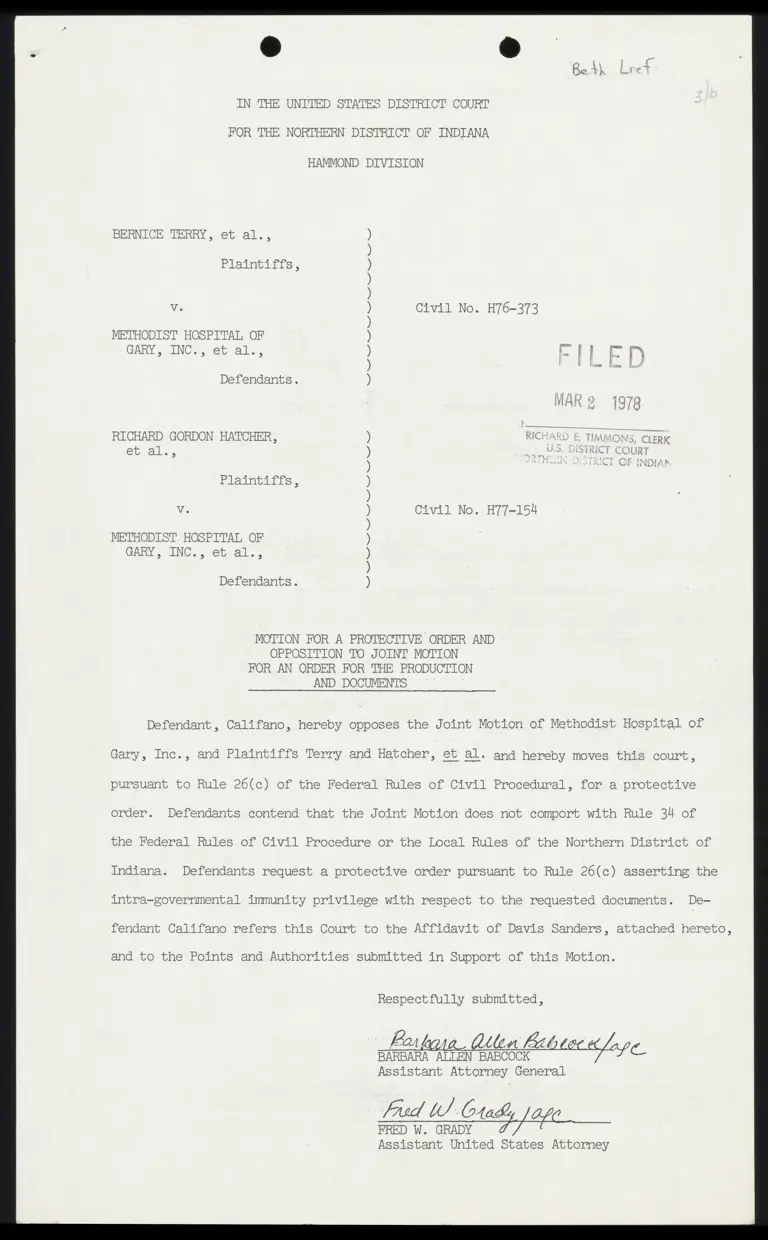
MOTION FOR A PROTECTIVE ORDER AND
OPPOSITION TO JOINT MOTION

FOR AN ORDER FOR THE PRODUCTION
AND DOCUMENTS


Defendant, Califano, hereby opposes the Joint Motion of Methodist Hospital of

Cary, Inc., and Plaintiffs Terry and Hatcher, et al. and hereby moves this court,

pursuant to Rule 26(c) of the Federal Rules of Civil Procedural, for a protective

order. Defendants contend that the Joint Motion does not comport with Rule 34 of

the Federal Rules of Civil Procedure or the Local Rules of the Northern District of

Indiana. Defendants request a protective order pursuant to Rule 26(c) asserting the

intra-governmental immunity privilege with respect to the requested documents. De-

fendant Califano refers this Court to the Affidavit of Davis Sanders, attached hereto,

and to the Points and Authorities submitted in Support of this Motion.

Respectfully submitted,

    Bait a Allen Bit
BARBARA ALLEN BABCOCK
Assistant Attorney General

fed WW Otay Jagr
FRED W. GRADY g/:"¢


Assistant United States Attorney


ben bana 0 alles Joy
BARBARA O'MALLEY 77

Kebeo CA & Re 55
REBECCA L. ROSS

aE
ANN F. COHEN


Attorneys, Department of Justice

Washington, D.C. 20530

(202) 739-2230
Attorneys for Defendant Califano


IN THE UNITED STATES DISTRICT COURT

FOR THE NORTHERN DISTRICT OF INDIANA

HAMMOND DIVISION

BERNICE TERRY, et al.,

Plaintiffs,

Vv. Civil No. H76-373

METHODIST HOSPITAL OF
GARY, INC., et al.,

S
N
’


N
a


N
a

N
N

N
N

N
N

N
N


Defendants.

RICHARD GORDON HATCHER,
et al.,

Plaintiffs,

Vv. Civil No. H7T7-154

METHODIST HOSPITAL OF
GARY, INC., et al.,

Defendants.

N
e
e
”

S
t
?


S
a
?


Na
t?


So
ut
?

No
i

Su
nt


Na

e?


u
t


S
u
t


N
o
?


MEMORANDUM OF POINTS AND AUTHORITIES IN SUPPORT
OF MOTION FOR A PROTECTIVE ORDER AND OPPOSITION
TO JOINT MOTION FOR AN ORDER FOR THE PRODUCTION
OF DOCUMENTS


FACTS

During the depositions conducted on February 22 and 23, 1978 of Alfred J.

Sanchez and George Hurney, officials of the Department of Health, Education and

Welfare, counsel for both Defendant Methodist Hospital and Plaintiffs requested

that counsel for Defendant Califano provide certain documents for discovery and

inspection.l/ The depositions were noticed without a request for the production

of documents pursuant to Rule 34. When counsel jointly requested the production

of these documents at the depositions, counsel for defendant Califano orally re-

sponding to the requests, indicated that they would be made available subject to

assertion of the privileges available to defendant Califano. Counsel for Califano


1/ Defendant Califano does not oppose or seek a protective order with respect to
seven of the nine documents requested by the other parties. Defendant Califano's

opposition to the request and motion for a protective order is united to items numbere

6 and 7 in the Joint Motion. Defendant Califano has already provided the parties

with most of the documents listed in items numbered 1, 2, 3, 4, 5, 8 and 9 and will
provide the parties with the balance no later than Monday March 6, 1978.


further stated that the requested documents must be examined before a specific

privilege could be asserted.

On Tuesday evening February 28, 1978 Counsel for Defendant Califano received

the Notice of Hearing, the Joint Motion For An Order For the Production of Documents,

the Joint Request of Defendants Methodist Hospital of Gary, Inc., and Denis E.

Ribozdy, and Plaintiffs For Production of Documents (Exhibit A). Exhibit A constitutes

the first request by Defendant Methodist Hospital for production of Documents. Plain-

tiffs previously made a general request for documents. Numerous documents were made

BEI based upon that request. Exhibit A, however, is the first

narrow and specific request received by either party and comes to defendant Califano

at the same time as does a Joint Motion for An Order For Production of Documents.

THE PARTIES HAVE FATLED TO COMPLY WITH THE PROCEDURAL REQUIREMENTS
OF RULE SA P.R, Cv. P. RL :


Rule 34(b) requires that a party upon whom a request for production is made

shall have 30 days in which to respond by producing the requested documents or

stating a objection to that request and setting forth the reasons for the objection.

The court may allow a shorter or longer period of time in which to respond. No

rather it
shortening of time has been requested by either party pursuant to their request /is

accompanied by an further Motion for An Order Compelling Production of Documents.

Defendant Califano is mindful of the March 13, 1978 trial date but must be afforded

the opportunity, in a timely manner, to assert the privileges to which he is entitled.

The procedural deficiencies of the Joint Motion hardly have provided Defendant Califano

with that opportunity.

Rule 7(e) of the Local Rules for the United States District Court for the

requires
Northern District of Indiana / "[s]trict corformance with Rules 26-37 of the

Federal Rules of Civil Procedure, which govern discovery." Counsel for Methodist

Hospital and Plaintiffs have clearly not filed their motion in "strict corformance"

with the rules governing discovery under the Federal Rules of Civil Procedure.

Nor have counsel for Methodist Hospital and plaintiffs followed the local

rules of this court, which under Rule 7 require:

. The court will refuse to rule on or will deny any and
all motions related to discovery unless moving counsel refers
to this rule and states in the motion that, after personal
meeting and consultation and sincere attempts to resolve


differences, counsel are unable to reach an accord. This

statement shall recite, in addition, the date, the time,
and the place of such personal conference, and the names
of all individuals attending.

The joint motion does not refer to the local rule nor does it recite that

personal meetings and conferences have been held to resolve differences. Defendant

Califano has made most of these requested documents available, within two days of

counsel's request, and it can hardly be alleged that defendant Califano is attempting

to delay this process. With regard to items numbered 6 and 7 defendant Califano

asserts the intra-governmental immunity privilege 2/ and the assertion of this

privilege cannot in any manner be construed as a delay of the discovery process,

but rather represents defendant Califano's rights under the Federal Rules of Civil

Procedure and the law outlined infra.


2/ See Argument infra.


Defendant Califano Objects to the Release of Items 6 and 7 in the Joint
Motion for Production of Documents and Asserts the Intra-Governmental
Immmnity Privilege


Defendant Califano has previously stated that there is no objection

to release of items 1,2,3,4,5, 8 and 9. However with respect to items 6 and 7

Defendant Califano contends that the public interest in nondisclosure as evidenced

by the attached Declaration of Davis Sanders and the claim of the inter-governmental

immunity privilege should prevent the disclosure of these documents.

As stated in the Declaration of Davis Sanders, attached hereto the

requested documents represent internal communications between agency officials

containing advice or recommendations on proposed government action. These are

advisory documents and do not constitute final agency action. Specifically item

number 6 is a draft of a final report prepared for discussion purposes. The

document is clearly marked "DRAFT" and was intended to be advisory. The

document was never released nor made public in any way. As such it does not

represent the official position of Defendant Califano and is only advisory in

nature.

Item number 7 is an internal memorandum prepared by the Chief of the

Health and Social Services Branch, office for Civil Rights, Region V, HEW Fon

the Deputy Director, Office for Civil Rights, Region V, HEW. This document

was prepared to offer advice and recommendations to the Office for Civil Rights

to make a determination on the Civil Rights clearances for projects 212 and 213.

A final decision was made and this document, item 7, represents advisory opinions

made prior to the determination to give Civil Rights clearance. As such this

document is a pre-decisional, internal and advisory memorandum.

The intra- governmental immunity privilege is predicated upon the

need for protecting the decision making process of governmental agencies and

focuses upon documents "reflecting advisory opinions, recommendations and

deliberations comprising part of a process by which governmental decisions and

policies are formulated." Carl Zeiss Stiftung v. E.B. Carl Zeiss, 40 F.R.D. 318,


at 324 (D.D.C. 1966) affirmed per curiam, 384 F.2d 1979 (D.C. Cir. 1966), cert.

denied, 398 U.S. 952, (hereinafter ''Zeiss').


The Department of Health, Education and Welfare documents are


certainly covered by the privilege protecting intra-governmental documents

containing opiniorsand recommendations, commonly referred to as "official

information" or "executive'' privilege. 3/

Perhaps the best analysis of the principle of not requiring

disclosure of intra-governmental communications is set forth in the

"Zeiss" case:

The privilege, as do all evidentiary privileges,
affects an adjustment between important but competing
interests. There is, on the one hand, the public
concern is revelations facilitating the fairest resolu-
tion in legal disputes, and, on the other, occasional
but compelling public needs for confidentiality. In
striking the balance in favor of non-disclosure of intra-
governmental advisory and deliberative commmications, the
privilege subserves a propounding policy of frank ex-
pression and discussion among those upon whom rest the
responsibility for making a determination that enables
government to operate. * * * No where is the public
interest more vitally involved than in the fidelity
of the sovereign's decision and policy-making resources.
[40 F.R.D. at 324-325].


3 / In N.L.R.B. v. Sears, Roebuck & Co., 421 U.S. 132 (1975) the Supreme
Court recognized that this privilege has been referred to by a wide variety
of labels:

The privileges claimed by the government to be
relevant to this case are (i) the "generally * * *
recognized privilege for ''confidential intra-agency
advisory opinions. * * *'%&"
Kaiser Aluminum and Chemical Corp. v. United States,
517 F. Supp. 939, 946 (Cc. Cl., 1958), Reed J., disclosure
of which would be 'injurious to the consultative functions
of government. * * *' Kaiser Aluminum & Chemical Corp.,
supra at 946. "Eppa Mink, supra, at 86-87 (sometimes referred

FP PRE, 7
FANT AY to as ''executive privilege) *


See also, Advisory Committee Note to Federal Rules of Evidence, Rule 509, 56 F.R.D.
at 251-254. The government also recognizes that some courts have required to
agency head to formally assert his official information privilege, similar
to the procedure followed in executive privilege cases. Other courts have not
required this burdensome procedure. Compare, SEC v. National Student Marketing
Association, 538 F.2d 404 (D.C. Cir., 1976); Federal Trade Commission v. Bremnan,
50°F. R.D, 364 W.D. Mo., 1972); Union Oil Co. of California v. Morton, 36 F.R.D.
643 (C.D. Calif., 1972); with Thill Securities Corp. v. New York Stock Exchange,
57 F.R.D. 133 (D. Wis., 1972); Veranzano Trading Co. v. United States, 358
F.Supp. 273 (Cust. Ct., 1973); Note "Discovery of Government Documents and the
Official information Privilege,' 76 Colum. L. Rev. 142, 166-167 (1976).


Should this Court determine that these documents are relevant and not
otherwise privileged, and that a formal claim by the agency head is necessary,
the government reserves the right to file such an affidavit. See discussion,
infra on in camera inspection.


In addition, the Zeiss case points that there is a second policy to support

the privilege:

[Tlhe immmnity of intra-governmental opinion and
deliberations also rest upon another policy of
equal vitality and scope. The judiciary, the court
declared, is not authorized to ''probe the mental
processes’ of an executive or administrative officer.
Statutory rule forcloses the investigation into the
methods by which the decision is reached, the matters
concerned, the contributing influences, or the role
played by the work of others. * * * Results demanded
by the exigencies of the most inperitive character.
[40 F.R.D. at 325-326]/

This concept of secrecy for intra-governmental commmications, whatever its

rationale, is deep-seated in our history. See United States v. Nixon, 418 U.S.


683, 705, fn. 15; The Federalist n. 64, (S. Mittell Ed. 1938), and has been

adopted by Congress in Exemption 5 of the Freedom of Information Act. See

5 U.S.C. §552(b)(5). Thus, it can be stated unwquivocally that there is a

privilege against disclosure, in certain situations, of intra-governmental

communications. There is no doubt that recommendations within the Department

of Health, Education and Welfare are covered by such a privilege. The documents

which were the subject of the Zeiss case were internal memoranda of the Antitrust

Pivision of the Department of Justice concerning the possibility of an Antitrust

ie

Further, plaintiff and defendant Methodist Hospital can show no

"need" for these documents which could be sifficient to outweigh the claim of

privilege. See, United States v. Article of Drug, 43 F.R.D. 181 (D. Del., 1967).


During the depositions of Messrs. Sanchez and Hurney the deponents were permitted

to testify as to factors considered in making their recommendations, persons consulted

with, the subject matter of meetings as well as the time and place of these meetings.

Moreover, the final determinations with respect to item number 7 was testified to by

both deponents. For these reasons, the discovery must be tempered by the claimed

privilege and the request for documents 6 and 7 should be denied.


4/

When counsel for Defendant Califano asserted the intra-governmental immunity privilege
during the deposition of Mr. Sanchez, counsel for plaintiff responded by stating that
the privilege only attaches to non-final agency action. This argument is specious.
As the Supreme Court was careful to point out in N.L.R.B. v. Sears, supra at 1517 fn.
18 and 19.


Our emphasis on the need to protect predecisional documents does


not mean that the existence of the privilege turns on the ability
of an agency to identify a specific decision in connection with
which a memorandum is prepared. Agencies are, and properly should
be, engaged in a continuing process of examining their policies; this
process will generate memoranda containing recommendations which do not
ripen into agency decisions; and lower courts should be wary of inter-
fering with this process.


IN CAMERA INSPECTION


The parties, in their Joint Motion for An Order For Production of Documents

have requested counsel for defendant Califano "to have in their possession . . . all

documents which are the subject of this motion, to facilitate in camera inspection

of the documents and/or their immediate production for purposes of discovery, should

either or both events be ordered by the Court."

Counsel for defendant Califano will tender the documents for which the Pian

is claimed to the court for in COTETE inspection if the court so requires. However

Defendant Califano agrees to in camera inspection on the condition that before this

Court orders the release of the two documents being withheld that defendant Califano

be permitted to file a Declaration with this Court asserting the Executive Privilege.

Therefore while Defendant Califano will agree to in camera inspection, if required,

the defendant will not agree to release of the documents after inspection until

Secretary Califano has been provided the opportunity to assert the further privilege

of the executlve,

In Freeman v. Seligson, 405 F.2d 1326, 1338 (D.C. Cir. 1968) the Court set forth


guidelines for assertion of the executive privilege. The court laid out a two step

process whereby the parties requesting the document must first "adequately bolster

[the production demand] by a general showing of relevance and good cause" Freeman

supra.

After that time the government should be afforded the opportunity to assert the

executive privilege. As the Freeman court stated, a definitive ruling should

appropriately be deferred until the executive has had a chance to assert the privilege.

CONCLUSION

For the foregoing reasons, defendants' objections to discovery should be sub-

stained and the protective order should be granted.

Respectfully submitted,

: Au hoa 2 fr bbcoce fy

BARBARA ALIEN BABCOCK
Assistant Attorney General

fred Cially Jaye


PD Jd. ORRY 1 7
Assistant United States Attorney


Ai hance Ohl Sars
BARBARA O'MALLEY FLA


7 po a 0 , Repeccap Eo sf Wai
REBECCA L. ROSS 7 ¢

/ / is 4

0 1 : Pa

ern : 7 (st Te

ANN F. COHEN


Attorneys, Department of Justice
Washington, D.C. 20530

(202) 739-2230
Attorneys For Defendant Califano


DECLARATION

I, Davis Sanders, make this declaration in accordance with the terms of

18 U.S.C. §1746.

1. TI am the Deputy Director of the Office for Civil Rights, Region V,

Department of Health, Education, and Welfare and have held this position since

April 13, 1975.

2. In this capacity I have become familiar with the operations of the Office

for Civil Rights with regard to pre-grant civil rights clearance, complaint re-

views, and compliance reviews. |

3. I understand that the counsel for Methodist Hospital of Gary, Inc. and

counsel for plaintiffs have filed a Joint Motion For An Order For the Production

of Documents. Specifically I understand that both counsel have requested "6. 'Final

Report' regarding complaint of Gary Human Relations Commission versus Methodist

Hospital of Gary, Inc., prepared by Alfred J. Sanchez in May or June 1977." and

"7. Memorandum from Alfred J. Sanchez to Davis Sanders regarding Sanchez' 'concerns'

about the mental health and family practice aspects of Methodist Hospital of Gary's

Application for Projects 212 and 213."

i, I have personally analyzed both of these documents.

5. The first document item 6 is a draft of a final report prepared for

internal agency discussion regarding the complaint of the Gary Human Relations

Commission. As an internal draft prepared for discussion purposes; it was never

released by the responsible official in the Office for Civil Rights and was never

issued to the parties involved.

6. The second document, item 7, is an internal memorandum prepared by the

Chief, Health and Social Services Branch, Office for Civil Rights, Region V, HEW.

The memorandum contains advice and recommendations which were considered by the

Office for Civil Rights in making a determination of civil rights clearance for

projects 212 and 213.


7. The proper operation of the Office for Civil Rights requires the

free flow of advice and recommendations within the agency to protect, among other

things, the internal deliberations of the persons involved.

8. The documents described as items numbered 6 and 7 contain such advice

and recommendations necessary to the proper operation of the Office for Civil

Rights.

9. Disclosure of these particular documents would seriously impede the free

flow of advice and recommendations and impair the Office for Civil Right's

decision-making process.

In declare under penalty of perjury that the foregoing is true and correct.

/-
Executed on Meow [ L: t97¢&

SE ich choles


Davis Sanders


IN THE UNITED STATES DISTRICT COURT

FOR THE NORTHERN DISTRICT OF INDIANA

HAMMOND DIVISION

BERNICE TERRY, et al.,

Plaintiffs,

Vv. Civil No. H76-373

METHODIST HOSPITAL OF
QARY, INC., et al.,

Defendants.

RICHARD GORDON HATCHER,
et al.,

Plaintiffs,

V. Civil No. H77-154

METHODIST HOSPITAL, OF
GARY, INC., et al.,

A
M
’


N
e

N
N
N


N
I
N

N
N
N

N
N


Defendants.

‘ORDER


This matter having come before the Court on the Defendant Califano's Motion

for a Protective Order pursuant to Rule 26(c) of the Federal Rules of Civil procedure,

and the Court having considered the motion and briefs from all parties, and being

fully advise in the premises, it is therefore this day of March, 1978 hereby

ORDERED, that defendant Califano's Motion For A Protective Order be and is

granted.


United States District Judge


IN THE UNITED STATES DISTRICT COURT

FOR THE NORTHERN DISTRICT OF INDIANA

HAMMOND DIVISION

BERNICE TERRY, et al.,

Plaintiffs,

Vv. Civil No. H76-373

METHODIST HOSPITAL OF
GARY, INC., et al.,

Ne
t?


Sa
r?


N
t


N
u


N
a
?


nt
?

a
?


at
?

N
e
?


i


N
u
?


Defendants.

RICHARD GORDON HATCHER,
et al.,

Plaintiffs,

v, Civil No, H77-154

METHODIST HOSPITAL OF
GARY, INC., et al.,

N
a
t
?


Na
u?


ui
?

N
e
?

N
t


Nu
a?


N
e
:

S
v
?

N
e


u
s
?


Se
er
?

S
c
?
”


Defendants.

ORDER

This matter having come before the Court on the Joint Motion of Defendant

Methodist Hospital of Gary, Inc. and Plaintiffs, and the Court having considered

the motion and briefs from all parties, and being fully advised in the premises,

it is therefore this day of March, 1978 hereby

ORDERED, that the Joint Motion For an Order to Produce Documents by Defendant

Methodist Hospital of Gary, Inc. and Plaintiff be is hereby DENIED.


UNITED STATES DISTRICT JUDGE


I, hereby certify that coples of the foregoing Opposition to Joint Motion

For An Order For the Production of Documents, Defendant Califano's Motion for a

Protective Order Affidavit of Davis Sanders, memorandum of Points and Authorities

in Support of Motion and Proposed Orders have been served upon the following counsel

of record this 2nd day of March 1978:

by hand delivery to:

Ms. Beth Lief

10 Columbus Circle

New York, New York 10019

Mr. Julian Allen
2009 Broadway
Gary, Indiana 46407

Mr. Bruce Sayers
Hodges, Davis, Greenberg,

Compton & Sayers
5525 Broadway
Gary, Indiana 46401

and by first class mall:

Ms. Marily G. Rose
1757 N Street, NW
Washington, D.C. 20036

Michael Schaefer
Assistant Attorney General of Indiana
219 State House :
Indianapolis, Indiana 46204

Lon = Cofle.,.


Ann Cohen [||e3d60ab7-196f-4ec3-a82d-3a14a8e1c088||]