Order Denying Application for Stay
Public Court Documents
August 17, 1970
5 pages
-
Case Files, Swann v. Charlotte-Mecklenburg Hardbacks. Order Denying Application for Stay, 1970. 6b16ef2e-2e34-f111-88b4-0022482cdbbc. LDF Archives, Thurgood Marshall Institute. https://ldfrecollection.org/archives/archives-search/archives-item/a1c86e60-2945-45d7-b175-4a9a2512243d/order-denying-application-for-stay. Accessed October 15, 2026.
Copied!
     [||e5f8bca9-5f38-46b0-b6e4-da880fd74257||] »
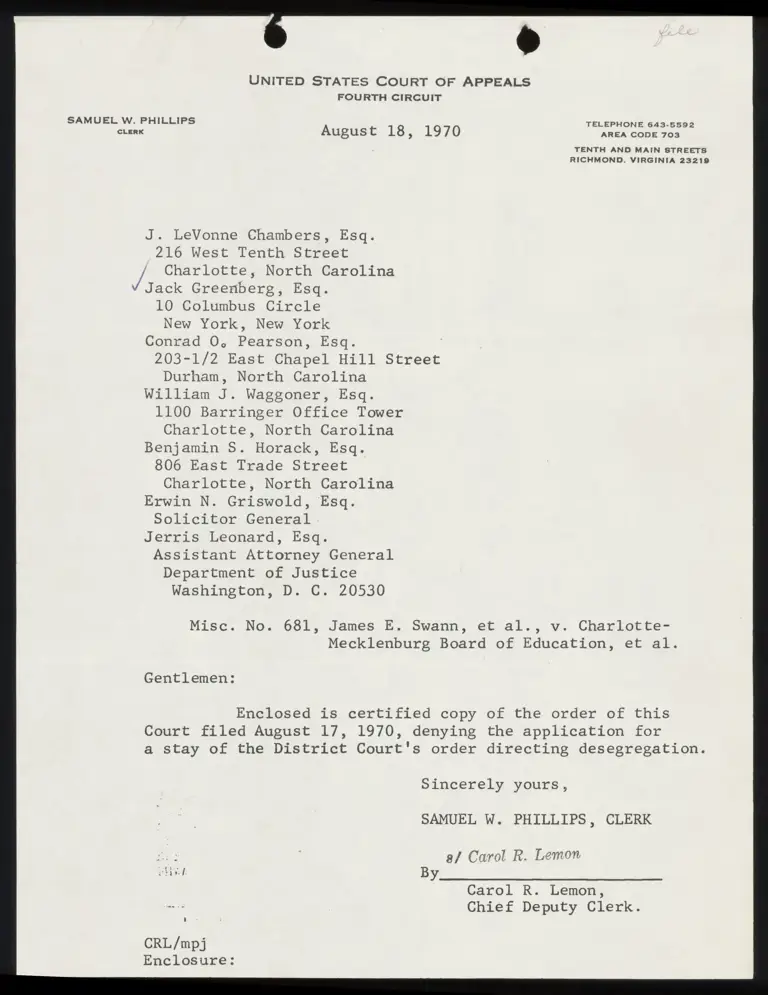
UNITED STATES COURT OF APPEALS

FOURTH CIRCUIT

SAMUEL W. PHILLIPS TELEPHONE 643-5592
CLERK Augus t 18 ’ 1970 AREA CODE 703

TENTH AND MAIN STREETS

RICHMOND. VIRGINIA 23219

J. LeVonne Chambers, Esq.

216 West Tenth Street

Charlotte, North Carolina

Jack Greenberg, Esq.
10 Columbus Circle

New York, New York

Conrad 0, Pearson, Esq.

203-1/2 East Chapel Hill Street
Durham, North Carolina

William J. Waggoner, Esq.

1100 Barringer Office Tower

Charlotte, North Carolina

Benjamin S. Horack, Esq.

806 East Trade Street

Charlotte, North Carolina
Erwin N. Griswold, Esq.

Solicitor General

Jerris Leonard, Esq.

Assistant Attorney General

Department of Justice
Washington, D. C. 20530

Misc. No. 681, James E. Swann, et al., v. Charlotte-

Mecklenburg Board of Education, et al.

Gentlemen:

Enclosed is certified copy of the order of this

Court filed August 17, 1970, denying the application for

a stay of the District Court's order directing desegregation.

Sincerely yours,

SAMUEL W. PHILLIPS, CLERK

g8/ Carol R. Lemon

  By
Carol R. Lemon,
Chief Deputy Clerk.

CRL/mpj

Enclosure:


UNITED STATES COURT OF APPEALS E I [ = D

FOR THE FOURTH CIRCUIT EE
AUG 1 | 14/0) JW

MISC. No. 681.
SAMUEL W. PHILLIPS


CLERK

JAMES E. SWANN, et al.,

Appellees,

versus

CHARLOTTE-MECKLENBURG BOARD

OF EDUCATION, et al.,

Appellants.

ORDER


Counsel for the School Board have submitted to me

an application for a stay of the August 3, 1970 order of the

United States District Court for the Western District of North

Carolina. I decline the application, because I find myself

without power to consider its merits.

On May 26, 1970, the Court of Appeals for the Fourth

Circuit vacated a previous order of the District Court and

remanded the case to that Court for further proceedings. On

June 29, 1970, the Supreme Court granted a writ of certiorari

to the Court of Appeals, expressing approval of the judgment of

the Court of Appeals insofar as it remanded the case for further

See ott ues in the District Court, and specifically authorized

the forener proceedings in the District Court. The Court of

Appeals' vacation of the District Court's order, however, was,

itself, vacated by the Supreme Court, and the District Court's

order reinstated, to remain in effect pending the authorized

proceedings in the District Court.

It is thus apparent that the case is now pending in


the Supreme Court of the United States and that further

proceedings in the lower courts are appropriate only to the

extent that they have been authorized by the Supreme Court.

Cf. Hermann v. Brownell, 9 Cir., 274 F.2d 842. The Supreme


Court has authorized such proceedings in the District Court,

but not in the Court of Appeals.

I requested the lawyers for the parties to submit

to me memoranda expressing their views on my authority to act.

Those memoranda were received by me this morning, and have been

considered. They express differing views of my authority.

The lawyers for the School Board find in the Supreme

Court's authorization of further proceedings in the District

Court an implicit authorization of further proceedings in the

Court of Appeals. This they attempt to support by reference

to the suggestion of the United States in a brief filed with

the Supreme Court as Amicus Curiae in response to the plaintiffs’


petition for a writ of certiorari. Earlier in that brief the

United States had expressed the view that the case was not

ripe for full review in the Supreme Court, and that, while

expressing general agreement with the judgment of the Court

of Appeals, it was thought that general review in the Supreme

Cotirt should await the contemplated filing of additional plans

and further proceedings in the District Court and, possibly,

in the Court of Appeals. Its ultimate suggestion was that

the Supreme Court grant the writ of certiorari, that the Court

of Appeals' authorization of further proceedings in the

District Court be lef: undisturbed, but that the District

Court's prior judgment be left in effect pending further


proceedings in the District Court. That ultimate suggestion

was substantially what the Supreme Court did, but I cannot

read the Government's suggestion as impliedly contemplating

further proceedings in the Court of Appeals any more than I

can find such authorization implicit in the Supreme Court's

order. The earlier reference in the Government's brief to the

possibility of further proceedings in the Court of Appeals

simply was not carried forward in the Government's final

suggestion or in the Supreme Court's order.

It would be most unbecoming for the Court of Appeals

to undertake a review of the District Court's order of

August 3, 1970 under the standards enunciated in the opinion

of the Court of Appeals of May 26, 1970, when the Supreme Court

clearly has vacated that judgment to the extent that it enunciates

such standards and directed the reinstatement of the District

Court's earlier order, subject to such modifications as might

be made by the District Court after further hearings. If the

Supreme Court had intended subsequent orders of the District

Court to be generally reviewable in the Court of Appeals, it

seems to me that such proceedings would have been expressly

Shbrized by the Supreme Court just as it expressly authorized

fopiher proceedings in the District Court.

When the Supreme Court granted the writ of certiorari,

it foreclosed all further proceedings in the lower courts,

except to the extent the Supreme Court has authorized such

proceedings. Such authorization usually is explicit; it ought

not be lightly inferred.

For such reasons, I conclude that I have no authority


to entertain the application for a stay, and I think it would

serve no useful purpose, as an alternative, to attempt to

convene the Court of Appeals for an expedited review of the

District Court's order of August 3, 1970.

In the interest of time I am acting upon the applica-

tion alone without a formal submission of the application to

a panel of the Court of Appeals. Informally, however, I have

consulted with my brothers Winter and Butzner, who, without

having had an opportunity to see the papers, on the basis of

my statement to them of the problem, have authorized me to say

that they are in agreement with my view.

IT IS NOW, THEREFORE, ORDERED that the application

for a stay of the order of the United States District Court

for the Western District of North Carolina of August 3, 1970

be, and it hereby is, denied.

A Vi Ye: ui / 2 AALS ud
Chief Judge, Font] Circuit

August 17, 1970

im. [||e5f8bca9-5f38-46b0-b6e4-da880fd74257||]