Order Granting Motion to Compel
Public Court Documents
November 6, 1977
3 pages
-
Case Files, Campbell v. Gadsden County District School Board Hardbacks. Order Granting Motion to Compel, 1977. bce424ed-a111-f111-8407-0022482cdbbc. LDF Archives, Thurgood Marshall Institute. https://ldfrecollection.org/archives/archives-search/archives-item/a1fbb3fc-59ea-4d1a-b806-a69cee7e2fa1/order-granting-motion-to-compel. Accessed October 18, 2026.
Copied!
    bes {1 vu 07 A(T
\ IN. THE UNITED STATES DISTRICT COURT FOR THER =~ | 7

2 ar NORTHERN DISTRICT OF FLORIDA nelich ug
sd Teh TALLAHASSEE DIVISION Bad co

JOHN HUTLEY, WITT CAMPBELL,

Plaintiffs,

TCA 73-177

VS.

GADSDEN COUNTY SCHOOL BOARD,

et al.,

ORDER

Defendants.

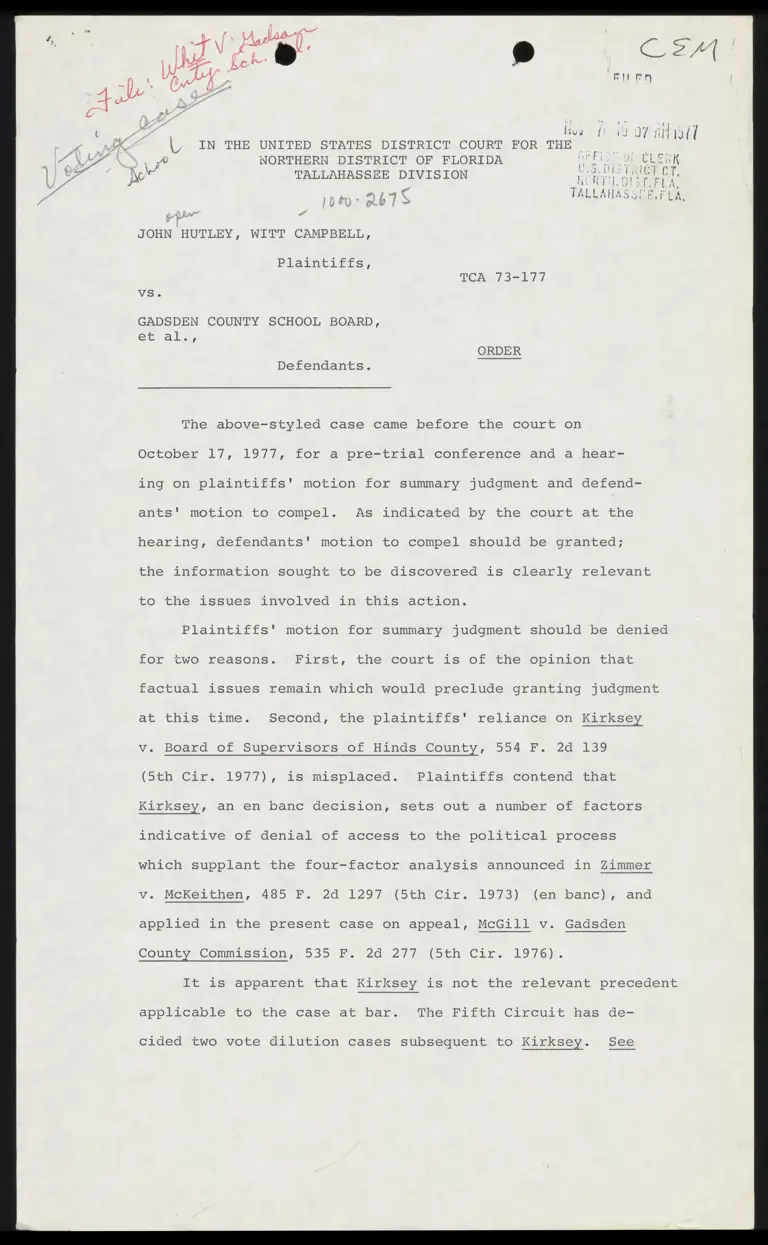
The above-styled case came before the court on

October 17, 1977, for a pre-trial conference and a hear-

ing on plaintiffs' motion for summary judgment and defend-

ants' motion to compel. As indicated by the court at the

hearing, defendants' motion to compel should be granted;

the information sought to be discovered is clearly relevant

to the issues involved in this action.

Plaintiffs' motion for summary judgment should be denied

for two reasons. First, the court is of the opinion that

factual issues remain which would preclude granting judgment

at this time. Second, the plaintiffs’ reliance on Kirksey

v. Board of Supervisors of Hinds County, 554 F. 2d 139

(5th Cir. 1977), is misplaced. = Plaintiffs contend that

Kirksey, an en banc decision, sets out a number of factors

indicative of denial of access to the political process

which supplant the four-factor analysis announced in Zimmer

v. McKeithenh, 485 PF. 284 1297 (5th Cir. 1973) (en banc), and

applied in the present case on appeal, McGill v. Gadsden

County Commigsion, 535 F. 2d.277 (5th Cir. 19275).

It is apparent that Kirksey is not the relevant precedent

applicable to the case at bar. The Fifth Circuit has de-

cided two vote dilution cases subsequent to Kirksey. See


» .

David v.. Garrison, 553 FF. 24 293 (5th Cir. 1977): Hendrix

V..Josepbh, Case Po, 76-1723, = . P.s2&4. {5th Clx.,

Sept. 12, 1977). In both decisions the four-part Zimmer

test, and not the approach utilized in Kirksey, was applied.

While a distinction between Kirksey and the more recent de-

cisions has not been clearly delineated by the Fifth Circuit,

the cases are factually different. David and Hendrix in-

volved challenges to legislatively enacted apportionment

schemes; Kirksey, on the other hand, involved the validity

of a court-ordered election plan. The Supreme Court and the

Fifth Circuit have ruled on several occasions that differ-

ing treatment is to be accorded legislative and court-ordered

plans. East Carroll Parish School Board v. Marshall, 424

U. 8. 636 (1976); Ferguson v. Winn Parish Police Jury, 528

F.-24:892 5th Cir. 1976); David v. Garrison, supra. "We

should not, however, confuse the standard by which to judge

a legislatively-enacted scheme of election for dilution

with the standard by which to judge a court-ordered scheme

which is to be substituted for a constitutionally infirm

system." David, supra, at 926.

The present case, like David and Hendrix, involves a

challenge to a legislatively adopted election plan. Con-

sequently, it appears that the Zimmer analysis applied by

the Fifth Circuit in the appeal of this case supplies the

proper standard. In this regard, it should also be noted

that the appellate decision in this case was cited by the

Fifth Circuit in Hendrix. For these reasons the motion for

summary judgment should be denied. This court adheres to

the mandate of the Fifth Circuit and this court's own order

of March 9,'.1977.

Accordingly, it is ORDERED:

1. Defendants' motion to compel is granted.


2. Plaintiff's motion for summary judgment is denied.

DONE AND ORDERED this Lo ‘day of November, 1977.

/

lier (a fifocd
WILLIAM STAFFOR

UNITED STATES DISTRICT JUDGE