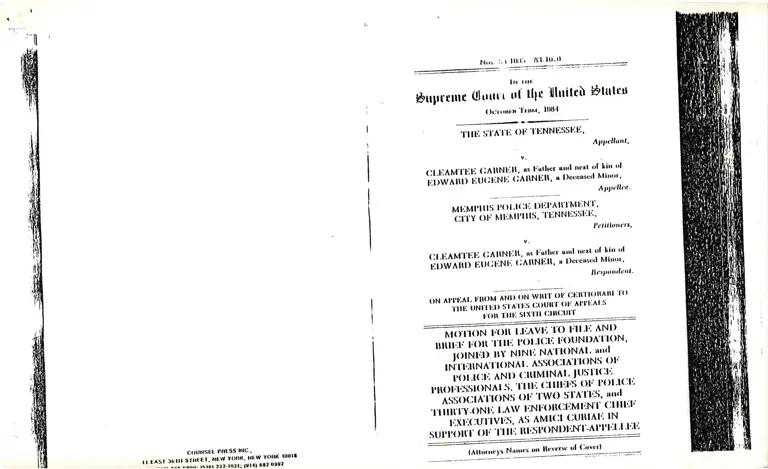
Motion for Leave to File and Brief for the Police Foundation et al. as Amici Curiae in Support of the Respondent-Appellee
Public Court Documents
1984
35 pages
-
Case Files, Garner Working Files. Motion for Leave to File and Brief for the Police Foundation et al. as Amici Curiae in Support of the Respondent-Appellee, 1984. 7057fccf-35a8-f011-bbd3-000d3a53d084. LDF Archives, Thurgood Marshall Institute. https://ldfrecollection.org/archives/archives-search/archives-item/a28c1ddf-03c0-4149-9460-5f57b47b0dcf/motion-for-leave-to-file-and-brief-for-the-police-foundation-et-al-as-amici-curiae-in-support-of-the-respondent-appellee. Accessed September 25, 2026.
Copied!
    ;■ I

COUNSEL PMESS INC.,
tAST 36... S.MEE,. NEW VO..K NEW

M„s I
In mm

griipitmi: (fliiiio »> "l"-’
( )cr< tlll'H I E3IM, llltl'l

Till". STATK Ol*' Tl*.NNLSSKh,
Ai>i>c'llonl,

V.
C l  TAM I r.l*: r.AUNi:il. us l uil.cr ui.<l ..exl ..f ku. uf
KDWAIU) EUC.Em-: CAUNEU. « Dcceuscd Minor,

MEMIMIIS l•()IJ(>E I .
CI TY OE MEMPHIS. TENNESSEE.

I’Vetitionvrt,

V.V .
C l EAM TEE CAllN EIE as Eull.cr and next of kin ol
E P W A iin  E lIC E N E  CAUNEH. a Deceased Minn.,

llvsjtoiuleitl.

I OH nils sixrn ciiuaim
MOT ION l•■OU LI'.AVl'yi'O HIT*, AND

imilT- KOll > >“ •• l*<>» l'<)^JNJ)AHON.
lOINI'T) IIY NINI'̂  n a t i o n a l  aiwi

,n i i :i! L t i(>n a l a s s o c i ^̂ ^̂^
I'OI U'l*' AND (TIIMINAL JUS'lKA**,.,U). rxsloNAi.s. o.i.K o.; ro. k ..

a s s o c i a t i o n s  OT’ I w o  S'I a i l s , uml
■ i m ^ T V O N i n A W I - N I O l i a

I.'VT'CUTIVT'S a s  A M K3 CUUIAT. IN
...■!;^.'nl-^3IKIU^I»ONI)IW.AI33:iJ^

BB _ . ..I ■

!.•

■'■t.


•••1

Of (.'luiiiu'l:
l l u l t l K I  K a SANOK, I'.SQ.

llil l liiiil Avemii:
New Volk, Ni;w Ytiik 11KJI7

Wll.I.IAM josi riisoN,
I'Vank, IIaiiiiis,

Siiiiivi:i( «< Jacoiison
(A |iarliu:i.slii|) wliirh iiielmlos
inofî-iioiiiil (Mil |ioiatioiis)

Oin! New York I’la/a
New Yoik, New \oik IO(MM
(212) 820 H220

run 1.11* l-A(.nvAiiA,
Iliiciii s, llniiiiAiU) & III u>
1201 I’ciiiisylvaiiiu Avr*, N.W.
U';nliiiiKloii. DC. 2(KM)4
M aii(;ai«i;i llnsii Wii.soN, llsy.
W'll SON, Sm IIII «< SllVMOUIl
-lO.'ri i.iiiilell llotilevaiil
Soile 100
Si l.ouis, Mhsoori O llOH of Urnnil

N03. 01-10 15
01-1070

IN THE
SIJPUEME COIIKT OE THE HNITEH STATES

OCTOHEU TEOM, l')04

the state or Te n n e s s e e,
AI‘PELI,AN‘I',

r s :  s s r :
APPE1H.ee .

MEMPHIS POI.ICECITY OF MEMPHIS, ILNNESSl.E,
pI'.T ri' lONEllS ,

OliarONUEUT -

Von THE SIXTH CIHCUIT

i


The police Fooncla t Ion , nine

„aUona. .n.. In.ec.aUnn.l assocU. io.,a ot
,„Uce a„,.«.»ioaV i-stice p . o teas io„a. s .
„.e cMers of poUcc associations of two
,„tes and thirty-one law entorce«.ent
chief-eaecutlees herehy ,.owe this Conrt
for leave to file the accorapanylnn brief

amid curiae.
The Interest of a«.ici Is

pfesented in the acco,.pany Ind hrUf lilLt-
f . f O l  i n  d e t a i l .  Rach Is  an

o f . a n U a t l o n  or I n d i v i d u a l  p o l i c e  c h i e f

s s e c n t l v e  d e d i c a t e d  t o  t h e  e f f e c t i v e n e s s

„ f  f „ e  p o l i c e  and t h e  p r o t e c t i o n  o f  the

basic tl.jhts of cltUens. As such,
a,.I d  are unlrp.ely e„nlpped to prov.de t he

court with both factual Infonaatlon and
aar•̂ iv;e‘̂ that bear onpolicy perspectives

. 1 Issues raised In this case.constitutional Issues

m ot io n FOII to FTLF. DIUF.F

hi

hi‘,1


More specifically, the issue in

this case is the constitutionality of the

Tennessee statute, Tenn. Code Ann.
<; 40-HOfl (19 75) permitt i iu j  police officers

to "use all tlie necessary means to effect
the arrest" of fleein*j non-violent felony

suspects. Garner v. Memphis Police
l)epar tmen t, 7 10 F . 2tl 2 40, 241 (6 th Cir.

1 903). Tl>rouqh long personal ami
professional experience, amici have

particularized knowledge or tie- t *w
enforcement considerations whi.h arise in

coiuiection with deadly force laws, such as

the Tennessee stat.ite. hy moau i •.! > I. is

hrief, they seek to bring this knowledge

to tlie attention of the Court.
counsel for the appellant, the

State of Tennessee, and for the
respondent-appellee. Garner, have

cnsente.) to the fiUoq of this hr lot e..a
their letters of consent are attache.l.

connse. fhr the ..etitioner, «e».^as foUce

„e„.rt»ent, c.tv of »e,.phle . Tennessee.

„,s not response, to the request of
counsel for a»iC for snch consent.

He spe c t fu l l y  submitted.

1̂ 1 rU .// a f• 1'*'̂
W i l l i a m  J o s e p h s o n ,  Esq.
counsel of Record
Fried, Frank. Harris,

Shrlver *. Jacobson
(A Partnership which

includes Frofessional
Corpor at ions)

one Nen Vort Plata
Men vork. New fork 10004

(202) 020-6220
attorneys for Amici C u r i a e

August 6 , 1984

U i:i(.' I-

M

!H'T


liMlll-tM
mate o£ Tennessee
O^nca ot the ALtooav

Genet a 1
4'jU James llouectson

l*ackwayNashville. Tennessee
j72iy t>o:̂ 5

July 11,

„c. si.nvecFt led, Fcank, Hat cl ,
i. Jacobson

One New Yotk Plaza
. v..rk NY 1UUU4 New Yot k . n 1

«e c o M - t . t o _ m ^

Ueat MC. J o s e p b a o n i

This IS in f tequestin^j oui
letter dateo a,» amlcns cntlae
consent to yout «£ JVennessee_^
Nclet hOW penoi.uj In the
Gatne£, No. « uniteu Scales. A--Supreme cour t ot , hereby
Attorney Geneiai
ytve such consent.

Glncetely,

/^/ W.J. Michael Cody
W.J. Michael Cody
Attorney General

t, uepoctec


tl-

Aiiyust 1,
•*'> "'‘““r mT' uIUHNew YotK, N.Y.
t2L2)

i, Jacobson
one New Vock Piaza
„ U  W<K, Haw VotK 10UU4

Deac MC. Joaepbson;
,.,.u U  to ‘;;'«;:jrGa'‘Hac.

iespon<Ient-aHPal‘«Jj^^^ „e an ai»icus l.t lot
coiiBenta to police rounilatlon. e
"" ‘'“"f, tne aboee noted case.al

S incecely•

■ .1

CG :

/a/ Steven U. Wiotec
Steven L*» VJiotec

waiter b. baiiey, Jt-
Henry b. Klein
Jerry Smitb iavid E. birenoau.n


1 NOS. '''jVv070

IN 'nM3
SUPREME COURT OF THE UNHEU

OCTOBER TERM, V9R4

THE S T M e "of TENNESSEE,
A PP El.CANT.

A T y"‘of PETIlPETIIONER^ »

OF

“ t o THE »¥i7 ¥„l SIXTll Cl I.CNIT


'I I lliV'i

Table o£ Authorities..............  ^

interest of Amici......
summary of Argument................
Statement of the Case..--

14
..............................................................

I Laws that authorize the
police to ei«i»loy £ ̂ ee ing
force to apprehend ail ^ ^^ute

r / u ; r o r t r e V u c „
fight crime or to pro
tiiemse Ives...........

II. A f t  o i  i c e ^ d e p a ^ t m e n r
"p̂ l cT:: a[:d^>ractiUs and
Till not unduly intrude on
criminal law enforcement.....

III. Laws that authorize police
use of deadly felony

tjuide police ofticer .......
discretion................

Conclusion..........

11

47

1̂ .3

1


i I

I

TAHI.I: Oi‘ AU’>‘IH)IUTil::S

CASES

Uivens V. Six Unknown Federal Naccotlca
4Q1U.S. 300 ( 1 9 7 U ..........  40

Chimel v. California,
l9 5-u7sT~l5r7T^WT......................
Delaware v. Ftouse, 440 U.S. 640 (1979)-.. 30

Furman v. Georcjla, 400 U.S. 230 (1972).... 41

earner v. Memphis Police Department,
710 F.2d 240 (6th Clr. 1903),........  ^4, 28

Katz V. United States,
309 U.S. 347 (1967).........................  30

Ko lender v. l.awson,
163 S. Ct. 1055 (1903)...................... 3^

Mapp V. Ohio, 367 U.S. 643 (1961).........  30

Payton v. New York, 445 U.S. 573 (1980)... 30

Itochin V. California,
342 U.S. 165 (1952)...........    30

Sibron V. New York, 392 U.S. 40 (1960)---  30

Warner v. Uartfelder, 113 Mich. App. 747,
310 N,W.2d 025 (1902), a p p e a l d e n ^ ,
410 Mich. 906, 342 N.W.ld 520 (1904)...... 23

Woiui Sun V. United States,
I ' T l ^ ^ n i  (1963).........................  30

ti

Pa;Jo

Ame ndme n t i V ....
Amendment .............
Amendment ..................

STATUTES  ̂j

42 U.S.C. S ..................

42 U.S.C. S .................
42 U.S.C. S .............
42 U.S.C. S ....................
42 U.S.C. S .................

. S 40-008 (1975)....Tenn. Code Ann. i

m-llER A U T H Q M H ^

. The U3eo£J3eadli_Jj^
bv Police

unlvotalty <>£ ”*“ o“o.'l4, ...............of crim. justice, Dec.

Brown,
................

K 1 lied 'I’bat Man 18 r 8 ^
...........

iii

36

45

2 3


OrilEU AUTIIOUITIES

f

i

Kvfe. A<lmlnlstcatlve inter-■---- :r-r—  .....
r»». .lllMt

J. Fyfe, A<iiain 1 t»ctaL1 VC
on t>o I ice~snoot Ln<iJĵ l̂scr̂ iî iVi
Filip I r ical Ex ainTna t ion , / J. tc
J09 (1979)
J. Fyfe, Obsecvatlona on Police Deadly
Fo tce^ 2 7 Cr iin. & De 11 nQ •
976 ......................... .......
<•. r.ain. Uischarqe of Fireaci«3_
poll C Y : m ^ i r n n q  JuaticejrKroi^
Administrative Recjulation -- A
PosTTIon Paper (Report released
December 23, 1971 by Oakland
Police Cliief Charles Gain in
explanation of a change in
departmental deadly force policy),
cited in W. A. Geller t, K.J.
KaF^eiT Split-Second Declsionsi
Shootings Of i^YLChTcaao_PoUce
(198TF. ............ ..................
W.A. Geller, K.J. Karalea, S £ l ^
Second Decisions ; Shootings_^
l  oF c r e i g ^ r p O T i i ^ ' *EiTforcement Study Group 19U1)........
G. Hayden, Police D i sc r e t i o n i j r ^
Use of Deadly Forcej—
StudV of Informatlon Deadlj^
Force Decision Making (1979)
TFnpuliTTifel paper available at the
University of New Haven), £ i t ^  U
I Qh,*rinan. Executon Without Ijia^

l3 Vand. b. Rev. at 95 n.l50 (1900)..
iv

^age

20

37

17-19

35

42-43

.................................

......................................

SsadiY_f°l|2P2i^i l„ J. ryEe,
j t .  App-  ̂ 'piiTTT^ ^ootlngB_iji

...................................... ..

M. M.yec.
m n | d t | | s ^ x 5 T O r T T r : ^ ^  ....

-  H ‘- T '  -„ricrua;
^ o u c r r o u n s s n s i n ^ r i ) ...............

1 code S 3.07(2)(b)
r p r o p o r / o E o c L t  o^^ee ...............

Matton.l

...........

p̂ .je

25

29, 33,
34

35

35

30


OTIItlll AUTIIOlUTIKS

I’r csideiiL'a Comm isa ton on Law
l̂ iiforceinent and the Admini^cat ton
of Justice,_Task Force Report;
The Police (1967)..................

Program Cuiiimission on Accred Itat ior»
tor Law Enforcement Agencies, liic.,
Standards For Law Enforcement A»p nc i • o
The StairnarSs Manual (.)!' tl>>j Law
Enforcemet\t Aijency Accreditation
(Aug. 1903)........................
Report of the National Advisory
Comm iŝ s ion on Civil Disorders
(Dantam Books, I960)...... ..............
L. Sl»erman, Reducing Police Gun Use,
in M. Punch, Control in the Police
OKjanizat ion 9ff'TAtlanta 191D) . . . ........
Staff Report to the Michigan Civil
Rigtits Commission (May 18, 1901)........
C. Uchida, L. Sherman, J. fyfe,
Police Shootings and the
Prosecutor fn Los Angeles County;
An EvaluatTon of Operation Rollout
(Police Foundation 1901)...............
C. IJelman, Varieties of Police Policy;
A Study of Police Po1 icy Regarding
I lie Use of neadlv Force in Los Angeles
County, 6 Loy. L.A. L. Rev. 1 (1973) cited
in U.S. Department of Justice,
A Community Concern; Police Use of
Deadly Force (1979)......................

vi

21, 22
30

31-32

22

20

29

40

INTERLST OF AMlCI

The police foundation is a

ovate, oon-ptoii. os.ai.itat .on
eetaoLishesi by t,.e .o.<i ioun..at.on in iv70

„U,i a .aandate to 1...prove tl.e .uailty ot
a,.e.lca„ poUcln9. U  ..as trai..ed poiice
eKecutives and »ana<,a.a tnrou.noot t„e

united States and abroad, and has
conouot.d and pnbiis,.ed ,„o.e tnan SO
resea.cb studies and eHpe.i,„ents invoivi,.

ei.tu.uv every aspect ot poiiCe policy

and operations.
The police Foundation's research

publication ot several articles in


I tl •

♦‘S’

i

professional periodicals and in three
books and monographs. Readings on Police

Use of Deadly Force (Fyfe ed. 1902); C.

Milton, J. Ualleck, J. Lardner, G.
Abrecht, Police Use of Deadly Force

(1977); C. Uchida, L. Sherman, J. Fyfe,
Police Shootings and the Prosecutor in Loa

Angeles County: An Fvalnat it>n of •

Operation Rollout (1901). The Police
Foundation has also served as a consultant

and tecdinical advisor to the National
Association for the Advciii.-emcnt oi: volored

People (NAACP) on a United States
Department of Justice funded project with

respect to police deadly force policies

and practices (Office of Community
Anti-Crime, Grant No. 0O-TA-AX-OOO4). In

addition, the Police Foundation is
presently engaged in a study of police use

of ileadly force in New York City and

Ph lladelpliia .
2

The police ExecutWe I.eeeetch

IPEBF) le . OlstOct o( Colu»bU Foruin ( »
non-profit corporation whose membership

consists of police chiefs from the Unite
States and Canada who serve jurlsdlctl

with populations over 100,000. Y
p.aneral members, andpolice chiefs are now gene

their departments Incl
..i i/'» oersonnet.petceot o( all M o O c a n  police pet

PBBf conducts and publishes ceseatch
of irs memtiershiptesponswe to the needs of

T I* S 0 CVGS
and the cltUeos u.ev serve.
. center for the collection and
dissemination of information useful in

improving police effectiveness,
eo-author of the standards on the use of

bv the Commission on deadly force adopted by
. rnr law Enforcement AgenciesAccreditation for haw

(infra at 30-32) .
The police Management Association

le a non-profit membership organization of
police managers and executives from

3

8(to ifl

h

it


the United States and ten other

countries. PMA was Incorporated in the
District of Columbia in 19fl0, and is
dedicated to upgrading police management,

professionalizing police at all levels,

and assisting police to protect the lives,

rights, and property of all citizens.
The National Organization of

Black [.aw Enforcement Executives (Noble)

is a non-profit organization of 1,000
professional command-leve1 law enforcement

officials representing all elements of

federal, state, and local law
enforcement. It is dedicated to improving

the quality of criminal jtistice ami police

services for all citizens thixigliour the

United States.
NOBLE unanimously adopted a

resolution in 1980 advocating limiting
police use of deadly force to the defense

of an officer's life or that of another

person. Hesearcli in this area by NOBLE

4

resulted In tl.e publication of a
Or I'll Shoot _!£!!£MQi-nD - or 1 — — « monograph, ------
, , enforcementuf Deadly Fotca_b]Lba>U:--

Offlceta NOBLE baa bean a

;;:::;rot m  t,.. st.ndacda on tbe uae of
aeadl, fotce adopted b, tbe Co»»lea.on on

..meditation .In*- at 30-32, and bas
,„e,ded tecbnlcal aeslatance to tbe NBaCP

nationwide.
nf f'rlminal Justice The Academy Of Criminaj.

. ,a,a-nroflt membership. o ixPISi is a non ptot Sciences (ALJiil
u.BanUatlin Inoo.poeated In Nevada In

1972. Its membership includes
Imatelv ccLulnal justiceappcoxlmateiy

1 reoresentingeduoatoce and prac..tlonete, cep
. The prime putpose of M  3ball 50 states. i

U  LO fostec excellence In education and

ceaeacch In criminal iuetlce.
^innal Law Enforcement The International

. Auencv lltEIM “ memberahipInst ructors  Agency i
laari in Massachusetts in organlxatlon founded in Ma

5

m

i f e

IM


1976. Its member sh li> Includes USD

instructors in academia, police

departments, police academies, state

tralnlny councils, and allied
institutions- ILEIA 1s dedicated to the

Improvement of criminal justice and

related training and education.
The International Law Enforcement

Stress Association (ILESA) la a non-profit

memberstiip organization Incorporated In

Massachusetts in 1970. Its membership

Includes 1,200 officials from local,
state, and federal law enforcement

agencies, as well as physicians, nurses,
and social workers. ILESA is dedicated to

ie<iucing stress among law enforcement

professionals in order to Instill • more

professional law enforcement ethic.
The National Association f)i

Police Planners (NAOPP) is li nt>u pioiit

membership organization incorporated in

Missouri in 1902. Its membership

6

InlcludeB 240 fadetal, state, and local

lav, enforcement planners In the United
States and abroad. NAOPP Is dedicated to
the contlnolns effectiveness, Improvement
end professionalization of law enforcement.

The National Black Police

Association (HOPM Is a non-profit
t.marlon of approximately membership organization or app

15,000 officials In federal, state, and

local law enforcement throughout the

united States. NBPA Is dedicated to
Improving law enforcement effectlvenes

end to protecting the lives, rights, and

property of all citizens.
The Reserve Law Officers

Association of America (RldvOA, Is a
non-profit membership organization founded

in 1969. Its membership Includes reserve

deputy sheriffs, auzlllary police, reserve
deputy constables, police reserves, chiefs

Haariffs constables, and law of police, sherltts,
nt officers from 2,500 cities inenforcement otriceia

7


49 states. RLAOA is dedicated to
increasing law enforcement professionalism

tlirough training, education, disseminating
Information, Improving police-coimimnity

relations, and eliminating use of

unnecessary force.
The Kentucky Association Of

Chiefs Of Police and the Utah Chiefs Of
Police Association are non-profit membership

organizations representing police chief
executives in their respective states. All
are dedicated to the continuing improvement

and professionalization of policing, and

to protecting the lives, rights, and

property of the citizens they serve.
The following are police chief

executives who join in tills brief as

individuals:

WilllA'" C. Oannec
Chief of police
corpus Christ I, Tex

Keith R. Bergstrom
Chief of police
Oak park, lH-
Robert V. Bradshaw
Chief of police
Reno, Nev.
Thomas E. Coogan
Chief of police
Denver, Colo.
Bernard D. Crooke
Chief of police
Montgomery County,

1 j lie: 1 BehanCornellos j •
Chief of police
BaltlinofO' f.’ounty M<

Anthony V. Bouza
Chief of police
Minneapolis Minn

Md

John F* Duffy
Sheriff .San Diego County, Cat

Donald G. Hanna
Chief of police
Champaign, 111*
Richard A. King
Deputy county

Execut i ve for
public s a f e t y

F a i r f a x  County,  Va .

Schuyler M. Meyer, I
Chief of police
Pompano Beach, Fia.

Jerry Neal
Chief of police
Amarillo, Tex.

David Cameron
Chief of police
Moscow, ldal>o

David C. Coupet
Chief of police
Madison, W is•
Raymond C. Davis
Chief of police
Santa Ana, Cal.
Reuben M* G r e e n b e r g
Chief of police
Charleston, S.C.
Charles Johnston
Chief of police
Lakewood, Colo.
William B. Kolender
Chief of police
San Diego, Cal.

II George Mapper
Director of
public Safety
Atlanta, Ga.
Thomas J. Nichols
Chief of police
Lubbock, Tex.

I


Charles M. Rodriguez
Chief of police

San Antonio, Tex.

William K. Stover
Chief of police
Arlington County, Va.

John L. Tagert
Chief of police
Colorado Springs, Colo.

Robert C. Wadman
Ch le f of Police
Omaha, Neb.
Gerald L. Williams
Chief of police
Arvada, Colo.

John P. O'Brien
Slier l f f
Genesee County, Mich.

Daryl Stephens
Chief of Police
Newport News, Va.
Charles T. Strobel
Director of Public
Sa fety

Alexandr la, Va.
Melvin b. Tucker
Chief of police
Tallahassee, Fla.

Robert Wasserman
Chief of police
Fremont, Cal.
Hubert Williams
police Director
Newark, New Jersey

All amici wish to Improve the

effectiveness of the police and to
safeguard the basic rights of citizens.
The amici are uniquely equipped to provide
II,e court with both factual Information and

policy perspectives that bear on the
constitutional Issues raised In this case.

10

SUMMARY OF ARGUMENT
After extensive research and

oonsldec^tlon, .»lc 1 concluded thnt

U „s per»l«ind police oULcere to uee

deadly totce to apprehend unarmed,
„on-»,olent Oeeln, felony anepects

actually do not protect clt.zena or law
,„,„rce,.ant o m c e r a .  do not deter crime oz

.uealate prohlema cauaed hy crime, an. o

„ot improve the cr Ime-f l,htin. ahllUy o
enforcement a.enciea. Thna. ar.nments

baaed on theae factora would not Juatlfy

„ee of deadly force a.alnat fleeln.
„nn-vtolent felony auapecta. Moreover, we
have concluded that lawa perm.tt.n. uae of

deadly force In thnae c.rcumatancea are
,eaponalhle for unneceaaary loaa of life,

friction between police and the
nltiea they serve resulting In lesscommunities i

 ̂ and for an undueeffective faw enforcement.
burden upon police offlcefs who must make

3od live with the consequences of hasty

V I


iti'

STATliMl-NT Of Till-: CA-if

This case involves th«;

shooting of Edward Eugene Garner by a
Memphis, Tennessee police officer. At the

time he was shot. Garner was fifteen years

old, stood five feet four inches tall,
weighed between 95 and 100 pounds, and was

fleeing from the scene of a reported
burglary. The police officer who shot

Garner iiaa testified that, while
approaching the unoccupied house that was
the scene of the reported crime, he heard a

screen door slam and saw a figure running
into the rear yard. In a subsequent search

of the rear yard, he saw Garner stooping

next to a six-foot tall cyclone fence at

the rear of the yard. The officer shouted
"halt." After pausing momentarily. Garner

can and sprang to the top of the fence.

The officer, who correctly believed Garner

to be unarmed, then fired his revolver,

striking Garner in the right side of the

12

f draped over the top of
head. Garner fell. ^

A died later that night at a the fence, and died ra
hospital. It - 3  later determined that le

U .O ..e ..a .
a , wallet containing two five ring and a walieu

aoU.. o U i c .  tesuae,. ..a.

eued be.— e “
0bbe.wue e.e.e cap.ece an. becanae

1 Chat it was properhe had been trained that
I fleeing felony

under Tenneeaee lae to shoot
suspects in such situations.

h suit -as brought against the

City of Memphis by Garner's father nnde
P .2 U S C. SS 19B1. 1983, 1995, authority of 42 U.S.G.

t,e. and l«. ^

Flahth, and Fourteenth of the Fourth, Elgntn,
h„end™ents to the Constitution. Keeerslng

hhs Olstrlct court lor the Western blstr.ct
the Court of Appeals for the of Tennessee, the goui

Sixth Circuit held that the Tennessee

1 ^

m

j i


permitting police officers to "use all the

necessary means to effect the arrest of

fleeing non-violent felony suspects,
violated the Fourth Amendment and the due

process clause of the tourteenth

Arne ndme n t. Garner v. Memptn^_i‘o_Li£g.
Department, 710 F.2d 240, 241 |6th Clr.
1903). On March 19, 1904. this .ourt noted

probable jur IstJ let ion of the appeal by the

Intervening State of Tennessee In number

03-1035 and granted the petition for
certiorari of the Memphis Police Department

and City In number 03-1070.
ARGUMENT

Appellant argues tliat the Court of

Appeals judgment should be reversed because

"the State retains compelling Interests In

the apprehension of criminals which can
,ly be served through the_t ruly_effeet lyeon J

[ )OW er of arrest." Brief for Appellant at 7

(emphasis added). Petitioners similarly

argue that "the Court of Appeals either

14

o .  , a v e  i o s u e e . c U n .  . e U c e n c e  to

co»petlin9 =tat. lotetosts heceln

eCfectlvo l.w enfotco»ent and tl,a
apprahanaion o( ftaa.n, otl»in.U. ■na
.„,a adoptad taao.a tPa ct.inat and

, a w»lcl ballava thattot patltlonata at 8.
nabla avidanca tndlcataa that tba the available t

pobtto-a intataat In attactWa law  ̂
antotoa»ant ta tnttbatad bv tba dacUton

the court of Appeals.

I LAWS THAT TO^APPREHEND ALLEMPbOV DEAbbY FORCE^TO^
fleeing ability of theCONTRIBUTE t H prqTECT
POLICE TO FIGHT CRin
t hemselves

Tbconqb long pataonal and
p.otaaalonal aapatlanca. a,a.cl tnow wall

tba tattlbla coata ol ct l»a to a,.atlcan

aoclatv and tba dangata It ptaaanta to

law-abiding citizens and to poll
Amid Share the frustration of officers. Amici

I


all law-abiding citizens with our high

rates of crime and, as police

professionals and students of police
o[)eratlons, amici would not argue that

tills Court should take any action that
would unreasonably diminish the ability

of the police to prevent or detect crime,
to apprehend criminals, or to protect the

|)ubLlc or themselves. Affirming the

decision of the Sixth Circuit in Llils

case, however, as amici urge, will result
In no diminution of police e f f ei; t i veness .

If expansive use of police ileadly

force had a measurable effect upon crime

and public safety, one would expect to

find some association between the breadth

of police authority to use deadly force

and measures of crime and public and

police safety. One would expect that

rates of crime and violence would be

lowest In jurisdictions In which police
authority to use deadly force was most

16

broad, and one would eapeot that
jutladlotlone that mote clearly defined
„„d limited police offlcere' authority to

uee deadly force would experience
increased crime rates and decreases In
the safety of the public and the police.

All the available evidence

indicates that expansive use of police
deadly force to apprehend fleeing suspects

i s  in no way aasoclated with reduced rates

of crime or with Increased safety of the

public or the police. For example, In
1,68, the Oakland. California, Police
Department established an administrative

policy prohibiting use of deadly force to

apprehend f l e e i n g  auto theft and burglary
Tn a 1971 evaluation of the suspects. In a

effects of that policy, then Police Chief

Charles Gain reported that-.

:rp“pit‘t!i^ ^he
r ^ : ? n c t i v e
policies adversely affect
^ 17

I


the arrest rate for
burglary arui auto theft.
Our own experience in
Oakland indicates that the
institution of a policy
restricting the use of
deadly force against
burglars had no effect^
one way or the other, upon
the arrest rate for
burglary. . • • There is
no evidence whatever to
support the contention
that police authority to
shoot is a deterrent to
tlie cotninlsslon of the
crime. . . .  It cannot be
demonstrated that police
firearms policies have had
any effect, one way or the
other, on the increase in
the incidence of crime.

"(Nlot a single
(police) officer has lieen
injured, killed or placed
in jeopardy because of the
restrictions upon his
authority to fire."

C. Gain, bisOiarge of
Firearms Policy;
EffectTng Justice Through
n,^n.)nistrative Reflation

Position Paper at 10
j. 25 fReport released
Deceml)er 23, 1971 byliefOakland Police Ch
Charles Gain in
explanation of a cliange
departmental deadly force

18

in

1 i,-v3 cited in W. A- policy), ^ ^  lurales,

7 7 ^  stud, o£ the efCects of •

„a« York City police Depatt..ent

authorIty to employ deadly lorce age na
a-e. reached slmHaf fleeing suspects

It analy*®*^ 2,926 police findings. It anai.y
ij k-e It repotted thatahootlnn inoldenta. It r po

,„,le»entatlo„ ol the Police Oeparfaen

regulation -as £ollo-ed by a 7S percen

aaureaa. .«ro™ Y-0 pat - k  to 0.. per
ueek, in Incldenta In ohlch o m c e r a
nred nhota at lleelng auspecta oho
presented no l»„lnent threat to Ule-

ununded by the police decreased by II
percent ,£ro» 3., to y.l weekly,. and the

number oe .atal shootings declined by
. , 6 to l.O weekly,. Y„esepercent (from l-‘ to

had no adverse effect
declines, however, had

19

'i' I

I


I)'

on rates of crime or arrest rates,
police Injuries and deaths decreased

following the directive. J. PyCe.

 lmlnlstratlve Inteojentlon3_.oiL^^
et.ooMng plsccetlonj__An_Ein|Urical

« *-ion 7 J Cr Im. Just. 309 (1979).P.xamlnatlon, / o. im.
^ study published just last year

of police use of deadly « 1 » " “
similarly repotted that reatrlctlon of

police shootlno dlacratlon In that city
oas accompanied by a d.cteaae In police

oae of deadly force and that there waa no

effect upon violent crime tataa, attest

rates, o r  police I n j u r y  and death cates.

L. Sherman. lleduoin<LioUo^^ 1"

punch, Control ^ i n _ t h e _ ^ ^

Organization 90 (1903).
Amici are aware of no empirical

evidence, reports or studies that
establish a public benefit flo-ind ....

ntoad use of police deadly force.

20

Broad police deadly force

.ctually “or" against the statutes actual y
tKi1 I tv to protect1 respousIbllity rprimary police resp

. I ̂  Whenever
life and enforce the 1

will citizens, tensions police officers kill cl
ollce and the communities ley

between pollc
l i k e l y  to increase, especially nerve are llkeiy

1 1 a nf persons wlio
when police take the ve
,res.nt no cl.ar and present danger

others. Consec|uently, Iofficers or other
..fflcult for t h e  pollbecomes more

obtain public cooperation In
efforts to protect l i f e  and to f i g

c r i m e .  P o l i c e  Inability -  o b t a i n

coopatatlon and Information ultimately
t I-1 fV violent.Its In failure to Identifyresults in

sari In further loss of Uto-
offenders end Enforcement
E E S S l d e l v t l i i a S e ^ --------^

% j,, f* /It't i-®̂  to On occasion, pud
r oollce use of deadly forceInstances of P »viX

O 1


has Included violence and further loss of

life. Tl»e National Advisory Commission
on Civil Disorders reported that police
shootInys were followed by riots In New
York City In 1964; that the fatal police

shooting of a young black led to violent

demonstrations In Los Angeles In 1966;

that. In 1966, a fatal police shooting of

an auto thief In Atlanta nearly
precipitated a riot; and that 1967 riots

In Tampa were triggered by the fatal
police shooting of a young black fleeing

from a burglary. Report of the National

Advisory Commission on Civil Disorders at

36, 38 t 42 (1968). In addition, In

1966, disturbances followed the fatal
police shooting of a fleeing car thief In

San Francisco, and a fatal sliootlng In

St. Ix)uls. President’s Commission on Law

Enforcement and the Admlnlstratlo_n_t>f

Justice, Task Force Report;__'’H Li^
189 (1967). More recently, f.itol

22

in New York City, Bhootlngs by police m  New
Uirmingham, New Orleans, and Miami

to pubLtc PiBoCe. ana violence.

The primary police
,naponslbUny of pfotectln. U fa and

nnfofcfn. Law in doat eefoad Oy feducfn,

of deadly fofce to an absolute

,.lnl»u» by ptovldlnq »eanln9ful
,nluellnes fof officef dlsctetlon.

, U l  benefit ffo,. standafds that ate « t e

catefully tailored than tne Tennessee
statute.s. under any circumstances, the

tahlng of a life pfoduces trauma for the

.Slice Officer, h. Cohen. C-JiiiiSii

.i..r Han lU.UOjLliSBB- ̂
K a killing occurs under(lyUO). When soch a kiiii 9

circumstances that ate legally
justifiable but that subseguently raise
questions of judiciousness, fairness, and

.roprlety. that trauma Is bound to be
increased. baus that authorUe pol.ce to

23


use deadly foice to apprehend all fleelnq

felony suspects but provide no other
guidance, encourage such killings and
expose police officers to unnecessary
criticism, trauma, and civil liability.

In a real sense, the officer who

shot Edward Eugene Garner has been
severely victimized by the statute In
question on which he based his decision

to shoot. Over the nearly ten years
since Garner's death, this officer has
been publicly criticized and second-

guessed. The criticism, trauma, and
liability that have affected the life of
this officer ate far mote attributable to

the inadequacy of the laws and rules
under which he acted than they ate to his

own actions.
The Delaware Police Chiefs

Council eloquently stated the forces that

work upon police officers who find

themselves In situations like that

24

leading to the
death o f  Bdward Eugene

Garneti
The decision to

:gfi%t‘*rnother°human
b e i n g  lapcobabliity
serious an enforcement
deolBlon •
officer will oe I The primary

« hllltv of the
police Is that of
protecting I ^^ctatea
'thaC°i Lnaldaratlon

o n l y  tha la,al
aapact of tha oa^
deadly from
„,oral the valuea reverence for tne
of life. It 3^^ Interest
therefore, In ^  the
of both the

"'''ffo^ty acceptedthat unlfot  ̂ . govern
firaa Ia"ln tha the use of tit

enforcement ot

j. Klenoskl,
Administrate^Stiti^eupT^Dea«llY_---
1 (May t9
bawB authorizing poUce to

A a w  force to apprehend all employ deadly
„.„ inclode no s I n f«»lonV suspectsfleeing tel y

uch


clear guidelines. Iinleed, they (.lace

officers who serve under these statutes

In the terrible position of having to
live forever with the consequences of the
Instantaneous decision, made without real

legislative guidance as to whether and

when it Is approjprlate to take the life
of a non-vlolent fleeing felony suspect.

Thus, laws that authorize police officers

to employ deadly force to apprehend all

fleeing felony suspects are likely to
lead to arbitrariness In the taking of
life by police officers. This Increases

the exposure of officers to censure,
trauma, and civil liability. Conversely,

because such laws so Inadequately define

appropriate police behavior, officers who

refrain from using deadly force will
always be uncertain that they have acted
correctly. In either case the long-term

effects of such laws upon both sets of

police officers 1s bad for their

26

t̂ fuf tl»e law

and their duties a
efe,ctlveness and motale

„,l for U'elt general

II
^FFIR^«^NCE WILL BE CONSISTENT

w i t h h os t POI.rCE bepai.thf.nt
POE.C.ES ANB PBACTICES ANB N.EE

hot uhbuet intbube on crihinai.

bAW ENFORCEMENT

The state of Tennesaee and the
. . Its police Department

City of Memphis and

court Of Appeafs -places Burdenso.ee and^
Unpractical constraints on effective

- Jurisdictional Statement at
enforcement.
7, and that tt -wUl create »uch

1 enforcement
confusion among 1
Officers....- petition f o r  cert, at if.

That is simply nc'̂  The Court of
appeals has adopted a standard that is

..rwable. and not unduly clear, wotkaoie,
21


restclctlve of law enforcement. Before

an officer uses deadly force to stop a

fleeing felony suspect, he ot she must
have “an objective, reasonable basis In

fact to believe that the felon is
dangerous or has committed a violent

crime." 710 F.2d at 241.
In fact, the actual practices of

most law enforcement agencies demonstrate

the practicability of the standard
adopted by the Court of Appeals. Most
jurisdictions studied already restrain

the use of deadly force by police

officers In a manner that Is as
restrictive or more restrictive than that

adopted by the court below. The comn.on
sense of law enforcement professionals

across the nation Is that these
restrictive standards ate workable and do

28

I (enforcement.*not hampec law ento
H.s been a steady move to There has ueeu

! nT^ices of most police The actual pc o fact governed l>ydepartments are policies
municipal  ̂ than state laws.

sea K- T s I i S i l E S r  T

denied. 418 Mich. 9^^^ ^he
gnt agencies have

local law that are more
deadly P°n the common law andrestrictive than those are
about the standard adopted
consonant f^"^peal3 In this
by the court ®PP th^icilia^ii
C l v U h S 5| I I ^ ^  is
(May 18, J- rue of majorparticularly Although
metropolitan Massachusetts,
Arizona, ^"''^nd Ohio are common lawNew Mexico, aid un Boston,
states, Phoen ' Cincinnati,Alburquerque, Sa deadly force
and D a yt o n  all h shooting“p S u c l L  that would b.r^t ^^31,
In this 1218. (8PP-
lUO, U 30. O » o  the docketed Coott citations ac App*
of Appeals j^mt Appendix
cltetlone .ee to tle^en .̂.eprepared by tne p


restrain the police use of deadly force.

More than twenty years ago the Model
Penal Code proposed to restrict police
authority to employ deadly force against
all fleeing felony suspects. Model Penal

Code § 3.07(2) (b) (Proposed Official

Draft 1962) .
In 1967, the President's

Commission on Law Enforcement ant)
Administration of Justice observed:

Deadly force should be
restricted to tlie
apprehension of
perpetrators who, in the
course of their crime
threatened the use of
deadly force, or if the
officer believes there is
a substantial risk tliat
the person wliose arrest is
sought will cause death or
serious bodily harm if his
apprehension is delayed.

•»
president's Commission on
Law Enforcement and the
Administration of Justice,
Task Force Report;The
Police at 189 (1967).
In 1903, the federally funded

Commission on Accreditation for Law

30

Enforcement Agencies, which is composed
juatcl.l, Ia.Ul.tlve. state and tocaV

government, academic, and law enforcement
„presentatlees. adopted the followln-,

model policy and commentary on use of

deadly force;
1.3.2
states
use dea<^
the

A written direct j ^
thlTa^ZIIIIIil-^only whendeadly I

officer

in

reasonably
th^TThilictiori

]J^fens£]o|j»uii^
i i ncluding the

of any person
of

^FltKTrTtandatd la ^o
provide officers with
guidance in the use o
'^ru:tlSn“ 'nd“ro : hi

re?!ntuo-s i r - r f  ̂nlhie
belief," eod "serious
physich injury- should be
lnolu.led in the directive.
1 3.3 A written djrec.tiy^
deadTyZIo7ce_^a 1 a
"fleeing

felo^ should not be
presumed to pose an
^ 31

!l:)


9!

Immediate threat to life
in the absence of actions
that would lead one to
believe otherwise, such as
a previously demonstrated
ttireat to or wanton
dlareyard for human life.

Program Commission on
Accreditation for Law
Enforcement Agencies,
Inc., Standards For Law
Enforcement Agencies! Tt»e
fitantiards Manual of tne
r.aw Enforcement Agencĵ
Accreditation a t 1-12
jMigTT^nd) nfemphasls In
or Ig Inal).

These standards were drafted and.
unanimously recommended to the Commission

by the International Association of

Chiefs of police ("lACP”), NOULL:, the
National Sheriffs' Association and PICRF.

In a United States Department of

Justice-supported study of police deadly
force in 53 American cities with
populations over 250,000, the
International Association of Chiefs of
police reported that, as of I960, 46

police departments (B6.0 percent) had
32

pcomulgated administrative rules that
- p a o v u .  ..eaU.V

to -«t.et on, t.too,- tOat «oo.
n  oermltted such deadly (7.5 percent) permn-v

A lhat the admlnlsttatl'ieforce, and that
o <5 7 percent) did notpolicies o£ three (5.1 pe

address this Issue.
rsrlv seven in eight of Thus, nearly sevui

.he »alor »uh.clpal police departments in

.he united States did not permit oOicers

.o use deadly iorce to apprehend ail

yelons. K. u.tuUa.

oE_Chlees__of__Poa£« at 161 (ISSH-

.he basis oE its analysis. I6CP
o.d the following guideline oncecommended cne

aae ot deadly torce to eEEect

apprehensions;
oEElcer may use deadly

torce to eEEect thecapture or prevent
escape of a susp
Cceedom U  reasonably
believed to represent an

.hreat oE uraue


bodily haem or death to
the officer or other
person(s).
Id. at 164 (emphasis In

orIgInal).
A 1982 survey of the deadly

force policies of 75 police departments

whose chief executives were members of
PEUF by that organization's staff found
that 74 prohibited use of deadly force to

apprehend all fleeing felony suspects.
These statements and the lACP

and PEUF findings regarding the small
number of police agencies adhering to the
rule that deadly force Is permissible to

apprehend all fleeing felony suspects

demonstrate that the law enforcement

community generally considers this
standard reprehensible. Indeed, since

the death of Edward Eugene Garner, the

Memphis police Department Itself has

adopted an administrative policy

prohibiting Its officers from using
34

eo.ee leeuuetione buc. .b t ,e

,„3tene. »e»P..>B - U c e  Oepa.«eoe,

. e . < . e „ v ,

 ̂ r r ^ 45 , c i t e d  i n  d-  e-Vf*'
1919), Jt- W -  -----

. . Online ShoojJLna3_JilBlind Ju8tj^g_------
o f  C r l m .  b .  6 C r l m .  722

Memphis, 73 J-

(1982)e
vety fo“ P“n «  depact»ents

 ̂ ho s t o p  f l e e i n g
a c t n a U y  u s e  d e a d l y  e o t c e  t o  e P

. o e p e e t e .  O n l y  a e a .a U  » l n o c U y  o l

police eltearm dlBChar,ee natl
, o c  t h e  p u t p o e e  o l  e t o p p l n O  e i e e l n o

l e l o n y  e n e p e c t e . *  T h i s  o s e  o .  d e a d l y

The el'inres ain9 on that city o
city to c.ty fP''’„i%11.3« in Mew
policy. hSS ,^!,p,i975)I W.A. Oellec,
York between i«h_second
K . j .
Esslai2fi|d-rclT§l53^^

 ̂ iqal) (1T» between


force 18 Inelrpnlflcant to the eblllty ot
the polloe to make felony atteata. For
enample, between ia69 and 1974. Memphla
police made mote than twenty-alk thooaand

arteata for property Crimea. App- I’S’-
M  the Hemphla police director obaetved.

■of all atteata how many Involve the oae
of deadly eotoa, I woold aay It woold be
lean than one percent, probably leaa than

a half percent.... U K  VO"
boll It down to atteata of felona I think

i'.f
t J

Footnote Continued From Previous Page

(1980) (between 1974-1978, 15% of all
shootings at black, 9% of all
shootings at lllspanlcs, and 9% of all
shootlmjs at whites); M.

DTIiiTtiro^r^tilinJn . ver s I ^ew

Dec. 14, 1982) (7.8% in
between 1975-1978; between 1973 1974,
4 6% In the District of Columbia, 10%
In Portland. Ore., but >;).U m
Indianapolis). 36

. v o W d  a t l U  flna U  l e a a  than -  well.

lefa a a y  yooM find U  a mlnote
« t- “ ADP. 957-58. bt . percentage point. PP

"Illn order for theFyfe has observed: HI'*
pntlce to have cleared even 1 percent

.more, of the non-vlolent felonlea
| b u t 9 l a t y ,  l a r c e n y ,  and a u t o  lar
reported In 1978 throo9h •apprehenaIona

1 t t-hev would have effected by shooting, Y
,ed to increaae the rate at which they

ahot people during that year by at le
f.fty-fold. Doing ao would have reaulte

1 1C 000 fatalities and In appcoxlroately 35,000
- 1 Fvfe, Obse^vajOons70,000 woundlngs.
Kfirre. 27 Crlm. *•Police PeadjxJ:o£ce,

Deling. '1’“"-
i n  applying conatltutlonal

dlctatea thla Court haa made many
w a substantial. . c .jhich have had  ̂ suuadecisions whicn n®

impact on police policies and procedurea

,„d have arguably limited t h e

mffectlveness of police operations.

37


E.q. , Payton v. New Yocji, 445 U.S. 573
(1980) (reatrictinq police authoclty to

enter residence to make arrest without
arrest warrant); P e i r c e  v. Prouae, 440

U.S. 648 (1979) (reatrlctlnq police

authority randomly to atop motorist);
V. California, 395 U.S. 752 (1969)

(denyinq police authority to search
beyond suspect’s body pursuant to

arrest); Sibron v. New 392 U.S. 40
(1968) (narrowing police authority to

search a suspect);
389 U.S. 347 (1967) (limiting police

authority to eavesdrop); Wona_Sun_v^

..nired Statea> 371 U.S. 471 (1963)
(conClnlng police authority to arrest

without a warrant),
U.S. 643 (1961) (restricting use of
unreasonably seized evidence); Rochln_v^

California, 342 U.S. 165 (1952) (police

authority to use stomach pump on

suspect). Most recently, this Court

38

u n c o „ . t l t u t l o n . U V  .

Callfornl. that authocUed pol oa

a»eat pedeatc lana -ho faUed to
to a poUce otOcet ctedthte and

„ U . h l a  Idantmcatlon and to account
V. Lawson,

for their presence. KolilL---- -

103 S. Ct. 1855 (1983).
In all ot these cases, the Court

Has delineated the U « U s  ot police
authority under the Constitution and has

alrected police not to e»ploV larger
practices that had been In -Idespread and

allsctlee use. follce use ot deadly
tore, to apprehend tleelno suspects Is
„„t cemon. hccordlnoly. atflr,.ance of

tH. decision helou. which protects the

due process right to life, will not
.uhstantlally intrude on current police

policies and procedures. Police

discretion to use deadly force to
apprehend a fleeing felon endangers a
„ote fundamental right -- the rIgh


life -- than any of the police techniques

that this Court has found prohibited by

the Constitution.
III. LAWS THAT AUTHORIZE POLICE USE OF

DEADLY FORCE TO APPREHEND ALL
FLEEING FEIiONY SUSPECTS FAIL
ADEQUATELY TO GUIDE POLICE OFFICER
DISCRETION

Tlie adoption of restrictive

administrative policies governing deadly

force In states with laws otherwise
authorizing police use of deadly force to

apprehend all fleeing felony suspects Is

largely dependent upon the Individual
predilections and philosophies of police

chiefs. G. Uelraan, Varieties of Police

Policy; A Study of Police Policy
p^aardlnq the Use of Deadly Force in Los

Angeles County> 6 Loy. L.A. L. Rev. 1

(1973), cited ^  U.S. Department of
Justice, A Community Concern; Police Use

of Deadly Force at 80-89 (1979) . Where

there are no administrative guidelines,

shooting Is left to the discretion of the

40

individual police officer. The question
of when police officers are permitted to

take a l U e  should no more be a matter of
unlimited administrative prerogative or

ungulded officer discretion than shoul
the imposition of capital punishment be

totally at the discretion of local

juries. in F u r m a j ^ ^
238 (1972), this court ruled that the
death penalty may not be Imposed even
,tter conviction for murder unless the

legislature has given the sentencing
authority guidance adequate to eliminate
arbitrariness and capriciousness. The

at-;*tute at Issue In this case Tennessee statute
gW. s  pollc. on th. street
unbcUled discretion whether to shoot to

kill eny time a lleelng suspect may haee
committed some felony. This unfolded
discretion Is tar less tolerable In a

„,U-ordered system of criminal justice.

41


There can be little doubt that

statutes like the one Involved In this

case lead to arbitrary exercises of
deadly force. One scholar has conducted

an experiment In which he presented
hypothetical fact patterns concerning

three arrest situations to 25 randomly
selected police officers In Connecticut,

a state In which the common law allows

police to use deadly force to apprehend

all fleeing felony suspects. Klthough
all 25 officers were making decisions on

the basis of the same state law, they
split almost evenly when asked If they
would be likely to use deadly force In

identical situations. G. Hayden, Police

ntacretlon In the Use of._Peadly_£o£cei

^  p.np»rtcal Study of_Jnfoj^naU«IL^^

n,.adlv Force DecjjjonJlaking.
(unpublished paper available at the

university of New Haven), cited In L.

Sherman, E x e c u U o T L W U i ^ ^
42

t .  Re».
Another echo Ur tooiul a

correlation between one ot .learUy force
end pereonal characterIstlce of the
nttloer baaed on analyata of the reeulta
„e a queatlonnalre administered to U l

patrol officers from two unnamed
municipal police departments in the

central south and the midwest. The
ctflcers were ashed to Identify ci^bt
personal characteristics, and Judwe the

« nf using deadly force mappropriateness of using
. 1 rrollce situations. Atwelve hypothetical police

high degree of agreement among these

officers was found Ih of these
altuatlons. Of the twelfth hypothetical.

 ̂ ' ? polIcrse?Vice;' If^of f Icer
!,:rbten'victim of a felonious
assult, military experlenc .


ill

a -classic fleeing felon situation |ln

whichl an officer sees and shoots a
burglar fleeing the scene of his crime,“
however, the officers* assessments of the

appropriateness of using deadly force
varied significantly with seven of the
eight personal characteristics analyzed.
Officers with high educational levels

were significantly less likely than less

well educated officers to regard shooting

in the fleeing felon hypothetical as
appropriate. The study also found that:

Older officers were
lass likely to agree with
the use of a firearm to
apprehend a fleeing
burglar suspect than
respondents in other age
groups. Younger officers
„»ay be in the ^heavy" phase of their
careers as police
officers. They are moat
likely to be cynical,and deflnlta In
their opinions. They may
also be the group of
police officers most
likely to shoot someone.

44

^1 .. Force by PolicyUse of Deadly j ;oice__ox— -----Brown, yae_oL— —
TralninglH£U£^tlons. ^2 J.

Ofltcersj— Ttainiilil---
— ----- at 139 (19841.
pol. sot. t Admin. Ud-

appellant and Petitionees at^ne

,nat tne decision Seine Invades tSe
penvlnce o. tSe state le.lslatnte.

Is whether the
r e a l  issue, however. I

1 the Tennesseepolio, u-annested by the

. te la one the Constitution petml Statute IS one
.loot This court should legislature to adopt.

. t h a t  the constitution requiresconclude t h a t  tn«
nationally and factually states to impose ration

oolice discretion to kill based limits on police
plloe to indlotment ot oonvlctlon. los
„  It has held that le<,lslatoces may no
aele,ate untesttalned dlsctetlon to

vmanltal punishment after impose capital p

conviction.
Even though there are

„ „aoltal punishmentdistinctions between capit
deadly force, the

and polICO “oo o(
n. tai- lustify the breadth distinctions do not justiry


-MBi

of discretion allowed here. Unlike
capital punishment, police use of deadly

force does not always kill, because
officers sometimes miss or only wound

their tarcjets. But police deadly force

Is almost always employed before
adjudication, without careful procedures

to ascertain actual guilt. The greater
clsk of error and of Irreparable injury
warrants tighter control over potentially

lethal public authority.
NO state capital punishment

statute allowa tot as « c h  atbittatInaaa
,3 do statutes authotUlnq police deadly

fotce to apptehend any fleeing felony
suspect. A decision to execute
invariably followed a substantial trial

and IS sublect to extensive review by

appellate courts and by the state
executive before It results In death.
There Is no such check on the wisdom of a
police officer's decision to use deadly

46

force to apprenend a fleeing felony
suspect. AS in this case, tne decision

to employ deadly force is typically made

in a dark alley or rear yard. It is
almost always quick, unilateral, and
irreversible. Thus, the Constitution
spouid constrain tne permissible scope of
official discretion where the legislature

authorizes police use of eKtra-:,uoicial
deadly force. The Tenpessee statute does

not satisfy this test.

CONCLUSION
Thirteen years ago Chief Justice

Burger wrote;
From time to time judges
nave occasion to pass on
regulations governing
police procedures. I
wonder what would be the

' judicial response to a
' police order authorizing

"snoot to kill'* with
respect to every
fugitive. It is easy to
predict opr collective
wrath and outrage. We, m
common with all Pational
minds, would say that the
police response must


relate to the gravity and
need, that a "ahoot" order
inlytit conceivably be
tolerable to prevent the
escape o£ a convicted
killer but surely not for
a car thief, a pickpocket
or a shoplifter.
Q t vena v. 3tx Unknowti
P ^ e r al Narcotics Aqen^^,
403 U.S. 388, 419 (lyUT
(dissenting opinion).
Amici agree wholeneactedly with

tne Chief Justice. The Tennessee statute

in question ia. In fact, an authorization

to shoot to kill car thieves,
pickpockets, and snoplifters, and it

cannot be justified as a legitimate
exercise of public authority. We urge

affirmance of the judgment of the Court

of Appeals.
Respectfully submitted,
jij
William Josephson, Esq.
Counsel of Record
Fried, Frank, llacris, Shriver

i, Jacobson ,  ̂ „(A partnership which includes
.professional corporations)

One New York Plaza
New York, New York 10004
(212) O2O-U220Attorneys cor Amici Cutlae