Brief for Plaintiffs-Appellants
Public Court Documents
June 22, 1970
40 pages
-
Case Files, Henry v. Clarksdale Hardbacks. Brief for Plaintiffs-Appellants, 1970. 09c22da4-8418-f111-8342-7c1e526962fd. LDF Archives, Thurgood Marshall Institute. https://ldfrecollection.org/archives/archives-search/archives-item/a2f028b6-3233-422f-beb5-6511a8149587/brief-for-plaintiffs-appellants. Accessed September 28, 2026.
Copied!
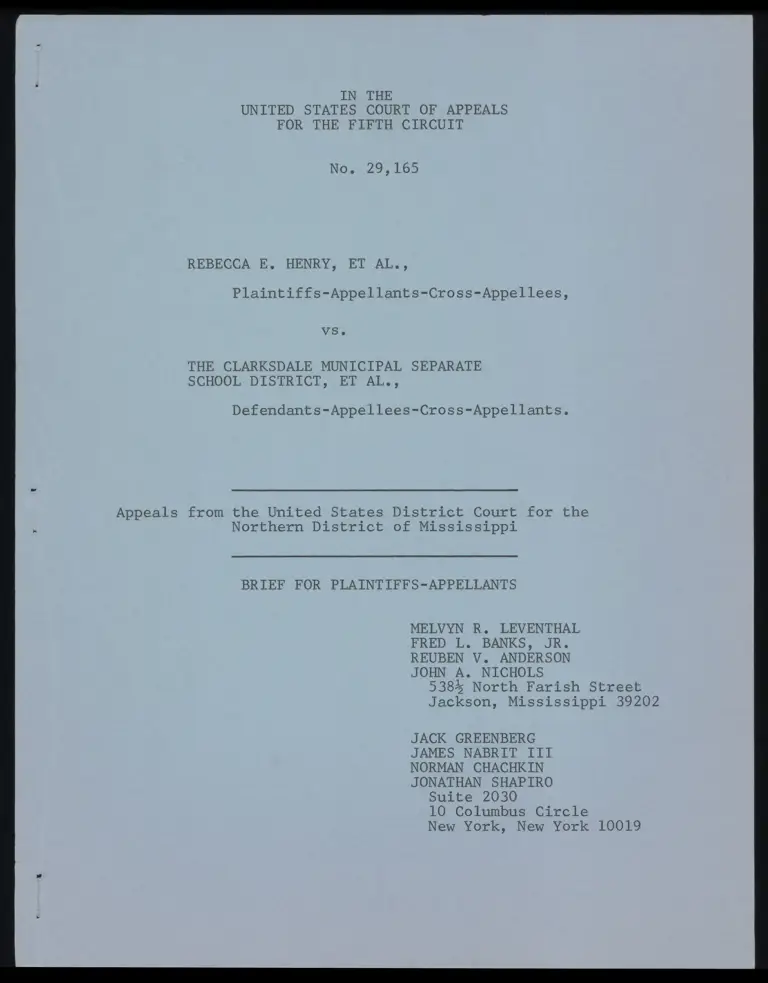
     [||31d4566a-8176-47cd-8494-e229ad52fa38||] IN THE
UNITED STATES COURT OF APPEALS

FOR THE FIFTH CIRCUIT

No. 29,165

REBECCA E. HENRY, ET AL.,

Plaintiffs=-Appellants-Cross-Appellees,

VS.

THE CLARKSDALE MUNICIPAL SEPARATE
SCHOOL DISTRICT, ET Al.,

Defendants~-Appellees-Cross-Appellants.

Appeals from the United States District Court for the
. Northern District of Mississippi

BRIEF FOR PLAINTIFFS~-APPELLANTS

MELVYN R. LEVENTHAL
FRED L. BANKS, JR.
REUBEN V., ANDERSON
JOHN A. NICHOLS

538% North Farish Street
Jackson, Mississippi 39202

JACK GREENBERG
JAMES NABRIT III
NORMAN CHACHKIN
JONATHAN SHAPIRO

Suite 2030
10 Columbus Circle
New York, New York 10019


TABLE OF CONTENTS

Page

Table Of CaSeS., ive idivesensvsanssseosrrivansesvis i

Statement of the Issues Presented for Review..... iii

Statement OL the CASE. uss tsncrssessssssnseeensinve 1

Statement. Of the Pach Sees ce ereossceovensovnessins 6

Argument

I THE TERMINAL PLAN OF DESEGREGATION
APPROVED BY THE DISTRICT COURT DOES
NOT RESULT IN A UNITARY SYSTEM BECAUSE
IT PROVIDES THAT ALL SEVEN ELEMENTARY
SCHOOLS IN THE DISTRICT REMAIN SEGREGATED..... 13

IT THE HEW PLAN OF DESEGREGATION IS EDUCATIONALLY
SOUND AND OF THE ALTERNATIVES AVAILABLE MOST
EFFECTIVELY ELIMINATES THE DUAL SYSTEM OF
CLARKSDALE AND SHOULD HAVE BEEN ORDERED

. IMPLEMENTED seo vsvervovins ves rh NEN CE ERNE 1

Conclusion and Relief Requested..ceeeeeeseen Chasis vo 0

Appendix A- Racial Composition of Student
Bodies and Grade Structures under
Plans of Desegregation Before the
District Court. vec rnssvvsecrsesnnsssnnes 32

Appendix B- Grade Structures Utilized In
School Districts Consolidated Under
United States v. Hinds County Board of
NGC acC100, Sih CiT: NOS: rv ereservrerse


TABLYFE 0 P CASTES

Alexander v. Holmes County
"Loard OF raucarion, 396 U.S,

(1969),

Andrews v. City of Monr
No. 79,353, April 73,

Briggs v, Elliot, 132 F.
PONE YL

Brown v. Board of Educati
349 U.S. 29Z (1955) (Brov

19

oe, 3th Cir.,
1870.

Supp.

tion
own IT)

776

Carter v. West Feliciana Parish
— School Board 0.35.

(19707, 2% 1.28. 24 477.

Filis v, Board of Public Instruction
~ of Orange County, 5th Cir.

Februa Ty 17,1870.

Green v. School Board o
~~ Fent County, 321 0.5,

f New

Henry v. Clarksdale Municipal
Separate School Distr ot
Clarksdale I) 409 F.2d 682

denied, toi Cir. 1969), cert.
396 U.S, 940 (1969).

Kemp v. Beasley, 8th Ci
March 17, 18/0.

De ————

1, "NOC,

Ro. 26.124

. 430 (1968)

19,782

Mannings v. The Board of Public
~TInstruction of Hillsborough,
3th Cir, No. 25,643, May 11,

Fla.,
19/0.

Plaquemines Parish School Board v. U.S.
415 F.2d 917 (5th Cir. 1969).

Page

1.14,21

15,16,21

8,15

6,7

11, 14,16,17,20

8,15,19, 20

1,6,3,11,15,19

21

26

21


School EET 419 F. 7d 1211 FEET Civ,
1969).

School DiScraice, oth Cir. No, 29,226
—_——,S A

Singleton v. Jackson Municipal Separate

May 5, 1870

Sparrow v. Gill, 304 F.Supp.
56 (H.5., N.C. 1969) |

United States v., Board of
Education of Baldwin County,
SEh Cir. Xo. 25,303, March 9,
1970.

United States v. Hinds County
— Board of Education, oth Cir. Nos.

23,030, 78,0747, November 7, 1969,

United States v, Jefferson County
Foard of LAuoat Ion, 3/2 F.2d
836, (1966) affirmed en banc,
330 F.24 385 (186737,

11

Page
——Cann

3,5,8

11,14,16,17,18,30

27

20

21,23


STATEMENT OF THE ISSUES PRESENTED

Whether the terminal plan of desegregation approved

by the district court which results in all of the

elementary schools of the district remaining

segregated achieves a unitary school system.

Whether the HEW plan of desegregation is the only

plan before this Court which eliminates the

dual school system and whether this Court should

order that plan implemented for the 1970-71 school

year,

iii


IN THE

UNITED STATES COURT OF APPEALS

FOR THE FIFTH CIRCUIT

NO. 29, 165

REBECCA E. HENRY, ET AlL.,

Plaintiffs-Appellants,

VS.

THE CLARKSDALE MUNICIPAL SEPARATE
SCHOOL DISTRICT, ET AlL.,

Defendants-Appel lees.

BRIEF FOR APPELLANTS

STATEMENT OF THE CASE

This school desegregation case is a continuation of
O

Henry v. Clarksdale Municipal Separate School District, 409

F.2d 682 (5th Cir. 1969), cert. denied, 396 U.S. 940 (1969).

The March 6, 1969 opinion of this Court (Clarksdale I)

did not order the mandate to issue forthwith. March 19, 1969,

the school board petitioned for rehearing en banc, thus staying

the mandate. Thereafter plaintiffs moved this Court to issue

the mandate forthwith. June 26, 1969, the school board's peti-

tion for rehearing was denied and the mandate issued.


July 8, 1969, the district court ordered defendants

to formulate and file a new plan of desegregation by July 23,

1969 to be implemented by the commencement of the 1969-70

school year. Prior to that order, however, the school board

moved this Court to recall the mandate issued on June 26, 1969.

Thereafter defendants moved the district court to stay further

proceedings and to vacate its order of July 8, 1969; July 17,

1969, the district court granted defendants' motion, vacated

its July 8 order and stayed further proceedings pending dispo-

sition by this Court of defendants' motion to recall the mandate.

July 29, 1969, plaintiffs moved this Court to immediately

deny defendants’ motion to recall the mandate; this Court did not

act upon plaintiffs' motion.

Four months later the Supreme Court denied defendants’

petition for writ of certiorari and on November 25, 1969 the

district court entered an order in response to the March 6, 1969

opinion of this Court: defendants and HEW were directed to col-

laborate and formulate a new plan of desegregation to be imple-

mented in part during the second semester of the 1969-70 school

year with full implementation deferred until the 1970-71 school

year.

HEW submitted its plan on December 23, 1969; January

2, 1970, plaintiffs filed objections to the plan of desegregation


offerred by HEW. January 2, 1970 defendants filed: 1) Motion

to Dismiss Because of Lack of Jurisdiction Over Subject Matter,

2) a motion to strike the HEW plan of desegregation, and 3)

objections to the HEW plan of desegregation.

January 9-10, the district court conducted hearings on

the HEW proposal and defendants' objections thereto (transcript NL

January 10, 1970, the district court entered its order which: 1)

provided for faculty integration and other interim measures as

required by Singleton v. Jackson Municipal Separate School District,

419 F.2d 1211 (5th Cir. 1970); 2) directed that in the event Carter

v. West Feliciana Parish School Board was decided by the Supreme

Court in favor of immediate implementation of desegregation plans

then the Clarksdale defendants must establish a single senior high

school and a single junior high school (except that ninth graders

would continue to be segregated); 3) ordered the formation of a

bi-racial committee; 4) referred the question of a terminal plan

of desegregation to a "special master," Dr. Forrest Murphy, and

deferred integration of elementary and ninth grade students until

September, 1970.2/

HM there are two transcripts of proceedings in this appeal. The
first records proceedings of January 9-10 and is designated
herein "transcript A;" the second records proceedings of April
24, 1970 and is designated herein "transcript B."

2/p second order of January 10, 1970 established guidelines and
instructions for the "special master." Order of Reference to
Special Master.


January 14, 1970, plaintiffs filed Notice of Appeal

from the district court's January 10,1970 orders; January 29,

1970, plaintiffs filed Motion for Summary Reversal. January 28,

1970 defendants filed Notice of Appeal and Cross-Appeal and on

February 4, 1970, plaintiffs filed a motion seeking summary

affirmance and disposition of defendants appeal and cross-appeal.

While this appeal was pending activity continued in the

district court. After obtaining an extension of time she "special

master," Dr. Forrest Murphy, on March 11, 1970, filed his plan of

desegregation (A Plan for the Continued Operation of the Municipal

Separate School District of Clarksdale, Mississippi). March 18,

1970, the district court granted defendants' motion for additional

time to file objections to the plan of the "special master," until

April 13, 1970, April 9, 1970, plaintiffs submitted objections to

Dr. Murphy's plan. April 13, 1970, defendants submitted their ob-

jections to Dr. Murphy's plan.

April 15, 1970, this Court entered an order providing

for a limited remand to the district court with directions that

a hearing be held and supplemental findings of fact and conclu-

sions of law be entered no later than May 15, 1970.

April 24, 1970, a hearing on Dr. Murphy's plan was held,

(transcript B). May 8, 1970 the district court entered an order

and opinion approving Dr. Murphy's plan without substantial modi-

fication.


May 19, 1970, this Court granted plaintiffs'-appellants'

Motion to Supplement the Record and established a briefing schedule

in accordance with Singleton, supra.


STATEMENT OF THE FACTS

There are four plans of desegregation relating to

pupil assignment which were developed in the district court.

The first, that proposed by defendants and advanced by them

herein, is "essentially and without significant variance the

3/ same plan disapproved by [this Court]..."=/ in its opinion of

March 6, 1969, (Clarksdale I). Defendants' "new" plan adopts

a majority to minority transfer right and assigns approximately

30 blacks to the Clarksdale Senior High School (See Appendix A,

hereto).

The second plan was ordered implemented by the district

court as an interim measure only. At the conclusion of the Jan-

uary 9, 1970 hearing the district court held that 4 44nd racial

system prevailed in Clarksdale and directed defendants to submit,

by the following morning, a plan providing for the consolidation

of grades at the secondary level to be effective only for the

balance of the school year now ending, (transcript A, 209-210).

Defendants, in response to the district court's instructions,

submitted two alternatives; and after a short hearing Judge Keady

ordered that for the second semester of the 1969-70 school year

all students in grades 10-12 plus white ninth graders must attend

the Clarksdale Senior High School, (white), and all students in

MM sovins. 1970 order OF this Coir: In thie appenl, 2115
Opinion, p. 2.


grades 7-8 plus black ninth graders must attend the Higgins

School (black). To accommodate this secondary program Riverton

Junior High School was converted to an elementary school and

Oliver Elementary was consolidated into the Higgins-Oliver

Junior High School Complex. Riverton Junior High School was

converted to an elementary school to accommodate children dis-

/
placed from the Oliver Elementary School 2

Judge Keady incorporated this second plan into his

January 10, 1970 order in response to Alexander and Carter.

Plaintiffs appealed from that order and filed a Motion for

Summary Reversal challenging the district court's refusal to

order all grades integrated by the second semester of the 1969-70

school year. This Court!s April 13, 1970 order reserved ruling

on plaintiffs' Motion for Summary Reversal but carefully noted

that the district court's January 10, 1970 order promised the

integration of all grades by September, 1970.%/

 —

4/o13ver Elementary is across the street from Higgins,
{tramscript A, Dp. 103),

2 spproximately 340 elementary students previously in attendance
at Oliver were transferred to Riverton Junior High School; an
additional 119 Oliver Elementary students were transferred to
Myrtle Hall Elementary. (These figures are rough approximations
and assume that Myrtle Hall was filled to capacity and that the
remaining Oliver children were transferred to Riverton Junior
High School.) :

8/ the January 10 orders appointed a special master and instructed
him to formulate a plan which desegregated all grades and all
schools. This Court's April 15, 1970 order quoted the disirict
court's instructions to the special master.


Defendants also appealed from the January 10 orders.

In effect, they ask this Court to overrule Jefferson I and II,

Singleton (en banc, December 1, 1969), and Green, Moreover,

they brashly assert there is no affirmative duty to integrate

under Briggs v. Elliot and Brown I and II. They argue that they

should not have to integrate faculties and construct and locate

new facllities to promote integration. Finally, they claim that

they either prevailed in or "disagree" with Clarksdale TI, (tran-

script A, pp. 121-23, 199). ¥/ Plaintiffs responded with a Motion

for Summary Affirmance which is still pending before this Court.

The third plan of desegregation was formulated and ad-

vanced by HEW and, with one exception, supported by plaintiffs.®/

That plan was submitted in response to the district court's order

of Novénber 25, 1969.2

2/ upon the decision of this Court in Clarksdale I defendants sought
to recall the mandate and stay proceedings in the district court.
They also filed a petition for writ of certiorari and petition
for rehearing en banc. These are hardly steps taken by a pre-
valling party.

2 vintnctees objected to segregation acquiesced in by HEW at the
Booker T. Washington Elementary School, (see Appendix A, hereto).

9/ Judge Keady had ordered defendants and HEW to collaborate and file
a joint proposal. Such collaboration was never realized. Defen-
dants later maintained that HEW refused to discuss new proposals,
(transcript A, pp. 141-43); and the HEW team stated that defendants
never sought to negotiate but rather insisted that the geographic
zone plan was educationally and constitutionally sound (transcript
B, p. 63). The district court resolved the dispute in favor of
defendants, (Order of May 8, 1970, p. 1). This is not a signifi-
cant issue. But in view of defendants recalcitrance and refusal
to offer any plan, the HEW explanation of the breakdown in commu-
nications seems far more plausible.


The HEW proposal superimposes pairing of grades upon ex-

isting zone boundaries to achieve integration of six of seven ele-

mentary schools. At the secondary level, HEW would establish two

consolidated city-wide attendance centers: the formerly white Clarks-

dale junior and senior high schools would be combined to form the

city-wide junior high school (grades 7-8); and the Higgins School

would be combined with the Oliver Elementary School to form the city-

yA wide senior high school (grades 9-12 The restructuring of

grades at the elementary level would be as follows:

Grades served under Students! previous
School HEW proposal assignments

Myrtle Hall 1-2 Oliver, Myrtle Hall
and Oakhurst

Oakhurst 4-6 Myrtle Hall and
Oakhurst

. Oliver (part of Higgins-
Oliver Complex;
closed as elementary

‘ school)

Riverton Junior 3-6 Oakhurst and Myrtle
High (converted Hall (grade 3 only);
to elementary Oliver grades 3-6
school)

Heidelberg 3-4 Heidelberg, Kirk-
patrick and River-
ton elementary

Kirkpatrick 5-6 Heidelberg, Kirk-
patrick and River-
ton elementary

Riverton elementary 1-2 Heidelberg, Kirk-
patrick and River-
ton elementary

10/ The Clarksdale Junior High School and the Senior High School are
across the street from each other and can be readily consolidated;
indeed, Dr. Murphy's plan calls for such consolidation. Similarly,
Oliver and Higgins are across the street from each other, (tran-
script A, p. 103). |


The HEW plan was vigorously attacked by defendants as

educationally and administratively impossible. They argued,

inter alia, that the plan undermined the 6-3-3 grade structure

and imposed upon the students a heavy transportation burden.

The district court agreed and, in rejecting the HEW proposal,

noted that:

many elementary grade children would be
required to travel up to two miles to
attend the school assigned, as contrasted
to a present average of % mile. This four-
fold increase in daily travel clearly exceeds
what might be regarded as 'reasonable incon-
venience' due to desegregation exigencies and
becomes an indefensible burden....

(Memorandum Opinion, May 8, 1970, p. 12,
Ea oa ——

emphasis added.)

Plaintiffs argued below and maintain herein that the HEW

plan is educationally and administratively sound and should be

ordered implemented in this school district.

Finally, the fourth plan of desegregation before this

Court was developed by Dr. Murphy after the district court de-

termined to reject the HEW proposal (transcript A, pp. 267-68).

Dr. Murphy was given explicit instructions in the district court

order of January 10 to submit a plan which integrated all of the

schools of the district (Order of Reference to Special Master,

January 10, 1970),


Dr. Murphy's plan at the secondary level established

one school serving grades 8-9, a second serving grades 10-12

and a third school serving grade seven only. At the elemen-

tary level, Dr. Murphy determined to ignore Clarksdale I and

the order of the district court: he submitted a neighborhood

school or "equal distance zoning" plan which promises a totally

11/
segregated elementary school program.—

Thus four separate plans were developed before the

district court. One of those was utilized for the balance of

the school year now ending and is not advanced by the parties

or the district court as a terminal plan. Of the. three remain-

ing alternatives the district court, in its order and opinion

of May 8, 1970, adopted Dr. Murphy's plan with two modifications:

first, a majority to minority transfer provision with the trans-

12/
feree preferred for space was adopted;—' secondly, Judge Keady

required that a Director of Elementary School Desegregation for

Clarksdale Schools be designated. This Official was to assure

11/500 Appendix A hereto. June 18, 1970, defendants filed
Supplement to Answers to Interrogatories dated April 19, 1570,
which is part of the record in this appeal. Those BhSwor 'S
demonstrate that Dr. Murphy's elementary plan results in
precisely the same dual system which this Court found unlaw-
ful in Clarksdale I. Dr. Murphy's elementary plan and that
of the school district are identical, except that they are
advanced under different names. The school board's plan is
called "geographic zoning"; Dr. Murphy's plan is called
"neighborhood zoning."

12/5111s v. Orange County and Singleton v. Jackson Municipal
Separate School District, May 5, 1970, 3&h Cir. NO, 29,220
provided for a similar right in the transferee under a major-
ity to minority transfer option.

- 11 =


Pa

exchange programs among the elementary schools of the district

13/
to insure integrated extra-curricula programs and activities.

The district court's May 8, 1970 Memorandum Opinion and Order

arc now before this Court for review.

35 Merit andi Opinion, May 8, 1970, pp. 26-27.


ARGUMENT

1. THE TERMINAL PLAN OF DESEGREGATION
APPROVED BY THE DISTRICT COURT DOES
NOT RESULT IN A UNITARY SYSTEM BECAUSE
IT PROVIDES THAT ALL SEVEN ELEMENTARY
SCHOOLS IN THE DISTRICT REMAIN SEGREGATED

The May 8, 1970 Memorandum Opinion and Order of the

district court approved the plan of desegregation advanced by

Dr, Murphy. of Although that plan results in an integrated

secondary school program, it depends upon "equal distance zoning"

or "neighborhood schools" at the elementary level. Under that

plan four of the seven elementary schools remain totally segre-

15/
gated and the remaining three might achieve token integration.

No plan of desegregation which results in all elementary

schools remaining segregated or tokenly integrated has survived

review in this Court. And every school district before the United

14/506 pages 10-12, above. Dr. Murphy's plan was approved with
two modifications: first, a majority to minority transfer
option with the transferee preferred for space was added by
the district court; second, a Director of Elementary School
Desegregation was appointed. See also, Appendix A, hereto.

23/ sccording to Defendants' Supplement to Answers to Interroga-
tories..., June 18, 1970, the following results would be
realized under equal distance zoning in Clarksdale: Heidel-
berg, Kirkpatrick and Oakhurst would remain all-white and
Booker T. Washington would remain all-black: three "formerly"
Negro schools, Myrtle Hall, Riverton and Oliver might have a
handful of whites enrolled.


States District Court for the Southern District of Mississippi,

including the most urban and residentially segregated city in

the state, Jackson, has been required to integrate its elementary

and secondary schools; Singleton v. Jackson Municipal Separate

School District, 3th Cir, No. 29,226, May 5, 1070187 The district

court herein would make Clarksdale an exception.

In approving equal distance zoning and Dr. Murphy's

plan, the district court misconstrued the holding of Ellis v.

Orange County and tortured the holding of Singleton v. Jackson

Municipal Separate School District, May 5, 1970, 5th Cir. Ro.

29,226. Pirst, the district court read Orange County as approv-

ing "a neighborhood school system where 'each student in the

system must be assigned to attend the school nearest his or her

home, limited only by the capacity of the school, and then to

the next nearest school,'" (Memorandum Opinion, May 8, 1970,

pp. 21-22). Second, the district court read Singleton, May 5,

1970, 5th Cir. No. 29,226, as permitting segregated elementary

schools when secondary schools are integrated. (Memorandum

Opinion, May 8, 1970, p 22).

16/ there are thirty-four school districts under court order in
the United States District Court for the Southern District
of Mississippi. Thirty of these are consolidated in this
Court under the mandate of Alexander v. Holmes County. The
four other cases remaining in the district court are: Adams 'v.
Ranking County Board of Education, Singleton v. Jackson Municipal
Separate School District, Mason v. Biloxi Municipal Separate
School District, and Cladney v. Moss Point Municipal Separate
School District. All thirty-four districts have been required
to fully integrate both elementary and secondary schools.


This Court has not decided ‘that neighborhood schools,

or strict adherence to equal distance zoning satisfies the equal

protection clause. Such a holding would tacitly overrule Jef-

ferson I, Jefferson II, Clarksdale I, and their progeny. Such

a holding would sap the strength from Green. It would resurrect

the Briggs dictum which was moribund after Singleton I, dead after

Jefferson I and buried by Green. After a system-wide policy of

segregation neutrality would again provide a remedy in accord with

the equal protection lanes 21 With this in mind this Court re-

cently noted that:

While . . . a system of student assignment
[based on geographic zoning] may be less
offensive than one which intentionally
segregates students, it does not necessarily
follow that it creates a unitary system. The
Supreme Court made it clear that school boards
cannot avoid their responsibility to create a
unitary system simply by resorting to non-
discriminatory geographical zoning where such
zoning would be ineffective....citing Green,
391 U.8. 430, 442, Lun. 6. ae
Andrews v. Clty of Monroe, 5th Cir. No. 29,358,
Bpril 73, 1970, iypewriiten opinion, p. 5.

wide policy of segregation directed against Negroes as a
entity is a system~wide policy of Integration," Jefferson 1,
372 F.2d 836, 869 (emphasis the Court's). The only school
desegregation plan that meets constitutional standards is
one Chat Works. Jeirterson I, 3/72 F.2d at 847. Pihe burden

X7/ "[T lhe only adequate redress for a previously overt system-

on a school board today is to come forward with a plan that
promises realistically to work and promises realistically to
work now," Green, 391 U.S. 430, at 439, (emphasis the Court's).


Indeed, Orange County noted that:

there are many variables in the student
assignment approach necessary to bring
about unitary school systems. The answer
in each case turns in the final analysis . . .
on all of the facts including those which are
peculiar to the particular system.

Ellis v, Orange County, Slip Opinion, n./7, p. 12.
See also, Singleton v. Jackson Municipal Separate
School District, 5th Cir. No. 29,226, May 5, 1970,
$1ip Opinion, n.l3, p. 12.

In reviewing the controlling facts in the City of Monroe,

supra, typewritten opinion, pp. 5-6, the Court distinguished Orange

County:

The Orange County system encompassed
both rural and urban areas, comprised
of large land area, had a total of 98
schools, and had a racial ratio of
students of approximately 82 per cent
white - 18 per cent black. The Monroe
City system, on the other hand, encom-
passes an urban area only, comprises a
relatively small land area, has a total
of only 18 schools, and has a racial
ratio of students of approximately 51
per cent white - 49 per cent black. In
view of these circumstances we reject as
facially invalid the School Board's plan
under which close to 85% of the black
elementary students would continue to
attend four ‘traditionally black schools
two of which remain all-black . . . and
two of which remain nearly all-black.
(emphasis added.)


The City of Clarksdale has much in common with Monroe.

It too comprises a small land area (four square miles, or approx-

imately 2 miles by two miles, Memorandum Opinion, May 8, 1970,

p. 6), has a total of only 11 schools and a ratio of black to

white students of approximately 6.4. Dr. Murphy's plan would

place, not 85%, but all of the elementary children, white and

18/ black, in absolutely segregated or tokenly integrated schools.—

Dr. Murphy's plan does not result in a unitary system.

In addition to misreading Orange County, the district

court held that elementary schools may remain segregated provided

only that secondary schools are integrated. Judge Keady relied

upon Singleton, supra, May 5, 1970, to support that rule of law.

The district court's reading of Singleton is erroneous.

The Singleton court reviewed separately the elementary and secon-

dary programs of Jackson, (Singleton, supra, Slip Opinion, pp. 5-8).

It found deficiencies at both levels: to produce a unitary system

one of the HEW plans was ordered implemented since there was "a

good possibility that [it] will establish a unitary school system

at the secondary level" (Singleton, supra, Slip Opinion, p. 11);

in addition, the district court was directed to call for additional

proposals to "eliminate the dual system which still remains in the

elementary level," (Singl¢on, supra, Slip Opinion, p. 13).

18/1¢ you total the black elementary and secondary school youngsters,
then 55% of all black children will attend segregated schools in
Clarksdale under the district court approved plan. The district
court so found, Memorandum Opinion, May 8, 1970, p. 23.


Thus, Singleton held that a unitary system is not attained unless

19/
integration is achieved at all levels of public school education.—-

At the very least the district court's opinion and order

of May 8, 1970, must be reversed and additional plans of desegre-

gation considered which will eliminate the dual system which

so tenaciously continues in this school district,

19/1he Appellants in Singleton did not seek immediate review of
the elementary program of Jackson but rather confined them-
selves to the secondary program. This Court refused to review
only the secondary program and found deficiencies at both levels.
Singleton, supra, Slip Opinion, n.6, pp. 5-6.


17. THE HEW PLAN OF DESEGREGATION IS EDUCATIONALLY
SOUND AND OF THE ALTERNATIVES AVAILABLE MOST
EFFECTIVELY ELIMINATES THE DUAL SYSTEM OF CLARKS~-
DALE AND SHOULD HAVE BEEN ORDERED IMPLEMENTED

The district court evaluated the alternatives as follows:

first, it rejected the school board's plan as inconsistent with

the mandate of Clarksdale I; second, it compared Dr. Murphy's

third, the district court compared the HEW proposal for secondary

schools to Dr. Murphy's secondary school proposal and found the

latter educationally more sound. This approach ignores the consti-

tutional imperatives.

It is of great inportance in this case that the school

board refused, with irresponsible persistency, to respond to its

duty to "come forward with a plan that promises realistically to

430,2%/ The district court responded to this recalcitrance by per-

mitting elementary and ninth graders to remain segregated for the

second semester of the 1969-70 school year and by appointing and

directing the special master to formulate and file a plan which

worked at all 1evels, 2, The record shows that Dr. Murphy did not

20/ wr drive nid Opinion, May 8, 1970, p. 7.

21/ 5c der of Reference to Special Master, January 10, 1970.

ie


consider Judge Keady's order controlling but rather, after

reading Orange County, concluded that he too could submit a

plan which left elementary grades segresated 2 Only HEW

determined to respond to the constitutional imperatives and

submit a plan which integrates elementary and secondary schools.

While it is true that the district court must examine all of the

educational considerations, it failed totally to recognize that

integration is a paramount facet of a sound educational program

and, equally important, that "the obligation of the district

courts, as it always has been, is to assess the effectiveness of

a proposed plan in achieving desegregation." Green, 391 U.S. at

439, (emphasis added). When the school board and Dr. Murphy failed

to submit integration plans, the district court should have held

that "[s]ince the HEW plan is the only one currently available that

gives any promise of ending the dual system, . . . [i]t must be

ordered implemented despite its defects," U.S.A. v. Board of Educa-

tion of Baldwin County, 5th Cir. No. 28,808, March 9, 1970, Slip

Opinion, p. 4 (emphasis added). The district court's approach

encouraged defendants to sit on their hands and offerged them a

premium for recalcitrance: a school board which refuses to submit

a constitutional plan should be enjoined from entering objections

to plans which meet constitutional standards. A court of equity

can require no less.

22/p,, Murphy not only determined for himself what the constitution
requires, but also insisted upon making the distinction between
"integration" and "segregation" rejected by this Court in Jefferson
and by the Supreme Court in Greeny (Transcript B, pp. 13-15).


Moreover, the district court's approach insists upon

placing the heavy burden of litigation upon plaintiffs in the

face of Alexander. In Alexander there were some defects in the

HEW plans--but this Court, in response to the Supreme Court man-

date, ordered those plans implemented with deficiencies to be

corrected later, U.S. v. Hinds County and Alexander v. Holmes,

5th Cir. Nos. 28,030 and 23,042, November 7, 1969.

Similarly, the district court ignored the constitutional

imperatives when it summarily rejected transportation of students

as a tool for alleviating segregation. Judge Keady noted that

defendants were without sufficient funds and that bussing to achieve

integration exaggerates the importance of integration (Memorandum

Opinion, May 8, 1970, pp. 24-25). Judge Keady entered these find-

ings without any evidence on the extent of bussing that might be

required, without the cost of such bussing determined, and in the

face of defendants' admission that they have rejected or failed to

apply for over one million dollars in Codural ald to education

(transcript, pp. 116-118). "Financial distress . . . is hardly

a convincing excuse when it is considered that the parish neg-

lected all forms of federal supplement for its school . . . program,"

Plaquemines Parish School Board v, U,S,, 415 P.2d 817, 830 (5th Cir,

1969).

The district court cannot enter such findings without a

; : tool, ao
comprehensive record and bussing may be a for achieving in-

tegration. Andrews v. City of Monroe, supra, typewritten opinion,

p. 8; Singleton, supra, Slip Opinion, p. 4, n.4; Kemp v. Beasley,

Sth Cir., No. 19,782, March 17, 1970, Slip Opinion, p. 14,


In attempting to undo the effects of past discrimi-

fot ion and the dual system, it will be almost impossible to

achieve perfection since schools have been located and building

capacities established to accommodate the dual system. And plain-

tiffs maintain that the HEW plan does not contain grievous SONS,

and that it is educationally sound and that the district court's

findings with regard thereto are clearly erroneous.

First, the district court held that a 2-2-2 elementary

grade structure as proposed by HEW is educationally unsound and

prevented proper "articulation." The record does not support

that conclusion. Indeed, Dr. Murphy, the court's naspenit noted:

A. There are many different possible organi-
zations of grade structure which will pro-
vide for an educational setting which would
be efficient. The 6-3-3 idea emerged about
« « « the mid-'20s, superseding what had been
a grade structure of 8-4. There have been
many combinations since . . . almost any com-~

. bination of grades so that it seems to me that
the organizational pattern is not as important
as how this pattern is administered and the
instruction which is carried out within the
pattern.

23/ the district court in its opinion of May 8, 1970, distinguishes
between the authority granted Dr. Murphy under Rule 53 of the
FRCP and that granted the HEW team; Judge Keady noted that "the
findings of a special master as contained in his report, are
binding upon the court as to all questions of fact unless such
findings are clearly erroneous," (Memorandum Opinion, May 8, 1970,
p. 17). The distinction drawn between the special master and the
HEW team is tenuous and strained. The parties, through counsel,
were not permitted to advance evidence to the special master to
influence the so-called "findings of fact." There were no hear-
ings conducted by the master appointed in this case. There were
no findings of fact but rather a proposed plan of desegregation.
Dr. Murphy served as special master under Rule 53 in name only.
He was an expert who gathered information and spoke to school
personnel and patrons of the district, performing in the same
capacity as the HEW team. The special master's plan cannot be
afforded any special weight merely because Rule 53 was recited.


Q. Tell me if this is an accurate statement
of your position: virtually any grade
structure is educationally sound if you
have the facilities and develop the curriculum
for it? Is that an accurate statement?

A. 1 would think so, yes.

(Transcript B, pp. 6-7).

The district court's findings with regard to grade

structures are not only unsupported by the record in this

case but by the experience that this Court has had with the
en

30 Mississippi school districts, United States v. Hinds County

Board of Education. Appended hereto, Exhibit B, is a summary

of the grade structures established in those 30 districts;

it demonstrates rather dramatically the unsoundness of the

district court's findings.

There are advantages in a 2-2-2 elementary arrangement

most notably that it permits the school district to concentrate

its resources for particular grades in one building. For example,

instead of having only two first grade teachers in a school

the HEW plan would result in perhaps 10 first grade teachers

in one school serving grades 1 and 2 only. This will permit

a better exchange of ideas among such teachers and will further

permit the school district to locate its equipment and supplies

designed especially for lst and 2d graders in consolidated

facilities, (Transcript B, p. 51).

-23..


Secondly, the district court found that the consolida-

tion of Oliver Elementary School and Higgins Junior-Senior High

School into a single city-wide high school facility does not

provide a "tolerable, educationally sound result," (Memorandum

Opinion, p. 9). Defendants disagreed. When they were asked to

submit proposals for consolidating Juntos sdenlon high school at

the conclusion of the January 9, 1970 hearing they submitted a

proposal which consolidated Higgins and Oliver and reassigned

Oliver elementary children to Riverton Junior High School, (Re-

sponse to Directions of Court, January 10, 1970, pp. 1-2). This

arrangement was ordered suplenshted by the court for the balance

of the school year now ending. In addition, the record shows that

during the second semester of the 1969-70 school year Oliver was

converted for use as a junior high school by merely raising black-

boards and replacing furniture designed for elementary children

with furniture designed for junior high school students (Transcript

B, pp. 69=70Y,

Thirdly, the district court found that the conversion

of Riverton Junior High School to an elementary school, as pro-

posed by HEW, was a "glaring improper building utilization,"

(Memorandum Opinion, p. 10). Of course, this arrangement is not

the best of all possible worlds. Dr. Murphy would convert this

facility to a school serving one grade only, the 7th grade. Since

most of the equipment and laboratories were designed for older junior


high school students, those in grades, 8 and 9, we are not

certain that Dr. Murphy's proposal would result in better

utilization of Riverton facilities. Riverton, under the HEW

proposal would contain sixth graders and we find nothing in

the record to support the district court's conclusion that

seventh graders would be able to fully deiline the Riverton

"eymnasium, auditorium and other facilities particularly

suited to secondary children.... (Memorandum Opinion, p. 10).

In fact, neither Dr. Murphy's plan nor that of HEW properly

utilizes Riverton as defendants will be quick to point out; but,

it bears repeating that the HEW proposal integrates 10 of the 11

schools in the district. Dr. Murphy's proposal would leave 7 of

the 11 schools segregated.

Finally, the district court found most objectionable

the additional distances which elementary children would have to

traverse to get to school under the HEW plan, (Memorandum Opinion,

p. 11). It is certainly true that some children would be as far

as two miles from the school to which they are assigned. But

several facts undermine the district court's reasoning. First,

under the past dual system whites living south of the railroad

track and several miles from the white elementary schools tra-

versed the long distances to attend segregated schools; blacks


north of the track sustained the same, burden, evidently suc-

cessfully, (Transcript A, pp. 127-136 24/ Second, the record

shows that when the interim plan of desegregation was implemented

for the second semester of this year, many children assigned to

Oliver Elementary School were assigned to Riverton Junior High

School and had to travel up to two miles to attend school. There

was no decrease in enrollment or average daily attendance between

the first and second semester of the school year, and it is ob-

vious that these children were able to traverse the additional

distance (Transcript B, pp. 104-105). Third, many states assume

that any child living up to two miles from the school to which he

is assigned can get to school without transportation; Florida, for

example, provides transportation for all children residing more than

two miles from school; Mannings v. The Board of Public Instruction

of Hillsborough County, Florida, No. 28,643, 5th Cir. May 11, 1970,

Slip Opinion, p. 5. Therefore, even though the Clarksdale district

has attempted to locate elementary schools within % mile from most

of its elementary children, this is not evidence that the school

board's standard is the only one which is sound. Moreover, it is

manifestly clear that in Clarksdale any effort to have children

1 attend schools which are within % mile from home will result in a

completely segregated and dual system.

24/11 Clarksdale I, 409 F.2d at 688, n.10, this Court noted.that
defendants had disregarded the railroad track as a barrier when
segregation was the objective; therefore, they could not claim
the railroad a barrier when integration would be the result.


Fourthly, the record shows that many if not most of

the elementary children are driven to school by their parents

(transcript A, p. 144, transcript B, pp. 57-52). Fifthly,

even if some of the elementary children are distant from the

schools to which they are assigned and are not driven to school

by their parents, the record is devoid of a detailed analysis

showing the number of children involved, and the cost to

the district of providing such children with tvenisportation sof

Sixthly, there is an extensive network of sidewalks in

Clarksdale and potential for use of crossing guards (transcript

A, p. 134, transcript B, pp. 33-57). Indeed, a three-judge

district court recently noted that North Carolina does not

provide reimbursement for intra-city transportation and does

not expect that municipal school duehiots will provide

transportation because children residing in municipalities:

are more apt to have sidewalks and other
pedestrian protection on their way to school;
...they are more apt to participate in an
'automobile' culture simplifying family trans-
portation and the formation of family car pools,
than their county-dwelling counterparts.

Sparrow v. Gil), 304 F, Supp, 86, 91
IMD. K.C., Auzust 13, 196%),

25/50 above, p. 21. Under state statutes cited by the district
court the school district has the authority to bus intra-city
provided only that such transportation is paid for out of
local school district funds. Under Miss, Code Ann, § 6336-31,
the school board, with the concurrence of the municipal author-
ities may bus intra-city. Judge Keady's assumption that the
city authorities might not endorse court ordered bussing is
transparent. If a court order required such transporation
the municipal authorities would either comply voluntarily
or be added as additional parties defendant to assure
compliance,

Hr


Seventhly, plaintiffs attempted to demonstrate that

in Grenada Municipal Separate School District, which has recently

converted to a 2-2-2-2-2-2 grade structure, at the suggestion of

its school board, and within which no transportation is provided

children residing within the city limits, and in which children

live up to 3-4 miles from school, the elementary youngsters were

having no appreciable difficulty getting to school 207

Eighthly, the HEW team carefully considered the dis-

tances between schools and the added burden upon the students

and found it not excessive (Transcript B, pp. 55-57).

The HEW proposal was prepared by a team of three educa-

tors and school administrators, (Transcript B, 44). Mr. Labat has

extensive experience as a junior high school teacher in

the ghetto schools of New Orleans, and has been an HEW team member

in the preparation of approximately 50 plans of desegregation (Tran-

script B, pp. 39, 44). Dr. Simmons, the second team member, has

been a principal and superintendent over a 23-year period, in

public school systems and holds a Doctorate in Education; the third

a

26/vvansoript B, p. 37. The district court excluded testimony
from Mr. Wilburn who is the Superintendent of the Grenada
Municipal Separate School District, on the ground that such
evidence is collateral. We had attempted to demonstrate that
Grenada and Clarksdale share much in common, most importantly
that children residing within the City of Grenada are not pro-
vided transportation and are getting to school. We submit that
the district court was in error in excluding this testimony:
the experiences of neighboring districts which have similar
problems and have devised ways of overcoming such problems are
relevant to the defendant school district.


team member, Mr. Grant, has a M.A. $1 education and extensive

background in the public school system of Monroe, Louisiana

(Transcript B, p. 44). Two of the team members made on-site

inspections of all the facilities of the district prior to the

submission of the plan (Transcript B, p. 43) ;21/ They reviewed

the distances between the schools and the facilities and equip-

ment available. This team put approximately 7 days into the

preparation of this plan and upon being denied additional time

by the district court to submit a plan they worked on Saturday

and Sunday to meet the court's deadline (Transcript B, pp. 68-69).

Furthermore, before the plan was finally approved and submitted to

the district court it was reviewed by additional educators and

attorneys for the Department of Justice, (Transcript B, p. 45).

After so exhaustive a study by these educators and school admini-

strators the district court should not have substituted its judg-

ment and that of the recalcitrant defendants for the judgment of

the HEW team members.

Plaintiffs do have one objection to the HEW plan: it

fails to integrate the Booker T. Washington Elementary School. We

maintain that the district court should be required to determine

whether students can be bussed to integrate that school. That is,

a a— — - ote zr

27 rm ° Ld . 3

27/ the third team member visited and inspected some of the
facilities after the plan was submitted to satisfy himself
that the plan was sound, (Transcript B, pp. 47-48).


the district court should be required. to enter specific findings

regarding the number of children to be transported, the cost of

such bussing and the budgetary position of this school district.

This Court in Singleton, supra, recently held that upon remand:

[TThe district court shall make findings
of fact that specifically evaluate the
alternatives in terms of cost, as well as
administrative, educational and economic
factors bearing on the elimination of the
dual system. The findings shall specifically
include the reasons, if any, for the continua-
tion of any all Negro or all white schools.
(Emphasis added.)

CONCLUSION AND RELIEF REQUESTED

The plan of desegregation approved by the district

court does not establish a unitary system. Moreover, there is

a reasonable available alternative, the HEW proposal, which does

integrate ten of the eleven schools in the district, which should

be ordered implemented by September, 1970. As for the segrega-

tion remaining at the Booker T. Washington Elementary School,

the district court should be required to enter an order calling

for the submission of new proposals by HEW and defendants to in-

tegrate that facility; and unless the school district can show

that there are economic, administrative and educational factors


which preclude the integration of that facility, it must be

integrated.

The May 8, 1970 Memorandum Opinion and Order of the

district court should be reversed and this case remanded with.

instructions that the HEW plan be entered, except for modifi-

cations necessary to integrate the Booker T. Washington Elem-

tary School.

Finally, the January 10, 1970 and May 8, 1970 orders of

the district court rejecting the defendants! plan of desegregation

and requiring the implementation of Singleton, supra, December 1,
aa a

1969, should be summarily affirmed.

. Vil EE ie

1

§ 4 %

MERVYNVR. LEVENTHAL
REUBEN V. ANDERSON
FRED 1. BANKS, JB.

538% North Parish Street
Jackson, Mississippi 39202

JACK GREENBERG

JAMES NABRIT IIT
NORMAN CHACHKIN
JONATHAN SHAPIRO

Suite 2030
10 Columbus Circle
New York, New York 10019

Counsel for Plaintiffs-Appellants

- 3] -


APPENDIX A

RACIAL COMPOSITION OF STUDENT BODIES AND GRADE STRUCTURES
UNDER PLANS OF DESEGREGATION BEFORE THE DISTRICT COURT

CLARKSDALE MUNICIPAL SEPARATE SCHOOL DISTRICT

School Board's : 2/ Dr. Murphy's

Name of School Plans! ffW plane n Plan! el
Grades WW, DB. { Grades W., 6.1 Grades Wn. =,

Ee ea EE ————

Heidelberg 1-6 346 0 3-4 224 138 1-6 295 0

Kirkpatrick 1-6 379.0 5-6 223 - 115 1-6 226.0

Oakhurst 1-6 302 0D 4-6 160 234 1-6 283.0

Oliver 1-6 2 163] combined wich }o1-s 0 415
Higgins

Myrtle Hall 1-6 7.468 i 1-2 100 290 1-6 5 469

Riverton Elem. 1-6 0 424 1-2 266 155 1-6 0 404

Washington 1-6 0 517 1-6 0 517 1-6 0 458

Riverton Jr. :
High School 7-9 0 433 3-6 56 384 7 154. 258

Higeins Jr.~Sr.
High School 7-12 2 834 Owl? 673 399 8-9 337 642

Clarksdale Jr.
High School 7-9 585 0 7-8 337 642 10-12 w


w


U
l


537

Clarksdale Sr.
High School 10-12 483 30 combined with combined with

Clarksdale Jr. HJ Clarksdale Jr. H.

os As

TOTALS: 2,106 3,169 2,089 3,074 1,983 3,183

(See page 33 for footnotes)

-20


FOOTNOTES TO APPENDIX A

1/ these columns also reflect statistics under the dual system
of previous years. Defendants' "new" plan merely assigns 30
blacks to Clarksdale Senior High School as reflected in the
above chart, (Transcript A, pp. 122-26). Also, defendants
propose a majority to minority transfer right. (Transcript A,
p.125). Figures derive from HEW Plan, Report to the Superin-
tendent, December 23, 1969, p. I.

2 gen text of brief, pp. 8-9, for explanation of HEW Plan.
Figures derive from HEW Plan, Report to the Superintendent,
p.11. a ~~

Hoviver Elementary School, located acorss the street from Higgins,
is converted to a part of the Oliver-Higgins Complex under the
HEW Plan and is discontinued as an elementary school. See text
of brief, pp. 8-

Vd Ld o Ld Ld MN *

3 pinsies for junior-senior high derive from Dr. Murphy's plan,
A Plan for the Continued Operation of the Municipal Separate

~ BE SC IOS ES —— —— omewsceea

- School District of Clarksdale, Mississippi, Mach 11, 1970,
pp. 2-4. Figures for elementary derive from Supplement to
Answers to Interrogatories dated April 9, 1970, Pp. 1-5; thes
answers are part of supplemental record in this Court.

IM riveevences among totals for the three plans derive from
the fact that the plans were prepared at different times;
each plan reflects student enrollments at a given moment.

-33-


APPENDIX B

GRADE STRUCTURES UTILIZED IN SCHOOL
DISTRICTS CONSOLIDATED UNDER UNITED
STATES v. HINDS COUNTY BOARD OF EDU-
CATION, 5th Cir. Nos. 28,030, 28,042

School District Grade Structure

1. AmiteCounty 6-2-4; 6-6

2. Anguilla Line Consol. 6-6

3. Canton Municipal Sep. 3=3=~1~5

4, Columbia Municipal Sep. 2=3m2=5

5. Covington County 5-7; 123 6~5

6. Enterprise Consol. 12

7. Franklin County 6-6

8. Forrest County L-bLi-ls 6-63 8-4

- 9... Hinds County 6-3-3

10. Holmes County 6-6; 12; 8-4

11. Holly Bluff 6-6

12. Kemper County 8-4

13. Lauderdale County 12

14. Lawrence County 4-4-4; 12; 4-5-3

15. Leake County 6-6; 8-43 12

16. Lincoln County 6-2-4

17. Madison County B=4; 12

18, Marion County 8-4

19. Meridian Mun. Sep 6~1-2~3

20. Natchez Spec. Mun. Sep. 1~-1~2-2~3~4

- 340


School District Grade Structures

21. Neshoba County 6-6

22. North Pike Consol, L-bL-4

23. Noxubee 8-4

24, Philadelphia Mun. Sep. 6-6

25. Quitman Consol. | © 3-3-3-3

26. Sharkey-Issequena 5-1-6

27... South Pike 4-4-4

28, Wilkinson County 6-6; 9-3

29. Yazoo City Mun. Sep, 2el=2=1-3=3

30, Yazoo County 6-6; 8-4

Chart derives from Reports to the
required by order of this Court, 30, 1970, 5th Cir.

' No. 28,030, United States v. Hinds County.

- 35 . [||31d4566a-8176-47cd-8494-e229ad52fa38||]