Appellees' Motion to Dismiss and Brief in Support; Appellants' Jurisdictional Statement
Public Court Documents
August 8, 1972
97 pages
-
Case Files, Norwood v. Harrison - Hardbacks. Appellees' Motion to Dismiss and Brief in Support; Appellants' Jurisdictional Statement, 1972. 922b0a69-722e-f111-88b4-000d3a199651. LDF Archives, Thurgood Marshall Institute. https://ldfrecollection.org/archives/archives-search/archives-item/a57e7bd8-8cf8-4994-9990-248f29145c39/appellees-motion-to-dismiss-and-brief-in-support-appellants-jurisdictional-statement. Accessed October 18, 2026.
Copied!
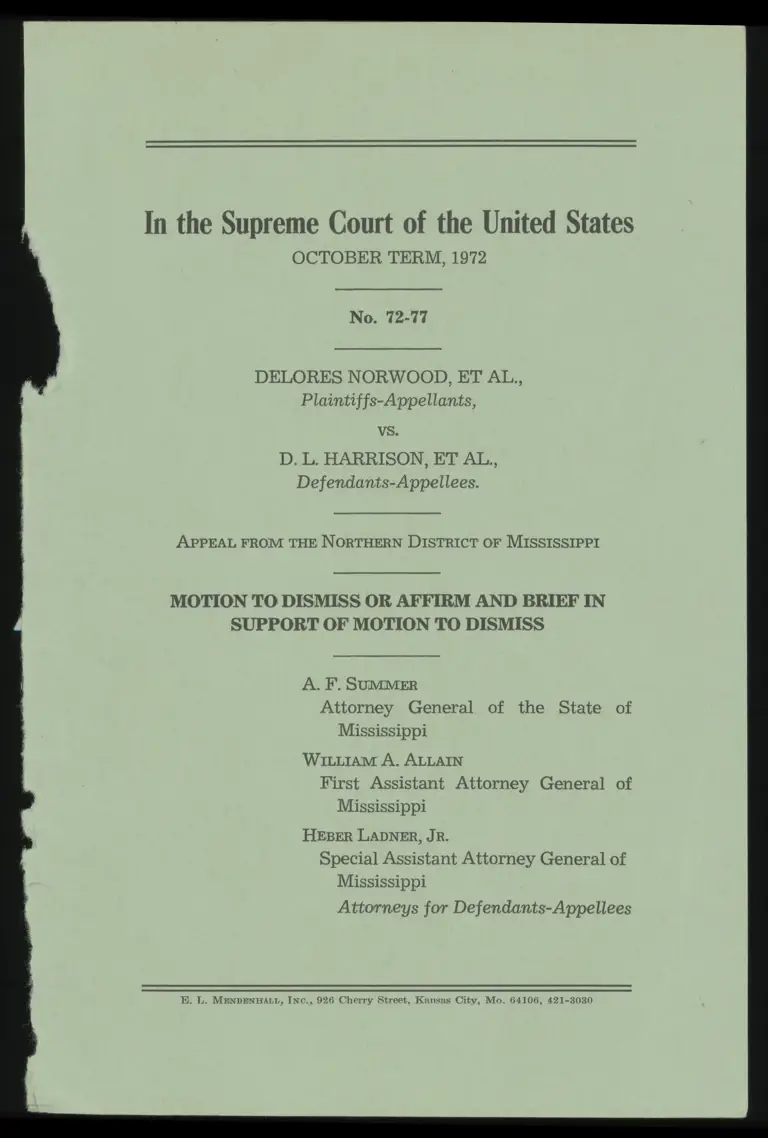
     [||2c972869-8346-4ec6-bf1d-3bf704f0150e||] In the Supreme Court of the United States
OCTOBER TERM, 1972


No. 72-77


DELORES NORWOOD, ET AL.,

Plaintiffs-Appellants,

VS.

D. L. HARRISON, ET AL,

Defendants-Appellees.


APPEAL FROM THE NORTHERN DISTRICT OF MISSISSIPPI


MOTION TO DISMISS OR AFFIRM AND BRIEF IN

SUPPORT OF MOTION TO DISMISS


A. F. SUMMER

Attorney General of the State of

Mississippi

WiLriam A. ALLAIN

First Assistant Attorney General of

Mississippi

HEBER LADNER, JR.

Special Assistant Attorney General of

Mississippi

Attorneys for Defendants- Appellees


BE. L. MENDENHALL, INC., 926 Cherry Street, Kansas City, Mo. 64106, 421-3030


TABLE OF CONTENTS

MOTION TO DISMISS OR AFFIRM

BRIEF IN SUPPORT OF MOTION TO DISMISS—


Argument—

I. Aid to Students in Private and Parochial

Schools by Lending Them Textbooks Does Not

Violate the Fourteenth Amendment

II. The Mississippi Statute Does Not Foster Seg-

regated Schools in Purpose or Effect

Conclusion

Table of Authorities

CASES

Abington School District v. Schempp, 374 U.S. 203, 83

S.Ct. 1560, 10 L.Ed.2d 844 (1963)

Board of Education v. Allen, 392 U.S. 236, 88 S.Ct. 1923,

20 L.Ed.2d 1060 (1968)

Burton v. Wilmington Parking Authority, 365 U.S. 715,

81 S.Ct. 856, 6 L.Ed.2d 45 (1961)

Cochran v. Louisiana State Board of Education, 281

U.S. 370, 60 S.Ct. 335, 74 L.Ed. 913 (1930)

Coffey v. Education Finance Commission, 275 F. Supp.

854 (S.D. Miss.)

Everson v. Board of Education, 330 U.S. 1, 67 S.Ct. 504,

91 L.Ed. 711 (1947)

Follett v. Town of McCormick, 321 U.S. 573, 64 S.Ct.

717, 88 L.Ed. 938 (1944)


II

Irvis v. Moose Lodge #107, 40 L.W. 4715 (No. 70-75,

June 12, 1972)

Lemon v. Kurtzman, 403 U.S. 602, 91 S.Ct. 2105, 29

L.Ed.2d 745 (1971)

Peterson v. City of Greenville, 395 U.S. 298, 83 S.Ct.

1119, 10 L.Ed.2d 323 (1963)

Poindexter v. Louisiana Financial Assistance Commis:

sion, 275 F. Supp. 833 (S.D. La., 1967), affirmed, 389

U.S. 571 (1968)

Reitman v. Mulkey, 387 U.S. 369, 87 S.Ct. 1627, 18

L.Ed.2d 830 (1967)

Shelley v. Kraemer, 334 U.S. 1, 68 S.Ct. 836, 92 L.Ed.

1161 (1948)

Walz v. Tax Commission, 397 U.S. 664, 90 S.Ct. 1409, 25

L.Ed.2d 697 (1970)

CONSTITUTIONAL PROVISIONS

AND STATUTES

Constitution of the United States—


In the Supreme Court of the United States
OCTOBER TERM, 1972


No. 72-77


DELORES NORWOOD, ET AL.,

Plaintiffs-Appellants,

VS.

D. L. HARRISON, ET AL,,

Defendants-Appellees.


APPEAL FROM THE NORTHERN DISTRICT OF MISSISSIPPI


MOTION TO DISMISS OR AFFIRM

Appellees move the Court, under Supreme Court Rule

16, to dismiss the appeal in that it does not present a sub-

stantial federal question as to the claim that (1) a 1940

law providing loaned textbooks to all individual students

in both public and private schools violates equal protec-

tion.

Alternatively, appellees move the Court to affirm the

final judgment of the District Court on the ground that

it is manifest that the questions upon which the decision

of the cause depends are so insubstantial as not to need

further argument: (1) Because the claim that textbook

loans to individual students in both public and private

schools is unconstitutional is obviously without merit and


because its unsoundness is unmistakably clear from the

previous decisions of this Court.

It is, therefore, respectfully moved that this appeal

be dismissed and, in the alternative, that the judgment of

the District Court denying all relief be affirmed.

Respectfully moved this 8th day of August, 1972.

A. F. SUMMER

Attorney General of the State of

Mississippi

WiLriam A. ALLAIN

First Assistant Attorney General of

Mississippi

HEBER LADNER, JR.

Special Assistant Attorney General of

Mississippi


3

BRIEF IN SUPPORT OF MOTION TO DISMISS


FACTS

A. The Claim.

Delores Norwood and other members of the plaintiffs’

class are black public school students of the Tunica County,

Mississippi, School District. The defendants, D. L. Harri-

son, et al., are members of the Mississippi State Textbook

Purchasing Board. The plaintiffs, in attendance at the de-

segregated unitary Tunica County School System, brought

suit to enjoin the defendants from providing or permitting

the distribution or sale of state owned textbooks to private

racially segregated schools and academies. Their standing

to sue was alleged to spring from their right to a totally

nondiscriminatory school system and their further right to

elimination of state support for racially segregated schools,

which right had allegedly been frustrated by the creation

of a racially segregated Tunica County institute of learning.

The statistical and empirical evidence marshalled by

the plaintiffs to show a supposed connection between the

growth and health of a private school system in Mississippi

and the provision for textbooks cannot obscure the thrust

of their complaint. The plaintiffs are enjoying their con-

stitutionally grounded right to a unitary public school

system. While the trial produced evidence of a with-

drawal from public education in several Mississippi school

districts, there was no proof that the statutory promise,

existent since 1940, of provision for textbooks wherever a

given student attended, was any moving force in the

changes which ensued in student population. The three-

judge Court found that ninety per cent (90%) of those

students previously in public schools remain there.


4

Section 5656 of the Mississippi Code of 1942, mandates

the distribution of free textbooks to Mississippi school

children:

“This act is intended to furnish a plan for the

adoption, purchase, distribution, care and use of free

textbooks to be loaned to the pupils in all elementary

and high schools of Mississippi. The books herein pro-

vided by the board shall be distributed and loaned free

of cost to the children of the free public schools of the

state, and all other schools located in the state which

maintain educational standards equivalent to the

standards established by the State Department of Edu-

cation for the state schools.”

Children in private schools have access to these books

based on only one discretionary factor. The school attended

must maintain educational standards equivalent to the

standards of the State Department of Education.

The terms of the statute leave no room for interpreta-

tion. Since 1940, free textbooks have been provided to

the children attending all private schools in each instance

where textbook aid has been requested or recommended

by representatives of the children or upon recommenda-

tion of a third party. Children attending all private and

parochial schools located in the State are entitled to free

textbooks under the statute if the school they are attending

is located in the State and maintains the standards of the

State Education Department. It is significant to note that

the textbooks are loaned to individual students, even

though distribution is handled through the school. The

subsidy, if it be a subsidy, is certainly de minimis. The

annual per pupil expenditure for new or replacement books

is a mere six dollars.


5

Unquestionably, children attending newly formed pri-

vate schools are enjoying the textbooks. The board, with-

out an alternative, had to provide books to these students.

Otherwise, thousands of carefully selected state owned

textbooks would have been rendered useless, since they

had already been allocated to each child.

ARGUMENT

I.

Aid to Students in Private and Parochial Schools

by Lending Them Textbooks Does Not Violate the

Fourteenth Amendment. :

For the purposes of constitutional adjudication, the

contours of forbidden action under the First Amendment’s

establishment of religion clause, should be analogous to

but more stringent than standards applicable to forbidden

state action under the Fourteenth Amendment.! Just as

a state action may not foster an established religion, it may

not support racial discrimination. This Court’s precedents

concerning state provision for assistance to pupils in sec-

tarian schools require affirmance in this case. Board of

Education v. Allen, 392 U.S. 236, 88 S.Ct. 1923, 20 L.Ed.2d

1060 (1968); Everson v. Board of Education, 330 U.S. 1,

67 S.Ct. 504, 91 L.Ed. 711 (1947); Abington School District

v. Schempp, 374 U.S. 203, 83 S.Ct. 1560, 10 L.Ed.2d 844

(1963).

It is likewise certain from Lemon v. Kurtzman, 403

U.S. 602, 91 S.Ct. 2105, 29 LL.Ed.2d 745 (1971) that state

aid to religious institutions which offends the First Amend-

ment is direct institutional aid which results in an inter-


1. The rights protected or secured from abridgment under
the First Amendment are said to occupy a preferred position.
Follett v. Town of McCormick, 321 U.S. 573, 64 S.Ct. 717, 88
L.Ed. 938 (1944).


twined relationship between the government and the re-

ligious authority. Id. at 757. “Neutral, or nonideological

services, facilities or materials” may be provided free of

the Establishment clause if they are given in common to

all students. In striking down Pennsylvania’s aid to de-

fray teachers’ salaries in church related schools, the Kurtz-

man Court found that the aid ran afoul of the carefully

preserved distinction that aid must flow to the student and

not to the church related school per se. Id. at 760. Non-

student centered financial assistance has likewise been up-

held for churches but only in the context where the in-

volvement of the state is not excessive and where there

is no continuing call for state surveillance or entangle-

ment. Walz v. Tax Commission, 397 U.S. 664, 90 S.Ct. 1409,

25 L.Ed.2d 697 (1970). While the tax exemption was to

benefit the institution directly, it was saved by virtue of

its application to all denominations and by the harshness

that might be worked by taxing church property.

This Court has unerringly considered whether a given

enactment has “a secular legislative purpose and a primary

effect that neither advances nor inhibits religion.” Ewver-

son, supra, at 858. The fact that aid may have assisted a

given religious institution did not, in the cited cases, de-

flect this Court from considering the recipient of the aid

and not the institutional by-product of that assistance.

Specifically, the Allen Court reaffirmed Cochran v. Louisi-

ana State Board of Education, 281 U.S. 370, 50 S.Ct. 335,

74 L.Ed. 913 (1930), holding that state wide provision for

free textbooks to all students was permissible under the

Fourteenth Amendment in that the state may further sec-

ular education through private schools as a proper public

concern.

This Court treated the argument that free school books

assist students in attending sectarian and parochial schools


as of no consequence. Even though the textbook aid was

certainly of some value to the religious school, this Court

acknowledged that line drawing was necessary, and that

the aid was not so direct or substantial as to violate the

Establishment clause. Allen, supra, at 1065. This line

drawing function is more sharply delineated in the Four-

teenth Amendment cases in which the Court’s formulation

has been that the state must “insinuate itself into a position

of interdependence [with otherwise private persons] . . .

so that they must be recognized as a joint participant in

the challenged activity.” Burton v. Wilmington Parking

Authority, 365 U.S. 715, 81 S.Ct. 856, 6 1.Ed.2d 45 (1961).

Surely six dollars ($6.00) per year per pupil expenditure,

when all students of every race enjoy that benefit, cannot

be said to be unconstitutional state aid. Furthermore, the

notion that Section 6656 aids schools is at variance with

the facts. No funds are provided to the school because the

textbooks are loaned to the students, and ownership of

the books remains in the state. These were significant

facts in Allen, and they are significant facts here.

The Court has lately addressed itself to the degree

of state action necessary to bring the Fourteenth Amend-

ment into play. Irvis v. Moose Lodge #107, 40 L.W. 4715

[No. 70-75, June 12, 1972]. There our position was re-

affirmed in the assertion that private discrimination does

not offend equal protection merely because “the private

entity receives any sort of benefit from the State ...” Id.

at 4718. To violate equal protection the state must be

commanding a discriminatory result by its machinery.

Shelley v. Kraemer, 334 U.S. 1, 68 S.Ct. 836, 92 L.Ed. 1161

(1948); Peterson v. City of Greenville, 395 U.S. 298, 83

S.Ct. 1119, 10 L.Ed.2d 323 (1963). Here, the Mississippi

statute providing textbooks is in no such “symbiotic” re-


8

lationship with private discrimination. Irvis, supra, at

4718.

One final factor cuts in favor of affirmance. Should

the case be reversed, the District Court must decide which

of 107 private schools can receive books, Stated “open

door” policies must be looked into. Determinations must

be reached as to the quantity of integration necessary to

avoid the textbook ban. Further, what standard should

be used for the state’s Catholic schools which have scant

numbers of black students?

II.

The Mississippi Statute Does Not Foster Segre-

gated Schools in Purpose or Effect.

Judge John Minor Wisdom, writing for a three-Judge

Court which enjoined Louisiana’s tuition grant system,

distinguished this case:

“Any aid to segregated schools that is the product

of the State’s affirmative, purposeful policy of fos-

tering segregated schools and has the effect of en-

couraging discrimination is significant state involve-

ment in private discrimination. (We distinguish,

therefore, state aid from tax benefits, free school-

books, and other products of the State’s traditional

policy of benevolence toward charitable and educa-

tional institutions.)” Poindexter v. Louisiana Finan-

cial Assistance Commission, 275 F. Supp. 833.

This ipse dixit from Judge Wisdom seems particu-

larly appropriate since his rationale would void “any state

aid” if the purpose and effect were suspect.

The proscription on state aid fostering private dis-

crimination has fallen upon


9

“aid which is the product of the state’s affirmative,

purposeful policy of fostering segregated schools and

has the effect of encouraging discrimination . . .”

Coffey v. Educational Finance Commission, 275 F.

Supp. 854 (S.D. Miss.).

The state must significantly encourage private dis-

crimination both in purpose and effect. Reitman v. Mul-

key, 387 U.S. 369, 87 S.Ct. 1627, 18 1.Ed.2d 830 (1967).

The purpose is to be judged by the natural and probable

effect of the legislation. Poindexter v. Louisiana Finan-

cial Assistance Commission, 275 F. Supp. 833 (S.D. La.,

1967), affirmed, 389 U.S. 571 (1968).

Neither in purpose nor effect does the Mississippi Text-

book law foster segregated schools. Unlike the tuition

grants, it is a “neutral statute” without racial motivation.

On the other hand, all the tuition grants were thinly

veiled segregation statutes. Tuition grants were direct

aid. As stated in Poindexter, “The private schools es-

tablished in Louisiana are direct beneficiaries of the

grants in aid; the children or the parents are conduits

to the school.” Poindexter, supra, at 852. Here textbook

aid goes directly to the student.

The relationship between the growth of private schools

in step with the increased revenue from tuition grants is

well documented. Here, no such link is established and

cannot be in the face of the unchallenged finding that

90% of the students remain in public schools.


10

CONCLUSION

State statute’s provision for loans of textbooks to

all students in both public and private schools does not

offend the Equal Protection Clause of the Fourteenth

Amendment. Neither does the Mississippi statute foster

segregated schools in a way which would invalidate the

statute.

Appellees submit that the appeal from the judgment

of the District Court denying all relief should be dis-

missed, or, in the alternative, that the Judgment and

Opinion upon which it is based should be affirmed with-

out further briefing and argument.

Respectfully submitted,

A. F. SUMMER

Attorney General of the State of

Mississippi

WiLLiam A. ALLAIN

First Assistant Attorney General of

Mississippi

HEBER LADNER, JR.

Special Assistant Attorney General of

Mississippi


IN THE

Supreme Court of the United States

October Term, 1972


DzeLoreEs Norwoob, et al.,

Appellants,
—_—V

D. L. Harrison, Sr., et al.


ON APPEAL FROM THE UNITED STATES DISTRICT COURT

FOR THE NORTHERN DISTRICT OF MISSISSIPPI


JURISDICTIONAL STATEMENT


MeLvyy R. LEVENTHAL

Frep L. Banks, Jr.

ReuBexn V. ANDERsoON

53814 North Farish Street

Jackson, Miss. 39202

JACK GREENBERG

James M. Nasrrr, III

Norman J. CHACHKIN

CHARLES STEPHEN RALSTON

10 Columbus Circle

New York, New York 10019

Attorneys for Appellants


1i1

TABLE OF AUTHORITIES

Cases:

Aaron v. Cooper, 261 F.2d 97 (8th Cir. 1958)

Alexander v. Holmes County Board of Education, 396

U.S. 19 (1969) 3,4,7,8,11,12

Anderson v. Canton Municipal Separate School Dist.

& Madison County School Dist., No. 28030 (5th Cir.,

Dec. 22, 1969)

Blackwell v. Anguilla Line Consolidated School Dist.,

No. 28030 (5th Cir., No. 24, 1969)

Board of Education v. Allen, 392 U.S. 236 (1968)

Brown v. South Carolina Board of Kducation, 296 F'.

Supp. 199 (D. S.C. 1968), affirmed per curiam, 393

U.S. 222 (1968)

Coffey v. State Educational Finance Commission, 296

F. Supp. 1389 (S.D. Miss. 1969) 89,11,21

Coit v. Green, 404 U.S. 997 (1971)

Cooper v. Aaron, 358 U.S. 1 (1958)

Evers v. Jackson Municipal Separate School District,

328 F.2d 408 (5th Cir. 1964)

Green v. Connally, 330 F. Supp. 1150 (D. D.C. 1971

affirmed sub nom. Coit v. Green, 404 U.S. 997 (1971)

18, 23

Green v. Connally, 330 F. Supp. 1150 (D. D.C. 1971),

U.S. 430 (1968) 3.4,7,8,17,'19

Green v. Kennedy, 309 F. Supp. 1127 (D. D.C. 1970),

appeal dismissed for want of jurisdiction sub nom.

Cannon v. Green, 398 U.S. 956 (1970) 11,18, 19

Griffin v. State Board of Education, 296 F. Supp. 1178

(E.D. Va. 1969)


PAGE

Jackson Municipal Separate School District v. Derek

Jerome Singleton, 402 U.S. 944 (1971)

Kennedy v. Mendoza-Martinez, 372 U.S. 144 (1963) ....

Lee v. Macon County Board of Education, 267 F'. Supp.

458 (M.D. Ala. 1967), affirmed sub nom. Wallace v.

United States, 389 U.S. 215 (1967)

Lemon v. Bossier Parish School Board, Civ. No. 10,687

(W.D. La., Sept. 25, 1970)

Lemon v. Kurtzman, 403 U.S. 602 (1971)

North Carolina Board of Education v. Swann, 402 U.S.

43 (1971)

Poindexter v. Louisiana Finance Commission, 274 F.

Supp. 833 (E.D. La. 1967), affirmed per curiam, 389

U.S. 571 (1968)

Swann v. Charlotte-Mecklenburg Board of Education,

402 U.S. 1 (1971)

United States v. Covington County School Dist., No.

28030 (5th Cir., Dec. 17, 1969)

United States v. Hinds County School Board, 433 F.2d

098 (5th Cir. 1969)

United States v. Jefferson County Board of Education,

372 F.2d 836, affirmed en banc, 380 F.2d 385 (5th

Cir. 1967)

U. S. v. Tunica County School District, 323 F. Supp.

1019 (N.D. Miss. 1970), affirmed, 440 F.2d 377 (5th

Cir. 1971)


PAGE

Wallace v. U. S., 389 U.S. 215 (1967), affirming Lee

v. Macon County Bd. of Ed., 267 F. Supp. 458 (M.D.

Ala. 1967)

Wright v. City of Brighton, 441 F.2d 447 (5th Cir.),

cert. denied sub nom. Hoover Academy, Ine. v.

Wright, 404 U.S. 915 (1971)

Wright v. Council of the City of Emporia, 40 U.S.L.

Week 4806 18, 21, 23

Statutes:

28 U.S.C. § 1253

28 U.S.C. §§ 2281, 2284

Miss. Code, 1942, § 6511

Miss. Code, 1942, § 6634

Miss. Code, 1942, Sections 6634-6659.5 ..........coooemeeenee....

Miss. Code, 1942, § 6641

Miss. Code, 1942, § 6646 14, 15, 16

Miss. Code, 3942, S0050-......cccid ncn ccsinertonnt it amatoinss 2,3

Miss. Code, 1942, § 6658

Other Authority :

U.S. Code Congressional and Admin. News, Sept. 5,

1970, P.L. 91-381, 84 Stat. 806


IN THE

Supreme Cort of the Ruited States
October Term, 1972


DerLoreEs Norwoob, ef al.,

Appellants,

— —

D. L. Harrison, Sg., ef al.


ON APPEAL FROM THE UNITED STATES DISTRICT COURT

FOR THE NORTHERN DISTRICT OF MISSISSIPPI


JURISDICTIONAL STATEMENT

Opinion Below

The opinion of the United States District Court for

the Northern District of Mississippi, reported at 340 F.

Supp. 1003 (N.D. Miss. 1972), is appended hereto, Ap-

pendix A, pp. la-22a.

Jurisdiction

This is an appeal from a final judgment entered by a

three-judge district court, convened pursuant to 28 U.S.C.

§§2281 and 2284, denying a permanent injunction enjoin-

ing state officers from enforcing a state statute having

state-wide application. Jurisdiction of this Court is ac-


2

cordingly invoked pursuant to 28 U.S.C. §1253. Kennedy

v. Mendoza-Martinez, 372 U.S. 144 (1963).

Complaint was filed on October 8, 1970. The case was

submitted to the district court on the basis of stipulations,

depositions, briefs and oral argument on July 9, 1971.

The district court’s judgment, denying all relief and dis-

missing the complaint, was rendered on April 17, 1972,

and entered on April 18, 1972 (Appendix A, p. 23). Notice

of appeal was filed in the United States District Court for

the Northern District of Mississippi on May 16, 1972

(Appendix A, p. 24a).

Constitutional and Statutory Provisions Involved

This case involves the Hqual Protection Clause of the

Fourteenth Amendment to the Constitution of the United

States.

This case also involves §6656 of the Mississippi Code,

1942 (volume 5, pp. 495-96 of the Mississippi Code, 1942,

Chap. 152, Laws of 1940), which states:

Plan.—This act is intended to furnish a plan for the

adoption, purchase, distribution, care and use of free

textbooks to be loaned to the pupils in all elementary

and high schools of Mississippi.

The books herein provided by the board shall be

distributed and loaned free of cost to the children of

the free public schools of the state, and all other

schools located in the state, which maintain educa-

tional standards equivalent to the standards estab-

lished by the state department of education for the

state schools.

Teachers shall permit all pupils in all grades of

any public school to carry to their homes, for home


3

study, the free text books loaned to them, and to

carry to their homes, for home study, all other regular

text books used in the public schools of the state

whether they be free text books or not.! (Emphasis

added.)

Question Presented

Whether Miss. Code, 1942, §6656, to the extent that it

provides for the distribution and use of state owned text-

books to private racially segregated academies formed for

the purpose and/or having the effect of providing white

students with an alternative to public integrated schools,

violates the Kqual Protection Clause of the Fourteenth

Amendment.

Statement

I. Proceedings Below.

January 23, 1970, the United States District Court for

the Northern District of Mississippi entered an order re-

quiring the integration of all public schools of Tunica

County, Mississippi, no later than February 2, 1970, in

accordance with standards established by this Court in

Green v. County School Board of New Kent County, 391

U.S. 430 (1968), and Alexander v. Holmes County Board

of Education, 396 U.S. 19 (1969). Upon the entry of this

order all white students of Tunica County withdrew from

public schools and formed a private academy housed in

church facilities. The principal and 17 of 21 high school

teachers of the Tunica County system resigned in mid-

year to assume positions with the new private school.

1 The statutes defining Mississippi's textbook program are ap-
pended hereto, Appendix B, pp. 27a-43a.


4

December 4, 1969, the Executive Secretary of the Missis-

sippi Textbook Purchasing Board, appellee herein, cir-

culated a memorandum to “County and Separate District

Superintendents” which stated:

Subject: Textbooks for Private Schools.

We have many disturbed parents since the Court de-

cisions. Many of them are going to organize private

schools, and they are going to need books.

Since all the money has been allotted for this year, it

will be necessary for the superintendents to transfer

books with the student as he transfers to the private

school. . . .

We appreciate your cooperation in this difficult situa-

tion.

As a result of this memorandum the textbooks used by

white students fleeing integrated education in Tunica

County and throughout the state were transferred from

public schools to private segregationist academies in Jan-

uary, 1970.2

October 8, 1970, four black students of Tunica County

filed this class action to enjoin the Mississippi Textbook

Purchasing Board and its Executive Secretary from dis-

tributing state-owned textbooks to the private academies

of Tunica County and all other academies of Mississippi

formed in response to the implementation of this Court’s

Brown,* Alexander and Green decisions. Plaintiffs alleged,

ter alia, that:

2 Tunica County public school officials continued to pay the
salaries of the white teachers and the principal who abandoned
the public schools in favor of the newly formed private academy.
This practice was enjoined and restitution ordered. U.S. v. Tunica
County School District, 323 F. Supp. 1019 (N.D. Miss. 1970),
affirmed, 440 F.2d 377 (5th Cir. 1971).

* Brown Vv. Board of Education, 347 U.S. 483 (1954); 349 U.S.
294 (1955).


5

[T1heir right to a racially integrated and otherwise

non-diseriminatory public school system, vindicated by

order of . . . [the district court] dated January 23,

1970 [United States and Driver v. Tunica County

School District, . ..] and their right to the elimination

of state support for racially segregated schools, have

been frustrated and/or abridged by the creation of the

racially segregated Tunica County Institute of Learn-

ing and the policies and practices of defendants as set

forth below . ..

Beginning with the 1964-65 school year—when the

first school districts in Mississippi were required to

integrate under freedom of choice—and through the

present, numerous private schools and academies have
been either formed or enlarged, which schools have

established as their objective and/or have had the effect

of affording the white children of the State of Missis-

sippi racially segregated elementary and secondary

schools as an alternative to racially integrated and

otherwise non-discriminatory public schools.

The defendants have provided these racially segre-

gated schools and academies and the students attending

such schools, . . . textbooks purchased and owned by

the State of Mississippi and have thereby provided

state ald and encouragement to racially segregated

education and have thereby impeded the establishment

of racially integrated public schools in violation of

plaintiffs’ rights assured and protected by the Four-

teenth Amendment to the Constitution of the United

States.

Appellants prayed for an order enjoining the Missis-

sippi Textbook Purchasing Board from any further distri-

bution of state owned textbooks to segregationist academies
and for an order recalling state textbooks which had al-


6

ready been distributed to such institutions. After stipula-

tions were filed and depositions taken, appellants refined

their prayer for relief: we sought an order withdrawing

state textbook aid from 148 specifically named private

academies formed or enlarged for the purpose or with the

effect of providing white students with an alternative to

public integrated education.?

April 17, 1972, the district court rendered its opinion

holding that: (a) plaintiffs had failed to demonstrate that

textbook aid was vital to the private schools, i.e., that
whites would return to public schools if textbook aid was

withdrawn; moreover, public integrated education was

secure since 90% of the student population of the state

continued to enroll in public schools; (b) the statute under

challenge was enacted in 1940 and was hence free of any

specific intent to aid private racially segregated academies;

(ec) the state’s statute contemplated textbook aid to

students and not to schools and was therefore valid under

the distinction approved by this Court in the context of the

First Amendment and aid to parochial education. Board

of Education v. Allen, 392 U.S. 236 (1968).

3 Appellants did not challenge textbook aid to the Catholic
School System of the state which contains 47 schools and enrolls
12,100 students because that system has generally not been made
available to white students fleeing integrated public schools. In
addition, we excluded 7 academies which were either all-black,
integrated or serving the needs of abandoned, orphaned or retarded
children.

Of the 148 specifically named academies against which plain-
tiffs sought relief, 107 were receiving textbooks and another 41
were eligible but not participating in the state’s program.


II. The Growth of Private Academies and Their Impact on
Public Education.

A. State-Wide Perspective.

The district court found that by the commencement of

the 1970-71 school year a network of 148 private segre-

gated academies enrolling approximately 42,000 students

had been formed in the state to provide white students

with an alternative to integrated public schools. As we

demonstrate below the creation and enlargement of these

academies occurred simultaneously with major events in

the desegregation of public schools and frustrated the

attainment of fully integrated public schools and the pro-

mise of Brown, Green and Alexander.

The decade immediately following Brown—1954-1964—

was marked by “Massive Resistance” and public schools

were operated on an absolutely segregated basis. Accord-

ingly, as late as the 1963-64 school year there was virtually

no private segregationist school system in the state.

In 1963, black students in Jackson, Leake County,

Biloxi and Clarksdale filed the state’s first school desegrega-

tion suits.’ In 1964, these four districts were required to

admit black first graders into white schools and the private

segregationist academy appeared for the first time. White

Citizens’ Council School #1 and Southside Academy

¢ During the 1963-64 school year there were 17 private non-
catholic academies enrolling 2,362 students operating in the state.
Five enrolled black students only; two were schools for retarded,
orphaned or abandoned children; one was a Military Academy;
two were parochial schools now operated on an integrated basis;
two operated part time programs enrolling only 25 students. The
five remaining schools enrolled only 722 students.

5 The late Medgar Evers filed the state’s first school desegrega-
tion suit in April, 1963. Evers v. Jackson Municipal Separate
School District, 328 F.2d 408 (5th Cir. 1964).


8

opened their doors in Jackson; Clarksdale Baptist School

began an elementary program for the first time; and St.

George Day School, also of Clarksdale, doubled its enroll-

ment and added three grades to its curriculum. The Lake

County Academy opened with a curriculum limited to first

graders. These five schools were the only new or enlarged

private academies operating in the state during the 1964-

65 school year.

1965-66 witnessed the implementation of the Civil Rights

Act of 1964 and the beginning of a concert of effort involv-

ing the Department of Justice, Department of Health,

Education and Welfare and private litigants to promote

integrated public schools. Prodded by Singleton v. Jackson

Mumicipal Separate School District, 348 F.2d 729 (5th Cir.

1965), most public school districts in the state integrated

at least four grades under freedom of choice during the

1965-66 school year. And by 1965-66 Mississippi counted
41 private segregationist academies enrolling 3,841 white

students.

[D]uring the 1965-66 school year twenty new

private schools . . . were added [to the twenty-one]

that had been in operation in 1964-65. In each instance

the new schools opened in public school districts which

either were under court order to desegregate or had

submitted voluntary desegregation plans to the United

States Department of Health, Education and Welfare.

Coffey v. State Educational Finance Commission, 296

F. Supp. 1389, 1391 (S.D. Miss. 1969).

Green and Alexander implemented in Mississippi dur-

ing the 1969-70 or 1970-71 school year signalled the end

of freedom of choice and token desegregation; all students

in Mississippi public schools were then assigned under

“terminal” plans for desegregation. 1969-70 also witnessed


9

the opening of 55 new private academies and the with-

drawal of 21,875 white students from public schools. Dur-

ing the 1970-71 school year an additional 11,061 white

students withdrew from public schools to enroll in 31

new academies. (Public and private school enrollments

for each year, 1963-64 through 1970-71, are contained in

Appendix C hereto.)®

In almost all cases the private segregationist academies

were opened without any meaningful planning and on the

“thinnest financial basis.” Coffey v. State Educational

Finance Commission, 296 F. Supp. 1389, 1392 (S.D. Miss.
1969). No less than 19 were opened in obsolete and aban-

doned public school buildings; an additional 26 were

opened in church facilities intended for Sunday School

purposes only; seven academies were opened in private

homes or in buildings that were not constructed to house

educational facilities. Of the approximately 100 academies

for which information is available through deposition,’

only four opened in newly constructed facilities designed

to house an educational program. Many of the schools

operate without any formal budget and a few depended

upon contributions rather than tuition.

Virtually all of the academies obtained the majority of

their teachers and administrators from the public school

systems. Virtually all rely upon the desegregation of

public schools and “white flight” for their survival.

6 The record in this case was closed before exact 1970-71 enroll-
ment figures were available and all references to such enrollments
are estimates accepted by the district court.

"There are 104 depositions contained in this record.


10

B. Impact of Private Academies on Public School Desegrega-
tion in Specific School Districts.

Although the district court found that 90% of the state’s

school population continues to attend public schools it

carefully refrained from any specific finding that private

academies have not undermined public integrated educa-

tion. In fact, the state-wide retention statistic of 90%

depends upon the inclusion of many schools districts which

have only a token number of black students. In the entire

“gulf coast” of Mississippi and several of the northern-

most school districts of the state, for example, there has

been less resistance to public school desegregation.! But

in districts where public officials have provided no leader-

ship for desegregation and blacks constitute a larger per-

centage of the student population, the implementation of

freedom of choice or terminal plans of pupil assignment

triggered the decimation of the white public school enroll-

ment and the resegregation of public schools.

The following desegregation histories of specific school

districts illustrate the pattern which emerged upon de-

segregation in all school districts wherein blacks constitute

a substantial segment of the student enrollment.

8 Indeed, the record shows that such districts were generally
desegregated without litigation and at least one year in advance of
compliance in other parts of the state. Biloxi Municipal Separate,
one of the defendant districts in the original school desegregation
cases in 1963-64, is 85% white and without any private academy.
It desegregated all twelve grades under freedom of choice by the
1966-67 school year although it could have easily obtained a stay
until the 1967-68 school year.


11

(1) Holmes County School District’

In September, 1965, the United States Distriet Court for

the Southern District of Mississippi ordered Holmes

County to desegregate grades 1-4 under freedom of choice.

Concurrently, three private academies, limited to grades

1-4 or 1-6 and enrolling approximately 450 students, were

opened. By the close of the 1967-68 school year, when the

Holmes County system was desegregated under freedom

of choice for all twelve grades, the private schools had

expanded their program to twelve grades and their com-

bined enrollment to 650 white students.

Holmes County desegregated its schools under a ter-

minal plan in September, 1970.'° At that moment one

additional private school opened in the county and all but

a handful of white students formerly enrolled in the

county’s public schools withdrew to attend private segre-

gationist academies. Holmes County presently has two

school systems: one public, staffed and attended by

blacks; the other private, and staffed and attended by

whites who abandoned the public schools upon this Court’s

mandate in Alexander. The appellees treat both school

systems as equals under the state’s textbook program.

(2) Canton Municipal Separate School District

The Canton Academy was opened in September, 1965

concurrently with the implementation of a freedom of

choice plan for grades 1-4 in the public school system. At

9 The interdependence of public school desegregation and the
formation and growth of private academies in Holmes County was
discussed in Coffey v. State Educational Finance Commission, 296
F. Supp. 1389, 1391, fn. 7, (S.D. Miss. 1969) and Green v. Ken-
nedy, 309 F. Supp. 1127 1133 (D.C. 1970).

10 Holmes County was one of three districts consolidated under
the Alexander caption which was given until September 1970 to
implement a “terminal” plan.


12

the close of the freedom of choice stage of desegregation

(1968-69), the Canton Academy enrolled 140 students in

a curriculum limited to grades 1-8. On January 19, 1970,

at the precise moment public schools opened under the

terminal plan of pupil assignment mandated by this Court

in Alexander, the Canton Academy expanded to serve

grades 1-12. Its enrollment surged to 1,322, or virtually

the entire white student body of the Canton Municipal

Separate School District. At the same moment, the acad-

emy was moved into an abandoned tent factory with a

staff of 20 white teachers who had left the public schools

and with textbooks supplied by appellees herein. (The

experience of the Tunica County system, wherein named

plaintiffs attend school, was identical to that of Canton

and Holmes County, supra, pp. 4-5.)

(3) Jackson Muwicipal Separate School District

Prior to the 1964-65 school year Jackson and the sur-

rounding Hinds County counted only three white private

academies.’ All were limited to the elementary grades

and their combined enrollment totaled 411. The 1964-65

school year witnessed the desegregation of grade one under

freedom of choice and Citizen’s Council School #1 and

Southside Academy opened as small elementary schools

serving grades 1-4. In September, 1965, Jackson and Hinds

County desegregated four grades under freedom of choice

and announced that all twelve grades would be so de-

segregated by 1967-68. During the same month White

Citizen’s Counsel #1 expanded its program to all twelve

grades and increased its enrollment from 25 to 103 stu-

dents while Southwest Academy and First Presbyterian

Day School opened for the first time. When all twelve

grades of the public system had been desegregated in

11 St. Andrews Episcopal (integrated), Jackson Academy
(opened in 1959) and Jackson Christian.


13

1967-68, there were nine segregationist academies enroll-

ing 1,250 students operating throughout Jackson and Hinds

County.

Terminal plans of pupil assignment were implemented

in Jackson and Hinds County in January and September,
1970. In September, 1969, the White Citizen’s Council

operated three schools enrolling 449 students. In Jan-

unary, 1970, enrollment at Council Schools rose to 2,920

and other groups opened three new academies. In Sep-

tember, 1970, when further changes in the plans of pupil

assignment were implemented, the White Citizen’s Council

opened three mew academies while other private groups

opened two more. By the 1970-71 school year there were

at least 18 private academies enrolling over 10,000 students

operating in the Jackson-Hinds County area.!? Jackson

school officials recently explained the impact of private

academies upon their system to the court:

For this pattern is emerging: the Courts will attempt

to achieve a percentage result on the basis of projected

enrollments; these enrollments will be rendered in-

accurate by continued loss of white students. . . .

It is an undeniable fact that desegregation cannot be

accomplished without the presence of white students

in the public schools. Surely it is not absolutely neces-

sary for a community to watch more than 40% of its

white students leave the public schools [to attend

private academies] in the space of one year. Enroll-

ment of white students in the system was 20,966 in

September, 1969 and 12,095 in September, 1970.

12 These 1970-71 statistics are estimates accepted by the district
court.

13 Jackson Municipal Separate School District v. Derek Jerome
Singleton, cert. denied, 402 U.S. 944 (1971) ; Petition for Writ of
Certiorari, pp. 29-30.


14

The histories reviewed above are not exceptional. The

pattern—public school desgregation followed by the with-

drawal of a substantial number of white students to

private academies and the resegregation of public schools

—was repeated in school district after school district

throughout the state.

III. The State’s Textbook Program.

A. The Program Generally.

Sections 6634-6659.5 of the Miss. Code of 1942 (Appendix

B, p. 27a et seq.), provide the framework for the selection,

purchase and distribution of textbooks used in the state’s

schools. The laws were enacted in 1940 and amended,

insignificantly, in 1942, 1944, 1946, 1960 and 1966. Prior

to the initiation of the free textbook program, parents

were required to purchase textbooks ($6511). Initially

the Act provided textbooks for the elementary curriculum

only; in 1942, the legislature extended the program to

high school grades ($6658).

Sections 6634 and 6641 establish the Mississippi Text-

book Purchasing Board and assign to that agency plenary

authority over the state’s multi-faceted program. Board

members are the Governor, the State Superintendent of

Education, and three others appointed by the Governor

for terms of four years. The Board employs an Executive

Secretary who serves as full-time administrator. All

members of the Board and the Executive Secretary are

appellees herein.

Textbooks may only be purchased “for use in those

courses set up in the state course of study adopted by the

State Board of Education, or courses established by special

acts of the legislature” (86646). For each such course

of study there is a “rating committee” consisting of


15

educators, and other “persons competent in the appraisal

of books” appointed by the Governor and State Superin-

tendent of Education (§6641(d)). No textbook may be

adopted or purchased by the appellees unless it is first

approved by the responsible rating committee.

Once approved, textbooks are purchased under contracts

between appellees and publishers at a price “not . . . higher

than the lowest prices at which the same books are being

sold elsewhere in the United States” (§6646(1)). The

publishers are required to “maintain a depository at a

place within Mississippi to be named by the Board
[Jackson] where a stock of books sufficient to meet all

reasonable and immediate demands [is] kept” (§6641(f)).

Appellees send to each school district (and now each

private school)! requisition forms which list all textbooks

available free through the state. The school district or

private school completes the requisition form and returns

it to the Purchasing Board where it is reviewed by the

14 Prior to 1970 each County Superintendent of Education was
required to requisition textbooks for all schools, public and private,
geographically located within his county. The requisition was then
approved by the Textbook Purchasing Board and thereafter ship-
ment was made by the School Book Depository directly to the con-
signee specified by the County Superintendent of Education.

In 1970 Congress enacted the Emergency School Assistance Act
appropriating funds to aid school districts converting to unitary
systems. The act made it unlawful for any recipient to “engage

. . in the gift, lease or sale of real or personal property or services
to a non-public elementary or secondary school or school system
practicing discrimination on the basis of race, color or national
origin.” P.L. 91-381, 84 Stat. 806, U.S. Code Congressional and
Administrative News, September 5, 1970, pp. 3318-3319. Public
school officials wishing to participate in this federal program were
forced to disassociate themselves from the private segregatist acad-
emies. As a result, the Textbook Board, in 1970, established new
distribution regulations which eliminated County Superintendents
as conduits for the distribution of textbooks to private academies.
The distribution regulations are reproduced in the district court’s
opinion, footnote 2, Appendix A hereto, pp. ba-6a.


16

Executive Secretary. After approval, the form is sent

to the Textbook Depository in Jackson which fills the

order and ships the textbooks directly to the school district

or private school. All shipping charges are billed to the

Textbook Purchasing Board (§§6645(f), 6646(1)).

B. The Extent of Textbook Aid to Private Racially Segregated

Academies.

Appendix D hereto (46a) lists the 107 academies which

receive textbooks from the State of Mississippi and which

were found by the district court to have been “formed

throughout the state since the inception of public school

desegregation.”

During the 1970-71 school year these academies enrolled

approximately 34,500 students and held 175,000 volumes

costing the state of Mississippi approximately $490,000.

The annual per pupil expenditure for new or replacement

textbooks approximates $6.00, which will result in an

annual recurring state expenditure for these academies

of approximately $207,000.

The district court found that there are 8,000 students

enrolled in an additional 41 private academies which do

not, at this time, participate in the state’s program.

Accordingly, an additional $120,000 in initial inventories

and $50,000.00 annually thereafter is available to private

segregationist academies.’

15 The Executive Secretary testified that the program was not
administered strictly on a per pupil allotment basis. Rather, they
sought to provide all textbooks needed and a school could exceed its
allotment by merely requesting additional aid.


17

The Questions Presented Are Substantial

The decision of the court below upholds the action of

the State of Mississippi in providing financial assistance

to buy textbooks for pupils attending more than 100

racially segregated private schools which were formed to

promote evasion of public school desegregation in the

State. The court below held inapplicable prior precedents

striking down as unconstitutional other forms of state aid

to these same segregationist academies. The court below

upheld the supplying of textbooks bought with tax money

and distributed by state officials at these segregationist

institutions on the ground that the state acted under a

statute which had no racial motive, that the textbook aid

was not essential to continued operation of the segrega-

tionist academies, and that similar aid had been held to be

consistent with the Kstablishment of Religion Clause of

the First Amendment. We believe that the first ground

is legally insufficient. The second ground is both incorrect

and legally irrelevant. The Constitution forbids all public

support of school segregation. Cooper v. Aaron, 358 U.S.

1, 19 (1958). The third ground relating to the Hstablish-

ment Clause is not decisive of the racial discrimination

issues in this case under the Equal Protection Clause.

The State of Mississippi and all of its agencies must be

guided by their “affirmative” and continuing duty to

remedy the effect of past racial discrimination and convert

school systems from dual to unitary operation. The provi-

sion of free textbooks to academies which drain public

schools of white students and faculties and which thereby

frustrate the attainment of fully integrated public schools

is inconsistent with the paramount duty.

In Green v. County School Bd. of New Kent County, 391

U.S. 430, 437-38, the Court was confronted with the very


18

argument relied upon by the court below. There the de-

fendant school board asserted that its only duty under the

Equal Protection Clause was to adopt a neutral stance

and permit “every student regardless of race . . . [to]

‘freely’ choose the school he will attend.” The Court held

that the state could not remedy its long history of support

and encouragement for racial segregation by standing neu-

trally aside. Rather, state agencies were charged with an

“affirmative” duty to take whatever steps might be neces-

sary to convert to a unitary system.®

This mandate which commands appellees to align them-

selves unequivocally with public integrated education was

recently imposed upon the federal government in Green

v. Kennedy, 309 F. Supp. 1127 (D. D.C. 1970), appeal dis-

missed for want of jurisdiction, sub nom. Cannon v. Green,

398 U.S. 956 (1970); and see Green v. Connally, 330 F.

Supp. 1150 (D. D.C. 1971), affirmed sub nom. Coit v. Green,

404 U.S. 997 (1971). There the Court was confronted with

mere indirect aid to private academies and with a neutral

statute enacted without any discriminatory motive. The

16 In Swann v. Charlotte-Mecklenburg Board of Education, 402
U.S. 1 (1971), the Court again relied upon the state’s duty to
form a meaningful remedy for past policies and practices of
segregation, upholding the use of a variety of techniques aimed at
uprooting an entrenched dual system. In North Carolina Board of
Education v. Swann, 402 U.S. 43 (1971), a statute tending to
interfere with the formulation of a remedy for racial segregation
was held unconstitutional. And in Wright v. Council of the City
of Emporia, 40 U.S... Week 4806, 4812, the Court held that “a
new school district may not be created where its effect would be
to impede the process of dismantling a dual system.”

See also United States v. Jefferson County Board of Education,
372 F.2d 836, 869, affirmed en banc, 380 F.2d 385 (5th Cir. 1967) :

“The only adequate redress for a previously overt system-wide
policy of segregalion directed against Negroes as a collective
entity 1s a system-wide policy of imtegration” (emphasis in
original).


19

Court held on motion for preliminary injunction!” that

donations to segregationist academies of Mississippi could

not be offset against income as charitable contributions for

federal income tax purposes because:

Where there is a showing, as here, that a dual system

of segregated schools was established and maintained

in the past either under State mandate or with sub-

stantial help from State involvement and support, the

State and the school districts are under a present, con-

tinwing and affirmative duty to establish a “unitary,

nonracial system of public education * * * a system

without a ‘white’ school and a ‘Negro’ school, but just

schools.” * * * The Federal Government is not con-
stitutionally free to frustrate the only constitutionally
permissible state policy, of a unitary school system,
by providing government support for endeavors to
continue under private auspices the kind of racially
segregated dual system that the state formerly sup-
ported. (Green v. Kennedy, 309 F. Supp. 1127 at 1137)
(emphasis added)).

The affirmative duty of Green v. County School Bd.
of New Kent County, supra, underlies the recent decisions
of this Court holding unconstitutional legislation providing
tuition grants for students attending private segregated
academies. Brown v. South Carolina Board of Education,
296 F. Supp. 199 (D. S.C. 1968), affirmed per curiam, 393

U.S. 222 (1968); Poindexter v. Louisiana Finance Com-

mission, 274 F. Supp. 833 (B.D. La. 1967), affirmed per

curiam, 389 U.S. 571 (1968). See Wallace v. U. S., 389 U.S.
215 (1967), affirming Lee v. Macon County Bd. of Ed., 267

"The final decision reached the same result on statutory rather
han constitutional grounds, but the decision has obvious strong
Qonstitutional overtones. See Coit v. Green, supra.


20

F. Supp. 458, 475 (M.D. Ala. 1967). And relying entirely

upon this Court’s decisions in Brown and Poindexter, a

district court stated the rule of law in Griffin v. State

Board of Education, 296 F. Supp. 1178, 1181 (E.D. Va.

1969) :

“T]he validity of a tuition plan is to be tried on a

severer issue: whether the arrangement in any mea-

sure, no matter how slight, contributes to or permits

continuance of segregated public school education.

* * *

To repeat, our translation of the imprimatur placed

upon Poindexter by the final authority is that any

assist whatever by the State towards provision of a

racially segregated education, exceeds the pale of

tolerance demarked by the Constitution.” (Emphasis

in original.)

Under this text the Court held that the Virginia statutes

were void:

Indisputably, the State supplies the money; incomes

from the public treasury; it goes to individual residents

who may expend it for a segregated classroom. Thus,

the Virginia payments are made available to help

in giving life to an educational forum decried by the

Federal Constitution. . . .

An absolute and unequivocal prohibition is the

logical effectuation of the intendment flowing from the

recent rulings of the Supreme Court. (Griffin, supra,

at 1181.)

The courts have similarly outlawed a variety of other

schemes in which public school properties were transferred

to aid private racially segregated schools. See Wright v

City of Brighton, 441 F.2d 447 (5th Cir), cert. dened sg


21

nom. Hoover Academy, Inc. v. Wright, 404 U.S. 915 (1971) ;

Aaron v. Cooper, 261 F.2d 97 (8th Cir. 1958) ; United States

v. Hinds County School Board, 433 F.2d 598 (5th Cir.

1969). Accord: Blackwell v. Anguilla Line Consolidated

School Dist., No. 28030 (5th Cir., Nov. 24, 1969) (“No

abandoned school facility under this plan, if any, shall be

used for private school purposes”); United States wv.

Covington County School Dist., No. 28030 (5th Cir., Dec. 17,

1969) (“It is further ordered that the Lincoln Elementary

School facility shall not be used, leased, or sold for private

school purposes”) ; Anderson v. Canton Municipal Separate

School Dist. & Madison County School Dist., No. 28030

(5th Cir., Dec. 22,1969) (rule to show cause why injunction

should not issue) ; Lemon v. Bossier Parish School Board,

Civ. No. 10,687 (W.D. La., Sept. 25, 1970) (granting injunc-

tion against use of public school athletic field for game

between two private schools; field had been leased in Lions

Club, sponsor of game).

The proper question then is whether state textbook aid

to academies which interfered with, and in some cases

rendered meaningless, the promise of fully integrated

public schools, “hinders or furthers” '® the dismantling of

dual school systems. The question almost answers itself:

textbook aid enables private academies operating on the

“thinnest financial basis” (Coffey v. State Educational

Finance Commission, 296 F. Supp. 1389, 1392 (S.D. Miss.

1969) ) to avoid expending sums for a vital aspect of their

educational program. It obviously aids the segregationist

schemes to have textbooks selected, purchased, and dis-

tributed by the State. But whatever the extent of benefit,

“state support of segregated schools through any arrange-

18 See Wright v. Council of the City of Emporia, 40 U.S.L.. Week
4806, 4809 (“Under the principles of Green and Monroe, such a
proposal must be judged according to whether it hinders or fur-
thers the process of school desegregation”).


22

ment, management, funds or property cannot be squared

with the [Fourteenth] Amendment’s command that no

State shall deny to any person within its jurisdiction the

equal protection of the laws.” Cooper v. Aaron, 358 U.S.

1, 19 (1958).

In the face of these authorities, the district court held:

[T]he racial identity of the child had nothing to do

with the original enactment of the Mississippi statute

nor has it had anything to do with the receipt of a

free textbook throughout a period of more than 70

years. HKvery Mississippi school pupil, before and since

1954 . . . whether enrolled in public, private or paro-

chial schools, of whatever race, has received the free

textbooks without question or impediment. (Appendix

A, 15a.)
* * *

It is plain . . . that the books have not been issued

to the schools but to the students. As in the case of

public schools, private and sectarian school authorities

are held responsible for books as a matter of orderly

administration. The statute does not authorize the

distribution of books to schools, only to pupils. (Ap-

dix A, 16a).
* %* *

There is no showing that any child enrolled in private
school, if deprived of free textbooks, would withdraw
from private school and subsequently enroll in pub-

lic schools now unitary. (Appendix A, p. 21a.)

The district court has thus upheld Mississippi’s textbook
legislation on the grounds that the statute is neutral on its
face and devoid of any purpose to aid private segregation-
ist academies. But this Court has made it abundantly clear


23

that state legislation and policy, especially in the field of

education and in systems converted from dual to unitary

operation, must be measured by its effect rather than its

purpose:

[A]n inquiry into the “dominant” motivation of school

authorities is as irrelevant as it is fruitless. The

mandate of Brown II was to desegregate schools and

we have said that “the measure of any desegregation

plan is its effectiveness.” ... Thus, we have focused

upon the effect—mnot the purpose or motivation—of a

school board’s action in determining whether it is a

permissible method of dismantling a dual system. The

existence of a permissible purpose cannot sustain an

action that has an impermissible effect. Wright v.

Council of the City of Emporia, supra, 40 U.S. Law

Week at 4810.

Similarly, the district court’s reliance upon Board of

Education v. Allen, 392 U.S. 236 (1968), is misplaced. All of

the tuition grant legislation provided grants directly to stu-

dents and not to schools and all such legislation has been

held unconstitutional by this Court. Although the distinction

between aid to a student and aid to a school may be relevant

in the context of aid to parochial education and the First

Amendment, it finds no support in the equal protection

decisions of this Court. Green v. Connally, 330 F. Supp.

1150, 1167-1169 (D. D.C. 1971), affirmed sub nom. Coit v.

Green, 404 U.S. 997 (1971).

The Court’s inquiry in the Allen case was properly ad-

dressed to whether state textbook aid was impermissible

state aid to a church school and thus was an establishment

of religion or whether it was merely state aid to individual

students. But such an inquiry is not helpful here since

Mississippi cannot constitutionally help either schools or


24

pupils maintain or attend racially segregated schools with

tax money. Cooper v. Aaron, 358 U.S. 1, 19 (1958). Mr.

Justice White pointed to the difference between considera-

tions involved in establishment of religion cases and racial
discrimination cases in his concurring opinion in Lemon

v. Kurtzman, 403 U.S. 602, 671, n. 2 (1971) :

As a postscript I should note that both the federal

and state cases are decided on specified Establishment

Clause considerations, without reaching the questions

that would be presented if the evidence in any of these

cases showed that any of the involved schools re-

stricted entry on racial or religious grounds or re-

quired all students gaining admission to receive in-

struction in the tenets of a particular faith. For

myself, if such proof were made, the legislation would

to that extent be unconstitutional.

Finally, the district court’s holding requiring appellants

to prove textbook aid vital to segregationist academies

imposes an impossible burden of proof. For neither in the

tuition grant or the tax exemption cases was there any

evidence that whites would return to public schools if only

tuition grants or tax benefits were withdrawn. And since

the private academies have grown in number and size

recently, rather than retreated, the standard approved by

the district court would argue for the restoration of tuition

grants and tax benefits to the academies of Mississippi.

The absurdity of this result and the authorities cited above

are sufficient answer to the standard the district court

would impose upon plaintiffs in cases such as this.

The need to provide an effective remedy for the state’s

historic alignment with racial segregation leads us to still

another fundamental principle controlling in this case:


25

The constitutional rights of children not to be dis-

criminated against in school admission on grounds of

race or color declared by this Court in the Brown case

can neither be nullified openly and directly by state

legislators or state executive officers, nor nullified by

them through evasive schemes for segregation whether

attempted “ingeniously or ingenuously.” Cooper v.

Aaron, 358 U.S. 1, 17 (1958).

One such “ingenious or ingenuous” method used by states

to circumvent their duty under Brown, is to support private

persons in efforts which they cannot directly undertake.

Such a scheme was at the foundation of an Alabama tuition

grant statute and resulted in a holding that “it is axiomatic

that a state may not induce, encourage or promote private

persons to accomplish what it is constitutionally forbidden

to accomplish.” Lee v. Macon County Board of Education,

267 F. Supp. 458, 475-76 (M.D. Ala. 1967), affirmed sub

nom. Wallace v. United States, 389 U.S. 215 (1967). It

should be axiomatic that the State of Mississippi, re-

strained from directly operating a segregated school sys-

tem, cannot give financial support or basic educational

resources—textbooks—to privately operated segregated

schools. Cooper v. Aaron, 358 U.S. 1 (1958).


26

CONCLUSION

For the foregoing reasons probable jurisdiction should

be noted, and the judgment below should be reversed.

Respectfully submitted,

Mervyn R. LeveNTHAL

Frep L. Banks, Jr.

ReuBexn V. ANDERSON

538V5 North Farish Street

Jackson, Miss. 39202

JACK GREENBERG

James M. Nasrir, III

Norman J. CHACHKIN

CHARLES STEPHEN RALSTON

10 Columbus Circle

New York, New York 10019

Attorneys for Appellants


Appendix A

ExTeERED: APRIL 18, 1972

In THE UNITED STATES DIsTRIcT COURT FOR THE

NorTHERN DistrIicT 0F MISSISSIPPI

Crvi. Action No. W(C70-53K


DrerorEs NorwoOOD, ET AL.,

Plawmtiffs,
—_—V.—

D. L. Harrison, Sr., ET AL,

Defendants.


(April 17, 1972)

Before CoLEmaN, Circuit Judge, and Keapy and Smith,

District Judges.

OprinioN oF THE COURT

CoreEMAN, Circuit Judge:

1

The Nature of the Case

This suit, a class action by Negro children attending

the public schools, is brought through their parents as

next friends.

The defendants are the members of the Mississippi

State Textbook Purchasing Board and the Executive Secre-

tary of that Board.

The gravamen of the complaint is that:

“Under the laws of the State of Mississippi, defen-

dants select, purchase, distribute, loan and otherwise


2a

Appendix A

dispose of textbooks, in behalf of the State of Mis-

sissippi, for the use of children enrolled in the elemen-

tary and secondary schools in the State of Mississippi

(Miss. Code Anno. Sections 6634 et seq.) * * *.

“Beginning with the 1964-65 school term * * * when

the first school districts in Mississippi were required

to integrate under freedom of choice * * * and through

the present, numerous private schools and academies

have been either formed or enlarged, which schools

have established as their objective and/or have had

the effect of affording the white children of the State

of Mississippi racially segregated elementary and sec-

ondary schools as an alternative to racially integrated

and otherwise non-diseriminatory public schools.

“The defendants have provided these racially segre-

gated schools and academies and the students attend-

ing such schools, either through sale or loan, textbooks

purchased and owned by the State of Mississippi and

have thereby provided state aid and encouragement to

racially segregated education and have thereby im-

peded the establishment of racially integrated public

schools in violation of plaintiffs’ rights assured and

protected by the Fourteenth Amendment to the Con-

stitution of the United States.”

Plaintiffs thus assert that defendants’ lending of state-

owned textbooks to children now attending racially segre-

gated private schools situated within the State of Mis-

sissippi is violative of plaintiffs’ Fourteenth Amendment

rights and constitutes illegal state aid to racially segre-

gated education. Plaintiffs emphasize that they do not

challenge the right of students attending private schools,

either sectarian or nonsectarian, to receive state-owned


3a

Appendix A

textbooks so long as the schools they attend were not

organized in the wake of public school desegregation and

do not engage in racially discriminatory admission prac-

tices, but as to students attending schools of the latter

category, their claim is that the state may not validly

provide them with free textbooks.

Plaintiffs pray an order requiring an accounting by de-

fendants of all textbooks purchased from the State of

Mississippi or on loan from the State of Mississippi to

private schools and students enrolled therein; that defen-

dants be directed immediately to recall, and otherwise

assure the return to state depositories, of all textbooks

used by students in attendance at private schools which

have already been adjudged by other United States Courts

as racially segregated and which have been formed for

the purpose of providing white students with an alter-

native to racially integrated, non-diseriminatory public

schools ; that the defendants be enjoined from further sale

or distribution of such textbooks to any private schools

or students enrolled therein without first notifying plain-

tiffs and obtaining court approval; and that defendants

be enjoined from distributing state-owned textbooks to

any private schools or students enrolled therein without

first establishing that the school is racially integrated and

has not had the effect of frustrating or impeding the estab-

lishment of racially integrated public schools.

Subject matter jurisdiction, not contested, is predicated

upon 42 U.S.C., §1983 and 28 U.S.C, §1343(3) and (4).

In

Three-Judge Court Jurisdiction

Subsequent to the original filing of the complaint, plain-

tiffs submitted the following motion:


4a

Appendix A

“Plaintiffs, pursuant to Jackson v. Choate, 404 F.2d

910 (5th Cir., 1968), respectfully move this Court to

certify this cause to the Chief Judge of the United

States Court of Appeals for the Fifth Circuit to

convene a Three-Judge District Court pursuant to 28

U.S.C. §§2281, 2284.

“We further move that the Three-Judge District

Court thereafter determine whether this action should

be litigated before it or a single district court judge.”

In response thereto, the managing District Judge con-

cluded that the complaint called for the convening of a

Three-Judge District Court in accordance with 28 U.S.C.,

§2284, and requested the Chief Judge of the Circuit to

constitute a Court as contemplated by the statute. There-

after, the Court was constituted.

The present views of the plaintiffs to the contrary not-

withstanding, the Court is of the opinion that, sitting as

a Three-Judge District Court, it has jurisdiction of this

controversy.

Title 28, U.S.C., §2281, provides:

“An interlocutory or permanent injunction restrain-

ing the enforcement, operation or execution of any

State statute by restraining the action of any officer

of such State in the enforcement or execution of such

statute or of an order made by an administrative

board or commission acting under State statutes, shall

not be granted by any district court or judge thereof

upon the ground of the constitutionality of such stat-

ute unless the application therefor is heard and deter-

mined by a district court of three judges under §2284.”

To authorize the convention of a Three-Judge Court

the controversy must possess the following characteristics:


oa

Appendix A

(1) the constitutional question raised must be substantial;

(2) a state statute or administrative order of general state-

wide application must be assailed as unconstitutional; (3)

a state officer must be party defendant; and (4) injunctive

relief must be sought. Idlewild Bon Voyage Liquor Cor-

poration v. Kpstein, 1962, 370 U.S. 713, 82 S.Ct. 1294,

8 L.Ed.2d 794; Hall v. Garson, 5 Cir., 1970, 430 F.2d 430,

442-443; Moore’s Federal Practice, 1 A. §0.205; C. A.

Wright, Law of Federal Courts, §50 at 189 (2nd Ed. 1970).

This case meets these tests.

An injunction is sought against the enforcement by

state officials of a state statute, $6634, et seq., Mississippi

Code, 1942,' and Board regulations. The contention is

1 Section 6641 (1) (a) Mississippi Code of 1942:

“The board shall have the power and is hereby authorized :
(a) To promulgate rules and regulations for the purchase,
care, use, disposal, distribution, and accounting for all books
to be furnished under the terms of this Act and to promulgate
such other rules as may be necessary to the proper administra-
tion of this Aet.”

Section 6656 Mississippi Code of 1942:

“Plan. This Act is intended to furnish a plan for the adop-
tion, purchase, distribution, care and use of free textbooks to
be loaned to the pupils in all elementary and high schools of
Mississippi.

“The books herein provided by the board shall be distributed
and loaned free of cost to the children of the free public
schools of the state, and all other schools located in the state,

which maintain educational standards equivalent to the stan-
dards established by the state department of education for
the state schools.”

2 The regulation for distribution of state-owned textbooks from
1940 through 1970 provided as follows:

“For the distribution of free textbooks the local control will
be placed in the hands of the County Superintendent of Edu-
cation. All requisitions for books shall be made through him
and all shipments of books shall be invoiced through him. At


6a

Appendix A

that although the statute requires the free lending of

textbooks to all educable children, it should not include

those attending private racially segregated schools. Plain-

tiffs say that they do not object to other educable children

receiving the books. Thus it is argued that they are not

claiming the statute to be altogether unconstitutional but

they are only challenging the constitutionality of its ap-

plication. Since, however, the statute specifically provides

that all children shall receive the books and this Court

has no authority to amend that language, we must con-

sider the complaint as an attack on the statute as written.

Our jurisdiction, of course, extends to a consideration of

whether a facially valid statute has been unconstitutionally

applied by officers in charge of its enforcement.

As to substantiality, see Fix Parte Poresky, 1933, 290

U.S. 30, 32; 54 S.Ct. 3, 4; 78 L.Ed. 152, 153; Local Union


his discretion he may set up certain regulations governing the
distribution of books within the county, such regulations not
to conflict with the regulations adopted by the State Textbook
Board or provisions of the Free Textbook Act.”

The above regulation was revised on October 14, 1970, to read
as follows:

“Public Schools. The administration of the textbook pro-
gram in the public schools shall be the responsibility of the
administrative heads of the county units, consolidated distriets,
and municipal separate districts set up by the Legislature.
All textbook transactions between the public schools and the
State shall be carried on through them. It shall be the duty
of these local custodians to render all reports required by the
State; to place orders for textbooks for the pupils in their
schools; . ..

“Private Schools. Private and parochial school programs
shall be the responsibility of the State Textbook Board. All
textbook transactions will be carried out between the Board
and the administrative heads of these schools. Their duties
shall be the same as outlined above for public schools.”


Ta

Appendix A

No. 300, Amalgamated Meat Cutters & Butchers Workmen

of North America, AFL-CIO v. McCulloch, 5 Cir., 1970,

428 F.2d 396, 399-400.

Contrary to the position taken by defendants, we hold

that these plaintiffs, black children who are attending

the public schools, have standing to prosecute this com-

plaint, Chance v. Mississippi Textbook Rating Board, 1941,

190 Miss. 453, 200 So. 706; Association of Data Processing

Service Organizations, Inc. v. Camp, 1970, 397 U.S. 150;

Barlow v. Collins, 1970, 397 U.S. 1509.

IIT

The Merits

Near the close of the Great Depression, Governor Paul

B. Johnson, Sr. on January 16, 1940, delivered his In-

augural Address to a Joint session of the Mississippi

Legislature. He said that 75,000 children in Mississippi

were without textbooks, that all states surrounding Mis-

sissippl gave free textbooks to each child in those states,

that the failure to provide free textbooks to the children

of Mississippi was “an indictment of our state govern-

ment”, and that the State should furnish free textbooks

to all educable children in the elementary grades.

The result of this appeal was the enactment of Chapter

202 of the General Laws of the State of Mississippi of

1940, approved February 16, 1940, now codified as indi-

cated supra, by which a textbook purchasing board was

established. The board was cloaked with authority to

select, purchase, distribute, and care for free textbooks in

all schools in the State, through the first eight grades.

3 Mississippi House Journal, 1940, page 42.


8a

Appendix A

In his message to the Legislature on January 7, 1942,*

Governor Johnson recommended that the free textbook

program be extended to high school students. This re-

sulted in the enactment of Chapter 152 of the General

Laws of Mississippi of 1942, approved March 23, 1942,

also codified as above, by which the program was extended

to include high school students.

The program had not long been in existence, however,

before a state court suit was filed to enjoin the Textbook

Purchasing Board from distributing free textbooks to pri-

vate and sectarian schools. This was a taxpayers’ suit,

complaining that textbooks were about to be requisitioned

by and loaned to pupils in thirteen private elementary

schools, all of which were sectarian, and that the issuance

of such books for the free use of students in sectarian

schools would be a violation of §208 of the Mississippi

Constitution of 1890.

Section 208 provides that:

“No religious or other sect or sects shall ever con-

trol any part of the school or other educational funds

of this state; nor shall any funds be appropriated

toward the support of any sectarian school, or to any

school that at the time of receiving such appropriation

is not conducted as a free school.”

In a 5-1 decision, the Supreme Court of Mississippi

upheld the legality and the constitutionality [under $208]

of providing free textbooks to students in private, sec-

tarian institutions.

* Mississippi House Journal, 1942, page 52.


9a

Appendix A

In an opinion written by the late [and we may justifiably

say, great] Justice Julian P. Alexander, Sr., the Missis-

sippi Supreme Court spoke the following:

“Although the act allows the loaning of such books

to pupils in properly qualified private elementary

schools, whether sectarian or not, the sectarian char-

acter of some of the schools whose pupils would be

loaned school books is vigorously stressed in com-

plainant’s brief and argument, and some alarm is

confessed by counsel lest this legislation be viewed

otherwise than as a threat to the mutual independence

of church and state.

“The bases for such anxiety are founded upon con-

siderations which bulked large in the minds and hearts

of those who founded our republic, and who, in order

to insure domestic tranquility and secure the blessings

of liberty, established its Constitution with its restriec-

tions, and the flag, which it follows, with its freedom.

“Freedom of conscience was one of the blessings of

liberty sought to be secured by constitutional separa-

tion of church and state. These principles are historical

and fundamental. Yet it is quite true that while liberty

is to be maintained at the price of eternal vigilance,

such vigilance should include within its scope the com-

mon welfare of those who have the right to view

educational opportunity as one of the ‘blessings of

liberty’.

“There is no requirement that the church should

be a liability to those of its citizenship who are at the

same time citizens of the state, and entitled to priv-

ileges and benefits as such. Nor is there any require-


10a

Appendiw A

ment that the state should be godless or should ignore

the privileges and benefits of the church. Indeed, the

state has made historical acknowledgment and daily

legislative admission of a mutual dependence one upon

the other.

“It is the control of one over the other that our

Constitution forbids. Sections 18, 208. The recog-

nition by each of the isolation and influence of the

other remains as one of the duties and liberties,

respectively, of the individual citizen. It is not amiss

to observe that by too many of our citizens the political

separation of church and state is misconstrued as

indicating an incompatibility between their respective

manifestations, religion and politics. The state has

a duty to respect the independent sovereignty of the

church as such; it has also the duty to exercise vigilance

to discharge its obligation to those who, although sub-

ject to its control, are also objects of its bounty and

care, and who, regardless of any other affiliation are

primarily wards of the state. The constitutional bar-

rier which protects each against invasion by the other

must not be so high that the state in discharging its

obligation parens patriae, cannot surmount distinctions

which, viewing the citizens as a component unit of

the state, become irrelevant.

“The religion to which children of school age adhere

is not subject to control by the state; but the children

themselves are subject to its control. If the pupil

may fulfill its duty to the state by attending a pa-

rochial school it is difficult to see why the state may

not fulfill its duty to the pupil by encouraging it ‘by

all suitable means’. The state is under duty to ignore

the child’s creed, but not its need. It cannot control


11a

Appendix A

what one child may think, but it can and must do all

it can to teach the child how to think. The state which

allows the pupil to subscribe to any religious creed

should not, because of his exercise of this right, pro-

scribe him from benefits common to all.

“If the safety of the republic is to remain the su-

preme law, the safety and welfare of the citizens

who compose it must remain supreme. In obedience

to this duty the state may and should supply the

child with protection against physical disease and

danger, and under our Constitution must encourage

the promotion of intellectual and moral improvement.

Such benefits once made available by the state, may

be demanded by the citizen or by any group of citizens.

* * * * *

“Calm reason must not be stampeded by random

cries of church or state or sectarian control, or by

the din from the conflict of catechism and dogmatism.

A wholesome sanity must keep us immune to the dis-

abling ptomaine of prejudice. If throughout the stat-

ute there are words which arrest the attention of over-

sensitized suspicion and are seen by a jaundiced eye

as symptoms of secular control, one may regain com-

posure by viewing the state’s book depository as a

great public libary of books available to all, which

sells any books to anybody, and which, subject to

reasonable regulation, allows the free use thereof to

any child in any school. Cf. ch. 289, Laws 1938.

* * * # *

“We are of the opinion that the appropriation in

chapter 18 of the Laws of 1940 was not a use or

diversion of school or other educational funds as


12a

Appendix A

contemplated by section 208, Mississippi Constitution

of 1890, nor did it become a part thereof. The ap-

propriation for schools is entirely separate, ch. 17,

Acts of 1940. The use of the textbook fund consti-

tutes no charge against any public school funds,

properly so called, nor against any trust funds avail-

able for particular schools or educational purposes.

Such funds are not appropriated ‘toward the support

of any sectarian school’, nor does the furnishing of

such books to the pupils in properly qualified private

schools constitute a pledging or loaning of the credit

of the state ‘in aid of any person, association, or cor-

poration’ in contravention of section 258 thereof. The

books belong to, and are controlled by, the state;

they are merely loaned to the individual pupil therein

designated ; their preservation is fostered by exaction

of suitable compensation for their loss or damage;

the duty of protection through fumigation against

contagion by use is assumed by the state.

* * * * *

“Nor is the loaning of such books under such ecir-

cumstances to the individual pupils a direct or indirect

aid to the respective schools which they attend, al-

though school attendence is compulsory. Such pupil

is free to attend a proper public or private school,

sectarian or otherwise.”

The judgment of the Chancery Court of Hinds County,

Mississippi, denying the injunction, was affirmed. Chance

v. Mississippi Textbook Rating Board, 1941, 190 Mass.

453, 200 So. 706.


13a

Appendix A

This 1941 decision of the Supreme Court of Mississippi

seems generally to be in accord with one delivered twenty-

seven years later by the Supreme Court of the United

States in Board of Education of Central School District

No. 1 v. Allen, 1968, 392 U.S. 236, 88 S.Ct. 1923, 20 L.Ed.2d

1060.

In that case a New York statute requiring school dis-

tricts to purchase and loan textbooks to students enrolled

in parochial as well as in public and private schools was

under constitutional attack. The Supreme Court held that

the New York statute did not constitute a “law respecting

an establishment of religion or prohibiting the free exer-

cise thereof” in conflict with the First and Fourteenth

Amendments to the Constitution of the United States.

We quote from the opinion in Allen, supra:

“Kverson v. Board of HKducation, 330 U.S. 1, 67

S.Ct. 504, 91 L.Ed. 711 (1947), is the case decided by

this Court that is most nearly in point for today’s

problem. New Jersey reimbursed parents for expenses

incurred in busing their children to parochial schools.

The Court stated that the Establishment Clause bars

a State from passing ‘laws which aid one religion,

aid all religions, or prefer one religion over another’,

and bars, too, any ‘tax in any amount, large or small

* * * levied to support any religious activities or in-

stitutions, whatever they may be called, or whatever

form they may adopt to teach or practice religion’.

330 U.S., at 15-16, 67 S.Ct., at 411. Nevertheless, said

the Court, the Establishment Clause does not prevent

a State from extending the benefits of state law to all

citizens without regard for their religious affiliation

and does not prohibit ‘New Jersey from spending tax-


14a

Appendix A

raised funds to pay the bus fares of parochial school

pupils as a part of a general program under which

it pays the fares of pupils attending public and other

schools’. The statute was held to be valid even though

one of its results was that ‘children are helped to

church schools’ and ‘some of the children might not

be sent to the church schools if the parents were com-

pelled to pay their children’s bus fares out of their

own pockets’. 330 U.S, at 17, 67 S.Ct, at 512. As

with public provision of police and fire protection,

sewage facilities, and streets and sidewalks, payment

of bus fares was of some value to the religious school,

but was nevertheless not such support of a religious

institution as to be a prohibited establishment of

religion within the meaning of the First Amendment.

* * * * *

“The express purpose of $701 was stated by the

New York Legislature to be furtherance of the edu-

cational opportunities available to the young. Appel-

lants have shown us nothing about the necessary

effects of the statute that is contrary to its stated

purpose. The law merely makes available to all chal-

dren the benefits of a general program to lend school

books free of charge. Books are furnished at the re-

quest of the pupil and ownership remains, at least

technically, in the State. Thus no funds or books are

furnished to parochial schools, and the financial benefit

is to parents and children, not to schools. Perhaps

free books make it more likely that some children

choose to attend a sectarian school, but that was true

of the state-paid bus fares in Everson and does not

alone demonstrate an unconstitutional degree of sup-

” [Emphasis ours]. port for a religious institution.


15a

Appendix A

To be specific, the racial identity of the child had nothing

to do with a the original enactment of the Mississippi

statute nor has it had anything to do with the receipt of

a free textbook throughout a period of more than thirty

years. HEvery Mississippi school pupil, before and since

1954, the date of Brown v. Board of Education, whether

enrolled in public, private, or parochial schools, of what-

ever race, has received the free textbooks without ques-

tion or impediment.

Plaintiffs say, however, that furnishing the textbooks

free to those students who now choose to attend racially

segregated private schools, established in Mississippi since

1964 for the purpose of affording a child an opportunity

of not attending integrated public schools, is unconstitu-

tional because it conflicts with the “affirmative duty to take

whatever steps might be necessary to convert to a unitary

system in which racial discrimination would be eliminated

root and branch”, Green v. County School Board of New

Kent County, 1968, 391 U.S., at 437.

In line with this position plaintiffs say (Brief, p. 25)

“We challenge this statute to the extent that it requires

or authorizes the distribution of state-owned textbooks to

schools formed for the purpose of having the effect of

providing whites with an alternative to public integrated

education.”

The evidence establishes that 34,000 students are pres-

ently receiving state-owned textbooks while attending 107

all-white, nonsectarian private schools which have been

formed throughout the state since the inception of publie

school desegregation.” This number is to be compared

5 An additional 8,000 students are enrolled in 41 private, non-
sectarian schools which do not participate in the state textbook
program.


16a

Appendix A

with 534,500 students in more than 1,000 public schools

and 12,100 students in desegregated parochial schools who

are receiving free textbooks. It is plain, however, that

the books have not been issued to the schools but to the

students. As in the case of public schools, private and

sectarian school authorities are held responsible for the

books as a matter of orderly administration. The statute

does not authorize the distribution of the books to schools,

only to pupils.

We are thus brought to the point of determining whether

the state’s furnishing of free textbooks to students attend-

ing racially segregated schools is a support of such schools,

for whose promotion and encouragement public funds, of

course, may not be constitutionally provided. In terms of

the unequivocal prohibition contained in the First Amend-

ment, made applicable to the states by the Fourteenth

Amendment, the question has been clearly settled. Free

textbooks to the students is not a financial benefit to the

church-related schools, as held in Allen, and is not a direct

or an indirect aid to such schools, as held in Chance. In

the recent case of Lemon v. Kurtzman, 403 U.S. 603, 29

L.Ed.2d 745, the United States Supreme Court continued

to recognize the distinction between permissible state aid

to the student and impermissible state aid to the church-

related school, and invalidated a Pennsylvania statute

which undertook to provide financial aid directly to church-

related schools.

The essential inquiry, therefore, is whether we should

apply a more stringent standard for determining what

constitutes state aid to a school in the context of the Four-

teenth Amendment’s ban against denial of the equal pro-

tection of the law than the Supreme Court has applied

in First Amendment cases. On the record made before us


17a

Appendix A

we perceive neither the logic nor the necessity for applying

any different test to a universally free school textbook

program.

Plaintiffs rely primarily upon Coffey v. State HEduca-

tional Finance Commission, 296 F. Supp. 1389 (S.D., Miss.,

1969) ; Poindexter v. Louisiana Financial Assistance Com-

mission, 275 F. Supp. 833 (E.D., La., 1967); Griffin v.

State Board of Kducation, 296 F. Supp. 1178 (E.D., Va.

1969); and Green v. Kennedy, 309 F. Supp. 1127 (D.C,,

1970), appeals dismissed for want of jurisdiction, sub nom.

Cannon v. Green, 398 U.S. 956 (1970), and Coit v. Green,

400 U.S. 986 (1971); continued as Green v. Connally, 330

F. Supp. 1150 (D.C., 1971); affirmed sub mom. Coit v.

Green, U.S. , 92 S.Ct. 564 (1971). These cases,

which are clearly distinguishable on their faces, are not

in point on the present issue.

In Coffey it was held that state tuition grants to students

attending private segregated schools, first begun in 1964,

and which in three years time was followed by an increase

in private nonsectarian schools from three to forty eight

in number, were “critical to most of the schools”, 296

F. Supp. at 1392. The Court further found “that the tuition

grants have fostered the creation of private segregated

schools * * * encourages, facilitates, and supports the

establishment of a system of private schools operated on

a racially segregated basis as an alternative available to

white students seeking to avoid desegregated schools * * *

and that grants ‘tend in a determinative degree to per-

petuate segregation’ ” . Therefore, the grants, and the Mis-

sissippi statute which authorized them, were struck down

as violative of the equal protection clause of the Four-

teenth Amendment,


18a

Appendix A

The Court further pointed out:

“There is no claim in this case that the Constitu-

tion requires all children to attend public schools, or

that a private citizen may not select a private segre-

gated school for his child because of a desire to keep

the child from being educated with children of a dif-

ferent race. What is involved here are legislative en-

actments which ‘will significantly encourage and in-

volve the State in private discriminations’. Reitman

v. Mulkey, 387 U.S. 369, 381, 87 S.Ct. 1627, 1634,

18 L.Ed.2d 830, 838 (1967).”

Similar tuition grant cases from other states are col-

lated in Footnote 1 to Coffey, 296 F. Supp., at 1390, and

will not be cited here.

Similarly in Powmdexter a statute providing for tuition

grants to pupils attending private segregated schools was

invalidated. The Court held that any affirmative and pur-

poseful state aid promoting private discrimination violates

the equal protection clause, a state cannot legitimately be

just a little bit discriminatory, and that the object or pur-

pose of legislation is to be determined by its natural and

reasonable effect. In speaking for the Court, Judge Wisdom

wrote:

“* * * any aid to segregated schools that is the prod-

uct of the State’s purposeful policy of fostering segre-

gated schools and has the effect of encouraging dis-

crimination is significant state involvement in private

discrimination. (We distinguish therefore, state aid

from tax benefits, free school-books, and other prod-

ucts of the State’s traditional policy of benevolence

toward charitable and educational institutions).” 275

F. Supp. 854.


19a

Appendix A

The United States Supreme Court affirmed, 389 U.S.

571, 88 S.Ct. 693, 19 L.Ed.2d 780 (1968).

The result of this decision was that Louisiana enacted

a revised tuition grant law. This statute, too, was in-

validated by a subsequent Three-Judge Court. Poindexter

v. Louisiana Financial Assistance Commission, 296 F'. Supp.

686. Judge Wisdom again wrote:

“The free lunches and textbooks Louisiana provides

all childen in public and private schools are the fruits

of a benevolent racially neutral policy.”

Again the United States Supreme Court affirmed, 393

U.B. 17 (1968).

In Griffin, a three-judge district court invalidated Vir-

ginia’s statute allowing tuition grants to children attend-

ing segregated schools. Expressly adopting Judge Wis-

dom’s reasoning in Powndexter, the Court held the statute

impermissibly provided for payments to children who may

expend such funds for a segregated classroom, thereby

“giving life to an educational forum decried by the Fed-

eral Constitution.” 296 F. Supp. at 1181.

The tuition grant cases, which emphasize the financial

support thereby afforded to educational instituitons, rest

upon wholly different considerations from the case sub

judice. Here we are concerned only with the act of fur-

nishing a state-owned textbook to the student.

Finally the Green case, upon which plaintiffs place great

reliance, involved the grant of federal tax exempt status

and deductibility of contributions to priate segregated

schools in Mississippi. The Green Court emphasized that,

apart from tax exemption to the schools, the deductions

from income taxes by individuals and corporations who

make contributions to racially segregated private schools


20a

Appendix A

amounted to substantial and significant governmental sup-

port for the segregated private school pattern. Thus the

exemptions were held invalid as against federal public

policy without reaching constitutional issues.

We find no federal decision which has suggested the

invalidation of the beneficient policy of a state to furnish

textbooks to all of the educable children within its borders.

To the contrary, under settled case law, the state’s legit-

imate interest in the education of its youth, in whatever

school the student or his parents may select, is a proper

and adequate basis upon which the state may administer

its free textbook program.

It has already been demonstrated that in Mississippi

the free textbook program began without racial motivation

and the books have long been uniformly supplied to all

children alike, regardless of race, in both public and private

schools. Only one prerequisite must be satisfied for the

student who attends a private school, i.e., the school shall

maintain educational standards equivalent to those estab-

lished by the State Department of Education for public

schools. In fact, plaintiffs concede that Mississippi has

historically maintained a benevolent and racially neutral

policy in the administration of its state-owned textbook

program.

We find it wholly illogical to require an alteration in

the state’s textbook program simply because of the advent

of more private schools following the desegregation of

the public school system. Depriving any segment of school

children of state-owned textbooks at this point in time is

not necessary for the establishment or maintenance of

state-wide unitary schools. Indeed, the public schools which

plaintiffs acknowledge were fully established as unitary

schools throughout the state no later than 1970-71, continue


21a

Appendix

to attract 90% of the state’s educable children. There

is no showing that any child enrolled in private school,

if deprived of free textbooks, would withdraw from private

school and subsequently enroll in the public schools, now

unitary. We are mindful of the fact that children are free

to attend private schools of their choice, for whatever

reason satisfactory to them and to their parents. See the

concurring opinion of Mr. Justice Brennan in Abington

School District v. Schempp, 374 U.S. at 242 (1963).

There could be considerable doubt about the consti-

tutionality, under the equal protection clause, of a pro-

gram which would provide free books to some children

while denying them to others. Providing schools to some

children and denying others access to those schools solely

for racial reasons was held invalid in Brown v. Board of

HKducation, supra.

Plaintiffs say that furnishing the free textbooks to

pupils in private schools encourages attendance at such

institutions. This, of course, is conjectural, as there is no

substantial proof on that score. It occurs to us, however,

that if encouragement alone is a sufficient test and if im-

permissible encouragement necessarily follows from the

issuance of the books and subsequent attendance at a

particular school, then the books may not be issued to

those attending private sectarian schools (something which

the Supreme Court has thus for declined to invalidate).

Since the issuance of free textbooks to students attend-

ing private schools has failed to defeat the establishment

of a state-wide unitary school system in Mississippi, and

since plaintiffs are themselves receiving their free text-

books, there is serious question as to whether plaintiffs

are threatened with the irreparable injury which is pre-

requisite to injunctive relief. Federal judicial power is to


22a

Appendix A

be exercised to strike down legislation, whether state or

federal, only if a plaintiff is himself immediately harmed,

or immediately threatened with harm, by the challenged

action, Poe v. Ullman, 1961, 367 U.S. 497, 504.

Lurking beneath all this is the principle that two wrongs

do not make a right. Punitive action against the children

now receiving free textbooks in the private schools will

do nothing to cure acts committed by others (not children)

in the years now dead and gone.

We hold that the free textbook program and the Mis-

sissippi statutes authorizing it, for the consideration herein

recited, are not constitutionally invalid.

This opinion constitutes both our findings of fact and

conclusions of law.

The complaint is dismissed and judgment will be entered

accordingly.

/s/ Jas. P. CoLEMAN

Unttep StaTEs Circulr JUDGE

/s/ WmLiaMm C. Krapy

Unxitep STATES DisTrRICT JUDGE

/s/ Orma R. Smith

Uxttep STATES DISTRICT JUDGE


23a

Appendix A

ExterEp: April 18, 1972

IN THE UNITED STATES DistrRicT COURT FOR THE

NorrHERN DIisTRICT OF MISSISSIPPI

Civi. Action No. W(C70-53K


Derores Norwoop, ET AL,

Plaintiffs,

—Vs.—

D. L. Harrison, Sr. ET AL.

Defendants.


JUDGMENT

This cause having been submitted upon the pleadings

and oral and documentary proof, and after arguments of

counsel and submission of memorandum briefs, and the

court having concluded for the reasons set forth in its

opinion this date released that the complaint is without

merit and should be dismissed; it is

ORDERED

(1) All relief sought by plaintiffs be, and the same is

hereby denied.

(2) The complaint is finally dismissed with prejudice.

All costs are taxed to plaintiffs.

This 17th day of April, 1972.

/s/ WiLLiam C. Krapy

United States District Judge

For THE THREE JUDGE COURT


24a

Appendix A

ExTerep: May 16, 1972

In THE UnIiTED STATES DistRicT COURT FOR THE

NorTHERN DiIsTRICT OF MISSISSIPPI

WesTERN Division

Crvi. ActioN No. W(C70-53K


DevrorEs NorwooD, ET AL,

Plaintiffs,

D. L. Harrison, Sg., ET AL,

Defendants.


Notice oF APPEAL

PLease Take Norice that plaintiffs Delores Norwood,

Andrew Galloway and Van Siggers, pursuant to 28 U.S.C.

§1253, enter an appeal to the Supreme Court of the United

States from the judgment and opinion of this three-judge

district court dated April 17, 1972 and entered April 18,

1972.


20a

Appendix A

Dated: May 15, 1972.

MeLvyN R. LEVENTHAL

Frep L. Banks, Jr.

ReuBeEN V. ANDERSON

53814 North Farish Street

Jackson, Miss. 39202

JACK (GREENBERG

Suite 2030

10 Columbus Cirele

New York, N. Y. 10019

Attorneys for Plawnitiffs


26a

Appendix A

CERTIFICATE OF SERVICE

I hereby certify that on this 15th day of May, 1972,

I caused to be served by United States mail, postage pre-

paid, a copy of the foregoing Notice of Appeal upon

Honorable William A. Allain, Assistant Attorney General,

P. O. Box 220, Jackson, Mississippi 39205.

/s/ REUBEN V. ANDERSON

Attorney for Plaintiffs


27a

Appendix B

ARTICLE 32

TEXTBOOKS

§ 6634. Mississippi state textbook purchasing board es-

tablished.—There is hereby established the Mississippi

State Textbook Purchasing Board, which shall hereinafter

be referred to in this act as the board. Said board shall

consist of five members, the governor who shall be ex-

officio chairman, the state superintendent of education,

and three members to be appointed by the governor, one

from each of the three supreme court districts, who shall

serve for a period of four years. In case of a vacancy

during the administration for which they are appointed,

the governor shall appoint a member or members to fill

only the unexpired term. Each appointed member of the

board shall be an educator of known character and acknowl-

edged ability in his or her profession, with at least five

years of successful teaching or supervisors experience

in the public schools of Mississippi immediately previous

to his or her appointment, and in addition thereto, shall

be a qualified elector of his or her supreme court district.

He or she shall be at least thirty years old.
The board, at its first meeting, shall elect an executive

secretary who has proven business ability, whose duty

it shall be to keep the minutes of the board, a complete

record of all the proceedings of the board, and shall keep,

file and preserve all documents, papers and records of

the board, and shall perform such other duties as may

be prescribed by the board. Said executive secretary shall

enter into bond in the sum of $10,000.00 payable to the

state of Mississippi, conditioned upon the faithful per-

formance of his duties, and the proper and accurate ac-


28a

Appendix B

counting for all funds of every nature that may come into

his hands or under his control under the provisions of

this act.

Three members shall constitute a quorum for the trans-

action of all business.

Sources: Laws, 1940, ch. 202; 1942, ch. 152; 1946, ch.

444, § 1.

§ 6635. Oath of office.—Kach appointive member of the

board and its executive secretary, before entering upon

the discharge of his or her duties shall take, subscribe,

and file with the secretary of state the following oath to

be administered by an officer authorized to administer

, do solemnly swear,

(or affirm) that I will faithfully discharge my duties as

required by law, uninfluenced by any factor except a sincere

desire to promote the best educational interest of Mis-

sissippi. So help me God.”

Sources: Laws, 1940, ch. 202.

§ 6636. Members of board not to be personally or pecu-

niarily interested.—No person who has acted as an agent

for any author or textbook publishing house, or an attor-

ney for any author or textbook publishing house, or who

has been an author or associate author of any textbook

published by any textbook publishing house, or who owns

stock in any textbook depository or any publishing house,

or who has been directly or indirectly concerned in the

authorship of any textbook, or directly or indirectly con-

nected in any way with any textbook publishing house,

shall be eligible to appointment on the Mississippi state


29a

Appendix B

textbook rating and purchasing board. Any contract en-

tered into in violation of this section shall be void.

Sources: Laws, 1940, ch. 202.

§ 6637. Publishers not to approach or make offers to

members of board.—It shall be unlawful for any publisher,

author, person, firm, company or corporation who deals

in books, or any of their representatives, to offer, either

directly or indirectly, any kind of employment of any

pecuniary connection to any member or members of said

board during their tenure of appointment.

Sources: Laws, 1940, ch. 202.

§ 6638. When members of board shall be disqualified to

vote.—If any person related within the third degree by

blood or marriage, as computed by civil law, to any mem-

ber of the board, or if any person that is associated in any

business or partnership with any member of said board,

shall be employed in good faith by any school book com-

pany, firm, corporation or agent in connection with the

adoption of textbooks within this state, the said member of

said board so related by blood or marriage, or so associ-

ated in business or partnership with such person, shall not

vote in the rating and adoption of any school book or books

offered by such school book company, firm, corporation or

agent for adoption.

Sources: Laws, 1940, ch. 202.

§ 6639. Compensation of the appointive members of the

board and secretary to the board.—The governor and state

superintendent of education shall serve without extra com-

pensation. Hach appointive member of the board shall re-

ceive ten dollars per day for each day in active service of


30a

Appendix B

the board, not to exceed sixty days per year, and, in addi-

tion thereto, ten cents (10c) per mile one way for each mile

actually traveled, by the shortest traveled route, from home

to the place of meeting.

The salary of the executive secretary shall be set by the

board and all necessary traveling expense shall be approved

by the board. The annual salary and travel expense, how-

ever, shall not exceed that allowed by the legislature for

the director of a division in the state department of edu-

cation, and shall be subject to all other provisions govern-

ing the same. The salary, per diem, and travel expense shall

be paid out of the state textbook fund provided herein.

The board shall have authority to provide necessary help,

clerical assistance and supplies for the executive secretary,

to be paid out of the state textbook fund, within the limits

prescribed in this act.

Sources: Laws, 1940, ch. 202; 1948, ch. 304, § 1; 1950, ch.

373, eff July 1, 1950.

§ 6640. Meeting—time and place.— The board shall meet

at such time and place as shall be designated by the chair-

man or by a majority of said board.

Sources: Laws, 1940, ch. 202.

§ 6641. Powers and duties of board.

1. The board shall have the power and is hereby author-

ized :

(a) To promulgate rules and regulations for the pur-

chase, care, use, disposal, distribution, and accounting for

all books to be furnished under the terms of this Act and

to promulgate such other rules as may be necessary for

the proper administration of this Act.


dla

Appendix B

(b) To adopt, contract for, and purchase, cash or credit,

basal textbooks through twelve grades as provided in the

school curriculum, or any other course or courses that they

may add thereto.

(¢) To determine the period of contract for rated and

adopted textbooks shall not be for less than four years and

not exceeding five years, with the right of the board in its

discretion to renew or extend such contract from year to

year for a period not exceeding two additional years, the

conditions of the approval or forfeiture of a contract and

other terms and conditions as may be necessary and not

contrary to law. No contract shall be valid and binding

until and unless approved by the Governor.

(d) For the purpose of assisting the board during an

adoption, there shall be rating committees in each of the

fields in which textbooks are considered for adoption, and

each committee shall be composed of seven members; the

State Superintendent of Education shall appoint three (3)

members of each of the committees, each of whom shall be

a competent, experienced teacher or supervisor of instruec-

tion professionally trained in each of the fields in which

textbooks are considered for adoption; the Governor of the

State of Mississippi thereupon shall appoint four (4) mem-

bers of each of said committees who shall be persons he

deems competent to participate in the appraisal of books

offered for adoption, in each field, for use in the public

schools of this state. It shall be the duty of said rating

committees to appraise the books offered for adoption in

each field in which textbooks are offered for adoption and

recommend three books for each adoption to be made by

the board and giving the reasons for or basis of such rec-

ommendations. No book shall be recommended which does


32a

Appendix B

not receive a majority vote of the members of each com-

mittee; any member or members dissenting from any ma-

jority vote of the committee shall make his or their ap-

praisal of any book recommended or rejected by the

majority of the committee and specify the reasons there-

for and make such recommendations as he or they think

proper. All appraisals, recommendations, and dissents if

any, shall be in writing and filed with the board for its

consideration upon the adoption. The expenses of such

committees shall be paid out of the State textbook fund

provided herein. Such rating committees shall be subject

to the regulations set forth in Sections 2, 3, 4, 5 and 6.

The board shall have the power to reject any and all rec-

ommendations of the rating committees and to call for

further recommendations; but in no case shall the board

adopt any book not recommended by the rating committees.

(e) The board shall have complete power and authority

over additions and amendments to textbooks, advertising

and their contents, bids and proposals, prices of textbooks,

specimen copies, cash deposits, selection and adoption, dis-

tribution, fumigation, emergencies, selling to others, return

of deposits, forfeiture of deposits, regulations governing

the deposit, forfeiture of contract, approval of contract,

renovation and repair of books requisition, transportation

or shipment of books, and any other Acts or regulations,

not contrary to law, that may be deemed necessary for

furnishing and loaning free textbooks to the school children,

as provided in this Act. The board shall have full power

to advertise for bids, to purchase, buy, and contract for all

such basal textbooks through twelve grades as provided in

this Act, and all contracts shall be approved by the Gov-

ernor.


33a

Appendix B

(f) It shall be the duty of the board to advertise for

sealed bids, said bids to be opened at a meeting of the

board at a date named in the advertisement. Bidders shall

quote their lowest net wholesale prices, and net exchange

prices, f.o.b. central depository, Jackson, Mississippi, or

the board may, in its discretion, establish a state depository

or depositories, or inaugurate any other plan for the dis-

tribution of books, and such prices must not be higher

than the lowest price at which books are sold anywhere

in the United States, after all discounts are allowed; and

at any time that the board may find that any book or books,

in either regular or special editions, are being furnished in

any other state at a lower price under contract than it is

being furnished in Mississippi, the contract shall be for-

feited to the State, and any contractor who violates the

provisions of this Section shall return all money paid out

for such book or books and also forfeit said book or books

to the State, and suit may be brought on the bond of the

contractor for all losses sustained.

Successful bidders or contractors shall be required to

maintain a depository at a place within the State of Mis-

sissippi, to be named by the board, where a stock of books

sufficient to meet all reasonable and immediate demands

shall be kept. Upon requisition of the board, the depository

shall ship books, transportation charges paid, to the vari-

ous shipping points in Mississippi to be specified by the

board, and for such service the depository shall make no

charge to the board except the actual cost of transporta-

tion from the depository to the shipping point designated;

provided that the cost of distribution shall not exceed eight

percent of the total appropriation for any fiscal year.

2. Any and all textbooks that may be furnished by the

publisher thereof to any member of the above mentioned


oda

Appendix B

rating committee without cost shall within one year after

receipt of same by said member be turned in to the State

School Book Depository without any cost to the State of

Mississippi, and the same shall thereafter be used without

any cost to the State of Mississippi in supplying free text-

books to the educable children of the State of Mississippi

as now provided by law.

Sources: Laws, 1960, ch. 310.

§ 6642. Copies of bids, contracts, specimen books retained

as public records.—Specimen copies of all textbooks, which

have been made the basis of contracts under the provisions

of this act, clearly marked and identified as such, shall be

deposited by the publisher of said books with the state

superintendent of education, said specimen copies shall be

preserved and kept open for inspection by the public. All

contracts and bonds executed under the provisions of this

act shall be executed in triplicate, one copy for the con-

tractor, one copy to be filed in the office of the secretary

of state, and one copy to be filed in the office of the state

superintendent of education. All contracts shall be ap-

proved by the governor. An original of each bid, whether

accepted or rejected, shall be filed and preserved in the

office of the state superintendent of education for at least

five years. All books furnished the state of Mississippi by
contractors under this act shall continue to measure up to

the same standards as are required in the contract, said

standards to include printing, binding, cover boards, me-

chanical makeup, and any other relevant points as set out

in the plans and specifications as fixed by the board. Any

contractor of any book or books, who fails to keep said

books up to said standards, shall forfeit, not only his con-


oa

Appendix B

tract to the state, but shall return all money paid out for

such book or books and also forfeit said books to the state.

Sources: Laws, 1940, ch. 202.

§ 6643. Others may buy books.—Any parent, person or

school board in any community of the state may purchase

books from the county superintendent of education or de-

pository, who is given authority to sell books under the

provisions of this act; provided, that the price of the books

so ordered or bought shall be paid in advance, said price

to be the same as the contract price, plus whatever postage

or delivery charges might accrue.

The county superintendent of education or depository

shall keep a detailed record of all such sales and shall for-

ward in quarterly payments all such funds received for

books to the executive secretary to be placed to the credit

of the state textbook fund. Said executive secretary shall

furnish the county superintendent or depository with a

receipt for the money received, and said county superin-

tendent or depository shall keep such receipt as part of

his public record.

Sources: Laws, 1940, ch. 202.

§ 6644. Anti-trust provision.—No book or books shall be

purchased from any person, firm or corporation who is a

member of, or connected with, any trust. In the event that

it is established that this provision has been violated, the

contract shall be forfeited and monies paid out under this

contract shall be returned to the state, and all books here-

tofore purchased under said contract shall be kept by the

state.

Sources: Laws, 1940, ch. 202.


36a

Appendix B

§ 6646. Uniform textbooks—selection by

local school authorities.

1. The State Textbook Board shall adopt and furnish

textbooks only for use in those courses set up in the State

course of study adopted by the State Board of Education,

or courses established by special acts of the Legislature.

In all subjects the board, in its discretion, may adopt five

(5) textbooks from those recommended by professional

committees, according to the State Textbook Law. The

prices of books adopted shall not be higher than the lowest

prices at which the same books are being sold anywhere

in the United States. The State Textbook Board may

adopt a plan which permits the local districts to choose

the book or books to be requisitioned from those adopted,

provided:

(a) That in selecting readers, the local district may be

allowed to adopt two (2) from which each pupil enrolled

may be furnished the equivalent of two (2) in such propor-

tions as desired;

(b) That in selecting books for all other subjects, the

local school districts may be allowed to select any adopted -

State textbook without being restricted to a single declared

adoption when the governing authority of the distriet de-

clares a policy of multiple adoptions and specifies the sub-

ject areas therefor, and further provided, that not more

than one (1) of the books from the multiple adoption list

shall be furnished to each pupil enrolled in a course;

(¢) That when a book is furnished by the State, it shall

remain in use during the period of its adoption;

(d) That school officials of separate school districts and

of each system of county schools shall select the same book

or books for all of its schools;


37a

Appendix B

(e) That the average per pupil cost of textbooks so fur-

nished any unit shall not exceed that allowed for all other

units in the State; and

(f) That nothing herein provided shall be construed as

giving any school the authority to discard or replace usable

copies of textbooks now being furnished by the State.

2. Whenever any book under contract is displaced by a

new adoption, the board may continue to require the schools

to use such books until the stock owned by the State is

exhausted, provided the period of use shall not exceed four

(4) years.

Sources: Laws, 1966, ch. 421, § 1, eff from and after

passage (approved May 31, 1966).

§ 6647. Agents designated.—Any person, firm or corpo-

ration with whom a contract has been entered into, under

the provisions of this act, shall designate the secretary of

state of Mississippi as its or their agent, upon whom cita-

tion and all other writs and processes may be served, in

case any suit shall be brought against such person, firm

or corporation.

Sources: Laws, 1940, ch. 202.

§ 6648. Textbook fund.—The state textbook fund of Mis-

sissippi shall consist of the amount or amounts appro-

priated by the legislature for same, together with all

monies accruing from the sale of disused books, all monies

derived from the purchase of books by both public and

private school trustees, by private individuals, all monies

collected in damage suits under the terms of this act, or

any other monies collected in any way whatsoever under

the terms of this act.

Sources: Laws, 1940, ch. 202.


38a,

Appendix B

§ 6649. Warrants.—Bills for textbooks purchased by the

state on requisitions as provided herein, and bills for all

other expenses incurred under the terms of this act, shall

be paid by warrants on the state treasury made by the

auditor on receipt of bills from the executive secretary,

and approved by the board.

Sources: Laws, 1940, ch. 202.

§ 6650. Printed labels—book covers.—All books shall

have printed labels on both inside covers. Kach school

shall number all books, placing the number on said labels.

All teachers shall keep an accurate record of the number

and names of all books issued to each pupil. All books

must be covered by the pupils, under direction of the

teacher, said covers to be furnished by the board.

Sources: Laws, 1940, ch. 202.

§ 6651. Penalty for school officers dealing in textbooks.—

No teacher in any of the schools of the State, nor county

or city superintendent of schools, nor any person officially

connected with the government of or direction of any

school shall, during the term of his office as said superin-

tendent, or during the time of his or her employment as

teacher, act as agent or attorney for any textbook pub-

lishing company selling textbooks in this state. If, after

election as county or city superintendent, or employment

as teacher, any person filling such position accepts the

agency or attorneyship of any textbook publishing com-

pany, the acceptance of such agency or attorneyship shall

work a forfeiture of the office or position as teacher held

at the time of the acceptance of such agency or attorney-

ship.

Sources: Laws, 1940, ch. 202.


39a

Appendix B

§ 6652. Executive secretary to deposit funds.—The exeec-

utive secretary shall deposit all funds sent to him for

lost or damaged books or any other funds accruing under

this act to the state treasury to the credit of the state

textbook fund.

Sources: Laws, 1940, ch. 202.

§ 6693. Suits.—Any loss occasioned by the neglect, care-

lessness, or failure of duty by the county superintendent

or any principal or teacher in charge of any school, shall

entitle the state to bring suit for the recovery of the

amount of the loss or losses occasioned thereby.

Any writ or suit of any nature instituted under the

provisions of this act shall be brought in the name of

the state of Mississippi by the attorney general, and any

money or moneys recovered by such suit shall be placed

to the credit of the state textbook fund.

Sources: Laws, 1940, ch. 202.

§ 6664. Penalty for the violation of the provisions of

this act.—Any person wilfully violating any of the provi-

sions of this act shall be guilty of a misdemeanor, and

upon conviction shall be punished by fine of not more

than five hundred dollars ($500.00), or not to exceed six

months in the county jail, or both, in the discretion of

the court.

Sources: Laws, 1940, ch. 202.

§ 6655. Constitutionality.—Should the courts declare any
section or sections, sentence, clause, or any part of this

act unconstitutional, such decision shall apply only to the

section or sections, sentence, clause or part so declared


40a

Appendix B

to be unconstitutional, and shall not apply to any other

section or sections or any other part of this act.

Sources: Laws, 1940, ch. 202.

§ 6656. Plan.—This act is intended to furnish a plan for

the adoption, purchase, distribution, care and use of free

textbooks to be loaned to the pupils in all elementary and

high schools of Mississippi.

The books herein provided by the board shall be dis-

tributed and loaned free of cost to the children of the

free public schools of the state, and all other schools lo-

cated in the state, which maintain educational standards

equivalent to the standards established by the state de-

partment of education for the state schools.

Teachers shall permit all pupils in all grades of any

public school to carry to their homes, for home study, the

free text books loaned to them, and to carry to their

homse, for home study, all other regular text books used

in the public schools of the state whether they be free

text books or not.

Sources: Laws, 1940, ch. 202; 1942, ch. 152; 1944, ch.

149, § 1.

§ 6657. Repeal.—All laws and parts of laws in conflict

herewith shall be and are hereby repealed.

Sources: Laws, 1940, ch. 202.

§ 6658. When free textbooks to be furnished.—The free

textbooks to be purchased and distributed for use in the

high schools in the state as provided in this act shall be

furnished to the pupils during each school session from

and after July 1, 1942, but nothing contained in this act


41a

Appendix B

shall be construed as requiring the board to furnish free

textbooks for use in the ninth to twelfth grades, inclu-

sive, during the 1941-42 school session.

Sources: Laws, 1940, ch. 202; 1942, ch. 152.

§ 6658-01. Storage of school books.—1. It shall be the

duty of the board of supervisors of each county in the

state to provide adequate storage space in the county court-

house, or in some other building at the county site, for

the storage of school books, distributed under the provi-

sions of chapter 202, laws of Mississippi, 1940, as amended

by chapter 152, general laws of 1942 [SS 6634—6658, Code

of 1942]. In the event sufficient space for the storage of

such books cannot be provided in the courthouse, the board

of supervisors shall be authorized to rent a room or rooms

in some other building at the county site for the storage

of such books, and to pay such reasonable rental therefor

as may be necessary out of the general fund of the county.

2. The county superintendent of education, with the

approval of the county school board, may expend out of

the county school fund an amount not to exceed one hun-

dred and fifty dollars ($150.00) in any school year for

part-time janitor’s services or other help in the handling,

storage, and distribution of school books.

Sources: Laws, 1946, ch. 464, §§ 1, 2.

§ 6658-02. Reports required from non-public schools re-

ceiving free textbooks.—1. The management of all private,

parochial or denominational schools wherein the state text-

book board is furnishing to the students thereof free

school textbooks and said free school textbooks are used

by the students in said school, shall file annually with


42a,

Appendix B

the county superintendent of education wherein said school

is located on or before July 1 of each year a report show-

ing the number of students receiving instruction, the num-

ber of students in regular attendance, the number of

teachers employed and any other facts required by the

state board of education as will show the grade, char-

acter and amount of educational work actually dome in

said school.

2. Any person required by this act to do so who shall

refuse, neglect or fail to file the report herein required

shall be guilty of a misdemeanor and upon conviction,

shall be fined in a sum not to exceed twenty five dollars

($25.00).

3. All laws or parts of laws in conflict herewith be and

the same are hereby repealed.

Sources: Laws, 1946, ch. 464, §§ 1, 2.

§ 6659. Advertising.—The Mississippi State Textbook

Purchasing Board is hereby authorized, empowered, and

directed, in its discretion, to offer for advertising pur-

poses, the protective covers of the several free textbooks,

to accept bids, to let contracts for said space; and the

contracts for said advertising purposes shall be let for

definite periods not to exceed two years.

It shall be the duty of the Mississippl State Textbook

Purchasing Board, if it is desired that advertising shall

be used, to approve all proposed advertising submitted for

use on the covers of such free textbooks, to accept only

that advertising which will be in keeping with the spirit

of the schools in promoting the children physically, men-

tally, and morally; and the said Mississippi State Text-

book Purchasing Board is hereby authorized, empowered,


43a

Appendix B

and directed, in its discretion, to reject any and all bids

submitted. Provided that no sectarian, un-American or

immoral advertisements shall be accepted.

That all moneys derived from sale of such advertising

be deposited in the state treasury for the benefit of the

general fund.

Sources: Laws, 1940, ch. 194.

§ 6659.5. Mississippi Blue Book, purchase and distribu-

tion of.—1. The State Textbook Purchasing Board be and

it is hereby authorized and empowered to purchase not

to exceed seven thousand five hundred copies of the Mis-

sissippi Blue Book for supplementary use in the schools

of Mississippi.

2. The Mississippi State Textbook Purchasing Board

shall prescribe the number of copies to be furnished each

school or make any other regulations governing its dis-

tribution and use.

3. The cost of the Blue Books purchased and distributed

in excess of the number of copies now authorized by law

shall be paid for out of the regular appropriation to the

state textbook fund.
YA

Sources: Laws, 1950, ch. 3


44a

Appendix C

(See Opposite) I=


APPENDIX cl/

STATEWIDE ENROLLMENTS


Private Non~Sectarian Public


Number
of
Schools
Opened
For

# of First
Schools Time


1963-64 17 570,000


1964-65 + 21 576,000


1965-66 +1,433 41 583,000


1966-67 +1,611 49 582,500


1967-68 +1,094 58 582,500


1968-69 +2,518 69 581,300


1969-70 +21,875 550, 500
                Sept. 1970 +11,061 534,500


an
This Appendix derives entirely/from exhibit offered and received into

evidence by supplemental order of district court.

2/gstinate based on stipulations; the exact figure lies somewhere between
41,000 and 43,000.


45a


46a

Appendix D

(See Opposite) EF


APPENDIX D

PRIVATE NON-SECTARIAN ACADEMIES 1/
PARTICIPATING IN STATE'S TEXTBOOK PROGRAM—

1970-71

NAME OF scuoor/ NUMBER OF BOOKS COST TO STATE NUMBER OF stupenTs2/


Presbyterian Day School 264 S$ 576.45 135
Chamberlain-Hunt Academy 829 3,398.82 360
Clarksdale Baptist 2356 5,937.45 427
First United Methodist 1305 3,029.25 169
Presbyterian Day School 1247 2,323.11 141
St. George's Episcopal 1340 2,885.54 169
Christ Episcopal Day School 2075 5,218.28 265
Woodland Hills Baptist Academy 2279 5,598.42 428
Heidelberg Baptist Academy 1993 5,557.50 295
Jesus Name Faith 85 170.70 Ma
St. John's Day School 1130 2,465.85 184
First Baptist Parochial 630 : 1,499.64 78
Sylvarena Baptist Academy 1671 4,255.77 236
Gospel Lighthouse Christian 119 472.95 22
Adams County Private 2513 8,327.34 1006
Adams County Christian 3452 8,918.07 535
Amite School Corporation 3950 11,875.26 581
Pine Hills Academy 1839 5,194.44 328
Gray Academy 1320 3,932.43 177
Shaw Educational Foundation 1480 4,443.00 905


Y this Appendix derives entirely from compilation filed by appellees in the district court

2/11 students (and all faculty members) are white except for "15 Chinese, 16 oriental, 2
Indians and 2 Latin American" students.

3/ The district court found that all of the "church schools" recorded herein are essentially
non-sectarian and were formed in response to the desegregation of public schools.


PARTICIPATING IN STATE'S TEXTBOOK PROGRAM—

NAME OF ScHoor3/


Calhoun Academy
Carroll Academy
Chickasaw Academy
Clarke Academy
Oak Hill Academy
Pheba Academy
Happy Day School
Copiah Academy
The Children's Academy
Union Private
Sanford Academy
Covington School Foundation
J. A. Beeson Academy
Kirk Academy
Grenada Lake Academy
Westminister Academy
Bearss Academy
Jackson Academy
Southwest Academy
Terry Academy
Central Holmes
Cruger-Tchula Academy
East Holmes Academy
Four County Academy
Humphreys Academy
Live Oak Academy

APPENDIX D

PRIVATE NON-SECTARIAN ACADEMIES 1

1970-71

NUMBER OF BOOKS


294
358

1420
387

2348
675
652

2472
726

1578
787
312

1531
842

2523
252
417

3071
1167
1378
3861
2299
2776
815

3480
218

COST TO STATE

/

NUMBER OF STUDENTSZ/


$ 655.14
1,084.83
3,586.17
1,478.04
6,739.17
1,636.14

884.73
7,312.20
2,588.70
4,526.16
2,277.54
1,494.36
4,229.04
3,061.74
7,119.58

773.86
1,146.18
6,652.56
2,649.12
3,884.61

12,787.11
7,712.64
7,791.60
1,905.90

10,000.71
822.21

127
305
164
340
450
133
110
483
148
202
136
75

265
639
381
132
117
575
131
157
501
438
619
76

398
412


APPENDIX D

PRIVATE NON-SECTARIAN ACADEMIES 1/
PARTICIPATING IN STATE'S TEXTBOOK PROGRAM—

NAME OF scuooL>/ NUMBER OF BOOKS COST TO STATE NUMBER OF sTUDENTSZ/


Claiborne Educational
Foundation 2032 $ 4,792.38 253
Prentiss Christian School 779 1,975.95 180
Kemper Academy 3849 10, 654.85 432
College Hill Academy 513 1,701.51 199
Lawrence County Academy 717 2,149.32 177
Leake Academy 2369 6,809.19 500
M & L Academy 844 2,013.18 42
Greenwood Private Junior High 1160 4,288.95 330
Pillow Academy 2453 7,802.87 1189
Brookhaven Academy 2675 6,457.74 307
Southwest Christian Academy 564 1,689.09 361
East Lowndes Academy 1745 5,056.02 247
Heritage Academy 1593 4,029.81 350
Canton Academy 8437 25,506.60 1225
Madison-Ridgeland Academy 448 1,151.01 136
Tri-County Academy 1217 4,327.71 438
Columbia Academy 1514 4,914,35 379
West Marion Academy 2073 6,336.78 383
Marshall Academy 1153 3,012.36 600
Mt. Pleasant Christian Academy 1254 3,498.30 149
North Mississippi Academy 442 1,230.96 95
Montgomery-Carroll Academy 699 1,629.49 174
Pioneer Academy 438 922.65 45
Newton County Academy 887 2,046.92 78
Central Academy 1858 5,329.29 751
Starkville Academy 3229 9,362.77 553
North Delta Schools, Inc. 1021 3,373.19 268


APPENDIX D

PRIVATE NON-SECTARIAN ACADEMIES 1/
PARTICIPATING IN STATE'S TEXTBOOK PROGRAM=

1970-71

NAME OF scuoor/ NUMBER OF BOOKS COST TO STATE NUMBER OF STUDENTS Z/


74. West Panola School 1143 $ 3,134.67 203
75. Parklane Academy 1539 3,887.01 228
76. Quitman County Education

Foundation 127 3,008.91 480
77. Brandon Academy 3912 11,447.46 589
78. East Rankin Academy 1341 3,149.16 180
79. Flowood Academy 443 1,251.93 227
80. Rankin Academy 1510 5,302.47 284
81. Scott County Christian 2235 6,325.58 320
82. Sharkey-Issaquena Academy 1051 3,815.35 664
83. Simpson Academy 1266 3,427.89 270
84, Pines Academy 156 404,82 44
85. Central Delta Academy 1933 4,878.66 216
86. Indianola Academy 7985 24,029.01 1209
87. North Sunflower Academy 2243 7,841.28 626
88. Paynes Academy 1288 3,635.73 96
89. West Tallahatchie Academy 666 1,856.85 178
90. Hillcrest Academy 547 1,495.26 165
91. Magnolia Heights 1930 5,674.80 228
92. Northwest Academy 1613 4,347.15 239
93. Tunica Institute 2189 6,851.52 495
94, Citizen's School 1776 4,589.91 255
95. Walnut Hills School 317 816.42 114
96. Deer Creek School 1821 5,126.76 496
97. Wayne County School Foundation 814 2,064.21 103
98. Centreville Academy 3250 10,295.55 407
99. Winston Academy 1781 5,036.76 288


APPENDIX D

PRIVATE NON-SECTARIAN ACADEMIES 1/
PARTICIPATING IN STATE'S TEXTBOOK PROGRAM=

1970-71

NAME OF scrooL/ NUMBER OF BOOKS COST TO STATE NUMBER OF STUDENTS Z/


100. Benton Academy 3148 S$ 8,432.85 421

101. Bentonia Academy 874 1,951.35 82

102. Manchester Academy 1004 2,356.92 550

103. Highway Baptist School 1304 2,839.83 104
104. Jefferson Davis Academy 1054 3,701.10 356
105. North Central Miss. Schools 723 1,602.87 67
106. Wilkinson County Christian 4002 11,359.74 404
107. Pearl River Academy ; 660 1,209.06 104


TOTALS: 173,424 $490, 239 34,532


Opinion Below

Jurisdiction

Constitutional and Statutory Provisions Involved

Question Presented

Statement

I. Proceedings Below

II. The Growth of Private Academies and Their

Impact on Public Education

A. State-Wide Perspective

B. Impact of Private Academies on Public

School Desegregation in Specific School

Districts

(1) Holmes County School District

(2) Canton Municipal Separate School

District

(3) Jackson Municipal Separate School

District

III. The State’s Textbook Program

A. The Program Generally

B. The Extent of Textbook Aid to Private

Racially Segregated Academies

The Questions Presented Are Substantial

ConNcLusiON


APPENDIX A—

District Court Opinion

District Court Judgment

Notice of Appeal

ArPENDIX B—

Mississippi Textbook Statutes

AprrPENDIX C—

Statewide School Enrollments, 1963-64—1970-71 ..44a

APPENDIX D—

Private Non-Sectarian Academies Participating

in State’s Textbook Program [||2c972869-8346-4ec6-bf1d-3bf704f0150e||]