Jones v. Marshall Court Opinion
Unannotated Secondary Research
November 24, 1975
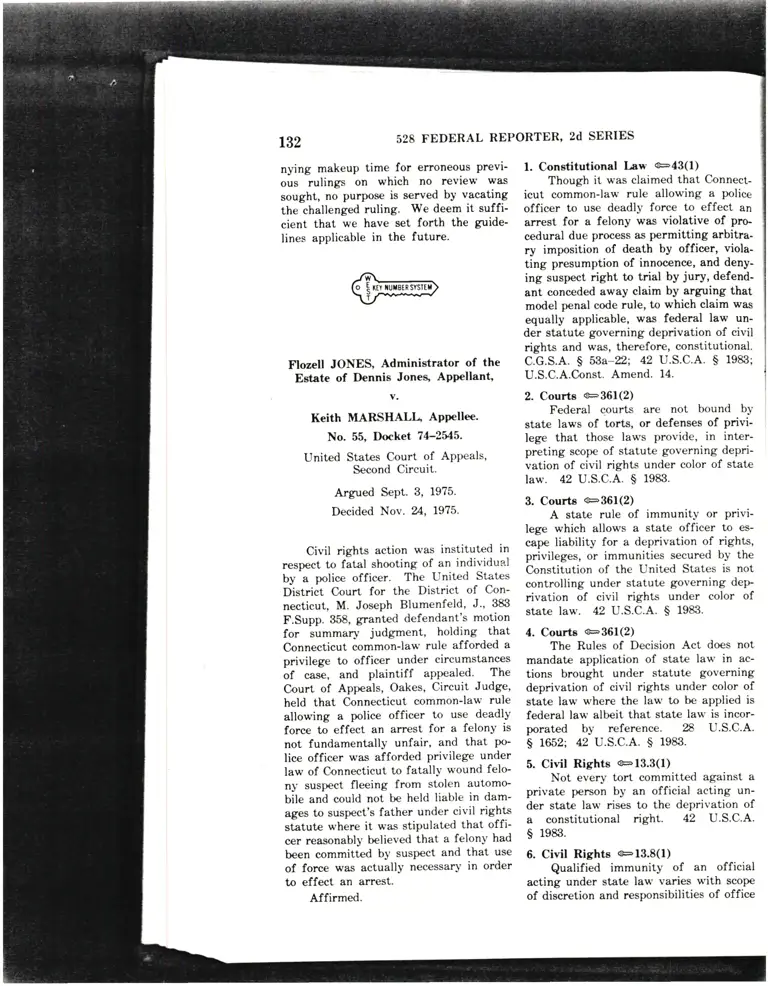
12 pages
-
Case Files, Garner Working Files. Jones v. Marshall Court Opinion, 1975. 5f71f39d-35a8-f011-bbd3-000d3a53d084. LDF Archives, Thurgood Marshall Institute. https://ldfrecollection.org/archives/archives-search/archives-item/a58e5d98-ca89-40ef-827c-b9437d53782a/jones-v-marshall-court-opinion. Accessed September 28, 2026.
Copied!
132 528 FEDERAL REPORTER, 2d SERIES
nying makeup time for erroneous previ
ous rulings on which no review was
sought, no purpose is served by vacating
the challenged ruling. We deem it suffi
cient that we have set forth the guide
lines applicable in the future.
I KEt NUMBER SYSTEM)
L T J
Flozell JONES, Administrator of the
Estate of Dennis Jones, Appellant,
V .
Keith MARSHALL, Appellee.
No. 55, Docket 74-2545.
United States Court of Appeals,
Second Circuit.
Argued Sept. 3, 1975.
Decided Nov. 24, 1975.
Civil rights action was instituted in
respect to fatal shooting of an individual
by a police officer. The United States
District Court for the District of Con
necticut, M. Joseph Blumenfeld, J., 383
F.Supp. 358, granted defendant’s motion
for summary judgment, holding that
Connecticut common-law rule afforded a
privilege to officer under circumstances
of case, and plaintiff appealed. The
Court of Appeals, Oakes, Circuit Judge,
held that Connecticut common-law rule
allowing a police officer to use deadly
force to effect an arrest for a felony is
not fundamentally unfair, and that po
lice officer was afforded privilege under
law of Connecticut to fatally wound felo
ny suspect fleeing from stolen automo
bile and could not be held liable in dam
ages to suspect’s father under civil rights
statute where it waa stipulated that offi
cer reasonably believed that a felony had
been committed by suspect and that use
of force was actually necessary in order
to effect an arrest.
Affirmed.
1. Constitutional Law ®=>43(1)
Though it was claimed that Connect
icut common-law rule allowing a police
officer to use deadly force to effect an
arrest for a felony was violative of pro
cedural due process as permitting arbitra
ry imposition of death by officer, viola
ting presumption of innocence, and deny
ing suspect right to trial by jury, defend
ant conceded away claim by arguing that
model penal code rule, to which claim was
equally applicable, was federal law un
der statute governing deprivation of civil
rights and was, therefore, constitutional.
C.G.S.A. § 53a-22; 42 U.S.C.A. § 1983;
U.S.C.A.Const. Amend. 14.
2. Courts e=361(2)
Federal courts are not bound by
state laws of torts, or defenses of privi
lege that those law's provide, in inter
preting scope of statute governing depri
vation of civil rights under color of state
law. 42 U.S.C.A. § 1983.
3. Courts <^361 (2)
A state rule of immunity or privi
lege which allow's a state officer to es
cape liability for a deprivation of rights,
privileges, or immunities secured by the
Constitution of the United States is not
controlling under statute governing dep
rivation of civil rights under color of
state law. 42 U.S.C.A. § 1983.
4. Courts ®=>361(2)
The Rules of Decision Act does not
mandate application of state law' in ac
tions brought under statute governing
deprivation of civil rights under color of
state law w'here the law’ to be applied is
federal law albeit that state law is incor
porated by reference. 28 U.S.C.A.
§ 1652; 42 U.S.C.A. § 1983.
5. Civil Rights 13.3(1)
Not every tort committed against a
private person by an official acting un
der state law rises to the deprivation of
a constitutional right. 42 U.S.C.A.
§ 1983.
6. Civil Rights 13.8(1)
Qualified immunity of an official
acting under state law varies w’ith scope
of discretion and responsibilities of office
133
®=43(1)
is claimed that Connect-
rule allowing a police
:adly force to effect an
ny was violative of pro-
iss as permitting arbitra-
death by officer, viola-
of innocence, and deny-
to trial by jury, defend-
ly claim by arguing that
rule, to which claim was
le, was federal law un-
■ning deprivation of civil
-herefore, constitutional.
2; 42 U.S.C.A. § 1983;
mend. 14.
(2)
rts are not bound by
ts, or defenses of privi-
laws provide, in inter-
statute governing depri-
ĥts under color of state
. § 1983.
[2)
of immunity or privi-
s a state officer to es-
a deprivation of rights,
nunities secured by the
he United States is not
statute governing dep-
rights under color of
.S.C.A. § 1983.
:2)
Decision Act does not
ion of state law’ in ac-
ider statute governing
dl rights under color of
the law to be applied is
that state law is incor-
'erence. 28 U.S.C.A.
:.A. § 1983.
= 13.3(1)
rt committed against a
7 an official acting un-
;s to the deprivation of
right. 42 U.S.C.A.
= 13.8(1)
munity of an official
e law varies with scope
responsibilities of office
and all circumstances as they reasonably
appear at time of action on w’hich liabili
ty is sought to be based. 42 U.S.C.A.
§ 1983.
7. Civil Rights 0=13.3(1)
Courts 0=361(2)
The federal courts are not Iwund by
whatever privilege a state law may af
ford to an official acting unrier state
law, but the federal courts are still by no
means free to elevate whatever view of
the privilege they feel may be jjreferable
to the constitutional level envisaged by
the statute governing dej>rivation of civil
rights. 42 U.S.C.A. § 1983.
8. Civil Rights '^13.4(2)
A use of force rule under statute
governing deprivation of civil rights
would neither permit brutal j>olice con
duct, nor allow such aj)plication of undue
force that police conduct shocks the con
science; such factors w’ould l)c analyzed
as the need for an application of force,
the relationship between the need and
the amount of force that was used, the
extent of injury inflicted, and whether
force was applied in a good-faith effort
or maliciously or sadistically. 42 U.S.
C.A. § 1983.
9. Civil Rights <s= 13.4(3)
A rule limiting privilege of a police
officer to use deadly force to effect an
arrest to situations where crime involved
causes or threatens death or injurious
bodily injury, or w'here there is substan
tial risk that person to l>e arrested will
cause death or serious lK)dily harm if his
apprehension is delayed would l>e prefer
able, but given history and current sta
tus of law of privilege, ready availability
of handguns to populace at large, and
needs of law enforcement in a society
where violence is W'ides[)read, rule can
not be codified as a federal standard to
w'hich all states would be subject. 42
U.S.C.A. § 1983.
tied rule as an arresting officer’s privi
lege to use deadlv force. 42 U S C A
§ 1983.
JONES V. MARSHALL
f i t p as 52S F.2d 132 (1975)
11. Arrest e=68
Connecticut common-law rule af
fording privilege to a police officer to
use force likely to cause death if he rea
sonably believes that a felony has been
committed by individual sought to be ap
prehended and that force is actually nec
essary to effect arrest is not fundamen
tally unfair. C.G.S.A. § 53a-22; 42 U.S
C.A. § 1983; U.S.C.A.Const. Amend. 14.
12. Assault and Battery ®=»64
Civil Rights «= 13.4(3)
Police officer was afforded privilege
under law of Connecticut to fatally-
wound felony suspect fleeing from stolen
automobile and could not be held liable
m damages to suspect’s father in civil
rights action where it was stipulated
that officer reasonably believed that a
felony had been committed by suspect
and that use of force was actually neces
sary in order to effect an arrest C G
S.A. § 53a-22; 42 U.S.C.A. § 1983; U.s’
C.A.Const. Amend. 14.
Louis I. Parley, West Hartford, Conn
(Bruce C. Mayor, Hartford, Conn., on the
brief), for appellant.
Robert Y. Pelgrift, Hartford, Conn.,
for appellee.
Before SMITH, MANSFIELD and
OAKES, Circuit Judges.
10. Civil Rights 13.4(3)
Within statute governing depriva
tion of civil rights, state must be given
some leeway in administration of the
systems of justice, at least insofar as
determining the scope of such an unset-
OAKES, Circuit Judge:
This appeal presents the question
whether a civil rights action lies, under
42 U.S.C. § 1983, against a jiolice officer
who, in the course of his duty, shoots
and kills a jKjrson who has committed a
felony and is trying to escajie arrest.
The crime involved here—auto theft—
did not involve conduct threatening use
of deadly force; nor was there, at the
time of the shooting, substantial risk
that the person fleeing arrest w’ould
cause death or serious bodily harm to
anyone if his apprehension w-ere delayed.
The United States District Court for the
District of Connecticut, M. Joseph Blu-
134 528 FEDERAL REPORTER, 2d SERIES
menfeld, Judge, granted the defendant
police officer’s motion for summary
judgment, holding that the Connecticut
common law rule as stated in JVfarty'n v.
Donlin, 151 Conn. 402, 198 A.2d 700
(1964), affords a privilege, in the circum
stances of this case, to an officer using
deadly force who reasonably believes
such force is necessary to effect an ar
rest for a felony. Judge Blumenfeld
ruled that since the Connecticut privilege
is not unconstitutional, it affords a de
fense to the § 1983 action for depriva
tion of the fleeing persons’s life without
due process of law. 383 F.Supp. 358
(D.Conn.l974).' We affirm.
The parties have stipulated the follow
ing facts. On August 29, 1969, Officer
Marshall of the West Hartford Police
Department w'as cruising in his patrol
car in the ordinary course of his duties.
While on patrol he observed a Cadillac
automobile occupied by three Negro
males, including the appellant s decedent,
Dennis Jones, traveling in the vicinity of
the Hartford Golf Club. Through radio
contact wdth headquarters, Marshall re
ceived the information that the Cadillac
had been reported as stolen, so he began
to follow it as it drove through the Golf
Club and adjacent streets. Both cars
proceeded for several blocks, neither ex
ceeding 35 to 40 miles per hour nor vio
lating any traffic regulations. While
following the car Officer Marshall did
not activate his siren or warning light or
make any attempt to cause the car to
come to a stop. He w’as then informed
over his radio that assistance from the
Hartford Police Department was on the
way.
Evidently the individuals in the Cadil
lac became aware that they were being
followed because after circling back onto
Mark Twain Drive from Dillon Road,
they accelerated to about 80 miles per
hour and drove north on Mark Twain
Drive. After traveling several blocks at
that speed the car reached the end of
the Mark Twain Extension and skidded
to a halt. Officer Marshall, who had
followed, also came to a sliding stop, and
the braking of both cars created a large
cloud of dust. The officer alit from his
cruiser ŵ ith his weapon drawn. Since
the occupants of the car were not imme
diately visible he climbed to the top of a
nearby embankment. At that point he
observed two men running" across an
open field and called to them to halt.
They momentarily turned to face him,
but then turned and began to run away
toward a nearby wooded area. Without
firing a warning shot or attempting any
further means of apprehension. Officer
Marshall fired his gun at Dennis Jones,
who was then about 125 feet away
across rough terrain which contained a
gully and was covered with bushes and
underbrush. The shot was aimed at the
decedent’s leg, but struck him in the left
buttock, causing internal injuries which
resulted in his death. It is stipulated
that neither Dennis Jones nor the other
two occupants of the car, all of whom
were minors approximately 16 years old,
were armed or had specifically threat
ened ̂ physical injury in any manner to
Officer Marshall or anyone else. It is
also stipulated that the automobile pur
suit did not endanger any other individu
al than the occupants, although had the
chase continued obviously it might have.®
1. The action originally named the Town of
West Hartford and its police chief and town
manager, but the action was dismissed as to
them. Cf. City of Kenosha v. Bruno. 412 U.S.
507, 93 S.Ct. 2222, 37 L.Ed.2d 109 (1973);
Moor V. County of Alameda, 411 U.S. 693, 93
S.Ct. 1785, 36 L.Ed.2d 596 (1973).
2. It may be noted that both of the young men
in the car with Dennis Jones were arrested by
the Hartford police on the day following the
auto theft and shooting. Neither was charged
with a felony; the charge against one was
ultimately dropped and the other pleaded
guilty to a misdemeanor charge and received a
suspended sentence.
3. It does not appear from the stipulation
whether Jones was the driver or a passenger
of the Cadillac. Nor does it appear what his
age was, although appellants brief states that
he was 16 years old. It also does not appear
what caliber revolver Officer Marshall w’as us
ing or the extent of his training in marksman
ship.
tIES
individuals in the Cadil-
ire that they were being
e after circling back onto
•rive from Dillon Road,
i to about 80 miles per
! north on Mark Twain
•aveling several blocks at
car reached the end of
n Extension and skidded
ficer Marshall, who had
ime to a sliding stop, and
both cars created a large
The officer alit from his
s weapon drawn. Since
r the car were not imme-
e climbed to the top of a
ment. At that point he
men running across an
called to them to halt,
•ily turned to face him,
and began to run away
̂ wooded area. Without
I shot or attempting any
of apprehension. Officer
lis gun at Dennis Jones,
about 125 feet away
rrain which contained a
jovered with bushes and
le shot was aimed at the
lut struck him in the left
' internal injuries which
death. It is stipulated
nnis Jones nor the other
)f the car, all of whom
moximately 16 years old,
had specifically threat-
njury in any manner to
1 or anyone else. It is
hat the automobile pur-
mger any other individu-
ipants, although had the
obviously it might have.’
;d and the other pleaded
leanor charge and received a
:e.
)pear from the stipulation
IS the driver or a passenger
“Jor does it appear what his
appellants brief states that
)ld. It also does not appear
ver Officer Marshall was us-
3f his training in marksman-
It was agreed by the parties that the
law in Connecticut at the time of the
shooting in this case was that theft of a
motor vehicle was a felony offense
Conn.Gen.Stat. § 53a-119," but that joy
riding was only a misdemeanor. Conn.
Gen.Stat. § 14-229 (use without owner’s
permission).’ The common law rule in
Connecticut is that an arresting officer
may use such force as he reasonably be
lieves to be necessary under all of the
circumstances to effect a legal arrest
and to prevent an escape. The use of
force likely to cause death, however is
privileged only if the officer reasonably
4. Larceny of any automobile is now a "Class
D” felony. Conn.Gen.Stat. § 53a 123. Under
a complicated formula set forth in Conn.Gen
Stat. § 53a-35(b)(4), Class D felonies carr\- a
maximum sentence of five years. While the
parties stipulated that the offense was a felonv
at the time of the shooting, the stipulation
erroneously refers to Conn.Gen.Stat. § 53a 47
a provision dealing with acquittal on grounds
of mental disease or defect. The crime was,
however, a felony under Conn.Gen.Stat § 53a
57. See State v. Keeby. 159 Conn. 201, 268
A.2d 652 (1970), cert, denied, 400 U.S. 1010 91
s et. 569, 27 L.Ed.2d 623 (1971). The automo
bile theft provision in the Connecticut code
now appears as Conn.Gen.Stat. § 53a-119
5. Conn.Gen.Stat. § 53a 25(a) defines a felony
as an offense “ for which a person may be
sentenced to a term of imprisonment in excess
of one year , The statute also pro
vides that any offense defined in anv other
section of the Connecticut General Statutes
which “ by virtue of any expressly specified
sentence, is within the definition set forth in
subsection (a) shall be deemed an unclassified
felony.” Id. § 53a-25(c). Since “joyriding" is
punishable by a prison sentence of up to one
year for a first offense, up to 10 years for a
second offense and up to 15 years for a third
offense, id. § 14-229, it is somewhat of a hy
brid for the purpose of making this classifica
tion. However, as to first offenses, unauthor
ized use of a motor vehicle would appear to
constitute only a misdemeanor. See id (> 53a-
26(c).
6. At least as of 1974, the Connecticut State
Police Rules §§ 20-29 limit the use of deadly
force to two situations: (1) where the felony is
one involving risk of serious bodily harm and
(2) where there is a risk that the felon’s efforts
to escape will cause harm to the officer or
others. Apparently the West Hartford Police
Department had issued a Training Bulletin
(Oct. 27, 1967), directing officers not to shoot
at a motor vehicle (or presumably its occu-
JONES V. MARSHALL
Cite as52S F.2d 132 (1975) 135
believes that a felony has been commit
ted by the individual sought to be ap
prehended and the force used was actu
ally and reasonably believed by him in
good faith to be necessary to effect the
arrest. See Martyn v. Donlin, supra, 151
Conn, at 411-12, 198 A.2d at 705-06.’
During a codification and revision of
Connecticut’s criminal laws occurring
after the facts in this case, the Martyn
rule was retained and codified as a part
of the Connecticut criminal law.’
The appellant’s argument involves two
simple steps. First, that in actions
pants) except in those limited circumstances.
It does not appear fronr the stipulation of
facts, however, whether Officer Marshall was
aware of this Bulletin or of the extent of its
effect.
7. Conn.Gen.Stat. § 53a-22 provides in part:
(a) For purposes of this section, a reason
able belief that a person has committed an
offense means a reasonable belief in facts or
circumstances which if true would in law
constitute an offense. If the believed facts
or circumstances would not in law constitute
an offense, an erroneous though not unrea
sonable belief that the law is otherwise does
not render justifiable the use of physical
force to make an arrest or to prevent an
escape from custody. A peace officer or an
authorized official of the department of cor-
rection who is effecting an arrest pursuant
to a warrant or preventing an escape from
custody is justified in using the physical
force prescribed in subsections (b) and (c)
unless such warrant is invalid and is known
by such officer to be invalid.
(b) Except as provided in subsection (a), a
peace officer or authorized official of the
department of correction is justified in using
reasonable physical force upon another per
son when and to the extent that he reason
ably believes it necessary to:
(1) Effect an arrest or to prevent the es
cape from custody of a person whom he
reasonably believes to have committed an
offense, unless he knows that the arrest or
custody is unauthorized: or
(2) defend himself or a third person from
the use or imminent use of physical force
while effecting or attempting to effect an
arrest or while preventing or attempting to
prevent an escape.
(c) A peace officer or authorized official of
the department of correction is justified in
using deadly physical force upon another
person for the purposes specified in subsec-
528 FEDERAL REPORTER, 2d SERIES
brought under the federal civil rights
statutes the law to be applied is federal
law—while reference may be made to
state or other law consistent with the
United States Constitution, it is not
mandatory, as a matter of choice of law,
that state law be applied. Second, fed
eral decisions and modern fx>licy indicate
that the federal rule to be applied in
actions under the federal civil rights
statutes, e. g., 42 U.S.C. §§ 1983, 1985(3),
is that use of deadly force is not jjermis-
sible in the case of any escape where a
felony has been committed except in a
few' limited situations essentially embod
ied in ALI Model Penal Code § 3.07 (Pro
posed Official Draft 1962).* Ap)pellant
argues that the use of force is justifiable
“ only where the arresting officer l>e-
lieves that (1) the crime for w’hich the
arrest is made involved conduct includ
ing the use or threatened use of deadly
force, or (2) there is a substantial risk
that the person to be arrested w'ill cause
death or serious bodily harm if his ap
prehension is delayed.” Id.
[1] Appellant further argues that the
common law rule in Connecticut lacks
logical support, is based upon historically
outmoded concepts of outlaw'ry and trial
by ordeal and has been uniformly disap
proved by scholars.® In contrast, appel
lant argues, the Model Penal Code rule.
tion (b) only when he reasonably believes
that such is necessary to:
(1) Defend himself or a third person from
the use or imminent use of deadly physical
force; or
(2) effect an arrest or to prevent the es
cape from custody of a person whom he
reasonably believes has committed or at
tempted to commit a felony.
8. The ALI Model Penal Code § 3.07 (Proposed
Official Draft 1962) makes the following pro
posal for the use of force in law enforcement:
(1) Use o f force justifiable to effect an ar
rest. Subject to the provisions of this Sec
tion and of Section 3.09, the use of force
upon or toward the person of another is jus
tifiable when the actor is making or assist
ing in making an arrest and the actor be
lieves that such force is immediately neces
sary to effect a lawful arrest.
(2) Limitations on use o f force.
(a) The use of force is not justifiable un
der this Section unless:
(i) the actor makes known the purpose of
the arrest or believes that it is otherwise
known by or cannot reasonably be made
known to the person to be arrested; and
(ii) when the arrest is made under a war
rant, the warrant is valid, or believed by the
actor to be valid.
(b) The use of deadly force is not justifia
ble under this Section unless:
(i) the arrest is for a felony; and
(ii) the person effecting the arrest is au
thorized to act as a peace officer or is assist
ing a person whom he believes to be autho
rized to act as a police officer; and
(iii) the actor believes that the force em
ployed creates no substantial risk of injury
to innocent persons; and
(iv) the officer believes that:
(1) the crime for which the arrest is made
involved conduct including the use or threat
ened use of deadly force; or
(2) there is a substantial risk that the per
son to be arrested will cause death or seri
ous bodily harm if his apprehension is de
layed.
9. The claim is also made that the Connecticut
rule violates the due process clause of the
Fourteenth Amendment because, procedurally
speaking, it permits the arbitrary imposition of
death by the officer, violates the presumption
of innocence, and denies the suspect a right to
trial by jury. Of course each of the due proc
ess arguments would apply equally where
deadly force is allowed to effect an arrest for a
crime which does involve “ conduct including
the use or threatened use of deadly force” or
where "there is a substantial risk that the per
son to be arrested will cause death or serious
bodily harm if his apprehension is delayed.”
ALI, note 8 supra, § 3.07(b)(iv). The killing by
the police officer in such a case would, as
much as the killing here, deprive the escapee
of his life without any procedural guarantees.
It would also raise the Eighth Amendment im
plications regarding arbitrary imposition of the
death penalty sanction set forth in Furman v.
Georgia, 408 U.S. 238, 92 S.Ct. 2726, 33
L.Ed,2d 346 (1972), due to the indiv'idual ar
resting officer’s discretion in his exercise of
the power to kill. Thus, by arguing that the
Model Penal Code rule is federal law under 42
U.S.C. § 1983, and is therefore constitutional,
the appellant has conceded away, as Judge
Blumenfeld held, his procedural due process
and Furman arguments; death under Model
Penal Code situations could surely be argued
to be equally arbitrary and without procedural
safeguards. We need not, and therefore do
not, consider the argument further.
lES
use of force is justifiable
le arresting officer be-
,he crime for which the
involved conduct includ-
-hreatened use of deadly
2re is a substantial risk
to be arrested will cause
i bodily harm if his ap-
layed.” Id.
further argues that the
le in Connecticut lacks
s based upon historically
(ts of outlawry and trial
IS been uniformly disap-
trs.® In contrast, appel-
Model Penal Code rule,
for which the arrest is made
:t including the use or threat-
adly force; or
substantial risk that the per-
;ted will cause death or seri-
m if his apprehension is de-
so made that the Connecticut
■ due process clause of the
idment because, procedurally
its the arbitrary imposition of
cer, violates the presumption
I denies the suspect a right to
course each of the due proc-
would apply equally where
lowed to effect an arrest for a
s involve "conduct including
ened use of deadly force" or
substantial risk that the per-
d will cause death or serious
is apprehension is delayed.”
, § 3.07(b)(iv). The killing by
r in such a case would, as
ng here, deprive the escapee
it any procedural guarantees,
e the Eighth Amendment im-
ng arbitrary imposition of the
iction set forth in Furman v.
S. 238, 92 s e t . 2726, 33
2), due to the individual ar-
discretion in his exercise of
Thus, by arguing that the
; rule is federal law under 42
id is therefore constitutional,
5 conceded away, as Judge
his procedural due process
jments; death under Model
lions could surely be argued
trary and without procedural
need not, and therefore do
argument further.
JONES V. MARSHALL
Cite as 52S F.2d 132 (IfiT.'ji
137
which has been adopted in form or sul>-
stance in a number of states by statute,'"
is consistent with the laws and Constitu
tion of the United States and the needs
of law enforcement {xirsonnel. He
therefore concludes that the rule of the
Model Penal Code should be adojited in
this case under 42 U.S.C. § 1983.
The appellee s position is less complex.
He assumes that since the challenged
law of Connecticut, as expressed in Mar-
tyn V. Donlin, supra, and in the new
Connecticut Penal Code, is constitutional,
in that it does not “shock the con
science,” Rochin v. California, 342 U.S
165, 72 S.Ct. 205, 96 L.Ed. 183 (1952);
United States v. Toscanino, 500 F.2d 267,
273 (2d Cir. 1974), or otherwise offend
any constitutional principle, it is there
fore the applicable rule in the case. This
was the position taken by Judge Blu-
menfeld in his decision below. 383
F.Supp. at 362.
[2-4] With this view, however, we
cannot agree. It has long been under
stood that in interpreting the scope of
§ 1983 we are not bound by the state
law of torts or the defenses of privilege
that law provides. In an unbroken line
of Supreme Court cases which includes
Ex parte Virginia, 1(X) U.S. 339, 346, 25
L.Ed. 676 (1879); United States v. Clas
sic, 313 U.S. 299, 326, 61 S.Ct. 1031, 85
L.Ed. 1368 (1941); Screws i’. United
States, 325 U.S. 91, 109-11, 65 S.Ct. 1031
89 L.Ed. 1495 (1945); Williams v. United
States, 341 U.S. 97, 71 S.Ct. 576, 95 L.Ed.
774 (1951); Monroe v. Pape, 365 U.S.
167, 183-87, 81 S.Ct. 473, 5 L.Ed.2d 492
(1961); Pierson i-. Ray, 386 U.S. 547, 87
S.Ct. 1213, 18 L.Ed.2d 288 (1967), knd
Scheuer v. Rhodes, 416 U.S. 232, 237-38
94 S.Ct. 1683, 40 L.Ed.2d 90 (1974), the’
conduct of police officers and other state
10. E.g.. Ill.Ann.Stat., ch. 38, § 7-5 (Smith-Hurd
1962); N.H.Rev.Stat.Ann. § 627:5 (1971)- 18
C.P.S.A. § 508 (1972).
11. The Rules of Decision Act, 28 U.S.C.
§ 1652, does not require a different result. It
provides that "[t]he laws of the several states,
except where the Constitution or treaties of
the United States or Acts of Congress other
wise require or provide, shall be regarded as
rules of decision in civil actions in the courts
528 F.2d— j
officials has, bofh civilly (Monroe, Pier
son, Scheuer) and criminally (Classic,
Screws, Williams), licen held subject to
standards demanded by the Constitution
of the United .States, regardless o f ap
probation by .state law." This is neces
sarily so becjuise one of the principal
purposes underlying the Civil Rights
Acts of 1871 and 1875 was to protect
individuals against “ (mjisuse of fxiwer,
possessetl by virtue of state law and
made possible only because the wrong
doer is clothed with the authority of
state law .” United States v.
Classic, suj>ra, 3)3 U.S. at 326, 61 S.Ct.
at 1043. .See ) H. Schwartz, Statutory
Historj’ of the United States: Civil
Rights 591 6.53 (1970 ed.). See generally
Monroe v. Pajx', sujma, 365 U.S. at 173,
81 S.Ct. 473. The phrase in Section 1 of
the Act of April 20, 1871, 17 Stat. 13
(known as Civil Rights Act of 1871 and
also as “ the Ku Klux Act” ), as amended,
42 U.S.C. § 198.3, which provides for lia
bility, “ any law, statute, ordi
nance, regulation, custom or usage of the
State to the contrary notwithstanding,”
makes this patently clear. A state rule
of immunity or j)rivilege which allows a
state officer to e.scape liability for a dep
rivation of “ rights, jjrivileges, or immu
nities secured by the Constitution of the
United StaU;s” is sim{)ly not controlling
under 42 U..S.C. § 1983.
[5] At the sanje time not every tort
committed agminst a private {>erson by
an official acting und<T state law rises to
the deprivatiofi of a constitutional right;
that is to say , there is no “general feder
al tort law .” Griffin i\ Breck-
enridge, 403 U.S. 8K, 102, 91 S.Ct. 1790,
29 L.E<I.2<I 338 (1971) (interpreting
§ 1985(3), derivc-d from § 2 of the Act of
April 20, 1871, 17 .Stat. 13). For exam-
of the United Stat<-v, in cases where they ap
ply.” However, th<- Rules of Decision Act
does not mandate application of state law in
actions brought und<-r 42 U.S.C. § 1983 where
the law to be applied is federal law, even if
state law is incorfFirated by reference as a
part of that law Construction and elaboration
of the reach of (, 1983 is an issue of federal
law.
pie, state legislators’ immunity, Tenney
V . Brandhove, 341 U.S. 367, 71 S.Ct. 783,
95 L.Ed. 1019 (1951), and judges’ immu
nity, Pierson v. Ray, supra, 386 U.S. at
553-55, 87 S.Ct. 1213, each established at
common law, have survived the enact
ment of § 1983. The latter, in fact, has
been adopted as federal common law.
Bradley v. Fisher, 80 U.S. (13 Wall.) 335,
351, 20 L.Ed. 646 (1872). But Pierson v.
Ray, supra, 386 U.S. at 555, 87 S.Ct.
1213, points out that police officers never
had an absolute and unqualified immuni
ty at common law. In that case the
Supreme Court did recognize a limited
privilege under § 1983 in a false arrest
situation where the arrest was made in
good faith under a statute later held un
constitutional. The Court expressly up
held “ the defense of good faith and
probable cause available to
the officers in the common-law action
for false arrest and imprisonment
. .’’ 386 U.S. at 557, 87 S.Ct. at
1219. In so doing, the Court looked to
“ the prevailing view in this country, cit
ing general sources, such as the Restate
ment (Second) of Torts § 121 (1965), and
1 Harper & James, The Law of Torts
§ 3.18 (1956). 386 U.S. at 555, 87 S.Ct.
at 1218. It is true that the court in
Pierson referred to the expansive lan
guage of Monroe v. Pape, supra, 365 U.S.
at 187, 81 S.Ct. 473, which states that
§ 1983 “should be read against the back
ground of tort liability that makes a
man responsible for the natural conse
quences of his actions.” Pierson v. Ray,
supra, 386 U.S. at 556, 87 S.Ct. at 1219.
The opinion modified that phrase, how
ever, to recognize some affirmative de
fenses under § 1983, sajdng Part of the
background of tort liability, in the case
of police officers making an arrest, is the
defense of good faith and probable
cause.” 386 U.S. at 556—5/, 87 S.Ct. at
1219.
[6] So, too, in discussing the qualified
immunity of the executive branch of a
state government, the Supreme Court
has referred to a variety of general
sources—English common law and stat
utes, federal and state cases—to support
an immunity which varies with “ the
scope of discretion and responsibilities of
the office and all the circumstances as
they reasonably appeared at the time of
the action on which liability is sought to
be bsised.” Scheuer v. Rhodes, supra,
416 U.S. at 247, 94 S.Ct. at 1692; see
also id. at 239 n. 4, 240^9.
[7] W’hile we are, then, not bound by
whatever privilege state law may afford
to the officer we still are by no means
free to elevate whatever view of the
privilege we think to be preferable to
the constitutional level envisaged by
§ 1983. Rather, with only the example
of Pierson and Scheuer before us we
must make a studied attempt to weigh
the competing interests in the light of
historical and current cases and commen
tary to arrive at a scope of the privilege
to use deadly force in particular instanc
es.
Initially we should point out that we
agree wdth appellant that the problem of
determining the appropriate rule of priv
ilege for the use of force by arresting
officers is complicated by the fact that
the common law rule evolved when only
a few crimes were felonies, and all of
them involved force or violence (arson,
burglary, robbery, rape, murder, man
slaughter) and were punishable by death
and forfeiture of lands and goods. See
ALL Model Penal Code § 3.07, Comment
3 at 56 (Tent. Draft No. 8, 1958). (“ Such
rational justification for the common law
rule as can be adduced rests largely on
the fact that virtually all felonies in the
common law period were punishable by
death.” ) But see Note, Justification for
the Use o f Force in the Criminal Lav.-, 13
Stan.L.Rev. 566, 572-82 (1961). Many
American jurisdictions, Connecticut in
cluded, have of course expanded the
number of felonies to include numerous
crimes not involving force or violence,
crimes which relate to property and to
compliance with complex governmental
regulations (e. g., income tax fraud). As
the scope of “ felony” crimes has expand
ed wholly away from the concept of vio
lence which underlay its common law or
igin, the use of the felony label to justi-
hich varies with “the
n and responsibilities of
,11 the circumstances as
appeared at the time of
ich liability is sought to
leuer v. Rhodss, supra,
94 S.Ct. at 1692; see
L 4, 240-49.
are, then, not bound by
ge state law may afford
■e still are by no means
whatever view of the
ink to be preferable to
lal level envisaged by
with only the example
Scheuer before us we
tudied attempt to weigh
interests in the light of
irrent cases and commen-
t a scope of the privilege
mce in particular instanc-
should point out that we
Bllant that the problem of
; appropriate rule of priv-
ise of force by arresting
plicated by the fact that
w rule evolved when only
were felonies, and all of
force or violence (arson,
lery, rap>e, murder, man-
were punishable by death
of lands and goods. See
nal Code § 3.07, Comment
Draft No. 8, 1958). (“ Such
cation for the common law
? adduced rests largely on
virtually all felonies in the
period were punishable by
see Note, Justification for
rce in the Criminal Law, 13
,66, 572-82 (1961). Many
•isdictions, Connecticut in-
of course expanded the
lonies to include numerous
ivolving force or violence,
relate to property and to
nth complex governmental
i. g-, income tax fraud). As
‘felonv” crimes has expand
ay from the concept of vio-
m'derlay its common law or-
of the felony label to justi-
JONES v. M
Cite as 528 F.2<
fv especially severe police behavior has
j^-come increasingly strained. As stated
, Judge McCree in his concurring opin
ion in Beech v. Melancon, 465 F.2d 425,
426-27 (6th Cir. 1972), cert, denied, 409
US. 1114, 93 S.Ct. 927, 34 L.Ed.2d 696
(1973):
I would find it difficult to
uphold as constitutional a statute that
allowed police officers to shoot, after
an unheeded warning to halt, a fleeing
income tax evader, antitrust law vio
lator, selective service delinquent, or
other p>erson whose arrest might be
sought for the commission of any one
of a variety of other felonies of a tjqse
not normally involving danger of
death or serious bodily harm.
[8] The elementary requirements of a
use of force rule under § 1983 must be
that it neither permits “ brutal police
conduct,” Rosenberg v. Martin, 478 F.2d
520, 526 (2d Cir.), cert, denied, 414 U.S.
872, 94 S.Ct. 102, 38 L.Ed.2d 90 (1973),
nor allows such “ application of undue
force” that the police conduct “ shocks
the conscience.” Johnson v. Click, 481
F.2d 1028, 1032, 1033 (2d Cir.), cert, de
nied, 414 U.S. 1033, 94 S.Ct. 462, 38
L.Ed.2d 32 (1973) (holding that a § 1983
action lies by a prison inmate for an
unprovoked attack by a guard). As
Judge Friendly pointed out in Johnson,
while the oft-quoted language from Ro-
chin gains added content from other lan
guage in the opinion, i t is not exactly
precise. We must analyze such factors
as “ the need for the application of force,
12. See also Chief Justice Burger’s comment in
Bivens v. Six Unknown Named Agents o f Fed
eral Bureau o f Narcotics, 403 t).S. 388, 419, 91
S.Ct. 1999, 2016, 29 L.Ed.2d 619 (1971) (dis
senting opinion);
Freeing either a tiger or a mouse in a
schoolroom is an illegal act, but no rational
person would suggest that these two acts
should be punished in the same way. From
time to time judges have occasion to pass on
regulations governing police procedures. 1
wonder what would be the judicial response
to a police order authorizing "shoot to kill”
with respect to every fugitive. It is easy to
predict our collective wnath and outrage.
We, in common with all rational minds,
would say that the police response must re-
ARSHALL
:d 132 (1975)
the relationship between the need and
the amount of force that was used, the
extent of injury inflicted, and whether
force was applied in a good faith effort
or maliciously or sadistically
. .” Johnson v. Click, supra, 481
F.2d at 1033. Judge Friendly’s com
ments were, to be sure, made in the
course of determining whether a claim
was stated rather than whether a privi
lege existed. However, a privilege, sim
ply stated, is a rule of law exempting
one from liability for conduct which
would otherwise subject him to it. Re
statement (Second) of Torts § 10 (1965).
This is no different from saying that
privileged conduct is not tortious. See
id. Comment a. Thus, whether we ap
proach the case from the standpoint of
Judge Friendly in Johnson, where the
issue was whether the conduct was tor
tious, or from the standpoint of privi
lege, where the issue is whether the con
duct is not tortious, the analytical fac
tors must be the same.
[9] We find in this case that a num
ber of legislatures, but few if any courts
on their own initiative, have analyzed
the factors just discussed and have mod
erated the harshness of the old common
law view. There is, in short, a discerni
ble trend in this century away from al
lowing the use of deadly force by a po
lice officer in effecting a felon’s arrest.
But this trend is not so momentous or
compielling as to require us to recognize
a § 1983 action to lie in the situation of
this case. This is to say that we do not
late to the gravity and need; that a "shoot”
order might conceivably be tolerable to pre
vent the escape of a convicted killer but
surely not for a car thief, a pickpocket or a
shoplifter.
13. The acts must do more than "offend some
fastidious squeamishness or private senti
mentalism about combatting crime too ener
getically” ; they must be such as “ to offend
even hardened sensibilities” [Rochin v. Cali
fornia. 342 U.S. 165, 172, 72 S.Ct. 205, 96
L.Fd. 183 (1952)], or constitute force that is
“ brutal” and “ offensive to human dignity.”
342 U.S. at 174, 72 S.Ct. 205.
Johnson v. Click, 481 F.2d 1028, 1033 n. 6 (2d
Cir.), cert, denied, 414 U.S. 1033, 94 S.Ct. 462,
38 L.Ed.2d 32 (1973).
140 528 FEDERAL REPORTER, 2d SERIES
believe that our responsibility to g-ive ef
fect to the important civil rights protect
ed by § 1983 provides us with a suffi
cient mandate to provide a remedy in
this case by rejecting the rule of privi
lege developed by the state to further its
ow'n important objective of enforcing its
penal law. The preferable rule would
limit the privilege to the situation where
the crime involved causes or threatens
death or serious bodily harm, or where
there is a substantial risk that the per
son to be arrested will cause death or
serious bodily harm if his apprehension is
delayed. But we are not satisfied, given
the history and current status of the law
of privilege, the ready availability of
handguns to the populace at large (in
cluding nonviolent felons), and the needs
of law enforcement in a society where
violence is widespread, that we can or
should impose that view through § 1983
as a federal standard to which all states
would be subject. We are aware, more
over, that to do so in this case, where
the Connecticut Supreme Court has fair
ly recently (1964) taken the contrary
view, a view’ w’hich has even more
recently (1971) expressly been preserved
in a legislative recodification of the state
criminal law, would be to deny the offi
cer the defense of good faith reliance
upon the law of his state.**
The question of use of deadly force in
' ** arises here in thepreventing escape
14. We would not incorporate the felony/mis
demeanor distinction into this rule, for a felo
ny is usually based merely on the length of
sentence involved, and some misdemeanors in
volve conduct more dangerous than many felo
nies. See ALI, Model Penal Code § 3.07, Com
ment 3, at 56 (Tent. Draft No. 8, 1958).
15. A defense which, however, might be less
available to him as a result of the West Hart
ford Police Department Training Bulletin, note
4 supra. This possibility has not, however,
been explored by appellant, and our record
comes to us with a stipulation that Officer
Marshall had acted in good faith See note 24
infra.
16. A question which is distinct from the use of
deadly force in effectuating arrest, where force
may clearly be used to counter force. ALI,
Model Penal Code § 3.07, Comment 3, at 56 &
n. 3 (Tent. Draft No. 8, 1958).
narrow context w’here there is no belief
in its necessity for the protection of the
officer or of any innocent third persons.
In this context, we find the history of
the treatment afforded the officer s f>riv-
ilege by the American Law Institute to
be enlightening.'* The first Restatement
of Torts § 131 (1934) extended that priv
ilege only to arrests for treason or a
felony which normally causes or threat
ens death or serious bodily harm, or
w’hich involves the breaking and entry of
a dwelling place. Official Comment h to
§ 131 of the Restatement stated that
deadly force was not privileged for every
common law felony,'* that crimes are in
discriminately labeled as felonies or mis
demeanors, and that it would “ be mon
strous to make the privilege
depend upon the word used by the legis
lature in describing the offense or upon
the penalty attached to its commission.”
This conclusion was felt to be particular
ly forceful in light of the fact that the
force used imperils the suspect as w’ell as
the guilty. Id. at 305. This rule of the
first Restatement of Torts, which ap
proximates the one advocated by appel
lant, was, however, overturned by the
ALI in 1948. Restatement of the Law,
1948 Supplement, Torts § 131, at 628 et
seq. (1949). The revised rule w'ould per
mit the privilege where the arrest is for
treason or any felony which has been
committed, if the actor reasonably be
lieves the offense was committed by the
17. WTiile ALI sanction of a rule even when
coupled with American Bar Association and
other distinguished endorsement may be help
ful, see Pierson v. Ray, 386 U.S. 547, 87 S.Ct
1213, 18 L.Ed,2d 288 (1967), it is no guarantee
of constitutionality. See Griffin v. California.
380 U.S. 609, 85 S.Ct. 1229, 14 L.Ed.2d 106
(1965); id. at 722 & nn. 6-8 (Stewart, J.. dis
senting).
18. Blackstone's view was to the contrary. He
believed a homicide to be justifiable "[w]here
an officer, or a private person, attempts to
take a man charged wnth a felony and is resist
ed, and in the endeavor kills him." Black-
stone’s Commentaries, bk. 4, ch. XIV, at 827
(Gavit ed. 1941). The only qualification placed
on the common law rule by Blackstone was
that “ there must exist an apparent necessiU
on the officer’s side that the part\
could not be arrested” without the use oi
deadly force. Id
[ES
where there is no belief
or the protection of the
■ innocent third j:)ersons.
we find the history of
forded the officer’s priv-
erican Law Institute to
' The first Restatement
934) extended that priv-
•rests for treason or a
•mally causes or threat-
jrious bodily harm, or
e breaking and entry of
Official Comment h to
estatement stated that
not privileged for every
ny,'* that crimes are in-
>eled as felonies or mis-
-hat it would “ be mon-
the privilege
word used by the legis-
ng the offense or upon
hed to its commission.”
as felt to be particular-
lit o f the fact that the
s the suspect as well as
: 305. This rule of the
t of Torts, which ap-
le advocated by appel-
er, overturned by the
statement of the Law,
Torts § 131, at 628 e t
•evised rule would per-
W’here the arrest is for
elony which has been
actor reasonably be-
was committed by the
tion of a rule even when
rican Bar Association and
endorsement may be help-
Ra.v, 386 U.S. 547, 87 S.Ct.
8 (1967), it is no guarantee
See Griffin v. California.
i.Ct. 1229, 14 L.Ed.2d 106
!e nn. 6-8 (Stewart, J., dis-
V was to the contrary. He
to be justifiable “ [w]here
ivate person, attempts to
with a felony and is resist-
leavor kills him." Black-
es. bk. 4, ch. XIV, at 827
le only qualification placed
V rule by Blackstone was
cist an apparent necessity
’ . that the party
ted” without the use of
JONES V. MARSHALL
Cite as 528 F.2(l 132 (1075)
141
other and that the arrest cannot other
wise be effected.'* The notes of the re
porter for the 1948 revision. Professor
Eldredge, criticize the reliance by the
earlier reporter. Professor Bohlen, on one
of three dicta from early American case
law. Professor Eldredge flatly states
that Comment h of § 131 of the first
Restatement (and its accompanying illus
trations) has “ no authority” to support
it. He cites five cases decided since 1926
contrary to § 131,2" concludes that
“ [n]o case has been found which has cit
ed § 131 or w'hich is in accord with it.”
Restatement of the Law, 1948 Supple
ment, supra, at 633.2' While the report
er to the 1948 revision allows that § 131
of the first Restatement is a “desirable
rule of law,” Restatement of the Law,
1948 Supplement, supra, at 634, the revi
sion is necessary in a “ Restatement of
existing authorities” since “ [ejvery case
which decides the question
agrees that the original English common
law is still the law.” Id., but see note 21
supra. It is in this context that the
Model Penal Code was adopted by the
American Law Institute in 1962. In this
Code there are comments which refer to
the common law distinction between fel
ony and misdemeanor crimes for the
purpose of determining the scope of the
19. If the arrest were made under a warrant for
a felony' the use of deadly force was privileged
so long as the person named in the warrant
was being arrested and the officer reasonably
believed the arrest could not otherwise be ef
fected. Restatement of the Law, 1948 Supple
ment, Torts § 131 (1949),
20. The most frequently cited of which is Stin
nett V. Commonwealth o f Virginia 55 F 2d 644
(4th Cir. 1932) (Parker. J.).
21. But see Commonwealth v. Duerr, 158 Pa.
Super. 484, 492-93, 45 A.2d 235, 239 (1946),
citing and relying on Restatement of Torts
§ 131, apparently, however, in support of the
proposition that the felony must actually have
been committed. Three of the five cases’ relied
upon in the reporter's notes to the 1948 revi
sion, see Restatement of the Law, 1948 Sup
plement, Torts § 131, at 632-33 (1949), upheld
the claim of privilege on the officer’s part in a
criminal case brought against him, rather than
in a civil suit for damages. Seemingly in a
criminal case the officer’s reliance on a com
mon law privilege goes to his willfulness or
mens rea, a matter not so much in issue in a
privilege to use deadly force as “ mani
festly inadequate for modern law.”
A LI, Model Penal Code § 3.07, at 56
(Tent. Draft No. 8, 1958). The authors
of the Model Penal Code point out the
anomaly resulting from juxtaposition of
the general rule that deadly force can be
used to prevent the commission of a felo
ny only if the felony involves substantial
risk to life and limb, e. g.. Common
wealth V. Beverly, 237 Ky. 35, 39, 34
S.W.2d 941, 943 (1931), with the rule
that such force can be used to obtain an
arrest for any fe lo n y .2 2 In contrast, the
Restatement (Second) of Torts § 131
(1965) has simply carried forward the
1948 revision of the original Restatement
of the Law of Torts and quotes the com
ment in the 1948 Supplement without
reference to the Model Penal Code.
The American Law Institute’s almost
50 years of consideration of the problem
demonstrates that the area in which we
are treading is one still characterized by
shifting sands and obscured pathways.
The leading text, 1 Harper & James, su
pra § 3.18 (1956), cannot suffice on its
own to lead us out of the wilderness.
The authors seem to equate the rule for
effectuating an arrest with that of re-
civil liability context. Neither the commenta
tors nor the cases seem to make any distinc
tion as to the use of the privilege although we
can readily perceive extending greater protec
tion to the officer charged with a crime than
one sued for damages.
22. The Model Penal Code reporter also points
to the more refined analysis suggested by Pro
fessor Henry Hart which would require post
ponement of the arrest, rather than use of
deadly force, in all but a few named instances.
ALL Model Penal Code § 3.07, at 60 (Tent
Draft No. 8, 1958). See also the contrary re
marks of Professor Waite of the Advisory-
Committee, who would require of the person
being arrested not only “ abstention from ac
tive resistance” but “ the even easier absten
tion from flight.” Id. at 61. The reporter and
a “ large majority of the Advisory Committee
and the Council” deemed "the balance of ad
vantage on the side of limiting the use of dead
ly force for the sole purpose of effecting an
arrest” Id. at 63. They conceded, however,
that ” [n]o perfect principle of limitation can be
formulated” Id.
142 528 FEDERAL REPORTER, 2d SERIES
taining custody once prop>erly acquired,
id. at 284; see also Restatement (Second)
of Torts § 134 (1965), and state that
[i]n the absence of a sf>ecific statute
the more desirable rule is
that only such felonies as threaten
death or serious bodily harm will justi
fy the use of deadly force to effect an
arrest therefor, and such force may be
used only when it reasonably appears
that the arrest can be made in no oth
er way.
1 Harper & James, supra, at 284.
[10,11] While we need not, either to
extend or to limit liability, “ tie section
1983 to the technicalities of state law,”
Street v. Surdyka, 492 F.2d 368, 370 (4th
Cir. 1974) (extending privilege of offi
cer), we recognize that actions under
§ 1983 are to some extent “ analogous to
tort actions,” Dowsey v. Wilkins, 467
F.2d 1022, 1025 (5th Cir. 1972). Here we
are dealing with competing interests of
society of the very highest rank—inter
ests in protecting human life against un
warranted invasion, and in promoting
peaceable surrender to the exertion of
law enforcement authority. The balance
that has been struck to date is very like
ly not the best one that can be. In an
area where any balance is imperfect,
however, there must be some room un
der § 1983 for different views to prevail.
The Connecticut rule carries with it the
defects explicated above; it makes no
distinction between felonies and there
fore could be argued to involve an ele
ment of irrationality. It also creates an
anomalous asymmetry to the privilege
relating to the use of force for prevent
ing the commission of felonies. Further
more, it is contrary to the recommenda
tions of the new proposed federal crimi
nal code, see U. S. National Commission
on Reform of Federal Criminal Laws,
Study Draft of a New Federal Criminal
Code § 607(2Xd) (1970),“ and the statute
law of one of the other two states in this
23. This provision was adopted for the pro
posed federal criminal code following the rec
ommendations of the U. S. National Commis
sion on Reform of Federal Criminal Laws, 1
circuit. New York, N.Y. Penal Law
§ 35.30(lXa) (McKinney 1975), although
apparently not of the other, 13 Vt.Stat.
Ann. § 2305 (1974). This would seem
p>eculiarly to be one of those areas where
some room must be left to the individual
states to place a higher value on the
interest in this case of peace, order, and
vigorous law enforcement, than on the
rights of individuals reasonably suspect
ed to have engaged in the commission of
a serious crime. We do not believe that
this approach to interpreting § 1983
hearkens back to the early Supreme
Court interpretation of the due process
clause which condoned all state proce
dural rules which were in conformity
with “ settled usage,” e. g.. Twining v.
New Jersey, 211 U.S, 78, 101, 29 S.Ct. 14,
53 L.Ed. 97 (1908); Hurtado v. Califor
nia, 110 U.S. 516, 528, 4 S.Ct. I l l , 28
L.Ed. 232 (1884). This approach has
been overruled in Griffin v. California,
380 U.S. 609, 85 S.Ct. 1229, 14 L.Ed.2d
106 (1965), and we by no means would
employ it here. W'’hile the Fourteenth
Amendment may require us to make an
indep>endent assessment of the fairness
of the state rule, however, we are today
interpreting § 1983, and within that stat
ute the states must be gjven some lee
way in the administration of their sys
tems of justice, at least insofar as deter
mining the scop>e of such an unsettled
rule as an arresting officer’s privilege
for the use of deadly force. Further, in
the light of the shifting history of the
privilege, we cannot conclude that the
Connecticut rule is fundamentally unfair.
[12] All of w'hich would not say that,
under the original stipulation of facts,
the complaint should have been dis
missed, as it was on cross motions for
summary judgment. As the facts were
originally stipulated there were still four
questions of fact to be determined under
the Connecticut’s common law rule: (1)
whether Marshall actually believed and
Working Papers 268-69 (1970), and The Presi
dent's Commission on Law Enforcement and
Administration of Justice, Task Force Report:
The Police 189 (1967).
I
Penal Law
975), although
er, 13 Vl.Stat.
s would seem
se areas where
the individual
value on the
ace, order, and
than on the
)nably suspect-
commission of
lot believe that
reting § 1983
jarly Supreme
he due process
,11 state proce-
in conformity
g., Twining v.
101, 29 S.Ct. 14,
tado V. Califor-
I S.Ct. I l l , 28
approach has
n V. California,
229, 14 L.Ed.2d
o means would
the Fourteenth
us to make an
of the fairness
r, we are today
vithin that stat-
given some lee-
m of their sys-
nsofar as deter-
:h an unsettled
ficer’s privilege
•ce. Further, in
' history of the
ticlude that the
mentally unfair.
I not say that,
,tion of facts,
,ve been dis-
,s motions for
he facts were
were still four
ermined under
law rule; (1)
' believed and
J70), and The Presi-
K Enforcement and
Task Force Report:
(2) whether Marshall reasonably believed
that Jones was a felony suspect; and,
even more importantly, (3) whether Mar
shall actually believed and (4) also rea
sonably believed that it was necessary-
under the circumstances to use deadly
force to make the arrest. The absence
of any one of these four elements would
have rendered the Connecticut privilege
unavailable, Martyn v. Donlin, supra.
Without our having finally to determine
the issue here, any such absence might
also have given rise to an action for
damages under § 1983.̂ ̂ But the origi
nal stipulation was amended not once
but twice to take these issues out of the
- Thus no factual issues remain.case.*
We accordingly affirm the judgment be
low. So holding we do not need to pass
on the troublesome question whether fe
lonious theft of an automobile resulting
in a high-sp>eed chase in a rural area
creates or under a given set of circum
stances could create a “ substantial risk
that the person to be arrested will cause
death or serious bodily harm if his ap
prehension is delayed.” See ALI, Model
Penal Code § 3.07(2)(iv)(2) (proposed of
ficial draft 1962). Even were we to hold
that § 1983 incorpKjrated the Model Pe
nal Code rule it is far from certain
UNITED STATES of America,
Plaintiff-Appellee,
V .
Richard TURNER,
Defendant-Appellant.*
Nos. 73-2740, 73-2937, 73-2959, 73-3082,
73-3083, 73-3156, 73-3159, 73-3168, 73-
3575, 74-1057, 74-1085, 74-1151, 74-
1322, 74-1465.
United States Court of Appeals,
Ninth Circuit.
July 24, 1975.
Certiorari Denied Dec. 1, 1975.
See 96 S.Ct. 426.
As amended Dec. 31, 1975.
Defendants were convicted in the
United States District Court for the Cen-
24. These qualifications serve to take quite a
little of the sting out of the harsh common-law
rule. As Comment f to Restatement of the
Law, 1948 Supplement. Torts § 131. at 630
(1949), relied on by the Connecticut Supreme
Court in Martyn v. Donlin. 151 Conn. 402. 412,
198 A.2d 700, 706 (1964), says:
The interest of society in the life of its
members, even though they be felons or rea
sonably suspected of felony, is so great that
the use of force involving serious danger
thereto, is privileged only as a last resort
when it reasonably appears to the actor that
there is no other alternative except abandon
ing his attempts to make the arrest
25. In order to remove these factual issues
from the case, appellant’s counsel joined in the
two following amendments to the stipulated
facts:
Amendment to Stipulations, August 15, 1974
1. Marshall actually believed that it was
necessary under the circumstances to use
deadly force to make the arrest.
Further Amendments to Stipulations, August
26, 1974
1. It was reasonable for Marshall to be
lieve, that in order to make the arrest, it was
necessary to use deadly force.
2. Marshall believed that the Defendant
[sic] was a felony suspect.
3. It was reasonable for Marshall to be
lieve that the Defendant [sic] was a felony
suspect.
We have no trouble in concluding that refer
ences in these stipulations to “ the Defendant”
were intended to refer to “ the Decedent.”
If the reason for the plaintiffs entering this
stipulation was to present the Connecticut law-
in its worst possible factual light, the ploy has
backfired since plaintiff has stipulated out of
the case the very elements which would tend
on the facts first stipulated to give rise to a
federal claim under the facts here involved.
• Consolidated with:
U. S. V. Grimes, 73-2937; Letiis (Howard),
73- 2959; Lewis (John Henry), 73-3082; John
son (Henry Bernard), 73-3083; Hackett, 73-
3156; Nice, 73-3159; Woodrow, 73-3168;
Ethridge, 73-3575; Johnson (Sharon), 74-
1057; Johnson (Ollie Lee), 74-1085; Roberts,
74- 1151; Gibson, 74-1322; Sneed, 74-1465.