Sipuel v Board of Regents of UOK Brief for the Plaintiff in Error
Public Court Documents
July 1, 1946
34 pages
-
Brief Collection, LDF Court Filings. Sipuel v Board of Regents of UOK Brief for the Plaintiff in Error, 1946. 3fc7139d-c49a-ee11-be37-00224827e97b. LDF Archives, Thurgood Marshall Institute. https://ldfrecollection.org/archives/archives-search/archives-item/a6a57eb3-fc55-4a2b-8bbf-ddd4207cedb3/sipuel-v-board-of-regents-of-uok-brief-for-the-plaintiff-in-error. Accessed September 13, 2026.
Copied!
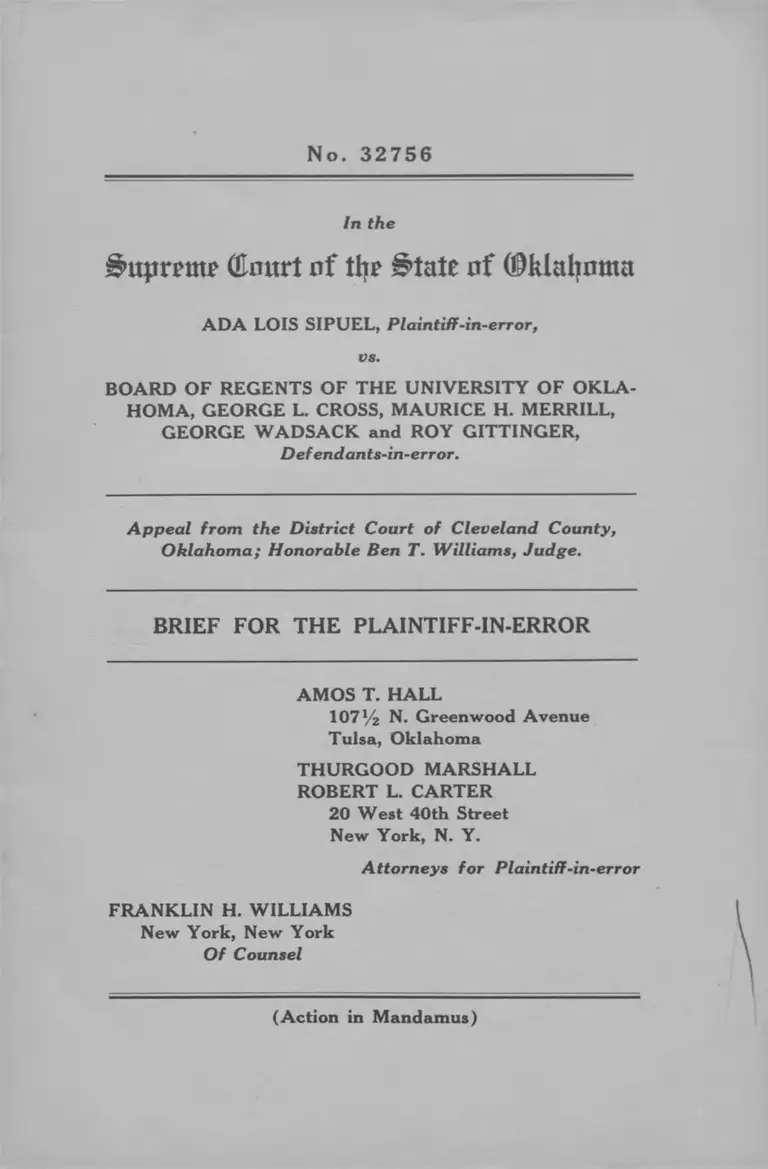
N o . 3 2 7 5 6
In the
Supreme (Unurt o f tfyp £>tate nf GDklaljnma
ADA LOIS SIPUEL, Plaintiff-in-error,
vs.
BOARD OF REGENTS OF THE UNIVERSITY OF OKLA
HOMA, GEORGE L. CROSS, MAURICE H. MERRILL,
GEORGE WADSACK and ROY GITTINGER,
Defendants-in-error.
Appeal from the District Court of Cleveland County,
Oklahoma; Honorable Ben T. Williams, Judge.
BRIEF FOR THE PLAINTIFF-IN-ERROR
AMOS T. HALL
107V2 N. Greenwood Avenue
Tulsa, Oklahoma
THURGOOD MARSHALL
ROBERT L. CARTER
20 West 40th Street
New York, N. Y.
Attorneys for Plaintiff-in-error
FRANKLIN H. WILLIAMS
New York, New York
Of Counsel
(Action in Mandamus)
n
B. Rational Basis for the Equal But Separate
Doctrine Is That Although a State May Require
Segregation, Equality Must Be Afforded Under the
Segregation System _____________________________ 7
Buchanan v. Warley, 245 U. S. 60 (1917)------ 8
Gong Lum v. Rice, 275 U. S. 78 (1928)--------- 7, 8
Johnson v. School Board, 166 N. C. 468, 82
S. E. 832 (1914)_________________________________ 8
Mitchell v. United States, 313 U. S. 80 (1941)- 7, 8
Missouri ex rel. Gaines v. Canada, 305 U. S.
337 (1938)_____________________________________7, 8
Pearson v. Murray, 169 Md. 478, 182 A. 540
(1936) ________________________________________ 7
People v. Gallagher, 93 N. Y. 438, 45 Am. Rep.
232 (1883)_____________________________________ 8
Plessy v. Ferguson, 163 U. S. 537 (1896)____7, 8
Roberts v. City of Boston, 5 Cush (Mass.)
198 (1849) ____________________________________ 8
Ward v. Flood, 48 Cal. 36 (1874)____________ 7, 8
C. Equality Under a Segregated System is a
Legal Fiction and a Judicial Myth_________________ 9
1. The General Inequities in Public Educa
tion Systems Where Segregation is Required___ 9
2. On the Professional School Level the In
equities are Even More Glaring_______________ 12
D. The Requirements of the 14th Amendment
Can Be Met Only Under an Unsegregated Public
Educational System______________________________ 17
E. Even Under “ Equal But Separate” Doc
trine, the Action of Defendants-in-Error Violated
the Fourteenth Amendment_______________________ 18
II. The application for a writ of mandamus to com
pel the defendant-in-error to admit plaintiff-in-error
to the Law School of the University of Oklahoma was
proper and should have been granted by the court below 19
A. Mandamus Should Iss%te as Prayed For___ 19
Blodgett v. Holden, 275 U. S. 142 (1928)____ 23
Comley ex rel. Rowell v. Boyle, 115 Conn.
406, 162 Atl. 26 (1932)___________________________ 20
PAGE
I ll
Federal Trade Commission v. American
Tobacco Co., 264 U. S. 298 (1924)______________ 23
Missouri ex rel. Gaines v. Canada, 305 U. S.
337 (1938)_________________________ 19,21,22,23,24
Missouri P. R. Co. v. Boone, 270 U. S. 466
(1926)________________________________________ 23
National Labor Relations Bd. v. Jones &
Laugblin Steel Corp., 301 U. S. 1 (1936)__________ 23
Pearson v. Murray, 169 Md. 478, 182 A. 590
(1936)________________________________ 19, 21, 23, 24
Panama R. Co. v. Johnson, 264 U. S. 375
(1924)__________________________________________ 23
Richmond Screw Anchor Co. v. United States,
275 U. S. 331 (1928)_____________________________ 23
Sharpless v. Buckles, et al., 65 Kan. 838,
70 Pac. 886 (1902)___________________________ 19,20
State ex rel. Hunter v. Winterrowd, 174 Ind.
592, 92 N. E. 650 (1910)_______________________19, 21
Welch v. Swasey, 193 Mass. 364, 79 N. E.
745 (1907)______________________________________ 21
B. Prior Demand on Board of Higher Educa
tion to Establish a Law School at Langston Uni
versity Is Not a Prerequisite to This Action_______ 24
Board of County Commrs. v. New Mexico
ex rel. Coler, 215 U. S. 296, 303 (1909)__________ 26
City of Port Townsend v. First Natl. Bank,
241 Fed. 32 (C. C. A. 9th, 1917)_______________ 27
McCabe v. Atchison, T. & S. F. R. Co., 235
U. S. 151, 160 (1914)__________________________ 25
McGillvray Const. Co. v. Hoskins, 54 Cal.
App. 636, 202 Pac. 677 (1921)___________________ 27
Mitchell v. United States, 313 U. S. 80, 96
(1941)________________________________________ 25
Northern Pacific R. R. Co. v. Washington,
142 U. S. 492, 508 (1891)______________________ 26
Pearson v. Murray, 169 Md. 478, 182 A. 590
(1936) ________________________________________ 25
Peo. ex rel. John Pear v. Bd. of Education,
127 111. 613, 625 (1889)
PAGE
26
IV
Pugsley v. Sellmeyer, 150 Ark. 247, 250 S. W.
538 (1923)____________________________________ 27
United States v. Saunders, 124 Fed. 124 (C.
C. A. 8th, 1903)_____________________________ 26,27
United States ex rel. Aetna Ins. Co. v. Bd.
etc. of Town of Brooklyn, 8 Fed. 473, 475 (N. D.
111. 1881)_________________________________________27
PAGE
Statutes.
Oklahoma Constitution, Art. 13, Sec. 3------------------------ 22
Oklahoma Constitution, Art. 13a, Secs. 1 and 2----------- 26
Oklahoma Statutes (1941) 70, Secs. 363, 451-470, 1591-
1593_____________________________________________ 22
Oklahoma Statutes (1941 as amended 1945), Secs. 1451-
1509 _______________________________________________ 24
Other A uthorities.
American Teachers’ Association, The Black and White
of Rejections for Military Service (1944)_________ 11,12
Blose, David T. and Ambrose Caliver, Statistics of the
Education of Negroes (A Decade of Progress)
(1943) ________ __________________________________10,11
Biennial Surveys of Education in the United States.
Statistics of State School Systems, 1939-40 and
1941-42 (1944) ___________________________________ 11
Dodson, Dan W. The American Mercury (July, 1946)_ 16
Flack, The Adoption of the Fourteenth Amendment
(1908)___________________________________________ 5
Lawyer’s Edition, Annotations, Yol. 27, p. 836________ 8
Lawyer’s Edition, Annotations, Yol. 44, p. 262______ 8
Merrill, Law of Mandamus (1892)___________________26, 27
National Survey of Higher Education for Negroes
_ (1943) ____________________________________________ 15
Sixteenth Census of the United States: Population,
Yol. I ll , Part 4 (1940)____________________________ 13
Thompson, Charles T., Negro Journal of Education,
Yol. 14 (1945)___ 13
In the
SUPREME COURT OF THE STATE OF OKLAHOMA
No. 32756
ADA LOIS SIPUEL, Plaintiff-in-error,
vs.
BOARD OF REGENTS OF THE UNIVERSITY OF OKLA
HOMA, GEORGE L. CROSS, MAURICE H. MERRILL,
GEORGE WADSACK and ROY GITTINGER,
Defendants-in-error.
BRIEF FOR THE PLAINTIFF-IN-ERROR.
Statement of the Case.
This is an appeal from the judgment of the District
Court of Cleveland County denying application of plaintiff-
in-error for writ of mandamus entered upon a hearing held
on July 9, 1946 to show cause why defendants-in-error
should not be compelled to admit plaintiff-in-error to the
first-year class of the School of Law of the University of
Oklahoma. In its opinion, the Court below adopted the
view that mandamus will not lie to compel state officers
to disregard the specific commands of state statutes at the
behest of a plaintiff who considers such statutes unconsti
tutional (R. 36-37). Plaintiff-in-error interposed a timely
motion for a new trial on July 9, 1946 (R. 45), which motion
was duly overruled on July 12, 1946 (R. 47); whereupon
this appeal was instituted.
2
Statement of Facts.
The facts in issue are uncontroverted and have been
agreed to by both plaintiff and defendants-in-error (R. 38-
40). The following are the stipulated facts:
That the plaintiff-in-error is a resident and citizen of
the United States and of the State of Oklahoma, County of
G-rady and City of Chickasha, and desires to study law in
the School of Law in the University of Oklahoma for the
purpose of preparing herself to practice law in the State
of Oklahoma (R. 38).
That the School of Law of the University of Oklahoma
is the only law school in the State maintained by the State
and under its control (R. 38).
That the Board of Regents of the University of Okla
homa is an administrative agency of the State and exer
cises over-all authority with reference to the regulation of
instruction and admission of students in the University of
Oklahoma; that the University is a part of the educational
system of the State and is maintained by appropriations
from public funds raised by taxation from the citizens
and taxpayers of the State of Oklahoma; that the School
of Law of the Oklahoma University specializes in law and
procedure which regulates the government and courts of
justice in Oklahoma; that there is no other law school main
tained by public funds of the State where the plaintiff-in-
error can study Oklahoma law and procedure to the same
extent and on an equal level of scholarship and intensity as
in the School of Law of the University of Oklahoma; that
the plaintiff-in-error will be placed at a distinct disad
vantage at the bar of Oklahoma and in the public service
of the aforesaid State with respect to persons who have had
the benefit of the unique preparation in Oklahoma law and
3
procedure offered at the School of Law of the University of
Oklahoma, unless she is permitted to attend the aforesaid
institution (R. 38-39).
That the plaintiff-in-error has completed the full college
course at Langston University, a college maintained and
operated by the State of Oklahoma for the higher educa
tion of its Negro citizens (R. 39).
That the plaintiff-in-error made due and timely appli
cation for admission to the first year class of the School of
Law of the University of Oklahoma on January 14, 1946,
for the semester beginning January 15, 1946, and that she
then possessed and still possesses all the scholastic and
moral qualifications required for such admission (R. 39).
That on January 14, 1946, when plaintiff-in-error ap
plied for admission to the said School of Law, she complied
with all of the rules and regulations entitling her to admis
sion by filing with the proper officials of the University, an
official transcript of her scholastic record; that said tran
script was duly examined and inspected by the President,
Dean of Admission and Registrar of the University (all
defendants-in-error herein) and was found to be an official
transcript entitling her to admission to the School of Law
of the said University (R. 39-40).
That under the public policy of the State of Oklahoma,
as evidenced by the constitutional and statutory provisions
referred to in the answer of defendants-in-error herein,
plaintiff-in-error was denied admission to the School of
Law of the University of Oklahoma solely because of her
race and color (R. 40).
That the plaintiff-in-error, at the time she applied for
admission to the said school of the University of Okla
homa, was and is now ready and willing to pay all of the
4
lawful charges, fees and tuitions required by the rules and
regulations of the said University (R. 40).
That plainti£f-in-error has not applied to the Board of
Regents of Higher Education to prescribe a school of law
similar to the School of Law of the University of Oklahoma
as a part of the standards of higher education of Langston
University, and as one of the courses of study thereof
(R. 40).
It was further stipulated between the parties that after
the filing of this case, the Board of Regents of Higher
Education had notice that this case was pending and met
and considered the questions involved herein and had no
unallocated funds on hand or under its control at the time
with which to open up and operate a law school and has
since made no allocation for such a purpose (R. 43).
A R G U M E N T .
I.
The refusal to admit plaintiff-in-error to the School
of Law of the University of Oklahoma constitutes a
denial of rights secured under the Fourteenth Amend
ment.
A. Distinctions on the Basis of Race and Color Are
Forbidden Under Our Laws.
One of the most firmly entrenched principles of Ameri
can constitutional law is that discrimination by a state based
on race and color contravenes the federal constitution. The
13th, 14th and 15th Amendments were specifically added to
the Constitution to give Negroes full citizenship rights and
5
to bar any future efforts to alter their status in that re
gard.1 The Court stated in Strauder v. Virginia:
“ This is one of a series of constitutional pro
visions having a common purpose, namely: securing
to a race recently emancipated, a race that through
many generations had been held in slavery, all the
civil rights that the superior race enjoy. The true
spirit and meaning of the Amendments * * * can
not be understood without keeping in view the his
tory of the times when they were adopted, and the
general objects they plainly sought to accomplish.
At the time when they were incorporated into the
Constitution, it required little knowledge of human
nature to anticipate that those who had long been
regarded as an inferior and subject race would, when
suddenly raised to the rank of citizenship, be looked
upon with jealousy and positive dislike, and that
state laws might be enacted or enforced to perpetu
ate the distinctions that had before existed. Dis
criminations against them had been habitual. It was
well known that, in some States, laws making such
discriminations then existed, and others might well
be expected.”
* * * * * * * *
“ . . . [the 14th Amendment] was designed to
assure to the colored race the enjoyment of all the
civil rights that under the law are enjoyed by white
persons, and to give to that race the protection of
the General Government, in that enjoyment, when
ever it should be denied by the States. It not only
gave citizenship and the privileges of citizenship to
persons of color, but it denied to any State the power
to withhold from them the equal protection of the
laws, and authorized Congress to enforce its provi
sions by appropriate legislation.”
* * * * * * * *
1 Flack, The Adoption of the Fourteenth Amendment (1908).
6
“ If this is the spirit and meaning of the Amend
ment, whether it means more or not, it is to be con
strued liberally, to carry out the purposes of its
framers. It ordains that no State shall make or
enforce any laws which shall abridge the privileges
or immunities of citizens of the United States * * *.
It ordains that no State shall deprive any person
of life, liberty or property, without due process of
law, or deny to any person within its jurisdiction the
equal protection of the laws. What is this but declar
ing that the law in the States shall be the same for
the black as for the white; that all persons whether
colored or white, shall stand equal before the laws
of the States and, in regard to the colored race, for
whose protection the Amendment was primarily de
signed, that no discrimination shall be made against
them by law because of their color? The words of
the Amendment, it is true, are prohibitory, but they
contain a necessary implication of a positive immun
ity, or right, most valuable to the colored race—the
right to exemption from unfriendly legislation
against them distinctively as colored; exemption
from legal discriminations, implying inferiority in
civil society, lessening the security of their enjoy
ment of the rights which others enjoy, and discrim
inations which are steps towards reducing them to
the condition of a subject race.” 2
The express guarantees against discrimination on the
basis of race and color run only against the states, but
these guarantees are considered so fundamental to our
political and social health that even in the absence of
express constitutional prohibitions, the federal govern
ment is prohibited from making any classifications and dis
tinctions on the basis of race and color. They are regarded
2 100 U. S. 303, 306, 307 (1879) ; see to same effect The Slaughter
House Cases, 16 Wall. (U . S.) 36 (1873); E x parte Virginia, 100
U. S. 339 (1879).
7
as arbitrary, unreasonable, constitutionality irrelevant and,
therefore, violative of the 5th Amendment.3
The United States Supreme Court, and American courts
in general, in giving life and substance to these abstract
constitutional guarantees have been required to strike down
statutes and governmental action in derogation thereof
without regard to local racial customs and practices requir
ing such color classifications.4
B. The Rational Basis for the Equal But Separate
Doctrine Is That Although a State May Require
Segregation, Equality Must Be Afforded Under
the Segregation System.
History has proved that democracy can flourish only
when its citizens are enlightened and intelligent. For this
reason, the states, even though under no obligation to do so,
have almost uniformly undertaken the task of providing free
education through the elementary and high school level,
and education through the college and professional level at
minimum cost to the individual. Having voluntarily under
taken to provide such opportunities, our Constitution and
laws require that such opportunities be afforded to all per
sons without regard to racial distinctions.5
3 Hircibayashi v. United States, 320 U. S. 81 (1943); Korematsu
v. United States, 323 U. S. 214 (1944); E x parte Endo, 323 U. S.
283 (1944); see also Steele v. Louisville and Nashville R. Co., 323
U. S. 192 (1944) ; Tunstall v. Brotherhood of Locomotive Firemen,
323 U. S. 210 (1944).
4 E x parte Virginia, 100 U. S. 339 (1879) ; Yick W o v. Hopkins,
118 U. S. 356 (1886) ; Buchanan v. Warley, 245 U. S. 60 (1917) ;
Missouri ex rel. Gaines v. Canada, 305 U. S. 337 (1938) ; Pierre v.
Louisiana, 306 U. S. 354 (1939); Hill v. Texas, 316 U. S. 400
(1942); Alston v. Norfolk School Board, 112 F. (2d) 992 (C. C.
A. 4th, 1940); cert. den. 311 U. S. 693 (1940); Smith v. Allwright,
321 U. S. 649 (1944).
5 Pearson v. Murray, 169 Md. 478, 182 A. 590 (1936); Missouri
ex rel. Gaines v. Canada, 305 U. S. 337 (1938) ; see also Gong Lum v.
Rice, 275 U. S. 78 (1927) ; Ward v. Flood, 48 Cal. 36, 17 Am. Rep.
405 (1874) ; People v. Gallagher, 93 N. Y. 438, 45 Am. Rep. 232
(1883); see also Mitchell v. United States, 313 U. S. 80 (1941);
Plessy v. Ferguson, 163 U. S. 537 (1896).
8
Oklahoma along with sixteen other states and the Dis
trict of Columbia has established an educational system on
a segregated basis, with schools set aside for the exclusive
attendance of Negroes.6 This enforced segregation has
been regarded by some American courts as not in conflict
with the requirements of the 14th Amendment as long as
the facilities afforded are equal to those afforded whites.7
The United States Supreme Court has never directly de
cided whether this view constituted a proper interpreta
tion of the Constitution but has given some indication that
it is in agreement with this statement of the law.8
6 Alabama, Arkansas, Delaware, Florida, Georgia, Kentucky,
Louisiana, Maryland, Mississippi, Missouri, North Carolina, Okla
homa, South Carolina, Tennessee, Texas, Virginia and West Virginia.
7 Johnson v. School Board, 166 N. C. 468, 82 S. E. 832 (1914);
and cases cited in note 5, supra. Annotations on the question, 27 L.
Ed. 836 and 44 L. Ed. 262.
8 In Plessy v. Ferguson, 163 U. S. 537 (1896) in sustaining the
constitutionality of a Louisiana statute requiring intrastate railroads
to furnish separate but equal coach accommodations for whites and
Negroes, the United States Supreme Court cited with approval Ward
v. Flood, People v. Gallagher, supra note 5 and Roberts v. City of
Boston, 5 Cush (Mass.) 198 (1849) which held that a state could
require segregation of the races in its educational system as long as
equal facilities for Negroes were provided. In Gong Lum v. Rice,
275 U. S. 78, 85 (1927) in passing upon the right of a state to clas
sify Chinese as colored and force them to attend schools set aside for
Negroes the Court assumed that the question of the right of a state to
segregate the races in its educational system had been settled in favor
of the state by previous Supreme Court decisions. In Missouri ex rel.
Gaines v. Canada, 305 U. S. 337, 344 (1938) the Court said obiter
dicta that right of a state to provide Negroes with educational advan
tages in separate schools equal to that provided whites had been sus
tained by previous Supreme Court decisions. In Mitchell v. United
States, 313 U. S. 80 (1941) the Court continued to uphold the
validity of the equal but separate doctrine as applied to transpor
tation facilities. But in Buchanan v. Warley, 245 U. S. 60 (1917) a
city ordinance which attempted to enforce residential segregation was
struck down as violating the 14th Amendment, and, in general the
Supreme Court has invalidated state action where it found that race
or color was used as a criteria as evidenced by cases cited in note 4.
The key to the difference in approach would seem to lay in Plessy v.
Ferguson, supra, which involved transportation and used state cases
upholding segregation in the state’s educational system to support
argument that segregation in transportation was valid.
9
The apparent rationalization for this rule is that the
states will provide equal educational opportunities for
Negroes under a segregated system and that therefore such
segregation does not amount to discrimination or a denial
of equal protection within the meaning of the 14th Amend
ment. Plaintiff-in-error contends that this “ equal but
separate” doctrine defeats the ends which the 14th Amend
ment was intended to achieve. If the guarantees of this
amendment are to be given life, substance and vitality,
American courts will have to recognize that segregation
itself amounts to an unlawful discrimination within the
meaning of the 14th Amendment.
C. Equality Under a Segregated System Is a Legal
Fiction and a Judicial Myth.
There is of course a dictionary difference between the
terms segregation and discrimination. In actual practice,
however, this difference disappears. Those states which
segregate by statute in the educational system have been
primarily concerned with keeping the two races apart and
have uniformly disregarded even their own interpretation
of their requirements under the 14th Amendment to main
tain the separate facilities on an equal basis.
1. The General Inequities in Public Educational
Systems Where Segregation Is Required.
Racial segregation in education originated as a device
to “ keep the Negro in his place” , i. e., in a constantly in
ferior position. The continuance of segregation has been
synonymous with unfair discrimination. The perpetuation
of the principle of segregation, even under the euphemistic
theory of “ separate but e q u a l h a s been tantamount to
the perpetuation of discriminatory practices. The terms
10
“ separate” and “ equal” can not be used conjunctively
in a situation of this kind; there can he no separate equality.
Nor can segregation of white and Negro in the matter
of education facilities be justified by the glib statement
that it is required by social custom and usage and generally
accepted by the “ society” of certain geographical areas.
Of course there are some types of physical separation
which do not amount to discrimination. No one would
question the separation of certain facilities for men and
women, for old and young, for healthy and sick. Yet in
these cases no one group has any reason to feel aggrieved
even if the other group receives separate and even pref
erential treatment. There is no enforcement of an inferior
status.
This is decidedly not the case when Negroes are segre
gated in separate schools. Negroes are aggrieved; they are
discriminated against; they are relegated to an inferior
position because the entire device of educational segrega
tion has been used historically and is being used at present
to deny equality of educational opportunity to Negroes.
This is clearly demonstrated by the statistical evidence
which follows.
The taxpayers’ dollar for public education in the 17
states and the District of Columbia which practice com
pulsory racial segregation was so appropriated as to de
prive the Negro schools of an equitable share of federal,
state, county and municipal funds. The average expense
per white pupil in nine Southern states reporting to the
U. S. Office of Education in 1939-1940 was almost 212%
greater than the average expense per Negro pupil.9 Only
9 Statistics o f the Education o f Negroes (A Decade of Progress)
by David T. Blose and Ambrose Caliver (Federal Security Agency,
U. S. Office of Education, 1943). Part I, Table 6, p. 6.
11
$18.82 was spent per Negro pupil, while the same average
per white pupil was $58.69.10
Proportionate allocation of tax monies is only one cri
terion of equal citizenship rights, although an important
one. By every other index of the quality and quantity of
educational facilities, the record of those states where seg
regation is a part of public educational policy clearly dem
onstrates the inequities and second class citizenship such
a policy creates. For example, these states in 1939-1940
gave whites an average of 171 days of schooling per school
term. Negroes received an average of only 156 days.11 The
average salary for a white teacher was $1,046 a year. The
average Negro teacher’s salary was only $601.12
The experience of the Selective Service administration
during the war provides evidence that the educational in
equities created by a policy of segregation not only deprive
the individual Negro citizens of the skills necessary to a
civilized existence and the Negro community of the leader
ship and professional services it so urgently needs, but also
deprive the state and nation of the full potential embodied
in the intellectual and physical resources of its Negro citi
zens. In the most critical period of June-July 1943, when
the nation was desperately short of manpower, 34.5% of
the rejections of Negroes from the armed forces were for
educational deficiencies. Only 8% of the white selectees
rejected for military service failed to meet the educational
standards measured by the Selective Service tests.13
10 Ibid, Table 8.
11 Biennial Surveys of Education in the United States. Statistics
of State School Systems, 1939-40 and 1941-42 (1944), p. 36.
12 Blose and Caliver, op. cit., supra note 9, Part I, p. 6, Table 7.
13 The Black and White of Rejections for Military Service. Mont
gomery, Ala., American Teachers Association (1944), p. 5.
12
Lest there be any doubt that this generalization applies
to Oklahoma as well, let us look at the same data for the
same period with respect to this state. We find that 16.1%
of the Negro rejections were for educational deficiency,
while only 3% of the white rejections were for this reason.14
This demonstration of the effects of inequitable segre
gation in education dramatizes one of the key issues which
this Court must decide. Failure to provide Negroes with
equal educational facilities has resulted in deprivations to
the state and nation as well as to the Negro population. The
Constitution establishes a set of principles to guide human
conduct to higher levels. If the courts reject the theory of
accepting the lowest common denominator of behavior be
cause this standard is so blatantly detrimental to the indi
vidual citizen, to the state, and to the nation as a whole—
then they will be exercising the power which the Constitu
tion has vested in them for the protection of the basic values
of our society.
2. On the Professional School Level the Inequi
ties Are Even More Glaring.
As gross as is the discrimination in elementary educa
tion, the failure to provide equal educational opportunities
on the professional levels is proportionately far greater.
Failure to admit Negroes into professional schools has
created a dearth of professional talent among the Negro
population. It has also deprived the Negro population of
urgently needed professional services. It has resulted in
a denial of equal access to such services to the Negro popu
lation even on a “ separate” basis.
14 Ibid.
13
In Oklahoma, the results of the legal as well as the extra-
legal policies of educational discrimination have deprived
'the Negro population of professional services in the fields
of medicine, dentistry and law. The extent of this depriva
tion can best be judged by the following data, in which the
figures represent one lawyer, doctor and dentist, respec
tively, to the following number of white and Negro popula
tion : 15 16
Profession White Negro
Law ______________ _____ 643 6,494
Medicine __________ _____ 976 2,165
Dentistry ________ _____ 2,646 7,675
That this critical situation is not peculiar to Oklahoma
alone hut is an inevitable result of the 'policy of racial seg
regation and discrimination in education is demonstrated
by an analysis made by Dr. Charles H. Thompson.10 He
states that:
“ In 1940 there were 160,845 white and 3,524 Negro
physicians and surgeons in the United States. In
proportion to population these represented one phy
sician to the following number of the white and Negro
population, respecitvely:
Section White Negro
U. S______________ 735 3,651
North ____ _______ 695 1,800
South ____ _______ 859 5,300
W est_____ _______ 717 2,000
Mississippi _______ 4,294 20,000
15 Based on data in Sixteenth Census of the United States: Popu
lation, Vol. I ll , Part 4, Reports by States (1940).
16 Charles H. Thompson, “ Some Critical Aspects of the Problem
of the Higher and Professional Education for Negroes,” Journal of
Negro Education (Fall 1945), pp. 511-512.
* To the nearest hundred.
14
“ A similar situation existed in the field of den
tistry, as far as the 67,470 white and 1,463 Negro
dentists were concerned:
Section White Negro
IT. S_________ _____ 1,752 8,800f
North ______ ______ 1,555 3,900f
South ____________ 2,790 14,000f
W est_____ _______ 1,475 3,900f
M iss._____________ 14,190 37,000+
“ In proportion to population there are five times
as many doctors and dentists in the country as a
whole as there are Negro doctors and dentists; and
in the South, six times as many. Even in the North
and West where we find more Negro doctors and
dentists in the large urban centers, there are two
and one-half times as many white dentists and doc
tors as Negro.
“ Law—In 1940 there were 176,475 white and
1,052 Negro lawyers in the U. S. distributed in pro
portion to population as follows:
Section White Negro
U. S. ......_________ 670 12,230
North ... _________ 649 4,000
South ___________ 711 30,000
West ____________ 699 4,000
Miss. ___________- 4,234 358,000
“ There are 18 times as many white lawyers as
Negro lawyers in the country as a whole; 45 times
as many in the South; and 90 times as many in Mis
sissippi. Even in the North and West there are six
times as many white lawyers as Negro. With the
exception of engineering, the greatest disparity is
found in leuw.” (Italics ours.)
f To the nearest hundred or thousand.
* To the nearest hundred or thousand.
15
The professional skills developed through graduate
training are among the most important elements of our
society. Their importance is so great as to be almost self-
evident. Doctors and dentists guard the health of their
people. Lawyers guide their relationships in a complicated
society. Engineers create and service the technology that
has been bringing more and more good to more and more
people. Teachers pass on skills and knowledge from one
generation to another. Social service workers minister to
the needs of the less fortunate groups in society and reduce
the amount of personal hardship, deprivation, and social
friction.
Yet the action of the lower Court in this case, quite
aside from any legal considerations, lends the sanction of
that Court to a series of extra-legal actions by which the
various states have carried on a policy of discrimination in
education. In Oklahoma, the 16 other states and the Dis
trict of Columbia where separate educational facilities for
whites and Negroes are mandatory, the provisions for
higher education for Negroes are so inadequate as to de
prive the Negro population of vital professional services.
The record of this policy of educational segregation and
denial of professional education to Negroes is clear. In
the 17 states and the District of Columbia in 1939-1940 the
following number of states made provisions for the public
professional education of Negro and white students: 17
Profession White Negro
Medicine _________ 15 0
Dentistry___________ 4 0
Law _______________ 16 1
Engineering ________ _ 17 0
Social service________________ 9 0
Library science _____ .... 13 1
Pharmacy __ .... 14 0
17 Based on data in National Survey o f Higher Education for
Negroes, Vol. II, p. 15.
16
The result has been that the qualified Negro student is
unable to obtain the professional education for which he
may be fitted by aptitude and training.
Other sections of the country, too, practice discrimina
tion against Negroes in professional schools by means of
“ quotas” and other devices.18 But only in the South is
legal discrimination practiced and it is thus in the South
that the Negro population suffers the greatest deprivation
of professional services.
The record is quite clear, and the implications of the
above data are obvious. There is another implication, how
ever, wThich is not as obvious but is of almost equal impor
tance in the long-range development of the Negro people.
From the ranks of the educated professionals come the
leaders of a minority people. In the course of their daily
duties they transmit their skills and knowledge to the
people they serve. They create by their daily activities
18 “ Wherever young Americans of ‘minority’ races and religions
are denied, by the open or secret application of a quota system, the
opportunity to obtain a medical, law or engineering education, apolo
gists for the system have a standardized justification.
“ In their racial-religious composition, the apologists contend, the
professions must maintain ratios which correspond to those found in
the composition of the whole population. Were the institution of
higher learning left wide open to ambition and sheer merit, they
argue, the professions would be ‘unbalanced’ by a disproportionate
influx of Catholics, Negroes and Jews.
“ Such racial arithmetic hardly accords with our vaunted prin
ciples of democratic equality. In effect it establishes categories of
citizenship. It discriminates against tens of millions of citizens by
denying their sons and daughters a free and equal choice of profes
sion. If a ratio must be imposed on the basis of race, why not on the
pigmentation? Forcing a potentially great surgeon to take up some
other trade makes sense only on the voodoo level of murky prejudice.
It not only deprives the citizen of his legal and human rights but, no
less important, it deprives the country of his potentially valuable ser
vices.”— from “ Religious Prejudices in Colleges,” by Dan W . Dodson.
The American Mercury (July 1946), p. 5.
17
a better, more enlightened citizenship because they trans
mit knowledge about health, personal care, social relation
ships and respect for and confidence in the law.
The average Negro in the South looks up to the Negro
professional with a respect that sometimes verges on awe.
It is frequently the Negro professional who is able to artic
ulate the hopes and aspirations of his people. The defen-
dants-in-error, in denying to the plaintiff-in-error access to
equal educational facilities on the professional level within
the State, also deny to the Negro population of Oklahoma
equal access to professional services and deprive it of one
of the most important sources of guidance in citizenship.
This denial is not only injurious to plaintiff-in-error, and
to other Negro citizens of the State, but adverse to the
interests of all the citizens of the State by denying to them
the full resources of more than 168,849 Negro citizens.
D. The Requirements of the 14th Amendment Can
Be Met Only Under an Unsegregated Public Edu
cational System.
The above recited data show that equal educational facil
ities are not maintained in those states, including Okla
homa, where segregation is required. More than that it is
impossible for equal facilities to be maintained under a
segregated system. The theory that segregation is consti
tutional as long as the facilities provided for Negroes are
equal to those provided for whites is a proper interpreta
tion of the federal constitution only if the rationale on
which the rule is based is correct. In those areas where
segregation is enforced in education, the states concerned
are least able economically to afford the establishment of
equal facilities in all respects that are required if this
theory is to be complied with. The facts demonstrate that
they could not provide such equal facilities even if they
18
were so disposed to do so. It is clear, therefore, that the
rationale for this “ equal but separate rule” of law is fal
lacious. A fortiori, the theory is erroneous and should be
discarded in light of the actualities of the situation.
Segregation constitutes a denial of the equal protection
of the laws and is violative of the Constitution and the laws
of the United States. Despite the line of cases in support
of the “ separate but equal” theory, this Court is under an
obligation to re-examine the rule and the reasons on which
it is based in the light of present day circumstances and to
adopt and apply a rule which conforms with the require
ments of our fundamental law.
E. Even Under “ Equal But Separate” Doctrine, the
Action of Defendants-in-Error Violated the Four
teenth Amendment.
No provision for the legal education of Negroes has
been made or is being made in the State of Oklahoma.
Plaintiff-in-error, possessing all the scholastic, moral and
legal qualifications therefor, applied for admission to the
only law school maintained by the State for the legal edu
cation of its citizens. Defendants-in-error refused her ad
mission on the grounds that the state policy requires the
separation of white and Negroes in the educational sys
tem in the State of Oklahoma. Plaintiff-in-error contends
that however free Oklahoma may be in adopting and main
taining a policy locally designed to meet its “ racial prob
lems” , this policy must conform to the requirements of the
federal constitution. Since the University of Oklahoma
Law School is the only law school maintained by the State,
plaintiff-in-error must be admitted to said school if the State
is to fulfill its obligation to plaintiff-in-error under the 14th
Amendment and under its own Constitution.
19
This is true under either theory discussed above. Under
the theory of plaintiff-in-error that segregation in Okla
homa’s educational system violates the federal constitu
tion, the maintenance of a school of law for the exclusive
attendance of white persons is unconstitutional. Plaintiff-
in-error and other Negro applicants must be admitted to
such school if they are to enjoy the rights and benefits guar
anteed under the Fourteenth Amendment. Under the
theory of defendants-in-error that segregation does not vio
late our fundamental law, as long as the facilities set aside
for Negroes are equal to those set aside for whites, it is
clear that the State cannot set up a law school exclusively
for whites without at the same time making similar provi
sions for Negroes.10 Since this has not been done in Okla
homa, the right of plaintiff-in-error to be admitted to the
law school of the state university is undenied. The refusal
of defendants-in-error to admit her to the school solely on
the basis of race and color violates her rights under the
Fourteenth Amendment.
II.
The application for a writ of mandamus to compel
the defendant-in-error to admit plaintiff-in-error to the
Law School of the University of Oklahoma was proper
and should have been granted by the court below.
A. Mandamus Should Issue as Prayed For.
The Court below in denying application of plaintiff-in-
error for a writ of mandamus relied upon Sharpless v.
Buckles et al., 65 Kan. 838, 70 Pac. 886 (1902); State ex rel.
Hunter v. Winterrowd, 174 Ind. 592, 92 N. E. 650 (1910); 19
19 Pearson v. Murray, 169 Md. 478, 182 A. 590 (1936); Mis
souri ex rel. Gaines v. Canada, 305 U. S. 337 (1938); see also other
cases cited in note 5, supra.
20
Comley ex rel. Roivell v. Boyle, 115 Conn. 406, 162 Atl.
(Conn.) 26 (1932), where the courts in question refused to
make a preliminary determination of the constitutionality
of state statutes before deciding whether a writ of man
damus should issue. The Court in these instances held that
a mandamus action was not proper unless the applicant had
a clear legal right to the thing demanded, and a duty on the
part of the defendant existed to do the acts required in the
absence of any other adequate remedy.
In Sharpless v. Buckles, supra, a state statute permitted
persons engaged in the railway express service who were
outside the district at the time an election took place to
vote in said election and to have their ballots counted along
with those cast in the district. An election was held. Votes
outside the district were cast in accordance with the statute
and counted by the Board of Commissioners along with
other ballots cast. Application was made for a peremptory
writ of mandamus to compel the Board of Commissioners
to reconvene, recount the vote and to exclude the ballots
cast outside the election district. The Court denied the
writ on the grounds that the Board of Commissioners were
merely under a duty to open the returns, determine the
genuineness of the ballots cast and certify the results. The
Court held that the Commissioners had no duty or authority
to determine the constitutionality of the statute permitting
absentee voting by persons engaged in the railway service
and that the Court could not by mandamus action impose
upon officials a duty beyond that which the law established.
In Comley ex rel. Rowell v. Boyle, supra, zoning regu
lations in the City of Stamford required a person to obtain
a permit to erect any structure within the city limits and
provided that no permit should issue unless the proposed
building complied with the law, ordinances and regulations
21
applicable thereto. The Building Commission was given
authority to vary or modify any provision or regulation of
the Building Code where it was found that it was impossible
to comply with the strict letter of those provisions. Appli
cation was made to build a structure with material ad
mittedly prohibited under the Building Code. Relator
sought to have the Building Commission permit a variation
in the provisions of the Code in order to permit him to
erect the proposed building. This being refused, relator
petitioned for a writ of mandamus to compel the Building
Commission to permit him to erect the building proposed.
The court refused the writ on the grounds that the court
could not disturb the proper exercise of discretion on the
part of public officials, and it was held that mandamus
would not lie except to force a public official to exercise a
mandatory duty and where the party seeking the writ had
a clear legal right to the thing demand and no sufficient
or adequate remedy.20
These cases do not bar the right to writ of mandamus
in this case. Plaintiff-in-error has a clear legal right to
obtain a legal education in the State of Oklahoma as long
as provisions for such education is made for white persons.
Once the state undertakes to provide educational facilities
for white persons, it is under a legal duty to make pro
vision at the same time for the education of Negroes.21 The
constitution and statutes of Oklahoma which require the
20 In State ex rel. Hunter v. Winterrowd, supra, the Court said:
“ The writ will issue . . . as a matter of right, in favor of
a petitioner who shows a clear legal right to the thing de
manded and an imperative duty on the part of respondent to
do the acts required in the absence of any other adequate
remedy.” But compare Welch v. Swasey, 193 Mass. 364,
79 N. E. 745 (1907).
21 Pearson v. Murray, 169 Md. 478, 182 A. 590 (1936); Mis
souri ex rel. Gaines v. Canada, 305 U. S. 337 (1938) and cases cited
in notes 5 and 8, supra.
22
separation of the races in the public school system must be
read and interpreted in the light of constitutional require
ments.22 Under any view of the law, as pointed out in the
first part of this brief, the state must admit plaintiff-in
error to the law school of University of Oklahoma if it has
made no other provision for the legal education of Negroes.
Segregation statutes can only be constitutional if equal
facilities are provided. Even under the “ equal but sepa
rate” theory, the state would be under an obligation either
to afford Negroes equal educational facilities in a school
set aside exclusively for them or to admit them to the school
set aside for whites. A state cannot use a segregation
statute as a means of avoiding its mandatory obligation
that Negroes be afforded the equal protection of the laws.
The only adequate remedy herein available for plaintiff-
in-error is the remedy available by the writ of mandamus.
The right of all Negroes in Oklahoma, to a legal education,
accrued and vested when the State established and main
tained the School of Law at University of Oklahoma for
the legal education of whites. Plaintiff-in-error asserted
this right upon her application for admission to School of
Law, University of Oklahoma, and the obligation of the
State to make provision for her legal education became an
immediate obligation which could not be postponed. Plain
tiff-in-error now has a right to a legal education as long as
the State is making provisions for the legal education of
22 Sec. 3, Art. 13 of Oklahoma Constitution provides for impar
tial maintenance of separate schools; 70 Okla. Stat. 1941, Sec. 363
provides for separate schools for training of teachers; 70 Okla. Stat.
1941, §§451-470 contain penal provisions; 70 Okla. Stat. 1941,
§§ 1591, 1592, 1593 provide for out of state scholarships for Negroes
who desire instruction on any subject taught only in a state insti
tution maintained exclusively for whites. That this type of provision
does not satisfy the constitutional requirements was settled in Mis
souri ex rel. Gaines, supra.
23
whites. Having the requisite lawful qualifications, and
there being no law school provided for Negroes, defendants-
in-error were without constitutional or statutory authority
to refuse to admit her to the Law School of the University
of Oklahoma. Whatever doubts might have existed on this
question were resolved by the United States Supreme
Court in 1938 in the case of Missouri ex rel. Gaines v.
Canada, 305 U. S. 337 (1938).
Oklahoma Statutes, requiring the segregation of the
races in the public school system, at the very least, can
only satisfy the Fourteenth Amendment if implicit in
such statutes is the requirement that the equal facilities be
afforded Negroes in separate schools.23 Barring this, Ne
groes must be admitted to the school set aside for exclusive
attendance of whites. Statutes must be read and inter
preted by the courts in a manner which will save their
constitutionality wherever possible.24 25 These statutes, there
fore, cannot be regarded as rigid and inflexible prohibitions
against Negroes and whites attending the same schools but
only necessitating separation where Negroes are specifi
cally afforded equal facilities. Public officers of the state,
therefore, are under a duty to admit Negroes to schools set
aside for whites if no school is maintained for Negroes.20
If the statutes in question impose the inflexible duty on
the defendants-in-error not to permit a qualified Negro
applicant to avail himself of the opportunities for educa
23 Missouri ex rel. Gaines v. Canada, supra. Pearson v. Murray,
supra; Ward v. Flood, supra,
24 National Labor Relations Bd. v. Jones & Laughlin Steel Corp.,
301 U. S. 1 (1936);Blodgett v. Holden, 275 U. S. 142 (1928);
Federal Trade Commission v. American Tobacco Co., 264 U. S. 298
(1924); Panama R. Co. v. Johnson, 264 U. S. 375 (1924); Mis
souri P. R. Co. v. Boone, 270 U. S. 466 (1926); Richmond Screw
Anchor Co. v. United States, 275 U. S. 331 (1928).
25 Missouri ex rel. Gaines v. Canada, supra; Pearson v. Murray,
supra.
24
tion afforded by the State in the same institution with
whites, where no such facilities are provided for Negroes,
the statutes clearly fail to meet the minimum requirements
of the Fourteenth Amendment and are unconstitutional.26
Either the defendants-in-error are obligated to admit plain-
tiff-in-error to the school of law of Oklahoma University
or the statutes, under which they rely to keep plaintiff-in
error from attending said school, are unconstitutional. No
other conclusion is possible. If the constitutionality of
Oklahoma segregation law are to be sustained, their pro
visions can only apply where equal facilities are afforded
Negroes in separate schools.
B. Prior Demand on Board of Higher Education to
Establish a Law School at Langston University
Is Not a Prerequisite to This Action.
It is contended by defendants-in-error that no applica
tion was made to the Board of Higher Education of the
State for the establishment of a school of law at Langston
University, a college maintained by the State for the educa
tion of Negroes (R. 30).27 That no such application had
been made is one of the agreed statements of fact (R. 43).
26 Pearson v. Murray, supra; Missouri ex rel. Gaines v. Canada,
supra, and other cases cited in note 5.
27 70 Okla. Stat. 1941 §§1451 to 1509, as amended in 1945,
relate to Langston University. § 1451, supra, as amended by
implication in 1945, is as follows: “ The Colored Agricultural and
Normal University of the State of Oklahoma at Langston in Logan
County, Oklahoma. The exclusive purpose of such school shall be
the instruction of both male and female colored persons in the art of
teaching, and the various branches which pertain to a common school
education; and in such higher education as may be deemed advisable
by such board and in the fundamental laws of this state and of the
United States, in the rights and duties of citizens, and in the agri
cultural mechanical and industrial arts.”
25
Such, a demand upon this Board did not constitute a pre
requisite to the maintenance of this action.
In the instant case there is no dispute as to the avail
ability of provisions for the legal education of white citizens
of the State desiring same as of the date plaintiff-in-error
duly applied and was denied admission to the first year
class of the School of Law of the University of Oklahoma.
The State, once having established a law school for one
portion of its citizenry, is under a constitutional mandate
to make equal provision for all, Negro as well as white.28
When plaintiff-in-error asserted her right, to a legal edu
cation by seeking admission to the University of Oklahoma,
no greater burdens or duties could be placed upon or re
quired of her than of white persons seeking to afford them
selves of the facilities provided by the State.29 Nor can
it be asserted here that failure of plaintiff-in-error to per
form this additional burden enabled the State to avoid its
plain duty to provide her with legal education on equal
footing with that provided for whites.
28 Cases cited in note 5, supra.
29 “ It is no answer to say that the colored passenger, if sufficiently
diligent and forehanded, can make their reservations so far in advance
as to be assured of first-class accommodations. So long as white
passengers can secure first-class accommodations on the day of travel
and the colored passengers cannot, the latter are subjected to inequali
ties and discrimination because of their race” Mitchell v. United
States, 313 U. S. 80 at 96 (1941).
As stated by the U. S. Supreme Court in a case involving dis
crimination in transportation if he is denied . . . , under
the authority of a state law, a facility or convenience . . . which, under
substantially the same circumstances, is furnished to another . . . ,
he may properly complain that his constitutional privilege has been
invaded” McCabe v. Atchison, T. & S. F. R. Co., 235 U. S. 151, 160
(1914).
“ Whatever system it adopts for legal education now must fur
nish equality of treatment now. . . . If those students are to be
offered equal treatment in the performance of the function, they
must, at present, be admitted to the one school provided.” Pearson
v. Murray, supra.
26
The Constitution and laws of the United States and
State of Oklahoma require that equal facilities be afforded
all citizens of the State The duty of making such equal
provisions was delegated to the Board of Regents of Higher
Education. This duty is incumbent upon the Board by
virtue of their office.30 It was not necessary, therefore, that
the plaintiff-in-error make a prior demand upon this Board
to perform its lawful duty before she may request man
damus to obtain her lawful right to a legal education.31
30 Art. 13a, Secs. 1 & 2, Okla. Constitution.
31 “ The argument in support of the proposition that a formal de
mand and refusal must be shown, is based upon the assumption that
the duty here sought to be enforced is of a private nature, affecting
only the right of realtor, the law being, that in such a case a demand
is necessary to lay the foundation for relief by mandamus. If, on
the contrary, the duty . . . is a public duty, resting upon respondent
by virtue of their office, it is equally well settled that no such demand
and refusal are necessary. . . . The duty here sought to be enforced
is not of a private nature, nor is the right demanded by relator
merely an individual right, within the meaning of the rule announced.
By the statutes of this State, the duty of providing schools for the'
education of all children between the ages of six and twenty-one in
their district, is imposed upon respondents. . . . The duty thus im
posed upon respondents is incumbent upon them by virtue of their
office. In such case it has been well said, ‘the law itself stands in
the place of a demand, and the neglect and omission to perform the
duty stands in the place of a refusal, or in other words, the duty
makes the demand, and the omission is the refusal.’ ” Peo. ex rel.
John Pear v. Bd. of Education, 127 111. 613, 625 (1889).
“ Decisions that there must be an express and distinct demand or
request to perform must be confined to such cases (o f a private
nature) where, however, the duty is of a purely public nature . . . ,
and where there is no one person upon whom either a right or duty
devolves to make a demand or performance and express demand or
refusal is not necessary.” Merrill, “ Law of Mandamus” (1892) pp.
277 and 278.
“ Whatever public officers are empowered to do for the benefit of
private citizens the law makes it their duty to perform whenever
public interest or individual rights call for the performance of that
duty.” United States v. Saunders, 124 Fed. 124, 126 (C. C. A. 8th,
1903) ; see also Bd. of County Commrs. v. New Mexico ex rel. Coler,
215 U. S. 296, 303 (1909) ; Northern Pacific RR Co. v. Washing
ton, 142 U. S. 492, 508 (1891).
27
It is axiomatic that the law will not require an individual
to do a vain and fruitless act before relief from a wrong
will be granted.32 This general rule applies in the instant
case as the demand alleged to be prerequisite to the grant
ing of relief would have been unavailing, fruitless and
vain33 as after the filing of this cause the Board of Regents
of Higher Education, having knowledge thereof, met and
32 “ The law does not require a useless thing . . . the law never
demands a vain thing, and when conduct and action of the officer is
equivalent to a refusal to perform the duty desired, it is not neces
sary to go through the useless formality of demanding its perform
ance.” Merrill, “ Law of Mandamus” (supra) at 279.
“Equity does not insist on purposeless conduct and disregards
mere formalities,” 49 Am. Jur. 167.
“ Demand is not, of course, necessary where it is manifest it would
be but an idle ceremony.” Ferries, “ Law of Extraordinary Rem
edies” (1926), p. 228. City o f Port Townsend v. First Natl. Bank,
241 Fed. 32 (C. C. A. 9th, 1917); McGillvray Const. Co. v. Hos
kins, 54 Cal. App. 636, 202 Pac. 677 (1921) ; Pugsley v. Sellmeyer,
150 Ark. 247, 250 S. W . 538 (1923) ; United States v. Saunders, 124
Fed. 124 (C. C. A. 8th, 1903).
“ . . . if the defendant has shown by his conduct that he does not
intend to perform the act . . . , it would be a work of supererogation
to require that a demand should be made for its performance. Here
the only effect of issuing the writ of mandamus is to require the
authorities of the town to do what by law they are obliged to do . . .
it seems . . . to be proper and reasonable and nothing more than the
Relator has a right to claim of the court, that an order should be
issued requiring them to do what the law says, in such a case as this,
they must do.” United States ex rel. Aetna Ins. Co. v. Bd. etc. of
Toum of Brooklyn, 8 Fed. 473, 475 (N. D. 111. 1881).
33 Plaintiff’s Exhibit “ 2”— the Board empowered to make sepa
rate provision for Relator or other colored citizens had no funds
available for this purpose. Even if they had available funds it would
have been many months before such a school could have been estab
lished (R. 43).
The fruitlessness of such a demand receives support from the
failure of this Board to take any such action subsequent to having
notice of Relator’s desire for a legal education had they intended to
fulfill their legal obligation to make provisions for Negro students
desiring legal education by establishing a separate school. Such
should have been done immediately upon having notice thereof
brought to their attention (R. 43).
28
considered the questions involved therein; had no unallo
cated funds in its hands or under its control at that time
with which to open up and operate a law school and has
since made no allocation for that purpose; that in order to
open up and operate a law school for Negroes in this State,
it will be necessary for the Board to either withdraw exist
ing allocation, procure moneys, if the law permits, from the
Governor’s contingent fund, or make an application to the
next Oklahoma legislature for funds sufficient not only to
support the present institutions of higher education but to
open up and operate said law school; and that the Board
has never included in the budget which it submits to the
Legislature an item covering the opening up and operation
of a law school in the State for Negroes and has never been
requested to do so (R. 43).
Conclusion.
For the reasons hereinbefore discussed plaintiff-in-error
asserts that her constitutional right to equal protection of
the laws can only be protected by her admission to the School
of Law of the University of Oklahoma and that under any
view of the constitutional principles involved, this conclu
sion is inescapable. Her rights to a legal education now,
and not at some future time, is the only issue before this
Court. That right can only be enforced by the issuance of
the writ prayed for in her petition to compel defendants-in-
error to admit her to the School of Law of Oklahoma
University.
29
W herefore it is respectfully submitted that the judg
ment of the Court below is in error and should be reversed.
A mos T. H all
107% N. Greenwood Avenue
Tulsa, Oklahoma
T htjrgood M arshall
R obert L. Carter
20 West 40th Street
New York, N. Y.
Attorneys for Plaintiff-in-error
F ranklin H. W illiams
New York, N. Y.
Of Counsel
212 [ 5 6 11]
L awyers P ress, I nc., 165 William St., N. Y. C .; ’Phone: BEekman 3-2300