Correspondence from Winter to Judge Wellford Re: Alaska v. Sundberg Court Opinion
Correspondence
April 7, 1981
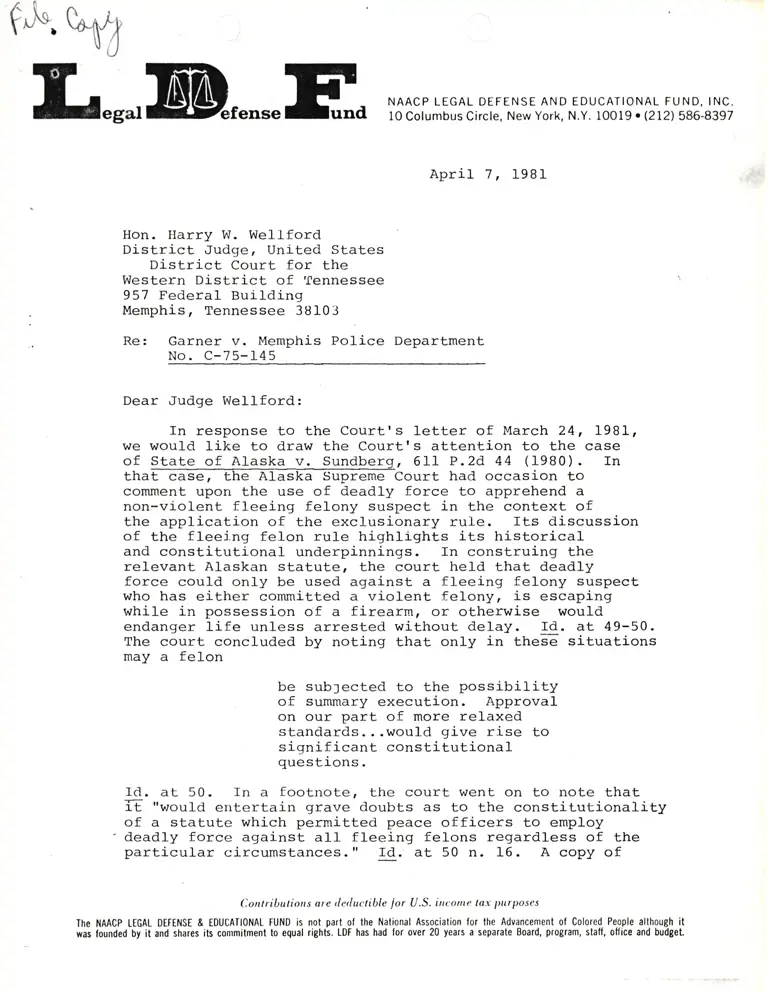
12 pages
-
Case Files, Garner Hardbacks. Correspondence from Winter to Judge Wellford Re: Alaska v. Sundberg Court Opinion, 1981. 3306ca13-27a8-f011-bbd3-000d3a53d084. LDF Archives, Thurgood Marshall Institute. https://ldfrecollection.org/archives/archives-search/archives-item/a790d69f-8b8d-4351-ac4f-dafc7cc66d92/correspondence-from-winter-to-judge-wellford-re-alaska-v-sundberg-court-opinion. Accessed October 18, 2026.
Copied!
L . . fefense 'F N A A C P L E G A L D E F E N S E A N D E D U C A T I O N A L F U N D , I N C .
10 Colum bus C ircle, New York, N.Y. 1 0 0 1 9 • (2 1 2 ) 5 8 6 -8 3 9 7
April 7, 1981
Hon. Harry W. Wellford
District Judge, United States
District Court for the
Western District of Tennessee
957 Federal Building
Memphis, Tennessee 38103
Re: Garner v. Memphis Police Department
No. C-75-145
Dear Judge Wellford:
In response to the Court's letter of March 24, 1981,
we would like to draw the Court's attention to the case
of State of Alaska v. Sundberg, 611 P.2d 44 (1980). In
that case, the Alaska Supreme Court had occasion to
comment upon the use of deadly force to apprehend a
non-violent fleeing felony suspect in the context of
the application of the exclusionary rule. Its discussion
of the fleeing felon rule highlights its historical
and constitutional underpinnings. In construing the
relevant Alaskan statute, the court held that deadly
force could only be used against a fleeing felony suspect who has either committed a violent felony, is escaping
while in possession of a firearm, or otherwise would
endanger life unless arrested without delay. IW. at 49-50.
The court concluded by noting that only in these situations
may a felon
be subjected to the possibility
of summary execution. Approval
on our part of more relaxed
standards...would give rise to
significant constitutional
questions.
Id. at 50. In a footnote, the court went on to note that
oTt "v;ould entertain grave doubts as to the constitutionality
of a statute which permitted peace officers to employ
deadly force against all fleeing felons regardless of the
particular circumstances." Id. at 50 n. 16. A copy of
C.onli ibulioiis are deductible for Ij.S. income tax i)urposes
The NAACP LEGAL DEFENSE & EDUCATIONAL FUND is not part of the National Association for the Advancement of Colored People although it
was founded by it and shares its commitment to equal rights. LOF has had for over 20 years a separate Board, program, staff, office and budget.
Hon. Harry W. Wellford
April 7, 1981
Page 2
the opinion is attached for the Court's convenience.
If the Court so desires, we would be happy to
appear at oral argument on the difficult constitutional
questions posed in our papers. Otherwise, we would
submit the case for decision based upon our brief and
the offer of proof which was submitted in lieu of the
evidentiary hearing which we requested-
Sincerely,
tco;
Steven L. Winter
/gh
Enc.
cc: Walter L. Daily, Jr.
Henry L. Klein, Esq.
Esq.
m
44 Alaska 611 PACIFIC REPORTER, 2d SERIES
|l'
v i
ate, work in, or frequent such establish
ments.
Affirmed as modified in this opinion.
I KEY NUMBER SYSHMp
STATE of Alaska, Petitioner,
V .
Russell SUNDBERG, Respondent.
No. 4397.
Supreme Court of Alaska.
May 9, 1980.
Defendant, charged with burglary,
moved to suppress evidence. The Superior
Court, Third Judicial District, Victor D.
Carlson, J., adopted an exclusionary rule as
a sanction against use of excessive force in
effectuating the arrest, and the State peti
tioned for review. The Supreme Court, Ra-
binowitz, C. J., held that: (1) statute pro
viding that if the person being arrested
either flees or forcibly resists after notice of
intention to make the arrest the officer
may use all necessary and proper means to
effect the arrest did not authorize law en
forcement personnel to employ deadly force
to arrest fleeing suspects under any and all
circumstances; rather, the “necessary and
proper” terminology was to be construed in
light of relevant portions of the new Crimi
nal Code which became effective on Janu
ary 1, 1980, and (2) assuming that police
officer, who discharged shotgun and
wounded fleeing burglary suspect, used ex
cessive force in effectuating the arrest, it
was inappropriate, under the circumstances,
to impose an exclusionary rule as a sanction
against officer’s violation of arrest statute.
Reversed and remanded for further
proceedings.
Burke, J., filed concurring opinion.
1. Homicide <®=»I07
Originally, the common-Ia^^
that use of deadly force was*j_
whenever the use of such force wasii
sary to prevent or terminate theN
sion of any felony. AS 12.25.(p,^
2. Arrest <3=68 ■ • •
Statute providing that ifyt
being arrested either flees oi[, fo
sists after notice of intention t,o'i
arrest the officer may use all nec«
proper means to effect the arrest .
authorize law enforcement personftdi
ploy deadly force to arrest fleeing
under any and all circumstano^"-;
the “necessary and proper’- ̂ter
was to be construed in light o f ^
portions of the new Criminal .Cod^
became effective on January 1,V.I
11.81.370, 11.81.900(12), 12.25.08oj
See publication Words and
for other judicial constructlons/li|
definitions. ‘
3. Constitutional Law «=>48(1)^^
It is duty of the Supremej;(
reasonably construe statutes,' whei^y
sible, to avoid the dangers _of'*UhO
tionality.
4. Criminal Law «=>394.1(2) *
Assuming that police officerJ>^jL
discharged shotgun and wounded^,®
burglary suspect, used excessivft^^on
the arrest, it was inappropriate, to j
an exclusionary rule as a sanction fij'
tion of arrest statute as officer h ^ j
ble cause, was proceeding . in
with existing departmental directrix
degree of force permissible under 1
tory “necessary and proper” langua
not previously been construed'by^l
preme Court; also, consideration!^
cial integrity did not dictate invo
an exclusionary rule. AS 12.25.0
art. 1, § 14; U.S.C.A.Const. Amend
5. Criminal Law <®=»394.1(1)
The primary purpose of the e x ._
ary rule is deterrence of future ille;^ |
duct by the police. Const. art^jV
U.S.C.A.Const. Amends. 5,
SERIES
*•
tie «=>107
'ally, the common-law rule
of deadly force was ju s tifu ^ i^
the use of such force was fx
event or terminate the com
' felony. AS 12.25.080.
3=>68
e providing that if the-,__
sted either flees or forcibly__
notice of intention to maka tkVfl
>fficer may use all neccssajy i
ms to effect the arrest did
w enforcement personnel to i
force to arrest fleeing suspi
and all circumstances;
'ary .and proper” terminolefyi.*
construed in light of r e le « ^ f i
the new Criminal Code «
■ctive on January 1, 1980.
•81.900(12), 12.25.080.
blication Words and Phrases'‘•.‘r,
" judicial constructions and
s. .
ional Law «=48(1) ^
ity of the Supreme Court to f t
)nstrue statutes, whenever pci^'^
id the dangers of unconsUl**’̂
>aw 394.1(2)
that police officer, who
hotgun and wounded Heeii^!^
pect, used excessive force to
was inappropriate to ir
ry rule as a sanction for <
statute as officer had proh^,;
as proceeding in accordeii^
departmental directives
e permissible under the
y and proper” language
■ been construed by the
also, considerations of jodkt
did not dictate invocalioa
y rule. AS 12.25.080; __ _
l-S.C.A.Const. Amends, i,''
9
IW <S=>394.1(1) '■
ry purpose of the exclus*s*»,P.
■rrence of future illegal
’olice. Const, a r t 1, § U,
Amends. 5, 14.
R-
Criminal Law <s=»394.1(2)
Potential deterrents to use of excessive
in making an arrest exists in the
|■Hbility of criminal sanctions, police de-
tlBtraental proceedings, civil rights actions
common-law tort suits against the of-
ding officer; absence showing that such
ents are ineffective, invocation of an
usionary rule is not mandated. AS 12.-
Const. art. 1, § 14; U.S.C.A.Const.
ends. 5, 14.
J. Stern, Asst. Atty. Gen., Daniel
X Hickey, Chief Pros., Avrum M. Gross,
Pltty. Gen., Juneau, for petitioner.
^ M n M. Murtagh and Walter Share, Asst
‘die Defenders, Brian Shortell, Public De-
ider, Anchorage, for respondent.
obert H. Wagstaff and Louis James M.
endez. Anchorage, for Alaska Civil Lib-
Union as amicus curiae in support of
“ “ ondont.
( Before-RABINOWITZ, C. J., and CON-
'OR. POOCHEVER, BURKE and MAT-
BEWS, JJ.
OPINION
^-RABINOWITZ, Chief Justice.
)This petition for review raises the propri-
m of the superior court’s adoption of an
w|Klusionary rule as a sanction against the
Ir •eof excessive force by the police in effec-
•ling an arrest of a fleeing burglary sus-
?f*t. We conclude such a rule should not
iTc been applied and reverse.
eThe relevant facts are as follows. On the
|i i |h t of Airril 30, 1978, Anchorage Police
f Officer Jack Bohannon, driving a marked
jfitrol car, responded to a police dispatch
Importing a burglary in progress at a phar-
in a medical office building. The
feliformation relayed by the dispatch was
l ^ t there were two susjrects one being
■ibly a black male. When Officer Bo-
anon arrived at the scene of the reported
̂ glary, he noted the presence of a private
I^,|rurity guard and another [)olice patrol
He had akso ob.served a third patrol
r a short distance away on its way to the
ETstoc.'
STATE V. SUNDBERG
CUe as, A laska, 6 1 1 P.2d 44
Officer Bohannon saw a susjicct near a
broken window of the pharmacy carrying a
blue hat and a pillow case as a sack. The
suspect dropiMid the pillow case on the side
walk and began to run down the sidewalk
away from Bohannon. Carrying a 12-
gauge riot shotgun loaded with buckshot,
Bohannon pursued the suspect on foot
around the corner of the building for about
fifteen or twenty feet, and shouted, “Hold
it, police officer.” Bohannon did not warn
the suspect that he had a weapon and
would shoot if the suspect failed to stop.
Bohannon decided that he could not out
run the suspect, stopped, and fired at the
suspect with his shotgun from a distance of-
approximately fifty yards. In accordance
with police department policy, Bohannon
had not fired a warning shot. One shotgun
pellet struck the suspect in the back of the
foot and another pellet struck him in the
upper thigh. The susjiect immediately fell
to the ground. - ' ’
Bohannon (juickly reached the suspect
and several other police officers arrived at ■
that location within a minute or so. The
suspect was searched and a box containing
forty-two nine-millimcter cartridges was
found in his pocket. A subsequent search
of the [lillow case which had been dropped
by the suspect revealed drugs and other
items which had been taken from the phar
macy. The susjKict was arrested, ques
tioned, and identified as Russell Sundberg,'
the respondent in this case.
Two days later, a nine-millimeter semi
automatic handgun with seven cartridges in
its clip and one cartridge in its chamber was
found on the roof of a building near the
pharmacy. This rooftop location was above
the place where Sundbe'rg had fallen after
being shot, and the cartridges in the hand
gun found there were the same type as
those found on Sundberg’s person when he
was apprehended. While Sundlxirg’s fin
gerprints were not on either the handgun or
the cartridges, the superior court concluded
that Sundberg had been armed at the time
of the burglary and his subsequent flight.
I:
'IS
l i
li
. ill,
' ’f
4|6 Alaska 611 f'ACIFIC REPORiER, 2d SERIES
However, Officer Bohannon did not testi
fy to any facts which indicated that he
perceived Sundberg to be armed at the time
of the chase, nor did he testify that he saw
Sundberg either reach for or discard a
weapon, though the street was well lit. Ac
cordingly the superior court found that “no
body perceived [Sundberg] to be armed*” at
the time of the shooting and arrest.
In the superior court, Sundberg moved to
suppress any evidence obtained by his ar
rest, including statements made by him, his
clothes and other evidence obtained in the
search made incident to his arrest, and the
identification of him accomplished after he
was arrested. Sundberg asserted that his
arrest was unlawful because excessive force
had been used to accomplish it. He argued
that Alaska’s statutory scheme, AS 12.25.-
080, detailing the means permissible to ef
fect an arrest is unconstitutional, if inter
preted to allow the use of deadly force to
arrest a fleeing felon who is not threaten
ing the life of another. His argument in
voked constitutional doctrines concerned
with due process, equal protection, cruel
and unusual punishment, and, unreasonable
searches and seizures.
In a memorandum opinion, the superior
court interpreted AS 12.25.080 to prohibit
the use of deadly force by a police officer to
arrest a fleeing felon unless the officer had
“a reasonable belief that the [fleeing felon]
was threatening the use of deadly force
against either the officer himself, the vic
tims of a crime, or innocent bystanders.”
The superior court alternatively held that,
if not so interpreted, the statutory scheme
1. After using a due process interest balancing
analysis to give content to this constitutional
requirement of reasonableness, Judge Carlson
stated:
In conclusion, I find that the state’s interest
in deterrence of future crime and effective
law enforcement does not outweigh the de
fendant's constitutionally protected right to
suffer no deprivation of life or limb without
due process of law. In order for the state’s
interest to outweigh the individual’s interest,
the individual must be threatening a compet
ing and equal interest in another person’s life
or limb. In other words, in the ca.se of a
police officer using deadly force against a
violated Alaska’s constitutional gu
against “unreasonable searches ‘ aiHl
zures.” ' Subsequently the sufierior c o ^ ,
entered an order “suppressing the resultfrf
the search which took place pursuant
what [it] believe[d] was an
reasonable seizure of Mr. Sundberg’a
The state then petitioned this .court
review of Judge Carlson’s opinion and
pression order. The state’s petition in jttC
asserts the following:
The state can establish that there'wMfiV
burglary of a pharmacy, that’a . 'p e f^ :
was seen fleeing from the pharma^
that prior to being arrested that p
dropped a pillow case containingH
and other items taken from the pi
cy. However, with the suppression of tbl,
results of the arrest, the critical pieoatf'J
evidence, the identification of SundlM|L
made after his arrest as the person
ing from the pharmacy, is unavailable to
the state. The state is unable to (
Sundberg’s identity by other:']
While the [sup>erior court’s] or „ „
framed in terms of the suppressioi^lf.!'
evidence, its effect is to bar prosecy^
of Sundberg.
Because of the importance of the l^ s l K
sues involved, we granted review.^"*
I Historical Background
The common law developed a highli' ̂
ticulated set of principles of jusUf.„,_j^,
for the use of force to prevent crime.ltotj
effect arrest.^ These principles are
to and some extent overlap the doctrinb^ll 1
fleeing suspect, the police officer m ustbntn^
reasonable belief that the fleeing suspect i l l
threatening the life of the officer, bys
or victims of the crime. In any other <___
. stance, the uge of deadly force to effed I
arrest would constitute an unreasonable)
zure in violation of the defendant's
under Article 1, section 14 of the Alatfca l
stitution. ' ■ ■■ >
2. For a thorough general discussion nt i
principles, see Note, Justification for the
f orce in the Criminal Law, 13 Stan,L.RM9
(1961).
•elf-dt
of pro[
|l . I- -Will
com me
The
justi
'̂ tion
P* prom
’■ the
' L For
f-'-.see V
̂j § 53
..nal c<
,1 iMurdt
■ Beale,
> Rev. f)“y ■
gard t
■ also S i
f c i i i. U n d e r
: (1942)
^^Proceii
l^"Code,
[.y- ■jBums,
'.Dangc:
Yal(
y4. Note
/X h m in
) '‘{footni
I> LaFa
: , notes i
m -
ska’s constitutional guaranUt’'''
reasonable searches and Mi> ’
ibsequently the superior court ̂
rder “suppressing the result! of ■'
■vhich took place pursuant to
{it] believe[dj was an ua>
'izure of Mr. Sundberg’s body,"^
then petitioned this court for •
dge Carlson’s opinion and 8up>
■r. The state’s petition in p u t
allowing:
can establish that there w u •
f a pharmacy, that a perso*
leeing from the pharmacy, and
to being arrested that pcnoa
pillow case containing drop
items, taken from the pharma*
'er, with the suppression of Uw •
he arrest, the critical piece of ,
he identification of Sundberf
his arrest as the person flo*»
he pharmacy, is unavailable tO'
The state is unable to establkk
identity by other meanfc
[superior court’s] order b
terms of the suppression of
s effect is to bar proseculioa
g-
he importance of the legal »•,
, we granted review. - Ij
listorical Background
>n law developed a highly ar*
of principles of justificatioa
if force to prevent crime and s?
■ These principles arc rclatad^^'
xtent overlap the doctrines of
>ect, the police officer must ha^O
belief that the fleeing suspect Is
the life of the officer, bystander^
)f the crime. In any other circuo^-
use of deadly force to effect
Id constitute an unreasonable i
ilation of the defendant's tiafais
le I, section 14 of the Alaska CoM' f
High general discussion of thaw ■;
' Note, Justification for the Vwtet
Criminal Law, 13 Stan.L.Rev.
KRIES
I
i
k ;ielf-defensc, defense of others, and defense of felonies
of proiierty.^
With regard to crime prevention, one
1 ̂commentator noted:
•< The use of force has historically been
justified when its purpose is the preven-
, tion of a criminal act. Such force is
prompted by different motives than when
the actor is protecting himself or his
property, because the threat is not to a
personal interest of the actor but rather
to society’s general interest in preventing
.̂criminal acts. This interest would clearly
seem a sufficient justification for force,
particularly because the common law jus
tified such force in apprehending the
criminal once he had committed the crim
inal act. Thus the effect of the crime-
prevention privilege is to allow a [Kirson
to use force in preventing a crime, rather
-. than compel him to await the commission
of the unlawful act.
Historically, the right to use force in
, • preventing crimes was limited to situa-
» tions where the threatened act would
l_ .have constituted a felony or breach of the
’peace. ' Consc(]uently, the threatened
"commission of a non-violent misdemean-
̂ or, such as petty larceny, provided no
basis for the use of preventive force.^
However, in the 19th century, this com
mon law distinction between the prevention
STATE v. SUNDl
CM.e as. A laska, 611 P.2d 44
and misdemeanors began to
erode, and it l>ecame the general rule that
“[0]ne who reasonably believes that a felo
ny, or a misdemeanor amounting to a
breach of the peace, is being committed, or
is about to l(c committed, in his pri-^.uice
may use reasonable force to terminate or
prevent it.” ®
Alaska 47
'■h-
i. For a general discussion of these doctrines,
see W. LaFave & A. Scott, Criminal Law
§§ 53 55 (1972). On self defense in the crimi
nal context, .see also Beale, Retreat from a
Murderous Assault, 16 Harv.L.Rev. 567 (1903);
Beale, Homicide in Self-Defense, 3 Colum.L.
[f^^^Rev, 526 (1903); Perkins, Self-Defense Reex-
twined, 1 U.C.L.A.L.Rev. 133 (19.54). With re-
, gard to the defense of others and property, .see
J V- tiso Stumberg, Defense of Person and Property
ll'''’'’ Under Texas Criminal Law, 21 Tex.L.Rev. 17
(1942); Note, The Use of Deadly force in the
Protection of Property Under the Model Penal
Codr. 59 Colum.L.Rev. 1212 (19.59); Bohlen &
Burns, The Privilege to Protect Property by
Dangerous Barriers and Mechanical Devices,
; , .,J5 Yale L.J. 525 (1926).
.m Note, Justification for the Use of Force in the
,̂ICrirninal Law, 13 Stan.L.Rev. 566, 568 (1961)
: (footnote omitted).
Lai ave & Scott, supra note 3, at 406 (foot-
note.s omitted).
[1] Originally, the common law rule was
that the use of deadly force was justifiable
whenever the use of such force was neces
sary to prevent or terminate the commis
sion of any felony. The common law felo
nies were murder, rape, manslaughter, rob
bery, sodomy, mayhem, burglary, arson, and
prison break, and each of these offenses
was punishable by death.* While most of
these offenses involved danger to the life of
others, the justification was based on the
rationale that “the law does not allow ‘any
crime to be prevented by death, unless the
same, if committed, would also be punished
by death.’ ” ^
With progressive creation of a great
number of'statutory felonies, few' of which
were punishable by death or even life im
prisonment, this supporting rationale disap
peared.* As a result, this justification was
modified by judicial interpretation and, in
some cases, statutes. The general rule that
emerged limited the right, to use deadly
6. This list applies to felonies recognized in Eng
land in 1500 and approximately the same felo
nies existed in America at the time of the Revo
lution. T. Plucknett. A Concise History of the
Common l.aw (5th ed. 1956). See also Com
ment, The Use of Deadly Force in the Protec
tion of Property Under the Model Penal Code,
59 Colum.L.Rev. 1212, 1217 nn. 26-27 (1959);
LaFave & Scott, Criminal §§ 53-55 at 406
(1972); Note, Justification for the Use of Force
in the Criminal Law, 13 Stan.L.Rev. 566, 577
(1961).
7. LaFave & .Scott, supra note 3, at 406 n. 27,
(/noting 4 Blackstone, Commentaries 182
(180,3).
8. From 1500 1800 the number of statutory fel
onies recognized in England increased by over
200. See L. Radzinowicz, A History of English
Criminal Law 151, 153 (1948).
■ S 'JM
ny jef-r
■ il;f
M-'i!
'I '
48 Alaska 611 PACIFIC REPORTER, 2d SERIES
force to prevent only those dangerous felo
nies which posed a substantial risk of death
or serious bodily harm to any person. How
ever, in some jurisdictions the use of deadly
force continued to be authorized to prevent
at least certain classes of felonies without
regard to the danger presented in the spe
cific circumstances.®
With resj>ect to the principle of justifica
tion involved in the present case, the com
mon law allowed the use of deadly force
when necessary to secure the arrest of any
felon, with no distinction made between
those felonies which did or did not pose a
threat of violence. In contrast, there was
no right to use deadly force, even though
necessary, to arrest a misdemeanant."* The
rationale was similar to that underlying the
original felony |>revention standard.**
The common law rule authorizing the use
of deadly force to effect the arrest of any
felony suspect has been almost uniformly
9. See. e. g„ State v, Waggoner. 49 N.M. 399,
165 P.2d 122 (1946); State v. Holbrook, 98 Or.
43, 188 P. 947 (1920); Commonwealth v. Em
mons, 157 Pa..Super. 495. 43 A.2d 568 (1945);
State V. Nyland, 47 Wash.2d 240, 287 P.2d 345
(1955). See generally LaFave & Scott, Crimi
nal Law §§ 53 55 at 406 07 (1972); Comment,
rhe Use o f Deadly Force in the Protection of
Property Under the Model Penal Code. 59 Co-
lum.L.Rev. 1212, 1217 18 (1959); Note, Ju.s(/F/-
cation for the Use of Force in the Criminal
law. 13 Stan.L.Kev. 566, 577 79. See also
Restatement (Second) of Torts § 143(2) (1965).
10. .See, e. g., Lal ave & Scott, supra note 3, at
405 06; Moreland, The Use of Force in Effect
ing or Kesisting Arrest, 33 Neb. L. Rev. 408
(1954); Pearson, The Right to Kill in Making
Arrests, 28 Mich.L.Rev. 957 (1930); Perkins,
The Law of Arrest. 25 Iowa L.Rev, 201, 268 73
(1940).
11. Comment, Deadly Force to Arrest: Trigger
ing Constitutional Review, 11 Harv. C.R. C.L.
L.Rev. 361, .365 67 (1976) (footnotes omitted).
In contrast with re(>ard to a misdemeanant it
was thought, as one court stated:
In such cases it is better, and more in conso
nance with modern notions regarding the
sanctity of human life, that the offender es
cape than that his life be taken, in a case
where e.xtreme penalty would be a trifling
line or a tew days' imprisonment in jail.
Klinkel v. .Saddler, 211 Iowa 368, 233 N.W. 538,
541 (1940). See generally Note, The Applica
tion of Deadly Force to Effectuate an Arrest, 5
Washburn L.J. 262 (1966).
criticized by legal commentators for
past fifty years. These commentf _
though differing as to details of
and formulation, have urged that dca^
force is justified only to a arrest a fitrr,
felon who, either iK'cause of the naUnt^ ■
the offense committed or the facts k w a j
to the arresting officer, poses a substariT
threat to the life or physical safety of’W_.
ers if not immediately apprehended.** fH- I
'-'tV-In 1962, the American Law InsUtotit
ter considerable debate, agreed upoB'ft*^
section, 3.07(2)(b) of the Model Penal
which provides:
The use of deadly force is not justifl^^
ble under this Section unless: '
(i) the arrest is for a felony; .̂.:
(ii) the person effecting the arr«t
authorized to act as a peace officer Of fc
assisting a person whom he believes toWf
authorized to act as a pieace officer;*aa41
12. See, e. g„ .Sherman, Execution WitbdutTl^^
al: Police Homicide and the Constilut/«d'
Vand.L.Rev. 71 (1980); Note, Arrest With i ‘
Without a Warrant, 75 U.Pa.L.Rev. 485.-.
504 (1927); Day, Shooting the Fleeing'fUm '
State of the Law. 14 Crim.L.Bull. 285, 297-9H '
(1978); Greenstone, Liability of Police Oftkini
for Misuse of Their Weapons. 16 Clev..M«4.^
Rev. .397, 400 05 (1967); Gremel, W henQ m tJ
Policeman Use His Gun? 40 J,Crim.L.C. * M ’
756,7.59 60(1950); McDonald, Use oFForcs^ *
Police to Effect Lawful Arrest, 9 Crlm.L(jL4H'j|
451 52 (1967) (urging narrowing of justifi»
tion in Canada); Moreland, The UseofFaitek]
Effecting or Resisting Arrest. 33 Neb,Ul»c |
408 (1954); Pearson, The Right to Kill in tU ti!
ing Arrests, 28 Mich.L.Rev. 957, 974-76(18*1
Safer, Deadly Weapons in the Hands of
Officers on Duty and Off Duty, 49 J.Urb.U SH
568 (1971); Note, The Justified Use of D e ^
Force. 4 Crim.L.Bull. 3, 15 20 (1968); Nats, 4
The Civil Liability of Peace Officers for Woimi- i
ing or Killing, 28 U.Cin.L.Rev. 488, 4 9 4 ^
(1959); Comment, Deadly Force to AmSBliiJ
Triggering Constitutional Review. 11 Han.
C.R. C.L. l..Rev. 361 (1976); Note, JustifiCMOOB,
for the Use of Force in the Criminal Lawi U
Stan.L.Rev. 566, 582 85 (1961); Note, j
ble Use of Deadly Force by the Police: A SoOh A
tory Survey, 12 Wm. & Mary L.Rev.
(1970). See also President's Commissloo M
Law Enforcement and Administration of Jm.
tice. Task Force Report: The Police 188-W
(1967).
'S":
Ik (iii) the acto
employed creat
'. ;injury to innoc
(iv) the actoi
(1) the crimi
made involved
or threatened
'.V,
(2) there is ;
^ ’person to be at
serious bodily
̂delayed.
'As of 1978, sevei
Imsion of the Co■p, ̂ .
non of the Mo>
:^nacted in Ala.'
which became c
i i f II Constru
With the foreg
Kpirid, we turn n<
Iquestion of the i
Il2.25.080. Thiss
Bnd effect at th
prehended by Oi
If the pers
flees or.forcil
If 'intention to n
Hofficer may u
[2;. proper means i
in the .case at b
strued AS 12.25.'
3. These statute'
Del.Code tit. 1
• Stat. tit. 37,
Stat. § 503.09'
; 17A, § 107-2(1
839(3) (1975);
§ 9.51(c) (19
401(d)(2)(b) (L
Note, Substantb
Deadly Force Ay
V. Memphis Pot
Schnarr, 7 Cap.'
/•See also Cornin'
If*' Triggering Con-
C.R.-C.L. L.Rev
| « . tifiable Use of I
fS .Statutory' Survey
J.V 81-84 (1970).
.14. Article I, § I
.provides:
The right ol
persons, housi
and effects, a
If: 611 P.2d—2
ES
î al commentators for
rs. These commcnUU*%.,^
r as to details of analyi
1, have urged that dca(Q|P ^
1 only to a arrest a flcrisf
■r because of the nuturv >jI
imitted or the facts kno««
officer, poses a substantM||
e or physical safety of olll»j
diately apprehended.**
Vmerican Law Institute, •!*
> debate, agreed upon th e ,
)) of the Model Penal Codl tM-
deadly force is not jusUfi**
̂ Section unless: . '
L'st is for a felony; ao4 . „
son effecting the arrest
act ae a peace officer or h"?
rson whom he believes to be
act as a peace officer; ani'.^
icrman, Kveciitioii Without 7X».,
'icidf and the Constitution, S i '
(1980); Note, Arrest With a
rant, 75 U.Pa.L.Rev. 485.
y. Shooting the Fleeing
w, 14 Crim.UBull. 285, 297-3011 '̂ ̂
one. Liability of Police Offictn. •.
I'heir Weapons. 16 Clev.-Marl.,f'
i5 (1967); Gremel, When Cana
llis Gun? 40 .I.Crini.L.C. & PX
r>0); McDonald, Use of Foret by
l.au fill Arrest. 9 Crim I..Q 434,
( i i i f ; i n; ; n a t r i ''■in; of justirtcaa'.-
Moreland, 7/icDse of Force ai I
esisting Arrest. 33 Neb.L.Rrw,'’',
irson. The Right to Kill in
Mich.L Rev. 957, 974 76 (1930t"*
Veapons in the Hands of Poircy
S' and Off Diil.v, 49 J.Urb.l. 564. i
te. The Justified Use of Deadly
l. Bull. 3, 15 20 (1968);
ity of Peace Officers for Wound- •
28 U.Cin.L.Rev. 488, 494 89 r
ent. Deadly Force to A i7 r* ^ l
■istitutional Resiew, 11 Han*..^j
361(1976); Note, JiisfificaOoe
f orce in the Criminal Lass', IS
582 85 (1961); Note, JustilUn-f^
lly Force by the Police: A SiatW-r^H
2 Wm. & Mary I, Rev. 67, 81 ‘
Iso President's Commission oa ’irfl
<‘iit and Administration of Ju»* fUm
ce Report: The Police 189-90'
(iii) the actor believes that the force
employed creates no substantial risk of
injury to innocent persons; and
(iv) the actor believes that;
(1) the crime for which the arrest is
made involved conduct including the use
or threatened use of deadly force; or
(2) there is a substantial risk that the
i .'person to be arrested will cause death or
serious bodily harm if apprehension is
delayed.
of 1978, seven states had enacted some
^ wsion of the Code’s approach,'* and a ver
sion of the Model Penal Code has been
enacted in Alaska’s new criminal code,
•hkh became effective January 1, 1980.
STATE V. SUNDBE
c ite .IS , Alaska, 611 P.2d 44
Alaska 49
II Construction of A S 12.25.080
With the foregoing historical overview in
f'y.. nind, we turn next to the first impression
'*>,-question of the proper construction of AS
c 12.25.080. This statute, which was in force
ft »nd effect at the time Sundberg was ap-
fei’prehended by Officer Bohannon, provided;
. If the person being arrested cither
.flees or. forcibly resists after notice of
, intention to make the arrest, the peace
V officer may use all the necessary and
’ proper means to effect the arrest.
In the case at bar, the superior court con-
■Itnied AS 12.25.080 in the following man
ner:
13. These statutes are:
Del.Code tit. 11 § 467(c) (1974); Haw.Rev.
• Stat. tit. 37, § 703 ,307(3) (1976); Ky.Rev.
St.at. § 503.090(2) (1975); Me.Rev.Stat. tit.
17A, § 107 2(B) (197.5); Nev.Rev.Stat. § 28.-
839(3) (1975); lex.Penal Code Ann. tit. 2.
§ 9.51(c) (1974); N.C.Gen.Stat. § 15A-
■■ 401(d)(2)(b) (197,5).
Note, Substantive Due Process and the Use of
Deadly Force Against the Fleeing Felon: Wiley
V. Memphis Police Department & Mattis v.
Schnarr, 1 Cap.U.T.Rev 497, 499 n. 13 (1978).
- See also Comment, Deadly Force to Arrest:
Triggering Constitutional Review, 11 Harv.
C.R.-C.L. L.Rev. 361,368 69(1976); Note, Jiis-
» liFiable Use of Deadly Force by the Police: A
Staliitoiy Surs'ey, 12 Wm. & Mary L.Rev, 67,
81-84 (l’970).
;r 14. Article I, § 14 of the Alaska Constitution
pro'.'ides:
The riglit of the people to be secure in their
pi-rsons, houses and other property, papers
and effects, against unreasonable searches
eil P.2d—2
In other words, in the case of a police
officer using deadly force against a flee
ing suspect, the police officer must have a
reasonable belief that the fleeing suspect
is threatening the life of the officer, by
standers, or victims of the crime. In any
other circumstance, the use of deadly
force to effect an arrest would constitute
an unreasonable seizure in violation of
the defendant’s rights under Article I,
section 14 of the Alaska Constitution.**
[2] We are of the opinion that the supe
rior court correctly rejected a construction
of AS 12.25.080 which would have permit
ted law enforcement personnel to employ
deadly force to arrest fleeing suspects un
der any and all circumstances.'* In making '
this ruling the superior court appropriately
considered relevant portions of Alaska’s
new Criminal Code which became effective
on January 1, 1980. AS 11.81.370 of the
new code provides in part that a peace
officer in making an arrest, or terminating
an escape, may
(a) [U]se deadly force only when and to
the extent he reasonably believes the use
of deadly force is necessary to make the
arrest or terminate the escajie or at-'
tempted escape from custody of a person
he reasonably believes
(1) has committed or attempted to
commit a felony which involved the use
of force against a person;
and seizures shall not be violated. No war
rants shall issue, but upon probable cause,
supported by oath or affirmation, and partic
ularly describing the place to be searched,
and the persons or things to be seized.
15. There is no dispute that Officer Bohannon
did use "deadly lorce” to make the arrest.
Though not specifically defined in the then ap
plicable statutes. AS 11,81,900(12) of the new
Criminal Code provides;
“[D]eadly force” means force which the per
son uses wilh the intent of causing or uses
under circumstances which he knows create
a substantial risk of causing, death or serious
physical injury; “deadly force includes in
tentionally discharging a firearm in the di
rection o f another person or in the direction
in which another person is believed to be
. . [emphasis supplied].
This definition is similar to that found in the
Model Renal Code § 3.11(2) (1962).
■'ll■|l i
4
-iH ■
, V V
50 Alask 611 PACIFIC REPORTER, 2d S
% ■'a
i
yl:
Hi
m
(2) has escaped or is aLtemplin^ to es
cape from custody while in possession of
a firearm on or about his person; or
(3) may otherwise endanger life or in
flict serious physical injury unless arrest
ed without delay.
Given the circumstance that AS 11.81.370 is
now operative, we believe a construction of
the “necessary and proper means” phraseol
ogy of AS 12.25.080, which brings these
provisions into conformity with contempo
rary Alaskan values, is indicated.
|3J Frequently felony suspects may flee
for reasons other than guilt. Whatever the
reason, the fleeing suspect has overriding
interests involved in these circumstances.
As one commentator notes;
The fleeing felony suspect advances
two distinct but interrelated interests:
the interest in not being deprived of life
or limb because he committed a crime (a
right to life) and the interest in suffering
no de[)rivation until convicted in a court
of law (a right to trial). When deadly
force is used to arrest nonviolent felony
suspects, these interests give rise to the
two fundamental objections against the
use of deadly force. The first is that the
use of such force merely to arrest for a
nonviolent crime is grossly disproportion-
' ate and morally wrong. The second ob
jection is that the de|)rivation of life or
limb without trial is offensive to the pre
sumption of innocence and other values
central to our conception of justice and
should not be condoned except in emer
gency situations.
Comment, Deadly Force to Arrest: Trig-
gering Constitutional Review, 11 Harv.
C.R.-C.L.L. Rev. 361, 372-73 (1976). This
16. Given the narrow applicability of our hold-
ing pertaining to the proper con.struction of AS
12.25.080, and the fact that AS 11.81.370 be
came effective on January 1, 1980, we deem it
unnecessary to .set forth a lengthy explanation
of our reasons for adopting the criteria of AS
11.81.370 as appropriate limitations on the
"necessary and proper" means phraseology of
AS 12.25.080. We deem it sufficient to again
note that without the construction of AS 12.25.-
080 we have adopted today, this court would
entertain grave doubts as to the constitutionali
ty of a statute which permitted [X'ace officers
first interest is es|)ecially compelling in that iff-
the death penalty is not available in Alaska,
Thus, it is only in situations articulated in ijs:
AS 11.81.370 that a felon should be subject
ed to the possibility of summary execution.
Approval on our part of more relaxed stan
dards than those provided in AS 11.81.370,
would give rise to significant constitutional O
questions.'* ^
Thus, we hold that the criteria embodied- '^ '
in AS 11.81.370 should be looked to as the (,
relevant standards to be applied by Alaska'a\
courts in resolving issues which might stM;
arise under the “necessary and propw
means” phraseology of former AS 12.25.0M.̂
III Appropriateness of the superiortj^;^^
court’s invocation o f the
exclusionary rule
14] T he foregoing leads us to an exami-'. '
nation of the merits of the superior court’s
imposition of an exclusionary rule and re-^.5
sultant suppression order. We assume ar-'ji
guendo that the record demonstrates that
Officer Bohannon used excessive force
effectuating the arrest of Russell Sundberg.f}p
Taking this given as our starting point,,weJ
address the (piestion of whether the sup
or court properly invoked an exclusionary*!?^
rule as a sanction against Officer Bohaih,^''
non’s violation of AS 12.25.080. In the
cumstances of this case, we conclude that it; .
was inappropriate for the superior court
have imposed an exclusionary rule. •
Initially, we note that there is no legisUr ̂
tive directive calling for invocation of
exclusionary rule as a sanction against
sort by the |)olice to excessive force in mak*.,jr
ing an arrest (/. e., a violation of AS 12JJ5,«_̂
080).” Therefore, in the absence of a^y,
compelling legislative history of AS 12.2S.-
to employ deadly force against all fleeing felOM
regardless of the particular circumstanc**,;,
See Mallis v. Schnarr, 547 F.2d 1007 (8lh Qc^
1976) vacated soli nom. Ashcroft v. Matlis, 4Jt
U.S. 171, 97 .S.ct. 1739, 52 L.Ed.2d 219,
sterdam. Perspectives on the Fourth Ameoit-'t
nient, 58 Minn.L.Rev. 349, 366-67 (1974)..
ther, it is this court’s duty to reasonably i
strue statutes, whenever possible, to avoid
dangers of unconstitutionality. Hoffman
State, 404 l'.2d 644. 046 (Alaska 1965).
17. See, e. g., lll.Rev.Stat. ch. 38 § 14-5 (1979I»,.s
080, we are fti
to whether a
rule should b
the situation '
by excessive
lice.**
Some measi
tach in the ci
duct is viola!
significantly
the accused.*®
of the rights i
think it relev:
between AS
18. Compare
(Alaska 1963
■y 367 U.S. 643
(1961) had n.
, • rule on unla
. state, “Alask
the federal e
, which obtain
718.
. 19. See Rule
Procedure (/
Model Code
. ' § SS 290.2(2
• 20. State v. S
1976). As t
.' the exclusioi
2 . ed States, 23
652 (1914); (
■ , 438, 48S.Ct.
United State
- . L.Ed.2d 1669
643,.81 S .ct
ry V. Ohio, 3;
889 (1968);
433, 96 S.Ci
The deteri
j-, , strongly dis|
, - the Exclusiv
-• 37 U.Chi.UR
• rent effect q
. • search) and
Problem—Ti
.. • Tort Remed}
\ J. Police Sc
-' effect not d
with Cannon
ing Health?
' Against a I
681, 725-26
,V< See also 1
§ 1.2(b), a t ; ’
21. See Annt!
(discussing a
■ See also Sta
STATE V. SUNDB
Clip as, Alaska, 611 P.2d 44
Alaska 51 i i v i
>ecially compelling in Oval
is'not available in Alaska. ’ "*
i situations articulated ia
a felon should be subjerl-
ly of summary execution..
iurt of more rela.xed sUn-
provided in AS 11.81.371),
significant constitutional ^^41^
r ' i '
hat the criteria embodied fc
lould be looked to as th# ■
> to be applied by Alaska's
r issues which might still
“necessary and proi>er
ry of former AS 12.25.080.
teness o f the superior
nvocation o f the
isionary rule . . ^
'ing leads us to an exami*
its of. the superior court’s
exclusionary rule and re*
in order. We assume ar-
record demonstrates that
1 used excessive force in
rrest of Russell Sundberg.,^
as our starling point, we
ion of whether the su|>cri-
invoked an exclusionary
n against Officer Bohan-
AS 12.^5.080. In the cir- ̂va
I case, we conclude that it
' for the superior court to
exclusionary rule.
le that there is no Icgisla-
ling for invocation of an
as a sanction against re-
to excessive force in mak-
a violation of AS 12.25.-
!, in the absence of any
• live history of AS 12.25.-
forcc against all fleeing felon*
!■ particular circumstance*,
narr. 547 F.2d 1007 (8th Cir.
I riom. Ashcroft v. Maltis, 431
1739, 52 L.F.(l.2d 219, Am-
iivcs on the Fourth Amend-
Itev. .349, 306 67 (1974). Fur-,
lilt's duty to reasonably con-
lenever possible, to avoid the
■nstitutionality. Hoffman V.
14. 646 (Alaska 1965).
ev.Stat. ch. 38 § 14 5 (1979).
080, we are faced with the policy decision as
to whether a judicially created exclusionary
rule should be .fashioned and employed in
the situation where arrests are accompanied
by excessive force on the part of the po
lice.'*
Some measurable consequence should at-
ifi the circumstance where police con-
duct is violative of a statute and in turn
1 significantly affects substantial rights of
the accused.'* In assessing the significance
i ' of the rights involved in the case at bar, we
think it relevant to consider the' relationship
between AS 12.25.080 and the goals of the
18. Compare Ellison v. State, 383 P.2d 716
(Alaska 1963). We noted that if Mapp v. Ohio,
367 U.S. 643 , 81 S.Ct. 1684, 6 L.Ed.2d 1081
(1961) had not applied the federal exclusionary
1 rule on unlawful searches and seizures to the
state, “Alaska would have been free to retain
the federal exclusionary rule or adopt the rule
’ which obtained at common law.’’. 383 P.2d at
718.
.19. See Rule 461, Uniform Rules of Criminal
Procedure (Approved Draft 1964); compare
, Model Code of Pre-Arraignment Procedure
• § SS 290.2(2) (Proposed Official Draft 1975).
?0. State V. Sears, 553 P.2d 907, 911 12 (Alaska
1976), As to the origins and development of
. the exclusionary rule, see, e. g.. Weeks v. Unit-
ed States, 232 U.S. .383, ,34 S.Ct. 341, .58 L.Ed.
652 (1914); Olmstead v. United States, 277 U.S.
438, 48 S.Ct. 564, 72 L.Ed. 944 (1928); Elkins v.
United States, 364 U.S. 206, 80 S.Ct. 1437, 4
L.Ed.2d 1669 (1960); Mapp v. Ohio, 367 U.S.
643, 81 S.Ct. 1684, 6 L.Ed.2d 1081 (1961); Ter
ry V. Ohio, 392 U.S. 1, 88 S.Ct. 1868, 20 L.Ed.2d
M9 (1968); United States v. Janis, 428 U.S.
433, 96 S.Ct. 3021, 49 L.Ed.2d 1046 (1976).
The deterrent effect of the rule has been
strongly disputed. Compare Oaks, Studying
, the Exclusionary Rule in Search and Seizure,
37 U.Chi.L.Rev.'665, 709, 775-76 (1970) (deter
rent effect questionable based on empirical re
search) and Spiotto, The Search and Seizure
Problem-—Two Approaches: The Canadian
Tort Remedy and the U.S. Exclusionary Rule, 1
J, Police Sci. & Ad. 36, 49 (1973) (deterrent
effect not demonstrated by empirical study)
’ with Cannon, Is the Exclusionary Rule in Fail-
- ing Health? Some New Data and a Plea
Against a Precipitous Conclusion, 62 Ky.L.J.
681, 725 26 (1974) (rule fulfills its purpose).
See also 1 W. LaFave, Search and Seizure
§ 1.2(b), at 25-30 (1978).
21. See Annot., 83 A.L.R.3d 174, 224-30 (1976)
(discussing a few such criminal prosecutions).
See also State v. Barr, 115 Ariz. 346, 565 P.2d
exclusionary rule as developed in the con
text of searches and seizures.
[5, 6] The primary purpose of the exclu
sionary rule is deterrence of future illegal
conduct by the police.** Assuming that ap
plication of an exclusionary rule would pro
vide some disincentive to the use of unlaw
ful force by police officers in making ar
rests, the question which remains is wheth
er other deterrents render adoption of an
exclusionary rule unnecessary giv.en socie
ty’s interests in the apprehension, preven
tion, and trial of offenders. Potential de
terrents exist in the possibility of criminal
sanctions; *' police departmental proceed-
526 (1977); People v. Wild, 60 Cal.App.3d 829,
1,31 Cal.Rptr. 713 (1976); Commonwealth v.
Duerr, 158 Pa.Super. 484, 45 A,2d 235 (1946),
See generally Edwards, Criminal Liability for
Unreasonable Search and Seizure, 41 Va.L.Rev.
621 (1955); Newman, Suing the Lawbreakers:
Proposals to Strengthen the Section 1983 Dam
age Remedy for La w Enforcer’s Misconduct, 87
Yale L.J. 447 (1978).
At the time of the offense, AS 11.60.350 pro
vided:
Deprivation of Rights Under Color of Law.
A person who, under color of any law, ordi
nance or regulation of this state or its politi
cal subdivisions, wilfully deprives another
person of a right, privilege or immunity
granted by the constitution or the laws of
this state, or who subjects another person to
different punishments, pains or penalties be
cause of that person’s race, color, creed or
national origin, is guilty of a misdemeanor
and upon conviction is punishable by impris
onment for not more than one year, or by a
fine of not more than $1,000, or by both,
3'his offense is now incorporated under AS 11.-
76.110 of the new criminal code which provides
in pertinent part:
Interference with Constitutional Rights, (a)
A person commits the crime of interference
with constitutional rights if
(1) he injures, oppresses, threatens, or in
timidates another person with intent to de
prive that person of a right, privilege, or
immunity in fact granted by the constitution
or laws of this state;
(2) he intentionally injures, oppresses,
threatens, or intimidates another person be
cause that person Iras exercised or enjoyed a
right, privilege, or immunity in fact granted
by the constitution or laws of this state; or
(3) under color of law, ordinance, or regu
lation of this state or a municipality or other
political subdivision of this state, he inten
tionally deprives another of a right, privilege,,
or immunity in fact granted by the constitu
tion or laws of this state.
m
52 Alaska 611 PACIFIC REPORTER, 2d SERIES
ip!!■
mi
E li'
ings; “ civil rights actions; “ and common
law tort suits against the offending officer.
On ihe record in this case we are not per-
suaiU'd that these deterrents are so ineffec
tive that invoiration of an exclusionary rule
is the only viable alternative.
Further, the conventional search and sei
zure setting usually involves a relatively
static factual circumstance where the object
of police efforts is to obtain evidence of
criminal conduct. In stark contrast, the
fleeing offender—arrest situation normally
does not involve intentional police efforts to
obtain evidence of criminality. This latter
setting often requires law enforcement offi
cials to make rapid decisions within the
framework of fluid and confused factual
situations which do not permit significant
reflection, the obtaining of legal advice, or
the intervention of, and decision from, a
neutral and detached judicial officer.
Given these considerations and the ab
sence of a history of excessive force arrests
by police officers in Alaska, we conclude
22. There is considerable di.sagreement as to
both the present and potential effectiveness of
such administrative procedures in determimng
police violations of individual rights and in im
posing meaningful sanction. See Report of the
National Advisory Commissioa on Civil Disor
ders 162 6.1(1968); President’s Commission on
1 aw enforcement and Administration of .Jus
tice, Task I'orce Report: Ihe Police 200 0.'5
(1967); W Gellhorn, When Americans Com
plain 170 95 (1966); Goldstein, Administrative
Problems in Controlling the Exercise of Police
Authority, 58 J.Crim. l-.C. & P.S. 160 (1967);
McGowan, Rulemaking and the Police, 70
Mich.L.Rev. 659 (1972); .Schwartz, Complaints
Against the Police: Experience of the Commn-
nitv Rights Division of the Philadelphia District
Attorney’s Office, 1 18 U.Pa.l. Rev. 102,1(1970);
Note, The Administration of Complaints by Ci
vilians Against the Police, 77 Harv.I. Rev. 499
(1964); Comment, POLICE— Philadelphia’s Po
lice Advisory Hoard—A New Concept in Com-
munitv Relations, 1 Vill.C.Rev. 6.56 (1962). See
also Council of Org. on Phila. Police Accounta
bility & P-esponsibility v. Rizzo, 157 F.Supp.
1289 (E D. Pa. 1971) (court ordering improved
police procedures for reducing police miscon
duct and handling citizen complaints alter lind-
ing frequent rights violations by members of
department), rcv’il sub nom. Rizzo v. Gooile,
421 U.S. .162, 96 S.Ct. 598, 46 l..i;d.2d 561
(1976); Calvin v. Conlisk, 167 F.Supp. 476
(N.D.111.1971) (refusing to order Chicago Police
Department “to adopt and implement an effec
tive police discipline system").
that the imposition of an additional exclu-
sionary deterrent would at best achieve
only a marginal deterrent effect. Further
more, we are of the view that imixwition of
an exclusionary rule on the particular facU
of the case at bar was clearly unwarranted.
Here the officer had probable cause to
make the arrest, was proceeding in accord* ̂
ance with existing departmental directive^
and the degree of force permissible undeg
the necessary and proper phraseology of
12.25.080 had not been previously constru^'^i
by this court.^ .
On the other hand, we think it appropri-’̂
ate to caution that our holding is not im
mutable. In the event a history of ex c ^ ' j
sive force arrests is shown, demonstrating y
that existing deterrents are illusory, we will,--
not hesitate to reexamine the question of y
whether an exclusionary deterrent should^ ;
be fashioned in the situation where
dence is obtained as a result of an arrest y
which is effectuated by excessive force,*:
23. Cases based on such complaints are collect-
ed in Annot., Police Action in Connection
Arrest as Violation of Civil Right,s Act, 42
U.S.C. § 1981. 1 A.l..R.Fed. 519 (1969 & Supp.
1979). See also Comment, The Use of Deadly
Force to Arrest: Conflicting and U n certa ^^^
Standards in the Courts, 12 Creighton LReV..
655 (1978).
Moreover, "[i]n recent years the number o<
civil suits filed in federal court under 42 U.S.C.)
§ 1981, alleging police misconduct has in- '^
creased dramatically.” Project, Suing the Pth .•>
lice in Federal Court, 88 Yale LJ. 781 (1^^^*
(footnotes omitted).
24 Compare Frisbie v. Collins, 342 U.S. 518,72
s e t .509, 96 L.Ed. 541 (1952) and Ker v.TO-
nois, 119 U.S. 436, 7 S.Ct. 225, 30 L.Ed 421- ' l l
(1886). In these cases the Supreme Court nd
dressed the question of illegality in obtaining
the physical presence of the accused for
dictional-due process purposes. See UniUi '
States V. Toscanino, 500 F'.2d 267 (2nd Of.
1974), where the Second Circuit noted wt»M ̂
has since been considered an exception to
Ker-Frisbie doctrine in cases,where grosi .
treatment, shocking to the conscience, bad
been perpetuated us part of the forcible abAifr
lion of the accused. ;
25. Implicit in our ilecision is the conclualo*.-
that considerations of judicial integrity dona,
dictate that an exclusionary rule should be ^
voked. See State v. Sears, 553 P.2d 907, 811-̂
12 (Alaska 1976), for a di.scussion of ih ii'
second rationale for the exclusionary rule.
• REVERSED
ther proceediii
ion.
BURKE, Ju
Were it not
l^v. enactment of
it'V grave reservat
of AS 12.25.01
to join in tl;
because I beb
actment of A;
̂ of what it im
' acted AS 12.2-
. erland Statut
' ed. 1973).
91’ ■
i#--' Supi
Followin
contendere ti
narcotic druj
denial by th<
District, Aik
IP to suppress <
that it was t
.'. The Supren
t (1) officers <
leave the pu
t ' path, and (2
: court’s find
t̂ 'were made
or was othiu
right to be.
Reverse
Alaska 53
of an additional exclu-
would at best achieve
errent effect. Further-
view that im|K)sition of
.> on the particular facts
>'as clearly unwarranted,
had probable cause to
as proceeding in accord-
departmental directives,
force permissible under
roper phraseology of AS
;en previously construed
d, we think it appropri-
our holding is not im-
vent a history of exces-
s shown, demonstrating
ents are illusory, we will
xamine the question of
ionary deterrent should
le situation where evi
ls a result of an arrest
■d by excessive force.“
uch complaints are collect-
Action in Connection with
1 of Civil Rights Act, 42
I..R.Fed. 519 (1969 & Supp.
mment. The Use o f Deadly
Conflicting and Uncertain
oiirts, 12 Creighton L.Rev.
■ cent years the number of
cieral court under 42 U.S.C.
lolice misconduct has in-
y.” Project, Suing the Po
rt, 88 Yale L.J. 781 (1979)
V. Collins, 342 U.S. 519, 72
.541 (1952) and Ker v. lilt-
7 S.Ct. 225, 30 L.Ed. 421
ses the Supreme Court ad
it of illegality in obtaining
ce of the accused for juris-
ss purposes. See United
). 500 F.2d 267 (2nd Cir.
■econd Circuit noted what
sidered an exception to the
■ in cases^where gross mis-
g to the conscience, had
Itart of the forcible abduc-
decision is the conclusion
of judicial integrity do not
usionary rule should be in-
. Sears, 553 P.2d 907, 911-
for a discussion of this
the exclusionary rule.
CHILTON V. STATE
c ite as, A laska, 6 1 1 P.2d 53
REVP.,RSED AND REMANDED for fur- Boochever, J., filed dissenting opinion
ther proceedings consistent with this opin- in which Matthews, J., joined,
ion.
BURKE, Justice, concurring.
Were it not for the legislature’s recent
enactment of AS 11.81.370, I would have
grave reservations about our interpretation
of AS 12.25.080. However, I am persuaded
to join in the opinion of my colleagues
because I believe that the legislature’s en
actment of AS 11.81.370 is strong evidence
of what it intended when it previously en
acted AS 12.25.080. See 2A C. Sands, Suth
erland Statutory Construction § 49.11 (4th
ed. 1973).
Eric CHILTON, Appellant,
v.
STATE of Alaska, Appellee.
No. 4148.
Supreme Court of Alaska.
May 9, 1980.
Following his entry of a plea of nolo
contendere to the charge of possession of a
narcotic drug, defendant apjiealed from the
denial by the Superior Court, First Judicial
District, Allen T. Compton, J., of his motion
to suppress certain evidence on the ground
that it was the product of an illegal search.
The Supreme Court, Burke, J., held that;
(1) officers did not have probable cause to
, leave the public way and enter upon private
path, and (2) evidence did not support trial
court’s finding that at time observations
were made the path was open to the public
or was otherwise a place where officers had
right to be.
Reversed.
1. Searches and Seizures «=>3.3(4)
Officer’s observation of things in plain
view made from place where he has right to
be does not constitute “search” in constitu
tional sense; conversely, when observations
are made from area to which officer has not
been expressly or impliedly invited, the in
trusion is an unlawful search unless made
pursuant to warrant or one of the estab
lished exceptions to warrant requirement.
U.S.C.A.Const. Amend. 4. ,> ■■■
2. Searches and Seizures <®=>7(29) ^
Once constitutionality of observation
by police has been challenged through mo
tion to suppress, burden is on State to prove
by preponderance of the evidence that offi
cer was in place where he had right to be or
was acting pursuant to exception to war
rant requirement. U.S.C.A.Const. Amend.
4.
3. Criminal Law «=> 1158(4)
Any factual determinations made by
trial court in ruling on motion to suppress
will be upheld unless clearly erroneous.
4. Searches and Seizures <s=>3.3(2)
For probable cause to exist, facts and
circumstances within officers’ knowledge
must be sufficient in themselves to warrant
man of reasonable caution to believe that
crime has been or is being committed; more
than good faith on the part of the officer is
required.
5. Searches and Seizures 'S=»3.3(3)
Where sole basis for officers’ departure
from the public way was that they heard
voices apparently coming from rear of
apartment building, area where officers had
previously accosted individuals smoking
marijuana, officers did not have probable
cause to venture onto private property sole
ly on ground that it was area in which past
crimes had been committed. U.S.C.A.
Const. Amend. 4.
■ 1 m
k ik r