Reply Brief for Plaintiff-Appellant on Remand from the US Supreme Court
Public Court Documents
July 23, 1985
8 pages
-
Case Files, Garner Working Files. Reply Brief for Plaintiff-Appellant on Remand from the US Supreme Court, 1985. ec54c0ff-34a8-f011-bbd3-000d3a53d084. LDF Archives, Thurgood Marshall Institute. https://ldfrecollection.org/archives/archives-search/archives-item/a7c7d7e4-12ab-49e4-8f58-3bc155f5b997/reply-brief-for-plaintiff-appellant-on-remand-from-the-us-supreme-court. Accessed September 26, 2026.
Copied!
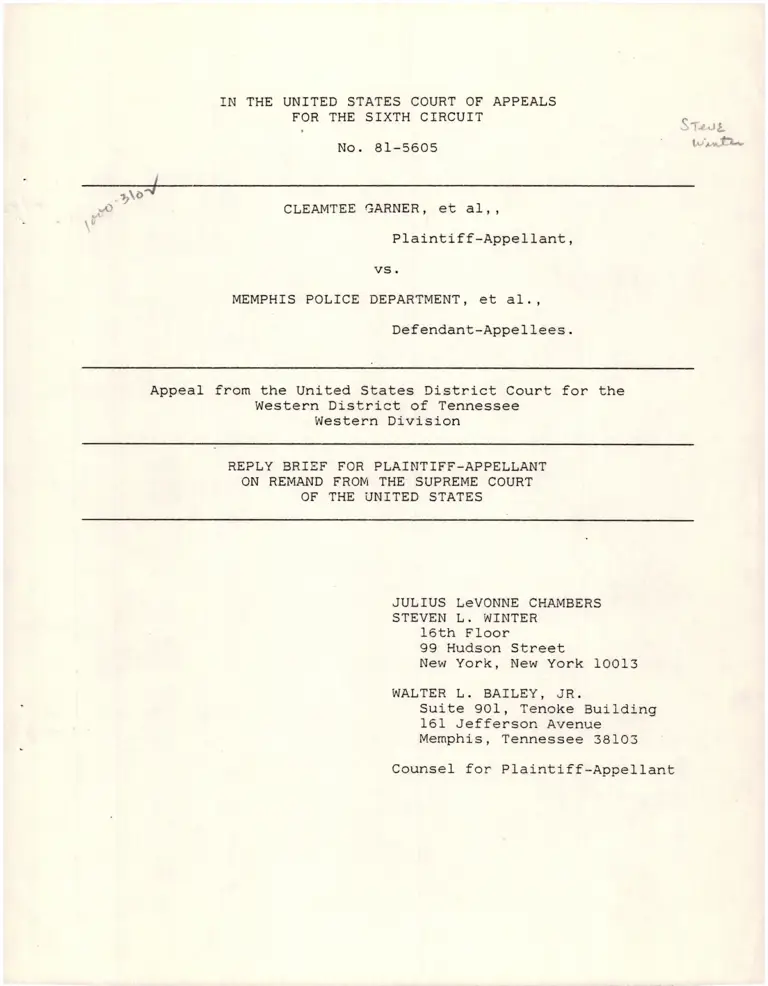
No. 81-5605
IN THE UNITED STATES COURT OF APPEALS
FOR THE SIXTH CIRCUIT
U ) CLEAMTEE GARNER, et al,,
Plaintiff-Appellant,
vs,
MEMPHIS POLICE DEPARTMENT, et al.,
Defendant-Appellees.
Appeal from the United States District Court for the
Western District of Tennessee
Western Division
REPLY BRIEF FOR PLAINTIFF-APPELLANT
ON REMAND FROM THE SUPREME COURT
OF THE UNITED STATES
JULIUS LeVONNE CHAMBERS
STEVEN L. WINTER
16th Floor
99 Hudson Street
Nevi York, New York 10013
WALTER L. BAILEY, JR.
Suite 901, Tenoke Building
161 Jefferson Avenue
Memphis, Tennessee 38103
Counsel for Plaintiff-Appellant
No. 81-5505
IN THE UNITED STATES COURT OF APPEALS
FOR THE SIXTH CIRCUIT
CLEAMTEE GARNER, et al.,
Plaintiff-Appellant,
vs .
MEMPHIS POLICE DEPARTMENT, et al . ,
Defendant-Appellees.
Appeal from the United States District Court for the
Western District of Tennessee
Western Division
REPLY BRIEF FOR PLAINTIFF-APPELLANT
ON REMAND FROM THE SUPREME COURT
OF THE UNITED STATES
Cleamtee Garner, plaintiff-appellant in this court,
respectfully submits this short reply to the city's brief of
July 17, 1985.
(1) There is no Monell issue: The city's brief confirms
our submission that there is no question of the city's liability
under Monell v. Department of Social Services, 4-35 U.S. 558 (1978).
The city has conceded liability under Monell, agreeing that its
policy authorized the unconstitutional action of Officer Hymon.
City's Brief at 1.
The city's only argument against the entry of judgment
for Mr. Garner is a claim of qualified good faith immunity for the
municipality. This argument has no basis in law, has already been
rejected by this court, and cannot be raised at this time.
(2) Res judicata and law of the case: The city cannot
raise the issue of a putative good faith immunity for a municipality
because it was already determined by this court in this case and was
not appealed. Thus, decision on that issue is either res judicata,
or, at the least, the law of the case.
On the previous appeal, the city raised the identical claim
of good faith immunity. This court rejected it, entered judgment for
Mr. Garner, and issued its mandate. Garner v. Memphis Police Depart
ment , 710 F.2d 24-0, 248-4.9 (6th Cir. 1983). In its petition for a
writ of certiorari in the Supreme Court, the city did not challenge
that aspect of this court's decision. The Supreme Court affirmed
the judgment of this court, remanding for further proceedings.
Tennessee v. Garner, 4-71 U.S. __, 85 L.Ed.2d 1, 17 (1985). In the
analogous context of appellate review of district court judgments:
"If an appeal is taken from only part of the judgment, the remaining
part is res judicata, and the . . . remand of the case for further
proceedings does not revive . . . jurisdiction of the unappealed
portions of the judgment." 1 B Moore's Federal Practice 5T 0.404
[4.-3], at p. 131.
At the very least, reconsideration is barred by the doctrine
of "law of the case," which "operates to preclude reconsideration
of identical issues." Petition of United States Steel Corp., 479
F . 2d 489, 493-94 (5th Cir. 1973). None of the three exceptions
to the doctrine -- new evidence at a subsequent trial, intervening
- 2 -
controlling authority, or manifest injustice -- are present in this
case; nor does the city urge that any of these exceptions is rele
vant here. To the contrary, as discussed below, the only new
decision in the area tends to confirm the controlling authority and
the prior decision of this court.
(3) There is no good faith immunity for a municipality:
On the prior appeal, this court rejected the city's argument that
there is a good faith immunity for a municipality. The court held
that "the reasoning underlying the Supreme Court's decision in Owen
[v. City of Independence, 4-4-5 U.S. 622 (1980)], precludes a municipality's
claim of good faith immunity under § 1983 altogether." Garner, 710
F.2d at 248.
Review of the Owen decision confirms this court's deter
mination. Owen rejected the very arguments now asserted by the city.
Owen concerned "the question whether local governments, although not
entitled to an absolute immunity, should be afforded some form of
official immunity in § 1983 suits." Owen, 445 U.S. at 524. The
Eighth Circuit said yes; the Supreme Court reversed. I_d. at 525. In
Owen, the City of Independence made the same argument now made by the
City of Memphis: that because the governing constitutional rule had
not been declared until after the violation,"officials of the City
. . . could not have been aware of [petitioner's] right" and,
therefore, "[t]he City . . . should not be charged with predicting
the future course of constitutional law." Id. at 534 (quoting the
- 3 -
Eighth Circuit decision, 589 F.2d 335, 338 (8th Cir. 1978)). The
1/
Supreme Court "disagree[d] with this holding." W . at 635. "In sum,"
the Court held "that municipalities have no immunity from damages
liability flowing from their constitutional violations ■. . . ." Id.
at 657,
There is no intervening law that casts any doubt on the
viability of this controlling authority. To the contrary, the
Court's recent decision in Oklahoma City v. Tuttle, 4-71 U.S. __,
85 L.Ed.2d 791 (1985), refutes the premise of the city's argument.
Thus, the city claims that: "To hold the City of Memphis liable
herein in damages would be to adopt a rule of strict liability in
tort, as the concept of fault must be totally ignored to reach such
a result." City's Brief at 6'. The Supreme Court, however, reaffirmed
its prior holding in Monell that respondeat superior does not apply and
"that only deprivations visited pursuant to municipal 'custom' or
'policy' could lead to municipal liability. This language tracks
the language of the statute; it also provides a fault-based analysis
for imposing municipal liability," Tuttle, 85 L.Ed.2d at 801;
(emphasis added; footnote omitted). In the Supreme Court's view.
1/ Thus, the city's, argument that this case is somehow distinguishable
from Owen must fail. Although we frankly do not understand the rele
vance of the city's argument that this case is different from Owen
because Memphis did not promulgate "a totally new policy," City's
Brief at 6, we note that the policy pursuant to which young Garner
was killed on October 3, 1974-, had been promulgated only eight months
earlier on February 5, 1974.
- 4 -
liability premised on municipal policy is liability based on
fault, even if, as in Owen, the individual municipal policymakers
2/relied in good faith on the prior decisional law.
Finally, there is no manifest injustice here. There have
been no changes in circumstances since this court's last opinion.
Moreover, the policy considerations found controlling by this court
in its prior opinion and by the Supreme Court in Owen continue to
apply. See Garner , 710 F , 2d at 24.8-4.9,
2/ It is also noteworthy that while the Court discussed the good
faith defense available to the individual, Tuttle, 85 L.Ed.2d at
797 & n.l, it adverted to no parallel immunity for municipalities.
Rather, it discussed only the parameters of the "policy or custom"
doctrine in its discussion of the meaning of "fault-based" liability.
- 5 -
CONCLUSION
The briefs on remand demonstrate that there are no legal
issues on the question of liability to be determined on remand from
the Supreme Court. Liability is plain; only the amount of damages
is left to be determined. The court should remand the case to the
district court with instructions to determine the amount of damages,
award attorneys' fees under § 1988, and enter final judgment for
Mr. Garner.
Respectfully submitted,
/t' - V* - * ~JULIUS LeVONNE CHAMBERS
STEVEN L. WINTER
16th Floor
99 Hudson Street
New York, New York 10013
WALTER L. BAILEY, JR.
Suite 901, Tenoke Building
151 Jefferson Avenue
Memphis, Tennessee 38103
COUNSEL FOR PLAINTIFF-APPELLANT
- 5
CERTIFICATE OF SERVICE
I hereby certify that copies of the foregoing
Reply Brief for Plaintiff-Appellant on Remand have been
served by placing same in the United States mail, postage
prepaid, addressed to Henry L. Klein, Esquire, 770 Estate
Place, Memphis, Tennessee 38117, Clifford D. Pierce, Jr., City
Attorney, 314-125 N. Mid America Mall, Memphis, Tennessee
38103, this 23rd day of July, 1985.
Steven L. Winter
Counsel for Plaintiff-Appellant