Motion as to Scheduling of Oral Argument and Apportionment for Time for Oral Argument
Public Court Documents
September 28, 1970
4 pages
Cite this item
-
Case Files, Swann v. Charlotte-Mecklenburg Hardbacks. Motion as to Scheduling of Oral Argument and Apportionment for Time for Oral Argument, 1970. 0944472c-2e34-f111-88b4-7c1e527f53b4. LDF Archives, Thurgood Marshall Institute. https://ldfrecollection.org/archives/archives-search/archives-item/a8200841-92e6-4a87-a5e1-a8ebf9fe9812/motion-as-to-scheduling-of-oral-argument-and-apportionment-for-time-for-oral-argument. Accessed June 02, 2026.
Copied!
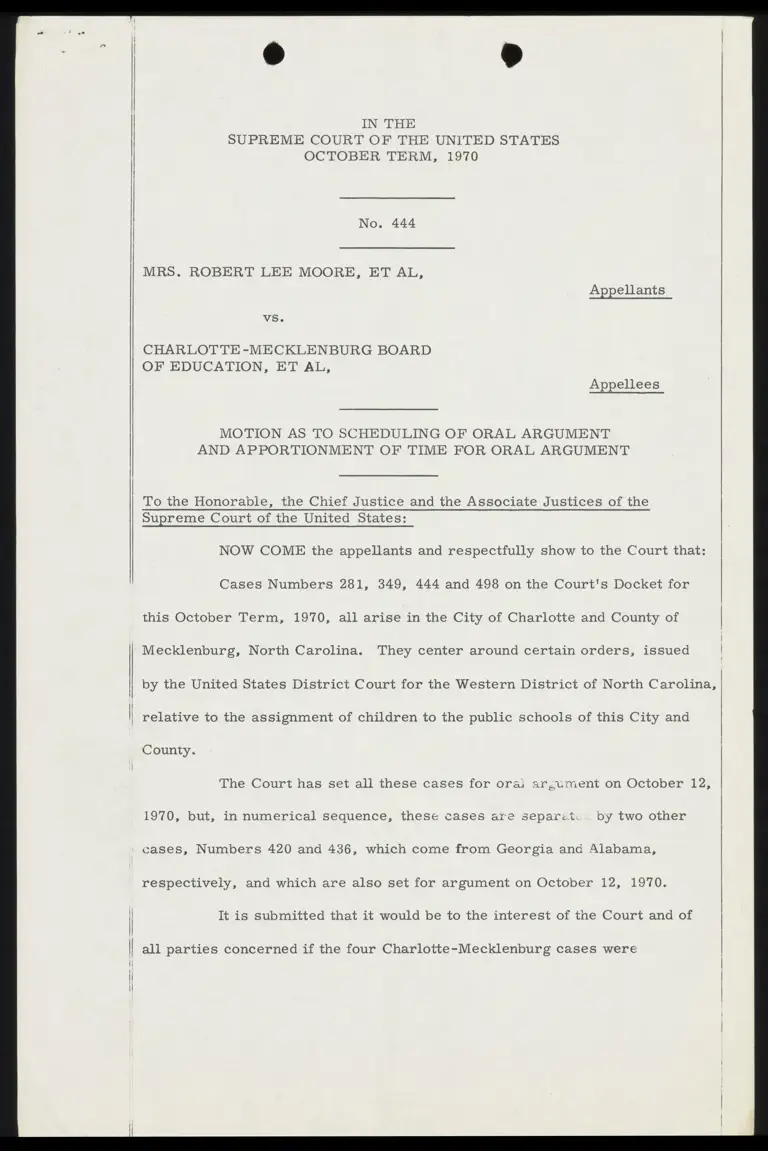
[||ccd67d5f-91d4-4bef-8e02-afb4750675d9||] IN THE
SUPREME COURT OF THE UNITED STATES
OCTOBER TERM, 1970
No. 444
MRS. ROBERT LEE MOORE, ET AL,
Appellants
VS.
CHARLOTTE -MECKLENBURG BOARD
OF EDUCATION, ET AL,
Appellees
MOTION AS TO SCHEDULING OF ORAL ARGUMENT
AND APPORTIONMENT OF TIME FOR ORAL ARGUMENT
To the Honorable, the Chief Justice and the Associate Justices of the
Supreme Court of the United States:
NOW COME the appellants and respectfully show to the Court that:
Cases Numbers 281, 349, 444 and 498 on the Court's Docket for this October Term, 1970, all arise in the City of Charlotte and County of
Mecklenburg, North Carolina. They center around certain orders, issued
by the United States District Court for the Western District of North Carolina, |
relative to the assignment of children to the public schools of this City and
County.
The Court has set all these cases for ora. ar_,ument on October 12,
1970, but, in numerical sequence, these cases are separc<i. by two other
cases, Numbers 420 and 436, which come from Georgia and Alabama,
respectively, and which are also set for argument on October 12, 1970.
It is submitted that it would be to the interest of the Court and of
all parties concerned if the four Charlotte-Mecklenburg cases were
- 4
consolidated for purposes of oral argument, instead of being separated, as
they now are, by the intervening cases from Georgia and Alabama. It is
believed that this would not be opposed by any of the parties in these cases.
The sequence of argument and the apportionment of time for
argument, in these Charlotte-Mecklenburg cases, are also matters to which
the Court will undoubtedly wish to give consideration.
Without regard to the respective docket numbers of the Charlotte -
Mecklenburg cases, the basic positions represented in these cases may be
classified into three principal groupings. One of these basic positions is
that of the plaintiffs in the Moore case. They are contending, essentially,
that under the compulsion of the orders issued by the United States District
Court, the minor plaintiffs in Moore, and thousands of other children
similarly situated, are being assigned to the public schools of Charlotte -
Mecklenburg solely on the basis of race. The Moore plaintiffs are raising
the direct and personal plea that such compulsion is violating rights
guaranteed to them by the United States Constitution. They obtained a Court
injunction against the compulsion, but the central and effective provisions of
such injunction were successively set aside and ruled unconstitutional in the
Courts below.
Occupying another basic position, at the opposite end of the
spectrum, are the plaintiffs in the case of Swann vs. Charlotte-Mecklenburg
Board of Education. The Swann plaintiffs sought and obtained the compulsions
of which the plaintiffs in the Moore case are complaining. The Swann
plaintiffs are thus seeking to sustain in this Court what the Moore plaintiffs
| are seeking to overturn in this Court.
The Charlotte-Mecklenburg Board of Education is in a somewhat
middle position. It opposes a part of the compulsion of which the Moore
plaintiffs complain, but also acquiesces in a part of such compulsion. The
State of North Carolina opposes the action of one of the Courts below in
invalidating a North Carolina statute, the central terms of which are the
same as the terms of the injunction which the Moore plaintiffs originally held.
The Moore plaintiffs are the only parties in the Charlotte-
Mecklenburg SAE are before this Court pleading that their constitutional
rights are being violated by the racial compulsions which have been imposed
upon them. Moreover, there are compulsions here involved, such, for
example, as have been proposed by the Charlotte-Mecklenburg Board of
Education and adopted by the United States District Court, which stand
uncontested before this Court save for the opposition of the Moore plaintiffs.
The Moore plaintiffs are the only parties in these cases who are resisting
and seeking to overturn each and all of the compulsions based on race,
which have been imposed, by whatever authority, during the litigation of
these Charlotte-Mecklenburg cases.
The Swann plaintiffs on the other hand, as has been noted, seek to
sustain these compulsions in their entirety. The antithetical positions in all
the Charlotte-Mecklenburg litigation are thus represented by the Moore
plaintiffs, on the one hand, and by the Swann plaintiffs, on the other.
It is submitted, therefore, that a reasonable and appropriate
procedure in a consolidated argument of the Charlotte-Mecklenburg cases
would be that argument be first presented by the Moore plaintiffs - and that
such enlargement of time for argument be granted to the Moore plaintiffs
as will give them time equal to that of the Swann plaintiffs and the
Charlotte-Mecklenburg Board of Education, respectively.
WHEREFORE, these appellants respectfully pray the Court to
direct that Cases Numbers 281, 349, 444 and 498 on the Court's Docket for
this October Term, 1970, be consolidated for purposes of argument - that
argument be first presented by the Moore plaintiffs - and that such
expansion of time for argument be granted to the Moore plaintiffs as will
give them time equal to that of the Swann plaintiffs and the Charlotte-
Mecklenburg Board of Education, respectively.
Respectfully submitted,
; hy a AZ. Sf
- ~D . / Vo ” theif tl A Ah eA
Whiteford 5] Blakeney I
North Carolina National Bank Building
Charlotte, North Carolina
Attorney for the Appellants
Of Counsel:
William H. Booe
Law Building
Charlotte, North Carolina [||ccd67d5f-91d4-4bef-8e02-afb4750675d9||]