Vulcan Society v. Bloomberg Brief Amicus Curiae in Support of Affirming Judgement in Favor of Appellees
Public Court Documents
April 13, 2012
-
Brief Collection, LDF Court Filings. Vulcan Society v. Bloomberg Brief Amicus Curiae in Support of Affirming Judgement in Favor of Appellees, 2012. adec9b22-c89a-ee11-be36-6045bdeb8873. LDF Archives, Thurgood Marshall Institute. https://ldfrecollection.org/archives/archives-search/archives-item/a89657cc-10fb-49d5-9b1b-9e0fa93691c4/vulcan-society-v-bloomberg-brief-amicus-curiae-in-support-of-affirming-judgement-in-favor-of-appellees. Accessed October 05, 2026.
Copied!
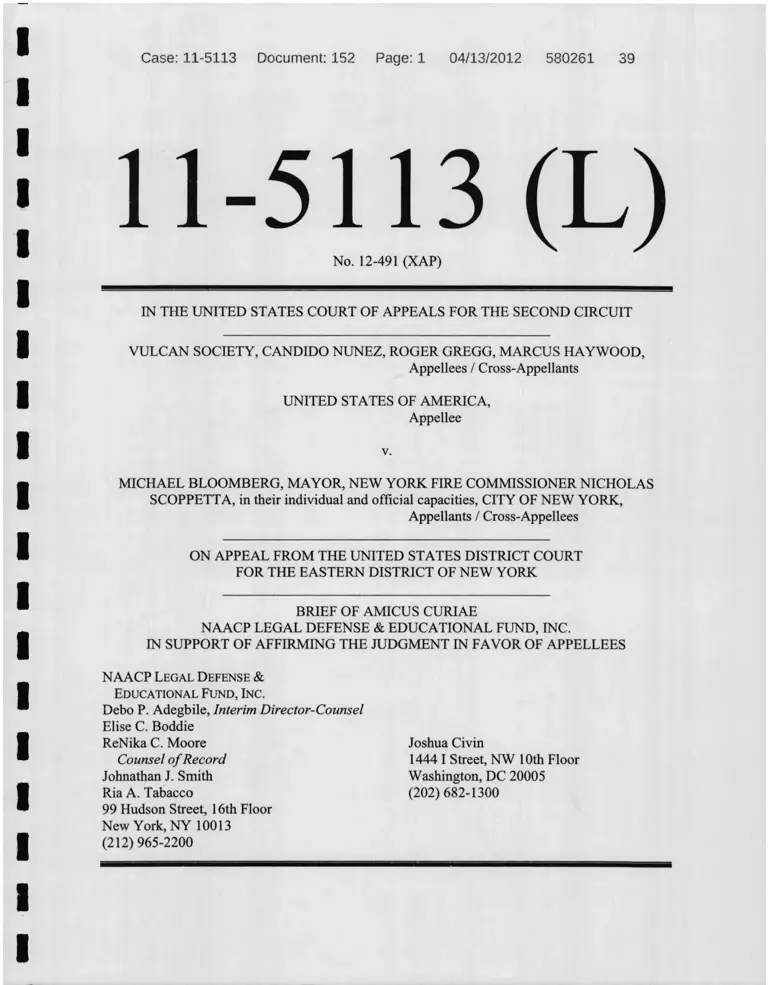
Case: 11-5113 Document: 152 Page: 1 04/13/2012 580261 39
11-5113 (L)
No. 12-491 (XAP)
IN THE UNITED STATES COURT OF APPEALS FOR THE SECOND CIRCUIT
VULCAN SOCIETY, CANDIDO NUNEZ, ROGER GREGG, MARCUS HAYWOOD,
Appellees / Cross-Appellants
UNITED STATES OF AMERICA,
Appellee
v.
MICHAEL BLOOMBERG, MAYOR, NEW YORK FIRE COMMISSIONER NICHOLAS
SCOPPETTA, in their individual and official capacities, CITY OF NEW YORK,
Appellants / Cross-Appellees
ON APPEAL FROM THE UNITED STATES DISTRICT COURT
FOR THE EASTERN DISTRICT OF NEW YORK
BRIEF OF AMICUS CURIAE
NAACP LEGAL DEFENSE & EDUCATIONAL FUND, INC.
IN SUPPORT OF AFFIRMING THE JUDGMENT IN FAVOR OF APPELLEES
NAACP Legal Defense &
Educational Fund, Inc.
Debo P. Adegbile, Interim Director-Counsel
Elise C. Boddie
ReNika C. Moore
Counsel of Record
Johnathan J. Smith
Ria A. Tabacco
99 Hudson Street, 16th Floor
New York, NY 10013
(212) 965-2200
Joshua Civin
1444 I Street, NW 10th Floor
Washington, DC 20005
(202) 682-1300
Case: 11-5113 Document: 152 Page: 2 04/13/2012 580261 39
TABLE OF CONTENTS
Table of Authorities................................................................................................ iii
Interest of Amicus Curiae.........................................................................................1
Summary of the Argument....................................................................................... 2
Argument.................................................................................................................. 6
I. Entrenched discrimination in firefighting was a key factor that
prompted Congress to extend Title VII to public employers in 1972........... 6
A. In 1972, Congress found rampant exclusion of African
Americans from fire departments nationwide.....................................6
B. Racial exclusion in the FDNY was severe prior to the 1972 Act
and has persisted................................................................................. 10
II. Title VII vests courts with wide latitude to exercise their equitable
powers to address disparate-impact discrimination.................................... 12
A. The plain language and legislative history of Title VII establish
Congress’s intent to provide courts with broad authority to
remedy employment discrimination in all forms.............................. 14
B. Section 706(g) authorizes, and courts frequently impose,
affirmative relief to remedy disparate-impact violations................. 19
C. Any limitations on affirmative relief apply only to long-term
quotas for hiring or other individualized job benefits awarded
based on race......................................................................................22
III. The limited award of affirmative relief was not an abuse of discretion.....25
A. The “persistent or egregious” standard does not apply......................25
B. In any event, the FDNY’s discrimination was persistent and
egregious............................................................................................28
Conclusion..............................................................................................................29
i
Case: 11-5113 Document: 152 Page: 3 04/13/2012 580261 39
Certificate of Compliance.....................................................................................31
Certificate of Service............................................................................................32
ii
Case: 11-5113 Document: 152 Page: 4 04/13/2012 580261 39
TABLE OF AUTHORITIES
Cases
Albemarle Paper Co. v. Moody, 422 U.S. 405 (1975)........................... 1, 15, 17, 19
Association Against Discrimination in Employment, Inc. v. City o f
Bridgeport, 647 F.2d 256 (2d Cir. 1981)......................................... 13, 19, 20, 28
Berkman v. City o f New York, 812 F.2d 52 (2d Cir. 1987)..................................... 24
Berkman v. City o f New York, 705 F.2d 584 (2d Cir. 1983)...........................passim
Bradley v. City o f Lynn, 443 F. Supp. 2d 145 (D. Mass. 2006).............................. 12
Brown v. Board o f Education, 347 U.S. 483 (1954)................................................. 8
Connecticut v. Teal, 457 U.S. 440 (1982)................................................................ 8
Cooper v. Federal Reserve Bank o f Richmond, 467 U.S. 867 (1984)...................... 2
Dozier v. Chupka, 395 F. Supp. 836 (S.D. Ohio 1975).......................................... 22
Firefighters Local Union No. 1784 v. Stotts, 467 U.S. 561 (1984).......................... 1
Franks v. Bowman Transportation Co., 424 U.S. 747 (1976).................... 1, 15, 16
Garcia v. Lawn, 805 F.2d 1400 (9th Cir. 1986) .................................................... 16
Griggs v. Duke Power Co., 401 U.S. 424 (1971).................................... 1,2, 17, 29
Guardians Association o f New York City Police Department, Inc. v.
Civil Service Commission, 630 F.2d 79 (2d Cir. 1980)................... 23, 24, 25, 28
Hammon v. Barry, 813 F.2d 412 (D.C. Cir. 1987).................................................. 9
Harper v. Kloster, 486 F.2d 1134 (4th Cir. 1973)................................................... 8
Harper v. Mayor & City Council o f Baltimore, 359 F. Supp. 1187
(D. Md. 1973)........................................................................................................ 8
Harrison v. Lewis, 559 F. Supp. 943 (D.D.C. 1983).............................................. 22
Honadle v. University o f Vermont & State Agricultural College,
56 F. Supp. 2d 419 (D. Vt. 1999)...........
iii
26
Case: 11-5113 Document: 152 Page: 5 04/13/2012 580261 39
Hutchison v. Deutsche Bank Securities Inc., 647 F.3d 479 (2d Cir.
2011)...................................................................................................................... 5
In re Employment Discrimination Litigation Against Alabama,
198 F.3d 1305 (11th Cir. 1999).................................................................... 13,20
International Brotherhood o f Teamsters v. United States, 431 U.S.
324(1977).............................................................................................................15
Kirkland v. New York State Department o f Correctional Services,
520 F.2d 420 (2d Cir. 1975)......................................................................... 24, 25
Lewis v. City o f Chicago, 130 S. Ct. 2191 (2010).....................................................1
Lewis v. City o f Chicago, 643 F.3d 201 (7th Cir. 2011)..........................................12
Local 28 o f Sheet Metal Workers ’ International Association v. EEOC,
478 U.S. 421 (1986).....................................................................................passim
Local 189, United Papermakers & Paperworkers v. United States,
416 F.2d 980 (5th Cir. 1969)............................................................................... 21
Louisiana v. United States, 380 U.S. 145 (1965)..................................................... 17
McNamara v. City o f Chicago, 138 F.3d 1219 (7th Cir. 1998).................................8
McNamara v. City o f Chicago, 959 F. Supp. 870 (N.D. 111. 1997)............................8
Mems v. City o f St. Paul, Department o f Fire & Safety Services,
327 F.3d 771 (8th Cir. 2003)................................................................................. 9
NAACP v. Town o f East Haven, 259 F.3d 113 (2d Cir. 2001)...............................21
Newark Branch, NAACP v. Town o f Harrison, 940 F.2d 792 (3d Cir.
1991)...............................................................................................................13,21
Parents Involved in Community Schools v. Seattle School District
No. 1, 551 U.S. 701 (2007).................................................................................. 26
Pollard v. E.I. du Pont de Nemours & Co., 532 U.S. 843 (2001)..........................18
Republic Steel Corp. v. NLRB, 311 U.S. 7 (1940).................................................. 16
Ricci v. DeStefano, 129 S. Ct. 2658 (2009)............................................................ 27
IV
Case: 11-5113 Document: 152 Page: 6 04/13/2012 580261 39
Rios v. Enterprise Association Steamfitters Local 638 ofU.A.,
501 F.2d 622 (2d Cir. 1974)................................................................................ 13
Robinson v. Lorillard Corp., 444 F.2d 791 (4th Cir. 1971)...................................21
Sheehan v. Purolator Courier Corp., 676 F.2d 877 (2d Cir. 1981) ......................16
United States v. Brennan, 650 F.3d 65 (2d Cir. 2011)............................................. 1
United States v. City o f New York, — F. Supp. 2d —, No. 07 Civ.
2067, 2012 WL 745560 (E.D.N.Y. Mar. 8, 2012)......................................... 3, 20
United States v. New York, 475 F. Supp. 1103 (N.D.N.Y. 1979).......................... 22
Vulcan Society o f New York City Fire Department, Inc. v. Civil
Service Commission, 490 F.2d 387 (2d Cir. 1973)...................................... 1, 5, 6
Vulcan Society o f New York City Fire Department, Inc. v. Civil
Service Commission, 360 F. Supp. 1265 (S.D.N.Y. 1973)...................... 5, 11, 29
Wagner v. Taylor, 836 F.2d 566 (D.C. Cir. 1987).................................................. 16
Statutes
29 U.S.C. § 160(c)...................................................................................................16
42U.S.C. § 1981a....................................................................................................18
42 U.S.C. 2000e et seq..............................................................................................2
42 U.S.C. § 2000e-5(g)........................................................................................... 14
42 U.S.C. § 2000e-5(g)(l)...................................................................................... 19
Civil Rights Act of 1964, Pub. L. No. 88-352, 78 Stat. 241 (1964).................. 6, 14
Civil Rights Act of 1991, Pub. L. No. 102-166, 105 Stat. 1071 (1991)................. 18
Equal Employment Opportunity Act of 1972, Pub. L. No. 92-261, 86
Stat. 103 (1972).............................................................................................. 7, 14
Legislative Materials
112 Cong. Rec. 6091 (1966)..................................................................................... 6
v
118 Cong. Rec. 1817 (1972)............................................................................. 8, 10
118 Cong. Rec. 7168 (1972)............................................................................ 15, 17
Equal Employment Opportunities Enforcement Act: Hearings on S.
2453 Before the Subcommittee on Labor o f the Senate Committee
on Labor and Public Welfare, 91st Cong. (1969)............................................. 6, 7
H.R. Rep. No. 88-914 (1963), reprinted in 1964 U.S.C.C.A.N. 2391 ................... 14
H.R. Rep. No. 92-238 (1971), reprinted in 1972 U.S.C.C.A.N. 2137........7, 10, 15
H.R. Rep. No. 102-40(1) (1991), reprinted in 1991 U.S.C.C.A.N. 529.......... 12, 18
S. Rep. No. 92-415 (1971), reprinted in Senate Committee on Labor
and Public Welfare, 92d Cong., Legislative History o f the Equal
Employment Opportunity Act o f 1972 (1972).......................................................7
Other Authorities
David A. Goldberg, Courage Under Fire: African American
Firefighters and the Struggle for Racial Equality (Feb. 2006)
(unpublished Ph.D. dissertation, University of Massachusetts
Amherst)....................................................................................................... 10, 11
Denise M. Hulett et al., Enhancing Women’s Inclusion in Firefighting
in the USA, 8 Inf 1 J. of Diversity in Organisations, Communities &
Nations 189 (2008)................................................................................................ 9
Minna J. Kotkin, Public Remedies for Private Wrongs: Rethinking the
Title VII Back Pay Remedy, 41 Hastings L.J. 1301 (1990).................................15
Note, Legal Implications o f the Use o f Standardized Ability Tests in
Employment and Education, 68 Colum. L. Rev. 691 (1968).............................. 21
U.S. Commission on Civil Rights, For ALL the people . . . By ALL the
people: A Report on Equal Opportunity in State and Local
Government Employment (1969)................................................................ 8, 9, 10
Case: 11-5113 Document: 152 Page: 7 04/13/2012 580261 39
vi
Case: 11-5113 Document: 152 Page: 8 04/13/2012 580261 39
INTEREST OF AMICUS CURIAE1
The NAACP Legal Defense & Educational Fund, Inc. (LDF) is a non-profit
legal organization established under New York law more than seven decades ago
to assist African Americans and other people of color in securing their civil and
constitutional rights. Since the enactment of Title VII of the Civil Rights Act of
1964, LDF has worked to enforce this landmark statute, challenging discriminatory
practices of both private and public employers, including in the original Vulcan
Society litigation. See Vulcan Soc’y o f N.Y.C. Fire Dep’t, Inc. v. Civil Serv.
Comm’n, 490 F.2d 387 (2d Cir. 1973); see also Lewis v. City o f Chicago, 130
S. Ct. 2191 (2010); Cooper v. Fed. Reserve Bank o f Richmond, 467 U.S. 867
(1984); Firefighters Local Union No. 1784 v. Stotts, 467 U.S. 561 (1984); Franks
v. Bowman Transp. Co., 424 U.S. 747 (1976); Albemarle Paper Co. v. Moody, 422
U.S. 405 (1975); Griggs v. Duke Power Co., 401 U.S. 424 (1971); United States v.
Brennan, 650 F.3d 65 (2d Cir. 2011).
1 This brief is filed with the consent of all parties. Pursuant to Federal Rule of
Appellate Procedure 29(c)(5), counsel for the amicus states that no counsel for a
party authored this brief in whole or in part, and that no person other than the
amicus, its members, or its counsel made a monetary contribution to the
preparation or submission of this brief.
1
Case: 11-5113 Document: 152 Page: 9 04/13/2012 580261 39
SUMMARY OF THE ARGUMENT
Employment discrimination has proved more difficult to eliminate in
firefighting than in perhaps any other employment sector. Six years after the
passage of the landmark Civil Rights Act of 1964, 42 U.S.C. 2000e et seq.,
Congress extended Title VII to cover municipal employers because it was
particularly concerned by the pervasive exclusion of African Americans and other
minorities from fire departments nationwide. While some fire departments across
the nation have made limited progress “to reflect the communities they serve,
employment as a New York City firefighter—arguably ‘the best job in the
world’—has remained a stubborn bastion of white male privilege,” as this case
vividly illustrates. SA85.2
The federal courts have played a critical role in the long struggle to eradicate
discrimination in firefighting because they have been able to make full use of the
broad equitable powers that Congress authorized, when it enacted Title VII in
1964, and later augmented, when it amended the statute in 1972. It is well
established that these equitable powers are equally robust and necessary to fulfill
Congress’s goal of eliminating barriers to equal employment opportunity, whether
a court is crafting a remedy for intentional discrimination or for practices that are
2 “SA__” and “JA__” refer, respectively, to the Special Appendix and Joint
Appendix filed with the City’s opening brief.
2
Case: 11-5113 Document: 152 Page: 10 04/13/2012 580261 39
“discriminatory in operation.” Griggs v. Duke Power Co., 401 U.S. 424, 431
(1971).
Misconstruing decades of precedent and clear congressional intent, the City
seeks to curtail the authority of courts to effectively remedy Title VII violations. It
bears emphasis that, in this appeal, the City does not contest, City Br. 3 n.2, 5, 9,
the district court’s liability finding that two entry-level firefighter examinations, as
they were utilized from 1999 to 2007, had a severe and unjustified disparate impact
on African-American and Latino applicants. JA428-520. Yet, according to the
City, the only lawful remedies for this uncontested disparate-impact discrimination
were those portions of the December 2011 remedial injunction barring future use
of the challenged examinations and requiring the development and administration
of a new test that complies with Title VII. SA156-58; City Br. 5, 94.3
Notwithstanding the City’s argument to the contrary, the district court’s
additional injunctive relief does not constitute an abuse of discretion. City Br. 67.
Specifically, the City challenges the provisions in the December 2011 remedial
injunction that require it to: (a) evaluate its recruitment strategies and identify best
Moreover, this appeal does not address the district court’s more recent
remedial order awarding aggregate gross backpay damages of $128,696,803
(subject to mitigation) and priority hiring of 293 candidates from among the
African Americans and Latinos who sat for the challenged examinations and were
not hired. See United States v. City o f New York, — F. Supp. 2d —, No. 07 Civ.
2067, 2012 WL 745560 (E.D.N.Y. Mar. 8, 2012).
3
Case: 11-5113 Document: 152 Page: 11 04/13/2012 580261 39
practices for outreach to African-American and Latino candidates; (b) combat high
attrition rates, especially for African-American and Latino applicants who pass the
written examination but are deterred by the lengthy period that elapses before they
proceed to subsequent stages in the hiring process; (c) revise post-exam screening
procedures, especially the City’s standardless use of arrest records to exclude
applicants who were arrested but never convicted, a practice which negatively
affects African-American and Latino applicants because they are more likely to
have been arrested in the City than whites; and (d) retain an independent consultant
to recommend changes within the FDNY’s chronically under-resourced Equal
Employment Opportunity office, and the City as a whole, in order to eliminate
barriers to compliance with equal employment opportunity law. According to the
City, these portions of the remedial injunction, which it characterizes as
“affirmative relief,” exceed the scope of the uncontested disparate-impact liability
finding and cannot be supported by the district court’s intentional discrimination
finding because that ruling is flawed and must be reversed. City Br. 84-95.
For the reasons stated by Plaintiffs-Intervenors, Vulcan Soc’y Br. 98-134,
this Court should uphold the district court’s finding that the City’s long-standing
reliance on discriminatory testing procedures constituted a pattern and practice of
intentional discrimination against African-American applicants in violation of Title
VII and the Equal Protection Clause of the U.S. Constitution. JA1372, JA1410-31.
4
Case: 11-5113 Document: 152 Page: 12 04/13/2012 580261 39
Indeed, the FDNY’s discriminatory practices are exactly the sort of conduct
highlighted in the legislative history of the 1972 amendments to justify extending
coverage of Title VII to municipal employers. The long history of federal judicial
intervention to address discrimination in the FDNY began the following year,
when Judge Weinfeld held that the City’s firefighter hiring examinations
unlawfully discriminated against African-American and Latino applicants. Vulcan
Soc’y o f N.Y.C. Fire Dep’t, Inc. v. Civil Serv. Comm’n, 360 F. Supp. 1265, 1277
(S.D.N.Y.), aff’d in relevant part, 490 F.2d 387 (2d Cir. 1973). Despite that
finding and an aggressive remedy, the City purposefully and persistently
obstmcted efforts to rectify its unfair hiring practices. JA1402, JA1421-27. As a
result, the percentage of African-American firefighters in the FDNY stood at just
3.4% when this case was filed in 2007. JA1386.
While the December 2011 remedial injunction is fully supported by the
district court’s finding of intentional discrimination, amicus LDF respectfully
suggests that it may be unnecessary to resolve the City’s challenge to that ruling.
This Court can affirm on the alternate grounds that all of the injunctive relief
ordered by the district court constitutes an appropriate remedy for the uncontested
disparate-impact violation. See Hutchison v. Deutsche Bank Sec. Inc., 647 F.3d
479, 481 (2d Cir. 2011) (affirming judgment on alternate grounds). To the extent
that there are limitations on affirmative relief, they apply only to long-term hiring
5
Case: 11-5113 Document: 152 Page: 13 04/13/2012 580261 39
quotas or other preferential treatment of individual employees or applicants based
on race—a type of remedy that the district court has not ordered in this case.
Indeed, the race-neutral injunctive relief that the City challenges is far more
modest than the remedy upheld by this Court decades ago in the original Vulcan
Society litigation. See 490 F.2d at 391, 398-99.
ARGUMENT
I. Entrenched discrimination in firefighting was a key factor that
prompted Congress to extend Title VII to public employers in 1972.
Widespread racial discrimination in public employment generally—and in
fire departments in particular—prompted Congress to extend Title VII to state and
local government employers in 1972, as the congressional record and other
contemporaneous evidence makes clear. The district court’s liability findings and
remedial injunction must be viewed in light of this history.
A. In 1972, Congress found rampant exclusion of African
Americans from fire departments nationwide.
As originally enacted, Title VII exempted state and local employers. See
Civil Rights Act of 1964, Pub. L. No. 88-352, § 701(b), 78 Stat. 241, 253 (1964).
Immediately following the statute’s enactment, this exemption was identified as a
serious shortcoming. See, e.g., 112 Cong. Rec. 6091-94 (1966) (statement of Sen.
Javits); Equal Employment Opportunities Enforcement Act: Hearings on S. 2453
Before the Subcomm. on Labor o f the S. Comm, on Labor and Pub. Welfare, 91st
6
Case: 11-5113 Document: 152 Page: 14 04/13/2012 580261 39
Cong. 73 (1969) (statement of Jack Greenberg, Director-Counsel, NAACP Legal
Defense & Educational Fund, Inc.); id. at 167-68 (statement of Howard Glickstein,
Staff Director, U.S. Commission on Civil Rights).
In 1972, Congress amended Title VII and redefined “employer” to include
state and local governments, governmental agencies, and political subdivisions.
See Equal Employment Opportunity Act of 1972 (the “1972 Act”), Pub. L. No.
92-261, § 2, 86 Stat. 103, 103 (1972). In adopting this amendment, Congress
found that “widespread discrimination against minorities exists in State and local
government employment, and . . . the existence of this discrimination is
perpetuated by . . . both institutional and overt discriminatory practices.” H.R.
Rep. No. 92-238 (1971), reprinted in 1972 U.S.C.C.A.N. 2137, 2152. Congress
further determined that “employment discrimination in State and local
governments is more pervasive than in the private sector.” Id.; see also S. Rep.
No. 92-415, at 10 (1971), reprinted in S. Comm, on Labor and Pub. Welfare, 92d
Cong., Legislative History o f the Equal Employment Opportunity Act o f 1972, at
419 (1972).
Congress singled out fire departments as among the most egregious
employers that justified extension of Title VII: “Barriers to equal employment are
greater in police and fire departments than in any other area of State and local
government. . . . Negroes are not employed in significant numbers in police and
7
Case: 11-5113 Document: 152 Page: 15 04/13/2012 580261 39
fire departments.” 118 Cong. Rec. 1817 (1972) (quoting U.S. Comm’n on Civil
Rights, For ALL the people . . . By ALL the people: A Report on Equal
Opportunity in State and Local Government Employment 119 (1969) [hereinafter
1969 USCCR Report]).4
Well into the 1960s, those few African Americans who were hired were
frequently assigned to segregated firehouses. See, e.g., 1969 USCCR Report 71;
McNamara v. City o f Chicago, 959 F. Supp. 870, 874 (N.D. 111. 1997) (Chicago
maintained segregated firefighting companies until 1965), aff’d, 138 F.3d 1219
(7th Cir. 1998); Harper v. Mayor & City Council o f Baltimore, 359 F. Supp. 1187,
1195 n.ll (D. Md.) (“Segregation persisted in the Baltimore Fire Department for
more than a decade after [Brown v. Bd. ofEduc., 347 U.S. 483 (1954)].”), aff’d in
relevant part sub nom. Harper v. Kloster, 486 F.2d 1134 (4th Cir. 1973).
These segregative and racially exclusive practices were reinforced by the
unique work environment in fire departments. See 1969 USCCR Report 87
(“[T]he unusual working arrangement of firemen has given rise to many forms of
prejudiced attitudes and treatment.”). Firefighters are typically assigned to work
twenty-four-hour shifts and must live and eat at their fire station while on duty.
4 As the Supreme Court has noted, in extending Title VII to state and local
employers, Congress relied heavily upon the 1969 USCCR Report, which detailed
pervasive racial discrimination in public employment and particularly in
firefighting. Connecticut v. Teal, 457 U.S. 440, 449-50 n.10 (1982) (noting
Congress’s reliance on the 1969 USCCR Report).
8
Case: 11-5113 Document: 152 Page: 16 04/13/2012 580261 39
See Mems v. City o f St. Paul, Dep 7 of Fire & Safety Servs., 327 F.3d 771, 775 (8th
Cir. 2003); Denise M. Hulett et al., Enhancing Women’s Inclusion in Firefighting
in the USA, 8 Int’l J. of Diversity in Organisations, Communities & Nations 189,
190 (2008). While these facets of firefighting—combined with its prestige, good
pay, job security, and valuable societal contribution—have made it a desirable job
for many Americans, they have also created an organizational culture particularly
resistant to racial integration. Thus, even after fire departments officially
desegregated, African-American firefighters were routinely barred from using the
same living and sleeping quarters as whites. For example, after Washington, D.C.
firehouses were desegregated in the 1960s, black firefighters were required for
more than a decade to sleep in designated “C” beds and eat from separate “C”
dishes and “C” utensils, for “Colored.” Hammon v. Barry, 813 F.2d 412, 434
(D.C. Cir. 1987); see also 1969 USCCR Report 71, 89 (finding that the only black
firefighter employed in San Francisco in 1967 was required to carry his own
mattress between stations during his training period).
Of particular relevance here, Congress concluded that segregation and hiring
barriers were often paired with widespread refusal to recruit African-American
candidates: “[Fjire departments have discouraged minority persons from joining
their ranks by failure to recruit effectively and by permitting unequal treatment on
the job including unequal promotional opportunities, discriminatory job
9
Case: 11-5113 Document: 152 Page: 17 04/13/2012 580261 39
assignments, and harassment by fellow workers.” 118 Cong. Rec. 1817 (1972)
(quoting 1969 USCCR Report 120). Congress also cited specific barriers to fair
employment in fire departments, including the use of “selection devices which are
arbitrary, unrelated to job performance, and result in unequal treatment of
minorities.” Id. (quoting 1969 USCCR Report 119).
Finally, Congress was especially concerned that continued discrimination in
firefighting and other highly visible jobs impaired government performance and
democratic accountability: “The problem of employment discrimination is
particularly acute and has the most deleterious effect in these governmental
activities which are most visible to the minority communities . . . with the result
that the credibility of the government’s claim to represent all the people equally is
negated.” H.R. Rep. No. 92-238, 1972 U.S.C.C.A.N. at 2153.
B. Racial exclusion in the FDNY was severe prior to the 1972 Act
and has persisted.
New York was no exception to this widespread pattern of racial
discrimination in firefighting. In 1963, just 4.15% of all FDNY employees, in any
title, were African American. JA1386. In the period leading up to the 1972 Act,
not only did the FDNY manipulate hiring procedures to screen out African-
American applicants, but it frequently excluded those who were hired from
coveted positions, such as drivers and fire inspectors, and instead “[rjelegated
[them] to . . . the toughest, most dangerous, and least public assignments.” David
10
Case: 11-5113 Document: 152 Page: 18 04/13/2012 580261 39
A. Goldberg, Courage Under Fire: African American Firefighters and the Struggle
for Racial Equality 73, 125-29 (Feb. 2006) (unpublished Ph.D. dissertation,
University of Massachusetts Amherst). In addition, African-American firefighters
regularly experienced harassment and physical threats from both white
counterparts and senior management. Id. at 73.
Not much changed after the 1972 Act went into effect. In 1973, when the
Vulcan Society won its original litigation against the City, African Americans and
Latinos accounted for just 5% of the firefighting force, although they made up 32%
of the city’s population. Vulcan Soc’y, 360 F. Supp. at 1269. “The subsequent
history of the FDNY demonstrates that whatever practical effect Judge Weinfeld’s
injunction may have had on minority hiring dissipated shortly after the injunction
expired” in 1977. JA1386. Strikingly, the percentage of African-American
firefighters in the FDNY was approximately the same when this case was filed in
2007 as it was in 1973. Id. (“Between 1991 and 2007, black firefighters never
constituted more than 3.9% of the force, and by the time this case was filed in
2007, the percentage of black firefighters in the FDNY had dropped to 3.4%.”).
The FDNY, unfortunately, has purposely and persistently thwarted efforts to
address its history of racial exclusion. Vulcan Soc’y Br. 8-36. To be sure,
discriminatory practices persist elsewhere, and indeed, Congress relied specifically
on widespread evidence of discrimination in firefighting to support its amendments
11
Case: 11-5113 Document: 152 Page: 19 04/13/2012 580261 39
to Title VII in 1991. See H.R. Rep. No. 102-40(1), at 99-100 (1991), reprinted in
1991 U.S.C.C.A.N. 549, 637-38. Nevertheless, the FDNY lags far behind other
major American cities in terms of its dismally low rates of African-American and
Latino firefighters. Vulcan Soc’y Br. 8-36; U.S. Br. 7-9 (charts demonstrating that
New York has the lowest ratio of African-American and Latino firefighters among
eight of the largest cities in the nation). Thus, the City’s attempt to limit the scope
of relief available here would frustrate Congress’s intent to desegregate municipal
employment generally and fire departments in particular. Indeed, absent an
efficacious remedy, the FDNY, which is the largest fire department in the nation,
seems impervious to meaningful changes that could redress its severe and
pervasive discrimination.
II. Title VII vests courts with wide latitude to exercise their equitable
powers to address disparate-impact discrimination.
To the extent that limited progress has been made in fire departments across
the nation, it has required diligent and persistent judicial intervention. See, e.g.,
Lewis v. City o f Chicago, 643 F.3d 201 (7th Cir. 2011) (affirming scope of remedy
for unjustified disparate impact on African Americans caused by Chicago’s
repeated utilization of a hiring examination administered sixteen years earlier);
Bradley v. City o f Lynn, 443 F. Supp. 2d. 145, 173-76 (D. Mass. 2006) (holding
that Massachusetts violated Title VII by using state-wide firefighter hiring
examinations that had an unjustified adverse impact on minority candidates and
12
Case: 11-5113 Document: 152 Page: 20 04/13/2012 580261 39
noting that “not much has changed” since a prior judicial remedy thirty years
earlier). In some municipalities where courts have successfully overseen
implementation of broad remedial measures, firefighting is now a career path that
is more accessible to communities of color. See Br. of Amicus Curiae Inf 1 Ass’n
of Black Prof 1 Firefighters, Part II (describing the success of court remedies in the
San Francisco Fire Department). The importance of court-ordered remedies in
furthering progress in other fire departments demonstrates the need for the
appropriate exercise of equitable remedial authority to remedy the continuing
effects of the uncontestedly discriminatory examinations that the City utilized from
1999 to 2007. JA428-520.
Where, as here, ‘“a violation of Title VII is established, the district court
possesses broad power as a court of equity to remedy the vestiges of past
discriminatory practices.’” Ass’n Against Discrimination in Emp’t, Inc. v. City o f
Bridgeport, 647 F.2d 256, 278 (2d Cir. 1981) (quoting Rios v. Enter. Ass’n
Steamfitters Local 638 ofU.A., 501 F.2d 622, 629 (2d Cir. 1974)); see also Newark
Branch, NAACP v. Town o f Harrison, 940 F.2d 792, 806 (3d Cir. 1991); Berkman
v. City o f New York, 705 F.2d 584, 594 (2d Cir. 1983); U.S. Br. 28-29. As the
district court correctly recognized, see SA102-03, the “full range of equitable
remedies [is] available in disparate impact cases as well” as disparate treatment
cases. In re Emp’t Discrimination Litig. Against Ala., 198 F.3d 1305, 1315 n.13
13
Case: 11-5113 Document: 152 Page: 21 04/13/2012 580261 39
(11th Cir. 1999). Notwithstanding the City’s contentions to the contrary, City
Br. 84, this broad equitable authority to remedy both disparate-impact and
disparate-treatment discrimination is well established by the Title VII’s text,
legislative history, and settled precedent.
A. The plain language and legislative history of Title VII establish
Congress’s intent to provide courts with broad authority to
remedy employment discrimination in all forms.
1. With the Civil Rights Act of 1964, Congress unequivocally sought to root
out employment discrimination in all forms. See H.R. Rep. No. 88-914 (1963),
reprinted in 1964 U.S.C.C.A.N. 2391, 2401. To accomplish this goal, Congress
included a broad remedial provision, section 706(g), which empowers courts not
only to enjoin discriminatory conduct but also to “order such affirmative action as
may be appropriate.” Civil Rights Act of 1964, Pub. L. No. 88-352, § 706(g), 78
Stat. 241, 261 (codified, as amended, at 42 U.S.C. § 2000e-5(g)) [hereinafter
section 706(g)],
When Congress amended Title VII in 1972, it made a revision that was just
as critical as removing the exemption for fire departments and other municipal
employers. See Part I.A supra. It expanded section 706(g) to authorize the courts
to order “any other equitable relief as [they] deem[] appropriate,” in addition to
backpay, injunctive relief, “affirmative action,” and other remedies originally
authorized. 1972 Act, Pub. L. No. 92-261, § 4, 86 Stat. 103, 104-07 (1972). As
14
Case: 11-5.113 Document: 152 Page: 22 04/13/2012 580261 39
the legislative history illustrates, this amendment responded to concerns that “the
machinery created by the Civil Rights Act of 1964 [was] not adequate” to ensure
equal employment opportunity. H.R. Rep. No. 92-238 (1971), reprinted in 1972
U.S.C.C.A.N. 2137, 2139. Congress therefore reaffirmed that Title VII’s remedial
provision was “intended to give the courts wide discretion exercising their
equitable powers to fashion the most complete relief possible.” 118 Cong. Rec.
7168 (1972); see also Minna J. Kotkin, Public Remedies for Private Wrongs:
Rethinking the Title VII Back Pay Remedy, 41 Hastings L.J. 1301, 1326 (1990)
(noting that the additional remedial language inserted in section 706(g) in 1972
was “directed to increasing and confirming flexibility, rather than to restricting
options for relief’).
2. The Supreme Court has repeatedly relied on this legislative history as
“emphatic confirmation that federal courts are empowered to fashion such relief as
the particular circumstances of a case may require.” Franks v. Bowman Transp.
Co., 424 U.S. 747, 763-64 (1976); see also Local 28 o f Sheet Metal Workers’ Int’l
Ass’n v. EEOC, 478 U.S. 421, 445-46 (1986) (acknowledging broad remedial
powers vested to federal courts under Title VII); Int’l Bhd. o f Teamsters v. United
States, 431 U.S. 324, 364 (1977) (same); Albemarle Paper Co. v. Moody, 422 U.S.
405, 420-21 (1975) (same). Similarly relying on pertinent legislative history, this
Court concluded:
15
Case: 11-5113 Document: 152 Page: 23 04/13/2012 580261 39
[W]e are persuaded that Congress intended the federal courts to have
resort to all of their traditional equity powers, direct and incidental, in
aid of the enforcement of [Title VII]. Having stated its aim to
eradicate employment discrimination, Congress made explicit
statutory attempts to forestall possible efforts to frustrate the
achievement of its goal.
Sheehan v. Purolator Courier Corp., 676 F.2d 877, 885 (2d Cir. 1981); see also
Wagner v. Taylor, 836 F.2d 566, 572 (D.C. Cir. 1987) (observing that the
legislative history makes clear that Congress vested courts with “broad statutory
powers designed to effectuate and preserve the rights of Title VII claimants”);
Garcia v. Lawn, 805 F.2d 1400, 1403 (9th Cir. 1986).
The Supreme Court has also placed considerable weight on the fact that
Congress modeled section 706(g), including its authorization of “affirmative
action,” after the remedial section of the National Labor Relations Act (NLRA), 29
U.S.C. § 160(c). See Franks, 424 U.S. at 769-70; Local 28, 478 U.S. at 446 n.26.
That provision provides the National Labor Relations Board with broad discretion
not only to enjoin unlawful labor practices, but also to require employers to take
affirmative measures that accomplish the NLRA’s objectives. See Republic Steel
Corp. v. NLRB, 311 U.S. 7, 12 (1940). Tellingly, in Franks, the Supreme Court
observed that, in light of the 1972 Act, section 706(g) now vests courts with even
greater remedial powers than the NLRA. Franks, 424 U.S. at 769 n.29.
3. The expansive remedial authorization in section 706(g) as originally
enacted is not limited to cases of intentional discrimination; nor does the even
16
Case: 11-5113 Document: 152 Page: 24 04/13/2012 580261 39
broader remedial authorization added in 1972 distinguish between relief for
disparate-treatment and disparate-impact discrimination, even though this
amendment was enacted against the backdrop of the Supreme Court’s seminal
decision two years earlier in Griggs, 401 U.S. at 430 (holding that Title VII
prohibits “practices, procedures, or tests neutral on their face, and even neutral in
terms of intent” that “operate to ‘freeze’ the status quo of prior discriminatory
employment practices”).
Four years after Griggs and two years after the 1972 Act, the Supreme Court
confirmed that Title VII’s broad remedial powers apply equally to disparate-impact
and disparate-treatment cases. In Albemarle Paper Co., the district court found
that the company’s employment tests and other policies had an unjustified adverse
impact on the basis of race, but it declined to award backpay because there was no
evidence of “bad faith.” 422 U.S. at 413. Relying on the legislative history of the
1972 amendments, the Supreme Court rejected this reasoning as inconsistent with
Congress’s mandate. Id. at 420-21 (citing 118 Cong. Rec. 7168 (1972)). The
Court emphasized what the legislative record makes clear: District courts have
‘“not merely the power but the duty to render a decree which will so far as possible
eliminate the discriminatory effects of the past as well as bar like discrimination in
the future.’” Id. at 418 (quoting Louisiana v. United States, 380 U.S. 145, 154
(1965)). Thus, Title VII’s remedial provision authorizes—and indeed, requires—
17
Case: 11-5113 Document: 152 Page: 25 04/13/2012 580261 39
that district courts do much more than simply enjoin a test that has an unjustified
and racially disparate impact.
Congress’s firm commitment to broad judicial authority to redress disparate-
impact discrimination is also evident in the Civil Rights Act of 1991, Pub. L. No.
102-166, 105 Stat. 1071 (1991) (the “1991 Act”). Troubled by a string of Supreme
Court decisions that limited the reach of Title VII, Congress sought to restore the
strength of the statute to promote equal opportunity. H.R. Rep. No. 102-40(1)
(1991), reprinted in 1991 U.S.C.C.A.N. 549, at 552. Congress underscored the
disparate-impact holdings of Albemarle and Griggs—-which the House Report
called “the single most important Title VII decision”—by expressly enshrining
them into the Act. See id. at 562.5
In sum, the plain text and legislative history of Title VII, as confirmed by
settled precedent, firmly establish that Congress intended courts to have “‘not
merely the power but the duty” to use Title VII’s remedial powers as fully as
possible to eradicate both disparate-impact and disparate-treatment discrimination.
5 In addition to reaffirming Griggs, the 1991 Act expanded remedies for
intentional discrimination to include punitive damages in certain circumstances.
See Pub. L. No. 102-166, § 102, 105 Stat. 1071, 1072 (codified at 42 U.S.C.
§ 1981a). While the Act did not authorize such relief for disparate-impact
discrimination, the legislative history makes clear that Congress “determined that
victims of employment discrimination were entitled to additional remedies . . .
without giving any indication that it wished to curtail previously available
remedies.” Pollard v. E.I. du Pont de Nemours & Co., 532 U.S. 843, 852 (2001)
(emphasis in original).
18
Case: 11-5113 Document: 152 Page: 26 04/13/2012 580261 39
Albemarle, 422 U.S. at 421 (citation and quotation marks omitted).
B. Section 706(g) authorizes, and courts frequently impose,
affirmative relief to remedy disparate-impact violations.
As amended, section 706(g) vests district courts with the power, inter alia,
to “enjoin the [employer] from engaging in [an] unlawful employment practice,” to
“order such affirmative action as may be appropriate,” and to award “any other
equitable relief as the court deems appropriate.” 42 U.S.C. § 2000e-5(g)(l). This
Court has explained that Title VII remedies fall into three categories:
compensatory relief, “designed to ‘make whole’ the victims of the defendant’s
discrimination”; compliance relief, “designed to erase the discriminatory effect of
the challenged practice and to assure compliance with Title VII in the future”; and
affirmative relief, “designed principally to remedy the effects of discrimination that
may not be cured by the granting of compliance or compensatory relief.”
Berkman, 705 F.2d at 595-96; Ass’n Against Discrimination in Emp’t, Inc., 647
F.2d at 280.
The City contends that it was an abuse of discretion for the district court to
award any “affirmative relief’; the only lawful aspects of the December 2011
remedial injunction, in the City’s view, were those barring future use of the
discriminatory examinations and requiring development and administration of a
19
Case: 11-5113 Document: 152 Page: 27 04/13/2012 580261 39
new Title VH-compliant examination. City Br. 86-94.6 To the extent that the City
accurately characterizes the remaining portions of the remedial injunction as
affirmative relief, its assertion that Title VII “presumptively limits affirmative
relief—[as opposed to] compliance or compensatory relief—to cases of intentional
discrimination,” City Br. 85, misconstrues well-established precedent.
First, the City’s reliance on the text of section 706(g) is misplaced. City Br.
85. “The requirement that an employer have discriminated ‘intentionally’ in order
for the provisions of § 706(g) to come into play means not that there must have
been a discriminatory purpose, but only that the acts must have been deliberate, not
accidental.” Ass ’n Against Discrimination in Emp 7, 647 F.2d at 280 n.22; accord
In re Emp’t Discrimination Litig. Against Ala., 198 F.3d at 1315 n.13 (section
706(g) ‘“requires only that the defendant meant to do what he did, that is, his
6 These uncontested portions of the remedial injunction are indisputably
compliance relief. See Berkman, 705 F.2d at 596. Moreover, although not the
subject of this appeal, the backpay damages and priority hiring required by the
district court’s March 2012 order, see City o f New York, 2012 WL 745560, are
compensatory, and perhaps compliance, relief as well. See Berkman, 705 F.2d at
596 (compensatory relief includes backpay); id. at 595-96 (“To the extent that an
order requires the hiring of a member of the plaintiff class—i. e., a victim of the
discrimination—it constitutes both compliance relief and compensatory relief.”).
y
Some of the remedies that the City challenges more properly could be
characterized as compliance relief. As this Court has observed, compliance relief
includes forward-looking remedies to bring the employer into compliance with
Title VII. See Berkman, 705 F.2d at 596. That is precisely what the district court
did when it ordered the City, inter alia, to maintain records of communications
concerning firefighter candidates and reform its Equal Employment Opportunity
office. SA163-64, SA168-71.
20
Case: 11-5113 Document: 152 Page: 28 04/13/2012 580261 39
employment practice was not accidental’”) (quoting Local 189, United
Papermakers & Paperworkers v. United States, 416 F.2d 980, 996 (5th Cir.
1969)); Robinson v. Lorillard Corp., 444 F.2d 791, 796 (4th Cir. 1971) (rejecting
position that section 706(g) “requires that plaintiffs prove the existence of a
discriminatory intent”); see also Note, Legal Implications o f the Use o f
Standardized Ability Tests in Employment and Education, 68 Colum. L. Rev. 691,
713 (1968) (willfulness requirement in section 706(g) was inserted to avoid
liability for “[accidental” or “inadvertent” acts); U.S. Br. 29-31.
Second, remedial injunctions upheld by this and other courts belie the City’s
assertion that affirmative relief for disparate-impact discrimination is “rare” or
“presumptively” unlawful. City Br. 85-86. For instance, in Berkman, this Court
expressly defined “affirmative relief’ to include “the imposition of a requirement
that the defendant actively recruit or train members of the Title VH-protected
group.” 705 F.2d at 596. Far from “rare,” City Br. 86, targeted recruitment
provisions, such as those in this case, are a common form of relief awarded to
remedy Title VII disparate-impact violations. See, e.g., NAACP v. Town of
E. Haven, 259 F.3d 113, 116-17 (2d Cir. 2001) (awarding attorneys’ fees for
decree requiring defendants “to increase awareness of job opportunities through
advertising directed to the black community and communications with black
community organizations”); Newark Branch, 940 F.2d at 806-08 (upholding decree
21
Case: 11-5113 Document: 152 Page: 29 04/13/2012 580261 39
requiring defendants to engage in “affirmative activities” including “recruitment
activities directed towards potential black applicants”); Harrison v. Lewis, 559
F. Supp. 943, 950-51 (D.D.C. 1983) (ordering affirmative relief, including
“aggressive recruitment of qualified minorities” to remedy disparate-impact
violation); United States v. New York, 475 F. Supp. 1103, 1110 (N.D.N.Y. 1979)
(ordering affirmative relief, including recruitment “to attract members of the
minority community,” to remedy disparate-impact violation); Dozier v. Chupka,
395 F. Supp. 836, 859-60 (S.D. Ohio 1975) (ordering affirmative relief including
recruitment, to remedy disparate-impact violation in municipal fire department);
U.S. Br. 32-34. Indeed, aggressive recruitment is often essential to attract qualified
minority candidates to an employer—and a line of work—with a long and well-
known history of discrimination. See, e.g., Dozier, 395 F. Supp. at 849, see also
supra Part I. Here, absent affirmative efforts to attract minority candidates,
African Americans and others may be deterred from applying, given the continuing
effects of the uncontested disparate-impact finding.
C. Any limitations on affirmative relief apply only to long-term
quotas for hiring or other individualized job benefits awarded
based on race.
Affirmative relief is in no way limited, as the City contends, to those cases
where disparate-impact liability is “coupled with ‘persistent or egregious’
discriminatory conduct.” City Br. 86-87 (citing Local 28, 478 U.S. at 475-76;
22
Case: 11-5113 Document: 152 Page: 30 04/13/2012 580261 39
Berkman, 705 F.2d at 596; Guardians Ass’n ofN.Y.C. Police Dep’t, Inc. v. Civil
Serv. Comm’n, 630 F.2d 79, 112-13 (2d Cir. 1980)). The City misreads the
authority upon which it relies, all of which concern a particular subset of
affirmative relief that is not at issue here: long-term quotas and other “preferential
relief’ that results in the award of jobs and other employment benefits to
individuals on the basis of race. Local 28, 478 U.S. at 444-45.
In Local 28, the Supreme Court concluded that Ҥ 706(g) does not prohibit a
court from ordering, in appropriate circumstances, [such] affirmative race
conscious relief as a remedy for past discrimination.” Id. at 445 (plurality
opinion); see also id. at 483 (Powell, J., concurring in part and concurring in the
judgment); id. at 499 (White, J., dissenting). The Court further “h[e]ld that such
relief may be appropriate where an employer or a labor union has engaged in
persistent or egregious discrimination, or where necessary to dissipate the lingering
effects of pervasive discrimination.” Id. at 445 (plurality opinion); see also id. at
483 (Powell, J., concurring in part and concurring in the judgment). Yet, a
plurality of the Justices were unwilling to rule out the appropriateness of such
relief in other contexts. Id. at 476.
Through the lens of Local 28, it is clear that this Court’s prior holdings in
Berkman and Guardians amount to no more than an endorsement of the rule
subsequently adopted by the Supreme Court. In Berkman, this Court did not hold
23
Case: 11-5113 Document: 152 Page: 31 04/13/2012 580261 39
that any affirmative relief in a disparate-impact case requires an additional finding
of a “long-continued pattern of egregious discrimination.” 705 F.2d at 596.
Rather, the Court held that this “persistent or egregious” standard applies to the
subset of affirmative relief that was at issue in Local 28—namely, long-term
quotas and other preferential relief to individuals based on their race. Id. In a
subsequent ruling in Berkman, this Court clarified that it is the type of
“[ajffirmative relief that accords enhanced hiring opportunities to compensate for
the effects of past discrimination [that] is available only under limited
circumstances.” Berbnan v. City o f New York, 812 F.2d 52, 61 (2d Cir. 1987)
(emphasis added) (citing Local 28, 478 U.S. 421 (plurality opinion)). It follows
that such limitations, including Local 28's “persistent or egregious” standard, do
not apply to other forms of affirmative relief—such as the facially race-neutral
recruitment and other provisions in the December 2011 remedial injunction, none
of which allocate individual employment benefits or burdens based on race.
This Court’s decision in Guardians is not to the contrary. See 630 F.2d at
109. In Berbnan, this Court relied on Guardians, as well as Kirkland v. New York
State Department o f Correctional Services, 520 F.2d 420 (2d Cir. 1975), simply to
support its conclusion that “the relatively permanent use of a specified hiring ratio”
to eradicate the vestiges of unlawful discrimination is limited to cases involving
24
Case: 11-5113 Document: 152 Page: 32 04/13/2012 580261 39
persistent or egregious discrimination. Berkman, 705 F.2d at 596-97; Guardians,
630 F.2d at 109; Kirkland, 520 F.2d at 429-30.8
III. The limited award of affirmative relief was not an abuse of discretion.
A. The “persistent or egregious” standard does not apply.
The relief challenged by the City does not include a long-term quota or
preferential hiring on the basis of race that would trigger Local 28's “persistent or
egregious standard.” In fact, the district court expressly rejected “hiring quotas in
any shape or form,” SA103, even though they were arguably justifiable in the
distinctive context of this case. See Local 28, 478 U.S. at 444-45, 481; Guardians,
630 F.2d at 108-09. Rather, the district court crafted a facially race-neutral
remedial injunction focused on improving the policies by which firefighters are
recruited as well as the post-exam screening processes. SA156-73. Section 706(g)
authorized the district court to take this approach in light of its detailed factual
findings, SA2-82, demonstrating that merely altering the written examinations
would not fully remedy the continuing effects of the City’s uncontested disparate-
impact violations, regardless of whether that discrimination also can be deemed
persistent or egregious. See Berkman, 705 F.2d at 596.
8 Yet, as this Court further held in Berkman, even hiring targets are
permissible in certain circumstances, even absent a finding of persistent or
egregious discrimination, if they are temporarily limited and tailored to
compensate for a finding of disparate-impact discrimination. See 705 F.2d at 596.
25
Case: 11-5113 Document: 152 Page: 33 04/13/2012 580261 39
The district court’s emphasis on improving the City’s hiring processes in a
facially race-neutral manner is evident from the recruitment relief included in the
December 2011 remedial injunction. SA159-61. Specifically, the court ordered
the City to retain a consultant to evaluate current recruitment strategies and to
identify best practices for outreach to African Americans and Latinos. Such
targeted recruitment is “[ijnclusive as opposed to exclusive” because it “serve[s] to
broaden a pool of qualified applicants and to encourage equal opportunity.”
Honadle v. Univ. ofVt. & State Agricultural Coll., 56 F. Supp. 2d 419, 428 (D. Vt.
1999). Yet such targeted recruitment stops far short of “imposing] burdens or
benefits” based on race. Id. (collecting cases); cf. Parents Involved in Cmty. Sch.
v. Seattle Sch. Dist. No. 1, 551 U.S. 701, 789 (2007) (Kennedy, J., concurring in
part and concurring in the judgment) (defining “recruiting students and faculty in a
targeted fashion” among a list of “mechanisms [that] are race conscious but do not
lead to different treatment based on a classification that tells each [individual] he or
she is to be defined by race, so it is unlikely any of them would demand strict
scrutiny to be found permissible”).
For similar reasons, the district court’s remedy to combat voluntary attrition
in the post-exam screening process was facially race-neutral and thus did not
trigger the “persistent or egregious” standard. As the district court found, the
City’s “position that firefighters should be selected on the basis of merit” is
26
Case: 11-5113 Document: 152 Page: 34 04/13/2012 580261 39
undermined when so many well-qualified candidates drop out during the lengthy
(sometimes lasting four to five years) post-exam screening process. SA5-18.
Furthermore, this attrition disproportionately affects African Americans and
Latinos who are significantly less likely than whites to have informal support
mechanisms within the FDNY “encouraging them to persevere,” because minority
hiring was systemically limited by the uncontestedly discriminatory testing
procedures utilized by the City for over a decade. SA9-16. While the district court
directed the City to focus on reducing attrition in communities of color, SA161, the
remedial injunction does not mandate that any particular African Americans or
Latinos will receive a job or any other employment benefit based on their race;
indeed, if implemented effectively, this affirmative relief will reduce attrition for
candidates of all races. Cf Ricci v. DeStefano, 129 S. Ct. 2658, 2677 (2009)
(declining to apply a heightened standard of review for “an employer’s affirmative
efforts to ensure that all groups have a fair opportunity to apply for promotions and
to participate in the process by which promotions will be made”). Likewise, the
revisions ordered by the district court to address the City’s standardless use of
arrest records in the post-exam screening process was prompted by the
unjustifiable disparate impact of these practices on minority candidates, but the
required reforms should benefit all applicants, regardless of their race. SA55-57.
27
Case: 11-5113 Document: 152 Page: 35 04/13/2012 580261 39
Accordingly, the district court did not abuse its discretion when it awarded a
limited array of facially race-neutral, affirmative relief designed “to make [the
City’s] equal employment opportunity compliance activities effective, [and] to
eliminate the barriers its hiring policies and practices have erected or maintained
that serve to perpetuate the underrepresentation of blacks and Hispanics as
firefighters in the FDNY.” SA104.
B. In any event, the FDNY’s discrimination was persistent and
egregious.
Even if, as the City contends, City Br. 86-91, the “persistent or egregious”
standard applies to the affirmative relief awarded here, both prongs are easily
satisfied by the stark and long-standing underrepresentation of African Americans
among the City’s firefighters, coupled with the uncontested disparate-impact
finding. See Berkman, 705 F.2d at 596; Ass ’n Against Discrimination in Emp’t,
Inc., 647 F.2d at 279. The district court found that, as of 2002, African Americans
made up 25% of the City’s population, but only 2.6% of the City’s firefighters.
JA429. Those statistics are worse than the numbers cited by this Court as evidence
of a flagrant racial disparity that warranted the type of long-term hiring quota that
the district court here expressly rejected. See Guardians, 630 F.2d at 113
(collecting cases and noting with approval a long-term hiring quota, where
minorities constituted 25% of population, but only 3.6% of police force). Not only
are African Americans grossly underrepresented among the City’s firefighters, but
28
Case: 11-5113 Document: 152 Page: 36 04/13/2012 580261 39
the proportion of the force that is African American has remained essentially
unchanged for nearly forty years. See JA1386; Vulcan Soc’y, 360 F. Supp. at
1269; see also Part I.B supra.
Coupled with the district court’s uncontested disparate-impact finding, such
an extreme and long-standing disparity is sufficient to meet Local 28' s “persistent
or egregious” standard. See U.S. Br. 32-33 & n.9, 36-39. That conclusion is
consistent with one of the central purposes of disparate-impact liability: rooting out
employers’ prolonged reliance on discriminatory practices that operate as ‘“built-in
headwinds’ for minority groups.” Griggs, 401 U.S. at 432. Summarizing “[t]he
history of the City’s efforts to remedy its discriminatory firefighter hiring policies
. . . [as] 34 years of intransigence and deliberate indifference, bookended by
identical judicial declarations that the City’s hiring policies are illegal,” JA1421,
the district court properly concluded that affirmative relief was necessary if there is
any hope that the nation’s largest fire department will at last begin to make some
progress towards Title VII’s goal of fair hiring for all Americans.
CONCLUSION
For the foregoing reasons, as well as those outlined by the United States, as
Appellee, and the Vulcan Society et al., as Appellees/Cross-Appellants, the
portions of the district court’s December 2011 remedial injunction challenged by
the City should be affirmed.
29
Case: 11-5113 Document: 152 Page: 37 04/13/2012 580261 39
Dated: April 13, 2012 Respectfully submitted,
NAACP LEGAL DEFENSE &
EDUCATIONAL FUND, INC.
By:_ /s/ ReNika C. Moore_______
Debo P. Adegbile, Interim Director-Counsel
Elise C. Boddie
ReNika C. Moore
Counsel o f Record
Johnathan J. Smith
Ria A. Tabacco
99 Hudson Street, 16th Floor
New York, NY 10013
(tel) 212-965-2200
(fax) 212-226-7592
Joshua Civin
1444 I Street, NW, 10th Floor
Washington, DC 20005
Attorneys for Amicus Curiae
30
Case: 11-5113 Document: 152 Page: 38 04/13/2012 580261 39
CERTIFICATE OF COMPLIANCE
WITH TYPE-VOLUME LIMITATION, TYPEFACE REQUIREMENTS,
AND TYPE STYLE REQUIREMENTS
Pursuant to Fed. R. App. P. 32(a)(7)(C)(i), I hereby certify that:
1. This brief complies with the type-volume limitations of Fed. R. App. P.
32(a)(7)(B), because this brief contains 6,878 words, excluding the parts of the
brief exempted by Fed. R. App. P. 32(a)(7)(B)(iii).
2. This brief complies with the typeface requirements of Fed. R. App. P.
32(a)(5) and the type style requirements of Fed. R. App. P. 32(a)(6) because this
brief has been prepared in a proportionally spaced typeface using Microsoft Office
Word 2003 in Times New Roman 14-point font.
Dated: April 13, 2012 /s/ ReNika C. Moore
NAACP Legal Defense &
Educational Fund, Inc.
99 Hudson Street, 16th Floor
New York, NY 10013
(tel) 212-965-2234
(fax) 212-226-7592
(e-mail) rmoore@naacpldf.org
Attorney for Amicus Curiae
31
mailto:rmoore@naacpldf.org
Case: 11-5113 Document: 152 Page: 39 04/13/2012 580261 39
CERTIFICATE OF SERVICE
I certify that on April 13, 2012, I electronically filed the foregoing Brief of
Amicus Curiae NAACP Legal Defense & Educational Fund, Inc. in Support of
Affirming the Judgment in Favor of Appellees with the Clerk of the Court for the
United States Court of Appeals for the Second Circuit by using the appellate
CM/ECF system. I further certify that all participants in this case are registered
CM/ECF users and that service will be accomplished by the appellate CM/ECF
system.
/s/ ReNika C. Moore
ReNika C. Moore
NAACP Legal Defense &
Educational Fund, Inc.
99 Hudson Street, 16th Floor
New York, NY 10013
(tel) 212-965-2200
(fax) 212-226-7592
(e-mail) rmoore@naacpldf.org
Attorney for Amicus Curiae
32
mailto:rmoore@naacpldf.org