Inalienable Rights and the Ninth Amendment (Harvard Law Review)
Unannotated Secondary Research
1975
1 page
-
Case Files, Garner Working Files. Inalienable Rights and the Ninth Amendment (Harvard Law Review), 1975. 690d6143-33a8-f011-bbd3-000d3a53d084. LDF Archives, Thurgood Marshall Institute. https://ldfrecollection.org/archives/archives-search/archives-item/a8c8c762-a2ae-4315-90e8-30b4bb0eda6c/inalienable-rights-and-the-ninth-amendment-harvard-law-review. Accessed September 25, 2026.
Copied!
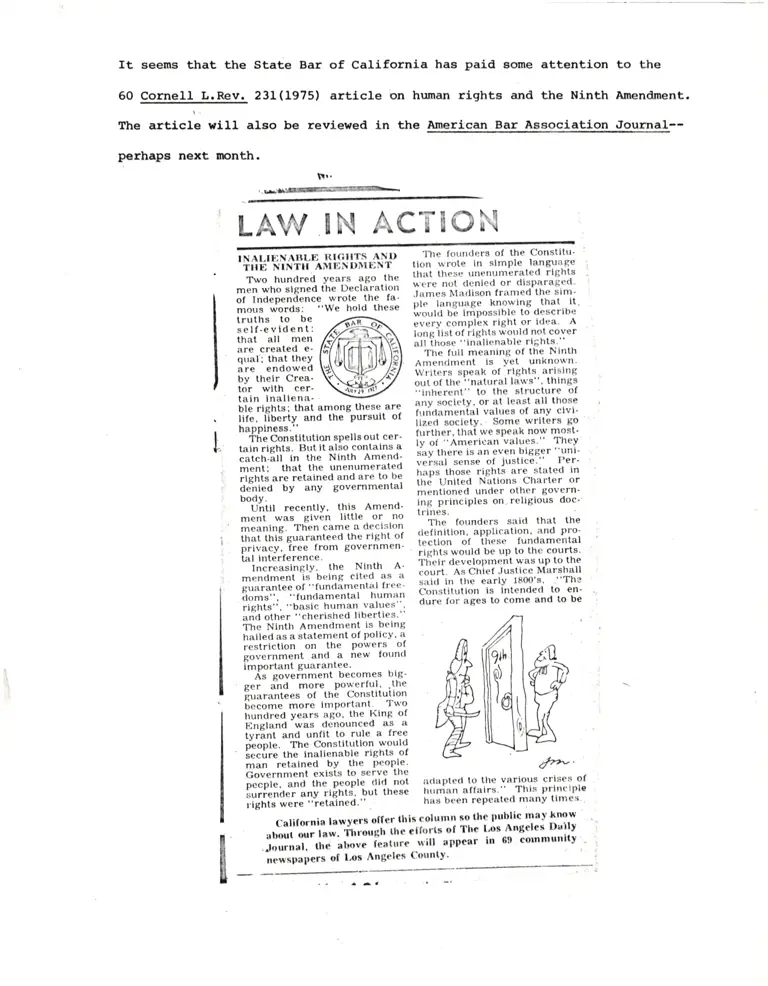
It seems that the State Bar of California has paid some attention to the
60 Cornell L.Rev. 231(1975) article on human rights and the Ninth Amendment.
The article will also be reviewed in the American Bar Association Journal—
perhaps next month.
LAV/ IW ACTiO^^
INAI.IKN/MU-K Kir.IITS A M )
T IIK NINTH AMKNDMKNT
Two hundred years ago the
men who signed the Declaration
of Independence wrote the fa
mous words: "We hold these
truths to be
s e l f - e v id e n t :
that all men
are created e-
qual: that they
are endowed
by their Crea
tor with cer
tain inaliena
ble rights; that among these are
life, liberty and the pursuit of
happiness.”
The Constitution spells out cer
tain rights. But it also contains a
catch-all in the Ninth Amend
ment; that the unenumerated
rights are retained and are to be
denied by any governmental
body.
Until recently, this Amend
ment was given little or no
meaning. Then came a decision
that this guaranteed the right of
privacy, free from governmen
tal interference.
Increasingly, the Ninth A-
mendment is being cited as a
guarantee of "fundamental free
doms” , "fundamental human
rights", "basic human values",
and other "cherished liberties."
The Ninth Amendment is being
hailed as a statement of policy, a
restriction on the powers of
government and a new found
important guarantee.
As government becomes big
ger and more powerful, .the
guarantees of the Constitution
become more important. Two
hundred years ago, the King of
Kngland was denounced as a
tyrant and unfit to rule a free
people. The Constitution would
secure the inalienable rights of
man retained by the people.
Government exists to serve the
people, and the people did not
surrender any rights, but these
l ights were "retained.”
The founders of the Constitu
tion wrote in simple language
that these unenumeraled rights
were not denied or disparaged,
.lames Madison framed the sim
ple language knowing that it.
would be Impossible to describe
every complex right or idea. A
long Ust of rights would not cover
all those "Inalienable rights.”
The full meaning of the Ninth
Amendment is yet unknown.
Writers speak of rights arising
out of the "natural laws” , things
"inherent" to the structure of
any .society, or at least all those
fundamental values of any civi
lized society. Some writers go
further, that we speak now most
ly of "American values.” They
say there is an even bigger "uni
versal sense of justice.” I’er-
haps those rights are stated in
the United Nations Charter or
mentioned under other govern
ing principles on religious doc
trines.
The founders said that the
definition, application, and pro
tection of these fundamental
rights would be up to the courts.
Their development was up to the
court. As Chief Justice Marshall
said in the early 1800’s, "The
Constitution is intended to en
dure for ages to come and to be
adapted to the various crises of
human affairs." This principle
has been repeated many limes.
California lawyers offer this colinnn so the public may hnow
U,oul .1 law Through the efforts of The Dos Angeles l)u. >
journal, the above feature will appear in 6!i community
newspapers of l.os Angeles County. _______________