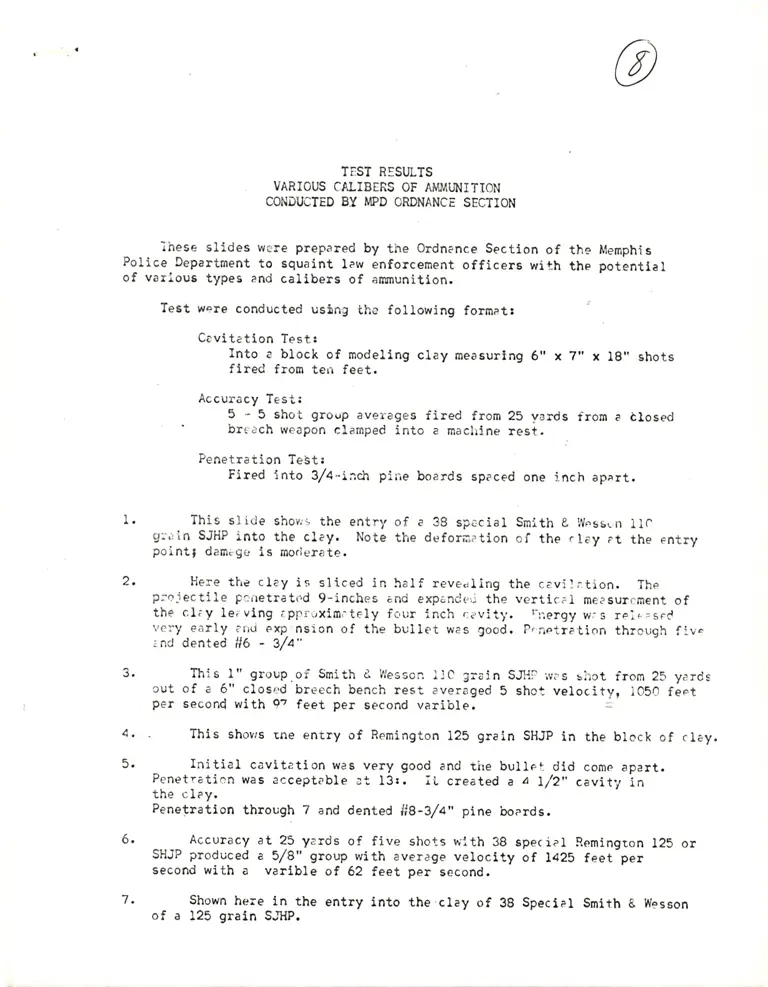
Test Results Various Calibers of Ammunition Conducted by MPD Ordinance Section
Other
February 21, 1975
4 pages
-
Case Files, Garner Working Files. Test Results Various Calibers of Ammunition Conducted by MPD Ordinance Section, 1975. d862f475-33a8-f011-bbd3-000d3a53d084. LDF Archives, Thurgood Marshall Institute. https://ldfrecollection.org/archives/archives-search/archives-item/a8e4b65f-95a0-4aa8-a127-bc6432ed7119/test-results-various-calibers-of-ammunition-conducted-by-mpd-ordinance-section. Accessed November 11, 2026.
Copied!
TEST RESULTS
VARIOUS CALIBERS OF AMWiUNITION
CONDUCTED BY MPD ORDNANCE SECTION
ihese slides were prepared by the Ordnance Section of the Memphis
Police Department to squaint law enforcement officers with the potential
of various types and calibers of ammunition.
Test w'̂ re conducted using tho following format:
Cavitation Test:
Into a block of modeling clay measuring 6" x 7" x 18" shots
fired from ten feet.
Accuracy Test:
5 - 5 shot groop averages fired from 25 yards from a tlosed
breach weapon clamped into a macliine rest.
Penetration Test:
Fired into 3/4-inch pine boards spaced one inch apart.
4.
5.
This slide shov.> the entry of a 38 special Smith & Was&ai IIC
grain SJHP into the clay. Note the deformation of the clay ?t the entry
point! damego is moderate.
Here the clay is sliced in half revealing the cavilrtion. The
projectile penetrated 9-inches and expander the vertical measurement of
the clay leaving approximately four inch cavity, '̂nergy was relf- = sed
very early and exp nsion of the bullet was good. Penetration through five
and dented tit - 3/4"
This 1" group of Smith d Wesson IIC grain SJHP was s’r.ot from 25 yards
out of a 6" closed breech bench rest averaged 5 shot velocity, 1050 feet
per second with 9"̂ feet per second varible. -
This shov/s tne entry of Remington 125 grain SHJP in the block of clay.
Initial cavitation was very good and the bullet did come apart.
Penetration was acceptable at 13:. U created a ̂ 1/2" cavity in
the clay.
Penetration through 7 and dented i}8-3/4" pine boards.
Accuracy at 25 yards of five shots with 38 special Remington 125 or
SHJP produced a 5/8" group with average velocity of 1425 feet per
second with a varible of 62 feet per second.
Shown here in the entry into the clay of 38 Special Smith 6. Wesson
of a 125 grain SJHP.
8. Penetration o f th is b u llet was approximately 15". Expansion
o f the b u llet vras good. Cavitation vraa good, however, enersr was
released slow ly. Penetration througn 4 and dented 5 - 3/^" pine
boards.
9. The Smith & Wesson 125 JHP held a very poor group out o f
fiv e shots at 25 yards from the bench rest average v e locity 985
fee t per second with l4 l feet per second varib le .
10. Shown here is the entry o f the Winchester Western 158 grain
lead HP. A good cavity is indicated by the bulge in the clay .
11. This b u llet expanded extremely w ell releasing it s energy early .
Penetration was acceptable at 11 1 /2 ". Throu^ 5 and dented 3/4"
pine board.
12. Accui’acy o f the fiv e shots v/as fa ir . The aimiunition f^r'ld a
1 3/4 Incli group vri.th average v e lo c ity o f 1021 feet per second with
a varib le o f 15 fee t per second.
13. Shown here is the entry in to the clay o f the Winchester Vfestem
158 grain lead luballoy b u lle t. Almost no apparent e ffe c t on the clay .
14. The b u llet penetrated approximately three inches before causing
any cavity and then I t began v;anderlng throu^^ the clay changing
d irection s arid traveling through the clay and out onto the range flo o r .
15. The V/inchester Vfestem I 58 grain luballoy held app^'oxiinately
1 1/2" group. Average v e locity 872 fee t per second \vith 25 feet per
second varib le . Penetration th rou ^ 6 and dented in 3 /4" pine boards.
16. Here is the entry in to the clay block o f the Remington 158
grain semi-vrad cutter lead, which appears to have an elongated cavity .
17 . Penetration was extreme as the b u llet conpletely vrcnt througli
the clay but i t did create a 'la rge cavity v.tille releasing it s energy
verj' slcpwly. The bu llet e:qpanded v /ell not to be a HP.
18. Here is the entry o f a Remington 230 grain metal case 45 AGP.
19. Being a metal case b u lle t , i t passed ccnpletely through the clay
delivering it s energy very slow ly.
20. Shovmi here is the entry o f Remington 4 l magnum, 210 grain SJ3?
fire d from a Smith & Wesson ^fodel 58 6" barrel. The cavity is
bulging fron a l l '^ides.
21. E:\panslon o f the bu llet was very good and penetration was
acceptable at approximately I 6" . The cavity v.as tremendous in size
and sha-7s the devastating e ffe c t o f the 4 l magiurn. Energy was
released on impact; through 9 and dented filO 3/4" pine.
22. A drawback o f the Remington 210 grain SP 4 l magium is accuracy
is shcum here. I t held only a 2 1 /2" group and it s r e c o il vhlch
is more than the average person can handle.
23. Here is the entry o f Remington 210 grain lead 4 l Magpum shovdng
a large cavity .
2k.
25.
26.
27.
2 8 .
29.
The bTillet shovred almost no expansion and traveled 19" throup-h
the clay and almost outj.the back. The cavity was good and it s
energ7 vras released early . However, as conpared to the previous
41 magnum bu llet th is bu llet runs a poor second. Thrcush 5 and
dented rfS 3/4" pine.
Accuracy o f the Remingtcn 210 grain lead 4 l ma&'ium was verv’ poor
with a 4 1/2" group. This is not acceptable fo r our use.
Here is the entry o f Remington 44 Special 246 grain lead round
nose. Almost no evidence o f a cavity .
The bu llet vrandered released it s energy slowly and passed com
p lete ly through the cla^'-. Very poor poten tia l fo r P olice use.
Here is the entry o f the Remington 45 Auto Rlni 230 grain lead,
oha-ring a cavity startin g la te .
The bu llet passed throu{^ the clay a fte r creating an elongated
cavity at the entry. Tlrrough 6 imbedded in §7 3 /4" pine.
30. The groiping o f the 45 Auto Rim was good vd.th a 1" groip .
T 111-: \V.\SHIN( 'T0N POST. V . V r. 1’. li i. \ fi V 2 1. 1 ^ i .>
Police Surgeon on '’flolloir Point Bullets
Two years it came to the r.tten-
lion ot the Itooid oi Police and Fire
Suivcons that ceiaaih units of ihe
F.xeculive iTotective Ser\ice were
eciuippod with "hollow point" bullets.
Kiimoir nltested to their inc-ense.!
imitilaiini; eltccis, \ crash stij<i\' pro-
cram was imtiatcd to prepare lor new
sur'-'icai prohlcins. It was inevita'''.
that metiihcrs within the Fxcctitive
i'lntcctiie .S( rvicc would Ik- \iclitns
ol their own .veapons.
It w;is soon learned that, while lesti-
ttionials were abundant, no factual
medical intormatton concerning hu
man injuries pro'iuccd b.v the hi liow
points c-xisted. The Surgeon Getieral's
library could find ro reference on ihe
subject. Range instructors who were
interviewed had bet.i led to believe
the iturposc of the new missile was to
auiiment the "killittg power."
Through special channels were
Ic.irtied the essential structural fca
lures ol th e hollow point and its
uimiue tactical advantage.
1 The hollow point is not a
liumdum ' The legendary dum duni is
described as a flat-ended soft lead unit
which was fiieti from high velocity ri-.
lies. These lead masses were said to
become distorted on impact, causing
mutilating and deep destruction. The
■ .‘tuper Vel" (at left in the accompany
ing photograph) hollow point 's fired
from a hand gun at low velocity. Kx-
cept for Hmm. at the tip, it ts encased
with hard metal. It does not expand
or become disiorted to a signifieant
degree on tissue impaet {.second bullet
irom left).
■ t M
-‘it-r.i.’lj--./,'.--..-I,'. ■ :
'TiSoaiR'i-xiSl-Jf-':-* . j- , .v<;,f ■ -V
‘‘Sillier I el" liolloiv iioiiils
Z. After tissue penetration, the hol
lowed point perioims a reverse para
etiul->hke roll. It causes more rapid
loss of velocity than occurs in (he
stream-lined standard counlorparl
ihis feature lessens the danger of the
missile passing through and out of the
biKly and into a secondary target. The
value of this quality is must useful
when weapons are fired at close
range in crovyded areas. Rraetically. a
hollow point fired at an assailant
would be less liable to penetrate and
injure a second individual. Since their
adoption, three Executive ib-otective
Service Officers have been injured by
. Super Vcl bullets. All were 'shot at
short range (loss than three Icen.
Uthough bone was not struck. In
III left, “ ihniuliims’ ’ nt rij:hl.
none e.d the bullet pass through and
i.ut. In none was t'- - n.uir; mm-e sc
vere lluin would havi- been I'xpec'cd
liv sla- .hiid aii.i..unition. In ail, the
bullets " c n removed--examined—am!
p'-eserveo In none was the expan.sion
or dislortion more than that “cen in
standard ammunition. All »heso ofli-
eers returneci full activities. Thus
limited experience supports the tacti
cal prognosicatinn of the Department.
Make re. mistake, the hollow points
tell the victim, yet they produce no
uiiusur! injury. They arrest more
quickly and are least Uangerou.s to ad-
lacent targets.
J. Blaine Harrell, Itl.D.,
MfniD'T Pr̂ rl ci Police »i>u I’lrp
\\'.-ishiitg'on.