IRS Technical Information Release Re: Tax-Exemption for Discriminatory Schools
Public Court Documents
May 22, 1975
5 pages
-
Case Files, Norwood v. Harrison - Hardbacks. IRS Technical Information Release Re: Tax-Exemption for Discriminatory Schools, 1975. 6adcfbcb-722e-f111-88b4-000d3a199651. LDF Archives, Thurgood Marshall Institute. https://ldfrecollection.org/archives/archives-search/archives-item/aa4fa261-3a81-411d-aa8a-49da9d8c16ff/irs-technical-information-release-re-tax-exemption-for-discriminatory-schools. Accessed October 16, 2026.
Copied!
     [||71057e38-e928-4b01-828c-2f1c7d054237||] Department of the Treasury
: : 3: Internal @evenue Service

: Informatio ess i Washington, DC 20224 Co EE ad al RR,
Tel”, (202) 964-4021.

ob

For Release; Immediate : hn ct ay £2 1973

TIRA1378 pl :
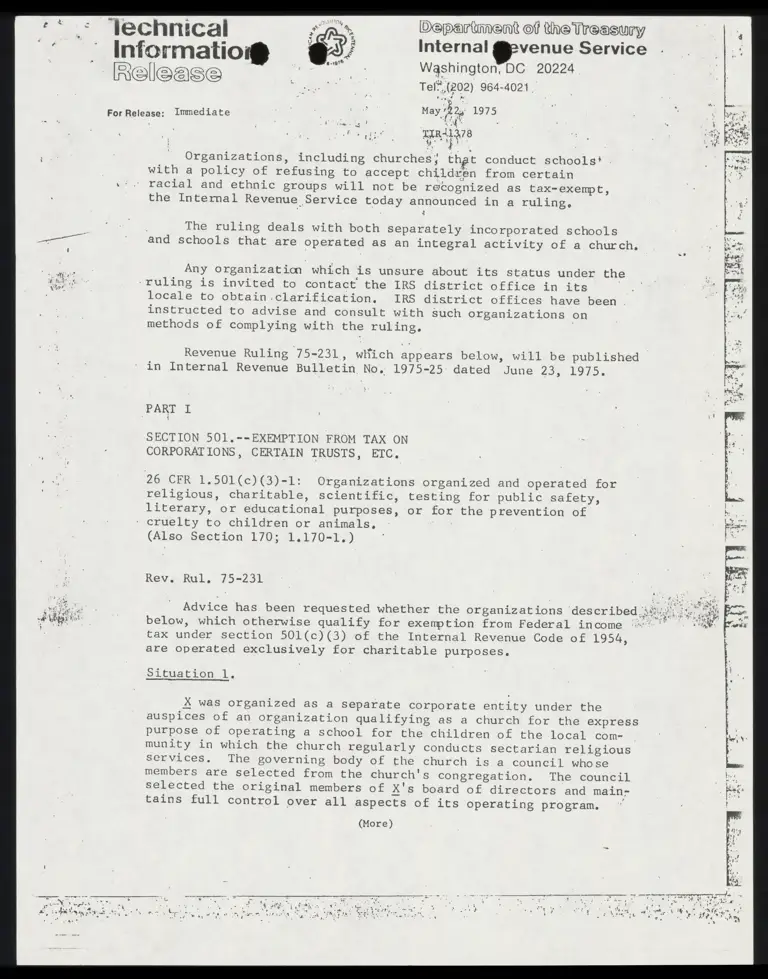
Organizations, including churches; that conduct schools® .

with a policy of refusing to accept children from certain
racial and ethnic groups will not be recognized as tax-exempt,
the Internal Revenue Service today announced in a ruling, : :


  The ruling deals with both separately incorporated schools
and schools that are operated as an integral activity of a church.

Any organization which is unsure about its status under the
ruling is invited to contact the IRS district office in its
locale to obtain .clarification., IRS district offices have been
instructed to advise and consult with such organizations on
methods of complying with the ruling, :

Revenue Ruling 75-231, wHich appears below, will be published
in Internal Revenue Bulletin No. 1975-25 dated June 23, 1975,
PART 1

SECTION 501,--EXEMPTION FROM TAX ON
CORPORATIONS, CERTAIN TRUSTS, ETC.

26 CFR 1.501(c)(3)-1: Organizations organized and operated for
religious, charitable, scientific, testing for public safety,
literary, or educational purposes, or for the prevention of

+ cruelty to children or animals.
(Also Section 170; 1.170-1.)

Rev, Rul, 75-231

Advice has been requested whether the organizations ‘described iii dh
below, which otherwise qualify for exemption from Federal income ‘+
tax under section 501(c)(3) of the Internal Revenue Code of 1954,
are operated exclusively for charitable purposes,

Situation 1,


X was organized as a separate corporate entity under the
auspices of an organization qualifying as a church for the express
purpose of operating a school for the children of the local com-
munity in which the church regularly conducts sectarian religious
services. The governing body of the church is a council who se
members are selected from the church's congregation. The council
selected the original members of X's board of directors and main-
tains full control over all aspects of its operating program.


(More)


   2 : 5 Jihad . FO

3 X naintaifff) and aces a school progranfat corresponds ¢; nd
with the publi® school program for the same grades. ' Although ° LATE]
its program includes a 10-minute religious service at the start

of each school day and the devotion of other amounts of time

to religious themes and subjects, the school complies with State.:

law requirements for public education. The school has a policy”

of refusing to accept any children from certain racial and ethnic .
groups,


1

vA

Situation 2.


An organization-qualifying as a church, having a full com- ‘

plement of active religious functions, directly supervises and
8; controls, as part of its overall operations, Y school, X is not :

Fy ; separately incorporated. Y's operations do not differ in any ¥)
| ~ material respect from those carried on by X in Situation 1,

"+. including, as a matter of school policy, the exclusion of stu-.. Paki
dents from certain racial and ethnic groups. = +d rp op. vid

a


Situation 3.


Z, an organization qualifying ‘as a church, operates a
school identical to Y in Situation 2. Z also organized and con-

trols as a separate ‘corporate entity a ‘school identical to X in

Situation 1. Z asserts that the policy observed by the two

schools of excluding children from certain racial and ethnic
groups is required by the tenets of the religion it embraces.


Section 170 of the Code provides, in part, that there shall
be allowed as a deduction any charitable contribution, as defined

‘in section 170(c), payment of which is made within the taxable
11 year. Section 170(c) provides, in pertinent part, .that a chari-=

; table contribution means a contribution or gift to or for the

use of a corporation, trust, or community chest, fund, or foun-

dation organized and operated exclusively for religious, chari-
a table, scientific, literary, or educational purposes, or for the
rh prevention of cruelty to children or animals.


Section 501(c) (3) of the Code provides, among other things,
for the exemption from Federal income tax of organizations 7 re %

"organized and operated exclusively for religious, charitable iia Pak
. . .or educational purposes. Section 1.501(c)(3)~1 of the!
Income Tax Regulations specifies the requirements which an

organization must meet to be 'organized and operated exclusively"
for one or more exempt purposes,


Section 1.501(c)(3)-1(d)(2) of the regulations provides

that the term ''charitable' is used in section 501(c)(3) of the

Code in its generally accepted legal sense and is, therefore, '
not to be construed as limited by the separate enumeration in =~
section 501(c)(3) of other tax exempt purposes which may fall
within the broad outlines of 'charity' as developed by judicial
decisions. Such section further provides that such term includes
advancement of education. . sii


     (More)


~ rap


’ forth'in Situation 1, prior to the effective date of the dis=:}

i -3-

{Section 1.:80 0:8 ui of the rai gs provides
that a primary or secondary school that has a regularly enrolled
body of students in attendance at a place where the educational
activities are regularly carried on may qualify for exemption as

an educational organization of the character contemplated by

section 501(c)(3) of the Code JE At otherwise meets the require-

ments ‘of that section. A HN, ;

‘Rev. Rul. 71-447, 1971-2 C.B. 230, in interpreting section’ .
501(c) (3) of the Code, concludes that an organization is not

operated exclusively for charitable purposes if its activities ''’
are carried on in a manner that can be reasonably classified as

contrary to well-established Federal public policy. Rev.'Rul,
71-447, relying principally on Brown v. Board of Education, 2
347 U.S. 483 (1954), many later judicial decisions to the same
effect, and certain provisions of the Civil Rights Act of 1964,


finds' that there is a well-established Federal public policy Ror :
against racial discrimination in education, whether public or

private. Rev. Rul. 71-447 expressly holds, therefore, that
any school not having a racially nondiscriminatory policy as to

students necessarily fails to bes«charitable within the common
law sense contemplated by sections 170 and 50L(e) (3) and other
relevant Federal statutes, : : SARE

The educational programs conducted by X and Y consist of

secular subjects of the same scope and type commonly dealt with

in the public schools or in private schools that are not :
religiously oriented. There is no basis for treating separate-

ly incorporated schools that, although church-related, teach
secular subjects and generally comply with State law requirements
for public education for the grades for which instruction is pro-
vided, any differently than private schools that are not church-
affiliated. Accordingly, in Situation 1, because X fails to

maintain a racially or ethnically nondiscriminatory policy as to
students, X is not operated exclusively for charitable purposes

and does not, therefore, qualify as a charity for Federal income
tax deduction and exemption purposes under sections 170 and
501(c) (3) of the Code. The disqualification of X will not affect
the exempt status of the organization qualifying as a church 4
solely as a result of.the organization and control of X, as set ;


qualification. A

Situation 2 differs from Situation 1 only in that Y is not

separately incorporated, and is directly supervised and controlled

within the same legal organization as the church. A racially or
ethnically discriminatory policy as to students is as contrary
to Federal public policy under these circumstances as it is when .
the educational institution is separately incorporated. An
analysis of the historical development of this fundamental ex=-

pression of national policy reaffirms the conclusion that the
form of the educational'organization is not relevant for these

fy wl th.

hi


(More)


-r


i
F
T
E


2?


Q
L


a
t


b
27

,
i
.


l
e


8


1


S
h
a
}


x:


iL


. Lav

inl) ra

I 5, NE Flymi

eit Him IX
Sees

2


. 0,
purposes. See Norwood .v. Harrison, 413 U.8, 455 (1973), in which the Supreme Court held that a@ state may not provide free textbooks to a private school if their i 113 "signifi- cant tendency to facil and support private dig- er crimination,"

de no exception for the BEI
Ha schools that were not Separate legal organizations but were : end
te directly operated by churches that were receiving free textbooks, ah

perating Y is frustrating
ly or ethnically dis-

Under these Circumstances,
clusively for charitable :
on 501(c)(3) of the Code and Accordingly, the organization does Federal income tax deduction and ; | ions 170 and 301(c) (3).

1


not qualify as a charity ‘for
exemption purposes under sect

3
4

fl
A

-r

Situation 3 differs from S   ituations 1 and 2 only in that Z


—
—
—
—
—

R
T

H
Y


—
—
—
—
—
—


v
—
h


a
rn

‘
3


a given course of conduct may

a religious duty to act in a
situation. The First Amend-
Congress shall make no law
eligion, does bar governmental
eliefs and opinions, but it


145, 166-167 (1878); Mitchell day poration, 210 F, 2d 879 (7th Cir sano 1954), cert, denied, 3470.8. 1013 (1954); U.S. v. Craft, 423 Foi; and Linscott v, Millers Falls Co. ,


The important distincti
one hand, and the legal cons

on between religious belief, on the : eéquences that may validly be attached Pp to action induced’ by religious belief, on the other, is well bo illustrated by one recent line of cases interpreting the Federal tr drug laws. The courts have repeatedly refused to engraft a bo religious exception on any criminal statute outlawing the trans- portation of heroin, marijuana, and peyote into the United Re
ie. States, notwithstanding an apparent judicial recognition that a oh J


(More)


Ae. EY
axl 4 J

‘ pry
stag?

1


given used he sincerely believe t use of such drugs has

a prope place in certain religious ceremonies which are pre=

scribed in both the Koran and the Bible. See U.S. v, Spears,.
443 F, 2d 895 (5th Cir. 1971), and other cases therein cited.

i tH


Accordingly, in Situation 3 neither the separately incor-

porated school nor Z itself is operated exclusively for chari-
table purposes and neither qualifies as a charity for Federal
income tax deduction and exemption purposes under sections 170

and 501(c)(3) of the Code.


The conclusions reached in the Revenue Ruling would be the
same if a convention or association of churches were substituted
for the organizations qualifying as churches referred to in


\ [ Situationsl, 2, and 3.

1
L [||71057e38-e928-4b01-828c-2f1c7d054237||]