Question from Paust to be asked RE: Garner v. Memphis Police Dept.
Correspondence
March 18, 1976
5 pages
-
Case Files, Garner Working Files. Question from Paust to be asked RE: Garner v. Memphis Police Dept., 1976. 3a0d6143-33a8-f011-bbd3-000d3a53d084. LDF Archives, Thurgood Marshall Institute. https://ldfrecollection.org/archives/archives-search/archives-item/aa7c31d9-f23f-41a9-af91-c45170421f73/question-from-paust-to-be-asked-re-garner-v-memphis-police-dept. Accessed November 11, 2026.
Copied!
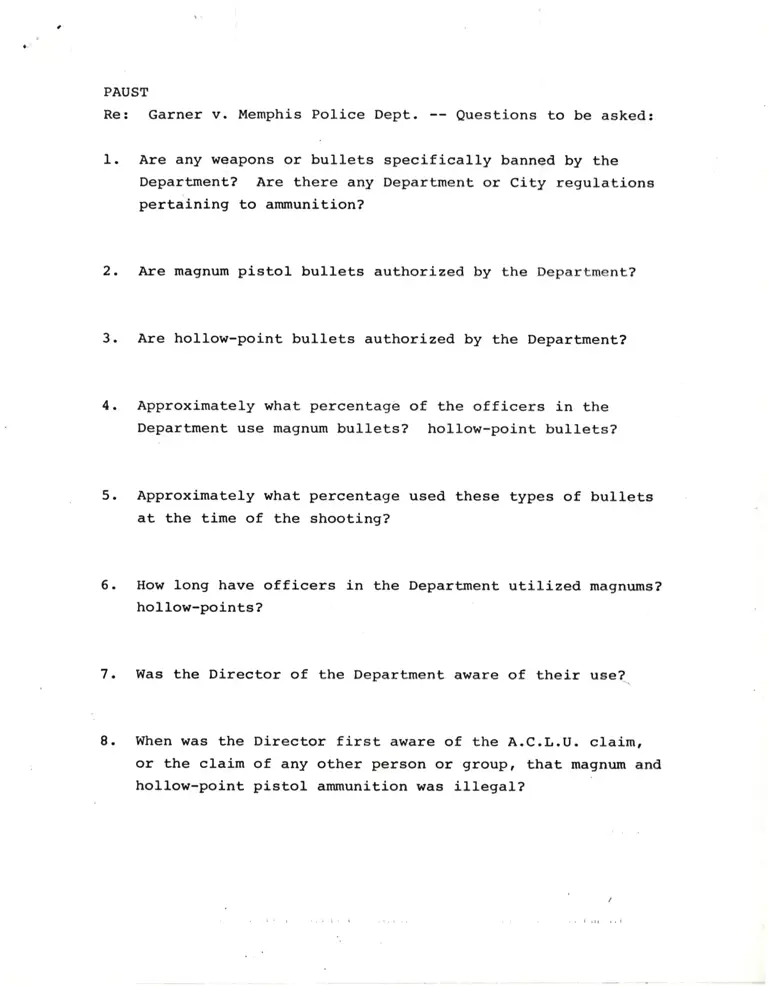
    PAUST
Re: Garner v. Memphis Police Dept. —  Questions to be asked:

1. Are any weapons or bullets specifically banned by the
Department? Are there any Department or City regulations
pertaining to ammunition?

2. Are magnum pistol bullets authorized by the Department?

3. Are hollow-point bullets authorized by the Department?

4. Approximately what percentage of the officers in the
Department use magnum bullets? hollow-point bullets?

5. Approximately what percentage used these types of bullets
at the time of the shooting?

6. How long have officers in the Department utilized magnums?
hollow-points?

7. Was the Director of the Department aware of their use?

8. When was the Director first aware of the A.C.L.U. claim,
or the claim of any other person or group, that magnum and
hollow-point pistol ammunition was illegal?


9. Did the Department ever seek legal advice on the acceptability
of magnums or hollow-points?
If so, when, where and with what results?

Page 2

10. Did the Department ever test the performance of magnum
or hollow-point ammunition? If so, when, where and with
what results?

11. Did the Department gain knowledge of the effects of magnum
or hollow-point ammunition in the human body? Why or why
not? If so, when, where and with what results?

12. Did the Department contact any manufacturer of ammunition
for information pertinent to questions 10 or 11?
If so,' when, where and with what results?

13. HOW many officers in the Department fired their weapons
in the line of duty, and how many times were they fired
per incident, for the years 1974, 1975 and 1976 to date?

14. How many of those firings resulted in misses of the target?

15. How many officers in the Department were shot by pistol
ammunition in the years 1974, 1975 and 1976 to date?

16. HOW many of those officers did not wear a bullet proof vest
of some type when they were shot?


17. How many officers in the Department now wear bullet proof
vests of some type?

Page 3

18. Does the Department (or City) record the number of gunshot
wounds to/or deaths of civilians? Is there a distinction
made on the basis of officer or civilian firings? Are
projectile types (e.g., magnums and hollow-points) recorded
when one civilian shoots another? when an officer shoots
an innocent bystander? Why or why not?

19. Is the Department (or City) aware of any autopsies performed
on gunshot victims in the years 1974, 1975 or 1976 to date?
Did the autopsies investigate different injury outcomes
with magnums or hollow-points?

20. Who are the bullet suppliers of the officers of the
Department?

21. Do officers receive any discounts or similar benefits
when they purchase magnum or hollow-point ammunition?
Does the Department?

22. Do officers ever use .45 caliber ammunition in line of
duty? Why or why not?

23. Is the Department (and the City) aware of the Los Angeles
Police Department ban on magnum and hollow-point ammunition?


24. Is the Department (and the City) aware of the refusal by
N.Y.P.D. and Washington D.C. police to use magnums and
hollow-points?

Page 4

25. Is the Department (and the City) aware of the fact that use
of magnum and hollow-point pistol ammunition against human
beings is violative of international legal standards?

26. Does the Department (and the City) instruct its officers
on the legal impropriety of use of certain weapon systems
against human beings? Why or why not?

27. Have officers of the Department ever received instructions
on the legal standard of necessary use of force? If so, are
there any printed pamphlets, books or other materials
utilized? If not, why not?

28. How many innocent bystanders were injured or killed by
police weapons in the years 1972, 1973, 1974, 1975, 1976
to date?

29. How many police officers were injured or killed by police
weapons in the years 1972, 1973, 1974, 1975, 1976 to date?

30. After injury to a citizen or fellow officer by a police
weapon, were there any changes in police instructions,
regulations or procedures? Why or why not?


31. Does the Department receive federal funds for law enforcement
programs or activities? Are weapons or ammunition ever
purchased with federal funds?

32. Is the Department aware of the statement in the 1973
Report of the National Advisory Commission on Criminal
Justice Standards and Goals on use of magnum and similar
ammunition in urban areas (at pg. 520, Report on Police)?

Page 5

33. Does the Department authorize or purchase new plastic
notepad shields to protect patrol officers?

34. Are .41 caliber or .44 caliber magnums ever used by
Department officers?