Bouie v. City of Columbia Transcript of Record
Public Court Documents
June 10, 1963
-
Brief Collection, LDF Court Filings. Bouie v. City of Columbia Transcript of Record, 1963. dd0e1e35-ca9a-ee11-be36-6045bdeb8873. LDF Archives, Thurgood Marshall Institute. https://ldfrecollection.org/archives/archives-search/archives-item/aab9b427-f35d-4750-8a32-a760fb93a11a/bouie-v-city-of-columbia-transcript-of-record. Accessed October 08, 2026.
Copied!
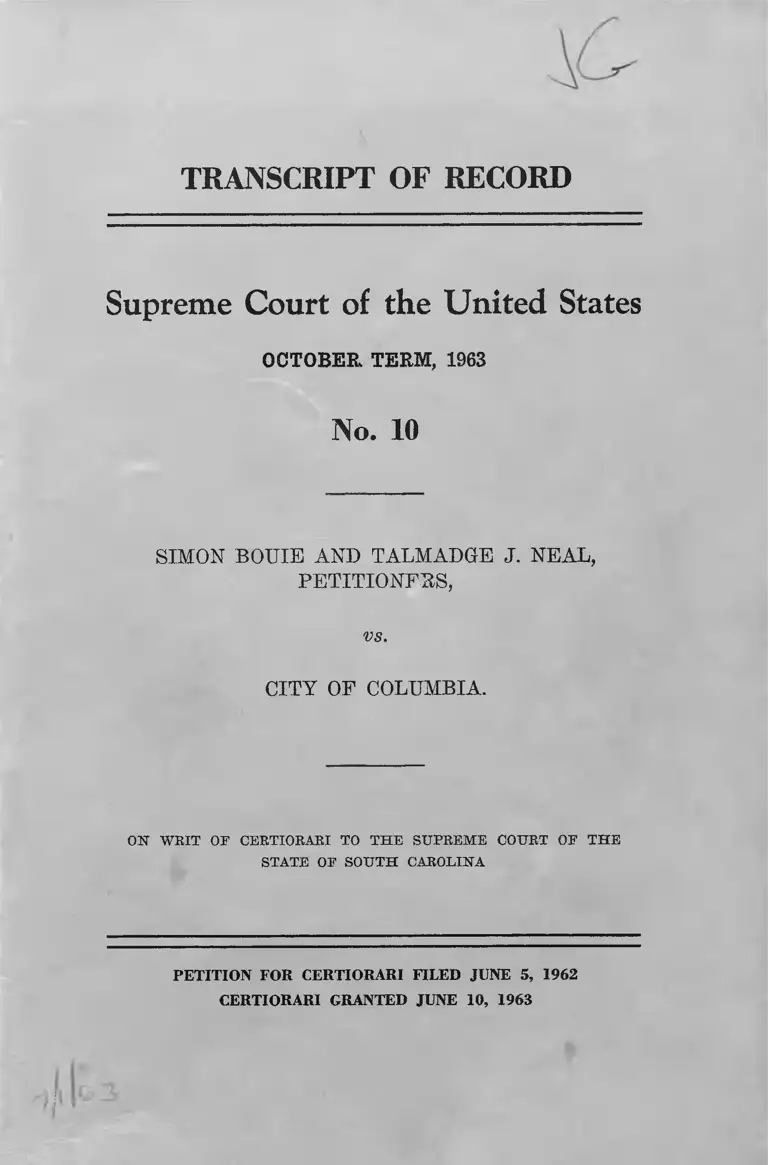
TRANSCRIPT OF RECORD
Supreme Court of the United States
OCTOBER TERM, 1963
No. 10
SIMON BOUIE AND TALMADGE J. NEAL,
PETITIONERS,
vs.
CITY OF COLUMBIA.
ON W RIT OF CERTIORARI TO T H E SU PREM E COURT OF T H E
STATE OF SO UTH CAROLINA
PETITION FOR CERTIORARI FILED JUNE 5, 1962
CERTIORARI GRANTED JUNE 10, 1963
SUPREME COURT OF THE UNITED STATES
OCTOBER TERM, 1963
No. 10
SIMON BOUIE AND TALMADGE J. NEAL,
PETITIONERS,
vs.
CITY OF COLUMBIA.
ON W RIT OF CERTIORARI TO T H E SU PREM E COURT OF T H E
STATE OF SO UTH CAROLINA
I N D E X
O riginal P r in t
Proceedings in the Supreme Court of the State of
South Carolina
Statement_________________________________ 1 1
Record from the Recorder’s Court of the City of
Columbia, State of South Carolina ___________ 2 2
Transcript of trial proceedings, March 25, 1960 2 2
Testimony of Shep A. Griffith—
direct_______________ 2 3
cross________________ 5 5
I. F. Gardner—
direct _______________ 21 17
Shep A. Griffith—
(recalled)—
direct ------------------------ 23 19
R eco rd P r e s s , P r in t e r s , N e w Y o r k , N . Y ., J u l y 1, 1963
11 INDEX
O riginal P r in t
Record from the Recorder’s Court of the City of
Columbia, State of South Carolina—Continued
Transcript of trial proceedings, March 25, 1960
—Continued
The State rests _________________________ 23 19
Colloquy between court and counsel------------ 23 19
Testimony of Guy Malone—
direct _______________ 28 23
Talmadge J. Neal—
direct _______________ 33 27
cross________________ 41 34
Simon Bouie—
direct _______________ 48 401
cross________________ 55 45
Isaac F. Gardner ___________ 59 49
The State rests in reply _________________ 60 49
Opinion and judgment, Rice, J. ----------------- 61 50
Renewal of motion for arrest of judgment and
for a new trial and overruling thereof--------- 63 51
Record from the Richland County Court, Criminal
Division ________________________________ 69 57
Opinion, Crews, J. ________________________ 69 57
Notice of intention to appeal _______________ 76 62
Exceptions ______________________________ 76 63
Stipulation______________________________ 77 63
Opinion, Legge, J. __________________________ 78 64
Petition for rehearing and order denying_______ 80 67
Petition for stay of rem ittitur------------------------- 84 69
Order staying remittitur ------------------------------- 87 71
Clerk’s certificate (omitted in printing) ------------ 89 72
Order allowing certiorari ____________________ 90 73
1
[fol. 1]
S tatem ent
t Appellants Simon Bouie and Talmadge J. Neal are
Negroes who, at the time of their arrests, were college
students attending private colleges in the City of Columbia,
South Carolina, their home city—They were arrested on
A!a.tvii 14, I960 and charged with the offenses of Trespass
and Breach of the Peace, and as to Simon Bouie alone. Re-
^gistmg Arresi^Appellants were tried before Honorable
John I. Bice, Recorder for the City of Columbia, without
a jury> on March 25, 1960. At the conclusion of all the evi
dence, the Recorder: JAnndJiatiL.appellants “Guilty” on the
charge of Trespass and found Simon Bouie “Guilty” of
Resistingr~Arres£ Appellant Bouie was sentenced to pay
a fine of One Hundred ($100.00) Dollars or serve thirty
(30) days in jail on each charge, provided that Twenty-
four and 50/100 ($24.50) Dollars of each fine was sus
pended, the sentences to run consecutively. Appellant Neal
was sentenced to pay a fine of One Hundred ($100.00) Dol
lars or serve a sentence of thirty (30) days in jail, provided
that Twenty-four and 50/100 ($24.50) Dollars was sus
pended.
Notice of Intention to Appeal was timely served upon the
Recorder as required by law, each of the appellants hav
ing on deposit cash bonds which were allowed to serve as
appeal bonds. Subsequently, appeal bonds with good and
sufficient sureties were filed in lieu of the cash deposits.
Thereafter, by consent this case was consolidated with
a similar appeal from the Columbia Recorder’s Court and
argued before Honorable John W. Crews, Judge of the
Richland County Court (Criminal Division). By Order
dated April 28, 1961, Judge Crews affirmed the judgment
of the Recorder’s Court.
Notice of Intention to Appeal was timely served upon
the City Attorney.
2
[fol. 2]
IN THE
RECORDER’S COURT OF THE CITY OF COLUMBIA
STATE OF SOUTH CAROLINA
The C ity of Columbia , Plaintiff,
vs.
S im on B ouie an d T almadge J . N eal.
Transcript of Record—March 25, 1960
Mr. Jenkins: Your Honor, this is my associate Matthew
J. Perry, of Spartanburg. He will be taking part in the
case. We will plead the defendants “Not Guilty”.
The Court: Jenkins, at the outset, I might state that
I want everybody to be heard. I want to give everybody
a chance to be heard but I do not want any long, repetitious
testimony. I want everybody to be heard but I don’t want
to prolong this for an indefinite period ad infinitum.
Mr. Jenkins: Your Honor, we are well aware of the
fact that you are going to conduct this case in an im
partial manner and give everybody his day in Court. How
ever we should also like to say at the outset, while we do
not intend to unduly delay the Court, we must try the case
in order to take advantage of all the rights of our clients.
We cannot set any limit on time. It appears to me that the
time will be determined by the development of tire case.
The Court: I ’m not going to set a limit at this particular
time but if I see that an undue length of time is being
taken by anybody, I intend to put a stop to it.
Mr. Jenkins: I understand that, your Honor, but we
have a right to take exceptions.
3
Mr. S h e p A. Gr if f it h , being duly sworn, testifies as
follows:
Direct examination.
By Mr. Sholenberger:
Q. Mr. Griffith, I believe you are Assistant Chief of
Police for the City of Columbia?
A. I am.
[fol. 3] Q. How long have you been with the Police De
partment?
A. For 25 years.
Q. All right, sir, Mr. Griffith, as a result of information
that you have, did you with another police officer in Colum
bia, go to Eckerd’s drug store on the 14th day of March,
1960i " ---- ---------------------------
A. I did.
Q. About what time?
A. I have forgotten.
Q. Around the noon hour?
A. Somewhere around noon or shortly after.
Q. When you arrived there did you see the defendant
Simon Bouie and the defendant Talmadge J. Neal?
A. I did.
Q. Suppose you relate to the Court what the circum
stances were in regard to the two defendants and just what
you observed in regard to them?
A. Well, Detective Slatterer and I went there as a call
to Headquarters that there was some disturbance in
Eckerd’s Drug Store. When we arrived, Mr. Malone, who
is the. Manager, went back to the booth. He met us about
halfway up the store and he went back to a booth with
the two defendants Neal and the other boy, Bouie, and he
said : “Now, you have served your purpose and I want
you out, because we aren’t going to.serve you” and they
sat there just ignoring him, so to speakAmpLjeadirig or
looking down at something, whether they were reading or
not, and he said: “I ’m asking you the second time to get
on out.” That was in my presence, so, then I told them both
that the Manager wanted them out and they should go on
4
out, and this boy on the other side there, Bouie, said: “For
[fol. 4] what?” I said: “Because it’s a breach of the peace
and Fin telling you the second time to go on out.” He
said: “Well, I asked you for what?” So at that time I
reached and got him by the arm. Neal here had started to
make an effort to get up but the other boy had not, and I
had to pull him up out of the seat, so I stood them up and
made a preliminary frisk, which we usually do to see if
they had any weapons on them and I found none. Then I
caught him in the belt, his belt and his breeches.
Q. You were in back of him at that time ?
A. I was in back of him. Pretty much my whole body
was covering him, because he had been told that he was
under arrest if he didn’t move, but he told me, he said:
“Don’t hold me, I ’m not going anywhere” and I said: “Boy,
that’s my privilege, go ahead” so we had gone out a few
steps, three, four or five yards, he started pushing back, Y
and he said: “Take your hands off me, you don’t have to
hold me” land a lady started screaming: “Get him out, get
him out” and I kind of tiptoed him and got him out in that
position.
Q. Then you brought him down here?
A. Yes, sir.
Q. This occurred while they were sitting in a booth?
A. Yes, sir.
Q. Was that close by the food counter at Eckerd’s?
A. Well, it is a food counter.
Q. Do you know anything else about this case?
A. Well, on the way down here he seemed to be very
excited. He kind of did like that, clapping his hands.
Q. Which one did that?
A. Bouie. He said: “I wonder how many they’re going
to arrest tomorrow”, and when we charged him in here for
[fol. 5] resisting arrest, he said: “Well, the reason I was
resisting was the way you were taking me out.”
Q. Mr. Griffith, during the search down here, did you get
any information from either one of the defendants?
A. I imagine you had better ask the guard because he
sent me a copy of something that came out of Neal’s pack
age.
Q. Is this a copy of what you were sent?
5
A. Yes, sir. We made a copy and put it back in bis
package.
Q. Anything else you have to say?
A. That’s about all.
Mr. Sholenberger: I want to have this marked for iden
tification at this time.
(Copy of Students’ Movements, marked for Identifica
tion, Exhibit No. 1.)
Cross examination.
By Mr. Jenkins:
Q. Chief Griffith, this occurrence which led to the charges
made here, took place on the 14th day of March, 1960?
A. That’s right.
Q. I believe you testified that you went to Eckerd’s Drug
Store on Main Street in the City of Columbia in response
to a call to headquarters?
A. That’s right.
Q. Do you know who made the call to headquarters?
A. I do not.
Q. Did you know at the time that you went to Eckerd’s,
what circumstance you were going to investigate?
A. I did not.
[fol. 6] Q. When you arrived at Eckerd’s I believe you
said you were met by Mr. Malone, the manager?
A. Well, I don’t say I was met. I say I met him in the
middle of the store.
Q. Did you inquire of him whether he had placed the
call to headquarters?
A. No, I didn’t.
Q. Did you inquire of him as to why the Police Depart
ment had been called in?
A. No, I didn’t.
Q. Did he advise you as to why you had been called in?
A. He said there were two colored boys back there.in .(V1
the seat and refused to move^yes, sir.
Q. That, was the only reasoiTTTegave for calling you?
A. Yes, that’s the only reason he gave.
6
Q. Now you saw these two defendants in Eekerd’sf
A. Eight.
Q. Now they were seated in a booth in the part of Eck-
erd’s reserved for serving food!
A. That’s right.
Q. What were they doing when you first observed them,
Chief ?
A. They apparently weren’t trying to get any food be
cause they were reading. They apparently weren’t even
attempting to get any food.
Q. When you saw them, Chief, when you first observed
them, what were they doing!
A. I said they were reading. They were not attempting
to get any food. You asked me the question as to whether
they were sitting there where they served food, and I said
they apparently were not attempting to get food, that they
were reading. That’s my answer.
[fob 7] Q. The specific answer that you gave to my ques
tion is that they were sitting there reading! Is that correct!
A. Yes, but you asked me if they were sitting there at a
booth where food was served, just prior to that, the im
mediate question before that.
Q. I think that’s right. Now, I ask you if they were sitting-
in that booth in a section reserved for serving food, and
your answer was “yes”!
A. I said “yes”.
Q. I further asked you what were they doing when you
first observed them!
A. I said they were not attempting to order food but
were reading.
Mr. Jenkins: We submit, if your Honor please, that the
Chief’s answer is not in response to the question I asked
him.
Mr. Sholenberger: If your Honor please, I think he’s
answered it to the best of his ability.
The Court: I think he’s answered it very adequately.
That’s my opinion, that he’s answered it.
Q. What in your opinion, Chief, is necessary for a per
son to do, to give the impression of ordering food, when
they are in a restaurant or other place where food is served!
7
A. What should they do, or what is my impression?
The Court: Frankly, that’s not admissible, what his im
pression is. We want him to testify about the facts of the
case and not his impressions.
Mr. Jenkins: If your Honor please, the witness stated
on several occasions his opinion in response to a question
as to his observation.
A. I didn’t say my opinion. If you will read back, I said
they had not ordered food.
[fol. 8] Q. Upon what do you base your knowledge that
they had not ordered food, Chief?
A. I said that they had not ordered food in my presence,
or had not attempted in my presence.
Q. Although that had not been asked for, you volunteer
that information?
A. You said this,-—
Q. I know what I said.
A. You said were they in a booth where food was being
served.
Mr. Sholenberger: Your Honor, counsel is attempting
to get into an argument with the witness.
The Court: We’re not going to have an argument.
Mr. Jenkins: If your Honor please, is counsel for the
State asking that I be instructed not to get into an argu
ment, or that the witness be instructed not to get into an
argument with me? I am not arguing with him.
Mr. Sholenberger: His questions provoke an argument.
Let him ask the questions straight and he’ll get straight
answers.
The Court: Jenkins, don’t ask argumentative questions.
Ask direct questions and if they are admissible, then he
can testify to them.
Mr. Jenkins: I submit your Honor, that this witness is
under cross examination and the Court has the right to
rule on the admissibility of any questions I ask him. I will
defer of course, to the Court’s ruling.
The Court: Ask the question and I ’ll rule on whether
it’s admissible.
Mr. Jenkins: I reserve my right to ask questions on
cross examination.
[fol. 9] Q. Back to your testimony, Chief, these two de
fendants were sitting in a booth!
A. That is correct.
Q. Now you observed them reading, apparently?
A. That’s correct.
Q. Did you observe them doing anything other than
reading!
A. No.
Q. Were they involved in any riotous or disorderly
conduct when you observed them ?
A. I didn’t get the question?
Q. When you observed these two defendants, was either
of them engaged in any riotous or disorderly conduct ?
A. Well certainly there was no riotous. If it was dis-
orderlyNiqnduct. it was because of the f^lhhatiEelHanagfiX**
had asked them to move, in my presence, and they refused .
'to mgae^-.
Q...Other than that there was nothingL.wh.ich. you would
saw was any disorderly conduct?
a : No... ............ .........
Q. Now’ you did not charge them with disorderly con
duct did you!
A. Well, breach of the peace, is what I charged them with.
Q. So the inference is that they were not guilty of any
disorderly conduct. Is that right?
A. I didn’t say that.
Mr. Sholenberger: Now if your Honor please, the wit
ness can’t be asked questions of a legal nature.
The Court: You can’t put words in the witness’ mouth.'
Mr. Jenkins: If your Honor please, the section of the
Statute under which these defendants are charged, is I
[fol. 10] believe Section 15-909, which is entitled “Dis
orderly Conduct”, etc. Now if the Court will indulge me, I
will read a portion of that Statute.
The Court: Go ahead.
Mr. Jenkins: “The Mayor or intendent and any Aider-
man, Couneilmen or Warden of any city or town in this
State, may in person arrest or may authorize and require
any Marshal or Constable, especially appointed for that
purpose, to arrest any person who, within the corporate
9
limits of such a city or town, may be engaged in a breach
of the peace, any riotous or disorderly conduct, open
obscenity, public drunkenness or any other conduct grossly
indecent or dangerous to the citizens of such a city or town,
or any of them.” In view of the fact, if your Honor please,
that these defendants are charged under a Statute which
sets forth all of these offenses, 1 am merely trying to elicit
from this witness whether these defendants were guilty of
any of these other offenses which are incorporated in this
Statute.
Mr. Sholenberger: He has answered those questions.
He said it was not riotous.
The Court: Jenkins, I take the position that the witness
has answered the question adequately. He stated to you
all he knows about the case and he stated the facts in
the case.
Mr. Jenkins: If your Honor please, I submit I have the
right on cross examination to ask the witness specifically
whether these defendants were guilty of any of these
other offenses. Of course again I submit that I will defer
to the ruling of the Court, but I want the record to show that
I am asking permission to direct such questions to this
witness.
[fol. 11] Mr. Sholenberger: Your Honor, he has a per
fect right to ask questions as to the facts, as to what they
were doing, but as to an interpretation of what they did
and what it constituted, that is an improper question in my
opinion. That’s for the Court to determine.
The Court: And I so rule on that.
Mr. Jenkins: May I hear specifically what your ruling is!
The Court: All right, my ruling is this; the witness has
answered the questions insofar as the facts are concerned.
The witness cannot pass upon the interpretation of the law
but this witness has answered the questions fully and accu
rately as to the facts in the case.
Q. Now Chief, you testified that in your presence, Mr.
Malone, the manager of the store, requested these two de
fendants to move. Is that correct?
A. That’s correct.
Q. Did they answer him in any manner?
A. No.
10
Q. They did not?
A. No.
Q. What did they do ?
A. They-sat-there.
Q. They continued whatever action they had done pre
vious to the request to leave. Is that right?
I A. They sat there. He asked them the second time and
I they still sat there.
Q. Now what, if anything, did you do after the manager
had requested these two defendants to move?
A. I told them that the manager had requested them to
move, in my presence. He had told them that they had
served their purpose and he was not going to serve them,
[fol. 12] and “Now I am asking you to move.” The boy on
my right there said: “For what?”
Q. Before we go that far, Chief, why did you ask them
to move?
A. Because the manager, in my presence, had asked them
to move, and it is my opinion that if he didn’t want them
in the store and he needed help, that it is my place to get
them out. The store had come to a complete standstill so
far as activities were concerned—
Q. Let me interrupt you just a minute, Chief. Up to this
point, how long had you been in the store?
A. Oh, a matter of a very few minutes, two, three or four
minutes.
Q. And yet, on the basis of the fact that you had been
in there two, three or four minutes, do you think you are
in a position to say that all of the activities of the store
had come to a complete standstill?
A. That’s right, there was a group of people standing
there completely idle, watching. I don’t know how long it
had been going on. Even when I went in, everybody vras
standing watching.
iy. Hnwever, insofar as you know, they could have just
been standing there watching anybody, whether these de
fendants were there or not?
A. They could have been, but I don’t believe that was
the case.
Q. We are not asking what you believe, Chief.
A. Well, I ’m telling you, though, what I believe.
11
Q. Did the manager state any reason why he was asking
these two defendants to leave?
A. He stated that: “You have served your purpose and
you have been in here long enough to serve your purpose,
we are not going to serve you and I ’m asking you to get
out.”
[fol. 13] Q. Did he state any reason why he was not serv
ing them?
A. No.
Q. In the part of the store where these defendants were
sitting, in that general area, there are other booths and a
food counter with seats?
A. That is correct.
Q. At the time you went in and observed these defendants
sitting in the booth, did you observe any other persons
sitting in that area where food is served?
A. No, I didn’t.
Q. You say that the only persons seated in that area
were these two defendants?
A. That’s all I observed.
Q. Did you pay any particular attention as to whether
there was anyone else there ?
A. I certainly did because you couldn’t help see, it was
right immediately in front of you.
Q. When you went in, you did advise these defendants
that they were under arrest when they did not move?
A. Yes, sir.
Q. Now when you went in and asked them to leave, were
you attempting to assist the manager in getting them to
leave ?
A. No.
Q. What was your purpose?
A. My purpose was that they were creating a disturbance
there in the store, a breach of the peace in my presence,
and that was my purpose.
Q. Chief, I believe it may be helpful if you will describe
to us what the disturbance was that was being created, and
what the breach of the peace was that was being created?
[fol. 14] Mr. Sholenberger: He’s gone over that three
times exactly as to what happened.
12
The Court: He certainly has. Jenkins, I ’ll have to rule
that out. The witness testified a half dozen times as to
exactly what happened, time and time again, and I don't
see where any elaboration is necessary.
Q. You testified I believe, Chief, that you asked these
defendants to leave, only after the manager had asked them
to leave!
A. That’s correct.
Q. So, had the manager not requested them to leave, you
would not have asked them to leave. Is that correct!
A. I would not, if the manager had not asked them to
leave. That’s correct.
Q. So then, you were, in fact, assisting the manager in
evicting them, when you asked them to leave, and placed
them under arrest. Isn’t that true!
A. No.
Mr. Sholenberger: Now, Judge, he’s asking for a con
clusion.
The Court: Yes, it’s all conclusions. In other words,
Lincoln, I ’ll have to ask you to confine your questions to
direct matters of fact and not on conclusions.
Q. Now, let’s get a little further along with the facts
then. These two defendants, after you asked them to move,
continued to sit where they were sitting. Is that correct!
A. Yes.
The Court: He’s testified a half dozen times already, as
to that fact. I don’t know why in the world you want to
bring it out any more.
[fol. 15] Q. One of the defendants, Neal, I believe, immedi
ately began to get up his things!
A". No.
Q. Tell us again what happened!
A. When I asked him the second time, or at least told
him the second time, and I reiterated: “I ’m telling you
the second time to get up and come on out of here, because
you are under arrest”, this boy sitting on my left, he did
make a move in the seat, apparently closing his book and
started to get up but the other boy never did make any
move at all to get up.
13
Q. Now, Chief, the defendant here in the dark suit is
Bowie and the one in the brown suit is Neal. Will you please
let the record show which of these defendants you’re talk
ing about when you say one closed his books or attempted to
close his books?
A. Neal closed his book, after I asked him the second
time, he made a move as though he was getting up.
Q. And he, in fact, did get up?
A. He didn’t get up at first.
Q. Now Bouie, the second defendant, asked you the ques
tion, I believe, after you told him the second time to get up?
A. No, he asked me the first time, why.
Q. Why you asked him to move ?
A. That’s right, and I told him.
Q. Then I believe you said he asked you the second time,
also?
A. No, he didn’t ask me the second time.
Q. Tell us again what happened. I ’m not really too
clear, Chief, as to what you said?
A. I said: “I ’m asking you the second time” and he still
didn’t make any move and I caught him by the sleeve of the
coat and lifted him up out of the seat.
[fol. 16] Q. Now how much time elapsed between the time
you asked him the second time and the time you caught him
by his coat and lifted him out of the seat?
A. Enough for him to get up.
Q. A half minute or two minutes?
A. Enough for him to get up.
Q. Will you give us some idea as to how much time
elapsed?
A. No, but he had had time to get up.
Mr. Jenkins: If your Honor please, I would like for you
to note that the witness states emphatically that he refuses
to answer the question.
The Court: The question has been answered adequately.
Q. Isn’t it a fact, Chief, that you did not give him any
opportunity to get up ?
A. It is not a fact.
Q. This defendant Bouie also had a book with him?
A. Yes.
14
Q. Was tins book open in front of him when you came
inf
A. Yes.
Q. Was the book still open in front of him when you
directed him the second time, to leave the establishment?
A. Yes.
Q. When you snatched him by the arm and snatched him
out of the seat—
A. I didn’t say I snatched. You said that.
Q. What did you say, sir'?
A. I said I caught him by the arm and lifted him out of
the seat.
[fol. 17] Q, When you caught him by the arm and lifted
him out of the seat, do you know where the book was then!
A. Still on the table.
Q. Was this defendant making any effort to get that
book?
A. No, not until I got him up.
Q. After you got him up did he make any effort to get
the book?
A. Yes, sir.
Q. Did you allow him to get the book?
A. Yes.
Q. Now at what point did you catch him by his belt or
by the back of his trousers?
A. I pulled him off to the side and gave him a preliminary
frisk and then I caught him by the pants and the belt.
Q. What was your reason for catching him by the pants
and the belt?
A. Because he was under arrest,
Q. Was the defendant Neal also under arrest?
A. Certainly he was under arrest,
Q. At that same time that you caught Bouie, Neal also
was under arrest?
A. Yes, sir.
Q. Did you catch Neal by his belt and pants?
A. No, because he voluntarily got up without having to
be lifted out of the seat.
Q. So then your reason for catching Bouie by the back
of his pants—
15
A. Because he had shown some resistance to begin with.
Q. Had he shown any physical resistance, Chief?
A. Except I had to pick him np out of the seat.
[fol. 18] Q. Did he pull back or snatch away or anything
of that sort?
A. Not right at that particular time but he did push back
later on going out, when he said: “Take your hands off me.”
Q. When you caught him by the back of the trousers,
were yoii under the impression that he was going to at
tempt to run or escape ?
A. We are under that impression with all of them, Jen
kins. When they are put under arrest, all these men are
instructed to put their hands on them and keep them under
their control.
Q. If that is true, Chief-—
A. Wait a minute. If there is any inclination whatsoever
that there is any resistance.
Q. Isn’t it a fact, Chief, that there was no other place
for him to go except with you?
A. I don’t know what his opinion was but my opinion was,
that was true.
Q. So then it was absolutely unnecessary to catch him by
his belt and by his trousers and lift him out?
A. I think it was necessary when he showed resistance,
after having been asked four times, twice by the manager
and twice by myself, and then refused, and I had to lift
him out of the seat by his coat sleeve. I think there was
resistance to begin with.
Q. Chief, did you personally have any objection to these
defendants sitting where they were seated?
A. Personally, no.
Q. So it didn’t make any difference to you where they sat?
A. No, sir, not from a police standpoint.
Q. What about personally, Chief?
A. I don’t care for that. ^
[fol. 19] The Court: Hold on a minute. He hasn’t got to
answer that, Jenkins. His personal opinions and his beliefs
and all that kind of stuff, are not admissible. No, he hasn’t
got to answer that.
16
Mr. Jenkins: Your Honor, we submit we have a right
to question this witness as to his personal bias and preju
dice.
A. I don’t care to answer that.
The Court: Mr. Sholenberger, do you want to make any
comment on that!
Mr. Sholenberger: I don’t think he has to answer that.
Anything in regard to this arrest and what was done, he
can cross examine him but I don’t think the personal opin
ion of anyone has anything to do with it.
The Court: It is not admissible and not germane to the
issue. It hasn’t got a thing to do with the case, his personal
opinion, and I ’m going to rule it out.
Q. Chief, are you aware of the race and color of these
two defendants!
A. Why certainly I am.
Q. In your opinion, what is the race and color of them!
A. Negro.
Q. Now, Chief, I just want to ask you a couple ques
tions about the general layout at Eckerd’s drug store. I t’s
a relatively large store. Is that correct, as compared with
drug stores in the City of Columbia?
A. I would say so, I guess.
Q. It is generally considered to be one of the most
popular drug stores in the City of Columbia. Is that right?
A. It is a popular drug store.
Q. There are a aujnbfijmQf departments in that store.
Is that correct!
[fol. 20] A. That’s correct.
Q. Drug department, cosmetic department, toilet arti
cles, etc.?
A. That’s correct.
Q. And in addition there is a food department?
A. That’s correct.
Q. Where food is sold and is served?
A. That is correct.
Q. And where the public is invited in to purchase food
and eat food. Is that correct?
A. Well, I don’t know what you mean by public. Explain
what you mean by the public being invited? I t’s a public
place, if that’s what you mean.
17
Q. I t’s a joublic place of business.-!—
A. That’s correct.’
Q. It is patronized generally by the public of the City of
Columbia?
A. That’s correct.
Q. White and Negro?
A. I would assume so, yes, sir.
Q. That’s reasonable, isn’t it?
A. Yes.
Q. Do you know whether or not Negroes generally are
served in the ordinary departments of Eckerd’s drug store?
A. I certainly would say so, yes.
Q. Do you know whether or not Negroes are served in
the food serving department at Eckerd’s drug store?
A. Not that I know of.
Q. Chief, isn’t it a fact that the only reason you were
called in from the Police Department to arrest these two
persons, was because they were Negroes who were asking
for service in the food departmenT in Eckerd’s drug store.
' [T(d721T and̂ TKe manager was’"directing them out because
TEe^were Negroes? Isn’t tKaF'cdrrecf?
A. Why certainly, I would think that would be the case.
Officer I. F. G a r d n e r , being duly sworn, testifies as fol
lows :
Direct examination.
By Mr. Sholenberger:
Q. Mr. Gardner, I hand you here a. paper marked for
Identification as Exhibit No. 1. Is that a copy of a paper
taken off the person of the defendant Neal?
A. That’s right.
Q. Did you take it off of him when you searched him?
A. Yes, sir.
Mr. Sholenberger: I would like to offer this paper in
evidence.
(Exhibit No. 1 offered and received in evidence.)
18
Mr. Jenkins: If your Honor please, we object to the
introduction of this paper, on the ground that it is ir
relevant and immaterial insofar as the charges against the
defendants are concerned.
The Court: Mr. Sholenberger, counsel has objected to
the introduction of that, and I would like to hear what you
have to say about it.
Mr. Sholenberger: If your Honor please, this is intro
duced for the purpose of showing—
Mr. Jenkins: If I may interrupt. Have you ruled on it?
The Court: No, I haven’t. I want to hear from both
sides before I rule on it.
[fol. 22] Mr. Sholenberger: This is introduced for the
purpose of showing that there was a concerted effort and
action on the part of a group, including these two defen
dants, to go on the premises for the purpose, a predeter
mined purpose, of creating the situation that has just been
created before your Honor by the testimony. That is the
purpose of showing the intent and the purpose behind the
movement.
The Court: Counsel for the defendants, if you have any
comments, I would like to hear you.
Mr. Jenkins: Your Honor, these defendants are charged
with trespass and a breach of the peace, concerning alleged
incidents which took place at Eckerd’s drug store on Main
Street. As I view this paper, which is attempted to be in
troduced into evidence, Eckerd’s drug store does not appear
there any place. Further, this paper is not signed, it con
tains no signature, and the conclusion reached by the State
that it shows a concerted effort on the part of these defen
dants to violate the law at the time they went into Eckerd’s
drug store, which gave rise to the charges against them,
has nothing whatsoever to do with this instrument. I repeat
that the paper here is irrelevant to the issues involved
here. Further if your Honor please, assuming that the posi
tion taken by the State is to be true, that there was a con
certed effort on the part of these defendants to go on the
premises of Eckerd’s or any other business establishment
and do what they did when they went into Eckerd’s, even
if they did it for the specific purpose of bringing about a
lawsuit, the Courts have ruled that they had a perfect right
19
to do so, if in fact the right exists for them to go into the
place where they went, and we respectfully submit that they
had a legal right to go where they went and to do what they
[fob 23] did. For those reasons, it is our position that this
paper should not be introduced in evidence and we object
to its introduction.
The Court: I ’ll admit it, subject to objection.
(No cross examination.)
Chief S h e p Gr if f it h recalled, testifies further as follows:
By Mr. Sholenberger:
Q. All this occurred in the City of Columbia, County of
Richland, and the State of South Carolina?
A. Yes, sir.
Mr. Perry: All of which is admitted.
T h e S tate R ests
(The State rests.)
C olloquy B etw een Court and Counsel
Mr. Jenkins: If your Honor please, we ask that the man
ager of Eckerd’s, Mr. Malone, be subpoenaed. We take the
position that he, if he is in Court, would be a hostile witness.
However, we take the further position that his testimony is
germane to the issues involved here, that in view of the fact
that his testimony in all probability would be hostile to us,
we respectfully request permission of the Court to question
this witness as a hostile witness.
The Court: Mr. Sholenberger, do you have any comment?
Mr. Sholenberger: They can subpoena him if they wish.
The Clerk: Your Honor, he was notified to be here and
Dr. John Terry (?) was notified to be here.
Mr. Sholenberger: I don’t know whether they were sub
poenaed. They don’t have to testify unless they were sub
poenaed.
[fol. 24] The Court: Dr. Malone is in Court and he can
testify if he wants to.
20
Mr. Jenkins: I want the record to show that as counsel
for the defendants, I took all the steps necessary to have
this witness subpoenaed.
Mr. Sholenberger: If he wants to put him up, he can
put him up, but we have rested our case.
Mr. Jenkins: If your Honor please, counsel for the de
fendants asks that the record show who the counsel for the
State is ?
The Court: The City Attorney, Hon. John W. Sholen
berger.
Mr. Jenkins: Do you have any associates, Mr. Sholen
berger?
Mr. Sholenberger: No.
Mr. Jenkins: If your Honor please, at this time, on be
half of the defendants, we should like to make a motion. I
hand your Honor a cojjy of the motion.
The Court: Mr. Sholenberger, do you wish to make any
observation about this motion ?
Mr. Sholenberger: If your Honor please, I believe the
motion is really being made for the record.
Mr. Jenkins: I ’ll say this, Mr. Sholenberger, that is one
of the reasons for making the motion.
Mr. Sholenberger: If your Honor please, under the laws
of the State of South Carolina, as I understand them, and
under the Federal laws as I assume the Court of Appeals
and the decisions of the United States Supreme Court, the
proprietor of a place of business, whether it be food, drugs,
sundries or whatever, is operating a private enterprise, and
he has the right to refuse to sell or serve anyone, whether
they be colored, whether they be white, whether their eyes
are green, brown or some other color. If he doesn’t like the
color of their hair, the color of their eyes or doesn’t like the
[fol. 25] person individually, or for any reason that he sees
fit, can ask them to leave his store or leave his premises,
and if upon that request they refuse to leave, then they
become a trespasser, and he can use such reasonable force
as is necessary to remove them from the premises. In this
instance, out of an abundance of precaution, the manager
not desiring to use force himself, called upon a Peace
Officer of the City of Columbia to remove the people who
refused to leave his premises. I do not believe it’s an inva-
21
sion of their Constitutional rights any more than I would
think that if a proprietor of the store told me to get out,
that he didn’t want to serve me, he would be invading my
Constitutional rights, because it is a private enterprise,
has nothing to do with Governmental functions, we have
no law that I know of that requires segregation in private
establishments, and I think that under those circumstances
the motion should be refused.
The Court: Jenkins, I would like to put this in the record
as my opinion of the law. In the case of Williams v. Howard
Johnson’s Restaurants, the United States Court of Appeals,
on July 16, 1959, Charles E. Williams, a Negro Attorney in
the United States Revenue Service, entered a restaurant of
Howard Johnson’s located in the City of Alexandria, Vir
ginia, and demanded service. He was refused service and
subsequently brought an action against the Howard John
son Restaurants, not only for himself but for all others
similarly situated. He asked for a Declaratory Judgment
in his favor on the grounds that he had been discriminated
against because he was a Negro and moving in Interstate
Commerce and also in violation of the 14th Amendment of
the Constitution of the United States and the Civil Rights
Act of the Federal Government of 1875. Now on motion of
[fol. 26] the defendant’s attorney the United States District
Court dismissed the action and an appeal was taken to the
United States Circuit Court of Appeals, Fourth Circuit,
Circuit Judge Soper wrote the opinion in which he said:
“Notwithstanding the substantial inconvenience and embar
rassment to which persons of the Negro race are subjected
in the denial to them of their right to be served in public
restaurants, the dismissal of the suit was in accord with
the decisions of the Supreme Court of the United States
and other Federal Courts.” The opinion further concludes
that the Howard Johnson restaurant was not operating
under any provisions of the Civil Rights Act of 1875 or
under any Statute of the State of Virginia, or under any
Ordinances of the City of Alexandria, and therefore was not
a violation of any of the foregoing Statutes, so I ’m going
to overrule the motion on the ground that the United States
Courts have held that any business has a right to serve
anybody and to refuse to serve anjUody, be they white or
22
colored. I think that’s the law of the land today and I so
rule.
Mr. Jenkins: If your Honor please, may I take it then
that the motion is in the record and is a part of the record?
The Court: The motion is in the record, is a part of it
and the motion is denied.
Mr. Jenkins: I ask this, your Honor, because I am not
certain. Am I at liberty now to make certain comments
with reference to the statement made by the City Attorney
and by the Court, even though the motion has now been
overruled?
The Court: Well, I think that would be purely academic
because the Court has ruled what the interpretation of the
law is. I think it would be purely academic. The motion is
in the record and the refusal of the motion is in the record,
[fol. 27] and my reasons for refusing it.
Mr. Jenkins: If your Honor please, at this time we
would like to enter a formal plea for the defendants.
Mr. Sholenberger: Is this in the nature of an argument?
Mr. Jenkins: I t’s a plea which the defendants make to
the charges against them.
The Court: In other words, they entered a plea at the
outset of the trial of “Not Guilty”.
Mr. Jenkins: This is in furtherance of the plea that we
have already made, your Honor.
Mr. Sholenberger: Tour Honor, this is not pertinent to
the case.
The Court: They plead “Not Guilty” at the very start,
and this is argumentative. This is a matter of argument.
Mr. Jenkins: Will the record show, your Honor, that an
effort was made by these two defendants to introduce into
the record, this plea?
The Court: Well, they entered a plea at the very outset,
and I think this ought to be strictly a matter of argument
and not a matter for the record.
Mr. Jenkins: Then if your Honor please, these defen
dants are invoking the protection of both the State Con
stitution of South Carolina and the Federal Constitution
of the United States, and we believe for that reason that
we should be allowed to enter into the record this plea which
we have handed to the Court, in order to be sure that the
23
Constitutional grounds upon which these defendants rely,
are brought squarely before the Court.
Mr. Sholenberger: Your Honor, they plead Not Guilty
to the charge, and if he wants to argue this for a time, I
think it’s perfectly all right.
[fol. 28] The Court: You see, in Item No. 2, “That said
Statutes are being used as a basis of unconstitutional State
action.” You are protected in your technicalities.
Mr. Jenkins: If your Honor please, orally then these
defendants plead “Not Guilty” and further invoke Constitu
tional protection given them by Article 1, Section 5 of the
Constitution of the State of South Carolina, and Consti
tutional protection—
Mr. Sholenberger: I hate to interrupt. The Court has
already overruled your motion. Is this additional argu
ment f
Mr. Jenkins: This is not argument whatsoever. I t’s in
support of the plea of “Not Guilty”.
Mr. Sholenberger: If your Honor please, as I under
stand trial procedure, if he wants to make an argument at
the close of the case. The City has closed its case. Now if
he has testimony to present, he should present it and then
at the close of that he has an opportunity to argue.
The Court: That’s what my conception of the procedure
is. Now Jenkins, I might say this, if the defendants want
to testify, the Court will be glad to hear from them but if
they don’t want to testify, I ’m ready to have argument pro
and con.
Mr. Jenkins: If your Honor please, at this time we call
as a witness, Mr. Malone, the manager of Eckerd’s Drug
Store.
D r . G xjy M a l o n e , being duly sworn, testifies as follows:
Direct examination.
By Mr. Perry:
Q. Mr. Malone, I believe you are the manager of Eckerd’s
Drug Store in the City of Columbia?
[fol. 29] A. Yes.
24
Q. How long have you been manager of this store, sir?
A. Twenty-four years.
Q. Mr. Malone, will you please describe the Eckerd’s
drugstore enterprise?
A. Well, it’s a retail drug business.
Q. Is it a chain drug business?
A. Yes.
Q. Are there establishments located practically all over
the United States?
A. No, mostly in the Southern states.
Q. It is located in different Southern states?
A. Yes.
Q. With stores in South Carolina and numerous other
Southern states?
A. Yes.
Q. Mr. Malone, is Eckerd’s in addition to being a drug
store, is it also a variety store? That is, does it sell com
modities other than purely drugs?
A. Well, we have different departments, sure.
Q. Will you tell us something about the departments,
sir, briefly?
A. Well, we have the retail drug department, we have a
cosmetic department, prescription department, and a lunch
eonette department.
Q. Mr. Malone, is the public generally invited to do busi
ness with Eckerd’s ?
A. Yes, I would say so.
Q. Does that mean all of the public of all races ?
A. Yes.
Q. Are Negroes welcome to do business with Eckerd’s?
A. Yes.
[fol. 30] Q. Are Negroes welcome to do business at the
lunch counter at Eckerd’s?
A. Well, we have never served Negroes at the lunch
counter department.
Q. According to the present policy of Eckerd’s, the lunch
counter is closed to members of the Negro public?
A. I would say yes.
Q. And all other departments of Eckerd’s are open to
members of the Negro public, as well as to other members
of the public generally ?
25
A. Yes.
Q. Mr. Malone, on the occasion of the arrest of these
young men, what were they doing in your store, if you
know?
A. Well, it was four of them came in. Two of them went
back and sat down at the first booth and started reading
books, and they sat there for about fifteen minutes. Of
course, we had had a group about a week prior to that, of
about fifty, who came into the store.
Mr. Perry: Your Honor, I ask, of course, that the prior
incident be stricken from the record. That is not responsive
to the question which has been asked, and is not pertinent
to the matter of the guilt or innocence of these young men.
The Court: All right, strike it.
Mr. Sholenberger: Your Honor, this is their own witness.
Mr. Perry: We announced at the outset that Mr. Malone
would, in a sense, be a hostile witness.
The Court: You haven’t shown he is hostile.
Mr. Sholenberger: They put him on the stand.
The Court: And he is your witness.
[fol. 31] Mr. Perry: In any event, of course, we move to
strike anything that’s not responsive.
The Court: Well, I ’m inclined to think that anything
that would be germane to the general situation, wmuld be
responsive to the question.
Mr. Perry: Very well, sir.
Q. Now7, Mr. Malone, on the occasion of the arrest of
these young men, wiiat specifically were they doing?
A. They were sitting in the booth reading.
Q. What general activity occurs in the booths?
A. Well, usually they come in to eat.
Q. Is this in the lunch counter section of Eckerd’s drug
store ?
A. Yes, it is.
Q. And so, when a person comes into Eckerd’s and seats
himself at a place where food is ordinarily served, what is
the practice of your employees in that regard ?
A. Well, it’s to take their order.
Q. Did anyone seek to take the orders of these young
men?
26
A. No, they did not.
Q. Why did they not do so ?
A. Because we didn’t want to serve them.
__ Q. W hy_did von not w n n limserve them?
X~l uTmhTmTik
Q. Did you refuse to serve them because they were Ne
groes ?
A. No.
Q. You did say, however, that Eckerd’s has the policy
of not serving Negroes in the lunch counter section?
A. I would say that all stores do the same thing?—- ̂
e’re spealdng'si^cifically^oTTlTckerd’s ?
A. Yes.
[fol. 32] Q. Did you or any of your employees, Mr. Malone,
approach these defendants and take their order for food?
A. No.
The Court: He testified to that awhile ago.
Q. What, if anything, did you do ?
A. I didn’t do anything.
Q. Did any of your employees do anything?
A. No.
Q. Mr. Griffith, the Chief of Police of the City of Colum
bia, testified previously that pursuant to a request of some
one in your store, he placed these—he first asked these
young men to leave and then placed them under arrest.
You may not have been in the courtroom at the time?
A. Yes, sir, I was here.
Q. I ’ll ask if you recall if that happened on the day of
arrest of these young men?
A. Say that again ?
\ Q. I ’ll ask you whether or not you or anyone in the
management of your store, called the City Police?
A. I did.
Q. And asked that these young men be removed?
A. Yes, I did.
Q. And pursuant to your request, Mr. Griffith, I believe,
came in ?
A. That’s correct.
Q. And subsequently the young men were placed under
arrest?
A. That’s correct.
27
[fol. 33] Mr. T almadge J . N eal, b e in g duly sworn, testifies
as follows:
Direct examination.
By Mr. Jenkins:
Q. Yon are Talmadge J. Neal, one of the defendants in
this case?
A. Yes, sir.
Q. I believe you are a student?
A. That’s right.
Q. Attending which school?
A. Benedict College.
Q. What’s your classification?
A. I ’m a Sophomore.
Q. Are you a native Columbian?
A. Well, originally I was not. I moved here in ’58.
Q. You have lived here since then?
A. Yes.
Q. Do you recall the events of the day leading up to your
arrest in Eckerd’s drug store in Columbia?
A. Yes, I do.
Q. Will you tell the Court just what you did with refer
ence to Eckerd’s drug store? Also, any events leading up
to your arrest on the 14th day of March, 1960?
A. Well, I entered Eckerd’s under the impression to be
served, and I felt that I was within my rights to be served
food there, inasmuch as it was open to the public, I consider
myself as a part of the public and I felt it was my right to
be served.
Q. Now you know that Eckerd’s drug store is a retail
drug store, catering to the public generally?
A. That’s right.
[fol. 34] Q. Have you had occasion over a spaee of time
you have been in Columbia, to make purchases in Eckerd’s
drug store?
A. Yes, I have.
Q. On one occasion, several occasions or numerous occa
sions?
A. Several occasions.
28
Q. Were you treated courteously?
A. Very courteously.
Q. Was any service denied you?
A. No, no service was denied me.
Q. On those occasions did you attempt to buy any food?
A. No, I didn’t.
Q. You were in other departments in Eckerd’s Drug
Store?
A. That’s correct.
Q. On the basis of your treatment previously in Eckerd’s
Drug Store, are you of the opinion that you were invited to
come in as a member of the public and trade in that store?
A. That’s right, yes.
Q. Did you have reason to believe that all departments
of Eckerd’s Drug Store catering to the public generally,
would be open to you?
A. Absolutely.
Q. Does that include specifically the lunch department
in Eckerd’s Drug Store?
A. The lunch department, as well as others.
Q. Now on the day of March 14, 1960, you were accom
panied by other companions in Eckerd’s Drug Store?
A. That’s right.
[fol. 35] Q. You entered with what intent? What was
your intent in going into Eckerd’s Drug Store?
A. To be served.
Q. To be served with what?
A. Food.
Q. You proceeded then to the food section of Eckerd’s
Drug Store?
A. That’s correct.
Q. You took a seat?
A. Took a seat.
Q. At the time that you came into Eckerd’s and took a
seat, did you bump into anybody?
A. No, I didn’t.
Q. Were you dressed somewhat similar to the way you
are now?
A. Yes.
Q. I mean, you were clean?
A. Yes.
29
Q. To your knowledge, did you annoy anybody else by
coming into Eckerd’s Drug Store on that day?
A. No, I don’t believe I did.
Q. Did anyone, prior to your getting to the food depart
ment, register any complaint about your presence in Eck-
erd’s Drug Store?
A. No.
Q. Prior to your seating yourself at the booth in Eck-
erd’s Drug Store, did anybody register any complaints for
Eckerd’s ?
A. One of the salesmen came with a chain posting a “No
Trespassing” sign but it was not posted. He had it in his
hands like this (indicating).
1 Q. Was this chain or rope eventually put up in Eckerd’s
j Drug Store while you were there?
A. After we were seated.
[fol. 36] Q. That was put up after you were seated?
A. Yes.
Q. When you seated yourself in the booth, do you re
member what booth it was?
A. Booth No. 13.
Q. Can you give generally the layout of Booth No. 13
with reference to the food service department of Eckerd’s?
A. This booth, along with others, is located in the middle
of the aisle and this is the first booth.
Q. The first booth in the middle aisle?
A. Yes.
Q. Are there seating arrangements on the right side
of this booth, the right of the aisleway of this booth?
A. Yes.
Q. Tables I believe?
A. Tables and booths.
Q. To the left of this booth I believe there is a lunch
counter with stools?
A. Yes.
Q. What time did you go into Eckerd’s?
A. We entered Eckerd’s around five after eleven.* (I • '
Q. Did you look around you when you sat down in this
booth in Eckerd’s Drug Store?
A. Yes, after we were seated we glanced around, or I
did.
30
Q. You looked around in the booth?
A. Yes.
Q. Did you have any opportunity to observe anyone
else in the food service department of Eckerd’s?
A. I did.
Q. Was there anyone else sitting in the area of Eckerd’s
Drugs, which is used generally for the service of food?
[fol. 37] A. Yes there was.
Q. Employees?
A. No I don’t think so.
Q. Did you see any employees of Eckerd’s Drugs in that
department?
A. Yes.
Q. Did you see any persons sitting at booths in that area?
A. Yes.
Q. Are you positive of that?
A. Positive.
Q. Were they Negro?
A. White.
Q. Were they sitting in booths?
A. Booths.
Q. Did you see anyone sitting at the lunch counter on
any of the stools at that time?
A. I ’m not sure. I wouldn’t say.
Q. Do you recall how many persons you saw seated in
Eckerd’s Drugs in that food service department?
A. Four or five I would say.
Q. Did you pay any particular attention to what they
were doing?
A. They were served food. What food they had I don’t
know.
Q. Did you observe anyone serving them food?
A. Yes I did.
Q. You saw waitresses bringing them food?
A. Yes I did.
Q. Did any waitress or any other employee of Eckerd’s
approach you to take an order from you?
A. No.
[fol. 38] Q. Had any employee of Eckerd’s approached
you to take an order for food, would you have given an
order for food?
31
A. Yes I would have.
Q. You are positive it was your intent to be served when
you went into Eckerd’s?
A. That’s right.
Q. You are positive that you believe you have a right as
a member of the general public, to service there?
A. That’s correct.
Q. Now while waiting service, what did you do?
A. Well, I had my book. One book, of course, and in
this book was a Bonanzagram puzzle, and I opened the
book and read a couple lines and then I took my Bonanza-
gram from the book and I pretended to work it out, and I
was observing the book and the Bonanzagram.
Q. How old are you Neal?
A. Twenty.
Q. Have you had occasion at other times to eat in public
eating places, other than March 14th, 1960?
A. In South Carolina?
Q. In South Carolina?
A. Yes.
Q. Have you eaten in the school cafeteria at school?
A. Yes.
Q. Have you ever eaten at a public restaurant?
A. Yes.
Q. On one occasion, numerous occasions or how many
occasions?
A. Well, not too many times but I have eaten.
Q. Ho you recall whether you ever had to wait for some
one to come up and ask to take your order when you went
in these places?
[fol. 39] A. No I haven’t had to wait.
Mr. Sholenberger: If your Honor please, I ’ve let this
go on for awhile. I don’t know what other stores have to
do with this particular case. I know he wants to get certain
things into the record and that’s why I have let him go on
for a certain length of time, but I really don’t think it’s
pertinent to the issue in this case because we are dealing
here with one particular store and one particular day, one
particular occasion, one particular cause of action.
(Question withdrawn.)
32
The Court: Jenkins, I ’ve let you go far afield so far but
in other words, confine your questions to the direct issue
involved in this instance.
Q. Getting hack now to March 14th in Eckerd’s Drug
Store, did anyone other than you, come into this area while
you were there?
A. Yes.
Q. Who?
A. Mr. Carter.
Q. Did anyone else come in for food service, to your
knowledge ?
A. I ’m not sure.
Q. You don’t know how long the other persons who were
seated in these booths, had been there?
A. No I do not.
Q. Do you know how long after you got there, that they
were actually served food?
A. No I don’t.
Q. You did nothing then except sit there and read your
book and work your Bonanzagram puzzle. Is that right?
A. Yes.
[fol. 40] Q. Did anyone approach you while you were sit
ting there?
A. No one.
Q. Did any employee of the store approach you?
A. No, not until the Assistant Chief and the Manager
came. No one approached me.
Q. Prior to Chief Griffith and Mr. Malone coming to you,
no other employee of the store had approached you with
reference to why you were sitting there?
A. That’s right, no.
Q. You were in court when Mr. Malone testified as to
what took place?
A. That’s right.
Q. Is that generally what happened?
A. Yes, generally.
Q. So then Mr. Malone approached you and advised
you that you would not be served?
A. That’s right.
33
Q. And for yon to leave ?
A. That’s correct.
Q. Did he give you any reason as to why you were not
served?
A. No, he just said: “We are not going to serve you
here, you will have to leave.”
Q. Did you see him approach anyone else who was seated
in that department and request them to leave ?
A. No, I didn’t.
Q. After Mr. Malone advised you to leave, Chief Griffith
then advised you to leave. Is that correct?
A. Yes, he did.
Q. Only after you had been advised to leave, by Mr.
Malone?
A. We were told.
[fol. 41] Q. You then left with Chief Griffith?
A. That’s correct.
Q. Were you under arrest at the time you left the store?
A. Yes.
Q. Now while in Eckerd’s store, were you loud and bois
terous?
A. Not at all.
Q. Were you profane and vulgar?
A. No, I was not.
Q. Was there any riotous conduct on your part?
A. No, sir.
Q. Were you disorderly in any manner?
A. No, sir.
Q. State to the Court whether or not you thought at the
time you entered the food service department of Eckerd’s
Drug Store, that you had a legitimate constitutional right
to be there?
A. Yes, I felt then and I feel now, that inasmuch as their
services are open to the public and that I am able to buy
goods in other departments, I feel that I have a right to
buy food.
34
Cross examination.
By Mr. Sholenberger:
Q. I think in answer to yonr counsel’s question you said
you entered Eckerd’s with the intention of attempting to
have food served to you. Is that right?
A. Correct.
Q. What kind of a meal were you going to buy?
A. Well, anything that would suit my appetite, sir.
Q. Well, did you look at the menu?
A. No, no one brought the menu to us and there was
none on the table.
[fol. 42] Q. Isn’t there usually one on the table ?
A. I didn’t see one, sir.
Q. So you definitely say you went there for the purpose
of ordering food and being served?
A. That’s right.
Q. Well, you wouldn’t deny that you didn’t have a penny
on you, would you ? You wouldn’t deny that ?
A. No, I wouldn’t.
Q. I t’s a fact that you didn’t have a penny on you?
A. Well, I had some silver and a greenback but not a
penny.
Q. You say you had some money?
A. I had some money.
Q. I’m putting you on notice now that I ’m going to con
tradict that. How much money do you say you had?
A. Oh, in the neighborhood of three dollars.
Q. I ’m warning you again, I ’m going to contradict you
on that. I ask you again, did you have any money on you?
A. Yes.
Q. Now then, how long had you been seated before Mr.
Malone asked you to leave?
A. Around fifteen minutes.
Q. And he did ask you to leave?
A. Yes, he told us.
Q. He told you both to leave?
A. Yes.
Q. He said you would not be served?
A. Correct.
35
Q. How many times did he tell you that?
A. I remember him telling us once, and then Assistant
Chief Griffith—
[fol. 43] Q. You don’t remember Mr. Malone telling you
twice ?
A. No.
Q. You heard his testimony?
A. Yes, I did.
Q. He said he asked you twice?
A. Yes, he did say that.
Q. Now Mr. Griffith asked you how many times ?
A. Twice.
Q. Did you leave when the manager asked you?
A. No.
Q. You continued to sit there?
A. Yes.
Q. And after Chief Griffith asked you to leave the first
time, did you leave ?
A. No.
Q. You continued to sit there?
A. Correct.
Q. As a matter of fact, wasn’t it your intention when you
went there, to be arrested?
A. I refuse to answer that, sir.
Q. Why? Wasn’t that your intention, to be arrested?
A. I refuse to answer that.
Mr. Jenkins: If your Honor please, I suggest that the
Court instruct the witness that he must answer any ques
tion put to him by the City Attorney.
The Court: That’s exactly right, you will have to answer
counsel’s questions.
A. Yes.
By Mr. Sholenberger:
Q. In other words,dt was your intention to be arrested?
A. Yes.
[fol. 44] Q. Now, isn’t it true that before you went to
Eckerd’s, you had been to a meeting of your folks ?
A. Yes.
36
Q. When was that?
A. This was the 14th that the incident took place. It was
Monday. It was Sunday afternoon that we met.
Q. And at that meeting wasn’t it agreed that you and
other people, would go to different stores for the purpose
of being arrested?
Mr. Jenkins: If your Honor please, we object on the
ground that it is not relevant to this matter. The witness
had a perfect right to go in if he pleased. He had a perfect
right at that meeting to formulate any legitimate plan and
that has absolutely nothing to do with the charge made
against him here.
Mr. Sholenberger: Then I don’t see why he can’t answer.
If your Honor please, this goes to the very purpose of show
ing the intention behind his action in going to Eckerd’s
store.
The Court: He admitted that he expected to be arrested.
He went there for the purpose of being arrested. I think
it’s germane to the question.
Mr. Jenkins: If your Honor please, if the witness has
already stated to the Court his purpose for going, then the
fact that he went to a meeting some time previous, has
nothing to do with this case. He was candid in admitting
why he went there.
The Court: Correct, but I think Jenkins, it shows a con
certed effort and I believe the question is admissible. Gfo
ahead and answer it.
Mr. Sholenberger: That’s the essence of the trespass.
[fol. 45] Q. At this meeting was it agreed by you and
others that you were going to Eckerd’s store in the City of
Columbia, for the purpose of being arrested?
A. No.
Q. What was the agreement?
Mr. Jenkins: We object to that, your Honor.
The Court: Mr. Sholenberger, I don’t believe that’s nec
essary. He denied the fact that he agreed to it so I don’t
think that would be admissible.
Q. Were you under instructions from anyone to go to
Eckerd’s for the purpose of being arrested?
37
Mr. Jenkins: We object to that question. The witness
already stated why he went there.
Mr. Sholenberger: I asked a different question this time,
if he was instructed.
Mr. Jenkins: If your Honor please, this witness is not
charged with conspiracy. He’s charged with a definite of
fense. He stated why he went.
The Court: I ’m going to allow it in, subject to objection.
A. No.
Q. You are sure that you were not instructed by anyone,
no one told you to—
A. That’s right.
Q. But you did attend this meeting on Sunday?
A. Yes.
Q. Well, I imagine you and Bouie agreed to do this, didn’t
you? Bouie was with you?
A. We were together.
Q. You all agreed among yourselves that you were going
to do this ?
A. Bouie and I did.
[fol. 46] Q. I believe there were two other boys with you,
weren’t there ? Who went to the store ?
A. Yes.
Q. They didn’t sit down?
A. That’s correct.
Q. Well, they were in agreement on this, weren’t they,
the other two boys ?
A. I don’t know.
Q. You know who they were ?
A. Yes.
Q. They went there with you?
A. That’s right.
Q. And you don’t know whether it was their intention to
do the same thing you did?
A. That’s right, I don’t know.
Q. Ho you remember what happened to you when you
came down here to Police Headquarters?
A. Yes.
Q. What did they do?
A. Well, we went to the desk and we were asked onr
names, our addresses and we were frisked.
Q. Well, do you recall signing a slip, a custody slip, for
the things that were taken off of you?
A. Yes.
Q. I hand you this slip. Is that your signature?
A. Yes, it is.
Q. All right, doesn’t that slip—
Mr. Sholenberger: I would like to introduce this in
evidence.
(Custody Slip offered and received in evidence as Exhibit
No. 2.)
Q. All right, sir, you say this is your signature on this
paper, and I want you to look at that and see if it says
[fol. 47] that you had any money on you at all when you
were arrested?
A. It says “no money” here.
Q. And you signed it, didn’t you?
A. Yes, I did.
Q. Yet you testified a little while ago that you had about
three dollars?
A. That’s correct.
_ Q. But you signed that at the time and that’s your
signature, and it says that you had no money?
A. This was signed just as we were getting ready to
leave the jail.
Q. That you had no money?
A. I had money.
Q. Where did it go? Why did you sign it if you had
some money?
A. I asked the Desk Sergeant that I could keep my money
in my pocket so that I could buy goods, and that I did.
Q. Is this a copy of a paper that you had on you?
A. I didn’t have this on me at the time.
Q. A copy I say ?
A. Yes.
Q. You had that on your person?
A. Not at the time that it was taken. You got the copy
but it was not on me.
39
Q. At the time you were arrested, you had something
similar to this?
A. It was in my possession.
By Mr. Jenkins:
Q. Neal, have you ever been arrested before!
A. No, I haven’t.
Q. You wouldn’t know what the general procedure is
when a person is arrested, would you?
[fol. 48] A. I sure wouldn’t.
Q. Did you read that slip that you signed, before you
signed it?
A. Well, they had items checked and the items that
were checked, I did have them.
Q. Now you’ve testified that you did, in fact, have some
money when you were arrested?
A. That’s correct.
Q. Do you recall whether or not, while in jail, you
bought some articles ?
A. I did buy some.
Q. What did you buy?
A. One pack of cigarettes, one cinnamon bun and a
Coca-Cola.
Q. Did you pay for it?
A. Yes, I did.
Q. With what?
A. With my money.
Q. Was that money you brought in jail with you?
A. That’s right.
The Court: Any further testimony on behalf of the
defendants ?
Mr. Jenkins: Yes, if your Honor please, I would like
to call to the stand, Simon Bouie.
40
S im o n B o uie , being duly sworn, testifies as follows:
Direct examination.
By Mr. Perry:
Q. Your name is Simon Bouie?
A. Yes, sir.
[fol. 49] Q. How old are you?
A. I ’m twenty years old.
Q. Where do you live?
A. I live in Columbia, South Carolina.
Q. What is your occupation?
A. I do not have a job at the present time.
Q. Are you a student?
A. Yes, sir.
Q. What school are you a student at?
A. I attend Allen University.
Q. What’s your classification?
A. A Junior.
Q. Now on March 14th I believe you were arrested while
on the premises of Eckerd’s Drug Store?
A. Yes, sir.
Q. What department of Eckerd’s were you visiting at
the moment?
A. I was visiting the lunch counter in the rear of the
store.
Q. Why wTere you at the lunch counter?
A. Because I wanted to be served.
Q. Now I believe that you went in with the young man
who just finished testifying?
A. Yes, sir.
Q. Did the two of you sit at the same booth or counter ?
A. Yes, sir.
Q. How long did you sit at the lunch counter?
A. In all? I would say about twenty minutes before I
was arrested.
Q. At what point after you had arrived, did the manager
or other employee of Eckerd’s come in to have anything
to say to you? Had you been there five minutes or ten
minutes or fifteen minutes ?
41
[fol. 50] A. We were there approximately fifteen minutes
I would say when the manager along with Chief Griffith,
came up to us.
Q. Did the manager not come over to you before Mr.
Griffith came?
A. No, sir.
Q. The two of them came together?
A. Yes, sir.
Q. Who spoke to you first?
A. The manager of the store, Mr. Malone.
Q. What did Mr. Malone say to you?
A. I don’t remember his exact words, but he said some
thing to the effect: “Boys, I will not serve you”.
Q. What happened then?
A. Then following that, Chief Griffith said: “The man
ager said he’s not going to serve you, what are you go
ing to do”?
Q. He asked: “What are you going to do?”
A. Yes, sir.
Q. Then did you give him a reply?
A. I can’t recall. I think we just sat there.
Q. What did Mr. Griffith or the manager then do?
A. Following then, Mr. Griffith again the second time
said: “The gentleman is not going to serve you, will you
leave”, or something to that effect, and he said: “I will
have to put you in jail” and then at the time I asked him:
“For what?” What was he charging me with?
Q. Did he reply?
A. Are you talking about Chief Griffith?
Q. Yes.
A. No, Chief Griffith didn’t give me any charges at all.
[fol. 51] Q. He did state that you were under arrest, how
ever?
A. I was under arrest.
Q. AVere you sitting or standing then?
A. I was sitting at that time.
Q. A\Then Chief Griffith said: “You are under arrest”
what, if anything, did you then do?
A. Well, when he said that I was under arrest, I asked
him orally why, and physically I began to gather my books.
I had a literature book at the time, one of these around
42
$10.00 books, which is huge in size, and I pulled it towards
me.
Q. Did you make any effort to arise?
A. Yes, sir.
Q. At the time you made such an effort, what was Chief
Griffith doing?
A. Chief Griffith was standing there, and when I was
making an effort to come, to get up to go, he didn’t lift me.
I know the difference between lifting and snatching. He
snatched me from the booth. I had my book in my hand
at the time he snatched me. I had my book in my hand,
so I gathered my book when he snatched me, very briefly,
and he gave me the regular patting down, I don’t know what
you call it, and following then he grabbed me by the seat of
my pants and a gentleman as large as this gentleman, with
a fellow my size and very timid, I couldn’t have run. People
were there looking at me. There were reporters at the time
at the front door. I couldn’t do anything but go with the
gentleman, and the only remark I said to the gentleman,
after he pulled me by my belt, I said to him: “That’s all
right, Sheriff, I ’ll come on” because I didn’t want to make
any scene because I knew the reporters were there and I
[fob 52] didn’t want anything to even look violent. Those
were the only remarks I made to him after he pulled me
by my belt.
Q. I ’ll ask you whether or not you resisted Chief Griffith
in any manner?
A. Oh, no, sir.
Q. When he placed you under arrest?
A. No, sir.
Q. I ’ll ask you whether or not you went along with him
voluntarily and without the necessity of the assistance
which he gave you ?
A. Repeat that again?
Q. I ’ll ask you whether or not you went along with Chief
Griffith voluntarily?
A. Yes, sir, I went along with him voluntarily.
Q. I ’ll ask you whether or not it was necessary for Chief
Griffith to apply force to take you with him?
A. Oh, no, sir. No, sir.
43
Q. Going back to the reasons for your going to Eckerd’s,
for what purpose did you go?
A. My purpose in going was because I wanted to be
served.
Q. Have you done business with Eckerd’s before?
A. For nineteen years.
Q. Have you generally shopped in the other departments
of Eckerd’s?
A. Yes, I have.
Q. Was your business welcomed?
A. Oh, certainly.
Q. Now I believe you have heard the testimony of Mr.
Malone, who has said that at this time it is not the policy
of Eckerd’s to serve Negroes?
A. Yes, sir.
Q. Are you a Negro?
A. Yes, sir.
[fol. 53] Q. Have you observed whether Eckerd’s follows
the policy announced by Mr. Malone, that is, of not serving
Negroes?
A. Yes, sir.
Q. At the food counter?
A. Yes, sir.
Q. Mr. Malone has testified about the size of Eckerd’s.
Is it a pretty large drug store?
A. Yes, sir.
Q. Is its lunch counter a large business place?
A. Yes, sir, it is.
Q. Do members of the public generally go to Eckerd’s
lunch counter for food?
A. Yes, sir.
Q. Do they go in large numbers?
A. I can’t answer that, sir.
Q. About what time of day was it that you went into
Eckerd’s ?
A. It was exactly two minutes after eleven and by the
time we reached the booth it should have been exactly four
minutes. It took us about two minutes.
Q. I believe this would not have been at the regular
lunch hour?
A. No, sir.
44
Q. It may have been perhaps an hour before the big
noonday rush!
A. Yes, sir.
Q. Do you know anything about the breakfast hour at
Eckerd’s lunch counter and when it comes to a close?
A. No, sir, I wouldn’t know that.
Q. Were there many customers eating and seated around
the lunch counter and the booths when you went in?
[fol. 54] A. I observed at that time there were a goodly
number of persons there at the time.
Q. Would you make any effort at saying how many people
were there?
A. No, I wouldn’t.
Q. Were any of the persons present, other than you and
Neal, Negroes? Other than you and Neal, were any other
Negroes present at the lunch counter?
A. No, sir.
Q. In the lunch room rather?
A. No, sir.
Q. All of the persons were white?
A. Yes, sir.
Q. Were you dressed similar to the way you are dressed
now?
A. The exact thing.
Q. Were you clean?
A. Yes, sir.
Q. Were you obscene in any way?
A. I don’t think so.
Q. Did you use any profanity?
A. Oh, no, sir.
Q. Were you vulgar in any manner?
A. No, sir.
Q. Did you engage in any riotous conduct?
A. Definitely not.
Q. Did you in any manner brush against any other cus
tomer, or any other member of Eckerd’s firm?
A. No, sir.
Mr. Sholenberger: Judge, I have let him go a long way
but these are very leading questions.
The Court: I believe he has covered that pretty fully.
45
[fol. 55] Q. Now in going into Eckerd’s Drug Store state
whether or not you thought that you had a right to go and
be served at the lunch counter?
A. Definitely sir. I was served previously in all of the
other departments of Eckerd’s and I felt that I had a
legitimate right to be served in the lunch room.
Cross examination.
By Mr. Sholenberger:
Q. I ’m not going to ask you many questions. You state
that you went there for the purpose of being served?
A. Yes, sir.
Q. Didn’t you also go there for the purpose of being ar
rested?
A. Oh, yes, if it took that.
Q. You and Neal agreed to that?
A. Oh, no, I didn’t make any type of agreement with
Mr. Neal.
Q. But you both understood—
A. I saw Mr. Neal and we were going to the lunch counter
together.
Q. Did you have any money on you?
A. Yes, sir.
Q. How much did you have?
A. I can’t rightly remember but I had enough to get
a pretty fine order for a schoolboy.
Q. I hand you this Custody Slip. Is that your signature
on it?
A. Yes, sir. Here is the money that I gave to the gentle
man here at the desk. Right here you are talking about?
I had a one dollar bill, plus I had some change too.
[fol. 56] Q. Now when Mr. Malone told you he was not go
ing to serve you, he asked you to leave?
A. Yes, sir.
Q. Did you leave?
A. No, sir.
Q. Did he ask you again to leave?
A. No, sir.
46
Q. You deny that he asked you to leave, a second time?
A. No, sir, the first time he asked me to leave, then
Chief Griffith came.
Q. But you did not leave when he asked you?
A. No, sir. Excuse me. Let me correct that. He didn’t
ask me to leave. He said: “I ’m not going to serve you”.
Q. Your friend here who was with you, testified that he
asked him to leave, and you were right there?
A. If I ’m not mistaken, he stated: I ’m not going to serve
you” and before he could get through, the Chief said: “Are
you going to leave?”
Q. Are you sure of that? Didn’t Mr. Malone ask you to
leave twice? Are you sure about it?
A. I ’m almost positive.
Q. But you’re not sure are you?
A. I ’m almost sure of what he said.
Q. You heard your buddy say that Malone asked him
twice ?
A. Yes, sir. He could have asked him twice.
Q. He could have asked you twice, too, couldn’t he?
A. No, sir, he didn’t ask me twice.
Q. But you’re not sure about whether he asked you one
time?
A. Oh, I ’m positive about that.
[fol. 57] Q. He did ask you one time ?
A. Yes, sir.
Q. And you didn’t leave?
A. No, sir.
Q. Then Chief Griffith asked you to leave?
A. Yes, sir.
Q. Did you leave?
A. No, sir.
Q. So he asked you a second time to leave?
A. Yes, sir.
Q. Did you leave?
A. No, sir.
Q. In other words, that’s when he pulled you up out
of the seat?
A. Yes, sir.
Q. And he frisked you?
A. Yes, he did.
47
Q. And lie grabbed yon by the belt?
A. Yes, sir.
Q. Now, after he grabbed yon by the belt, didn’t yon tell
him to take his hands off you?
A. Oh, I didn’t tell the Chief that. Definitely not.
Q. Didn’t you try to push back away from him?
A. Oh, sir, as big as that man is, if you want to go
through the procedure and see how difficult it would be,
I ’ve never been arrested before, I ’ve never been jerked by
my pants as some criminal before. He came and he pulled
me by the seat of my pants. Now, normally I couldn’t do
anything but follow him. He pushed me.
Q. You deny that you tried to get away from him?
A. Yes, sir, I deny that.
Q. Or that you pushed back against him?
A. I deny that.
[fol. 58] Q. Did you meet with this group that Neal testi
fied about?
A. No, sir, I didn’t meet with that group.
Q. You didn’t meet with them on Sunday?
A. No, sir.
Q. Didn’t you tell Chief Griffith: “Don’t hold me.”?
A. After he was ready to make a scene like he anticipated
he wanted a scene, and I said—
Q. Just answer my question. Did you say that or not?
A. I told him these exact words; I said: “You don’t have
to hold me. I will come, sir.”
By Mr. Perry:
Q. And having stated your reply to the questions of the
City Attorney, that you were prepared to be arrested
if need be, state whether or not you were willing to go
along with Chief Griffith?
A. Yes, sir.
Q. And also on the question of the money that you
had in your pocket, did you make any purchase of food
while you were in the city jail?
A. Yes, sir, I bought a pack of cigarettes, a Coca-Cola
and another gentleman that was there in the cell, because
they put me in a cell, and we had to let the persons who
48
were out there, and I gave him also a pack of cigarettes and
a Coca-Cola.
Q. Where did you get the money to pay for that?
A. Well, I had it when I came to jail.
Q. Is that the money that appears on the slip?
A. Yes, sir.
By Mr. Sholenberger:
Q. After Mr. Malone and Mr. Griffith asked you to leave,
why didn’t you leave?
A. Mr. Malone didn’t ask me to leave.
[fol. 59] Q. Just awhile ago you testified that he did
ask you to leave ?
A. Mr. Malone said he would not serve me. That’s what
I said.
Q. In answer to one of my questions you said he asked
you to leave?
A. No, sir, he didn’t.
Q. Why didn’t you leave after Mr. Griffith asked you
to leave?
A. I was attempting to leave but I wanted to know what
I was to leave for.
Q. Well, didn’t you testify that he asked you to leave
twice, and you didn’t leave after the first time and you
didn’t leave after the second time? Why didn’t you?
A. Because I wasn’t doing anything. I was only waiting
to be served.
Q. Isn’t it true you wanted to be arrested?
A. It was all in his judgment to arrest me. That was
his problem.
Q. That’s what you went there for, wasn’t it?
A. No, sir, I went to be served.
Q. And to be arrested?
A. No, sir, I didn’t go to be arrested.
Q. Do you change your testimony on that?
A. I don’t change my testimony on that.
(Defendants rest.)
49
Officer I saac F. Gardner, having been duly sworn, testi
fies as follows in Reply:
By Mr. Sholenberger:
Q. Mr. Gardner, you were the man on duty back here
when Talmadge J. Neal was brought in?
[fol. 60] A. Yes, sir, I was the Housekeeper on duty at the
time he was brought in.
Q. Did he have any money on him?
A. He had a one dollar bill.
Q. Neal I ’m talking about?
A. Neal? He didn’t have any money at all.
Q. Did he sign this custody slip?
A. That’s right, sir.
Q. Does that show any money?
A. No, sir, it doesn’t. He didn’t have any money and
I informed him at the time. I said: “Now you don’t have
any money at all.”
By Mr. Jenkins:
Q. Would you know, Mr. Gardner, whether or not the
defendant Neal made any purchases while.in jail?
A. No, sir, I don’t.
S tate R ests in R eply
(State rests in reply.)
(Testimony closed.)
Mr. Jenkins: If your Honor please, the defendants have
certain motions which at this time they would like to make
and enter into the record. In view of the fact that these
motions are written out, I would ask the Court if you
would dispense with the necessity of reading them and
merely show that they are entered into the record.
The Court: All right.
Mr. Sholenberger: I might ask, are these motions along
the same general line as the previous motions?
Mr. Jenkins: Along the same general lines but per
haps a little more elaborate, Mr. Sholenberger. They are
of the same nature however.
50
The Court: I would like to state for counsel for defen
dants that the motions are overruled.
[fol. 61] Mr. Jenkins: If your Honor please, the defen
dants would like to introduce certain motions for Arrest of
Judgment, or in the alternative, for a New Trial, on the
grounds set forth in the motions.
Mr. Sholenberger: Judge, I might state that the Motion
for Arrest of Judgment is proper at this time but certainly
they can’t ask for a New Trial at this time.
Mr. Jenkins: We must admit that you are correct. We
respectfully withdraw that part of the motion which asks
for a New Trial at this time, but we will ask leave to allow
the Motion for Arrest of Judgment to remain in the record.
The Court: The motion is overruled, insofar as it is
covered by the other motions made.
Op in io n and J udgment
To the Defendants:
The Court: I ’m prepared to hand down an opinion. In
the case of Stramack (!) v. Walker, 149 Southeastern,
Mr. Justice Cothran, who is one of the ablest members of
the Supreme Court of this State, wrote the opinion of the
Court and that was decided on August 27, 1929. This was
a suit for damages where an individual remained in a
building after having been ordered by the owner to de
part. He refused to leave the building and was forcibly
ejected by the owner. In this case Mr. Justice Cothran,
speaking for the Court, said: “The law is well settled as
thus expressed in our own case of State v. Lazarus, 1, Mills,
Constitution 34: “The Prosecutor having business to
transact with him, had a right to enter his house but if he
remained after having been ordered to depart, might have
been put out of the house. The defendant using no more
violence than was necessary to accomplish this object and
showing to the satisfaction of the Court and the jury, that
this was his object.” Now, I might add that in Second
[fol. 62] Ruling Case Law, 559, the law is stated very
succinctly and very properly: “It is a well settled prin
ciple that the occupant of any house, store or other build-
51
ing, has the legal right to control it and to admit whom he
pleases to enter and remain there and that he also has the
right to expel from the room or building anyone who abuses
the privilege which has been thus given to him. Therefore,
while the entry by one person on the premises of another
may be lawful by reason of express or implied invitation
to enter, his failure to depart on the request of the owner
will make him a trespasser and justify the owner in using
reasonable force to eject him.” That’s a quotation from
Ruling Case Law and I think that law is well settled in
South Carolina and I might say in the United States, and
furthermore, under the case which I stated some time ago
during the early part of the morning, the Circuit Court of
Appeals has held that the private owner of a business has
a perfect right to control it and to do business with any
body he pleases to do business with. That applies not only
to Howard Johnson but I think in the case involved, which
is Eckerd’s, they’ve got a perfect legal right to do business
and transact business with anybody they want to do busi
ness with, and if they invite them to leave and request them
to leave and if they refuse to do it, then they have every
right under the law to use such force as may be necessary to
eject them.
It is therefore the opinion of this Court that the defen
dants are guilty, and the fine of the Court against Simon
Bouie is $100.00 or 30 days, for trespassing, and I suspend
$24.50 of that, and on resisting arrest, the fine of the Court
is $100.00 or 30 days, of which amount the sum of $24.50 is
suspended, said fines to run consecutively.
[fol. 63] The judgment of the Court is in the case of Tal-
madge J. Neal, the fine of the Court is that he pay a fine
of $100.00 or serve 30 days, provided that the sum of $24.50
is suspended.
R enew al oe M otion for A rrest of J udgment and for a
N ew T rial and Overruling T hereof
Mr. Jenkins: If your Honor please, on behalf of these
two defendants, I would like to renew the Motion for
Arrest of Judgment and for a New Trial, on the basis of
the motions previously handed to the Court. It is embodied
\
52
in the same motion, if your Honor please. Further, at this
time, we would like to renew all previous motions that have
been made here today.
The Court: I will decline and overrule all motions.
Mr. Jenkins: If your Honor please, at this time we would
like to note an Appeal in this case.
The Court: The Appeal Bond in the case against Simon
Bouie will be $300.00 and the Appeal Bond against Tal-
madge Neal will be $200.00.
I hereby certify that the foregoing is a true and correct
transcript of the stenographic notes of testimony taken by
me at the above trial.
Jos. C. Cordell, Reporter.
The defendants move to dismiss all charges against
them, and each of them, on the grounds that the statutes,
i.e., State Code No. 16-386, as amended, trespass, and State
Code No. 15-909, breach of peace, though constitutional on
their faces, are, as to these defendants, unconstitutionally
applied, thus denying to these defendants due process of
law and equal protection of the laws, in violation of the
14th Amendment of the United States Constitution, and
Article 1, Section 5 of the Constitution of South Carolina,
[fol. 64] The grounds for said motion being that the evi
dence proves:
(1) That said statutes are being used to back up un
constitutional State action by the use of the State’s
police power to aid a private business catering to the
general public to discriminate against these defen
dants solely on the basis of race and color.
(2) That said statutes are being used as a basis of
unconstitutional State action in that the State police
power is provided to eject the defendants from a public
place where he has been invited and has a legal right
to go, and to arrest them and deprive them of their
liberty solely on the basis of race and color.
53
(3) That said statute is being used as a basis of un
constitutional State action in depriving said defendants
of their liberty in that they are singled out as being
ejected and arrested solely on the basis of race and
color, while others are allowed to remain where the
defendants had the right to be.
The defendants move for a dismissal of all charges
against them for the reason that the evidence shows that
the said defendants were attempting to exercise their
common law right to free access to the common market
and that to be denied that right by the State by being
ejected from the business places described in the record
and subjected to arrest by the State solely on the basis of
race and color is a denial of the equal protection of the
laws and due process of law as guaranteed by the 14th
Amendment of the United States Constitution and Article
1, Section 5 of the South Carolina Constitution.
[fol. 65] The defendants move for the dismissal of all
charges against themselves, and each of them, on the ground
that the operator of the private business catering to the
general public invited them in and afterwards discriminated
against them in the sale and purchase of wares and ser
vices solely on the basis of race and color and that the
State, through the use of its police as its agents, cannot
assist in this unequal treatment; for to so assist the private
business operator by the ejectment and arrest of the defen
dants the State denies to said defendants the equal pro
tection. of the laws in violation of the 14th Amendment of
the United States Constitution.
The defendants move the Court to dismiss the charges
against them, and each of them, on the ground that the
Court lacks jurisdiction to try these defendants as charged.
The evidence shows that the defendants were arrested and
charged by police officers, agents of the State, not for the
commission of any crime as charged, or any other for that
matter, but in aid of private discrimination against the
defendants, based solely on race and color.
This Court, also an agent of the State, cannot use its
authority to aid in the enforcement of a private discrimina
tion based solely on race and color. For this Court to sub-
54
ject the defendants to fine and conviction under the facts as
herein outlined would be without due process of law and
would deny to the defendants the equal protection of the
laws as guaranteed the defendants by the 14th Amendment
of the United States Constitution.
The defendants move for a dismissal of all charges
against them on the ground that for the State to stand
idly by and allow a private individual in public business to
discriminate against the defendants on the basis of race
[fol. 66] and color alone and then for the State to back up
this discrimination by State action in ejecting, arresting
and subjecting to trial these defendants is a denial of due
process of law and a denial of the equal protection of the
laws as guaranteed by the 14th Amendment of the United
States Constitution.
The defendants move to dismiss the charges of trespass
and breach of the peace, in violation of State Statutes
Section 16-386 and 15-909, on the ground that the evidence
proves that the defendants were merely attempting to ex
ercise their rights as business invitees of a business cater
ing to the general public to exercise the freedom of being
served by said business on a nondiscriminating basis with
out regard to race and color and in so doing were not guilty
of any crime.
Further, the defendants move to dismiss all charges
against them on the ground that to deprive them of their
liberty to enter such a business establishment as the
record describes and be served as others, and that to be
ejected and arrested by agents of the state—the police—
solely on the basis of race and color, and to be singled
out as the only persons ejected while others remain, is a
denial of due process of law and the equal protection of
the laws as guaranteed by the 14th Amendment of the
United States Constitution.
The defendants move for arrest of judgment or in the
alternative for a new trial on the ground that the operator
of the private business catering to the general public in
vited them in and afterwards discriminated against them
in the sale and purchase of wares and services solely on
the basis of race and color and that the State, through the
use of its police as its agents, cannot assist in this unequal
55
treatment; for to so assist the private business operator
by the ejectment and arrest of the defendants the State
[fol. 67] denies to said defendants the equal protection of
the laws in violation of the 14th Amendment of the United
States Constitution.
The defendants move for arrest of judgment or in the
alternative a new trial on the ground that the evidence
proves that the defendants were merely attempting to ex
ercise their rights as business invitees of a business cater
ing to the general public to exercise the freedom of being
served by said business on a nondiscriminating basis with
out regard to race and color and in so doing were not guilty
of any crime.
Further the defendants move to dismiss all charges
against them on the ground that to deprive them of their
liberty to enter such a business establishment as the record
describes and be served as others, and that to be ejected
and arrested by agents of the state—the police—solely on
the basis of race and color, and to be singled out as the only
persons ejected while others remain, is a denial of due
process of law and the equal protection of the laws as guar
anteed by the 14th Amendment of the United States Con
stitution.
The defendants move for arrest of judgment or in the
alternative a new trial on the grounds that the Court lacks
jurisdiction to try these defendants as charged. The evi
dence shows that the defendants were arrested and charged
by police officers, agents of the State, not for the commis
sion of any crime as charged, or any other for that matter,
but in aid of private discrimination against the defendants,
based solely on race and color.
This Court, also an agent of the State, cannot use its
authority to aid in the enforcement of a private discrimina
tion based solely on race and color. For this Court to
subject the defendants to fine and conviction under the facts
as herein outlined would be without due process of law and
[fol. 68] would deny to the defendants the equal protection
of the laws as guaranteed the defendants by the 14th
Amendment of the United States Constitution.
The defendants move for arrest of judgment or in the
alternative for a new trial on the ground that the statutes,
56
i.e., State Code No. 16-386, as amended, trespass, and State
Code No. 15-909, breach of peace, though constitutional on
their faces, are, as to these defendants, unconstitutionally
applied, thus denying to these defendants due process of
law and equal protection of the laws, in violation of the
14th Amendment of the United States Constitution, and
Article 1, Section 5 of the Constitution of South Carolina.
The grounds for said motion being that the evidence
proves:
(1) That said statutes are being used to back up
unconstitutional State action by the use of the State’s
police power to aid a private business catering to the
general public to discriminate against these defendants
solely on the basis of race and color.
(2) That said statutes are being used as a basis of
unconstitutional State action in that the State police
power is provided to eject the defendants from a public
place where he has been invited and has a legal right
to go, and to arrest them and deprive them of their
liberty solely on the basis of race and color.
(3) That said statute is being used as a basis of
unconstitutional State action in depriving said defen
dants of their liberty in that they are singled out as
being ejected and arrested solely on the basis of race
and color, while others are allowed to remain where the
defendants had the right to be.
[fol. 69] The defendants move for arrest of judgment or
in the alternative for a new trial on the ground that for
the State to stand idly by and allow a private individual in
public business to discriminate against the defendants on
the basis of race and color alone and then for the State to
back up this discrimination by State action in ejecting, ar
resting and subjecting to trial these defendants is a denial
of due process of law and a denial of the equal protection of
the laws as guaranteed by the 14th Amendment of the
United States Constitution.
The defendants move for arrest of judgment or in the
alternative a new trial for the reason that the evidence
57
shows that the said defendants were attempting to exercise
their common law right to free access to the common mar
ket and that to he denied that right by the State by being
ejected from the business places described in the record
and subjected to arrest by the State solely on the basis of
race and color is a denial of the equal protection of the laws
and due process of law as guaranteed by the 14th Amend
ment of the United States Constitution and Article 1, Sec
tion 5 of the South Carolina Constitution.
I n th e R ichland County C ourt, Crim in a l D ivision
Op in io n —April 28, 1961
These Appeals from the Recorder’s Court of The City of
Columbia were orally argued together before me and taken
under advisement. The facts are largely undisputed. All
of the Defendants are Negroes. Eckerd’s Drug Store and
Taylor Street Pharmacy are separate stores in The City
of Columbia. Besides filling prescriptions, each sells drugs
and sundries and has a section where lunch, light snacks
and soft drinks are served. Trade is with the general pub-
[fol. 70] lie in all the departments except the lunch de
partment where only white people are served.
On one occasion, Bouie and Neal went into Eckerd’s and
on another day the other Defendants went into the Taylor
Street Pharmacy, sat down in the lunch department and
waited to be served. All said they intended to be arrested.
In each case, the manager of the store came up to them with
a peace officer and asked them to leave. They refused to
do so and were then placed under arrest and charged with
trespass and breach of the peace. Bouie, in addition, was
charged with resisting arrest. It is undenied that he re
sisted.
Bouie and Neal were tried on March 25, 1960, and the
other Defendants on March 30, 1960, before The Honorable
John I. Rice, City Recorder of Columbia, without a jury;
trial by jury having been waived by all the Defendants.
All the Defendants were convicted and sentenced and
these appeals followed. Motions raising the constitutional
questions were timely made.
58
There are 16 grounds of Appeal in the Bouie and Neal
proceeding and 13 grounds of appeal in the proceeding
involving the other Defendants, raising the following ques
tions : (1) Did the State deny Defendants, who are Negroes,
due process of law and equal protection of the laws within
the Federal and State Constitutions either by using its
peace officers to arrest them or by charging them with vio
lating Secs. 16-386 (Criminal Trespass) and 15-909 (Breach
of Peace) of the Code of Laws of South Carolina, 1952, as
amended, when they refused to leave a lunch counter when
asked by the manager thereof to do so? (Bouie and Neal
Nos. 1, 2, 3, 4, 5, 6, 10, 11, 12, 13, 14, and 15; and other De
fendants, Nos. 1, 2, 3, 4, 5, 6, 8, 9,10,11,12 and 13.) (2) Was
there any substantial evidence pointing to the guilt of the
[fol. 71] Defendants? (Bouie and Neal, No. 8; other De
fendants, No. 7.)
Since Defendants did not argue Bouie and Neal’s Ex
ceptions 7, 9 and 16, I have considered them abandoned.
The State has not denied Defendants equal protection
of the laws or due process of law within the Federal or
State Constitutional provisions.
A lunch room is like a restaurant and not like an inn.
The difference between a restaurant and an inn is ex
plained in Alpaugh v. Wolverton, 36 S. E. (2d) 907 (Court
of Appeals of Virginia) as follows:
“The proprietor of a restaurant is not subject to the
same duties and responsibilities as those of an inn
keeper, nor is he entitled to the privileges of the latter.
28 A. Jr., Innkeepers, No. 120, p. 623; 43 C. J. S.,
Innkeepers, No. 29, subsection b, p. 1169. His respon
sibilities and rights are more like those of a shop
keeper. Davidson v. Chinese Republic Restaurant Co.,
201 Mich. 389, 167 N. W. 967, 969, L. R. A. 1919 E, 704.
He is under no common-law duty to serve anyone who
applies to him. In the absence of statute, he may ac
cept some customers and reject others on purely per
sonal grounds. Nance v. Mayflower Tavern Inc., 106
Utah 517, 150 P. (2d) 773, 776; Noble v. Riggins, 95
Misc. 328, 158 N. Y. S. 867, 868.”
59
I And the proprietor can choose his customers on the
i basis of color without violating constitutional provisions.
' State v. Clyburn, 101 S. E. (2d) 295, 247 N. C. 455; Wil
liams v. Howard Johnson’s Restaurant, 268 F. (2d) 845;
Slack v. Atlantic Whitetower, etc., 181 F. Sup. 124 (Dist.
Court Md.), 284 F. (2d) 746.
[fob 72] In the Williams case, supra, Judge Soper, speak
ing for the Court of Appeals for The Fourth Circuit, said:
“As an instrument of local commerce, the restaurant is not
subject to the Constitution and statutory provisions above
(Commerce Clause and Civil Eights Acts of 1875), and is
at liberty to deal with such persons as it may select.”
And in Boynton v. Virginia, . . . U. S. . . . , 81 S. Ct. 182,
5 L. Ed. (2d) 206, The Supreme Court of The United States
took care to state:
“Because of some of the arguments made here it is
necessary to say a word about what we are not decid
ing. We are not holding that every time a bus stops
at a wholly independent roadside restaurant the In
terstate Commerce Act requires that restaurant ser
vice be supplied in harmony with the provisions of
that Act. We decide only this case, on its facts, where
circumstances show that the terminal and restaurant
operate as an integral part of the bus carrier’s trans
portation service for interstate passengers.”
I have reviewed all of the cases cited by both the City
and the Defendants, and in addition have reviewed subse
quent cases of the Court of Appeals and The United States
Supreme Court, including the case of Burton v. Wilmington
Parking Authority, handed down on April 17, 1961, and
find none applicable or controlling except the Williams and
Slack cases, supra.
The Defendants, under South Carolina law, had no right
to remain in the stores after the manager asked them to
leave. Shramek v. Walker, 149 S. E. 331, 152 S. C. 88. As
the Court quoted the rule, “while the entry by one person on
the premises of another may be lawful, by reason of ex
press or implied invitation to enter, his failure to depart,
[fol. 73] on the request of the owner, will make him a tres-
60
passer, and justify the owner in using reasonable force to
eject him.”
If the manager could have ejected Defendants himself,
he could call upon officers of the law to eject them for him.
Since the Defendants refused to leave, they were criminal
trespassers under Sec. 15-909 of The Code of Laws of
South Carolina, 1952, and their conviction was proper.
Shelly v. Kraemer, 334 U. S. 1, 92 L. Ed. 845, 68 S. Ct.
836, 3 A. L. B. (2d) 441, and Barrows v. Jaclcson, 346 U. S.
249, 97 L. Ed. 1586, 73 Supreme Court 1031 cited by the
Defendants are not in point. In both of these cases, there
had been a sale of real estate to a non-caucasian in viola
tion of restrictive covenants. In the Shelley case, the Court
held that the equity of court of the State could not be used
against the non-caucasian to enforce the covenant. In the
Barrows case, the court held that the covenant could not
be enforced by an action at law for damages against the
co-covenanter, who broke the covenant.
In both of these cases, there were willing sellers and
willing purchasers. The purchasers paid their money and
entered into possession. Having entered, they had a right
to remain.
In the cases before the Court, there were no two willing
parties to a contract. True, the Defendants wanted to buy,
but the storekeeper did not want to sell and the Defen
dants had no right to remain after being asked to leave.
A white person would not have the right to remain after
being asked to leave either. In either case, a person would
be a trespasser. The Constitutions provide for equal rights,
not paramount rights.
[fob 74] I have only to pick up my current telephone
directory and look in the yellow pages to find at least four
establishments listed under “Kestaurants” that advertise
that they are for colored or for colored only.
To say that a white proprietor may not call upon a police
man to remove or arrest a Negro trespasser or a Negro
proprietor cannot call upon a policeman to remove or ar
rest a White trespasser would lead to confusion, lawless
ness and possible anarchy. Certainly, the Constitutions
intended no such result.
61
The fundamental fallacy in the argument of Defendants
is the classification of the stores and lunch counters as
public places and the operations thereof as public carriers.
A person, whatever his color, enters a public place or
carrier as a matter of right. The same person, whatever
his color, enters a store or restaurant or lunch counter by
invitation.
That person’s right to remain in a public place depends
upon the law of the land, and in a public carrier upon such
law and such reasonable rules as the carrier may make,
and, under the Constitution, neither the law nor rules may
discriminate upon the basis of color.
On the other hand, the same person has no right to enter
a store, a restaurant, or lunch counter unless and until
invited, and may remain only so long as the invitation is
extended. Whether he enters or remains depends solely
upon the invitation of the storekeeper, who has a full choice
in the matter. The operator can trade with whom he wills,
or he can, at his own whim and pleasure, close up shop.
There is no question but that the Defendants are guilty.
They were asked to leave and they refused. They, there
upon, were trespassers and such constituted a breach of
[fob 75] the peace. In addition, Bouie admittedly resisted
a lawful arrest.
The trespass statute (Section 16-386,as amended, Code
of Laws of South Carolina, 1952) is not restricted to
“pasture or open hunting lands” as defendants argue. The
statute specifically says “any other lands”. In Webster’s
New International Dictionary, the definition of “land” in
“Law” is as follows:
“ (a) any ground, soil, or earth whatsoever, regarded
as the subject of ownership, as meadows, pastures,
woods, etc., and everything annexed to it, whether by
nature, as trees, water, etc., or by man, as buildings,
fences, etc., extending indefinitely vertically upwards
and downwards, (b) An interest or estate in land;
loosely any tenement or hereditament.”
The statute thus applies everywhere and without dis
crimination as to color. There is no question but that it
was designed to keep peace and order in the community.
62
Since Defendants had notice that neither store would
serve Negroes at their lunch counters, they were trespassers
ab initio. Aside from this, however, the law is that even
though a person enters property of another by invitation,
he becomes a trespasser after he has been asked to leave.
Shramek v. Walker, supra.
For the reasons herein stated, I am of the opinion that
the judgments and sentences of the Recorder should be
sustained and the Appeals dismissed, and it is so Ordered.
John W. Crews, Judge, Richland County Court.
Columbia, S. C., April 28, 1961.
[fol. 76]
I n t h e R ichland C ounty Court, Crim in a l D ivision
Notice of I ntention to A ppeal— May 2, 1961
To: Messrs. John W. Sholenberger and Edward A. Harter,
Jr., Attorneys for the City of Columbia:
You will please take notice that the defendants above
named intend to and do hereby appeal to the Supreme
Court of South Carolina from the Order of the Richland
County Court, Criminal Division, in the above entitled
matter, dated April 28, 1961, upon a case and exceptions
hereafter to be served upon you.
Jenkins and Perry, By: Lincoln C. Jenkins, Jr.,
Attorneys for Defendants.
Acceptance of service (omitted in printing).
I n t h e R ichland County C ourt, Cbim in a l D ivision
E xceptions
1. The Court erred in refusing to hold that the City
failed to prove a prima facie case.
2. The Court erred in refusing to hold that the City
failed to establish the corpus delicti.
3. The Court erred in refusing to hold that the evidence
shows conclusively that the arresting officers acted in the
furtherance of a custom, practice and policy of discrimina
tion based solely on race or color, and that the arrests and
convictions of appellants under such circumstances are a
denial of due process of law and the equal protection of the
laws, secured to them by the Fourteenth Amendment to
the United States Constitution.
[fol. 77] 4. The Court erred in refusing to hold that the
evidence establishes merely that at the time of their arrests
appellants were peaceably upon the premises of Eekerd’s
Drug Store as customers, visitors, business guests or in
vitees of a business establishment performing economic
functions invested with the public interest, and that the
procurement of the arrest of appellants by management
of said establishment under such circumstances in fur
therance of a custom, practice and policy of racial discrim
ination is a violation of rights secured appellants by the
due process and equal protection clauses of the Fourteenth
Amendment to the United States Constitution.
I n t h e R ichland County Court, Crim in al D ivision
S tipulation
It is hereby stipulated and agreed by and between counsel
for the appellants and respondent that the foregoing, when
printed, shall constitute the Transcript of Record herein
and that printed copies thereof may be filed with the Clerk
64
of the Supreme Court and shall constitute the Return
herein.
Respectfully submitted,
John W. Sholenberger, Edward A. Harter, Jr., Co
lumbia, South Carolina, Attorneys for Respondent.
Jenkins and Perry, Columbia, South Carolina, By:
Lincoln C. Jenkins, Jr., Attorneys for Appellants.
[fol. 77a] Clerk’s Certificate to foregoing transcript
(omitted in printing).
[fol. 78]
I n t h e S u prem e Court of t h e S tate of S ou th Carolina
Case No. 4778
T h e C ity of Columbia, Respondent,
v.
S im on B ouie and T almadge J. N eal, Appellants.
Appeal From Richland County, John W. Crews, County
Judge.
Affirmed in P a rt; Reversed in Part.
Jenkins & Perry, of Columbia, for appellants.
John W. Sholenberger and Edward A. Harter, Jr., both
of Columbia, for respondent.
O pin io n No. 17875—Filed February 13, 1962
Legge, A. J . : The appellants Simon Bouie and Talmadge
J. Neal, Negro college students, were arrested on March
65
14, 1960, and charged with trespass (Code, 1952, Section
16-386 as amended) and breach of the peace (Code, 1952,
Section 15-909). Borne was also charged with resisting
arrest. On March 25, 1960, they were tried before the
Recorder of the City of Columbia, without a jury. Both
were found guilty of trespass; Bouie guilty also of re
sisting arrest. Bouie was sentenced to pay a fine of one
hundred ($100.00) dollars or to imprisonment for thirty
(30) days on each charge, twenty-four and 50/100 ($24.50)
of each fine being suspended and the prison sentences to
run consecutively. Neal was sentenced to pay a fine of
one hundred ($100.00) dollars, of which twenty-four and
50/100 ($24.50) was suspended, or to imprisonment for
thirty (30) days. On appeal to the Richland County Court
the judgment of the Recorder’s Court was affirmed by order
dated April 28, 1961, from which this appeal comes.
Eckerd’s, one of Columbia’s larger drugstores, in addi
tion to selling to the general public drugs, cosmetics and
other articles usually sold in drugstores, maintains a
luncheonette department. Its policy is not to serve Negroes
in that department.
On March 14, 1960, about noon, the appellants entered
this drugstore and sat down in a booth in the luncheonette
department for the purpose, according to their testimony,
of ordering food and being served. Neal testified that it
was his intention to be arrested; Bouie testified that he
knew of the store’s policy not to serve Negroes in that de
partment, and that it was his purpose also to be arrested
“if it took that”. No employee of the store approached
them, and they continued to sit in the booth for some fifteen
minutes, each with an open book before him, when the
manager of the store came up, in company with a police
officer, told them that they would not be served, and twice
requested them to leave. Upon their ignoring such request,
the police officer asked them to leave, which request brought
no result other than the query “for what” from Bouie. The
police officer then told them to leave and that they were
under arrest. Thereupon Neal closed his book and got up;
Bouie did not, and the officer thereupon caught him by the
arm and lifted him out of the seat. Bouie’s book being still
66
on the table, he was permitted to get i t ; and the officer then
seized him by the belt and proceeded to march him out of
the store. Bouie testified that he made no resistance, but
only said to the officer when the latter had hold of his belt,
“That’s all right, Sheriff, I ’ll come on”. The officer testi
fied that Bouie said: “Don’t hold me, I ’m not going any
where”, and that after they had proceeded a few steps he
“started pushing back and said ‘Take your hands off me,
you don’t have to hold me.’ ”
The appeal here is based upon four Exceptions of which
Nos. 3 and 4 present, in substance, the contention that ap
pellants’ arrest by the police officer at the instance of the
store manager, and the convictions of trespass that fol
lowed, were in furtherance of an unlawful policy of racial
[fol. 79] discrimination and constituted state action in vio
lation of appellants’ rights under the Fourteenth Amend
ment. Identical contention was made, considered, and re
jected in City of Greenville v. Peterson, filed November 10,
1961,----- S. C.------ , ----- S. E. (2d)------ ; City of Charles
ton v. Mitchell, filed December 13, 1961, ----- S. C. ----- ,
----- S. E. (2d) ----- and City of Columbia v. Barr, filed
December 14, 1961, — S. C. ----- , ----- S. E. (2d) — -,
in each of which was involved a sit-down demonstration,
similar to that disclosed by the uncontradicted evidence
here, at a lunch counter in a place of business privately
owned and operated, as was Eckerd’s in the case at bar.
Exceptions 3 and 4 are overruled.
Exceptions 1 and 2 purport to question the sufficiency of
the evidence to make out a case of trespass as to either
appellant, or a case of resisting arrest as to the appellant
Bouie. So far as they relate to the charge of trespass,
these exceptions are without merit. The uncontradicted
testimony, to which we have referred, amply supported that
charge.
On the other hand, the evidence was in our opinion in
sufficient to warrant Bouie’s conviction on the charge of
resisting arrest. It is apparent from the testimony of the
arresting officer that the only “resistance” on Bouie’s part
was his failure to obey immediately the officer’s order, with
the result that the latter “had to pick him up out of the
67
seat”. Resisting arrest is one form of the common law
offense of obstructing justice; and the use of force is not an
essential ingredient of it, State v. Hollman, 232 S. C. 489,
102 S. E. (2d) 873. But we do not think that such momen
tary delay in responding to the officer’s command as is
shown by the testimony here amounted to “resistance”
within the intent of the law, City of Charleston v. Mitchell,
supra.
The judgment is affirmed as to the conviction and sentence
of each of the appellants on the charge of trespass; it is
reversed as to the conviction and sentence of the appellant
Bouie on the charge of resisting arrest.
Affirmed in part and reversed in part.
Taylor, C.J., Moss and Lewis, JJ., concur.
Clerk’s Certificate to foregoing paper (omitted in
printing).
[fol. 80]
I n t h e S u prem e Court of t h e S tate of S o u th Carolina
Case No. 4778
C ity of Columbia, Respondent,
against
S im on B ouie a n d T almadge J. N eal, Appellants.
P e t i t i o n f o r R e h e a r i n g — February 22, 1962
To the Honorable Chief Justice and Associate Justice
of the Supreme Court of South Carolina:
Petitioners, Simon Bouie and Talmadge J. Neal, respect
fully request a rehearing in the above-entitled case. Peti
tioners submit that this Court, in affirming that part of
the judgment of the Court below which sustained petition
ers’ conviction of the offense of trespass under Section
68
16-386, Code of Laws of South Carolina for 1952, may have
overlooked or misapprehended certain facts and rules of
law, urged by petitioners in their appeal.
1. The Court may have misapprehended that Section
16-386, Code of Laws of South Carolina for 1952, was in
voked against petitioners in this case solely for the pur
pose of preserving and furthering the custom of excluding
Negroes from lunch counters in Columbia, South Carolina
[fol. 81] or segregating them in same, in violation of peti
tioners’ rights to due process of law and equal protection
of the laws, protected by the Fourteenth Amendment to
the United States Constitution.
2. The Court may have overlooked petitioners’ asser
tion that they were unwarrantedly penalized for exercising
their freedom of expression in violation of the Fourteenth
Amendment. The Court further overlooked the applica
bility of Marsh v. Alabama, 326 U.S. 501, 90 L.Ed. 265,
66 S.Ct. 276, and Munn v. Illinois, 94 U.S. 113, 26 L.Ed. 77,
to this argument.
3. The Court may have overlooked petitioners’ asser
tion that in arresting and prosecuting petitioners, the State
has either enforced or supported racial segregation in a
place open to the general public, thereby infringing their
rights under the Fourteenth Amendment to the United
States Constitution. Petitioners, in their appeal, did not
challenge the right of the store manager to select his
customers, but asserted that the State cannot implement
and enforce segregation by direct action on the part of its
police nor by statutory scheme.
Conclusion
Wherefore, petitioners request they be granted a rehear
ing in this case.
Jenkins and Perry, Columbia, South Carolina, By:
Matthew J. Perry, Attorneys for Appellants.
Columbia, South Carolina, February 22, 1962.
69
[fol. 82]
Certificate
I, Harold R. Boulware, hereby certify that I am a prac
ticing attorney of this Court and am in no way connected
with the within case. I further certify that I am familiar
with the record of this case and have read the opinion of
this Court which was filed February 13, 1962, and in my
opinion there is merit in the Petition for Rehearing.
Harold R. Boulware
Columbia, South Carolina, February 22, 1962.
[fol. 83]
Order Denying P etition for Rehearing—March 7, 1962
The Within Petition for Rehearing has been carefully
considered and is found to be without merit. The Petition
is therefore denied.
C. A. Taylor, C.J., Lionel K. Legge, A.J., Joseph
R. Moss, A.J., J. Woodrow Lewis, A.J.
[fol. 84]
I n t h e S uprem e Court of t h e S tate of S o u th Carolina
Case No. 4778
[Title omitted]
P etition for S tay of R em ittitu r
To the Honorable Claude A. Taylor, Chief Justice of
the Supreme Court of South Carolina:
The Petition of Simon Bouie and Talmadge J. Neal,
respectfully shows:
[fol. 85] 1.
Petitioners have been convicted of the offense of
trespass after notice under Section 16-386, Code of Laws of
70
South Carolina for 1952. Their convictions of this offense
have been affirmed by the Supreme Court of South Carolina
in an opinion which was filed on February 13, 1962. In
the same opinion, petitioner, Simon Bouie’s conviction of
the offense of resisting arrest was reversed.
2.
Thereafter, petitioners requested rehearing of said cause
in a Petition therefor dated February 22, 1962. Rehearing
was denied on March 7, 1962.
3.
Petitioners are aggrieved with that portion of the deci
sion which affirmed their convictions under Section 16-386,
Code of Laws of South Carolina for 1952 and intend to
petition the Supreme Court of the United States for a
Writ of Certiorari in order that that Court can pass upon
petitioners’ contention that their arrests and convictions
were in furtherance of a custom of racial segregation in
violation of the Fourteenth Amendment to the United
States Constitution.
4.
Under the Rules of the United States Supreme Court,
petitioners have ninety (90) days after the rendering of the
final judgment of this court within which to file their Peti
tion for Writ of Certiorari. Petitioners are therefore de
sirous of obtaining a stay of the sentences imposed upon
them and a Stay of the Remittitur herein for a period of
ninety (90) days after the rendering of the final judgment
of this Court in order that they may have time within which
to file said Petition for Writ of Certiorari.
5.
Counsel for the City of Columbia have agreed to a pro
posed Order, Staying the Remittitur for the requested
period.
71
[fol. 86] Wherefore, petitioners pray that execution of
their sentences be stayed and that Remittitur in this mat
ter be stayed by order to this Honorable Court for a period
of Ninety (90) days after the final judgment of said Court
in order that they may file in the United States Supreme
Court a Petition for Writ of Certiorari.
Jenkins and Perry, Columbia, South Carolina, By:
Matthew J. Perry, Attorneys for Appellants.
[fol. 87]
l x t h e S u prem e Court of t h e S tate of S ou th Carolina
Case No. 4778
C ity of C olumbia, Respondent,
against
S im on B ouie and T almadge J. N eal, Appellants.
Order S taying R em ittitu r
On the 13th day of February, 1962, we issued an Opinion
in the above case, Reversing in part and Affirming in part
the judgment of the County Court for Richland County.
Specifically, we affirmed that portion of the judgment which
sustained appellants’ conviction of the offense of trespass
after notice under Section 16-386, Code of Laws of South
Carolina for 1952.
Thereafter, appellants petitioned this Court for a re
hearing and, on March 7, 1962, we entered an Order, deny
ing same.
Appellants have now indicated that they desire and in
tend to file in the Supreme Court of the United States a
Petition for Writ of Certiorari, seeking review of our
judgment in said cause. Under the rules and decisions of
the United States Supreme Court, they have ninety (90)
days after the final judgment of this Court within which to
72
file their Petition for Writ of Certiorari. The final judg
ment of this Court is the Order, denying rehearing. De
partment of Banking, State of Nebraska v. Pink, 65 S. Ct.
253, 217 U. S. 264, 87 L. Ed. 254. They desire a Stay of
the Remittitur and Sentences in this matter pending the
[fol. 88] filing of their Petition for Writ of Certiorari in the
United States Supreme Court and thereafter until said mat
ter has been disposed of by that Court. It appears that the
request for Stay of Remittitur and Sentences is proper.
Now, on motion of counsel for the appellants, by and with
the consent of counsel for the respondent,
It Is Ordered that the Remittitur and execution of the
sentences herein be stayed for a period of ninety (90) days
after the day of the final judgment of this Court in order
that petitioners may file with the United States Sujoreme
Court their Petition for Writ of Certiorari.
It Is Further Ordered that if a notice from the Clerk of
the United States Supreme Court that the Petition for
Writ of Certiorari has been filed in that Court is filed with
the Clerk of the Supreme Court of South Carolina with
in the time aforesaid, the Stay of Remittitur and execution
of Sentences herein shall continue in effect until final dis
position of the case by the Supreme Court of the United
States.
Claude A. Taylor, Chief Justice.
We Consent: John W. Sholenberger, Edward A. Harter,
Jr., Attorneys for Respondent.
[fol. 89] Clerk’s Certificate to foregoing transcript (omit
ted in printing).
73
[fol. 90]
S u pr em e C ourt op t h e U ntted S tates
No. 159—October Term, 1962
S im on B ouie and T almadge J. N eal, Petitioners,
vs.
C ity oe Columbia .
Order A llow ing Certiorari—June 10, 1963
The petition herein for a writ of certiorari to the Su
preme Court of the State of South Carolina is granted,
and the case is placed on the summary calendar.
And it is further ordered that the duly certified copy of
the transcript of the proceedings below which accom
panied the petition shall be treated as though filed in re
sponse to such writ.