Defendants' Answers to Plaintiffs' Second Set of Interrogatories as Amended
Public Court Documents
1977
7 pages
-
Case Files, Hatcher v. Methodist Hospital - Hardbacks. Defendants' Answers to Plaintiffs' Second Set of Interrogatories as Amended, 1977. 1c890de8-5384-f111-ab0f-7c1e527d528a. LDF Archives, Thurgood Marshall Institute. https://ldfrecollection.org/archives/archives-search/archives-item/ac0e0bd7-803b-411f-91d9-444a4d799d8d/defendants-answers-to-plaintiffs-second-set-of-interrogatories-as-amended. Accessed October 10, 2026.
Copied!
     [||21e44b6b-23e9-41af-832d-7e87f3291efd||] IN THE

UNITED STATES DISTRICT COURT

FOR THE NORTHERN DISTRICT OF INDIANA

HAMMOND DIVISION

BERNICE “TERRY, et al.,

Plaintiffs

NO. H<76~-373

METHODIST HOSPITAL OF GARY, INC.,

et al.,

Defendants

RICHARD GORDON HATCHER, et al.,

Plaintiffs NO. H 77-154

METHODIST HOSPITAL OF GARY, INC.,

et al.,

N
e
e
?


ee
”

N
a


a


N
n


N
e


a


a
?


a


S
N
?


Defendants

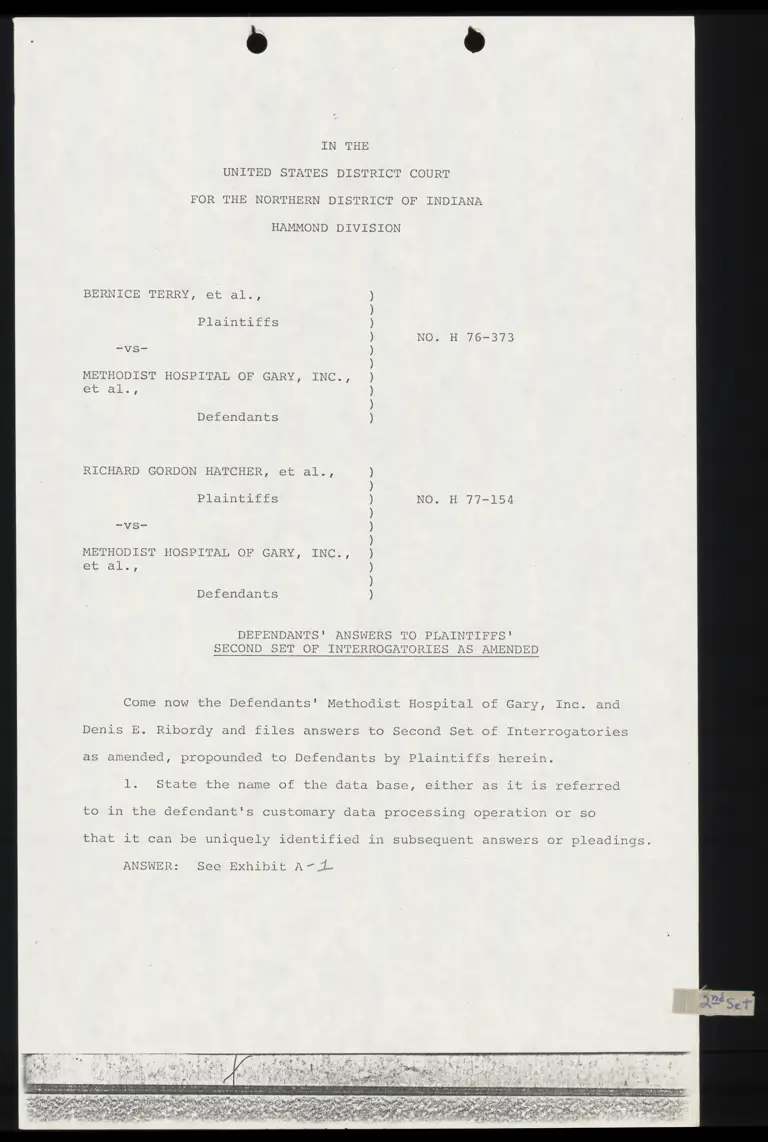
DEFENDANTS' ANSWERS TO PLAINTIFFS

SECOND SET OF INTERROGATORIES AS AMENDED


Come now the Defendants' Methodist Hospital of Gary, Inc. and

Denis E. Ribordy and files answers to Second Set of Interrogatories

as amended, propounded to Defendants by Plaintiffs herein.

1.  8tate the name of the data base, either as it is referred

to in the defendant's customary data processing operation or so

that it can be uniquely identified in subsequent answers or pleadings.

ANSWER: See Exhibit A-_1


TER mp ry des Saye ¥ wie pond MSE i 1
Beh AA STR ARATE Sa Ae erat


7a
i = aa


2. Which categories of employees are included in the data

base.

ANSWER: See Exhibit A

3. When was the data base first created, and when was it last

used.

ANSWER: See Exhibit A

4. If volumes, version, or generations of the data base are

(were) periodically produced, state:

(a) how often a copy is produced.

(b) what period of time is covered by each volume.

(c) in what ways any of the answers to questions in Part I

differ between different volumes of the data base.

(d) by volume serial or other unique identifier, the volumes

still extant and the contents and dates thereof, retained,

and if so,

(e) identify any volumes scheduled for destruction within the

next twelve months.

ANSWER: See Exhibit A

5. If entries in the data base are periodically updated, without

a new volume or copy being created (such as the weekly updating of a

disk master file), state:

(a) how often the data base is updated.

(b) which fields or records are subject to revision.

(c) whether complete copies are made and retained, and if so,

(d) state by volume or other unique identifier the volumes

still extant, the contents and dates thereof, and any

proposed destruction dates.


ANSWER:

whether changed or purged entries are maintained in

computer-readable form, and if so,

answer all applicable questions in Part I for any files

containing these purged entries.

See Exhibit A

Provide the following for all fields found within each

different record structure within the data base.

a "record layout" for the file may be produced, providing it supplies

each requested item of information in a clear, legible, and unambigous

In the alternative,

(a) its location within the record.

(b) a brief description. of its contents.

(c) a brief description of its function and significance,


BrP NTI GO Co Te i) OTE 3+ pe ye

if not immediately obvious (such as name, race).

the physical representation of its contents (character,

zoned decimal, packed decimal, signed decimal, binary,

floating point, location of assumed decimal point, lo-

cating of sign, right = or left - justified, strictly

numeric, numeric with blanks, etc.).

the sign codes used for decimal fields (f.e., IBM

standards hexadecimal "C" or "FP" for plus, hex "DY

for minus).

the status of the field; whether data was always entered,

was sometimes entered (was optional), or was never en-

tered (space was provided, but field was not used).

For each field which contains "coded" entries, such as

a Field for race containing a *1" for white and. a "2¥


g PR
Ae WER ae x ea

Sis Wiad


ES 4 ASIST

Taal APN] ng


for black, or numbers representing department titles,

provide a translation table which contains each possible

entry and its English translation or literal meaning.

If such translation table exists in computer-readable

form, answer all appropriate questions in Part I con-

cerning the table.

ANSWER: See Exhibit A

7. If the file is composed of records differing in form from

one another, provide the record layout for each possible record entry,

(c.f. question 6) and state how the format appropriate to any par-

ticular record can be ascertained. If the file is "hierarchical"

in structure (i.e., it contains an unpredictable number of minor-level

records related in some manner to a preceeding major-level record),

describe in detail the structure of the file, and state how different

record types and levels can be recognized.

ANSWER: See Exhibit A

8. State the approximate number of logical records in the data

base.

ANSWER: See Exhibit A

9. Describe the storage device or medium.

ANSWER: See Exhibit A

10.: State the:

(a) logical record length.

(b) physical record length (blocksize).

(c) record format (fixed length, variable length, spanned,

blocked.


(d) file organization (sequential, indexed, direct, VSAM).

(e) recording code {EBCDIC, ASCII, BCD, Hollerith,

column binary).

ANSWER: See Exhibit A

11. State the programming language or retrieval system used to

Create and access the data base.

ANSWER: See Exhibit A

12. If the data base is generated or accessed by a program which

is part of a formal or documented processing system, provide a "flow-

chart" for that system, showing the flow of information (files) from

program to program.

ANSWER: See Exhibit A

13. 1f on magnetic tape, state the density (bits per inch), the

number of tracks (7.9), the recording technique (parity, translation,

conversion, character code ) if on 7 track; the form of internal

identifying labels (IBM standars, non-labelled, IBM 1400 series,

Burroughs standard, etc.), and the format of block prefixes if ASCII.

ANSWER: See Exhibit A

14. With reference to the fields enumerated in the answer to

Question 6, describe the order in which records in the data base are

sorted.

ANSWER: See Exhibit A

15. Briefly describe each of the defendant's computer facilities,

including:

(a) manufacturer.

(b) model number.


          » 7 MAS RAY mt se

a “ia


   ih Sa hid


(c) name and release of operating system.

(d) type and number of each input/out/put device.

ANSWER: See Exhibit A

16. If the defendant's client colivater system is not capable of

copying each of the data bases identified in Part I according to

the following parameters, state why not, and state what alternatives

are avallable for each of the parameters listed:

(a) onto magnetic tape.

{h)."9 track.

(cy. aL 800, 1600, or 6250 bpi.

(4d) in EBCDIC character code.

(e) with IBM standard OS labels.

ANSWER: See Exhibit A

17. For each information retrieval program or report generator

(L.e., software capable of producing a multitude of different reports,

depending on control information entered) available, hats purchased,

leased, or written locally,

(a) identify its name or title, vendor or author, and any

optional features installed.

(b) identify which of the data bases named in Part I the

program operates on, and whattype of reports it is capable

of generating.

(c) Identify and describe all documents, reference manuals

or texts which describe the program and its operation.

ANSWER: See Exhibit A


18. If defendant contracts with an outside service bureau or

agency for processing of data bases identified in Part I,

(a) describe those services completely.

(b) indicate which data bases identified in Part I are in

the possession of such bureau or agency.

(c) answer all parts of questions 15 and 16 concerning the

bureau's data processing capabilities.

ANSWER: See Exhibits A and B

19. Give the name, business address, job title, and job function

nf:

(a) the manager of defendant's data processing operation.

(b) each analyst or programmer who has intimate knowledge

of the contents or function of each data base identified

in Part I (specify which).

(c) the person (s) who answered these Interrogatories.

ANSWER: See Exhibits A and B

HODGES, DAVIS, GRUENBERG, COMPTON & SAYERS


Edward J. Hus$ey 7
5525 Broadway
Gary, Indiana 46410
Phone: 981-2557


SS Se — WEE A [||21e44b6b-23e9-41af-832d-7e87f3291efd||]