Transcript of the Evidence Volume 3
Public Court Documents
April 7, 1975
-
Case Files, Garner Hardbacks. Transcript of the Evidence Volume 3, 1975. 01ae7bc1-24a8-f011-bbd3-000d3a151b15. LDF Archives, Thurgood Marshall Institute. https://ldfrecollection.org/archives/archives-search/archives-item/ad1b795d-c900-40dd-81c4-d1d157fec870/transcript-of-the-evidence-volume-3. Accessed September 25, 2026.
Copied!
(
3
4
5
6
7
8
9
10
11
12
13
14
15
16
17
18
19
20
21
22
23
24
25
2
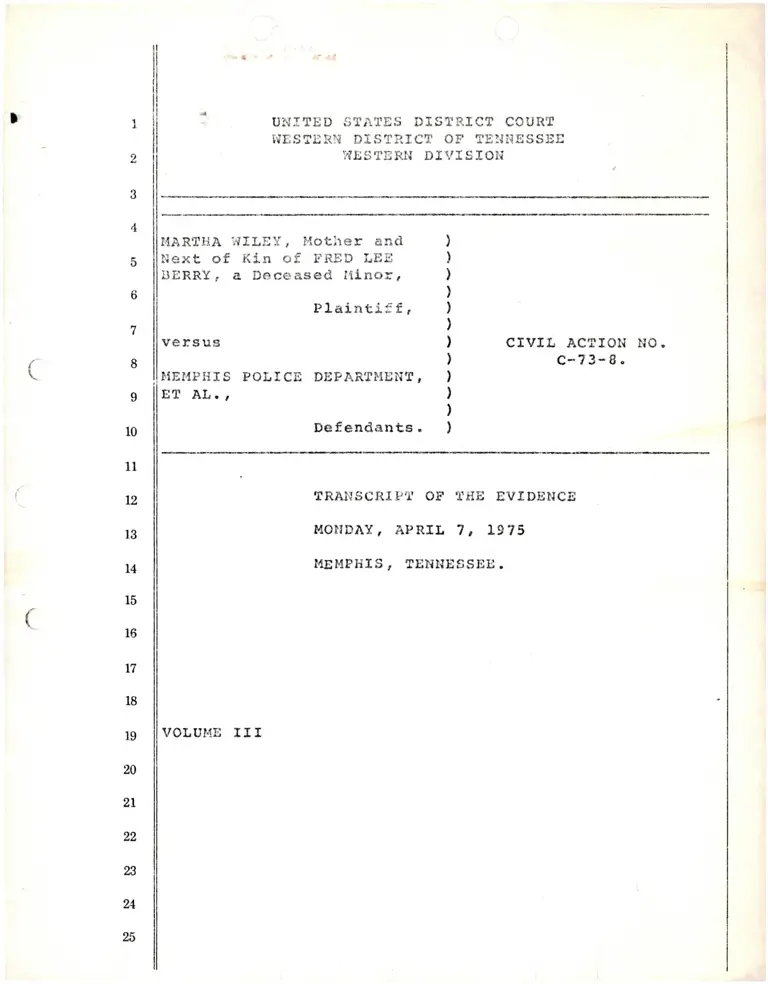
UNITED 5T/\TES DISTRICT COURT
WESTERN DISTRICT OF TENNESSEE
WESTERN DIVISION
MARTHA V̂ ILEY, Mother and
Next of Kin of FRED LEE
BERRY, a Deceased Minor,
Plaintiff,
versus
MEMPHIS POLICE DEPARTMENT,
ET AL.,
> )
)
)
)
)
)
)
Defendants. )
CIVIL ACTION NO
C-73-8.
TRANSCRIPT OF THE EVIDENCE
MONDAY, APRIL 7, 1975
MEMPHIS, TENNESSEE.
VOLUME III
3 6 6
O
1
2
3
4
WITIIEG'̂
I-N-D~E-X
DIRECT
EXAMINATION
Mrs. Michael A. Smith 374(a) 410,
414
CROSS-
EXAMINATION
397, 415
Charles T. Kenny
John A, Coletta
421
443, 475
424
464
O
10
11
12
13
14
15
16
17
18
19
20
21
22
23
24
25
. /
2
3
1
6
7
8
9
10
11
12
13
14
15
16
17
18
19
20
21
22
23
24
25
367
(Whereupon,, pursuant to the overxiight
recess, Court reconvened in this case beginnix̂ ĝ
at 1:38 p.ra., and the follovifing proceedings
were had.)
THE COURT: Gentlemen, I have been apologizing
all day long. I'm sorry that is the case, was the
case. I had no choice. I want you to understand
that, whereas, at nine thirty, for the second
straight case, I was advised by the defendant's
attorney that the defendant was in jail, and there--
fore, we couldn't proceed, and that was the first
that I had known about it, so we had no choice of
inconveniencing about thirty-five or forty jurors,
and, and the persons that v;ere attempting to pro
ceed in this case, or inconveniencing all of you
for which I'm sorry, but it took us, as you know,
until about one ten or one fifteen in order to get
the jury panel selected and I regret that I have
delayed you in this case because of that unexpecte
situation.
MR. ARUOLD: If Your Honor please, if there
is something we could take up with the Court,
briefly, before we put on more proof.
It has to do with the Court's ruling concerni)ig
our statistics and data on police arrests and
2
3
4
5
6
7
8
9
10
11
12
13
14
15
16
17
18
19
20
21
22
23
24
25
1
368
shooting incidents after January the 8th, 1372, in
specifically involved Exhibits 19(a), 13(b), 20,
39 and 40, in which data of, after that date, is
also included and while we have not prepared any
ineraorandura on the subject, we would ask the Court
to reconsider its previous ruling. We would speci:̂ i-
cally call attention to Rule 406 of the new rules
of evidence, v/hich, of course, do not go into, did
not go into, do not go into effect until the first
of July.
Rule 406 states, that:
"Evidence of the habit of a person or of
the routine practice of an organization,
whether corroborated or not and regardless of
the presence of eyewitnesses, is relevant to
prove that the conduct of the person or organi
zation on a particular occasion was in con
formity v;ith the habit of routine practice."
One example that I would call to the Court's
attention from Wigmore on Evidence, is under the
topic, "Circumstantial Evidence," and deals with
the question of existence in time.
The example given is -- (interrupted)
THE COURT: Now, where, v/here, what section
are you reading from?
o
G
1
2
3
4
5
6
7
8
9
10
11
12
13
14
15
16
17
18
19
20
21
22
23
24
25
36 9
MR. ARNOLD: are reading from the matter,
circumstantial evidence is the topic, section
eight zero, paragraph, Roman Numeral Three.
THE COURT:: All right, sir.
MR. ARNOLD: This is student's textbook of the
law of evidence as opposed to the treatise, as Mr.
Caldwell has pointed out to rae, the example given
is, that:
"The existence of a dangerous hole on
the -- in the sidev/alk on June 15 may be evi
dence by the prior or later exhibits of a
hole at this point on June 1, or on June 30."
Neither Rule 406 , nor this example here, woulcjl
suggest that subsequent to happenings, which are
a part of the pattern and practice, for the conduc^
and habits as alleged, are to be excluded because
those events occurred after the specific date in
question.
We have called the Court's attention to other
positions, including that of the unavailability of
information prior to a certain date, as testified
to by Captain Coletta, and would urge the Court to
reconsider the Court's ruling and to allow those
matters which we have presented, occurring after
January, 1972, to be admitted under Rule 406, as
o
o
2
3
4
5
6
7
8
9
10
11
12
13
14
15
16
17
18
19
20
21
22
23
24
25
1
370
the habit or routine practice of the defendant
organization of Meiaphis Police Department,
THE COURT; All right, sir.
Do you v/ant to be heard in that respect, Mr.
Shea?
MR. SHEA; Your Honor, we voice a continuing
objection, that, first, there isn't, to my way of
thinking, any evidence in the record at the presen^
time, there may be some conclusions on the part of
the attorney for the plaintiff, but there is no
evidence that there is any systematic pattern of
the Memphis Police Department of shooting just
black fleeing felons.
What they are asking the Court to do at this
time is not, at this time, is not to look at the
facts as they were on January 8, 1972, but, but to
take into consideration matters that have occurred
offenses, events that have occurred since 1974,
certainly would have absolutely no bearing whatso
ever on what took place in January '72. So our
objection is continuing.
THE COURT; Well, the Court has ruled pre
viously that evidence which relates to the shootin
or wounding of persons fleeing from the police,
going into 1973 and 1974, when the episode in
o
2
3
4
5
6
7
8
9
10
11
12
13
14
15
16
17
18
19
20
21
22
23
24
25
1
371
question occurred in January of 1972, was not rele
vant or admissible, and at the time the plaintiff
had prepared certain material, and summaries, and
information, and statistical data which related to
matters that had been reported into *73 and '74,
and the contention was, in two respects, that ought-
to be admissible, in other v/ords, to get a sufficii^nt
statistical pattern, that it v/ould be meaningful,
and that the police had not maintained, for a suff4“
cient number of years before January, *72, data
that would be perhaps as significant or as helpful
for looking at the contentions that the plaintiff
is making v/ith regard to racial implications of
the policies of the police.
The Court ruled that anything beyond 1972, we
woxild not consider to be relevant or material, but
that the plaintiff might amend their data and infor
mation that would go through that time, although
we specifically stated that, said that we wanted
information that would have a cutoff date as near
to January the 8th, of '72, as i>ossible, but we
did indicate that we might consider matters that
would go through 1972, even though that postdates
the actual occurrence here.
We are not persuaded at this point, although
o
2
3
4
5
6
7
8
9
10
11
12
13
14
15
16
17
18
19
20
21
22
23
24
25
1
372
wc will review the particular new rule of evidence
and the matter that has been submitted, we are not
persuaded that our previous ruling should be amended
or changed, and we also do not, do not feel that
this does work a prejudice to the plaintiff, because
they were able to make a summary or theoretical
questions to the statistical witness with regard t<|)
his particular conclusions drav;n, based on figures
v/hich, in fact, did go through the longer period.
In relation to the example, of course, that
Wigmore cites, we think that the, that there are
obvious and evident differences in that situation
and what we have here. VJigmore argued that evidence
within a few days, and within a few days before an<̂
after a particular defect in property, of what it
v/as like a few days before or a few days after, is
so close to the fact that it might be considered
by a court or jury, pertaining to what the situation
actually was on the day in question, and there, of
course, the parties on either side would have had
an opportunity to bring in anything, anything that
would shov; a difference in the actual situation at
the date of the accident, and what pertained a few
days before and a few days after.
Here we have proof and evidence that have
o
o
2
3
4
5
6
7
8
9
10
11
12
13
14
15
16
17
18
19
20
21
22
23
2-4
25
1
373
been submitted through, through the plaintiff,
that there have been differing persons in charge
of the police department, differing persons that
have adopted soraê 'rhat different policies v/ith
regard to the policies that are in question, par
ticularly v/ith regard to the use of reasonable
force, including the use of firearms, firearms to
apprehend a fleeing felon.
The Court just feels that there are so many
variables and significant differences from the
examples that have been cited to us, plus the nor
mal and usual rules that v/hat may have occurred,
one, or two, or almost three years after an episodjj,
is simply not material and relevant to what may
have happened and may, wliat may have been the poli)::y
and practice at that particular time.
So we are disposed to ratify and reaffirm our
previous ruling, subject to re-examining the matte
in light of the authorities that have been cited
to us; but, again, the plaintiffs have the right
to resubmit evidence and exhibits that, that go
through the dates in question and evidence going
beyond, through 1972, but not otherwise; and, of
course, they may make their record by identifyir^O
those exhibits that have information in the later
o
o
2
3
4
5
6
7
8
9
10
11
12
13
14
15
16
17
18
19
20
21
22
23
24
25
1
374
period that we had ruled not relevant and not
materi al.
Are there anything, any other matters tliat we
need to take up before we proceed nov/?
MR. ARNOLD; No, sir.
THE COURT; All right.
Vie had concluded the testimony of Dr. Kenny
and, after his testimony we had the tostiraony of
Captain, or before his testimony of Captain Colett^,
are there any other matters of proof and evidence
that are to be offered by the plaintiffs at this
time?
MR. CALDWELL: Your Honor, we would like to
call at this time Mrs. Maxine Smith.
THE COURT: All right.
374 (ci
O
O
1
2
3
4
5
6
7
8
9
10
11
12
13
14
15
16
17
18
19
20
21
22
23
24
25
MRS. MICHAEL A. SMITH,
the said witness, having beezi first duly sworn,
testified as follows:
DIRECT EXAMINATION
DY MR. CALDWELL:
Q I'll try to make you understand me, I'm having
speaking problems, Mrs. Smith.
Would you state your name, your full name, please,
and your address, please?
A Mrs. Michael A. Smith, 120 8 East Parkv/ay South.
Q And among other things, you are executive secretary
of the Memphis branch, NAACP, is that correct?
A That is correct.
Q And you are also an elected member of the Board
of Education of Memphis?
A City schools, that is correct. That is also cor
rect.
Q And how long have you held that position?
A Since January 1, 1972.
Q All right.
And hov̂ long have you been executive secretary of
Memphis branch NAACP?
A I think it was in April of '62.
Q Are you a native Meraphian?
A Yes, sir, I am.
375
O
O
2
3
4
5
6
7
8
9
10
11
12
13
14
15
16
17
18
19
20
21
22
23
24
25
1 Q Prior to April of 1962 , !lro. Smith, had you become
involved in, in what was then known as the Civil Rights
Movement, if, and if so, would you tell us hov; you be
came involved?
A Yes, sir. I have been involved to some extent all
of ray life, but as an adult, ray first involvement came
v;ith a futile effort to enter Memphis State University
in the summer of 1957. I did this independently, inde
pendent of an organization. I would say, along with a
friend, and we were rejected. Som.ehow, the nev.’s media
got wind of this and there was some public attention
put to, put to this, and it was at this point, in 1957,
that the N double ACP first invited us to become members
of its board of directors.
Q V<hy was your application at Memphis State rejectedl*
A Because I was black.
Q Subsequently, did Memphis State admit black stu
dents?
A Subsequently, yes.
Q Can, can you proceed there, from there to the next
major facet of the Civil Rights Movement in Memphis, and
we are particularly interested in the, in this case with
relation to, of the police department, and the black
community?
HR. SHEA: If Your Honor please, I fail to seh
o
o
2
3
4
5
6
7
8
ot y
10
11
12
13
14
15
16
17
18
19
20
21
22
23
24
25
1
376
any relevancy of Mrs. Smith’s involvement as a bla<j:k
as her activities, has to do with the incident thai
took î lace on January the 8th, 1972 .
THE COURT; Well, I will overrule your objec
tion .
The witness may testify with regard to the
background, and in the area that may pertain to
the issues that are involved in this matter.
You may proceed.
A I became a member of the board of directors of
Memphis branch N double ACP, in 1957.
My first position was as membership chairman.
To move on to direct action with the community
problems, I, I was coordinator of what we call the
"Freedom Movement" of 1960-61, that was in, eighteen
months period of direct action programs in which more
than four hundred people participated in this program
were arrested for attempting to use public libraries,
art museums, get services at lunch counters, be served
at rail, bus and air terminals, ride streetcars or buse
or trolleys, whatever we had. In fact, during this
period, around this period, H double ACP filed suit
against every tax-supported institution in Memphis, all
of v;hich, at that time, barred blacks from participation
and I served as coordinator of this movement.
o
o
2
3
4
5
6
7
8
9
10
11
12
13
14
15
16
17
18
19
20
21
22
23
24
25
1
377
Q iiow many people do yoxi estimate were arrested durincj
this period?
A In excess of four hundred people.
Q And these were people arrested by the police
department in Ilenphis?
A That is correct.
Q Following then, 1961, or 1962, what was the next
major civil rights events in Memphis? Was that the
sanitation strike in ’68?
A ’Well, there were a number of direct action program;
even before '68. There were a number of arrests in '63-
in '64, because many of the things that we had been
promised in '61, at the culmination of that movement
were not forthcoming and, and so we continued to peace
fully picket department stores, financial institutions,
which lead to even further arrests, and I guess we v/ould
say that the next major civil rights thrust was involved
with the sanitation strike of 1968 . IJ double ACP led
the first protest. We had an all-night vigil around
City Hall in protest of the treatment the sanitation
workers v;ere receiving from city officials.
Q Were there events which occurred during the course
of the sanitation which, which you observed and which
involved the Memphis Police Department, or certain mem
bers of the Memphis Police Department?
o
o
3
4
K
G
7
8
9
10
11
12
13
14
15
16
17
18
19
20
21
22
23
24
25
378
x'lR. SREA: If Your Honor please, ayain, I ' ra
going to object. It has nothing at all to do with
v/hat we are inquiring into.
THE COURT; What is the purported relevancy,
Mr. Caldwell?
MR. CALDWELL; Your Honor, we have attempted
to demonstrate, or we have alleged, at least, that
the Memphis Police Department has had relationship
with the black community which has been one of mis'
trust or hostile, hostility, from the standpoint
of the black community, and we have also attempted
to establish that, that the Memphis Police
Department has, by its history, actions, been respon
sible at least in part for these differences, and
perceptions, and is a part of the history of the,
of the Civil Rights Movement in Memphis. It is a
part of the history of the relationship with the
Memphis Police Department, of the Memphis Police
Department v;ith the black community, which does,
does go to establishing those perceptions.
THE COURT; V7ell, insofar as the latter matter
bearing upon the issues that are presented by the
plaintiff in the case. I'll overrule the objection^
and in saying, "insofar as the latter part", I
would, of course, v/ant to emphasize those portions
o
2
3
4
5
6
7
8
9
10
11
12
13
14
15
16
17
18
19
20
21
22
23
24
25
1
379
which bear upon police actions or conduct rather
than general civil rights movements, as it pertain;
to the issues in this particular case.
MR. CALDWELL: I understand,
Tliank you, Your Honor.
MR. SHEA: Your Honor, rather than being
bouncing up and dov/n, could I have a continuing
objection to this witness' testimony?
THE COURT; The Court understands that it is
your contention, continuing position, and objection,
that v/hat may have taken place and the time, times
and places, differ, if a, differ from the time and
places in nineteen seven- -- January, 1972, are
not relevant and material. Now, in overruling your
objection, the Court is not making an ultimate
finding here, v/e are simply overruling the objec
tion .
You may proceed, Mr. Caldwell.
BY MR. CALDWELL:
Q Would you, you may proceed, Mrs. Smith.
Would you, do you remember the question?
A I think I do.
In 1968 there were numerous arrests by the members
of the police department.
I was arrested, I don't remember exactly how many
o
o
2
3
4
5
6
7
8
9
10
11
12
13
14
15
16
17
18
19
20
21
22
23
24
25
1
380
times, and I was treated extremely rudely by police offi
cials doing their, during the arrest, and being process*;
I was throvm into a restroom with all males. I was
deprived when I asked to be addressed by ray proper
courtesy title.
The v/ord "nigger" was frequently used. There was
just general contempt and lack of respect by those of
us Who were arrested for sitting in City Hall after the
police decided they didn't want us there.
Q Referring specifically to the sanitation strike,
itself, was there a march or demonstration on March 28,
196G?
A Yes, sir, there was a march on March 28th. I was
right at the front of that march and, and the march got
out of hand, those of us who felt to be leaders in the
black community were doing a pretty good job of turning
the march around, but suddenly, I don't know why or how
by what command, police officers began swinging clubs,
shooting teargas. It was the most inhuman episode I
have ever witnessed. I witnessed brutality that I coul
not really imagine, I never would have thought could
have happened at the hands of the police officers.
I saw many people beaten, just for trying to get
to their car after the order was to clear the streets,
and we were attempting to tell people, in fact, leaders
3ei
o
o
2
3
4
5
6
7
8
9
10
11
12
13
14
15
16
17
18
19
20
21
22
23
24
25
1 of the community, Mr. Jessie Turner, himself, was placea
and struck by police officers in his effort to turn the
people around.
Hr. Hiram V7iIlham, one, president of one of our
white businesses at the time, was struck, cursed.
Vve were standing together at the door of N double
7vCP office, and we stood there, in Memphis, and watched
just savage brutality being inflicted on citizens by
police officers who had removed their shirts, I would
imagine in an effort not to be identified.
I was a witness in court subsequently to several
of these incidents, and as result, N double AGP did
process eighty complaints from that one day, people who
received, received rather serious varying degrees of
brutal abuse.
Q Do you have a son, Mrs. Smith?
Is that correct?
A Yes, sir, I have one son.
Q How old is he now?
A He is eighteen years old now.
Q Has he been arrested in the course of these kind
of activities?
A Yes, sir, he has been arrested. I think he was
eight years old when he had his first arrest.
Q And what was he arrested for at that time?
o
o
2
3
4
5
6
7
8
9
10
11
12
13
14
15
16
17
18
19
20
21
22
23
24
25
1
382
A He vras in a picket line in front of Lowenstein's
Department Store for, that was located at Monroe and
Main at that tirie.
Q And what was the picket protesting?
A We were seeking equal eupl.oyment opportunities for
black people.
Q Has he been arrested on subsequent occasions?
A He has been arrested on subsequent occasions.
Q To your judgment, has that affected his -- (inter
rupted)
MR. SHEA; Now, if Your Honor please, I am
I
going to object to this one isolated incident that
he is going to say. I just don't think we ought
to inquire into this. Your Honor.
THE COURT: Well, I'm going to sustain the
objection to the testimony about the, about an
individual, ivhere the individual is, himself, not
1I
present to testify, and I v;ill, unless the indivi-|
dual is here to testify, I'll sustain the objection.I
MR. CALDWELL; Your Honor, I was not going to!
ask her, I was going to ask her about her --
mother's perception about her son's reaction.
THE COURT; Well, she may testify to her own
observations and so forth, but I'll sustain any
objection made to his attitudes, attitude of his
o
o
]
3
4
5
2
8
9
10
11
12
13
14
15
16
17
18
19
20
21
22
23
24
25
383
subjective response, and that sort of thing, as he
would be the appropriate person to do that.
I think the objection, from a hearsay stand
point, is an appropriate objection.
I’m not cutting off the line of inquiry in
that regard, I just think in this instance it is
an apjjropriate objection.
MR. CALDVJELL; Thank you. Your Honor.
Q Mrs. Smith, in terms of your relationship with
your son, have you been concerned about his perception
of the, of the Memphis Police Department, and have you
taken steps to deal with that?
A Very definitely.
I personally feel that any citizen, young, old,
middle age, should have a good image of police officers^
Ibecause I have a concept of what their role in the city'
should be, and my concern was that, and I hope I’m not
doing what you asked not to do. Your Honor, but my son's
concept, because of his experiences, was obviously net
what I would like to see it, as a mother, so I tried, !
i
perhaps futilely, to correct his concept of the police
department.
Q Your son is in college today, is that correct?
A Yes, sir, he is a freshman in college now.
Q Following 1968, am I correct that there were, was
o
o
2
3
4
5
6
7
8
9
10
11
12
13
14
15
16
17
18
19
20
21
22
23
24
25
1
384
a boycott of the school systein led by^ or organized by
you and NAACP in 1969?
A That is correct.
Q And were there arrests and what-have-you during
this, during this period also?
A Yes, sir, there v;ere arrests. I don't remember
exactly how many. I was arrested on at least two occa
sions, personally during that period. I think one of
the charges v;as contributing to the delinquency of
minors, ironically these charges were only dropped afte::
white mothers participated in boycotts some years later,
just what, why mine v;as dropped all of a sudden --
Q They were protesting bussing?
A Right.
Q There has been previous testimony in the case,
Mrs. Smith, about hearings conducted by the NAACP and
a committee, committee selected of OE, elected officials
in 1970.
Would you, could you tell us something about what
led up to those hearings and what they were about?
A Yes, sir.
I think it was in the latter part of 1969 that tiie
N double AGP felt it necessary to try to create a com
munity awareness of the whole problems that it engulfcdj
this community, as far as our system of criminal justice,
o
o
1
2
3
6
7
8
9
10
11
12
13
14
15
16
17
18
19
20
21
22
23
24
25
385
as far as the inequities in the adjni.nistration of justit|:e
If I could just back up.
Much of the time I have spent as an official of, as;
an executive secretary of N double ACP, has been spent
filing police abuse, and charging other inequities. Vie
picketed for the right to include blacks in juries. We
have just, through the years, and I think our record
will reflect, been very concerned about the adrainistra-
tion of justice. However, most of the complaints we
filed with charges of police abuse were ignored by the
power brokers to whom w q filed, agencies, the officials
and we felt this to be a type of community, community-
wide hearing.
I really think, and maybe I'm a bit prejudice, tha
it is really one of the finest things that has come to
Memphis. It was not a vindictive against the police
department. We invited the police department to parti
cipate. We invited the mayor. We invited all indivi
duals, all of the officials, city officials, to partici
pate. We spent a considerable amount of money to set
this up. Wc brought people who were experts in the
field of some area of administration of justice. We
v/ere concerned with the young police abuse. We were
concerned with the stallist bail bond system, we were
concerned with the, with the discrimination employment
o
2
3
4
5
6
7
8
9
10
11
12
13
14
15
16
17
18
19
20
21
22
23
24
25
1
38G
by our law enforcement, by, in fact, if I raay say so, i
felt pretty proud of the high caliber hearings that
N double ACP put together and brought to Memphis.
Unfortunately, some of our officials ignored it.
Q You say the Memphis Police Department was invited
to attend and participate?
A Very definitely.
Q , And did they cooperate in the hearings?
A No. I think they, they didn't cooperate. The
only member of the police department that were present,
to ray knowledge, were one or two people with tape
recorders. I sat next to one taping a record of what
v;ent on. Of course, there, it was no secret. We had,
have a, you know, the entire transcript of the whole
thing, but I think the director, at that time, said he
never had heard of a brutal policeman; although this
was not the v/hole issue. There was cooperation from
the police department, and the only attendant, to my
knowledge, v;as to get the record.
Q Did you also invite the Shelby County police.
Sheriff Department, to participate?
A We did.
Q And did they also cooperate?
A Yes, sir. In fact, the v;itness from the sheriff's
department testified in that hearing.
o
o
2
3
4
5
6
7
8
9
10
11
12
13
14
15
16
17
18
19
20
21
22
23
24
25
1
387
Q Could you fcell lae who the rtembors of the -- it was
called, called the ad-hoc committee, and who were the
members of the committee?
A Let me see.
We used black elected officials. At that time, it
was in *70, there was Mr. Turner and Mr. Fred Davis,
Rev. J. L. Matters, Attorney J. O. Patterson, and nov;
Commissioner Ben Kooks.
Q Mr. Jessie Turner, at that time, and still to the
present, was a magistrate, an elected magistrate, on
the Shelby County quarterly court; is that correct?
»
A That is correct.
Q And Mr. Fred Davis was, at that time, and still is
a member of the city council?
A Yes, sir, that is correct.
Q And Mister, Rev. James Matters, v;as, at that time,
and still is, an elected member of the council?
A That is correct. Yes, sir.
Q And Judge Hooks had just been, or was a member of
the judiciary of Shelby County; right?
A Right.
Q He is now a commissioner of the Federal
Communications Commission, is that right?
A That is right.
Q And Mr. Patterson was a member of the State Senate
o
o
388
1 and the city council; is that correct?
2 A That is correct.
3 Q Mrs. Smith, let me show you some documents, one
4 document is marked Exhibit 23, and the others are markec
5 Exhibits 24(a) through 24(d).
6 Now, are the 24 series, is that the transcript of
7 the ad-hoc committee hearings which were conducted'during
g — excuse me -- Exhibit 24(a) through (d) hearings, and
9 I have the original of those transcripts.
10 A Yes, sir, without reading them all, just at a
11 glance, I would say these are the transcipts of the
12 hearings, of those hearings, and went on, you know, ove^
]3 a period of time.
14 (2 Did you have them routinely one day a week for
15 three or four weeks? Is that right?
16 A Yes, sir, not consecutively, but within, maybe a
17 two months time frame. I would have to check back for
18 the dates .
19 Q Now, you mentioned that some of the testimony
20 dealt with, with the bail bond system and the other,
21 other testimony dealt with the experts which wei'e called
22 in, and what-have-you, but were there also some indivi-
23 dual citizens who testified, make allegations of the
24 police conduct and racial abuse?
25 A Yes, sir.
o
2
3
4
5
6
7
8
9
10
11
12
13
14
15
16
17
18
19
20
21
22
23
24
25
1
389
MR. SliE/i.; If Your Honor please, I am going
to object. Certainly that is the rankest hearsay
that people came in and took a transcript of what
they said. We have no opportunity to cross-examin^
these people. I object to it on the ground that
it is hearsay and should be excluded.
THE COURT: v;ell, the Court has ruled hereto
fore that v;e are not concerned, considering the
transcript or the evidence that may have taken
place there for the truth of the matter that is
asserted. So that, in the face of the hearsay
objection, we are not considering those matters
with regard to testimony pertaining to the parti
cular complaint or particular matter.
As we understand it, the plaintiff has offeredi
it for the purpose of information or matters that |I
the defendants were or should have been aware of,
not for the truth of the matter assarted, and v;e
have stated that the matter may be alluded to and
we overrule the objection on the latter basis, but
we are not admitting it on the hearsay objection
as to the truth of the matter asserted.
BY MR. CALDWELL;
Q We were talking about allegations of police conduct;
or racial abuse; there v/as that kind of testiraony, as ij
o
o
3
4
5
6
7
8
9
10
11
12
13
14
15
16
17
18
19
20
21
22
23
24
25
39 0
understand your ansv7or?
A Yes, sir, that v;as a pcirt of the hearings, yes, sijf.
Q And that v/as a part, report, lot me turn your atter !tion now to Exhibit 23, and this is the ad-hoc committee
staff report, and was that approved by the five members
of the committee, that testimony before the coramittee?
A Yes, sir, i t v/ a s .
Q In, in October, 1971, I think there v/as an incident
involving the death of a young nan named Elton fiayes .
Are you familiar with that incident?
a Yes, sir, I am. »
MR. SHEA: Your Honor, I object to anything
that happened to Elton Hayes in 1971. That has
nothing to do \/ith January, 1972 .
THE COURT: Well, with your continuing objec-j
tion on the same basis as noted before, and v/ith-
out attributing a special materiality or signifi
cance or otherwise, not either way, the Court will;
overrule the objection and permit the testimony.
BY MR. CALDWELL:
Q Was there further black community concern and
activity in v/hich you participated as result of that
particular incident?
A Yes, sir, it was more or less a continuation, or
perhaps an intensification of our effort to, that had
o
o
2
3
4
5
6
7
8
9
10
11
12
13
14
15
16
17
18
19
20
21
22
23
24
25
1
391
taken place over the years, to eliminate this type of
brutality from our police system. It v/as resulting pri--
marily from the tragedy of Elton Hayes that the
N double ACP drew up what came to be known as our
Eighteen Point Program, and this program was widely disf
semenated to all elected officials, to all lav; enforce
ment agencies, and including the county commission, the
county court, the city council, and anybody who v;ould
have some effect on trying to implement those eighteen
points, we felt would bring about a just society.
As I said, those v;ere drav;n up in '71, and the
I
dissemination of this was intensified early in *72. V/e
made appearances before everybody, every public body.
We had conferences with the editors of the two daily
newspapers, and in an effort to join us in this effort
to remove this blight from our city.
MR. CALDWELL; Your Honor, if I raay mar]: a
document at this time as the next exhibit number? !
THE COURT: All right, let it be marked for
identification as Exhibit Number --
THE CLERK; Forty-six for identification only
THE COURT: Forty-six.
(Whereupon, the said instrument was
accordingly laarked Exhibit Number 46 for
identification only.)
o
o
2
3
4
5
6
7
8
9
10
fX X
, 12
13
14
15
16
17
18
19
20
21
22
23
24
25
1
392
BY MR. CALDWELL:
Q Mrs. Smith, there has been marked for identifica
tion as Exhibit 46, a document which purports to be a
document of LAACP, and I believe you testified that is
the Eighteen Point Program that you were speaking of?
A Yes, sir, it is.
Q V7hat is left of it. I tore part of it off while
I v/as standing here.
Now, during both of these, these two events, we
were just talking about, the Eighteen Point Program and
the 1970 ad-hoc committee hearings --
A ifesrsir.
Q (Continuing) -- you did address and make comiaunica
tions in connection v/ith the deadly use, deadly force,
is that correct, arrest and use of deadly force, is
that correct?
A Yes , sir.
Q Would you read item seventeen of the Exhibit 46?
A (Reading):
"A new guideline for use of lethal force
by officers should simply state that:
"'A police officer shall use lethal
force only v;hen he is clearly defending his
own life or v̂ hen clearly defending tlie life
of another individual or fellow officer.'"
o
o
3
4
5
6
7
8
9
10
11
12
13
14
15
16
17
18
19
20
21
22
23
24
25
39:
Q All riglit.
And the Lighteen Point deals with a whole lot of
other things, including better salaries for policeiuon,
and that sort of thing?
A That is right.
Q And similar deadly force policy was proposed by
the ad-hoc coi.imittee report, is that correct?
A Yes, sir.
Q Mrs. Smith, based on your experience with the
black community and the Civil Rights Movement in Meiaphiŝ ,
and continuing to a tim.e prior to, and up to January of
1972 , what was the, from your i^erception, the general
feeling of black citizens toward the Memphis Police
Department?
MR. SHEA; If Your Honor please, I am going
to object to that. She can give v/hat her opinion
is, but not v;hat the general -- is she speaking
for the entire black community, or is she speaking
for Mrs. Maxine Smith?
THE COURT: Uell, the Court is considering
that the witness is testifying in light of her
position in the organization, or organizations
that she has participated in, and the testimony
that has been adduced, adduced.
V7e v/ill overrule the objection to her
2
3
4
5
6
7
8
9
10
11
12
13
14
15
16
17
18
19
20
21
22
23
24
25
1
394
tostiiaony \7itriout attributing to the witness the
fact that she rnay be speaking, or not be speaking
for the entire black comraunity, but she may testifj^
in light of her background and her own position
that she has testified about.
HR. CALDV7ELL: Thank you, Your Honor.
A Through the contacts I have had, primarily as
executive secretary of N double ACP, and the complaints
that have been filed in our office, I would have to say
that in answer to your question that the attitude is
quite unhealthy and there, there are elements of fear
and distrust, and animosity, maybe even hate, unfortu
nately. This is how I perceive from my experience, the
attitude of blacks toward the police force.
MR. CALD;7ELL: Your Honor, I would like to
offer Exhibit 23 into evi.’ence, which is the ad-ho<|;
committee final report.
How, I have previously marked 24(a) through
(d) , as transcript of those bearings, but I promis^^d
the Court last week that v;e would not burden the
record with those unless the Court, or opposing
counsel required, but they are here and they are
marked for identification. I don't offer then int
evidence, and, at the conclusion of the trial, I
will be glad to v;ithdraw those.
G
O
4
r>
(;
7
8
{)
10
11
12
i;i
14
15
10
17
18
19
20
21
22
2.1
21
2
3Q 5
THE COERT; v/ell, the Court is hoping that ir;
any ultimate event of any ultimate appeal by oithei
party in this case, that it will not be necessary
that the parties include the voluminous matters
that are set forth as part of the proof and evi
dence .
The Court is not considering the contents of
the matter that has been stated for the purpose of
the truth of the matter asserted therein, and it
may be marked for identification, but v;ith the hop
that it does not have to be made a part of the
record for any ultimate purpose, because of the
expense involved.
MR. CALDWELL: I understand that. Your Honor,
and at the conclusion of the trial in this case, I
will be happy to withdraw the 24 series.
THE COURT: All right, sir,
MR. CALDV7ELL: I would offer into evidence
the final report which is marked Exhibit 23, and
the Eighteen point Program which is marked Exhibit
46 .
THE COURT: Mr. Shea, I take it that, that
Exhibit Number 24, is it, Mr. Clerk?
THE CLERK: (No response.)
THE COURT: And 46 -- (interrupted)
o
1
2
3
4
5
6
7
8
9
10
11
12
13
14
15
16
17
18
19
20
21
22
23
24
25
396
MR. CALDVJELL : Twenty-tlirGG and 46,
THE COURT: Ilow, do you v/ant to bo heard with
regard to admitting 46 and 23?
MR. SHEA: Yes, sir, Your Honor.
I say they have absolutely nothing at all to
do with this lav/suit, that they are conclusions on
the part of the N double kCP, which are not in evi
dence here, and the vhiole entire record, in my
opinion, should not be permitted in evidence at al'
THE COURT: Well, the Court admits the two
documents that are referred to, noting the objec
tions that have been made, again, since this is a
nonjury matter, the Court, in admitting these into
evidence, is not making any findings v/ith regard
to these matters at this point. We understand thai
they are being submitted as a part of the plaintifjf's
theory in this case, with regard to the attitude
of, of some, as evidenced by these documents in th^
black community, and v/e are noting the defendant’s
objection and they are admitted at this time under
the circumstances that have been stated.
MR. CALDWELL; Thank you. Your Honor.
That is all the questions I have from Mrs.
Smith.
Thank you, Mrs. Smith.
o
o
1
2
3
4
5
6
7
8
9
10
11
12
13
14
15
16
17
18
19
20
21
22
23
24
25
39 7
THE COURT: All right, Mr. Shea.
I might say that, state thcit any examination,
Mr. Shea, that you go into, that relates to these
exhibits that have been introduced, subject to
your continuing objection, you are not waiving
your objection by any cross-examination that goes
into any of these areas.
MR. SHEA: If Your Honor please, thank you
very much. They are much too voluminous to go
into. My objection is noted to then as to their
conclusions, and I do not intend to go into them.
CROSS-EXAMINATION ’
BY MR. SHE A : ___
si Mrs. Smith, what, I believe you said members of
the ad-hoc committee v;as Jessie Turner, Councilman
Davis, Rev. Metters, and Councilman Patterson, Rev. Ben
Hocks?
A Right.
Q They are all blac]:, are they not?
A That is right.
Q v;hat was your particular function in the ad-hoc
committee?
A Function, well, as I was executive secretary of
the local N double ACP, the organization that sponsored
and, and, you knov;, put the hearings together, I v/as
o
o
2
3
4
5
6
7
8
9
10
11
12
13
14
15
16
17
18
19
20
21
22
23
2-1
25
1
398
sort of ov'e.’cseor of the whole thing, I guess you v/ould
call it.
v?ell, did you oversee and attend all of the hearimjs,
yourself ?
7' Yes , sir .
Q Let's see, this v/as N double 7iCP' s responsibility?
h That is correct.
Q There were no whites asked to be members?
A Of the names whom I have just mentioned. No, there:
were no whites that, we used black elected officials.
0 VJhy was that? »
A V7e used men of ability, of credibility, men who
had been on record opposing the type of justice of
blacks, blacks received in our system of criminal jus
tice, and v/e thought they were capable men of jjerformin<;j[
this task.
Q Are you saying that all white men to be incapable?
A I‘m saying nothing about any white man.
Q Well, they were excluded because you felt that
these black men were better qualified than any white
people?
h We didn't even consider. We looked for five good
men.
C? Well, were you discriminating against whites?
A No, we were not discriminauing against anybody.
3 9 9
O
o
3
4
5
6
7
8
9
10
11
12
13
14
15
16
17
18
19
20
21
22
23
24
25
lie picked five laen we kr.ev/ to be good men,
Q All right.
Now, Mrs. Si.iith, you, as the executive secretary
of the 11 double ACP, and back in 1961, you said that
you had some function, that was membership?
A I \/as chairman of the membership committee.
Q All right.
A Earlier, when I first went on the executive board
of N double ACP.
Q Well, what training and teaching xvas given to the
young, old blacks alike, during the civil disobedience
period in Memphis, from 1956 through 1972?
A We had sessions, proceedings every demonstration.
First of all, every participant was advised of his or
her rights under the First Amendment to our Constitutioh
V4e had people come into tov;n, such as Rev. Lawson, v?ho
currently moved to Memphis, from other areas, that had
been involved in direct action programs, people v;ho
subscribed to the theory or prinicple of nonviolence to
lecture to our participants, and if you remember cor
rectly, we were never violent in our demonstrations.
No one ever accused us of violence. If any of the
youngsters got out of hand, there were one or tv/o occa
sions when I had to pull one out of line, but they were
very strongly admonished to conduct themselves in a
400
O
o
3
4
5
6
7
8
9
10
11
12
13
14
15
16
17
18
19
20
21
22
23
24
25
nonviolent manner to, to picket according to laws that
v/erc, not, not misconstrued as bombarding trade, or
back doors, v/e stayed our distance. I think -we did a
pretty good job of teaching. Most cf them v̂ 7ere young
people there were people of all ages -- to partici
pate in this type of demonstrations in a dignified
manner.
U V7ho broke out all the windows on South Main from,
when the march was coming toward City Hall?
A This was in 1968?
Q Yes .
A There were people who were not even involved in
the march. I saw this myself.
Q But there were people who v\̂ ere involved in the
march, breaking windows and putting people out of busi
ness, were they not?
A I saw no people involved in the march breaking v/in-
dov;s .
Q Are you telling this Court, Mrs. Smith, that none
of the protestors broke any of those windov/s on South
Main Street?
A I'm telling this Court, Mr. Shea, what I saw.
Q Well, of course -- (interrupted)
A There were plenty of people milling on the side
walks who were not in the line of inarch. I don't think
o
o
2
3
4
5
6
7
8
9
10
11
12
13
14
15
16
17
18
19
20
21
22
23
24
25
1
401
thcit element of citizenry would be concerned about the
rights we wore trying to gain for our people.
0 Well, isn't it a fact, Firs. Smith, that the teachiijg
til at you gave to the young children not to obey and
respect the laws has had a great deal to do v/ith their
attitudes tov;ard the police department?
A I have -- (interrupted)
MR. CALDWELL: I would like to — (interrupted)
THE WITNESS; I have never given any teaching
to any child, young or old, to disrespect and not
obey the police department. I have never done thi^*
and I don't Icnow where you get your information.
BY MR. SHEA;
Q Well, you just testified, excuse me, I have some
(interrupted)
MR. CALDWELL; I will withdraw my objection,
the witness has handled it.
BY MR. SHEA; . -
Q (Continuing) -- You just stated that you told them
what their rights were and didn't you also tell them
that they didn't have to obey such laws as riding on
the back of the bus, or eating in separate facilities,
and restaurants, or going to the park on certain days,
didn't you tell them that?
A I did not testify to that, but that was the whole
Q
1
2
3
4
5
6
7
8
9
10
11
12
13
14
15
16
17
18
19
20
21
22
23
24
25
4 0 2
reason of the nioverient.
Q All right.
So then you did.
All right, your sanction, soraeone taught then dis
respect for laws that you felt they should not obey?
A I feel that the Constitution of the United States
supersedes any law.
Q V4ould you answer ny question, please.
A I answered you, please, sir.
THE COURT: Just a minute.
Mr. Shea will ask the question and after he
has completed the question, the v/itness will respoho,
and be permitted to respond, and if there is any
objection made by counsel, v;e'll consider that
objection, but the Court can't pick up the natters
»
that are being discussed with all of you talking
at one time, and the reporter, neither, neither
can the court reporter, so let's proceed in a
fashion that we can all understand.
A Does that answer the question?
iiy MR. SHEA;
Q No. Would you answer it, please?
A A part of our movement, the main function of our
movement was to prove that these things you referred to
as laws, were unconstitutional and I think you v;ill
o
o
1
2
3
4
5
6
7
8
9
10
11
12
13
14
15
16
17
18
19
20
21
22
23
24
25
403
recall as vividly as I can that they v/ere so proven.
Q Well, I, I (interrupted)
A The Thirteenth, Fourteenth, and Fifteenth
Aracndaients of the Constitution guarantee all citizens
equal rights under the lav/, and that is what v/e were
trying to prove, and I think we proved it.
Q But you did teach then to disrespect and disobey
certain laws that you didn’t think were right, that you
and others like you didn't think were correct; right?
A I never taught, taught disrespect. I taught self-
respect. • , ' '
0 Now, v/liat is -- I'n glad we discussed that.
Now, v/hat is disrespect for the law?
A Well, Mr. Shea, you are the one that brought that
statenent up, perhaps you can define it.
MR. SKEA; Your Honor, I an not going to argut̂
with Mrs. Smith. I an asking the questions.
A I never used the word. It is your term.
BY MR, SHEA:
Q All right.
You just, just excuse me, Mrs. Smith, but do you
feel that there is any relationship between obeying a
just law and obeying one that someone does not think is
a just law?
A Well, see, in that instance, I don't consider it
404
O
O
1
2
3
4
5
6
7
8
9
10
11
12
13
14
15
16
17
18
19
20
21
22
23
24
25
law, Mr. Sheav
Q You don't consider it law. All right,
A That is ricrht.
Q All right.
Now, Mrs. Smith, the only way that those matters
could be changed though was by a court test, was it not|
A Yes, sir, and we were v;iiling to suffer any conse
quences that would corae as we tested the courts.
Q I see .
I see .
Now, well, now, you have testified earlier that
you were mistreated in some instances. Were, I believe
after the bologna was cut up on the tables in the counc
chambers, and certain people were arrested and brought
to headquarters, that you were not accorded certain
respect that you thought were due you?
A Mr. Shea, laws are getting broken continuously,
broken by the presence in the courts. The day that tne
bologna was cut -- (interrupted)
Q V7ell, now, you said on one incident when you were
seized, led from city council table to the police sta
tion?
A That is right.
Q That, that event took place, and do you recall, or
do you know that your attorney asked Ciiief MacDonald to
LI
o
o
1
2
3
4
5
6
7
8
9
10
11
12
13
14
15
16
17
18
19
20
21
22
23
2-4
25
give you preferential treatment find let you go first?
A No, because I was the last one to, to have been
released from jail that night.
Q Nell, I nappened to have been present when that
incident took place.
MR. CALDvJdLL; Your Honor, I object.
MR. SHE/i; Excuse me.
THE COURT; Again, as I have stated before,
I don’t take comments from counsel on either side
that may be stated by counsel as a question, as
proof or evidence in the case.
BY MR. SHEA:
Q Mrs. Smith, v;hat effect did the teaching of civil
disobedience have on the black community toward all lav̂
if you know?
A Well, I, I thin];, we can look at tlie changes that
have been made in our community, and other communities
throughout the country, and I don't knov; if we would
have had a civil Rights Bill of 1964, or Civil Rights
Act, had not, and the Voting Act of 1965, had not black
people who also believed in equities,under the law,
protested these inequities that blacks suffered.
Q vVeii, that isn't exactly what I asked you.
The fact that you taught civil disobedience, didn' j;
that have any affect on the attitude of young blacks
S /
1
2
3
4
5
6
7
8
9
10
11
12
13
14
15
16
17
18
19
20
21
22
23
24
25
406
towara all la\/s that were on the books?
Hh. CALDlvLLL: Your honor, I don't think X
have led the v/itness into this kind of -- being
colloquial testinony.
MR, SHEA: This is cross-examination, Your
Honor.
THE COURT: I am going to overrule the objec
tion. The witness may respond if she knows, or if
she understands.
A I think you are asking me did the movement of the
sixties lead young blacks to have a total disrespect»
for laws?
BY MR. SHEA;
Q Not a total disrespect, but disrespect the lav;.
A I would not think so.
Q All right.
At the present time, is the H double ACP engaged
in a program to stop blacks from committing crimes?
A VJe are engaged in a program to alleviate the problem
of crime. It involves all crime.
Q All crimes, but -- (interrupted)
A Um-hum.
Q But all crimes, I see.
A Right.
Q But, now, you changed, can you state whether or not
o
o
2
3
4
5
6
7
8
9
10
11
12
13
14
15
16
17
18
19
20
21
22
23
24
25
1
40 7
you have changed your position at the present time tovra;
teaching young blacks aboxit the respect for lav;?
A We are not talking about respect for law in this
program now.
Q Uh-huh.
Are you teaching young blacks respect for law at
the present time?
A We are trying to reduce the instances, incidents
of crime that take place in this community.
Q And how is that brought about?
A Oh, well, the program is quite extensive.
»Q What are some of the facets of it?
A We have what we call a concerned neighborhood pro
gram. We go into different areas of the city, what we
are trying to do is build a just committee, we are
trying to do this through the cooperation of the police
department. Mr. Hubbard, in fact, has been quite
cooperative with us. 'We have what we call a whistle
stop program as a part of this. We are, we just had
a conference since I v;as up this morning, that may lead
to involving insurors, contractors, in this program.
It is a multi-featured program where v/e are trying to
just reduce the instances of crime against individuals,
crime against property, and the whole gammit. 'We have
a great feeling for our community.
:d
408
O
o
2
3
4
5
6
7
8
9
10
11
12
13
14
15
16
17
18
19
20
21
22
23
24
25
1 0 Mh7 is fclie feeling just manifesting itself in 19 73 ;
Iwhen it didn’t n.anifest itself in the fifties and sixties?
A Well, Mr. Shea, you are not correct in saying everv-Iithing N double AGP has done. This program also involves,
1 don't know if you want to talk about things since '72
but the, the committee of, you know, we call U double AGP's!
response to crime, that is the name of the committee, is
composed of a chairinan, or chairperson. I'll say, of ourI
various standing committees, and they include such
committees as youtli v/ork, housing, employment, education,
church work, and they have thirteen such committees, I !
, !believe, and these committees have, since the inceptionj
I
of the N double AGP over sixty-six years ago, fought, j
alleviated the problems that eiaanate from poor housing|
from unemployment, undereiriployment, and we have long |
!
had short range goals, perhaps, what you are driving at,
I\the only new dimensions to this whole attack on crime, |
. ■ I Iis that we are going into communities, involving people.I1Again, installing self-respect, which seems to have been
lost in their permissive society in recent years, some
thing that was, has nothing to do with race, but this
has been the fight of N double AGP for more than sixty-
six years now.
Q Well, isn't it, it a fact, Mrs. Smith, that you
have, the trouble, N double AGP has created sonie sort
o
2
3
4
5
6
7
8
9
10
11
12
13
14
15
16
17
18
19
20
21
22
23
24
25
1
409
monster that you are now trying to dismenber by having
taught disrespect for la\/ and order?
A Very definitely not, Mr. Shea. If you are interested
in what the M double AGP has done, you'll see quite a
bit of relationship, if not repetition, at the ad-hoc
hearings of 1970, the Eighteen Point Program of '71,
the many visits, protests, complaints we have filed
through the years, ever since I have been with the
N double 7iCP, we haven't changed our course. We may pu
a little emphasis, emphasize activity, emphasize sorae-
thing, but we don't feel like we have created a monster
In fact, we feel very strong that IJ double AGP has done
more to make a reality of democracy than any other
organization in the community.
Q Mrs. Smith, is it safe to say that, that you don't
like white people, per se?
A No, it is not safe to say that, because it is not
true .
Q It is not true?
A No .
Q Do you believe that there are many good and fine
police officers?
A I would certainly hope. I knov/ there are some. I
have had contact v;ith a fev/.
Q You say there are some good white police officers?
410
O
O
3
4
5
6
7
8
9
10
11
12
13
14
15
16
17
18
19
20
21
22
23
24
25
7̂ Yes, sir, yes, sir, I do.
I would say that I wrote to the director of police
at the ti.T.e I caiae in contact with one, a letter of
conraendation, because, v;hen you comiaend, you look to do
the reverse.
Q It is true, that you v̂ 70uld like to see all of the
v;hite people sitting on the back of the bus and all
white people denied access to the library, and you dis
trust -- (interrupted)
A Ho, I don't see how such question can come to your
mind .
Q You don't despise all white people as such?
A Ho, I don't despise anybody. I would hate myself
tremendously if I did.
Q Hell, then, you don't hate any white people as
such ?
- well, I
A Ho; no.
Q And you say that conditions that exist -
will v/ithdraw the question.
MR. SHEA: That is all, Your Honor.
THE COURT: Anything further?
MR. CALDv?ELL: Yes, sir, thank you. Your
Honor.
REDIRECT EXAMIHATIOH
BY MR. CALDWELL:
‘ill
O
o
1 Q Mrs. Smith, lixhibit 24 (p.) rpflects that tiie council
2 for 1970 ad-]ioc committee consisted of two people,
3 Philip L. Khun and Burton L. Lpstein, do you know both
4 of those cjentlenien?
5 A As lav/yers , yes, sir, I do.
6 Q And v/hat was their skin color, please, ir.a ' an?
7 A They v/ere white.
8 0. All right.
9 A And if I may, I mean, in answering Mr. Shea --
10 0 Yes, please do.
11 A Many of our witnesses, many of our participants
12 v/ere white people. It just happened, happens that the
13 committee, itself, I ' ra sorry, I, I didn't answer you,
14 no, and that when you asked, instructors from our local
15 colleges, most of whom were v/hite, were involved. Many
16 vv'hites were involved. V<e didn't exclude anyone. In
17 fact, if, if Mr. Holloman, who was director, if he had
18 v/antod to cross-examine some of the witnesses, he cer-
19 tainly had the opportrinity, but he v'as invited to parti
20 cipate and it was at his decision that he didn't come
21 or send a rep»resentative.
22 Q Incidentally, did Memphis State and LeMoyne-Ov/ens
23 College conduct a survey on police data and comraunity
24 attitude, relations?
25 A Yes, there was. This was done by Mr. William il.
o
o
2
3
4
5
6
7
8
1
11
12
13
14
15
16
17
18
19
20
21
22
23
24
25
412
2aciiary, a Mr. Charles Bailey, from LeMoyne-Owens Colleg^
and Robert K. Vidulich, and, three professors that were
involved, and they were white, there were tv/o.
MR. CALD'lbLL: That is all I have. Your Honor
THE COURT; Mrs. Smith, do you, does the
M double AGP take any position, or was it involved
or the Legal Defense Fund involved in any matter
which pertained to the Tennessee law that read:
"If, after notice of the intention to
arrest the defendant, he" --
that is, the police officers --
"If, after notice of the intention to
arrest the defendant, he either flee or forci
ble resists, the officer may use all the
necessary means to effect the arrest."
Did the N double ACP take any position with
regard to that statute? ’ ■ ,
MR. CALDWELL: If, raay it please the Court,
we object to that on the relevancy ground.
THE COURT: The objection is noted.
If you direct or not to respond to whether
il double ACP has taken a position with regard to
that law, whether it is just or unjust, or enfor-
cible -- (interrupted)
MR. CALDWELL; Your Honor, we would make an
o
o
2
3
4
5
6
7
8
9
10
11
12
13
14
15
16
17
18
19
20
21
22
23
24
25
1
413
additional objection that the question has tv;o dis--
tinct, 17 double AGP relief fund and 11 double AC?,
the relief fund -- (interrupted)
THE COURT: I v;ill ask it this way;
Is there any relation between IJ double ACP anĉ
N double ACP relief fund?
THE V7ITNESS : They are tv̂ o separate organiza
tions .
THE COURT: And II double ACP relief fund, doe^
it represent H double ACP in natters in court per
taining to certain objectives and certain suits
that are brought to challenge laws, and things of
this kind?
THE WITNESS: In sone instances.
THE COURT: Do you know v/hether N double ACP
or N double ACP defense fund has taken any positio
to the law that I just read to you?
I may not have clarified it, if I haven't, I'
read it again.
THE WITNESS; May I have it read again?
THE COURT: Yes.
"If, after notice of the intention to
arrest the defendant, he either flee or forci
ble resist, the officer may use all the neces
sary means to effect the arrest."
414
O
O
1
2
3
4
5
6
7
8
9
10
11
12
13
14
15
16
17
18
19
20
21
22
23
24
THE .JITNESS: I would think that the H double
AGP's position, position was quoted in Point
Seventeen of our Eighteen Point Program, it v;as th^
one that I quoted.
Am I ansv/ering the Court?
THE COURT: I think so.
THE '.WITNESS: It was cited in our ad--hoc
hearing report. I hope I’m understanding you
correctly.
THE COURT: Well, the position would be, in
effect, that the lav/ should be changed?
THE WITNESS: Yes, sir, speaking for the
Memphis branch N double ACP, v/e feel very strongly
that deadly force should be eliminated under such
\
situations.
THE COURT; All right, thank you.
Anything else?
MR. CALDWELL: Just a couple.
FURTHER REDIRECT EXAMINATION
BY MR. CALDWELL;____________
Q Mrs. Sraith, is the N double ACP, Memphis branch,
financing this case, to your knov/ledge?
A No.
Q Or the National N double ACP?
25 No .
! J. J
o
o
MR. CM.DVJIJLL: That is nil
3
4
5
6
7
8
9
10
11
12
13
14
15
16
17
18
19
20
21
22
23
24
25
RE C RO S S - E X2\yi 11J AT IOH
BY MR. SHEA:
Q Mrs. Smith, do you knov/ who is financing the case?
A I saw something, something in the newspaper, news
papers that was mentioned of N double ACP Legal Defense
Fund, only what I saw in tae newspapers giving some, to
some limited funds, what v/as , was in the nev/spapers,
that is the extent of ray knowledge of financing of this
case .
Q Then a newspaper article, as far as you know, is
Icorrect?
A As far as I kno\/. You know, I don't assume too
much in newspapers.
MR. SHEA: I didn't hear that.
THE COURT: The witness says she doesn't know
one way or the other.
MFi. SHEA: Yes, sir, but then she said the
nex«;s, you know, quoted something.
THE V7ITNESS: This is the only place I saw
anything. I don't even remeraber that there v/as a
mention. I don't remember, fully, what it said of
the Legal Defense Fund in some small way.
Q Excuse me, maybe, perhaps I misunderstood. Was
your answer to Mr. Caldwell's question that it was
o
o
4
5
8
7
8
9
10
11
12
13
14
15
16
17
18
19
20
21
22
23
24
25
41G
U c'.ouble ACP Defense Fund or the H double ACP was not iri
any way financially responsible in this particular law
suit?
A Mr. Caldwell asked me at the time if II double ACP
and N double ACP, neither of these, and Memphis, as a
part of the national.
Q Yes, ma'am.
A , Neither is financing nov;. M double ACP Legal
Defense Fund is entirely a different organization.
Q Oh, it is possible that they might?
MR. CALD.-IELL: If Your Honor please, I believes
that is irrelevant.
BY MR. SHEA:
Q Then you don't know?
A I really don't know.
MR. SHEA: All right, thank you.
THE COURT: Anything further?
(No response .)
THE COURT: Thank you, you may step dov;n.
(Witness excused)
MR. CALD’WELL: Your Honor, Dr. Kenny, I wonder
if we could have just a few minutes, he has another
statistical analysis, and we have, have had no tim^
to talk to him, and I would request, if Your Honor
please, that we be afforded a moment. He is in thii
o
3
4
5
6
7
8
9
10
11
12
13
14
15
16
17
18
19
20
21
22
23
24
25
417
witness rooirs.
THE COURT; w’e ' 11 take a brief recess at this
time .
MR. CALD77ELL: Than]; you.
(Whereupon, at 2:50 p.m., the Court v̂?a3
in the afternoon recess and pursuant to the
recess Court reconvened at 3.12 p.n, and the
following proceedings were had.)
THE COURT: All right, gentlemen.
MR. CALD'.JELL: Thank you, Your Honor. I will
call Dr. Kenny in view of the Court's ruling last
»
Thursday, I think, on the, that evidence that we
included after January, 1972, v̂ e have gone back an<̂
eliminated, he prepared exhibits which include dat
only up through 1971 and v;ithout waiving our pre
vious position, we would like to proceed with
offering these nev; exhibits.
THE COURT: As I stated before, you are not
waiving your previous position by filing the per
mitted additional or amended exhibit.
MR. CALDVJELL; Thank you. Your Honor.
Your Honor, the exhibit I have marked, I have
marked those exhibits 19(c), a document which is
tne same as 19(b), except it excludes any informa
tion thcit occurred after 1971, after the end of
o
o
1
2
3
4
5
8
9
10
11
12
13
14
15
16
17
18
19
20
21
22
23
24
25
41S
1971. This axhibit runs from May 16, '71, throucjn
DGcciT:ber 30 , ' 71.
And as Exhibit 20(a), I have narked a docurrient
which is the same as Exhibit 20, but v/hich excludes
the post-1971 information and there would then be
information from the years 1969 through 1971 on, oh
the incidents involving police shootings.
As Exhibit 40(a) through (u), I have marked
a document which is similar to Exhibit 40, except |1Iit, that it excludes arrest statistics, occurring j
after 1971, and this exhibit shows arrest data for
Iviolent crimes and property crimes for the years
i1969 through 1971, and subject to any error, mathaf
!matical error, that might have been made, we would
offer those into evidence at this time.
THE COURT: Do you v/ish to be heard, Mr. Shea?
MR. SHEA: Your Honor, I still have the con
tinuing objection to the exhibits.
THE COURT: All right, sir.
Noting the objection made by the defendant,
the exhibits just referred to will be introduced,
which, as the Court understands it, excludes the
data and statistics and figures after January 1972
or January, '72, and thereafter.
MR. CALD'.'JELL; That is correct. Your Honor.
o
o
1
2
3
4
5
6
7
8
9
10
11
12
13
14
15
16
17
18
19
20
21
22
23
24
25
419
In fact, nctnincj -- (interrupted)
MR. SHEA: Excuse ne, Your Honor.
Is Your Honor adnitting these for the truth
of the matter alleged?
THE COURT; I am admitting these as evide.nce
submitted by the plaintiff in furtherance of their
assertions and theory that there is a dispropor
tionate affect of the policy of the police, and
there, therefore, the policy is illegal or, and/or
unconstitutional.
MR. SHEA: Well, well, of course, we object,
Your Honor, to that. I didn't think the figures
prove that at all.
THE COURT: Well, Mr. Shea, of course, you,
by adraitting into evidence, of something, the Cour
is not determining the v;eight, credit, or effect
of the particular exhibit that is introduced.
HR. SHEA; All right, sir.
THE COURT; lie are simply ruling, noting your
objection, that it has a sufficient likelihood of
bearing upon, and being relevant to the issues
that are before us; that it should be admitted,
and you gentlemen are free to argue whatever you
want witii regard to any exhibit, as to any of tne
exhibits submitted, by the expert, and otherwise,
o
o
2
3
4
5
6
7
8
9
10
11
iz
13
14
15
16
17
18
19
20
21
22
23
24
25
1
420
as to rheir materiality, relevancy, and \vhether or
not the proof bears it out, or whether or not it
does not.
Hr. Clerk, v/e v/ill receive the exhibits in
evidence and will you please call the numbers out
again for the record?
THE CLERK: Nineteen (c), 20(a), and 40(a).
THE COURT: All right, sir.
(Uhereupon, the said exhibits previously
marked 19(c), 20(a) and 40(a) for identifica
tion, were received in evidence.)
MR. CALDWELL: Thank you.
At this time, we v/ould like to recall Dr.
Kenny to the stand again, without waiving our pre
vious position, v/e would like to go into the new
analyses that he has prepared.
THE COURT: All right.
You remain under oath, sir.
THE WITNESS: Yes, sir.
G
O
4 21
1 j! CHAP.LE8 T. KEIm’NY ,
2 the Said \/itness, having been previously sv;orn, was
i
3 recalled to the witness stand and testified as follows.
4 DIRECT EXAMINATION
R- CALDWELL:_
5
6 0 Dr. Kenny, since your testinony last Thursday, I
7 believe I am correct that I furnished you with informa-
8 tion contained on Exhibit 40(a) and Exhibit 20(a)?
9 A Yes, sir.
10 0 Is that correct?
11 A Yes, sir.
12 Q And you have prepared an addendum to your previous
13 analyses, v;hich I have marked as Exhibit 42(a).
14 Could you identify that, please, sir?
15 A Yes, sir.
16 This is an addendum that covered, covers the figures
17 for 1969-1971 only.
18 0 Only?
19 A That is right.
20 Q How, am I correct that by eliminating the shooting
21 information and arrest information after 1972, that the
22 size of the sample of both sets of data is smaller?
23 A That is true; yes, sir.
24 Q Would you briefly describe what, v/hat exhibit,
25 Exhibit 42(a) shows with regard to your nev; analysis.
o
o
1
2
3
4
5
6
7
8
9
10
11
12
13
14
15
16
17
18
19
20
21
22
23
24
25
422
adiTii ttincj, oraitting poat-1972 information?
A Okay.
I conducted statistical tests to determine 'Whether
or not the difference between the percentage range of
blacks vjho were shot at, all property crimes v/ere crimej;
large enough to be significant, and the test which I
conducted vms a "Z-test", which is the statistics
devised for determining the different — (interrupted)
Q Pardon, I'm sorry, that is a "Z-test"?
A That is right, it is a "Z-test".
Q And it is a devise for comparing percentages; is
»that correct?
A That is right, to, for comparing percentages to
determine whether or not the difference between them is
significantly -- (pause)
Q Different?
A Yes, sir.
Q That is a test for that kind of analyses?
A Yes, sir.
Q Okay.
A And, okay, and the results v/ere that the difference
is somewhat higher than thirteen percent point, thirtee
point four percentage point, and this difference is
large enough to be statistically significant. It is
significant at the point 0 two level, at least, and the
423
O
o
1 point zero tv/o level strictly neans , means this is less
2 than two chances in a hundred that the difference
3 occurred by chance.
4 I might add that the universal accepted standard
5 for the significant statistic is the point 0 five level
6 and this is substantially below that. So there is no
7 doubt about the reliability of the statistical signifi-
8 cant differences between the two percentages. The con--
9 elusions that I drew is the same from the other analyse^
10 on the, on all of the data. It, the conclusion is that
11 the difference is statistically significant. The impli--I
12 cation of this finding is that race has been a factor
13 in the shooting practices in the Memphis Police
14 Department, and, therefore, that race has operated in a
15 v.’ay that has a disparity effect on tlie blacks.
16 Q That is the particular analysis excluding the post-
17 1972 data that led you to that conclusion, is that
18 correct?
19 A That is right.
20 ^ And using the broader sample, which you used pre-
21 viously, does that, what effect does that have on your
22 conclusion with regard to the smaller sample?
23 A It would simply underline and emphasize and re-en-
24 force the findings.
25 MR. CALDWELL: Your Honor, I would like to
o
o
3
4
5
6
7
8
9
10
11
12
13
14
15
16
17
18
19
20
21
22
23
24
25
4 24
offer Exhibit 40, 42(a) into evidence, which is tho
item up there, those are the subsequent analyses,
THE COURT: All right.
Let it be identified and tendered as received
in evidence, subject to the right of cross-
examination at this time.
MR. CALD.VLLL: Thank you, Your Honor.
That is all the questions I have of Dr. Kenny
THE COURT: All right, Mr. Shea.
CROSS-EXAMINATION -
BY MR. SHEA:_____
Q Dr. Kenny, I believe you stated that you came to
Memphis some seven years ago?
A That is right.
Q Did you open your business at the time that you
came here?
A No, I did not.
Q What did you do when you first arrived?
A I v/as employed by Meiaphis State University.
Q How long did you stay there?
A I'm still on the staff there.
Q Still a member of the staff?
A That is right.
Q Are you teaching courses there at the present time?
A Yes, sir.
o
o
425
1 Q V«hat courses do you teach at Ileiaphis State?
2 A Teach courses for the undergraduate. They'll have
3 instruct in psychiatry and social-psychiatry on the
4 graduate level, and social-psychiatry. In the past, I
5 have taught other courses, but this is for the past
6 several years, these are the courses that I have taught
7 Q All right, sir,
8 Are you a laember of the N double ACP or American
9 Civil Liberties Union?
10 A No, sir.
11 Q Directing your attention to page, to table one --
12 A Yes , sir.
13 Q Violent crimes, blacks, one thousand four hundred
14 and fifty-seven, total one thousand seven hundred and
15 thirty-nine, by subtracting the smaller figure from the
16 larger figure, if ray mathematics is correct, it shov/s
17 that tl̂ ere \-jqxq two hundred eighty-two nonblacks
18 involved in violent crimes; is that correct? I mean --
19 (interrupted)
20 MR. CALDVJELL: Arrested.
21 MR. SHEA; Excuse me.
22 Q (Continuing) -- arrested?
23 7i Can I see, yes.
24 Q Of the total of seventeen hundred and thirty-nine
25 violent crimes arrested, twenty-three were shot at, is
I
o
1
2
3
4
5
6
7
8
9
10
11
12
13
14
15
16
17
18
19
20
21
22
23
24
25
42G
that correct?
A Yes, sir
Q So, if you subtract the eighteen fron the twenty-
three, it shovrs that five, there /ere five incidents of
shootings where nonblacks v/ere involved?
A Ura-hum, Yes.
Q But then the five nonblacks shot at, the relation
ship that figure bears to two hundred eighty-two is
what?
h The two hundred eighty-two standing for -- (inter
rupted)
Q The number of nonblacks shot, shot at.
A Two eighty-two are the number of nonblacks arreste<|I,
isn’t it?
Q Oh, excuse me. Arrested, I ’ ra sorry.
A Tv/o hundred eighty-two is obviously, obviously is
much larger than five.
Q All right, sir.
What is the percentage of nonblacks that v/ere shol
at?
A
0
A
Q
Twenty-one point seven percent.
Twenty-one point seven percent?
Yes .
All right, sir.
What relationship does the figure one tv/enty-eight
o
o
1
2
3
4
5
6
7
8
9
10
11
12
13
14
15
16
17
18
19
20
21
22
23
24
25
4 27
bear to fourteen hundred and fifty-seven?
A Eighteen is smaller, smaller than forteen hundred
fifty-seven.
Q Well, are you arriving at a i^ercentage by using tiu;
figure eighteen in relation to one thousand one hundred
fi f ty-se ven?
A You could. Those percentages are presented on
table two.
Q All right, sir.
Now, what is that percentage, percentage there?
A That is the percentage of the blacks who v;ere shot
at in the midst of violent crimes versus the percentage
of blacks who v/ero simply arrested in violent criraes,
and the figure, that figure is not significantly impor
tant.
Q Well, if it is -- could you give it to me, wiiateve
even though you don't think it is important?
A What?
Q The fiaure.
A Give what to you?
Q The relationship of the eighteen blacks who were
shot at and there were fourteen hundred and fifty-seven
blacks arrested?
A Okay.
Well, I’ll, I'm not sure what you v/ant me to give
428
O
O
2
3
4
5
6
7
8
9
10
11
12
13
14
15
16
17
18
19
20
21
22
23
24
25
1 you nov;
Q \le
more bl
that , i
like to
A We
v7ell, I want you to, to shov; there were many, many
more blacks who v;ere arrested for violent crimes, and
that, if only eighteen of them were shot at, I would
like to know what that percentage figure is?
Well -- (interrupted)
MR. CALDV7ELL: Your Honor, it seems to me
there it is a simple matter of computations.
MR. SHEA: Well, he has held himself out as a
statistician v;ho v/ould be able to answer this for
me. I'm just asking, asking him if he'll take a
pencil and figure it out.
MR. CALDWELL; Your Honor, it does seem to me
that it is -- (interrupted)
THE COURT; Well, it appears to the Court that,
one of the figures is probably (approximately) two
point one seventeen percent, and the other is
approximately one point eight percent.
THE WITNESS: Okay.
MR. SHEA: I7hat is the tv/o point figure. Your
Honor?
THE COURT; The first relates to the percentac
of whites, if I have heard your figures correctly,
but the witness may either bear me out or not.
THE WITNESS: V/ithout doing the computation.
429
O
O
2
3
4
5
6
7
8
9
10
11
12
13
14
15
16
17
18
19
20
21
22
23
24
25
1 it,, in looking at it, it i.s two point what. Your
Honor?
THE COURT: Approximately percentage two poinlj:
one one seven percent, in one case, and approximately
one point eight something in the other, v/hich I
believe the v/itness has testified is not statisti
cally significant.
MR. SIIEZi: You know, I have got to admit that
1 don't know all I need to know about this.
Q But when you say fourteen hundred fifty-seven
blacks were arrested for violent crimes, and eighteen
of them were shot at, that comes out to point one eighty
and if you take the tv/o hundred and eighty-two nonblack^,
the five that v/ere shot at, there more nonblacks, per
centagewise, shot at than there were blacks?
A More nonblacks percentagewise?
Q Were shot at?
A Than blacks. No, if you look at the table tv;o.
Q No, excuse me. Before we get to table two.
Just ansv/er my question.
MR. CALDWELL: If Your Honor please, he is
trying to answer it by directing him to the second
table.
A It can't be because tiie percentage of blacks that
is shot at, is higher.
o
o
1
2
3
4
5
6
7
8
9
10
11
12
13
14
15
16
17
18
19
20
21
22
23
24
25
4 30
BY :5R. SHEA:
All right, sir.
I see what you are saying. You are saying that
the percentage of whites, okay. That difference is noi
statistically significant, meaning that you really
can't make anything out of it. There is nothing you
can say about it.
Well, the figures that you have said are signifi
cant?
A (Nods head in the affirmative.)
Q Did you say that those,have some statistical meritf’
A H um.
Q But these other figures that prove that more wliitei
were shot is not statistically sound, they don't prove
that a higher percentage of whites were -- (interrupted
A Shot at, if the difference between the two, the
tv;o is not statistical significant, it wouldn't prove
anything.
Q v;ell, v;hy is it not a significant figure?
A Well, because the difference between the two is
larger.
Q Is not larger?
A That is right. !
Q You are telling us then -- (interrupted)
A In existence, mathematically, is not, if it is, if
o
o
2
3
4
5
6
7
8
9
10
11
12
13
14
15
16
17
18
19
20
21
22
23
24
25
1
431
there is no statistics, it exists xn procedure, that is
used, but it is based on probability theory, and the
probability associates with the difference that you are
identifying are not remote enough to allow one to con
clude that the difference is large enough to be one tha|,
you could get, again and again, if you conducted these
tests again and again.
Q All right, sir.
Tell me how you arrived at the figure eighty-three
point eight?
A We took the percentage of -- (interrupted)
MR. CALDWELL: Your Honor, I*m sorry v;e don't
have more copies of this. If I may look over Mr.
Shea's shoulder?
MR. SHEA: Yes, sir.
THE COURT; All right.
A I divided fourteen hundred fifty-seven by seventee:^
hundred and thirty-nine.
BY MR. SHEA:
Q Fourteen hundred and fifty-eight?
A Um-hum.
Q Which, which is what?
A Seventeen hundred thirty-nine.
Q Seventeen hundred and thirty-nine.
Now, seventeen hundred and thirty-nine is, now.
o
o
2
3
4
5
6
7
8
9
10
11
12
13
14
15
16
17
18
19
20
21
22
23
24
25
1
432
wait a minute, huram, shows that seventeen hundred and
thirty-nine, all right, the relation of those two figurc^s
is that you divided, divided, you found that sev’enty-
three point four v/ere arrested for property crimes.
All right, sir, all right, sir.
Now, how many v;ere shot at?
A In the midst of property crime?
Q Uh-huh.
A The total of fifty-three were shot at, of that
forty-six v;ere black.
Q All right, sir.
What relation does forty-six bear to fourteen
hundred and fifty-seven?
A There that v/ould be like comparing apples and
oranges, because you v/ould be crossing property crime
with violent crimes.
Q Well, excuse me, maybe I'm wrong, perhaps, I, excu
me, violent crimes, excuse me, property crimes are
fourteen hundred, four hundred and sixty-six?
Right.
Q Vdiere did v/e get the figure fourteen thousand 0
five seven, you subracted 0 five seven?
A I don't know where you got that figure,
Q You quoted me a figure of fourteen thousand 0 five
seven, I thought.
?e
o
o
1
2
3
4
5
6
7
8
9
10
11
12
13
14
15
16
17
18
19
20
21
22
23
24
25
433
A I didn't quote you that figure.
Q Well, I ' rn sorry, I ’ ra not trying to confuse you, but
v/eil, will you tell me again v/here this seventeen hundrc
thirty--nine, v;hat is that figure?
A I think it is the difference in fourteen hundred
fifty-seven, if, if I could explain the percentages on
table tv;o are arrived at by dividing the smaller number
that is the number of blacks by the total number in each
case, so that ten thousand six hundred nineteen is
divided by fourteen thousand four hundred sixty-six, and
then one thousand four hundred fifty-seven is divided by
one thousand seven hundred thirty-nine, and forty-six
is divided by fifty-three, and eighteen is found.
Q You mean that is the same way you figured the
batting averages then totaling, total number at, at that
figure?
A V.'ell, a certain -- (interrupted)
Q You take the number of times at bat, and number of
hits they get, and divide the larger into the smaller
and get the percentage?
A That is right. . . ‘ ' ■
Q That is a very simplification way you have of your
figuring the batting average?
A That is right.
Q All right, sir.
o
2
3
4
5
6
7
8
9
10
11
12
13
14
15
16
17
18
19
20
21
22
23
24
25
1
434
Let's (JO through, hand-in-hand then, and raaybe you
can educate me.
Fourteen thousand four hundred sixty-six into ten
thousand six hundred nineteen results in vjhat?
A Seventy-three point four percent.
Q Seventy-three point four.
And that is the number of blacks that were arrestee
for property crime?
A That is the percentage of blacks that were arrestee,
Q Percentage of blacks.
What is the percentage, the difference between
»
seventy-three point four and one hundred percent v;ould
be the number of whites?
A The percentage of whites, right. It would be
twenty-six persons.
Q How did we arrive at eighty-eight point eight?
A Divided forty-six by fifty-three.
Q Forty-six is, which is the number of blacks shot
at?
A Right.
Q By fifty-three? ‘ I
A Which is the total, right.
Q Now, who is comparing apples and oranges. You have
ten, you have cloven thousand -- excuse me, what is the
difference, if you subtract ten thousand six hundred
o
o
2
3
4
5
6
7
8
9
10
11
12
13
14
15
16
17
18
19
20
21
22
23
24
25
1
4 35
nineteen from fourteen thousand four hundred sixty-six,
what do you get?
A Three hundred and something.
Q You mean you got three thousand something?
A Three hundred and something. I'm sorry, three
thous and.
Q One hundred fifty-three, something like that?
A Yes, sir.
Q All right.
So only three thousand one hundred fifty-three non
whites, nonblacks, committed property crime?
A V7ell, well, were arrested, again, were not --
(in terrupted)
Q Arrested, excuse me, were arrested for property
crimes?
» ’ ••
A Okay. ^
Q Is that right? ■ ,■
A Y e s , s i r .
Q And you say that the method that you used there
is statistically okay. These computations that you havcj;
on the table one and table two are statistically okay
as far as your profession is concerned?
A Yes, sir; yes, sir. The method there is used are
standard universal accepted methods.
Q All right, sir.
o
o
2
3
4
5
6
r»
i
8
9
10
11
12
13
14
15
16
17
18
19
20
21
22
23
24
25
1
436
But then the only oiitiplification that me, as a lay
man, use, where I wound up v;ith, in using some I'lore
figures, I find that tv̂;o point seventeen whites \-iere
at, and only one point eight blacks were shot at, and
that is not statistically acceptable. I mean the dif
ference would not be statistically significant; is that
shot
right?
A That is right.
Q Thank you.
MR. SHEA: Thank you. Your Honor.
THE COURT: Mr. Kenny, at what point if I, I
haven't seen the figures, do I understand that
seventy-three point four percent of the, those
arrested, were property crimes, were for property
crimes, were blacks, according to your calculation^,
based on the figures furnished you?
THE WITNESS: Right.
THE COURT: And v;hat percentage of those so -
arrested were shot at who were black?
THE WITNESS: Eighty-eight point eight pcrcen^.
THE COURT; All right.
So that the difference between the two is
fifteen point four percent?
THE WITNESS: Between — (pause)
THE COURT: Between those two proportions?
o
o
1
2
3
4
5
6
7
8
9
10
11
12
13
14
15
16
17
18
19
20
21
22
23
24
25
437
THE V7ITIJES5; Yes, sir.
THE COURT: And what would be, if, for exanipl
the, the seventy-five percent of those arrested
were property criir.es were black, and, and eighty
percent of those shot at while arresting, arrested
for property crimes, what v/ould be on your Z-test,
%vould that be significant or not?
THE WITNESS: No, I'm sure that it wouldn't
be.
THE COURT: ht what point would the differenc^
becorce significant on a basis of somewhere between
seventy and seventy-five percent of those arrested
being black, and v;hat point does it become signifi
cant v/ithin your five percentage likelihood test?
THE WITNESS: I can only give you an estimate
because this is the sort of thing that you v;ould
have to keep working for trial and error repeatedl;|'
over and over again to get the answer.
Let me say it would be approximately in the
particular case, given a number of arrests and the
number of shootings, because that has a bearing on
it, the number of cases that you are working has,
and a very strong bearing, and it would be approxi
mately eleven or twelve percent, well, it would be
smaller than that, would be approximately.
o
o
2
3
4
5
6
7
8
9
10
11
12
13
14
15
16
17
18
19
20
21
22
23
24
25
1
4 38
approximately nine or ten percentage point where
the breaking point would occur. I believe I could
v/ork that out and furnish the Court with precised
ansv/ers .
THE COURT: No, I ' ra just asking for an approx;,
mation at this point.
THE WITNESS: Okay.
THE COURT; If your testimony before, and in j
trying to find out the background in relation to
articles, or other matters that you were relying
upon as a part of your previous testimony, and as |
I j
I recall it, Sears was the author of an unpublishecji) I
article that had come to your attention, and j
IRodgers V7as the author of an article that I believe
iyou said was in Midwest Political Science Journal?|
THE WITNESS: Right.
THE COURT; And Lav/rence was an article, I
believe that your testimony v/as , was in Social
Science Quarterly, and. Social Science Quarterly,
and Public Opinion Quarter.
V7ere there any others that I failed to note
that you made reference to in regard to other
journals ?
THE WITNESS; Yes, sir. Yes, sir. There
v;ere three articles, an article by Greenburg, two
o
o
3
4
5
6
7
8
9
10
11
12
13
14
15
16
17
18
19
20
21
22
23
2*1
25
439
of these appears in Social Science and iublic
Opinion Quarterlies.
Tin: COURT; And do you kno\; whether any of,
or all of these were dated before or after 1972?
THE WITHESS: Ye.s , sir.
Let's see, I believe most of the studies that
I cited were 19 70 or '71. The Rodgers v;as '72, I
believe, again, if Your Honor please, if Your
Honor wishes I could furnish the exact references.
THE COURT: Well, it would be helpful to the
Court if you furnished the references, and as I
recall it, your testimony was that those articles
v;ere based on studies in one instance in
Sacramento, and in another instance in Fresno?
THE WITNESS; Yes, sir, and one in Breezeberg
and, v;ell, the three Greenburg studies were
findings of samples from Pittsburgh, and
Philadelphia.
THE COURT: All right, sir.
Anything further, gentlemen?
MR. CALDWELL; That is all.
THE COURT; All right, thank you.
THE WITNESS: Thank you.
(V7itness excused)
MR. CALDWELL: Your Honor, that concludes all
o
o
3
4
5
6
7
8
9
10
11
12
13
14
15
16
17
18
19
20
21
22
23
24
25
440
of the v/itnesses we intend to call and I do have
some exhibits v/hich have been marked, which I v;oult
like to offer, but I understand that Mr. Shea v;oulc
like to call Captain Coletta this afternoon, and 1
v;ould have no objection if we proceeded to that.
VJe sort of have half a responsibility to Captain
Coletta also for, for having kept him around a few
days. If we could be assured that he is completed
with -- (interrupted)
MR. SHEA: If Your Honor please, at this time
I would like to move that the case be dismissed as
to all defendants, particularly, I believe the
Memphis Police Department is still a defendant in
this lawsuit, under nineteen -- if Your Honor
please, if Your Honor would refresh my m-emiory as
to what the city was still in here under?
THE COURT; Nineteen eighty-eight and 1985, ani
i
1931. !
MR. CyYLDdELL: They are presently in under
1981 and 1988, as I understand.
THE COURT; I believe that is correct.
MR. SHEA: The same applies to. Your Honor,
to the city of Memphis, and I assume to Chief Hill
Price, Henry Lux, Wyeth Chandler, B. J. Cox, and
J. K. Richards, Your Honor.
o
o
2
3
4
5
6
7
8
9
10
11
12
13
14
15
16
17
18
19
20
21
22
23
24
25
1 Your Honor, tne plaintiffs have the burden of
proof, whicn is axiomatic and I don't believe thatjII
the status of the proof in the matter as it stands! ̂ II
nov;, that there has been any shov;iny at all that
either Chief Bill Price or Chief Lux, or Mayor
Wyeth Chandler, or the Memphis Police Department,
or the city of Meirtphis, ordered Fred Lee Berry
shot, or that they had anything at all to do v/ith
the shooting of him,
I respectfully raove, at this tine, that the
case be dismissed as to all defendants.
THE COURT: The Court will treat the motion
as having been submitted on the basis that Mr. She^
has stated, at the conclusion of the plaintiff's i
iproof, although there nay be some additional or |
»
possibly some additional exhibits that may be sougnt
ito be introduced that may be a part of the plain- !
tiff's proof. I
The Court will consider that the motion has j
been made and submitted and taken under advisement!I
at the conclusion of the plaintiff's proof with |1Ithe option of the defendant's in that, either that!I
they laay, in that position, either proceed with j
the proof and evidence or to rely on the motion i
that the Court, in due course, would rule thereon.
441
Q
O
2
3
4
5
6
7
8
9
10
11
12
13
14
15
16
17
18
19
20
21
22
23
24
25
1
442
Go it is subnittod and is taken under advisement,
and you may proceed with your proof ana evidence
without \^aiving the argument that you have made
and the position that you have taken at the ccnclu--
sion of the plaintiff's proof, although the Court
will consider, in that undertaking, the advisement
of that raotion, all of the matters that are property
admitted into evidence as part of the plaintiff's
proof.
MR. SHEA; We certainly do not waive that
right. Your Honor.
THE COURT; All right, sir.
MR. SHEA; 'We call Captain Coletta.
THE COURT; All right. Captain Coletta, you
remain under oath, sir.
THE WITNESS: Yes, sir.
o
o
1
2
3
4
5
6
7
8
9
10
11
12
13
14
15
16
17
18
19
20
21
22
23
24
25
443
JOIUj A, C O L E T T 7\,
the said witness, having been previously sworn, was
recalled to the witness stand and testified as follows:
DIRECT EXAMINATION
3Y MR. SHEA;
Q For the record, please state your name again?
A I'm John Coletta.
Q - All right, sir.
Mr. Coletta, you are employed by the Memphis
Police Department?
A Yes, sir.
Q And how long have you been so employed?
A Eighteen years.
Q And what is your present rank with the department?
A Captain.
Q A.nd what are your present duties?
A In charge of the ordnance section, in connection
v;ith handling firearms training.
Q Jould you just tell us what the firearms training
program v/as, if you know, in 1972?
A In 1972?
Q Yes, sir.
A Basically it remains the same that it is today,
that, in that we are charged with the responsibility of
training police officers with not only the handgun, but
444
O
O
3
4
5
6
7
10
11
12
13
14
15
16
17
18
19
20
21
22
23
24
25
also the shoulder v,-eapons which they may employ during
the course of duty.
Q All right, sir.
How many hours of instructions are there in the
use cf firearms?
Basic, basical classes or inservice?
Q Basics?
A Classes in breaking dov/n basics, basic classes,
and then inservice training.
Q All right, sir.
A Basic classes for each recruit, goes through betwe
eighty and eighty-eight hours during his recruit
training period inservice, a man may spend a basic
amount of eighty hours and then it could, on occasion,
even be more than that.
Q All right, sir.
I believe you have prepared some excerpts from the
Memphis Police Department firearms training manual.
When did you compile that. Captain?
A I have a copy of it here.
I prepared it Thursday night, I believe.
Q Thursday night?
A. Yes, sir.
Q All right, sir.
Now, were these policies in effect in 1972?
n
.̂4 5
O
O
1
2
3
4
5
6
7
8
9
10
11
12
13
14
15
16
17
18
19
20
21
22
23
24
25
A 'i e 3 , sir.
HR. CALDV/ELL: Your Honor,- \ i e have the entire
firoarns manual rtarkeH as Exhibit 10.
BY MR. SliEA;
Q Vvhat you are looking at there was this used in 197i?
A Yes, sir. I don't rei.’.em.ber the exact date that I
prepared the manual that counsel is referring to, but
it was prepared from literature which had been in exis
tence and v/hich had, v;e had used since the beginning,
you Know, of the time that I started teaching firearms.
Q All right, sir. »
MR. SHEA: If you v;ould, please, I would like
to .have this marked as the next exhibit, please.
THE COURT; As I understand it, or do I under
stand it, Mr. Shea, those are excerpted from the
manual and the complete manual that v;as introduced
as Exhibit Humber 10?
MR. SHEA: That is correct.
THE WITNESS; I don't know what the exhibit
number is, -- Humber 10, I'm sorry.
MR. SHEA: It is this ir.anual (indicating).
THE CLERK: It is only marked for identifica
tion Number 10.
MR. CALD./ELL: That is correct.
THE WITNESS: Yes, sir. There appears to be,
o
o
2
3
4
5
6
7
8
9
10
11
12
13
14
15
16
17
18
19
20
21
22
23
24
25
1
446
that appears to be the manual that I did compile.
THi: COURT: All right, sir.
Is there any objection to the introduction of
the excerpts as Exhibit 10(b)?
MR. ARNOLD: No objection, Your Honor.
THE COURT: Let it be introduced as Exhibit
10(b), and the others as the clerk has advised me,
Exhibit 10 heretofore has borne the identification
only status, and let it be Exhibit 10(a) for
identification.
(Whereupon, the said manual was
accordingly marked Exhibit Number 10(a) for
identification only, and the excerpts v/ere
accordingly marked Exhibit 10 (b) and received
in evidence.)
MR. SHEA: All right, sir.
Q Captain, starting on the first page there, would
you tell us what, just read it to us, please?
A Yes, sir, the firearms paragraph is concerned withjiithe safety lecture that v;e give, and, of course, safety'
is, it is the first subject that we approach with the
new recruits.
The nature of firearms is such that we must adhere
to certain basic safety rules, not only in the handling
but also the \ise while on the range.
o
o
4
5
6
7
8
9
10
11
12
13
14
15
16
17
18
19
20
21
22
23
24
25
447
wG also reinforce the knov.’ledge that recruits gain
from their legal training which is taught prior to
their firearms segment. Each recruit goes through the
various lav/s , criminal laws, constitutional lav;s, sub
stantive laws, that kind of thing, prior to his firearra^
training.
So v/e point out that their responsibility is to
avoid endangering innocent life or damaging property;
that they raust make certain not only that the path to
the target is clear, but also the path of the bullet is
clear after it passes the target; that a firearm is a
Ideadly weapon and must be handled with full knowledge,
that, realizing after the bullet passes or penetrates
the target, it still has energy, making it dangerous to
anytliing in its path; that the privilege of bearing arrâ
carries the responsibility to knov; hov/ to use them
safely to ourselves and to others.
If the officer cannot definitely identify his tar
get and has a good chance of hitting it, he should not
shoot, even though he may be justified by law; and sinct
an incident can do more damage than a thousand cautious
officers can rectify in a lifetime.
Q All right, sir.
7v That is part of our safety record.
Q Moving on to the next topic; "Liability and
o
o
2
3
4
5
6
7
8
9
10
11
12
13
14
15
16
17
18
19
20
21
22
23
24
25
1
448
lactic on Ethical Use of Weapons," would you read that,
please, sir?
A Yes, sir.
(Reading) :
"The common lav/:
"Defense of life both in the protection
of the citizen and in the protection of the
individual officer, keeping in mind that only
the amount of force that is reasonably re
quired may be used"
And it goes on and then dov/n to two, number two;
t
"In the prevention of flight of fleeing
felon, a strong ethical reaction will follow
if deadly force is indiscriminately employed.
This law is greatly modified in the various
states, but in the state of Tennessee it has
been hold that deadly force may be used only
as a last resort after all other means of
apprehension have failed, keeping in mind that
the safety of the innocent persons must alvvays
be a prime factor in the judgment of v/hether
to use or not to use this deadly force.
"Generally, this is construed to mean
that the action taken by a police officer
using split-second judgment must later hold tb
o
o
2
3
4
5
6
7
8
9
10
11
12
13
14
15
16
17
18
19
20
21
22
23
24
25
1
449
a reasonable person justifiable action on the
part of a policeman.
"The safety factors and hazards is in
volved in using deadly force must be seriously
considered, taking into account the change of
success as v/ell as background and surrounding
features before it may be employed.
"C;" -- then these: "Police tactics in
the use of firearms:
"Tactics may be defined as an art of
maneuver, performed for the purpose of bringing
a combat situation to a successful conclusion!.
"The police combat tactics must be em
ployed within the framework of law and the
lawful use of force.
"Two: Factors influencing the type of
tactics.
"Public opinion; departmental policy;
Imoral responsibility; legal duty.
"Three: Police officers must be thor
oughly trained in their jurisdiction laws and
in the use of their equipment.
"The type of action taken will vary with
each situation, however, certain basic prin
ciples are common to many cases."
o
]
2
3
4
5
6
7
8
9
10
11
12
13
14
15
16
17
18
19
20
21
22
23
24
25
450
Q All right, air.
The question of the typo anrnunition is going to
come up in the course of your testimony. Captain, so if
you would go ahead and read section E.
A Ail right, sir.
Section E deals with: "Bullet effectiveness and
potential on the human body,
"One: Less factual information availably
, on this facet of ballistic science.
"h: Experts can measure velocity, range
trajectory, and answer the ballistic question^
with c\ high degree of accuracy.
"B; How a man will react when shot is
mostly opinion and supposition.
"Tv7o : No one can accurately state how
a man v;ill react, for each case must be
examined separately.
"A: Men hit in combat with small arms
fire have not been knocked off their feet in
many cases.
"B: Reaction of a person shot is variabtle
"One; Depends on where the hit is sus
tained .
"C: Photographs of bullets entering
blocks of gelatin do not:
o
o
3
4
5
6
7
8
9
10
11
12
13
14
15
16
17
18
19
20
21
22
23
24
25
451
"One: Measure the human mind v/ith its
intensity to hate or to avenge.
"Two: Measure the capacity of the mind
to anasthetizcd by alcohol or narcotics,
"Three: Register the fact a man is in
jured and may die.
"Four: Measure the human mind's drive
to get away, or to attack, or to be fricjhteneĉ
to the point of performing superhuman feats."
Q All right, sir.
A (Reading):
"Specific tactics.
"One: Criminals have a distinct advan
tage over police.
"A; Ke knows what crime he has committe
"One: Police only suspect in some cases
"11; Criminal can initiate a deadly
assault at any time.
"One: Police can only meet force with
amount of reasonable force necessary to make
the arrest.
"C; Criminal owes no responsibility or
duty to society and will, in many cases,
resort to extremes to avoid capture.
"One: Police must worry about
o
o
2
3
4
5
6
7
8
9
10
11
12
13
14
15
16
17
18
19
20
21
22
23
24
25
1
A
452
iiidiscrininate and irresponsible actions and
innocent bystanders.
"D: In a vast laajority of cases involving
police brutalities and assaults, the officer
involved is unaware of the seriousness of the
situation on initial contact.
"One; "when the officer is aware, he can!
!bring the contact to a successful conclusion,{
providing he uses proper techniques."
All right, sir.
The next section is: "Pursuit on foot"?
Yes, sir.
(Reading):
"Pursuit on foot:
"One: Many gun battles occur as the
climax of a chase. As mentioned before, be |
I
aware of the factors involved in accurately !I !firing a revolver in a police action involving
a chase.
"A; Emotional tension, physical exertioh,
rapid heart beat, muscle tremors, irregular
breathing.
"B: Also poor lighting, irregular ter
rain, obstructed view, irregular movement of
target.
o
2
3
4
5
6
7
8
9
10
11
12
13
14
15
16
17
18
19
20
21
22
23
24
25
1
4 5;
"Tv.'c Purpose of pursuit on foot is to
close the distance betv/een the esccaping criiui
nal and t.-.e officer so that the officer may
induce surrender, or if necessary, fix*e with
some degree of accuracy."
Q All right, sir.
How, the last rage of this is F.
A ' "F“ is: "Suggested uses of the shotgun" knowledge
"The shotgun, like the submachiiae gun,
has a distinct psychological effect on person^
who believe it raay be used against them. The
muzzle of this weapon, when viewed in the
hands of a police officer, resembles the en
trance to the Holland Tunnel. This psycholo
gical effect can be used in many instances to
great advantage without need for the actual
firing of the v/eapon.
"Use of shotgun fay members of the force
requires utmost discipline in their care and
employment. Its use must al\/ays be considere
a deadly force and as such may be employed
only when necessary and justifiable in:
"One: Defense of one's life or the life
of another; and,
"Two: Preventing a felony or retaking
3
4
5
6
7
8
9
10
11
12
13
14
15
16
17
18
19
20
21
22
23
24
25
Q
v.’hen?
A
Q
A
454
an escaping felon. VJhile the shotgun may be ^
used in demonstrating a show of force, it should
Inever be fired tactically as a scare weapon.
The firing of light loads, birdshots, into
disorderly groups with the intention of dis
persing the participants is not recoinraended.
Birdshots fired at close range, seven yards,
is as deadly and will kill as quickly as i
double ought buckshot. 7it forty yards it willj
penetrate the skin and may deliver a mortal |
I
wound if the eye is struck or a pellet enters i
the nasal or ear openings. Shotguns are the
ultimate force in the police arsenal and the
final stage in the escalation of the use of
force in police actions. Therefore, the use
of these firearms should be limited as a iIfinal action after all other means have been j
(
exhausted, and no other alternative is avail-'
able to the police."
This was taught to the young police officers since,
Since I can remember teaching them.
And how long is that?
Eight years.
Eight years. So that predates, of course, 1972?
o
o
1
2
3
4
5
6
7
8
9
10
11
12
13
14
15
16
17
18
19
20
21
22
23
24
25
A Yes, sir.
Q 7\11 ricjht, sir.
Now, what type ammunition v/as, is and was in use
in January, January of 1972, for handguns and shotguns?
A In 1972, it was of the hollow point, simply jacketc
type .
Q And w’hat is the significance of a hollow point
simply jacketed type ammunition?
A Hollow point, round, loses its energy more rapidly
than a standard convention lead alloy round; therefore,
it tends to stay within the object that it strikes moreI
readily than a lead alloy round.
Q All right, sir.
Now -- (interrupted)
A And -- (interrupted)
Q Excuse me. Go ahead.
A (Continuing) -- And by so doing, constitutes a
safety factor, as far as other people are concerned, in
that it will not penetrate through a felon, or whoever,
whatever the case may be, and go into, indiscriminately
down the street, to hit sorae innocent person.
G All right, sir.
There, there is a popular term called "dum-dum".
Nov/, what does dum-dum mean?
A I don’t know. It is construed to mean many things
4f;6
O
o
1 The dictionary/ I think, detines it, it has been uefinccj
2 as an original Indian bullet, which cairie frora India, andi
3 originally were for revolvers, I think that v/as the ori4
4 ginal definition of v;hat a duiu-duia may be.
5 Q All right, sir.
6 All right.
7 V?ell, in the instant case, Fred Lee Berry v/as not
8 hit by a police revolver bullet?
9 A Yes, sir.
10 Q He was struck by a shotgun blast?
11 Yes, sir.
12 Q Hov; does a shotgun, v/hat is the, what is inside of
13 the shotgun sliell?
14 A The double ought buck contains nine lead pellets,
15 each pellet is about thirty-two caliber. In other words,
16 in effect, the man v/as shooting nine .32 caliber pistols,
17 but each projectile, due to its velocity, and mass, has
I
118 considerably less energy than one standard hollow point
19 type, or ev'en a lead alloy type projector. I think a
20 double ought buck has about one hundred and seven foot
21 pounds for each pellet of energy.
22 Q Are they, the shotgun barrel, is not grooved, is
23 i t?
24 A do, sir, it is a plate bore weapon.
25 Q Plate bore v/eapon.
o
o
2
3
4
5
6
7
8
9
10
11
12
13
14
15
16
17
18
19
20
21
22
23
2-1
25
1
4 57
And, therefore, v;eil, state v;hether or not t2ie
Pellets, when they ai'e coming out of the muzzle, vjhat
is their characteristics of their flight pattern?
A '//ell, raost people tend to think that v;hen shotgun
pellets emerge from the barrel of a gun, that they
maroon in a conical form, v/hen actually they don't, thev
don’t immediately. They come out as this r\ass and they
retain that mass five to seven yards before they start
any dispersing, dispersions, or the, and the amount of
dispersion and spread those pellets take is contingent
\ipon what their action is in relation to each other
while driving the length of the barrel and while
travelling in that type mass. If they were bumped
against each other, whatever, it could cause one to
stray off from the mass, but generally speaking, they
do stay in a raass up to about seven yards, and reraain
within a thirty inch circle up to forty or fifty yards.
Q That, then that is ray next question.
V/hat is the effective range of a shotgun?
A V/ith double ought buck?
Q V/ith double ought buck?
A Another forty or fifty yards, v;e feel that the
pellets will stay within a thirty inch circle and therel.
give it the needed energy to stop someone.
Beyond that range, then it becomes a question of
4 5 8
O
o
1
2
3
4
5
6
7
8
9
10
11
12
13
14
15
16
17
18
19
20
21
22
23
24
25
how many pellets should happen to strike.
Q All r i 9 h t r sir.
A But general ly speaking, forty to fifty yards v/ould
be the naximuia effective range.
Q Dr. Coletta, there has been some proof in this
record that police officers are taught to shoot to kill.
Now, could you explain what the teaching is at the
training academy as to the use of the ultimate force,
t.hat is, what they are permitted to do by the Tennessee
statute ?
A Yes, sir.
Of course, you know the term "shoot to kill"
depends upon the connotation that is placed upon the
words. If the connotation that is made, that, do we
teach to execute, the answer is definitely "No, we don'1
But if, if the connotation is, do we teach to stop,
or to thwart, yes, sir, we do, and I have tried, by
getting together these excerpts, to explain exactly whai
our position is in teaching our recruits.
We, of course, must, must tell a recruit to be
prepared to kill because the inherent factor involved,
use of deadly force, in itself, to me, is a definition
of causing death, or tending to cause death. So, naturally
v;e have to prep>are officers for that.
I night add that in teaching a person, particularly
o
o
2
3
4
5
6
7
8
9
10
11
12
13
14
15
16
17
18
19
20
21
22
23
24
25
1
459
with a handgun, which I consider tha liardcst gun to mas
ter, for many variable reasons, it is necessary that we
teach a recruit to center, shoot center mass, to shoot
the largest part of the target that he, target that they
can, can hope to hit, because the mistakes that can be
made with that handgun are many, and generally a person,
in fact, I know of no person, really, a person at one
time or another will commit these mistakes, and he has
to be taught to where he can remedy his ability and his
proficiency to where he can nit what he shoots at.
Q All right, sir.
llov;, would you state to the Court why you don't
permit officers to shoot warning shots?
A Yes , sir.
Because the hazard to other people is too great.
I think military tests show that fifty-eight foot
pound is sufficient emergency to cause a casualty.
Now, I'm not real certain what causes a casualty,
means in military terms, you know, but suppose it means
to seriously injure one, and a falling projectile does
have fifty-eight foot pounds of energy.
Q You may have already answered this question.
Captain, but you say that the officer is taught to shoo
at the center of the mass?
A Yes, sir.
o
o
460
1 Q When you say, aay '‘mass'’, you, that v/oulci be the
2 trunk of the person fleeing?
3 A Yes, sir.
4 Q pather than, well, will you state to the Court v/hy
5 officers are not taught to shoot at their foot, or arm,
6 or shoulder, or what?
7 A Yes, sir.
8 That is because of the inturned difficulty in
9 shooting, and in particular with a handgun. Flinching
10 is a great problem. It is one that every recruit that
11 I have ever had occasion to, to instruct has suffered
12 with, and flinching can be a number of things, jerking
13 the trigger, bucking the gun, pushing the grip up so
14 that the lock will go up to the right, or with a shoulder
15 and anticipating the recoil and lunging into it, causin'!;
16 the shot to go wild, and that sort of tiling, and the
17 proficiency of a person dees not indicate that he can
18 be selective enough vi/ith all of the prevalent arcev pre-
19 sent, he cannot be selective enough to insure, v/ith any
20 great degree of reasonable ability, expect to hit a
21 moving target such as the finger, or hand, or arm, or
22 leg, or v/hatever.
23 Q All right, sir.
24 A And then coupled v̂ ith the psychological stress of
25 the situation, I know in a, in the situations that I
o
o
2
3
4
5
6
7
8
9
10
11
12
13
14
15
16
17
18
19
20
21
22
23
24
25
1
461
h-zve been in too, with the heart trei.iors, and hiyii hear
and tiir.es just being dovrnright scared, that also affects:
accuracy in riarksnanship .
U All right, sir.
You have been a police officer for eighteen years,
is that correct?
A Yes, sir.
0 - You rrientioned soirethinc there about fear.
State v;hether or not police officers are afraid
just like evtirybody else?
A Well, v;ell, I thinJ:, well, I can relate from ray
viewpoint, I can remember one night in particular I was
checking a service station v;hich had been broken into -
(interrupted)
MR. ARNOLD: Your Honor, v/e object to this
particular instance.
MR. SHEA: I will withdraw the question. I
think it is relevant.
THE COURT: All right, sir.
MR. SHEA: Is that for identification, or is
that in evidence (indicating instrument)?
If Your Honor please. Exhibit 37(d), is that
in evidence for^ or for identification?
THE CLERK: That is admitted, yes, sir.
MR. SHEA; Okay (passing instrument to the
o
o
1
2
3
4
5
6
7
8
9
10
11
12
13
14
15
16
17
18
19
20
21
22
23
24
25
462
wi tnes ) .
o Captain Coletta, I hand you a picture that has boeniII
identified as 37(d), and ask you what that purports to
portray?
A 'Well, of course, I don't really know what it is,
but I see a fence, and ditch, and trees, and darkness,
and hills, and/or, or en\bankirients .
Q All right, sir.
In the training that you give to the police office:i|s
at the training academy, you mentioned something in the
excerpt, rather excerpts, there are excerpts here that;
»goes into terrain?
>. * T ■
A Y e s , s i r .
Q All right, sir. . jI
State whether, in your opinion, that the conditions
i
Portrayed by that picture would be dangerous and, to the
Ilife and well-being of a police officer? I
MR. ARNOLD: No\;, if Your Honor please, we
Iobject to that. Your Honor. He has stated that hei
can't tell what it is. Whatever it is in that pic*
ture -- (interrupted)
MR. SHEA: Your Honor, certainly he can relate,
he can't tell us what it is exactly there, by tnis Î
but he did say there is a ditch there, and that
tiiere was a fence, and trees, and certainly from
o
o
2
3
4
5
6
7
8
9
10
11
12
13
14
15
16
17
18
19
20
21
22
23
24
25
1
4G3
that he c^n conclude as to what he has, from he ha;
taught his, taught the Memphis Police Department,
relate ns to exposing themselves to, to a dangerotu
position.
THE COURT; I’m going to suggest that counsel
rephrase his question, without ruling specifically
on the objection.
BY MR. SHEA:
Q What that picture portrays, would that be a safe
place for a police officer to be?
A No, sir, it would not.
MR. ARNOLD; We make the same objection on
that, base of that, about what that is, being dan
gerous, or otherwise, on the basis of that picture
THE COURT: I will overrule the objection.
You may cross-examine him on it. I will over
rule the objection.
W’e don't attribute any particular v;eight or
evaluation on the matter at this point, but I'll
overrule the objection,
BY MR. SHEA;
0 Go ahead and answer, will you, again?
A It is, it is extremely dangerous from v/hat I can
see nere, here, from a policeman's point of view.
MR. SHEA; Thank you. You may cross-examine.
o
o
3
4
5
6
7
8
9
10
11
12
13
14
15
16
17
18
19
20
21
22
23
24
25
CRO£ S - E lIzAT I ON
3Y MR. ARNOLD:
Q Captain, I know that you are aware of the tir.e in
question and, and the place in question involved in thi.
lav;sui t?
A Yes, sir.
Q Because you have been v/orking on this lawsuit?
A Yes, sir.
Q In January of *72, did you make an investigation
at the, at the scene?
A At the scene?
0 Y e 3 , s i r ?
A No, sir.
Q So in connection v;ith this and, and those i:>ictures
and all you didn't, you didn't personally participate
at all in checking out that aspect of the case, is tiiat
right?
A That is correct.
Q Where you became involved v;as a firearms record,
report filed with you at the shooting range, is that
correct?
A That is correct.
Q And v/hat did you primarily deal with there?
A Primarily I v/as at that tixae looking for, for any
technique of method, or method that could be instituted
o
o
2
3
4
5
6
7
8
9
10
11
12
13
14
15
16
17
18
19
20
21
22
23
24
25
1
465
that would help or better help a policeman to cope with
the realistic practical conditions that he has to be
faced with in the field.
Q And no\r, you v/ere applying the reports you got,
vis-a-vis, these criteria that you have just mentioned,
is that correct?
A That is correct.
C You have previously stated that you thought that
this exhibit marked 1 0 (a) --
A Uh-huh.
Q Is a copy of police department firearms manual
which you, yourself prepared?
A Right.
Q When was that prepared?
A It, as I said earlier, somev/here around, around
the time in question, I don't remember exactly the date
It was in the process of being compiled over a long
period of time, actually.
Q Is it possible that was prepared after January 8 ,
1972?
A Yes, sir, it is possible.
Q That, that it was drafted and it is possible that
was given out to the recruits after that date and not
before?
A Yes, sir.
o
o
2
3
4
5
6
7
8
9
10
11
12
13
14
15
16
17
18
19
20
21
22
23
24
25
1
4 0 6
Well, I'n fairly sure it wasn't given to them before,
because it v;as about at that time that it v;as compiled.
Q \7as , v/as this then given to officers in the field
as well as to persons coming to the school?
A 11 o , sir.
Q Did you have the opportunity to train Officers Cox
and Richards?
A. Nov7, that is, v/ould you please -- (indicating) .
Q Well, did you train then coning through the school'
A Basically you are talking about?
C Yes, sir.
A Officer Cox, I did not, not. Officer Richards I
participated in his training.
Q And that was prior to the time that manual was
handed out?
A Yes, sir.
Q And so this manual also was not something either
one of them would have received, is that correct?
A That is correct.
However, I did also state that much of the material
in it was derived from lectures v̂ hich had been given
prior to that time.
Q What was in use prior to this manual which did the
job that this manual nov? does?
A There was no such article as a manual prior to that.
467
O
O
1
2
3
4
5
6
7
8
9
10
11
12
13
14
15
16
17
18
19
20
21
22
23
24
25
U That belonged to the Memphis Police Department?
A Vie relied upon lectures v;hich v/ere, which were
developed by the individual instructors and instructors
and also using guidelines in the FBI manual,
Q And did you hand out printed copies of these lec
tures?
A Hope.
Q And so in terms of written statements, which you
gave out to the recruits, those simply did not exist
prior to the compilation of this manual, is that correct?
A Some.
Q I assume -- (interrupted)
A Some written matters were given to recruits only,
but not the manual, as such.
Q And not copies of the lectures?
A Not copies of all lecutures, no.
Q I assume that is the i:>urpose of that manual, was
to get into written form some of the things that you
have been dealing with prior to that?
A That is correct.
Q 'Would you state again for us the size of the patte
that, that forty or fifty yards, yards of shotgun obvi
ously double ought buck shots?
A A thirty inch, the shot \/ould stay within the
thirty inch circle.
in
o
2
3
4
5
6
7
8
9
10
11
12
13
14
15
16
17
18
19
20
21
22
23
24
25
1
46 3
Q Thirty inch. Co that would be nuch broader or
about as broad as the body of a person, right?
h That is right.
Q Would that be a fair statement?
A Yes, sir.
Q And so in that set of circumstances, shooting a
pattern that broad, one could aim at another part of
the body, for instance, the legs, other than the trunk
of the body and still have a good chance of hitting it;
isn't that true?
A I wonder if a person could even aira, aim for any
thing other than the center mass, under those condition^f,
because, because looking at night is very difficult, bu
now, let me say this: you don't aim a shotgun, you poî .t
a shotgun.
Q And so you don't aim at the center mass?
A You point at the center mass with a shotgun.
Q It v/ould have an affect on the heighth at which
you would point that shotgun, whether you are aiming at
the legs or what you call center mass, is that correct?
A That is correct.
Of course, -- (interrupted)
Q Now, -- excuse me. Please go ahead.
I v/as going to make the observation that, observa
tion of what you call aiming, and what I call aiming.
o
o
2
3
4
5
6
7
8
9
10
11
12
13
14
15
16
17
18
19
20
21
22
23
24
25
1
469
you knou, I don't think you understand the fundamental
shooting a shotgun, and one of the fundamentals is to
point, because there are no clearly defined sites on a
shotgun. It is made to point, not to angle or aim.
Q But nonetheless the teaching is to point at the
center mass rather than to point at the legs, in terms
oZ stopping someone, is that correct?
A Yes, sijl, it is.
Q Yes, sir.
Where it is a matter of, at forty yards, covers a
thirty inch circle, which would be the width, width of
the, of a body, and that would also be the v/idth was
passed that the leg would take up?
A Well, I don't mean the mass as, as v;here the legs
are, as where the chest would be, for example, but when
a thirty inch range that would be through, I still don't,
think there is, I still don't think that is the same
mass if you aim at the upper torso, if you were to just
take a thirty inch circle of the leg, you don't have as
much mass and you have gaps in the mass v;hereas yoh
could pin dov/n and just go on through like that, that,
say going down the street, continuing to move, continuiiig
to travel, whatever.
Q But on the other hand, you wouldn't maintain that
all -- how many pellets would you say there are in a
470
O
O
3
4
5
6
7
8
9
10
11
12
13
14
15
16
17
18
19
20
21
22
23
24
25
shotgun shell?
A Double ought shot?
Q Yes, sir.
A There are nine.
Q You wouldn't maintain at that distance all nine of
the, all nine of them would go into the body anyway?
A
Q
A
The forty yards?
Yes, sir.
It would just be supposition on what I say. I can
say there is at twenty-five yards, I can definitely say
say, yes, sir, everyone would, and into an eighteen
inch width, I can say that as a matter of fact, because
I have done it on too many occasions, some at twenty-
five yards, I know for sure that all nine pellets will
remain within eighteen inches on a circle, now, but
eighteen inches -- (interrupted)
Q But at fifty yards that* s
A I be lieve there is no way
Q That is much bigger?
A Yes , sir.
Q Much bigger, greater on it
or more?
A Thir ty inches;, a thirty in
is what I'm speaking of.
Q And V7hat about at fifty or sixty yards?
4 7 1
O
O
2
3
4
5
6
7
8
9
10
11
12
13
14
15
16
17
18
19
20
21
22
23
24
1 A I really can’t, I really don't knov;. I would ima
gine, and that is all I can do, is imagine that a corta
percentage of a, a pex'centoge of them are not going to
be within that circle and I don't know what percentage
it would be, really.
Q Within the thirty incli circle?
A Right, v/ithin the thirty inch circle.
Q That we are talking about?
A Um-hum.
Q May I see the Exhibit 10(b) you were reading from
earlier?
A Yes, sir. These are my notes, that is what I was
reading from.
Q You were reading from them?
A Yes, sir. \
Q I believe v/e have marked one exhibit here, and I'l
let you keep that.
Captain, I find that your synopsis is, in dealing
with pursuit on foot, is taken from page, pages forty-
two and forty-three of the manual, and only takes in
numbers one and two of that section, and there are othe
numbers as well?
A Um-hum.
Q From that?
n
25 Um-hum.
472
O
O
2
3
4
5
6
7
8
9
10
11
12
13
14
15
16
17
18
19
20
21
22
23
24
25
1 Q Nov/, I would ask you to read number three and thro<̂
(a) of that section specifically into the record?
A All right, sir.
Number three says:
”A police officer in chasing a suspect
should:
"(A): Run parallel to and not directly
behind until ready to close."
Q All right, sir.
If your counsel v/ishes to have you read others int<[)
the record, that is fine. I did wish to have that one
read.
A Well, of course, that, you know how rauch can you
put upon a person that is on, that is, depends upon the
man being able to do that.
Q Certainly, as are some of the other things that
I'm sure you have testified to?
A Right, um-hum.
MR. ARNOLD: One second, Your Honor.
THE COURT: Yes, sir.
3Y MR. ARNOLD;
Q Captain, from your notes when dealing with the use
of a shotgun, I find that on page sixty-seven of the
firearms manual you list the shotgun may be employed
only when necessary and justifiable.
2
3
4
5
6
7
8
9
10
11
12
13
14
15
16
17
18
19
20
21
22
23
24
25
1
47:
In number one/ defense of one’s life/ or the life
of another.
Number two: preventing a felony or retaking an
escaping felon.
Can I understand that retaking an escaping felon
means recax:>turing one that has previously been captured^
A Yes / sir, I would assume so.
Q And/ and so as I see you list four circumstances
here/ when the department's firearms policy authorizes
the use of a shotgun, number one, in defense of the
life of the officer, himself; number two: in defense of
the life of any other person.
A Um-hum.
Q And number three, in preventing the commission of
a felony?
A Uh-huh.
Q And number four, in retaking an escaping felon, ainji
that is one who is escaping and who has previously been
captured?
A Um-hum.
Now, but, now, let me say this. This is not policy
This is for instruction, and that, that I, and in that
it was, it was mentioned to me, and I know it is taught
that way, to preventing the flight of a felon also.
Q But that is not what it says, is it?
o
o
3
4
5
6
7
8
9
10
11
12
13
14
15
16
17
18
19
20
21
22
23
24
25
2
4 74
A It may not be. As a matter of fact that sentence
does not say that, in fact.
Q And it don’t say that anywhere under the manual in
terns of the use of the shotgun, does it?
A Still, that is the use of these firearms should be
limited as a final action after all other means have
(exhausted)
been executed; however, that may be something needs to
be rectified.
Q Yes, sir.
A I'm sure that the manual is full of gaps as that.
Q Yes, sir.
But my question was, that it doesn't list that
specifically nowhere?
A Any firearms, and it does mean, it does -- (inter
rupted)
Q Does it say to fire at a fleeing felon specifically?
A No, sir.
Q Anywhere?
A No, sir.
Yes, sir, now, in, with a shotgun, now, in proce
dure lecture, the manual does state that deadly force,
and of course, the shotgun is considered, you know, as
part of the, part of the deadly force, and it can be
used, it is not restricted from the deadly force policy
MR. ARNOLD; That is all I have. Your Honor.
475
O
o
2
3
4
5
6
7
8
9
10
11
12
13
14
15
16
17
18
19
20
21
22
23
24
25
1 TIii; COURT; All right, sir.
Anything further, Mr. Shea?
MR. 3IIRA; Yes, sir.
REDIRECT EXAM III AT I ON
BY MR. SHEA:
Q Captain Colctta, at the time that you were teachin
Officer Richards, and prior to the issuance of the man
ual in 1972, I believe you said that they were given
classroom lectures?
A Yes , sir.
Q Were they required to take notes at that time?
I
A Yes, sir, they were.
Q 'Were they given an examination at the end of the
period to see --
A I don't recall the 1968, just exactly what written
examination, if that is what you are speaking of, a
written examination?
Q Yes, sir.
A I should think so. I don't recall exactly though,
Mr. Shea, the written firearms -- (interrupted)
Q Excuse me. Written examinations were given in the
school of 1968, were they not?
A Oh, yes, sir.
Q So in all -- (interrupted)
A Now, let me clarify the point that the written
o
o
2
3
4
5
6
7
8
9
10
11
12
13
14
15
16
17
18
19
20
21
22
23
24
25
1
4 76
examinations are given by the academy, marksmanship is
recorded, and examination is to, to consider the, that
firing on the range.
Q But the, in the academy, they are given classroom
instructions, is that correct?
A Yes, sir, that is correct.
And they are graded on that in some respect?
They are tested and graded.
And -- all right, sir.
One last question, if I might.
This would be a hypothetical situation:
Suppose that it was eight o'clock, dark, raining,
there v;as a fence with barbed wire on top of the fence
about six feet tall, the officer had yelled "Halt" on
more than one occasion, the suspect that was fleeing
had robbed, excuse me, had burglarized a business estabt
lishment. If the officers fired at him, would that be
in conformity to the firearms policy of the city of
Memphis?
MR. ARNOLD: Your Honor, I object to the
speculative nature of the question and the witness
has not been qualified as an expert to deal with
such question.
THE COURT: Well, I'm going to overrule the
objection on the ground -- I will sustain the
o
0
2
3
4
5
6
7
8
9
10
11
12
13
14
15
16
17
18
19
20
21
22
23
24
25
1
47 7
objection as to whether the question as put includ-t-s
all of the necessary, necessary elements that may
hav.'e been established at the particular time and
place, but I'll overrule the objection as it per
tains to the ability of the v;itness to respond to,
to a question as to the, v/hether or not the policy
given in light of this testimony would apply in a
given theoretical or assumed situation.
MR. SHEA: May I rephrase the question?
THE COURT: Yes, sir, you may.
HR. SHEA: All right, sir.
IQ Supposing that it was January the 8 th, 1972, it
was raining, it was eight o'clock at night, a business
place had been burglarized, the police officers who
arrived at the scene could not get access to the rear
of the business establishment because of a large fence
with barbed wire on top of it; assuming further that
the officer had yelled: "Halt, halt, halt", and had
run, and had run some ten or fifteen yards parallel witlji
the fleeing suspect; assumed that the officer felt that
the only way he could stop the fleeing felon was to use
ultimate force; and assume that he did so; would that
have been justified under the firearms policy then
existing with the Memphis Police Department?
A Yes, sir.
o
o
478
1 HR. ARMCLD: (Standing.)
2 THE COURT: Just a minute.
3 MR. ARNOLD: Same objection.
4 THE COURT: I will disregard the reply.
5 MR. ARNOLD: In terms of the establishment,
0 all of the facts that have previously been put intĉ
7 evidence hero, that question certainly does not
8 encompass those.
9 THE COURT: Ivell, I'm going to overrule the
10 objection. The witness, of course, may be subject
11 to further examination as to whether or not the
»
12 hypothetical or assumed situation is in accordance
13 with all of the facts and evidence, but I'll over-
14 rule the objection.
15 Go ahead.
16 A Yes, sir.
17 As long as an officer is justified by state lav/,
18 in 1972, and he was, and those conditions were present,
19 and then in addition, a fence which he could not surmou;(it,
20 and then under the circumstances that it was raining,
21 yes, sir, he was in conformity to our policy at that
22 tine.
23 THE COURT: All right, sir.
24 MR. SHEA: That is all.
25 THE COURT: You m.ay ask, Mr. Arnold.
o
o
1
2
3
4
5
6
7
8
9
10
11
12
13
14
15
16
17
18
19
20
21
22
23
24
25
479
MR. ARM-OLD: Nothing further, Your Honor.
THE COURT: All right, sir, you may step down;
THE WITNESS: Thank you.
(Witness excused)
MR. ARNOLD: Your Honor, v;e v^ould like to
move the introduction into evidence of Exhibit
1 0 (a), v/hich is the complete firearms policy.
THE COURT: Let the Exhibit 10(a), be intro
duced .
(Whereupon, the said exhibit previously |
imarked Number 10(a), was received in evidence.)
MR. SHEA; And then 10(b) also, if it please
the Court.
THE COURT: Ten (b) has been introduced, and
the Court is ruling that 10 (b) having been offered
by the defendant, certainly 1 0 (a) may be offered
by the plaintiff.
Anything further?
MR. SHEA; Nothing.
jOh, yes, yes, sir. Your Honor, I have, I under
stand that what, that we are getting into another
witness who will probably take the rest of the
afternoon, Your Honor. It is one/of the named
defendants. Your Honor.
THE COURT: \vfell, gentlemen, I am, I have, I
o
o
2
3
4
5
6
7
8
9
10
11
12
13
14
15
16
17
18
19
20
21
22
23
24
25
1
4 80
knov; v;e liave iiad problems in rearranging, and, in ,
scheduling everything, and everyone. I vjould like
to ask, if it were convenient for all concerned,
if we could set a specific time, if you can give
me some reasonable estimate that we might begin anci
hopefully conclude all of the proof and evidence or
tomorrov;.
I have expected to get underway in a jury case
earlier in the morning, and I don't want to incon
venience or want to inconvenience as little as
possible, and I would like to ask when, in light
of that situation, we might recommence, if possibl<i,
the Court's hope is that v;e might do that at approxi
mately eleven thirty, or thereabouts, thereabouts,
or eleven o'clock, and hear from you gentlemen, if
that is a reasonable estimate of time, of an hour,
or an hour and a half, hour and forty-five minutes
of time to conclude the proof and evidence that is
to be adduced here?
MR. CALDWELL: Your Honor, all that remains
in our case in chief is our, as I previously indi
cated, are some exhibits which have been previouslv
marked which we proposed to offer that will take
five minutes to offer them, fifteen minutes of law-̂
yer's arguments, and that concludes our case, and
o
o
1
2
3
4
5
6
7
8
9
10
11
12
13
14
15
16
17
18
19
20
21
22
23
24
25
4 8 1
then whatever- l\r. Shea has.
•THE COURT; Mr. Shea?
MR. If Your Honor please, we have, of
course, the two priiaary people who will be heard.
THE COURT: Well, I will do this. If you
gentlemen v/ant to proceed, I will interrupt us nov?
and go later this afternoon, in order to go as far
as we can in the proof and evidence this afternoon
if v/e go on to five thirty or, or thereabouts and
adjourn until an appropriate tirae tomorrow.
We are prepared to go ahead on and do that,
if you gentlemen are prepared to.
MR. SHEA; Yes, sir, I think that is a good
idea.
THE COURT; All right, we'll take a recess.
•i MR. SHEA; Do you mean to take a recess now?
the COURT: Yes, sir. We'll take a recess,
gentlemen, in your matter and we'll take just a
very brief recess for the Court and then we'll
resume in another matter and then be ready to pro
ceed frora there in your situation.
(V?hereupon, the Court was supposedly in
a brief recess, so brief this reporter was
unable to put the time down, and pursuant to
other matters extending longer than expected.
482
G
O
2
3
4
5
6
7
8
9
10
11
12
13
14
15
16
17
18
19
20
21
22
23
24
25
1 the case of Wiley versus Menphis Police
Department/ et al., did not come back on to
i <
be heard on this date.)