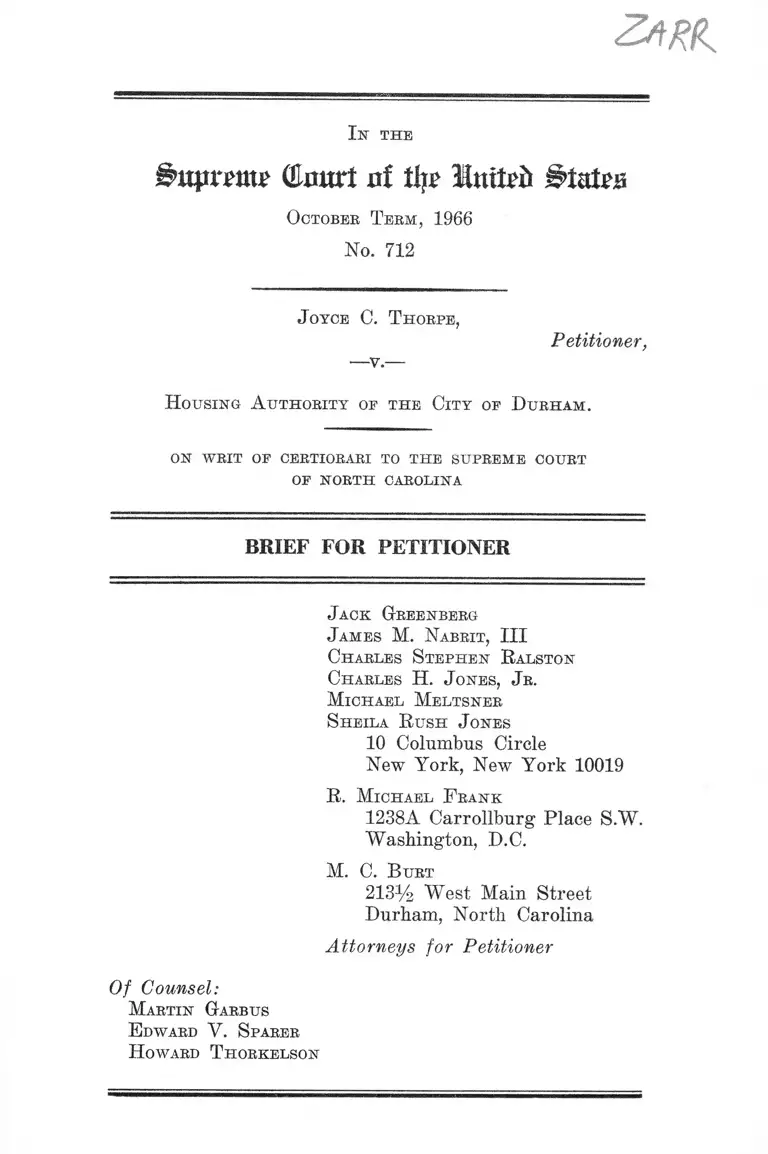
Thorpe v. Housing Authority of the City of Durham Brief for Petitioner
Public Court Documents
October 3, 1966
-
Brief Collection, LDF Court Filings. Thorpe v. Housing Authority of the City of Durham Brief for Petitioner, 1966. bb2d5629-c69a-ee11-be37-00224827e97b. LDF Archives, Thurgood Marshall Institute. https://ldfrecollection.org/archives/archives-search/archives-item/ae780084-b1cd-420d-a3bf-c0c50d34bfc6/thorpe-v-housing-authority-of-the-city-of-durham-brief-for-petitioner. Accessed September 15, 2026.
Copied!
Z * R k
Isr th e
(Umtrt at tip Im M §>tato
O ctober T er m , 1966
No. 712
J oyce C. T horpe ,
H ousing A u th o rity oe th e Cit y op D u rh a m .
Petitioner,
on w r it op certiorari to th e suprem e court
OP NORTH CAROLINA
BRIEF FOR PETITIONER
J ack Greenberg
J ames M . N abrit , TIT
Charles S teph en R alston
C harles H . J ones, J r .
M ich ael M eltsner
S h e ila R u sh J ones
10 Columbus Circle
New York, New York 10019
R . M ic h ael F r an k
1238A Carrollburg Place S.W.
Washington, D.C.
M . C. B urt
213% West Main Street
Durham, North Carolina
Attorneys for Petitioner
Of Counsel:
M artin G arbus
E dward Y. S parer
H oward T horkelson
I N D E X
Opinions Below ............................................................... 1
Jurisdiction ....................................................................... 1
PAGE
Question Presented ......................................................... 2
Constitutional and Statutory Provisions Involved....... 2
Statement ........................-................................................. 3
Summary of Argument 9
A rg u m en t :
Petitioner Was Denied Due Process of Law by
Her Eviction}from a State and Federally Sup
ported Low-Income Housing Project, w-t -'t+ru A+r-
pf fhr B^nr^n H r the Frir-Dnn nr any TToarinopta.
Cjffl±astAbA-S«6ia^aB™tiieA*eaiW«neiBtaj-Aetiun .... 12
Introduction 12
I. Public Housing Agencies May Not Evict
Tenants Arbitrarily......................................... 14
II. Petitioner Was Entitled'^Notice^f the Rea
son He¥i«w-fee©*aeHirrc^I^S^re#te“W'ere
Cancelled.. B ^ -.ii£ fi,fy icT!9d......................... 23
III. Petitioner Was Entitled to an Administra-
t i ^ *ffearinĝ )to Contest the C^ncelMicin^of
.. 40C onclusion
A ppendix—
i i
Excerpts from the United States Housing Act of
PAGE
1937 (42 U.S.C. §1401 et seq.) ............ ............... la
Excerpts from the North Carolina “Housing Au
thorities Law” (Gen. Stats, of North Carolina,
§157-1 et seq.) ............. ............... ........ ........... ..... .... 10a
North Carolina Statutes Re Summary Ejectment
(Gen. Stats, of North Carolina, §42-46 et seq.) .... 23a
T able oe Cases
Banks v. Housing Authority of City and County of
San Francisco, 120 Cal. App. 2d 1, 260 P.2d 668
(1953), cert, denied, 347 U.S. 974 (1954) __________ 20
Berman v. Parker, 348 U.S. 26 _________________ 10, 26, 37
Bi-Metallic Inv. Co. v. State Board of Equalization,
239 U.S. 441............. ............................ ......................... 34
Chicago Housing Authority v. Blackman, 4 I11.2d 319,
122 N.E.2d 522 (1954) .................... ............................ 15
Chin Tow v. United States, 208 U.S. 8 ......................... 34
Clearfield Trust Co. v. United States, 318 U.S. 363 ....11, 32
Coe v. Armour Fertilizer Works, 237 U.S. 413 ............... 33
Cramp v. Board of Public Instruction, 368 U.S. 278
(1961) _____________________ ____ _______ ________ 21
Detroit Blousing Commission v. Lewis, 226 F.2d 180
(6th Cir. 1955) ................................ ............................. 20
Dixon v. Alabama State B<j. of Ed., 294 F.2d 150
(5th Cir. 1961), cert, denied, 368 U.S. 930 .........11, 30, 34
Frost Trucking Co. v. Railroad Commission, 271 U.S.
583 ........................ .............................. ...................... ..10,29
Gonzales v. United States, 348 U.S. 407
Greene v. McElroy, 360 U.S. 474 .........
,..,,,24, 27
34-35, 39
I l l
Hanover Fire Insurance Co. v. Carr, 272 U.S. 494 .... 30
Holt v. Richmond Dedevelopment and Housing Au
thority, Civil Action No. 4746, E.I). Va., Sept. 7,
1966 .................. ....................... .... ........ ............15, 27, 28, 39
Housing Authority of Los Angeles v. Cordova, 130
Cal. App.2d 883, 279 P.2d 215 (App. Dept. Super.
Ct. 1955) ......... ................ ............................. ................ 15
I.C.C. v. Louisville & N. R. Co., 227 U.S. 88 ........... . . . 11, 34
Japanese Immigrant Case (Tamataya v. Fisher), 189
U.S. 86 ___ __________ ______________ ________ .....11,34
Johnson v. Zerbst, 304 U.S. 458 ..................................... 30
Joint Anti-Fascist Refugee Comm. v. McGrath, 341
U.S. 123 ..... ...................... ..... ....... .................. ..11, 25, 36-39
Jones v. City of Hamtramck, 121 F. Supp 123 (E.D.
Mich. 1954) ________ ___ ________ _____ _____ _____ „. 20
PAGE
Knight v. State Board of Education, 200 F. Supp.
174 (M.D. Tenn. 1961) ......................................... ....... 34
Kutcher v. Housing Authority of Newark, 20 N.J. 181,
119 A.2d 1 (1955) ............................. ........... ............ 15
Kwong Hai Chew v. Golding, 344 U.S. 590 .................... 34
Lawson v. Housing Authority of City of Milwaukee,
270 Wise. 269, 70 N.W.2d 605 (1955), cert, denied,
350 U.S. 882 (1955) ......................................... . 15
Londoner v. Denver, 210 U.S. 373 .................... ........11, 34
Morgan v. United States, 304 U.S. 1 ..................10, 11, 24,
25, 27, 34
Morgan v. United States, 298 U.S. 468 ......................... 34
NAACP v. Button, 371 U.S. 415 ................................... . 22
Ng Fung Ho v. White, 259 U.S. 276 ............................. 37
IV
Ohio Bell Telephone Co. v. Public Utilities Com., 301
PAGE
U.S. 292 _______________ _____________________ _ 14
Be Oliver, 333 U.S. 257 .................................................... 33
Powell v. Eastern Carolina Regional Housing Auth.,
251 N.C. 812, 112 S.E.2d 396 (1960) .............. ........... 19
Rudder v. United States, 226 F.2d 51 (D.C. Cir. 1955)
14-15, 23
Shelton v. Tucker, 364 U.S. 479 ................. ..... .............. 30
Sherbert v. Yerner, 374 U.S. 398 (1963) ...........10,11,14, 21,
29, 39, 40
Simmons v. United States, 348 U.S. 397 ____________ 27
Slochower v. Board of Higher Education, 350 U.S.
551 ______ ____ __________ ____ ________ __11,14,30,34
Southern R. Co. v. Virginia, 290 U.S. 190 ........... .......11, 34
Speiser v. Randall, 357 U.S. 513 __________ 10,11, 21, 29, 40
Steier v. New York State Educ. Com’r, 271 F.2d 13
(2d Cir. 1959), cert, denied, 361 U.S. 966 ............... . 34
Swan v. Board of Higher Education, 319 F.2d 56 (2nd
Cir. 1963) ............. ...... .... ............................................. 34
Taylor v. Leonard, 30 N.J. Super. 116, 103 A.2d 632
(1954) ......... ............... ................................................... 20
Torcaso v. Watkins, 367 U.S. 488 __ _________ ___ .21, 30
Tucker v. Texas, 326 U.S. 517 ............. ...... ..... 10, 22, 23, 40
United Public Workers v. Mitchell, 330 U.S. 75 .......... 30
United States v. Allegheny County, 322 U.S. 174 ...... 32
United States v. Helz, 314 F.2d 301 (6th Cir. 1963) .... 32
United States v. Yazell, 382 U.S. 341.......... ......... ......... 32
Vann v. Toledo Metropolitan Housing Authority, 113
F. Supp. 210 (N,D. Ohio, 1953) ............... ................. 2 0
V
Wheeling’ Steel Corp. v. Glander, 337 U.S. 562 .......... 30
Wieman v. Updegraff, 344 U.S. 183 __ _________21, 22, 30
Williams v. City of Ypsilanti, C.A. No. 28936, D. Midi.,
1966 .............................. ................................................. 15
Willrier v. Committee on Character & Fitness, 373
U.S. 96 ................................................... ........ ..10,11,23,34
Wong Yang Snng v. McGrath, 339 U.S. 33 .................. 34
Woods v. Wright, 334 F.2d 369 (5th Cir. 1964) .......... 34
Yick Wo v. Hopkins, 118 U.S. 356 .............................. . 14
PAGE
S tatutes and R egulations
28 U.S.C. § 1257 (3) .................. ....................................... 1
42 U.S.C. § 1401 ...................... ...................... ..2,15,18, 25, 32
42 U.S.C. § 1402 .............................. ........ ........................ 2
42 U.S.C. § 1404a ................ ....... .................... ........ ...2,16,17
42 U.S.C. § 1410 (g) (3) ....................................................3,16
42 U.S.C. § 1415 (7) ................. ......................... ............3,18
Act of July 31, 1947, c, 418, § 2, 61 Stat. 705 (formerly
42 U.S.C. § 1413a) .......... ............................................ 17
Civil Rights Act of 1964, 78 Stat. 252, 42 U.S.C.
§ 2000(1......... ............................. ............................... . 20
24 C.F.R., Subtitle A, Part 1 __ ___________ _________ 20
Executive Order No. 11063, 27 Fed. Reg. 11527 (1962) 20
Housing and Rent Act of 1947, Title II, §209 (b),
61 Stat. 201 ............... ..... .............................. ............- 17
Housing Act of 1948, Title V, § 502 (b), 62 Stat. 1284 17
VI
Gen. Stats. N.C. § 42-26 ....................... ........................ 6
Gen. Stats. N.C. § 42-28 ....... 3; g
Gen. Stats. N.C. § 42-29 ______ 3, 6
Gen. Stats. N.C. § 42-30 ...... 3, 6
Gen. Stats. N.C. § 42-31 _____ 3; 6
Gen. Stats. N.C. § 42-32 ............ 3? 6
Gen. Stats. N.C. § 42-34 ..... 3) 6
Gen. Stats. N.C. § 157-1 _________________ ______ 3, 4,15
Gen. Stats. N.C. § 157-2 ................. ................3,18,19, 25, 26
Gen. Stats. N.C. § 157-4 __________________ _________ 3; ig
Gen. Stats. N.C. § 157-9 ......... ................................3, 4,12, 38
Gen. Stats. N.C. § 157-23 ....... 3
Gen. Stats. N.C. § 157-29 ...... ...... .................... ...............3,16
Gen. Stats. N.C. § 157-40 ............ 18
Gen. Stats. N.C. § 157-48 ....... 18
93 Cong. Rec. 6044 .......... ..... ................. ..................... 17
93 Cong. Rec. 9867 ____ __ _____ ______ ____ _________ 17
Other Authorities
1 Davis, Administrative Law Treatise, § 7.04 (1958) .... 34
Remarks of President Lyndon B. Johnson at Howard
University, Wash., D.C., June 4, 1965, To Fulfill
These Rights, p. 4 _________ _____ __________ _____ 37
Jones, The Rule of Law and the Welfare State,
58 Colum. L. Rev. 143 (1958) .......... .......................... 35
PAGE
V l l
PAGE
Millspaugh, Problems and Opportunities of Relocation,
26 L aw & Co n te m p . P rob. 6 (1961) _________ ____ 19
O’Neil, Unconstitutional Conditions: Welfare Benefits
with Strings Attached, 54 C a lif . L. Rev. 443 (1966) 30
Reich, Individual Rights and Social Welfare: The
Emerging Legal Issues, 74 Y ale L. J. 1245 (1965) .. 19,
35-36
Schorr, S lu m s and S ocial I n secu rity (Dept, o f H.E.W.
Research Report No. 1) (U.S. Govt. Printing Office,
Washington, D.C., 1963) ................ .................. ......... 19
Sternlieb, T en em en t L andlord, Rutgers Univ. Press
(1965) _______ __________________ ________________ 19
I n the
fttp ra tt? (fcmrt at % Htnxtth MuUa
O ctober T eem , 1966
No. 712
J oyce C. T horpe ,
■— v .
Petitioner,
H ousing A u th o rity oe th e Cit y oe D u r h a m .
ON WRIT OE CERTIORARI TO THE SUPREME COURT
OF NORTH CAROLINA
BRIEF FOR PETITIONER
Opinions Below
The opinion of the Supreme Court of North Carolina
(R. 26-29) is reported at 267 N.C. 431, 148 S.E.2d 290
(1966). The judgment, including findings of fact and con
clusions of law, of the Superior Court of Durham County
(R. 19-23) is unreported.
Jurisdiction
The judgment of the Supreme Court of North Carolina
was entered May 25, 1966 (R. 30). On August 12, 1966,
the time for filing a petition for writ of certiorari was
extended by Mr. Justice Brennan to and including Oc
tober 21, 1966 (R. 31). The petition filed October 21, 1966,
was granted December 5, 1966 (R. 32). Jurisdiction of
this Court rests on 28 U.S.C. § 1257(3), petitioner having
2
asserted below and here the deprivation of rights secured
by the Constitution and statutes of the United States.
Question Presented
Petitioner and her children have been tenants in a low-
income housing project constructed with federal and state
funds and administered by the Housing Authority of the
City of Durham, an agency of the State of North Caro
lina, pursuant to federal and state laws and regulations.
The day after petitioner was elected president of a tenants’
organization in the project, the Housing Authority gave
notice that it was cancelling her lease. Petitioner requested
that the Housing Authority tell her the reasons for her
eviction and give her a hearing. The Housing Authority
refused to give her a reason or a hearing but initiated this
summary ejectment action in a state court and obtained an
order that petitioner be removed from the premises.
Under these circumstances, was petitioner denied rights
granted by the due process clauses of the Fifth and Four
teenth Amendments to the Constitution of the United
States'?
Constitutional and Statutory Provisions Involved
This case involves the First, Fifth and Fourteenth
Amendments to the Constitution of the United States.
This case also involves the United States Housing Act,
as amended, 42 U.S.C. §1401 et seq. The following por
tions of the Housing Act are set forth in the Appendix,
infra, pp. la to 9a:
42 U.S.C. § 1401
42 U.S.C. § 1402
42 U.S.C. § 1404a
3
42 IJ.S.C. § 1410(g)
42 IJ.S.C. §1415(7)
This case also involves the North Carolina “Housing
Authorities Law” , Gen. Stats, of North Carolina, § 157-1
et seq. The following portions of the “Housing Authorities
Law” are set forth in the Appendix, infra, pp. 10a to
22a:
N.C.G.S. §157-2
N.C.G.S. §157-4
N.C.G.S. §157-9
N.C.G.S. §157-23
N.C.G.S. §157-29
The case also involves North Carolina statutes relating
to summary ejectment proceedings, Gen. Stats, of North
Carolina, § 42-26 et seq. The following sections are set
forth in the Appendix, infra, pp. 23a to 27a:
N.C.G.S. §42-26
N.C.G.S. §42-28
N.C.G.S. §42-29
N.C.G.S. §42-30
N.C.G.S. §42-31
N.C.G.S. §42-32
N.C.G.S. §42-34
Statement
On November 11, 1964, petitioner and her children be
came tenants in McDougald Terrace, a low-rent public
housing project owned and operated by the Housing Au
thority of the City of Durham, North Carolina. The lease
agreement under which petitioner has occupied the project
had an initial term from November 11 to November 30,
1964 (R. 11). The lease further provided that it would
4
thereafter be automatically renewed for successive terms
of one month at a rental of $29 per month, provided there
was no change in her income or family composition or
violation of the terms of the lease (R. 12).
The Housing Authority of the City of Durham was
established under North Carolina law and is “a public
body and a body corporate and politic, exercising public
powers,” Gen. Stat. of N.C. § 157-9. The Authority has
“all the powers necessary or convenient to carry out and
effectuate the purposes and provisions” of the North Caro
lina Housing Authority law (§§ 157-1 et seq., Gen. Stat.
of N.C.), including the powers “to manage as agent of
any city or municipality . . . any housing project con
structed or owned by such city” and “to act as agent for
the federal government in connection with the acquisition,
construction, operation and/or management of a housing
project,” Gen. Stat. of N.C. § 157-9. The Housing Author
ity operates McDougald Terrace as a low rent housing
project “under its statutory authority and pursuant to its
contract with the Federal government” (R. 5).
On August 10, 1965, petitioner was elected president of
the Parents’ Club, a group composed of tenants of the
McDougald Terrace project (R. 6). The following day,
August 11, 1965, the Housing Authority, through its ex
ecutive director, delivered a notice that petitioner’s lease
would be cancelled effective August 31, 1965, at which
time she would have to vacate the premises (R. 5-6);
petitioner received this notice on August 12, 1965 (R. 6).
In the notification the Authority gave no reasons for its
action but merely mentioned a provision of the lease that
it claimed permitted the landlord to cancel upon fifteen
days notice (R. 18).1 After she received the notice, peti
1 The text o f the notice, dated August 11, 1965, is as follows:
Your Dwelling Lease provides that the lease may he cancelled upon
fifteen (15) days written notice. This is to notify you that your
5
tioner, through her attorneys, by phone and by letter re
quested a hearing to determine the reasons for her evic
tion; the request was denied (R. 9). It was stipulated
that “although the Housing Authority had a meeting on
the subject the defendant was not given a hearing in
which she herself was present and reasons assigned to
her” (R. 6). Her attorney met with the Housing Authority
and its executive director on September 1, 1965, and the
attorney again asked for a hearing but the request was
denied (R. 9). Petitioner averred, on information and
belief, that on September 1, 1965, the Housing Authority
held a meeting with a police officer who supplied informa
tion allegedly obtained in an investigation of petitioner
(R. 9). However, neither petitioner nor her attorney were
present at this meeting, and she was not confronted with
her accuser, informed of the information supplied to the
Housing Authority, or given any opportunity to rebut
any charges made against her (R. 9).
In evicting petitioner without giving a reason or a hear
ing, the Housing Authority relied on a sentence in the
lease which provides that: “The Management may termi
nate this lease by giving to the Tenant notice in writing
of such termination fifteen (15) days prior to the last day
of the term” (R. 12). The lease, prepared by the Housing-
Authority, also contained a variety of other provisions for
termination. One provision states that the lease “ shall
be automatically terminated at the option of the manage
ment” with an immediate right of reentry and all notices
required by law waived, if the tenant misrepresents a ma
terial fact in his application or if “the tenant fails to
comply with any of the provisions of this lease” (R. 16).
Dwelling Lease will be cancelled effective August 31, 1965, at which
time you will be required to vacate the premises you now occupy
(R. 18).
6
Among the enumerated provisions of the lease which a
tenant must comply with, and which might support termi
nation of the lease in the event of non-compliance, are
agreements by the tenant, inter alia, to pay rent when due;
to pay for damages to the premises; to pay a penalty for
excess consumption of electricity, gas or water; not to
assign the lease or sublet or accommodate boarders or
lodgers or use the premises other than as a dwelling for
the tenant and his family; to keep the premises in “a clean
and sanitary condition” ; to “maintain the yard in a neat
and orderly manner” ; to “assist in the maintenance of the
project” ; “not to use the premises for any illegal or im
moral purposes” ; not to keep dogs or pets; not to make
repairs or alterations without consent; “to follow all rules
or regulations prescribed by the Management concerning
the use and care of the premises” ; to permit management
to enter for repairs, etc.; to submit an annual income state
ment to Management; and to notify Management “ of any
increase or decrease in family income or of any change
in family composition or assets” (R. 13-14). Another sec
tion of the lease allows the Management to terminate on
30 days notice at the end of any calendar month if the
tenant’s income “exceeds the limits established for eligible
occupancy” (R. 15). Still another section provides that the
tenant will “promptly” vacate the premises if he falsely
warrants that neither he nor any person who is to occupy
the premises is a member of an organization listed as
subversive by the Attorney General of the United States,
or if he becomes a member of such an organization.
Despite the notice of cancellation of her lease, when she
was given no reason and no hearing petitioner refused
to vacate the premises. On September 17, the Housing
Authority instituted a summary ejectment action against
petitioner in the Justice of the Peace Court in Durham.
See Gen. Stats, of N.C. §42-26 et seq., infra, pp. 23a-27a.
7
On September 20, the Justice of the Peace ordered that
petitioner be removed from the premises (E. 4-5). Peti
tioner appealed to the Superior Court of Durham County
(R. 4), where evidence was submitted in the form of a
stipulation and petitioner’s affidavit.
In the Superior Court petitioner filed a motion to quash
the eviction proceedings and alleged therein that she had
a right to her apartment and that a deprivation of that
right without a hearing violated due process of law. Fur
ther, it was alleged that the defendant’s eviction resulted
primarily from her activities as a organizer of tenants
(R. 10-11). These allegations were supported by peti
tioner’s affidavit (R. 7-10). In the stipulation entered into
between petitioner and the Housing Authority (R. 7-10), it
was stipulated, inter alia, that the Housing Authority did
not give petitioner a reason for its termination of the lease
nor did it give her a hearing despite her request for one;
that on August 10, 1965, defendant was elected president
of the Parents Club and that the eviction notice was sent
out on August 11, and that the executive director of the
Housing Authority would testify, as he had testified before
the justice of the peace, that
. . . whatever reason there may have been, if any, for
giving notice to Joyce C. Thorpe of the termination
of her lease, it was not for the reason that she was
elected president of any group organized in McDougald
Terrace . . . and not for any of the other reasons set
forth in the affidavit . . . (R. 7).
Finally, it was stipulated and agreed that the judge could
determine the case by finding facts based on the stipula
tion and affidavits, Ibid.
On the basis of the stipulation, the Superior Court made
the finding:
8
That the plaintiff Housing Authority of the City of
Durham . . . gave notice to the defendant to vacate
said premises not because she had engaged in efforts
to organize the tenants of McDougald Terrace, nor
because she was elected president of a group organ
ized in McDougald Terrace on August 19, 1965; that
these were not the reasons said notice was given and
eviction undertaken (R. 21).
The Court went on to find that the Housing Authority gave
no reason to petitioner for terminating the lease and did
not conduct any hearing at which the defendant was
present or invited to be present to inquire into the reasons
for terminating the lease and, further, that although the
defendant requested a hearing, she had no hearing other
than that “before the Justice of the Peace in this eviction
action and in this Court” (R. 22). The Court then con
cluded as a matter of law that the Housing Authority of
the City of Durham had no duty to hold a hearing on the
subject of petitioner’s eviction or to communicate or give
to the defendant any reason for the termination. Thus,
the Court affirmed the judgment of the eviction (R. 23).
Subsequently, petitioner appealed to the Supreme Court
of North Carolina, raising as error the above findings of
fact and conclusions of law (R. 25). On May 25, 1966, in
a per curiam decision, the Supreme Court affirmed the
order to evict. It held, in effect, that the Authority was
under no obligation to conduct a hearing or advise the
tenant of its reasons for terminating the lease, apparently
since its obligations to its tenants were the same as the
obligations of a private landlord. Thus, the Court said:
It is immaterial what may have been the reasons for
the lessor’s unwillingness to continue the relationship
9
of landlord and tenant after the expiration of the term
as provided in the lease (R. 26-28).
The petitioner and her children have remained in posses
sion of their apartment under a stay granted by the Su
preme Court of North Carolina, pending decision in this
Court.
Summary of Argument
Petitioner was denied due process by the cancellation of
her low-income public housing benefit without notice of the
reason for eviction or any administrative hearing to contest
the cancellation. Her claim arose on an assertion that her
First Amendment rights were violated by the Housing Au
thority of the City of Durham, an agency of the state and
federal governments subject to constitutional restraints.
( The courts below upheld the claim of the Authority that
it could act arbitrarily, without a reason, relying on prin
ciples applicable to private landlords.
I.
Governmental agencies acting as landlords are neverthe
less subject to Due Process restraints against arbitrary
action. Nothing in either the federal or state statutes under
which the Durham Authority was established confers an
arbitrary power to evict. Indeed, arbitrary evictions sub
vert the purposes of the federal-state program to protect
low income citizens from the effects of inadequate slum
housing.
* * * < * ■ +
Overriding constitutional concerns defeat any claim of
arbitrary power to evict public housing tenants. The gov
ernmental agencies plainly cannot evict for a variety of
reasons under the Constitution, including racial or religions
discrimination, suppression of free speech, or (as petitioner
1 0
charged) interference with the right of free association.
Government may not condition the availability of public
benefits so as to restrict First Amendment rights. Sherbert
v. Verner, 374 U.S. 398; Speiser v. Randall, 357 U.S. 513.
The general principle against arbitrary action by govern
ment officials applies with equal force to government hous
ing project managers who claim broad authority over the
lives of those living in the projects. Tucker v. Texas, 326
Petitioner was entitled, at the bare minimum, to notice
of the reason for the cancellation of her governmental
benefit of low income housing. Notice of the ground for
governmental action is basic to the concept of Due Process.
Morgan v. United States, 304 U.S. 1; Willner v. Committee
on Character & Fitness, 373 U.S. 96. The authority has no
substantial interest in secrecy. Disclosure would promote
responsible action by the agency and insure that there is
a reason for its action. Secrecy merely shields arbitrari
ness. The petitioner’s interest in low-income housing is
precious. When denied decent housing she is remitted to
the misery of the slums, a penalty which may be “an almost
insufferable burden,” Berman v. Parker, 348 U.S. 26, 32.
The housing agency may not make surrender of the right
to notice a condition of tenancy because of the doctrine
forbidding imposition of unconstitutional conditions as the
price of governmental benefits. Sherbert v. Verner, 374
U.S. 398; Speiser v. Randall, 357 U.S. 513; cf. Frost Truck
ing Co. v. Railroad Commission, 271 U.S. 583. In any event,
the lease was not a clear and explicit waiver of the right
to notice of a reason for cancellation. Indeed, the lease
should be construed to require the housing management to
give a reason for eviction. The lease may be construed by
1 1
tiiis Court under federal principles of law. Clearfield Trust
Co. v. United States, 318 U.S. 363.
III.
Petitioner was entitled to an administrative hearing. An
opportunity to offer proof when factual issues determine
vital interests is basic to due process in administrative
proceedings. The rule that a hearing is a fundamental re
quirement to preserve Due Process—freedom from arbi
trary, capricious or discriminatory official action—has been
developed in a variety of contexts. Japanese Immigrant
Case (Yamataya v. Fisher), 189 U.S. 86; Londoner v. Den
ver, 210 U.S. 373; Southern R. Co. v. Virginia, 290 U.S.
190; l.G.C. v. Louisville & N. R. Co., 227 U.S. 88; Morgan
v. United States, 304 U.S. 1; Slochower v. Board of Higher
Education, 350 U.S. 551; Dixon v. Alabama State Board
of Education, 294 F.2d 150 (5th Cir. 1961); WiUner v. Com
mittee on Character & Fitness, 373 U.S. 96.
By each of the tests stated by Mr. Justice Frankfurter
in Joint Anti-Fascist Refugee Comm. v. McGrath, 341 U.S.
123, 163 (concurring opinion), petitioner is entitled to a
hearing. Her injury is potentially grave; she has been
treated arbitrarily. The Durham Housing Authority has
statutory powers to conduct a hearing, including issuing
subpoenas, administering oaths, and other incidents of fair
procedure. Petitioner’s First Amendment claim should be
decided only after rigorous procedural safeguards. Such
safeguards are needed to insure against arbitrariness.
Rejection of the right to a hearing on the basis of the
lease provision was improper. The lease contained no ex
press waiver of a hearing. For the government agency to
require waiver of a hearing to obtain low-income housing
is to impose an unconstitutional condition. Sherbert v.
Verner, 374 U.S. 398; Speiser v. Randall, 357 U.S. 513.
1 2
ARGUMENT
Petitioner Was Denied Dee Process of Law by Her
Eviction From a State and Federally Supported Low-
Income Housing Project in the Absence of Any Pro
cedures to Give Her Any Notice of the Reason for the
Eviction or Any Hearing to Contest the Basis for the
Governmental Action.
In trod u ction
This case involves whether a municipal housing author
ity, acting as the agent of both the state and federal gov
ernments, violates the due process clauses of the Fifth
and Fourteenth Amendments,2 when it terminates housing
benefits it is charged by law to furnish to a citizen, with
out affording the citizen either a statement of the reason
for cancellation, or a hearing to contest its action. The
case arises in the context of an assertion that petitioner
was evicted to punish her exercise of First Amendment
rights to freedom of association.
Although it is incontestable that the Housing Authority
of the City of Durham is a governmental agency subject
to the restraints of the Constitution, the Supreme Court of
North Carolina decided that no procedural protection
was required. Without mentioning the governmental char-
2 The Due Process Clause of the Fourteenth Amendment applies to the
Housing Authority of the City of Durham, because it is a state agency,
established and operated in accordance with state law (R. 5; Gen. Stats,
o f N.C. §157-9). The Due Process Clause o f the Fifth Amendment is
also applicable because the Authority acts as an “agent for the federal
government” (Gen. Stats, of N.C. § 157-9) in the operation and man
agement of the housing project pursuant to a contract with the Federal
Government (R. 5). By law the Authority is a “ public body and a body
corporate and politic, exercising public powers” (Gen. Stats, o f N.C.
§157-9) {infra, Appendix, p. 14a).
13
acter of the agency, the Court applied to it the same legal
principles that it would apply to a private non-govern
mental landlord. The State Court thus sanctioned and
enforced the Authority’s action cancelling petitioner’s bene
fits under the public housing laws at its mere will or whim.
It reasoned that petitioner had no rights to the housing
except those conferred by her lease; that under the lease
the Housing Authority had the right to terminate; and
that it “is immaterial what may have been the reason for
the lessor’s unwillingness to continue the relationship of
landlord and tenant after the expiration of the term as
provided in the lease” (R. 28).
On this record it cannot be assumed that the Authority
acted on any reasonable ground. Rather, it was testing
its right to be arbitrary, capricious and unreasonable, and
the Court thus sanctioned wholly arbitrary governmental
action. This, we submit, is the net effect of the proceed
ings below, which included: (1) petitioner’s affidavit that
she was evicted the day after she was elected President
of a tenant organization and that she believed the reason
was an official’s opposition to her effort to organize tenants
(R. 8); (2) the official’s stipulated testimony that his rea
son “if any” was not the reason alleged by plaintiff (R. 7);
(3) the trial court’s decision that the authority had no
“duty to communicate or give . . . any reason” (R. 23) ; (4)
confirmed by the appellate decision that the reason “is
immaterial” (R. 28). Plainly, the case was viewed by the
parties and the courts below as a test of the right of the
Authority to evict arbitrarily and without any reason, any
statement of a reason, or any hearing on the reason or
lack of a reason.
Petitioner urges in detail below that the result reached
in the state courts is inconsistent with the requirements of
Due Process. We urge, first, that the Constitution pre-
14
eludes arbitrary, discriminatory or capricious action to
withhold from an individual the benefits of the state-federal
public housing program for the poor. Second, we submit
that a minimum necessary protection against arbitrary
action is that the Housing Authority be required to re
veal the reason for its action. Third, we assert that due
process requires that tenants in low-income governmentally
operated projects be given some opportunity to be heard
in order to offer such proof as may be appropriate to con
test the asserted factual basis for the government’s evic
tion orders.
I.
Public Housing Agencies May Not Evict Tenants
Arbitrarily.
We urge that the Court reject the Durham Housing
Authority’s claim of an absolute and arbitrary power to
deny the benefits of its program for low-income families
at its mere will or whim. Such a claim comes late, far too
late, in our constitutional history.3 As a unanimous Court
said in 1886: “When we consider the nature and the theory
of our institutions of government, the principles upon which
they are supposed to rest, and view the history of their
development, we are constrained to conclude they do not
mean to leave room for the play and action of purely
personal and arbitrary power.” Yick Wo v. Hopkins, 118
U.S. 356, 369. The essence of Due Process is “the protec
tion of the individual against arbitrary action.” Ohio Bell
Telephone Co. v. Public Utilities Com., 301 U.S. 292, 302
(Mr. Justice Cardozo); Slochower v. Board of Higher Edu
cation, 350 U.S. 551, 559. This was stated with clarity in
its application to a government housing authority in Rud-
Cf. Sherbert v. Verner, 374 U.S. 398, 404-405, and cases cited.
15
der v. United States, 226 F.2d 51, 53 (D.C. Cir. 1955), where
Judge Edgerton wrote:
The government as landlord is still the government.
It must not act arbitrarily, for, unlike private land
lords, it is subject to the requirements of due process
of law. Arbitrary action is not due process.
Similar reasoning has been followed—and we think rightly
so—by state courts in New Jersey, California, Wisconsin
and Illinois, holding that public housing authorities are
subject to the Due Process Clause. Kutcher v. Housing
Authority of Newark, 20 N.J. 181, 119 A.2d 1 (1955);
Housing Authority of Los Angeles v. Cordova, 130 Cal.
App.2d 883, 279 P.2d 215 (App. Dept. Super. Ct. 1955);
Lawson v. Housing Authority of City of Milwaukee, 270
Wise. 269, 70 N.W. 2d 605 (1955), cert, denied, 350 U.S. 882
(1955); Chicago Housing Authority v. Blackman, 4 111. 2d
319, 122 N.E. 2d 522 (1954). Cf. Williams v. City of Ypsi-
lanti, Civil Action No. 28936, D.Mich., 1966 (Temporary
injunction barring eviction of woman who had an illegiti
mate child); Holt v. Richmond Redevelopment and Hous
ing Authority, Civil Action No. 4746, E.D. Va,, Sept. 7,
1966. The Housing Authority’s claim to arbitrary power
must be found wanting for a host of reasons.
There is nothing in either the federal4 or state acts6
creating the publicly supported low-income housing pro
gram administered by the Durham Authority which ex
pressly confers an arbitrary power to evict, or otherwise
withhold the benefits of the program. Neither of the two
provisions of the federal law which authorize the local
4 The United States Housing Act of 1937, as amended, 42 U.S.C. §1401
et seq., p. la , Appendix, infra.
6 The North Carolina "Housing Authorities Law,” Gen. Stats, o f North
Carolina, § 157-1 et seq., p. 10a, Appendix, infra.
1 6
agencies to require tenants to move from low-income
projects (42 U.S.C. §1410(g)(3) and 42 U.S.C. §1404a)
grants arbitrary power; both provisions are related to a
policy of limiting occupancy to low-income families. The
only provision of the state “Housing Authorities Law”
about tenant selection also refers only to the income lim
itation (Gen. Stats. NIC. §157-29). The text of 42 U.S.C.
§1410 (g) (3) (Appendix, infra, p. 7a), makes plain that it
relates only to enforcement of maximum income limitations
in low-income projects.6 The other provision, 42 U.S.C.
§1404a, serves this same purpose, although the purpose
becomes completely apparent only from review of the
legislative history. Section 1404a, provides, inter alia:
Notwithstanding any other provisions of law except
provisions of law enacted after August 10, 1948 ex
pressly in limitation hereof, the Public Housing Ad
ministration, or any State or local public agency
administering a low-rent housing project assisted pur
suant to this chapter or sections 1501-1505 of this title,
shall continue to have the right to maintain an action
or proceeding to recover possession of any housing
accommodations operated by it where such action is
authorised by the statute or regulations under which
such housing accommodations are administered, and,
in determining net income for the purposes of tenant
eligibility with respect to low-rent housing projects
assisted pursuant to this chapter and sections 1501-
1505 of this title, the Public Housing Administration
is authorized, where it finds such action equitable and
in the public interest, to exclude amounts or portions
6 The provision, added in 1961, 75 Stat. 164 (Act of June 30, 1961,
Section 205) states that federal contribution contracts must provide that
local agencies make periodic reexaminations of tenant’s incomes and re
quire tenants above the maximum income limits to move from the project,
except in special circumstances.
17
thereof paid by the United States Government for dis
ability or death occurring in connection with military
service. (Emphasis supplied.)
The history of the provision, and its statutory predecessor
amply demonstrates that §1404a was enacted to allow
eviction of tenants above the income limits for low-income
projects; nothing in the legislative history supports a
claimed power to evict without cause.7 There is no in-
7 The quoted provisions of section 1404a were enacted in the Housing
Act of 1948, Title Y, §502 (b), 62 Stat. 1284. This was a reenactment,
with slight changes of wording, of a provision adopted a year earlier in
the Housing and Rent Act of 1947, Title II, §209 (b), 61 Stat. 201.
Senator Ellender, who introduced the Section as an amendment made
clear that the purpose was to permit evictions to enforce the income limi
tations :
“ Mr. B uck . A s I understand the amendment, it would permit the
Housing Authority to remove from public housing units tenants who
are now earning an income greater than that which would enable
them to qualify for occupancy o f low-cost public housing units V’
“ Mr . E llender. That is correct. . . . There are many tenants in some
of the public housing projects at the moment who can pay an eco
nomical rent. . . . [T]he purpose of the amendment is to make it
possible for the authorities in charge of public housing to be able
to evict those who are not entitled to be there.” 93 Cong. Bee. 6044
(1947).
One month after the 1947 version was enacted, Congress passed a law
allowing local ag’encies to postpone the commencement of eviction pro
ceedings until March 1, 1948, if undue hardship would result for the
occupants. Aet of July 31, 1947, C.418, §2, 61 Stat. 705, (formerly 42
U.S.C. §1413a).
As indicated the 1948 version was basically a reenactment o f the pro
vision inserted in 1947. The 1948 version was proposed by a Senate sub
committee; tbe chairman made clear that it was a “ provision for the
eviction of over-income tenants.” 94 Cong. Rec. 9867 (1948) (remarks
of Senator McCarthy) :
. . . [W ]e also have a provision for the eviction of over-income
tenants in the present 190,000 public housing units. We do not
provide that they must be evicted instanter. We provide that the
F.P.H.A., the local housing agency, shall evict them in an orderly
manner, and I understand they have a program of evicting 5 per
cent each month on 6 month’s notice.
18
dication that Congress made a judgment to grant arbitrary
power.
Furthermore, the claim of arbitrary power is inconsis
tent with the expressed purposes of the state-federal
low-income housing program. The policy of the United
States is :
. . . to promote the general welfare of the Nation
by employing its fund and credit, . . . to assist the
several States and their political subdivisions to al
leviate present and recurring unemployment and to
remedy the unsafe and insanitary housing conditions
and the acute shortage of decent, safe, and sanitary
dwellings for families of low income, in urban and
rural nonfarm areas, that are injurious to the health,
safety, and morals of the citizens of the Nation. 42
U.S.C. §1401.
The North Carolina enactment contained an even more
detailed declaration of the necessity of the program for
low-income housing to correct conditions which it found
“cannot be remedied by the ordinary operation of private
enterprise.” Gen. Stats. N.C. § 157-2 (reprinted Appendix,
infra, p. 10a).8 * Indeed, there must be specific findings as to
the need for low income housing in order for a municipality
to establish a housing authority under the North Carolina
law (Gen. Stats, of N.C. § 157-4), or for such an authority
to obtain federal funds (42 U.S.C. §1415(7)). The state
and federal statutory schemes make it plain that the
public housing agencies are not acting as private land
lords, furnishing housing as business proprietors. The
program is rather an exercise of the general governmental
power to protect the health, safety, and welfare of an
8 See also the similar declarations in Gen. Stats, o f N.C. §§157-40,
157-48.
19
economically disadvantaged segment of the citizenry.9 The
initiation of the program rested on explicit recognition
of the fact that without public housing large number of
persons would be condemned to live in urban and rural
slums, suffering all the injuries stemming from unsafe and
unsanitary dwellings.10
A power to evict tenants of public housing capriciously
or without a reason is not merely inconsistent with the
purposes of the program; it actually undermines and sub
verts them. Such arbitrary power necessarily places pub
lic housing tenants in “a state of insecurity,” as the com
mentators have observed.11 ’Thus, the intended benefits—
family stability and security in a decent and safe environ
ment—are negated. This naturally reduces the attractive
ness of public housing for slum residents, even though
housing is their primary problem.12 More directly, of
9 As stated in Powell v. Eastern Carolina Regional Housing Auth., 251
N.C. 812, 112 S.E.2d 386, 387, “ The Legislature authorized the creation
of housing authorities as a means of protecting low-income citizens from
unsafe or unsanitary conditions in urban or rural areas, G.S. § 157-2.”
10 Gen. Stats, o f N.C. § 157-2, found, inter alia, “ the existence o f hous
ing conditions which endanger life or property by fire and other causes” ,
and that “ these conditions cause an increase in and spread of disease and
crime and constitute a menace to the health, safety, morals and welfare
of the citizens. . . . ”
11 Reich, Individual Rights and Social W elfare: The Emerging Legal
Issues, 74 Y ale L. J. 1245, 1250. As observed by Alvin Schorr of the
U. S. Dept, o f Health, Education, and Welfare, some tenants find housing
regulations and penalties “ to be precisely a confirmation of their greatest
anxiety, that they were being offered decent housing in exchange for their
independence.” Schorr, Slums and Social I nsecurity (Dept, of H.E.W.
Research Report No. 1), p. 112 (U.S. Govt. Printing Office, Washington,
D. C. 1963).
12 Studies indicate the distaste of slum residents for the rules, regula
tions and control over their lives which accompany public housing, and
the marked lack of desire o f many eligible slum residents to move to
public housing. Sternlieb, T he T enement L andlord, Rutgers LTniv. Press
(1965), pp. 14-15; Millspaugh, Problems and Opportunities of Reloca
tion, 26 Law & Contemp. P rob. 6, 11-12 (1961).
20
course, every actual exercise of an arbitrary power to
evict a public bousing tenant, remits the tenant and his
family to the slums, subjecting them to all the injuries
stemming from residence in unsafe and unsanitary dwel
lings, which the program is supposed to prevent.
Of course, putting aside the provisions and purposes of
the housing acts, there are overriding constitutional con
cerns which make it plain that the claimed right to act
for any reason, or for no reason, must fail. There plainly
are some reasons which could not constitutionally support
housing authority action. For example, it has been widely
held that a public housing authority violates the Four
teenth Amendment by a policy of refusing to lease units
to qualified Negroes because of their race. Detroit Hous
ing Commission v. Lewis, 226 F.2d 180 (6th Cir. 1955).13
Race, or a desire to enforce racial segregation, must
equally be a forbidden ground for eviction from a govern
ment project, lest the power to discriminate be absolute.
It should be equally be made clear that a public housing
authority may not bar citizens on the basis of their reli
gion, or their ideas on public issues in violation of First
Amendment guarantees. Petitioner’s case arises not from
a racial discrimination claim, but, rather, in the context
of her assertion that she is being punished for exercising
First Amendment rights of free association in a tenant’s
13 Other such cases are Jones v. City of Hamtramck, 121 F. Supp. 123,
(E.D. Mich. 1954) ; Vann v. Toledo Metropolitan Housing Authority, 113
F. Supp. 210 (N.D. Ohio 1953); Banks v. Housing Authority of City
and County of San Francisco, 120 Cal. App.2d 1, 260 P.2d 668 (1953),
cert, denied, 347 U.S. 974 (1954); Taylor v. Leonard, 30 N.J. Super.
116, 103 A.2d 632 (1954). See Executive Order No. 11063, 27 Fed. Reg.
11527 (1962), prohibiting racial discrimination in federally assisted hous
ing. And see Title V I of the Civil Rights Act of 1964, 78 Stat. 252, 42
U.S.C. § 2000d, and the implementing regulations (24 C.F.R., Subtitle A,
Part 1) prohibiting discrimination in federally assisted programs, includ
ing low-rent housing projects.
21
organization. This Court’s decisions expressing concern
for the procedures by which First Amendment claims
are determined (ef. Speiser v. Randall, 357 U.S. 513),
leave no room for an absolute power to conceal violations
of the Amendment. This Court has condemned rules which
condition the availability of public benefits so as to re
strict First Amendment rights. In Sherbert v. Verner,
374 U.S. 398, 404, the Court said:
It is too late in the day to doubt that the liberties
of religion and expression may be infringed by the
denial of or placing of conditions upon a benefit or
privilege. American Communications Asso. v. Douds,
339 U.S. 382, 390; Wieman v. Updegraff, 344 U.S.
183, 191, 192; Hannegan v. Esquire, Inc., 327 U.S. 146,
155, 156. . . . In Speiser v. Randall, 357 U.S. 513, we
emphasized that conditions upon public benefits cannot
be sustained if they so operate, whatever their purpose,
as to inhibit or deter the exercise of' First Amendment
freedoms.
The principle was applied in Speiser v. Randall, 357
U.S. 513, to invalidate state action limiting the availability
of a tax exemption in a manner which inhibited free
speech. The rule is necessary lest the State “produce a
result which . . . [it] could not command directly” 357
U.S. at 526. Applying these principles, we submit that
it could not be gainsaid that a public housing authority
could not bar a citizen from occupancy in a project for
failure to make a religious oath (ef. Torcaso v. Watkins,
367 U.S. 488), or for refusal to make an unconstitutionally
vague oath (cf. Cramp v. Board of Public Instruction, 368
U.S. 278, 288), or to punish innocent membership in a
proscribed organization (cf. Wieman v. Updegraff, 344
2 2
XJ.S. 183, 192),14 or to suppress freedom of association
to advance political views (cf. N.A.A.C.P. v. Button, 371
XJ.S. 415). There is no reason whatever to suppose that
the restraints of the Constitution do not apply with equal
force to the manager of a federally operated or supported
housing project. T-ucher v. Texas, 326 U.S. 517.
Tucker v. Texas, supra, held that the manager of a fed
eral housing development for defense workers unconstitu
tionally suppressed the distribution of religious literature
by seeking to exercise a licensing power. This manager
had claimed “full authority to regulate the conduct of
those living in the village” (326 XJ.S. at 519), in support
of his order that a Jehovah’s Witness discontinue all re
ligious activity in the village (id.). The Court rejected the
claim of arbitrary power over freedom of the press and
religion and reversed state criminal convictions which en
forced the manager’s invalid assertion of authority over
the tenants’ lives.
We submit that reason and authority reject the Durham
Authority’s claimed right to act unreasonably in termi
nating the benefits of the program it administers. Of
course, the Authority, like other governmental agencies,
may constitutionally be given a substantial degree of con
trol over the use and occupancy of its projects, to effi
ciently manage and fulfill the purposes of its program.
We do not stop to fully explore the detailed scope of the
Authority’s power to make, and to enforce by evictions,
rules for the conduct of tenants needed to protect its prop
erty and other tenants, because no one would deny that
14 The Court said in Wieman {supra, 344 U.S. at 192) :
We need not pause to consider whether an abstract right to public
employment exists. It is sufficient to say that constitutional protec
tion does extend to the public servant whose exclusion pursuant to a
statute is patently arbitrary or discriminatory.
23
the Authority must have powers to accomplish these ends.
The issue herefis not whether a public housing agency may
evict on a reasonable ground, or whether or not a particu
lar ground is reasonable. The issue is whether a govern
ment agency may evict for
ft® aa^eiews reason, recognizing that the power to be ca
pricious includes a practical power to act for reasons
specifically forbidden by the Constitution. The answer to
that question must be negative if there is to be any pro
tection at all for the civil rights and civil liberties of pub
lic housing tenants. Rudder v. United States, 226 F.2d 51
(D.C. Cir. 1955). Otherwise, minor bureaucrats—housing
project managers—are granted “full authority to regulate
the conduct of those living in the [project].” Tucker v.
Texas, 326 U.S. 517, 519.
So we now turn to another vital question. What does
procedural due process require to give protection against
discriminatory, arbitrary, capricious and unconstitutional
action terminating public housing benefits?
II.
Petitioner Was Entitled to Notice o f the Reason Her
Low-Income Housing Benefits Were Cancelled.
Whatever may be decided with respect to petitioner’s
claim (discussed in Part III below) that she had a right
to a hearing before eviction, petitioner was at the very
least entitled to notice of the reason, if any, for the Hous
ing Authority’s action requiring her to move from the
project. Notice of the reasons for proposed governmental
action adversely affecting a citizen’s interests has been
regarded as an essential element of due process in a
variety of contexts. Willner v. Committee on Character &
24
Fitness, 373 U.S. 96, 105-106; Morgan v. United States, 304
U.S. 1, 18, 19; cf. Gonzales v. United States, 348 U.S. 407.
If there is even to be any potential protection against
arbitrary action by public housing officials, the officials
must at the very least be required to formulate and articu
late a reason for an eviction, and notify the tenant of that
reason in writing. Notice of reasons would at least offer
a possibility of relief if an official is mistaken about the
facts and he or some reviewing authority can be persuaded
that he is mistaken, or if the official is mistaken about the
law and it can be shown that the proposed action violates
the law, or if the official acts contrary to policy estab
lished by superior administrative officials. A requirement
that the housing agency state its reason for terminating-
low income benefits serves the salutary function of re
quiring that the agency act responsibly and actually have
a reason. It is a protection against capricious action.
The Authority has no substantial interested to be served
by keeping its reason secret. Such secrecy does nothing to
further the purposes of the state-federal program to pro
vide housing assistance to the poor. We have seen no
proffered justification for a policy of secrecy. If the Hous
ing Authority has a good reason for evicting a tenant,
there is no impediment to its stating that reason and rely
ing on it as the basis for eviction. There are no consider
ations of immediate danger to the public or of peril to the
National Security or other similar factors which might
justify the Authority’s reluctance to give tenants notice
of the reasons for eviction. The Authority’s refusal to
accord its tenants reasonable protection can only help to
break the spirits of the evicted tenants, and of other mem
bers of the community familiar with the injustice, and
increase the apathy and despair of the impoverished. The
policy of secrecy serves only as a shield for arbitrariness.
25
It is, of course, more convenient for a bureaucrat to have
arbitrary power and to be unaccountable for his acts. But
as Mr. Justice Frankfurter put it: “ Secrecy is not con
genial to truth-seeking and self-righteousness gives too
slender an assurance of rightness.” Joint Anti-Fascist
Refugee Committee v. McGrath, 341 U.S. 123, 171 (con
curring opinion). Indeed, it is in the “manifest interest”
of government agencies to be fair, and to appear to be
fair, in their dealings with citizens they are charged with
assisting. Cf. Morgan v. United States, 304 U.S. 1, 22. A
policy of secrecy in evictions sacrifices the deterrent value
which might be gained from announced enforcement of
reasonable rules and regulations, and merely promotes
generalized fear and insecurity on the part of tenants.
The tenant of public low income housing has a strong
interest in continued eligibility for public housing benefits
and in being informed of the reason the authorities may
have for cancelling such benefits. The value of the tenant’s
interest in public housing may be measured by the govern
mental findings which justify providing the benefits (42
U.S.C. §1401; Gen. Stats, of N.C. §157-2). The essence of
the matter is that the tenant is provided public housing
only because he would be otherwise unable to obtain decent
and sanitary housing, and when the tenant is denied
decent housing he is remitted to slums, including:
. . . such unsafe or unsanitary conditions [that] arise
from overcrowding and concentration of population,
the obsolete and poor condition of the buildings, im
proper planning, excessive land coverage, lack of
proper light, air and space, unsanitary design and
arrangement, lack of proper sanitary facilities, and
the existence of conditions which endanger life or
property by fire and other causes; * * * [which] con
ditions cause an increase in and spread of disease and
26
crime and constitute a menace to the health, safety,
morals and welfare of the citizens of the State and
impair economic values . . . ” (Gen. Stats, of N.C.
§157-2).
The federal and state governments have found that un
less they provide Mrs. Thorpe and others in her economic
position decent and sanitary housing, they will be con
demned to live in slum conditions which pose a constant
threat to their health, safety and morals. Thus, the inter
est of petitioner is no less than the interest in being able
to live at a minimum level of decency and comfort. And,
of course, petitioner, and society in general have an inter
est in her freedom to exercise her rights of free speech
and free association without fear of a crushing reprisal.
The effect of being remitted to live in slum conditions
can be incalculable. It is punishment in a real sense. The
impact of such decisions on the children of the poor may
influence the entire course of their lives. And where a
Negro family is involved, as in petitioner’s case, a return
to the slums may quite likely mean a return to a racial
ghetto. This Court described the problem in Berman v.
Parker, 348 U.S. 26, 32, where Mr. Justice Douglas wrote:
Miserable and disreputable housing conditions may do
more than spread disease and crime and immorality.
They may also suffocate the spirit by reducing the
people who live there to the status of cattle. They
may indeed make living an almost insufferable burden.
The tenant’s interest in knowing the grounds for eviction
is compelling. This minimal protection against arbitrari
ness may at least afford a channel for relief in some cases
of injustice. Knowing the ground for the official action
may afford a basis for informal complaint or request for
27
reconsideration, for an appeal to higher executive author
ity, for an appeal for legislative reform or relief, or for
an appeal to the courts. Minimal fairness requires that
petitioner be apprised of the reason for a curtailment of
benefits she is entitled to receive under a program of bene
fits for poor persons. Petitioner is entitled to know the
claims of those who would deprive her of governmental
benefits. Morgan v. United States, 304 U.S. 1. The right
to know a reason for official action is vital so long as
there remains any conceivable method, however informal,
of influencing that action. Gonzales v. United States, 348
U.S. 407, illustrates the point. In Gonzales, supra, a draft
registrant was held entitled to have a copy of an “advisory
recommendation” made by the Department of Justice to
his Selective Service Appeal Board, and to an opportunity
to file a reply. Though there was no hearing before the
appeal board and the statute involved was silent on the
right to know the recommendations, the Court found that
this right was implicit in the Act “viewed against our
underlying concepts of procedural regularity and basic
fair play” (348 U.S. at 412).15
The great value to a tenant of a rule requiring that the
Housing Authority disclose its asserted justification for
eviction is demonstrated by a recent case involving claims
similar to petitioner’s. In Holt v. Richmond Redevelop
ment and Housing Authority, Civil Action No. 4746, E.D.
Va., September 7, 1966, a tenant sued under 42 U.S.C. §1983
to restrain his eviction from a public housing project on
the ground that the authority’s purpose was to punish
him for his tenant-organizing activities. The housing au
thority answered by asserting that the reason for eviction
16 Cf. Simmons V. United States, 348 U.S. 397, finding a deprivation
of the fair hearing required by the selective service law in the failure
to furnish a fair resume of an adverse FBI report considered by the
hearing officer.
was the plaintiff’s failure to report all of his income in
violation of a lease provision, and not his organizing ac
tivities. The plaintiff then proved the circumstances con
cerning his income and his organization’s disputes with
the authority. The Federal District Court (Butzner, J.)
found the authority’s asserted reason for eviction un
founded, and that the actual reason was plaintiff’s con
stitutionally protected activity, and restrained the evic
tion. Holt, supra, clearly shows the vice of the rule (ap
plied in this case) that the reason for eviction is “imma
terial.”
28
In the Brief in Opposition to the petition for certiorari
respondent suggests that petitioner could have learned the
“motives, if any, for the eviction,” in the course of the
summary ejectment proceedings, by cross-examination of
the housing director either during trial or by pre-trial
discovery. (Brief in Opposition, pp. 7-8). But the courts
below never rested on this ground. They took the view
that the Housing Authority had no duty to communicate
a reason (R. 23), and that the reason was “immaterial”
in a determination of the Authority’s right of possession
(R. 28). The case was tried as a test of the Authority’s
right to act without a reason, as clearly indicated by the
stipulation that the Housing Director would testify, as he
had before the Justice of the Peace that “whatever rea
son there may have been, if any, for giving notice . . . it
was not for the reason” of petitioner’s organizing activi
ties. (Emphasis supplied). There was no suggestion that
the Authority had any reason which it was prepared to
divulge and rely on. Finally, petitioner urges that dis
closure in court would not in any event cure the failure
to give a reason at the time her benefits were cancelled.
An important ground for requiring that the Authority
state a reason is to insure that the Authority will actually
29
formulate a reason and act responsibly in cutting off gov
ernmental benefits. This objective is not accomplished by
disclosure of a reason for the first time in court, when the
reason may be merely a post facto attempt to justify that
which was done for no good reason. Low-income housing
officials deal with tenants who are impoverished, and are
often ignorant of their rights. The tenants will not often
know whether to resist an order to move unless they know
the grounds of the agency’s action. They will rarely have
lawyers or the resources to go to court to find out why
they are being evicted. They should at least be told why
they are being subjected to eviction—a punishment that
is real and severe.
The courts below decided that petitioner had no right to
be informed of the grounds for eviction by relying on the
provisions of the lease. This was, in effect, a ruling that
petitioner had waived the claimed constitutional right to
notice of the reason for eviction. Conceding, arguendo, that
the lease permits eviction arbitrarily and unconstitution
ally, we urge that the government may not validly exact
such an unconstitutional condition as the price of obtain
ing low-income public housing benefits. The state-federal
agency may not exact surrender of the right to be treated
fairly and reasonably as the price of the opportunity to ob
tain decent quarters under a government program for the
poor. In Sherbert v. Verner, 374 U.S. 398, 404, this Court
held that a state could not condition the granting of un
employment benefits on the surrender of First Amendment
rights to the free exercise of religion. The rule against un
constitutional conditions protected free speech in Speiser
v. Randall, 357 U.S. 513. The rule proscribing the imposi
tion of unconstitutional conditions has also been applied in
cases that involved: use of public highways, Frost Truck
ing Company v. Railroad Commission, 271 U.S. 583; foreign
30
corporations doing business in a state, Hanover Fire Ins.
Co. v. Harding, 272 U.S. 494; Wheeling Steel Corf. v. Glam-
der, 337 U.S. 562; and public employment, see, Torcaso v.
Watkins, 367 U.S. 488; Shelton v. Tucker, 364 U.S. 479;
United Public Workers v. Mitchell, 330 U.S. 75, 100. See
also, Slochower v. Board of Education, 350 U.S. 551, 555;
Wieman v. Updegraff, 344 U.S. 183, 191. And see, O’Neil,
Unconstitutional Conditions: Welfare Benefits with Strings
Attached, 54 Calif. L. Rev. 443 (1966).
As the United States Court of Appeals for the Fifth
Circuit said in Dixon v. Alabama State Board of Educa
tion, 294 F.2d 150 (5th Cir. 1961), upholding the right of
students to a hearing before expulsion from a public col
lege for alleged misconduct: “the right to notice and a
hearing is so fundamental to the conduct of our society
that the waiver must be clear and explicit” 294 F.2d at
157. Cf. Johnson v. Zerbst, 304 U.S. 458. The alleged
waiver of notice of the reasons for eviction in Mrs. Thorpe’s
lease, is by no means “clear and explicit.” There is nothing
in the lease which expressly grants the right to evict
without stating a reason. Indeed, we submit that—far from
supporting a finding of waiver—ordinary principles of
interpretation support a holding that this lease does re
quire that a ground for eviction be stated in writing. This
follows from any effort to read the variety of provisions
allowing the management to terminate so that they are
mutually consistent.
The lease states that it “ shall be automatically renewed
for successive terms of one month each” at a rental of
$29, provided, “there is no change in the income or com
position of the family of the tenant and no violation of
the terms hereof” (R. 12). The lease has four provisions
for termination by management: one allows termination
on 30 days notice; another requires only 15 days notice;
31
another provides termination “automatically at the option
of the management” without notice; and, another requires
the tenant to vacate “promptly.” 16 Unless the lease re
quires written notice of the reason for eviction, the tenant
cannot know how much notice he is entitled to receive. The
lease clearly does not contemplate, for example, that a
tenant be evicted on no notice, or on only fifteen days
notice, if the manager’s reason is that the tenant’s income
makes him ineligible. And, similarly, it does not contem
plate eviction on fifteen days notice, or at all, if the manager
believes that the tenant’s income makes him ineligible when
the actual facts are otherwise. Merely to insure that the
tenant gets what he “bargains” for (if we may use that
inapplicable word in this context), the lease may be, and
161. Management “ may terminate this lease by giving to the Tenant
notice in writing of such termination fifteen (15) days prior to the last
day of the term” (R. 12).
2. I f management determines that a tenant’s income exceeds the limits
for eligible occupancy it “may terminate at the end of any calendar month
by giving the Tenant not less than 30 days’ prior notice in writing”
(R. 15).
3. I f a tenant is a member o f an organization designated as subver
sive by the Attorney General of the United States he must vacate the
premises “ promptly” (R. 17).
4. I f a tenant makes misrepresentations in his application or if he
“ fails to comply with any of the provisions of” the lease, it is “ auto
matically terminated at the option of the management” and the tenant
“ waives all notice required by law” and management may “ immediately
re-enter said premises and dispossess the Tenant without legal notice or
the institution of any legal proceedings whatsoever” (R. 16).
The host o f provisions the tenant must comply with include, inter alia,
duties: to pay rent when due; to pay for damages and excess consump
tion of gas, water and electricity; to use the premises only for a dwell
ing; to keep the premises clean; not to keep dogs; to follow rules and
regulations; to submit an annual income statement; and to promptly
notify management of any increase or decrease in family income or any
change in family composition or assets (R. 13-14). There are numerous
other such provisions (ibid.).
32
should be, read to require that management state a reason
for a purported termination of the lease.17
In any event, the lease contains no clear waiver of the
right to notice of the reasons for eviction. It should not
lightly be presumed, from a document that is silent on the
subject, that the constitutional rights of indigent public
housing tenants have been waived. This is particularly true,
considering the fact that the leases are prepared by govern
ment agencies who stand in an infinitely superior “bargain
ing position.” Indeed, by definition, indigent public hous
ing tenants have no “bargaining position” at all. They are
offered public housing only because they have insufficient
17 This Court may independently construe the lease in accordance with
federal law. Clearfield Trust Co. v. United States, 318 U.S. 363; United
States v. Allegheny County, 322 U.S. 174. The lease was entered into by
the Housing Authority acting to carry out the policy o f the federal
housing law's, under a contract with the federal government and with
federal funds. The lease in question is a contract with an intended bene
ficiary of the federal program. This was not a custom-tailored lease
negotiated with specific reference to North Carolina law. Contrast: United
States v. Yazell, 382 U.S. 341; and see United States v. Helz, 314 F.2d
301 (6th Cir. 1963). Such month to month leases are commonly used by
almost every public housing agency in the country, though no federal
law requires such short terms. There is, thus, a substantial federal interest
in national uniformity in the treatment of the intended beneficiaries of
the federal program in accordance with basic standards of decency and
procedural fairness. This is not at all inconsistent with the policy of the
federal act to vest in local agencies the “maximum amount o f responsi
bility in the administration of the low-rent housing program, including
responsibility for the establishment of rents and eligibility requirements
(subject to the approval of the [Federal] Authority), with due considera
tion to accomplishing the objectives o f this chapter while effecting econo
mies” (42 U.S.C. §1401; emphasis supplied). The policy assumes a
reservoir of federal control to accomplish the objective of the Act, e.g.,
furnishing housing to the needy. Interpretation of the lease as a federal
instrument under the Clearfield Trust doctrine, would not require that fed
eral rather than state law govern contracts made by local authorities with
others. Contracts with beneficiaries of the program are plainly distinguish
able from contracts between the local agencies and builders or suppliers,
which ought to be governed by state law, consistent with the policy of
using local law as a convenient local resource to accomplish the objectives
of the program.
33
funds to obtain decent bousing' on the private market. It
blinks reality to treat low-income public housing tenants as
if they bargain with the government over the terms of
their leases.
Petitioner Was Entitled to an
ing to Contest the Cancellation of Her Low-Income
Housing Benefits.
Due process requires that petitioner be given some op
portunity to be heard to offer proof to contest the Au
thority’s action cancelling her low-income housing benefits.
The right to a hearing has long been regarded as one of
the fundamental rudiments of fair procedure necessary
where the government acts against a citizen’s vital inter
ests. Hearings are an important protection against ar
bitrariness. They are customary in our law where the deci
sion about how government will treat the citizen turns on
issues of fact. The expectable ordinary controversies that
may lead to public housing evictions need fair procedures
for fact-finding. They might involve various claims of mis
behavior by tenants affecting other tenants or the prop
erty. Tenants should have the right to have decisions
on such issues based on evidence and not on rumor or
fancy. For the indigent, eviction is a serious penalty.
And, of course, hearings are all the more necessary where
First Amendment claims are implicated, or there is a claim
of race discrimination, or any similar constitutional claim.
The due process right to a fair administrative hearing
has been sustained in a variety of contexts over the years.18
18 The right to a hearing in criminal and civil litigation in the courts
is, of course, basic in our Constitutional jurisprudence. Re Oliver, 333
U.S. 257, 273; Coe v. Armour Fertilizer Works, 237 U.S. 413.
Ill
34
The right to a hearing has been upheld where officials
sought to deport aliens, Japanese Immigrant Case (Yama-
taya v. Fisher), 189 U.S. 86; Wong Tang Sung v. McGrath,
339 U.S. 33, 49-51; Kwong Hai Chew v. Colcling, 344 U.S.
590; where a man claiming citizenship was excluded from
the country, Chin Yotv v. United States, 208 U.S. 8; where
a board assessed taxes for street-paving, Londoner v.
Denver, 210 U.S. 373, 386 ;19 where a railroad was ordered
to abolish a grade crossing, Southern R. Co. v. Virginia,
290 U.S. 190; where railway rates, I.C.C. v. Louisville &
N. R. Co., 227 U.S. 88, 91, 93, and livestock prices, Morgan
v. United States, 304 U.S. I,20 were regulated; where a col
lege professor was summarily discharged without a hearing
for invoking the privilege against self-incrimination before
a Senate committee, Slochower v. Board of Higher Educa
tion, 350 U.S. 551; where students in state colleges were
expelled without hearings for alleged misconduct in anti
segregation demonstrations, Dixon v. Alabama State Board
of Education, 294 F.2d 150 (5th Cir. 1961), cert, denied,
368 U.S. 930; Knight v. State Board of Education, 200
F.Supp. 174 (M.D. Tenn. 1961) ;21 and where a bar commit
tee refused, without a hearing, to certify an applicant’s
good character, Willner v. Committee on Character £ Fit
ness, 373 U.S. 96. In Greene v. McElroy, 360 U.S. 474, the
Court invalidated revocation of the security clearance of
19 Contrast Londoner, supra, with Bi-Metallic Inv. Go. v. State Board
of Equalization, 239 U.S. 441. The difference in results follows from
application of the distinction between cases involving “ adjudicative” facts
and those involving “ legislative” facts. 1 Davis, A dministrative Law
Treatise, §7.04 (1958). The issues in eviction cases will almost invariably
involve “ adjudicative” facts determining whether tenants fall within an
established rule.
20 Cf. Morgan v. United States, 298 U.S. 468.
21 See also Woods v. Wright, 334 F.2d 369 (5th Cir. 1964). Compare
Swan v. Board of Higher Education, 319 F.2d 56, 58 (2d Cir. 1963), with
Steier v. New York State Educ. Com’r, 271 F.2d 13 (2d Cir. 1959), cert,
denied, 361 U.S. 966.
35
the private employee of a defense contractor, based on un
disclosed adverse reports about the employee. Where the
action without a fair hearing was not explicitly authorized
by the President or Congress, the Court ruled it impermis
sible without deciding the constitutional issue. But the
opinion has constitutional overtones: “Where administra
tive action has raised serious constitutional problems, the
Court has assumed that Congress or the President in
tended to afford those affected by the action the tradi
tional safeguards of due process.” 360 TT.S. at 507.
When the poor deal with government welfare agencies
they should receive no less protection than is accorded to
meat packers, and railroads, and lawyers, and college stu
dents in their confrontations with government. As Pro
fessor Harry Jones has put it, this is “the task of the rule
of law.” 22 Addressing the issue, Professor Charles A.
Reich has written, concerning public housing, and welfare
programs generally:
In a society where a significant portion of the popu
lation is dependent on social welfare, decisions about
eligibility for benefits are among the most important
that a government can make. By one set of values the
granting of a license to broadcast over a television
channel, or to build a hydroelectric project on a river,
might seem of more far-reaching significance. But in
a society that considers the individual as its basic unit
22 Jones, The Rule o f Law and the Welfare State, 58 Colum. L. Rev.
143, 156 (1958) :
“ In the welfare state, the private citizen is forever encountering
public officials of many kinds: regulators, dispensers of social ser
vices, managers of state-operated enterprises. It is the task of the
rule of law to see to it that these multiplied and diverse encounters
are as fair, as just, and as free from arbitrariness as are the familiar
encounters of the right-asserting private citizen with the judicial
officers of the traditional law.”
36
a decision affecting the life of a person or a family
should not be taken by means that would be unfair for
a television station or power company. Indeed, full
adjudicatory procedures are far more appropriate in
welfare cases than in most of the areas of administra
tive procedure.
# * # # #
At a minimum, there should be notice to beneficiaries
of regulations and proposed adverse action, and fact
finding should be carried on in a scrupulous fashion.
# # * # #
Procedures can develop gradually and pragmatically,
but as welfare grows in importance in our society, it
will be necessary to give increasing attention to the
procedures by which welfare rights are granted or re
fused. Here the experience of lawyers can be of great
assistance; whatever the outcome of particular deci
sions, adequate procedure gives a sense of fairness that
is vital to community acceptance of a welfare pro
gram.23
In a concurring opinion, expressing the view that the
designation of organizations as Communist without a hear
ing violated procedural due process, Mr. Justice Frankfur
ter stated the matters he thought properly considered in
judging the right to a hearing; Joint Anti-Fascist Refugee
Com. v. McGrath, 341 U.S. 123, 163:
The precise nature of the interest that has been ad
versely affected, the manner in which this was done,
the reasons for doing it, the available alternatives to
the procedures that were followed, the protection im
23 Reich, Individual Bights and Social W elfare: The Emerging Legal
Issues, 74 Y ale L.J. 1245, 1253 (1965).
37
plicit in the office of the functionary whose conduct is
challenged, the balance of hurt complained of and good
accomplished—these are some of the considerations
that must enter into the judicial judgment.
Appraising the circumstances of Mrs. Thorpe’s case
against the tests mentioned by Mr. Justice Frankfurter,
persuasively demonstrates her right to a hearing as a mat
ter of fundamental fairness:
1. “The precise nature of the interest that has been
adversely affected.” Petitioner’s interest (discussed supra,
pp. 25-26) involves the difference between living in a low-
cost, decent, sanitary and stable environment or being
relegated to slums that “may indeed make living an almost
insufferable burden.” Berman v. Parker, 348 IT.S. 26, 32.
It has been said that deportation may result in the loss
“of all that makes life worth living” , Ng Fung Ho v. White,
259 U.S. 276, 284. Can any less be said about loss of the
opportunity to raise one’s children in a decent environ
ment? As President Johnson has said, the dispossessed
Negro poor “are another nation.” 24
2. “ [T]he manner in which this was done, the reason
for doing it.” The eviction notice stated no reason for
the action, and no reason was otherwise disclosed despite
petitioner’s repeated requests. This is sufficient commen
tary on the arbitrary manner in which she was treated.
3. “ \_T~\he available alternatives to the procedure that
was followed.” The housing authority could have afforded
24 Remarks of President Lyndon B. Johnson, at Howard University,
Washington, D. C., June 4, 1965, “ To Fulfill These Rights” , p. 4:
“ But for the great majority of Negro Americans— the poor, the
unemployed, the uprooted and the dispossessed—there is a much
grimmer story. They still are another nation. Despite the court
orders and the laws, despite the legislative victories and the speeches,
for them the walls are rising and the gulf is widening.”
38
Mrs. Thorpe a written statement of the grounds for can
celling her lease, and an opportunity to present proof on
any issues of contested fact affecting her right to remain
in the housing project. The Housing Authority of the
City of Durham, has statutory power “to conduct examina
tions and investigations and to hear testimony and take
proof under oath at public or private hearings on any
matter material for its information.” Glen. Stats, of N.C.,
§157-9. The authority can “issue subpoenas requiring the
attendance of witnesses or the production of books and
papers and . . . issue commissions for the examination of
witnesses who are out of the State or unable to attend
before the authority, or excused from attendance” Ibid.
The authority is empowered to delegate its powers to con
duct investigations or examinations, and to administer
oaths and issue subpoenas, to committees, to counsel, and
to officers or employees. Ibid. The authority has made no
effort to show that a full trial type hearing to resolve
factual disputes determinative of a tenant’s right to re
main in a project would be burdensome or impractical.
Surely some traditional safeguards are needed lest tenants
be deprived of their low income housing benefits on the
basis of vicious and unfounded rumors about their per
sonal lives or for any of a variety of invidious reasons.
Petitioner’s First Amendment claim should have been de
cided only after rigorous procedural safeguards to insure
fair and reliable fact-finding.
4. “ [T]he protection implicit in the office of the func
tionary whose conduct is challenged.” Housing authority
managers and supervisory officials ordinarily have no train
ing in constitutional law, are not directly responsive to
an electorate, and are unlikely to be morally or intel
lectually superior to any other class of government ad-
39
ministrators. They have no special distinction which makes
them the safe repositories of arbitrary power.
5. [“T]he balance of hurt complained of and good ac
complished.” The injury threatened to Mrs. Thorpe has
been discussed above. The Housing Authority’s secrecy
about its reasons for evicting her deprives the Court of
any opportunity to appraise what good, if any, might be
accomplished by evicting her. Denial of a hearing can
plainly hide evil, but we are unable to perceive any useful
public purpose that it might accomplish.
The courts below rejected the claimed right to a hearing,
as they rejected the claimed right to notice, on the basis
of the lease provisions. We have argued, above pp. 29-33,
with respect to the right to notice, that it is unconstitu
tional for the agency to exact the waiver of a basic element
of procedural fairness as part of the price of obtaining
a low-income apartment. What we have said before, supra,
pp. 29-33, applies with equal force to the right to a hearing.
The petitioner’s lease contains no clear and explicit waiver
of a hearing. The Congress has not authorized local agen
cies to deny procedural fairness to these recipients
of the national largesse. “ Such [a decision] cannot be as
sumed by acquiescence or non-action.” Greene v. McElroy,
360 U.S. 474, 507. A requirement that low-income tenants
waive their rights to a hearing is an unconstitutional con
dition which the state-federal agency may not impose.
Sherbert v. Verner, 374 U.S. 398.25 As we have seen,
arbitrary power in the hands of housing managers can
strike at the heart of free speech (Holt v. Richmond, Re
development and Housing Authority, Civil Action No. 4746,
E.D. Va., September 7, 1966), and free religious expres-
20 See also cases cited, supra, p. 29.
40
sion (Tucker v. Texas, 326 U.S. 517.) The Housing Author
ity of the City of Durham may not acquire arbitrary
power over basic constitutional freedoms by contract, lease
or otherwise. Sherbert v. Verner, supra; Speiser v. Ran
dall, 357 U.S. 513.
CONCLUSION
It is respectfully submitted that the judgment below
should be reversed.
Respectfully submitted,
J ack Greenberg
J am es M. N abrit , III
C harles S teph en R alston
C harles H. J ones, J r .
M ich ael M eltsner
S h e ila R u sh J ones
10 Columbus Circle
New York, New York 10019
R. M ic h ael F r an k
1238A Carrollburg Place S.W.
Washington, D.C.
M. C. B urt
213% West Main Street
Durham, North Carolina
Attorneys for Petitioner
Of Counsel:
M artin Garbus
E dward V . S parer
H oward T horkelson
APPENDIX
A P P E N D I X
Excerpts from the United States Housing Act of 1.937
42 U.S.C. §1401 et seq.
§ 1401. Declaration of policy
It is declared to be the policy of the United States to
promote the general welfare of the Nation by employing
its funds and credit, as provided in this chapter, to assist
the several States and their political subdivisions to alle
viate present and recurring unemployment and to remedy
the unsafe and insanitary housing conditions and the acute
shortage of decent, safe, and sanitary dwellings for families
of low income, in urban and rural nonfarm areas, that are
injurious to the health, safety, and morals of the citizens
of the Nation. In the development of low-rent housing it
shall be the policy of the United States to make adequate
provision for larger families and for families consisting of
elderly persons. It is the policy of the United States to
vest in the local public housing agencies the maximum
amount of responsibility in the administration of the low-
rent housing program, including responsibility for the
establishment of rents and eligibility requirements (subject
to the approval of the Authority), with due consideration
to accomplishing* the objectives of this chapter while effect
ing economies. Sept. 1, 1987, c. 896, § 1, 50 Stat. 888;
July 15, 1949, c. 338, Title III, § 307(a), 63 Stat. 429;
Sept. 23, 1959, Pub.L. 86-372, Title V, § 501, 73 Stat. 679.
§ 1402. Definitions
When used in this chapter—
L ow -R en t H o u sin g ; E l ig ib il it y ;
Continued O ccupancy
(1) The term “low-rent housing” means decent, safe,
and sanitary dwellings within the financial reach of fam-
2a
ilies of low income, and developed and administered to
promote serviceability, efficiency, economy, and stability,
and embraces all necessary appurtenances thereto. The
dwellings in low-rent housing shall be available solely for
families of low income. Except as otherwise provided in
section 1421b of this title, income limits for occupancy
and rents shall be fixed by the public housing agency and
approved by the Administration after taking into con
sideration (A) the family size, composition, age, physical
handicaps, and other factors which might affect the rent-
paying ability of the family, and (B) the economic factors
which affect the financial' stability and solvency of the
project.
(2) The term “ families of low income” means families
(including elderly and displaced families) who are in the
lowest income group and who cannot afford to pay enough
to cause private enterprise in their locality or metropolitan
area to build an adequate supply of decent, safe, and sani
tary dwellings for their use. The term “families” includes
families consisting of a single person in the case of elderly
families and displaced families, and includes the remaining
member of a tenant family. The term “elderly families”
means families whose heads (or their spouses), or whose
sole members, have attained the age at which an individual
may elect to receive an old-age benefit under title II of the
Social Security Act, or are under a disability as defined in
section 423 of this Title, or are handicapped within the
meaning of section 1701q of Title 12. The term “displaced
families” means families displaced by urban renewal or
other governmental action, or families whose present or
former dwellings are situated in areas determined by the
Small Business Administration, subsequent to April 1,
E xcerp ts from the United, S tates H ousing A ct o f 1937
3a
1965, to have been affected by a natural disaster, and
which have been extensively damaged or destroyed as the
result of such disaster. As amended Aug. 10, 1965, Pub.L.
89-117, Title I, §§ 103(b), 104, 79 Stat. 457.
S lum
(3) The term “slum” means any area where dwellings
predominate which, by reason of dilapidation, overcrowd
ing, faulty arrangement or design, lack of ventilation, light
or sanitation facilities, or any combination of these factors,
are detrimental to safety, health, or morals.
S lu m Clearance
(4) The term “slum clearance” means the demolition
and removal of buildings from any slum area.
D e v e lo p m e n t ; O ffice S pace for R en ew al F unctions
(5) The term “development” means any or all under
takings necessary for planning, land acquisition, demolition,
construction, or equipment, in connection with a low-rent
housing project. The term “development cost” shall com
prise the costs incurred by a public housing agency in such
undertakings and their necessary financing (including the
payment of carrying charges, but not beyond the point of
physical completion), and in otherwise carrying out the
development of such project. Construction activity in con
nection with a low-rent housing project may be confined
to the reconstruction, remodeling, or repair of existing
buildings. In cases where the public housing agency is
also the local public agency for the purposes of sections
1450-1452, 1453-1455, 1456-1460, and 1462 of this title, or
in cases where the public housing agency and the local
E xcerp ts from the United S tates H ousing A c t o f 1937
4a
public agency for purposes of such sections operate under
a combined central administrative office staff, an admin
istration building included in a low-rent housing project
to provide central administrative office facilities may also
include sufficient facilities for the administration of the
functions of such local public agency, and in such case,
the Administration shall require that an economic rent
shall be charged for the facilities in such building which
are used for the administration of the functions of such
local public agency and shall be paid from funds derived
from sources other than the low-rent housing projects of
such public housing agency.
A dm inistration
(6) The term “administration” means any or all under
takings necessary for management, operation, maintenance,
or financing, in connection with a low-rent-housing or slum-
clearance project, subsequent to physical completion.
F ederal P roject
(7) The term “Federal project” means any project owned
or administered by the Administration.
* # # # *
P ublic H ousing A gency
(11) The term “public housing agency” means any State,
county, municipality, or other governmental entity or pub
lic body (excluding the Administration), which is author
ized to engage in the development or administration of
low-rent housing or slum clearance. The Administration
shall enter into contracts for financial assistance with a
State or State agency where such State or State agency
E xcerp ts from the U nited S tates H ousing A c t o f 1937
5a
makes application for such assistance for an eligible project
which, under the applicable laws of the State, is to be
developed and administered by such State or State agency.
S tate
(12) The term “State” includes the States of the Union,
the District of Columbia, and the Territories, dependencies,
and possessions of the United States.
P ublic H ousing A dm inistration
(13) The term “Administration” means the Public Hous
ing Administration.
# # # # #
§ 1404a. Public Housing Administration; right to sue; em
ployment of personnel; delegation of functions;
rules and regulations; expenses
The Public Housing Administration shall sue and lie
sued only with respect to its functions under this chapter,
and sections 1501-1505 of this title. The Public Housing
Commissioner may appoint such officers and employees as
he may find necessary, which appointments, notwithstand
ing the provisions of any other law, after August 10, 1948,
shall be made under this section, and shall be subject to
the civil-service laws and the Classification Act of 1949,
as amended; delegate any of his functions and powers to
such officers, agents, or employees of the Public Housing
Administration as he may designate; and make such rules
and regulations as he may find necessary to carry out his
functions, powers, and duties. Funds made available for
carrying out the functions, powers, and duties of the Ad
ministration (including appropriations therefor, which are
authorized) shall be available, in such amounts as may
E xcerp ts from the United S tates H ousing A c t o f 1937
6a
from year to year be authorized by the Congress, for the
administrative expenses of the Administration. Notwith
standing any other provisions of law except provisions of
law enacted after August 10, 1948 expressly in limitation
hereof, the Public Housing. Administration, or any State
or local public agency administering a low-rent housing
project assisted pursuant to this chapter or sections 1501-
1505 of this title, shall continue to have the right to main
tain an action or proceeding to recover possession of any
housing accommodations operated by it where such action
is authorized by the statute or regulations under which
such housing accommodations are administered, and, in
determining net income for the purposes of tenant eligibil
ity with respect to low-rent housing projects assisted pur
suant to this chapter and sections 1501-1505 of this title,
the Public Housing Administration is authorized, where
it finds such action equitable and in the public interest,
to exclude amounts or portions thereof paid by the United
States Government for disability or death occurring in
connection with military service. Aug. 10, 1948, c. 832,
Title Y, § 502(b), 62 Stat. 1284; Oct. 28, 1949, c. 782, Title
XI, § 1106(a), 63 Stat. 972.
§ 1410. Annual contributions in assistance of low rentals—
Authorization
# # # # #
M a xim u m I ncome L im its ; A dmission P olicies
(g) Every contract for annual contributions for any low-
rent housing- project shall provide that—
(1) the maximum income limits fixed by the public hous
ing agency shall be subject to the prior approval of the
Administration and the Administration may require the
agency to review and revise such limits if the Administra-
E xcerp ts from the United S tates M ousing A c t o f 1937
tion determines that changed conditions in the locality make
such revisions necessary in achieving the purposes of the
chapter;
(2) the public housing agency shall adopt and promul
gate regulations establishing admission policies which shall
give full consideration to its responsibility for the rehous
ing of displaced families, to the applicant’s status as a
serviceman or veteran or relationship to a serviceman or
veteran or to a disabled serviceman or veteran, and to the
applicant’s age or disability, housing conditions, urgency
of housing* need, and source of income: Provided, That in
establishing such admission policies the public housing
agency shall accord to families of low income such priority
over single persons as it determines to be necessary to
avoid undue hardship; and
(3) the public housing agency shall determine, and so
certify to the Administration, that each family in the
project was admitted in accordance with duly adopted
regulations and approved income limits; and the public
housing agency shall make periodic reexaminations of the
incomes of families living in the project and shall require
any family whose income has increased beyond the ap
proved maximum income limits for continued occupancy
to move from the project unless the public housing agency
determines that, due to special circumstances, the family
is unable to find decent, safe and sanitary housing within
its financial reach although making every reasonable effort
to do so, in which event such family may be permitted to
remain for the duration of such a situation if it pays an
increased rent consistent with such family’s increased in
come.
7a
E xcerp ts from the U nited S tates H ousing A c t o f 1937
# # # # *
8a
§ 1415. Preservation of low rents
In order to insure that the low-rent character of housing
projects will be preserved, and that the other purposes of
this chapter will he achieved, it is provided that—
# # # * *
L ocal R esponsibilities and D eteb.m in atio n s
(7) In recognition that there should be local determina
tion of the need for low-rent housing to meet needs not
being adequately met by private enterprise—
(a) The Administration shall not make any contract
with a public housing agency for preliminary loans
(all of which shall be repaid out of any moneys which
become available to such agency for the development
of the projects involved) for surveys and planning in
respect to any low-rent housing projects initiated after
March 1, 1949, (i) unless the governing body of the
locality involved has by resolution approved the ap
plication of the public housing agency for such pre
liminary loan; and (ii) unless the public housing
agency has demonstrated to the satisfaction of the
Administration that there is a need for such low-rent
housing which is not being met by private enterprise;
and
(b) The Administration shall not make any contract
for loans (other than preliminary loans) or for annual
contributions pursuant to this chapter with respect to
any low-rent housing project initiated after March 1,
1949, (i) unless the governing body of the locality in
volved has entered into an agreement with the public
housing agency providing for the local cooperation
required by the Administration pursuant to this chap
ter ; (ii) unless the public housing agency has demon-
E xcerp ts from the United S tates H ousing A ct o f 1937
9a
strated to the satisfaction of the Administration that
a gap of at least 20 per centum (except in the case of
a displaced family or an elderly family) has been left
between the upper rental limits for admission to the
proposed low-rent housing and the lowest rents at
which private enterprise unaided by public subsidy is
providing (through new construction and available ex
isting structures) a substantial supply of decent, safe,
and sanitary housing toward meeting the need of an
adequate volume thereof; and (iii) unless the public-
housing agency has demonstrated to the satisfaction
of the Administration that there is a feasible method
for the temporary relocation of the individuals and
families displaced from the project site, and that there
are or are being provided, in the project area or in
other areas not generally less desirable in regard to
public utilities and public and commercial facilities and
at rents or prices within the financial means of such
individuals and families, decent, safe, and sanitary
dwellings equal in number to the number of and avail
able to such individuals and families and reasonably
accessible to their places of employment.
E xcerp ts from the United S tates H ousing A c t o f 1937
10a
Excerpts from the North Carolina
“ Housing Authorities Law”
Gen. Stats, of North Carolina, § 157-1 et seq.
§ 157-2. Finding and declaration of necessity
It is hereby declared that unsanitary or unsafe dwelling
accommodations exist in urban and rural areas throughout
the State and that such unsafe or unsanitary conditions
arise from overcrowding and concentration of population,
the obsolete and poor condition of the buildings, improper
planning, excessive land coverage, lack of proper light, air
and space, unsanitary design and arrangement, lack of
proper sanitary facilities, and the existence of conditions
which endanger life or property by fire and other causes;
that in such urban and rural areas many persons of low
income are forced to reside in unsanitary or unsafe dwell
ing accommodations; that in such urban and rural areas
there is a lack of safe or sanitary dwelling accommodations
available to all the inhabitants thereof and that conse
quently many persons of low income are forced to occupy
overcrowded and congested dwelling accommodations; that
these conditions cause an increase in and spread of disease
and crime and constitute a menace to the health, safety,
morals and welfare of the citizens of the State and impair
economic values; that these conditions cannot be remedied
by the ordinary operation of private enterprise; that the
clearance, replanning and reconstruction of such areas and
the providing of safe and sanitary dwelling accommoda
tions for persons of low income are public uses and pur
poses for which public money may be spent and private
property acquired; that it is in the public interest that
work on such projects be instituted as soon as possible;
and that the necessity for the provisions hereinafter en
acted is hereby declared as a matter of legislative deter-
11a
mination to be in the public interest. (1935, c. 456, s. 2; 1938,
Ex. Sess., c. 2, s. 14; 1941, c. 78, s. 2.)
§ 157-4. Notice, hearing and creation of authority; can
cellation of certificate of incorporation
Any twenty-five residents of a city and of the area
within ten miles from the territorial boundaries thereof
may file a petition with the city clerk setting forth that
there is a need for an authority to function in the city
and said surrounding area. Upon the filing of such a peti
tion the city clerk shall give notice of the time, place and
purposes of a public hearing at which the council will de
termine the need for an authority in the city and said
surrounding area. Such notice shall be given at the city’s
expense by publishing a notice, at least ten days preceding
the day on which the hearing is to be held, in a news
paper having a general circulation in the city and said
surrounding area, or, if there be no such newspaper, by
posting such notice in at least three public places within
the city, at least ten days preceding the day on which the
hearing is to be held.
Upon the date fixed for said hearing held upon notice
as provided herein, an opportunity to be heard shall be
granted to all residents and taxpayers of the city and said
surrounding area and to all other interested persons. A f
ter such a hearing, the council shall determine:
(1) "Whether insanitary or unsafe inhabited dwelling
accommodations exist in the city and said sur
rounding area, and/or
(2) Whether there is a lack of safe or sanitary dwell
ing accommodations in the city and said sur-
E xcerp ts from the N orth Carolina
“ H ousing A u th ority Law ”
12a
rounding area available for all the inhabitants
thereof.
In determining whether dwelling* accommodations are un
safe or insanitary, the council shall take into consideration
the following: the physical condition and age of the build
ings; the degree of overcrowding; the percentage of land
coverage; the light and air available to the inhabitants of
such dwelling accommodations; the size and arrangement
of the rooms; the sanitary facilities; and the extent to
which conditions exist in such buildings which endanger
life or property by fire or other causes.
If it shall determine that either or both of the above
enumerated conditions exist, the council shall adopt a reso
lution so finding (which need not go into any detail other
than the mere finding) and shall cause notice of such
determination to be given to the mayor who shall there
upon appoint, as hereinafter provided, five commissioners
to act as an authority. Said commission shall be a public
body and a body corporate and politic upon the comple
tion of the taking of the following proceedings:
The commissioners shall present to the Secretary of State
an application signed by them, which shall set forth (with
out any detail other than the mere recital):
(1) That a notice has been given and public hearing
has been held as aforesaid, that the council made
the aforesaid determination after such hearing,
and that the mayor has appointed them as com
missioners ;
(2) The name and official residence of each of the com
missioners, together with a certified copy of the
appointment evidencing their right to office, the
E xcerp ts from the N orth Carolina
“ M ousing A u th ority Law ”
13a
date and place of induction into and taking oath
of office, and that they desire the housing au
thority to become a public body and a body cor
porate and politic under this article;
(3) The term of office of each of the commissioners;
(4) The name which is proposed for the corporation;
and
(5) The location of the principal office of the proposed
corporation.
The application shall be subscribed and sworn to by each
of said commissioners before an officer authorized by the
laws of the State to take and certify oaths, who shall certify
upon the application that he personally knows the commis
sioners and knows them to be the officers as asserted in the
application, and that each subscribed and swore thereto
in the officer’s presence. The Secretary of State shall ex
amine the application and if he finds that the name pro
posed for the corporation is not identical with that of a
person or of any other corporation of this State or so
nearly similar as to lead to confusion and uncertainty he
shall receive and file it and shall record it in an appropri
ate book of record in his office.
When the application has been made, filed and recorded,
as herein provided, the authority shall constitute a public
body and a body corporate and politic under the name
proposed in the application; the Secretary of State shall
make and issue to the said commissioners a certificate of
incorporation pursuant to this article, under the seal of
the State, and shall record the same with the application.
E xcerp ts from the N orth Carolina
“ H ousing A u th ority Law ”
14a
If the council, after a hearing as aforesaid, shall deter
mine that neither of the above enumerated conditions exist,
it shall adopt a resolution denying the petition. After
three months shall have expired from the date of the de
nial of any such petitions, subsequent petitions may be
filed as aforesaid and new hearings and determinations
made thereon.
In any suit, action or proceeding involving the validity
or enforcement of or relating to any contract of the au
thority, the authority shall be conclusively deemed to have
been established in accordance with the provisions of this
article upon proof of the issuance of the aforesaid certifi
cate by the Secretary of State. A copy of such certificate,
duly certified by the Secretary of State, shall be admissible
in evidence in any such suit, action or proceeding, and
shall be conclusive proof of the filing and contents thereof.
The Secretary of State is authorized and empowered to
revoke or to cancel a certificate of incorporation previ
ously issued to an authority or housing authority upon
filing in his office a petition and resolution of the council
and a petition and resolution of the authority and its mem
bers requesting such revocation or cancellation and wThen
the Secretary of State is satisfied that no indebtedness has
been incurred or property acquired by said housing au
thority. (1935, c. 456, s. 4; 1943, c. 636, s. 7; 1961, c. 987.)
§ 157-9. Powers of authority
An authority shall constitute a public body and a body
corporate and politic, exercising public powers, and having
all the powers necessary or convenient to carry out and
effectuate the purposes and provisions of this article, in
cluding the following powers in addition to others herein
granted:
E xcerp ts from the N orth Carolina
“ H ousing A u th ority Law ”
15a
To investigate into living, dwelling and housing condi
tions and into the means and methods of improving such
conditions; to determine where unsafe, or insanitary dwell
ing or housing conditions exist; to study and make recom
mendations concerning the plan of any city or municipality
located within its boundaries in relation to the problem of
clearing, replanning and reconstruction of areas in which
unsafe or insanitary dwelling or housing conditions exist,
and the providing of dwelling accommodations for persons
of low income, and to co-operate with any city municipal
or regional planning agency; to prepare, carry out and
operate housing projects; to provide for the construction,
reconstruction, improvement, alteration or repair of any
housing project or any part thereof; to take over by pur
chase, lease or otherwise any housing project located with
in its boundaries undertaken by any government, or by any
city or municipality located in whole or in part within its
boundaries; to manage as agent of any city or municipality
located in whole or in part within its boundaries any hous
ing project constructed or owned by such city; to act as
agent for the federal government in connection with the
acquisition, construction, operation and/or management of
a housing project or any part thereof; to arrange with
any city or municipality located in whole or in part within
its boundaries or with a government for the furnishing,
planning, replanning, installing, opening or closing of
streets, roads, roadways, alleys, sidewalks or other places
or facilities or for the acquisition by such city, municipal
ity, or government of property, options or property rights
or for the furnishing of property or services in connec
tion with a project; to arrange with the State, its subdi
visions and agencies, and any county, city or municipality
E xcerp ts from the N orth Carolina
“ H ousing A u th ority L aw ”
16a
of the State, to the extent that it is within the scope of
each of their respective functions, (i) to cause the services
customarily provided by each of them to be rendered for
the benefit of such housing* authority and/or the occupants
of any housing projects and (ii) to provide and maintain
parks and sewage, water and other facilities adjacent to
or in connection with housing* projects and (iii) to change
the city or municipality map, to plan, replan, zone or re
zone any part of the city or municipality; to lease or rent
any of the dwelling or other accommodations or any of the
lands, buildings, structures or facilities embraced in any
housing project and to establish and revise the rents or
charges therefor; to enter upon any building or property
in order to conduct investigations or to make surveys or
soundings; to purchase, lease, obtain options upon, ac
quire by gift, grant, bequest, devise, or otherwise any
property real or personal or any interest therein from
any person, firm, corporation, city, municipality, or gov
ernment ; to acquire by eminent domain any real property,
including improvements and fixtures thereon; to sell, ex
change, transfer, assign, or pledge any property real or
personal or any interest therein to any person, firm, cor
poration, municipality, city, or government; to own, hold,
clear and improve property; to insure or provide for the
insurance of the property or operations of the authority
against such risks as the authority may deem advisable;
to procure insurance or guarantees from a federal govern
ment of the payment of any debts or parts thereof se
cured by mortgages made or held by the authority on any
property included in any housing project; to borrow money
upon its bonds, notes, debentures or other evidences of
indebtedness and to secure the same by pledges of its
Excerpts from the North Carolina
“Housing Authority Law”
17a
revenues, and (subject to the limitations hereinafter im
posed) by mortgages upon property held or to be held
by it, or in any other manner; in connection with any loan,
to agree to limitations upon its right to dispose of any
housing project or part thereof or to undertake additional
housing projects; in connection with any loan by a gov
ernment, to agree to limitations upon the exercise of any
powers conferred upon the authority by this article; to
invest any funds held in reserves or sinking funds, or
any funds not required for immediate disbursement, in
property or securities in which savings banks may legally
invest funds subject to their control; to sue and be sued;
to have a seal and to alter the same at pleasure; to have
perpetual succession; to make and execute contracts and
other instruments necessary or convenient to the exercise
of the powers of the authority; to make and from time to
time amend and repeal bylaws, rules and regulations not
inconsistent with this article, to carry into effect the pow
ers and purposes of the authority; to conduct examina
tions and investigations and to hear testimony and take
proof under oath at public or private hearings on any
matter material for its information; to issue subpoenas
requiring the attendance of witnesses or the production of
books and papers and to issue commissions for the exam
ination of witnesses who are out of the State or unable
to attend before the authority, or excused from attendance;
and to make available to such agencies, boards or commis
sions as are charged with the duty of abating or requir
ing the correction of nuisances or like conditions, or of
demolishing unsafe or insanitary structures within its ter
ritorial limits, its findings and recommendations with re
gard to any building or property where conditions exist
Excerpts from the North Carolina
“Housing Authority Law ”
18a
which are dangerous to the public health, morals, safety
or welfare. Any of the investigations or examinations pro
vided for in this article may be conducted by the author
ity or by a committee appointed by it, consisting of one
or more commissioners, or by counsel, or by an officer or
employee specially authorized by the authority to con
duct it. Any commissioner, counsel for the authority, or
any person designated by it to conduct an investigation
or examination shall have power to administer oaths, take
affidavits and issue subpoenas or commissions. An au
thority may exercise any or all of the powers herein con
ferred upon it, either generally or with respect to any
specific housing project or projects, through or by an
agent or agents which it may designate, including any
corporation or corporations which are or shall be formed
under the laws of this State, and for such purposes an
authority may cause one or more corporations to be
formed under the laws of this State or may acquire the
capital stock of any corporation or corporations. Any
corporate agent, all of the stock of which shall be owned
by the authority or its nominee or nominees, may to the
extent permitted by law exercise any of the powers con
ferred upon the authority herein. In addition to all of the
other powers herein conferred upon it, an authority may
do all things necessary and convenient to carry out the
powers expressly given in this article. No provisions with
respect to the acquisition, operation or disposition of
property by other public bodies shall be applicable to an
authority unless the legislature shall specifically so state.
Notwithstanding anything to the contrary contained in
this article or in any other provision of law an authority
may include in any contract let in connection with a
Excerpts from the North Carolina
“Housing Authority Law”
19a
project, stipulations requiring that the contractor and any
subcontractors comply with requirements as to minimum
wages and maximum hours of labor, and comply with any
conditions which the federal government may have at
tached to its financial aid of the project. (1935, c. 456, s. 9;
1939, c. 150.)
§ 157-23. Contracts with federal government
In addition to the powers conferred upon the authority
by other provisions of this article, the authority is em
powered to borrow money and/or accept grants from the
federal government for or in aid of the construction of
any housing project which such authority is authorized by
this article to undertake, to take over any land acquired
by the federal government for the construction of a hous
ing project, to take over or lease or manage any housing
project constructed or owned by the federal government,
and to these ends, to enter into such contracts, mortgages,
trust indentures, leases or other agreements as the federal
government may require including agreements that the
federal government shall have the right to supervise and
approve the construction, maintenance and operation of
such housing project. It is the purpose and intent of this
article to authorize every authority to do any and all thing's
necessary to secure the financial aid and the co-operation
of the federal government in the construction, maintenance
and operation of any housing project which the authority
is empowered by this article to undertake. (1935, c. 456,
s. 23.)
§ 157-29. Rentals and tenant selection
It is hereby declared to be the policy of this State that
each housing authority shall manage and operate its hous-
Excerpts from the North Carolina
“Housing Authority Law”
20a
mg projects in an efficient manner so as to enable it to
fix tbe rentals for dwelling accommodations at the lowest
possible rates consistent with its providing decent, safe and
sanitary dwelling accommodations, and that no housing
authority shall construct or operate any such project for
profit, or as a source of revenue to the city. To this end
an authority shall fix the rentals for dwellings in its proj
ects at no higher rates than it shall find to be necessary
in order to produce revenues which (together with all
other available monies, revenues, income and receipts of
the authority from whatever sources derived) will be suffi
cient
(1) To pay, as the same become due, the principal and
interest on the bonds of the authority;
(2) To meet the cost of, and to provide for, maintain
ing and operating the projects (including the
cost of any insurance) and the administrative
expenses of the authority; and
(3) To create (during not less than the six years
immediately succeeding its issuance of any
bonds) a reserve sufficient to meet the largest
principal and interest payment which will be
due on such bonds in any one year thereafter
and to maintain such reserve.
In the operation or management of housing projects an
authority shall at all times observe the following duties
with respect to rentals and tenant selection:
(1) It may rent or lease the dwelling accommodations
therein only to persons who lack the amount of
income which necessary (as determined by the
Excerpts from the North Carolina
“Housing Authority Law”
21a
housing authority undertaking the housing proj
ect) to enable them, without financial assistance,
to live in decent, safe and sanitary dwellings,
without overcrowding;
(2) It may rent or lease the dwelling accommodations
only at rentals within the financial reach of such
persons;
(3) It may rent or lease to a tenant dwelling accom
modations consisting of the number of rooms
(but no greater number) which it deems neces
sary to provide safe and sanitary accommoda
tions to the proposed occupants thereof, with
out overcrowding; and
(4) It shall not accept any person as a tenant in any
housing project if the person or persons who
would occupy the dwelling accommodations have
an annual net income in excess of five times the
annual rental of the quarters to be furnished
such person or persons, except that in the case
of families with three or more minor depend-
dents, such ratio shall not exceed six to one;
in computing the rental for this purpose of
selecting tenants, there shall be included in the
rental the average annual cost (as determined
by the authority) to occupants of heat, water,
electricity, gas, cooking range and other neces
sary services or facilities, whether or not the
charge for such services and facilities is in fact
included in the rental.
Excerpts from the North Carolina
“Housing Authority Law”
22a
Excerpts from the North Carolina
“Housing Authority Law”
Nothing contained in this section shall be construed as
limiting the power of an authority to vest in an obligee
the right, in the event of a default by the authority, to
take possession of a housing project or cause the appoint
ment of a receiver thereof, free from all the restrictions
imposed by this section. (1939, c. 150.)
23a
North Carolina Statutes Re Summary Ejectment
Gen. Stats, of North Carolina, § 42-26 et seq.
§ 42-26. Tenant holding over may be dispossessed in certain
cases
Any tenant or lessee of any house or land, and the as
signs under the tenant or legal representatives of such
tenant or lessee, who holds over and continues in the
possession of the demised premises, or any part thereof,
without the permission of the landlord, and after demand
made for its surrender, may be removed from such prem
ises in the manner hereinafter prescribed in any of the
following cases:
(1) When a tenant in possession of real estate holds
over after his term has expired.
(2) When the tenant or lessee, or other person under
him, has done or omitted any act by which, ac
cording to the stipulations of the lease, his estate
has ceased.
(3) When any tenant or lessee of lands or tenements,
who is in arrear for rent or has agreed to culti
vate the demised premises and to pay a part of
the crop to be made thereon as rent, or who
has given to the lessor a lien on such crop as a
security for the rent, deserts the demised prem
ises, and leaves them unoccupied and unculti
vated. (4 Geo. II, c. 28; 1868-9, c. 156, s. 19;
Code, ss. 1766, 1777; 1905, cc. 297, 299, 820;
Rev., s. 2001; C. S., s. 2365.)
§ 42-28. Summons issued by justice on verified complaint
When the lessor or his assigns, or his or their agent or
attorney, makes oath in writing, before any justice of the
24a
peace of the county in which the demised premises are
situated, stating such facts as constitute one of the cases
described in § 42-26 and §42-27, and describing the premises
and asking to be put in possession thereof, the justice shall
issue a summons reciting the substance of the oath, and
requiring the defendant to appear before him or some other
justice of the county, at a certain place and time (not to
exceed five days from the issuing of the summons, with
out the consent of the plaintiff or his agent or attorney),
to answer the complaint. The plaintiff or his agent or
attorney may in his oath claim rent in arrear, and damage
for the occupation of the premises since the cessation of
the estate of the lessee: Provided, the sum claimed shall
not exceed two hundred dollars; but if he omits to make
such claim, he shall not be thereby prejudiced in any other
action for their recovery. (1868-9, c. 156, s. 20; 1869-70, c.
212; Code, s. 1767; Rev., s. 2002; C. S., s. 2367.)
§ 42-29. Service of summons
The officer receiving such summons shall immediately
serve it by the delivery of a copy to the defendant or by
leaving a copy at his usual or last place of residence, with
some adult person, if any such be found there; or, if the
defendant has no usual place of residence in the county
and cannot be found therein, by fixing a copy on some
conspicuous part of the premises claimed. (1868-9, c. 156,
s. 21; Code, s. 1768; Rev., s. 2003; C. S., s. 2368.)
§ 42-30. Judgment by default or confession
The summons shall be returned according to its tenor,
and if on its return it appears to have been duly served,
and if the defendant fails to appear, or admits the allega
tions of the complaint, the justice shall give judgment that
the defendant be removed from, and the plaintiff be put
North Carolina Statutes Re Summary Ejectment
25a
in possession of, the demised premises; and if any rent or
damages for the occupation of the premises after the
cessation of the estate of the lessee, not exceeding two
hundred dollars, he claimed in the oath of the plaintiff as
due and unpaid, the justice shall inquire thereof, and give
judgment as he may find the fact to be. (1868-9, c. 156, s.
22; Code, s. 1769; Rev., s. 2004; C. S., s. 2369.)
§ 42-31. Trial by justice; jury trial; judgment; execution.
If the defendant by his answer denies any material alle
gation in the oath of the plaintiff, the justice shall hear
the evidence and give judgment as he shall find the facts
to be. If either party demands a trial by jury, it shall be
granted under the rules prescribed by law for other trials
by jury before a justice; and if the jury finds that the
allegation in the plaintiff’s oath, which entitles him to be
put in possession, is true, the justice shall give judgment
that the defendant be removed from and the plaintiff put
in possession of the demised premises, and also for such
rent and damages as shall have been assessed by the jury,
and for costs; and shall issue his execution to carry the
judgment into effect. (1868-9, c. 156, s. 23; Code, s. 1770;
Rev., s. 2005; C. S., s. 2370.)
§ 42-32. Damages assessed to trial
On appeal to the superior court, the jury trying issues
joined shall assess the damages of the plaintiff for the
detention of his possession to the time of the trial in that
court; and, if the jury finds that the detention was wrong
ful and that the appeal was without merit and taken for
the purpose of delay, the plaintiff, in addition to any other
damages allowed, shall be entitled to double the amount of
rent in arrears, or which may have accrued, to the time
North Carolina Statutes Be Summary Ejectment
26a
of trial in the superior court. Judgment for the rent in
arrears and for the damages assessed may, on motion, be
rendered against the sureties to the appeal. (1868-9, c. 156,
s. 28; Code, s. 1775; Rev., s. 2006 ; C. S., s. 2371; 1945, c.
796.)
§ 42-34. Undertaking on appeal; when to be increased
Either party may appeal from the judgment of the jus
tice, as is prescribed in other cases of appeal from the
judgment of a justice; upon appeal to the superior court
either plaintiff or defendant may demand that the same
shall be tried at the first term of said court after said ap
peal is docketed in said court, and said trial shall have
precedence in the trial of all other cases, except in cases
of exceptions to homesteads: Provided, that said appeal
shall have been docketed at least ten days prior to the
convening of said court: Provided further, that in the
event the trial before the justice of the peace takes place
at least fifteen days prior to the convening of said superior
court, said appeal shall, upon the demand of either plain
tiff or defendant, be docketed in time to be tried at said
first term of said superior court after said trial before
the justice of the peace: Provided, further, that the pre
siding judge, in his discretion, may make up for trial in
advance any pending case in which the rights of the par
ties or the public require it ; but no execution commanding
the removal of a defendant from the possession of the
demised premises shall be suspended until the defendant
gives an undertaking in an amount not less than one year’s
rent of the premises, with sufficient surety, who shall jus
tify and be approved by the justice, to be void if the
defendant pays any judgment which in that or any other
action the plaintiff may recover for rent, and for damages
North Carolina Statutes Re Summary Ejectment
27a
for the detention of the land. At any term of the superior
court of the county in which such appeal is docketed after
the lapse of one year from the date of the filing of the
undertaking above mentioned, the tenant, after legal no
tice to that end has been duly executed on him, may be
required to show cause why said undertaking should not
be increased to an amount sufficient to cover rents and
damages for such period as to the court may seem proper,
and if such tenant fails to show proper cause and does not
file such bond for rents and damages as the court may
direct, or make affidavit that he is unable so to do and
show merits, his appeal shall be dismissed and the judg
ment of the justice of the peace shall be affirmed. (1868-9,
c. 156, s. 25; 1883, c. 316; Code, s. 1772; Rev., s. 2008; C. S.,
s. 2373; 1921, c. 90; Ex. Sess. 1921, c. 17; 1933, c. 154; 1937,
c. 294; 1949, c. 1159.)
North Carolina Statutes lie Summary Ejectment
MEILEN PRESS INC. — N. Y. 219