Media Advisory and Press Release
Press Release
December 4, 1985
-
Case Files, Thornburg v. Gingles Working Files - Guinier. Media Advisory and Press Release, 1985. 6af14c6c-e092-ee11-be37-6045bdeb8873. LDF Archives, Thurgood Marshall Institute. https://ldfrecollection.org/archives/archives-search/archives-item/af676d39-c105-48ee-a68f-e61e02cb825e/media-advisory-and-press-release. Accessed October 05, 2026.
Copied!
    Lesar@renseH.
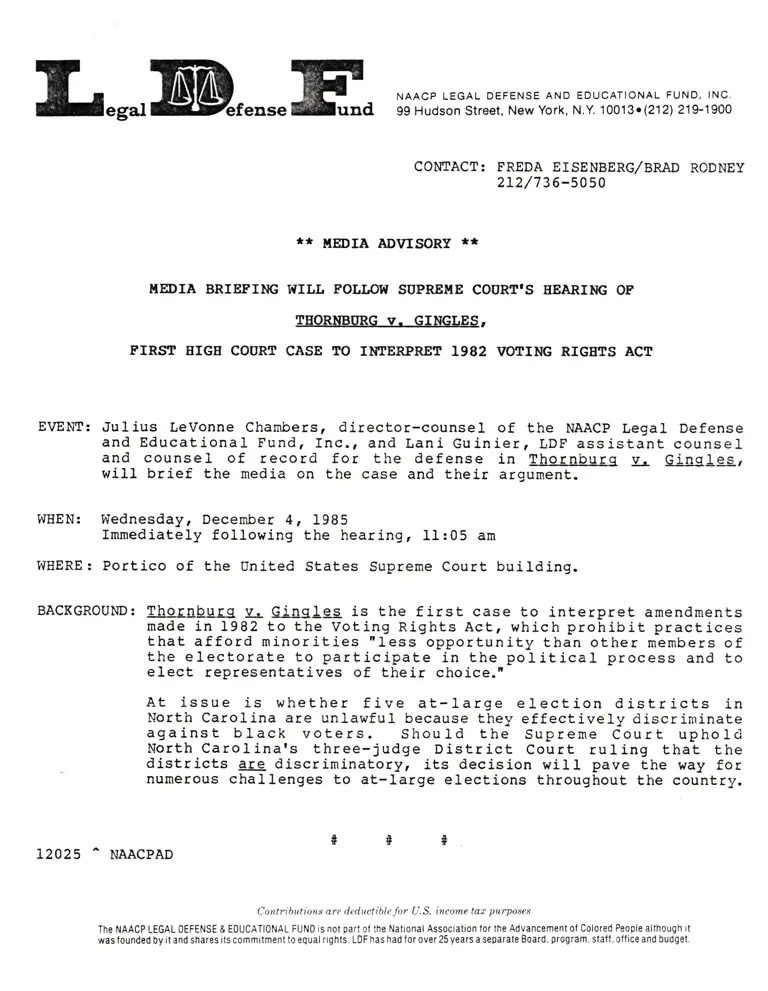
CO}ITACT: FREDA EISENBERC,/ERAD RODNEY

2L2/736-s0s0

** }iEDIA AD\JrISORY **

I,TEDIA BRIEFIT.IG WTLL POLIPW ST'PRBI.IE COURT'S EEARI}IG OF

TEORNBT]RG v. GTNGLES,

FIRST ETGB COT'RT CASE TO IITTERPRET 1982 VOTI}re RIGETS ACT

EVENT: Julius LeVonne Chambers, director-counsel of the NAACP Legal Defense
and Educational Fund, Inc.r and Lani Guinier, LDF assistant counsel
and counsel of record for the defense in Thornburq g,- Ginqfes,
will brief the media on the case and their argument.

WHEN: Wednesday, December 4, 1985
Immediately following the hearing, 11:05 am

I{EERE: Portico of the United States Supreme Court building.

BACKGROUM: Thorgbg4t y- Gingles is the first case to interpret amendments
made in 1982 to the Voting Rights Act, which prohibit practices
that afford minorities "less opportunity than other members of
the electorate to participate in the political process and to
elect representatives of their choice."

At issue is whether five at-1arge election districts in
N.orth Carolina are unlawful because they effectively discriminate
against black voters. Should the Supreme Court uphold
North Carolinars three-judge District Court ruling that the
districts are discriminatory, its decision will pave the hray for
numerous challenges to at-large elections throughout the country.

12025 ^ NAACPAD

Con.tributiorts are deductibLe for U.S. income tar purposes

The NAACP LEGAL oEFENSE & EDUCATIoNAL FUN0 is not part of the National Association for the Advancement of Colored People although il
was lounded by it and shares its commitment to equal rights. LOF has had for over 25 years a separate Board, prog ram, stall, ofrice and budg et.

NAACP LEGAL DEFENSE AND

99 Hudson Street, New York,
EDUCATIONAL FUND, INC.

N.Y. 10013o (212\ 219-1900


L e sar @rense H. U$ i.iH'^" *"'"T,i Hi: iL?
^?

?: iJ,'l ila! ;'il B: I i',i,

FROITI: FREDA ETSENBENC/BRAD RODMY
PUBLIC I}rIEREST PUBLIC REI.ATIONS
225 West 34th Street, Suite 1500
tibw York, Iibw York 10001
2t2n35-s0s0

FOR IMMH)IATE RELEASE

STIPREI,IE COURI EEARS IERNBIIRG V. GTIGTES,

FIRsI EIGE Cq,RT CASE TO ITITERPREE L982 \,oTIIG RIGETS ACT

ilrlius Chaders, Director{ounsel of I6ACP f-€<ra]. Defense Ftrd Areres for

Ibrth Carolina Bladr Voters Aqainst Discri.Ei-patorv. At-tarqe Election Distric*ts

WASHIIIGI.ON, D.C., December 4, 1985 -- The Supreme Court today heard oral argument

in Thornburq IIs Ginqles, the first major voting rights case interpreting amendments

rnade in 1982 to the Voting Rights Act. The Courtrs decision will affect how the 1982

Act is applied in lower court cases ruling on a variety of election practices around

the country.

In Thornburq g- Ginqles, North Carolina is appealing the ruling of a federal

three-judge panel that held the staters 1982 redistricting plan discriminated against

blacks in seven districts. The State has been joined by the Reagan Adninistration in

a brief filed by the U.S. Department of Justice. Appellees, black voters in North

Caro1ina, are represented by the I{AACP Lega1 Defense and Educational Fund, Inc. (LDf).

Amici for the appellees include the Republican Party of llcrth Carolina, the Retrublican

National Committee and Senators Dole (R.-KS) and Grassley (R.-IA), along with the

eight other principal co-sponsors of the 1982 amendments.

- ttORE -

Contributions are deductible for U.S. incmne ta:x purposes

The NAACp LEGAL oEFENSE & EDUCATIoNAL FUND is nor part ot the National Association for the Advancement of colored People although it
was tounded by it and shares its commitment to equal rights. LOF has had lor over 25 years a separate Board, program, staff, ollice and budget.


-2-

The District Court panel ruled the districts, six of which conducted at-large
elections, unlawful because t,hey violated Section 2 of the 1,982 Voting Rights Act.

Section 2 prohibits practices that afford minorities "less opportunity than other
members of the electorate to participate in the polit,ical process and to elect
representatives of their choice."

llorth Carolina maintains that blacks have some electoral opportunity in five of
the at-large districts, citing as conclusive evidence theic 1982 post-lawsuit, election
results where five of 30 seats were won by blacks. The State is urging the high court

to rule that such a recent electoral success automatically precludes t,he possibility
of a Voting Rights Act violati.on.

fn defense of the District Courtrs finding, Julius LeVonne Chambers, director-
counsel of the NAACP Legal Defense and Educational Fund, argued that the Staters

approach "disregards the ttotality of circumstances testt that, must be used when

determining whether or not blacks are able to participate equally in the political
Process. The test requires the courts to consider a variety of factors, not just one

electi.on. The 1982 election results in the challenged districts are clearly an

aberratj.on. North Carolinats three-judge District Court found that, in several
instancese blacks were able to win only because of support by whites who hoped to
effect the outcome of this litigation, initiated 14 uronths earlier.'

Mr. Charnbers cited several circumstances which put black voters at a distinct,
disadvantage in elections held within the five majority-white districts, reducing

their opportunity to elect candidates of their choice.

-- l,toRE --


-3-

These circumstances include:

Polarized Voting: The proportion of white voters who ever voted for blacks

was ertremely low, and those who did ranked them last or next to last on

their at-Iarge ballots. This is due in part to the common practice of white

candidates in !{ortb Carolina of urging whites to vote on racial lines. In

addition, black candidates receiving the largest number of black votes

ordinarily received the smallest nurber of white votesi

lov ltinority Registration nates: The lingering effects of a century of

virulent official hostility toward blacks who sought, to register have

resulted in substant,ially lower registration figures for blacks than whites;

and

* Poverty and tor Education Levels Among Blacks: These factors harm the

ability of candidates fielded by the black community to wage a successful

campaign. An at-large carpaign must reach eight tfunes as many voters as one

waged in a single-member district, and are more than twice as expensive.

Despite these conditions, a few black candidates have been elected to North

Carolinars State Legislature for the districts in questi.on. The Stat,e hopes the Court

will read those token results as proof of equal opportunity. The appellees believe

that, even with the 1982 results, the nunbers are not dispositj.ve.

Part of the NAACP tegal Defense Fundrs argument here is the issue of "single-
shootingr'a voting practice where minority voters in an at-large election forfeit
npst of the ballots on their slate in order to weight their vote for one candidate.

-- l,lORE -


-4-

Although single-shooting has been effective in allowing minorities a chance of

electing one candidate of their choice, LDF contends that it forces then to abnegat,e

their right to cast a couplete ballot and thus provides blacks with less electoral

opportunity than whites who can cast a fu1l slate Eurd, even with single-shooting by

blacks, choose all the winning candidates, including which black wins.

Lani Guinier, an assistant counsel with the I{AACP Legal Defense Fund and counsel

of record for the appellees, said their position on single-shot voting "is on the

cutting edge of law. Previously, courts favored laws allowing blacks to single-shoot

because it gave them a chance of electoral successr and t,hat was better than none.

Eere werre challenging laws and practices that, though they may be partially
successful, do not provide full and equal opportunity."

rlf the Court decides in favor of the Stater'!{[s. Guinier addedr'violations of

the Voting Rights Act will be easily avoida.ble. $lhites could throw their support to

blacks for a single election t ot field black candidates that, support the positions of

the white corununity. Such tactics could create situations that, from the viewpoint of

North Carolina and the Justice Departmentr would preclude findings of a Section 2

violation. But any appearance of equal elect,oral opportunity would be just that,
an appearance onlyr an illusion.'

In addition to 1,1s. Guinier and Mr. Chambers, attorneys on the case include
Eric Schnapper at LDF, and Leslie J. Winner, with the !{orth Carolina firm of Ferguson,

Watt, Wallas & Adkinsl P.A.

The NAACP tegal Defense and Educational Fund, Inc. is the primary legaI arm of
the civil rights movement. Although founded by the National Association for the

Advancement of Colored People, LDF has had for over 25 years a separate Board,

progr.rm, staff, office and budget.

12025 ^ TBACP\m,


CONTACT: Freda Eisenberg/Brad Rodney
(2t2) 736-s0s0

TEORNBTIRG v. GTNGLES

Fact Sheet

Black Representation in the tlorth Carolina f,egislature
* North Carolina has long had the smallest percentage of blacks in its statelegislature of any state with a substantial black population, according toa report by the Joint Center for political Studies.

Though blacks are 22.4 percent of North carolinars popuration,
never held more than 4 percent of the seats in either
North Carolinars legislature.

* The first black state senator in North Carolina was not elected
* The first black was not elected to North carol inars

Representatives until 1958.

they have
house of

until 197 4.

llouse of

North Carolina Election Districts
* North Carolina makes greater use

states: under the 1982 p1 an
representaLives and 30 of the 50
multi-member distr icts.

of at-1arge elections than most other
being challenged, 98 of the L20

state senators were to be chosen from

40 of North Carolinars 100 counties, including the districts underconsideration in Thornburg v*Gingles, are covered by Section 5 of theVoting Rights Act which requires t,hat proposed chinges in election
procedures be approved by the Justice Department,

Eistory of thornburq v. Ginqles
* In 1981 Nort,h Carolina submitted its redistricting plan to the Att.orney

Generalr who made objections, concluding that "the use of large multil
member (at-large) distr icts effectively submerges cognizable
concentrations of the black population into a majority white eLectorate."

* fn L982 a three-judge panel of the Federal District Court for Eastern
North Carolina unanimously ruled that six of the multi-member districts
and one single-member district effectively discriminated against the
staters black population.

* North Carolina, supported by the current Justice Department, is nowchallenging, before the Supreme Court, the correctness of the District
Court ruling with respect to five of the multi-member districts.