Petition by Defendants-Appellees for a Rehearing and Suggestion for Rehearing En Banc
Public Court Documents
June 29, 1983
9 pages
-
Case Files, Garner Working Files. Petition by Defendants-Appellees for a Rehearing and Suggestion for Rehearing En Banc, 1983. 8abe519f-34a8-f011-bbd3-000d3a53d084. LDF Archives, Thurgood Marshall Institute. https://ldfrecollection.org/archives/archives-search/archives-item/afb5323b-1636-42aa-ad6e-1a93dd696385/petition-by-defendants-appellees-for-a-rehearing-and-suggestion-for-rehearing-en-banc. Accessed September 26, 2026.
Copied!
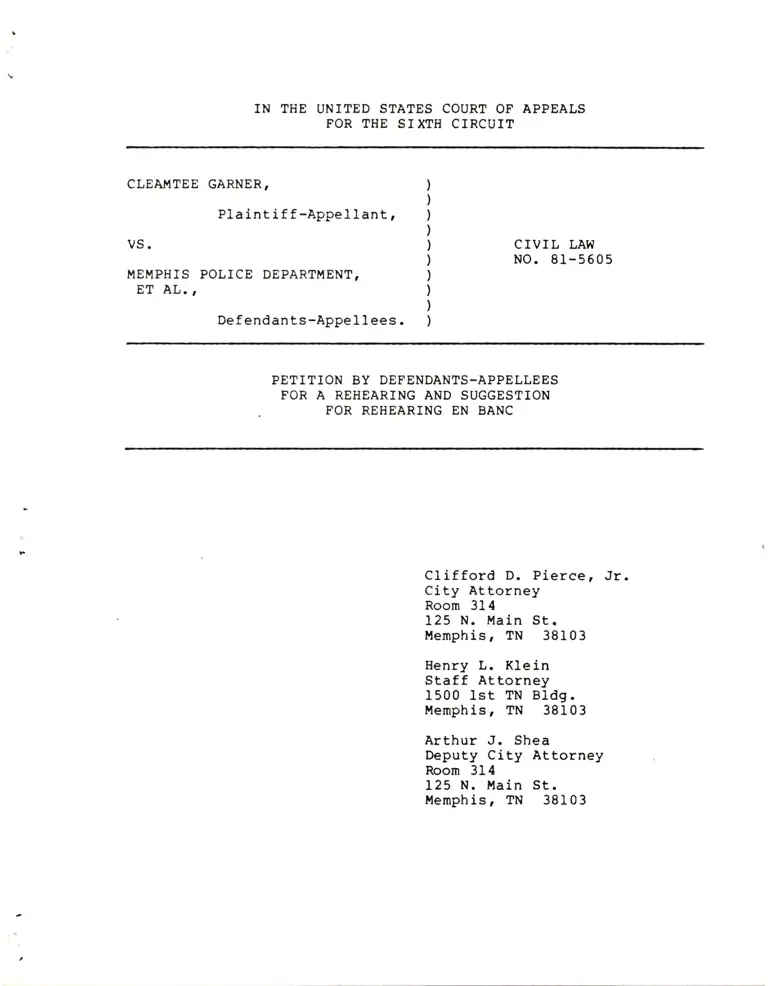
IN THE UNITED STATES COURT OF APPEALS
FOR THE SIXTH CIRCUIT
CLEAMTEE GARNER, )
)
Plaintiff-Appellant, )
)VS. )
)MEMPHIS POLICE DEPARTMENT, )
ET AL., )
)
Defendants-Appellees. )
CIVIL LAW
NO. 81-5605
PETITION BY DEFENDANTS-APPELLEES
FOR A REHEARING AND SUGGESTION
FOR REHEARING EN BANC
Clifford D. Pierce, Jr.
City Attorney
Room 314
125 N. Main St.
Memphis, TN 38103
Henry L. Klein
Staff Attorney
1500 1st TN Bldg.
Memphis, TN 38103
Arthur J. Shea
Deputy City Attorney
Room 314
125 N. Main St.
Memphis, TN 38103
PETITION FOR A REHEARING AND SUGGESTION
FOR A REHEARING EN BANC
I express a belief based on a reasoned and studied
professional judgment that the panel decision is contrary to the
following decisions of this Circuit and the United States Court
of Appeals for the Sixth Circuit and that consideration by the
full Court is necessary to secure and maintain uniformity of
decisions in this Court:
Cunningham v. Ellington, 323 F. Supp. 1072 (W.D. Tenn.
1971);
Beech v. Melancon, 465 F. 2d, 425 (6th Cir. 1972) cert,
denied, 409 U. S.'1114, (1973).
Qualls V. Parrish, 534 F. 2d, 690 (6th Cir. 1976); and
Wiley V. Memphis Police Department, 548 F. 2d, 1247
(6th Cir. 1977) cert, denied, 434 U. S. 822 (1977).
I express a belief based on a reasoned and studied pro
fessional judgment that this appeal involves one or more ques
tions of exceptional importance:
I .
Can the United States Court of Appeals
find the Tennessee Fleeing Felon Statute,
TCA §40-808, unconstitutional and disregard of
its previous rulings upholding the constitu
tionality of said statute?
II.
Can the United States Court of Appeals dis
regard the fact that in one of its previous cases
it sustained the conclusions of law of the District
Judge who had disposed of a Fourth Amendment
argument holding it to be "meritless"?
Ill.
Can this Court determine those crimes
warranting the application of the Tennessee
Fleeing Felon Statute, TCA
this a determination which
within the province of the
§40-808, or is
lies exlusively
legislative branch?
f\
/
Clif ford'D.pPierce, Jr,
Attorney of,’ Record for
Defend ants-^Appellees
Defendants-Appellees
Attorney of Record for
Defendants-Appellees
ARGUMENT
I .
IN THIS CASE, THE UNITED STATES COURT OF APPEALS HAS
RENDERED AN UNPRECEDENTED OPINION WHICH IS DIRECTLY CONTRARY TO
PREVIOUS OPINIONS IN THIS CIRCUIT WHICH HAVE UPHELD THE CONSTITU
TIONALITY OF THE TENNESSEE FLEEING FELON STATUTE, TCA §40-808.
The constitutionality of TCA §40-808 was first con
sidered in this circuit by a three-judge District Court in
Cunningham v. Ellington, 323 F.Supp. 1072 (W.D. Tenn. 1971). The
facts in that case are similar to those in the case at bar in
that they involve a shooting by the Memphis police which resulted
in death after investigating a burglary attempt in which the vic
tim was fleeing from arrest by the officers. It was contended
that the statute was unconstitutional on its face because it
permitted the use of cruel and unusual punishment in violation of
the Eighth Amendment; that it was unconstitutionally over-broad;
that it was an unconstitutional incursion with respect to a
person's right to trial by jury, confrontation of witnesses and
assistance of counsel; and that it violated the due process
clause of the Fourteenth Amendment. These arguments were
disposed of by the Court and the statute held to be
constitutional in all respects. It is obvious from a reading of
the opinion, that the three-judge Districct Court, carefully
considered the statute in making its decision. Although a Fourth
Amendment question was not raised, it can certainly be argued
that in considering the matter as carefully as the Court did, if
the three judges had felt the Fourth Amendment was a basis for
holding the statute unconstitutional, they would have done so sua
sponte.
Likewise, this Court considered the constitutionality
of the statute in Beech v. Melancon, 465 F. 2d, 425 (6th Cir.
1972) cert, denied, 409 U. S. 1114, (1973); Qualls v. Parrish,
534 F. 2d, 690 (6th Cir. 1976); and Wiley v. Memphis Police
Department, 548 F. 2d, 1247 (6th Cir. 1977) cert, denied, 434 U.
S. 822 (1977). Again, this Court gave very serious consideration
to the constitutionality of TCA §40-808 and again it was upheld.
II.
THE UNITED STATES COURT OF APPEALS IS IN ERROR WHEN IT
SAYS THAT THE FOURTH AMENDMENT QUESTION WAS NOT CONSIDERED BY
THIS COURT PREVIOUSLY.
In the slip opinion in this case which was decided and
filed June 16, 1983, the Court says as follows, at page 14:
"Our holding here under the Fourth Amend
ment is not inconsistent with our holdings
in Wiley v. Memphis Police Department, 548
F.2d 1247 (6th Cir. 1977), and Beech v.
Melancon, 465 F.2d 425 (6th Cir. 1972), or
the three judge District Court opinion in
Cunningham v. Ellington, 323 F. Supp. 1072
(W.D. Tenn. 1971), in all of which youths
were killed by the Memphis police while
fleeing from the commission of a burglary.
In each of those cases the Tennessee statute
was drawn into question under the 'cruel and
unusual punishment' clause of the Eighth
Amendment and under the Fourteenth Amendment
as a matter of substantive due process.
In none of these cases was a Fourth
AirTendment question raised^ discussed,
mentioned or decided. Fourth Amendment
considerations were not argued. (Emphasis
added. )
In the Memorandum Opinion entered by Judge Harry
Wellford in Wiley v. Memphis Police Department, No. C-73-8 (W.D.
Tenn., June 30, 1975), the Court stated as follows on page 22 of
said Opinion:
"Plaintiff's Fourth Amendment claim here
based on unreasonable 'seizure' of Berry
is meritless. Certainly under these facts
the officers had a right to arrest Berry
and to search him for stolen prperty or
weapons and to seize him and any stolen
contraband. No federal case cited by
Plaintiff has construed this amendment to
apply to this type of situation. Terry v .
Ohio, 392 U.S. 1 (1968) involved a police-
man's stopping and frisking suspects under
suspicious circumstances where no crime was
committed in his presence nor yet reported
to him. Others involved suppression of
illegally obtained narcotics or alleged
kidnapping by authorities in a foreign juris
diction. This court does not conclude that
the policy of using all necessary force,
including use of potentially deadly force to
bring about arrest, as a last resort, of a
fleeing felon is per se unreasonable and
unconstitutional. As previously noted,
Cunnini^ham v. Ellington, supra, has settled
Plaintiff's Eighth Amendment ’cruel and
unusual punishment' claim contrary to her
contentions."
On appeal, this Court in its opinion refers to the fact
that jurisdiction was invoked under 42 U.S.C. SS1981, 1983, 1985,
1986, and 1988 and under the Fourth, Fifth, Sixth, Eighth, Thir
teenth and Fourteenth Amendments to the Constitution. Wiley v .
Memphis police Department, supra, 548 F.2d at 1248. In his
opinion. Judge Weick goes on to say at page 1253:
5
"We are of the opinion that there was
substantial evidence to support the
factual findings of the District Court
and they are not clearly erroneous. The
Court's conclusions of law are correct."
(Emphasis added.)
Clearly, Judge Wellford had considered the Fourth Amen
dment claim and clearly the Sixth Circuit had confirmed the
findings.
It should also be noted that in the Brief for Appellant
which was filed with this Court in Wiley, the Fourth Amendment
question was extensively argued by able counsel (Brief for Appel
lant pp. 68-73). This is a further indication that the Fourth
Amendment was before the Court in Wiley.
III.
ANY CHANGE WITH REGARD TO THE USE OF DEADLY FORCE IN
THE STATE OF TENNESSEE SHOULD BE LEFT TO THE STATE LEGISLATURE.
In Cunningham v. Ellington, supra, the three-judge Dis
trict Court stated at page 651:
"Again the Court notes that any classi
fication which would allow deadly force ,
to be used against persons who have com
mitted certain specified crimes, and not
against other offenders would inevitably
be subject to the same attack as plain
tiff wages here. To abolish the use of
deadly force altogether is to deprive
the state and its citizens of their
rights to security, safety and a feeling
of protection. To pick and choose
those crimes warranting the application
of these statutes is the duty of the
legislature. It involves a determina
tion of the effect and seriousness of
^imes on society and such a determina
tion lies exclusively within the pro
vince of the legislative branch. It
is not the role of a federal ^judge to
legislate for the people of a state.
(Emphasis added.) g
In Wiley v. Memphis Police Department, supra, this
Court said at page 1252:
"The Eighth Circuit is the only Court
to our knowledge which has ever held
that such a statute, which is so nec
essary even to elementary law enforce
ment, is unconstitutional. It extends
to the felon unwarranted protection,
at the expense of the unprotected public.
We agree with the dissent in the Eighth
Circuit case (Mattis v. Schnarr), which
was highly critical of the majority
opinion for not following the deci
sions of other Circuits and for em
barking on a new course which should
have been left to the state legis
latures where it belongs."
CONCLUSION
Your Defendants contend in accordance with Rule 35 of
the Federal Rules of Appellate Procedure, that the questions
presented in this Petition are of the utmost importance, and the
results reached in the panel's opinion are unprecedented. They
pray that the United States Court of Appeals for the Sixth
Circuit will rehear this en banc, reverse its previous decision,
and affirm the action of the United States District Court in
finding for the Defendants.
f^ll/y submi tted,Respect
"cITFFor9’""DtvP
Attorney of Record for
Defenc^nts-Appellees
Verce, Jr.
Attorney of Record for
Defendant-Appellees
At^rhur J. Sb«a
Attorney of Record for
Defendant-Appellees
CERTIFICATION
I hereby certify that I have this 29th day of June,
1983, forwarded a copy of the foregoing instrument to Mr. Jack
Greenberg; Mr. James M. Nabrit III; and Steven L. Winter, Suite
2030, 10 Columbus Circle, New York, New York 10019; and to Mr.
Walter L. Bailey, Jr., Suite 901, Tenoke Building, 161 Jefferson
Avenue, Memphis, Tennessee 38103, Counsel for Plaintiff-
Appellant, by United States Mail, postage pre-paid, on the date
shown above.
Henry L. Klein