memorandum in opposition to motion to dismiss
Public Court Documents
August 16, 1977
56 pages
-
Case Files, Hatcher v. Methodist Hospital - Hardbacks. memorandum in opposition to motion to dismiss, 1977. 3c8e8bdb-5384-f111-ab0f-7c1e527d528a. LDF Archives, Thurgood Marshall Institute. https://ldfrecollection.org/archives/archives-search/archives-item/b03ea87e-1169-4eb8-930e-762289c03a27/memorandum-in-opposition-to-motion-to-dismiss. Accessed October 10, 2026.
Copied!
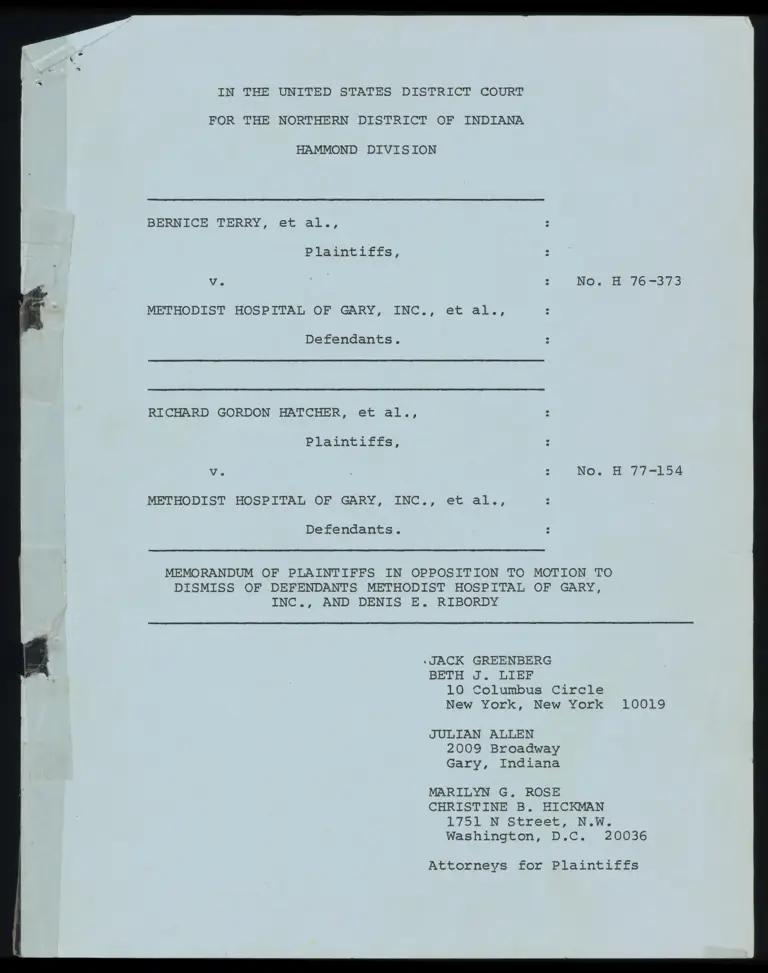
     [||4498796f-f67c-48cf-b5cd-583c451ddb4f||] IN THE UNITED STATES DISTRICT COURT


FOR THE NORTHERN DISTRICT OF INDIANA

HAMMOND DIVISION


BERNICE TERRY, et al.,

Plaintiffs,

Ve Ck : No. H 76-373

METHODIST HOSPITAL OF GARY, INC,., et al,., 3

Defendants.


RICHARD GORDON HATCHER, et al.,

Plaintiffs,

Vv. : No. H 77-154

METHODIST HOSPITAL OF GARY, INC., et al., 2

Defendants.


MEMORANDUM OF PLAINTIFFS IN OPPOSITION TO MOTION TO
DISMISS OF DEFENDANTS METHODIST HOSPITAL OF GARY,

INC., AND DENIS E. RIBORDY


JACK GREENBERG

BETH J. LIEF

10 Columbus Circle
New York, New York 10019

JULIAN ALLEN

2009 Broadway
Gary, Indiana


MARILYN G. ROSE

CHRISTINE B. HICKMAN

1751 N Street, N.W.
Washington, D.C. 20036

Attorneys for Plaintiffs


4

uy

iY.

1X.

iv.

VI.

Vii.

viii.

INDEX

TABLE OF CONTENTS

PRELIMIVARY STATEMENT cvs eveasrnvsvvsrsninences

NEITHER TITLE VI, THE HILL-BURTON ACT,

SECTION 1122, OR SECTION 504 PRECLUDE

JUDICIAL REVIEW OF THE SUBJECT MATTER

OF THE COMPLAINT wus te vicnnonnrinsvassvennvves

A. Title VI and the Hill-Burton Act .......

B. Title VI AanG C1120 cect vets ansovdaceisions

Cc. SOCEIOoN B04 ft vvsesnner ress virienenniecionins

PLAINTIFFS HAVE STANDING TO BRING THEIR

COMPLAINT AND THIS COURT IS CAPABLE OF

REDRESSING THE HARM THEY SUPPER ..cevevvecens .

JUDICIAL REVIEW IS APPROPRIATE IN THESE
ACTIONS: THE CONTROVERSY IS RIPE AND
PLAINTIFFS ARE IN NO WAY GUILTY OF LACHES ...

PLAINTIFFS HAVE EXHAUSTED ALL POSSIBLE

ADMINISTRATIVE REMEDIES, ANY FURTHER

EFFORTS AT OBTAINING RELIEF THROUGH THE

ADMINISTRATIVE PROCESS WOULD BE FUTILE,

AND THE DOCTRINE OF EXHAUSTION OF AD-

MINISTRATIVE REMEDIES IS INAPPLICABLE TO

THE CAUSES OF ACTION AGAINST THE SECRETARY

OF HEW ouvert ncntinsvitvvensnsinesios se oonitis snes

DEFENDANT METHODIST HOSPITAL IS SUBJECT

TO THE REQUIREMENTS OF THE FOURTEENTH

AMENDMENT ® @ & © © © & 0 O° & oO OO SO 8 8 Sd 8 Os OS O° eee ee SO BPO

THE COMPLAINTS STATE CLAIMS FOR WHICH

RELIEF CAN BE GRANTED cevevonsesersinsns enone

OTHER HEALTH CARE PROVIDERS IN THE STATE

WHO RECEIVE FEDERAL FUNDS ARE NOT INDIS-

PENSIBLE PARTIES TO THIS ACTION Levers visvssnns

Page

11

25

29

34

36

38


TABLE OF CONTENTS CONT'D.

Page

IX. OTHER ARGUMENTS RAISED BY DEFENDANTS ARE

4 EQUALLY WITHOUT MERIT ® © © © ® 4 © 9 © © 6 © © 6 6 OO O° O° "eee 43

ol

X. CONCLUSION wc ccvscvncecssvesnesnes Sv sieve evese “ein a4


IN THE UNITED STATES DISTRICT COURT

FOR THE NORTHERN DISTRICT OF INDIANA

HAMMOND DIVISION


BERNICE TERRY, et al.,

Plaintiffs, :

v. s Noo H 16-373

METHODIST HOSPITAL OF GARY, INC., et al., :

Defendants.


RICHARD GORDON HATCHER, et al., :

Plaintiffs, :

Vv. x No. H 77-154

METHODIST HOSPITAL OF GARY, INC., et al.,

Defendants. :


> MEMORANDUM OF PLAINTIFFS IN OPPOSITION TO MOTION TO

DISMISS OF DEFENDANTS METHODIST HOSPITAL OF GARY,

INC., AND DENIS E. RIBORDY

I

Preliminary Statement


Plaintiffs in the above-entitled consolidated actions

charge defendants with violating their obligations and the

rights of plaintiffs and the plaintiff class under Title VI

OF the Civil Rights Act of 1964, 42 U.S.C. § 2000d, and to


equal protection guaranteed by the Fifth and Fourteenth

Amendments to the Constitution of the United States.

Defendant Methodist Hospital of Gary, Inc., filed

a Motion to Dismiss the action of Wesson, et al. v.


Methodist Hospital of Gary, Inc., et al., Cause No. H 76-373.


Defendant Secretary of Health, Education and welfare

originally filed a Motion to Dismiss or, in the Alternative,

for Summary Judgment but subsequently wrote a letter to

inform this Court that the Secretary was currently analyzing

its policy and asked that the Court withdraw the Motion.

In a companion case, Hatcher, et al. v. Methodist


Hospital of Gary, Inc., et al., Cause No. 77-154, plaintiffs


charged defendants with identical violations of their rights

and the rights of the plaintiff class under Title VI and the

Constitution, as well as discrimination against the handi-

capped in the provision of health care services in violation

of Section 504 of the Rehabilitation Act of 1974, 29 U.S.C.

§ 794. This Court granted the motion of plaintiffs to con-

solidate the two actions.

Defendant Methodist Hospital has now filed a second

Motion to Dismiss against the consolidated actions on the

grounds that: (1) judicial review is precluded under Title

VI and the Hill-Burton Act, 42 U.S.C. § 291, Title VI and


Section 1122 of the Social Security Act, 42 U.S.C. § 1320a-1,

and Section 504 of the Rehabilitation Act of 1974, 29 U.S.C.

§ 794; (2) plaintiffs lack standing to bring these actions;

(3) the Court is unable to redress the alleged injury;

(4) there is a lack of ripeness; (5) plaintiffs have failed

to exhaust administrative remedies; (6) there is no state

action under 42 U.S.C. § 1983; (7) there is no jurisdiction

under § 1361; (8) the complaints fail to state claims for

relief under the Hill-Burton Act, Title VI, § 504, § 1122,

and § 1983; (9) the complaint is guilty of laches; and

(10) plaintiffs have failed to join indispensible parties.

hyd
Although the grounds of defendant's motion are numerous,

many of the issues raised have already been discussed in

earlier memoranda filed with this Court. In the interest of

efficiency, plaintiffs will therefore not reiterate points

already made in their prior memoranda, but will instead

refer to them in appropriate places. Similarly, since this

Court is already familiar with the facts which gave rise

to these lawsuits and to plaintiffs' allegations, plaintiffs

will refrain from including a Statement of the Facts.


1l/ For purposes of clarity, defendant Methodist Hospital
and Denis Ribordy will be referred to as "Methodist

Hospital.


IT

Neither Title VI, The Hill-Burton

Act, Section 1122 or Section 504

Preclude Judicial Review of the

Subject Matter of the Complaint.


A. Title VI and the Hill-Burton Act.

Defendant reiterates three arguments made in prior

motions for the proposition that judicial review is pre-

cluded under Title VI and the Hill-Burton Act. First,

despite the fact, as defendant acknowledges, that HEW

acknowledges the applicability of Title VI to both the

Hill-Burton direct grant program and loan guarantee pro-

grams (see 42 C.¥.R. §:53.112{c); 45 C.F.R.. §8§ 80.2,

80.12 (f); Memorandum of HEW, p. 5); Methodist Hospital

persists in its argument that Title VI is inapplicable

(Defendants' Memorandum in Support of Their Second Motion

to Dismiss [hereinafter "Second Motion"], pp. 9-10).

Plaintiffs fully explained the lack of merit to the hospital's

position in their memorandum in opposition to defendant's

first motion at pages 5-10, and respectfully refer the

Court to that discussion.

Defendant also repeats the argument that the

Administrative Procedure Act precludes review. Plaintiffs

have fully briefed this point and refer the Court to

the Memorandum in Opposition to defendant's first motion.


at pp. 11-15, and to their Memorandum in Opposition to

defendant Califano's motion, at pp. 16, n. 16, 18-20,

and 24-25.

Finally, defendant again arguesthat certain pro-

visions of the Hill-Burton Act itself preclude judicial

review (see Memorandum II, pp. 13-14). As stated in

plaintiffs' Memorandum in Opposition to defendant's first

motion at pp. 11-12, this argument misperceives the na-

ture of plaintiffs' complaint for these actions do not

arise under the Hill-Burton Act.

Be Title VI snd § 1122

The purpose of Section 1122 is set forth in its opening

paragraph (42 U.S.C. § 1320 a-1 (a)):

- —- to assure the federal funds used to reimburse health
facilties under the Medicare, Medicaid, and Crippled
Children's programs are not made to support unnecessary
capital expenditures;

- = to assure that such federal reimbursement funds are
used, to the extent possible, to support health planning
activities in the various states.

To accomplish these objectives, a health facility must receive

approval of capital expenditure programs as a condition for

receiving federal reimbursement for capital construction costs
2/

under the Medicare, Medicaid, and Crippled Children's programs.


2/ A portion of the reimbursement received by hospitalsincluding
Methodist Hospital, under these programs represents costs for
capital construction.


Thus, approval of an § 1122 application, such as the 1976 applica-

tion Methodist Hospital made for expansion of Broadway Methodist

Hospital, is approval for the receipt of federal financial assist-

ance and subjects a recipient to the requirements of Title VI,

Indeed, defendant does not argue that Title VI is inapplic-

able to the § 1122 process, but contends that judicial review

is precluded by the provisions of 42 U.S.C. § 1320a-1 (f) which

states:

(f) Any person dissatisfied with a determination by the
Secretary under this section may within six months follow-
ing notification of such determination request the Secre-
tary to reconsider such determination. A determination by
the Secretary under this section shall not be subject to
administrative or judicial review.

That section might arguably be applicable if plaintiffs were

Proceeding under §1122, but they are not. This action is not

an action arising under § 1122, just as it does not arise under

the Hill-Burton Act. Plaintiffs do not allege that either

§1122 or the Hill-Burton Act per se have been violated, but

rather that defendants have violated the provisions of Title VI,

which apply to recipients who receive federal financial assistance
3/

as a result of receiving § 1122 approval.


3/ In any event, as the Court of Appeals for this circuit stated
in Apter v. Richardson, 510 FP. 24 351, 355-56 (7th Cir. 1975):


"Where it is alleged that the agency has transgressed a con-
stitutional guarantee or violated an express statutory or
procedural device, otherwise non-reviewable agency action
should be examined to the extent necessary to determine the
merits of the allegation. See, e.g., Johnson v. Robinson,
415 U.S. 361 (1971) (constitutional questions); Brotherhood
of Railway & Steamship Clerks v. Association for the Benefit

of Non-Contract Employees, 380 U.S. 650 (1965) (statutory
duty); Kletscher V, Driver, 411 PF. 2d 436 (28 cir. 1969)
(statutory duty): Cappadora v. Celebrezze, 356 F 2d 1,6
(2d cir. 1966) (administrative regulations)".


In order to review charges of civil rights violations in the contest
of both the Hill-Burton and § 1122 applications of Methodist

-~ 6 =


To the extent that Methodist Hospital argues that the

allegations of the complaints concerning the § 1122 process

does not pertain to it, defendant is correct. That posi-

tion does not in any way imply, though the judicial

review of the other defendants' involvement in the review

and approval of Methodist Hospital's § 1122 application

concerning Broadway Methodist Hospital in any way lessens

the viability of plaintiffs' charges against the hospital.


3/ Continued

Hospital and the application procedures of the other de-

fendants in these actions, an entire analysis of such

applications and procedures is necessary to determine

whether the criteria and judgments mandated by Title VI

and Section 504 were enforced.


C. Section 504

Defendant's argument that this Court lacks subject

matter jurisdiction as to plaintiffs' claims under

Section 504 of the Rehabilitation Act of 1974, 29 U.S.C.

§ 794 mirrors those arguments it previously made with

regard to Title VI, the Hill-Burton Act, and § 1122,

namely that: (1) recipients of Hill-Burton federal

financial assistance are exempt from § 504 as "contracts

of insurance or guaranty;" (2) judicial review of § 1122

is precluded; and (3) under the Administrative Procedure

Act, 5 U.S.C. § 701 (a) (2), agency action under §504 is

committed to agency discretion by law.

In holding that § 504 confers affirmative rights

and private right of action, the Court of Appeals for

the Seventh Circuit in Lloyd v. Regional Transp. Authority,


548 F.24 1277, 1280,-1285 (7th Cir. 1977) noted that § 504

"closely tracks" Title VI and that the legislative history

of § 504 makes clear that the striking similarity "was not

accidental." According to the report of the Senate Labor

and Public Welfare Committee:

"Section 504 was patterned after,

and is almost identical to, the anti-

discrimination language of section 601

of the Civil Rights Act of 1964, 42

U.S.C. 2000d4-1 (relating to race, color,

or national origin) . . . The section

therefore constitutes the establishment

of a broad policy that programs receiving

Ge


Federal financial assistance shall

be operated without discrimination

on the basis of handicap." 4 U.S.

Code Cong. & Admin. News, p. 6390

(1974), cited in Lloyd v. Regional

Transp. Auth., id.


Thus, plaintiffs' discussion, supra, and in earlier memo-

4/
randa establishes that defendants' arguments are as

equally without merit with regard to § 504 as they are

with regard to Title VI and Hill-Burton, and plaintiffs

will not repeat those arguments here.

Methodist also appears to argue, however, that it is

somehow unfair to impose the nondiscrimination provisions

of 504 upon its facilities services because the regulations

issued by HEW pursuant to § 504 took effect on June 3, 1977,

after this lawsuit was filed. That argument ignores the

fact that § 504 was promulgated in 1974; and that the Court


of Appeals in Lloyd, supra, held that § 504 imposed obli-

gations on recipients of federal financial assistance and

rights of private action of beneficiaries of recipients

5/
services before the regulations were even issued.


4/ See plaintiffs' Memorandum in Opposition to Methodist
Hospital's first motion, pp. 3-4.

3/ ‘Accord, cases cited in Llovad, id., at 1281, n. 14.


Methodist Hospital also ignores the fact that it has and

presently does continue to receive on an ongoing basis

.substantialamounts of federal financial assistance, not

only under its Hill-Burton grant, loan and interest sub-

sidy, but under Medicare, Medicaid and other service

programs. See § 7 of Complaint in Hatcher, et al. v.


Methodist Hospital, et al.


. Finally, Methodist Hospital's denial that it discrimi-

nates against handicapped persons is irrelevant to the

resolution of a Motion to Dismiss inasmuch as the facts in

the complaint are accepted as true.

-10-


IX}

Plaintiffs Have Standing To Bring

Their Complaint And This Court Is

Capable Of Redressing The Harm
They Suffer,


As stated in plaintiffs' memorandum in opposition

to Methodist Hospital's first motion, the essence of

2a the question of standing, from the constitutional per-

spective of whether an Article III "case or controversy"

exists, is whether the plaintiff has 'alleged such a

personal stake in the outcome of the controversy' as to

warrant his or her invocation of federal court juris-

diction and to justify exercise of the courts' remedial

powers on his behalf." Wwarth v. Seldin, 422 U.S. 490,


498-99 (1976), citing Baker v. Carr, 369 U. S. 186, 204


(1962). Thus, the plaintiff must have suffered "some

threatened or actual injury resulting from the putatively


illegally action." Linda BR, 8S, v, Richard D., 410 U. S.


614, 617 (1973); accord, warth v. Seldin, supra, 422 U.S.


at 499; see Data Processing Service v., Camp, 397 U. S.


150, 151-154 (1970) (emphasis added). Each of the plain-

tiffs clearly meets this requirement.

As a black resident of Gary who will require use of

the health facilities at Gary Methodist Hospital, plaintiff

“11l-~


Hatcher suffers from the segregated health care system

of Methodist Hospital that discriminates against minority

s/
persons, including Mayor Hatcher.

The injury from having to receive segregated, unequal

health services is not, as the defendants suggest,

"speculative; " Mayor Hatcher lives and works in Gary, and

he and/or his immediate family could at any moment require

use of the emergency room at Gary Methodist and/or use

of the outpatient or inpatient services there, The fact

that he is not at the present time a patient at Gary

Methodist in no way lessens his "threatened" injury. See

Linda R. S. Richard D., supra; Warth v. Seldin, supra:


Data Processing Service v. Camp, supra. Thus, standing


on the basis of future harm irrespective of a showing of

the realization of such injuries in the past, has been

upheld in the Supreme Court. Doe v. Bolton, 410 U. S.


179, 188 (1973). The recent decision by the Supreme Court

in Arlington Heights v. Metropolitan Housing Corp.,


DU. Se. , 50 L.Ed.2d 450 (1977) further reinforces

Mayor Hatcher's standing.

In Arlington Heights, the plaintiffs, a housing


6/ One cannot possibly dispute the fact that segregation

and discrimination in hospital services is a real injury

in fact. See Moses v. Simkins Cone Memorial Hospital,

323 F.24 929, cert. denied, 376 U. S. 938 (1964).


-12.


development corporation and certain individuals, challenged

as racially discriminatory the refusal of a village to

rezone land to permit the construction of law and moderate-

income multiple family housing units. The Supreme Court

held that a black individual who "seeks and would qualify

for the housing MHDC wants to build" and who testified

"that if Lincoln Green were built he would probably move

there" was not a "generalized grievance" or "speculation"

but a particularized injury that met the standing test. (Emp added)

Id. The Supreme Court distinguished the individual plaintiff

in Arlington Heights, supra, from those in Warth wv. Seldin,


supra, on the ground that in Arlington Heights, unlike Warth,


plaintiffs were challenging an ordinance in the context of

a specific housing project. In the instant actions, Mayor

Hatcher's grievance is not only directed at a specific

facility but one that is built and in operation — albeit

2/
on a segregated and discriminatory basis.

Moreover, as the Supreme Court stated in wWarth wv.


Seldin, supra, 422 U.S. at 513-14:


"Congress may create a statutory right

or entitlement the alleged deprivation


The case cited by defendant, Jackson v. Dukakis, 526

F.24 64 (ist Cir, 1975), is inapposite. ‘In Jackson,

which involved an employment discrimination claim,


“13


of which can confer standing to sue

where the plaintiff would have suffered

no judicially cognizable injury in the
absence of statute."

Accord, Linda R, §, Richard D., supra, 410 U. S. at 617,


n. 3: Trafficante v. Metropolitan Life Ins. Co., 409 U. S.


205, 215 (1972) (White, J., concurring);Hardin v. Kentucky


gtilities Co,., 390 UY. 8S. 1,6, 19 (1968),


As noted earlier, it is clear that Title VI guarantees

to racial minorities the right to receive the services of

a recipient of federal financial assistance, such as

Methodist Hospital, without being "excluded from partici-

pating in, be[ing] denied the benefit of, or be[ing]

subjected to discrimination." 42 U.S.C. § 2000d; Lau v.

Nichols, 414 U. S. 563 (1974); see, e.g., Llovd v.


7/ (Continued)

the Court held that the plaintiff lacked standing because

he had not applied for a job with defendant. However, un-

like the employment context, a person does not "apply" for

a hospital bed or emergency treatment for sickness is often

unforeseeable, but must have such services available im-

mediately when he or she needs them. Moreover, as discussed,

infra, Methodist Hospital, as a Hill-Burton Hospital,
is obligated to provide those services to all members of

the community, including Mayor Hatcher without consideration
or approval of any application.” 42 C.P.R. § 53.113(4)Y{1) (i).


Regional Transportation Auth.,supra. In addition, as a Hill-Burton


facility, Methodist must:

"(l) (i) Make the services it furnishes available to the
general public.” 45 C. P. R. 53.113 (4d) (1) (i); 8/
see 42 U.S.C. §291 c (e).


-8/ As a Hill-Burton hospital, Methodist Hospital is obligated
to provide"community service" 42 C. F. R. 53.113(a).
Compliance with the obligation to provide "Community
Service" is defined at 42 C.F.R. 53.113 (a) to mean in
pertinent part:

Hoes BD applicant must:
(1) (1) Make the service it furnishes available
to the general public, or

(ii) Limit the availability of such services
only on the basis of age, medical indigency,
or type or kind of medical or mental dis-
ability, or
(iii) If the facility constitutes a medical
or nursing care unit of a home or other in-
stitution, make such home or other institu-
tion available in accordance with paragraph
(4) (1) (i) or (ii) of this section.”

Sections (ii) and (iii) of the above provision are
inapplicable to the instant situation and any
limitations in (11) dc not supercede the inforcement
of Title VI. Sec. 42, C.P.R. 53.112

-15-


See Cook v. Ochsner Foundation Hospital, 61 F.R.D. 354


(E.D. La. 1972). As a member of the "general public"

and the "community, Mayor Hatcher thus has the right

to have the services of Methodist Hospital available

to him without discrimination or segregation, 42 U.S.C.

§ 20008; 45 C.BP.R.-Part 80y 42 C.P.R. '§ 53.112, and

the standing, in view of discrimination by Methodist Hospital to

challenge the violation of that right. Lau v. Nichols,supra;Lloyd v.


Regional Transportation Auth., supra, 548 F.2d at 1280.


Plaintiff Hatcher also alleges that as:

"Chief executive officer of Gary, [he]

is responsible, inter alia, for assuring

that the social service and health needs

of his constitutency, including members

of the plaintiff class, are met. The

enforcement of that responsibility is

directly obstructed by the actions of

defendants complained of herein."

(Complaint, ¢q 4) (emphasis added)


Defendants incorrectly contend that this allegation does

not constitute injury suffered by Mayor Hatcher. As gtated in the

SY
affidavit to be submitted by Mayor Hatcher, part of the

Mayor's responsibilities are, as the complaint alleges,

to assure that the health needs of his constitutency,

including the plaintiff class are met, and that as Mayor


9/ This affidavit is being forwarded to the Court separately.

“1B6«


he has taken numerous actions to fulfill that obligation.

And, as the complaint states, the programs and practices

of Methodist Hospital which segregate and discriminate

against plaintiffs' constitutency who are black and

Hispanic "directly obstructs] that obligation." Mayor

Hatcher has standing to challenge practices which "adversely

affect a relationship between [him] and the persons whose

rights assertedly are violated." Wwarth v. Seldin, supra,


422 U. 8S. at 510; see, e.g., Doe v, Bolton, supra, 410


Uv. 8S. at 188-189; Eisenstadt vy, Baird, 405 U. 8S. 438 (1972);


Sullivan v. Little Hunting Park, 396 U. S. 229 (1969);


Epperson v. Arkansas, 393 U. S. 97 (1968); Pierce v. Society


of Sisters, 268 U. S. 510, 534-536 (1925). The case cited


by defendant, O'Malley v. Brierly, 477 F.2d 785, 788 (3rd


Cir. 1973) is inapposite since in that case, plaintiff

priests who challenged the refusal of prison officials to

permit their admission did not seek relief on the basis

of the derivative rights of others
-

Plaintiffs Metro Corp, Inc., also have standing, both


"to seek relief from injury to itself" and "as representative

of its members." Warth v. Seldin, supra, 422 U. S. at 511.


wl


Paragraph 6 of the complaint in Hatcher, et al. v.


Methodist Hospital, et al. states:


"Plaintiffs Metro Corps, Inc. has in the
past and will continue to be injured by
the necessity of expending resources from
its limited funds in order to transport
persons to Broadway Methodist Hospital."

Defendant Methodist Hospital makes the self-serving

argument that although plaintiff Metro Corps, Inc. has a

limited budget from which to fulfill a huge number of goals

and to operate numerous programs, the money plaintiff ex-

pends solely as a result of Methodist Hospital's discrimi-

natory operation and placement of its facilities is not

an injury because the purpose of Metro Corps, Inc. is the

provision of health services. Methodist Hospital totally

ignores the fact that Metro Corps, Inc.'s limited funds

could and would be directed toward other needed services

which it cannot now provide as a direct result of defendant's

unlawful actions. A public interest group which is economically

injured by the discriminatory actions of another has standing

to challenge these activities. Apter v. Richardson, 510.F.2d


351,354 (7th Cir. 1975) Village of Park Forest v. Fairfas

Realty, Prentice-Hall Equal Opp. in Housing q 13,784 (N.D.


Ill. 1976). The fact that Metro Corps, Inc. is publicly

funded has no bearing on its standing or the injury it

suffers - the relevant fact, and the injury suffered, is

that limited funds are diverted from other services solely


in an attempt to ameliorate the harm suffered by minority

residents of Gary as a result of Methodist Hospital's dis-

«18


criminatory conduct.

Moreover, defendant ignores the allegation that

"Plaintiff Metro Corps, Inc. and its constituency, in-

cluding members of the plaintiff class, have been injured

and will continue to be harmed by the segregation of and

discrimination in the provision of health services by

ee Methodist Hospital of Gary, Inc." (9 6 of Complaint.)

Despite this allegation, Methodist Hospital contends

that "Metro Corps does not allege that any of its consti-

tuents or members have been denied any services or been

denied access to any services by Methodist Hospital."

(Defendant's Second Motion, p. 22) An allegation of

blatant denial of services or access 1s unnecessary;

segregation and discrimination are injuries to minorities

and are against the law.

As the Supreme Court stated in Warth v. Seldin, supra,


424 U.S. at 511, an association has standing so long as it

"allege [s] that its members, or any one of them, are suffer-

ing immediate injury or threatened injury as a result of the

challenged action." Accord, Simon v. Eastern Kentucky Welfare


Rights Organization, U.S. y 48 L.Ed. 24 450, 461


(1976); Sierra Club v., Marton, 405 U.8, 727, 739 (1972);

10/
NAACP v. Bulton, 371 U.S, 415, 428 (1963). Metro Corps, Inc.


10/ Like the plaintiff in Sierra Club, supra, Metro Corps,
Inc. has a special interest in seeing that the elderly, handi-
capped, and minority residents receive equally in health
services and serves regularly as a responsive representative
of its members, including the plaintiff class.

=) Om


thus has standing not only as to the injury it suffers but

also as to the harm suffered by its membership and consti-

1l/
tuency, the minority and handicapped residents of Gary.

Plaintiff Willie Lee Page is an elderly minority

resident of Gary who requires continual treatment that is

not available at Gary Methodist Hospital. As the complaint

and affidavit to be submitted by plaintiff Page make clear,

she "has a physical or mental impairment which substantially

limits one or more of [her] major life activities" and is

therefore handicapped within the meaning of § 504. 29 U.S.C.

§ 794; 29 U.S.C. § 706(6);: 42 Fed. Reg. 22676. As stated

in § 84.21 of the regulations issued pursuant to § 504:

"No qualified handicapped person shall,
because a recipient's facilities are
inaccessible to or unusable by handi-
capped persons, be denied the benefits
of, be excluded from participation in,
or otherwise subjected to discrimina-
tion under any program or activity to
which this part applies.” 42 ped. Reg.
22681.

Section 84.4 (b) (5) of the regulations further provides:

“? "(5) In determining the site or location
of a facility, an applicant for assistance
or a recipient may not make selections (i)

. that have the effect of excluding handicapped
persons from, denying them the benefits of,
or otherwise subjecting them to discrimination
nies” 42 Ped. Reg. 22679.


1ll/ The situation in Richmond Black Police Officers Ass'n v.
City of Richmond, 386 P.Supp. 151, 155 (D.Va. 1974), cited
by defendants, is inapposite because in that case, unlike
here, there was "no allegation that the Association itself
suffered . . . an injury in fact." To the extent that it
holds the Association cannot represent its members who suffer
injury, the opinion directly contradicts the numerous Supreme
Court opinions cited above and cannot be followed.


-20-


The difficulty and harm that plaintiff Page suffers from

the lack of public transportation or hospital-provided

transportation to the needed treatment services at Broadway

Methodist Hospital clearly deprive her of a right guaran-

teed by § 504 and the regulations just cited, and create

an injury in fact. Plaintiff Page as a handicapped person,

is also "protected : by the statute or consti-

tutional guarantee in question." Data Processing Service


¥Y. Comp, supra, 397-y.8, at 153.


As noted infra at Point VII, reliance on Jackson v.


New York City Health & Hospitals Corp., 419 F.Supp. 809 vi


(S.D.N.Y. 1976) is misplaced. Plaintiffs, including

plaintiff Page, do not assert that they are entitled "to

access to medical care at a particular location.” Id. at

812. Rather, plaintiff Page asserts that Methodist Hospital

has violated its duty under § 504 and Title VI not to install

critical services which are not equally accessible to the

minority, handicapped residents of Gary, including herself

and/or which have the effect of discriminating against her

in the provision of critical health services. The plaintiffs

in Jackson did not raise Title VI and § 504 claims. Moreover,

the opinion in Jackson was issued after a hearing and was

based on evidence presented. In contrast, these cases are

before this Court on a motion to dismiss, where the facts in

the complaint must be accepted as true and viewed in the light

most favorable to plaintiffs.

“dle


Another aspect of the standing requirement is that

plaintiffs show "an injury to [themselves] that is likely

to be redressed by a favorable decision." Simon v. Eastern


Kentucky Welfare Rights Organization, 426 U.S. 26 48 L.Ed.


2d 450, 460 (1976). Unlike the plaintiffs in either Simon,

id., or Linda R.8., v. Richard D,, supra, the relief re-


quested from defendants in these actions will provide relief

for the injuries suffered by plaintiffs and the plaintiff

class.

Defendant Methodist Hospital has direct control over

the facilities and services of the two hospitals it operates,

Gary Methodist and Broadway Methodist. The complaint requests

this Court can enjoin defendant from operating segregated

discriminatory health facilities in violation of Title VI,

Section 504 and the Equal Protection Clause of the Fourteenth

Amendment. Such relief, together with the relief sought from

the other defendants, will effectively redress plaintiffs’

injuries.

Defendants rely heavily on Simon v. Eastern Kentucky


Welfare Rights Organization, 426 U.S. 26 (1976) and Linda R.S.


v. Richard D,, 410 U.S. 614 (1973) to assert that plaintiffs


have failed to allege a redressable injury. These two decisions,

however, are distinguishable from the facts in the instant case.

In Linda R.S. the mother of an illegitimate child lacked


-22-


standing to enjoin state officials who refused to prosecute

fathers of illegitimate children for non-support. The Court

reasoned that enforcement of the statute against the father

would not necessarily result in his payment of child support,

but only "in the jailing of the child's father." Supra, 410


U.S. at 618. Similarly, in Simon v. Eastern Kentucky Welfare

Rights Organization, plaintiffs did not have standing to sue


IRS officials since revocation of the tax-exempt status of

several hospitals would not inevitably lead to the provision

of free health services to the injured parties. Significantly,

Justice Powell noted in Simon that: "injury at the hands of a

hospital is insufficient by itself to establish a case or con-

troversy in the context of this suit, for no hospital is a


defendant." 426 U.S. at 41 (emphasis added). In essence,


therefore, the requirement of a redressable injury restates

the need for plaintiffs to demonstrate that the named defendants

are primarily responsible for the injuries suffered and capable

of redressing the injuries by providing the relief requested.

See Rental Housing Association of Greater Lynn v. Hills, 548


F.2d 388, 390 {lst Cir. 1977). In contrast to Simon and

Linda R.S., the defendants named here are primarily responsi-


ble for the injuries suffered by plaintiffs and the plaintiff

class,

Without a single affidavit or other document, defendant

makes the bold statement that "If the court in the present

case were to grant plaintiffs' numerous requests for relief,

the court, by its action, might very well destroy the avail-

ability of effective health care provision to the plaintiffs.”

-23=


(Defendant's Second Motion, p. 25) That assertion cannot

be considered on a motion to dismiss since it raises facts

outside the pleadings. Without affidavits or other proof

to support such a defense, particularly such a stark one,

defendants cannot raise the issue on a motion for summary

judgment. See Rule 56, Federal Rules of Civil Procedure.

In sum, each of the named plaintiffs has alleged

"an injury in fact" that, on the basis of the facts alleged

in the complaint, directly flows from and can be redressed

by the granting of the relief sought against the named

defendants.


IV

Judicial Review Is Appropriate In These

Actions: The Controversy Is Ripe And

Plaintiffs Are In No Way Guilty Of Laches.


Defendants adopt the inherently contradictory position

that these actions are both insufficiently ripe for judicial


review and "overly" ripe, or in violation of the doctrine of

laches.

Initially, plaintiffs note that Methodist Hospital does

not dispute the fact that it is currently and continually

receiving federal financial assistance. Moreover, as plaintiffs

noted in their memorandum in opposition to Methodist Hospital's

first motion, at p. 26, HEW approved defendant's 1976 proposal

for expansion of Broadway Methodist Hospital. This con-

tinual and projected receipt of federal funds by a hospital

that plaintiffs allege delivers segregated and discriminatory

health care is not a conjectural complaint at all, but

a very real, current and continuing one.

Indeed, plaintiffs challenge defendant's actions at

a distinctly proper juncture. As stated in the affidavit

of Alfred Sanchez, Chief of the Health and Social Services

Branch of the Office for Civil Rights, Region V, Department

of Health, Education and Welfare, submitted in support of

defendant Califano's motion, the Office For Civil Rights

25 -


on September 20, 1976 approved the 1976 proposal for

Broadway Methodist Hospital and found "no potential

or actual Title VI problems" (94), despite acknowledge-

ment of segregation at defendant's facilities. It is

precisely this finding that plaintiffs challenge as in

blatant violation of HEW's Title VI obligations. It is

true that, pursuant to HEW procedures under the Hill-Burton

program, the Secretary must approve final working drawings

and specifications, and contract bids, and that only after

such approval may actual construction commence. See 45

C.F.R. 53.128(b); "Part 2 for Federally Assisted Activities:

Information for Project Applicants and State Agencies on

Design and Construction Related Activities," Technical


Handbook for Facilities, Engineering and Construction


Manual, Office of the Secretary, HEW, ch. 2, 3, 4; "Part 2.4

Guide For Project Applicants: Instruction Management Sources,”

Office of the Secretary, HEW, Ch. 4.

However, had plaintiffs waited until such approval had

been given, Methodist Hospital might have begun actual

construction the next day. Plaintiffs did not wish to,

will not, and have not sought to tear down existing facil-

ities, but have approached this Court at the very point

before such radical relief, and harm to Methodist Hospital,

Jw


was necessary.

Moreover, while Methodist Hospital argues that it is

necessary for plaintiffs to wait until actual construction

is about to begin or already begun on the expansion of


Broadway Methodist Hospital, they simultaneously argue

that it is too late to seek relief because the initial con-

struction of Broadway Methodist Hospital has already

occurred. The prayer for relief in either of these con-

solidated actions does not ask that the present facilities

at Broadway Methodist Hospital be torn down, although

plaintiffs assert and will establish that the construction

violated Title VI, and Section 504. Instead, plaintiffs

seek remedies within the context of the present situation

which will best ensure that the minority and handicapped

residents of Gary will receive integrated, equal health

care services as guaranteed by law.

The doctrine of laches requires a lack of diligence

by plaintiff and good faith and reasonable reliance by


defendant to his detriment. Concern About Trident v. Hann


Schlesinger, 400 F. Supp. 454 (D. D.C. 1975). One of the


named plaintiffs, Richard Hatcher, filed a complaint
12/

with HEW opposing the expansion; by filing these actions


12/ Contrary to defendants' assertion at p. 27 of their
second motion, plaintiffs do not admit in their complaint

that they did not file Title VI complaints. See 22 of

3 Fo


prior to actual construction of the proposed expansion

at Broadway, plaintiffs continue to exercise diligence

in asserting their rights and the rights of the plaintiff

class. The case cited by defendants are distinguishable

and inapplicable; neither involve civil rights claims

and in those cases plaintiffs delayed action for nineteen

years and eleven years, respectively. Robinson v. Linfield


College, 42 F. Supp. 147 (D. wash. 1941), aff'd, 136 F.2d

805 (9th Cir. 1943), cert. denied, 320 U. 5. 700; Butcher


vy, United Blectric Coal CO., 174 7.28 1003 (72th Cir. 1949).


12/ (Continued)
complaint in Hatcher, et al. v. Methodist Hospital of Gary,

Inc., et al. To the extent that defendant's argument as

to ripeness concerns exhaustion of the administrative pro-

cess, that issue is addressed in Point V of this memorandum.


—-28=


Vv

Plaintiffs Have Exhausted All Possible

Administrative Remedies, Any Further

Efforts At Obtaining Relief Through

The Administrative Process Would be

Futile, And The Doctrine Or Exhaustion

Of Administrative Remedies Is Inappli-

cable To The Cause Of Action Against

The Secretary Of HEW.


Defendant repeats its argument made in its First Motion,

that plaintiffs have failed to exhaust their administrative

remedies. Plaintiffs have responded to this argument insofar as

it applies to the Title VI claims raised in the complaint and

will not repeat those arguments here. See memorandum in opposition

to Methodist Hospital's First Motion, pp. 20-22; memorandum in

opposition to motion of defendant HEW, pp. 4-16. It is worth

note, however, that while Methodist Hospital adopts the argument

made in defendant HEW's motion that the complaints sent by indi-

viduals, including plaintiff Hatcher, are not really complaints,

HEW itself subsequently informed this court by letter that it was

re-evaluating its position and has now withdrawn its motion. It

can thus be inferred that HEW no longer considers further exhaustion

to be required.

Turning to the §504 claim raised, in another context de-

fendant admits that at the time the complaint was filed, there

I Clue


13/
were no regulations issued pursuant to §504. HEW, the agency

responsible for enforcing §504, has not argued that §504 claims

must be first represented to itspersonnel; defendant's argument,

in essence, is that is should defend its actions before HEW and

not before the court.

However, the requirement that plaintiffs exhaust admin-

istrative remedies does not apply when such exhaustion would be

inadequate to afford the relief sought. Glover v. St. Louis -


San Francisco Railway Co., 393 U.S. 324 (1969); American Federa-


tion of Government Employees v. Acree, 475 F.2d 1289 (D.C. Cir.


1973).

HEW's Office for Civil Rights (OCR), by allocating vir-

tually no staff to enforce §504, has rendered its enforcement

procedures for §504 practically Rosdmtive. An examination of

HEW's OCR Annual Operating Plan for Fiscal Year 1977, the year in

which the plaintiffs' complaint arose, confirms plaintiffs' as-

sertion that HEW has inadequate resources to investigate the

issues raised by this lawsuit.

According to OCR's 1977 Annual Operating Plan (AOP),

there are no staff positions in Region Vv, the regional office

responsible for Lake County, for the investigation and enforce-

ment of §504 complaints. 42 Fed. Req. 11154 (Feb. 25, 1977).


13/ Methodist Hospital's characterization of the administrative
process as a "well established and available administrative remedy"
is hardly an accurate one.

“30


Moreover, OCR allocated only 29 positions for §504 enforcement

nationwide for FY 1977. 41 Fed. Req. 41776 (Sept. 23, 1976).

In fact, only 11 positions were eventually filled. (Deposition

of Gwendolyn Gregory, pp. 35-38, taken in the case of N.A.A.C.P.


v Wilmington Medical Center, Civil Action No. 76-298. (D. Del.),


to be submitted to the Court under separate cover.) These 11

people are responsible for the investigation of an anticipated

349 §504 complaints.

Indeed, OCR in its proposed AOP for 1978 admits that its

AOP for 1977, which indicated that backlog could be reduced by

the end of this fiscal year, was "totally unrealistic and dis-

regarded OCR's other lawful responsibilities," and admits that

the entire nation and Region V, have a serious backlog of §504

complaints. 42 Fed. Req. 39824 (Aug. 5, 1977). OCR recognizes

that the backlog will only be eliminated by fiscal year 1980

or 1981, id.

Moreover, as noted in plaintiffs' earlier memoranda,

the allegation that HEW has failed to enforce §504 is not sub-

J ject to the exhaustion requirement. Adams v Richardson, 480 F.2d


1159 (b.C. Cir, 1973); Shannen v HUD, 436 F.2d 809, S20 (3rd


Cir. 1970): Lee County School District No. 1 v Gardner, 263 F. Supp.


26, 317{D.s.C. 1987).

In light of the dual inadequacy of lack of resources

and inappropriateness of the complaint procedure to deal with

«3) =


allegations implicating those procedures themselves, this Court

should retain jurisdiction of the §504 counts. In the area of

discrimination, courts have often retained jurisdiction without

requiring exhaustion of administrative remedies, or else re-

tained jurisdiction while overseeing administrative proceedings.

NAACP v. Wilmington Medical Center, supra, Grubbs v. Butz, 514


F.2d 1323 (p.C. Cir. 1975); Drennon v Philadelphia General


Hospital, 428 F. Supp. 809 (E.D. Pa. 1977); N.A.A.C.P.,, Western


Region v Brennan, 360 F. Supp. 1006 (D.C. Cir. 1973).


In N.A,A.C.P. v Wilmington Medical Center, plaintiffs


raised issues of Title VI and §504 discrimination very similar

to those raised by plaintiffs herein. Mindful of the lack of

HEW resources to make a prompt and thorough investigation of

the isstes raised by the action, the plaintiffs did not file

an administrative complaint with OCR. HEW moved to dismiss

the complaint for failure to exhaust administrative remedies,

contending that it did in fact have sufficient resources to in-

vestigate properly the Title VI and §504 allegations. The

Court, however, retained jurisdiction and ordered HEW to sub-

mit a detailed plan for investigating plaintiffs’ allegations.

The Court stated

"In view of the grave doubt created by plaintiffs

over the capability to perform the appropriate

review, the Secretary will be requested to submit

“3D


for the Court's consideration a detailed plan for

processing plaintiffs' complaint and an estimate

of the period of time required to carry out the

plan. If it later appears that the Secretary is

unable or unwilling to conduct his review in a

timely fashion, the Court may find that exhaustion

of administrative remedies would be futile and

proceed to consider the Title VI and §504 al-

legations without benefit of an administrative

record,"

426 7. Supp. at 925,

In its Order, the Court further stressed its intention of re-

taining jurisdiction and supervision over the "administrative"

process. Paragraph 3 or the Order, attached hereto as Exhibit C

states

"If any proposal (for investigation of the Title VI

and §504 allegations) submitted by the Secretary...

is not reasonable under the circumstances, the

Court will proceed in a manner designed to avoid

prejudicing the rights of the other parties and

the public interest."

In Brennan, supra, plaintiffs challenged as inadequate


a plan proposed by the Department of Labor to remedy Title VI

and other violations brought to light by plaintiffs. The Court

held that although the agency plan was not so facially deficient

as to require total abrogation, and that although the doctrine

of exhaustion applied "to a certain extent" to allow time to

test the agency plan's sufficiency, it would retain jurisdiction

"until it [could] be demonstrated that further relief [was] or

[was] not necessary." 360 F. Supp. at 1018. The letter sent

“33


~~

by HEW to hospitals in Lake County (forwarded to this Court) which

indicates that HEW plans to investigate possible violations of Title

VI and §504 makes clear that resort to administrative remedies

should not be required. ' The issuance of that letter, as HEW notes,

was prompted by facts brought to its attention as a result of

these cases. Yet, HEW does not indicate when the investigation

will begin, how many personnel will be assigned to conduct it,

or when it will be completed. Action taken by HEW, after the

commencement of this lawsuit, should not and cannot serve to

frustrate plaintiffs' right to judicial review. As noted above,

HEW itself does not contend that it does . Rather, as the

cases cited above hold, judicial review is necessary of the

actions of Methodist Hospital and of HEW in light of the in-

adequacy of and consequent futility of resort to the administra-

tive process.

The present situation ~ reguires judicial inter-

vention to insure that plaintiffs receive the relief to which

they are entitled.

-33a~


VI

Defendant Methodist Hospital Is

Subject To The Requirements Of

The Fourteenth Amendment.

Methodist Hospital continues to argue that its

actions are not "state action" for purposes of the

Fourteenth Amendment. As shown in plaintiffs' memorandum

of law in opposition to defendant's first motion, at pp.

15-19, that argument is without merit because there is

direct state and federal government regulation and in-

volvement not only with respect to the approval of federal

funds for the discriminatory construction program challenged,

but to the responsibility to insure that Methodist Hospital,

as a recipient of federal financial assistance, not dis-

criminate against minority and handicapped persons. In

contrast, none of the cases cited by defendant, either

in its first or second motion, involve a violation of

Title VI and Section 504, or claims of racial racial dis-

crimination. See Greco v. Orange Memorial Hospital Corp.,


5313 P.24 873 (5th Cir. 1975) (challenge to policy of

prohibiting performance of elective abortions, a policy

which neither the County nor the State had sought to

regulate); ward v. St. Anthony Hospital, 476 F.2d 671


(10th Cir. 1973) (challenge to dismissal of doctor);

“34


Blackburn v. Pisk University, 443 P.24 121 (6th Cir. 1971)


(complaint that suspension of students without a hearing

violates due process); Stavcoff v. Harrisburg Polyclinic


Hospital, 375 F. Supp. 299 (M.D. Penn. 1974) (complaint


that curtailment of doctors privileges without procedural

safeguards violates due process).

“3%


VII

The Complaints State Claims
For Which Relief Can Be Granted


Defendant also claims that even if there is subject matter

jurisdiction over the complaints, they fail to state claims for

which relief can be granted under Title VI, Hill-Burton, Section

504, Section 1122 and 42 U.S.C. § 1983. This argument, set forth

at pp 33-35, largely reiterates other arguments made by defendant

elsewhere, and in the interests of efficiency plaintiffs will not

repeat their response. See pp. 4-10, supra.

To continue to argue, as defendant does, that plaintiffs

do not allege facts which constitute a deprivation of constitutional

rights is to ignore paragraphs 14-16 of the complaint in Hatcher,

et al.v. Methodist Hospital of Gary, et. al. and paragraphs 9


- 12 of the amended complaint in Terry, et al. v. Methodist


Hospital, et al. which allege facts that establish, if true, that


defendant Methodist Hospital has purposefully created a health


care system that segregates and discriminates against persons on

the basis of race, and national origin. Such facts, if proven,

clearly establish a deprivation of plaintiffs' rights to equal

protection guaranteed by the Fourteenth Amendment. Reliance by

defendant on Jackson v. New York City Health & Hospitals Corp.


419 F. Supp. 809(S. D. N.Y. 1976) is misplaced. The opinion

in Jackson was issued after a hearing and was based on the

-3


evidence presented to the Court. In contrast, the cases here are

before this Court on a motion to dismiss, where the facts pleaded

in the complaints are accepted as true and must be viewed in the

light most favorable to the plaintiffs. Conley v. Gibson, 355% U.S.


41, 45-46 (1957); Fuhrer v. Fuhrer, 292 F. 2d 140, 143 (7th Cir.


* 1961). Moreover, the plaintiffs in Jackson, unlike the plaintiffs

here, did not allege that defendants operated their facilities on

a segregated basis.

37


vIlY

Other Health Care Providers In The State

Who Receive Federal Funds Are Not Indis-

pPensible Parties To This Action.


Defendants assert that if Methodist Hospital of Gary is

found to have maintained segregated health facilities, the entire

federal aid program to hospitals throughout the state would be

affected. In response to the broad relief which defendants

anticipate, they come to the remarkable conclusion that all

health care providers in Indiana--hospitals, clinics and even

individual doctors--should be joined as indispensable parties

to this suit under Rule 19, F. R. Civ. P. Such an application of

Rule 19, however, reflects the defendants' misunderstanding of

the operation of the compulsory joinder provision and its under-

lying equitable policies.

Under Rule 19 a SHYLY is indispensable if: 1) complete

relief among the existing parties cannot be afforded in his or

her absence; 2) disposition of the case would adversely affect

the absent party's interests; or 3) his or her absence would expose

the existing parties to the risk of multiple or inconsist obliga-

.tions. Defendants do not claim that complete relief cannot be

ordered by this court or that they would be subjected to multiple

or inconsistent liabilities. Instead, defendants rest their

argument on the speculative theory that all other health care

providers in Indiana would somehow be prejudiced by a judgment

against the defendants in this action. At the outset, it should

be noted that a judgment against defendants Methodist Hospital of


Gary and Denis E. Ribordy would not have res judicata effect on

any institutions that are not parties to this action. Provident


“38


Tradesmen 's Bank Vv. Patterson, 390 U.S. 102, 110 (1968). No


direct relief is sought as to other hospitals or doctors in the

state. Nor does the fact that the complaint seeks to enjoin

HEW to enforce Title VI and Section 504 and to assure that all reci-

pients of federal financial assistance neither segregate nor dis-

criminate in the provision of health care services in any way suggest

that the interests of health care providers in Indiana or elsewhere

would be "adversely affected". All hospitals which receive federal

aid are already subject to the prohibitions of Title VI and Section

504. See 45 C.F.R. Part 80, Appendix A; 42 Fed. Reg. 22676 (May 4,

1977). If civil rights investigations and enforcement by HEW pursuant

to Title VI and Section 504 of other health care providers in the

state revealed violations of the law, those providers would have

an administrative forum in which to present their position. See

45 CC. 7. R. 8§8§80.7, 80.8, 80.9, 80.10, 80.11; 42 Fed Reg. 22676.

Violations by other health care providers are simply not included

in the complaints or before this Court.

In American Civil Liberties Union of Maryland v. Board of


Public Works, 357 7. Supp. 877 (DD. C. Md. 1972), plaintiffs


challenged the constitutionality of a statute authorizing state aid

to private colleges and sought the return of such funds by aid

recipients. At an early stage of the suit, defendants moved to

dismiss for failure to join twelve private colleges receiving

state aid, claiming that the relief requested would harm the absent

parties and require the state to engage in multiple suits to collect

the improperly disbursed funds. The district court rejected this

“30


argument, stating that "The fact that all recipients of aid under

a challenged statute have a financial interest in the continua-

tion of that statute does not lead inevitably to a conclusion that

all aid recipients must be joined as parties”. Id. at 884 (emphasis

in original). Accord, Brumfield v. Dodd, 425 F. Supp. 528, 530-31


(E. D. La. 1976) (all private schools need not be joined as de-

fendants in suit challenging state aid to racially segregated

private schools). The Maryland court concluded that the absent

parties could move for intervention under Rule 24 "if they are

concerned that their interests in this case justify the burden

that entering into the litigation would place upon them." 357 F.

Supp. at 884.

A similar result was reached in Hoots v. Commonwealth of


pennsylvania, 359 F. Supp. 807 (W. D. Pa. 1973), aff'd, 495 F.


2d 1095 (3d Cir.) (per curiam), cert. denied, 419 U.S. 884 (1974).


In a civil rights action alleging that black children were being

forced to attend racially segregated schools, the court refused to

join the surrounding school districts as party defendants even though

they might be affected by the relief ordered. The court instead

reserved the possibility of joining the adjacent districts at a

later time and stated that the defendants would be ordered to

consult the absent parties with regard to any desegregation plan

to be developed. Id. at 822.

These two cases indicate that the likelihood that absent

parties might be concerned with or even adversely affected by a

court's decision does not in itself necessitate joinder. See also


Provident Tradesmen's Bank v. Patterson, supra at 110 (joinder not


lO


required even if the court issues a judgment which practically

affects nonparties):; Jackson Vv. Sargent, 394 FP. Supp. 162, 173


(D.C. Mass. 1975) (arguable interest of white job applicants in

Title VII suit brought by minority plaintiffs does not suffice to

require joinder); Robertson v. National Basketball Association,


389 PF. Supp. 867 (S.D.N.Y. 1975) (decision conceivably affecting

an absent party does not automatically require joinder). In

the instant case, other hospitals and clinics have not come for-

ward to express an interest in the pending suit. If it becomes

necessary for other health care providers to participate in this

action, they may move to intervene or the court may join them as

defendants at a later stage of the proceedings. Robertson v. National


Basketball Association, supra at 879; Hoots v. Commonwealth of


Pennsylvania, supra at 822.


Finally, the application of Rule 19 must be governed by

pragmatic considerations rather than formalistic incantations of

rigid principles. See Advisory Comm. Note on Rule 19, F.R. Civ. P.,

quoted in 39 F. R. D. 88 (1966). If this court were to accept the


full implications of defendant's argument and order the joinder of

the chousands of health care providers throughout the state, this

litigation would be rendered unnecessarily complex, if not totally

unmanageable, and an effective resolution of the issues would in-

evitably be delayed immeasurably. Given the numerous issues to be

resolved and the extensive discovery which will have to be conducted

with the present defendants, additional parties should not be joined

-4]-


in this action. Fair Housing Development Fund Corp. v. Burke,


55 P.R. D. 414, 420 (D.C.N.Y., 1972); ACLU of Marviand v. Board


of Public Works, supra at 885.


~%

a


aa J

IX

Other Arguments Raised By Defendants

Are Equally Without Merit.

(1) while defendants are correct that plaintiffs

do not predicate jurisdiction over Methodist Hospital

and Denis Ribordy on 29 U.S.C. § 1361 and that the

Declaratory Judgment Act, 28 U.S.C. §§ 2201 et seg.,

is subject to the "case on controversy" requirement of

Article III of the Constitution, Aetna Life Insurance


Co. v. Howorth, 300 U. S. 277, 239-40 (1937), these prop-


ositions in no way support defendant's motion.

(2) Denis Ribordy is President of the Board of

Directors of Methodist Hospital. Plaintiffs name Mr.

Ribordy as a defendant in that capacity because he has

ultimate power over and responsibility for the actions

of defendant Methodist Hospital and is therefore legally

liable as President for Methodist Hospital's unlawful

discriminatory actions. It is not as if plaintiffs named

a total stranger to Methodist Hospital or that any actions

of the hospital were taken without his approval -- it is

undisputable that as President he is the person who author-

ized the plans and construction programs complained of in

thsee actions.

«3


X.

Conclusion


For the reasons stated above and in plaintiffs' earlier

memoranda submitted to this Court, the Motion to Dismiss of

Defendants Methodist Hospital of Gary, Inc., and Denis E.

Ribordy must be denied.

Respectfully submitted,


Drvi, 4. dort
| Vv J

JACK GREENBERG

BETH J. LIEF

10 Columbus Circle

New York, New York 10019

JULIAN ALLEN

2009 Broadway
Gary, Indiana

MARILYN G. ROSE

CHRISTINE B. HICKMAN
1751 N Street, N.W.

Washington, D.C. 20036

Attorneys for Plaintiffs

ram


a

Certificate of Service


I hereby certify that a copy of the foregoing Memorandum

of Plaintiffs in Opposition to Motion to Dismiss of

Defendants Methodist Hospital of Gary, Inc., and Denis E.

Ribordy was served by United States mail, postage prepaid,

gn
on the /3 day of Ag n >r , 1977, on counsel for

J


defendants as follows:

Rebecca L. Ross, Esq.

Department of Justice

10th and Pennsylvania Avenue

Washington, D. C.

Marvin G. Garvin, Esq. and Edward L. Koven, Esq.

Regional Attorney and General Attorney

Department of Health, Education and welfare

300 South wacker Drive, 18th Floor

Chicago, Illinois

Fred W. Grady, Esq.

Assistant United States Attorney

Northern District of Indiana

Federal Building, 502 State Street

Hammond, Indiana 46325

Attorneys for Defendant Secretary of Health,

Education and Welfare

Hodges, Davis, Gruenberg, Compton & Sayers

Bruce E, Sayers, Esg.

5525 Broadway

Gary, Indiana 46401

Attorneys for Defendant Methodist Hospital

of Gary, Inc.


Theodore L. Sendak, Esq.

Assistant Attorney General of Indiana

219 State House

Indianapolis, Indiana

Attorney for State Defendants

Anthony DeBonis, Jr., Esq.

» Joseph E. Costanza, Esq.

Murphy, McAtee, Murphy & Costanza

»~ First National Bank Building
720 W. Chicago Avenue

East Chicago, Indiana 46312

Attorneys for Defendant Kipton Kaplan

J
#

1
Sth J Leos


Beth J. Lief
Attorney for Plaintiffs


UNITED STATES DISTRICT COURT
NORTHERN DISTRICT OF INDIANA

HAMMOND DIVISION °° .


BERNICE TERRY, ET AL.,

Plaintiffs,

VS. CIVIL NO. H 76-373

METHODIST HOSPITAL OF GARY,
INC... ET AL.

Defendants.

EEE EEE EEE EEE ERE EIRETEEEETEE EERSTE EEE EES

RICHARD GORDON HATCHER, ET AL.,

Plaintiffs

CIVIL NO. H 66-154 VS.

METHODIST HOSPITAL OF GARY,
INC., ET AL.,

Defendants

N
e
?

N
e


M
e


e
e

N
e


e
e


N
e


N
e


N
d


a


a


a


a

N
N


N
N


N
L


AFFIDAVITS IN OPPOSITION TO
DEFENDANT'S MOTION TO DISMISS


Come now plaintiffs, Richard Gordon Hatcher and Willie Lee

Page, by counsel, and file Affidavits in Opposition to Defendant's

Methodist Hospital of Gary, Motion to Dismiss.

CHEST)

Respectfully Submitted,

SHROPSHIRE §& ALLEN
> / / Pd el

g / ~~ Z4 So ~

4 IE 2, (%4 ol


CHARLES B. en?


CERTIFICATE OF SERVICE


-

I hereby certify that copies of the foregoing Affidavits in

Opposition to Defendant's Motion to Dismiss were served by United

States mail, postage prepaid, on the 16th day of August, 1977, on

"counsel for defendants as follows:

Rebecca ‘1. Ross, Esq,
Department of Justice
10th and Pennsylvania
Washington, D. C. 20004

Marvin G. Garvin, Esq., and Edward L. Koven, Esq.
Regional Attorney and General Attorney
Department of Health, Education and Welfare
300 South Wacker Drive, 18th Floor
Chicago, Illinois 60606

Fred W.. Grady, Esq.
Assistant United States Attorney
Northern District of Indiana
Federal Building, 402 State Street
Hammond, Indiana 46325

Attorneys for Defendant Secretary of Health, Education
and Welfare

Hodges, Davis, Gruenberg, Compton § Sayers
Bruce E. Sayers, Bsqg.
5525 Broadway
Merrillville, Indiana 46410

Attorneys for Defendant Methodist Hospital
of Gary, Inc,

Theodore L. Sendak, Esq.
Assistant Attorney General of Indiana
219 State House
Indianapolis, Indiana 46204

Attorneys for State Defendants

Anthony DeBonlis, Jr., Esq.
Joseph B. Costanza, Esq,
Murphy, McAtee, Murphy § Costanza
First National Bank Building
720 W. Chicago Avenue
East Chicago, Indiana 46312

Attorneys for Defendant Kipton Kaplan

    a” -


z= &.

¥ LES B. MILLE
Attorney for Plaintiffs


UNITED STATES DISTRICT COURT
NORTHERN DISTRTCT OF INDIANA AUG 16

HAMMOND DIVISION
AN,

: FRANCIS 1. aranpye=M BERNICE TERRY, ET AL., YS, DISTRICT coy CLERK

Plaintiffs ,

vs CIVIL NO. H 76-373

METHODIST HOSPITAL OF GARY, ’

rm ET
N L. LI J J 75

Ty 7 5 on dm pn
bot § an en? eo

1 & 3 ala . aly x 7 kc rol kth hkAhdki%h

v3 CIVIL NO. 8 712154


¥ ODI ! ( y oD 7 TTA T OF GA RY

- rm AT |

Lidl. . ? dat J 3 CR

£1 ed Sl
JL Lidia

FFIDAVIT IN QrPOSITI! (
7 ANY - {] PT - ™ "Tf TK

|. { 1 ¥ 1, he

~ » ~ - J 1 :

11 4 J. (BR ( til H { J 4

N ) { al

* yF actio

} ( \ 1 \ ¢ i 0) } £31

( C i | l l >) 4 y= 1 On { ( ¢ 2 . : = LON :

~ “ ‘ nd ge a" de) EA x 3 3 bl gy - oF oan : f° ie \V4 Ger Of Th 1S Will 8 Yeqgulire two (2)

yrs
operations and related treatments since 196¢

ney de . - - ia — - = » J TY on a Ld 3. My first operation was at Gary ocilst llosrital,

iY ol hE i Naa yy of Ql TTP ~ » ay go] oy - ~~ - a a NS - C00 Grant Street, Gary, Indiana, and I rcccive eatments at

i NE.  — y 48 W rv} “ = yo A 7% %*% 2% an doe a pnp ay ee P ALT PR that facility following that overation on my right .

COCA } noeratl on wh 1 ven c rev 7 £4} 1 } SSCOonl operacl 2D, -WRIO0HD Was On 1 < } 3 Lp ! Sold

ge KE = — py po pon ~~ ~~ go um Po ~ fn ~ ~ We J 1- MAP sre JIE le PTI SE J | WL a 1976, and was also performed at Gary Methodist Hospital with ¥

4. Since that operation and the treatments which immediately

followed, I have been sent to Broadway lMethodist Hospital for

follow up examinations because Gary Methodist Hospital no longer

had the necessary equipment to treat my condition.


9. In order for me to go to Broadway Methodist Hospital

for these follow up examinations, it is sometimes necessary that

I pay someone to take me out to the facility and bring me back home.

This creates a financial hardship and burden, because my husband is

the sole support of my household and I am dependant on his wages to

provide money for these trips, as well as all normal household

and living expenses.

6. As a result of my condition and age, I have a physical

impairment which substantially limits one or more of my major life

activities.

7. I can no longer do housekeeping chores, care for my husband

and myself without assistance, nor attend church services on a

regular basis. Due to my condition, on occasion, I am not well

enough to leave my bed in the morning and feed and care for myself.

8. Ms a minority and handicapped individual, I have been

discriminated against in the provision of health services by the

Defendant Methodist Hospital of Gary, Inc.

Further affiant saith not.


7 { fo Py) Vid ny / / i 7 / / (14. A (iol wr f / /S / 4 \ ; a “LF

WILLIE LEE PAGE 7%


Subscribed and Sworn to before me this /Z— day of

August, 1977.


Ps itl] A Sn

Notary Public
7


My Commission expires:

Yas oe
4


/


STATE OF INDIANA )
} ‘$8:

COUNTY OF LAKE )

IN THE

UNITED STATES DISTRICT COURT

FOR THE NORTHERN DISTRICT OF INDIANA

HAMMOND DIVISIO}

a . —r————


RICHARD GORDON HATCHER, et al.,

Plaintiffs,

METHODIST HOSPITAL OF GARY, et al.,

Defendants.


AFFIDAVIT


RICHARD GORDON HATCHER, being flrst duly sworn and on oath

(1) | am a plaintiff, Richard Gordon Hatcher, in opposition

to defendant, Methodist Hospital of Gary's Motion to Dismiss.

(2) I1f | become ill and have to be hospitalized, | would

seek such hospltal care at Methodist Hospital of Gary.

(5) As Mayor of the City of Gary, | am responsible for the

public health and welfare of the City of Gary. This responsibility

is carried out through the following agencies:

(a) The Health Department

(b) Model Cities Health Program

(c) Medical Center of Gary

(d) The Drug Abuse Center

(e) Gary Ambulance Service

(f) Rodent Control


(g) Mosquito Abatement

(h) Immunization Program

(i) Women's Infant Child Food Program

(J) Gary Dental Health Program

Total expenditures for these programs, except for the Medical

Center of Gary, amounts to approximately 1.6 million dollars

per year.

Further, affiant saith not.

y} 4 J ol

JALYUY XAY XIHA
RICHARD YGORDON FATCHER

i
SUBSCRIBED and SWORN to before me this _ /A2 day of August, 1977.

/ /) ¥ 4 off /
/ / py 4 \_ Fe V J 4 Sf

I 4 / ff 74 / V4

SHAY A Nf Mot
Jf


Noyary Public

My Commission Expires:

Lil) TS Oo //"/O [||4498796f-f67c-48cf-b5cd-583c451ddb4f||]