Dissent
Public Court Documents
March 27, 1985
11 pages
-
Case Files, Garner Working Files. Dissent, 1985. 4cb779c9-35a8-f011-bbd3-000d3a53d084. LDF Archives, Thurgood Marshall Institute. https://ldfrecollection.org/archives/archives-search/archives-item/b0695246-74a9-4cb6-9cc4-4e96ed8ded75/dissent. Accessed September 26, 2026.
Copied!
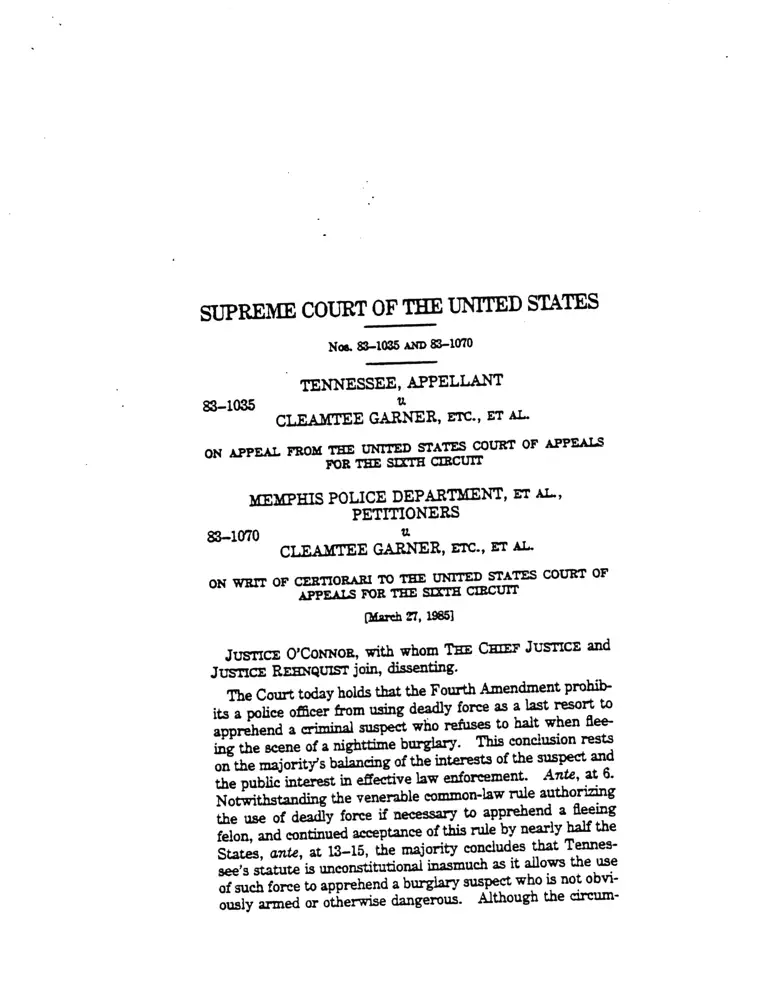
SUPREME COURT OF THE UNWED STATES
Noe. 8S-1035 AND 83-1070
TENNESSEE, APPELLANT
83-1035 ^
CLEAMTEE GARNER, e t c ., ET a l .
ON APPEAL FROM THE UNITED STATES COURT OF APPEALS
FOR THE SIXTH dRCUTT
MEMPHIS POLICE DEPARTMENT, ET a l . ,
PETITIONERS
83-1070 ^
CLEAMTEE GARNER, ETC., ET a l .
ON WRIT OF CERTIORARI TO THE UNITED COURT OF
a p p e a l s fo r t h e s ix t h CIRCUIT
(M a«h27, 1965]
Ju s t ic e O’Co n n o r , with whom Th e Ch ie f Ju s t ic e and
Ju s t ic e R e h n q u ist join, dissenting.
The Court today holds that the Fourth Amendment prohib
its a police officer from using deadly force as a l^ t to
apprehend a criminal suspect who refuses to halt when fle^
ing the scene of a nighttime burglary. This conclusion rests
on the majority's balancing of the interests of the suspect ^ d
the public interest in effective law enforcement. Ante, at 6.
Notwithstanding the venerable common-law rule authonzmg
the use of deadly force if necessary to apprehend a
felon, and continued acceptance of this rule by nearly the
States, ante, at 13-15, the majority concludes t ^ t 'T ^ e s -
see's statute is unconstitutional inasmuch as it a llo ^ th e ^ e
of such force to apprehend a burglary suspect who is not obvi
ously armed or otherwise dangerous. Although the orcum-
2 TENNESSEE u GARNER
Stances of this case are unquestionably tragic
nate, our constitutional holdings must be «.neral
the history of the'Fourth Amendment and to
impUcatioM of the Court's reasoning. By
serious and dangerous nature of residential b u ^ ia n e s ^ d
the longstanding practice of many States, the Court e ^
tively (S ates a Fourth Amendment ngh t^ ow m g a
suspect to flee unimpeded from a police o ^ r who | ^ P
S e ^ u s e to arrest, who has ordered the suspect to halt
and who has no means short of firii^ ran-
escape. I do not believe that the F o i ^ Amendment sup
ports such a right, and I accordingly dissent.
I
The below warrant brief review because they hig^
liA t the difflcult, spUt-second decirions poUce (jffice rsm ^
iS te in these circumstances.
Elton Hymon and LesUe Wright responded to a
can that a bursary was in progress at a private resi^®“ “ :
When the officers arrived at the scene, the cafl^ said
“they" were breaking into the house next door. A.pp. m m .
8 1 - ^ (CA6), p. 207. The officers found the
be«»n forcibly entered through a wmdow and saw hghts on m
aide the house. Officer Hymon testified that when h ^ w
the broken window he realized “that something was ^ S
inside,” id., at 656, but that he could not detOTi^e
anyone— either a burglar or a member of
™ within the residence. Id., at 209 As Officer H y ^ n
walked behind the house, he heard a door slam. He sa
Edward Eugene Gamer run away from the hou^
the dark and cluttered backyard. Gamer crouched next to a
6-foot-high fence. Officer Hymon thought Gamer was an
adult and was unsure whether Gamer ™
Hymon “had no idea what was in the hand [that^he roul
not see] or what he might have had on his p ^ m lcL ,it
658-659. In fact, Gamer was 15-years old and unannea.
83-1035 & 83-1070— DISSENT
TENNESSEE «. GARNER ^
Hvmon also did not know whether accompUcM renained
S thrhouae. 7d .,at657. The officer id e n t ^ ^
as a police officer and ordered Garner t o ^ t . G“ nw
pausedbriefly and then sprang to the top ofthe
Gamer would escape ifhe ctoh ed o v » the fe n « ,
Hymon fired his revolver and mortally wounded the sus
’“ ^ ^ ^ ^ ^ S p o n d e n t, the deceased’s
u s e . §1983 action in federal court against Hymon, tn
dty of Memphis, and other d e fe n ^ ts , for
tiSL of G arner's constitutional righ ts.
for the Western District of T e n n e y held ^
Hymen’s actions were justified by a Tennessee statute tha
auSirizes a police ofheer to “use all the n e c e s ^
effect the arrest,” if “after n o t^ ^ the
the defendant, he either flee or
Ann. §40-7-108 (1982). As construed by the T eu M S ^
courts, this statute allows the use of deadly force only ff a
police officer has probable cause to beheve that a per^n h ^
Smmitted a felony, the officer warns
intends to arrest him, and the officer reason^ly beheves ̂ t
no less than such force will prevrat the
e. 7̂., Joknsan v. StaU, 173 Tenn. 134, U4 S. W. M 8W
(1 & ) The District Court held that the T en n es^ statute
i^ ^ t u t io n a l and that Hymon’s actions a?
that statute did not violate Gamer’s consUtutionai ng^te.
^ e Court of Appeals for the Sixth Circuit the
grounds that the Tennessee statute “authorizing t ^ k i^ g of
fTunarmed, nonviolent fleeing felon by poUce m order to ^
vent escape” violates the F ourth A m en itoen t and the
Process CJlause of the Fourteenth Amendment. 710 F. 2d
240,244 (1983). , ^
The Court affirms on the ground that apphcation of tee
Tennessee statute to authorize Officer Hymon’s i^e of d ^ y
force constituted an unreasonable seizure m vioIaUon of ^
Fourth Amendment. The precise issue before tee Court
83-1035 & 83-1070— DISSENT
4 TENNESSEE u GAKNER
deserves emphasis, because both the decision below a n d ^ e
majority obscure what must be decided m ^ case. The
S i e ifn ot the constitutional validity of the T e^essee stot-
ute on its face or as appUed to some hypothetical
Instead, the issue is whether the use of deadly fo r M ^ ^
cer Hymon under the circumstances of this (^ v io la te d G ^-
^ 8 ̂ t itu t io n a l rights. Thus, the m ajont/s a s s e i^
that a police officer who has probable cause to a suspect
-may M t always do so by killing him,” aTite, at 7, is
tionable but also of Uttle relevance to the q ^ tio n
here. The same is true of the rhetorically stim ng s t^ m ra t
that *“It]he use of deadly force to prevent the ’
ony suspects, whatever the drcumstanc^, is
u i ^ S . ” Ante, at 9. The q u ^ o n we must a d ^ ^
is whether the Constitution allows the use of su ^
apprehend a suspect who resists arrest by ̂ em ptin g to flee
the of a nighttime burglary of a residence.
n
For purposes of Fourth Amendment ai^ysis, I agr^ ^ th
the C o ^ that Officer Hymon “seized” G ^ e r ^ h w ^
him. Whether that seizure was reasonable and
permitted by the Fourth Amendment requires a careful
^ ^ g of the important public interest m crime pre>^tion
ZT L ZcH on and the nature and quality of the m ^ ^ o n
upon legitimate interests of the individual United v,
U. S. 696,------ (1983). In s t r t o g this balance
here it is crucial to ackno^edge that police use of deaffiy
force’ to apprehend a fleeing criminal sus^^ct falls
-rubric of poUce conduct . . . necessarily [m v o ^ g ] s i^ t
action predicated upon the o »-th e -sp ^ o b ^ a tio n s o f ^ e
officer on the beat.” Terry v. Ohio, 2S2 U. S- 1, 20 (19^).
The clarity of hindsight cannot provide the s ta n d ^ for judg
ing the reasonableness of police decisions made m u n cert^
and often dangerous circumstances. Moreover I
more reluctant than is the Court to conclude that the Fourth
83-1036 & 83-1070—DISSENT
83-1035 & 83-1070-DlSSENT
TENNESSEE u GARNER ^
proscribes a poUce practice tlat was accepted at
the time of the adoption of the BBl of Rights ^ has con-
turned to receive the support of many sUte legislatur^.
though the Court has recognized that the reqi^xnents of the
Fourth Amendment must respond to the re^ ty of socia l^ d
technological change, fidelity to the notion of conatitu-
opposed to purely judidal-linuts on govern-
mental action requires us to impose a heavy b u rd ^
who that practices accepted when the Fourth
ment was adopted are now
See e. United States v. Watson, 423 U. S. 411, 416-421
(1976); Carroll v. United States, 267 U. S.
(1925). Cfl United States v. ViUaTMyrUe-Marq^, ̂ ti-
579, 585 (1983) (noting “impressive historical pedigree of
statute challenged under Fourth Amendment).
The public interest involved in the use of deadly force as a
last resort to apprehend a fleeing burglary suspert
primarily to the serious nature of the crime. Household bur
glaries represent not only the illegal entry into a p ^ n s
home, but also “pos[e] real risk of serious hann to others.
Solem V. H elm T ^ U. S. 277, 315-316 (1983) (BURG^,
C J., dissenting. According to recent Department of Jus-
ti<« statistics, “tt]hree-fifths of all rapes in the home, three-
fifths of all home robberies, and about a third <u hom e^gra-
vated and simple assaults are committed by burglars.
Bureau of Justice Statistics Bulletin, Household B i ^ l ^ 1
(January 1985). During the period 1973-1982, 2.8 milhon
such violent crimes were committed in the course of burgl^-
ies Ibid Victims of a forcible intrusion into them home by
a ririittime prowler will find Uttle consolation in the major
ity's confident assertion that “burglaries only rarely mvolve
physical violence." Ante, at 19. Moreover, even if a p ^ -
ticular burglary, when viewed in retrospect, does not mvolve
physical barm to others, the “harsh potentialities for vi^
lence” inherent in the forced entry into a home preclude
characterization of the crime as “innocuous, inconsequen-
5 TENNESSEE u GARNER
tial, minor, or ‘nonviolent:'” ’ Solem v.Helm, ^pra 316
(B u r g e r , C. J. , dissenting). See also Restatement of T o ^
§131, Comment g (1934) (burglary is among felomes ^ t
normally cause or threaten death or serious
R Perkins & R. Boyce, Cnimnal Law 1110 (3d ed. 19ffi)
(burglary is dangerous felony that creates unreasonable risk
of great personal harm).
Because burglary is a serious and dang^ us felony, the
public interest in the prevention and detection of the crime is
of com pelling im portance. W here a poUce officer has p ro to -
ble to arrest a suspected burglar, the use of deadly
force as a last resort m i^ t well be the only m e ^ of appre
hending the suspect. With respect to a particular b u r g ^ ,
subsequent investigation simply cannot represent a substi
tute for immediate apprehension of the criminal suspert at
the scene. See Report of President’s C o m r ^ n on Law
Enforcement and Administration of Justice, The C M ^ ^ of
Crime in a Free Society 97 (1967). Indeed, the ^ t ^ of
the Memphis Police Department testified that m his aty, if
anprehension is not immediate, it is likely that the s ^
p e S ^ not be caught. App. in No. 81-5605 (CA6), at 334.
2though some law enforcement agencies niay choose to
assume the risk that a criminal will remam at l a ^ , the
Tennessee statute reflects a legislative determination that
the use of deadly force in prescribed circumstances will
serve generally to protect the public. Such statut^ a ^ t
the police in apprehending suspected perpetrators of serious
crimes and provide notice that a lawful poUce oriCT to stop
and submit to arrest may not be ignored with
See, e. g., Wiley v. Memphis
1247 1252-1253 (CA6), cert, demed, 434 U. S. 822 (1977),
JotJ s v. Marshall, 528 F. 2d 1 ^ , 142 (CA2 1975).
The Court unconvindngiy dismisses the general deter
rence effects by stating that “the presently available evi-
dence does not support [the] thesis” that the threat ol f o ^
discourages escape and that *^ere is a substantial basis for
83-1036 & 83-1070— DISSENT
TENNESSEE u GARNER
doubting that the use of such force is an
the arrest power inaU felony cases. Ante, at 8-9. m r e
no question that the effectiveness of jK)hw ̂ e of
is igu ab le and that many States or mdividual pohce d e p ^ -
nxenS^ve decided not to authorize it
Isr to those presented here. But it should go ^thout
that the effectiveness or popularity of J
practice does not detemime its .o .^ ;
Spaziano v. Florida, 468 U. S. »
Eighth Amendment is not violated every time
r ^ s a conclusion different from a n ^ on ty f a s t ^
over how best to administer its criminal laws'O (shp op. 161
Moreover, the fact that poUce
statute is challenged on constitutional gromds
impose a burden on the State to produce s < ^ saenw s t ^
t id ^ t o dispel any possible doubts about the n e ^ t y of ̂
«^duct. tS s observation, I beUeve, has P « t i ^
83-1035 & 83-1070—DISSENT
number of the States.
Against the strong pubUc interests justifymg the condurt
a t ^ here must be weighed the individi^ mterests u n s
eated in the use of deadly force by poha officers. The
majority declares that “lt]he suspect’s fundament^ m te ^ t
hThis own life need not be elaborated upon. J*
This bUthe assertion hardly provides an a^eqmte ^^stitate
for the majority’s failure to acknowledge ffie (^tinctive m ^
ner in which the suspect’s interest m his life is even
to risk. For purposes of this case, we must re < ^ that the
poUce officer, in the course of investigating a
glary, had reasonable cause to arrest the s u s ^ ^ d o r d ™
L n to halt. The officer’ s use of force resulted beouse ffie
suspected burglar refused to heed this command and ffie offi
cer reasonably believed that there was no m ea^ short of Sr-
ing his weapon to apprehend the suspect Without
ing the importance of a person’s interest m his life, I do n
8 TENNESSEE u GARNEK
think this interest encompasses a right to
from the scene of a burglary. Cf. v. New
U. S. 573, 617, n. 14 (1980) (Whtte, J., diss^tm g) ( T O e
poUceman’s hands should not be tied merely of the
possibility that the suspect will fail to c o o p a ^ ^ jepto-
actions by law enforcement perMnnel”). The legiti-
mate interests of the suspect in these d r c u m s ^ ^
quately accommodated by the Tennessee stetote: to avoid toe
usT S deadly force and toe consequ^t nsk to his life, toe
suspect need merely obey toe valid order to ^ t .
A ^ p e r halancng of the interests mvolved suggests that
use of deadly force as a last resort to apprehend a cnnunal
suspect fleeing from the scene of a n ighttoe bu^lary ^ not
uni^onahle within the meaning of the Fourth A m en d m ^
Admittedly, the events giving rise to this case are “
spect deeply regrettable. No one can view toe death of an
S S n e d and apparently nonviolent 15-year old without sor
row, much less disapproval. Nonetheless,
ness of Offlcer Hymon’s conduct for purpose of the Fourto
Amendment cannot be evaluated by what later ^ p e ^ to
have been a preferable course of pohce actmn. "pie o f^ er
pursued a suspect in the darkened backyard of a ^ u se timt
L m all indicSons had just been burglarized. The police
officer was not certain whether the suspect w m alone or
unarmed; nor did he know what had transpired made the
house. He ordered the suspect to halt, ^ d when toe s i^
pect refused to obey and attempted to flee mght, toe
officer fired his weapon to prevent escape. The rea^nabl^
ness of this action for purposes of the Fourth i^endm ent is
not determined by the unfortunate nature of this p a ^ cu i^
case* instead, the question is whether it is constitutionally
impermissible for pohce officers, as a last resort, to shoot a
burglary suspect fleeing the scene of the crime.
Because I reject toe Fourto Amendment reasomng of the
majority and the Ckiurt of Appeals, I briefly note toat im
other constitutional provision supports the decision be-
83-1035 <t 83-1070—DISSEN T
TENNESSEE u GARNER ®
low. In addition to his Fourth Amendment claim,
respondent also alleged violations of due PJ*o^ss, the Sixth
Amendment right to trial by jury, and the Eighth A ^ ^ d -
ment proscription of cruel and unusual punishment. These
arguments were rejected by the District C o u rte d , e^wept
for the due process claim, not addressed by the Court of
Appeals. With respect to due process, the Court of Appeals
reasoned that statutes affecting the fundamental inter^t m
life must be “narrowly drawn to express only t ^ leg iti^ te
state interests at stake." 710 F. 2d, at 245. The Co o
Appeals concluded that a statute allowing pohce use of d e ^ y
force is narrowly drawn and therefore constitutional only if
the use of such force is limited to situations in which ^ e s ^
pect poses an immediate threat to others. Id., at ^ 2 4 7 .
Whatever the validity of Tennessee’s statute in other ran-
texts, I cannot agree that its appUcation in this
in a deprivation “without due process of law. Ci. v.
McCoUan, 443 U. S. 137, 144-146 (1979). Nor do I beheve
that a criminal suspect who is shot while trjrag to avoid
apprehension has a cognizable claim of a deprivation of ms
Sixth Amendment right to trial by jury. See Cunw n^^m
V. EllingUm, 323 F. Supp. 1072, 1075-1076 (WD T ^ im )
(three-judge court). Finally, because there is no indication
that the use of deadly force was intended to punish rath^
than to capture the suspect, there is no valid claim im der^e
Eighth Amendment. See Bell v. Wolfish, 441 U. S. 520,
538-539 (1979). Accordingly, I conclude that the District
Court properly entered judgment against respondent, and I
would reverse the decision of the Court of Appeals.
in
Even if I agreed that the Fourth Amendment was violated
under the circumstances of this case, I would be unable to
join the Court's opinion- The Court holds that deadly fo w
may be used only if the suspect “threatens the officer with a
weapon or there is probable cause to believe that he has com-
83-1035 & 83-107O—DISSENT
10 TENNESSEE u GARNER
mitted a crime mvolving the infliction or threatened ii^ ction
of serious physical harm.” Ante, at 10. The C o ^ i^ ores
the more general impUcations of its reasoning. Relymg on
the Fourth Amendment, the majority asserts that it con
stitutionally unreasonable to me deadly force apm st fleemg
criminal suspects who do not appear to pose a th i^ t of seri
ous physical harm to others. Ante, at 9. By declinmg
limit its holding to the use of firearms, the Court uimecessar-
ily implies that the Fourth Amendment constrains the um of
any poUce practice that is potentially lethal, n o ^ ^ r how
remote the risk. C t Los Angeles v. Lyons, 461 U. S. 95
(1983).
AlthouA it is unclear from the language of the opimon, I
assume that the majority intends the word “use to include
only those circumstances in iriiich the suspect is actually ap
prehended. Absent apprehension of the suspert, is no
“seizure” for Fourth Amendment purposes. I doubt ̂ t the
Court intends to allow criminal suspects who succ^sfully ^
cape to return later with § 1983 claims against o f f i ^ who
albeit unsuccessfully, deadly force in their ̂ futile at
tempt to capture the fleeing suspect. The Court s
despite its broad language, actually deades only that toe
shooting of a fleeing burglary suspect who was m fact neither
armed nor dangerous can support a § 19© action.
The Court’s silence on critit^ factors in the decision to
deadly force simply invites second-guessing of difficult police
decisions that must be made quickly in the most trying of
circumstances. Cf. Paytcm v. New York, supra, at 619
(WHITE, J., dissenting). PoUce are given no guid^ce for
determining which objects, among an array of p o te n t ly
lethal weapons ranging from guns to knives to basebaU bats
to rope, will justify the use of deadly force. The Court a^o
declines to outline the additional factors necessary to provide
“probable cause” for beUeving that a suspect “p c^ s a signifi
cant threat of death or serious physical injury,” ante, at 1,
when toe officer has probable cause to arrest and the suspect
83-1036 & 83-1070—DISSENT
83—1035 & 83—107(V—■DISSEl'TT
TENNESSEE u GARNER 11
refuses to obey an order to halt. But even if it
oriate in this case to limit the use of deadly force to that
S bieu ou s class of suspects, I beHeve the class should include
nightSne residential burglars who resi^
tempting to flee the scene of the crime. We can expert dn
S J a t i fg volume of litigation as the lower courts struggle to
determine if a poUce offlcer’s spUt-second
was justified by the danger posed by a p ^ c u l^ object ^
other facts related to the crime. Thus, the
portends a burgeoning area of F our^
wnceming the circumstances m which police officers can rea
sonably employ deadly force.
IV
The Court’s opinion sweeps broadly to adopt an ®^tirely
new standard for the constitutionality of the
force to apprehend fleeing felons. Thus, the C o ^ “h ^ tly
brusheCsl aside," Payton v. New York, supra, at 6W, a long-
landing police practice that predates tte
meat and continuea to receive the approv^ of
the state legislatures. I cannot accept the majority's ^
ation of a conatitationai r i^ t to ffight
seeking to avoid capture at the scene of the m ine. Wha
ever the constitutional limits on police use of d ^ y force m
o^Sr to apprehend a fleeing felon, I do not beheve they are
exceeded in a case in which a poUce officer h ^ prob^le » i^ e
to arrest a suspect at the scene of a residential burglary,
ders the suspect to halt, and then fires his jeapon as a 1 ^
resort to prevent the suspect's escape mto the night, i re
spectfully dissent.