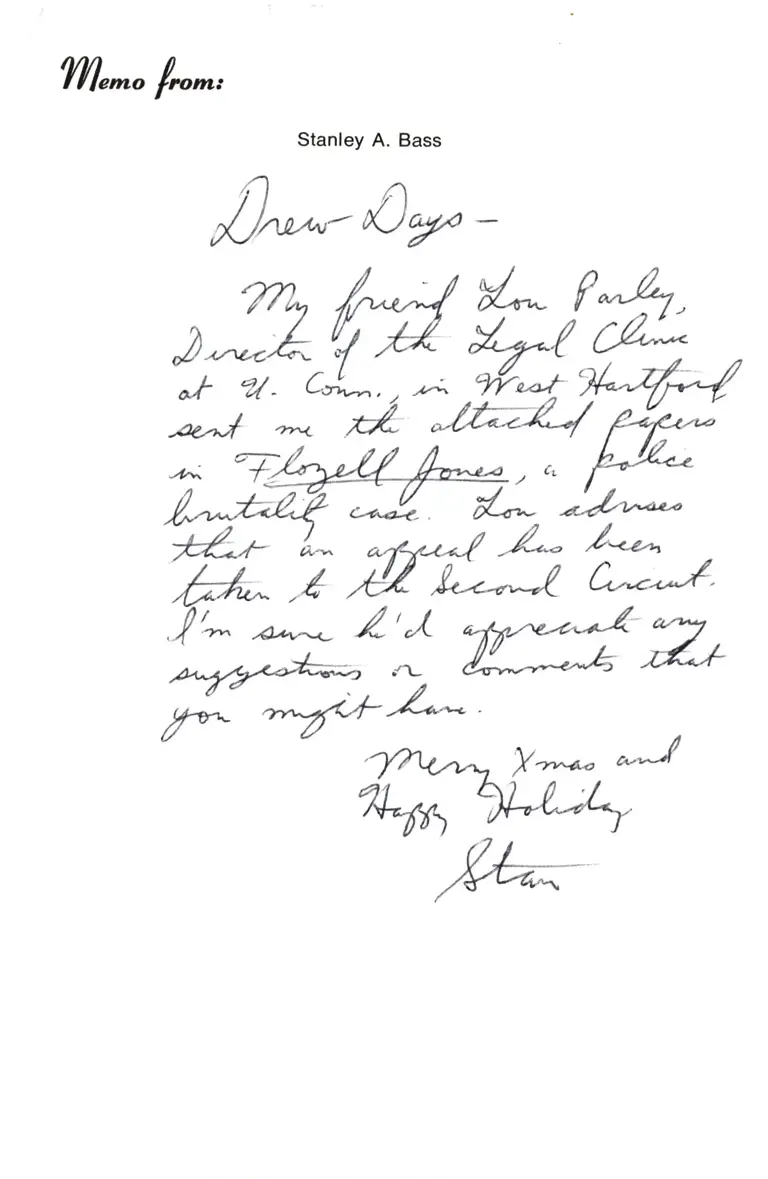
Memo and attached case files from Bass to Days RE: Jones v. Marshall
Correspondence
January 1, 1974
49 pages
-
Case Files, Garner Working Files. Memo and attached case files from Bass to Days RE: Jones v. Marshall, 1974. 934d7063-33a8-f011-bbd3-000d3a53d084. LDF Archives, Thurgood Marshall Institute. https://ldfrecollection.org/archives/archives-search/archives-item/b075bda7-0495-499c-9e7e-74508707e62b/memo-and-attached-case-files-from-bass-to-days-re-jones-v-marshall. Accessed September 20, 2026.
Copied!
W e ^ o ( r o n . :
Stanley A. Bass
'/ y iA n j' —
7 n ^ ^isL^
---------- ̂ /
,J ^ ->^ ^ cA .
* • • V '
■ u
UNITED STATES DISTRICT COURT
DISTRICT OF CONNECTICUT
̂___- .
FLOZELL JONES, Individually and as
Administrator of the Estate of
Dennnis Jones, Decedent
Plaintiff
va,
KEITH MARSHALL
Defendants
CIVIL ACTION NO. 13, 811.
PLAINTIFF'S BRIEF IN’ SUPTOKT
OF HIS MOTION FOR SU>DL\RV JUDGMENT
STATEMENT OF THE CASE
. ■ J*-,
This is an action for damages arising from the wrongLul death
of Dennis Jones, brought by his father Flozell Jones, as Administrator of
the estate. Tlvis Court has jurisdiction pursuant to Title A2, U, S. C. §1983
and Title 18 U. S. C. 51343.
The action originally named the defendant Keith Marsliail, a police
officer, the Town of West Hartford, West Hartford’s Police Chief William
Rush, and West Hartford's Town Manager Richard Custer. The actions against
the latter parties were dismissed by Judge Blumenfeld on June 29, 1971 and
all causes of action except the First Cause of Action against Ofiicer
Keith Marshall were subsequently withdrawn. Cf. Moor _ v _ i t l a .
411 U. S. 693 (1973); City of Kenosha v. Bruno, 412 U. S. 507 (1973).
STATEMENT OF FACTS
A statement of facts has been stipulated to by the parties. The
following narrat'*ve is taken from that stipulation.
On Augtist 29, 1969 at approximately 12 o'clock noon, Officer
Keith Marshall of the West Hartford Police Department, while on patrol in a
police cruiser and in the course of the performance of his duties, observed a
! *■
i
̂ LT- *
• ' --r' -‘••--Ti,.. .V* -5.'
Cadillac automobile occupied by three Black males, later identified as Russell
^y®ond Arter and the decedent.Dennis Jones, ail of Hartford
Connecticut. The automobile was proceeding in a westerly direction on
Simsbury Road in West Hartford, in the vicinity of the Hartford Coi f Club.
. c-;.-- Officer Marshall through radio contact with the West Hartford
Police headquarters received Information that the Cadillac was a stolen
vehicle and he therefore began to follow it.
He foUowed the car through the Hartford Coif Club cmU o Norwood
Road until it readied a stop atign located at Norwood Road and Albany .Avenue.
At chat stop signj:he Cadillac stopped for traffic and then turned Knc onto
Albany Avenue, heading for Hartford. Officer Marshall continued to follow
the car.
After it crossed the Hartford Town line, the car turned left
at Mark Twain Drive, and headed in a northerly direction. The car then turned
right onto Dillon Road. Dillon Road is a semicircular road and returns with
out Intersecting any other street to Mark Twain Drive. The automobile circled
back onto Mark Twain Drive again turning right and it was therefore once acain
lieadlng north on Mark Twain Drive.
While following the car. Officer Marshall did not activate lus
•siren or warning signal or make any attempt to cause the Cadillac to come to a
stop. Prior to the time the Cadillac re-entered Mark Twain Drive, it had not
been driven at speeds which exceeded 35 to 40 miles per hour nor had any traffic
regulations been violated. No high speed cliase had yet occurred. Prior to
the time that the automobile re-entered Mark Twain Drive, Officer Marshall had
learned by car radio that the Hartford Police Department had dispatched
assistance which w.as on its way.
!
j.
- 2-
•• ,
;&?A %A -
' -■.■ ■ 1 .
mr ’W im m '' rivnr ■ • "Tini -minn lafiu
\ L j - i
i ■ «
When the Cadillac re-entered Mark Twain Drive from Dillon Road
it accelerated to a speed of approximately 80 miles an hour. It reached
the end of Mark Twain Drive and continued straight ahead entering onto the Mark
Twain Extension at the end of which it skidded to a halt. Officer Mar.shall
continued to follow the' car and the tvro automobiles were ongage.I in a iiich
speed chase.
Upon arriving at the point at which the Cadillac had stooped,
Qtficer Marshall skidded to a halt and aliglited from his cruiser with Ills
weapon drawn. The braking of both cars had created a large cloud of dust.
• - Ihe occupants of the Cadillac were not immediately visible.
Officer Marshall therefore climbed to the top of an adjacent eiiibankr.ieut t,>
3 better view. Irom that point, he observed two males running across an
open field. He called at them to halt. They halted momcut.arilv turned to face
him and then they turned again and began to run away from wiicre Officer
Marshall was standing. They were running across a field toward a noatby
wooded area. Without firing a warning shot or attempting any further means
of apprenhension. Officer Marshall fired his weapon at one of the two nuiles
and the single shot he fired killed the decedent Dennis Jones. Dennis Jones
was 16 years old.
Officer Marshall had aimed at the decedent's leg. The bullet,
however., had struck the decedent in the left buttock and penetrated through
the left ilium and lacerated the left common iliac artery, peritoneum,
raassentery and Jejiinum, ultimately causing death.
! Officer Marshall had been 125 feet from Dennis Jones when he fired
his weapon. The distance between them can be characterized as a field covered
with bushes and underbrush.
Neither the decedent nor any of the other individuals in the
Cadillac had been armed or had specifically threatened physical injury to
Officer Marshall or to any other individual. The. sliort automobile high speed
-3-
. 1-
' pursuit had not endangered any individual other than the occupants of the two
. cars.-
, __ Russell Seals,Jr. and Elaymond Artec, both wLnors of .ipproxinuto 1 y
16 years of age, were arrested by Hartford Officers on tho next Jay. Neither
I of them was charged with a felony. The charges against one wore ultimately
dropped. The other pled guilty to a misdemeanor charge receiving a suspended
sentence.
X, EXISTING STANDARDS GOVERNING THE USE OF DEADLY FORCE HY rOLTC.E orFlCF.KS
WHEN ATTEMPTING TO CAPTURE A FLEEING FELON ARE INAPPLICABLE AS THE TEST
WHERE VIOLATIONS OF THE DUE PROCESS CLAUSE ARE CLAIMED
Actions brought In federal courts pursuant to the Civil Rights
Act, Title 42 U. S, C, 51983, must assert a violation of constitutional pro
visions or of federal statutes. The use of deadly force by police officers
in the process of attempting to effectuate the arrest of a fleeing felony
suspect is cognizable by a federal court because the wrongful use of such
force violates the due process clause of the 14th Amendment.
Averett. 424 F. 2d 1228, (4th Cir., 1970); Love v. Davis, 353 F. Supp. 533
(E.D. La.., 1973); Jackson v. Martin, 261 F. Supp. 902 (N.D. Miss. 1966);
Roberts v. Trapnell. 213 F. Supp. 49 (C.D. Pa., 1962). The constitutional
Halm is usiiany cast in terms of whether or not the officer's use of deadly
force amounted to an Impermissible interference with those rights the suspect
would have had in the criminal process. Screws v. United _States, 325 U. S. 91
(1945). But see Jenkins v. Averett, supra which rested the cunst1tutional
claim upon the invasion of the victim's person.
The concern in this case, however, is not with the theory oi the
constitutional claim, but rather with defining the standard against whleh
the actions of the police officer should be tested. An examination of the
reported federal decisions indicates that no uniform standard has ever been
developed. Instead, in each case involving the use of deadly force by the
police, the federal courts have adopted the local state law standard. The
■t
i
j-
■E-'-.-'-y ̂ i-4-.
. • v r. rr- • ' ■ TC* •- *T "• - A t « - * 'J’72 ̂JT*. • m. ' ̂ ‘ I*
tWQ most fre<iuently cited cases in the area of Feople of the State of
Colorado for the Use of Little v. Hutchinsop, 9 F. 2d 275 (8th Cir., 1925) and
Stinnett v. Commonwealth" of Virginia, 55 F, 2d 644 (4th Cir., 1942). In
Hutchinson the issue was raised in a diversity action, while in Stinnett
the issue was raised in a criminal prosecution of a federal liquor agent
which had been removed to federal court. In both cases he court adopted
the States' standards. The two standards were similar. In Colarndo
4
an officer could use as much force as is necessary under the circumstances.
In Virginia, he could use such force as reasonably appeared necessary
to effectuate the arrest. However, in Love v. Davis, 357 F. Supp. 3S7
(E.D. La., 1973), the federal court adopted a very different standard. It
adopted Louisiana's standard which had its roots in civil law and which
limited the use of deadly force to situations involving danger to life.
Similarly, in every other reported federal case dealing with the
problem, the courts have adopted the State standard. Roberts v. Trapncll,
213 F. Supp. 49 (E.D. Pa., 1962), Pennsylvania law; Jackson v. Martin, 261
F. Supp 902 (N.D. Miss., 1966), Mississippi law; Clark v. Zicdonis.
368 F. Supp. 544 (E.D. Wis., 1973), Wisconsin law; and Beard v. S.teplinns.,
372 F. 2d 685 (5th Cir. 1967), Alabama law; see Note Appropriateness of__
Deadly Force, 15 Howard Law Journal 306 (1969).
This state by state approach has the deficiency of resting the
federal constitutional claim squarely upon state common law or statutory riglits.
It is the Plaintiff's position that this inevitably results in the federal
e«»urts using standards in civil rights cases that arc inconsistent. Moreover,
almost every state standard in>the area is Illogical, antequated and
unconstitutional. It is the Plaintiff's position that the Due Process Clause
of the 14th Amendment requires the adoption of a standard under which:
I
Deadly force may be used to effect the
f9
arrest of a fleeing felony suspect only when
,;4
I
-5-
't-'
■ttsai
Zir Z t a ' -r
(1) the police officer believes that
such force is immediately necessary to
effect a lawful arrest, and (2) the
police officer believes that the force
employed creates no substantial risk of
Injury to innocent persons and (3) that
the crime for which the arrest is to be
made involves conduct including the*1180 or
threatened use of deadly force or that there
la a substantial risk that the person to be
arrested will cause death or serious bodily
harm if his apprehension is delayed. See
-S
h -% :
The Model Penal Code, Proposed Officla] Draft
1
1962, Section 3.07 , "Use of Force In Law
Enforcement" for a slightly differently worded
version of this proposed rule.
At the outset it must be recognized that tliere is no single
clear statement of the common law rule. Although the rule has been generally
identified as permitting the officer to use whatever force appeared reasonably
necessary to affect the arrest of a fleeing felony suspect. Note, Tl'S’..
AppUcation of Deadly Force to Effectuate An Arrest, 5 Washburn law .lournal,
262 (1966) It has also been described as permitting the use of deadly force
i
only as a last resort. Pearson, The Right to Kill in fkiking Arrests, 28
Michigan Law Review, 957 (1930); Rummel, The Right of Law Enforcement
Officers to Use Deadly Force to Effect an Arrest, 14 New York Law Forum, 749,
751 (1968); Cook v. Petrie, 414 S.W. 2nd 954 (Ark. 1967); Hĵ bb̂ yrd v.__8tate.
30 SW 2d 901 (Miss. 1947). One Jurisdiction even requires Ln order to justify
In Clark v. Zle^ojils, 368 F. Supp 544, (E.D. Wise. 1973) This slaiulari.1 has
Incidentally been adopted by a Wisconsin federal court applying state law.
- 6-
Z> '•
. • • T - " • • .T‘-=-2:-.s r --4 --- -4 .v--'.
t '•s.
' li %t
the shooting that there have been in fact a felony committed and that Che
deceased have been in fact the felon. f>n the other hand, another jnrisdiction
1,
‘ requires simply that the officer have had a reasonable belief that a felony
was committed and that the use of deadly force was reasonably required.
Compare Petrie v. Cartright, 70 SW 297 (Ky. 1902) and Johnson
Administrator, 63 SW 759 (Ky. 1901) with Martin v. Donlin, 151 Conn. 402
(1964). See also. Note, Killing a Suspected Felon Fleeing t(̂ K.scape .\rrost,
38 Kentucky Law Journal 609, 618 (1950); Note, Re-examination of the Riglit
of an Officer to Kill a Fleeing Felony Suspect, 40 Kentukey Law Journal
192 (1952).
This confusion has been compounded rather than alleviated by
the development of statutory rules. A survey of state statutes done in
1970 by the William and Mary Law Review Indicated that 16 states had
codified their interpretations of the common law rule and that at least four
different variations of the rule appeared within that group. Note,
Justifiable Use of Deadly Force by the Police; A Statutory Survey, 12
William and Mary Law Review 67 (1970). These variations turn on sucli points
as whether the statute requires that a felony have been committod In fact, on
whether the officer simply has to have reasonable grounds to believe that
a felony has been committed, or on whether the suspect might have been
charged with a felony. Ibid., at 72-76.
The conversion in 1971 of the Connecticut common law approach
contained in Martin v. Donlin, supra, into a statutory form added yet a fifth
statutory variation. Title 53a C. G. S. §22.
In addition to the various "common law" codifications there
are at least four rules which are at such variance with common law that
they should be separately mentioned. Alaska and Oregon apparently allow
deadly force to be used to stop anyone suspected of any crime who is
-7-
. i ̂ i ; . f ;J 3 3 •• ‘i : :: - .V
“ -.4
- '= V 1
attempting to escape. 12 William and Mary Law Review at 76. Texas, on the
other hand, permits deadly force to be used only in self-defense. Ibid, at 77
*■ Another group of states allows the use of deadly force only if a forcible
felony involving danger to'one*s life or great bodily harm is involved. Ibid-
' at 78-81. And finally there is growing adoption of the rule that appears in
the Model Penal Code, paraphrased above. In the last two years alone, five
states have enacted use of force statutes similar to the Model Penal Code or
similar to the forcible felony rule previously adopted In New York and
Illinois, which is comparable in many respects to the rule contained in the
Model Penal Code. Nebraska Revised Statutes §28-839 (1972); New Hampshire
Revised Statutes §627:5 (1971); Oregon Revised Statutes §161.239 (1973);
18 Pennsylvania Statutes §508 (1972); Utah Penal Code, §76-2-404 (1973).
See also, 1973 International Association of Chiefs of Police, Law Enforcement
Legislative Research Digest, Statutory Reference Service, Co m p i l a t i o n ^ __
(January 2, 1974),
It is not solely the inconsistencie.s contained in the various state-
tests which make the federal court deference to state standards appear to be
ludicrous. It is the fact that the common law rule in all of its variations
* is Illogical, antequated and barbaric. To understand how a common law rule
could have evolved that allowed for the killing of a fleeing felony suspect,
n person needs to briefly review the history of feudal felony law.
j By the year 1201, a felony was identified as a crime against tlie
feudal obligation (loyalty to one's lord) for which the felon's land could
be forfeited and for which the felon himself would lose his life. Similarly,
a man accused of being a felon who fled before his capture was automatically
"outlawed.," Pollack and Maitland, History of English Law, 2nd Ed. Vol 2.
(Cambridge University Press, 1968) p. 466; 4 M a c kstone's Commentaries. 94-98.
- 8-
l
K
{-
■>
The concept of outlaw ry was of ancient origin. It was more
than a label for someone who could be sought with force, it wajx in medieval
'timea a form of punishment. ,
2.' _ {]e vjiQ breaks the law has gone to war
with the community; the community got'i? to
" - war with him. It is tlie right and dutv or
every man to pursue him, to ravage his land,
' - to burn his house, to hunt him down like a
wild beast and slay him; for a wild beast he
^ ~ la; not merely is he a"friendless nuan" he
la a wolf. 2 Pollack and Maitland, p. A49
The concept of outlawry carried with it the attitude that one
who was considered an outlaw could and should be eliminated from society.
Similarly, the felon's procedural rights upon capture helped to doijegraio
any humane feelings concerning a suspect^s right to life. The life of the
suspected felon was of very little value. Not only were all felonies by
j
some point in the Twelfth Century punishable by death, but in addition
the suspected felon would probably lose his life whether he was innocent
or guilty. This was true because procedurally the felon was entitled to
offer his proof by trial by ordeal.
In the ordeal of cold water, a special favorite in England where
there were so many streams and ponds, the defendant was bound hand and
foolt* and thrown into the water. If he sank he was innocent and if he
floated he was guilty. The premise underlying the ordeal by cold water was
that water, being a holy element, would not receive a guilty man. The
defend.ant’s choice then was death by drowning, if innocent and death hy
hanging^if guilty. Norman S. Cantor, The English: A Hlstoryof Politics
and Society to 1760.(Simon and Schuster, 1967) p. 36, 37.
In analyzing the development of the common law rule that allows
for outlawry or, in other words for the murdering of suspects, it is
Important to note that the rule evolved prior to the elimination of trial
by ordeal. Trial by ordeal was effectively terminated in 1216 hy Lite 4tli
-9-
. 1
'1̂ - . ‘ .3
:* • ; ̂
..r. ! ' % I •-Cr-= Vr?-r-'5-:
Lateran Council, That Council forbade clerical iJarticipation in the ordeal.
Without church support the practice fell into desuetude. Cantor, .sû ira p.
..;237 and Strayer and Munro, The Middle Ages, 395-1500. (4th Ed. Appleton-
Century-Crofts, Inc., 1959) p. 310.
With this as its starting point, it is not surprisirp that the
common law could have wholeheartedly endorsed the use of deadiv force to
capture a fleeing felony suspect. Obviously, if felonies were punishable
by death and if fleeing felons were outlaws, then '*any necessary guilty
verdict could, in effect, be rendered after the execution of sentence."
McDonald, Use of Force by Police to Effect lawful Arrest, 9 Criminal Law
Quarterly, 435, 437 (1967).
It has been argued that the abondonment of the penalty of forfeiture
and the abandonment of the concept of outlawry, not to mention the growth
of logic, has substantially undermined the justification for the common law
rule. 15 Virginia Law Review, 582, 584; Note, Officer's Right to Use
Deadly Force to Arrest Fleeing Felon. 24 Iowa Law Review 159 (1938)
The annoying persistence of this outmoded common law rule
in modern legal thought therefore has in all probability come about as a
conscious effort to ignore its inherent inadequacies. Modern restatements of
rule that- have attempted to justify its continuance have done, so on the
basis that society’s interest in being free of criminal activities outweights
the suspect's interest in living. Therefore, these modern restatements
arj'.iiu that an officer can shoot to kill If it api)ears that sneli fi>ree is
reasonably necessary to capture the suspect. Perkins, The Law of Arrest.
25 Iowa Law Review 201 (1940). This unfortunate attitude is no more logical
5r
y.i
4
the
- 10-
A*
1 --414UIWK.
than the old comnon law justification. In rejecting the concept of
’ outlawry and In not relying upon the flight of the suspect to support the
■ use-of force, the new justification contains, no legal rationale. ,\ny
reliance on the use of force as an instrument of detetence is similarly
Illogical since studies have shown that the threat of force has no doteront
effect on the flight of suspects. Tslmbinos. The_JjiSt.lXedJJse,j:iLJl^
Force, 4 Criminal Law Bulletin 3, (1968)
The lack of any meaningful rationale for the continued application
of the common law rule warrnats its rejection as the text to be applied
in any constitutional determination. The rule, which has its historical
antecedents in the I2th Century, A. D. . should finally ho cast aside,
particularly in light of the momentous decision of the United States Supreme
Court in Furman v. Georgia, 408 U. S. 238 ( 1972)
II. THE DECISION INFUKMAN V. GEORGIA ELIMINATES ANY POLICY SUPPORT FOR
THE COMMON lAW RULE.
The common law sanctioned the death of a felony suspeit because
the threat he posed to society was considered to be greater th.in the value of
his life. The common law rule at least had an honesty about it. It clearlv
labeled the felony suspect as someone would could be killed -- he was an
"outlaw". The modern approach is substantially the same but, in sulfiring
from the inability to label the suspect an outlaw, it is less honest.
Moreover, wliatever legitimacy the common law rule or its modern
justifUtions may have had at the time of their development has been
undermined by the decision of the United States Supreme Court in ^.rman,v.
Georgia, 408 U. S. 238 (1972)
• The balance against human life that exists in the common
law rule is reversed in Furmn .Georgia. The emphasis is now placed on
i
r
h-
- 11-
• i r v
y 'i. w
• J - *» I
I , ,
' riFWi
human dignity and the sanctity of human life, Furman, ^08 U. S. at 270.
Furman clearly casts aside the classical concept of outlawry or the modern
view that a fleeing suspect's life could be forfeited simply because he.is
fleeing. An examination of the decision in Furman clearly shows the need to
adopt or to recognize a constitutional standard in which the suspect's cap
ture is not Ipsofacto worth more than his life. Each of the three cases
comprising the Furman decision Involve the discretionary imposition of a death
penalty on a convicted felon following a Jury trial. The Supreme Court held
that the penalty violated the cruel and unusual Clause of the 8th
Amendment and the Due Process Clause of the 14th Amendment to the
Constitution of the United States, 408 U. S. at 239. Each member of the
Court wrote his own opinion; five in support and four against the .judgment.
I
Although this presents difficulty in attempting to interpret the
Court's decision, its rationale is not impossible to discern. Justice
Brennan's opinion presents a framework for analyzing the approach taken
by the Court as a whole. It not only stands on its own but it substantially
encompasses the position of the other four majoirty Justices. The issue,
as framed by Justice Brennan, was whether death could be imposed as a ^
punishment or whether to do so would be cruel and unusual. 408 U. S. at 257
Finding no simple definition of the clause. Justice Brennan embarked on a
historical examination to determine what criteria, if any, had been
developed in order to test the validity of punishments. 408 U. S. at
258—282. This led him to develop the following four point test;
See Footnote 4, page ^3 infra.
3
Unless otherwise indicated all citations to the Furman decision are to
the opinion of Justice Brennan.
V
- 12-
r-
•: .. v;-. - t - --V 'AU. >•'.
The test, then, will ordinarily be a
cumulative one: if a punishment is
unusually severe, if there is a strong
probability that it ig inflicted arbitrarily,
if it is substantially rejected by contemporary
society, and if there is no reason to believe
that it serves any penal purpose more eifeerivel>
than some less severe punishment, then the
continued infliction of that punishment violates
̂the command of the Clause that the States may not
inflict inhumane and uncivilized punishments ̂
upon those convicted of crimes. 408 U. S. at _8_
An examination of the development by the Court of this test and of
Its application by Justice Brennan highlights the emphasis placed on thevalue
of human life. The Court's decision elevates its concern for human dlgnltv
po a position of such significance that any attempt to dovmgrade it should
run afoul of constitutional protection. Each of the prongs rests firmly on
Q concern Cor huinan dignity*
(1) Severity. The prior decisions of the Court have indlcntod
that an act is not allowed as a punishment if its use would bo "so severe to
be degrading to the dignity of human beings.” 408 U. S. 271 The focus is
not on pain inflicted but on those aspects that
[tlreat members of the human race as not
human, as subjects to be toyed with and
discarded. They are thus inconsistent with
the fundamental premise of the Clause that
even the vilest criminal remains a human
being possessed of common human dignity.
408 U. S. at 273
(?) arbitrary Imposition. The focal concern in assessing the arbltrurlnc
of imioaiug a penalty la also on its infringement of burn,.., dignity.
The state docs not respect hnm.an dignlt>
when wUI.out rca.son it Inflicts upon .some
people the severe punishment It does not
inflict on others. 408 U . S. at 274.
‘justice Douglas' opinion focuses prl^rily on 'ha arbitrary and discretionary
nature of the imposition of the death penalty. 408 U. S- 240 • ^
Stewart's rests on both the issue of less drastic means, 408 U. S 309 and
. c / nfl T! 809-310 Justice White s also rests
o" ti;: : r t - r — i r r r
arhitrarlly imposed. 408 U. S. 364-369.
-13-
/ A - 4
It is interesting to note, as Justice Brennan did, that there is a
close interrelationship between the severity*of the penalty and the
‘ arbitrariness of its imposition. Rarity of use is indicative of severity.
408'IT. S. at 276. In light of the decreasing number of crimes fer vhi,-:i
‘ death was a possible punishment and the rare number of ca.ses in which death
vas imposed, let alone carried out, it was clear that the death penalty was
not being fairly applied. 408 U. S. at 291-293. "Indeed it smacks of little
5
mope than a lottery system." 408 U. S, at 293.
(3) Societal Disapproval. Recognizing that societal disapproval is a
strorig indication that a punishment does not comport with human dignity.
Justice Brennan turned to various objective indicators to evaluate societal
opinion. 408 U, S. at 295. He found the continuing, voluminous, and emotional
public debate that had occurred indicative of tlie significant moral concern
over the use of death as a punishment. 408 U. S. at 306.
In fact, he found the progressive history of the use of a death
penalty to be one evidencing its abandonment. He said
[R]ejection could hardly be more complete
without becoming absolute. 408 U. S. at
300
■ ( 4 ) Less Drastic Means. With regard to this portion of his four part
test, Justice Brennan said that
The final principle inherent in rJic Clause
Is that a severe punishment must not he
excessive. A puni.shment is excessive iimler
this principle if it is unnecessary: the
infliction of a severe punishment by the state
cannot comport with human dignity when it is
' nothing more than the pointless infliction of
- - suffering. 408 U. S. at 293.
Ju.stlce Stewart considered the pattern of imposition of death sentences to he
so arbitrary that he characterized it as being "cruel and unusual in the same
way .as being struck by lightening is cruel and unusual." 403 U. S. at 309
-14-
1
/■. .n
Against this statement of principle any purpose that the death
penalty might serve other than the complete obliteration of the person could
obviously be served by~less drastic means. The death penalty does not
defer" any better than confinement. It does not rehabilitate. It doe> nc't
illustrate societal abhorrence of the offense involved any better than any
other means, 408 U. S. at 305.
Thus death is an excessive penalty to impose and to do so ii;nores
6
humanity.
As the history of the punishment of death
in this country shows, our society wishes
to prevent crimes; it has no desire to kill
criminals simply to get even with them.
408 U. S. at 305
of the four points of his test was that the death penalty was not consistent
with human life and dignity and was therefore not permissible.
The Court's opinion taken as a whole makes clear that the Court,
when confronting the legitimacy of death as a penalty for the first time,
found that its use was disfavored. This attitude toward death as a legitimate
penalty raises significant questions about its use throughout the other
phases of the law enforcement process. This is particularly true when it is
imposed prior to trial. Any attempt to justify the use of death as a law
enforremcuit technique must be done in light of _^*rn^n.
A more comprehensive analysis of the general purposes of the death penalty
was undertaken by Justice Marshall. 408 U. S. at 342-359.
This conclusion was also reached by Justice Douglas, 408 U. S. at 257 and
Justice Marshall, 408 U. S. at 371. Justice Burger in his dissent suggested
that Justice White and Justice Stewart would net have objected to mandatory
deatli piMialtles for specific crimes. 408 U. S. at 397, 403-403. Ihis
position, if accurate, does not undermine tlie fact that botli Justice Stewart
and Justice White clearly exhibited significant concern for protecting
human life. 408 U.S. at 309, at 317. See also the opinion of Justice Powell
408 U. S. at 415, Note 1.
-15-
' V, ;':r: :
. r • V '
E : i i. .i
V ■
■r- -*■-
The inevitable conclusion Justice Brennan reached from the application
1
Moreover this re-evaluation cannot be avoided merely by labeling
Furman "a cruel and.unusual punishment clause case.". The concerts contviincd
in the 8th and 14th'Amendments are essentially the same; there are cotK-erns
for human dignity.
[B]oth before and after sentencing,
constitutional protection against police
brutality is not limited to conduct violating
the specific command of the 8th Amendment or
as in Monroe v. Pape,. . .of the Fourth. Rochin
V. California must stand for the proposition
that quite apart from any "specific" of the
Bill of Rights, application of undue force by
law enforcement officers deprives a suspect of
liberty without due process of law. Jojinsou y._
Click, 481 F. 2d 1028, 1032 (2nd Cir.'*!^?!);
see also, Jenkins v. Averett, 424 F. 2d 122,
1232 (4th Cir., 1970)
i -
r
.i'
T
Thus it should be clear that when the Supreme Court undermined
the policy justification upon which the existing standards relied when
permitting the use of deadly force in tie arrest process, it also brought the
practice itself into question. The concerns of the Court render those
standards inapplicable in any due process determination. For example,
when Justice Brennan's test is used as a mode of assessing whether or not the
use of deadly force to capture a fleeing felony suspect adequately respects
the human dignity of that suspect, the rule's fallings become even mere
apparent.
(1) Unusual severity. Allowing a police officer to risk killing a
fleeing suspect is obviously exposing that person to an unusually severe
I
use of force. Not only is death not the penalty for most offenses, but in
the terms of this case, it is certainly not the penalty for escape, resisting
arrest, or for allegedly stealing a car.
Since none of the chargeable offenses carry the death penally, and
since the flight Itself did not justify executing the suspect, allowing a
police officer to risk the suspect's life was clearly a debasement of life
and has so been universally recognized by legal scholars. One of the leading
-in-
:
“ : • . .r • . '
. i r -
law journal articles quoting Professor Mikell said:
It has been said, "Why should not this man
be shot down, the man who is running away with
an automobile? Why not kill l\im if you cannot
arrest him?" We answer: because, assuming
that the man is making no resistance to the ofticer,
he does not deserve death..Maybe I ask what wo aro
killing him for when he steals an automobile and
runs off with it? Are we killing him for stealing
the automobile? If we catch him and try him,we
throw every protection around him. Wo say he
cannot be tried until 12 men of the grand jury
Indict him and then he cannot be convicted until
12 men of the petit jury have proved him guilty
^jeyond a reasonable doubt, and then when we have
done all that, what do we do to him? Put him before
a policeman and have a policeman shoot him? 01
course not. We give him three years in a peni
tentiary. It cannot be that we allow the officer
to kill him because he stole the automobile, because
the statute provides only three years in the
penitentiary for that. Is it then for fleeing?
And again I insist it is not a question of resistence
of the officer. Is it for fleeing that we kill
him? Fleeing from arrest is also a common law
offense punishable by a light penalty. A penalty
much less than that of stealing an automobile.
If we are not killing him for stealing the auto
mobile and not killing him for fleeing, what are
we killing him for? 13 Stanford, 566, 581 (1961)
(2) Arbitrary Imposition. If rarity and randomness of use are the indicia
of arbitrariness, then the use of deadly force in the arrest process is
arbitrary. Moreover, the statistics available provide a strong suggest ion
tlial .Iiinllie Douglas’ concern over racially discriminatory Imposition
was well founded. Reuben, Justifiable Homicide by __P_ol̂ c
Journal of Criminal Law, Criminology and Police Science, 225 (1963) .
Similarly, arbitrariness exists because there are no standards for
the police officer to consider. His decision depends more on his physical
state or on his whim than it does on legal principles.
-17-
£.
> .
•• • -a. -t*
t. /-.j;
(3) Societal Disapproval. The public debate over the use of deadl
force by police officers has been at least as continuous as the public debate
over the death penalty. Moreover, of the more than three dozen articles
on the topic in legal periodicals, only one appears to find the common Law
rule acceptable and, in that article, the author incorrectly characterizes
the common law rule as allowing for the use of deadly force only where it is
clearly employed as a last resort. Rummell, The Right of Law Enfocement
Officers to Use Deadly Force to Effect An Arrest. 14 New York haw Forum
749 (1968), All of the other legal scholars have rationalized some rule
allowing the use of deadly force in limited situations; perhaps because of
the existence of a legal death penalty at the time of their writing.- They
all, however, found the common law rule abhorrent. The author of tlie note
contained at 15 Virginia Law Review 582 lamented that "it is to be regretted
that the pronouncements from the bench anent a modification have been confined
to dicta." Ibid., at 585. He continued.
It is to be hoped that there will be judges
with sufficient courage to formulate a rule
more consonant with the laws of humanity
then Is the present, antequated law of the
courts. With due deference it is submitted
that the privilege to use a means likely or
• intended to cause death for the purpose of
effecting an arrest should be limited to those
crimes which are likely to cause death or
threaten serious danger thereof.
Similarly, the author of a note entitled The Use of Deadly Force
BJL. A Police Officer In the Apprehension of a Person In Flight. 21 University
of Pittsburgh Law Review 132 (1959) went so far as to suggest that the solution
to the problem might be for our police officers to follow the example of
bobbies and carry no firearms at all in the line of regular duty. For other
oxcelliuit examples of societal disapproval contained in legal per iod ica I.*> -̂ ee
Tappan, Official Homicide 6 Lawyers Guild Review 400 (1946); Note,
Justification for the Use of Force in The Criminal Law. 13 Stamford Law
t
-18-
; /
.ij-
:>:r>v--:>ry 1
I:
!' ■1 '
1
-T'*- ■
Review, 566 (1961); Note, The Use of Deadly Force in the Apprehension of
Fugitives from Justice 14 McGill Law Journal 295 (1968); Avins, Equal
Protection Against Unnecessary Police Violence and the Orin^inal Understanding
i of the Fourteenth Amendment; A Comment. 19 Buffalo Law Review 5 ’̂ 9 (1970); and
The President's Commission on Law Enforcement nnd the Administration of
Justice Task Force Report; The Police, page 189 (1967)
(4) Less Drastic Means. The ability of police agencies to apprehend
even the most illusive suspects, including but not limited to political
suspects such as Angela Davis and the Bcrrigan brothers, clearly undercuts
any claim that the use of force is needed to prevent the complete escape of
a suspect. This is especially important in light of the indications that
the existence of deadly force does not deter flight, Tsimbinos, 4
Criminal Law Bulletin 3, supra. Moreover, there are obviously nondeadly
means of force by firearms that can be employed by police officers. Articles
in local newspapers have indicated that the use of birdshot rather than
traditional shells has been considered by the state and local police.
Having examined the common law rule in light of the four point test
contained in Justice Brennan's decision, it should be clear that the common
law rule fails to satisfy the constitutional criteria requiring recognizition
. of human life and dignity in just the same way that the death penalty fails
to satisfy that constitutional criteria. The inhumanity of allowing a
police officer to terminate the life of a suspect merely because he cannot
run as fast as Llie suspect Is even more shocking tlian Llie Inluimauilv foiiiul
I . . .it should be noted that all of the law review articles cited in this brief
except for the Rummell article take a position calling for abandonment,
modification, alteration or different application of the common law rule,
unless they are justifying a rule that is already different from the common
law rule. A similar indicia of disapproval can be found in the statutory
alterations adopted by state legislatures when they enact a more limiting
test such as variations of the model penal code.
»•
-19-
fc H TH iiiTn n l i r i i i r i
10
to be contained in the uneven imppsition of death by juries. It is
Important to bear in mind that the sanctity of human life is so important
that even an accidental shooting is impermissible.
The Injury in this case could be called
"accidental"^ only in the sense that it was
not specifically intended. It was, however,
the direct consequence of the Defendant's
wanton conduct in the course of his attempt
-- to apprehend the plaintiff... Our concern
b^re is with the raw abuse of power by
a police officer... and not with simple
negligence...Jenkins v. Averett, 424 F. 2d
at 1033.
Vk.
III. DEADLY FORCE MAY BE USED BY A POLICE OFFICER TO EFFECT THE ARREST OF
FLEEING FELONY SUSPECT ONLY UNDER LIMITED CIRCUMSTANCES
There is substantial reason to believe that a majority of the
Justices of the United States Supreme Court still hold to the belief that
there is room for a limited use of the death penalty. Certainly this
would be true of all of the dlssentors. Moreover, Justices Douglas, Stewart
and White all appear to be willing to accept the death penalty if its use
could be nondiscrimlnatory, nonarbitrary and based upon clear and firm
policy statements. 408 U. S. at 257, 310, 313-334. Mandating a death
penalty for certain serious offenses would appear to meet this criteria
since it might create or be based upon a meaningful relationship between
the seriousness of the offense and the display of societal approval for the
elimination of an individual convicted of committing such a lieinous offense.
10 _
This conclusion will also be reached if the four factor test identified
in Johnson v. Click is employed. 481 F. 2d at 1033.
- 20-
‘] The underlying acceptance of some death penalties contained in Furman mzikes
it impossible to argue that Furman mandates the end of the use of deadly
force in all arrest situations. In fact, it is precisely the policies of
Furman that limit the application of the death penalty that support the use
of deadly force in some circumstances in the arrest process. Those polioic:
- - 11
are the Court's concern for human life and dignity.
taking of one life to protect the life of oneself or of another
has always been sanctioned by society, Miller Criminal I.aw, 199-218; 28
Michigan Law Review 957-960, and has been constitutionally rccogn 1::lh1 .
Row V. Wade, 410 U. S. 113, 163-165 (1973). These principles are in full
accord with the emphasis placed on human life and dignity. The balancing is
between the lives of a suspected wrongdoer and an apparent victim. Similarly,
the use of deadly force may be sanctioned where there is reason to believe
I
that the suspect's escape presents a threat of death or of serious bodily
harm. Again the concern for the protection of human life allows for a
balancing of the lives of the victim and the offender.
It is because of these principles relating to the need to respect human
life and dignity that we have proposed the rule set forth on page 6 supra
to govern tlie use of deadly force by police officers. As the rule is, in
oHsence, ;j rest.itement of the model penal code rule, we have appt'iuleil a lopy
of llie eomplele text of that rule to this brief. Its most relevant sections
provide:
II
The use of force upon or toward the person of another
is justifiable when the actor is making or assisting in
making an arrest and the actor believes that such force is
Immediately necessary to effect a lawful arrest. [However[
the use of deadly force is not justifiable under this Section
unless:
a. the arrest is for a felony; and
b. the person effecting the arrest is author I/.ed
Although Furman is again used as an essential test, the upproacli coiilaitud
in Johnson v. Click is similarly relevant. The Court there also recognized
a need to balance force with protection of human dignity. 481 F. 2d at 1033<
- 21-
. • « ̂ • -4 - Tti'., _•
V .1 r -V --
'-r.V* .—r -J!'Vis — *s .J'-* ̂ ■ -
ik
•. « .»s
, . . ~i
■ r ..,.«•
tQ act as a peace officer or is assisting
{I person whom he believes to be authorized
to act as a peace officer; and
c. the actor believes that the force employed
creates no substantial risk of injury to
Innocent persons; and
d. the actor believes that:
1. the crime for which the arrest is made
Involved conduct including the use or
threatened use of deadly force; or
2. there is substantial risk that the person
to be arrested will cause death or serious
bodily harm if his apprehension is delayed.
V
>■«
■
It is our belief that the model penal code rule fully satisfies ^
of the requirements of Furman and of Johnson v. Click. It eliminates
the concern that the use of deadly force might be unusually severe '
by clearly positing those special circumstances under which it might be used.
It limits it to those situations where there has been a felony which involved
the use or threatened use of deadly force or where there was a substantial
risk that the person to be arrested would cause death or seriou.s bodily
harm if his apprehension was delayed. It not unusually severe for a police
officer to risk the life of a flaelng suspect for the purpose of arresting
him where it is clear that the fleeing suspect has or will place the lives
>
of others in danger. Similarly, it eliminates any arbitrariness in the use
of deadly force by identifying those circumstances under which it may be
used. Clearly, the thrust of the rule is to discourage the use of deadly
force .and therefore those circumstances that warr.ant its use will appear
to be icircumstances where the use of deadly force was entirely reasonable.
I :
The rule also clearly indicates under what circumstances society will approve ̂
of the use of deadly force by a police officer and provides appropriate criteria,
to determine whether or not the officer acted within the guidelines that '
have been laid down by society. An officer's failure to abide by the criteria
set forth in such a rule would and should subject him to sanctions for
i
acting beyond the scope of that authority approved by society. Finally,
- 22-
TV ». ■
.'i
the rule reduces the use of deadly force for those circumstances where less
drastic means are not available. The effect of this rule is to limit the
opportunity for a police officer to employ deadly force to only those
situations where it might be said there is a compelling need for him to do so.
IV. THE USE OF DEADLY FORCE BY THE DEFENDANT I'OLICE OFFICER WAS IN
VIOLATION OF THE DECEDENT'S RIGHTS GUARANTEED TO HIM UNDER ITIE
DUE PROCESS CLAUSE OF THE FOURTEENTH AMENDMENT
i:
In light of the foregoing discussion it is clear tliat the Uetond.mc's
use of deadly force to effectuate the arrest of the decedent failed to
satisfy the constitutional test.
While it might be asserted that the Defendant believed that deadly
force was necessary to effect the immediate lawful arrest of the deceased,
it may be stated with equal certainty that that was the only possible
justification for the shooting. Moreover, even upon the stipulated facts
in this case there is arguably a substantial element of negligence in the
Defendant holding the belief that the shooting was essential. Decedent w.is
merely 125 feet away from him and possibly could have been pursued on foot.
In this regard it is significant that assistance was on the way from the
Hartford Police Department.
Even conceding arguendo that the Decedent knew that Officer M.arshall
wanted to arrest him for stealing a car, it is obvious both from the nature
of llie »)ffense and from the stipulated facts tliat Dennis' crime was not
one that Involved the use or threatened use of deadly force ;uul tlial there
was not substantial risk that the person to be arrested might cause death
or serious bodily harm if his apprehension was delayed. What occurred in
4;.
t'
12
See American T,.nw Institute Model Penal Code, Tentative Draft No. S, Pap.i’ S.’
to 6‘) for .1 lull discussion of itie position of llu- Aiiu-rlc.ui Law 1 n:.i i t nt e
on the .iilopted rule. See also Love v. Davis, 151 F. Snpp. 5H/ (i;.l). I.a.
197i)
-23-
*v “ . -i . . ̂ ■ y
* r w]
V , c....
v;
m uj wmm
the Instant case is that the Defendant police officer shot at a tlooing
felony suspect arbitrarily chosen to be his victim. Moreover, he fired
his weapon under circumstances which he had been instructed did not warrant
shooting. It is this element of contra instruction which makes the defendant';
behavior appear particularly reckless, wanton, unfortunate and.sad.
The West Hartford Police Department Training Bulletin clearly
warned against using deadly force simply to effect the arrest of a fleeing
felon; especially if the felony Involved was automobile theft. It provided
that;
In the Connecticut Police and Prosecutors
Manual, you have read, when possible, you
should, shoot to wound the person rather than
to kill. The statement is right, but neither
you nor I can be sure that the shot intended
to injure and disable will not kill either tiie
person that you are shooting at or some other
person.
Therefore it is best to shoot only when killing
! would be justified. Shoot to kill.
i
Stealing a motor vehicle is a felony but shooting
at a car that is carried on your verified list
or just given out is the wrong thing to do.
You do not know who is in the car or why. It
could even be the owner. Most times it is some
kid, who, if caught, is turned over to the Juvenile
Court, or, if a little older is charged witli
taking a motor vehicle without permission, a
misdemanor. "Gun Use Guidelines Are Read by
Police Force," West Hartford News, December 18,
1959, page 6.
The tragedy of the death of Dennis Jones is not merely that it
should not have happened. It is moreover that it could easily happen again.
Ah long as the common law rule exists it will continue to provide an aura
of permissiveness. It will continue to provide an aura that encourages
police officers to act as judge, jury and executioner.
For centuries, the rule has been criticized. For decades modern
legal scholars have condemned it. The underlying and only rational
rt
I
-24-
T V - • A * '
Justification for the rule was eliminated in Rome by a clerical convention
759 years ago. Yet the rule persists and each year finds some new youngster's
needless death justified on its alter of stupidity. Admittedly it nuiy
appear inequitable to this particular defendant to cast aside tlio common law
defense in his case. However, if it had been previously repudiated, tiiero
%rould hopefully have been no case. And if it is eliminated in this case.
hopefully there will be no others.
Respectfully submitted,
t
A*
r
t - Cl. ‘
- y/ y
Bruce Mayor
Attorney for Plaintiff
CERTIFICATE OF SERVICE
This is to certify that a copy of the foregoing Plaintiff's Uriel
In Support of His Motion for Summary Judgment has been mailed, postage
prepaid this 26th day of March, 1974 to Robert Pelgrift, Esquire, Uhl
Mountain Road, Farmington, Connecticut.
/
Bruce Mayor »
I
i
i
i.v
I /
ii
ii
»
II;M
i
M.4
i.:
n
ii
1
1
’i
. !>
J
j;
UNITED STATES DISTRICT COURT
' DISTRICT OF CONNECTICUT
FLOZELL JONES, Individually and as
Administrator of the Estate of
Dennis Jones, Decedent
CIVIL ACTION NO. 13, 811
Plaintiff
va.
PLAINTIFF'S BRIEF IN SUPPORT
OF ms MOTION FOR SU^nL-\RY
JUDGMENT
KEITH MARSHALL
Defendants
EXCERPTS FROM THE MODEL PENAL CODE
Section 3.07. Use of Force In Law Enforcement.
(1) Use of Force Justifiable to Effect an Arrest. Subject to the provisions
of this Section and of Section 3. 09, the use of force upon or toward the person of
another is justifi:4)le when the actor is making or assisting in making an arrest
and the actor believes that such forcg is immediately necessary to effect a 1 awful
arrest.
(2) Limitations on the Use of Force.
(a) The use of force Is not justifiable under this Section unless:
(i) the actor makes known the purpose of the
arrest or believes that it is otherwise known by or
cannot reasonably be made known to the person to
be arrested; and
(il) when the arrest is made under a warrant,
the warrant is valid or believed by the actor to
be valid.
(b) The use of deadly force is not justifiable under this Section unless:
(1) the arrest is for a felony; and
(ii) the person effecting the arrest is authorized
to act as a peace officer or is assisting a person
whom he believes to be authorized to act as a peace
officer; and
i/'V'.-
I •. -
!l
, t i * f
• f
, t {• ■
M.1
(Hi) the actor believes that the force employed creates
no substantial risk of injury to innocent persons; and
(Iv) the actor believes that:
(1) the crime for which the arrest is made
involved conduct including the use or threat
ened use of deadly force; or
(2) there is a substantial risk that the per
son to be arrested will cause death or serious
bodily harm if his apprehension is delayed.
ih
Section 3.09.
,1
.)
■ t
a
; f
Mistake of Law as to Unlawfulness of Force or Legality of
Arrest; Reckless or Negligent Use of Otherwise Justifiable
Force; Reckless or Negligent Injury or Risk of Injury to
Innocent Persons.
(1) The justification afforded by Sections 3.04 to 3. 07, inclusive, is
unavailable when:
(a) the actor’ s belief in the unlawfulness of the force or conduct
against which he employs protective force or his belief in
the lawfulness of an arrest which he endeavors to effect by force
is erroneous; and
(b) his error is due to Ignorance or mistake as to the provisions
of the Code, any other provision of the criminal law or the law
governing the legality of an arrest or search.
(2) When the actor believes that the use of force upon or toward the
person of another is necessary for any of the purposes for which such belief would
establish a justification under Sections 3. 03 to 3. 08 but the actor is reckless or
negligent in having such belief or in acquiring or failing to acquire any knowledge
or belief which is material to the justifiability of his use of force, the justification
afforded by those Sections is unavailable in a prosecution for an offense for which
recklessness or negligence, as the case may be, suffices to establish culpabihu .
(3) When the actor is justified under Sections 3.03 to 3.08 in using foice
upon or toward the person of another but he recklessly or negligently injures or
creates a risk of injury to innocent persons, the justification afforded by those
Sections is unavailable in a prosecution for such recklessness or negligence towards
Innocent persons.
I« J
- 2 -
̂ I; .
. . , .. r r'
UNITED STATES DISTRICT COURT
DISTRICT OF CONNECTICUT
FLO ZE LL JONES, Individually and as
Administrator of the Estate of Dennis
Jones, Decedent,
Plaintiff-
vs.
TOWN OF WEST HARTFORD, a Municipal
Corporation,
KEITH MARSHALL, Officer, West Hartford
Po lice Department,
W ILLIAM RUSH, Chief of Police, West
Hartford Police Department, and
RICHARD CUSTER, Town Manager, Town
of West Hartford, Defendants
C O M P L A I N T
April 22, 1970
CIVIL NO.
) ,
Bruce Mayor, Esq.
Ill Pearl Street
Hartford, Conn.
Louis I. Parley, Esq.
IBOO Asylum Avenue
West Hartford, Conn.
Patrick Brown, Esq. ISOO Asylum Avenue
West Hartford, Conn.
Of Counsel
• ^
COM PLAINT
I. JURISDIC TION
' ‘ This is an action to redress the deprivation, under color of
law, statute, ordinance, regulation, custom or usage, of rights, | >- alleges,
m - «(Mir • •
and immunities secured to the plaintiff and to the plaintiff's decedent,
Dennis Jones, by the Fourth, Fifth, Sixth, Eighth, and Fourteenth Amend
ments to the Constitution of the United States by the laws of the U r ' d
States, including 42 U. S. C. § 1983 and 1988, and by the statutes, ord i
nances, regulations, customs, usages, and common law of the State of
Connecticut* '
2. The jurisdiction of this court is invoked pursuant to 28 U. S. C.
• •
1343, and the laws of the State of Connecticut.
3, The jurisdiction of this court is further invoked pursuant to
28 U. S. C. § 1331, the matter in controversy exceeding, exclusive of
interest and costs, the sum or value of $10, 000. 00. '
•i. -v-.
• ,
I . I
f
I I
\ !
'/
' f
Im«3M
r
> ». .• ; •, -,i'
■'■,'\ ̂ V' V . ;A
Ii ■ ■■ . K .1I
1 - > •
■|; W; '‘:V
! 'v;. 'i' ■'■' • "■'.■ -̂'■i ̂ ' ’■ ' •, ■ "■ ■ ';■> ■■
• .■ *', •', ■■ ■'• ' i 'i;' i,V;vf.;- ' _ '.V
'' I 1 • ' ■' - •I. ^ ■ ■■ ■:■' • > • V .'■■■.•'■ ' ■'■• • * .
i i ’’-. :v;
PARTIES
A. Plaintiff
1. The plaintiff, FlozeU Jones, is the natural parent of the decedent,
Dennis Jones, aged 16 years old, late of Hartford, Connecticut, and has been
• •
appointed by the Hartford Probate Court as the Administrator of ;he Estate
of Dennis Jones and has qualified as such Administrator, and is acting
herein both ap natural parent and Administrator.
2. Plaintiff is a citizen of the United States and a resident of the
City of Hartford and the State of Connecticut. :
B. Defendants
1. Defendant, Keith Marshall was at all times mentioned herein,
and still is, a citizen of the United States and a resident of the State of
Connecticut, and the dxily employed officer of the West Hartford Pol'.ce
%
Department.
2. Defendant William Rush was at all times mentioned herein, and
still is, a citizen of the United States and a resident of the State of Connec- ̂
ticut, and the duly employed Chief of Police of West Hartford.
3. Defendant Richard Custer^^ was at all times mentioned herein,
and still is, a citizen of the United States and a resident of the State of
Connecticut and the duly employed Town Manager of the Town of West
Hartford.
4. Defendant Town of West Hartford, was at all times ment^.oned
herein, and still is, a' duly incorporated municipal corporation of the State
* . t <
of Connecticut.
"1-
necticut. ̂ V̂V’, ^ V
1-.'. ‘ ••,«r *, • . i >.r. :
.... . • j .1
■ ;".'Z
2 - .
1
'■ .;, Z < '' ■' ■ Z- ' Z -
' ■! Z'.- vV̂ ;Z,'- Z''
. . . . 'C Z v Z : Z - V . : ^ '^ vZ'..-:,V- ■
FIRST CAUSE OF ACTION
• •
1. On August 29, 1969, around noon-time. O fficer Keith
Marshall, of the West Hartford Po lice Department, while on patrol in a
police cruiser, and in the course of the performance of his duties, observed
a Cadillac automobile, occupied by three Negro males, later indentified as
Russell Seals, J r ., Raymond A rter, and Dennis Jones, all of Hartford,
Connecticut, proceeding in a westerly direction on Simsbury Road, in West
Hartford, in the vicin ity of the Hartford Golf Club.
2. O fficer Marshall began to follow the automobile, and
through contact with West Hartford Po lice headquarters, received informa
tion that it was a stolen vehicle.
3. O fficer M arsh ill continued to follow the car, which changed
direction, and began to head e;.»t, to Hartford, on Albany Avenue. A fter
crossing the Hartford town lii.;, the car turned le ft at Mark Twain Drive,
and headed in a northerly dir»ction. The car then turned right onto
Dill^on Road, and then circ le; back onto Mark llwain Drive, once again
n
heading north. '
I ^' 4
4. During tJ» course of this pursuit. O fficer Marshall did not
J
activate his siren or wai/ing light.
5. During che course of his pursuit. O fficer Marshall had
contact with the Hartfo d Po lice Department, which dispatched a cruiser
to his assistance, "he Hartford cru iser came on the scene in the vicinit/
of Mark Twain Dr/ve, \»lth its headlights, warning lights, and siren
activated.
6 At this point, the Cadillac, which had not gone faster than
th irty-five ’ forty m iles per hour, accelerated, and the two police cars
increased / Jeed to remain in pursuit.
7. The Cadillac continued north, to the'Mark Twain Extension,
where it ikidded ;o a halt. .
3 - I
■inwr>iy-^
• ■ ■ ‘ ; I
’ '
' • " : - ■
V '■ . !•■ .
'f-- ■■,,•7’
lv\
' • f ■ '
v/.*-* V
‘ ’ •.
•<■ v' v''
’■ ' ' ■ /■
. *v ■ •
- 7' ! '■ ■' ■
̂ , ‘ v.- ■ \ -
> V̂'
' 8* The occupants of the car immediately got out and ran up
an embankmont. * Officer Marshall arrived on the scene shortly ther&fter
and also skidded to a halt.
9. Upon alighting from his cruiser, and not immediately
seeing the three men. Officer Marshall climbed to the top of the embank
ment, from which point he observed two men running. He called at them to
hilt, and then, without firing a warning shot, or attempting any other means
of apprehension, fired his gun at one of the men, later identified as Dennis
Jones, the plaintiff's decedent. The shot struck Dennis Jones and caused
serious injuries and death.
10. An autopsy report showed that the bullet fired by Officer
Marshall struck Dennis Jones in the left buttock; that it penetrated through
the left ilium, and lacerated the left common iliac artery, peritoneum',
mesentery, and jejunum.. The report further sho.wed that there was intra
abdominal and retro-peritoneal hemmorrhage, which was secondary, par-
ticvilarly to the laceration of the aforesaid iliac artery.
11. Despite first aid measures that were applied at the scene,
Dennis Jones was dead on arrival at Saint Francis Hospital in Hartford.
12. The aforesaid actions of defendant Keith Marshall, acting
under color of law, deprived Dennis Jones of those rights secured to him
by the Fourth, Fifth, Sixth, Eighth, and Fourteenth Amendments to the
Constitution of the United States and the Laws of the United States in that
the use of deadly force against a fleeing person, in circximstances where
the person is not reasonably suspected of committing or having committed
a crime of serious bodily injury and is not reasonably suspectt^jif being
armed, deprives that person of the right to due process of law and to all
the safeguards which said Amendments are designed to assure a person in
such ciriumstances in the normal course of the criminal process, and
deprives that person of the right to be secure in his person and to be free
of physical abuse.
\
- 4
i.. \
SECOND CAUSE OF ACTION
<
1. All of paragraphs one through eleven (1 - 11) of the first
cause of action are included and made a part of this cause of action as if
repeated and fully set forth herein.
2. Defendant William Rush, as Chief of Police of the West
Hartford Police Department, and the superior and supervising officer of
defendant Officer Marshall, failed to provide for, secure to, or teach to.
Officer Marshall, and the other members of the West Hartford Police
• •
Department, instruments, contrivances, techniques, means and modes of efj
fecting an arrest in the circumstances of this case without the use of deadly
force, and said acts or ommissions were contributing causes to the death
of Dennis Jones.
3. Defendant William Rush failed to promulgate and super
vise and enforce standards prohibiting the use of deadly force by the mem
bers of the West Hartford Police Department .when effecting an arrest in
the circumstances of this case, and said acts or omissions were contri
buting causes to the death of Dennis Jones.
4. Defendant William Rush was at all times acting under
the color of law and the authority of his position, and said acts or omissions
caused Dennis Jones to be deprived of those rights secured to him by the
Fourth, Fifth, Sixth, Eighth, and Fourteenth Amendments to the Constitu
tion of the United States and the Laws of the United States in that the use
of deadly force against a fleeing person, in circumstances where the person
IS not reasonably suspected of committing or having committed a crime of
serious bodily injury and is not reasonably suspected of being armed, de
prives that person of the right to due process of law and to all the safeguards!
which said Amendments are designed to assure a person in such circum
stances in the normal course of the criminal process, and deprives that
person of the right to be secure in his person and to be free of physical
abuse.
■■■; 'y ■ ■ 1 . .
,■■ ' ■ r - 'i*t. •• ;
>'
■■■
■ : ■ ' ■ . ■■ : • .
• * • . y-• V . . . ^
: ’ •
J.. • . i; . v. • \ ̂ I
yr)? ; ‘ ■; ■. -
• • V i '
V- : • %. «. .
• , r ■■ ■ . ■.
' r .• ,
*.'1‘ •
‘ '' ■
THIRD CAUSE OF ACTION
«
1* A ll allegations of the first and second causes of acti^on
are included and.made a part of this cause of action as if repeated and
fully set forth herein.
i1 . ■
2. Defendant Richard Custer, as Town Manager of the Town
I .
of West Hartford, has the responsibility for overseeing the performance of
its officers, agents, employees, departments and agencies, and, acting
in this capacity, he failed to cause the West Hartford Police Department
to promulgate and supervise and enforce standards prohibiting the use of
deadly force by the members of the West Hartford Police Department when
effecting an arrest in the circtimstances of this case, and said acts or
omissions were contributing causes to the death of Dennis Jones.
t ■ • •
3. Defendant Town Manager was at all times acting under
color of law, and the authority of his position, and said acts or omissions
caused Dennis Jones to be deprived of those i;ights secured to him by the • •
Fourth, Fifth, Sixth, Eighth, and Fourteenth Amendments to the Consti-
*• /
tution of the United States and the Laws of the United States in that the
0
use of deadly force against a fleeing person, in circtimstances where the
person is not reasonably suspected of committing or having committed a
crime of serious bodily injury and is not reasonably suspected of being
armed, deprives that person of the right to due process of law and to all
the safeguards which said Amendments are designed to assure a person in
such circumstances in the normal course .of the criminal process, and
deprives that person of the right to be secure in his person and to be free
of physical abuse.
•\ ^ ̂V, ” ' ■ A i * ; / , ' V ^ V -
̂iV:'; v/:‘- .v, ■
' , . ■ : ’.V.- '■
' ‘ S'.. '■ S-■' ■^ S i i ■ ' V ' . . A ' . S ' ; -VV'
■ -S"’ .'V-S V.'S :S' S'--V ..A
.t
FOURTH CAUSE OF ACTION
1. A ll of paragraphs one through eleven (1 - 11) of the firs t
cause of action and paragraphs two and three (2 and 3) of the second cause
of action and paragraph two (2) of the third cause of action are included and
made a part of this cause of action as i f repeated and fully set forth herein.
2. Defendant Keith Marshall was negligent in that:
a. In apprehending Dennis Jones, he used m ore force than
was reasonably necessary in the circumstances;
b. He used deadly force to apprehend a person fleeing who
was not reasonably suspected of committing or having committed a crime
of serious bodily injury and was not reasonably believed to be armed: and
c. He violated the policy, regulations, and standards of the
West Hartford Po lice Department concerning the use of deadly force as
set forth in West Hartford Police.Train ing Bulletin dated October 27, 1967,
I .
and in the guidelines of the Task Force on Po lice of the President's Com-
m ission on Law Enforcement and the Administration of Justice.
3. Defendant W illiam Rush was negligent in that:
a. He failed to provide for, secure to, or teach to O fficer
Marshall, and the other members o f the West Hartford Police Department,
instruments, contrivances, techniques, means and modes of effecting an
arrest in the circumstances of this case without the use of deadly force;
b. He failed to promxilgate and supervise and enforce stan
dards prohibiting the use of deadly force by the members of the West
Hartford Po lice Department when effecting an arrest in the circumstances o|
this case.
' 4. Defendant Richard Custer was negligent in that he failed
to cause the West Hartford Police Department to promulgate and supervise
and enforce standards prohibiting the use of deadly force by the members of|
the West Hartford Po lice Department when effecting an arrest in the c ir
cumstances of this case. ' '
' i' . •• • ' • ' ■ *
'f̂ i .'-• »•»* V # J . ' .
r’ '• ■' 7
•v - C ': ‘
;:V .!;/:/■
"7 -'.rV*
7u’'
;%■■■. *: T;v :;v
5,’ As a direct and proximate result of the aforesaid acts
and omissions, the plaintiff's decedent suffered great injury to his body,
internal organs, and surrounding tissue, and extensive bleeding, and great
physical pain and mental anguish prior to his death, and death. As a result
of said injuries and death, his wage-earning capacity was totally destroyed.
»
As a further result of said injuries and death, costs and expenses were iii-
currsd by his estate in connection with his final treatment and burial.
V • • • 7 ;■ ;,r ' H ' - ' - ■ • . '■ -V" ^
' : 7'. 7' ■•• .*♦ 'j ‘ ..'v I*%,v ;.:c. ̂ .
• V. - ■ a : ^ i<, r. v ' - ■ •:. ■' " ;• •
'
̂ i ' . ' .•' I * ■■ •• V.--
'S • ■ ■'.% ••. ̂v i 'i-.V'• iv '‘ ‘ j; '• ■-• ••: *; • ■ ' ■ -
‘ ■.■'(•’ . ‘ ^'i'••■ v’ I . i v - . ; ; -. ^ 1 lit '■■■■'•■. ■ .■• .■ V ■•) tV '. it*'" ■ • > ' ; ? ̂ ‘'.’f', '■ ■ •• ■
.' j; *,.V'fi'' tV:: c ■■■'''■.* 1 1V* V .iv \ ■’ '. .
. .. '-i-̂ vV; %'• y V :v r ■ - y - - . 7 . -.v-' ■ ̂ : •
• -.•-V
‘tV''‘If.-.’,.'
. ■ V 7' V ‘ '
■ : i i ''f ‘ ■I
1
FIFTH CAUSE OF ACTION t
1. A ll paragraphs of the first, second, third, and fourth
causes of action are included and made a part of this cause of action as
i f repeated and fvilly set forth herein.
times mentioned herein, defendants Keith Marshall,
W ilham Rush and Richard Custer, were duly employed by the Town of
West Hartford,, and were acting, as its agents, employees, and offio-rs,
in the performance of their duties and within the scope of their employmeu*.
3. At a ll times mentioned herein, and at the present time,
defendant Town of West Hartford was a municipal corporation of the State
of Connecticut, and was the employer of defendants Marshall, Rush and
Custer, and that the defendants Marshall, Rush and Custer performed all
acts or omissions menUoned herein in the name of, and for the authority
of, the Town of West Hartford.
4. The Town of West Hartford is incorporated under the laws
• of the State of Connecticut with authority to sue and be sued in its corporate
name, and is liable for the acts of its employees pursuant to the statutes.
• •
of the State of Connecticut.
I
5. Notice of intention to commence this action and of the time
and place where the injuries and death occurred has been filed with the
Town Clerk of the Town of West Hartford within six months after the in
juries and death occurred.
: I
̂ i.
PRAYER FOR RELIEF
WHEREFORE, the plaintiff prays:
1. Judgment against defendants Keith Marshall, W illiam
Rush and Richard Custer, and the Town of West Hartford, in the amount
o f $200, 000. 00.
I
i ‘ .
I 2. Judgment against defendant W illiam Rush, and his em
ployer, the Town of West Hartford, and an order requiring him to:
a. Promulgate and make public record of police
department standards regulating the use of deadly force
, by members of his department when effecting an arrest.
y ■ •
b. Institute a program for testing the members of
the police department to insure their continuing adherence
• to department standards regarding the use o f deadly force.
■ ' c. • Secure devices, instrximents, or equipment to be
• used and carried by the members of the police department as
I ■ ■
means of apprehending fleeing suspects without the use of
deadly force, and to educate members of the police department
in the proper use of such alternative devices. ’ ^
3. Judgment against defendant Richard Custer, and his
^^^pl®ycr, the Town of W^est Hartford, and an order requiring him to:
j Assist in the establishment of procedures for en-
> <•
’ ' < j forcing such rules as the Chief of Po lice might promulgate re-
• ■ V • *
; lating to the use of deadly force.
( ' b. Assist in the efforts to secure devices, instruments or
■ equipment to be used fo r apprehending fleeing suspects without
the use o f deadly force.
. t •'»*
4. Such other re lie f as may be appropriate.
■-i- ■ !
■■ i
. T
' V. ;•
. V ‘ \
April 22, 1970
Respectfully Submitted,
THE PLAINTIFFS
BT:
Bruce m a y0 I 7 W 0 .
LOOls I. F A R M , eSq .
HtklcK bRowN , ES(5.
Their Attorneys
} r
\V
a io it t f i in r Il iu m
l i
dci 3 J 35 iVH
UNITED STATES DISTRICT COURTi, ' . ..ONM.
DISTRICT OF CONNECTICUT
FLOZELL JONES, Individually
and as Administrator of the
Estate of Dennis Jones,
Decedent
V.
KEITH MARSHALL, Officer,
West Hartford Police
Department
CIVIL NO. 13,811
RULING ON CROSS MOTIONS FOR SUMMARY JUDGMENT
This is an action for damages for the death of Dennis
Jones that has been brought by his father as administrator of
his estate. The defendant. Officer Keith Marshall of the
West Hartford Police Department, who shot and killed Jones,
is alleged thereby to have deprived the decedent of his civil
1/rights under color of state law. 42 U.S.C. § 1983 (1970),
Jurisdiction is proper tinder 28 U.S.C. § 1343(3) (1970). The
parties have filed cross motions for summary judgment based
upon the following basic facts to which they have stipulated.
. ^
17
The complaint originally named as defendants Marshall; the
Town of West Hartford; William Rush, Chief of the West
Hartford Police; and Richard Custer, West Hartford Town
Manager. The causes of action against all but Keith Marshall
were dismissed by order of this Court, Jones v. Marshall.
Civ. No. 13,811 (D. Conn. 1971), and a claim of negligence
■against Marshall was- subsequently withdrawn by the plaintiff,
leaving the § 1983 claim against Marshall as the sole cause
of action.
KT. 1
. i f
- 2 -
t-
I, Facts
-«iy w f'
On August 29, 1969, at approximately noon. Officer
Marshall, while on patrol in his cruiser, observed a Cadillac
being driven by three males, later identified as Russell
Seals, Jr., Ra3rmond Arter, and Dennis Jones. Through radio
contact with the West Hartford Police Headquarters, Marshall
learned that the automobile was a stolen vehicle and began to
follow it. Marshall made no attempt to stop the car and did
hot activate his siren or flasher. The Police Headquarters
radioed him that assistance from the Hartford Police Depart
ment was on the way.
The Cadillac and Marshall proceeded for some time into
Hartford at a moderate pace. However, when the Cadillac
entered Mark Twain Drive from Dillon Road it accelerated to
about 80 miles per hour and proceeded, with Marshall in pur
suit, onto Mark Twain Extension. At the end of the Extension,
the Cadillac and the police cruiser skidded to a halt, creating
a large cloud of dust.
Marshall alighted from his cruiser with his weapon
drawn. Since the occupants of the Cadillac were not immedi
ately visible, Marshall climbed to the top of a nearby embank
ment, and from that point he observed two males running across
an open field. He called to them to halt. They did so
momentarily and turned to face him; then they turned and
began to run away from Marshall foward a nearby wooded area.
- 3 -
Without firing a warning'shot or attempting any further
means of apprehension, Marshall fired his gun at one of them,
Dennis Jones. Although Marshall aimed at Jones' leg, the
bullet struck the decedent in the left buttock and then pene
trated the left ilium and lacerated the left common iliac
artery, peritonexmi, massentery, and jejunvnn, causing death.
At the time, Marshall was 125 feet from Jones; the intervening
distance can be characterized as rough terrain containing a
gully and covered with bushes and underbrush.
Neither Jones nor the other individuals in the Cadillac
was armed or specifically threatened physical injury in any
«manner to Officer Marshall or anyone else. The automobile
pursuit did not endanger anyone other than the occupants of .
the two cars.
Officer Marshall actually and reasonably believed that
Jones was a felony suspect. Theft of a motor vehicle was
defined by state law as a felony at the time these events
occurred. Conn. Gen. Stat. § 53-57. Marshall actually and
reasonably believed that it was necessary under the circimi-
stances to use deadly force to apprehend and arrest Jones.
II. Civil Liability and the Constitutional Claim
If this case had been brought as a wrongful death
action in state court, there could have been no recovery:
Marshall, on the stipulated facts, would have been privileged
to shoot at Jones. In Martyn v .’’ Donlin. 151 Conn. 402 (1964),
- 4 -
a police officer (Donlin) chased and shot one whom he reason
ably believed to be a felon (Martyn) when Martyn ignored the
officer’s order to stop and climbed over a fence. Finding
that Donlin had a reasonable belief that the use of deadly
force was necessary to effect the arrest, the court declined
to hold him liable for Martyn's death. The case states the
2/Connecticut common law principles
"Under our rule, in effecting a legal arrest,
the arresting officer may . . . use such force
as he reasonably believes to be necessary,
under all the circumstances surrounding its
use, to accomplish that purpose, that is, to
effect the arrest and prevent an escape. . . .
But the use of a means, or of force, likely to
cause death, as was the case here, is privileged
only if the arrest was for a felony and the
force used was reasonably believed to be
necessary to effect that arrest. . . .
tf• • • •
If
. I
. An officer in using deadly force for
this purpose must act in good faith. He must
have actually believed, and also have had reason
able cause to believe, that it was necessary
under the circumstances, to use deadly force to
make the arrest."
These common law principles, if constitutional, are
applicable here; in Pierson v. Ray, 386 U.S. 547 (1967), a
suit under § 1983 for damages for false imprisonment, the
Court emphasized that the section "should be read against the
background of tort liability" and recognized the common law
17
Although there are*variations of this rule in some states,
the Martyn formulation is representative of the common law
rule.
3/
151 Conn, at 411-12.
[
««
- 5 - _
privilege of a police officer to make an arrest, in good
faith and with probable cause, of one whose innocence is later
proved. Similarly, this Court must allow Marshall to use the
common law privilege enunciated by Martyn v. Donlin as a
shield against liability unless that common law privilege
itself be xmconstitutional. C^. Jenkins v. Averett. 424 F.2d
1228 (4th Cir. 1970); Clark v. Ziedonis. 368 F, Supp. 544
(E.D. Wis. 1973); Love v. Davis. 353 F, Supp. 587 (W.D. La.
1972).
The plaintiff does not challenge any of these principles
as embodied in Connecticut's law other than that element which
extends the privilege to use deadly force to attempt to effect
an arrest for an offense that did not pose the risk of death
or serious bodily harm. As to this element, the plaintiff
contends that the proposed limitations on the use of deadly
force, as stated in the Model Penal Code, are constitutionally
required. With regard to the instant case, the relevant sub
sections in that code provide:
"(b) The use of deadly force is not
justifiable under this Section unless;
(iv) the actor believes that:
(1) the crime for which the arrest is
made involved conduct including the
use or threatened use of deadly force;
or
(2) * there is a substantial risk that
the person to be arrested will cause
death or serious bodily harm if his
apprehension is' delayed." 4/
57Model Penal Code § 3.07(2)(b)(iv) (proposed official draft
1962).
■yam
t « . , j ■ i w y T
j#*
/ '•
• t
.»■
. 6 -
The basis for the plaintiff's contention lies in policy
argtments that allowing the use of deadly force in circxjm- '
stances such as those of this case is "illogical, antequated
[sic] and barbaric." Reduced to its essence the argument is
that allowing life to be taken to protect property is barbaric
in our modem world, where only jail sentences and fines are
prescribed as punishments for crimes against property. In
arguing that "[t]he balance [between the value of a suspect's
life and the threat he poses to society] against life that
exists in the common law rule is reversed," the plaintiff
relies upon language that appears in the opinions in Furman
V. Georgia. 408 U.S. 238 (1972). Furman provides no support
for that proposition, however. The case cannot be explained
as founded upon an overriding reverence for human life.
Fuiman does not hold that imposition of the death penalty is
^constitutional. Rather, the key to Furman is only its
insistence that in the imposition of the death penalty pro
cedures which allow the wide discretion to triers heretofore
employed are not permissible. Note, "Discretion and the
Constitutionality of the New Death Penalty Statutes," 87 Harv.
L. Rev. 1690 (1974).
In his argument the plaintiff also relies upon Johnson
V. Click, 481 F.2d 1028 (2d Cir. 1973), which sets up as a
criterion for § 1983 actions which seek damages for personal
injuries at the hands of state officials the "shock-the-
conscience" test of Rochin v. California. 342 U.S. 165 (1952).
i .
. iT
- 7 -
The plaintiff’s contention is that if that criterion is
jsjpplled the Martyn rule falls on the wrong side of the line.
However, language in Johnson itself proves that the plaintiff
has misread its scope: "Certainly the constitutional protec
tion is nowhere nearly so extensive as that afforded by the
common law tort action for battery, which makes actionable any
intentional and unpermitted contact with the plaintiff's
person . . . 481 F.2d at 1033. In the present case, of
course, the plaintiff could not recover in tort at common law,
for Marshall under the common law was privileged under the
circumstances to fire at Jones.
I It is noteworthy that during the course of the recent
codification and substantial revision of Connecticut's
criminal laws, which effort used the Model Penal Code as a
guide, the Martyn rule was retained and c o d i f i e d . T h e Court
5 T
Conn. Gen. Stat. § 53a-22 provides, in pertinent part:
"Sec. 53a-22. Use of physical force in making
arrest or preventing escape.
(a) For purposes of this section, a reason
able belief that a person has committed an offense
means a reasonable belief in facts or circum
stances which if true would in law constitute an
offense. If the believed facts or circumstances
would not in law constitute an offense, an erro
neous though not unreasonable belief that the
law is otherwise does not render justifiable the
use of physical force to make an arrest or to
prevent' an escape from custody. A peace officer
who is effecting an arrest pursuant to a warrant
is justified in using the physical force prescribed
in subsections (b) and (c) unless such warrant is
invalid and is known by such officer to be invalid.
[Footnote continued on following page.]
- 8 -
regards this legislative assessment of the balance between
life and property values, occurring as it did after the events
here in question took place, as strong evidence that the
common law rule is not one which is generally regarded as so
shocking to the conscience as to violate the Constitution.
While there is no doubt that a contrary view exists and indeed
has much to support it, it is not the prerogative of this
Court to judge the constitutionality of state laws on policy
grounds alone,*as the plaintiff would essentially have it do.
If the plaintiff believes the state law on the use of deadly
force to effect an arrest to be unjust or overly harsh, it
is to the legislature, and not the federal courts, that he
must turn. The plaintiff*s motion for summary judgment is
5/ cont'd
(b) Except as provided in subsection (a),
a peace officer is justified in using reasonable
physical force upon another person when and to
the extent that he reasonably believes it neces
sary to: (1) Effect an arrest or to prevent the
escape from custody of a person whom he reason
ably believes to have committed an offense, un
less he knows that the arrest or custody is
unauthorized; or (2) defend himself or a third
person from the use or imminent use of physical
force while effecting or attempting to effect
an arrest or while preventing or attempting to
prevent an escape.
(c) A peace officer is justified in using
deadly physical force upon another person for
the purposes specified in subsection (b) only
when he reasonably believes that such is neces
sary to: (!)• Defend himself or a third person
from the use or imminent use of deadly physical
force; or (2) effect an arrest or to prevent
the escape from custody of a person whom he
reasonably believes has committed or attempted
to commit a felony." (Emphasis in original.)
r
- 9 -
denled, and the defendant *s motion for summary judgment is
granted.
SO ORDERED. ... . --
Dated at Hartford, Connecticut, this d a y of
October, 1974.
̂ f
<
I
i
.11
* {I
• i
M. Josedh Blumenfeld f
United Stated District Juage
, <