Memorandum in Support of Motion to Dismiss
Public Court Documents
May 23, 1975
-
Case Files, Garner Hardbacks. Memorandum in Support of Motion to Dismiss, 1975. c6d498c8-24a8-f011-bbd3-000d3a151b15. LDF Archives, Thurgood Marshall Institute. https://ldfrecollection.org/archives/archives-search/archives-item/b24321b8-39cc-4fb3-89a7-b4ef774efd87/memorandum-in-support-of-motion-to-dismiss. Accessed September 25, 2026.
Copied!
IN THE UNITED STATES DISTRICT COURT
FOR THE WESTERN DISTRICT OF TENNESSEE
WESTERN DIVISION
CLEAMTEE GARNER, father and
next of kin of EDWARD EUGENE
GARNER, a deceased minor.
Plaintiff,
VS.
MEMPHIS POLICE DEPARTMENT;
CITY OF MEMPHIS, Tennessee;
WYETH CHANDLER, Mayor of
Memphis; JAY W. HUBBARD,
Director of Police of Memphis;
and E. R. HYMON, Police Officer
of the City of Memphis,
Defendants.
CIVIL ACTION
No. C-75-145
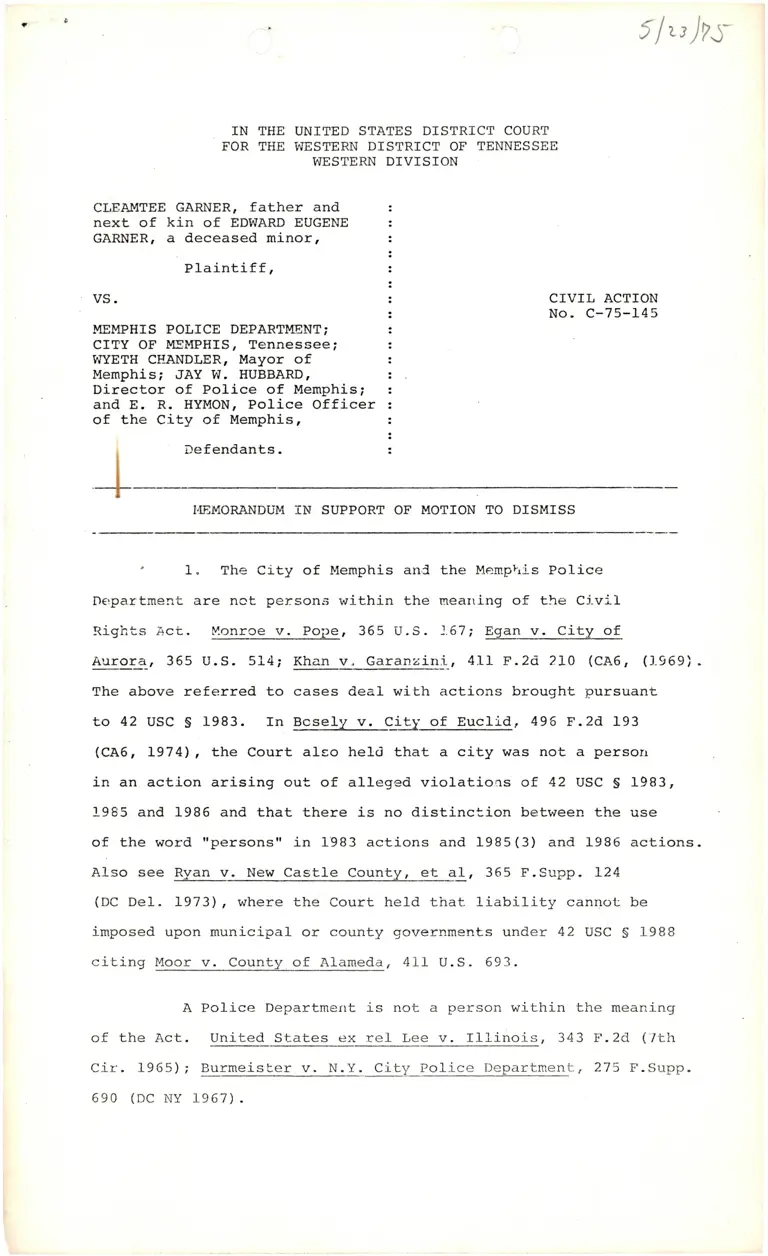
MEMORANDUM IN SUPPORT OF MOTION TO DISMISS
' 1. The City of Memphis and the Memphis Police
Department are not persons within the meaning of the Civil
Rights Act. Monroe v. Pope, 365 U.3. J.67; Egan v. City of
Aurora, 365 U.S. 514; Khan v, Garan2:ini, 411 F.2d ?10 (CA6, (1569)
The above referred to cases deal with actions brought pursuant
to 42 use § 1983. In Besely v. City of Euclid, 496 F.2d 193
(CA6, 1974), the Court also held that a city was not a person
in an action arising out of alleged violations of 42 USC § 1983,
1985 and 1986 and that there is no distinction between the use
of the word "persons" in 1983 actions and 1985(3) and 1986 actions
Also see Ryan v. New Castle County, et al, 365 F.Supp. 124
(DC Del. 1973), where the Court held that liability cannot be
imposed upon municipal or county governments under 42 USC § 1988
citing Moor v. County of Alameda, 411 U.S. 693.
A Police Department is not a person within the meaning
of the Act. United States ex rel Lee v. Illinois, 343 F.2d (7th
Cir. 1965); Burmeisber v. N.Y. City Police Department, 275 F.Supp.
690 (DC NY 1967) .
2. The City of Memphis is not a person within the
meaning of the Civil Rights Act which would make it subject to
equitable relief. In Deane Hill Country Club, Inc, v. City of
Knoxville, 379 F.2d 321 (CA6, 1967), the Court held that under the
Supreme Court decision of Monroe v. Pope, supra, equitable relief
could not be obtained against a municipality under § 1983. In the
case at bar. Plaintiff seeks a form of equitable relief which is
an action for Declaratory Judgment. Defendants assert that such
an action cannot be maintained against the City of Memphis under
the holding in the Deane Hill Country Club case, supra.
Defendants recognize that in other circuits, actions
have been maintained against a municipality where the only relief
sought is injunctive or declaratory in nature, however, this
relief may be granted only when there is no action for tort or
daraages. Garren v. City of Winsfon Salem, N.C., 439 F.2d 140 (CA4,
1971); Adams v. City of Park Ridge, 293 F.2d 585 (CA7, 1961).
3. The Doctrine of Respondeat Superior is not applicable
to the City of Memphis and the Mem.phis Police Department under the
Civil Rights Act and the laws of the State of Tennessee. Ryan v.
New Castle County, supra; Bricher v. Sims, et al, 195 Tenn. 261,
259 S.W.2d 661; Davis v. Knoxville, 90 Tenn. 599, 18 S.W. 254.
4. The City of Memphis is not liable for torts com
mitted by its police officers under the Doctrine of Governmental
Immunity.
The operation of a municipal police department and that
of a sheriff's department is a governmental function, and under
the Doctrine of Governmental Immunity, a municipality and a county
are not liable for torts committed by its policemen or sheriffs.
Coffman v. City of Pulaski, 220 Tenn. 642, 422 S.W.2d 429; Johnson
V. City of Jackson, 194 Tenn. 20, 250 S.W.2d 1; Bobo v. City of
Kenton, 186 Tenn. 515, 212 S.W.2d 363; Combs v. City of
Elizabethton, 151 Tenn. 363, 31 S.W.2d 691.
The Dochri.na of Governmental Immunity of municipalities
in the performance of governmental functions is without question
- 2
the law of Tennessee. In the early case of Combs v. City of
Elizabethton, 161 Tenn. 353, 31 S.W.2d 691 (1930), the city was
held not liable for the acts of its known violent policemen who
slapped, arrested and jailed an automobile driver's wife while
arresting the automobile driver.
The city of Kenton, Tennessee, was held not liable for
the tortious acts of its known insane police chief, in a situation
where the police chief shook hands with a traffic violator, backed
up and announced his intention to shoot the man and did so. The
Supreme Court stating:
" . . . there is no question but that the employment
of a police officer, and also his retention in
office, is governmental. Thus we have held that
a city is not liable for the torts of its police
men in making arrests. Pesterfield v. Vicker,
43 Tenn. 205; Davis v. Knoxville, 90 Tenn. 599,
18 S.W. 254. In the latter case it was held that
there is no liability 'however negligent and
tortuous' the act may be, citing numierous cases."
Bobo V. City of Kenton, 186 T 515, 212 S.W.2d 363 (1948).
In the case of Coffman v. City of Pulaski, 220 Tenn.
642, 422 S.W.2d 429 (1967), the Supreme Court, in a unanimous
decision speaking through Mr. Justice Humphreys, makes it un
mistakably clear that in situations involving municipal policemen,
the Doctrine of Governmental Immunity is the law of Tennessee. In
the Coffman case the Supreme Court traces the Doctrine of Govern
mental Immunity from its earliest beginning. It finds the doctrine
to be of legitimate origin both under the common law of England
and as a judicial doctrine of this state.
5. The Doctrine of Respondeat Superior is not applicable
to Wyeth Chandler, Mayor of Memphis, and Jay W. Hubbard, Director
of Police of Memphis, and these Defendants are not liable under
the Civil Rights Act while acting in a supervisory capacity, absent
allegations xn the Com.plaint of direct personal participation.
In Richardson v. Snow, 340 F.Supp. 1261 (D.C. Md 1972),
the Court in dismissing the Chief of Police stated as follows at
Page 1262:
- 3 -
"As a general rule, an official will not be liable
in an action brought under the Civil Rights Act,
42 U.S.C. § 1983, unless he directly and per
sonally participates in conduct under color of
state law which deprives the plaintiff of rights,
privileges, and immunities secured him by the
Federal Constitution. E.g. Sanberg v. Daley,
306 F.Supp. 277 (N.D. 111. 1969); Runnels v.
Parker, 263 F.Supp. 271 (C.D. Cal. 1967). It is
not sufficient to hold a chief of police liable
for the wrongful acts of his subordinates merely
to show that rhe wrong-doer was acting under the
general supervision of the chief. Barrows v.
Faulkner, 327 F.Supp. 1190 (N.D. OkTT 1971);
Fanburg v. City of Chattanooga, 330 F.Supp. 1047
(E.D. Tenn. 1968); Sanberg v. Daley, supra; see
also Bennett v. Gravelle, 323 F.Supp. 203, 214
(D. Md. 1971), aff'd, 451 F.2d 1011 (4th Cir.
1971)."
In Jennings v. Davis, 339 F.Supp. 919 (DC Mo. 1972),
the Court said at Page 921:
"Plaintiffs' claims against defendants Davis,
Kelly, Gilmore, Willits, Wells and Kelley under
the provisions of 42 U.S.C. § 1983 should and
will be dismissed for failure to state a claim
upon which relief can be granted. Where the
relief sought under the Civil Rights Act is
monetary damages, rather than equitable relief,
the doctrine of respondeat superior is not
available to impose vicarious liability upon a
defendant who has no personal involvement in the
alleged deprivation of plaintiff's federally-
protected rights. Adams v. Pate, 445 F.2d 105
(7th Cir. 1971); Kish v. County of Milwaukee,
441 F.2d 901, 905 (7th Cir. 1971); Anderson v.
Nosser, 438 F.2d 183, 199 at n. 13
1971) Dunham v. Crosby,
Barrows(1st cir. 1970);
1190 (N.D. Okl. 1971)
F.Supp. 314, 315 (N.D
Daley, 306 F.Supp. 277 (N.D.
V. Williams, 302 F.Supp. 972
Mack V
(5th Cir.
435 F.2d 1177, 1180
V. Faulkner, 327 F.Supp.
Nugent v. Sheppard, 318
Ind. 1970); Sandberg v.
Roberts
Patrum v
111. 1969) ___
987 (N.D. Miss.
Lewis, 298 F.Supp. 1351 (S.D.
Martin, 292 F.Supp. 370
223
1969)
Ga. 1969); ____________
(W.D. Ky. 1968); Jordan v. Kelly, 223 F.Supp.
731, 737 (W.D. Mo. 1963). Rather, in order for
there to exist liability for monetary damages
under the Civil Rights Act, there must be a
showing that the defendant personally and
directly participated in the acts which were
allegedly violative of plaintiff's rights under
federal law. Such involvement, either direct or
indirect, is not indicated by the allegations of
plaintiffs in their complaint. Further, by
merely continuing to employ defendants Lewis,
Carr, and Noffke and nothing more, these
defendants did not, as a matter of law, ratify
the allegedly wrongful conduct." Chaney v.
Frigidaire Corp., 31 F.2d 977 (5th Cir. 1969);
____ 264 F.Supp. 635 (D.S.C. 1967);
Humpty Dumpty Supermarkets, 463 P.2d
69
Higgins v. Moore
Urabazo v,
Mallory v. O'Neil,
Grattan v.
352 (Okla.App. 1969);
So.2d 313 (Fla. 1954) ___________________
144 Mo.App. 719, 129 S.W. 1038 (Mo.Ct.App.
Annot., 34 A.n.R.2d 372, 381 (1954).
Suedmeyer,
1910)
4 -
In Patrum v. Martin, 292 F.Supp. 370 (W.D. Ky. 1968),
the court dismissed the mayor from a suit even though there was an
allegation in the complaint that the officers were acting pursuant
to orders and directions from defendant city by and through its
mayor, and further that the mayor knew of the officers' dangerous
propensities. These allegations the court found to contain no
definite assertion of the mayor's personal participation in the
wrongful acts, and not sufficient to render him liable under the
Civil Rights Act. The often-cited case of Sandberg v. tialey,
306 F.Supp. 277 (111. 1969), clearly excuses the mayor, super
visory personnel, and others not directly participating, including
those charged with the duty to properly train, restrain and super
vise the activities of the defending policemen. The court in this
case stated as follows:
"The doctrine of respondeat superior has no
place under the civil rights statutes, for
•personal involvement is contemplated.' Salazar
v. Dowd, 256 F.Supp. 220, 223 (D. Cole. *1966).
Premised on personal culpability, rhese statutes
are aimed at those who subject others to a
deprivation of their constitutional rights,
rather than at the state or city vrhich employs
them or the official with ultimate authority
over them in the governmental hierarchy.
"Of course, supervisory personnel may be liable
in damages if they personally participate in
or direct the infliction of injury. Plaintiff
does not charge, however, that the named defen
dants struck the blows, nor does he allege that
they ordered the attack on plaintiff. And the
courts have uniformly held that police super
visory personnel are not liable for damages to
one injured by police misconduct absent direct
personal participation. Jordan v. Kelly, 223
F.Supp. 731 (W.D. Mo. 1963); Pritchard v. Downie,
216 F.Supp. 621, 627 (E.D. Ark. 1963); Runnels v.
Parker, 263 F.Supp. 271 (C.D. Calif. 1967);
Patrum v. Martin, 292 F.Supp. 370 (W.D. Ky.
1968); Mack v. Lewis, 298 F.Supp. 1351 (S.D.
Ga. 1969). The established rule was stated in
Jordan v. Kelly, supra, 223 F.Supp. at 737:
"'Even though he (the police chief)
may be charged with the duty of
selecting the mem.bers of the force,
he is not responsible for their acts
, unless he has directed such acts to
\be done, or has personally cooperated
in the offense, for each police
officer, is, like himself, a public
servant.'
Also see Memorandum Decision of Chief Judge Bailey
Brov/n in the case of Clinton Ghoston v. The City of Memphis, et al.
- 5 -
United States District Court for the Western District of Tennessee,
Civil Action No. C-73-243, citing Jennings v. Davis, 339 F.Supp.
919 (W.D. Mo. 1972) and Fanburg v. City of Chattanooga, 330 F.Supp.
1047 (E.D. Tenn. 1968).
6. The Complaint fails to state a cause of action upon
which relief can be granted with regard to the hiring practices and
training programs implemented by the City of Memphis, the Memphis
Police Department and Jay W. Hubbard, Director of Police.
See Patrum v. Martin, supra, wherein the Court said:
"Furthermore, although the rules of pleading in
federal courts are to be liberally construed,
they do not authorize complaints framed in merely
conclusory and general terms. Huey v. Barloga,
277 F.Supp. 864, 867 (N.D. 111. 1967). The
thrust of the charges against these named defen
dants is that they are liable for plaintiff's
injuries because of alleged gross failures to
properly train, restrain and supervise the
activities of the offending policemen. These
allegations fail to state the personal, specific
and factual involvement in the complained of
attack necessary to impose liability."
7. The Complaint fails to state a cause of action upon
which relief can be granted with regard to Wyeth Chandler, Mayor
of Memphis, and his "public support" of the policies and practices
of the I4emphis Police Department and its officers.
Under the holdings in the authorities cited hereinabove
the alleged "public support" by the Mayor of the policies and
practices of the Memphis Police Department would not constitute
such participation and involvement as to make him liable under the
Civil Rights Act.
8. Memphis Police Department, City of Memphis, Wyeth
Chandler, and Jay W. Hubbard are not liable for any claims based
upon violation of State law under Doctrine of Pendent Jurisdiction.
If the City, the Police Department, the Police Director,
and the Mayor are not liable under the Civil Rights Act, then the
law does not permit the joinder of parties in an action where no
federal claim is made or can be supported. In Jennings v. Davis,
- 6
supra, the Court determined that since the federal claims were
dismissed, any claims based upon State law would have to be dis
missed also. The Court said at Page 922:
"And while the doctrine of pendent jurisdiction
permits the joinder of federal and non-federal
claims which arise out of a common nucleus of
operative fact, it does not permit joinder of
parties against whom no federal claim, is made or can be supported."
Respectfully submitted.
\jtUMA
//
Henry Jl. Klein, Staff Attorney
City or Memphis
Attorney for Defendants
Suite 3500 - 100 N. Main Bldg.
Memphis, Tennessee 38103
Certificate Of Se.rvice
I, Henry L. Klein, hereby certify that a copy of the
fox'egoing Memorandum in Support of Motion to Dismiss ha.s been
fcrwa.rded to Mr. Walter Lee Bailey, Jr., Suite 901, Tenoke Building,
161 Jefferson Avenue, Memphis, Tennessee 38103, and Mr. Drew S.
Days, III, 10 Columbus Circle, New York, New York 10019, Attorneys
for Plaintiff, on this the day of May, 1975.
i W L-Hen] Klein
- 7 -