Gingles v. Edmisten and Pugh v. Hunt Defendants' First Set of Interrogatories and Requests for Production (Gingles)
Public Court Documents
March 25, 1982
-
Case Files, Thornburg v. Gingles Working Files - Williams. Gingles v. Edmisten and Pugh v. Hunt Defendants' First Set of Interrogatories and Requests for Production (Gingles), 1982. edc1f5ca-da92-ee11-be37-6045bdeb8873. LDF Archives, Thurgood Marshall Institute. https://ldfrecollection.org/archives/archives-search/archives-item/b2957122-b786-4653-b8af-3b04b8bdac81/gingles-v-edmisten-and-pugh-v-hunt-defendants-first-set-of-interrogatories-and-requests-for-production-gingles. Accessed September 22, 2026.
Copied!
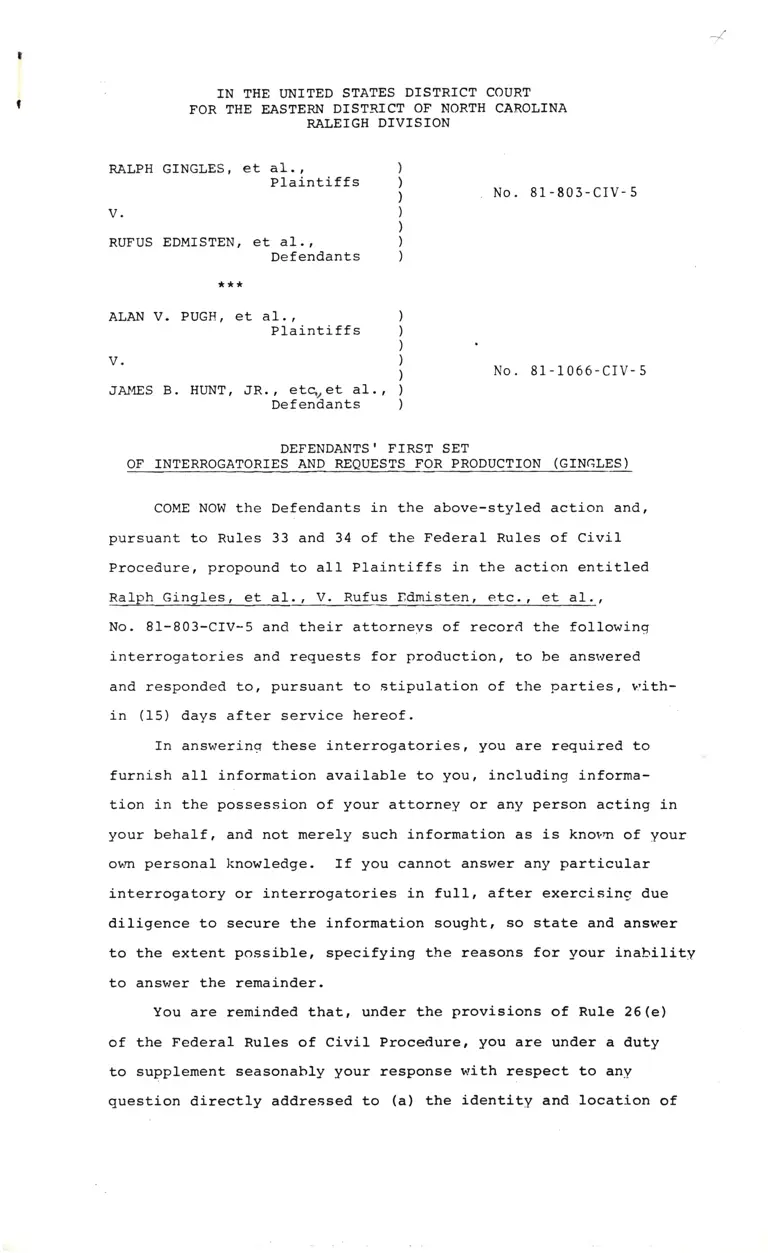
    rN THE T'NITED STATES DISTRICT COURT

E'OR THE EASTERN DTSTRICT OF NORTH CAROLINA
RALETGH DIVISION

RALPH GINGLES, Et dI.,
Pl-aintif f s No. 81 -803-CIV- 5

V.

RUFUS EDI"IISTEN, €t A1.,
Defendants

ALAN V.

v.

JA}4ES B.

***

PUGH, €t dl.,
Plainti ffs

No. 81-1066-CIV-5
HUNT, JR., etcret a1.,

Defendants

DEFENDANTS' FTRST SET
OF INTERROGATORIES AND REQUESTS FOR PRODUCTION (GINGLES)

COME NOW the Defendants in the above-styled action and,

pursuant to Rules 33 and 34 of the Federal Rules of Civil
Procedure, propound to all Plaintiffs in the action entitled

Ralph Gingles, et al., V. Rufus Edmj-sten, etc., et a1.,

No. 81-803-CIV-5 and their attorneys of recordl the following

interrogatories and requests for production, to be ansrvered

and responded to, pursuant to st5-pulation of the parties, v.'ith-

in (15) days after service hereof.

In answering these interrogatories, you are required to

furnish all information available to you, including informa-

tion in the possession of your attorney or any person acting in
your behalf, and not merely such information as is knorm of your

obm personal knowledge. If you cannot ansvrer any particular

interrogatory or interrogatories in fuII, after exercising due

diligence to secure the information soughtr so state and answer

to the extent possible, specifying the reasons for lzour inability

to ansvrer the remainder.

You are reminded that, under the provisions of Rule 26 (e)

of the Federal Rules of Civil Proce<lure, you are under a duty

to supplement seasonakrly your response with respect to any

question directly addressed to (a) the identity and location of


?.2-

persons having knowledge of discoverable matter, and (b) the

identity of each person expected to be called as an expert

witness at triaI, the subject matter on whj.ch he is expected to
testify and the substance of his testimony.

Base your responses on the statistics in your possession

and on which you have L'ased your allegations.
You are under a arity to amend seasonal:ly a prior response

if you obtain information upon the basis of which (a) you know

that the response, though correct when made, is no longer true
or complete, and the circumstances are such that a failure to
amend the response is, in substance, a knowinq concealment.

Any such supplemental response is to be filed and served

uPon eounsel of record for this Defendant rvithin fifteen (15)

days after receipt of such informatj-on.

DEFINITIONS

Unless otherwise indicated, the followj-ng definitions
sha11 be applicable to these interrogatorj-es and requests for
producti-on:

You and your sha1l mean the Plaintiffs and each of their
attorneys, agentsr or representatj-ves and all other persons

acting on their behalf

Person shall mean any individual, partnership, firm,
assocj-ation, corporation or other businessr gov€rDmenta1 or

legal entity.

Address shall mean the post office box numher, street
number, street, route number, route, town, city, county and

state of subject person, business or other entity.
Document shall mean any r.rritten, recorded, transcribed,

punched, taped, drarm, filmed or graphic matter of any k-ind or

description, however produced or reproduced. "

Paragraph, your pgragraph, or paragrg)h of your Complaint

refers to the numbered paragraphs of your Complaint, as supple-

mented.


-3-

Gross deviation is the total figurer plus or minusr con-

puted by subtracting the ideal population Cistrict from the

total population rvithin the specific district.
Census unit shall refer to tracts, enumeration districts,

block groups and blocks as these term.s are defined hy the

United States Bureau of the Census.

fdeal population dj-strict or .equal population of the State

of North carolj-na divided by the total number of state House

of Representatives or State Senate districts.
Number of each district, number of each Fouse district or

number of each Senate district refers to those numbers applied

to each legislative district for identification purposes.

District refers to districts vrithin the lrouse of Repre-

sentatives and/or .senate of the State of llorth Carolina.

Percentage by which a district 4eviates from the ideal
population distrj-ct is that percentage which is computed by

dividing the gross deviation by the ideal population clistrict
and converting that fraction into a percentage.

Overall range of devj-ations is that term used which is
identical in meaning to the term used t'y the United States

Supreme Court in Mahan v. Hovrell, 410 U,S. at 319, as "maximum

percentage variation from that ideal" or "maximum variation or
maximum deviationr" 410 U.S. at 323. This overall range of
devj-ations is equal to the sum of the percentage by which the

most populous district deviates from the ideal population

district and the percentage by which the least populous district
deviates from the ideal population district, ignorinq the plus

and minus signs of these percentages.

Your revised reapportionment glln or your revised plan or
your plan or your revised reapportionment proposal or your

revised proposal or your proposal j-s that plan or proposal rvhich

embodies any adjustments, changes, alterations, or amendments to
the basic legislative reapportionment plans embodied in Chapters

4 and 5 of the Extra Session Laws of Lg82 which the Plaintiffs


-4-

suggest aB possit,le .eolutions to various alleged deficieneies

within the legislative reapportionment plans. Describe thls
pJ,an or proposal in terus of incremental ehanges to the plan

emtodied in Chapters 4 and 5 of the Extra SesEion Laws of 1982.

***

1. State the fu1l name, t9€, date

address, place of birth, and place

tiff in th.is action.

birthr pr€a€Dt residence

ernployment of each plain-
of
of

2. State (a) vrhether each plaintiff has read the introductory

paragraphs to these interrogatories and (h) vrhether eaeh plain-

tiff underatands that these interrogatoriee are to te ansnerd

under oath.


-5-

3. In Paragraph 109 of your Complaint, you allege that the

reapportionment plan for the House of RePresentatives, Chapter 4

of the Extra Session Laws of 1982, 'has the effect of and was

enacted vrith the purpose of discriminating against black

citizens of the State of North Carolina, and of denying blacl<

citizens the ability to use their vote effectively." !'lith regard

to this allegation, set out the following:

a. The numher of each House district v,here the reapPor-

tionment plan substantially dilutes or minimizes the

voting strength of blacks within that House district-

b. set out specifically the objections which you or any

of the plaintiffs have to the specific House district and

its composition.

c. set out in detail the effect of the House plan in

substantially diluting or minimizing the voting strength

of the plaintiffs or members of their class. In ansvrering

this interrogatory, set out, at a minimum, the follorving:

1. Each whole county, tovrnship or census unit which

the Legislature j-ncluded

district with the effect

voting strength.

2. Each whole county, township, or census unit which

the Legislature included or omitted within each }iouse

district with the purpose of diluting the plaintiffs I

voting strength.

or

of

omitted within each House

diluting the Plaintiffs'


-6-

4. In Paragraph 115 of your Complaint, you allege that Chapter

of the Extra Session Lavrs of 1982, "has the effect of and was

enacted vrith the purpose of discriminating against black voters

and of diluting the vote of plaintiffs and other black citizens
of the state of North carolina and of denying brack citizens
the right to use their vote ef f ectively. " I,vith regard to this
allegation, set out the following:

a. The number of each Senate district where the reappor-

tionment plan substantially dilutes or minimizes the

voting strength of blacks within that Senate district.
b. Set out specifically the objections vrhich you or any

of the plaintiffs have to the specific Senate district
and its composition.

c. Set out in detail the effect of the Senate plan in
substandially diluting or minimizing the voting strenqth
of the plaintiffs or members of their class in the same

manner as in responding to interrogatory number 3 (c) .


5. For each whole eounty, torrnehip, or cengus unit whlch you

llsted in your anawer to interrogatory number 3(c) (r), set out
the Houee district whereLn you would propoEe to place that
particular whole countyr township, or census unit within the
Legisldture'8 reapportionment plan ernbodied in chapter { of
the Extra Session Laws of 1982.


-8-

5. For each whole courty, township, or cenaus unit which you

listed in your anewer to interogratory number 3(e) (2), eet out

the Houee district wherein you would ProPoBe to place ttrat

particular whole county, towrrehip, or census unlt within the

Legislature's reaPPortionment plan as ernbodied ln Chapter 4

of the Extra Session Laws of 1982.


-9-

7. Set out the following:
a. A11 House districts wherein you would al-ter the

legislative reapportionment plan to correct the alleged

deficiencs.es set out in your answer to interrogatory
number 3.

b. Within each House district cited in your resPonse

to interrogatory number 7(a) set out the following:

1. Each whole county, townshiP, or census unit

included rvithin the House district under your proposal.

2. The total population of the revised House district

under your proposal

3. The total number of whites wi-thin the revised

House district under your proposal.

4. The total number of blacks rvithin the revisedl

House district under your proposal.

5. The percentage of whites within the revised

House district under your proposal.

6. The percentage of blacks vrithin the revised

House district under your proposal.

7 . The gross deviation of each revj-sed llouse

district under your ProPosal.


-10-

8. In your revised reapportionment proposal as set forth in
your answer to interrogatory number 7, have you placed the

same whole county, townstrip, or census unit within two House

districts or have you omitted to place a whole county, township,

or census unit within a House district?

9. Set out the following:

a. AII Senate districts wherein you would alter the

legislative reapportionment plan to correct the alleged

deficiencies set out in your answer to interrogatory

number 4.

b. Within each Senate district cited in your answer

to interrogatory number 9(a), set out the following:
1. Each whole county, township, or census unit

included within the Senate district under your

proposal.

2. The total population of the revised Senate

district under your proposal.

3. The total number of whites within the revised

Senate district under your proposal.

4. The total number of blacks within the revised

Senate district under your proposal.

5. The percentage of whites within the revised

Senate district under your proposal.

5. The percentage of blacks within the revised

Senate district under your proposal.

7. The gross deviation of each revised Senate

district under your proposal.


-11-

, lO. In your reaStportionment propoeal ag let forth Ln your

anBwer to interrogatory ntnber 9, havc you placed the sane

whole countI,, tcusbiP, or cenBus unit rithin tro Senate

dletricts or have you omitted to place a wbole county, town-

shipr ot censua unit wittrLn a Senate diatrlct?

11. With respect to elther Chapter { or 5 of the Special SeraLon

Laws of L982, do you contend that the Fcderal or State Conatltut-

ion requires the Legislature to apportLon each legislative dietrict

eo that the overall range. of de.vlationg l,e leee tlran lt presantly

is in the Houge or Senate Plan?


-L2-

L2. If you answered interrogratory nr:rnber 11 in the afflrmative,
eet out the following.

a. The LegiELaturers duty under the Federal and State

Constitutions with regard to uaximum permissible overall
range of deviations from the ideal populatlon Houge diEtrict.
b. Each House district whieh devlates from this overall
range of deviations divided by two.

c. The Federal and State Constitutional provisions on

which you base your ansvrer to interrogatory number 12 (a) .

d. The Legislaturets duty under the Federal and State

Constitutions with regard to maximum permissible overalL

range of deviations from the ideal population Senate distriet.
e. Each Senate district which deviates from this overall-

range of .deviations divided by two.

f. The:Pederal and State Constitutlonal provisions on

which you base your answer to interrogatory nurnber 12 (d) .


-13-

13. Set out the followlng:
i. Name each new llouse or Senate diEtrlct which you

contend has inpet'nissible large varianees from populatLon

eguality.
b. For each distriet described in your anewer to
interrogatory number 1,3 (a) set out the groes number of
residents and the percentage that each district departs

from the ideal population district or equal population.


-r4-

ll. With respect to your allegations ln Paragraph 109 and

Paragraph 115 that the Eouse and Senate reapportionraent plans

have ithe effeet of and (were) enacted vLth the purpose of
digcriminating against black noters and of diluting the vote

of plaintiffe and other black citizens of the State of North

Carolina, " (a) define 'diluting" in both guantitative and

deecriptive terms, (b) with regard to thie allegation, set out

each House and Senate district within the legielative reappor-

tionment plans where you alIege the Legislature intended to

dilute the voting strength of black citizens or (c) which had

the effect of diluting the voting strength of black citizens.


-I5-

15.IfyouidentifiedanyHousedistrictinyouranswerto

interrogratory num'ber 14 ' set out the fo11owing:

a.Eachvlho].ecounty,township,orcensusunitwithin
each House district listed in your ans'"rer to interrogatory

number 14 which was included within the identified House

district for the PurPose of diluting black voting strength'

b.Eachwholecounty,tovmship,orcensusunitrvithin
each House district listed in your ansr'rer to i'nterrogatory

number 14 which was included ruithin the identifieit House

district which had the effect of diluting blac): voting

strength.

c.Eachwholecounty,tol.mship,orcensusunitvlithin
anyHousedistrictwhichwasexcludedfromanyHouse

distriet listed in your answer to interrogatory number 14

fortlrePurPoseofdilutingblackvotinqstrength

d.Eachwholecounty,torvnship,orcensusunitwithinany
House district vrhich was excluiled from any House district

listedinyouransh,ertointerrogatorynumber14which
had the effect of diluting or minimizing black voting

strength.


-15-

15. If you have identified any llouse district in your answer

to interrogatory number L4, set out the follovring:

a. A.11 House districts wherein you would alter the

Iegislative reapportionment plan to correct to alleged

deficiencies set out in Paragraph 109 of your Complaint.

b. Within each House district set out in your answer to

interrogatory number 16(a), set out the following:
1. Each whole county, township, or census unit vrithin

the revised Fouse district under your proposal.

2. The total population of the revised llouse district
under your proposal.

3. The total number of whites vrithin the revised

House district under your proposal.

4. The total number of blacks rvithin the revised

House district under your proposal.

5. The percentage of whites within the revised House

district under your proposal.

6. The percentage of blacl<s vrithin the revised House

district under your proposal.

7. The gross deviation of the revised llouse district

under your proposal.


-t7-

17. In your revised reapportionment proposal as set forth in
your ansvrers to interrogatory number 16, have vou placed the

same whole county, township, or eensus unj.t within tvro House

districts or omitted to place a whole county, township, or

census unit within a House district?

18. If you identified any Senate district in your answer to

interrogatory numl:er 14, set out the following:

a. Each whole couhty, torrnship, or census unit within
each Senate district listed in your ansrver to interroga-

tory number 14 which was included within the identified

Senate district for the purpose of diluting or mj,nimizing

black voting strength.

b. Each vrhole county, tovmship, or census unit within
each Senate district listed in your answer to j-nterroga-

tory number 14 which was included vrithin the identified

Senate district which has the effect of diluting or

minimizing black voting strength.

c. Ilach whole county, township, or census unit vrithin

any Senate district which was excluded from any Senate

district listed 5-n your anslrer to interrogatory number 14

for the purpose of diluting or minimizinq black voting

strength.
d. Each whole county, township, or census unit within

any Senate district which was excluded from any Senate

district listed in your anshrer to interrogatory number l-4

which had the effect of diluting or minimizing black

voting strength.


-18-

19. If you have identified any Senate district in your anawer

to interrogatory nurnber.l{, set out the foLlowing:

€t. All Senate districts wherein you vrould alter the

legislative reapportlonnent plan to correct the alleged

deficiencies set out in Paragraph 1I5 of your ComplaJ-nt.

b. Within each Senate district Eet out in your answer to

interrogatory number 19 (a) , Bet out the following:

1. Each whole county, townshiP, or cenaus unit within

the revised Senate district under your propoeal.

2. The total population of the revised Senate district
under your proposal.

3. The total number of whitee within the revlsed

Senate district under your proposal.

4. The total number of blacks r:ithin the reviged

sendte district of your proposal.

5. The percentage of whites within the revieed

Senate district under your proposal-

6. The percentage of blacks withLn the reviEed

Senate district under your proposal. '

7. The gross deviation of the revised Senate district

under your ProPosal.


-19 -

20. will you attemPt to Prove that contemporaneous statements
of legislators regardi.ng chapter 4 and 5 of the Extra session
Laws of L982 Lrere made which indicate the purpose of discrimin-
ating against black voters and/or of diluting brack voting
strength on the part of the Legislature or any members thereof?'
ff so, set out the following.

B. The name of each Legislator who made such a statement.
b. The place he or she made the statement.

c. The date of the statement.

d. The exact statement he or she made.

e. The souree through which you learned of the statement.
f. The name, address, and telephone number of such source.
g. ff reported in the media, the name, address, and

telephone number of each such media outlet.
h. The date each media report was made and by whom.

i. Please attach a copy of each such media report.


-20-

2L. Does either the House of Repreaentatives or senate

reapportionment plan enacted bry the Iegielature ln L982 enhanee

or maintain the oplrcrtunity of any black incumbent to continue
in office? rf so, name the ineumbent and the manner in which
the opportunity was enhanced or naintained.


-2L-

22. Does either the Houee of RePreBentatives or Senate

reapportionment plan enaeted by the tegielature in 1982 lesgen

the opportnnlty of arry black lncrunbent to continue Ln offlce?

If Bor nane the incumbent and the manner I'n which the oppor-

tunity was lessened. '


-22-

23. Do you allege that any whole counties, tonnshJ.pe, or
census unite in the l9g2 legislative reapportl,onnent plans
were traneferred from any dLstrict where they would have had

a major iryact ln ttre erection of a black Leglslator to one

where the electorar impact would be minor in the erection of
a black Legislator?


-23-

24. If yo.ur answer to interrogatory number 23 r.ras in the

affirmative, set out the following:

a. f dentify the '.rhole county, township or census unit.
b. The House or Senate district wherej-n the whole county,

townshipr or census unit is now located.

c. The percentage of blacks within the House or Senate

district as presently constituted in the L982

legislative reapportionment p1ans.

d. The number of people within the district as presently

consti-tuted.

e. The Flouse or Senate district in r.rhich you believe

this whole county, township, or census unit should he

relocated, its present percentage of blacl.-s and

number of people.

f. The percentage of blacks within the trvo districts
if the svritch you advocated vrere made.

g. The total number of residents in the tv.,o distrj-cts
if the whole county, township, or census unit were

switched as you advocate.

h. The number(s) or name(s) of the whole county, tor.^nrship,

or census unit previously specified in answer to
interrogatory number 24 (a) in order to satisfy the

one-man, one-vote requirement.

i. The House or Senate district from which such v:hole

county, tovrnship, or census unit would be removed.

j. The gross deviations of all llouse and Senate districts
by district as a consequence of the foregoing shifts
in whole county, township, or census units.


-24-

25. If you have drawn or have in Your

reapportionment maPs for the House of

Senate whieh you prefer to be adopted,

possession statewide

Repreoentatives and the

pJ.ease attach the aame.

:

26. If you have no maps referred to ln interrogatory number 25,

please attach a drarving of each ner'r dietriet and the districts

contiguous to that district if such district hlere drawn aE you

advoeate in response to interrogatory number 24.


-23-

27. fn your Paragraph 121 you Btate that "!he intent and effect
of the apportionment of the North carolina General Aesemhly

enacted in chapters { and 5 of the Extra seseion Laws of l9g2
are to. '.deny plaintiffs their right to uae thelr vote effec-
tively. "

B. E:rplain the phrase nright to uae their vote effec-
tivelyr' as you employ it.

. b. rdentify specifically each component of the reappor-
tionment plans which you contend denied the plaintiffs
the right to use their vote effectivery and explain
hovr the effective use of their vote was so denied.


-26-

28. In Paragraph L27 you state that "the State of north Carolina

has a history of discrimination against black citizens in its

voter registration practiees and in other election lat'rs,

regulations and practices rvhj-ch have prevented plaintiffs and

other black citizens of this State from voting or from using

their votes effectively. " With respect to your Paragraph 127,

set forth the follorving:

a. A11 voter registration practices which have occurred

historically in this State vrhich have prevented

plaintiffs and other black citizens of this State

from voting or from using their votes effectively.

b. A11 voter registration practices in this State which

continue to prevent plaintiffs and other black

citizens of this State from voting or from using

their v<jtes effeetively.

c. A11 eteition laws which have historj-calIy been

employed in this State to prevent plaintiffs and other

blacl'. citizens of this State from voting or from

using their votes effectively.
d. A11 election laws lrhich continue to be enforced v'hich

prevent plaintiffs and other black citizens of this

State from voting or from using their votes effectively.

e. All regulations which have historically been used to

prevent plaintiffs and other blacks of this State from

voting or from using their votes effectively.

f. All regulations which continue to be used to prevent

plaintiffs and other black citizens of thj-s State

from voting or from using their votes effectively.

g. A11 practices which have historically been used by the

State to prevent plaintiffs and other blacl: citiz.ens

of this State from voting or from using their votes

effectively.

h. A11 practices which continue to be used to prevent

plaintiffs and other black citizens of this State

from voting or from using their votes effectively.


-21-

29. Can you state epecl,flc inetanceg of the use of voter
regiatration practices or other election lawsr or regrulatlons,

or practieee rhich have been used to prevent plaintl.ffe and

other black citizens of this state frm voting or frorn ualng

their \rotes effectiveLy? If Bor liet chronologlcalJ.y, by

date, the occurrence of each incident of preventing plaintiffs
and other blaek citizens of this state from voting or from

usi.ng thelr votee effectively,


-28-

30. Your Faragraph 128 etates ithe North carorina General

Aesenbly has historically been unresponsive to the neede of
the blacL citizens of the state of North carolina." get forth
the following:

!. Explain the phrase "needs of the blae}. cLtizens of
the State of North Carolinari aE Jrou employ it.

b. Give speeific examples of occasions on which the llorth
carolina General Assembly has been unresponsive to
the needs of the black citizens of the state of North

Carolina and explain your anstrer.


-29-

31. Do your statlstics iiaicate that any paet North carorina
House of Repreeentatives or Senate reapportionnrent planE, enacted
by the r,egislature after any deeennial censue, provided bracks
with a greater opportunity to eleci representatives of their
choosing than do the current plans enrbodied in Chapters { and 5
of the Extra session Lar.rs of LgB2? rf Bo, identify the plan(e)
and explain your ansvrer.

32. Do your etatistics.indicate that any past North carolina
House of Representatives or senate reapportLonment plans,
enacted by the Legislature after any decenniar censusr pro-
vided blacks with a greater opportunity to uBe their vote effec-
tivery than do the current plans embodied in chapters 4 and 5
of the Extra sesslon Laws of LgBz? rf eo, identify the plan(s)
and expJ.ain your answer.


-30-

33. Do your etatistics indicate that any past North carorLna

House of Repreeentatives or Senate reapportl.onrnent plans,

enacted by the xagislature after any decennial census, provided

blacks with as .great an opportunity to el.ect repreBentatl.ves of
their choosing as do the current plans ernbodied in chapters

4 and 5 of the Extra Session Laws of 1982? If eo, Ldentify the
plan(a) and e4tlain your answer.

34. Do your atatistics indicate that any past Uorth Carolina

House of Repreaentatives or Senate reapportionment plans,

enacted by the Legislature after any decennial censue, provlde4

blacks with as great an opportunity to use their vote effeci
tively as do the current plans embodied in Chaptere 4 and 5

of the Extra Seseion LawE of 1982? If so, identify the plan(s)

and explain your answer.


-31-

35. State the name, addresE, emplolzment, and telephone nuruber

of each pergon you will or nay carl as a wltness at the trial
of thie matter (with the exception of those expertB, if EDy,

referred to in the next interrogator?) and further state the
substance of eaeh eueh pergonts expected testirrony.


36. State the name,

and qualifications of
expert witness at the

the subject matter on

testify.

-32-

address, employment, telephone number,

each person you expect to call as an

tri-al of this matter and further state
vrhich each such expert is expected to


-33-

37. As to each expert named in the ansr.rer to interrogatory
number 36, state the substance of the facts ancl opinions to
which said experts are expected to testify and give a sunmary

of the grounds for each opinion.


-34-

38. Please attach to your answers to theee interrogatorieE

true, complete, aad correct copies of any and all documente

prepared by any guch erq>erts es e(pert relating to this aetion.

39. State the name, address, telephone number, and gualificatione

of each expert whom you have retained or speeifically employed

in anticipation of litigation or preparation of trial and who is

not expected to be cal1ed as a witnesg of the trial of this actLon.


-35-

40. rndicate each oecasion on vrhich each person named in the
answers to interrogatories number 35 and 36 has testified in
other legaI proceedings regarding state legislative reappor-
tionment and describe ttre nature of his or her testimony in
each of those proceedings.

Respectfully submitted this *" 29 day of t,tarch, Lgg2.

RUFUS L. EDMISTEN
ATTORNEY GENERAL

Raleigh, North Carolina 27602
Telephone: (9I9) 733-3377

Norma Parrel_l
Tiare Smiley
Assistant Attorney General

John Lassiter
Associate Attorney General

Jerris Leonard
Kathleen Keenan
Jerris Leonard & Assocj.ates, p.C.
900 17th Street, It.W.
Suite 1020
Slashi-ngton, D.C. 20006
Telephone: (2021 872-1095

al.Iace, .Tf .
Attorney Gen6ral

Legal A.ffairs
tgfney General's Office

I\E:C. Department of JusticePost Office Box 629


-36-

CERTTFICATE OF SEF.VTCE

r hereby certi'fy that r have this day served the foregoing
Interrogatories and Reguests for Production upon plaintiffrfs
Attorneys by placing a copy of same in the united states post
Officer postage prepaiti, addressed to:

J. Levonne Chambers
Leslie ll7inner
Chambers, Ferguson, Watt, Wa11as,

Adkins & Fuller, p.A
951 South Independence Boulevard
Charlotte, North Carolina 29202

Jack Greenbert
James M. Nabritr fII
llapeoleon B. .Wi1liams, Jr.
10 Columbus Circle
New York, Ner.r york 10019

Arthur J. Donaldson
Burke, Donaldson, Holshouser & Kererly
309 North l,Iain Streeti: Salisbury, North Carolina 2gL44

Robert lI. llunter, Jr.
Attorney at Law
Post Office Box 3245
201 West Market Street
Greensboro, North Carolina 2?402

;X' day of !,!arch , irgg2.This the