Garner v. Memphis Police Department Court Opinion
Unannotated Secondary Research
June 18, 1979
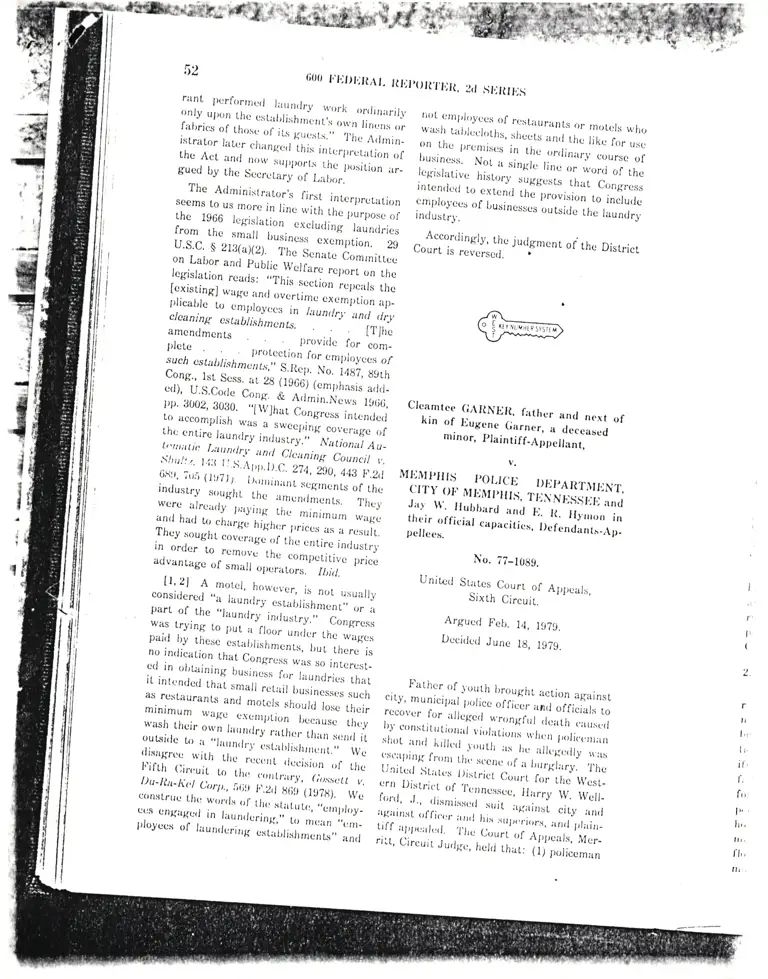
4 pages
-
Case Files, Garner Working Files. Garner v. Memphis Police Department Court Opinion, 1979. 71cd8906-34a8-f011-bbd3-000d3a53d084. LDF Archives, Thurgood Marshall Institute. https://ldfrecollection.org/archives/archives-search/archives-item/b2f5dd84-0efe-437f-bb57-9369e0728d90/garner-v-memphis-police-department-court-opinion. Accessed September 25, 2026.
Copied!
11
» ^ u ; ™ r i . : z " " ........... .
l.'“ « n . J U.C Sc.crau.ry ,,r l . a w ' " ” " ' " ' “ '"
The Adinini.straLor's r.Vc-t ■ .
seems to us more in line wiU, '
the 19C6 le,Ai.s,ation cxclu i m r T ' ' T "''
from the sm-ill i • ̂ laundries
U.S.C, 5 2 « . ' L ?,"“ o 29
on Lalior an,I PnWic W c | f " ' “ ' ‘^"” ' » ' “ oc
loEialalion rca.Ia t i I f r ™ "on on u.c
plicahlo to cm,Jr, ‘-''"e exemption ap-
clcaninfr eslablishmcni''
amendments tHhe
plete . , ' for com-
csUihlishmdZ ” s 'rc of
Contr.. 1st Sess.a; i n \
-1). U.S.Code Conp. & A S ' ' ' '
to accomplish wa a t
the^entire laundry i n d u s ? t ' ' ' S n a M t
Council e'
0« . . TO. ( m , f i r - 290. 443F.2d
industry .soupdit segments of the
'̂>'i ha<l to c h a r t h it, r"
They .soupditcovtat
in order to remove , ’ ,
advantapro of small ̂ eonipetitive price te oj small ojicrators. Mp/
l « r l of the V " 'aab l,ah ,„o„r „r ,
™ to
P«9I l.y 11,00 0au,l,lish"
no indication that Congress u-as ■
o'i in obtaining husinet 'o i
't intended that small retail''|
as restaurants and motels shrhnose\ 'r-^ ’
minimum wage exemml .
" ’ash their own laundry a a lo r\ h ['! r ‘' r ^
Cmv. 300 K 2d H ' ( l O ^ ' V ' '
oon.struetheword.softheslalut ■■ , 'ees eneaLred in l i ■ '‘ tiiti,, employ.
Plovers r '̂ ‘ '^'-'oriiig,” to mean
' o»uu,h,, i „„o„u,~ :,i:,
" ( i t e m p l o y e e s o f r,.ci
lablcdo'thc, ,l,col“ " ‘,"rthc' i,”t'c'r'“
iegislalive historv
employees of I o to include
industry ' “ " " o u t s id e 'aundry
C o n r t l ' r S k c f I h o District
^ w \____
(? s svsrfM̂
m-nor. PJaintiff-Appellant.
‘ ‘t i r ' l f f S t t J u t ' V f 7"'0'’pellec.s. ‘ Pamtic.s. llefendant.s-Ap.
No. 77-1089.
United States Court of Appeals,
hiixth Circuit.
Argued Feb. 14, 1979
decided June 18, 1979
s r : ; ; ,
(;aicni; i{ V.
'itcla who
i> for use
ourse of
rd of the
Congress
I include
laundry
■ District
I I
next of
used
I'MENT,
''EE and
vmon in
•ints-Ap-
ils,
N X
against
. icials to
1 caused
■liceman
dly was
ry. The
e West-
V. Well-
ity and
d plnin-
Is, Mer-
1 iceman
(■
fi-
E f'-
ii; »'
'■i *
!'i ■
was entitled to assert, as complete defense,
a (juahfied “good faith” jirivilege or immu
nity from liability for constitutional claims
based on his reliance on Tennessee law
which allows an officer to kill a fleeing
felon rather than run the risk of allowing
him to escape a|iprehension, and (2) liability
of city under federal civil rights statute
depended u|)on resolution of (juestions as to
whether municipality had a (jualified immu
nity or privilege based on good faith,
whether municipality’s use of deadly force
under state law was constitutionally per
missible, whether municipality’s use of hol
low j)oint bullet was constitutionally per
missible and whether officer’s conduct
flowed from a “ jiolicy or custom” for which
municipality could be liable in damages.
Case against city remanded for recon
sideration.
MEMl’ IllS I'OIJCK DEIT., ETC.
Clio as 600 r.2(l .'■>2 (1 97!)) 5;]
U.S.C.A. § 11W.T IJ.S.C.A.Const. Amends 4
b. H, 14; T.C.A. § 40-808.
̂ Jack Greenberg, Charles Stephen Ralston,
Steven I,. Winter, New York City, Walter’
D. Railey, Jr., D’Army Bailey, Memphis,
I'enn., Avon N. Williams, Jr., Nashville,
Tenn., for plaintiff-apjiellant.
Henry L. Klein, Menijihis, Tenn., for de-
i'crulants-appolleos.
* *
Before EDWARDS, Chief Judge and
l i v e l y and MERRITT, Circuit Judges.
1. Civil Rights ©=>13.8(4)
A city policeman who shot and killed a
youth as he esca|)ed from the scene of a
burglary was entitled to a.ssert, as com])lete
defen.se U> civil rights action, a qualified
“good faith” jirivilege or immunity from
liability for constitutional claims ba.sed on
his reliance on 'i'ennes.see law which allows
an officer to kill a fleeing felon rather than
run the risk of allowing him to escape ap
prehension. 42 U.S.C.A. § 1983; U.S.C.A.
Const. Amends. 4, 8, 14; T.C.A. § 40-808.
2. Civil Rights 13.8(3)
Liability of city under federal civil
rights statute for shooting by city police
man of youth as he escaped from scene of
burglary dej)ended upon resolution of que.s-
Uons as U> whether municipality had a qual
ified immunity or privilege based on good
faith, whether municipality’s u.se of deadly
force under state law was constitutionally
permi.ssible, whctlKir municip.-dity’s use of
hollow point bullet was constitutionally per
missible and whether officer’s conduct
flowed from a "policy or custom” for which
municipality could he liable in damages. 42
MERRI1 1, Circuit Judg'e.
On the night of October 3, 1974, a fifteen
year old, unarmed boy broke a window and
entered an unoccupied residence in subur
ban Meni|)his to steal money and pro|)erty.
Two police officers, called to the scene by a
neighbor, intercepted the youth as he ran
from the back of the house to a si.x foot
cyclone fence in the back yard. Using a
38-calibre pistol loaded with hollow |)oint
bullets, one of the officers shot and killed
the boy from a range of 30 to 40 feet as he
climbed the fence to e.scape. After shining
a flashlight on the boy as he crouched by
the fence, the officer identified him.self as a
lioliceman and yelled “ Halt.” He could see
that the fleeing felon was a youth and was
apparently unarmed. As the boy jumped to
get over the fence, the officer fired at the
upper part of the body, as he was trained to
do by his superiors at the Memphis Police
Department. He shot because he believed
the boy would elude capture in the dark
once he was over the fence. The officer
was taught that it was proper to kill a
fleeing felon rather than run the risk of
allowing him to escape.
Ihe District Court dismissed the suit of
decedent’s father lirought against the City
under 42 U.S.C. § 1983 (197b) to recover
damages for wrongful death cau.sed by
claimed constitulional violations of the
fourth, eighth and fourteenth amendments.
In accordance with then existing law, the
District Court held that a city is not a
54 (iOO FKDKRAL RKl’OKTKK, 2d SKRIKS
l]
iM i!
; jij
H i
li I'!
i
I
'i I
̂ 1
i !
i
'! i
] I
,>!
1 I
“ purson” subject, lo suit under § 1983; but
Monroe r. Pape, 3(>5 U.S. 167, 81 S.Cl. 473, 5
L.Ed.2(1 492 (1961), in which the Supreme
Court so ruled, was overruled on this point
last term by the case of Monell v. Depart
ment o f Social Services, 436 U.S. 658, 98
S.Ct. 2018, 56 L.Ed.2d 611 (1978). Follow
ing a bench trial, the District Court also
dismi.ssed the case against the officer and
his superiors holding, in accordance with
our decisions in Beech v. Melancon, 465 E.2d
425 (6th Cir. 1972), cert, denied, 409 U.S.
1114, 93 S.Ct. 927, 34 L.Ed,2d 696 (1973);
Qualls V. Parrish, 534 E.2d 690 (6th Cir.
1976); and Wiley v. Memphis Police De
partment, 548 E.2d 12-17 (6th Cir.), cert,
denied, 434 U.S. 822, 98 S.Ct. 65, 54 L.Ed.2d
78 ('1977), that the officers acted in good
faith reliance on Tennessee law which al
lows an officer to kill a fleeing fedon rather
than run the risk of allowing him lo escape
apprehension.
11| We conclude that the District Court
did not err in finding that the individual
defendants acted in good faith reliance on
Tenn. Ccxle Ann. § 40-808 which provides
that an officer “ may use all the necessary
means to effect the arrest” of a fleeing
felon. As our [jrevious cases, cited above,
point out, Tennessee courts have interjiret-
ed this sUitute as a codification of the com
mon law rule allowing officers to kill flee
ing felons rather than run the risk of |)er-
mitting them to escape ajiprehension. This
rule applies to fleeing felons suspected of
property crimes not endangering human
life, as well as life-endangering crimes, and
to felons who ix)se no threat of bodily harm
to others, if not apprehended immediately,
as well as felons who may bo dangerous to
others if left at large. Applying the (juali-
fied “good faith” privilege or immunity
from liability for constitutional claims, as
announced in our previous decisions cited
above, we affirm lhal poi'tion (d‘ Ihe Dis-
tricl. Court's jiidgmeiit dismissing the case
against the individual defendants.
|21 We reverse and remand the case
against the City, however, for reconsidera
tion by the District Court in light of Monell
V. Department o f Social Services, supra.
Monell holds that a city may be held liable
in damages under § 1983 for constitutional
deprivations that result from a “ policy or
custom” followed by the city. 436 U.S. at
694 and n. 66, 98 S.Ct. 2018.
Our previous decisions do not establish
the constitutionality of Tenn. Code Ann.
§ 40-808, permitting a city to authorize its
officers to use deadly* force against a flee
ing felon, nor have they established the
constitutionality of the city’s use of hollow
point bullets. Although there is discussion
of the constitutionality of the Tennessee
statute in the Beech, Qualls and Wdey
cases, supra, all three of those cases dealt
with actions against individual officers un
der § 1983, and not liability based on the
“ policy or custom” of a governmental enti
ty. Those cases held that it “ would be
unfair" to imjHise liability on an officer
“ who relied, in good faith, upon the settled
law of his state that he relieved him from
liability for the particular acts performed in
his official capacity.” Qualls v. Parrish,
supra at 694, quoted in Wiley v. Memphis
Police Department, supra at 1253. The es
sential holding of those cases was that an
individual officer has a ([ualified privilege
or immunity from liability for constitution
al claims based on good faith performance
of his duties in accordance with statutory or
administrative authority, a holding subse
quently a[)proved by the Sujiremo Court in
Butz r. Economou, 438 U.S. 478, 496-508, 98
S.Ct. 2894, 57 L.Ed.2d 895 (1978). Although
the qualified immunity developed in those
cases insulates the officers and officials
from personal liability in this case, as the
District Court held, the following questions
in the c:use against the city are still 0[)cn
under Monell:
1. Does a munieip.'dil V have a similar
ipialifieil immmdiy or pj'ivilege based
on good faith under Monell'! '
I. .See (li.scns.sion ol this <|nc‘.sUon ni /./e(e V. Of.v ol l'rovi<lence, l•,,Sll|)p, .'iH.'i, .'iKH (D.K.I.
1978).
^ ' i
ise
ra-
ncll
>ra.
iile
nal
or
at
■lish
!
,nn.i
its
lee-
Ihe
OW
ion
<see
Vi ley
lealt
un-
the
nti-
il he
ficer
I lied
from
■d in
Irish,
nphis
(i es-
it an
ilege
ition-
lance
>ry or
ubse-'^
irt in
ii8, 98
ough
those
icials
s the
slions
open
imilar
hiuscd
D.R.I.
2.
lJNlTi;i) S'l AT
( 111* i<s r>oo I
If not, is a municipality’s use of dead
ly force under Tennessee law to ca|)-
lure allegedly nondangerous felons
fleeing from nonviolent crimes consti
tutionally permissible under the
fourth, sixth, eighth and fourteenth
amendments? ^
Is the municipality’s use of hollow
point bullets constitutionally permis
sible under these provisions of the
Constitution? ^
I f the municipal conduct in any of
these respects violates the Constitu
tion, did the conduct flow from a
"policy or custom” for which the City
is liable in damages under M onclll*
We remand the case against the City to
the District Court for reconsideration in
light of Moncll, including consideration of
these questions.
HS V, ItllNFltO
ill 5!i
3.
4.
I *£YNUMOtBSVST[M';f -- ----------- ^
2 . See f;ener:iHy Coker v. Georgia, 433 U..S. 584,
97 S.Ct. 252.3, 5.3 L.gd.2ci 653 (1977); In^raharn
V. Wright, 430 U.S. 651, 97 S.Ct. 1401, 51
L.Ed.2d 711 (1977); Gregg v. Georgia. 428 U.S.
153, 96 S.Ct. 2909, 49 l..Ed.2d 859 (1976); Fur
man V. Georgia. 408 U.S. 238, 92 S.Ct. 2726, 33
L.Ed.2d 346 (1972); Landrum v. Moats, 576
F.2d 1320 (8th Cir.), cert, denied. 439 U.S. 912,
99 S.Ct. 282, 58 L.Ed.2d 258 (1978); Mattis v.
Schnarr, 547 F.2d 1007 (8th Cir. 1976), vacated
as advisory opinion sub nom. Ashcroft v. Mat
tis. 431 U.S. 171, 97 S.Ct. 1739, 52 L.Ed.2d 219
(1977); Jones v. Marshall. 528 F.2d 132 (2d Cir.
1975); Day, Shooting the Fleeing Felon: State
of the Law, 14 Crim.L.Bull. 285 (1978); Com
ment, Deadly Force to Arrest: Triggering Con
stitutional Keview, I 1 Harv.C.R.— C.1..L Rev
361 (1976).
3. See generally I’lm.si, Does Your I’ohee Force
Use Illegal Weapons:’ /\ Configuralive Ap
proach to Decision Integrating Inteln.ition.il
and Domestic Law, 18 llarv.Int'l L.J. 19 (1977).
IJNIII'^I) S'l'ATKS of America,
Plaintiff-Appellee,
v.
Andrew KKNFKO, Defendant-Appellant.
No. 78-r>482.
UniUid States Court of Appeals,
Sixth Circuit.
Argued April 9, 1979.
Decided June 19, 1979.
Rehearing and Rehearjng En Banc
Denied July 31, 1979.
Defendant was convicted before the
United States District Court for the East
ern District of Michigan, Southern Division,
Philip Pratt, J., of income tax evasion and
failing to file, and he appealed. The Court
of Appeals, Cecil, Senior Circuit Judge, held
that: (1) the prosecutor’s supposed improj)-
er argument concerning expression of per
gonal o])inion of guilt, misstatements of law
and fact and shifting burden of proof did
not rise to level of plain error; (2) court
properly instructed that .jury could consider
reasonableness of defendant’s explanation
as to his increase in net worth as bearing on
his consciousness of guilt; (3) in prosecution
for income tax evasion and failure to file,
admission of alleged hearsay testimony of
4. On the question of “ policy or cu.stom,'' police
records are said to show, according to reports
we do not find in this record, that during the
preceding eight years Memphis police officers
killed seventeen fleeing burglary suspects; thir
teen were black and five were youths. Accord
ing to the same reports, Memphis police offi
cers killed twenty-four individuals during this
period in connection with crimes of violence or
in self-defense; they attempted to use deadly
force on 177 occasions. 114 of which were in
connection with property crimes. See the orig
inal certified appellate record, document 45, in
Wiley V. Memphis Police Dep't. 548 F.2d 1247
(Cth Cir.), cert, denied, 4.34 U.S. 822, 98 S.Ct.
65, 54 E.Ed.2d 78 (l!)77), as summarized in
Comment, Deadly Force to Arrest: Triggering
Consliiution.il Review, II I lai v.C.R. —C,l. |„
Rev. .itil, .f(i2 I I . 4 (1976); Re|)orl. I'eiiii. Adv.
( oiiimittee to U..S. Civ. Rip.hls (liiiiim'ii. Civic
(-risis— Civil Challenge: Pohce-Coniiiiuiiity Re
lations in Memphis 81 (1978).
!̂li
I' 1
• i • A-*'.- ' • .* Tr '*> . ,,
■ ’ •- V* I'i.’ '
. . . V V ’ .'.’v ■- t . . ■ a ' " •