Memorandum of Defendants in Support of Motion to Alter or Amend Judgment
Public Court Documents
1979
8 pages
-
Case Files, Norwood v. Harrison - Hardbacks. Memorandum of Defendants in Support of Motion to Alter or Amend Judgment, 1979. e21e5873-722e-f111-88b4-0022482cdbbc. LDF Archives, Thurgood Marshall Institute. https://ldfrecollection.org/archives/archives-search/archives-item/b3033d2d-2623-461e-b4a7-848104a51280/memorandum-of-defendants-in-support-of-motion-to-alter-or-amend-judgment. Accessed October 16, 2026.
Copied!
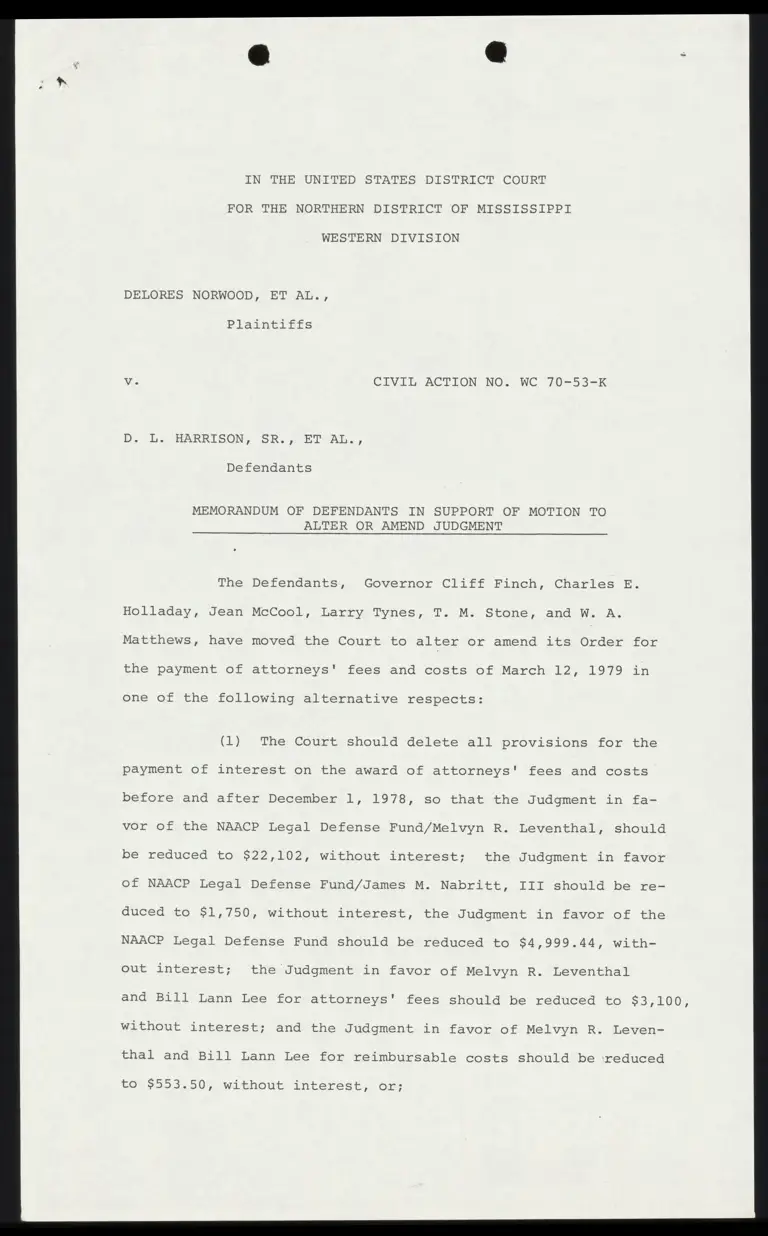
     [||35ca7f4d-51e0-4be3-9b80-ef0d283e2f07||] IN THE UNITED STATES DISTRICT COURT

FOR THE NORTHERN DISTRICT OF MISSISSIPPI

WESTERN DIVISION

DELORES NORWOOD, ET AL.,

Plaintiffs

Vv. CIVIL ACTION NO. WC 70-53-K

D. L. HARRISON, SR., ET AL.,

Defendants

MEMORANDUM OF DEFENDANTS IN SUPPORT OF MOTION TO

ALTER OR AMEND JUDGMENT


The Defendants, Governor Cliff Finch, Charles E.

Holladay, Jean McCool, larry Tynes, T. M. Stone, and W. A.

Matthews, have moved the Court to alter or amend its Order for

the payment of attorneys' fees and costs of March 12, 1979 in

one of the following alternative respects:

(1) The Court should delete all provisions for the

payment of interest on the award of attorneys' fees and costs

before and after December 1, 1978, so that the Judgment in fa-

vor of the NAACP Legal Defense Fund/Melvyn R. Leventhal, should

be reduced to $22,102, without interest; the Judgment in favor

of NAACP Legal Defense Fund/James M. Nabritt, III should be re-

duced to $1,750, without interest, the Judgment in favor of the

NAACP Legal Defense Fund should be reduced to $4,999.44, with-

out interest; the Judgment in favor of Melvyn R. Leventhal

and Bill Lann Lee for attorneys' fees should be reduced to $3,100,

without interest; and the Judgment in favor of Melvyn R. Leven-

thal and Bill Lann Lee for reimbursable costs should be reduced

to $553.50, without interest, or;


(2) The Court should, in the event it decides not

to delete all provisions for the payment of interest on the

award of attorneys' fees and costs before and after December 1,

1978, amend said Order so as to provide that the amounts ordered

to be paid thereby as interest should be placed in an escrow

account under the control and supervision of the Court.

A brief recapitulation of the various motions, orders,

and judgments that have been filed in this case since December 4,

1978 might be useful in considering this motion. On December 4,

1978 this Court signed a Judgment awarding attorneys for Plain-

tiffs certain sums of money for attorneys' fees and costs, with

interest at the rate of 8% per annum from March 2, 1976 through

December 1, 1978, with additional interest accruing at a fixed

sum of noney per day from December 1, 1978 until paid. On De-

cember 14, 1978 one of the Attavhovs for Defendants mailed for

filing a Motion to Alter or Amend the Judgment of December 4,

1978; one of the respects in which Defendants moved the Court

to Alter or Amend said Judgment was to delete all provisions for

the payment of interest on the awards made by said Judgment.

Counsel for Plaintiffs, on December 18, 1978 mailed for filing

Plaintiffs' Opposition to Defendants' Motion to Alter or Amend

Judgment; and on December 20, 1978 the Court entered a Memo-

randum Order denying the Motion to Alter or Amend Judgment.

Counsel for Defendants received the opposition of Plaintiffs on

December 21, 1978, but did not receive a copy of the Memorandum

Order of the Court until after Christmas, 1978. On December 22,

1978 , within the time permitted by the Ipcal Rules of this Court

one of the attorneys for Defendants mailed a Rebuttal to Plain-

tiff's Opposition to Defendants' Motion to Alter or Amend Judg-

ment. On January 18, 1979, Defendants filed a Notice of Appeal

to the United States Court of Appeals for the Fifth Circuit from

the Judgment of December 4, 1978. On January 26, 1979 this


Court entered a Memorandum Order awarding counsel for Plaintiffs

the sum of $2,200 for attorneys' fees plus $553.50 for reimbur-

sable costs for services rendered and costs incurred since March

2, 1976. By Amendatory Order dated February 5, 1979 the Court

increased the fee award to $3,100. On March 12, 1979, the

Court entered an Order for the payment of attorney fees and

costs which is the subject of this motion.

As to the request that the Court alter or amend its

Order of March 12, 1979 so as to delete the interest provisions

thereof, we reiterate our reliance on the case of Carpa, Inc.


V. Ward Foods, Inc., 567'F 24.1316, 1321-1323 (5 Cir. 1978).

In Carpa, supra, the Fifth Circuit was interpreting the attor-


neys' fees award provisions of the Clayton Act, 15 U.S5.C. § 15,

and held that the general rule is that interest is not allowable

on costs, and that when attorneys' fees are considered as part

of the costs, that interest is not allowable on fees. The Court

of Appeals announced this as a general rule, but emphasized that

it was interpreting only one particular statute, and that in-

terest may be allowable on costs in the application of other

statutes if Congress manifested an intent to so provide.

The two statutory bases upon which this Court awarded

attorneys' fees and costs in the case sub judice are § 718 of the


Emergency School Aid Act, 20 U.S.C. § 1617 and the Civil Rights

Attorney's Fees Awards Act of 1976, 42 U.S.C. § 1988. This

Court is well familiar with the provision of each of these two

Acts of Congress, and we will not burden the Court with re-copying

the text of these statutes here. Suffice it to say, the oper-

ative languate of each of the statutes is that "the Court, in

its discretion, may allow the prevailing party, other than the

United States, a reasonable attorney's fee as part of the costs.”


The Supreme Court of the United States in Hutto v. Finney,


98 8. Ct. 2565, 57 L. Ed. 2d. 522, clearly treated the award

of attorneys' fees pursuant to the Fees Awards Act as being

part of costs. 57 L. Ed. 2d. pp. 536-539. Likewise, as noted

in Carpa, the fee award provisions of the Clayton Act treated

fees as part of the costs.

Thus, Carpa controls this case unless it can be

demonstrated that Congress manifested an intent to add interest

to the fees award provisions of the Emergency School Aid Act or

the Civil Rights Attorney's Fees Awards Act of 1976. We re-

spectfully submit that this Court erred in its Memorandum Order

of December 20, 1978, in which it held that the legislative

history of the Civil Rights Attorney's Fees Awards Act of 1976

demonstrated congressional intent to add interest to the award

of fees and costs. l/

We would not ordinarily request the Court to recon-

sider a prior decision made by it on the same issue, but as noted

in the recapitulation of proceedings, post, this Court decided

that issue based on the Defendants' Motion to Alter or Amend

and the Plaintiffs' opposition thereto, and did not have before it

for consideration the rebuttal of the Defendants to Plaintiffs’

opposition. For the reasons stated in the rebuttal of the De-

fendants to Plaintiffs' opposition to our motion to alter or

amend, we submit that their position that the legislative history

of the Civil Rights Attorney's Fees Awards Act of 1976 showed


_1/ Memorandum Order, p. 2.


an intent of Congress to abrogate the general rule and provide

for the adding of interest to an award of fees and costs is un-

sound.

Plaintiffs do not contend, nor could they that there

is any language contained in either Act of Congress authorizing

the award of attorneys' fees in the case sub judice which has


any provision for the adding of interest to the award of attor-

neys' fees. Being unable to find any statutory language in ei-

ther Act of Congress, Plaintiffs pluck one paragraph from one of

25 cases 2/ «cited in the Report of the Senate Judiciary Com-

mittee, and attempts to use that as a sound basis for a finding

that it was the intent of the Congress which enacted the Civil

Rights Attorney's Fees Awards Act of 1976 to provide for the ad-

ding of Interest to an award of attorneys' fees. This is far

too slender a reed upon which to rest the weighty presumption

that Congress, in enacting the Fees Awards Act, intended to

alter the well-settled rule that interest should not be added

to costs of Court.

It is clear from reading the complete pertinent lan-

guage of the Report of the Senate Judiciary Committee which

referred to Davis v. County of Los Angeles, supra, that Davis


was cited strictly as an example of the appropriate standards

to be used in fixing the amount of attorneys' fees, and not to

support the proposition that interest should be added to an award

of attorneys' fees. The complete language is as follows:

"It is intended that the amount of fees
awarded under S. 2278 be governed by the
same standards which prevail in other types
of equally complex Federal litigation, such


_2/ Davis v. County of Los Angeles, 8 EPD Y 9444 (C.D. Cal. 1974).


as antitrust cases and not be reduced
because the rights involved may be non-
pecuniary in nature. The appropriate
standards, see Johnson v. Georgia High-
way Express, 488 PF. 24. 714 (5 Cir. 1974),
are correctly applied in such cases as
Stanford Dally v, Zurcher, 64 F.R.D.
680 (N.D. Cal. 1974); Davis v. County of
LOS Angeles, 8 E.P.D. 4 9444 (C.D. Cal.
1974); and Swann v. Charlotte-Mecklenburg

Board of Education, 66 F.R.D. 483 (W.D.
N.C. 1975).


This is highlighted by the fact that neither Stanford


Daily v. Zurcher, supra, nor Swann Vv. Charlotte-Mecklenburg Board


of Education, supra, not mentioned by the Plaintiffs, have no-

thing to do with the adding of interest to an award of attorneys’

fees, but deal strictly with the standards for fixing the amount

for the award of fees, which is the sole and only purpose for

which the Senate Judiciary Committee referred to all of the cited

cases, including Davis v. County of Los Angeles, supra. It is


further highlighted by reference in the language of the Senate

Report to antitrust cases, being a class of cases as to which the

Fifth Circuit held in Carpa, Inc. interest should not be awarded

on costs, or fees when considered as part of costs.

If the Court should decline to reconsider its prior

holding that interest is properly added to the award for fees

and costs in the case sub judice, then Defendants request as


alternative relief that the Court alter or amend its Order of

March 12, 1979 so as to provide that all sums of money ordered

to be paid as interest be placed in an escrow account under the

supervision and control of the Court. The reasons for this

alternative request are:

(1) Defendents intend to appeal the March 12, 1979

Order to the United States Court of Appeals for the Fifth Cir-

cuit. One of the principal points of such an appeal will be


that interest was improperly added to the award for costs and

fees. Even if this Honorable Court disagrees with our position

on this, Defendants respectfully submit that our position is

not frivolous, and there is a reasonable chance that the portion

of the March 12, 1979 Order adding interest to the award will

be reversed on appeal; and

{2) The beneficiaries of the March 12, 1979 Order

are the NAACP Legal Defense Fund, Melvyn R. Leventhal, Esquire,

James M. Nabrit, III, Esquire, and Bill lann Lee, Esquire. All

of these persons or entities are non-residents of the State of

Mississippi. In the event that interest should be now paid to

these non-residents, and on appeal that portion of the March 2

1979 Order adding interest should be reversed, the Defendants

should, in SCALE, be able to recover said funds covering in-

terest without the difficulties inherent in requesting non-

residents to reimburse the funds. We suggest that the funds

representing the amount of interest added by the March 12, 1979

Order could be placed in an escrow account in ~@. bank or other

depository under the control and supervision of the Court under

the terms and conditions to be prescribed by the Court. If

Defendants fail to prosecute their appeal from the March 12, 1979

Order in a timely fashion, or if a final Judgment is entered

affirming the March 12, 1979 Order of this Court as to interest,

then the amount in escrow, with additional interest added as

provided in the Order of March 12, would be paid to the bene-

ficiaries of that Order.

Defendants previously filed a Notice of Appeal to the

Court of Appeals from the Judgment of December 4, 1978 entered

by this Court in this cause. In order to avoid the situation

presented by piecemeal appeals, Defendants intend to either


request that the appeals be consolidated, or to dismiss their

appeal taken from the Judgment of December 4, 1978 and appeal

from the Order of March 12, 1979, so as to present all issues

involved in these proceedings in one appeal.

For the reasons above stated, Defendants respectfully

request this Court to alter or amend its Order of March 12, 1979

in one of the alternative respects requested in the Motion to

Alter or Amend Judgment.

Respectfully submitted,

A. F. SUMMER, ATTORNEY GENERAL
STATE OF MISSISSIPPI

PETER M. STOCKETT, JZ.
ASSISTANT ATTORNEY GENERAL


A i 5 yA po ———

BY: (Rt m <ds I
PETER M.. STOCKETT, JR. [||35ca7f4d-51e0-4be3-9b80-ef0d283e2f07||]