Crawford v. Marion County Election Board Brief Amicus Curiae
Public Court Documents
December 1, 2007
-
Brief Collection, LDF Court Filings. Crawford v. Marion County Election Board Brief Amicus Curiae, 2007. 45ef2e9d-ae9a-ee11-be37-00224827e97b. LDF Archives, Thurgood Marshall Institute. https://ldfrecollection.org/archives/archives-search/archives-item/b35e3b0f-8db2-45ea-998e-3ba076a40167/crawford-v-marion-county-election-board-brief-amicus-curiae. Accessed October 05, 2026.
Copied!
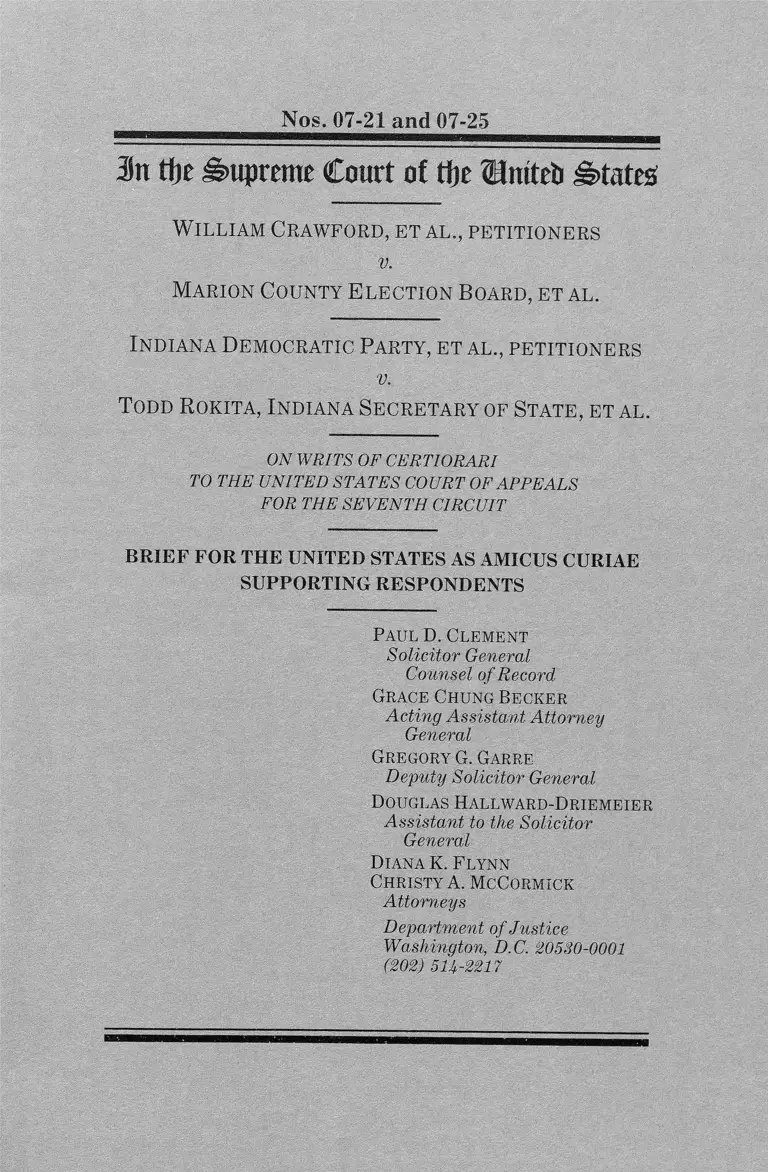
Nos. 07-21 and 07-25
in tfje Supreme Court of tf)e Umteb States
William Crawford, et al., petitioners
V.
Marion County E lection Board, et al.
Indiana Democratic Party, et al., petitioners
v.
Todd Rokita, I ndiana Secretary of State, et al.
ON WRITS OF CERTIORARI
TO THE UNITED STATES COURT OF APPEALS
FOR THE SEVENTH CIRCUIT
BRIEF FOR THE UNITED STATES AS AMICUS CURIAE
SUPPORTING RESPONDENTS
Paul D. Clement
Solicitor General
Counsel of Record
Grace Chung Becker
Acting Assistant Attorney
General
Gregory G. Garre
Deputy Solicitor General
Douglas Hallward-Driemeier
Assistant to the Solicitor
General
Diana K. F lynn
Christy A. McCormick
Attorneys
Department of Justice
Washington, D.C. 20530-0001
(202) 514-2217
QUESTION PRESENTED
Whether an Indiana statute mandating that those
seeking to vote in person produce a government-issued
photo identification on its face violates the First and
Fourteenth Amendments to the Constitution.
(I)
TABLE OF CONTENTS
Interest of the United S tates.......................................................... 1
Statem ent.......... .............................................. 2
Summary of argument ................. ......................................... 8
Argument ..................... 10
I. Petitioners have failed to show that the Voter ID
Law is invalid on its fa c e ................................................11
II. The Voter ID Law is a reasonable administrative
rule that furthers the State’s compelling interest in
combating voter fraud ................................. 18
A. States have broad authority to establish
rules to ensure the integrity of elections ........ 18
B. Because the Voter ID Law is neither
discriminatory nor a severe burden on the
franchise, heightened scrutiny is
unwarranted............................................................20
1. The Voter ID Law does not discrim
inate with respect to the right to vote . . . . 20
2. The Voter ID Law does not impose a
severe burden on the right to v o t e ............ 23
C. The Voter ID Law serves the State’s
compelling interest in preserving the
integrity of the electoral process.........................28
III. HAVA’s identification requirements do not
preempt Indiana’s Voter ID Law ...............................31
Conclusion ......................................................33
Page
( H I )
IV
TABLE OF AUTHORITIES
Cases:
Anderson v. Celebrezze, 460 U.S. 780 (1983) ................. 9,19
Ayotte v. Planned Parenthood, 546 U.S. 320 (2006) . 13,16
Broadrick v. Oklahoma, 413 U.S. 601 (1973) ................... 13
Bullock v. Carter, 405 U.S. 134 (1972) ............................... 20
Burdick v. Takushi, 504 U.S. 428 (1992) .......... passim
Carrington v. Rash, 380 U.S. 89 (1965) ...................... .. 18
City of Cleburne v. Cleburne Living Ctr., 473 U.S. 432
(1985) ................................................................................... 20
City of Mobile v. Bolden, 446 U.S. 55 (1980) ..................... 21
Clements v. Fashing, 457 U.S. 954 (1982) ................. 19
Common Cause/Ga. v. Billups, 504 F. Supp. 2d 1333
(N.D. Ga. 2007) ....................................... 24
Cutter v. Wilkinson, 544 U.S. 709 (2005) ........................... 24
Eu v. San Francisco County Democratic Comm.,
489 U.S. 214 (1989) ............................................................ 28
FECv. National Right to Work Comm., 459 U.S. 197
(1982) ................................................................................... 29
Foti v. McHugh, No. 05-16079, 2007 WL 2472340
(9th Cir. Aug. 28, 2007) .................................................... 23
Gilmore v. Gonzales, 435 F.3d 1125 (9th Cir. 2006),
cert, denied, 127 S. Ct. 929 (2007) ................................. 23
Gonzalez v. Arizona, 485 F.3d 1041 (9th Cir. 2 0 0 7 )........ 24
Gonzalez v. Carhart, 127 S. Ct. 1610 (2007) ..................... 18
Harper v. Virginia Bd. of Elections, 383 U.S. 663
(1966) .................................................................. ..
Page
26
V
Cases-Continued: Page
Harris v. McRae, 448 U.S. 297 (1980) ............................... 20
Kimel v. Florida Bd. of Regents, 528 U.S. 62 (2000) . . . . 20
Kramer v. Union Free Sch. Dist., 395 U.S. 621 (1969) .. 24
Lassiter v. Northampton County Bd. of Elections,
360 U.S. 45 (1959) .............................................................. 18
Mason v. Missouri, 179 U.S. 328 (1900) ........................... 18
Massachusetts v. Oakes, 491 U.S. 576 (1989) ................... 12
McDonald v. Board of Election Commr’s, 394 U.S. 802
(1969) ................................................................................... 14
Munro v. Socialist Workers Party, 479 U.S. 189
(1986) ................................................................................... 29
New York v. Ferher, 458 U.S. 747 (1982) ........................... 12
Norman v. Reed, 502 U.S. 279 (1992) ................................. 19
Pabeyv. Pastrick, 816 N.E.2d 1138 (Ind. 2004) ................. 3
Personnel Adm’rv. Feeney, 442 U.S. 256 (1979) ............ 21
Purcell v. Gonzalez, 127 S. Ct. 5 (2006) ....................... 18, 28
Reno v. Bossier Parish Sch. Bd,., 520 U.S. 471 (1996) . . . 21
Reynolds v. Sims, 377 U.S. 533 (1964) ......................... 18,28
Rodriguez v. Popular Democratic Party, 457 U.S. 1
(1982) ................................................................................... 26
Rust v. Sullivan, 500 U.S. 173 (1991) ................................. 16
Sabri v. United States, 541 U.S. 600 (2004) ................. 12,13
United States v. Raines, 362 U.S. 17 (1960) ........ 12,13,14
United States v. Salerno, 481 U.S. 739 (1987) . 10,11,16,17
Village of Arlington Heights v. Metropolitan Hous.
Dev. Corp., 429 U.S. 252 (1977) ..................................... 21
Village of Hoffman Estates v. Flipside, Hoffman
Estates, Inc., 455 U.S. 489 1982) 11,12
VI
Virginia v. Hicks, 539 U.S. 113 (2003) ............................... 12
Worth v. Seldub, 422 U.S. 490 (1975) ........................... 12,13
Washington v. Davis, 426 U.S. 229 (1976) ...................... 21
Wisconsin v. City of New York, 517 U.S. 1 (1996) .......... 21
Cases-Continued: Page
Constitution, statutes and regulations:
U.S. Const.:
Art. I, § 4, Cl. 1 ................................................................... 18
Amend. I ............................................................................. 12
Amend. XIV ....................................................................... 21
Help America Vote Act of 2002, Pub. L. No. 252,116
Stat. 1666 (42 U.S.C. 15301
etseq.) ........................................................................... 2
42 U.S.C. 15483(a)(4)(A) (Supp. IV 2 0 0 4 )................... 3
42 U.S.C. 15483(a)(5)(A) (Supp. IV 2 0 0 4 ).............. 2, 3
42 U.S.C. 15483(b) (Supp. IV 2 0 0 4 )............................. 5
42 U.S.C. 15483(b)(l)-(4) (Supp. IV 2004) ................. 3
42 U.S.C. 15483(b)(2)(A) (Supp. IV 2004) .......... 2,3
42 U.S.C. 15483(b)(2)(A)(i)(II) (Supp. IV 2004) 17, 32
42 U.S.C. 15483(b)(3)(A) (Supp. IV 2004) . . . . 2, 3, 32
42 U.S.C. 15484 (Supp. IV 2004) ..................... 3,10,32
42 U.S.C. 15485 (Supp. IV 2004) ............................... 32
42 U.S.C. 15511 (Supp. IV 2004) ................................. 2
National Voter Registration Act of 1993, 42 U.S.C.
1973gg et seq....................... 2
42 U.S.C. 1973gg(b)(l) .................................................. 2
42 U.S.C. 1973gg(b)(3) .................. 2
42 U.S.C. 1973gg-3(a)(l)................................................ 2
VII
42 U.S.C. 1973gg-3(c)(2)(B)(ii) .................................... 2
42 U.S.C. 1973gg-4(c)(l)(A) .......................................... 2
42 U.S.C. 1973gg-4(c)(l)(B) .......................................... 2
42 U.S.C. 1973gg-7(b)(l) .............................................. 2
42 U.S.C. 1973gg-9 ............................................................
42 U.S.C. 1973gg-10(c) .................................................. 2
Voting Rights Act of 1965, 42 U.S.C. 1973 et seq.:
42 U.S.C. 19731(c) .............................................................. 2
42 U.S.C. 19731(e) ....................................... 2
Pub. L. No. 103-2005, § 4, 2005 Ind. Acts 1948 .................. 4
Pub. L. No. 109-2005, 2005 Ind. Acts 2005 ......................... 4
Ind. Code:
§3-5-2-40.5 ........................................................................... 4
§3-6-5-34 ............................................................................... 6
§3-10-1-7.2 ........................................................................... 5
§ 3 - l l -4 - l(a ) .................... 6
§ 3-ll-4-2(c) ........................................................................... 4
§ 3-ll-4-2(d) ......................................................................... 4
§3-11-4-3(2)........................................................................... 6
§3-11-8-25.1 ......................................................................... 5
§ 3-ll-8-25.1(c) .................................................................... 4
§ 3-ll-8-25.1(d) .................................................................... 6
§ 3-ll-8-25.1(e) .................................................................... 5
§ 3-1 l-10-24(a)(3)-(5) .......................................................... 5
§ 3-ll-10-24(a)(4) .............................................................. 25
§ 3-ll-10-24(a)(5) .............................................................. 25
Statutes and regulations-Continued: Page
VIII
§ 3-ll-10-26(a)......................................... 6
§3-ll-10-26(c) .............. 6
§3-11.7-5-1 ............................................... 6
§3-11.7-5-2.5(0) ..................................................................... 6
§ 9-24-16-10(b) .......... ................................................... ••• 5
8 C.F.R.:
Section 1274a.2(b)(l)(i) ............................... 24
Section 1274a.2(b)(l)(v) .................................................... 24
Miscellaneous:
R. Michael Alvarez et al., CalTech/MIT Voting
Technology Project, Working Paper #57, Version 2
(Oct. 2007) < http://www.vote.caltech.
edu/media/documents/wps/vtp_wp57.pdf>................... 22
Commission on Federal Election Reform, Building
Confidence in U.S. Elections: Report of the
Commission on Federal Election Reform (2005)
< http://www.american.edu/ia/ cfer/report/
full_report.pdf> ................................................................ 28
148 Cong. Reg. (2002):
p. 20,832 ............................... 30
p. 20,833 30
p. 20,834 .............. 32
Memorandum from Dale Simmons and Cody Kendall,
Co-Counsels, Ind. Election Div., to J. Bradley King
and Kristi Robertson, Co-Directors, Ind. Election
Div., regarding Photo ID Interpretations (May 1,
2006) < http://www.in.gov/sos/elections/pdfs/
PhotoIDAdvisory_4_30_06.pdf> ............................... 5,16
Statutes and regulations-Continued: Page
http://www.vote.caltech
http://www.american.edu/ia/
http://www.in.gov/sos/elections/pdfs/PhotoIDAdvisory_4_30_06.pdf
http://www.in.gov/sos/elections/pdfs/PhotoIDAdvisory_4_30_06.pdf
IX
Miscellaneous—Continued: Page
Jeffrey Milyo, The Effects of Photographic
Identification on Voter Turnout in Indiana:
A County-Level Analysis, Report 10-2007
(Nov. 2007) <http://www.truman.
missouri.edu/uploads/publications/
report%2010-2007.pdf> 2,16
Todd Rokita, Ind. Sec’y of State, PhotoID.lN.gov: Are
There Exemptions ':? <http://www.in.gov/sos/
photoid/exemptions.html> ................................... 6,15,16
United States Election Assistance Comm’n,
EAC Advisory 2005-006: Provisional Voting
and Identification Requirements (2005)
< http://www.eac.gov/election/
advisories%20and%20guidanee/
EAC%20Advisory%2005-006%20
Provisional%20Voting.pdf> ............................................ 32
http://www.truman
http://www.in.gov/sos/photoid/exemptions.html
http://www.in.gov/sos/photoid/exemptions.html
http://www.eac.gov/election/
31n tf)e Supreme Court of tfje ®nttcti States;
No. 07-21
William Crawford, et al., petitioners
v.
Marion County Election Board, et al.
NO. 07-25
Indiana Democratic Party, et al., petitioners
v.
Todd Rokita, Indiana Secretary of State, et al.
ON WRITS OF CERTIORARI
TO THE UNITED STATES COURT OF APPEALS
FOR THE SEVENTH CIRCUIT
BRIEF FOR THE UNITED STATES AS AMICUS CURIAE
SUPPORTING RESPONDENTS
INTEREST OF THE UNITED STATES
This case concerns a facial challenge to a sta te law
that requ ires those who vote in person in federal e lec
tions to p resen t a governm ent-issued photo identifica
tion and, m ore generally , the appropriate constitutional
standard for review ing such a law. C ongress has en
acted num erous requirem ents, including registration
and identification requirem ents, designed to “increase
(1)
2
the number of eligible citizens who register to vote”
while simultaneously “protecting] the integrity of the
electoral process.” 42 U.S.C. 1973gg(b)(l), (3). In 2002,
Congress enacted the Help America Vote Act of 2002
(HAVA), Pub. L. No. 107-252,116 Stat. 1666 (42 U.S.C.
15301 et seq.), to establish and modernize various mini
mum election administration standards for federal elec
tions. Among other things, HAVA requires voters to
provide proof of identification before registering or cast
ing their first ballot, see 42 U.S.C. 15483(a)(5)(A),
(b)(2)(A), (3)(A). The Attorney General is responsible
for enforcing those provisions. 42 U.S.C. 1973gg-9,
15511. The Attorney General also has authority to pros
ecute voter fraud in federal elections. See, e.g., 42
U.S.C, 1973i(c), (e), 1973gg-10(c).
STATEMENT
1. In 1993, Congress enacted the National Voter
Registration Act of 1993 (NVRA), 42 U.S.C. 1973gg et
seq. One of the Act’s purposes was to “increase the
number of eligible citizens who register to vote.” 42
U.S.C. 1973gg(b)(l). The NVRA facilitated voter regis
tration by, among other things, requiring that state mo
tor vehicle driver’s license applications also serve as
voter registration applications. 42 U.S.C. 1973gg-3(a)(l).
At the same time, Congress emphasized the need to
“protect the integrity of the electoral process.” 42
U.S.C. 1973gg(b)(3). Thus, the NVRA authorizes States
to require information necessary to “assess the eligibil
ity of the applicant.” 42 U.S.C. 1973gg-3(c)(2)(B)(ii),
1973gg-7(b)(l). The Act also specifies that States may
require individuals who have submitted their voter reg
istration by mail “to vote in person” the first time they
vote. 42 U.S.C. 1973gg-4(c)(l)(A), (B).
3
In 2002, Congress enacted HAVA. HAVA requires
States to maintain accurate statewide voter registration
lists, by making a “reasonable effort to remove regis
trants who are ineligible to vote from the official list of
eligible voters.” 42 U.S.C. 15483(a)(4)(A). In addition,
HAVA requires States to verify the voter registration
information of new registrants. 42 U.S.C. 15483(a)(5)(A),
(b)(l)-(4). A State must require a person who submits a
voter registration by mail to submit, either as part of the
registration or the first time the individual votes, proof
of identity. Ibid. Acceptable forms of identification
under HAVA are “a current and valid photo identifica
tion” or “a current utility bill, bank statement, govern
ment check, paycheck, or government document that
shows the name and address of the voter.” 42 U.S.C.
15483(b)(2)(A), (3)(A). HAVA specifies that States may
establish “more strict” standards that are not inconsis
tent with the federal law’s “minimum requirements,” 42
U.S.C. 15484.
2. Indiana determined that it faced a serious prob
lem of actual and potential election fraud. In 2004, the
Indiana Supreme Court invalidated the 2003 East Chi
cago mayoral primary based on evidence of rampant
absentee-ballot fraud, which included the use of vacant
lot or former addresses and casting of ballots by nonres
idents. Pabey v. Pastrick, 816 N.E.2d 1138,1145,1153.
The Indiana Supreme Court found that the widespread
fraud had rendered the election results “inherently de
ceptive and unreliable.” Id. at 1151.
At the same time, the State was experiencing highly
inflated voter registration rolls, thus creating a risk of
further voter fraud. Indeed, a report shows that more
than 35,000 deceased individuals were on the rolls state
wide, and that, in 2004, the list of registered voters was
4
inflated by some 41%, including well over 200,000 dupli
cate voter registrations. 07-21 Pet. App. 40 (Pet. App.).
On April 7, 2005, the United States Department of Jus
tice informed the Indiana Secretary of State that numer
ous counties had registration totals that exceeded their
voting age populations and noted the State’s obligations
under federal law to maintain accurate voter registra
tion lists. J.A. 312-313.1
Shortly thereafter, Indiana responded to those and
other concerns by enacting a number of election re
forms. In particular, Indiana enacted Senate Enrolled
Act No. 483 (Voter ID Law), Ind. Pub. L. No. 109-2005,
2005 Ind. Acts 2005, which, in order to deter voter fraud,
requires those who vote in-person to present photo iden
tification, issued either by the United States or Indiana.
See Ind. Code 3-ll-8-25.1(c) and 3-5-2-40.5; Pet. App.
106. On the same day, the legislature also placed new
restrictions on absentee voting and the handling of ab
sentee ballots. Ind. Pub. L. No. 103-2005 § 4, 2005 Ind.
Acts 1948; Ind. Code 3-1 l-4-2(c), (d).
Under the Voter ID Law, an acceptable ID must con
tain the photograph and name of the individual to whom
it was issued, which must conform to that on the regis
tration rolls. The ID must also have an expiration date
and be either unexpired or have expired after the most
recent general election. See Ind. Code. 3-5-2-40.5. Nu
merous forms of identification may qualify, including an
Indiana driver’s license, a non-license photo identifica
tion issued by the State’s Bureau of Motor Vehicles
(BMV), a student ID issued by a State-sponsored college
1 The United States Department of Justice brought suit against the
State for violating the NVRA’s requirements regarding the removal of
ineligible voters from the voter registration list. J.A. 309-317. That suit
was resolved through a consent decree. J.A. 299-307.
5
or university, a passport, or military ID. See Dale
Simmons and Cody Kendall, eo-eounsels, Indiana Elec
tion Division, Photo ID Interpretations 3-4 (2006)
{Photo ID Interpretations) <www.in.gov/sos/elections/
pdfs/PhotoIDAdvisory_4_30_06.pdf>.
Indiana provides alternatives for those wdio do not
already possess an acceptable ID. The State will pro
vide, free of charge, a photo ID that satisfies the re
quirements to any individual who will be at least 18
years of age at the next election and does not have a
valid Indiana driver’s license. See Ind. Code 9-24-16-
10(b). To obtain a photo ID, the BMV requires first
time applicants to produce one primary document (such
as a certified birth certificate or certain immigration
documents), one secondary document (such as non-photo
government documents, bank statements, school docu
ments, or credit card statements), and one proof of Indi
ana residency; or two primary documents and one proof
of Indiana residency. Pet. App. 32-35.
For certain voters, state law provides ways for those
individuals to vote without producing photo identifica
tion. Those who are over 65, disabled, or confined by
illness or injury may cast an absentee ballot by mail.
See Ind. Code 3-ll-10-24(a)(3)-(5). Indiana’s photo ID
law does not apply to absentee balloting by mail. See id.
3-10-1-7.2, 3-11-8-25.1; Pet. App. 25.2 The Voter ID Law
also does not apply to individuals “who vote in person at
a precinct polling place that is located at a state licensed
care facility where the voter resides.” Ind. Code. 3-11-8-
25.1(e). See Pet. App. 25.
2 A voter easting an absentee ballot by mail the first time that person
votes after having registered to vote by mail may be required to
present identification pursuant to HAVA. See 42 U.S.C. 15483(b).
http://www.in.gov/sos/elections/pdfs/PhotoIDAdvisory_4_30_06.pdf
http://www.in.gov/sos/elections/pdfs/PhotoIDAdvisory_4_30_06.pdf
6
Those who object to having their pictures taken on
religious grounds or do not have and cannot afford to
obtain the necessary documentation may execute affida
vits regarding their status and cast their ballots without
presenting a photo ID. Ind. Code 3-11.7-5-2.5(c); Pet.
App. 25-26. State law allows such individuals to vote
without presenting an ID in either of two ways. First,
such voters may exercise the right of any Indiana voter
to vote an “absentee” ballot in person at the office of the
circuit court clerk or board of elections on any date be
tween 29 days and one day before the election. See Ind.
Code 3-ll-4-l(a), 3-ll-10-26(a), (c). Voters who choose
to do so may file an absentee application, cast their bal
lot, and sign an affidavit of indigency or religious objec
tion on a single trip to the local election office. See id. 3-
11-4-3(2), 3-11.7-5-2.5(c); <www.in.gov/sos/photoid/
exemptions.html >.
Second, any voter who appears at the polls without
the requisite identification, either because an exemption
applies or because the person does not have an ID in his
or her possession at the time, may cast a provisional
ballot. See Ind. Code 3-ll-8-25.1(d). A provisional bal
lot will be counted so long as the voter appears before
the circuit court clerk or the county election board no
later than ten days following the election, and executes
an affidavit that he or she is the same person who cast
the provisional ballot, and either: (a) presents accept
able photo identification; or (b) executes an affidavit of
indigency or religious objection. Ind. Code 3-11.7-5-1; 3-
11.7-5-2.5(c); Pet. App. 25-26. If the county election
board rejects the ballot, the individual may obtain judi
cial review in the local circuit court. Ind. Code 3-6-5-34.
3. Two different plaintiff groups—the Indiana Dem
ocratic Party and the Marion County Democratic Cen
http://www.in.gov/sos/photoid/exemptions.html_
http://www.in.gov/sos/photoid/exemptions.html_
7
tral Committee; and two elected officials, along with
several nonprofit organizations, including the Indianap
olis Branch of the NAACP, the United Senior Action of
Indiana, the Indianapolis Resource Center for Inde
pendent Living, and Concerned Clergy of Indianapo
lis—brought suit alleging that the Voter ID Law violates
the First and Fourteenth Amendments to the Constitu
tion because it imposes an unwarranted burden upon the
right to vote. On April 14, 2006, the district court
granted summary judgment in favor of the State, hold
ing that the Voter ID Law is a permissible time, place,
and manner restriction on voting. Pet. App. 16-149.
The district court stressed that petitioners had failed
to “introduce[] evidence of a single, individual Indiana
resident who will be unable to vote as a result of [the
Voter ID Law,] or who will have his or her right to vote
unduly burdened by its requirements.” Pet. App. 18.
The court found that petitioner’s expert report, which
attempted to estimate the number of Indiana registered
voters without a BMV-issued photo ID by comparing the
voter registration rolls and BMV records in Marion
County, was “utterly incredible and unreliable” and re
flected “a conscious effort * * * to report the largest
possible number” of impacted individuals. Id. at 60-62.
To the extent that it shed any credible light on the mat
ter, the court found that petitioners’ report actually sup
ported the State’s position that its law had “no potential
disparate impact * * * based on a voter’s race or edu
cation level,” and that “to the extent [the report] is accu
rate, [it] actually indicates that voters without photo
identification are not significantly more likely to come
from low income segments of society.” Id. at 70, 72.
4. The court of appeals affirmed. Pet. App. 1-15.
The court concluded that the Voter ID Law was not sub
8
ject to strict scrutiny because the record at most re
vealed only a “slight” effect of eligible voters “dis-
enfranchis[ing] themselves,” and that negligible concern
was outweighed by the State’s interest in combating
“voting fraud.” Id. at 6-7. Furthermore, the court ob
served that the State was free to “take preventive ac
tion” to deter voter fraud and, with it, the dilution of
legitimate votes. Id. at 8.
Judge Evans dissented. He would have subjected
the Voter ID Law to “strict scrutiny” or at least “strict
scrutiny light,” Pet. App. 11, and concluded that the law
failed that test, see id. at 11-15.
5. A petition for rehearing en banc was denied, with
four judges dissenting. Pet. App. 151-155.
SUMMARY OF ARGUMENT
The court of appeals correctly held that petitioners
have not carried the heavy burden of showing that the
Voter ID Law is invalid on its face.
I. This Court requires a particularly demanding
showing in facial challenges because such attacks run
counter to numerous principles of judicial restraint: pru
dential standing, ripeness, and invalidating no more of
a legislature’s enactment than necessary. Petitioners’
facial challenge to the Voter ID Law raises all of those
concerns. Indeed, petitioners have failed to identify a
single individual in Indiana who would vote if, but only
if, the Voter ID law were invalidated. And, as the dis
trict court found, petitioners have utterly failed to show
that the Voter ID law has had a discriminatory impact
on any segment of society. Invalidating the Indiana law
on its face would therefore require this Court to invert
the analysis that it customarily applies to facial chal
lenges, in which a law is constitutional unless there are
9
no circumstances in which it can be constitutionally ap
plied.
II. In any event, the Voter ID Law clearly satisfies
the inquiry established by this Court for reviewing the
constitutionality of election laws. Because any election
regulation necessarily imposes some burden on voters’
exercise of the franchise, the Court has rejected the ar
gument that “a law that imposes any burden upon the
right to vote must be subject to strict scrutiny.”
Burdick v. Takushi, 504 U.S. 428, 432 (1992). Instead,
“when a state election law provision imposes only ‘rea
sonable, nondiscriminatory restrictions’” on voting,
“‘the State’s important regulatory interests are gener
ally sufficient to justify’ the restrictions.” Id. at 434
(quoting Anderson v. Celebrezze, 460 U.S. 780, 788
(1983)).
Petitioners have failed to demonstrate that the Voter
ID Law imposes a severe burden on the right to vote.
Photo ID requirements are ubiquitous in American soci
ety today. For the 99% of voters in Indiana who already
have a photo ID, the law requires no more than that the
voter present the ID at the polls. For the less than 1%
of Indiana voters who do not yet have an ID, the State
offers them such an ID free of charge. And for those
who are most likely to find it difficult to obtain even a
free ID, state law provides alternative methods of vot
ing that do not require presenting identification. Be
cause petitioners have not shown that the Voter ID Law
imposes a severe burden on the right to vote, it is sub
ject to more generous review under the Burdick balanc
ing analysis.
Any burden that is imposed by the Voter ID Law is
more than justified by the State’s interest in combating
in-person voter fraud. Voter fraud itself constitutes an
10
impairment of the right to vote. In a close race, even a
handful of fraudulent votes could invalidate the entire
election, as has happened in Indiana. Moreover, the
well-publicized fact of voter registration lists with fraud
ulent, deceased, or otherwise invalid names undermines
the public confidence in the electoral process that is the
lifeblood of democratic institutions. Particularly given
that in-person voter fraud is difficult to detect without
rigorous ID requirements and that as a practical matter
it is important for the State to deter, not just detect and
punish, voter fraud, the State has amply demonstrated
its interest in passing its Voter ID Law.
III. HAVA does not preempt the Voter ID Law.
HAVA explicitly states that its requirements do not pre
vent States from adopting administrative requirements
that are “more strict” than HAVA’s. 42 U.S.C. 15484.
While Indiana’s ID requirement is “more strict” than
HAVA’s, it is in no way “inconsistent with the Federal
requirements.” Ibid. A contrary interpretation would
deprive the States of the flexibility that Congress in
tended to preserve under HAVA in enacting laws that
would modernize and improve the electoral process as
our democracy enters the 21st century.
ARGUMENT
Petitioners elected to bring a facial challenge to Indi
ana’s Voter ID Law, and to bring such an action before
the statute had ever been implemented in practice. Such
a challenge is “the most difficult challenge to mount.”
United States v. Salerno, 481 U.S. 739, 745 (1987). Peti
tioners’ facial challenge is fatally undercut by the undis
puted fact that they have failed to identify a single indi
vidual in Indiana whose ability to vote depends on that
law. In light of that fact, petitioners’ challenge flunks
11
any reasonable formulation of this Court’s standard for
evaluating facial constitutional challenges to legislative
acts. Petitioners would avoid that conclusion by having
this Court revamp the settled framework for evaluating
First Amendment challenges to election laws and hold
that a law that imposes any burden on the right to
vote—indeed, as in this case, even a hypothetical one
—subjects a law to strict scrutiny. This Court rejected
precisely such a proposal in Burdick, 504 U.S. at 432,
and petitioners provide no reason for the Court to re
verse course here. Any individual is free to bring an as-
applied challenge to Indiana’s Voter ID Law grounded
in their particular circumstances or actual experience
and attempt to demonstrate that the law imposes an
unconstitutional burden on his or her right to vote. But
the court of appeals properly rejected petitioners’ facial
challenge to the Voter ID Law on the record here.
I. PETITIONERS HAVE FAILED TO SHOW THAT THE
VOTER ID LAW IS INVALID ON ITS FACE
A. The only question presented for the Court’s re
view is the constitutionality of the Voter ID Law on its
face. See Dem. Br. i; Crawford Br. i. This Court long
ago explained that “[a] facial challenge to a legislative
Act is * * * the most difficult challenge to mount.”
Salerno, 481 U.S. at 745. “The fact that [a statute]
might operate unconstitutionally under some conceiv
able set of circumstances is insufficient to render it
wholly invalid.” Ibid. Rather, in the typical case, to suc
ceed in a facial challenge, “the challenger must establish
that no set of circumstances exists under which the Act
would be valid.” Ibid. See Village of Hoffman Estates
12
v. Flipside, Hoffman Estates, Inc., 455 U.S. 489, 494 n.5
(1982).3
The rule disfavoring facial invalidation is animated
by several related principles of judicial restraint. First,
as a matter of prudential standing, “a person to whom a
statute may constitutionally be applied may not chal
lenge that statute on the ground that it may conceivably
be applied unconstitutionally to others in situations not
before the Court.” New York v. Ferber, 458 U.S. 747,
767 (1982); Warth v. Seldin, 422 U.S. 490, 499 (1975);
United. States v. Raines, 362 U.S. 17, 21 (1960). Second,
facial invalidation raises ripeness concerns because it
invites “‘premature interpretation] of statutes’ on the
basis of factually barebones records.” Sabri v. United
3 Although the Court has recognized that “[t]he First Amendment
doctrine of overbreadth is an exception to [the] normal rule regarding
the standards for facial challenges,” Virginia v. Hicks, 539 U.S. 113,118
(2003), petitioners’ invocation of the First Amendment as a source of
their constitutional claims, Dem. Br. 1, 44; Crawford Br. 2, does not
bring them within that exception. The overbreadth doctrine has been
applied “only where its effect might be salutary,” Massachusetts v.
Oakes, 491 U.S. 576,582 (1989) (plurality opinion), such as, for example,
where threat of enforcement of a law that “punishes * * * protected
free speech,” “especially” one that “imposes criminal sanctions,” may
“deter or ‘chill’ ” the speech, and individuals cannot be expected to “un
dertake the considerable burden (and sometimes risk) of vindicating
their rights through case-by-case adjudication.” Hicks, 539 U.S. at 118-
119. The Voter ID Law does not threaten to “punish” anyone, and
there is no “risk” to an individual (or association with standing to re
present that individual) who challenges the law as applied to their
circumstances. Moreover, the ability to cast a provisional ballot means
even someone unsure of the law need not suffer any loss of voting
rights. In any event, to the extent the doctrine applies, petitioners in
ability to identify a single individual who is unable to vote as a result of
the Voter ID Law fatally undercuts any suggestion of overbreadth
here.
13
States, 541 U.S. 600, 609 (2004) (quoting Raines, 362
U.S. at 22). Third, facial invalidation conflicts with the
Court’s practice not to “nullify more of a legislature’s
work than is necessary.” Ayotte v. Planned Parenthood,
546 U.S. 320, 329 (2006). Relatedly, a facial challenge
short-circuits the process by which potential constitu
tional questions are avoided when a statute is narrowed
through the course of its application. Broadrick v. Okla
homa, 413 U.S. 601, 613 (1973).
B. Petitioners’ facial challenge to the Voter ID Law
highlights all of those concerns.
1. As respondents have explained, serious questions
exist regarding petitioners’ constitutional standing to
bring this suit at all. See Resp. Br. 14-19. Petitioners’
suit also implicates prudential standing concerns be
cause of the significant divergence between the facts on
which petitioners base their claims of standing and the
types of injuries they highlight in their broad attack on
the Voter ID Law. Cf. Warth, 422 U.S. at 499 (“the
plaintiff generally must assert his own legal rights and
interests, and cannot rest his claim to relief on legal
rights or interests of third parties”). For example,
whereas the Democratic Party of Indiana asserts asso-
ciational standing to represent individuals affiliated with
the party, Dem. Br. 58-59, each of the individual voters
the party identified as being burdened by the law and
who consented to representation by the party is over 65
years of age and therefore has a right under Indiana law
to vote absentee by mail, without producing a photo ID.
See Pet. App. 80-81; p. 5, supra. Those voters, because
they have that option, would seem to have a markedly
weaker claim. Indeed, the party’s argument with re
spect to the constitutional adequacy of that alternative
voting method is confined to a footnote, see Dem. Br. 32
14
n.17, and the party instead focuses its argument on
those who “simply cannot vote” or who “will not * * *
successfully complete all the steps needed to vote.” Id.
at 23; see id. at 31-41. Yet, the party was unable to iden
tify any such individual, much less one who it could rep
resent through associational standing. See Pet, App. 80-
81. Similarly, the individual plaintiffs themselves have
failed to demonstrate that they have been directly in
jured by the Voter ID Law. See Resp. Br. 15-16.
2. Petitioners’ inability to identify any concrete
harms stemming from the Voter ID Law renders peti
tioners’ arguments largely theoretical and speculative.
Petitioners failed to identify any individual who would
not vote as a result of the statute, Pet, App. 80-81, 94; id.
at 5, and rely instead on their mere assertion that “there
can be no doubt that these people exist.” Dem. Br. 59;
Crawford Br. 26, 27, 32, 37 (“the Indiana law will deter
some people from voting” (quoting the court of appeals’
opinion, Pet. App. 3)). But, as this Court has stressed,
“[t]he delicate power of pronouncing an [act] unconstitu
tional is not to be exercised with reference to hypotheti
cal cases thus imagined.” Raines, 362 U.S. at 22. See
McDonald v. Board of Election Co?nmr’s, 394 U.S. 802,
808 (1969) (“Faced as we are with a constitutional ques
tion, we cannot lightly assume, with nothing in the re
cord to support such an assumption, that [a statute] has
in fact precluded [petitioners] from voting.”).
The abstract quality of petitioners’ challenge is exac
erbated by their decision to attack the statute before it
went into effect. Without any experience under the stat
ute, petitioners premised their challenge on an expert’s
statistical analysis of registration rolls and BMV re
cords. But the district court found that report to be
“utterly incredible and unreliable.” Pet. App. 60. And,
15
in any event, the report revealed “no potential disparate
impact * * * based on a voter’s race or education level
and only a small potential disparate impact based on
income level.” Id. at 70. Having failed to provide proof
of a burden on voting in the district court, petitioners
now ask this Court to decide the constitutionality of the
Voter ID Law on the basis of reports that post-date the
district court ruling and have never been subjected to
cross-examination or peer review. See, e.g., Dem. Br.
xiv-xvi (citing no fewer than 11 publications that post
date the district court decision); id. at 34-35 (citing Oct
ober 2007 “working paper” as “evidence” that Indiana’s
law “placed significant burdens on voters” (quotation
marks omitted)); id. at 12 (citing November 2006 report
as evidence regarding incidence of lack of identification);
Crawford Br. 15, 40 n.19, 41 n.20 (same). As we discuss
below, see p. 22, infra, an even more recent unpublished
study that focuses exclusively on Indiana’s experience
points in the opposite direction. But, more fundamen
tally, such speculation and as-yet untested evidence can
not satisfy the standard for proving a statute facially
unconstitutional.
The premature nature of petitioners’ challenge has
also caused them and their amici to posit constructions
of the Voter ID Law that are contrary to the State’s own
interpretation and application of the statute. For exam
ple, the Democratic Party repeatedly asserts (Dem. Br.
11, 16) that indigent persons without identification and
those with religious objections may not execute affida
vits to that effect before the election, at the same time
the individual casts an in-person absentee ballot. See
also Lawyers’ Comm. Br. 27 (same). But the State’s
published guidance is to the contrary. See <www.in.gov
/sos/photoid/exemptions.html> . Likewise, the League
http://www.in.gov/sos/photoid/exemptions.html
http://www.in.gov/sos/photoid/exemptions.html
16
of Women Voters suggests (Br. 24-29) that recently
married individuals, or others whose IDs vary slightly
from the names on the rolls, will be rejected because the
names do not “conform,” but the Indiana Election Divi
sion’s Guidance says otherwise. Photo ID Interpreta
tions 2.
3. The remedy petitioners seek—facial invalidation
of the Voter ID Law—also bears no relation to the con
stitutional harms petitioners assert. If, as petitioners
contend, it is unconstitutional to require a homeless per
son to vote absentee in person (or at the polls with sub
sequent validation by affidavit) because he is unable to
obtain a BMV-issued ID (see, e.g., Crawford Br. 18 (cit
ing case of Kristjan Kogerma, J.A. 67)), then a narrower
remedy would be to enjoin the BMV from denying an ID
on the ground that a person has no address, or to enjoin
the IDOH from collecting a search fee for a birth certifi
cate in that circumstance. Such challenges should await
actual circumstances in which those difficulties may or
may not arise. But at a minimum, as the Court reiter
ated in Ayotte, courts should “enjoin only the unconsti
tutional applications of a statute while leaving other ap
plications in force.” 546 U.S. at 329.
C. Petitioners not only have not identified a single
individual who would be unable to vote because of the
Voter ID Law, but they make no serious argument that
the Voter ID Law imposes an unconstitutional burden
on the more than 99% of Indiana voters who already
possess an ID that satisfies the statutory requirements.
Accordingly, instead of attempting to carry the “heavy
burden,” Rust v. Sullivan, 500 U.S. 173, 183 (1991), to
“establish that no set of circumstances exists under
which the Act would be valid,” Salerno, 481 U.S. at 745,
petitioners effectively ask this Court to invert the set-
17
tied inquiry and hold that the Voter ID Law must be
struck down in toto “[e]ven if only a single citizen is de
prived completely of her right to vote.” Dem. Br. 33
(emphasis added; brackets in original) (quoting dissent
from denial of rehearing, Pet. App. 154); see Crawford
Br. 37 (focusing on the “burdens on individual voters”);
id. at 38 (“[t]hat Indiana’s photo identification law may
affect few voters is irrelevant”). That argument not only
has no footing in this Court’s case law, but could have an
extraordinary impact on election laws.
For example, although the Democratic Party sug
gests that HAVA’s ID requirement (see p. 3, supra) is a
valid example of an acceptable “less-restrictive voter-
identification rule[],” Dem. Br. 37-39, 51, petitioners’
theory of the case—that an election law is invalid if one
can hypothesize any single individual who would be pre
vented from voting by the burden it creates—would cast
serious doubt on the constitutionality of HAVA as well.
HAVA’s ID requirements pose no serious obstacle to the
99% of the population with photo IDs or alternative
means of proving their residence and identification. But
one can just as easily hypothesize a theoretical individ
ual who would be prevented from registering to vote by
HAVA because he lacks the documentation it requires.
Compare 42 U.S.C. 15483(b)(2)(A)(i)(II) (accepting non
photo ID that “shows the name and address of the
voter”), with J.A. 67 (affidavit of individual denied BMV-
issued ID because he “did not have anything on it with
proof of my address”). But that is not the test. Rather,
to make out a facial challenge, it is petitioners’ burden
to “establish that no set of circumstances exists under
which the Act would be valid,” Salerno, 481 U.S. at 745.
Because petitioners have not come close to meeting
the high threshold set for facial invalidation of a legisla-
18
live act, petitioners’ facial challenge to the Voter ID
Law must be rejected. As with any statute, the Voter
ID Law remains “open to a proper as-applied challenge
in a discrete case,” Gonzales v. Carhart, 127 S. Ct. 1610,
1639 (2007), but this facial challenge lacks merit.
II. THE VOTER ID LAW IS A REASONABLE ADMINISTRA
TIVE RULE THAT FURTH ERS THE STATE’S COM PEL
LING IN TEREST IN COMBATING VOTER FRAUD
A. States Have Broad A uthority To E stablish Rules To E n
sure The In teg rity Of E lections
The Constitution expressly provides that state legis
latures are to prescribe “[t]he Times, Places and Man
ner of holding Elections for Senators and Representa
tives.” U.S. Const. Art. I, § 4, Cl. 1. And this Court has
long recognized that States “have broad powers to de
termine the conditions under which the right of suffrage
may be exercised,” Carrington v. Rash, 380 U.S. 89, 91
(1965) (quoting Lassiter Northampton County Bd. of
Elections, 360 U.S. 45, 50 (1959)); Mason v. Missouri,
179 U.S. 328, 335 (1900), and a “compelling interest in
preserving the integrity of [the] election process,”
Purcell v. Gonzalez, 127 S. Ct. 5, 7 (2006) (per curiam)
(citation omitted). This authority reflects the fact that
“[v]oter fraud drives honest citizens out of the demo
cratic process and breeds distrust of our government,”
and that “[t]he right of suffrage can be denied by a de
basement or dilution of the weight of a citizen’s vote just
as effectively as by wholly prohibiting the free exercise
of the franchise.” Ibid, (quoting Reynolds v. Sims, 377
U.S. 533, 555 (1964)).
Because States must necessarily “play an active role
in structuring elections” to ensure that they are “fair
and honest * * * rather than chaos,” and because
19
“[ejection laws will invariably impose some burden upon
individual voters,” this Court has stressed that a citi
zen’s “right to vote in any manner” is not “absolute.”
Burdick, 504 U.S. at 433. Likewise, the Court has held
that not every voting regulation that “imposes [a] bur
den upon [individual voters] must be subject to strict
scrutiny.” Id. at 432. See Clements v. Fashing, 457 U.S.
957 965-966 (1982) (plurality opinion); Bullock v. Carter,
405 U.S. 134,143 (1972). Rather, “a more flexible stan
dard applies.” Burdick, 504 U.S. at 434. Under that
approach, “when a state election law provision imposes
only ‘reasonable, nondiscriminatory restrictions’ ” on an
individual’s right to vote, ‘“the State’s important regula
tory interests are generally sufficient to justify’ the re
strictions.” Ibid, (quoting Anderson, 460 U.S. at 788).
In contrast, when the right to vote is “subjected to ‘se
vere’ restrictions,” “the regulation must be ‘narrowly
drawn to advance a state interest of compelling impor
tance.’” Ibid, (quoting Norman v. Reed, 502 U.S. 279,
289 (1992)).
Petitioners point to the fact that Burdick mentions
the “extent to which [the States’] interests make it nec
essary to burden the plaintiffs rights,” Burdick, 504
U.S. at 434 (quoting Anderson, 460 U.S. at 789), and
mistakenly characterize that and similar statements as
establishing a “less restrictive]]” alternative standard
for analyzing electoral regulations. Dem. Br. 26; id. at
27 (emphasizing “necessary”)', id. at 41 (same). But this
Court rejected that interpretation of the standard in
Burdick itself, in which it characterized the dissenting
opinion’s test as a form of “strict scrutiny” analysis pre
cisely because it faulted the State for failing to pursue
“less drastic means.” 504 U.S. at 440 n.10. In short,
because election laws “invariably impose some burden
20
upon individual voters,” heightened scrutiny is reserved
only for those laws that impose “‘severe’ restrictions” on
the right to vote. Id. at 433-434 (emphasis added).
B. Because The Voter ID Law Is N either D iscrim inatory
Nor A Severe Burden On The F ranchise, H eightened
Scrutiny Is U nw arranted
Petitioners and their amici argue that the Indiana
Voter ID Law imposes any number of severe burdens on
the right to vote. But as the district court found, the
fact is that, “[djespite apocalyptic assertions of whole
sale voter disenfranchisement, [petitioners] have pro
duced not a single piece of evidence of any identifiable
registered voter who would be prevented from voting”
by the Indiana law. Pet. App. 101.
1. The Voter ID Law does not discriminate with respect
to the right to vote
a. Petitioners contend that the Voter ID Law should
be subjected to heightened scrutiny because it has a
“discriminatory impact” on “persons in lower socioeco
nomic brackets.” Dem. Br. 35-36. That argument fails
on at least two counts. First, the Court has refused to
recognize poverty, without more, as a suspect classifica
tion that warrants heightened scrutiny. Harris v.
McRae, 448 U.S. 297, 323 (1980). And the same is true
of the other groups that are alleged to suffer disparate
impact of the Voter ID Law: the elderly and disabled.
Kimel v. Florida Bd. of Regents, 528 U.S. 62, 83 (2000)
(age); City of Cleburne v. Cleburne Living Ctr., 473 U.S.
432, 441-442 (1985) (mental retardation). Second, even
with respect to a protected class, disparate impact alone
does not trigger heightened scrutiny under the Four-
teenth Amendment. Personnel Adm’r v. Feeney, 442
U.S. 256, 271-272 (1979); Village of Arlington Heights v.
21
Metropolitan Hous. Dev. Corp., 429 U.S. 252, 265 (1977);
Washington v. Davis, 426 U.S. 229, 237-239 (1976).
Rather, “[sjtrict scrutiny of a classification affecting a
protected class is properly invoked only where a plaintiff
can show intentional discrimination by the Government.”
Wisconsin v. City of New York, 517 U.S. 1,18 n.8 (1996).
Petitioners offer no evidence that the Indiana legisla
ture harbored such an improper purpose.
Petitioners contend that, notwithstanding the gen
eral rule that a plaintiff must show discriminatory in
tent, “[u]nder the Burdick standard, election laws that
exhibit * * * discriminatory effects” are subject to
heightened scrutiny, and “must be justified as necessary
to serve very substantial state interests.” Dem. Br. 36.
But this Court has applied the general equal protection
rule to voting cases as well. As the Court recognized in
Reno v. Bossier Parish School Board, 520 U.S. 471
(1996), “[sjince 1980, a plaintiff bringing a constitutional
vote dilution challenge, whether under the Fourteenth
or Fifteenth Amendment, has been required to establish
that the State or political subdivision acted with a dis
criminatory purpose,” id. at 481 (citing City of Mobile v.
Bolden, 446 U.S. 55, 62, 66 (1980) (plurality opinion)).
b. In any event, petitioners have failed to demon
strate a discriminatory impact as well. The district
court found that petitioners’ own expert’s report regard
ing the effect of the Voter ID Law—which it found “ut
terly incredible and unreliable,” Pet. App. 60—neverthe
less “revealed no potential disparate impact * * *
based on a voter’s race or education level and only a
small potential disparate impact based on income level.”
Id. at 70; see id. at 72; J.A. 279 (expert’s deposition tes
timony: “we could not conclude one way or the other in
terms of the distinction in terms of racial categories”).
22
That failure of proof should be the end of the matter for
purposes of determining what level of review applies.
In an attempt to fill that evidentiary void, petitioners
rely in this Court on studies and reports produced since
the trial court litigation that have yet to be subjected to
cross-examination or peer review. See Dem. Br. 12 &
n.8 (citing Nov. 2006 survey); Crawford Br. 15, 40 n.19,
41 n.20 (same). There is no basis to consider such extra
record materials, but the most recent studies neverthe
less undermine petitioner’s assertion of disparate im
pact. The Cal. Tech./M.I.T. study petitioners cite as
evidence of the statute’s burden (Dem. Br. 34), actually
states that “there does not seem to be a discriminatory
impact of the requirements for some subgroups, such as
nonwhite registered voters.” R. Michael Alvarez et ah,
CalTech/MIT Voting Technology Project, Working Pa
per #57, Version 2, at 21 (Oct. 2007) <http://www.vote.
caltech.edu/media/documents/wps/vtp_wp57.pdf>.
Likewise, the one report that has been conducted look
ing exclusively at voting in Indiana before and after the
Voter ID Law found “no consistent evidence that coun
ties that have higher percentages of minority, poor, el
derly, or less-educated population suffer any reduction
in voter turnout relative to other counties.” Jeffrey
Milyo, The Effects of Photographic Identification on
Voter Turnout in Indiana: A County-Level Analysis,
Report 10-2007 1 (Nov. 2007) (Milyo Report) < http://
www.truman.missouri.edu/uploads/publications/report
%2010-2007.pdf. >
Thus, even if impact alone were sufficient to warrant
applying heightened scrutiny to the Voter ID Law, there
is no evidence to support a finding of such impact.
http://www.vote.caltech.edu/media/documents/wps/vtp_wp57.pdf
http://www.vote.caltech.edu/media/documents/wps/vtp_wp57.pdf
http://www.truman.missouri.edu/uploads/publications/report%2010-2007.pdf._
http://www.truman.missouri.edu/uploads/publications/report%2010-2007.pdf._
http://www.truman.missouri.edu/uploads/publications/report%2010-2007.pdf._
23
2. The Voter ID Law does not impose a severe burden on
the right to vote
a. Petitioners have also failed to show that the Voter
ID Law imposes a severe burden on the right to vote. It
is commonplace in virtually every polling place in Amer
ica that voters are asked to identify themselves before
they may cast a vote. Petitioners cannot seriously take
issue with a requirement that someone arriving at the
polls produce some indication of identity and residence.
Indiana’s choice of a means to enforce such an identifica
tion requirement does not cross any constitutional line,
especially in light of the commonsense reality that a
photo ID requirement is familiar in numerous other fac
ets of everyday life, and is a particularly effective means
of verifying a voter’s identity.
The record establishes that “the vast majority of Indi
ana’s voting age population”—“an estimated 99%”—
“possesses the requisite photo identification.” Pet. App.
68-69. And being asked to present a photo ID as a
means of verifying identity cannot be regarded as a se
vere burden in any legal or practical sense. Indeed, as
the district court noted, “presentation of photo identifi
cation is routinely required for a multitude of everyday
activities—from boarding a plane, entering a federal
building, to cashing a check.” Id. at 108. See Foti v.
McHugh, No. 05-16079, 2007 WL 2472340 (9th Cir. Aug.
28, 2007) (rejecting constitutional challenge to federal
courthouse’s requirement that visitors show photo ID);
Gilmore v. Gonzales, 435 F.3cl 1125 (9th Cir. 2006) (re
jecting constitutional challenge to requirement to show
ID to board an airplane), cert, denied, 127 S. Ct. 929
(2007). Federal law likewise requires any employee to
show identification at the time of hire for purposes of
Form 1-9. See 8 C.F.R. 1274a.2(b)(l)(i), (v). The Consti-
24
tution does not require that we afford less security to
the important civic task of voting, especially in light of
the obvious state interest in ensuring electoral integrity.
See Pet. App. 3; id. at 109.
b. Nor does the Voter ID law impose a severe bur
den on the 1% of the voting age population in Indiana
that—it is assumed—does not already have a photo ID.
To begin with, as discussed, the fact that 1% of the State
presumably faces an additional hurdle to voting as a
result of the Voter ID Law itself provides no basis for
invaliding the Indiana statute on its face. See pp. 13-18,
supra. But even putting that to one side, petitioners
have failed to demonstrate that the Voter ID Law im
poses an impermissible burden on the at most 1% of the
Indiana voters who do not already possess a photo ID.
At the outset, there is no evidence of what portion of
the 1% without a BMV-issued ID may have a federal
government ID or already possess the documents neces
sary to obtain a BMV photo ID, which Indiana provides
for free. See Pet. App. 106 n.75. Accordingly, it is “fac
tually impossible * * * at this juncture” to conclude
that the Voter ID Law’s requirements impose an imper
missible burden on anyone’s right to vote. Cutter v.
Wilkinson, 544 U.S. 709, 725 (2005) (internal quotation
marks and citation omitted). As the court of appeals
noted, petitioners did not identify “a single plaintiff
* * * who would vote were it not for the law.” Pet. App.
5; id. at 101. Plaintiffs challenging other voter ID laws
have likewise failed to identify such an individual. See
Gonzalez v. Arizona, 485 F.3d 1041,1050 (9th Cir. 2007)
(Arizona law); Common Cause/Ga. v. Billups, 504 F.
Supp. 2d 1333,1380 (N.D. Ga. 2007) (Georgia law).
Petitioners also complain (Dem. Br. 31-32; Crawford
Br. 41-42) about the time, cost, and inconvenience that
25
may be required of these voters to obtain a free photo
ID from BMV. Such inconveniences, however, do not
trigger heightened scrutiny. “Election laws will invari
ably impose some burden upon individual voters” and
strict scrutiny is not triggered merely because a law
makes casting a ballot marginally more difficult for
some voters. Burdick, 504 U.S. at 433; Kramer v. Union
Free Sch. Disk, 395 U.S. 621, 626 n.6 (1969). Indeed, it
is hard to imagine any election regulation that does not
limit the opportunity of, or cause some inconvenience to,
at least some citizens who choose to vote. A State’s
choice of poll locations and hours of operation will incon
venience some voters and could require them to find
child care, incur transportation costs, or even miss work
in order to vote in-person. Some citizens may also need
to stand in long lines to vote in-person depending on
where and when they go to the polls. And any identifica
tion requirement—photo or otherwise—wall inconve
nience some voters. Such routine costs and inconve
niences, however, do not render a State’s electoral pro
cess constitutionally defective.
Petitioners maintain (Pet. App. 45) that a dispropor
tionate number of the 1% of prospective voters without
a BMV-issued photo ID are elderly, disabled and poor
voters. But to the extent such voters are disproportion
ately elderly and disabled that fact hurts petitioners’
claim because such voters automatically qualify to vote
absentee, see Ind. Code 3-ll-10-24(a)(4), (5); and accord
ingly can cast a ballot by mail without obtaining any
photo ID. See Pet. App. 81-82. Indiana law also allows
an indigent person to vote in multiple ways, even with
out obtaining an ID. See p. 6, supra. Accordingly, be
cause the right to vote does not include the right to vote
in-person, or by any particular method, the Voter ID
26
Law does not impose any burden on the right to vote for
a majority of the 1% of Indiana voters who do not have
a photo ID, but may nonetheless vote absentee or by
provisional ballot. Cf. Rodriguez v. Popular Democratic
Party, 457 U.S. 1, 9 (1982) (the Constitution does not
“compel[] a fixed method of choosing state or local offi
cers or representatives”).
In order to bolster their claim of burden, petitioners
again rely on unreviewed studies that were not sub
jected to the district court’s scrutiny to demonstrate a
purported burden. See Dem. Br. 12; Crawford Br. 15.
But as discussed, those studies—which were not consid
ered below and are not part of the record—provide no
basis for invalidating the Indiana law. In addition, the
one study focused on the Indiana Voter ID Law found
“no consistent evidence that counties that have higher
percentages of minority, poor, elderly or less-educated
population suffer any reduction in voter turnout relative
to other counties.” Milyo Report abstract..4
c. Petitioners also contend (Dem. Br. 27; Crawford
Br. 51-52) that the Voter ID Law imposes per se a se
vere burden because it is analogous to a poll tax. That
contention is mistaken. As this Court has held, the
prototypical poll tax is a “capricious or irrelevant factor”
that is “not germane” to one’s qualification to vote.
Harper v. Virginia Bd. of Elections, 383 U.S. 663, 668
(1966). The Voter ID Law is the opposite. It is designed
to ensure that the enforcement of concededly legitimate
restrictions on the franchise—viz., limiting eligible votes
to registered voters in the relevant district—-in a man
ner that directly promotes the integrity of the electoral
4 In his study of the effects of the Voter ID Law, Professor Milyo
discusses what he views as flaws in the methodology of certain studies
on which petitioners and their amici rely. See Milyo Report 2-4.
27
process. The law does not impose a tax on any citizen,
much less condition voting on payment of a fee.
Moreover, the State will issue a photo ID free of
charge to every registered voter who will be over the
age of 18 at the next election and does not have an Indi
ana driver’s license. Nor is any indigent voter who does
not possess a photo ID excluded from voting because he
or she is unable to pay for the documentation that would
be necessary to obtain one. Those voters can vote an in-
person absentee ballot at the courthouse before election
day and sign an affidavit of indigency or vote at the polls
and go to the courthouse thereafter. See p. 6, supra. In
short, the Indiana Voter ID imposes no more of a “tax”
on the right to vote than the fact that to get to the polls
a voter may need to pay for bus fare, parking, or a baby
sitter. In other words, it is not a poll tax at all.
d. The conclusion that the Indiana Voter ID Law
does not impose a severe burden on the right to vote
follows a fortiori from Burdick. In that case, the Court
held that a Hawaii law that banned write-in voting
“impose[d] only a limited burden on voters’ rights to
make free choices and to associate politically through
the vote.” 504 U.S. at 439. Justice Kennedy, joined by
Justices Blackmun and Stevens, disagreed. In their
view, the Hawaii law imposed a “significant burden” on
the right to vote because, as a result of the ban on write-
in voting, a plaintiff had “no way to cast a meaningful
vote” for a candidate who was not on the ballot. Id. at
442 (emphasis added). Under the Indiana law at issue in
this case, Indiana voters are not barred from voting for
any candidate. They simply must present a photo ID at
the polls, and if they do not have or cannot afford such
an ID, the State has provided a number of reasonable
options to ensure that they can obtain one or submit a
provisional ballot that can be counted upon subsequent
proof of identification. See pp. 5-6, supra.0
C. The Voter ID Law Serves The S ta te ’s Com pelling In te r
est In Preserving The Integrity Of The Electoral Process
The State’s interest in preventing actual or threat
ened voter fraud is more than sufficient to justify any
burden that is imposed by Indiana’s Voter ID Law. As
this Court has recognized, “[a] State indisputably has a
compelling interest in preserving the integrity of its
election process.” Purcell, 127 S. Ct. at 7 (quoting Eu v.
San Francisco County Democratic Cent. Comm., 489
U.S. 214, 231 (1989)). Indeed, as the court of appeals
explained, “voting fraud impairs the right of legitimate
voters to vote by diluting their votes—dilution being
recognized to be an impairment of the right to vote.”
Pet. App. 6 (citing, e.g., Purcell, 127 S. Ct. at 7; Sims,
377 U.S. at 555). As the district court found, the Indiana
Voter ID Law advances the State’s interest in prevent
ing voter fraud in a way that strikes a “reasonable” bal
ance “between discouraging fraud * * * and encourag
ing turnout.” Pet. App. 106-107.
While recognizing a powerful state interest in deter
ring election fraud, see Dem. Br. 42; Crawford Br. 46,
5 The Biirdick dissenters noted that Hawaii’s prohibition on write-in
voting was at odds with the trend in “new5 * 7 democracies in foreign
countries.” 504 U.S. at 444. Here, it is just the opposite. Photo ID
requirements are prevalent in other countries’ elections. As the
Commission on Federal Election Reform, chaired by President Carter
and former Secretary of State Baker, noted in support of its recommen
dation that the United States adopt a photo identification requirement,
“[vjoters in nearly 100 democracies use a photo identification card
without fear of infringement on their rights.” Building Confidence in
U.S. Elections 5, 25 (2005) < http://www.american.edu/ia/cfer/report/
full_report. pdf>.
http://www.american.edu/ia/cfer/report/full_report._pdf
http://www.american.edu/ia/cfer/report/full_report._pdf
29
petitioners contend that Indiana lacks an interest in de
terring the particular type of fraud to which the Voter
ID Law is addressed—in-person voter impersonation—
because of the lack of reported incidences of such fraud
in Indiana. See Dem. Br. 43; Crawford Br. 47. Further,
petitioners argue that, to the extent the State has a le
gitimate interest in combating such fraud, the Voter ID
Law is not “necessary” to serve that interest because
less restrictive tools are available. Dem. Br. 41; Craw
ford Br. 55-56. Both arguments are mistaken.
There is no requirement that the State show evi
dence of past in-person voter impersonation for the
State’s interest in preventing such fraud to qualify as
important. A State need not wait to suffer a harm; it can
adopt prophylactic measures to prevent it from occur
ring in the first place. That is particularly true in a situ
ation, like voter fraud, where the temptation is obvious
and the consequences of undeterred and undetected vio
lations are enormous. Thus, legislatures may “respond
to potential deficiencies in the electoral process with
foresight rather than reactively, provided that response
is reasonable and does not significantly impinge on con
stitutionally protected rights.” Munro v. Socialist
Workers Party, 479 U.S. 189,195-196 (1986). This Court
has declined to “second-guess” legislative determina
tions on the “need for prophylactic measures where cor
ruption is the evil feared.” FEC v. National Right to
Work Comm., 459 U.S. 197, 210 (1982).
The State’s interest in deterring voter fraud before
it happens is evident from the monumental harm that
can come from such fraud. The East Chicago mayoral
primary in Indiana proves the point. Although the
plaintiff was only able to show 155 invalid absentee
votes, the court found that the “[widespread corrup
30
tion” had left the putative winner’s 278-vote victory “in
herently deceptive and unreliable,” and the court invali
dated the entire election. Pabey, 816 N.E.2d at 1151,
1154. Thus, the fraudulent votes of even a small number
can, in a close election, invalidate the votes of every
other citizen who participated in the election. Even
when the election is not so close, “[ejvery false registra
tion and every fraudulent ballot cast harms the system
by cancelling votes cast by legitimate voters.” 148 Cong.
Rec. 20,833 (2002) (HAVA conference report) (statement
of Sen. Bond). “If your vote is canceled by the vote of a
dog or a dead person, it is as if you did not have a right
to vote.” Id. at 20,832 (same). Moreover, whatever its
exact incidence, even the prospect of voter fraud may
undermine the integrity of the voting process. In light
of the obvious temptation to engage in such fraud and
the enormous costs if the integrity of the process is un
dermined, States have an obvious incentive to deter such
violations before they happen.
In any event, as the Carter-Baker Commission
found, there is “no doubt” that in-person voter fraud oc
curs. J.A. 138. Moreover, the record includes reported
incidents of in-person voting fraud in nine States, Pet.
App. 109, and there is no reason to believe that Indiana
is immune from such fraud. If anything, as the district
court noted, ibid., there is a greater “opportunity for in-
person voter fraud to occur” in Indiana since the State’s
voter rolls are “significantly inflated.” That evidence,
combined with the fact that impersonation fraud is ex
tremely difficult to detect in the absence of some reli
able means of checking the voter’s identity (like a photo
ID), provides more than ample support for the State’s
legislative judgment that a photo ID requirement was
warranted to combat voter fraud in Indiana.
31
Petitioners contend that signature matching is an
adequate alternative to verify voters’ identities at the
polls and point to the fact that a photo is not required
for absentee ballots. Dem. Br. 51-52; Crawford Br.
55-56. But a photo ID requirement is less easily admin
istered in the case of absentee ballots as opposed to in-
person voting and a State may deal with the added risk
of fraud in the absentee context by limiting it, as Indiana
has, to special contexts.
Petitioners’ amici suggest other alternatives, includ
ing affidavits, utility bills, social security numbers, or
dates of birth (see AALDEF Br. 9-11; Lawyers’ Comm.
Br. 29-31; NLCHP Br. 25-28; Secretaries of State Br.
24; Brennan Ctr. Br. 33), but none of those methods is as
reliable as a photo ID. In addition, under petitioners’
analysis, those methods would themselves be subject to
constitutional challenge. Indeed, a utility bill require
ment might be more burdensome than a photo ID re
quirement for, say, a homeless person. A State might
reasonably rely on one (or more) of those methods, but
the Constitution does not require Indiana to use the
least restrictive alternative in establishing the time,
place, and manner of its elections.
III. HAVA’S IDENTIFICATION REQUIREMENTS DO NOT
PR E E M PT INDIANA’S VOTER ID LAW
Petitioners’ amici (Sen. Feinstein Br. 2-3, 19) argue
that HAVA’s identification requirements preempt Indi
ana’s stricter requirements. That argument—-which was
neither raised nor decided below—is without merit. By
its terms, HAVA establishes mandatory “minimum”
voter identification requirements and explicitly provides
that “nothing in [it] shall be construed to prevent a State
from establishing * * * requirements that are more
32
strict.” 42 U.S.C. 15484. See 148 Cong. Rec. at 20,834
(“this bill in no way limits the ability of the states from
taking steps beyond those required”) (statement of Sen.
Bond); U.S. Election Assistance Commission, EAC Ad
visory 2005-006: Provisional Voting and Identification
Requirements 1 (2005).
While Indiana’s requirements are “more strict” than
those of HAVA, they are not “inconsistent with the Fed-
eral requirements.” 42 U.S.C. 15484. HAVA’s identifi
cation requirements, which apply only to first-time vot
ers who registered by mail and whose identities were
not established from information submitted at that time,
42 U.S.C. 15483(b)(3)(A), (B), relate to authentication of
a voter’s registration, whereas the Voter ID Law con
firms the identity of those casting ballots. Amici’s argu
ment would convert HAVA into both a floor and a ceil
ing, thereby divesting States of the flexibility that Con
gress intended them to retain. See 42 U.S.C. 15485.
33
CONCLUSION
The judgment of the court of appeals should be
affirmed.
Respectfully submitted.
Paul D. Clement
Solicitor General
Grace Chung Becker
Acting Assistant Attorney
General
Gregory G. Garre
Deputy Solicitor General
Douglas Hallward-Driemeier
Assistant to the Solicitor
General
Diana K. F lynn
Christy A. McCormick
Attorneys
Dec em b er 2007