Footnotes and Articles RE: Use of Dum Dum Bullets in Pennsylvania
Working File
May 12, 1975
-
Case Files, Garner Working Files. Footnotes and Articles RE: Use of Dum Dum Bullets in Pennsylvania, 1975. cf950c5d-33a8-f011-bbd3-000d3a53d084. LDF Archives, Thurgood Marshall Institute. https://ldfrecollection.org/archives/archives-search/archives-item/b47bd697-1ba0-4bdb-a5d9-97b63c87f480/footnotes-and-articles-re-use-of-dum-dum-bullets-in-pennsylvania. Accessed October 24, 2026.
Copied!
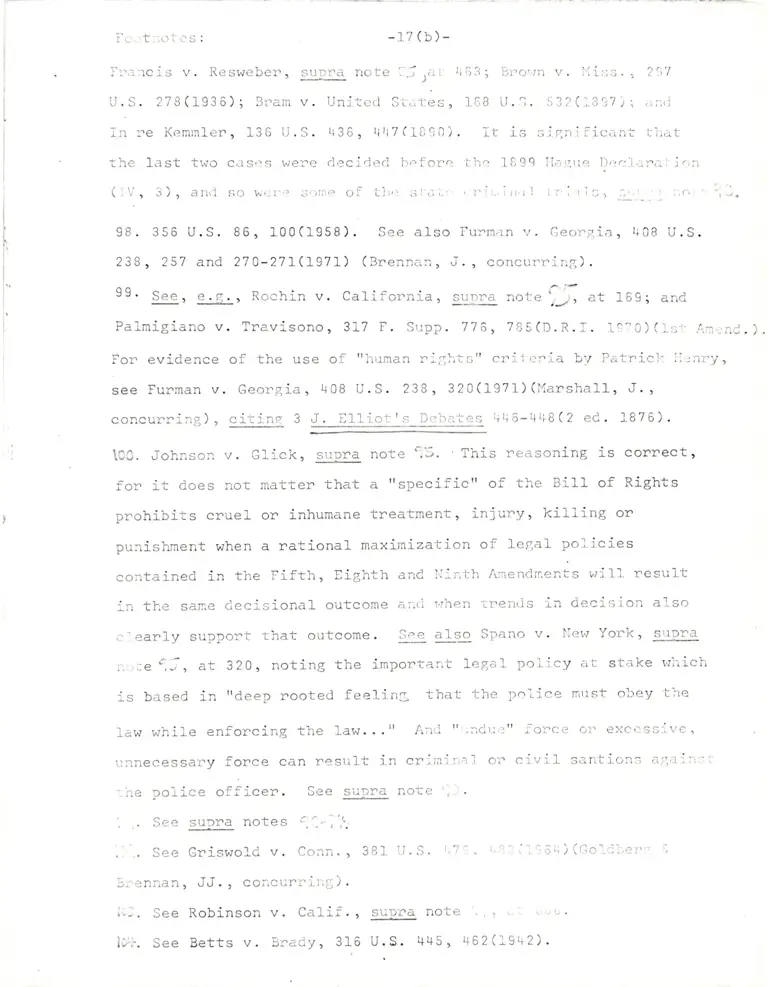
Fc. 't'.'.otos : - 1 7 ( b ) -
Francis v. Resweber, suara note 1J i; Uol; Brovni v. Kias., 217
U.S. 278(1935); 3ram v . United St^ates, 158 U.l. 83 2(1397;; and
In re Kemmler, 136 U.S. 136, 117 (18 90). It is sini^i ficant tliat
the last two cases were decided before the 1899 IIa<ziie J) r; o ] ; j r,;
(IV, 3), aral so wer-;’ soine of t}i<;’ ' j I- i
98. 356 U.S. 86 , 100 (1958 ). See also Furnan v. Geoj-’.f.ia , 108 U.S.
238 , 257 and 27 0-271 (1971) (Brennan, J., concurr inj^) .
93. S e e , e . n . , Rochin v. California, sunra note at 159; and
Palmigiano v. Travisono, 317 F. Supp. 776 , 785 (D.R.I. 19’̂0)(].rd' .lr.-;nd.)
For evidence of the use of "human rights" criteria by Patrich Henry,
see Furman v. Georgia, 108 U.S. 238, 320(1971)(Marshall, J.,
concurring), c it ins; 3 J. Elliot's Deba.tes 115-118(2 e d . 1875).
ICO. Johnson v. Glick, supra note ‘‘.'J. ■ This reasoning is correct,
for it does not matter that a "specific" of the Bill of Rights
prohibits cruel or inhumane treatment, injury, killing or
punishment when a rational maximization of legal policies
contained in the Fifth, Eighth and Ninth Amendments will result
in the same decisional outcome and when trends in decision also
c"early support that outcome. See also Spano v. New York, suora
n,'-e hJ", at 320 , noting the important legal policy at stake v/hich
is based in "deep rooted feeling, that the police must obey the
law while enforcing the law..." And " ,nduc" force or excessive,
unnecessary force can result in crimina] or c:vil santions aga^nsl'
the police officer. See supra note .
. ,. See supra notes
. .. See Grisv/old v. Conn., 381 U.S. 'i7'
Brennan, JJ., concurring).
See Robinson v. Calif. , supra note
iJ.“. See Betts v. Brady, 315 U.S. 445, 462(1942)
•̂■3 3 (19 54 ) (Goldber'
1.0 .
P.S. If you know of any ballistics or medical
experts on our side of the controversy,
please contact Bill Olds, CCLU Exec. Bir.
57 Pratt St., Hartford, CT. 06103 and
Rep. Joseph Rhodes, Jr., Penn. House of Reps.,
Box 192, Harrisburg, PA. 17102.
If you don't already have a copy of my short
piece on "Clearing Up the Facts About Hollow-
Point and Magnum Effects Within the Human
Body," write Ms. Trudi S. Young, Press Dept.
A.C.L.U., 22 East 40th St., N.Y., N.Y. 10016.
62 A ^ e 1ri)cninflBulletin T..«̂ av. May 6, jgZL-
Pa. Allows Police to Use Dum-Dums
By ROBERT KOTZBAUER
Of The Bulletin Staff
Police in Pennsyvania now
are free to use handgun bul
lets .with three times the
wounding potential of normal
ammunition.
T h e Governor’s Justice
Commission yesterday re
jected efforts to ban so called
dumdums, actually hol
low-point, high-velocity bul
lets, of a type outlawed in in
ternational warfare.
The Pennsylvania State Po
lice and officers of about 20
percent of all departments in
the state already are car
rying such ammunition. Yes
terday’s effort was to stop
this. Police in the two largest
cities, Philadelphia and Pitts
b u r g h , use a different
bluntnosed bullet that is not
considered so lethal.
Fear Expressed
The fear expressed by op
ponents of the dumdum bul
lets, however, is that the
commission’s decision will
spur widespread use of the
new ammunition.
Law-enforcement officials
say the hollow-point bullets
have more “ stopping power”
to keep criminals from shoot
ing back once they’ve been
hit. Also, they don’t ricochet
and endanger innocent by
standers.
“ There is an internal arms
race going on in this coun
try,” Professor Jordan J.
Paust of the University of
Houston, testified before the
commission. He represented
the American Civil Liberties'
Union.
Used by Criminals Too
“ Not only are police depart
ments increasing use of hol
low-point bullets,” he said,
“ but criminal elements are
doing so as well.
“ The bullets are available
in any gun shop, to anyone
who can buy ammunition,”
Paust said.
The ACLU and others, in
cluding the Public Interest
Law Center of Philadelphia,
sought a commission ruling
that would deprive police de
partments using dumdums
f r o m receiving federal
anticrime funds.
Paust said the bullets ef
fects on human tissues con
stituted cruel and inhumane,
and thus unconstitutiraial, use
of force.
“ We can’ t leave this deci
sion (whether to use such
ammunition) to police alone,”
s a i d s t a t e Rep. Joseph
Rhodes (D-Allegheny).
Must ‘ Fight Fair’
But as New York police Lt.
Francis' McGee said, “ We’re
required to fight fair, they
(the criminals) are not.”
According to Dr. Vincent
J. M. DiMaio, of Texas, a na
tionally recognized expert on
gunshot wounds, hollow-nosed
bullets do not explode on en
tering the body, nor can it be
said they kill more readily
than the usual bullets police
have been using.That depends
on where they strike. Dr.
DiMaio said.
But b e c a u s e the hol
low-nosed, high-velocity bul
lets hit the body with such
shocking force, they will
cause wounds about three
times as great as regular
ammunition, he said.
Rep. Rhodes said he still in
tends to push legislation ban-
n i n g dumdum bullets in
Pennsylvania.
Expense Boost OKd
Washington (UPI) — The
House gave final congression
al approval yesterday to a
bill that would raise expense
money to cover food and lodg
ing for federal employes trav
eling on government business
to a day. It is $25 now.
Un iv e r s it y o f Ho u s t o n
COLLEGE OF LAW
HOUSTON, TEXAS 77004
Attorney DrewS. Days, III
NAACP Legal Defense Fiind
10 Columbus Circle
New York, N.Y. 10019
v>
■ J