Plaintiffs' Memorandum in Opposition to Defendants' Motion to Set Aside a Temporary Injunction and For a New Trial
Public Court Documents
1962
14 pages
-
Case Files, Bush v. Orleans Parish School Board. Plaintiffs' Memorandum in Opposition to Defendants' Motion to Set Aside a Temporary Injunction and For a New Trial, 1962. 8ac4fa9b-d2fd-f011-8406-7c1e527f53b4. LDF Archives, Thurgood Marshall Institute. https://ldfrecollection.org/archives/archives-search/archives-item/b596f4e1-d33b-4a79-b6d0-f5dc34330669/plaintiffs-memorandum-in-opposition-to-defendants-motion-to-set-aside-a-temporary-injunction-and-for-a-new-trial. Accessed October 06, 2026.
Copied!
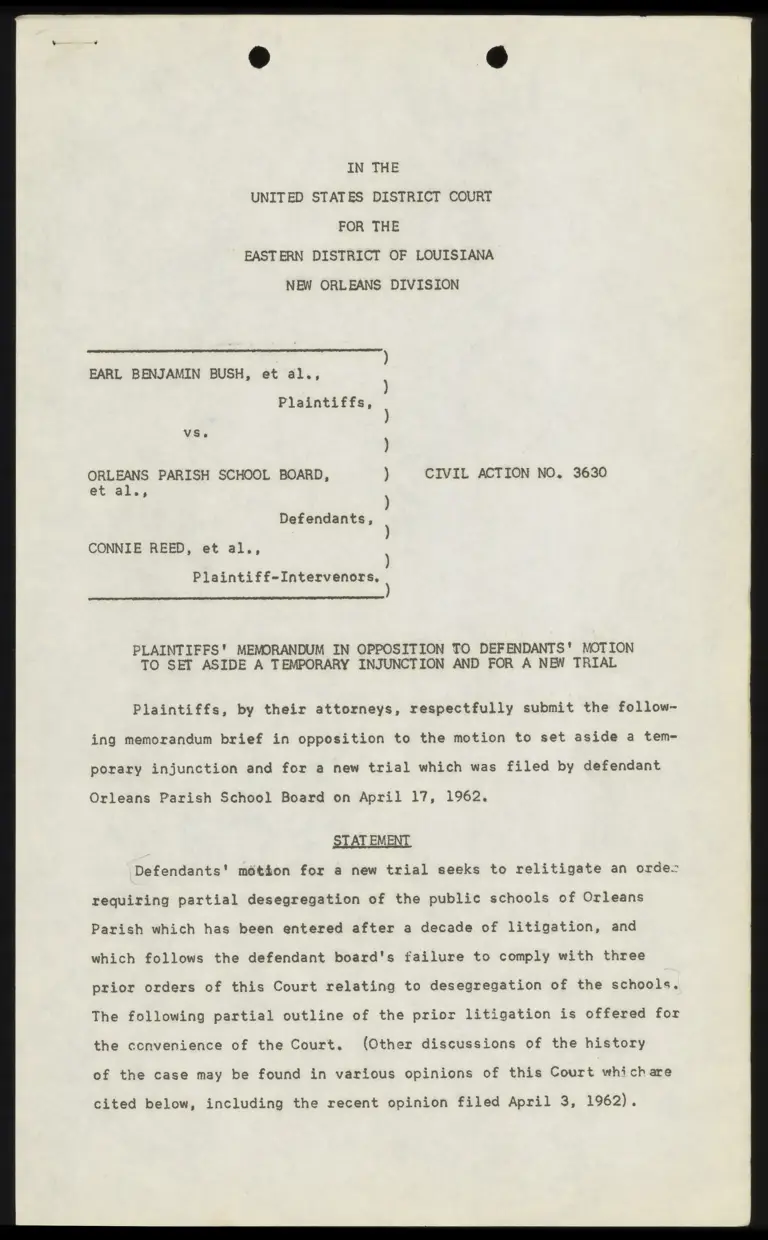
    IN THE

UNITED STATES DISTRICT COURT

FOR THE

EASTERN DISTRICT OF LOUISIANA

NEW ORLEANS DIVISION

EARL BENJAMIN BUSH, et al.,

Plaintiffs,

vs,

et al.,

Defendants,

CONNIE REED, et al.,

)

)

)

)

ORLEANS PARISH SCHOOL BOARD, ) CIVIL ACTION NO. 3630

)

)

Plasnestt-Intorvences.

PLAINTIFFS' MEMORANDUM IN OPPOSITION TO DEFENDANTS' MOTION
TO SET ASIDE A TEMPORARY INJUNCTION AND FOR A NEW TRIAL

Plaintiffs, by their attorneys, respectfully submit the follow-

ing memorandum brief in opposition to the motion to set aside a tem-

porary injunction and for a new trial which was filed by defendant

Orleans Parish School Board on April 17, 1962.

STAT EMENT

Defendants' motion for a new trial seeks to relitigate an ordec:

requiring partial desegregation of the public schools of Orleans

Parish which has been entered after a decade of litigation, and

which follows the defendant board's failure to comply with three

prior orders of this Court relating to desegregation of the schools.

The following partial outline of the prior litigation is offered for

the ccnvenience of the Court. (Other discussions of the history

of the case may be found in various opinions of this Court whichare

cited below, including the recent opinion filed April 3, 1962).


The original complaint in this action was filed on September

4, 1952. Action was withheld in this Court by agreement pending the

outcome of the "School Segregation Cases" in the United States Supreme

Court. After the second decision in Brown v. Board of Education,

347 U.S. 483 (1954): 349 U.S, 294 (1955), an amended complaint was

filed in the present case on August 18, 1955 and the proceedings were

resumed,

On February 15, 1956, this Court entered a preliminary injunction

requiring that the school board desegregate the public schools, De=

fendants were ordered to make arrangements for admission of children

on a nondiscriminatory basis "with all deliberate speed." Bush Vy.

Ogzleans Parish School Board, 138 F.Supp. 337, 342 (E.D. La. 1956) .

The school board appealed, and the judgment of the trial court was

affirmed, 242 F.2d 156, (5th Cir., 1957), cert, denied 354 U,S. 921.

A later motion to vacate the preliminary injunction was denied by the

trial court, and on appeal that order was affirmed, 252 F.2d 233,

(5th Cir, 1958), cert. denied, 356 U.S. 969 (1958). The school board

again moved to vacate the injunction in 1958, but this motion was

denied and the injunction was then made permanent, 163 F.Supp. 701

(E.D. La. 1958). This order was affirmed, 268 F.2d 78, (5th Cir,

1959).

On July 15, 1959, the District Court, finding no action had been

taken in compliance with its prior orders, ordered the school board to

file a desegregation plan, When the board failed to present a de-

segregation plan, the Court entered an order on May 16, 1960 requiring

limited desegregation of the first grade on an ad hoc basis beginning

in September 19607 The defendant board filed a notice of appeal, and

1/ A three-judge court had been convened and then dissolved prior

to these proceedings, 138 F.Supp. 337 (E.D. La, 1956), man-
damus denied 351 U,S. 948 (1956).


unsuccessfully sought stays of this order in the Court of Appeals

and before Mr. Justice Black. |

In August 1960, a three-judge district court convened, invali-

dated certain state laws designed to thwart the prior judgments,

enjoined a number of public officials from interfering with the in-

junction and ordered the school board to obey the order of May 16,

1960. 187 F.Supp. 42 (E.D. La. 1960), aff'd 365 U.S. 569.

On this occasion the Attorney General of Louisiana sought a

stay of the order of May 16, 1960 in the United States Supreme Court,

arguing then asthe board argues now that Judge Wright's desegrega-

tion plan was "impossible" to carry out. The stay was denied. 364

U.S. 803. The District Court was required to enter a series of in-

junctions invalidating repeated attempts by various state officials

to thwart its orders. See 188 F.Supp. 916 (E.D. La. 1960), stay

denied (per curiam opinion) 364 U.S. 500, aff'd 365 U.S. 569; 190

F.Supp. 861 (E,D. La. 1960), aff'd 365 U.S. 569; 191 F.Supp. 871

(E.D. La. 1961), aff'd 367 U.S. 908; 194 F.Supp. 182, aff'd 368 U.S. 1!

Meanwhile, the appeal by the Orleans Parish School Board from

the order of May 16, 1960 remained on the docket of the Court of

Appeals until March 1962, when it finally was dismissed for want of

prosecution,

The temporary injunction of April 9, 1962 and the opinion of

April 3, 1962, resulted from a hearing held March 5, 1962 at which

the Court received oral testimony and documentary evidence submitted

by the plaintiffs and intervenors and opposing evidence submitted bv

the school board. The matter had come before the court on plaintiffs

motion for further injunctive relief, and a motion by the intervenors

for a preliminary injunction, both of which contended that the board

was not complying with the order of May 16, 1960, and prayed for com=

plete desegregation of all grades of the school system. The Court

entered a preliminary injunction on April 9, 1962 which modified the

order of May 16, 1960 to make it applicable to the first six grades

and to make it clear that defendants' pupil assignment procedures


could not be continued on the discriminatory basis used since 1960.

On April 17, 1962, the defendant school board filed the now

pending motion asking that the order of April 9, 1962 be set aside

and a new trial gtantedy No affidavits were filed with the motion,

and there has been no request for an extension of time within which

to file supporting affidavits. However, on or about May 1, 1962 the

defendants filed an affidavit by Dr. Stanley Fitzpatrick, a school

official, in support of the pending wotion/

[The grounds proffered in the motion for new trial may be divided

into two general categories;

(1) Defendants argue that the judgment of this Court is

contrary to the law and particularly urge that: (a) defendants have

made a "prompt and reasonable start;" (b) the Louisiana Pupil Place-

ment Law may be applied to a segregated school system; (c) plaintiffs

have not exhausted administrative remedies; (d) plaintiffs have not

exhausted remedies in certain particulars; (e) the Louisiana Pupil

Assignment Law is binding upon defendants; (f) this Court's decision

improperly concerned itself with desegregation of generations of

Negroes yet unborn.

(2) The motion for new trial also urges that the findinos of

act is "erroneous." The particulars in which

these findings are asserted to be erroneous are that: (a) white

schools as well as Negro schools have overcrowded conditions; (b)

upon completion of defendants' building program platooning in Negro

schools will be eliminated; (c) the vast preponderance of building

funds in the past few years has been for Negro schools; (d) ten mil-

lion dollars of Orleans Parish school bonds were delivered April 4,

1962, enabling defendants to "begin its current construction program.’

The motion also claims that the Court erred in enjoining defend-

ants from assigning pupils inconsistent with its plan in that this:

"has stripped the defendant of its administrative powers" by allow-

ing children to decide the school they will attend; required present

nonsegregated admission of all Negro children "whether qualified or


not;" and prohibited use of the Louisiana Pupil Assignment Law, It is

also argued that the Court's plan is impractical and virtually im=-

possible to comply with,

To support some of the claims of errors in fact finding (points

(a) and (b) above) the defendants filed on May 1, 1962 an affidavit

by Dr. Stanley Fitzpatrick restating some of his testimony at the

trial and expanding on it by introducing further matter, all of which

was available to defendants and might have been offered at the time

of the earlier hearing.


ARGUMENT

THE DEFENDANT BOARD HAS PRESENTED NO
GROUNDS FOR THE GRANTING OF A NEW
TRIAL OR FOR THE SETTING ASIDE OF THE
PRELIMINARY INJUNCTION AND THE ENTRY
OF A NEW JUDGMENT

Defendants' motion is made pursuant to Rule 59, Federal

Rules of Civil Procedure, which provides in pertinent part as

follows:

(a) Grounds. A new trial may be granted to all or
any of the parties and on all or part of the issues
..»{(2) in an action tried without a jury, for any
of the reasons for which rehearings have heretofore
been granted in suits in equity in the courts of
the United States. Only a motion for new trial in
an action tried without a jury, the court may open
the judgment if one has been entered, take addi-
tional testimony, amend findings of fact and
conclusions of law or make new findings and con-
clusions, and direct the entry of a new judgment.

(b) Time for Motion. A motion for a new trial shall
be served not later than 10 days after the entry of
the judgment, except that a motion for a new trial on
the ground of newly discovered evidence may be made
after the expiration of such period and before the
expiration of the time for appeal, with leave of court
obtained on notice and hearing and on a showing of due
diligence.

(c) Time for Serving Affidavits. When a motion for
new trial is based upon affidavits they shall be
served with the motion. The opposing party has 10 days
after such service within which to serve opposing affi-
davits, which period may be extended for an additional
period not exceeding 20 days either by the court for
good cause shown or by the parties by written stipula-
tion, The court may permit reply affidavits.

There are generally three grounds upon which a new trial

may be granted, e g., manifest error of law, manifest error of

fact, or, newly discovered evidence. Hutches v., Renfroe, 200 F.2d

337 (5th Cir. 1952); Phelan v, Middle States Oil Corp., 210 F.2d

360 (2nd Cir. 1954).

Defendants allege no manifest errors of fact sufficient

to warrant granting of a new trial or setting aside the injunc-

tion. Defendants state in the motion for new trial: "While

some few negro classes are conducted in classrooms converted from

stages, custodians' quarters, libraries and teachers' lounge


rooms, similar classroom conditions exist in the white schools.”

Judge Wright's opinion made no statement that there were no white

students attending converted classrooms. His entire statement on

this point was as follows:

The evidence shows further that the average class size
in the negro elementary schools is 38.3 pupils compared
to 28.7 in the white, that the pupil-teacher ratio in
the elementary schools is 36.0 to 1 for negro, 26.1 to

1 for white, and that negro classes are conducted in
classrooms converted from stages, custodians' quarters,

libraries and teachers' lounge rooms, while similar
classroom conditions do not exist in the whit e schools.
(Opinion of April 3, 1962, notes omitted.)

The obvious meaning and relevance of the statement is that given

all three indices -- overcrowding, pupil-teacher ratio and make-

shift classrooms -- the Negro students were on an over-all basis

attending school under much worse conditions than white students.

This is amply supported by the school board's own records and its

officials' testimony which demonstrate it conclusively. The fact

that some white schools might be overcrowded or might be conducted

in rooms not planned for classroom use does not alter the overall

pattern of glaring inequality between the Negro and white schools,

It is still plain that several thousand Negro pupils are on pla-

toon and no white pupils are, and that even with the platooning

most Negro classes are above the state prescribed maximum class

size while only a few white classes are overcrowded.

Defendants allege that their present building plans will,

when completed, eliminate platooning in the Negro schools, even

taking into account the current birth rates. They state that

Judge Wright erred in finding that:

The Board states that in the next two or three years,

when its present building program is completed, most

of the platooning and the crowded conditions in the

negro schools will be eliminated, But the Board's
projection gives no facts or figures, nor does it make

allowance for the increase in the school population to

be anticipated, based on the current birth rate. The

Board also suggests that in two successive elections

property owners of New Orleans have voted down proposals
for tax increases to defray the increased cost of

operating the public schools in New Orleans, and that

this failure has caused the crowded conditions in the

negro schools, Whether New Orleans will have adequate

public schools is, of course, the responsibility of her


taxpayers. But whatever is provided, inadequate as
it is, must at least be made available on an equal
basis to all school children.

Even if defendants are able to establish conclusively

that the present building program will at some future time enable

them to eliminate platooning of Negro pupils, this would not alter

the result. Judge Wright's finding that facilities for Negroes

have been unequal, are now unequal, and will continue for some

time to be unequal, remains uncontradicted.

The defendants' other challenges to the findings of fact

are merely disagreements with the emphasis given by Judge Wright

on uncontradicted facts. There is no argument about the amount

of money spent for Negro schools in the past. The figures are in

the record. Judge Wright apparently did not regard it necessary

to mention them in his opinion. The same is true with regard to

the bond issues and the details of the building plans, all of

which were placed before the court at the trial.

In Pioneer Paper Stock Company v. Miller Transportation Co.,

(1953), 109 F. Supp. 502, 504, the defendants' offering of "no

more than a mere 'pointing up' or re-emphasis of the testimony"

was found wholly insufficient to support the granting of a motion

for new trial. In considering such a motion, the court must view

the evidence and the inferences reasonably, deducible therefrom

in the light most favorable to the party against whom the motion

is made. Pigneer Paper Stock Company v. Miller Transportation

Company, supra. Further, the findings of fact must be challenged

on the basis that they are clearly erroneous in an obvious and

gross manner. International Bureau, Inc. v. Bethlehem Steel

Company (C.A. 2nd 1951), 192 F,2d 304. A mere difference of opin-

ion as to the interpretation of facts is not appropriately advanced

under the motion for new trial, but is properly presented on

appeal. Everest v. Buffalo Lubricating 0il Co, (C.C. N.D. N.Y.),

22 Fed. 252.

More importantly, the defendants' claim that they have

complied (or will in the future comply) with the "separate but

«il


equal” doctrine of Plessy v. Ferguson, 163 U.S. 537 (1896), to a

greater degree than indicated by Judge Wright is really peripheral

to the main issues here. This does not affect the basic propriety

of the order which is based on the desegregation requirements of

Brown v. Board of Education, 347 U.S. 483 (1954); 349 U.S. 294

(1955). Under Brown plaintiffs are not obligated to demonstrate

physical inequalities to be entitled to admittance to public

schools without regard to their race. The showing of inequality

here merely demonstrates an aggravation of the denial of constitu-

tional rights by continued segregation. The order would be plainly

legally proper even absent the special showing of inferior condi-

tions in the Negro schools. As stated in Stewart Warner Corp, v.

Levally (N.D. Ill. 1936), 16 F. Supp. 778, under a motion for new

trial:

. . + the first question to be determined is whether

the new evidence sought to be introduced would have

been material or helpful in determining the issues.
If not, its proffer is wholly futile.

Defendants allege the order of April 3, 1962, is based

on a misstatement of the applicable law. A motion for new trial

on this ground may only be had where there is a manifest misap~-

prehension of the law sufficient to warrant a different result.

Davis v, West (W.D. Missouri 1947),71 F. Supp. 377. The motion is

inappropriate for a mere rehash of arguments on the law already

advanced at trial. Giant Powder Co, v. California Vigorit Powder

Co.,, 5 Fed. 197 (D, Calif. 1880). Defendants here have failed to

advance any arguments not previously made before Judge Wright.

They have not shown that his decision was "manifestly" or

obviously legally incorrect, nor do they claim any supervening

decisions by a higher court.

The whole history of the litigation belies defendants’

claim that they have made anything approaching a "prompt and rea-

sonable start" toward full compliance with the 1954 ruling of the

United States Supreme Court to desegregate schools. The board

was first ordered to desegregate in 1956. Since that time, and


after much litigation, the board has failed to comply with three

court orders over a span of almost six years. The total result of

their efforts to date has barely amounted to token integration,

with only twelve Negro students out of a total of 13,000 Negro

school children now attending schools on a racially integrated

basis. Indeed, in January 1962, the school board made an effort

to resegregate five of the twelve Negro pupils attending white

schools by converting the desegregated McDonough No, 19 Eiementary

School into an all-Negro school, requiring the Negro children to

remain there and transferring out the white pupils to other

schools. Judge Wright issued a temporary restraining order to

prevent this on January 23, 1962.

Defendants' continued requests for delay in desegregation

are plainly not justified in terms of any of the administrative

problems which might be considered relevant under Brown v. Board of

Education, 349 U.S. 294, 300-301. Defendants have continued to

refuse to present an orderly plan of desegregation to the Court,

so that the Court might determine whether any requested period of

delay is justified by administrative problems rationally related

to the period of delay. Instead, defendants continue a general

plea for more time, Six years after the first injunction in this

case, it is plainly time to require the defendants to take effec-

tive action to carry out the order. The Supreme Court has

specifically said that "delay in any guise in order to deny the

constitutional rights of Negro children could not be countenanced,

and...only a prompt start, diligently and earnestly pursued, to

eliminate racial segregation from the public schools could consti-

tute good faith compliance." Cooper v, Aaron, 358 U.S. 1, 7 (1958).

The Court also has said?! "State authorities were thus duty bound

to devote every effort toward initiating desegregation and bringing

about the elimination of racial discrimination in the public school


system. (Id.) It is obvious that the defendant board has not met

its obligations under these tests, and that Judge Wright's order

requiring prompt action to desegregate all grades of the elementary

“10


schools is legally supportable. It cannot properly be said that

such an order is manifestly erroneous.

The defendants' argument that Judge Wright's plan of

desegregation is impossible to comply with, is a familiar argument

in this case. The same argument was made with respect to the order

of May 16, 1960, by the Attorney General of Louisiana, with sup-

porting affidavits by the local school officials in requesting a

stay of the 1960 order in the United States Supreme Court. The

argument was rejected then (364 U.S. 803), and should be rejected

now. The defendants' argument speculates that all (or at least

vast numbers of) Negro pupils in white school areas will seek

admission to white schools which are already near capacity, and the

overcrowding will result in chaos. Of course, whether large num-

bers of Negroes will apply to transfer remains to be seen.

Defendants have made no effort to ascertain how many Negro pupils

would transfer next year if given an unimpeded option to do so

under the Court's order. Defendants' argument is extremely supposi-

titious (Cf. Evans v. Ennis, 281 F.2d 385 (3rd Cir. 1960) (rejecting

a similar argument as "fraught with unreality")). However,

defendants pose no irresolvable problem, no matter how many Negro

pupils apply. For, should there be difficulties resulting from

overcrowding, the defendants may, of course, present a workable

plan for effective desegregation, using perhaps a non-racial system

of priorities in determining admission to overcrowded schools.

Judge Wright's opinion of April 3, 1962, specifically provides

another opportunity for the board to propose a good faith plan of

desegregation. The opinion states in footnote 2:

* * * To date no Board plan has been filed and it was

admitted at the hearing that submission of a plan is
not in contemplation. This court will, therefore, con-

tinue to order desegregation on an ad hoc basis until

an acceptable plan for integration of the Orleans Parish

schools is forthcoming.

A further question of law is defendants’ claim that

plaintiffs are not entitled to relief since they did not exhaust

the remedies of the challenged pupil placement procedure. This

wll w=


question was squarely decided against defendants' contention in

Mannings v. Board of Public Instruction, 277 F.2d 370 (5th Cir,

Cir. 1960), and other cases cited in the opinion of April 3rd.

Northeross v. Board of Education, 6th Cir., F.2d (2/23/62),

slip opinion; cf. Farley v. Turner, 281 F.2d131 (4th Cir. 1960).

Defendants argue for the continued use of the pupil assign-

ment law as administered in the past. The order of April 9, 1962,

does not ipso facto enjoin the use of the pupil assignment law,

The order merely bars defendant from creating a segregated system

by initially assigning pupils on a racial basis, and then requiring

Negro pupils to meet special transfer standards not used in the

initial assignment process to attend white schools. Thus, the

order requires nonracial initial assignments as a prerequisite to

the use of the pupil assignment law's special transfer procedures

for Negroes seeking desegregation. The order merely informs the

defendants that they cannot restrict the "option" to attend

desegregated schools granted by the first paragraph of the order,

through the use of restrictive transfer rules. It should serve to

make clear to the defendants that a repeat of their prior proce-

dures is not compliance with the order, as their 1960 and 1961

assignments were not in compliance with the May 16, 1960, order,

Again, in connection with this issue of law, the opinion and judg-

ment of the District Court is fully supported by the authorities

cited.

The one case mentioned by defendants, Rippy v. Borders,

250 F.2d 690 (5th Cir. 1957), is totally inapplicable to the present

situation. In that case a desegregation order requiring all schools

to be desegregated in the middle of a school year was reversed in

somewhat unusual circumstances. The District Court had twice been

reversed when it dismissed the Negro pupils' case. After the second

reversal, the Court misconstrued the mandate of the Court of

Appeals to require immediate total desegregation, even though the

trial judge thought this was improper and without giving the school

authorities any opportunity to present a desegregation plan or even

- You,


holding a hearing. By contrast, the defendant in this case has

had many opportunities to institute its own plan and has refused

to take the initiative or even to follow the Court's order to bring

in a plan.

Defendants have introduced no matter in support of the

motion for new trial which may be deemed newly discovered evidence.

Defendants do not aver they have discovered facts of which they

were excusably ignorant at trial, and such a claim is necessary to

secure a new trial on this ground. United States v. Bramsen (CCA

Oth 1944), 142 F.2d 232. All of the facts defendants present were

known to them during the trial and were presented therein.

Further, a claim of newly discovered evidence must be

supported by affidavits served within ten days of the judgment with

the motion for new trial (F.R.C.P., Rule 59(c)) alleging the

source and substance of the new evidence and the reason for failure

to present it at trial. Marshall's U. S. Auto Supply v. Cashman

(CCA 10th 1940), 111 F.2d 140. The only affidavit defendants have

presented cannot satisfy this requirement as it contains, by

defendants' admission, a mere repetition of testimony given at

trial. In any event, it was presented out of time after the ten

day limit for such affidavits had expired. Defendants have failed

to advance any matter sufficient to meet this third and last ground

for new trial.

The affidavit of Dr, Fitzpatrick, filed more than ten

days after the order of April 9, 1962, was not submitted within the

time provided by Rule 59(b) and Rule 59(c), F.R.C.P. The rules

provide that motions for new trial must be served not later than

ten days after the entry of judgment, and that when such motions

are based upon affidavits, the affidavit "shall be served with the

motion." It is settled that the Court may properly refuse to con-

sider such untimely affidavits in deciding motions for new trial.

6 Moore's Federal Practice 959.10, pp. 3869-3871; Marshall's U. S.

Auto Supply v. Cashman, supra; Sevmour v. Potts & Callahan Con=-

struction Co,, 5 F.R.Serv. 59a.62, Case 1, 2 F.R.D. 38 (D, D.C.,

-13 =


1041), reversed on other grounds, 133 F.2d 15 £D.C. Cir, 1942),

CONCLUSION

WHEREFORE, plaintiffs respectfully submit that the Court

should enter an order denying the defendant Orleans Parish School

Board's motion to set aside the preliminary injunction and for a

new trial, and that the Court should reinstate the said injunction.

Respectfully submitted,

James M, Nabrit, III
Jack Greenberg
Constance Baker Motley
10 Columbus Circle
New York 19, New York

A. P, Tureaud
Ernest Morial
A. M, Trudeau
1821 Orleans Avenue
New Orleans, Louisiana

Attorneys for Plaintiffs

- 14" -