Annotated Research on Precedent of Human Rights Implemented in Legislation
Annotated Secondary Research
October 14, 1975
-
Case Files, Garner Working Files. Annotated Research on Precedent of Human Rights Implemented in Legislation, 1975. 123bb256-33a8-f011-bbd3-000d3a53d084. LDF Archives, Thurgood Marshall Institute. https://ldfrecollection.org/archives/archives-search/archives-item/b6b61fe5-9acd-486b-8ca7-10393bea5e49/annotated-research-on-precedent-of-human-rights-implemented-in-legislation. Accessed October 24, 2026.
Copied!
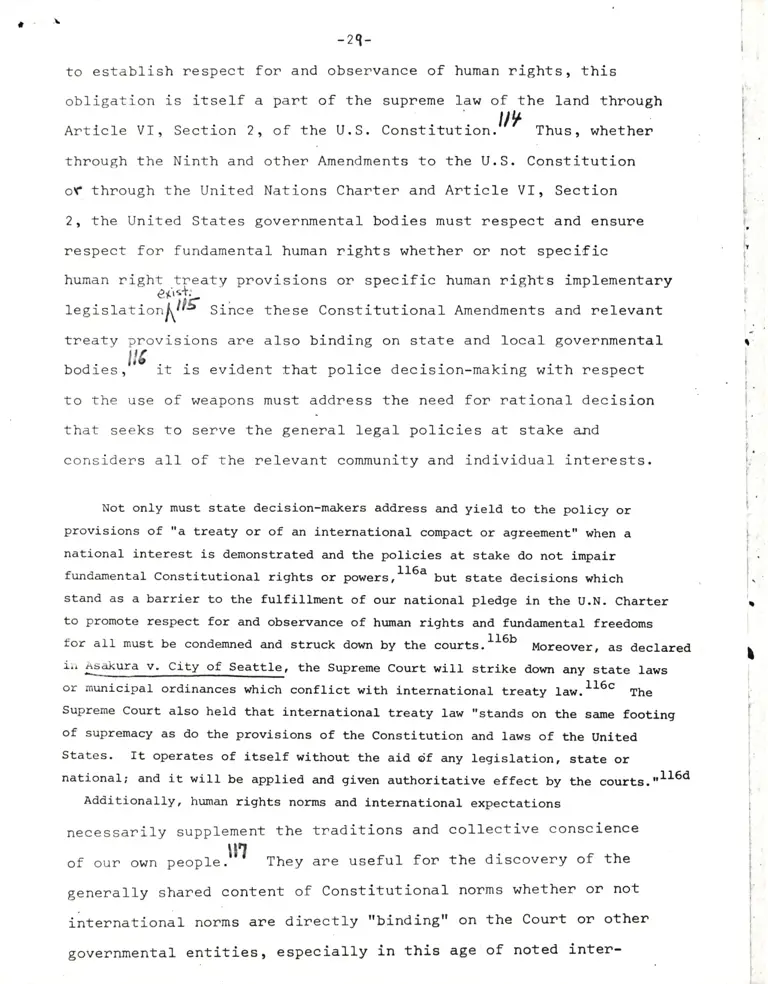
    to establish respect for and observance of human rights, this
obligation is itself a part of the supreme law of the land through
Article VI, Section 2, of the U.S. Constitution. Thus, whether
through the Ninth and other Amendments to the U.S. Constitution
oV through the United Nations Charter and Article VI, Section
2, the United States governmental bodies must respect and ensure
respect for fundamental human rights whether or not specific
human right treaty provisions or specific human rights implementary
legislation^"-^ Since these Constitutional Amendments and relevant
treaty provisions are also binding on state and local governmental
.odies it is evide.t that police ae=ision-.a.in, wit. respect
to the use of weapons must address the need for rational decision
that seeks to serve the general legal policies at stake and
considers all of the relevant community and individual interests.

-29-

! .

Not only must state decision-makers address and yield to the policy or
provisions of "a treaty or of an international compact or agreement" when a
national interest is demonstrated and the policies at stake do not impair
fundamental Constitutional rights or p o w e r s , b u t  state decisions which
stand as a barrier to the fulfillment of our national pledge in the U.N. Charter
to promote respect for and observance of human rights and fundamental freedoms
for all must be condemned and struck down by the c o u r t s . M o r e o v e r ,  as declared

^sakura v. City of Seattle, the Supreme Court will strike down any state laws
or municipal ordinances which conflict with international treaty law.^^^*^ The
Supreme Court also held that international treaty law "stands on the same footing
of supremacy as do the provisions of the Constitution and laws of the United
States. It operates of itself without the aid of any legislation, state or
national; and it will be applied and given authoritative effect by the courts.

Additionally, human rights norms and international expectations
necessarily supplement the traditions and collective conscience

\ nof our own people. They are useful for the discovery of the
generally shared content of Constitutional norms whether or not
international norms are directly "binding" on the Court or other
governmental entities, especially in this age of noted inter-


Footnotes: -20(b)-

J. Paust, After My Lai: The Case for War Crime Jurisdiction Over
Civilians in Federal District Courts, 50 Tex.L.Rev. 6(1971),
Ieorinted at R. Falk, ed., IV The Vietnam War and International
Law(A.S.I.L. 1974); L. Henkin, The Constitution, Treaties, and
International Human Rights, 116 Pa.L.Rev. 1012(1968); P. Jessup,
^Modern Law of Nations 91(1952); M. McDougal, G. Leighton, supra
note in ; P. Sayre, Shelley v. Kraemer and United Nations Law,
3̂  Iowa L.Rev. 1(1948); H. Sprout, Theories as to the
Applicability of International Law in the Federal Courts of the
United States, 26 Am.J.Int'l L. 280(1932); Oyama v. Calif. 332 U.S.
633, 649-650 and 673(1948)(Black & Dougals, Murphy & Rutledge, JJ., concurring);
and Namba v. McCourt, 185 Ore. 579, 604, 204 P.2d 569, 579(1949). See also
U.S. V. Toscanino, 500 F.2d 267, 276-278(2d.Cir. 1974), using the U.N. Charter and
U.N. Security Council action to find federal law enforcement practices illegal.
Moreover, at least part of the relevant international law in this case,..the law
of war, has already been implemented by Congressional legislation. See 10 U.S.C.
§§ 818 and 821; Ex parte Quirin, infra note 118; and J. Paust, After My Lai, supra.
It can also be argued that the 1964 Civil Rights Act implemented general human
rights law, since human rights are protected by the U.S. Const., Art. VI, Cl. 2
and the Ninth Amendment and are, thus, part of federal and constitutional law.

lie. See, e.g., Griswold v. Conn., 381 U.S. 479(1964); Robinson v.
California, 370 U.S. 660(1962); Rochin v. Calif., 342 U.S. 165
(l952); and Missouri v. Holland, 252 U.S. 416(1920).

116a. See U.S. v. Pink, 315 U.S. 203(1942); Missouri v. Holland, supra note 116;
and infra note 116b.

116b. Oyama v. California, 332 U.S. 633, 673(1948)(Murphy & Rutledge, JJ.,

concurring). See also at 649-650(Black & Douglas, JJ., concurring); United
States V. Pink, 315 U.S. 203, 230-231(1942), adding: "state law must yield when
it is inconsistent with or impairs the policy or provisions of a treaty or of an
international compact or agreement"(emphasis added); Nielsen v. Johnson, 279 U.S.
47(1948); Asakura v. City of Seattle, 265 U.S. 332(1924); Missouri v. Holland,
supra note 116; Hauenstein v. Wynham, 100 U.S. 483(1879); Fairfax's Devisee v.
Hvnter's Lessee, 11 U.S.(7 Cranch) 603(1813); and Ware v. Hylton, 3 U.S.


Footnotes: -21-

(Dall.) 199(1796). The only case to the contrary was a California decision made in an

of noted racial hysteria; Sei Fujii v. Calif. i 38 Cal.2d 718, 242 P.2d 617(1952)
The Sei Fujii decision is not only contrary to every relevant U.S. Supreme Court
decision but is highly controversial and, in the opinion of this author, incorrect.
See J. Paust, Human Rights and the Ninth Amendment; A New Form of Guarantee, 60
Cornell L.Rev. 231, 233(1975). Further, in direct conflict with the statement in
Sei Fujii that certain treaty provisions are not "self-executing" and require
implementing legislation at the federal level before they become part of the supreme
law of the land was the holding in Asakura v. City of Seattle, supra note 116b, that

Footnotes: -21(a)-

a treaty for the protection of certain persons "operates of itself without the aid
of any legislation, state or national; and it will be applied and given authoritative
effect by the courts." See also The Paquete Habana, infra note 118.
116c. Supra note 116b.
116d. See also Maiorano v. Baltimore & O.R.R., 213 U.S. 268, 272-273
(1909), stating; "A treaty...is the supreme law of the land, binding alike
National and state Courts, and is capable of enforcement, and must be
enforced by them in the litigation of private rights;" and The Paquete
Habana, infra note 118.

^x7. e ^ ,  j. Paust, supra note 108; M. McDougal, supra note 114; and
supra notes 99 and 102-108.
118. 175 U.S. 677, 700 (1900). See also In re Yamashita, 327 U.S. 1, 8(1945);
EX parte Quirin, 317 U.S. 1, 27-28, p_assim (1942); Maiorano v. Baltimore &
O.R.R., 213 U.S. 268, 272-273 (1909); Hilton v. Guyot, 159 U.S. 113 (1895);
U.S. V. Smith, 18 U.S.(5 Wheat) 71, 74 (1820); The Nereide, 13 U.S.(9 Cranch)
769, 780 ff. (1815); The Scotia, 14 Wallace 170 (1801); Talbot v. Jansen,
3 U.S.(3 Dali.) 540, 552 (1795) (Iredell, J., concurring); Respublica v.
De Longchamps, 1 U.S.(1 Dali.) 59 (1784);

Henfield's Case, 11 F.Cas. 1099, 1107-1108 and 1120 n. 6(No. 6,360)
(Pa. 1793); Triquet v. Bath, 3 Burr. 1478, 96 Eng.Rep. 273(K.B. 1764)
(necessarily familiar to the Framers of the U.S. Constitution); 11
Ops. Atty. G e ^  297, 299-300(1865); FM 27-10, para. 511: J. P.u.t,