Skehan v. Board of Trustees of Bloomsburg State College Opinion
Public Court Documents
July 20, 1977
25 pages
-
Case Files, Norwood v. Harrison - Hardbacks. Skehan v. Board of Trustees of Bloomsburg State College Opinion, 1977. d5558e4b-722e-f111-88b4-7c1e526962fd. LDF Archives, Thurgood Marshall Institute. https://ldfrecollection.org/archives/archives-search/archives-item/b6e55b40-f9b2-478c-badc-c21ccff608ba/skehan-v-board-of-trustees-of-bloomsburg-state-college-opinion. Accessed October 16, 2026.
Copied!
     [||869f1619-073c-4f46-b466-b1301015484f||] . 0 1)


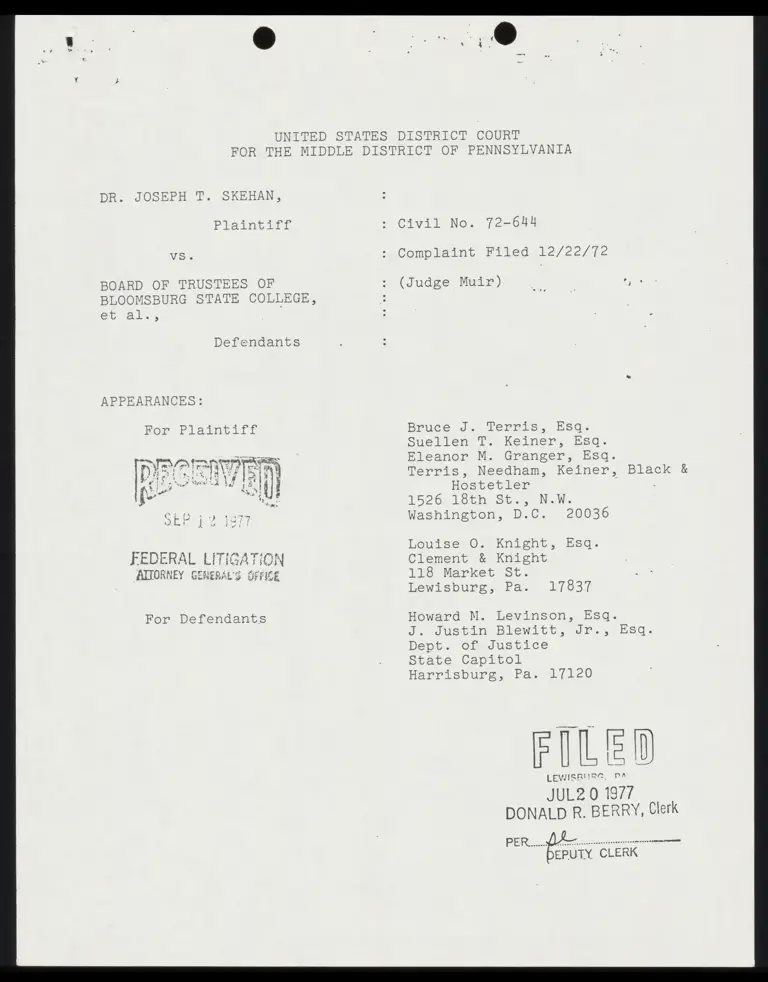
UNITED STATES DISTRICT COURT

FOR THE MIDDLE DISTRICT OF PENNSYLVANIA

DR. JOSEPH T. SKEHAN,

Plaintiff : Civil No. 72-644

VS. : Complaint Filed 12/22/72

BOARD OF TRUSTEES OF : (Judge Muir) 5

BLOOMSBURG STATE COLLEGE, : gs >

et al.,

Defendants

APPEARANCES:

Por Plaintiff Bruce J. Terris, Esq.

Suellen T. Keiner, Esq.

SIA ITRTI TATE Eleanor M. Granger, Esq.

DESS INTE Terris, Needham, Keiner, Black &

pi bu Hostetler :

2 1526 18th 8t., N.V.

SEP 1% 1577 Washington, D.C. 20036

'e Louise 0. Knight, Esq.

FEDERAL LITIGATION Clement & Knight

ATTORNEY GEIMERAL'S OFFICE 118 Market St.
Lewisburg, Pa. 17837

For Defendants Howard M. Levinson, Esq.

J. Justin Blewitt, Jr., Esq.

Dept. of Justice

State Capitol
Harrisburg, Pa. 17120

FILED
LEWISEIIRR, Pa

JUL2 0 1577

DONALD R. BERRY, Clerk

PER... crimes mss srr

EPUTY CLERK


UNITED STATES DISTRICT COURT
FOR THE MIDDLE DISTRICT OF PENNSYLVANIA

DR. JOSEPH T. SKEHAN,

Plaintiff : Civil No. 72-644

VS. : Complaint Filed 12/22/72

BOARD OF TRUSTEES OF : (Judge Muir) ey

BLOOMSBURG STATE COLLEGE, : 3 C3

et al.,

Defendants

OPINION

MUIR, District Judge.

1. Introduction.

Skehan, formerly an Associate Professor at Bloomsburg

State College, has brought this action alleging that the

Defendants violated his constitutional rights by terminating

his employment as a professor at the College in October,

1970 and by failing to renew his contract for the 1971-1972

academic year. The history of this case is set forth in

this Court¥s Opinion of May 18, 1977, 7 ‘P. Supp. =. In:

1973, this Court found that Skehan's constitutional rights

pursuant to the Fourteenth Amendment were violated by his

termination as a member of the faculty without a prior

hearing. 353 P.Supp. 430 (M.D. Pa. 1973). In its opinion of

May 18, 1977, this Court concluded that the decision not to


] Cee
— —


renew Skehan's contract for the academic year 1971-1972

without affording him the procedures prescribed by Article ne

of the Statement of Policy of Bloomsburg State College

violated the due process clause of the Fourteenth Amendment.

The Court also stated in its opinion that the only Defendant

from whom Skehan sought monetary damages had acted in good
.¥

\ EY , a. IN

faith and in a reasonable manner and therefore was protected

by the doctrine of official immunity as set forth lin Wood :

vs. Strickland, #20 0.85. 309 (1975). ‘The only issues remaining

in this litigation are whether Skehan is entitled to any

equitable relief as the result of the two violations of his

constitutional rights, whether his attorneys should be

awarded part or all of the $67,288.59 claimed as attorney's

fees and whether Skehan should recover expenses and costs

from the Defendants. The following are the Court's findings

of fact, its discussion Of these issues, and its conclusions

of law concerning these matters.

11. Pindings of Tact.

1 On October 10, 1972, Plaintiff filed a complaint

against the Defendants with a claim that they had violated

his constitutional rights by their fallure to provide him a

hearing prior to his termination on October 17, 1970.


1
5e conforms to the numbering system in the Statement of

Policy. TheisArticle 1s referred to as '‘5{e) in the Circuit Court
opinion. :


y | y dis : i rl a

dt


2 One of the statutes under which Plaintiff brought

sult was 42 U.S.C. $§1983. (Undisputed)

3. Plaintiff prevailed in this Court in 1973 on hls

claim that Defendants violated his due process rights by

their failure to provide him a hearing prior to his termination.

(Undisputed)

L, Plaintiff was represented 1 bheso initial proceedings

in this Court by Harry Lore. (Undisputed) :

5. Plaintiff appealed the decision of this Court of

May 9, 1973 to the United States Court of Appeals for the >

Third Circuit. (Undisputed)

6. Plaintiff prevailed in the Court of Appeals in

that the case was remanded to this Court for findings as to

whether Defendants had violated his First Amendment and due

process rights in the course of thelr decision not to renew

his contract and ln that the Court of Appeals upheld this.

Court's rullng that Plaintiff's due process rights had bee

violated by Defendants' failure to provide him with a hearing

prior to termination.

/ 8 The Court of Appeals also determined that Defendants

were immune from liability to Plaintiff in damages because

they were engaged in discretionary functions. (Undisputed)

B. Plaintiff was represented in the proceedings

in the Court of Appeals in 1973-1974 by Michael H. Gottesman

who was assisted by his assoclate, Dennis D. Clark.

9g. Plaintiff filed a petieion for a writ of certiorari

in 1974 on the issues of sovereign immunity, official immunity

and attorneys' fees. (Undisputed)


: vised
—— or

10. The Supreme Court, which granted Plaintiff's

petition for a writ of certiorari, vacated the judgment of

the Court of Appeals and remanded for further consideration

on the issues of official immunity and attorneys’ fees.

11. Plaintiff was represented in the proceedings in

the Supreme Court in 1974 and 1975 by Bruce J5 Terris.

212. Plaintiff prevailed in the hurt of Appeals in 1976

in that the Court of Appeals ried hats PIaintift vas ontitTed

to an award of damages if the individual defendants did not

meet their burden of proof on officlal Tannity and ‘that °

Plaintiff was entitled to an award of attorneys: fees if

Defendants had litigated in bad faith.

13. Michael H. Gottesman and Dennis D. Clark represented

Plaintiff in 1975-1976 in the proceedings on remand to the

Court of Appeals from the Supreme Court. (Undisputed)

14. Plaintiff prevailed in the proceedings in this

Court on remand in 1976 and 1977 in that this Court has

determined that Defendants violated Plaintiff's due process

rights by failing in the course of their decision not fo

renew his contract beyond the 1970-1971 academic year to

provide him with the procedures to which his contract entitled

him.

15. Robert B. Elion and Robert B. Wayne represented

Plaintiff initially in proceedings in this Court in 1976 on

remand from the Court of Appeals. (Undisputed)

16. After Plaintiff's case was remanded to this Court


® ; Je Ba $ ie

in 1976, Defendants filed a petition for a writ of certiorari

to the Supreme Court on the questions whether the Court of

Appeals had ruled correctly on the issues of the sovereign

immunity, official immunity and attorney's fees. (Undisputed)

17. Defendants’ petition for a writ of certiorari was

denied by the Supreme Court on November 29, 1976. ?

- 18. Dennis D. ‘Clark represented plainslsP-respoident

before the Supreme Court in response to Defendants! petivion’

for a writ of certiorari. (Undisputed)

19. Bruce J. Terris represented Plaintiff during

proceedings in this Court after the withdrawal of Robert B.

Elion and Robert B. Wayne as counsel for Plaintiff; associates

of Mr. Terris who assisted him during these proceedings were

Eleanor M. Granger, Zona F. Hostetler, Nathalie v. Black,

Lonnie C. Von Renner, Edward C. Comer and Suellen T. Keiner.

(Undisputed) -

20. Mr. Terris undertook representation of Plaintiff

before this Court in 1976 because passage of the Civil

Rights Attorney's Fees Awards Act was imminent and Plaintiff's

right to recover attorney's fees under the Act was Co naat

on Plaintiff prevailing. (Undisputed)

23... PlaintiTr claims to have incurred legal expenses,

other than the fees and expenses of his attorneys, including

the cost of travel to and from conferences with his attorneys

and the cost of telephone calls to his attorneys in order

to assist them in his case.


22. Plaintiff has submitted an application for an

Award of Costs and Attorney's Fees to this Court. (Undisputed)

23. Plaintiff's application was prepared by Bruce J.

Terris and his associates Eleanor M. Granger and Peter J.

Eglick. (Undisputed)

24, Prior to May 1, 1977, Mr. Teryis and his assocliabes

conferred with and assembled materials from all of the

attorneys who have represented Plaintiff from the time the

complaint was filed up to the conclusion of the proceedings

in this Court; after May 1, : 1877, they prepared the application,

researched and prepared a trial brief on the award of attorney's

fees, prepared findings of fact and conclusions of law,

attended a pre-pretrial conference, and represented Plaintiff -

at the hearing on the application. .(Undisputed)

25. At the present time there 1s no Committee on

Professional Affairs at Bloomsburg State College (BSC).

26. The Statement of Policy of Continuous Employment

and Academic Freedom at Bloomsburg State College has been

superseded by a collective bargaining agreement between the

Assoclation of Pennsylvania State College and University

Faculties and the Commonwealth of Pennsylvania.

27. The collective bargaining agreement mentioned 1n

the preceding paragraph went into effect on September 1,

1974, and is in effect at the present time.

28. Defendants were the prevailing party with respect

to the venue lssue raised in the United States District Court

for the Eastern District of Pennsylvania, where this case

was originally brought. (Undisputed)


Xi o£. ris: 4

% : . \ . @
— —~—
Y's -

29. Defendants were the prevailing party at the preliminary

injunction stage of this case. (Undisputed)

30. This Court has found that Plaintiff was not discharged

from his employment at BSC in October of 1970 for reasons

violative of the First Amendment. Thus, as to this First

Amendment issue, the Defendants are the prevailing parties, : (ndianted

31. This Court has found that Plaintiff was discharged because

Of his refusal to follow administrative directives and

specific orders from his superiors relating to the scheduling
M

and teaching of classes in the fall of 1970.

32. Plaintiff-Appellant designated the following

issues for review by the Court of Appeals:

1) "Having found that plaintiff was wrongfully discharged
in mid-term without a proper prior hearing under the ;
Due Process Clause of the Fourteenth Amendment should
not the lower Court, having found a contract of employment,
awarded plaintiff his salary for the remainder of the
academic year, as.well as. damages for lost.salary in
the ensuing years, counsel fees and reinstatement?" wits

2) "Was the suspension and subsequent discharge a
nullity, in view of the failure to provide a due process
hearing before the body mandated in the college's
Statement of Policy?'"

3): "Was the plaintiff's dismissal as a college professor
grounded upon constitutionally impermissible reasons

under the First and Fourteenth Amendments?"

4) "Did the lower Court err in finding that plaintiff
disobeyed an administrative directive on class scheduling?"

5) "Is the failure to provide a due process hearing
prior to discharge where such is clearly required by
the Fourteenth Amendment of the U.S. Constitution as
well as the College's regulations, a mere 'technical
deprivation' warranting damages in the nominal amount
of one dollar?"


; HE


6) "Whether the lower Court erred in failing to take
judicial notice of the censure report on Bloomsburg by
the AAUP and of its own dockets in connection with the

sult brought by Professor Maxwell Primack against
defendants in connection with his discharge in violation
of the First and Fourteenth Amendments?" (Undisputed)

33." Plaintiff-Appellant 41d not ralse in this Court

prior to 1976 or in the Court of Appeals the issue as to

whether the decision not to renew Plaintiff after the 1970- «, .

1971 academic year was in violation of the First Abenanent,

34, Plaintiff-Appellant did not raise in the district court

in 1972 or in the Court of Appeals the issue of whether his E

constitutional rights had been violated by not being afforded the

procedures of 5e of the Statement of Policy of Bloomsburg State

College.

35. Article 5e provides, in part, that, "[11f a faculty

member of professional (sic) rank, on probationary Aa

alleges that a decision not to reappoint him has been caused

by considerations violative of academic feedom, his allegation -

shall be given preliminary consideration by the Committee on

Professional Affairs..." (Undisputed)

36. Plaintiff did not show by a preponderance of the

evidence that his stands concerning campus issues at Bloomsburg

State College were a substantial factor in the non-renewal

of his contract by either the then President of the college,

Nossen, or the Board of Trustees.

37. Assuming arguendo that Plaintiff had shown by a

preponderance of the evidence that his protected speech was

a substantial factor in the decision not to renew his employment

contract, Defendants Nossen and the Board of Trustees have

established by a preponderance of the evidence that they

i


rs os

: . ) er
pr

would have reached the same decision as to his reemployment

even in the absence of the protected conduct.

38. This Court has found that Defendant Nossen acted

in good faith in not affording Plaintiff the procedures set

forth under Article 5e of the Statement of Policy. Thus,

88 to this issue of official immunity, defendants .are the

\ ¢ [

prevailing party. (Undisputed) \ “

39. This Court has found that Nossen acted in good 2

faith and in a reasonable manner in not affording Plaintiff

a due process hearing prior to Plaintiff's termination Ot ui»

October 19, 1970. Thus, as to this lssue Of official immunity,

defendants are the prevailing party. (Undisputed)

40. In its second opinion in this case, the Third

Circuit held as follows: "It can hardly be sald that on

those issues on which the Defendants have thus far prevailed

the defense has been maintained in bad faith, vexatlously,

wantonly, or for oppressive reasons. Nor can we find evidence

of oppressiveness in Defendants' response on appeal to those

issues on which Skehan has been successful." (Undisputed)

41. Since this case was remanded by the Third Circuit

in June of 1976, Plaintiff has filed with this Court three

requests for the production of documents and one set of

interrogatories. (Undisputed)

42. Each of the discovery requests identified in the preceding

paragraph was accompanied by a motion to reduce time and a

brief in support thereof. (Undisputed)

43. This Court denied all of Plaintiff's motions to


. A 8, ny of
y \ . @

reduce time in connection with discovery requests. (Undisputed)

44, As to each of the four discovery requests referred

to in 41 above, Plaintiff filed a motion to compel discovery

under Rule 37. (Undisputed)

45. This Court denied all four of the Rule 37 Motions

filed by Plaintiff. (Undisputed) \ Ca 3
\

#6, In connection with one of the Rule 37 motions, Zh

this Court, in an opinion filed on November 16, 1976, held

as follows:
LJ

"Except for pro se civil rights actions by state prisoners,
the Court has not witnessed a more flagrant misuse of
the discovery procedures provided by the Federal Rules
of Civil Procedure. Discovery, when properly employed,
is a worthwhile device for the preparation and fair
disposition of cases. However, its continued vitality

as a legitimate instrument of legal inquiry is threatened:

by misuse. The technique of litigation by exhaustion
through discovery makes a mockery of the process. If
discovery in all cases were conducted as in this particular

request, the legal system would collapse under its own
weight." (Undisputed)

47. The individual defendants did not act vexatiously

or oppressively in the pre-litigation stages of this case,

48. The defense of this case has not been pursued in

bad faith, or vexatiously, wantonly or oppresslively.

49. Plaintiff was a probationary employee with the

Department of Economics during his employment at Bloomsburg

State College. (Undisputed).

50. * The Article 5(e) issue was not raised in either of

the Supreme Court proceedings in this case. (Undisputed)

=~ 10 =


: As, hia

: : v qn


51. Defendants' motion for Leave to File an Amended

Answer Raising the Defense of the Statute of Limitations was

granted. (Undisputed)

52. Defendants' Motion to Take Additional Testimony on

the Issue of Official Immunity was granted. (Undisputed)

53. Plaintiff's Motion to Take Additional Testimony on

1

His First Amendment Claim was denied. (Undisputed)

I11. Discussion.

Skehan contends that he is entitled to reinstatement as

a remedy for the Defendants' violation of his sonshitustonal

right to a pretermination hearing. Two competing factors

must be considered by the Court in fashioning a remedy in

this case. One is that if Skehan's constitutional rights are

to be protected, adequate remedies should be afforded him.

The other factor is that Skehan bears an extremely large

measure of responsibility for the violation of his constitutional

right to a pretermination hearing. The Court has set thls

forth in its findings of fact of Vay 18, 1977. Skehan's conduct

in refusing to teach his classes at assigned times created

confusion among his students and caused disrespect for the

college administration. The administration repeatedly warned

Skehan that action would be taken against him if he did not

meet his classes at the assigned times. In spite of these

warnings, Skehan refused to comply with the directions of

his superiors. As a result, he was suspended on October 9,

1970. Even after suspension, Skehan continued to meet with

- 1 =


a

er?

classes, informing students that they wold receive credit

for attending courses taught by him despite the fact that the

administration advised Skehan's students that they should

not attend courses taught by him, and that they would not

receive credit for such attendance. As a result of his

conduct, Skehan was terminated on October 19, 1970, effective -

October 17, 1970. The termination brought no peace to the

college. Skehan continued to attempt to hold classes. :

Finally, the college administration applied to the Court of

Common Pleas of Columbia County to enjoin gkehan from further

disrupting the campus. A consent decree was ultimately

entered. To reinstate Skehan with full teaching duties

after his blatant disregard for administrative directives

would seriously undermine respect for the college administration

at Bloomsburg State College, would have the potential of

impairing the college's ability to operate 1ts own affairs and

would result in a grave miscarriage of justice.

Federal court interference with the administrative

procedures of state institutions should be kept to a minimum.

Rizzo vs. Goode, 423 U.S. 326 (1976). Prospective reinstatement

is an equitable remedy. The requirements of the law of

equitable remedies clearly applies to §1983. Gurmankin vs.

Coztanzo, +. P24 A34Cly. 4/25/76). Equity has

traditionally only offered its relief to those who have

clean hands. Precision Instrument Manufacturing Company vs.

1D


Automotive Maintenance Machinery Company, 324 'U.8, 306

(1945). Consequently, the clean hands doctrine should in my

view be considered when equitable relief is sought pursuant

to 42 U.5.C. $1933. Brown vs. Greer, 296 P.3Supp. 595 (S.D.

Miss. 1969). The clean hands doctrine bars Skehan from full

reinstatement as a faculty member. 53 . 45

The appropriate remedy in this. case is reinstatement of ’

Skehan to the suspended status that he held on October 15,

1970. Because Skehan has not contended that his suspension

was invalid, reinstatement of Skehan to the position that se

held before the unconstitutional termination is sufficient. Horton

vs. Orange County Board of Education, 464 F.2d 536 (4th Cir.

1972), The Court would have reached this conclusion even

if Skehan had acted with clean hands. His conduct only |

reinforces the Court's view that reinstatement to the status

he held -on October 15, 1970 -is the-appropriate remedy. fh

Skehan has not claimed that his suspension violated the

United States Constitution. No reason exists to place him

in a position superiorcto that which he possessed when the

illegal conduct of the Defendants commenced. Skehan's

reinstatement to a suspended status may be ended either by

his full reinstatement or a termination. The College will be

required to afford him a hearing comporting with due process

at which he will have an opportunity to refute any charges

relating to his conduct in 1970.

Reinstating Skehan to the status that he held on October

15, 1970 alleviates the disadvantages which, according to the


——


Court of Appeals Tor the Third Circuit, occur when a public

employee 1s terminated prior to a hearing. Skehan vs. Board

of Trustees of Bloomsburg State College, 501 F.24 31 (34d

Cir. 1974). :Skehan will be on the payroll and will not be unduly

limited in his ability fo pursue the hearing remedy. The

concern of the Court of Appeals that after an employee 1s

terminated an institution will make substitute teaching : Lad

arrangements, thus increasing whatever tendency may already

exist for the hearing officials to defer 10 the administration's

decision is. not present ‘in this case. Any substitute teaching

arrangements have already been made and will not be altered

by a full reinstatement of Skehan.

Skehan also maintains that the proper remedy for the

fallure of Bloomsburg State College to provide him with the

administrative procedures of 5e of the Statement of Policy

1s his reinstatement. - Because--Skehan-has-not-contended--in ns

any proceedings before this Court, or the United States

Court of Appeals or the United States Supreme Court that his

suspension with pay on October 9, 1970 was illegal, the

Court concludes that he should be placed back in the position

he held after his suspension and before his termination. In

addition, reinstating Skehan {0 his full status as a faculty

member because .of the Bloomsburg College's officials!  fallure

to afford him the appropriate procedures before deciding not

to renew his employment would also vitiate this Court's

determination to limit Skehan's equitable remedies because

- I


LR


of his violation of the clean hands doctrine. Full relnstatement

is not the required remedy for failure to provide due process

prior to a final determination of the renewal of an employment

contract. In Perry vs. Sindermann, 408 U.S. 593, 603 (1972),

the Supreme Court concluded that proof of an individual's

property interest in continued Publ SEtlonrent Le wk 2

entitle him to relnstabeniont, | |

Because the procedures under 5e of the Statement of Policy

are no longer in effect at Bloomsburg State College, the *

Defendants must recreate them for Skehan. He 1s entitled to

those procedures, no more, no less. Establishing special

hearing boards as suggested by the Defendants could result

in Skehan not being afforded protection equivalent to that

provided by 5e. The Court will order that Bloomsburg State

College and the other relevant Defendants afford Skehan the

first tier of applicable procedures of Article 5e within 90 :

days. A decision by the Committee on Professional Affairs

should be rendered within 30 days of the date on which it

completes its proceedings concerning Skehan.

Skehan contends that the Court of Appeals was in error

when it ruled that the state Defendants, acting in their

official capacities, were protected from an award of damages

by sovereign immunity. This Court 1s bound by the decision

of the United States Court of Appeals and therefore will

reject this argument.


Next, Skehan seeks $67288.501in attorney's fees pursuant

to the Civil Rights Attorney's Fees Awards Act of 1976,
2

Pub.L. 94-559 enacted October 19, 1976, from the Defendant

Nossen in his individual capacity and from Nossen and the


2
$2 U.8.C.A8 1988 (1976)

"The jurisdiction in civil and criminal matters conferred
on the district courts by the provisions of thls chapter

and Title 18, for the protection of all persons in the
United States in thelr civil rights, and for their
vindication, shall be exercised and enforced in confornmity
with the laws of the United States, so far as such laws
are suitable to carry the same into effect; but in all
cases where they are not adapted to the object, or are
deficient in the provisions necessary to furnish sulftable
remedies and punish offenses against law, the common
law, as modified and changed by the constitution and
statutes of the State wherein the court having jurisdiction
Of such civil or criminal cause 1s held, 30 far as the
same is not inconsistent with the Constitution and laws
Of the United States, shall be extended to and govern
the said courts in the trial and disposition of the
cause, and, if it is of a criminal nature, in the
infliction of punishment on the party found guilty. In .

any action or proceeding to enforce a provision of
sections 1981, 1982, 1933, 1985, and 1936 of this
title, title IX of Public law 92-318, or in any civil
action or proceeding, by or on behalf of the United
States of America, to enforce, or charging a violation of a
provision of the United States Internal Revenue Code, or
title VI of the Civil Rights Act of 1964, the court, in its
discretion, may allow the prevailing party, other than the
United States, a reasonable attorney's fee as part of the
costs.


" re
a

—

other Defendants in their official capacities as state

officials. In order to be entitled to attorney's fees from

Nossen in his individual capacity, Skehan must establish

that he was the prevailing party in this litigation. Although

Skehan did prove by a preponderance of the evidence that

Nossen violated his Fourteenth Amendment rights by failing
7 .

to accord him a hearing prior to sermination and by failing

to provide him with the procedures contained in 5e of the

Statement of Policy of Bloomsburg State College, Nossen

showed by a preponderance of the evidence that he had committed

these violations without malicious intent to deprive Skehan

of his constitutional vights or injure him in any other way

and that his actions were reasonable. Because Nossen prevailed

on the issues of good faith and the reasonableness of hls

failure to provide Skehan with a prior termination hearing

and the procedures of 5e, Nossen 1s immune to a damage

action by Skehan. Consequently, as to Skehan's claim for

damages, Nossen is the prevailing party and is not liable in

his personal capacity for attorney's fees pursuant to the

Civil Rights Attorney's Fees Awards Act of 1976.

Even if Skehan were to be viewed as having prevailed

against Nossen, this Court would not direct Nossen to pay

Skehan's attorney's fees in his individual capacity. The

Civil Rights Attorney's Fees Awards Act of 1976 permits the

Court to exercise its discretion as to whether to award

attorney's fees. Awarding attorney's fees against Nossen in

17


A Ere

: \ | Sa


his individual capacity would be grossly unjust. Nossen

acted in good faith and in a reasonable manner when he

failed to accord 3kehan his constitutional rights, To

penalize Nossen for conduct which was neither malicious nor

negligent would violate the standards of common decency. In

addition, awarding attorney's fees against Nossen personally-

after he has prevailed on the official immunity issue would .

severely undermine the policies which motivated the Supreme

Court to fashion this defense. Unlimited personal liability

Of public officials for attorney's fees rn to 42

U.S.C. $1983 would inhibit public officials from performing

their duties in an efficient and prompt manner. Sheuer vs.

Rhodes, 416 U.8. 232, 242: (1973). The amount of the attorney's

fees requested in this case is so great that requiring a

state official to pay it would have the same tendency to

cause hesitation in the performance of vital public functions:

as a damage award. In the absence of express statutory

language, this Court will not assume that Congress intended

the Civil Rights Attorney's Pees Awards Act to undercut the

doctrine of limited official immunity. Consequently, Skehan's

claim for attorney's fees from Nossen in his individual

capacity will be denied.

Skehan also seeks attorney's fees from the Defendants

in thelr official capacities. In effect, he is attempting

to recover attorney's fees from the Commonwealth of Pennsylvania

Lk


. 2, RE

yo} w : ; 5


through the state officials whom he has sued. Defendants

contend that this claim of attorney's fees from the Commonwealth

of Pennsylvania is barred by the Eleventh Amendment of the

United States Porsttaninh Although that amendment appears

only to prevent sults against states in federal court brought

by citizens from other states or by citizens or subjects of,

any foreign state, the federal courts have consistently :

interpreted it to bar actions for monetary damages brought

by a citizen of a state against his own state. Hans vs. .

Louisiana, 134 U.S. 1 (1889); Fialkowski vs. Shapp, 405

¥.Supp. 946 (E.D., Pa. 1975). In Fitzpatrick vs. Bitzer, 427

U.S. 445 (1976), the Supreme Court concluded that Congress

possesses the power pursuant to §5 of the Fourteenth Amendment

to limit the application of the Eleventh Amendment. Ic is

clear that Congress derives the authority to implement the

Attorney's Fees Awards Act from the Fourteenth Amendment. The

purpose of the Civil Rights Attorney's Fees Awards Act is to

compensate counsel who represent prevailing litigants in

various claims brought pursuant to several different civil

rights statutes. But the Clvll Rights Attorney's Fees Sanbds

Act contains no language expressly allowing the recovery of

attorney's fees from the states.

In Fitzpatrick vs. Bitzer, supra, the Plaintiffs

sought damages from the State of Connecticut pursuant to

Title VII of the Civil Rights Act of 1964. In 1972, Congress


2 amendnent XI of the United States Constitution reads:

"The Judicial power of the United States shall not be construed t«

extend to any suit in law or equity, commenced or prosecuted against

one of the United States by Citizens of another State, or by

Citizens or Subjects of any Foreign State."

-10 =


gt a

. he JX

amended the language of that statute to permit an employee

of a state or political subdivision to sue his or her public

employer pursuant to that act. Thus, in Fitzpatrick, by

concluding that §5 of the Fourteenth Amendment limited the

applicability of the Eleventh Amendment and allowed a state

to be held liable for damages, the Supreme Court enforced

the specific statutory language of Congress. The ‘Nit ornedts

Fees Awards Act contains no such 1angusse authorizing a

recovery against a state.

This Court 1s of the view that Congress must exercise *

by express and clear language its power to limit the applicability

of the Eleventh Amendment. Only two reported decisions have

considered the issue of whether a Plaintiff in a §1983

action can recover attorney's fees from a state pursuant to

the Civil Rights Attorney's Fees Awards Act. The entire

analysis of this matter. presented by the Eighth Circult _in

Finney vs. Hotto, 548 P.24 740 (8th Cir. 1977) is as Follows:

"Since the Act was passed by Congress under, inter
alia, the enabling clause of the fourteenth amendment,
85.Rep. No. 94-1011, S4th Cong., 248 Sess. 5.0.38. Code
Cong. & Admin. News, 1976, p. 5908 the award of attorneys'"
fees is not barred by the eleventh Amendment. Fitzpatrick
vs. Bitzer (citation omitted).


The Eighth Circult does not discuss the need for statutory

language indicating the Congressional intent to limit the

applicability of the Eleventh Amendment.

In Wade vs. Mississippi Cooperative Extension Service,

$24 F.Supp. 1242 (N.D. Miss. 1976), the Court noted that

- 00


[a i
. * A

% . \ @

Congress did not expressly authorize a recovery of attorney's

fees from the states in the Civil Rights Attorney's Fees Awards

Act as it had expressly authorized a recovery of damages

from the states pursuant to Title VII of the 1964 Civil

Rights Act. The Court concluded that the legislative history

of the Attorney's Fees Act provided the necessary indication.

of Congressional Intent. This Court finds that ralbienRale

unpersuasive. In the absence of explicit statutory language

subjecting the states to liability for damages and attorney's

fees, this Court will not imply a limit to the state's

immunity to sult under the Eleventh Amendment. See Employees

of the Department of Health and Welfare vs. Missouri, 411

0.8. 279 (1973).

Even if the Eleventh Amendment is not a bar to Skehan's

claim for attorney's fees against the Commonwealth of Pennsylvania,

this Court would not award such fees for the legal-work —

performed concerning termination without a prior termination

hcaring because in our view it would be unjust in this case.

The Court would exercise its discretion pursuant to the Civil Rights

Attorney's Fees Awards Act not to award the fees requested

by Skehan. As stated above, and in the Court's opinions of

May 9, 1973, 358 P.Supp. 430 (M.D. Pa. 1973), and May 18,

1977, Skehan's termination on October 19, 1970 by college

officials was caused by his failure to meet his classes at

assigned times. Skehan's conduct was in my view egregious.

To award attorney's fees of $87288.9 to Skehan would be to

- 2]


Pu; t

: \ |

—

place an unconscionable and unjust burden. upon the taxpayers

of the Commonwealth of Pennsylvania and would penalize the

Commonwealth of Pennsylvania and 1ts taxpayers for the

attempt of Bloomsburg State College officials to administer

its affairs in an orderly and efficient manner.

This analysis does not apply to a request for attorney's
£3

fees for time expended pursuant to the 5e issue.” If this

Court is found to be in error bY the Court of Appeals in its”

conclusion that the Eleventh Amendment bars Skehan's claim

for attorney's fees, the Court believes that, Skehan is .

entitled to attorney's fees on the 5e issue. Because no time

was expended on that matter until this case was remanded to

this Court from the United States Court of Appeals in July,

1976 any claim for attorney's fees prior to that date would

be unjustified.

In the light of the foregoing, Skehan's claim for

attorney's fees from the Defendants in their official capacities

will be denied.

Skehan also claims expenses which he allegedly incurred while

aiding his attorneys in the preparation of his case. These expenses

include the cost of telephone calls to his attorneys and the cost

of travelling to confer with his attorneys. Such expenses are not

authorized by the Civil Rights Attorney's Fees Awards Act of

1976 and do not come within the definition of costs as that term

is used in the PFederal Rules of Civil Procedure. Consequently,

Skehan's request for expenses will be denied. Because each party


"n ot tall v. oy


was at fault in this case, 1t seems appropriate that each party

shall bear his own costs.

IW. Conclusions of law.

1. Skehan is entitled to reinstatement to the position

he had at Bloomsburg State College on October 15, 1970.

2 The clean hands doctrine of equity Prevents Skehan
¢

from being reinstated to full status as a faculty member of

Bloomsburg State College. |

3. Skehan 1s not entitled to recover attorney's fees

pursuant to the Civil Rights Attorney's Fees Awards Avs op :

1976 on his damage action against Nossen individually because

Nossen was the prevailing party on the immunity issue.

L. Skehan's claim for attorney's fees pursuant to the

Attorney's Fees Awards Act from the Defendants in thelr

official capacities is barred by the Eleventh Amendment to

the United States Constitution and by-sovereign immunity.

i 38 An award of attorney's fees against Nossen rdw iaually

would be unjust.

6. An award of attorney's fees against the Defendants

in their official capacities for falling to afford a hearing

prior to the termination of Skehan's employment would be

unjust.

7. Skehan 1s not entitled to attorney's fees from the

Defendants as to the issue that his employment contract was

not renewed beyond 1970-1971 because of his involvement in

campus activities and his expression of views hostile to the

Administration of Bloomsburg State College for the reason that

i DS


. re ald

the Defendants were the prevailing parties.

8. Skehan is not entitled to expenses.

An appropriate order will be entered.


MUIR, U.S. District Judge

DATED: July 20, 1977 [||869f1619-073c-4f46-b466-b1301015484f||]