Virginia v. Moore Brief and Appendix on Behalf of Appellant
Public Court Documents
October 29, 1965
-
Brief Collection, LDF Court Filings. Virginia v. Moore Brief and Appendix on Behalf of Appellant, 1965. 4ec98c10-c89a-ee11-be36-6045bdeb8873. LDF Archives, Thurgood Marshall Institute. https://ldfrecollection.org/archives/archives-search/archives-item/b91587e3-208d-4edc-94d0-94dfb1046fde/virginia-v-moore-brief-and-appendix-on-behalf-of-appellant. Accessed October 06, 2026.
Copied!
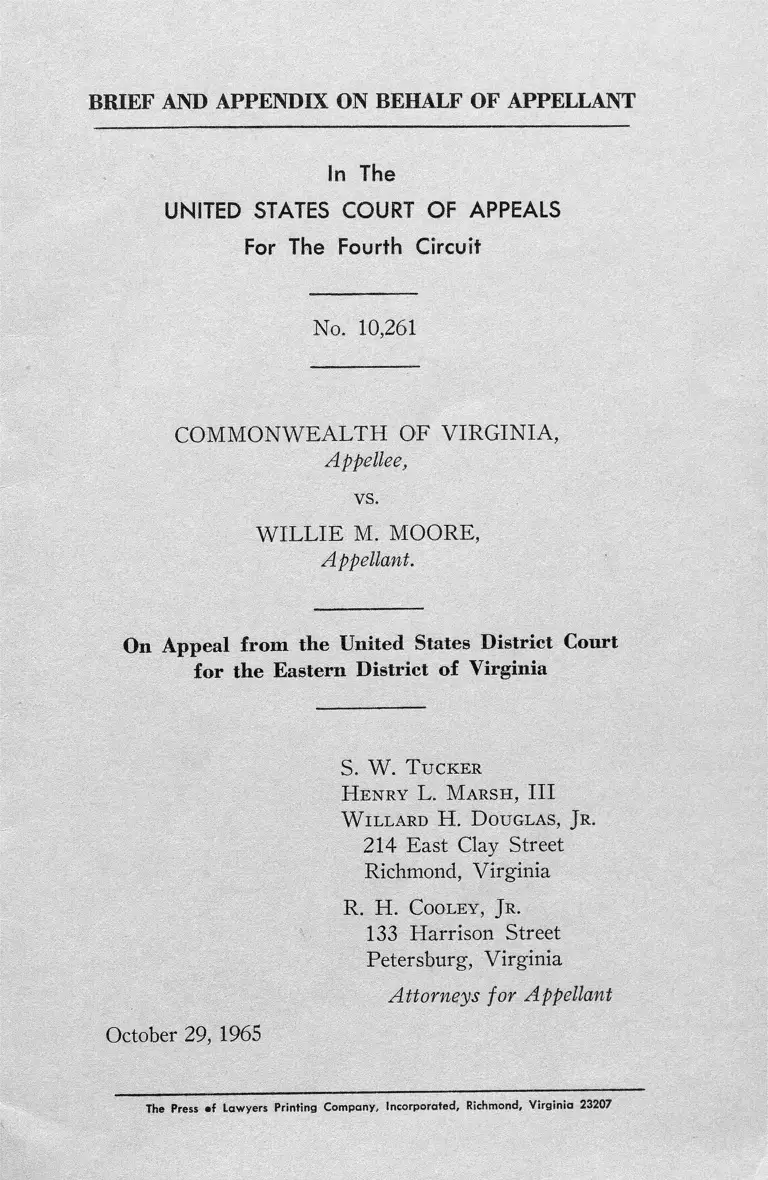
BRIEF AND APPENDIX ON BEHALF OF APPELLANT
In The
UNITED STATES COURT OF APPEALS
For The Fourth Circuit
No. 10,261
C O M M O N W E A LTH OF V IR G IN IA ,
Appellee,
vs,
W IL L IE M. M OORE,
Appellant.
On Appeal from the United States District Court
for the Eastern District of Virginia
S. W . T ucker
H enry L. M a rsh , III
W illard H. D ouglas, Jr.
214 East Clay Street
Richmond, Virginia
R. H. Cooley, Jr .
133 Harrison Street
Petersburg, Virginia
Attorneys for Appellant
October 29, 1965
The Press e f Lawyers Printing Company, incorporated, Richmond, Virginia 23207
TABLE OF CONTENTS
Pa««-
Statement of the Case ........-............ -....... -.................... ....- 1
The Questions Involved ................................... *.............— 2
Statement of the Facts ....................................................... 3
Argument ................................................... -......... ......... ....... 6
I. The State Prosecution Was For An Act Un
der Color O f Authority Derived From A Law-
Providing For Equal Rights And Was For
Refusing To Do An Act On The Ground
That It Would Be Inconsistent With Such
L a w .................................................................. ...... 6
A. Defendant Is Being Prosecuted For An
Act Under Color O f Authority Derived
From A Law' Providing For Equal
Rights ........................... ....................... ........ 7
B. Defendant Is Being Prosecuted For Re
fusing To Do An Act Inconsistent With
A Laur Providing For Equal Rights ---- 14
II. Defendant Cannot Enforce In The State
Courts His Rights Under Due Process And
Equal Protection Clauses O f The Fourteenth
Amendment ................................. ........... ........... 16
Page
III. Section 1443(1) Provides For Removal O f A
State Prosecution Under Virginia Statutes
When Such Statutes As Applied Deny De
fendant’s Rights Under The Civil Rights Act
O f 1964 ................................................................ 19
Conclusion ............ .............................................................. . 20
TA B L E OF CITA TIO N S
Cases
Bailey v. Commonwealth, 193 Va. 814 (1952), 71 S.E.
2d 368 .................................................................. 16, 17, 18
Bailey v. Smyth, 220 F. 2d 954 (4th Cir. 1955) ..16, 17, 18
Commonwealth v. Wallace, Crim. No. 7429 (E.D . Va.,
April 10, 1964) ............................................................ 16
Hamm v. Rock H ill,........U .S........... , 13 L.ed 2d 300 ..12, 14
Kentucky v. Powers, 201 U.S. 1 (1906) .......................17
New York v. Galamison, 342 F 2d 255 (2d Cir.), cert,
denied. 380 U.S. 977 (1965) .......................... .9, 10, 11
F 2d ........ (5 thPeacock v. City o f Greenwood,
Cir., June 22, 1965) ........ . 19
Page
Rachel v. Georgia, 342 F 2d 336 (5th Cir. 1965), re
hearing denied, 343 F 2d 909 (5th Cir. 1965), peti
tion for certiorari filed, 33 U.S. Law Week 3391
(U .S. May 15, 1965) ............... ............................. .9, 19
Other Authorities
Code of Georgia:
Section 26-3005 ............................ ........................... . 20
Code o f Virginia, 1950, as amended:
Section 18.1-120 ....................................... ....... .......... 19
Section 18.1-254 .................................... ................ 19
Constitution of Virginia:
Section 8 ............................................. ............. ........ . 5
United States Code:
Title 28 Section 1443(1) ________________3, 6, 16, 20
Title 28 Section 1443(2) ............................ .......6, 10, 11
Civil Rights Act of 1964:
Sections 201, 202, 203 ................................. ..3, 12
INDEX TO APPENDIX
Page
Petition for Removal ................ .................................. App. 1
Warrant As Originally Issued ....................... ...... ......App. 7
Warrant As Amended ......................... .................. App. 7, 8
Motion To Remand ............ ....... ............................ App. 8, 9
Opinion From The Bench ..................................App. 10, 11
Order O f Remand ......................................... ..............App. 12
Notice O f Appeal ................................................. App. 13, 14
In The
UNITED STATES COURT OF APPEALS
For The Fourth Circuit
No. 10,261
C O M M O N W E A LTH OF VIRG IN IA ,
Appellee,
vs.
W IL L IE M. M OORE
Appellant.
On Appeal from the United States District Court
for the Eastern District Of Virginia
BRIEF ON BEHALF OF APPELLANT
STATEMENT OF THE CASE
On April 7, 1965, pursuant to Title 28 United States
Code, Section 1443, Willie M. Moore filed a petition in
the United States District Court for the Eastern District
o f Virginia, Richmond Division, for removal o f a certain
2
criminal prosecution then pending against him in the Circuit
Court o f the County o f Sussex, in the State of Virginia,
which petition, by leave of Court, was subsequently
amended (A . 1-6). On May 28, 1965, the Commonwealth
o f Virginia filed a motion to remand which (1 ) challenged
the legal sufficiency of the factual allegations of the pe
tition as amended and (2) denied several of those allega
tions (A . 8-9). Having heard argument of counsel on the
question of the sufficiency of the allegations, the District
Court, in an opinion from the bench, held that the petition
for removal was not sufficient (A . 10-11); and, by order
entered on August 24, 1965, remanded same to the Circuit
Court o f the County o f Sussex, meanwhile suspending the
execution of its order o f remand pending the disposition of
this appeal (A . 12). Notice o f appeal was filed August 30,
1965 (A . 13).
TH E QU ESTION S IN V O LVE D
I
Whether §§ 201, 202 and 203 o f the Civil Rights Act
o f 1964 are laws providing for equal rights within the
meaning o f the Removal Statutes.
II
Whether a Negro who refused to accept service in a
restaurant covered by the Civil Rights Act o f 1964 when,
solely because of his race, he was denied the full and equal
enjoyment o f such service, was acting under the color of
authority of §§201, 202 and 203 o f said Civil Rights Act.
3
11
Whether §§ 201, 202 and 203 of the Civil Rights Act
o f 1964 give a Negro customer (o f a covered establish
ment) who, solely because o f his race, was refused ice
for a warm soda, the right to refuse to accept his meal.
IV
Whether the defendant can enforce in the State courts
his rights under the due Process and Equal Protection
Clauses of the Fourteenth Amendment.
V
Whether Section 1443 (1 ) provides for removal o f a
state prosecution under Virginia Statutes when such
statutes as applied deny defendant’s rights under the Civil
Rights Act o f 1964.
STATEMENT OF FACTS
Davis Truck Terminal, located in Sussex County on
Highway US 301, is engaged in selling food for con
sumption on the premises and serves and offers to serve
interstate travelers; and a substantial portion o f the food
which it serves and gasoline and other products which it
sells has moved in commerce. Appellant, hereinafter re
ferred to as defendant, is a Negro and a resident o f Din-
widdie County, Virginia.
4
In the early morning of March 7, 1965, the defendant
entered Davis Truck Terminal and there ordered food and
drink. The waitress brought the food and drink to the
counter where defendant was seated, the drink being in a
bottle.
Defendant asked the waitress to provide a glass o f ice
because the drink was warm. Solely because the defendant
is a Negro, the waitress refused to do so. Another restau
rant employee offered to get a glass of ice for defendant
but when the waitress expressed her objections the other
restaurant employee declined to interfere. Defendant did
not consume the food and drink because he was not pro
vided a glass o f ice. He refused to pay for the food and
drink and left the restaurant. Before he could drive away
he was accosted by the proprietor and subsequently arrested.
(A . 3)
The warrant as it was issued on the complaint and in
formation o f I. T. Davis, the proprietor o f Davis Truck
Terminal, charged that the defendant
“ did on the 7 day of March, 1965: Unlawfully fail
ing to pay for meal at his place o f bmness” (A . 7).
Subsequently, when the case was tried in the County
Court, the Court permitted the warrant to be amended to
charge that the defendant
“ did on the 7 day of March, 1965: Unlawfully fail
ing to pay for meal at his place o f bigness and com
mitting acts in breach o f the peace and otherwise
acting in a disorderly manner” (A . 7-8).
5
Prior to the filing of the removal petition, the defendant,
a Negro, faced prosecution in the Circuit Court o f the
County o f Sussex on a misdemeanor charge for which is
provided a maximum penalty of a $500.00 fine and a jail
sentence not exceeding one year. Section Eight o f the
Constitution o f Virginia guarantees to a defendant facing
such a charge the right to a trial by jury.
In 1950, according to the United States Census o f Popu
lation for that year, there were 6,868 persons twenty-one
years o f age and over residing in Sussex County of which
number 2,834 were white persons and 4,034 were non-white
persons or Negro. In 1960, according to the United States
Census o f Population for that year, there were 6,368 per
sons twenty-one years of age and over residing in the
County of Sussex of which number 2,662 were white
persons and 3,706 were non-white persons or Negroes
(A . 4 ).
It is and for many years has been the custom, usage and
practice o f the officials o f the Circuit Court o f the County
of Sussex charged with duties pertaining to jury selection
to deliberately limit the number o f Negroes who may be
summoned for jury duty so that never has the concurrence
o f a Negro member o f a grand jury [seven members] been
essential to an indictment, and seldom, if ever, have more
than four Negroes been included in a panel o f twenty from
which each side strikes four to leave a jury o f twelve for
the trial o f a felony charge, and seldom, if ever, have more
than three Negroes been included in a panel of eleven from
which each side strikes three to leave a panel o f five for the
6
trial of a misdemeanor charge. Such custom, usage and
practice o f deliberate limitation would enable the prosecutor
peremptorily to exclude all Negroes from the jury by which
petitioner would be tried in said Circuit Court (A . 4-5).
ARGUMENT
I
The State Prosecution Was For An Act Under Color
Of Authority Derived From A Law Providing For
Equal Rights And Was For Refusing To Do An
Act On The Ground That It Would Be Inconsistent
With Such Law
This is an appeal from an order o f the District Court
sustaining the motion of the Commonwealth of Virginia to
remand to the State court the criminal prosecution pending
against the defendant. The petition for removal had alleged
that removal jurisdiction was based on both paragraphs
(1 ) and (2 ) o f § 1443 of Title 28 United States Code.
The District Court remanded the case on the ground that
§ 1443 afforded no jurisdictional basis for removal.
The removal statute provides as follows:
“ § 1443. Civil rights cases
“ Any of the following civil actions or criminal
prosecutions, commenced in a State court may be re
moved by the defendant to the district court of the
United States for the district and division embracing
7
the place where it is pending:
“ (1 ) Against any person who is denied or cannot
enforce in the courts o f such State a right under any
law providing for the equal civil rights o f citizens of
the United States, or o f all persons within the juris
diction thereof;
“ (2 ) For any act under color o f authority derived
from any law providing for equal rights, or for re
fusing to do any act on the ground that it would be
inconsistent with such law.”
In order to assert a right o f removal under subsection
(2 ), the defendant was required to allege that he was being
prosecuted:
(1 ) for an act under color of authority derived
from any law providing for equal rights, or (2 ) for
refusing to do any act on the ground that it would
be inconsistent with [any law providing for equal
rights].
The fact shown by the instant petition clearly demon
strate that the defendant met both o f the alternatives
requisite to removal under subsection (2).
A
Defendant Is Being Prosecuted For An Act Under
Color Of Authority Derived From A Law Providing
For Equal Rights
8
Has the defendant alleged that he is being prosecuted
for an act under color o f authority derived from a law
providing for equal rights?
The following allegations contained in Section II of the
removal petition demonstrate that Davis Truck Terminal
is a place of public accommodation as defined by Sections
201 (b ) (2 ) and (c ) of the Civil Rights Act o f 1964:
“ Davis Truck Terminal, located in Sussex County on
Highway US 301, is engaged in selling food for con
sumption on the premises and serves and offers to
serve interstate travelers; and a substantial portion
: ■ o f the food which it serves and gasoline and other
products which it sells has moved in commerce.”
Section 201 (a ) o f the Civil Rights Act provides that the
defendant is entitled to the full and equal enjoyment o f the
goods and services o f the Davis Truck Terminal “ without
discrimination . . . on the ground of race .. . .” Pursuant
to this law, the defendant ordered food and drink from said
establishment. The next quoted excerpt contains the reason
for the prosecution which arose in the state court:
■ “ * * * The waitress brought the food and drink to the
counter where petitioner was seated, the drink being in
the bottle.
“ Petitioner asked the waitress to provide a glass of
ice because the drink was warm. Solely because pe
titioner is a Negro, the waitress refused to do so.
Another restaurant employee offered to get a glass
o f ice for petitioner but when the waitress expressed
her objections the other restaurant employee declined
9
to interfere. Petitioner did not consume the food and
drink because he was not provided a glass of ice.
Petitioner refused to pay for the food and drink and
left the restaurant. Before he could drive away he
was accosted by the proprietor and subsequently
arrested.” [Emphasis added.]
If, as alleged in the petition, the defendant was refused
ice to cool a warm beverage solely because of his race, then
obviously he was denied the full and equal enjoyment of
the goods and services of the Davis Truck Terminal solely
because of his race.
Thus, the District Court was required to decide whether
the fact that the defendant, who was denied the full and
equal enjoyment o f the goods and services of a restaurant,
and who, therefore, refused to accept and pay for these
goods and services, was acting under color of authority of
a law providing for equal rights. Stated another way, the
question is whether Section 203 o f the Civil Rights Act
protected the defendant from prosecution in the State
courts for seeking full and equal service in a covered
establishment.
In his opinion, the District Court stated:
“ The petition with regard to subsection (2 ) presents
a very close question. The cases of Rachel v. Georgia
342 F. 2d 336 (5th Cir. 1965), rehearing denied,
343 F.2d 909 (5th Cir. 1965) petition for certiorari
filed, 33 U.S. Law Week 3391 (U.S. May 15, 1965)
and New York v. Galamison, 342 F.2d 255 (2d Cir.),
cert, denied, 380 U.S. 977 (1965) do not appear to
provide a definitive answer to the problem in the case
10
at bar. In the Georgia case the petitioners were re
fused service. In this case it is charged that Moore
failed to pay for his meal, committed a breach o f the
peace and otherwise acted in a disorderly manner. He
asserts as a defense the Civil Rights Act o f 1964,
Sections 202 and 203, 42 U.S.C. Sections 2000a-l & 2
which would seem to bring the case within the rule
expressed in Nezu York v. Galamison, supra. The
distinction is not altogether clear. Certainly if he were
arrested simply because he went in and demanded a
meal or demanded to be served, Rachel would control
and the case would not be remanded.
“ On the other hand, when having been served a
dispute arises about the quality of the service, and the
defendant refuses to pay, the case should be remanded.
In this situation the Civil Rights Act is urged as a
defense. In Galamison the Court stated, 342 F2d at
271:
“ ‘When the removal statute speaks of ‘ “ color of
authority derived from” ’ a law providing for equal
rights, it refers to a situation where the lawmakers
manifested an affirmative intention that a beneficiary
of such a law should be able to do something and not
merely to one where he may have a valid defense or be
entitled to have civil or criminal liability: imposed on
those interfering with him.’ I f the defendant raises
this defense in the state court and he is not accorded
a full defense, or the defense isn’t recognized, then, of
course, we would have a clear-cut situation. That
doesn’t appear to be the situation here. The Court is
o f the opinion the motion to remand should be
granted.”
11
W e cannot agree with the District Court that the dis
tinction between refusing to serve and refusing to accord
the full and equal enjoyment of goods and services is con
trolling. Furthermore, we do not agree that the Court in
Galamison was stating that the Civil Rights Act o f 1964
does not confer “ color o f authority” in the sense required
by the removal statute. W e repeat the quote relied on by
the District Court and add the sentence which immediately
follows:
“ (4 ) When the removal statute speaks o f ‘color o f
authority derived from ’ a law providing for equal
rights, it refers to a situation where the lawmakers
manifested an affirmative intention that a beneficiary
of such a law should be able to do something and not
merely to one where he may have a valid defense or be
entitled to have civil or criminal liability imposed on
those interfering with him.
“ (5 ) When the removal statute speaks o f ‘any law
providing for equal rights,’ it refers to those laws
that are couched in terms o f equality, such as the
historic and the recent equal rights statutes, as dis
tinguished from laws, o f which the due process clause
and 42 U.S.C. § 1983 are sufficient examples, that
confer equal rights in the sense, vital to our way of
life, of bestowing them upon all.” New York v.
Galamison, 342 F.2d 255 (2nd Cir.), cert, denied, 380
U.S. 977 (1965).
Earlier, in pointing out that the Equal Protection Clause
and 42 U.S.C. § 1981 do not confer “ ‘color of authority’
in the sense o f § 1443(2), to perform the acts that are
the subject o f state prosecution,” the Court indicated:
12
“ *** a different case from any here before us would
be presented if the act complained o f in the state suit
was performed in the defendant’s exercise of an equal
right, such as the right to equal accommodations under
§ 201 of the Civil Rights Act o f 1964, which Congress
has singled out for federal protection.” Ibid.
In Section III of his petition, defendant had asserted:
“ Petitioner claims a right to removal under Title
28 U.S.C. §1443(2); this being a criminal prosecution
for refusing to pay for the food and drink, in the
circumstances under which they were served, on the
ground that it would be inconsistent with a law pro
viding for equal rights, viz: Section 201 of the Civil
Rights Act o f 1964 by virtue o f which the petitioner,
a Negro, is entitled to the full and equal enjoyment of
the goods and services o f the subject establishment
without racial discrimination, and Sections 202 and
203 of the Civil Rights Act o f 1964, by virtue o f which
the defendant may not be punished for exercising or
attempting to exercise any right or privilege secured
by Section 201 or 202.”
In the case of Hamm v. Rock Hill, . . . U.S. . . ., 13 L.ed
2d 300, 304-5, the Court, in reversing the conviction of
lunch counter sit-in demonstrators, stated:
“ Under the Civil Rights Act, petitioners’ conduct
could not be the subject o f trespass prosecutions, fed
eral or state, if it had occurred after the enactment of
the statute.
13
“ Title II includes several sections, some o f which
are relevant here, that create federal statutory rights.8
The first is § 201(a) declaring that ‘all persons shall
be entitled to the full and equal enjoyment of the
goods, services, facilities, privileges, advantages, and
accommodations of any place o f public accommodation,’
which as we have found includes the establishments
here involved. Next, § 203 provides:
“ No person shall (a ) withhold, deny, or attempt to
withhold or deny, or deprive or attempt to deprive, any
person of any right or privilege secured by section 201
or 202, or (b ) intimidate, threaten, or coerce, or at
tempt to intimidate, threaten, or coerce any person with
the purpose of interfering with any right or privilege
secured by section 201 or 202, or (c ) punish or attempt
to punish any person for exercising or attempting to
exercise any right or privilege secured by section 201
or 202. [Emphasis supplied.]
“ On its face, this language prohibits prosecution of
any person for seeking service in a covered establish
ment, because o f his race or color. It has been argued,
however, that victims of discrimination must make
use of the exclusive statutory mechanisms for the
redress of grievances, and not resort to extra legal
means. Although we agree that the law generally con
demns self-help, the language of § 203(c) supports a
conclusion that non-forcible attempts to gain admit
tance to or remain in establishments covered by the
Act, are immunized from prosecution, for the statute
speaks of exercising or attempting to exercise a ‘right
or privilege’ secured by its earlier provisions. The
14
availability of the Act as a defense against punishment
is not limited solely to those who pursue the statutory
remedies. The legislative history specifically notes that
the Act would be a defense to criminal trespass, breach
of the peace and similar prosecutions.”
B
Defendant Is Being Prosecuted For Refusing To
Do An Act Inconsistent With A Law Providing For
Equal Rights
It can hardly be argued that defendant is not entitled
to the same protection by the Civil Rights Act as one who
is refused service altogether and is arrested for refusing
to leave the premises. The clear language o f the Act refutes
the idea that a covered establishment can discriminate in
the service given Negro customers. However, the District
Court stated:
“ Certainly if he were arrested simply because he
went in and demanded a meal or demanded to be
served, Rachel would control and the case would not
be remanded.
“ On the other hand, when having been served a
dispute arises about the quality o f the service, and the
defendant refuses to pay, the case should be remanded.”
It is inconsistent with the letter, purpose and spirit o f
the Civil Rights Act o f 1964 to permit prosecution o f a
citizen seeking to exercise a right created by that Act. See
footnote 3 in Hamm v. Rock Hill, supra.
15
A contrary view would require any victim of racial dis
crimination at the hands o f a covered establishment either
to :
(1 ) file a suit to enjoin such discrimination,
(2 ) submit to such discrimination either by leaving the
premises when requested to do so or by accepting
and paying for discriminatory service, or
(3 ) refuse such discriminatory service and face prose
cution in the State court on charges brought by the
establishment.
In this case, the defendant chose to follow the latter
alternative. His subsequent prosecution is not only incon
sistent with, but is forbidden by, Section 203 o f the Act,
which provides that:
“ No person shall . . . .
“ ( c ) punish or attempt to punish any person for
exercising or attempting to exercise any right
or privilege secured by Section 201 or 202.”
To permit the instant case to be remanded would mean
that Congress has created substantial federal rights pur
porting to insure that racial discrimination be eliminated
from places o f public accommodation, but has left the inter
pretation and enforcement o f these rights to State courts.
16
II
Defendant Cannot Enforce In The State Courts His
Rights Under Due Process And Equal Protection
Clauses Of The Fourteenth Amendment
With respect to Section 1443(1), the District Court
stated:
“ This case is before the Court on a petition for re
moval and a motion to remand. The petition for re
moval is based upon 28 U.S.C. Section 1443 (1 ) and
(2 ). The petition, insofar as it is based upon subsec
tion (1 ) , is denied on the basis o f the Commonwealth
v. Wallace Crim. No. 7429 (E. D. Va., April 10,
1964) and Bailey v. Smyth, 220 F.2d 954 (4th Cir.
1955).” (A . 10)
The allegations of Section IV of the removal petition
(A . 4-5) make out a clear prima facie case of jury dis
crimination. The petition further asserts that:
“ In the case of Bailey v. Commonwealth, 193 Va.
814 (1952), the Supreme Court of Appeals o f Virginia
approved such custom, usage and practice o f consist
ently limiting the number of Negroes who may be
called for jury service so that either side may per
emptorily eliminate all Negroes from actual jury serv
ice. Under the law of the State of Virginia as thus
ascertained and declared by its highest court, petitioner
cannot enforce in the courts of the State his right to
be tried by a jury in the selection o f which there has
been no discrimination against persons of his race.”
17
In the Wallace case, the District Court stated:
“ * * * The petitioner urges that Bailey brings the
case at bar squarely within the proposition cited in
Kentucky v. Powers, supra, and the cases upon which
its reasoning is based. If Bailey can be read to allow
such discrimination, then it follows that under more
recent decisions of the Supreme Court the Virginia
Constitution and Statutes do fall within the purview
of section (1 ).
‘ ‘The Court, however, concludes that the case of
Bailey v. Commonwealth cannot be cited to establish
the proposition that in Virginia improper racial dis
crimination in the selection of jurors is permitted.
That case must be considered solely upon the facts'
that were presented in it and upon the concessions
made by counsel in argument. It cannot be considered
as precedent for the proposition that if the defendant
establishes in Prince Edward County factual racial
discrimination, the Virginia courts will hold as a mat
ter o f law that such discrimination is permissible.
“ The Court reaches that conclusion not only from
reading Bailey, but largely from the case of Bailey v.
Smyth in 220 F.2d 954 (4th Cir. 1955). O f course,
as we all know, the petitioner in Bailey v. Smyth was
the appellant in Bailey v. Commonwealth.
18
“ The Court of Appeals for the Fourth Circuit, at
220 F.2d 955, points out that one of the grounds upon
which a writ of habeas corpus was sought was ‘that
there had been discrimination on the ground of race in
the selection of the jury by which he had been tried.’
They found that such discrimination had not been
established and refused to grant the writ.
“They went further and held that the issues could
be determined from the state record.
“ Therefore, this Court does not see how it can de
termine that the case of Bailey v. Commonwealth in
71 S.E. 2d 368 establishes the proposition which coun
sel for the petitioner urges upon this Court. To do so,
the Court would have to disregard the plain holding
o f the Court o f Appeals for the Fourth Circuit in
Bailey v. Smyth, which was based not on the redeter
mination o f the facts, but on the law. And this Court
is not, of course, in a position to do so.”
The District Court thus held that Bailey v. Smyth, supra,
decided that there had been no discrimination on the ground
of race in the selection o f the jury in Commonwealth v.
Bailey, supra. This holding was clearly erroneous for as is
shown in the last sentence quoted above, this Court in
Bailey v. Smyth did not redetermine the facts in that case
but merely decided the legal questions presented.
19
III
Section 1443 (1 ) Provides For Removal Of A State
Prosecution Under Virginia Statutes When Such
Statutes As Applied Deny Defendant’s Rights Finder
The Civil Rights Act Of 1964.
The defendant is being prosecuted for violating (1 ) a
Virginia statute1 which prohibits one from obtaining food
from a restaurant without paying and with the intent to
cheat or defraud and (2 ) a Virginia statute2 which prohibits
disorderly conduct in public places. (A . 1-2, 7-8.)
The Commonwealth of Virginia is foreclosed from prose
cuting the defendant under these statutes for exercising
his rights under the Civil Rights Act o f 1964 by the reach
of Rachel v. Georgia, 342 F.2d 336 (5th Cir. 1965), re
hearing denied, 343 F.2d 909. (See also, Peacock v. City
of Greenwood,..... F .2 d ....... (5th Cir. June 22, 1965). The
Rachel case involved prosecutions of sit-in demonstrators
under the Georgia anti-trespass statute, Georgia Code Sec.
26-3005. The Georgia statute, like the Virginia statutes
here, was non-discriminatory on its face and only through
application could it operate to deny equal civil rights. The
law providing for equal civil rights was the Civil Rights
Act o f 1964. The removal petitions in that case were con
strued as alleging, in effect, that the Georgia Code Section
1 Code o f Virginia, 1950, as amended, Sec. 18.1-120.
2 Code of Virginia, 1950, as amended, Sec. 18.1-254.
20
26-3005 was being applied to the appellants in violation of
the Civil Rights Act of 1964 and therefore in violation of
the Supremacy Clause. The Court held that this was a good
claim for removal under Section 1443(1). It was as though
the Civil Rights Act had placed a gloss on the Georgia
statute to the effect that it was not to be applied in peaceful
sit-in demonstration.
The rationale of Rachel is applicable here since the denial
o f the equal rights was through statutory application rather
than through some infirmity appearing on the face of the
statute.
CONCLUSION
W H EREFO RE, It is respectfully submitted that the
judgment o f the District Court remanding this prosecution
should be reversed. S.
S. W . T ucker
H enry L. M a r sh , III
W illard H. D ouglas, Jr.
214 East Clay Street
Richmond, Virginia
R. H. Cooley, Jr.
133 Harrison Street
Petersburg, Virginia
Attorneys for Appellant
APPENDIX
APPENDIX
IN THE UNITED STATES DISTRICT COURT
FOR THE EASTERN DISTRICT OF VIRGINIA
Richmond Division
Criminal No. 7575
W IL L IE M. MOORE, Petitioner,
v.
C O M M O N W E A LTH OF VIRG IN IA , Respondent.
PETITION FOR REMOVAL
[Filed April 7, 1965]
I
Willie M. Moore petitions the Court that a certain crim
inal prosecution against him pending in the Circuit Court
of the County of Sussex, in the State of Virginia, be re
moved from said state court to the United States District
Court for the Eastern District of Virginia, Richmond
Division, the said criminal prosecution being the proceed
ing upon a warrant which as issued, on complaint and in
formation of I. T. Davis, charged that the defendant
App. 2
“ did on the 7th day of March, 1965:
Unlawfully failing to pay for Meal at his place of
bissness”
and, as amended by the Sussex County Court, charged
that the defendant
“ did on the 7th day of March, 1965:
Unlawfully failing to pay for Meal at his place of
bissness and committing acts in breach of the peace
and otherwise acting in a disorderly manner”
A copy of the warrant as issued and a copy of the warrant
as amended are attached as exhibits hereto.
II
The incident which gave rise to said prosecution is,
briefly stated, as follow s:
Davis Truck Terminal, located in Sussex County on
Highway US 301, is engaged in selling food for con
sumption on the premises and serves and offers to
serve interstate travelers; and a substantial portion of
the food which it serves and gasoline and other prod
ucts which it sells have moved in commerce.
In the early morning of March 7, 1965, the petitioner
entered Davis Truck Terminal and there ordered food
and drink. The waitress brought the food and drink
to the counter where petitioner was seated, the drink
being in the bottle.
App. 3
Petitioner asked the waitress to provide a glass o f ice
because the drink was warm. Solely because petitioner
is a Negro, the waitress refused to do so. Another
restaurant employee offered to get a glass of ice for
petitioner but when the waitress expressed her objec
tions the other restaurant employee declined to inter
fere. Petitioner did not consume the food and drink
because he was not provided a glass of ice. Petitioner
refused to pay for the food and drink and left the
restaurant. Before he could drive away he was ac
costed by the proprietor and subsequently arrested.
Ill
Petitioner claims a right to removal under Title 28 U.S.C.
§ 1443(2) ; this being a criminal prosecution for refusing to
pay for the food and drink, in the circumstances under
which they were served, on the ground that it would be
inconsistent with a law providing for equal rights, viz:
Section 201 of the Civil Rights Act of 1964 by virtue of
which the petitioner, a Negro, is entitled to the full and
equal enjoyment of the goods and services of the subject
establishment without racial discrimination, and Sections
202 and 203 of the Civil Rights Act of 1964, by virtue of
ivhich the defendant may not be punished for exercising
or attempting to exercise any right or privilege secured by
Section 201 or 202. [Italicized portion added by amend
ment June 7, 1965.]
App. 4
IV
Petitioner claims a right to removal under Title 28 U.S.C.
§ 1443(1) because he can not enforce in the courts o f the
State of Virginia his right under the Due Process and
Equal Protection Clauses of the Fourteenth Amendment
to the Constitution of the United States that there be no
systematic discrimination against, or limitation of the num
ber of, persons of his race in the selection o f the petit jury
by which he would be tried.
Petitioner is a Negro and a resident of Dinwiddie County,
Virginia.
In 1950, according to the United States Census of Popu
lation for that year, there were 6,868 persons twenty-one
years o f age and over residing in Sussex County of which
number 2,834 were white persons and 4,034 were non
white or Negroes. In 1960, according to the United States
Census of Population for that year, there were 6,368 per
sons twenty-one years o f age and over residing in the
County of Sussex of which number 2,662 were white per
sons and 3,706 were non-white persons or Negroes.
It is and for many years has been the custom, usage and
practice o f the officials of the Circuit Court o f the County
of Sussex charged with duties pertaining to jury selection
to deliberately limit the number of Negroes who may be
summoned for jury duty so that never has the concurrence
of a Negro member of a grand jury been essential to an
indictment, and seldom, if ever, have more than four Ne
groes been included in a panel o f twenty from which each
side strikes four to leave a jury o f twelve for the trial of
App. 5
a felony charge, and seldom, if ever, have more than three
Negroes been included in a panel of eleven from which
each side strikes three to leave a panel o f five for the trial
of a misdemeanor charge. Such custom, usage and practice
of deliberate limitation would enable the prosecutor peremp
torily to exclude all Negroes from the jury by which pe
titioner would be tried in said Circuit Court.
In the case of Bailey v. Commonwealth, 193 Va. 814
(1952), the Supreme Court o f Appeals of Virginia ap
proved such custom, usage and practice of consistently
limiting the number of Negroes who may be called for
jury service so that either side may peremptorily eliminate
all Negroes from actual jury service. Under the law of the
State of Virginia as thus ascertained and declared by its
highest court, petitioner cannot enforce in the courts of
the State his right to be tried by a jury in the selection of
which there has been no discrimination against persons of
his race.
App. 6
W H ER EFO RE , petitioner prays the removal of the
above mentioned criminal proceeding from the Circuit
Court o f the County o f Sussex to the United States District
Court for the Eastern District o f Virginia, Richmond D i
vision, and prays that said proceeding stand so removed.
/ s / Willie M. Moore
Petitioner
/ s / R. H. Cooley, Jr.
O f Counsel for Petitioner
R. H. Cooley, Jr.
133 Harrison Street
Petersburg, Virginia
S. W . T ucker
H enry L. M a rsh , III
W illard H. D ouglas, Jr.
214 East Clay Street
Richmond, Virginia 23219
Counsel for Petitioner
App. 7
WARRANT AS ORIGINALLY ISSUED
STA TE OF V IR G IN IA }
CO U N TY OF SU SSEX $
T o -W it: N o____ ____
TO A N Y SH ERIFF OR POLICE OFFICER:
Whereas, I. T. Davis has this day made complaint and
information on oath before me, E. R. Heisler, J. P, o f the
said County, that Willie M. Moore in the said County did
on the 7 day of March, 1965: Unlawfully failing to pay
for meal at his place of bissness.
These are, therefore, to command you, in the name of
the Commonwealth, to apprehend and bring before the
County Court of the said County, the body . . . o f the above
accused, to answer the said complaint and to be further
dealt with according to law.
* -1=
Given under my hand and seal, this 7 day of March, 1965
E. R. Heisler, J.P. (Seal)
WARRANT AS AMENDED
STA TE OF V IR G IN IA }
CO U N TY OF SU SSEX j
To-W it: No.
App. 8
TO A N Y SH ERIFF OR PO LICE O FFICER:
Whereas, I. T. Davis has this clay made complaint and
information on oath before me, E. R. Heisler, J. P. o f the
said County, that Willie M. Moore in the said County did
on the 7 day of March, 1965: Unlawfully failing to pay
for Meal at his place o f bissntss and committing acts in
breach of the peace and otherwise acting in a disorderly
manner.
These are, therefore, to command you, in the name of
the Commonwealth, to apprehend and bring before the
County Court o f the said County, the body . . . o f the above
accused, to answer the said complaint and to be further
dealt with according to law.
* * *
Given under my hand and seal, this 7 day of March, 1965
s / E. R. Heisler, J. P. (Seal)
[Caption Omitted]
MOTION TO REMAND
[Filed May 28, 1965]
To the Honorable John D. Butzner, Jr., Judge of said Court.
Now comes the respondent, the Commonwealth of V ir
ginia, by its Attorney, E. Carter Nettles, Jr., Common
wealth’s Attorney for the County o f Sussex, Virginia, and
moves the court to remand this suit to the Circuit Court of
App. 9
Sussex County, Virginia, from which court it was at
tempted to be removed to this court, for the reasons and
upon the grounds hereinafter set forth:
1. That petitioner, Willie M. Moore, is prosecuted for
violation o f Virginia Code of 1950, Section 18.1-120;
2. That if all allegations alleged in petitioner’s “ Petition
for Removal” in paragraph denoted “ IT” are proved true
this court is without jurisdiction to hear the case;
3. That petitioner has not at any time requested a jury
trial in the Circuit Court o f Sussex County of Virginia;
4. That juries are selected in the Circuit Court o f Sussex
County. Virginia in those cases provided in accordance
with the statutory law of Virginia ;
5. That no specific violation o f Section 201 o f the Civil
Rights Act o f 1964 have been alleged nor did any such
violation in fact occur.
W H EREFORE, Commonwealth of Virginia prays that
this suit may be remanded to the Circuit Court o f Sussex
County. Virginia to be proceeded with according to the
practice governing such cases.
C O M M O N W E ALTH OF V IR G IN IA
By E. Carter Nettles, Jr., Commonwealth’s
Attorney for the County of Sussex,
Virginia.
App. 10
OPINION FROM THE BENCH
[June 7, 1965]
T H E C O U R T : This case is before the Court on a pe
tition for removal and a motion to remand. The petition
for removal is based upon 28 U.S.C. Section 1443 (1 )
and (2 ). The petition, insofar as it is based upon sub
section (1 ), is denied on the basis o f the Commonwealth
v. Wallace Crim. No. 7429 (E. D. Va., April 10, 1964)
and Bailey v. Smyth, 220 F.2d 954 ( 4th Cir. 1955).
The petition with regard to subsection (2 ) presents a
very close question. The cases o f Rachel v. Georgia, 342
In 2d 336 (5th Cir. 1965), rehearing denied, 343 F.2d
909 (5th Cir. 1965) petition for certiorari filed, 33 U.S. Law
Week 3391 (U.S. May 15, 1965) and New York v. Gala-
mison, 342 F.2d 255 (2d Cir.), cert, denied, 380 U.S. 977
(1965 ) do not appear to provide a definitive answer to the
problem in the case at bar. In the Georgia case the petition
ers were refused service. In this case it is charged that
Moore failed to pay for his meal, commited a breach of
the peace and otherwise acted in a disorderly manner. He
asserts as a defense the Civil Rights Act o f 1964, Sections
202 and 203, 42 U.S.C. Sections 2000a-l & 2 which would
seem to bring the case within the rule expressed in New
York v. Galamison, supra. The distinction is not altogether
clear. Certainly if he were arrested simply because he went
in and demanded a meal or demanded to be served, Rachel
would control and the case would not be remanded.
On the other hand, when having been served a dispute
arises about the quality of the service, and the defendant
App. 11
refuses to pay, the case should be remanded. In this situ
ation the Civil Rights Act is urged as a defense. In Gal-
cnnison the Court stated, 342 F2d at 271 :
“ When the removal statute speaks of ‘color o f authority
derived from’ a law providing for equal rights, it refers
to a situation where the lawmakers manifested an affirma
tive intention that a beneficiary of such a law should be
able to do something and not merely to one where he may
have a valid defense or be entitled to have civil or criminal
liability imposed on those interfering with him.” If the
defendant raises this defense in the state court and he is
not accorded a full defense, or the defense isn’t recognized,
then,, o f course, we would have a clear-cut situation. That
doesn’t appear to be the situation here. The Court is of the
opinion the motion to remand should be granted.
MR. M A R SH : Your Honor, we intend to appeal this
case and would like to move for a stay o f the Court’s ruling
pending the outcome of appeal.
TH E C O U R T : What is your position on that?
MR. N E T T L E S : I would move that you withhold your
decision pending the decision of the case that is now on
appeal, the Wallace case.
TH E C O U R T : No. This case should be decided. The
motion for a stay is granted. The Court supposes the appeal
will be prosecuted within the statutory time. If the appeal
is not prosecuted you can move to dissolve the stay.
App. 12
[Caption Omitted]
ORDER OF REMAND
[Filed August 24, 1965]
This cause came on to be heard on the Petition for Re
moval, the Answer of the Commonwealth of Virginia,
Amendment to Petition for Removal, and as argued by
counsel on June 7, 1965; and it appearing that the cause
herein should not be removed and that it should be re
manded,
IT IS O RDERED and ADJUDGED that the above
cause be and is remanded to the Circuit Court o f Sussex
County, Virginia.
Upon motion of Willie M. Moore, execution of this
order is stayed pending appeal.
Let the Clerk send copies of this order to counsel of
record.
August 24, 1965
John D. Butzner, Jr.
United States District Judge
App. 13
[Caption Omitted]
NOTICE OF APPEAL
[Filed August 30, 1965]
Name and address of Appellant:
Willie M. Moore
Route 2, Box 118
Dinwiddie, Virginia
Name and addresses of Appellant’s Attorneys:
R. H. Cooley, Jr.
133 Harrison Street
Petersburg, Virginia 23803
S. W . Tucker
Henry L. Marsh, III
Willard H. Douglas, Jr.
214 East Clay Street
Richmond, Virginia 23219
Offense: Failing to pay for meal [in restaurant], breach of
the peace, and disorderly conduct.
Concise Statement of Judgment or Order, giving date and
any sentence:
App. 14
August 24, 1964: O RDERED and ADJUDGED that
the above cause be and is remanded to the Circuit
Court o f Sussex County, Virginia.
Name of institution where now confined, if not on bail:
Defendant is on bail.
The above named defendant hereby appeals to the United
States Court o f Appeals for the Fourth Circuit from the
above stated judgment.
Date: August 28, 1965
/ s / Henry L. Marsh, III
Appellant’s Attorney