Senter v. General Motors Corp. Court Opinion
Unannotated Secondary Research
March 1, 1976
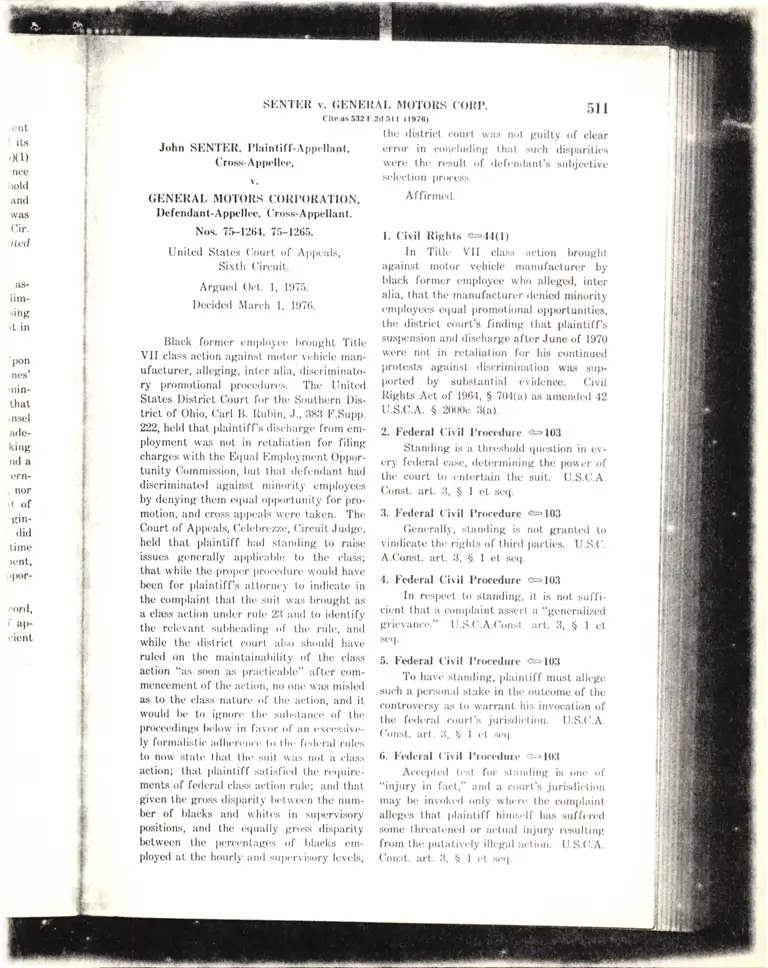
6 pages
-
Case Files, Garner Working Files. Senter v. General Motors Corp. Court Opinion, 1976. f6295df3-34a8-f011-bbd3-000d3a53d084. LDF Archives, Thurgood Marshall Institute. https://ldfrecollection.org/archives/archives-search/archives-item/b9c2cc50-2d42-4550-96d6-24174f477d10/senter-v-general-motors-corp-court-opinion. Accessed September 25, 2026.
Copied!
John KKNIKK, I’hiiiiliff-ApiH'lianl,
Cross-Appollcc,
(JKNKRAL MOTORS CORI’ORATION,
Defcnclant-ApiH'lli'o, CrosK-Appollant.
Nos. 7r>-12(i1,
United States Ooiitt of Appeals,
Sixth I'ireuit.
Argued Oet. 1, l ‘.)7r).
Decided .March 1, 197G.
Black former eni|)h)yee hrought Title
VII class action against motor vehicle man
ufacturer, alleging, inter alia, di.scriminato-
ry promotional proceduri's. The Uniteil
States District Court for tlu’ Southern Dis
trict of Ohio, Carl H. Rubin, .1,, 88.2 F.Su|)p.
222, held that |)laintiff’s discharge from em-
|)loyment was not in retaliation for filing
charges with the Kipial Kinployment 0|)p(jr-
tunity Commission, hut that defendant had
discriminated against tTiinority employees
by denying them eipial opportunity for pro
motion, and cross ap|)eals were taken. The
Court of Appeals, Celebrezz(p Circuit .Judge,
held that plaintiff had standing to rai.se
issues generally applicable to the class;
that while the proper procc'dure would have
been for plaintiff’s attorney to indicate in
the complaint that the suit was brought as
a class action umhu- role 28 and to identify
the relevant subheading of the rule, an<l
while the district court also should have
ruled on the maintainability of the class
action “as soon as [iraciicable” after com
mencement of the action, no one was misled
as to the class nature of the action, and it
would be to ignore the substance of the;
proceedings below in f.ivor- of an excessive
ly form.’distic adherence to the federal rules
to now stale that the suit was not a class
action; that plaintiff satisfiisl the reipiire-
monts of federal class action rule; and th.at
given the gross disparity between the num
ber of blacks and whiles in supiTvisory
positions, and the eipially gross disparity
l)etween the percentages of blacks em
ployed at the hourly and supervisory levels.
v. (JKNKRAD MOTORS COlO’.
Cltpas 532 I 2il 51 I
the <listrict court was not guilty of clear
(‘iror in concluding lh.it such disparities
were the result of defemlant’s subjective
selection (irocess.
Affirmeil.
1. Civil Rights «=>M(1)
In Title VII class action brought,
against motor vehicle manufacturer by
black former employee who alleged, inter
alia, that the manufacturer denied minority
employees eipjal promotional opportunities,
the district court's finding tliat plaintiff’s
suspension and di.scharge after June of 1971)
were not in retaliation for his continued
protests against discrimination Wius sup
ported by substantial evidence. Civil
Rights Act of 1901, § 70'1(al as amended 12
II.S.C.A. § 2000e .8(a),
2. Federal Civil I’rocedure <S=>I08
Standing is a threshohl ipiestion in ev
ery federal case, determining the |>ower of
the court to entertain the suit. IJ.S.C.A
Const, art. 8, 1 et seip
8. Fwleral Civil I’riicedure <s=»108
(lenerally, standing is not granted to
vindicate the rights of third parties. U.S.C
A.Const, art. ti, § 1 et seip
4. FtMleral Civil Frocedure '*=>108
In respect to standing, it is not suffi
cient that a complaint assert a “generalized
grievance.” U.S.C.A.thmsl art. 8, § 1 et
.seip
.I. Federal Civil FriK-ediire g=>108
To have standing, plaintiff must allege
such ii personal stake in the outcome of the
controversy as to warrant his invocation of
the federal court’s Jurisdiction. II.S.C.A.
Const, art. 8, 1 et .sei|
(i. I''eder;il Civil I’locediiic
Accepted test for standing is one of
“injur}' in fact,” and a court’s jurisdiction
may be invoked ordy where the complaint
alleges th.al plaintiff him.s. lf has suffered
some threatened or actual injury resulting
from the putatively illegal action. IJ.S.ttA.
Const, art. 8, § 1 et seip
* .J"!
532 KKDKRAh I{K1’()KTEH, 2d SER IES
7. Eedcral Civil I ’riK-i'diire c=>l(l3
Onro ;ui individual has allcjicd a dis
tinct and |ial|)al)lc injury to himscdf. ho has
standiiifi to challenge a practice even if the
injury is of a sort shared hy a large class of
[jossibk ̂ litigants. II.S.C.A.Const, art. 3, § I
et seep
8. Civil Rights 13.11
Standing for purposes of the Civil
Rights Act of Ithil was intended hy Con
gress as broadly as perniilteil by Article III
of the Cotistitution. tlivil Rights Act of
IDM, § 701 et se(|. as amended 42 I!.S.C.A.
§ 2000e et se(p; I'.S.C.A.Const, art. 3, 1 et
se(p
9. Civil Rights c=>41
Taking a broad view of standing in
Title VI1 litigation is consistent with the
clear weight of authority in other jurisdic
tions and is also in keeping with the uniipie
enforcement structure of th(! 190-1 Civil
Rights Act which relegates much of the;
responsibility for vindicating the policies of
the Act to private; litigants. Civil Rights
Act of 19t>t, § 701 et seep as amended 42
U.S.C.A. § 2000e et seep
10. Ecderal Civil Procedure
It is not sufficient that an aspiring
class rejeresentative allege purely pe-rsonal
injury ;it the hands of the elefendant; to
have standing to sue on bedialf of the cla.ss,
he must be a member of the class and
suffer injury common to tlu’ class. Feel.
Rules Civ.l’reee-. rule 23, 28 U.S.C.A.
11. EtMleral Civil PrcK-edure <5=184
Offer e)f promotieen te> empleeyee feelleew
ing his complaint to the Eeiueil Empleeyment
Oppeertunity Commissieen of eliscriminateery
lereemotieenal preece'ehires eliel met eiffect the'
e'mpleeyce;’s steineling tee raise e'hiss issue'.
Civil Rights Ae't eef IttOl, § 701 e'l se'ep ;e.';
ame'iiele'el 42 U.S.C.A. § 2000e e't Seep
12. Civil Rights ©^11
If an empleeyer e'eeulel neg.ite' :iii eunphey-
ee>’s stemeling tee chalh'iige' elise'riminateery
empleeyment prae'tie'es by the simple; expe;eli-
ent eef eeffe'ring him unilatendly the' relief
he seeks feer the' class, the iieelivielual-initiat-
eel e'lifeerce'iieent slrue'ture eef Title; VII
weeidel be; se'rieeiisly thrcatene;el. Civil Rights
Ae't of 1901, § 701 et si'e|. as aim;neleel 42
U.S.C.A. § 2lMM)e et seep
13. Fwlcral Civil PreK'cdurc ©=103
Staneling is eletermineel as eef the elate
suit is fih'el.
14. Civil Rights ©=41
Siiece' plaintiff w :is a blae'k neensupe't vi-
seery empleeyee een the elate Title VI1 suit
was fileel charging em|eleeyi;r with eli;nying
inineerity empUeyee;s eepial preemotieenal eep-
peertunities, phiintiff hael staneling tee reiise
the; issue' eef allegcel eliscrimimitieeii by the
e'lnpleeyer in selecting supe'i'viseers. Civil
Rights Ae t eef 1964, § 701 et .se;ep as ame'nel-
e'el 42 U.S.C.A. § 2000e el se:ep
15. EeKleral Civil PreM-e'dure <5=184
Neet every suit alleging emieheynu'iit
eliscriminatieen is suitable for chuss action
treatment; a plaintiff must sheew Ihiit the
aclieen satisfies the re'e|uiremenls eef feeleral
class iictieen rule. Civil Rights Act eef 1964,
§ 701 et seep as amenele'el 42 U.S.C.A.
§ 2000e; et seep; Feel.Reih's Civ.l’reee'. rule 23,
28 U.,S.C.A.
16. Fenleral Civil Pren'celure <5=l(il
I’reevisieen of feeleral cliiss actieen rule'
that “lajs seeon as practicable after the com
mencement eef an actieen bieeughl as a cla.ss
eu'lieen, the; court shall eletermine' by eerelcr
whellu'r it is tee be so maintaineel” is manela-
teery anel the' elislrid ceeurl has a eluty lee
e'e'rtify the chess aclieen whe'ther reepiesleel
lee elee so or met. Feel.Rules Civ.l’reec. rules
23. 23(c)(1), 28 U.S.C.A.
17. Feeleral Civil Proe'celiire <5=161
•Meinel.'ete' e e f fe'ele'ral e'lass iictieen rule'
that “|a|s seieeii :is prae'l ie'eible' afle'f the' e'eem-
mi'Mce'me'rel eef ate tie'tieeii breeught as a class
actieeie, the' ceeurt sh.'ill elt'lcrmine' by eeriler
whe'ther it is tee be; see maintaiiK'd’’ is eebvi-
eeusly elire'cteel tee the elistrie't ceeurt, anel it
eleees met impeese upeen a plaintiff the tuleli-
tieenal burelen eef ensuriieg that the; elislrict
eeeurt adhere's tee that elirective. Fe;el.Rules
Civ.Freer, rule's 23, 23(c)(1), 28 U.S.C.A.
SKNTKK V. (iKNKRAI- MOTORS ('OKI'.
Cilea5 532 l . 2iir>ll ( I 97fi)
lights
0(1 42
dale
ipervi-
II suit
onying
lal op-
() raise
hy the
Civil
amend-
loy merit
action
that the
federal
of 1964,
U.S.C.A.
rule 23.
lion rule
the com-
us a class
by order
IS inanda-
duty to
reiiuested
roc. rules
'il
liotl rule
r the com
as a class
hy order
I” is ohvi-
irl, and il
Uie addi-
ho district
Fed.Rules
'.S.C.A.
18. Federal (dvil I’roccdiire c^lHl
Il is not essential that an action
brought under Title VII of the ( ivil Rights
Act of 1964 be labeled a class action since it
is [lerforce a sort of class action for fellow
einjiloyees similarly situ.atcd. t ivil Rights
Act of 196'!, § 701 et seq. as amimded 42
U.S.C.A. § 20l)0e et s('q.; Fed.Rules Civ.
IVoc. rule 23, 28 U.S.C.A.
19. Federal Civil Procedure Ci^ltil
While the proper procedure, in 'I'itle
VII suit charging discrimin.atory promotion
al procedures, would have been for plain
tiff’s attorney to indicate in the conqilaint
that the suit was brought as a class action
under rule 23 and to identify the relevant
subheading of the rule, and while the dis
trict court also should have ruled on the
maintainability of the class action “as soon
as practicable” after commencement of the
action, no one was misleil as to the class
nature of the action, and it would be to
ignore the substance of the proceedings be
low in favor of an excessively formalistic
adherence to the federal rules to now state
that the suit was not a class action. Civil
Rights Act of 1964, § 7111 el se<i. as amend
ed 42 U.S.C.A. § 2l)l)0e et .seip; Fed.Ruh;s
Civ.Proc. rule 23, 28 U.S.C./V.
20. Federal Civil Procedure c-=16l
Clear trend is to read the federal class
action rule functionally rather than forrnal-
istically in litigation brought under Title
VII of the Civil Rights Act of 1961. Civil
Rights Act of 1964, ^ 7111 et se<|. as amend
ed 42 U.S.C.A. § 2l)l)()e et seip; Fed.Rules
Civ.Proc. rule 23, 28 U.S.C.A.
21. Federal Civil Procedure <s=̂ 62.$
Pleading under the feder.d rules is de
signed to give notice to the court and other
parties of the naluie ol the action and the
relief sought.
22. F(Hleral Civil PriM-ediire Ce.̂ 161
Party seeking to ulili'/.e the class action
device has the burden of establishing his
right to do so. Fe<l.Rules Civ.Proc. rule 2.!.
28 U.S.C.A.
23. F'ederal Civil l*r<M‘cdure c=>184
Title VII suit charging discriminatory
promotional procedures brought by black
former enqiloyee against motor v'ehicle
manufacturer was maintainable as a cla.ss
action, since the numerosily recpiirement
was satisfied by jiroof that, over the periixi
in (piestion, blacks compri.sed approximately
14% of the substantial work force, since
there was a question common to the cla-ss of
whether the manufacturer’s [irocedures for
making promotions had resulted in discrimi
nation against minority employees, since
the typicality requirement was .satisfied by
proof that plaintiff’s inl(’resls were coex
tensive with thos(? of the class on all issues
(•(dating to the class, sinc(! plaintiff demon
strated that he would ade<p(ately represent
the class interests, and since the manufac
turer had acted or refused to act on
grounds generally applicable to the class.
Fell.Rules Civ Proc. rule 23(a), (bX2), 28
U.S.tVA.
21. Federal Civil PriK-edure c=»161
In ruling on a class action, a judge may
consider reasonable inferences drawn from
facts before him at that stage of the pro
ceedings, and an appellate court will gener
ally defer to the district court’s determina
tion that a cla.ss is sufficiently numerous to
make joinder impracticable. Fed.Rules ( iv.
Proc. rule 23(a)(1), 28 11.S.C.A.
2.5. Civil Rights <3=»4f»
While it is manifest that every decision
to hire, fire or discharge an employiH' may
involve individind considerations, yet when
that decision is made as part of class wide
discriminatory practices, courts bear a s|k;-
cial responsibility lo vindicate tlie [silicii's
of Title \ I1 of the Civil Rights Act of P.161,
regardles.; of the |iositioii of the individual
{ilaint.iif. ('.ivil Rights Act of 1964, § (01 et
sei[. as amended 42 U.S.C.A. § 2000e et .seq.
26. Federal Civil PriM-edure <^161
Factual identity between plaintiff’s
(dainis and those of the cla.ss he seeks to
represent is not. neci'ssary. 1'ed.Riih‘s ( iv'.
Proc. rule 23, 28 US.('.A.
-1
V - ;
t, ?:
532 I i;i)KUAL UKI’ORI'KK, 2d SKIMKS
27. Civil Hislils
Rua; (liscriTiiiiialion is peculiarly cla.ss
(liscriminalion.
28. Civil UiKhfs «==!). 10
The operative fact in an action under
Title VII of the Civil Rights Act of lOM is
that an individual has heen discriminated
against because he was a inemher of a class.
Civil Rights Act of Ithrl, § 701 et se<|. as
amended '12 U.S.C.A. § 2()0tk; et seip
29. Fcnleral Civil Rrocediire c^ ltil, 105
There are two criteria for determining
whether the named i)laintiff's representa
tion of the class will he ade(piate: the rep-
n'.sentative must have common interests
with unnamed meml)ers of the cla.ss, and it
must appear that he will vigorously protect
the interests of the cla.ss through (pialifieil
counsel. Fed.Rules Civ.l’roc. rule 23(a)(4),
28 U.S.C.A.
30. I’jHlcral Civil I’roceduro >3=105
As plaintiff was a member of the class
at the time class suit was filed, to that
extent his claims were typical; and class
membership was also relevant to the (|ues-
tion of common interests, although it was
not dispositive. Fed.Rules Civ.Proc. rule
23(a)(3, 4), 28 U.S.C.A.
,31. Ftnleral Civil Procedure <0=105
To be typical, a representative’s claim
need not iilways involve the same facts or
law, provided there is a common elemeid of
fact or law. Fed.Rules Civ.l’roc. rule
2tl(a)(3), 28 U.S.C.A.
.32. Fwleral Civil Pna-ediire <o=l81
Since black former employee, who fileil
'I'itle VII class action charging discriminato
ry promotional procedures, primarily
prayeil for inJuticLive relief, his addiliorud
reipiesi for ba<-k pay diil not preclude cerli
fication of the suit as a 2;i(b)(2) class aelii>n
f'eil.Rules (uv.l’roc. rule 2tt(b)(2), 2S U S.
C.A.
.3.3. Ferleral Civil I’roccdure <3=101
Lawsuits alleging class wide discrimi
nation are particularly well suited for
23(b)(2) class treatment since the common
claim is susceptible to a single proof and
subject to a single injunctive remedy. Fed.
Rules t'iv.l'ns'. rule 23(b)(2), ‘28 U.S.UA.
34. Coin Is <3=100.3(9)
On issues of fact and creilibility, the
Court (d' Appeals is bound by the “clearly
erroneous" principle, but it is not so bound
where the contention is that tlu; district
court api)lie<l erroneous legal iirincijiles.
Fed.Rules Civ.l’roc. rule 52(a), 28 U.S.C.A.
35. Civil Riglits <s=‘).10
Facially noniliscriminalory employment
practices may U‘ stria k down if they have
the practical effect of continuing jiast injus-
t ices.
30. Civil Rights <3=13
.Statistical evidence is an important tool
for placing seemingly inoffensive employ
ment [ir.-ictices in their proper pers|)ective
in Title VII cases. Civil Rights Act of 19t’4,
§ 701 et se(|. as amended 42 U.S.C.A.
§ 2IIOOe et seq.
37. Clivil Rights <3=44(1)
An employee is at an inherent disad
vantage in gathering hard evidence of em
ployment discrimination, |)urticularly when
the discrimination is plantwide in sc(.i>e, and
it is for this rea.son that the courts general
ly acknowledge the value of statistical evi
dence in establishing a prima facie cu.se of
<liscrimination under 3’itle VII. Civil
Rights Act of 190'L § 701 et .seep !is amend
ed 42 U.S.C.A. § 2000e et .seep
38. ( ivil Itights <3=<’43
In title VII chess actieen charging elis-
crimiieateay preuneetiejmil proceelures
breiught by black feermer empleiyee against
moteir vehicle manufiie'turer, the elistrict
e’eeurl preepeu ly e'eensiele're el the' st.'itislie'ul evi-
ele'iie'e' ill re'ae'hing the' e'eme'lusion that the'
mamd ae'l uri'C hael illscrmiinati'd against his
minoiilv i iuployi'i's in thi' seli'ition eif su
pervisors Civil Rights Ae't eif HHll, § 701
e't, seep as anu'nile'el 42 U.S.C.A. § 2000e et
si'ep
.39. Cieil Rights <3=9.10
It is not eni'Ugh that tlu'i'e are' seime
e'lnpleiymi nt opportunities iivailable to mi-
neirily eniployee's; Title' VII reipiires that
there he eijiial employment opportunities
aviiilal)le. Civil Rif^hts Act of lOltl, § 701 et
seep as amended 42 U.S.C.A. § 2000c et seep
40. Civil iti^hts toil.lO
Given the f̂ reess elispiirity he'twe'e n thee
number of lelaeks :inel whites in supemviseery
j)e)sitions, anel the eepeally pn-eess elisparity
between the percentap;e.s eif bleieks em-
|)loyeel at the heeurly anel seipeu-viseery levels,
the elistrict ceeurt, in Title Vll edass ae'tiem
cluirKing eliseriminateiry premieetiemeil preee'e-
eiures, was neet guilty e>f clear e rieer in ce>n-
clueling that such eiisparities we're thee result
of elefenelant e'lnjeleiyer’s subje'e'tive' se'le'Ctieen
process, (.'ivil Rights Ael e>f Itlttl, ̂ 701 et
seep as ameneieel 42 U.S.C.A. 2000e' et se'ep
41. Civil Rights c=>i;{.i:!(l)
After it prima feiciee eaese' eef disiTimina-
tion against bhicks in preuneetiemal eippeertu-
nities hiiei been establislu'el by phiintiff, it
was not erreer for the ceeurt te> tlu'ii shift the
burelen to the empleeyer tee e.xplain why see
few blacks h:iel been preemote'el eluring the
perieeel in e|uestie)n, peirticidarly in light eef
the elr.amatic successes e>f ne'W preemeetiemid
preeceelures eieleepteel sheirtly the re'afte'r.
42. Civil Rights c=>i;{.i;i(i)
Once a prima facie' case' eef e nipleiyment
eliscriminatieen in respe'e't tee preimotieenal eip-
portunities has beeen imieh', ;e streeng pre-
sumptieen ari.ses that inelividiud me'inbers eef
the class weeidel have receivi'd preuneitieens if
the .system luiel been basi-el e ntii'e'ly een me'r-
it.
4H. Fwleral Civil I ’reeccdiire' ■5;='7.''>,7
Stateite eef limiteilieens is an .aff irm ative
eiefense anel must be expressly I’aise'el eer el.se
it is waiveel. Feel.Reilees Civ.l’nee' rule' 8(c),
28 U.S.C.A.
I're'i',IV I’faire'i', ('(eudeii,
'.e'e'ke'i', ,Ieese'|eh I’. Heicluinau, Day-
(diarle's
Crew & I
teen, Ohiee, Russe'll ,1. Theeiieiis, .)r.
Moteers Ceerp., Detreeit, Mich., feer
Moteers Ceerp.
' Mon. .lam es I la rve y . l ln ite d S ta les .Ind ia ' tni- the
Eastern U is lr ic l o l M ich ig an , S on the rn D iv i
sion, s it t in g by des ljm ation .
Ik'feere CF.UUHRKZZU eenel RUCK. Cire'eiit
.luelges, anel IIARVUY, Uistrie't .leielgen*
CFUF.HRFZZK, Circuit .luelge.
This is an appeeil freem ;i chess action
bi'eeught euieler Title Vll eef the' lOlVl Civil
Rights Act, 42 U.S.C. § 2000e' e't seep (1970).'
Appelhint .John Si'iiter ap|ee.ds freem the
jueigment eef the District Ceeurt that his
elischarge freem e'lnpheyment !il Ge'iieral Mo
teers' Inlanel Divisieen was met in re'lidiatieen
for filing charges with the Fejual Kmpleey-
ment Oppeerliinity Ceemmissieen edleging elis-
crimineitieen in Inlanel's preemeetieenal preece-
eleircs. General Meeteers creess-ii|epeals from
the Ceeurt’s fineling that tlmy hael eliscrimi-
nateei :ig:dnst mineerity empleeyees by eieny-
ing them e'epial eeppeertunity feer preemeetieen.
Our juriseiictieen is baseel eepeen 42 U.S.C.
§ 2000e .'■e(f)(3) (197t)).
Jeehn Senter is <i lehick nude whee w.is
eunpleeycel at Genenil Meeteers Inhinel Divisieen
in Dayteeti freem 1907 until his eii.scharge in
1973. During his pe'i ieeel eef I'mpleeyment, he
eiiel not at any time' eee'e-eepy a seipervi.seery
peesitieen. While ;m e nipleeyee' ;it Inhmel he
was a ltH'mlee:r eef Ueee'al 87 eef the Uniteel
Rubber, Ceerk, Lineele'eim & I’hestie', Weerkers
eef America. In 1909, he w:is eiccte'el as an
Altermitive Ceefiimitte'eunan iiutheeri/.cel tee
represent empleeye'cs ite grieveene'c pren'e-
eiures whi'll the [•e'gularly e'le'e te'el Ceeinmit-
tecnuin was neet pre'seuit in the plant. It
wiis in this c;ip;ie'ity th;et his Ireeeibles with
Inhenel begem. lb' appeire'iitly tesek his
eluties epiite si'rieeusly einel be'ceeieee inveelveel
in threee elise'iplineiry ine'iele'tets.
The eenly ine'iele iet whie-h heis any re'levem-
cy tee this eeppe'eel (eccurre'el in .lune eef l!)7t).
Die .luiU' 8, 197tl, ppi'lhilit eiiili eiviere d to
pri'si'iit a '‘Group ( irii'veiiici'” on prii'veini'i'
forms provieli'd by managi'iiiciit. The'
grie'vaiU'C e'harge'il GciU'ral Moliers with elis-
criminating ageunst its minority I'lnployees
in nuiking preeinotioiis to siipi'iwisor. The'
1. i l i r D is tr ic t C 'mnt o p in in ti is rc p o itc d ;ii 3H.1
I' Supi) 222 (S .D .O h io 197 D
H
f ’.*1
*
.? n i
5.(2 I KDKKAI, KKI'ORTIOR, 2<l SKRIICS
whose nieinhefs are iiu'a|)al)le of specific
eniimeralioii." •’’*
In summary, Appellant has satisfie<l the
re(piirement,s of Rule Zi and is entitled to
proceed with the class action. Ŵe nov̂ ' turn
to the issue of whether the case was cor
rectly decided on the merits.
|.‘(4| Tile court helow found that Appel
lant had shown hy a prepomlerance of the
evidence that Appellee had discriminateil
a>>;ainst its minority employees hy denvinjr
them an eipial ()|)portunity to ipialify for
promotions.^’ Apiiellee contends that the
record cannot su|)|)ort this conclusion. Our
| j >1 standard of review in this ca.se is twofold.
On issues of fact and credibility we aiH'
bound by the “clearly erroneous” principle
of Rule .52(a) of the Federal Rules of Civil
I'rocedure. Sec Miller v. I ’nileil Stales,
sui>r:i at 2. However, we are not .so bound
where the contention is that the district
court applieil erroneous lefral prineijiles.
See Sims v. Sheet Meta! Workers hit. Ass’n
hoeal ti,% F.2d 1022, 1020 (Oth (hr, HI72).
|.d5| In Griegs v. Duke I ’ower Co., 101
U.S. 121, 120, <)1 S.C.t. 84!), 8.52, 28 L.Fd.2d
158, 102 (1071), the Supreme t'.ourt stated
that practices neutral on their
fiwe . , cannot be maintained if
they o|>erate to ‘freeze’ the status ipio of
prior discriminatory employment luactices”
This circuit hits followed Grifrf>s in striking;
down facially nondiscriminatory I'lnploy-
ment |)ractices which have the practical ef
feet of continuin>r past injustices. See
I'almer v. General Mills, Inc., 512 F.2d 1010,
1012 (0th ( ir. 107,5); Afro American I ’atrol
mens hea);iie v. Duck, 502 F.2d 2!)1, .'(01
(01 h Cir. 1074); Sims v. Sheet Metal Work
eis lot. .I.s'.s n. Local fi.'i, supra at 1020;
lleail V. I iniken Holler Insirinp' Co., |80
F.2d 870, 870 (Olh Cir. 1072).
.4(). .S'cc Notes ol the A<lvisur\’ ( 'o m m i l le e on the
I9(i(> A m eiu l incn ts to tlic Icdc i . i l Kales ol Cl\il
I’m ccO uic , r e p n a l c d in Mo(jie ' 2:i.01|IO. 2|
.'{7. i Supp. Ill 22s.
3S. I d at 227
The District Court found that Inland’s
promotional procedures had the (iractical
I'ffect of lockinK minority cin|)loyees in the
hourly ranks.“ Apindlee contends that this
conclusion is invalid becau.se the District
Court improperly allocated the burden of
proof when it considered statistical evidence
as p;irt of Appellant’s prima facie iui.se of
discrimination thus shiftin^r the burden of
production to Appellee to justify iLs promo
tional jirocedures. Ajijiellee submits that
the Supreme Cajurt establLshed the proper
order of proof in Title VI1 cases in McDon
nell DoukIhs V. Green, 411 U.S. 7!)2, 802, 92
S.Ct. 1817, 1824, 20 D.Fd.2d 608, 677 (1972).
Appellee arffues that a district court should
not consider statistical evidence until after
a plaintiff luus established a prima facie
case and the defendant has had an opportu
nity for rebuttal. At that point, acairdinj;
to Aiipellee, statistics could 1k' introduced
by plaintiff to imlicate whether ilefendant’s
e.\planat ions of his conduct ari' frenuine or
pretextual.
We cannot accept so limiteil a role foi
st atistical evidence in Title VII cases, nor
do we believe that the Sujireme Court in
tended to limit the u.se of statisticid evi-
<lence by its decision in McDonnell Douf>las.
'Phe i.ssui- in that case was the allocation
and order of proof in a private non-class
action challentrinf? employment discrimina
tion solely atriunst the individual complain-
ant.59 The Court .specifically disclaimed
any intention of establishiiifr a rijrid order
of proof in Title VII ca.ses. "̂ We rejected a
similar arpniment in //ai;̂ <-e,sen v. Anaconda
Co., 510 F.2d .’(07, 212 (6th Cir. 1975), where
this C-ourt refu.sed to adopt a literal reading
of McDonnell Doufrias in an afre di.scrimina-
tion ca.se. The only relevance of the
(kmri’s di.'.cussion of statistics in McDonnell
Doiiplas to our inipiiry is that they reco ĵ-
nized the benefit of slalisticid evidence in
di nionstral iiiK a “(general iwilicy and prac-
.ti*. I l l II .s , || HOO, <).! ,S I 1 at l«2H, .'{U l..(;d.2il
at t)7(>.
10. /(/ at M, i:t. i .S.Ct. at 1S2-I. .iti I. (-(i 2<]
il «;77