Shelby County v. Holder Brief Amicus Curiae
Public Court Documents
August 23, 2012
23 pages
-
Brief Collection, LDF Court Filings. Shelby County v. Holder Brief Amicus Curiae, 2012. 163cf2fe-c39a-ee11-be37-00224827e97b. LDF Archives, Thurgood Marshall Institute. https://ldfrecollection.org/archives/archives-search/archives-item/b9fc5881-0aed-401f-b2e5-acccbff42d7d/shelby-county-v-holder-brief-amicus-curiae. Accessed October 05, 2026.
Copied!
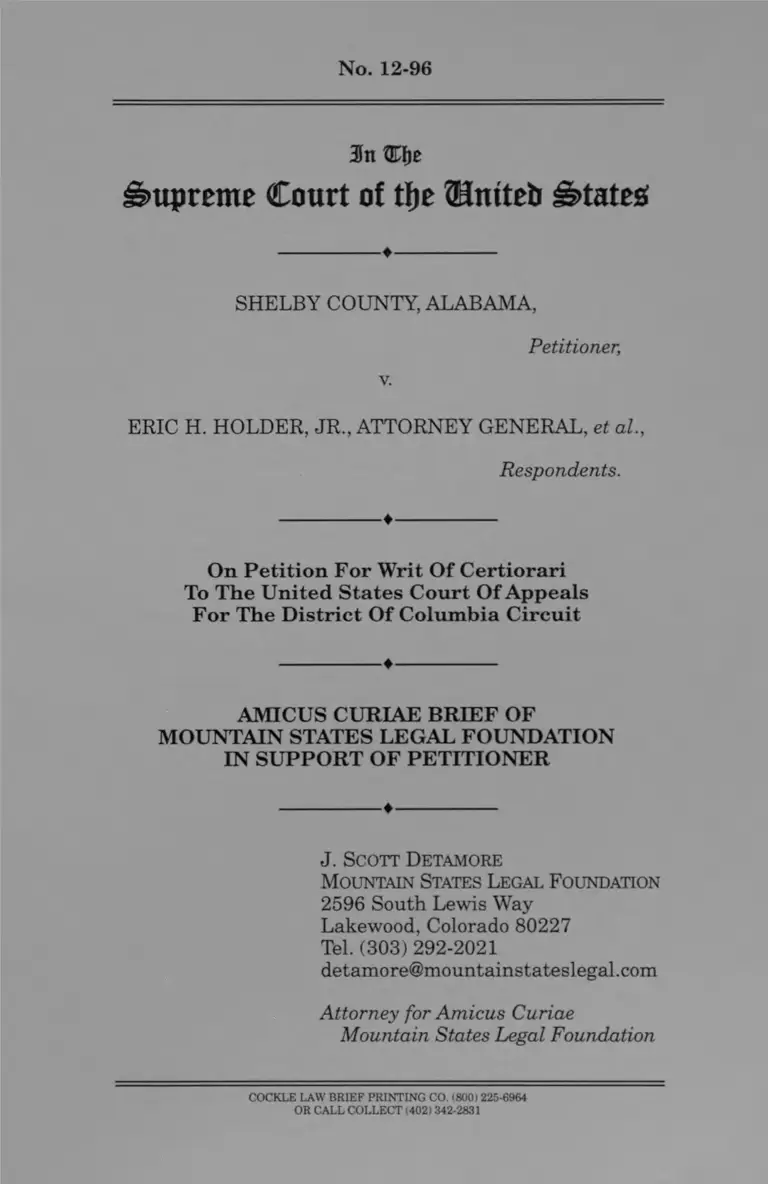
No. 12-96
3JtI ® fjt
S u p r e m e C o u r t of tfje M m te b S t a t e s
--------------- « ----------------
SHELBY COUNTY, ALABAMA,
Petitioner,
v.
ERIC H. HOLDER, JR., ATTORNEY GENERAL, et al.,
Respondents.
--------------- ♦----------------
On Petition For Writ Of Certiorari
To The United States Court Of Appeals
For The District Of Columbia Circuit
--------------- ♦----------------
AMICUS CURIAE BRIEF OF
MOUNTAIN STATES LEGAL FOUNDATION
IN SUPPORT OF PETITIONER
--------------- « ----------------
J. Scott Detamore
Mountain States Legal Foundation
2596 South Lewis Way
Lakewood, Colorado 80227
Tel. (303) 292-2021
detamore@mountainstateslegal.com
Attorney for Amicus Curiae
Mountain States Legal Foundation
COCKLE LAW BRIEF PRINTING CO. (800) 226-6964
OR CALL COLLECT (402) 342-2831
mailto:detamore@mountainstateslegal.com
1
QUESTION PRESENTED
Whether the “congruency and proportionality”
test governs the standard of review for the consti
tutionality of remedial legislation enacted pursuant
to both the Fourteenth and Fifteenth Amendments?
11
TABLE OF CONTENTS
Page
QUESTION PRESENTED..................................... i
TABLE OF CONTENTS......................................... ii
TABLE OF AUTHORITIES................................... iv
IDENTITY AND INTEREST OF
AMICUS CURIAE.............................................. 1
STATEMENT OF THE CASE............................... 3
REASON FOR GRANTING THE PETITION...... 6
I. THE CONGRUENCY AND PROPORTION
ALITY STANDARD ENSURES THAT CON
GRESS DOES NOT EXCEED ITS
REMEDIAL POWERS CONFERRED BY
THE FOURTEENTH AND FIFTEENTH
AMENDMENTS.......................................... 7
II. BOTH KATZENBACH AND BOERNE ES
TABLISHED THE CONGRUENCY AND
PROPORTIONALITY STANDARD OF RE
VIEW............................................................ 9
A. Katzenbach Ruled That What Is “Ap
propriate” And “Reasonable” Remedial
Legislation Depends Upon The Nature
Of The Constitutional Violation To Be
Remedied And The Means Adopted To
Do So........................................ ............. 9
B. Katzenbach Established A Congruency
And Proportionality Standard Of Re
view Without Expressly So Stating..... 11
Ill
TABLE OF CONTENTS - Continued
Page
C. Boerne Adopted Katzenbach’s Fifteenth
Amendment Analysis As The Model
For Its Congruency And Proportional
ity Standard Of Review......................... 14
CONCLUSION....................................................... 16
IV
Cases
City of Boerne v. Flores, 521 U.S. 507 (1997)... ..passim
Ex Parte Virginia, 100 U.S. (10 Otto) 339
(1879).................................................................. 9, 10
Large v. Fremont County, Wyo., 709 F. Supp. 2d
1176 (D. Wyo. 2010)..................................................2
McCulloch v. Maryland, 17 U.S. (4 Wheat.) 316
(1819)...................................................................9, 10
Nw. Austin Mun. Util. Dist. No. 1 v. Holder,
573 F. Supp. 2d 221 (D.D.C. 2008).......................... 4
Nw. Austin Mun. Util. Dist. No. 1 u. Holder,
557 U.S. 193 (2009)...........................................2, 4,5
Shelby County, Ala. v. Holder, 811 F. Supp. 2d
424 (D.D.C. 2011)..................................................3, 4
Shelby County, Ala. v. Holder, 679 F.3d 848
(D.C. Cir. 2012)................................................2, 4, 11
State of S.C. v. Katzenbach, 383 U.S. 301
(1966)...............................................................passim
United States v. Alamosa County, Colo., 306
F. Supp. 2d 1016 (D. Colo. 2004)............................ 2
United States v. Blaine County, Mont., 363 F.3d
897 (9th Cir. 2004), cert, denied, 544 U.S. 992
(2005)............................................................ 2
TABLE OF AUTHORITIES
Page
V
TABLE OF AUTHORITIES - Continued
Constitutional Provisions
U.S. Const, amend. XIV .....
U.S. Const, amend. XV.......
.passim
passim
Page
Statutes
Voting Rights Act Reauthorization and Amend
ments Act, Pub. L. No. 109-246, 120 Stat.
577 (2006)................................................................... 3
Section 4(b) of the Voting Rights Act (42 U.S.C.
§ 1973b(b))..............................................................3>6
Section 5 of the Voting Rights Act (42 U.S.C.
§ 1973c).............................................................passim
Rules
Supreme Court Rule 37.2 1
1
AMICUS CURIAE BRIEF OF
MOUNTAIN STATES LEGAL FOUNDATION
IN SUPPORT OF PETITIONER
Pursuant to Supreme Court Rule 37.2, Mountain
States Legal Foundation (“MSLF”) respectfully sub
mits this amicus curiae brief, on behalf of itself and
its members, in support of Petitioner.1
--------------- ♦----------------
IDENTITY AND INTEREST
OF AMICUS CURIAE
MSLF is a nonprofit, public-interest legal foun
dation organized under the laws of the State of Colo
rado. MSLF is dedicated to bringing before the courts
those issues vital to the defense and preservation
of individual liberties, the right to own and use
property, the free enterprise system, and limited and
ethical government. MSLF has members who reside
and work in every State. MSLF and its members
strongly believe that the Founders created a federal
republic, in which the federal government is one of
limited, enumerated powers, and that federalism and
1 Pursuant to Supreme Court Rule 37.2(a), notice of MSLF’s
intent to file this amicus curiae brief was received by counsel of
record for all parties at least 10 days prior to the due date of this
brief and all parties consent to the filing of this amicus curiae
brief. The undersigned further affirms that no counsel for a party
authored this brief in whole or in part, and no person or entity,
other than MSLF, its members, or its counsel, made a monetary
contribution specifically for the preparation or submission of
this brief.
2
separation of powers is at the heart of the U.S. Con
stitution. Since its creation in 1977, MSLF has been
active in litigation opposing legislation in which the
federal government acts beyond its constitutionally
delegated powers, or in derogation of the principles of
federalism and separation of powers.
Especially relevant to this case, MSLF has chal
lenged the power of Congress to enact the 1982
Amendment to the constitutionality of Section 2 of
the Voting Rights Act (“VRA”), arguing Congress had
exceeded its powers, in three different cases: United
States v. Blaine County, Mont., 363 F.3d 897 (9th Cir.
2004), cert, denied, 544 U.S. 992 (2005); United States
v. Alamosa County, Colo., 306 F. Supp. 2d 1016 (D.
Colo. 2004); and Large v. Fremont County, Wyo., 709
F. Supp. 2d 1176 (D. Wyo. 2010). Recently, MSLF also
filed an amicus curiae brief with this Court support
ing a challenge to the constitutionality of the 2006
Reauthorization of Section 5 of the Voting Rights Act
in Nw. Austin Mun. Util. Dist. No. 1 v. Holder, 557
U.S. 193 (2009). MSLF also participated as an amicus
curiae in the case below, Shelby County, Ala. v. Hold
er, 679 F.3d 848, 884 (D.C. Cir. 2012). MSLF brings a
unique perspective to this case and believes that its
amicus curiae brief will assist this Court in consider
ing whether to grant the Petition.
--------------- ♦---------------
3
STATEMENT OF THE CASE
Shelby County filed suit in the district court for
the District of Columbia arguing that Congress
exceeded its Fourteenth and Fifteenth Amendment
remedial powers by reauthorizing Sections 4(b) and
5 of the Voting Rights Act (codified as 42 U.S.C.
§ 1973b(b) and 42 U.S.C. § 1973c, respectively) in the
Voting Rights Act Reauthorization and Amendments
Act, Pub. L. No. 109-246, 120 Stat. 577 (2006).2 Shel
by County, Ala. v. Holder, 811 F. Supp. 2d 424, 427
(D.D.C. 2011) “The Attorney General . . . argue[d] . . .
that ‘when Congress is legislatively enforcing the
Fifteenth Amendment’s prohibition on race discrimi
nation with respect to voting, the Court reviews the
appropriateness of that legislation under a deferen
tial rationality standard,’ ” not congruency and pro
portionality, as announced in City of Boerne v. Flores,
521 U.S. 507, 519-20 (1997). Id. at 448-49.
The district court rejected that argument: “Boerne’s
congruence and proportionality framework reflects a
refined version of the same method of analysis uti
lized in Katzenbach (State of S.C. v. Katzenbach, 383
U.S. 301 (1966)), and hence provides the appropriate
standard of review to assess Shelby County’s facial
constitutional challenge to Section 5 and Section
2 All references to “Section 5” are references to Section 5 of
the Voting Rights Act.
4
4(b). Id. But the district court also erroneously held
that Section 5 of the Voting Rights Act met the con
gruency and proportionality standard. Id. at 502-03.
Shelby County appealed that holding to the D.C.
Circuit.
The Attorney General renewed his argument on
appeal: “The Attorney General insists that Congress
may use ‘any rational means’ to enforce the Fifteenth
Amendment (citing Katzenbach, 383 U.S. at 324).”
Shelby County, 679 F.3d at 859.4 The D.C. Circuit did
' The government made the same argument successfully to
a three-judge panel of the district court in Nw. Austin Mun. Util.
Dist. No. 1 v. Holder, 573 F. Supp. 2d 221, 235-36 (D.D.C. 2008),
rev’d on other grounds by Nw. Austin Mun. Util. Dist. No. 1 v.
Holder, 557 U.S. 193 (2009). That court ruled that there are “two
distinct standards for evaluating the constitutionality of laws en
forcing the Civil War Amendments.” That is, “notwithstanding
the City of Boerne cases [under the Fourteenth Amendment],
Katzenbach s rationality standard remains fully applicable to
constitutional challenges to legislation [under the Fifteenth
Amendment] aimed at preventing racial discrimination in vot
ing. Nw. Austin, 573 F. Supp. 2d at 235-36 (emphasis added).
The Attorney General modified his argument at the D.C.
Circuit in his principal brief. He conceded that “the terms ‘en
force and appropriate legislation’ have the same meaning in the
Fourteenth and Fifteenth Amendments.” Brief of Appellee at 27,
Shelby County, Ala. v. Holder, No. 11-626, Dkt. 1345212 (D.C.
Cir. 2012). Then he argued that Katzenbach’s “rational basis
review” applied to all legislation under the Fifteenth Amend
ment. Id. at 27. Finally, he tried to extend deferential review to
the Fourteenth Amendment, insofar as it targeted race discrim
ination, by suggesting that Boerne’s congruence and proportion
ality test applied to Fourteenth Amendment legislation only
when it targeted acts “outside the core prohibitions on race dis-
criminationt.]” Id. at 27-28.
5
not answer this question and settle the conflict of
opinions from the district court. Though noting that
the Supreme Court, in Nw. Austin Mun. Util. Dist.
No. 1 v. Holder, 557 U.S. 193 (2009), sent a “powerful
signal that congruence and proportionality is the ap
propriate standard of review,” id., it did not decide
the issue: “[I]n any event, if section 5 survives the
arguably more rigorous ‘congruent and proportional
ity’ standard, it would also survive Katzenbach’s
rationality review.” Id. So the D.C. Circuit analyzed
the case under congruency and proportionality, with
out deciding that it was required to do so, and held
that Section 5 was congruent and proportionate leg
islation and, therefore, constitutional under both the
“congruency and proportionality” standard and the
“rational means” standard. Id. at 873. Petitioner then
filed its Petition.
This background demonstrates the Attorney Gen
eral’s relentless determination to establish a deferen
tial standard of review for remedial legislation under
both the Fourteenth and Fifteenth Amendments that
targets racial discrimination. The matter was not
decided by the D.C. Circuit and it is very likely
that the Attorney General will persist in arguing
that Katzenbach and Boerne are inconsistent and
that they establish very different standards of review
for race discrimination remedies. Therefore, it is
6
imperative that this Court provide a definitive deci
sion on the proper standard of review.6
---------------« ----------------
REASON FOR GRANTING THE PETITION
This Court should grant the Petition not only for
the reasons stated in the Petition, but also to firmly
establish that there is only one standard of review for
constitutional challenges to remedial enforcement
legislation enacted pursuant to the Fourteenth and
Fifteenth Amendments - congruency and proportion
ality. The Attorney General will likely continue to
argue to the contrary. The proper standard of review
for challenges to the constitutionality of remedial
enforcement legislation pursuant to the Fourteenth
and Fifteenth Amendments is an important national
question that this Court has not expressly decided.
MSLF agrees with Petitioners that the outcome of the
challenge to the coverage formula under Section 4(b) of the
Voting Rights Act, 42 U.S.C. § 1973b(b), does not necessarily de
pend upon whether the “congruency and proportionality” stan
dard of review is applied to Section 4(b). See Petition at 29-35.
7
I. THE CONGRUENCY AND PROPORTION
ALITY STANDARD ENSURES THAT CON
GRESS DOES NOT EXCEED ITS REMEDIAL
POWERS CONFERRED BY THE FOUR
TEENTH AND FIFTEENTH AMENDMENTS.
The Fourteenth and Fifteenth Amendments are
remedial and merely prohibit certain State conduct.
Thus, “Congress’s power under § 5 extends only to
‘enforcing the provisions of the Fourteenth Amend
ment^ which] [t]his Court has described . . . as ‘reme
dial.’ ” Boerne, 521 U.S. at 519 (quoting Katzenbach,
383 U.S. at 326). Congress “has been given the power
‘to enforce’ a constitutional right, not the power to
determine what constitutes a constitutional viola
tion.” Id. That is, “if Congress could define its own
powers by altering the Fourteenth Amendment’s
meaning, no longer would the Constitution be the
superior paramount law, unchangeable by ordinary
means.” Id. at 529.
Constitutional difficulty arises when Congress,
in a purported attempt to prevent unconstitutional
conduct, legislates regulating conduct that is facially
constitutional, without requiring proof of discrim
inatory intent - so-called “prophylactic legislation”
like Section 5. In such a case, the question arises
as to whether Congress has enforced the constitu
tional prohibition set forth in the Amendment, or
whether it has unconstitutionally substantively de
fined the Amendment. To address this, Boerne pro
nounced the congruency and proportionality standard
of review:
8
There must be a congruence and proportion
ality between the injury to be prevented or
remedied and the means adapted to that end.
Lacking such a connection, legislation may
become substantive in operation and effect.
Id. at 519-20 (all emphasis added). In other words:
While preventive rules are sometimes appro
priate remedial measures, there must be
congruence between the means used and the
ends to be achieved. The appropriateness of
remedial measures must be considered in
light of the [degree of] evil presented. Strong
measures appropriate to address one harm
may be an unwarranted response to another,
lesser one.
Id. at 530 (all emphasis added).
This standard restrains Congress from unconsti
tutionally defining the substance of the Fourteenth
and Fifteenth Amendments instead of enforcing
them.
9
II. BOTH KATZENBACH AND BOERNE ES
TABLISHED THE CONGRUENCY AND
PROPORTIONALITY STANDARD OF RE
VIEW.
A. Katzenbach Ruled That What Is “Ap
propriate” And “Reasonable” Remedial
Legislation Depends Upon The Nature
Of The Constitutional Violation To Be
Remedied And The Means Adopted To
Do So.
In Katzenbach, this Court stated that “[a]s
against the reserved powers of the States, Congress
may use any rational means to effectuate the consti
tutional prohibition of racial discrimination in vot
ing.” Katzenbach, 383 U.S. at 324 (emphasis added).
Katzenbach then cited McCulloch v. Maryland, 17
U.S. (4 Wheat.) 316 (1819), a case construing whether
Congress had the substantive power, under the Nec
essary and Proper Clause of Article I, to establish a
national bank:
“Let the end be legitimate, let it be within
the scope of the constitution, and all means
which are appropriate, which are adapted to
that end, which are not prohibited, but con
sistent with the letter and spirit of the consti
tution, are constitutional.”
Id. (quoting McCulloch, 17 U.S. at 421) (all emphasis
added).
Katzenbach also cited to Ex Parte Virginia, 100
U.S. (10 Otto) 339, 340, 344 (1879), which involved
10
enforcement of the Thirteenth and Fourteenth Amend
ments, and which prohibited judges from inten
tionally and discriminatorily disqualifying jurors on
account of their race and providing penalties for doing
so.6 Katzenbach, 383 U.S. at 327. In Katzenbach, this
Court observed that “the Court [in Ex Parte Virginia]
. . . echoed [McCulloch’s] language in describing each
of the Civil War Amendments.” Id. at 327 (emphasis
added). Katzenbach then observed that, with respect
to all Civil War Amendments:
“Whatever legislation is appropriate, that is
adapted to carry out the objects the amend
ments have in view, . . . if not prohibited, is
brought within the domain of Congressional
power.”
Id. (quoting Ex Parte Virginia, 100 U.S. at 345-46).
Thus, Ex Parte Virginia, like McCulloch, required
that enforcement of any of the Civil War Amendments
must be “appropriate,” “adapted to carry out the ob
jects” of the constitutional prohibition it enforces, and
not “prohibited” by other constitutional considera
tions.
The consistent lesson of Katzenbach, McCulloch,
and Ex Parte Virginia, is that what is “rational,”
“appropriate,” legislation, “not otherwise prohibited,”
depends upon the fit between the constitutional harm
targeted and the means adopted to remedy it.
This was a direct prohibition and penalty, not a prophylac
tic statute.
11
B. Katzenbach Established A Congruency
And Proportionality Standard Of Re
view Without Expressly So Stating.
The Attorney General seized upon the phrase
“Congress may use any rational means to effectuate
the constitutional prohibition of racial discrimina
tion,” Katzenbach, 383 U.S. at 324, to justify a “defer
ential standard” of review of Fifteenth Amendment
enforcement legislation. Shelby County, 679 F.3d
at 859 (“the attorney general insists that congress
may use ‘any rational means’ to enforce the Fifteenth
Amendment”). But the Attorney General ignored
Katzenbach’s next sentence: “We turn now to a more
detailed description of the standards which govern
our review of the Act.” Katzenbach, 383 U.S. at 324
(emphasis added).
This Court then detailed the egregious record of
an unremitting, widespread pattern and practice of
ingenious defiance of the Constitution, impervious to
ordinary remedies, that it believed justified the ex
traordinary resort to Section 5 remedies. Katzenbach
ruled that Section 5 was, under those circumstances,
a “rational” response. Id. at 335 (“States covered by
the Act resorted to the extraordinary stratagem of
contriving new rules of various kinds for the sole
purpose of perpetuating voting discrimination in the
face of adverse federal court decrees.”) (emphases
added).
12
The “extraordinary stratagems” with which
Katzenbach was confronted, and that were docu
mented by Congress, consisted of widespread, persis
tent, intentionally discriminatory voting practices
that prevented African-Americans from register
ing and voting, and which were not remediable by
other, less drastic means. For example, more than
half a dozen States “enacted tests . . . specifically
designed to prevent [African-Americans] from voting.”
Katzenbach, 383 U.S. at 310. “At the same time,
alternate tests were prescribed . . . to assure that
white illiterates were not deprived of the franchise,
[which] included grandfather clauses, property quali
fications, ‘good character’ tests, and the requirement
that registrants ‘understand’ or ‘interpret’ certain
matters.” Id. at 311. Worse still, these tests were
discriminatorily administered; white voters were
“given easy versions, . . . received extensive help from
voting officials, and [were] registered despite serious
errors in their answers,” while African-Americans
were “required to pass difficult versions . . . without
any outside assistance and without the slightest
error.” Id. at 312.
Congress had originally addressed this pattern of
intentional voting discrimination by passing laws to
“facilitate] case-by-case litigation” and the Supreme
Court responded by “striking down [unconstitutional]
discriminatory voting tests and devices in case after
case.” Id. at 313. But widespread voting discrim
ination persisted. Thus, the Voting Rights Act of
1965, particularly Section 5, which targeted facially
13
constitutional practices, was enacted to defeat these
efforts to intentionally nullify the Fifteenth Amend
ment that had “infected the electoral process in parts
of our country for nearly a century.” Id. at 308.
Therefore, Katzenbach concluded that, “under the
compulsion of these unique circumstances, Congress
responded in a permissibly decisive manner [in enact
ing Section 5].” Id. (emphasis added). Katzenbach
held that the evidence before Congress - persistent,
pervasive, and intransigent State action intentionally
discriminating against African-Americans to prevent
them from registering and voting, impervious to less
drastic remedies - was sufficient to justify the ex
traordinary prophylactic exercise of remedial powers
contained in Section 5:
Two points emerge vividly from the volumi
nous legislative history. . . . First: Congress
felt itself confronted by an insidious and per
vasive evil which had been perpetuated in
certain parts of our country through the un
remitting and ingenious defiance of the Con
stitution. Second: Congress had concluded
that the unsuccessful remedies which it had
prescribed in the past would have to be re
placed by sterner and more elaborate meas
ures in order to satisfy the clear commands
of the Fifteenth Amendment.
Id. at 309 (all emphases added). Far from employing
the relaxed, deferential standard of review advocated
by the Attorney General, Katzenbach recognized that
Section 5 of the Voting Rights Act is “an uncommon
14
exercise of congressional power” and that only “excep
tional conditions can justify legislative measures not
otherwise appropriate.” Katzenbach, 383 U.S. at 334-
35 (emphasis added).
Thus, Katzenbach held that the extraordinary
and uncommon exercise of congressional power en
gaged in by Congress in enacting Section 5’s prophy
lactic provisions was “appropriate” and “rational”
only because it was adopted to remedy a widespread
pattern of insidious, pervasive, unremitting, and in
genious defiance of the Constitution to deny African-
Americans the right to register and to vote, which
had defied previous lesser remedies.
In fact, consistent with the Supreme Court’s sub
sequent decision in Boerne, the remedy approved by
Katzenbach was congruent and proportionate to the
nature and scope of the unremitting defiance of the
Constitution presented to Congress and that it sought
to remedy as set out in Boerne. Boerne, 521 U.S. at
519-20, 524-26. Therefore, Katzenbach, without ex
pressly so stating, applied the congruency and pro
portionality standard that this Court would later
articulate more specifically in Boerne.
C. Boerne Adopted Katzenbach's Fifteenth
Amendment Analysis As The Model For
Its Congruency And Proportionality Stan
dard Of Review.
In Boerne, this Court, quoting Katzenbach, ruled
that “ ‘the constitutional propriety of [legislation
15
adopted under the Enforcement Clause] must be
judged with reference to the historical experience it
reflects.” ’ Id. at 525 (quoting Katzenbach, 383 U.S. at
308). Indeed, Boerne noted that Katzenbach approved
the severe and intrusive remedies of Section
5 only because they were necessary to ‘“ banish the
blight of racial discrimination in voting which has
infected the electoral process in parts of our country
for nearly a century.’ ” Id. (quoting Katzenbach, 383
U.S. at 308). Referring to Katzenbach, this Court
emphasized that “[t]he new unprecedented remedies
were deemed necessary given the ineffectiveness of
the existing voting rights law. . . .” Id. at 526 (empha
sis added).
Far from announcing a new standard of review
for exercising remedial, prophylactic enforcement
powers under the Fourteenth Amendment, Boerne re
lied heavily on Katzenbach to demonstrate the consti
tutional predicate necessary for a congruent and
proportionate prophylactic remedy under all the Civil
War Amendments. In fact, Boerne cited Katzenbach
no less than eleven times to support its congruence
and proportionality standard of review. Id. at 518,
519, 524, 525, 526, 530, 533. In Boerne, this Court,
echoing Katzenbach, ruled that “there must be a con
gruence and proportionality between the injury to be
prevented or remedied and the means adapted to that
end.” Boerne, 521 U.S. at 519. In other words, only
congruent and proportionate remedial legislation is
“rational” and “appropriate.”
16
Therefore, it was only because Congress was
confronted with egregious, widespread, pervasive, un
constitutional scheming to prevent African-Americans
from registering or voting in spite of lesser remedies
that Katzenbach ruled that Section 5’s exceptional,
prophylactic remedy was “appropriate” legislation
that adopted a “rational means” of addressing those
extraordinary discriminatory practices. Thus, Section
5 was, when adopted in 1965, congruent and propor
tionate to the extreme constitutional violations tar
geted by Congress.
--------------- « ----------------
CONCLUSION
For the reasons set out in the Petition, and for
the reason elaborated here, this Court should grant
the Petition.
Dated this 23rd day of August, 2012.
Respectfully submitted,
J. Scott Detamore
M ountain States Legal Foundation
2596 South Lewis Way
Lakewood, Colorado 80227
Tel. (303) 292-2021
detamore@mountainstateslegal.com
Attorney for Amicus Curiae
Mountain States Legal Foundation
mailto:detamore@mountainstateslegal.com