Memorandum in Support of Joint Motion for an Order for Production of Documents; Memorandum Opposing Protective Order
Public Court Documents
March 2, 1978
22 pages
-
Case Files, Hatcher v. Methodist Hospital - Hardbacks. Memorandum in Support of Joint Motion for an Order for Production of Documents; Memorandum Opposing Protective Order, 1978. 74c869f3-5384-f111-ab0f-7ced8d2181dd. LDF Archives, Thurgood Marshall Institute. https://ldfrecollection.org/archives/archives-search/archives-item/ba976130-f0bf-4852-b76b-9f210c644e72/memorandum-in-support-of-joint-motion-for-an-order-for-production-of-documents-memorandum-opposing-protective-order. Accessed October 10, 2026.
Copied!
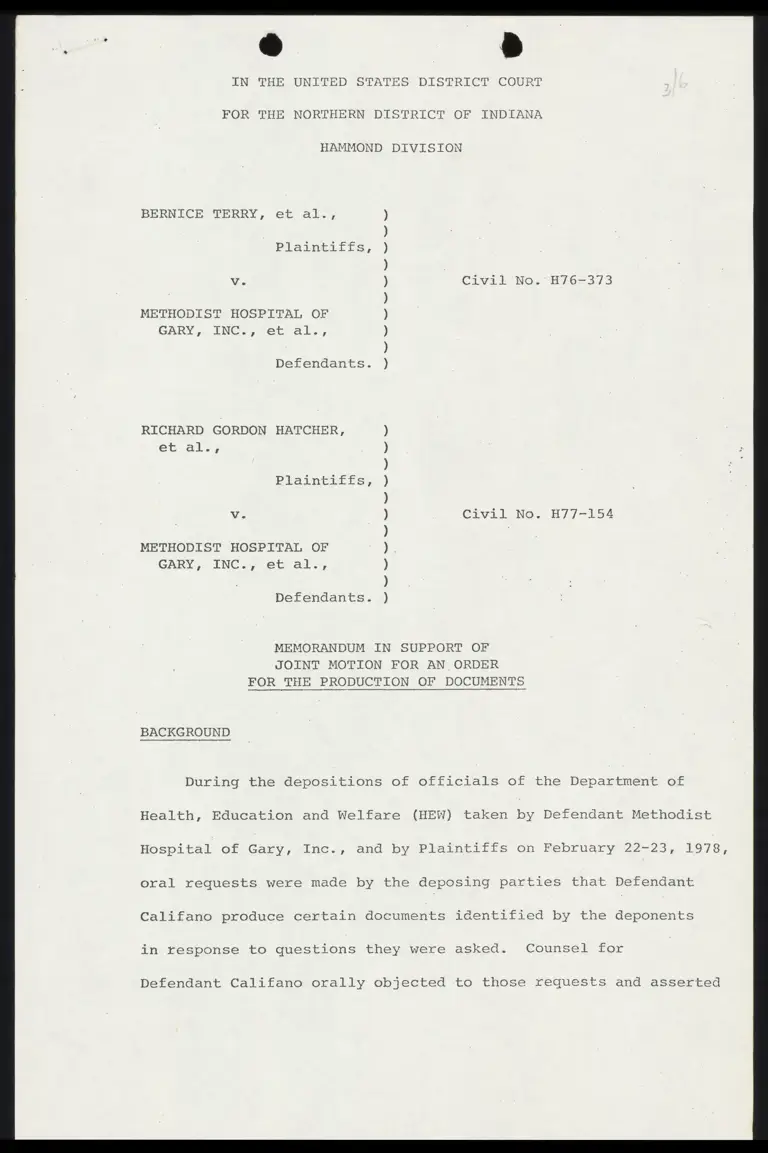
     [||23d7b883-888d-4423-894a-ecacaf6e0c62||] IN THE UNITED STATES DISTRICT COURT


FOR THE NORTHERN DISTRICT OF INDIANA

HAMMOND DIVISION

BERNICE TERRY, et al.;

Plaintiffs,

Civil No. H76-373 Ve

METHODIST HOSPITAL OF

GARY, INC., ‘er al.,

Defendants.

RICHARD GORDON HATCHER,

et al.,

Plaintiffs,

)
)
)
)
)

Vv. ) Civil No. H77~154
) :

METHODIST HOSPITAL OF )

GARY, INC., et al., )

)
) Defendants.

MEMORANDUM IN SUPPORT OF

JOINT MOTION FOR AN ORDER

FOR THE PRODUCTION OF DOCUMENTS


BACKGROUND

During the depositions of officials of the Pepsriment of

Health, Education and Welfare (HEW) taken ty Defendant Methodist

Hospital of Gas, Inc., and by Plaintiffs on February 22-23, 1978,

oral requests were made by the deposing parties that Defendant

Califano produce certailn documents identified by the deponents

in response to questions they were asked. Counsel for

Defendant Califano orally objected to those requests and asserted


that some or all of the requested documents were privileged

on various grounds, including that the documents were protected

from discovery as "intra-governmental communications."

At the conclusion of those depositions, counsel for

Methodist Hospital and for Plaintiffs orally informed counsel

for Califano that they intended to move this Court for an

order compelling Califano to produce the requested documents.

Methodist Hospital and Plaintiffs SHEA ASHETY served counsel

for Califano and filed with this Court a Joint Request for

Production of Documents (pursuant to Rule 34 of the Federal

Rules of Civil Procedure) and a Joint Motion for an Order

for the Production of Documents (pursuant to Rule 37 of the

Federal Rules of Civil Procedure). The Request and Motion

each specify the requested documents to the extent they were

identified by the deponents from HEW. In the tPtorais of

resolving this matter prior to trial, this Motion is being

brought before this Court in an expedited manner procedurally

agreed upon by counsel for all concerned parties.

ARGUMENT

It is undisputed that the requested documents constitute

or contain evidence relevant and material to matters involved

in this action and that the documents are in the possession

of Defendant Califano. Abu dinnive tie sole issue to be

decided is whether the scope of the privilege asserted by

Califano may prevent the discovery of the requested documents

under the circumstances of this case.


® | ®


The principal ground relied upon by Califano for

withholding the requested documents is that they constitute

intra-governmental communications which are confidential and

must remain free from disclosure through normal discovery

procedures. Since the Supreme Court's landmark decision in

United States V. Nixon, 418 U.S. 683 (1974), there can be no

doubt that this Court has the power and authority to resolve

the parties' instant dispute underlying this motion.

In an extensive analysis of the intra-governmental

communication privilege, the U.S. District Court for the District

of Columbia has discussed the history and judicial foundation

  underlying this concept in Carl Zeiss Stiftung v. V.E.B.

Carl Zeiss, Jena, 40 F.R.D. 318 (1966). It declared that

"the privilege obtains with respect to intra-governmental

documents reflecting advisory opinions, recommendations and

deliberations comprising part of the process by which govern-—

mental decisions and policies are formulated." Id. at 324.

However, the court clearly recognized that the intra-

governmental communication privilege 1s not absolute, but

rather is a limited and qualified one which must yield under

particular circumstances. In this regard, the court wrote:

"This privilege, as do all evidentiary

privileges, effects an adjustment between important

but competing interests. There is, on the one

hand, the public concern in revelations facilitating

the just resolution of legal disputes, and, on the,

other, occasional but compelling public needs for

confidentiality. In striking the balance in favor

or nondisclosure of intra-governmental advisory


*® Co»

and deliberative communications, the privilege

subserves a preponderating policy of frank expression

and discussion among those upon whom rests the

responsibility for making the determinations that

enable government to operate, and thus achieves an

objective akin to those attained by other privileges

more ancient and commonplace in character. Nowhere

is the public interest more vitally involved than

in the fidelity of the sovereign's decision- and
policy-making resources.

xk %

"To restate the Government's claim and its

justifications is not to say that nondisclosure is

to follow in all instances where the conditions

prerequisite to invoking the privilege are found

to exist. Nor is it to suggest that the interests
it protects cannot be outweighed in particular
situations by a sufficiently strong showing of

necessity for examination.” Id. at 327+323

(footnotes omitted; emphasis added).


See Kaiser Aluminum & Chemical Corp. v. U.S., 157 F.Supp. 939, 946


(Ct. Cl. 1958); Timken Roller Bearing Ce. v. U.S., 38 ¥.R.D. 57,

64 (N.D. Ohio 1964).

The qualified nature of the privilege was never demonstrated

  more profoundly than in U.S. v. Nixon, op. cit. In Nixon,

certain tape recordings and documents of the President ors

subpoenaed by the Special Prosecutor for use in the prosecution

of former government officials. The President sought to quash

that sulbeena by claiming that because the requested items

manifested the "confidential conversations between a President

and his close advisors that it would be inconsistent with the

public interest to produce” [them]. 418 U.S. at 703. Since

the President ALE hot assert that the subpoenaed materials

contained matters of military secrecy or national security

(id. at 710), the privilege claimed by the President is no


different than that asserted here by Califano: a general

privilege based upon the need for free intra-governmental

communication.

In Nixon, the Supreme Court wrote:

"Since we conclude that the legitimate needs

of the judicial process may outweigh Presidential
privilege, it is necessary to resolve those competing

interests in a manner that preserves the essential

functions of each branch. .. .. .

"The expectation of a President to the

confidentiality of his conversations and

correspondence, like the claim of confidentiality

of judicial deliberations, for example, has all

the values to which we accord deference for the

privacy of all citizens and, added to those values,

is the necessity for protection of the public

interest in candid, objective, and even blunt or

harsh opinions in Presidential decisionmaking. A
President and those who assist him must be free to

explore alternatives in the process of shaping

policies and making decisions and to do so in a way

many would be unwilling to express except privately.

These are the considerations justifying a presumptive

privilege for Presidential communications. . . .

"But this presumptive privilege must be

considered in light of our historic commitment to

the rule of law." Id. at 707-708.

The high court then proceeded to examine the Special

Prosecutor's need for discovery of the subpoenaed materials,

which it then weighed against the President's need for

preserving confidentiality. In so doing, the Court relied

heavily upon the constitutional rights of the Special

Prosecutor as the people's representative and of the

defendants in the matter for which the materials had been

subpoenaed. The Court declared, "The right to the production


of all evidence at a criminal trial similarly has constitutional

dimensions." Jd. at 711.

In conclusion, the Court directed the District Court

to conduct an in camera examination of the subpoenaed documents

to ascertain which materials or parts thereof must be released

pursuant to the subpoena. To guide that process, the Court

ruled:

"We conclude that when the ground for asserting
privilege as to subpoenaed materials sought for use

"in a criminal trial is based only on the generalized
interest in confidentiality, it cannot prevail over
the fundamental demands of due process of law in
the fair administration of criminal justice. The
generalized assertion of privilege must yield to
the demonstrated, specific need for evidence in a
pending criminal trial.” Id. at 713,

While the instant case is a civil case, unlike the

criminal matter involved in U.S. v. Nixon, the principles


propounded by the Supreme Court are no less applicable here.

The government, through Califano, asserts a generalized

privilege designed to encourage free communication among

federal officials as they carry out their respective jobs.

However, the Plaintiffs here have brought into question precisely

how those officials carried out their duties and whether their

acts satisfied the federal government's statutory and consti-

tutional obligations. Within the scope of the issues raised

by this case, the documents being sought constitute aivine

evidence of what HEW aia and how they did it. Because Plaintiffs

have alleged that Defendant Califano acted in an unconstitutional


manner by extending federal financial assistance in a manner


- 7 -

which discriminates on the basis of race, Plaintiffs!

need for the requested documents is congruent with

their statutory right to seek to compel the government

to act in a manner which fully comports with the Constitution.

Therefore, Califano’'s generalized assertion of privilege

must yield to the "demonstrated, specific need for

evidence" in the pending litigation.

Defendant Methodist Hospital no less has a "demonstrated

specific need" for the requested documents. To properly

defend itself, Methodist Hospital must prove not only

that all of its actions complied with its statutory

obligations, but also that HEW, which Srodsssed and -

approved its applications for federal financial assistance,

did so in a full counties with its regulatory, statutory

and constitutional requirements. Moreover, if HEW

possesses any documents of information which Arguably

suggests that Methodist Hospital is not in full compliance

with the law, the Hospital's need to discover that

material before trial is manifest.

Should the privilege asserted by Califano prevent

the pre-trial discovery (and, a fortiori, the introduction


into evidence at trial) the requested documents, not

only would the Plaintiffs and Methodist Hospital be

precluded from properly presenting their respective


cases, but the government will, in essence, be protected

from being held accountable for its actions. While

it once had been the rule that a judicial proceeding

could not be used to probe the government's decision-

making process (United States v. Morgan, 313 U.S. 403,


422 [1341]), the increased involvement of government

in societal affairs has caused the abandonment of this

principle in favor of a rule demanding greater accountability

of the Executive Branch. This was made clear in Citizens


to Preserve Overton Park, Inc. v. Volpe, 401 U.S. 402


(1971), where the basic issue was whether the Secretary

of Transportation had satisfied the statutory preconditions

before approving the use of federal funds for constructing

a highway through a public park. Because the Supreme

Court was unable to determine from the record if the

Secretary had in fact considered and decided the statutorily

mandated pre-requisite questions, it remanded the case

to the District Court for "plenary review" of the Secretary's

decision-making process. In this regard, the Court

explained:

That review is to be based on the full adminis-
trative record that was before the Secretary
at the time he made his decision. But since

the bare record may not disclose the factors
that were considered or the Secretary's con-
struction of the evidence it may be necessary
for the District Court to require some explana-
tion in order to determine if the Secretary
acted within the scope of his authority and
if the Secretary's action was justifiable
under the applicable standard.

Id. at 420
(citations omitted)


Yet, the Court went even further and suggested that

the District Court might "require the administrative

officials who participated in the decision to give

testimony explaining their action; . . . it may be

that the only way there can be effective judicial review

is by examining the decisionmakers themselves." Ibid.

The Motion before the Court here asks nothing

other than what the Supreme Court directed in Overton Park.


When the acts of the Executive Branch are called into

question as being contrary to law, the Goverment.

interposition of the intra-governmental communication

Seivilege, if upheld, would prevent that fundamental

question from being resolved.

Accordingly, the privilege claimed by Califano

must yield to the greater need of the moving parties

for the requested documents. Plaintiffs and Defendant

Methodist Hospital, therefore, respectfully pray for

an order compelling their production.


- 10 -

Respectfully suwmitted,


oe, A AN Ce; / a J An

22 Bruce EB. Sayirs
. "i ie - be”

& ; : 5 fv


Marc S. Krass

HODGES, DAVIS, GRUENBERG,

COMPTON & SAYERS

5525 Broadway

Gary, Indiana 46410
(219) 981-2557

SEYFARTH, SHAW, FAIRWEATHER &

GERALDSON

55 East Monroe Street

Suite 4200

Chicago, Illinois 60603
(312) 346-8000

Attorneys for Defendants

Methodist Hospital of Gary, Inc.,

and Denis E. Ribordy gl

gra ERATE


Beth J. LYQF ja ag
10 Columbus Circle

New York, New York 10019

Attorney for Plaintiffs


UNITED STATES DISTRICT COURT

NORTHERN DISTRICT OF INDIANA

HAMMOND DIVISION

BARBARA WESSON, ET AL.,

Plaintiffs,

ais
CIVIL NO. H 76-373

METHODIST HOSPITAL OF GARY,

INC., BT. AL.,

Defendants.

m
e
?


wr
?

Na
w?


N
a


a


Na
at
’

a
t


N
w
?


Sg
t?


“u
t?


a
t
’


FoRiidk ff Rid eh wb tl lak lik kl de

RICHARD GORDON HATCHER, ET AL.,)

Plaintiffs,

CIVIL NO. H 77-154 Ve

METHODIST HOSPITAL OF GARY,

INC., :

Defendants.

MEMORANDUM OF METHODIST HOSPITAL OF GARY, INC.

IN OPPOSITION TO MOTION OF

GARY HUMAN RELATIONS COMMISSION

FOR PROTECTIVE ORDER


FACTS

A Civil Subpoena was served upon Stephen Tallackson,

Executive Director of the Gary Human Relations Commission

on February 3, 1978 compelling his deposition and the pro-

duction of certain documents from the Gary Human Relations

Commission files, Exhibit A to Motion for Protective Order.

Documents were delivered pursuant to Stephen Tallackson's

request to the office of Hodges, Davis, Gruenberg, Compton

& Sayers on afternoon of February 15, 1978. On February le,


1978, Stephen Tallackson testified at his deposition that

after receiving the Subpoena he discussed it with Attorney

Julian Allen and the Gary Human Relations Commission

Attorney William R. Norman prior to the delivery of the.

documents and the deposition of February 16, 1978.

At the start of the Zool ion on February 16, 1978,

Attorney Norman presented colise for Eh Zives time of

the Motion for Protective Order apparently filed February 15,

1978 including a Notice of Hearing which indicated no date

for hearing. The Affidavit of Service indicated, in error,

that copies had been mailed to all attorneys of record ex-

cept those of Methodist Hospital on February 15, 1978.

Thereafter, a new Affidavit of Service indicating delivery

to all attorneys of record was prepared on February 16, 1978

after the deposition of Stephen Tallackson had been partially

taken and continued due to his vefusal to prodide documents

or testify concerning complaints filed by or with the Gary

Human Relations Commission against Metro Corps, Inc., a

plaintiff in this cause.

Rules 26(c), 30(c) and 37(d) of the Federal Rules of

Civil Procedure require that a Motion to quash or limit a

subpoena or for a protective order be filed and a hearing

held thereon prior to the date established for the production

of documents or testimony. The failure of either the

plaintiffs’ attorneys and the attorney for the Gary Human

Relations Commission to present such a Motion within the

time frame set forth in the Rules referred to above has


necessitated the delay of the deposition and production of


documents to the inconvenience in time and expense of

Methodist Hospital.

The Motion for Protective Order requests that the

Hospital or others be prohibited from asking questions or

obtaining documents concerning Metro Corps, THE, AS set

forth in the Subpoena and/or any such documents which

Stephen Tallackson "claims is confidential" (Motion, Para-


graphs 2, 3).

The Motion further contends without identifying the

documents or allowing testimony that such an examination of

Stephen Tallackson regarding Metro Corps, Inc., would be

irrelevant and not pertinent to this lawsuit, although

Metro Corps, Inc., is a plaintiff herein and has been con-

ditionally named a class representative (Motion, Paragraph 4).

Peponant Stephen Tallackson did teliity at his PAE LLAL

deposition on February 16, 1978 that a complaint had been

filed against Metro Corps, Inc., with the Gary Human Relations

Commission. TNSTeRTLor; he was instructed not to answer any’

further questions by Attorney Norman, notwithstanding refer-

ences by the attorney for the Hospital to the Federal Rules

of Civil Procedure requiring Znswers over objection. The

Tallackson Affidavit in Support filed with the Motion for

Protective Order also confirms that a complaint has been

filed with the Gary Human Relations Commission against Metro

Corps, Inc. Such Affidavit contends that the Gary Civil

Rights Ordinance, Section 7 (C) prohibits the publication


% od *

Of details of a concilliation.

ARGUMENT


Methodist Hospital's Subpoena and attempted question-

ing at the deposition of February 16, 1978 sought documenta-

tion of any complaint received by the Gary Human Relations

Connisslion soalnet Metro Corps, Inc. Even assuming that

the documentation concerning concilliation might not be

obtainable in this matter pursuant to the Federal Rules of

Civil Procedure, certainly the complaint and any other

documentation other than "the details of a concilliation”

should be produced and testimony permitted to that extent.

Copies of the gary Municipal Code, Title 7, Chapter ],

Section 7-101 and subsequent portions thereof, the Gary

Civil Rights ordinance, have been attached hereto for the

Court's consideration in this matter. That Ordinance de-

fines 2 "Complainant" as an individual charging on his own

behalf that he has been personally agrieved by an unlawful

discriminatory practice, or the director or the deputy

director charging that such an unlawful ido intnaiany

practice was committed against a person or class of persons

other than himself. Further, the term "complaint" is de-

fined as a written grievance filed by a complainant (Section

7-103). Further provisions of the Ordinance set forth the

Commission's procedures upon the receipt or issuance of a

‘complaint, which must be verified, and in Section 7-107 (C)

states the following: "The Commission shall not make public

the details of any concilliation and/or consent agreement


|

® i ®


except when so authorized by the person against whom the

complaint was made or when a party to the concilliation

and/or consent agreement has not complied with the agreement."

Obviously, if a deponent is allowed to determine what

is immaterial or irrelevant, particularly with respect to

a lawsuit in which he or it is not a party, the taking of

-a deposition would be hopelessly confused and delayed.

Further, to contend that a deponent should be able to

determine what testimony or documents are confidential

would result in the same frustration of the Federal Rules

and is totally without any support in the Rules or in

interpretive decisions.

Defendant Methodivt Hospital has Alsmuted the alle-

gations of plaintiff Metro Corps, ne. itis standing, and

its conditional designation as a class representative of

the black residents of Gary. Discovery of a verified com-

plaint against this plaintiff and purported class repre-

sentative alleging unlawful &tscrininstory practices would,

therefore, be particularly material and cSlevant £0 thls

lawsuit.

Methodist Hospital has also denied that Metro Corps,

Inc., 1s entitled to certain equitable relief sought in

its complaint and further set forth in its Affirmative

Defense that by Metro Corps, Inc.'s actions it is not en-

titled to such relief. The details of the complaint, which

undisputedly has been filed against Metro Corps, Inc., with


* ; "
with the Gary Human Relations Commission would bear directly

on the issue of "clean hands" pursuant to the prayer for

equitable relief.

Wherefore, Defendant Methodist Hospital of Gary, Inc,,

requests that this Court deny the Motion for Protective

Order of the Gary Human Relations Commission and its Execu-

tive Director, Staanen Tal lackson, results the. production

of documents and testimony sought in the Civil Subpoena

troperly served upon Director Stephen Tallackson on Feb-

ruary 3, 1978. Further, Methodist Hospital requests that

this Court award it appropriate attorneys' fees and expenses,

{huolay as’it Has Desh required to continue the deposition

of Stephen Tallackson on February 16, 1978, present its

Memorandum in Opposition to the Motion for Protective Order

and appear before this Court in opposition thereto, none

of which would have been required had the Federal Rules of

Civil Procedure been properly complied with initially.

Respectiully submitted,

Aes
One/Bf the AttorneyS¢Ior

METHODIST HOSPITAL /OFy GARY, INC.


Hodges, Davis, Gruenberg,

Compton & Sayers

~ 5525 Broadway

Gary, Indiana 46401

(219) 981-2557

Seyfarth, Shaw, Fairweather

& Geraldson

55 East Monroe Street

42nd Floor

Chicago, Illinois 60603

(312) 346-8000


-

- TITLE 7—REGULATION OF BUSINESS
CHAPTER. : : : CHAPTER.
*1. GARry Crvir RIGHTS ORDINANCE, §§ 7- 23.
ttt 1017-110, es as

LICENSES, § 7-206. 2305.1—7-2305.6.
[REPEALED] 24. [DELETED.] :

. FooD ESTABLISHMENTS — RESTAU- 27. Dxy CLEANING PLANT LESTABLISH-
RANTS, §§ 7-1012—7-1023, . -. : MENTS, §§ 7-2701—7-2705.

PAWNBROKERS, § 7-1702. "28. GASOLINE SzRVICE STATIONS, §§7-
PLUMBING CONTRACTORS, § 7-1923. 2301—7-2803. "4

. .. TAXICABS, §§ 7-2208, 7-2213, 7-2265-— : sims
T-2267. ig a

LIC AMUSEMENTS, §§7-2301.3, 7-

-

CHAPTER 1—GARY CIVIL RIGHTS ORDINANCE

SECTION. :
: RE 7-106. Unlawful discriminatory prae-
Ly : tices.

7-107. Procedure—Enforcement.
7-108. Penalties. >
7-109. Pending suits.
7-110. Severability.

SECTION.

7-101. Title.
7-102. Purpose.
7-103. Definitions.
7-104. Commission — Creation — Mem-

bership.
7-105.. Commission—Powers and duties.

+ 7-101. 'Title~This ordinance shall be known and may be cited
and referred to as the “Gary civil rights ordinance.” [1970 Ord. No.
4458, § 1.] :
Repeal. Section 7-101 as it appears in
the bound volume was specifically re-
pealed by §10 of 1965 Ord. No. 4050,

which in turn was specifically repealed by
§ 11 of 1970 Ord. No. 4458.

- 7-102. Purpose.—lt is the public policy of the city of Gary, Indiana
- to provide all of its citizens equal opportunity for education, employment,
access to public conveniences and accommodations and acquisition
through purchase or rental of real property including but not limited
to housing, and to eliminate segregation or separation based solely on
race, color, religion or national origin, since such segregation is an
impediment to equal opportunity. The promotion of equal opportunity
without regard to race, creed, color, national origin, ancestry or sex is

. the purpose of this act. It is also the public policy of this city to pro-
tect employers, labor organizations, employment agencies, property
owners, real estate brokers, builders and lending institutions from un--
founded charges of discrimination. :

Equal educational and employment opportunities and equal access to
and use of public accommodations and equal opportunity for acquisition
of real property, to the extent that remedies for the prevention of
their denial are herein provided, are hereby declared to be civil richts.
The practice of denying these rights to persons by reason of the race,
creed, color, ancestry, or sex of such person is contrary to the principles
of freedom and equality of opportunity and is a burden to the ob-
Jectives of the public policy of this city [and] are hereby declared to
be unlawful discriminatory practices. [1970 Ord. No. 4458, §2.]

104

TPR

G
L
R


NT
R
R
U
A


TE
EA

I
J
R


THEATERS, SHOWS AND OTHzR PUB-

PIF
E
R
E


CR
Y
C
R
I
T


FU


IE


PI
CR
P

CE
RTI


EC
T

~
C
E
R
I


PE


FA
L

AY
E

ES
B
E
A

A


aU

A
,


RY
ee


wt
l
e
a
n
t


105 AAR 17

Compilers Note. The t
“and” was inserted by tt
a proper reading of the s

Repeal. Section 7-102 a
- the bound volume was :

7-103. Definitions.-
ing terms, phrases, w:
given herein. When 1
the present tense incl
include the singular 1
include the plural nu
not merely directory.

(A) The term “per:
associations, organize

tives, legal represent
and other organized g

_ (B). The term “con
of the city of Gary,
~ (C) The term “cor

~ the human relations
(D) The term “dir

commission.. . 7.
(B) The term “dt
human relations com:
-(F) The term “er

civil subdivision the:
persons within the
include any not for
fraternal or religious
religious institution d

. or religious institutiq

(G) The term “e
by his parents, spot
person. via |

- (H) The term “la}

exists for the purpo
for dealing with emr
of employment, or {
employment,

~: (I) The term “‘emj
with or without con
ployees. - } aes

(J) The term “pub
caters or offers its si

(K) The term “e
school or training f{

stitutions which ma
"group in selecting its


ey

7-104 -- REGULATION OF BUSINESS

eAL) The term “owner”
ship or possession or the right to sell, ren
including but not limited to a lessee, s
agent. : :

t or lease any housing unit,
ublessee, assignee or managing

. (M) “Real estate operator” means any individual or combin
individuals, labor unions, joint
associations, corporations, legal representatives, mutual companies, trusts, unincorporated organizations, trustees in bankruptcy, receivers, or other legal or commercial entity,

+ branch, or subdivision thereof, that is e
ing, purchasing, exchanging, renting,

+ improvements thereon, including options, or that derives income, in whole or in part, from the sale, purchase, exchange, rental or lease of . real estate; or any individual emplo
of these, "45. We ie

~~ (N) “Financial institution” means banks, banking organization, mort- "gage company, insurance company, or other lender to whom application ... 1s made for financial assistance for the purchase, lease, acquisition, -." construction, : rehabilitation, repair, maintenance, or improvement of ...-real property, or an individual employed by or acting on behalf of any - + of these. TL aes CO ed FUL Ea igh Bad
~~ . (0) The term “complainant” means any individual charging on his ~~ own behalf to have been personally aggrieved by an unlawful diserimi- -. natory practice, or the director, deputy director, or charging that an’ ‘unlawful discriminatory practice was committed against a person or ~ class of persons other than himself. - dls ro ol oe rl
~~: (P) The term “complaint”
complainant pursuant to the provisio

"Repeal. Section 7-103 as it appears in .repealed all ordinances and parts of ordi- . the bound volume was repealed by impli- nances in conflict therewith. g “an +.- cation by 1970 Ord. No. 4458, § 11 which. .- ie 5
-—

il is, . - >

ation of

ngaged in the business of sell-
or leasing real estate, or the

’ |

Pil bad 10h
* A RIE . ERP Le

’

ns of this ordinance. [1970 Ord. No.

+. 7-104. Commission—Creation—Nembershij
established in the city of Gary a commi

- carry out the provisions of this ordinanc
...sist of fifteen (15) members. All members of
"commission shall be appointed by the mayor, s

and consent of the common council,
2 (B) All commissioners appointed. under the authority of Ordinance
"4050 and whose terms have not expired by the effective date of this . ordinance, shall continue to serve for the term of their appointment.
‘Thereafter the term of service shall be four (4) years. Each member

- of the commission shall continue to serve after his term until his

1p—(A) There is hereby
ssion on human relations to
e. The commission shall con-

the human relations
ubject to the advice

successor is appointed.

.(C) Upon the death or resignation of any member, a successor dont
be appointed by the mayor, subject to the advice and consent of the common council, to serve for the unexpired term of the member.

Ep wn
{3 ; ea

~
oF. $x

Rovage "i

means any person having the right of owner. =

apprenticeship committee, partnerships,

or any governmental agency, 3

ved by or acting on behalf of any -

E
i
,


T
A


N
L
T
 T
IN
E
T
A
R
T
S


R
A


R
e


Bl
R
F
R


PU


Sh

P
R
I
S
 X
t


AT
S
A
T


SE
a ™

means any written grievance filed by a

[

nl
a
hs =k

ae

Li


hd
ag


w
h
a


T

P
A
R
R
Y


¥

Su
“rhe

"
es


W
n


L
a


te


4,


E
S
)

E
A


pe
 F
o
i


i
ard


33


a


ok

o
T


FA
TE


Le


re


"5%


y
y


TD


TI
LA


Lt


a
S
O


TL


LA
T

F
E
A
R
P
R
R
I


UR


14


AR
T

RO
CA
NB
IE


RL
 U
S
A
A
F


4

© groups. -.


Ra A pV oe EP ro TT

107

(D) The memb:
tion but they ma:
in the performan
made by the com

(BE) Any mem!
successive regula:
a majority vote

* Repeal. Section 7-1
the bound volume wa
cation by 1970 Ord. I

7-105. Commis
elect one of ifs m
as it may deem
each month and
sary. Eight (8) 1
for the transactiqg
commission excel
a2 quorum of mer

. .the entire comm
this ordinance.

~~ (B) The com
such other perso
assist the commi

(C) To create
ment will aid in

. (D) To gathe
man relations an

..(E) To reduce
in relations betv

(F) To make
policies of this {
the public.

(G) To discou
tices by inform:
compliance with

.- (FH) To preve
discriminating 2
testified in any
sisted the comn

(I) To invest
compel the atte
documents and x
findings and req
quiring remedial
stitute actions £
superior court
subpoena. All s


a zation, educational institution, financial institution, or real estate oper-

.. word “institution” was inserted to cor-
: Tweet an obvious error.

7-107 REGULATION OF BUSINESS

any prospective student or enrollee, or to deny any service offered by such :
- institution to any person, otherwise qualified for such service, on the :
ground of race, color, religion or national origin.

(XK) Nothing contained in this section shall be constr wel to prevent =
the termination of the employment of any person who is unable to 4
‘perform satisfactorily his duties, or to affect the retirement policy +:
or system of any employer where such policy or system is not merely
a subterfuge to evade the purposes of this section unless such policy

~or system, if established on or after (July 1, 1965), is provided for a
mandatory retirement age of less than 65; nor shall anything in this *
‘section be deemed to preclude the varying of insurance coverages ac-
cording to an employee’s age.

(L) It is an unlawful discriminatory practice for any person, includ-
ing but not limited to any employer, employment agency, labor organi-

ator to discharge, expel, or penalize any individual in any manner
because he has filed a complaint, assisted or participated in any manner
in an investigation, proceeding, or hearing under this ordinance. [1970 3
“Ord. No. 4458, § 6.]
“ Compilers Note. The bracketed words
“qualify” in subdivision (E)(4) and
“with” in subdivision (G)(2) were in-
.serted by the compiler for a proper read- -
ing of the section, and the bracketed

pealed by §10 of 1965 Ord. No. 4050,

§ 11 of 1970 Ord. No. 4458.

7-107. Procedure—Enforcement.—(A) No ompliint 1 may h ac-
pi by the commission unless it substantially Comes with ihe

it following requirements:

(1) The complaint must sufficiently show the full name and stress
3 2 the complainant; the full name and the address of the person, em-

ployer, employment agency, labor organization, real estate operator,
i financial institution or educational institution against whom the com-

- plaint is made; the alleged discriminatory practice and a statement of
particulars thereof; the date or dates of the alleged discriminatory

practice, and if the alleged discriminatory practice is of a continuing
. nature, the dates between which said continuing acts of discrimination

a
ra Su a 59 Ba

are alleged to have occurred; and a statement as to any other action,
civil or criminal, instituted in any other form based upon the same
grievance as is alleged in the complaint, together with a statement as .

- to the status or disposition of such other action.
(2) The original complaint must be signed, and verified Yitnre 1)

- notary public or any other person duly authorized by law to administer :
oaths and take acknowledgments.

© (3) No complaint shall be valid unless filed within ninety (90) days
from the day of the occurrence of the alleged discriminatory practice.

(B) The commission shall make a prompt and full investigation of
each complaint that is properly filed. The commission may, by its rules
and regulations authorize such an investigation by an individual com-
missioner, by any committee or subcommittee of the commission, by the

sis
tud


b
r
n


e
r
d
a
d
i
d


3
AR
E

SHES
2 Pas


*\


ed


O
R


ST
R
M
E

a
R


Ai


BA


3
4


a


be


[
R
a
t
 81


4
ch
r

a
n
t
e
s


-
a
l


wd
B
l


d
n
i

PE


bd


4 PE
AR
S

R
o

2


1


Repeal. Section 7-106 as it appears in ge!
the bound volume was specifically re- =

which in turn was specifically repealed by 3

a
h

T
R


RTO
Tr

H
h

T
L


De
R
A


R
e


Re


A
T


A
R


LN
T

ha
d

Ca
on


Y
T


RE
Y

S
o
a


54
WL


Fa
r,


I
A
A
L


RA
L

3
e
g


L
o
n
i


ter
 L
E

E
T
E


WO
PH
T
T
R

U
R


3
+

113

director of the com
sion as may be desi

(C) If the comm
cause exists for th

attempt to eliminat

tion. The commissi

tion and/or consen

son against whom

conciliation and/or

. ment.

(D) In any case
charged in the cor
commission shall hy

unlawful discriming

shall serve upon

or engaging in th

“ferred to as the ri

complaint and a n

ing shall be held

the statement of ¢

an answer to the

~ person or to be re
examine and Ccrosy

(BE) If upon all
the respondent ha

it shall state its

(F) If upon al

respondent has en

cause to be serve

person to take s

purposes of this g

that the person u

is not complying

with such order,

the commission r

forcement of its

a failure to com

a failure to coms

(G) If it app:
gaint that ther
damage to the

act, the directo)

such complaint,
" appears that:

41) the {
‘subject of

(2) the f
(8) ther

harm to th


ESS Si 112

‘any service offered by such
d for such service, on the
in.

11 be construed to prevent
person who is unable to
ect the retirement policy
y or system is not merely
section unless such policy
, 1965), is provided for a
nor shall anything in this
bf Insurance coverages ac-

ice for any person, includ-
ent agency, labor organi-
ution, or real estate oper-
individual in any manner
participated in any manner
hder this ordinance. [1970

Section 7-106 as it appears in
1 volume was specifically re-
§10 of 1965 Ord. No. 4050,

urn was specifically repealed by
[0 Ord. No. 4458.

5 *

AN ral
Rg Bi

0 complaint may be | ac-
tially comptes wily toe

Lhe full name and daisens
ddress of the person, em-
ion, real estate operator,
against whom the com-

actice and a statement of
he alleged discriminatory
ractice is of a continuing
ing acts of discrimination
nt as to any other action,

rm based upon the same
ther with a statement as
tion. 2%

2d, and verified before a
ized by law to administer

1 within ninety (90) days
d discriminatory practice.

and full investigation of
mission may, by its rules

ion by an individual com-
of the commission, by the

a4


Co
g

li


B
E
V
 DR


A
f
r


w
a
t
e


5 i
Ni

R
R
L

H
i
s
k
e
r


y
e
t


A
P
R
R


L
a


0,
v1

S
U
C
H
 TA

AM
YE
VE


SE
RS


Te
l

M
I
W


|
i
y


v
e
l
 in


m
I


n
d


WE


ai
i

W
e
l
d
e
r


CR
P

AT


P
E


D
R


FE
S

Ee


k
a

PR
A

Lt
)

“p
d

Ve ¥

A
t


s
Seen


Y
i
l
i


FR
MV
RT
S

3
I
o


.

A
T
A


[2


of,
 v

B
L


TITER

E
R


I
SA
TS


ER
 F
A
T


a

5


03

ar


i
7

E
a

wd
 F
AT


Sa
i


y
g


¢
L
a
h


Ar
g

dr
E
A
T
 a


1 EY
4


113 GARY CIVIL RIGHTS ORDINANCE


7-107

director of the commission, or by such staff members of the commis-
sion as may be designated. :

(C) If the commission determines after investigation that probable
cause exists for the allegations made in the complaint, it shall first
attempt to eliminate the discriminatory practice by means of concilia-
tion. The commission shall not make public the details of any concilia-
tion and/or consent agreement except when so authorized by the per-

son against whom the complaint was made or when a party to the

conciliation i or consent agreement has not complied with the agree-
ment.

(D) In any case of failure to eliminate the discriminatory practice
charged in the complaint by means of conciliation or persuasion the
commission shall hold a public hearing to determine whether or not an

- unlawful discriminatory practice has been committed. The commission
shall serve upon the person charged with having been engaged in
or engaging in the unlawful discriminatory practice, hereinafter re-
ferred to as the respondent, a statement of the charges made in the

complaint and a notice of the time and place of the hearing. ‘The hear-

ing shall be held not less than fifteen (15) days after the service of
. the statement of charges. The respondent shall have the right to file
an answer to the statement of charges, to appear at the hearing in
person or to be represented by an attorney or amy: other person, and to
examine and cross-examine witnesses.

. (BE) If upon all the evidence presented, the commission finds that
the respondent has not engaged in any unlawful discriminatory practies,
it shall state its findings of fact and dismiss the complaint, :

(F) If upon all the evidence presented the commission finds that
respondent has engaged in an unlawful discriminatory practice, it may

cause to be served on such person or oder [an order] requiring such
person to take such further affirmative action as will effectuate the
purposes of this ordinance. If the commission subsequently determines
that the person upon whom the cease and desist order has been served
is not complying with such order, or is making no effort to comply
with such order, (or is making no effort to comply with such order,)

. the commission make [may] seek and obtain a decree of court for the en-
forcement of its order in the circuit or superior court. Provided, that
a failure to comply with 2 consent agreement shall be considered as

a failure to comply with a cease and desist order. :

“(G) If it appears from the facts alleged in 2a properly filed com-
plaint that there is a great probability of immediate and irreparable
damage to the complainant as a result of the alleged discriminatory
act, the director or a deputy director may immediately investigate

such complaint, and if upon the completion of such investigation, it
appears that: :

(1) the facts allege a discriminatory practice that is the proper
‘subject of a hearing by the commission; and :

(2) the facts as allezed in the complaint are true; and
(3) there is a great probability of immediate and frreparable

“harm to the complainant,


10
H
A
T


rg]
6
P
A
T


11
I
T
 dp

Ss


fr
on


-

>
TR
Y


IN THE

UNITED STATES DISTRICT COURT

FOR THE NORTHERN DISTRICT OF INDIANA

HAMMOND DIVISION

BERNICE TERRY, et al.,

Plaintiffs

VS. No. H 76-373

METHODIST HOSPITAL OF GARY, INC.,
er ‘al,,

W
a
t


Na
t?


N
a
”


a
n
?


C
t
l


at
?

Ca
i

N
t


ui
t?


“
g
t
?


Defendants

RICHARD GORDON HATCHER, et al.,

Plaintiffs

VS. No. H 77-154

METHODIST HOSPITAL OF GARY, INC. ,
et al., :

T
n
?


N
p
’


N
n
?


N
t
?


N
g


C
t
?


Na
g?


ap
t?


“g
s?


S
m
?


Defendants

AFFIDAVIT OF SERVICE


Marc S. Krass, first being duly sworn upon his oath,
alleges and says:

1. That he is one of the attorneys for the defendants,
Methodist Hospital of Gary, Inc. and Denis E. Ribordy.

2. That on the 2nd day of March, 1978, he served copies
of the following, to-wit:

Memorandum in Support of Joint Motion for an
Order for the Production of Documents; and

Memorandum of Methodist Hospital of Gary, Inc.
in Opposition to Motion of Gary Human Relations
Commission for Protective Order

upon the following named attorneys of. record in this matter,
to-wit:

Julian B. Allen
Attorney at Law
2009 Broadway
Gary, Indiana

Beth J. Lief
Attorney at Law
Suite 2030

10 Columbus Circle
New York, New York 10019


Rebecca L. Ross, Esq.
Department of Justice
10th and Pennsylvania Avenue, N.W.
Washington, D. C.

Marvin G. Gavin and Edward L. Koven
Regional Attorney and General Attorney
Department of Health, Education and Welfare
300 South Wacker Drive, 18th Floor
Chicago, Illinois

Fred W. Grady
Assistant United States Attorney
United States District Court
Northern District of Indiana
Federal Building, 507 State Street
Hammond, Indiana 46325

Marilyn G. Rose
Christine B. Hickman

1751 N Street, N.W.
Washington, D. C. 20036

Theodore Sendak
Attorney General
State House
Indianapolis, Indiana 46320

by depositing the same in the United States Mail, postage
prepaid, and addressed to each of the above-named individuals.

3. Further affiant sayeth not.
27


Subscribed and sworn to before me, a Notary Public,
this 2nd day of March, de’

J a 4 N72 IY.

. My Commission Expires:
: ’ ; ) :


Mare 2, 1981
. ) [||23d7b883-888d-4423-894a-ecacaf6e0c62||]