Order Granting Motion to Bifurcate Issues of Violation and Remedy
Public Court Documents
December 7, 1977
10 pages
-
Case Files, Hatcher v. Methodist Hospital - Hardbacks. Order Granting Motion to Bifurcate Issues of Violation and Remedy, 1977. 680c3b28-5484-f111-ab0f-7c1e527d528a. LDF Archives, Thurgood Marshall Institute. https://ldfrecollection.org/archives/archives-search/archives-item/bab8de68-6eb6-4477-98f0-871d50a3ebc7/order-granting-motion-to-bifurcate-issues-of-violation-and-remedy. Accessed October 10, 2026.
Copied!
     [||55c97590-eaf9-4f9c-a093-703d20f8bae5||] . »

FULED
UNITED STATES DISTRICT COURT


SORT Dey or TE UECT 1677

Abidin ; Mo
BERNICE TERRY, ET AL., TN yam

Plaintiffs, )

Vv. CIVIL NO. H 76-373

METHODIST HOSPITAL OF GARY,
BT AL. )

Defendants.

RICHARD GORDON HATCHER; ET AL. )

Plathii fier"

N. CIVIL NO. H 77-154»

METHODIST HOSPITAL OF GARY,
ET Al., )

Defendants.

ORDER .-


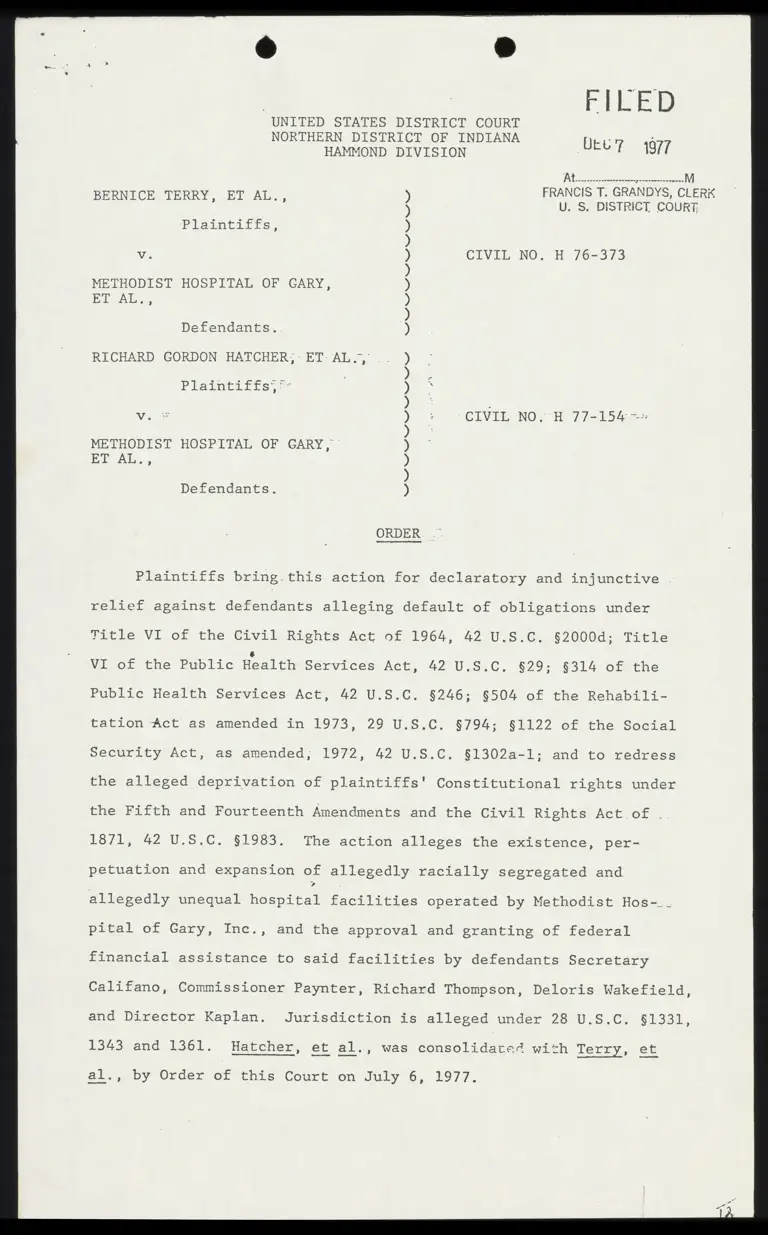
Plaintiffs bring. this action for declaratory and injunctive

relief against defendants alleging default of obligations under

Title VI of the Civil Rights Act of 1964, 42 U.S.C. 520004; Title

VI of the Public Healt Services Act, 42 U.8.C., §29: 8314 of the

Public Health Services Act, 42 U.85.C. $246; $504 of the Rehabili-

tation Act as amended in 1973, 29 U.S.C, 8794; 81122 of the Social

Security Act, as amended; 1972, 42 U.S.C. §1302a-1; and to redress

the alleged deprivation of plaintiffs' Constitutional rights under

the Fifth and Fourteenth Amendments and the Civil Rights Act of _

1871, 42 U.S.C. §1983. The action alleges the existence, per-

petuation and expansion of allegedly racially segregated and

allegedly unequal hespiind facilites operated by Methodist Hos-_._

pital of Gary, Inc., and the approval and granting of federal

financial assistance to said facilities by defendants Secretary

Califano, Commissioner Paynter, Richard Thompson, Deloris Wakefield,

and Director Kaplan. Jurisdiction is alleged under 28 U.S.C. §1331,

1343 and 1361. Hatcher, et al., was consolidated with Terry, et

al., by Order of this Courtion July 6, 1977.


This matter comes before the Court on:

I. Plaintiffs' Motion to certify the proceedings as

a class action pursuant to Federal Rules of Civil Procedure,

Rule 23;

II. Defendant Kaplan's Motion to dismiss;

111. Plaintiffs! Motion for coniianen of the trial

date; and

IV. "Plaintiffs' Motion for bifurcation of the issues

at trial.

I

Plaintiffs’ Motion for Class Certification


Plaintiffs seek to represent a class consisting of:

1. All black and Hispanic residents .of Gary, Indiana,....

who use, have used or will ‘use Gary Methodist Hospital.and_--=

who are, have been or will be injured by the creation, per-

petuation and expansion of an allegedly segregated hospital

system; and

2 All éhandicapped residents of Gary who use, have

used or will use and who are better served by facilities at

Gary Methodist Hospital, and who are, have been or will be

injured by the placement, removal to or expansion of facilities-

at Broadway Methodist Hospital.

Defendants oppose certification alleging that plaintiffs have

not met their burden of showing compliance with the prerequisites

to certification contained in Rule 23(a) and that there is no

factual support for certification.

Subsection (a) of Rule 23 provides that a class action may

be maintained ... "only if (1) the class is so numerous that joinder

ofall enbers is impracticable, (2) there are questions of law or

fact common to the class, (3) the claims or defenses of the repre-

sentative parties are typical of the claims or defenses of the class,

and (4) the representative parties will fairly and adequately protect

the interests of the class."


If these requirements are mer, Rule 23(b) (2) provides that

the Court may grant class certification if "the party oPposing

the class has acted or refused to act on grounds generally applicable

to the class thereby making appropriate final injunctive WALT, or

corresponding declaratory relief with respect to the class as a

whole."

Suits for alleged violations of Title VII of the Civil Rights

Act of 1964 are often by their nature appropriate class actions

because the alleged discrimination sought to be remedied is based : -

on class characteristics’ such as race or sex. : Bowe v. Colgate-_.-~


Palmolive Co. 416 F.2d 711,719 (7th Cir. 1969). Eveh.so0, it is .:


well settled that Title VII plaintiffs are not exempt -from demon-  -

strating compliance with the prerequisites to class certification

of Rule 23(a). . East Yexvs Motor Freight System, Inc, v. Rodrizuez,


LU.8.7 97 8.Ce~ 1891," 51 %. 24.24 453.1977). Purther ; the’

burden is on the plaintiff to show that there is a class and that

he is a proper class representative. Redhouse v. Quality Ford


Sales, Inc,, 511 F.24 230, 236 (10th Cir, 1975). ‘There mere asser-


tion of representation based upon racial identity or a plaintiff's

characterization of his cause as a "class action" without more

will not qualify a plaintiff as a representative. Doctor v. Sea-


board Coast Line RR, Co,,.540 7,24 669, 706 {4th Cir. 1976). The


Court finds this line of reasoning equally applicable to Title VI

actions."

The named plaintiffs in this action are identified as two

black residents of Gary, Indiana, one of whom is Mayor of that city

and one of whom is alleged to be handicapped within the meaning of

29 U.85.C. §706. Insofar as Richard Hatcher's claim goes in part

to allegations of his inability to perform his duties as Mayor

Of Gary, Indiana, due to the allen discriminatory actions of

defendants, the claim cannot be maintained as a class hatin be-

cause it fails to meet the (numerosity) requirement of Rule 23(a).

However, his status as a Black resident of Gary, Indiana, together

with the Black residents of Gary who are plaintiffs in the ferry


action and plaints Page's status as a black, handicapped resi-

dent of Gary, may be considered for purposes of determining Bins

status. The third named plaintiff in this action, Metro Corps,

Inc., is identified as a not-for-profit corporation which, inter


alia, conducts programs to assure that transportation to defendant's

hospital is available to the poor, the elderly, and the handicapped

residents of Gary, Indiana. One-third of the board of directors of

ifetro Corps, Inc.. is alleged to be comprised of organizations with .....

a manifest interest in and responsibility to the Black, Hispanic, ..

poor; elderly, "and handicapped citizens of Gary, Indiana: - -The Court .::

finds authority for the position that such a’ group is not necessarily’:

precluded from representing a class where it exists to represent- the:=-

interests of the class. Norwalk Core v. Norwalk Development Agency,


395. 7.24 920, 937. {2nd Cir. 192568). “While such a group must

additionally have standing, the Court does not here-address--that -..

aspect,

The initial consideration in a class determination is identi-

fication of the class and of its representatives. It is necessary

to identify the class to determine whether the proposed class will

be cohesive ‘and homogenous. Martin v. Easton Publishing Co., ---


F.. Supp.:~~-, 14 F.E.P, cases 765, 769 (E.D.Pennn. 1977). The

Court must also determine whether a class representative has the

same interests and suffers the same injuries as other class members.

Schlesinger v. Reservists Committee to Stop the War, 418 U.S. 208,


94 S.Ct, 2825, 41. 1,.Fd4.24 .706 .(1974).

The Court is satisfied that plaintiffs have met their Rule 23(a)

burden with respect to the class of Black residents of Gary, Indiana,

whom they seek to represent. Based upon evidence contained in the

pleadings, the Court is convinced that the class described is so

numerous as to make joinder impracticable, that the claims of the

named plaintiffs are typical and present common questions of both

law and fact, and that the named plaintiffs can adequately and

vigorously represent the class. Therefore, the class as to Black

residents of Gary, Indiana, is certified under Rule 23(b) (2).


This certification is conditionally granted pursuant to the

provisions of Federal Rules of Civil Procedure, Rule 23 (c) (1)

which allows the Court to alter or amend such an order. It seems

eles that should the plaintiffs prevail on the merits, any boAelit

would inure to all others similarly situated. Further, if indi-

vidual relief will remedy the prion, class certification is not

necessary. [See for example Berlin Democratic Club v. Rumsfeld,


£10 F.8upp. 144 -(D.D.C. 1976); O'Connell v, Teachers College,


Columbia University, 63 FP.R.D, 638 (S.D. N.Y. 1974); Lugo VV. ures


  Dumpson, -390 F.Supp... 379 (S.D.N.Y. 1975): District of Columbiatsmers oo

Podiatric Socleily v, District of Columbia, 65 F.R.D. 113 {D.D. Cire


1974)]. Nevertheless, the Seventh Circuit has expressly stated

that if all prerequisites to a class action have been met, the

Court may not refuse to certify the action merely because there

is no need for certification. Tuiishima v, Board of Education,

460 ¥.24 1355, 1260 {7th Cir. 1972).

‘The pleadings in this case indicate that in 1970, sixty-two

percent (627%) of the population of Gary, Indiana, was Black or His-

panic yet not one ef the named plaintiffs is identified as being

Hispanic even though plaintiffs seek to represent the Hispanic

population of Gary, Indiana. The papers on file disclose little

that would lead the Court to certify the named plaintiffs as repre-

sentatives of the Plspants community of Gary, Indiana. The only

reference to the Hispanic community, aside from its inclusion in

the group sought to be certified as a class is the statement that

one-third of the board of directors of Metro Corps, Inc. is comprized

of organizations with a manifest interest in and responsibility to

the Black, Hispanic, poor, elderly and handicapped citizens of Gary.

Without more, plaintiffs' representations regarding the Hispanic

community of Gary, Indiana amount to merely a general interest

common to all members of the public and are therefore not sufficient

to support certification of the named plaintiffs in a class which

includes the Hispanic community of Gary, Indiana.


Plaintiffs seek also to represent a class of Gary residents

who are handicapped as defined in 29 U.S.C. §706(6). Platnties

Page asserts information sufficient to bring her within this defi-

nition. However, plaintiffs allege generally that approximately

13,300 residents of Gary in 1970 were over 65 years of age and

that as a group the aged suffer disproportionately from physical

and mental impairments which could be said to bring them within

the definition of "handicapped" of 29 U.S.C. §706(6). Since plain-

tiff Page is 66 years old,’ and handicapped, plaintiffs would have: =:

the Court certify the handicapped: as a class:and plaintiff: Page as ==

an adequate representative of the class This ithe Court refuses: =

to do.: The pleadings contain information’ regarding the number of +

elderly individuals, yet plaintiffs do not seek to have the elderly

certified as a class. Plaintiffs further represent the race and

physical handicap of plaintiff Page but do not offer sufficient .

information. to conclude that her claims are typical of a class.of -&

handicapped individuals. Therefore, the Court cannot certify ther:

handicapped residents of Gary, Indiana as a class for purposes of

this action. ‘ |

In certifying a 23(b) (3) class, it is generally incumbent

upon the Court to order the plaintiffs to provide the most reason-

able and practicable notice to the class members. Rule 23(c) (2),

Federal Rules of Civil Procedure. The Court, however, perceives

the concept of notice to be a judicial housekeeping consideration -

in 23(b) (2) types of class action, which may be waived in the: :

Court's discretion. Johnson v. City of Baton Rouge, Louisiana, -


50 ¥.R.D. 203, 301 (U.5.0.C.-E. 0.12" 1070). Professor Nodie,

amplifying the Court's position, has stated.that, "the Rule iu

does not command the giving of any notice to members of (b) (1)

and (b) (2) types of class action." 3B Moore, Federal Practice,

$23.55, p. 23-1152 (1976).

In Yaffe v. Powers, 454 F.2d 1362 (lst Cir. 1972), the Court


Of Appeals for the First Cirvcuilt, in dealing with a 23(b){2) action,

stated:


Y w+. motice to the members of a (b)(2) class
1s not required and the actual membership of
the class need not be ... precisely delimited.
In fact the conduct complained of is the bench-
mark for determining whether a ... (b) (2) class
exists, making it uniquely suited to civil
rights actions in which the members of the
class are often incapable of specific enumera-
tion,” "454 F.2d at 1366.

With this the Court agrees. It strikes this Court in the

instant case that requiring plaintiffs to provide notice to all

Black residents—of' Gary would be not only burdensome but also -

unnecessary. The relief sought by the plaintiffs, if success-

ful ob the merits; would inuresto all: regardless of whether ===

the plaintiffs represented a’ class. Therefore, the Court.shall.:”

not require plaintiffs to provide notice to the (b) (2) class. -

Ig

Defendant Kaplan's Motion to Dismiss...


Plaintiffs have requested no relief specifically against

Director Kipton Kaplan or Northwest Indiana Health Systems Agency.

(hereafter HSA), nor does the presence of Kaplan as Executive

Director of HSA add to plaintiffs’ ability to obtain the velief

sought. Thus, Kaplan cannot be regarded as an "indispensable

party” in this litigation. The Court finds that since the Depart-

ment of Health, Education and Welfare (hereafter HEW) may alone

grant or deny approval of federal financial assistance under $1122,

and since HEW determines how the Health Systems Agency administers :=

its responsibilities under §1122, including matters relative to .-

Title VI of the Civil Rights Act of 1964 and $504 of the Rehabili-~

tation Act as amended, 1973, the presence of HEW as a party is

sufficient- to obtain whatever relief is required by the plain- --

tiff regarding HSA.

In the situation now before the Court, the relief sought

will require only HEW and Methodist Hospital of Gary, Inc. and

the State defendants to take action to redress any violation of

Title VI and Section 504. Since HEW has ultimate authority with


regard to the distribution of federal financial assistance under

Section 1122 and Section 504 as well as the ultimate vesponsibiitey

with respect to Title VI, the real controversy in this matter -

exists only between plaintiffs and HEW and Methodist Hospital of

Cary, Inc, and the State defendants. Such parties will not only

facilitate judicial economy but also any relief which might be

granted will become immediately applicable to and binding upon

the local agency.

For the above reasons, the Court GRANTS defendant Kaplan's

Motiow to Dismisg.z=-

IY

Plaintiffs®' Motion for Continuance of Trial Date


Plaintiffs (in their Motion for Continuance) represented to

the Court that due to the complexity of the issues presented by:

their claims, at least ninety. additional days from December 5, :

1977 will be required for analysis and proposals for remedies.::.

Defendant HEW in its response requests that this matter be set

for trial sometime safter March, 1978 due to the fact that HEW is

presently engaged In a Title VI siudy of all hospitals in Lake

County, Indiana and that such study will not be completed prior ..

to that date. Defendant Methodist Hospital of Gary, Inc. opposes

this extension alleging that such a delay would cause them signi-

ficant additional economic harm. In its Memorandum of Points and -.-

Authorities in Support of Motion for Reconsideration of December

5, 1977 Trial Date, defendant HEW represented that it had offered -

to enter into a stipulation with both plaintiffs and defendant

hospital, thereby tolling the time for enforcement of 42 C.F.R; ©

§100.109(a) which requires defendant hospital to obligate its funds

by the end of March, 1978. (Memorandum at 9).


Being duly advised in this matter, the Court now finds that

due to the complexity of the issues involved and the Title VI

study by HEW, additional time should be granted both plaintiffs

and defendants. In view of the serious nature of the aap

tions raised and in light of the detailed study of the matter,

presumed to have begun in September, 1977 by HEW, the Court

believes that the parties need an additional ninety (90) days

in which to prepare for the pretrial conference and for trial.

Moreover, in light of the Stipulation entered into by all ":

parties..and made a part of .this Order, .the .Court.is inclined to.

Novémber 21,1977, will .be "held February 20, 1978 8t 10:00 &E.m,

The Pretrial Order is now due March 1, 1978. The trial set for -

December 5, 1977, is continued until March 13, 1978, at 9:30 a.m.

Plaintiffs’ Motion for Bifurcation on


Plaintiffs have moved this Court to bifurcate the trial of

the issues and to et for trial the issue of violations of the law

prior to and separate from the issue of remedy. Due to the com-

plexity of the issues as well as the enormity of ordering and -:

structuring any remedial relief, the Court agrees that bifurcation

of these issues is proper. Therefore, the March 13th trial date

will consider only the issue of violations of the law.. After the...

trial is concluded, the Court can then formulate, with the aid of

all parties, any remedial measures which may be warranted. While ~~
, ’ .

bifurcating trials is not the praciice of this Court, it does seem

appropriate in this instance.

WHEREFORE, IT IS ORDERED, ADJUDGED AND DECREED:

1. That plaintiffs' Motion for Class Certification under

Rule 23(b) (2), Federal Rules of Civil Procedure, is conditionally

GRANTED in part and DENIED in part according to the provisions of

grant the continuance... Therefore, the pretrial conference set for’


® »


Rule 23(c) (1), under which such an Order may be conditional,

altered or amended prior to a decision on the merits.

A. The Court certifies this action as a class action

pursuant to Rule 23(b) (2) as regards all Black residents of

Gary, Indiana who use, have used or will use Gary Methodist

Hospital and who are, have been or will be injured by the

creation, perpetuation and expansion of a segregated hospital

system.

B. -- For reasons stated above; the Court denies class-

action certification witty vespees to Hispanic and handicapped. :-

residents of Gary..~.

2. = That defendant Kaplan's Motion to Dismiss is GRANTED. -

3. That plaintiffs' Motion for a continuance is GRANTED.

Accordingly, pretrial conference in this matter is now set for or

February 20, 1978," at 10:00 a.m: ‘and trial of this cause. is now --:

seb for March 13, 1978, at 9:30 a.m., with the Pretrial Order --

being due March 1, 1978; -

4, That plaintiffs’ Motion to bifurcate the issues of vio-

lation and remedy is GRANTED. |

So Ordered this 7H day of December, 1977.

a LB it


Judge, United States District Court [||55c97590-eaf9-4f9c-a093-703d20f8bae5||]