Court of Appeals Case Summary and Decision
Public Court Documents
June 16, 1983
-
Case Files, Garner Working Files. Court of Appeals Case Summary and Decision, 1983. 0e611686-34a8-f011-bbd3-000d3a53d084. LDF Archives, Thurgood Marshall Institute. https://ldfrecollection.org/archives/archives-search/archives-item/bb57adf3-02e7-4c64-b1d4-636e998795d0/court-of-appeals-case-summary-and-decision. Accessed September 26, 2026.
Copied!
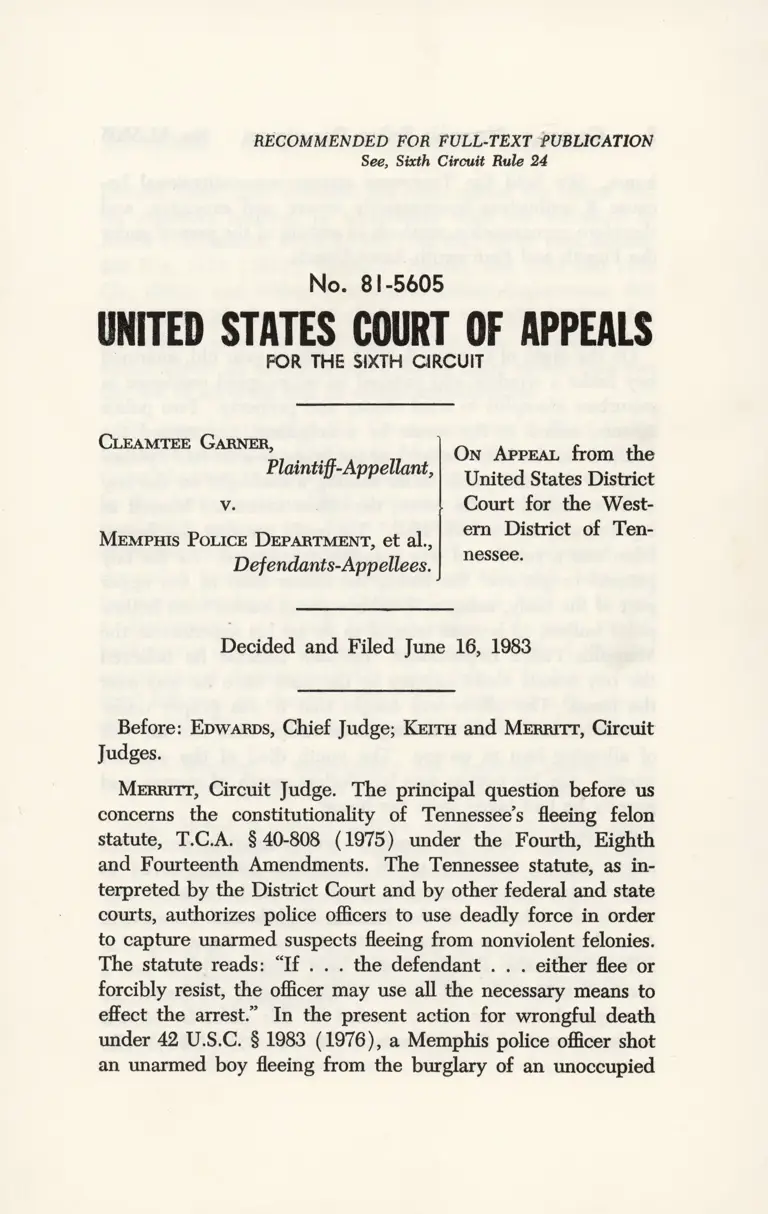
RECOMMENDED FOR FULL-TEXT PUBLICATION
See, Sixth Circuit Rule 24
No. 81-5605
UNITED STATES COURT OF APPEALS
FOR THE SIXTH QRCUIT
Cleamtee Garner,
Plaintiff-Appellant,
Memphis Police Department, et al.,
Defendants-Appellees.
On Appeal from the
United States District
Court for the West
ern District of Ten
nessee.
Decided and Filed June 16, 1983
Before: E dwards, Chief Judge; Keith and Merritt, Circuit
Judges.
Merritt, Circuit Judge. The principal question before us
concerns the constitutionaUty of Tennessee’s fleeing felon
statute, T.C.A. §40-808 (1975) under the Fourth, Eighth
and Fourteenth Amendments. The Tennessee statute, as in
terpreted by the District Court and by other federal and state
courts, authorizes police officers to use deadly force in order
to capture unarmed suspects fleeing from nonviolent felonies.
The statute reads: “If . . . the defendant . . . either flee or
forcibly resist, the officer may use aU the necessary means to
effect the arrest.” In the present action for wrongful death
under 42 U.S.C. § 1983 (1976), a Memphis police officer shot
an unarmed boy fleeing from the burglary of an unoccupied
house. We hold the Tennessee statute unconstitutional be
cause it authorizes tuinecessarily severe and excessive, and
therefore unreasonable, methods of seizure of the person under
the Fourth and Fourteenth Amendments.
2 Garnets V. Memphis Police Department No. 81-5605
I.
On the night of October 3, 1974, a fifteen year old, tmarmed
boy broke a windovv̂ and entered an unoccupied residence in
suburban Memphis to steal money and property. Two police
officers, called to the scene by a neighbor, intercepted the
youth as he ran from the back of the house to a six foot cyclone
fence in the back yard. After shining a flashfight on the boy
as he crouched by the fence, the officer identified himself as
a policeman and yelled “Halt.” He could see that the fleeing
felon was a youth and was apparently rmarmed. As the boy
jiunped to get over the fence, the officer fired at the upper
part of the body, using a 38-calibre pistol loaded with hollow
point bullets, as he was trained to do by his superiors at the
Memphis Pohce Department. He shot because he befieved
the boy would elude capture in the dark once he was over
the fence. The officer was taught that it was proper under
Tennessee law to kill a fleeing felon rather than run the risk
of allowing him to escape. The youth died of the gunshot
wound. On his person was ten dollars worth of money and
jewelry he had taken from the house.
The District Court dismissed the suit brought by decedent’s
father against the City under 42 U.S.C. § 1983 (1976) to
recover damages for wrongful death caused by claimed con
stitutional violations of the Fourth, Eighth and Fourteenth
Amendments. In aceordance with Monroe v. Pape, 364 U.S.
167 (1961), the District Com't held that a city is not a
“person” subject to suit under § 1983. Before we heard the
first appeal, Monroe was overruled on this point by Monell
V. Department o f Social Services, 436 U.S. 658 (1978). The
No. 81-5605 Garner v. Memphis Police Department
District Court also dismissed the case against the officer and
his superiors holding, in aecordance with our decisions in
Beech v. Melancon, 465 F.2d 425 (6th Cir. 1972), cert, denied,
409 U.S. 1114 (1973); Qualls v. Parrish, 534 F.2d 690 ( 6th
Cir. 1976); and Wiley v. Memphis Police Department, 548
F.2d 1247 (6th Cir.), cert, denied, 434 U.S. 822 (1977), that
the ofiBcers aeted in good faith reliance on Tennessee law
which allows an officer to kill a fleeing felon rather than run
the risk of allowing him to escape apprehension.
On appeal, a panel of this Court eonsisting of Chief Judge
Edwards and Judges Lively and Merritt affirmed the District
Court’s holding that the individual defendants were protected
by the doctrine of qualified immunity beeause they acted in
good faith reliance on T.C.A. § 40-808. Garner v. City of
Memphis, 600 F.2d 52 (6th Cir. 1972). We reversed and
remanded the case against the City of Memphis, however,
for reconsideration by the District Court in fight of Monell
V. Department o f Social Services, supra. Because Monell
held that a city may be liable in damages under § 1983 for
constitutional deprivations that result from a “policy or cus
tom” followed by the city, 436 U.S. at 694 and n.66, we in
structed the District Court to consider the following questions;
1. Whether a munieipality has qualified immunity or
privilege based on good faith under Monell?
2. If not, is a municipality’s use of deadly force under
Tennessee law to capture allegedly nondangerous
felons fleeing from nonviolent crimes constitutionally
permissible under the Fourth, Sixth, Eighth and
Fourteenth Amendments?
3. Is the munieipality’s use of hollow point bullets con
stitutionally permissible under these provisions of
the Constitution?
4. If the municipal conduct in any of these respects
violates the Constitution, did the conduct flow from
a “policy or custom” for which the City is liable
in damages under Monell?
600 F.2d 52, at 54-55.
On remand, Judge Wellford ordered memoranda and oral
argument on the issue of whether the trial should be re
opened. By order dated February 29, 1980, he denied further
hearings and dismissed the case on the merits, holding that
the constitutional claims had aheady been fully adjudicated.
Because there had been no constitutional violation, the hold
ing of Monell that cities could be liable for violations occur
ring pursuant to a policy or custom of the city did not
require a different result. Plaintiff’s motion for reconsidera
tion was granted and he was allowed to submit further briefs
and make an offer of proof. The Judge considered the offer
of proof and once again ruled against plaintiffs in a written
opinion dated July 8, 1981. He held that the wisdom of a
statute permitting the use of deadly force against aU fleeing
felons was a matter of policy for the legislature rather than
the judiciary, and that the Tennessee statute was not un
constitutional on its face, nor as applied by the pohce officer
in this case.
Addressing the question of the City’s good faith immunity,
the District Court held that Owen v. City of Independence,
445 U.S. 622 (1980), prevented the city from claiming im
munity from hability based on the good faith of its agent.
Nevertheless, it found that it was still an open question
whether the City might claim immunity if the City itself
was relying in good faith on the Tennessee law as interpreted
by the federal and state courts. Judge Wellford did not
believe it necessary to address the constitutionafity of the
use of hollow point bullets, because he found that there was
no causal connection between the use of hollow point bullets
and Garner’s death.
4 Garner V. Memphis Police Department No. 81-5605
No. 81-5605 Garner v. Memphis Police Department
II.
We consider the Fourth Amendment question first because,
unhke the other more general constitutional provisions raised,
the Fourth Amendment is specifically directed to methods of
arrest and seizure of the person. The question under the
Fourth Amendment is one of first impression in this Circuit.
The narrow question presented is whether a state law author
izing the killing of an unarmed, nonviolent fleeing felon by
pohce in order to prevent escape, constitutes an unreason
able seizure of the person.
The Fourth Amendment provides for the “right of the
people to be secure in their persons . . . against unreasonable
. . . seizures.” The Amendment also provides that where
a warrant is necessary it must describe “the person to be
seized.” When an officer “accosts an individual and restrains
his freedom to walk away,” the Fourth Amendment comes
into play. Terry v. Ohio, 392 U.S. 1, 16 (1968). “[A] person
is ‘seized’ . . . when, by means of physical force or a show
of authority, his freedom of movement is restrained.” United
States V. Mendenhall, 446 U.S. 544, 553 (1980). Killing the
individual is the most decisive way to make sure that he
does not “walk away,” a method “unique in its severity and
irrevocabihty.” Gregg v. Georgia, 428 U.S. 153, 187 (1976).
It is plainly a “seizure” of the “person.” The question there ̂
fore becomes whether this method of capturing suspects is
“reasonable” under the Fourth Amendment.
Tennessee courts have interpreted their statute regarding
the capture of fleeing felons to create a jury question on the
issue of the “reasonableness” and the “necessity” of using
deadly force. But the “reasonableness” and “necessity” of
the officer’s action must be judged solely on the basis of
whether the officer could have arrested the suspect without
shooting him. Purporting to follow the rule developed in
England at common law allowing the use of deadly force
against suspects fleeing from any felony, Tennessee courts
have interpreted their statute to mean that once it is deter
mined that the officer probably could not have captured the
person without firing, the jury should find the police action
reasonable under the statute. Scarbrough v. State, 168 Tenn.
106, 110 (1934) (oflBcer may kill automobile thief “as a last
resort” to prevent escape and the question of “necessity of
killing” is one for jury); see also to the same eflrect Love v.
Bass, 145 Tenn. 522 (1921) and State v. Bowles, 598 S.W.2d
821 (Tenn. App. 1980) and the cases cited in those opinions.
It makes no difference that the felony was nonviolent or that
the felon was unarmed and not dangerous to the physical
safety of others.
It is true that the common law permitted the kilfing of
a felon who resists arrest without regard to the nature of the
felony. But it did so at a time when all of the small number
of felonies then in existence were capital crimes. Since any
felon at large would be hanged or otherwise executed if
taken and tried, he was an “outlaw” who was automatically
dangerous and posed an imminent threat to the physical
safety of others. The common law, however, prohibited the
use of deadly force against a fleeing suspect whose crime
did not require execution and who, therefore, was not likely
to become a dangerous outlaw.
Pollock and Maitland describe as follows the felony at
common law and the method by which a felon could be
taken:
But the very ease with which the king’s peace spread
itself until it had become an all-embracing atmosphere
prevented a mere breach of that peace from being per
manently conceived as a crime of the highest order. . . .
It was otherwise with felony. This becomes and remains
a name for the worst, the bootless crimes.
6 Garner v. Memphis Police Department No. 81-5605
The specific effect of the ‘words of felony’ when they
were first uttered by appellors, who were bringing
charges of homicide, robbery, rape and so forth, was
to provide that, whatever other punishment the appel
lees might undergo, they should in all events lose their
land. . . . At all events this word, expressive to the com
mon ear of all that was post hateful to God and man,
was soon in England and Normandy a general name
for the worst, the utterly ‘bootless’ crimes. . . . The
felon’s lands go to his lord or to the King and his
chattels are confiscated. The felon forfeits life or mem
ber. If a man accused of felony flies, he can be out
lawed .
We have now to speak of the various processes which
the law employs in order to compel men to come before
its courts. They vary in stringency from the polite
summons to the decree of outlawry. . . .
When a felony is committed the hue and cry should
be raised. . . . The neighbors should turn out with the
bows, arrows, knives, that they are bound to keep and,
besides much shouting, there will be hornblowing; the
‘hue’ vdll be ‘horned’ from vale to ville.
Now if a man is overtaken by hue and cry while he
has still about him the signs of his crime, he will have
short shrift. Should he make any resistance, he will be
cut down.
No. 81-5605 Garner v. Memphis Police Department 7
There is hardly room for doubt that this process had
its origin in days when the criminal taken in the act
was ipso facto an outlaw. He is not entitled to any
‘law,’ not even to that sort of ‘law’ which we allow to
noble beasts of the chase. Even when the process is
being brought within some legal control, this old idea
survives. If there must be talk of proof, what has to
be proved is not that this man is guilty of a murder,
but that he was taken red-handed by hue and cry.
II Pollock and Maitland, History of English Law, 464-66,
578-80 (2d ed. 1959).
It is this common law rule allowing all fleeing felons to
be killed, a rule based on the ancient concept of outlawry,
that Tennessee courts have adopted in interpreting their
statute. These killings were acceptable at common law be
cause only violent crimes were classified as felonies, and all
were punishable by death and subject to outlawry. The kill
ing of a fleeing felon merely accelerated the time of punish
ment. The rule of outlawry permitting the killing of the
fleeing felon did not apply to misdemeanors and lesser crimes.
Lesser criminals who took flight from their crimes could not
be killed to prevent their escape. See Comment, Deadly
Force to Arrest: Triggering Constitutional Review, 11 Harv.
C.R.-C.L. L. Rev. 361, 364-65 (1976).
It is inconsistent with the rationale of the common law
to permit the killing of a fleeing suspect who has not com
mitted a hfe endangering or other capital offense and who
we cannot say is likely to become a danger to the community
if he eludes immediate capture. Those states like Tennessee
that cite the common law in defense of their rule permitting
the killing of any fleeing felony suspect exalt the form of the
common law rule over its substance and purpose. Tennessee
law authorizing the use of deadly force against all fleeing
felons is at odds with the purpose and function of the com
mon law principle because there are now hundreds of state
and federal felonies that range all the way from violations of
tax, securities and antitrust laws and the possession of stolen
or fraudulently obtained property to murder and crimes of
terror. A state statute or rule that makes no distinctions based
on the type of offense or the risk of danger to the community
is inherently suspect because it permits an unnecessarily
severe and excessive police response that is out of proportion
to the danger to the community.
This hne of reasoning concerning the origin, development
and current status of the common law rule is similar to the
reasoning of the Eighth Circuit in its en banc decision in
Mattis V. Schnarr, 547 F.2d 1007 (8th Cir. 1976), vacated as
8 Garner v. Memphis Police Department No. 81-5605
moot per curiam sub nom Ashcroft v. Mattis, 431 U.S. 171
(1977). There the court held a similar state statute in
Missouri unconstitutional under the Fourteenth Amendment
as a matter of substantive due process. After tracing some
of the history of the fleeing felon doctrine and cataloguing in
comprehensive fashion the state statutes on the question,
as well as federal decisions, administrative rules and scholarly
commentary, the Eighth Circuit observed that “the historical
basis for permitting the use of deadly force by law enforce ̂
ment officers against nonviolent fleeing felons has been sub
stantially eroded,” 547 F.2d at 1016. At common law since
all felonies . . . were punishable by death, the use of deadly
force was seen as merely accelerating the penal process. . . .
547 F.2d at 1011 n.7.
Likewise, in Jones v. Marshall, 528 F.2d 132 (2d Cir. 1975),
the Second Circuit in a scholarly opinion by Judge Oakes
observed that a rule which permits the use of deadly foree
against nonviolent fleeing felons is not consistent with the
purpose and function of the common law rule. Although the
Jones case, like our earlier opinion in this case, insulates the
officer from federal liability when, in rehance on a similar
state statute, he shoots a nonviolent fleeing felon, the court
commented;
[T]he common law rule evolved when only a few crimes
were felonies, and all of them involved force or violence
. . . and were punishable by death or forfeiture of lands
and goods. See ALI, Model Penal Code § 3.07, Com
ment 3 at 56 (Tent. Draft No. 8, 1958). (“Such rational
justification for the common law rule as can be adduced
rests largely on the fact that virtually all felonies in the
common law period were punishable by death”). . . . As
the scope of “felony” crimes has expanded wholly away
from the concept of violence which underlay its common
law origin, the use of the felony label to justify especially
severe police behavior has become increasingly strained.
As stated by Judge McCree in his concurring opinion in
No. 81-5605 Garner v. Memphis Police Department 9
Beech v. Melancon, 465 F.2d 425, 426-27 ( 6th Cir. 1972),
cert, denied, 409 U.S. 114 (1973):
" . . . I would find it dilficult to uphold as constitutional
a statute that allowed police officers to shoot, after an
unheeded warning to halt, a fleeing income tax evader,
antitrust law violator, selective service dehnquent, or
other person whose arrest might be sought for the com
mission of any one of a variety of other felonies of a
type not normally involving danger of death or serious
bodily harm.”
We have thoroughly explored the digests and the electronic
case retrieval systems, and our research discloses only one
appellate decision discussing Fourth Amendment limitations
on the use of deadly force to capture a fleeing suspect. In
Jenkins v. Averett, 424 F.2d 1228 (4th Cir. 1970), a black
youth took flight at night. The police officer cornered the
boy and shot him. The District Court dismissed the federal
constitutional claim. Applying a Fourth Amendment analysis,
the Fourth Circuit in an opinion by Judge Sobeloff reversed.
Holding that the Fourth Amendment “shield covers the in
dividual’s physical integrity,” the Court found a constitutional
violation because “our plaintiff was subject to the reckless
use of excessive force.” 424 F.2d at 1232.
The only other discussion of the reasonableness of the use
of deadly force by police in a Fourth Amendment context is
that of Chief Justice Burger in his dissenting opinion in
Bivens v. Six Unknown Federal Narcotic Agents, 403 U.S.
388 (1971). In Bivens the Court held that the Fourth
Amendment creates a direct constitutional tort claim for
violation of a citizen’s right to be free of illegal searches of
the home and seizures of the person. Although Bivens was
not a fleeing felon case. Chief Justice Burger, in the course
of his Fourth Amendment analysis in dissent, observed:
I wonder what would be the judicial response to a
police order authorizing ‘shoot to kill’ with respect to
10 Garner v. Memphis Police Department No. 81-5605
every fugitive. It is easy to predict our collective wrath
and outrage. We, in common with all rational minds,
would say that the police response must relate to the
gravity and need; that a ‘shoot’ order might conceivably
be tolerable to prevent the escape of a convicted killer
but surely not for car thieves, pickpockets or a shop
lifter. Bivens v. Six Unknown Agents, 403 U.S. 388, 411
(1971) (Burger, C.J., dissenting) (emphasis added).
The Sixth Circuit long ago in United States v. Clark, 31 F.
710 (6th Cir. 1887), expressed similar doubts about the
vahdity of a rule allowing deadly force against all fleeing
felony suspects:
Suppose, for example, a person were arrested for petit
larceny, which is a felony at the common law, might
an offlcer under any cricumstances be justified in killing
him? I think not. The punishment is altogether too
disproportionate to the magnitude of the offense.
Id. at 713.
The Tennessee statute in question here is invalid because
it does not put sufficient Hmits on the use of deadly force.
It is “too disproportionate.” It does not make distinctions
based on “gravity and need” nor on “the magnitude of the
offense.” Before taking the drastic measure of using deadly
force as a last resort against a fleeing suspect, officers should
have probable cause to believe not simply that the suspect
has committed some felony. They should have probable
cause also to beheve that the suspect poses a threat to the
safety of the officers or a danger to the community if left at
large. The officers may be justified in using deadly force if
the suspect has committed a violent crime or if they have
probable cause to believe that he is armed or that he will
endanger the physical safety of others if not captured. A
statute which allows officers to kill any unarmed fleeing felon
does not meet this standard and is therefore invalid.
No. 81-5605 Garner v. Memphis Police Department 11
After oral argument in this case, upon motion, the Court
permitted the state of Tennessee, through its Attorney Gen
eral, William M. Leach, Jr., to intervene as a party under
28 U.S.C. § 2403(c) for die purpose of defending the con-
stitutionahty of T.C.A. § 40-7-108. The State has filed
an able brief. It concedes that Tennessee comts and
law enforcement agencies interpret the statute to permit the
use of deadly force against any fleeing felon, whatever the
felony, “when no lesser means of apprehension reasonably
appears available.” (Brief, p. 5,) The State’s brief argues,
however, that we should not reach the issue of whether
Tennessee’s rule may be constitutionally apphed to a non-
dangerous felon fleeing from a non-violent felony because
here the officer “could not be certain whether there was an
accomplice in the burglarized house, or in the area, and
whether the accomphce might be armed.” (Brief, p. 6.)
This argument almost always permits the officer to shoot
to kill. The officer wiU seldom be absolutely certain of the
situation. The Fourth Amendment resolves this problem,
however. It requires probable cause — an objective, reason
able basis in fact to beheve that the felon is dangerous or has
committed a violent crime. There is no evidence to support
such a finding in this case, although as the state argues, and
as the District Court found, the officer was not certain on
this point. The officer knew only that he was dealing with
a youth who had committed a non-violent felony and was
apparently unarmed. We do not have to hold the District
Judge’s findings clearly erroneous in order to reach this
result, because the facts, as found, did not justify the use
of deadly force under the Fourth Amendment.
An analysis of the facts of this case under the Due Process
Clause of the Fourteenth Amendment leads lis to a similar
result. That clause prohibits any State from depriving “any
person of hfe, liberty, or property, without due process of
law.” U.S. Const. Amend. XIV. The right to life, expressly
protected by the Constitution, has been recognized repeatedly
12 Garner v. Memphis Police Department No. 81-5605
hy the Supreme Court as fundamental in the due process and
equal protection contexts. Tick W o v. Hopkins, 118 U.S.
356, 370 (1886) (the fundamental rights “to life, liberty and
the pursuit of happiness”); Johnson v. Zerhst, 304 U.S. 458,
462 (1938) (“the fundamental human rights of life and lib
erty”); Roe V. Wade, 410 U.S. 113 (1973) (right to life
protected by Fourteenth Amendment when fetus becomes
viable).
When a fundamental right is involved, due process requires
a state to justify any action affecting that right by demon
strating a compelling state interest. Roe v. Wade, supra;
Mattis V. Schnarr, 547 F.2d 1007, 1019 (8th Cir. 1976) (en
banc). Laws which infringe on fundamental rights must be
“narrowly drawn to express only the legitimate state interests
at stake.” Roe v. W ade, supra. The law challenged here is
not so narrowly drawn. Certainly there are state interests
in law enforcement served by this law which allow police to
shoot all ffeeing felons. Those interests are compelling when
the ffeeing felon poses a danger to the safety of others. We
do not consider these interests sufficiently compelfing to
justify the use of deadly force to protect only property rights.
As the Eighth Circuit pointed out in striking down a
similar law:
We find nothing in this record . . . to support the con
tention of the state that statutes as broad as these deter
crime, insure public safety or protect life. Felonies are
infinite in their complexity, ranging from the violent
to the victimless. The police officer cannot be constitu
tionally vested with the power and authority to kiU any
and all escaping felons, including the thief who steals
an ear of corn, as weU as one who kills and ravishes at
will.
Mattis V. Schnarr, supra at 1019-20 (footnote omitted).
Where, as here, human life is the right at stake, a statute
that sweeps as broadly as this one violates due process of
law and must be struck down.
No. 81-5605 Garner v. Memphis Police Department 13
The principles and distinctions we have enunciated here
have been cast in the form of a rule by the American Law
Institute in the Model Penal Code, a rule which accurately
states Fourth Amendment limitations on the use of deadly
force against fleeing felons:
The use of deadly force is not justifiable . . . unless (i)
the arrest is for a felony, and (ii) the person effecting
the arrest is authorized to act as a peace officer or is
assisting a person whom he believes to be authorized to
act as a peace officer; and (iii) the actor believes that
the force employed creates no substantial risk of injury
to innocent persons; and (iv) the actor believes that
(1) the crime for which the arrest is made involved con
duct including the use or threatened use of deadly force;
or (2) there is a substantial risk that the person to be
arrested will cause death or serious bodily harm if his
apprehension is delayed.
Model Penal Code § 3.07 (2) (b ) (Proposed Official Draft,
1962).
Our holding here under the Fourth Amendment is not
inconsistent with our holdings in Wiley v. Memphis Police
Department, 548 F.2d 1247 ( 6th Cir. 1977), and Beech v.
Melancon, 465 F.2d 425 (6th Cir. 1972), or the three judge
District Court opinion in Cunningham v. Ellington, 323 F.
Supp. 1072 (W.D. Tenn. 1971), in all of which youths were
killed by the Memphis police while fleeing from the commis
sion of a burglary. In each of those cases the Tennessee
statute was drawn into question under the “cruel and un
usual punishment” clause of the Eighth Amendment and
under the Fourteenth Amendment as a matter of substantive
due process. In none of these cases was a Fourth Amend
ment question raised, discussed, mentioned or decided.
Fourth Amendment considerations were not argued. More
over, in each of the cases the narrow question before the
court was whether the police officer who shot the fleeing boy
14 Garner v. Memphis Police Department No. 81-5605
was entitled to a good faith privilege against liability based
upon his reliance upon the Tennessee statute. In each case
the court held, just as we held in our previous decision in
this case. Garner v. City o f Memphis, supra, that the officer
is insulated from personal liability by a good faith privilege
which entitles him to rely upon the Tennessee statute. This
is the ratio decidendi of each of those cases. In those cases
it was unnecessary to reach the constitutionality of the statute
in order to decide the question of the officers’ immunity, and
in any event, no Fourth Amendment question was raised in
any of the cases.
No. 81-5605 Garner v. Memphis Police Department 15
m.
In his opinion of July 8, 1981, Judge WeUford held that
although Owen v. City o f Independence, 445 U.S. 622 (1980),
precludes the city of Memphis from claiming immunity based
on the good faith of its police officers, that opinion left open
the question whether the City could claim immunity for its
good faith reliance on a facially vahd state law in enacting
City police regulations. Because he found no violation of
Garner’s constitutional rights, the Judge did not have to
answer this question. In light of our finding of a constitutional
violation, we must reach this question; in doing so, we hold
that there is no good faith immunity for municipafities under
§ 1983.
The reasoning underlying the Supreme Court’s decision
in Owen, supra, precludes a municipality’s claim of good
faith immunity under § 1983 altogether. Justice Brennan,
speaking for the Court in Owen, gave two major reasons why
good faith immunity of city officials should not be extended
to municipafities themselves. First he pointed out that at
common law, which is the source of immunities under § 1983,
there was no good faith immunity for governmental entities.
Id. at 640. Sovereign immunity at common law was un
related to the question of good faith and was waived when
the government consented to suit as it does under § 1983.
16 Garner v. Memphis Police Department No. 81-5605
Immunity for discretionary functions, the only other govern
mental immunity at common lâ v, involved concerns of sep
aration of powers, unrelated to good faith. Because a munci-
pahty has no “discretion” to violate constitutional rights of
its citizens, this traditional form of immunity does not come
into play. There is no common law analogue which would
suggest that municipalities have immunity for good faith
reliance on state law under § 1983.
Second, Justice Brennan discussed the public policy con
siderations which justify individual good faith immunity and
found that they did not weigh heavily in favor of govern
mental immunity. The two considerations are (1) the in
justice of forcing an individual whose position requires him
to exercise discretion to bear the cost of his good faith reh-
ance on a law or regulation; and (2) the danger that the
threat of liabiHty would deter individuals from executing the
duties of their oflBces or even from seeking pubHc office. Id.
at 654. When a municipality is held liable, whether for the
actions of its officials, or based on its own reliance on state
law, no single individual or official must bear the cost. The
cost is spread among the general public, which is ultimately
responsible for the conduct of its officials. There is little
danger that individuals will hesitate to carry out their duties
or accept public office, when any liabihty for their rehance
on state law wiU be paid from the public fisc.
In a well-reasoned opinion, the Tenth Circuit sitting en
banc, held that good faith reliance by a school district on
the prior law of the circuit provided no independent protec
tion from habihty for wrongful dismissal of a teacher. Bertot
V. School District No. 1, Albany County, 613 F.2d 245, 251
(10th Cir. 1979). It held that the remedying of deprivations
of fundamental constitutional rights must be of primary con
cern to courts and other governmental bodies. A rule impos
ing habihty despite good faith rehance insures that if govern
mental officials err, they will do so on the side of protecting
constitutional rights. It also serves the desirable goal of
No. 81-5605 Garner v. Memphis Police Department 17
spreading the cost of unconstitutional governmental conduct
among the taxpayers who are ultimately responsible for it.
Id. at 252.
Neither the District Judge nor the City of Memphis has
offered any reason why the courts should expand the doctrine
of good faith immunity under § 1983. The considerations
which prompted the Supreme Court in Owen to deny good
faith immunity to municipahties for the acts of their officials
apply with equal force to this case.
Accordingly, the judgment of the District Court is reversed
and the case remanded for further proceedings consistent
with this opinion.