Draft Report From University of Denver RE: Weapons Regulation and Legal Standards
Working File
November 29, 1974
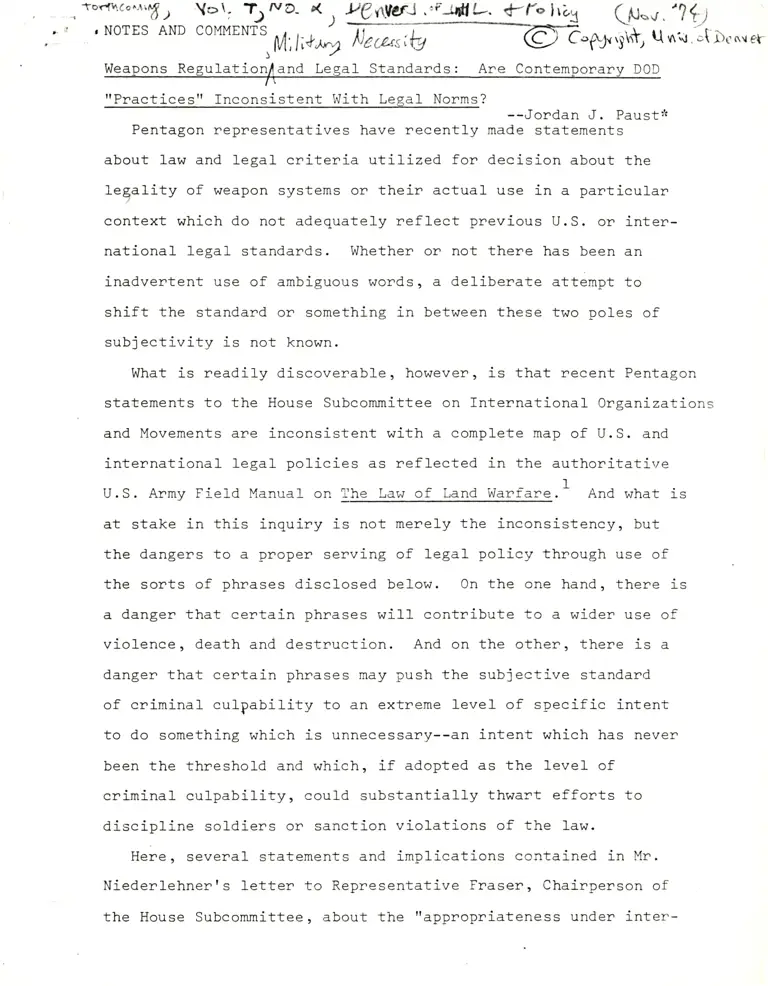
11 pages
-
Case Files, Garner Working Files. Draft Report From University of Denver RE: Weapons Regulation and Legal Standards, 1974. 5daf5c3d-33a8-f011-bbd3-000d3a53d084. LDF Archives, Thurgood Marshall Institute. https://ldfrecollection.org/archives/archives-search/archives-item/bb6153f3-ea4b-4416-8dd5-55c329bd1d02/draft-report-from-university-of-denver-re-weapons-regulation-and-legal-standards. Accessed October 19, 2026.
Copied!
T^/vo. ^ ̂ «d-'roh^ C W w / ? < j
.NOTES AND COMMENTS . , , Jt ' ; ~ \A- n I?n
̂ M ‘. V ( C > U V\ vv). o \ j > o (vvi
Weapons Regulatioiy^and Legal Standards: Are Contemporary POD
"Practices" Inconsistent With Legal Norms?
--Jordan J. Paust*
Pentagon representatives have recently made statements
about law and legal criteria utilized for decision about the
legality of weapon systems or their actual use in a particular
context which do not adequately reflect previous U.S. or inter
national legal standards. Whether or not there has been an
inadvertent use of ambiguous words, a deliberate attempt to
shift the standard or something in between these two poles of
subjectivity is not known.
What is readily discoverable, however, is that recent Pentagon
statements to the House Subcommittee on International Organizations
and Movements are inconsistent with a complete map of U.S. and
international legal policies as reflected in the authoritative
U.S. Army Field Manual on The Law of Land Warfare.̂ And what is
at stake in this inquiry is not merely the inconsistency, but
the dangers to a proper serving of legal policy through use of
the sorts of phrases disclosed below. On the one hand, there is
a danger that certain phrases will contribute to a wider use of
violence, death and destruction. And on the other, there is a
danger that certain phrases may push the subjective standard
of criminal culpability to an extreme level of specific intent
to do something which is unnecessary--an intent which has never
been the threshold and which, if adopted as the level of
criminal culpability, could substantially thwart efforts to
discipline soldiers or sanction violations of the law.
Here, several statements and implications contained in Mr.
Niederlehner's letter to Representative Fraser, Chairperson of
the House Subcommittee, about the "appropriateness under inter-
- 2 -
2national law of the M-16 rifle" are used as a focus. There is
no attempt to refute Mr. Niederlehner's conclusions about the
legality, per se, of the M-16, since no detailed analysis of
relevant legal policies and ballistics and medical effects has
3been,completed by the Department of Defense. His letter is
merely used as a widely publicized example of recent Pentagonian
thinking about weapons regulation, and comment^on his actual or
inferable misstatements of law are offered to avoid a public
confusion with regard to actual U.S. and international legal
standards.
The first discrepancy involves subjective standards and
criminal culpability. Mr. Niederlehner states that the phrase
"calculated to cause," as contained in the English version of
Article 23(e) of the Annex to the Hague Convention No. IV(1907),
will place within the content of the prohibition of the use of
weapons which cause "unnecessary suffering" some "element of
intent." This is an erroneous interpretation if, by that, Mr.
Niederlehner means to create some new "element of intent" beyond
an intent to do an act which causes unnecessary death, destruction,
injury or suffering in a circumstance where one of "reasonable"
make-up could reasonably foresee that such an act could cause
such a death or injurious outcome.
It is by no means clear what Mr. Niederlehner actually meant.
He qualifies his requirement of an "element of intent" with the
following language: "such that members of the Armed Forces cannot
justify the use of weapons inconsistent with attaining a legitimate
5military objective." But even this language is insufficient for
clarity. One does not know whether he subscribes to a mens rea
standard of the "calculated to cause" or "inconsistent with"
variety. This writer feels that something in between the two
is the proper test, and it hinges upon the proverbial "reasonable
7man" and the actual conditions of decision. What is clear,
however, is that no higher subjective standard(i.e., commission
of an act or adoption of a weapon system "calculated" to cause
unnecessary injury or which is "intentionally superfluous") is
contained in this prescription.
The French text of the 1907 Hague prohibition does not contain
the word "calculated," and the French wording is the only
g
authoritative wording. The French text, moreover, retained the
exact wording of the earlier 1899 Hague Convention No. II, Annex,
Article 23(e) prohibition. The relevant language is as follows:
"...of a nature to cause superfluous injury"("...propres a causer
des maux superflus"). Custom has also retained the original
meaning and text-writers now merely refer to the principle of
9unnecessary suffering. This writer feels, however, that
although weapon illegality must substantially hinge upon effects,
not upon subjectivites, a criminal prosecution for design, adoption
or use of illegal weapons must address the common mens rea standard
of culpability which is based upon a "reasonable man," foreseeability
and actual circumstance. But Mr. Niederlehner is plainly wrong
if it is his contention that Article 23(e) has been violated only
when a weapon or conduct causes suffering or injury which is'
10"intentionally superfluous." Since he uses this language along
with an exposition of the postulated "element of intent" theory,
one must infer that it is his standard and, then, denounce it
as unsupportable by proper legal analysis.
There is another misstatement of law implied in Mr. Niederlehner's
letter. It is the implication that the Department of Defense now
subscribes to the repudiated "Kriegsraison" theory of the German
-3-
0
war criminals. At the outset it must be emphasized that it has
never been an accepted international legal standard in modern times
that armed forces can employ any sort of* intensity of violence
which is consistent with or -helpful in the attainment of a legitimate
military objective. Such an approach is far too broad. It amounts
to a military "benefit" test as opposed to a military "necessity"
test, and the military benefit or "Kriegsraison" theory was
12expressly repudiated at Nuremberg in the Von Leeb case. One
could infer that Mr. Niederlehner adopts the military benefit
test through use of the phrase "use of weapons inconsistent with
attaining a legitimate military objective" by implying that he
feels that any weapon usage which is merely consistent with
attaining a legitimate military objective would be lawful. But
it is not clear that he subscribes to such an implication, although,
for clarity, such an implication must be emphaltically denounced.
What is also disturbing, however, is that this sort of
implicationCof a new DOD "Kriegsraison" theory} seems consistent
with recent statements made before the same Congressional
body by Major General George Prugh, the Judge Advocate General,
U.S. Army. General Prugh stated that "loss of life and damage
to property must not be out of proportion to the military
13advantage to be gained"(emphasis added). Actually, the rule
is that loss of life must not be out of proportion to what is
militarily "necessary" under the circumstances, and damage to
property must not be out of proportion to what is "imperatively
-4-
demanded by the necessities of war." 14 Although it is true
that General Prugh's words reflect a partial reading of paragraph
1541 of the U.S. Army Field Manual, that paragraph also reiterates
the "necessity" test through the phrase: "demanded by the
exigencies of war," and paragraph 3 of the Army manual makes
clear that the military benefit or "advantage" test is not the
legal standard. That paragraph states that the law of war
"requires that belligerents refrain from employing any kind or
degree of violence which is not actually necessary for military
purposes..."(emphasis added). The same paragraph states that
military necessity also involves the use of measures "which
are indispensable for securing the complete submission of the
enemy as soon as possible"(emphasis added). With regard to
property, " ̂ "^he measure of permissible devastation is found in
-5-
the strict necessities of war." 16 It is clearly not enough
that the measure is advantageous to, beneficial to or consistent
with military needs. The test is "necessity," not "Kriegsraison."
Another implication in Mr. Niederlehner's letter is that
the prohibition of "dum-dum" bullets only applies to bullets
17which are not "fully jacketed." Such an implication would also
be clearly erroneous, since the very purpose of the customary
1899 Declaration on Expanding Bullets was to prohibit certain
effects of any bullet within the human body and not merely
18certain specific configurations of bullets. That declaration
prohibited "bullets which expand or flatten easily in the human
body, such as bullets with a hard envelope which does not
19entirely cover the core or is pierced with incisions." The
listing of partially-jacketed bullets and bullets pierced with
incisions was merely illustrative. Moreover, it is clear that
the proscribed effects can be caused by partial-jacketing, a flat
top(bullet tip), cutting off of the tip of a bullet, scoring
the surface of the jacket, a hollow-point, soft lead, a weak
20jacketxng and/or a tremendous increase in velocity. As the
Army Field Manual sets forth, usage has established the illegality
of "irregular-shaped bullets... and the scoring of the surface or
-6-
21the filing off of the ends of the hard cases of bullets."
More recent Army publications reiterate these prohibitions.
Army Subject Schedule No. 27-1 states that these principles
"have established the illegality of the use of irregular-shaped
2 2bullets such as dum-dum bullets..." And Department of the
Army Pamphlet No. 27-200 states:
...irregular shaped bullets Cdum-dum) and projectiles
filled with glass are examples of weapons considered to
be illegal per se; that is, they may never be used...
Misuse of a legitimate weapon, such as cutting of the
points of issued ammunition, is a violation of the law
of war.23
An older United States Naval War Code(1900) had also declared
that:
it is forbidden...(2) To employ arms, projectiles, or
materials calculated to cause unnecessary suffering.
Entering especially into this category are... bullets
with a hard envelope which does not cover the core
entirely or is pierced with incisions.2̂
The U.S. position at the 1899 Hague Conference was that it
should be forbidden to use "bullets inflicting wounds of useless
cruelty, such as explosive bullets, and in general all kinds
of bullets which exceed the limit necessary for placing a man
2 5hors de combat..." , but the U.S. position was not adopted
26by the Conference. What was clearly adopted, however,
was a focus on the effects of bullets within the human body
rather than upon specific bullet configurations. Moreover, it
is because of the basic prohibition of unnecessary suffering,
cruelty, torture, unusual injury, aggravation of wounds beyond
what is necessary, the rendering of death inevitable and other
such outcomes that legal guidance in this matter must necessarily
consider an interrelated set of norms that are generally referred
to as human rights.
A fundamental norm of human rights which is relevant to this
sort of inquiry is Article 5 of the 1948 Universal Declaration
27of Human Rights. It states: No one shall be subjected to
torture or to cruel, inhuman or degrading treatment or punishment."
This prohibition applies in time of armed conflict or in time
of relative peace--through all levels of human violence and
circumstances of state or public need and military necessity.
Moreover, the fundamental prohibition contained in Article 5
of the Universal Declaration significantly matches the legal
policies that are articulated in Geneva law. Common Article 3
of the 1949 Geneva Conventions, applicable in time of an internal
armed conflict, also prohibits summary execution(the denial of
a right to a fair trial), inhumane treatment, murder, mutilation,
2 8torture, and cruel treatment. To the extent that these policies
are relevant in any given inquiry into the legality of a weapon
system or weapon usage, they should be considered by legal
decision-makers so as to maximize the serving of legal policy.
And these legal policies are certainly going to be relevant
in most cases. With regard to norms contained in the law of
war, the author agrees with Mr. Niederlehner that these norms
apply to "all weapons" and all bullets^and that the U.S. is
bound by each of these norms.
On a related matter, I also feel that Mr. Niederlehner's
letter about the effects of the U.S. M-16 and the Soviet AK-47
is unduly kind to the Soviet Union's position. It is alleged,
prior to completion of comprehensive tests, that "the lethality--
or wounding impact--of the ^ - 1 ^ does not differ from weapons
29such as the Soviet Union's AK-47." It is also stated that the
"wounds inflicted" are "not substantially different." However,
the International Committee of the Red Cross report of experts
the factdisclosesy^that although the muzzle velocity of the Soviet AK-47
-7-
projectile is slower than that of the U.S. M-16, the kinetic
30energy is much greater for the Soviet projectile. Since the
Soviet AK-47 projectile has almost 23 per cent more energy for
transfer to the human body, it seems that it can cause greater
death, injury and suffering. Thus, it would seem to differ
from the U.S. M-16 projectile in terms of effects within the
human body. But actual tests may prove that although the
Soviet AK-47 has more energy for transfer it actually transfers
about the same amount of energy to the body as the M-16. We
await further tests.
In conclusion, what should be stressed is that the test
for permissibility or impermissibility with regard to a weapon
system or a weapon usage hinges upon military "necessity" and
not some "benefit," "advantage," ’honsistency" or "Kriegsraison"
theory. Since I do not seriously believe that there has been
a change in U.S. or DOD policy, or that Mr. Niederlehner's
letter fairly expresses that policy, I continue to regard
as violative of international law the employment of "any kind
or degree of violence which is not actually necessary for
military purposes
-8-
* Assoc. Prof., designate, University of Houston; J.S.D. Candidate,
Yale.
1. U.S. Dep't of Army, FM 27-10, The Law of Land Warfare(1956)
hereinafter cited as FM 27-1^.
2. See 68 AJIL 5 28-5 3 0(1971+).
3. With regard to possible illegality see ICRC Report on the work
of experts on Weapons that May Cause Unnecessary Suffering or
Have Indiscriminate Effects (Geneva 197 3 ) [hŝ îĴ f̂'Ter cited as
ICRC report of expert \ ^ ^ . t ^ ^ 4- Oo,' \ /A « r s ( U + K + o P N t I7^^5rt33.:e3/
opra note 2, at 5 2 9. -- ^
5. Id.
FOOTNOTES: -1-
0
6. See also id.("intentionally superfluous").
7. See J. Paust, The Nuclear Decision in World War II--Truman's
Ending and Avoidance of War, 8 Int'1 Lawyer 160(1974).
8. See FM 27-10, forward, at i.
9. See ICRC report of experts,at 14, para. 21; and infra note 11.
10. Supra note 2, at 529. For a contrary DOD/DA view see FM 27-10,
at 3(paras. 2a and 3a), 18(paras. 34b and 36), 19-20(para. 41)
and 23-24(para. 56); see also id. at 178(para. 501) and 182(para. 509).
11. See J. Paust, supra note 7, at 163-166 and 168-169 n. 31; J.
Paust, comment, 26 Naval War Coll. Rev. 103(Feb. 1973); J. Paust,
My Lai and Vietnam: Norms, Myths and Leader Responsibility, 57
Mil.L.Rev. 99, 149-153(1972). See also G. Aldrich, remarks,
Proc. Amer. Soc. Int. L., 67 AJIL 148 (Nov. 1973 ); J. Paust, remarks,
id. at 162; and A. Rubin, remarks, at 165.
12. See also U.S. Dep't of Army Pam. No. 27-161-2, II International
Law 248(1962), quoting from U.S. v. Von Leeb, XI Trials of War
Criminals 541(1948)(rejecting the "right to do anything that
contributes to the winning of a war").
13. Statement of Major General Prugh, in Hearings before the
Subcomm. on Int'1 Organizations and Movements of the Comm, on
Foreign Affairs, 93d Cong., 1st Sess., at 102(Comm. Print 1974).
14. See FM 27-10, at 3(para. 3a), 19(para. 41), 23(para. 56) and
24(para. 58).
15. Id. at 19.
16. JA. at 23(para. 56)(emphasis added). See also at 24(para. 58).
17. See supra note 2, at 529: "The M-16 projectile is fully-
jacketed and does not, therefore, violate the prohibition on
’dum-dum’ bullets."
18. See, e.g. , J. Paust, Does Your Police Force Use Illegal
Weapons?— An Approach to Decision-Making About Weapons Regulation,
forthcoming; and ICRC report of experts
Footnotes: -2-
19. Dec. IV, 3, July 29 , 1899 , reprinted at 1 Supp. , Ajf L 1S'5 (1907 ).printed at 1 Supp,
20. See supra note 13; FM 27-10, at 18(para. 34b); and U.S. Dep’t
of Army Pam. No. 27-161-2, supra note 12, at 45.
21. FM 27-10, para. 34.
22. The Geneva Conventions of 1949 and Hague Convention No. IV
of 1907, at 6(1970).
23. The Law of Land Warfare— A Self-Instructional Text 5 (1972).
24. See G. Hackworth, VI Dig, of Int’1 L. 455 (1943).
25. This was General Crozier’s amendment, see 2 AJIL 75-77 (1908).
vs.
V
(O
“V
ON
The U.S. and Great Britain also expressly intim.ated accession to
the 1899 Declaration during the 1907 Hague Conference. See J.
Spaight, War Rights on Land 79 ff. (London 1911); and A. Higgins,
The Hague Peace Conferences 495-497(Cambridge 1909). See also
supra note 18.
26. See U.S. Dep’t of Army Pam. No. 27-161-2, supra note 12, at
44.
27. U.N. G.A. Res. 217, 3 GAOR, U.N. Doc. A/810, at 71(1948).
28. See, e.g., 75 U.N.T.S. 287, 6 U.S.T. 3516(1955). See also
‘Footnotes: -3-
J. Bond, The Rules of Riot--Internal Confli~~ - ~:d the Law of War
(1974), reviewed by the author in 58 AJTL E-
29. Supra note 2, at 529.
30. See ICRC report of experts, at 42(Table
features...). The muzzle velocity of the Al
and that of the M-16 is 980 m/sec. But the
transfer to the body is: 2100(AK-47, at pcirr
1700(M-16, at point of release), or 1600(Al
and 1300 (M-16, at 100 meters). Thus, the AA.-
more kinetic energy for transfer.
31. FM 27-10, para. 3a.
\_Mr74).
1 Ballistic
is 720 m/sec.,
;tic energy for
' release) and
at 100 meters)
has over 23 %