Fax to Norman Chachkin re: draft of stipulations
Correspondence
July 6, 1999
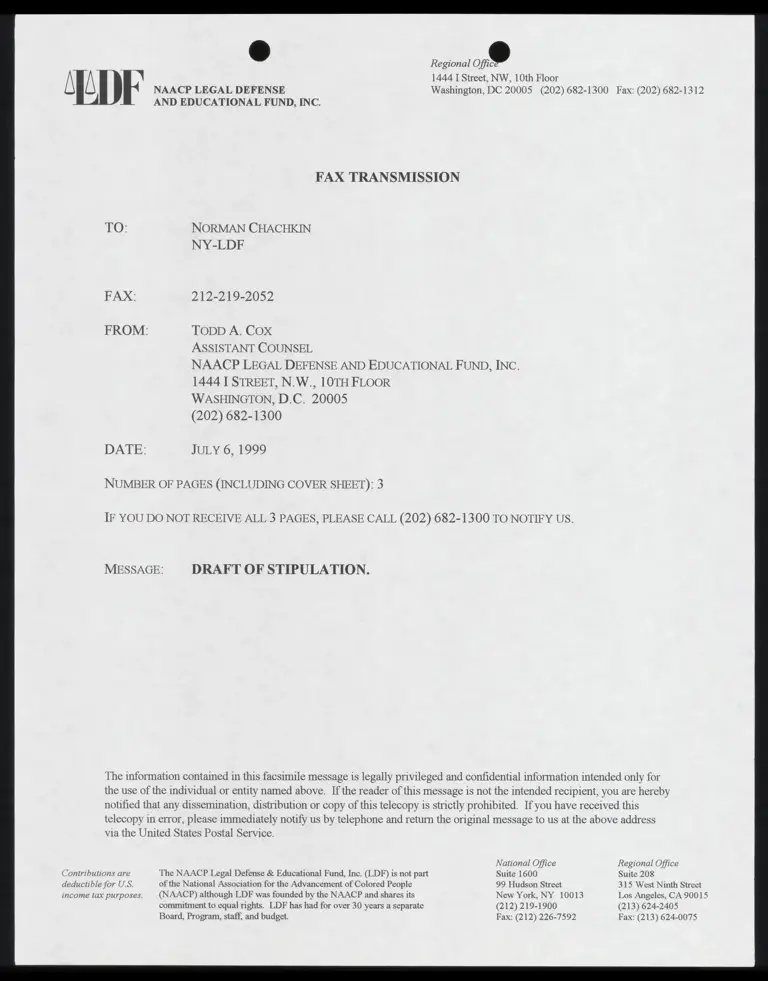
3 pages
-
Case Files, Cromartie Hardbacks. Fax to Norman Chachkin re: draft of stipulations, 1999. 3eed9521-fe0e-f011-9989-7c1e5267c7b6. LDF Archives, Thurgood Marshall Institute. https://ldfrecollection.org/archives/archives-search/archives-item/bc362dda-0273-4d00-94a1-c4e19c31728b/fax-to-norman-chachkin-re-draft-of-stipulations. Accessed October 06, 2026.
Copied!
    Regional  _

A A 1444 1 Street, NW, 10th Floor
NAACP LEGAL DEFENSE Washington, DC 20005 (202) 682-1300 Fax: (202) 682-1312
AND EDUCATIONAL FUND, INC.

FAX TRANSMISSION

TO: NORMAN CHACHKIN

NY-LDF

FAX: 212-219-2052

FROM: ToDD A. COX

ASSISTANT COUNSEL

NAACP LEGAL DEFENSE AND EDUCATIONAL FUND, INC.

1444 I STREET, N.W., 10TH FLOOR

WASHINGTON, D.C. 20005

(202) 682-1300

DATE: JULY 6, 1999

NUMBER OF PAGES (INCLUDING COVER SHEET): 3

IF YOU DO NOT RECEIVE ALL 3 PAGES, PLEASE CALL (202) 682-1300 TO NOTIFY US.

MESSAGE: DRAFT OF STIPULATION.

The formation contained in this facsimile message is legally privileged and confidential information intended only for

the use of the individual or entity named above. If the reader of this message is not the intended recipient, you are hereby

notified that any dissemination, distribution or copy of this telecopy is strictly prohibited. If you have received this

telecopy in error, please immediately notify us by telephone and return the original message to us at the above address

via the United States Postal Service.

National Office Regional Office
Contributions are The NAACP Legal Defense & Educational Fund, Inc. (LDF) is not part Suite 1600 Suite 208

deductible for U.S. of the National Association for the Advancement of Colored People 99 Hudson Street 315 West Ninth Street
income tax purposes. (NAACP) although LDF was founded by the NAACP and shares its New York, NY 10013 Los Angeles, CA 90015

commitment to equal rights. LDF has had for over 30 years a separate (212) 219-1900 (213) 624-2405

Board, Program, staff, and budget. Fax: (212) 226-7592 Fax: (213) 624-0075


STIPULATIONS

Based upon the record evidence before the Court, the parties agree that they will not

contest in this case that:

1. In North Carolina and in the areas comprising Congressional Districts 1 and 12 of

the 1997 Sessions Laws, Chapter 11 in the 1997 Redistricting Plan, African-American voters are

politically cohesive.

2 In North Carolina and in the areas comprising Congressional Districts 1 and 12 of

the 1997 Sessions Laws, Chapter 11, the white majority votes sufficiently as a bloc to enable it, in

the absence of special circumstances, usually to defeat the African-American voter’s preferred

candidate.

3 North Carolina and the areas comprising Congressional Districts 1 and 12 of the

1997 Sessions Laws, Chapter 11 the have a long history of official discrimination against its

minority citizens which has affected the right of minority citizens to register, vote, and otherwise

participate in the electoral process.

4. For nine decades, from 1901 until 1992, no African-American candidate had been

elected to Congress in North Carolina.

S. In North Carolina, African-American voters were disenfranchised as a result of

deliberate state laws that both denied African-American voters access to the ballot box and diluted

their votes.

0. The State of North Carolina utilized measures such as poll taxes, literacy tests,

anti-single shot voting laws, and at-large and multi-member election districts to exclude African-

Americans from the political process.

2. In its 1970 and 1980 reapportionment plans, the North Carolina General Assembly

intentionally fragmented the African-American vote in the northeastern portion of the State to

make sure African-American voters could not garner enough support to elect their preferred

candidate to Congress.

8. In North Carolina, racial appeals in campaigns have been used, as late as the

1990’s, by white candidates to discourage white voters from voting for African-American

candidates.

9. The minority citizens of the State of North Carolina and the areas comprising

Congressional Districts 1 and 12 of the 1997 Sessions Laws, Chapter 11 continue to bear the

effects of historical racial discrimination in such areas as education, employment, and health,

which hinders their ability to participate effectively and equally with white citizens in the political

process.


10. African-American voters as a whole are less well-educated, lower-paid, more likely

to be in poverty, and have less access to telephones, cars, and money than do their white

counterparts, which adversely affects their ability to participate effectively in the political process.

11, There 1s a strong basis in evidence for the State of North Carolina to have

determined that it had denied minority voters an equal opportunity to participate in the political

process and elect candidates of their choice to office.

12. There is a strong basis in evidence for the State of North Carolina to have

determined that it had a compelling interest in complying with the Voting Rights Act and in

ensuring that racially polarized voting patterns and the lingering effects of the State’s past

discrimination did not exclude the State’s African-American citizens from equal access to the

political process.