Patterson v. Newspaper and Mail Deliverers' Union of New York and Vicinity Brief of Defendant-Appellee
Public Court Documents
September 19, 1974
-
Brief Collection, LDF Court Filings. Patterson v. Newspaper and Mail Deliverers' Union of New York and Vicinity Brief of Defendant-Appellee, 1974. 1d6757e3-c09a-ee11-be36-6045bdeb8873. LDF Archives, Thurgood Marshall Institute. https://ldfrecollection.org/archives/archives-search/archives-item/bd7f3bea-0776-40f0-8f52-d56f8b5e9e15/patterson-v-newspaper-and-mail-deliverers-union-of-new-york-and-vicinity-brief-of-defendant-appellee. Accessed October 06, 2026.
Copied!
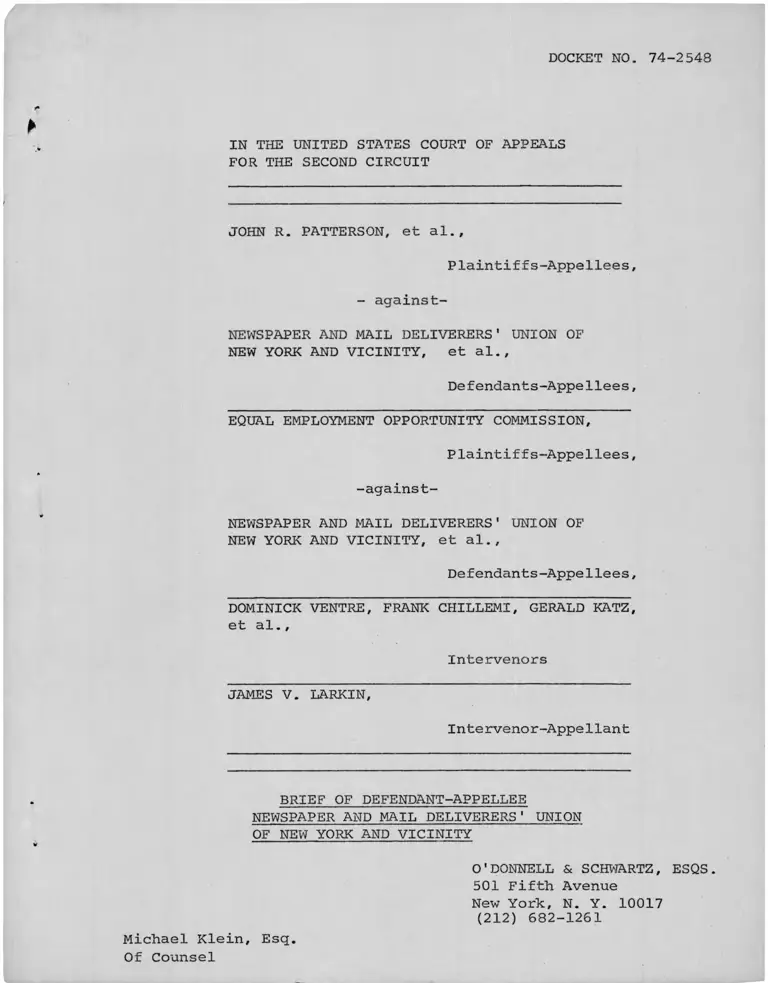
DOCKET NO. 74-2548
IN THE UNITED STATES COURT OF APPEALS
FOR THE SECOND CIRCUIT
JOHN R. PATTERSON, et al.f
Plaintiffs-Appellees,
- against-
NEWSPAPER AND MAIL DELIVERERS' UNION OF
NEW YORK AND VICINITY, et al.,
Defendants-Appellees,
EQUAL EMPLOYMENT OPPORTUNITY COMMISSION,
Plaintiffs-Appellees,
-against-
NEWSPAPER AND MAIL DELIVERERS' UNION OF
NEW YORK AND VICINITY, et al.,
Defendants-Appellees,
DOMINICK VENTRE, FRANK CHILLEMI, GERALD KATZ,
et al.,
Intervenors
JAMES V. LARKIN,
Intervenor-Appellant
BRIEF OF DEFENDANT-APPELLEE
NEWSPAPER AND MAIL DELIVERERS' UNION
OF NEW YORK AND VICINITY
O'DONNELL & SCHWARTZ, ESQS.
501 Fifth Avenue
New York, N. Y. 10017 (212) 682-1261
Michael Klein, Esq.
Of Counsel
TABLE OF CONTENTS
PRELIMINARY STATEMENT
ARGUMENT:
The Approval By The Court Below Of The
Settlement Agreement Was In Accordance
With The Requirements And Objectives Of
Title VII Of The Civil Rights Act
CONCLUSION
TABLE OF CASES CITED
PAGE NOS.
Griggs v. Duke Power Co.
401 U.S. 424 (1971) 12
Humphrey v. Moore
375 U.S. 335 (1963) 5
Rios v. Enterprise Association Steamfitters
Local 638, 501 F. 2d 408 (2nd Cir. 1973) 3, 12
Trans World Airlines, Inc. v. State Human
Rights Appeal Board, et al, N. Y. Sup. Ct.,
App. Div., 2d Dept., N. Y. Law Journal,
December 5, 1974, pp. 1, 5. 4
U. S. v. Bethlehem Steel Corp.
446 F. 2d 652 (2nd Cir. 1971) 7, 10, 12
U. S. v. Wood, Wire & Metal Lathers International
Union Local Union No. 46
471 F. 2d 408 (2nd Cir. 1973) 3, 7, 12
STATUTES
Civil Rights Act, 42 U.S.C. 2000(e) et seq. 1,2,6,8,10,11
Labor-Management Relations Act
29 U.S.C. 141 et seq. 5, 6.
DOCKET NO. 74-2548
IN THE UNITED STATES COURT OF APPEALS
FOR THE SECOND CIRCUIT
JOHN R. PATTERSON, et al.,
Plaintiffs-Appellees,
-against-
NEWSPAPER AND MAIL DELIVERERS' UNION OF
NEW YORK AND VICINITY, et al.,
Defendants-Appellees,
EQUAL EMPLOYMENT OPPORTUNITY COMMISSION,
Plaintiffs-Appellees,
-against-
NEWSPAPER AND MAIL DELIVERERS' UNION OF
NEW YORK AND VICINITY, et al.,
Defendants-Appellees,
DOMINICK VENTRE, FRANK CHILLEMI, GERALD KATZ,
et al.,
Intervenors
JAMES V. LARKIN,
Intervenor-Appellant
BRIEF OF DEFENDANT-APPELLEE
NEWSPAPER AND MAIL DELIVERERS' UNION
OF NEW YORK AND VICINITY
PRELIMINARY STATEMENT
This is an appeal by one of the intervenors, Larkin,
in which he seeks to reverse an Opinion and Order rendered on
September 19, 1974, by United States District Court Judge
Lawrence W. Pierce in the United States District Court for the
Southern District of New York. In his aforesaid Opinion and
Order, Judge Pierce had approved a settlement agreement dated
June 27, 1974, in which the plaintiffs, the Defendant Union and
the Defendant Employers had all joined and which settled two con
solidated actions brought by a class of private plaintiffs and
by the United States Attorney for the Southern District of New
York on behalf of the Equal Employment Opportunity Commission,
(hereinafter "EEOC"), pursuant to Title VII of the Civil Rights
Act (42 U.S.C. §2000 (e) , et seq.)
Since the essential facts and background of events
leading up to the settlement agreement are adequately stated in
Judge Pierce's Opinion and Order dated September 19, 1974 and in
the brief submitted to this Court on behalf of EEOC, it is not
necessary to burden the Court with a repetitious recital of such
facts and chronology. Sufficient it is to confine this brief to
a rebuttal of the contentions made by Appellant Larkin in his
brief.
ARGUMENT
It is the fundamental contention of the Defendant-
Appellee Union that the approval by Judge Pierce in the Court
below of the settlement agreement was proper in all respects,
in accordance with the requirements and objectives of Title VII
of the Civil Rights Act, and should accordingly be affirmed.
Conversely, if the settlement agreement is set aside, serious
disruption could again affect the industry which is now returning
to a state of stability following many months of unsettled labor
conditions during the pendency of the Title VII litigation.
As noted by Judge Pierce in his Opinion , the settle
ment agreement now under attack by Intervenor Larkin was reached
by the parties after a four-week trial on the merits of the two
consolidated actions. It was preceded by many months of frequent,
intensive negotiations and discussions by and among the various
parties. Indeed, an earlier tentative settlement agreement had
been rejected by a vote of the Union's membership. Following
the trial, the present settlement agreement was ratified by the
Union membership in a secret ballot.
Prior to his approval of the settlement agreement.
Judge Pierce held a hearing on its fairness, adequacy and reason
ableness after due notice to the class of plaintiffs noticed
-2-
in this law suit. On that same date, he also held a hearing
on the legality of the relief provided in the settlement agree
ment with regard to its impact on the intervenors, including
Larkin, all of whom are non-minority "shapers" in the industry.
His Opinion reflects that he gave careful consideration to each
and every contention raised by Larkin on this appeal - and he
properly rejected each such contention.
After noting that the instant settlement agreement sets
forth a goal of achieving 25% minority employment in the industry
within five years, consistent with the results in Rios v. Enterprise
Association Steamfitters Local 638, 501 F. 2d 622 (2nd Cir. 1974)
and in U. S. v. Wood, Wire and Metal Lathers International Union,
Local No. 46, 471 F. 2d 408 (2nd Cir. 1973), Judge Pierce mani
fested the thoughtful and careful consideration he gave to the
approval of the instant settlement agreement by stating:
"But, unlike Rios and Wood Wire, this settle
ment agreement does not merely commit the par
ties to the future development of a plan to
achieve that goal. Instead, it sets forth a
plan with great specificity, including varia
tions on the general theme to account for vary
ing circumstances between different employers.
Such detail indicates that the plan is the re
sult of hard, serious and good faith negotia
tions, and that the different pressures, per
spectives and interests of the parties have been
confronted and already resolved. This serves
to increase the Court's confidence that the plan
is workable, and can be implemented immediately."
-3-
1.
It is axiomatic that a settlement agreement is a com
promise involving a "give and take" process in which each party
or group settles for less than a "perfect" satisfaction or pro
tection of its respective intents. This is especially true in
seniority disputes. The chief characteristic of seniority is
that it is relative in nature. The seniority claim of any in
dividual or group necessarily affects adversely the seniority
interest of others in the bargaining unit.*
From this standpoint, none of the parties and groups
affected by the instant settlement agreement can be ideally satis
fied with all of its contents. The Defendant Union encountered
considerable difficulty in persuading its membership to accept a
settlement agreement. Certainly, the plaintiffs sought more in
the relief requested by their complaints. The various Defendant
Employers undoubtedly would have preferred less stricture and
regulation with respect to employment in their industry and they
cannot be pleased with the substantial money damages charged to
them in the Final Order and Judgment predicated on the settlement
agreement.
In this context, it is not surprising that Intervenor
Larkin is displeased with the settlement agreement. However, his
disagreement with some of its contents is not a basis for setting
* See N. Y. Law Journal, December 5, 1974, pp 1, 5, for decision
by N. Y. Supreme Court, App. Div., 2d Dept., in Trans World
Airlines, Inc, v. State Human Rights Appeals Board, et al,
which dramatically illustrates how the correction of past dis
crimination necessarily affects the seniority standing of others.
-4-
it aside. In his Opinion, Judge Pierce asserted that the
intervenors will benefit from the settlement agreement. He
described these benefits as follows:
"Most of the provisions of the settlement agree
ment are applauded by the intervenors, as well
they might be. By regulating employment oppor
tunities in the industry, unlocking Group III
and Group I, Regular Situations and Union mem
bership, the agreement will operate beneficially
for the intervenors as well as the minorities."
'There can be no dispute that the Defendant Apellee
agent of the
Union is the duly recognized/bargaining unit involved in this
litigation, including Intervenor Larkin and the other shapers he
purports to represent. In this connection, the role of the Union
in fulfilling its duty of fair representation when there are com
peting and conflicting seniority interests by members of a bar
gaining unit was settled by the United States Supreme Court in
Humphrey v. Moore, 375 U.S. 335 (1963). The action of the Union
in entering into this settlement agreement conforms to the hold
ing in Humphrey v. Moore.
2.
In substance, Intervenor Larkin is attempting improper
ly in this appeal to convert the instant Title VII law suit into
a proceeding under The Labor-Management Relations Act, 41 U.S.C.
-5-
§141, et seq, whereby individuals may invoke the unfair labor
practice procedures of the National Labor Relations Board to
remedy violations of that Act resulting from preferential em
ployment treatment accorded to employees by reason of Union
membership. In this regard, the record reflects that Intervenor
Larkin and the class of shapers he purports to represent are non
minorities (to the extent that there are minority shapers, they
are included in the class represented by the plaintiffs).
In his earlier Opinion and Order of April 30, 1974,
in which the appellant and others were permitted to intervene,
Judge Pierce strictly limited such intervention to the impact on
them of relief granted in this Title VII action involving racial
discrimination and expressly excluded any effort by intervenors
to enforce such rights as they may have under the National Labor
Relations Act for complaints of alleged discrimination on grounds
other than those authorized in Title VII. In that connection,
he chided some of the intervenors for attempting to utilize the
present Title VII proceeding to enforce an NLRB order which in
volved the Defendant Appellee Union and one of the Defendant Ap
pellee Employers and which has been affirmed by this Court in
1972.
Again, in his Opinion and Order of September 19, 1974,
Judge Pierce emphatically excluded the granting of relief to any
-6-
of the intervenors which would be based on grounds other than
discrimination within the meaning of Title VII. Thus, in reject
ing the contention raised again in this appeal by Intervenor
Larkin, Judge Pierce cogently concluded:
"Finally, it must not be forgotten that this
is a Title VII case. Such cases, as Judge
Frankel has said in Wood, Wire are 'launched by
statutory commands, rooted in deep constitu
tional purposes, to attack the scourge of ra
cial discrimination in employment . . .(a)nd
we know that, in addition to the spiritual wounds
it inflicts, such discrimination has caused mani
fold economic injuries, including drastically
higher rates of employment and privation among
racial minority groups.' United States v. Wood
Wire and Metal Lathers International Union, Local
Union 46, 341 F. Supp. 694, 699 (S.D.N.Y. 1972).
Title VII is an expression of a commitment to cor
rect minority employment discrimination and, hope
fully, the vast social consequences that flow from
it and afflict the whole of the nation. The sta
tute does not undertake to correct all forms of
employment discrimination. Thus, to the extent
that what the intervenors seek here is relief equal
to that afforded minorities, it has no legal found
ation, in this case. Under the law, relief here
must be limited to victims of the kind of discri
mination prohibited by Title VII. United States v.
Bethlehem Steel Corp., supra, 446 F. 2d at 665.
There is no evidence and no assertion that the
intervenors have been discriminated against on ac
count of race, religion, color, sex, national
origin, or because they have made charges, testified,
assisted or participated in any enforcement proceed
ings under Title VII."
3.
Repeatedly, the brief submitted on behalf of Inter
venor Larkin in this appeal erroneously informs this Court that
-7-
the Court below found that the white shapers he purports to
represent have suffered ’fequally" with minorities the effects of
past discrimination. Based on this distorted view, the appellant
inappropriately quotes the maxim that "Equality is Equity" and
pedantically cites "Pomeroy Eq. Jur. Section 405" as his autho
rity for this assertion. In effect, the appellant offers the
specious arqument that the Court below should not qrant any re
lief that did not give non-minorities equal treatment with the
minorities.
Although the Court below did acknowledge a past history
of discrimination against so-called Group III shapers on grounds
unrelated to Title VII, it is inaccurate to state that the Court
concluded that minorities and non-minorities had "suffered
equally" and therefore, that the Court had erred in not granting
"equal relief" to the appellant and to the group for x>?hich he
claims to speak.
Under the guise of seeking "equal relief", the appellant
is actually attempting to scuttle the relief accorded to minori
ties in a Title VII proceeding. Ironic, indeed, is Intervenor
Larkin's reference to the stirring words of the recent civil
rights song, "We shall overcome". Instead of "Black and white
together", he wants the minorities to march behind him on their
way to jobs in this industry!
-8-
Equally cynical and irresponsible is the appellant's
citation of sources dealing with the Nazi destruction of
European Jewry as a ground for attack on Judge Pierce's Order
approving the instant settlement agreement. Does Intervenor
Larkin dare to insinuate that Judge Pierce's decision in the
Court below can be compared to the Nazi code in dealing with the
"Jewish Question"?
The appellant's pious pretense in quoting from the
Bible is absurdly misplaced. It adds neither sanctity nor sanc
tion to his groundless argument on this appeal.
4.
In a futile attempt to bolster his untenable argument
that the settlement agreement grants proscribed "super-seniority"
to minorities which permits them to "leap-frog" illegally past
him and other Group III non-minorities, the appellant inaccu
rately ascribes the qualities of vested seniority rights of a
fUH-time employee to himself and to those in his class.
Judge Pierce expressly found that Larkin and the Group
III class to which he belongs are shapers who "do not have full
time employment, nor do many of them have any great expectations
or intention of working full-time while they shape from the
Group III list." It is common knowledge in the industry that
many of the Group III shapers hold full-time jobs in civil ser
-9-
vice and elsewhere and utilize thei.r status in this industry to
supplement their income. This is hardly the type of employment
which warrants granting them such a protected status as to shield
them from the appropriate relief available to minorities in a
Title VII action.
In commenting on a Group III shaper's work expectations
Judge Pierce made the following persuasive analysis:
"In other words, assessing a shaper's expecta
tion is a highly speculative exercise. The
Court does not mean to minimize a Group III
member's vested emotional interest in his po
sition at a shape, but it cannot be equated with
the worker who might be 'bumped' from a steady
and seemingly secure position by an outside minor
ity with less seniority than him. Further, it
must be pointed out that even if these shaping
priorities were viewed as providing firm expecta
tions, '(such) seniority advantages are not in-
defeasibly vested rights but mere expectations
from a bargaining agreement subject to modifica
tion. ' United States v. Bethlehem steel Corp.,
supra, 446 F. 2d at 663."
Moreover, Judge Pierce rejected outright the contention
of the intervenors that the settlement agreement was harmful to
them. Thus he said:
"First and dispositive of all the issues raised
by the intervenors, the settlement agreement
simply does not trample on their employment op
portunities. In the long run, it must be acknow
ledged by all concerned that the effect of this
agreement, if it operates as predicted, will be
to achieve Regular Situation or Group I status for
all members of Group III, minority and non-minority
alike, within a relatively short time span. With
out this settlement, Group III workers had little
if any hope of ever achieving either status under
the present system."
5.
After the four-week trial, Judge Pierce made a find
ing that minority employment in this industry is less than 2%.
The parties to the settlement agreement stipulated therein that
there is a statistical imbalance within the industry in relation
to those individuals defined as minorities in Title VII.
In this connection, Judge Pierce accepted as credible
the testimony at the trial of the Union's President that the
Union had historically favored employment practices partial to
its members and that the Union v;as not motivated by any intent
to discriminate against minorities. Although Judge Pierce des
cribed this Union position as "admirable under most circumstances",
he ruled that "it is the discriminatory effect of practices and
policies, not the underlying intent, which is relevant in a
Title VII action".
Accordingly, the Defendant-Appellee Union had no
choice except to enter into the settlement agreement which gave
reasonable protection to its members and to all others in the
bargaining unit at the same time that it provided an affirmative
action program which fulfills the objectives of Title VII in
detailing plans whereby a goal of 25% minority employment in
the industry will be reached in five years. To permit Inter-
venor Larkin and a small group of non-minority shapers for whom
he might possibly speak to upset this settlement agreement could
only serve to plunge the employment practices of this industry
-11-
back into the chaos from which it has just emerged.
6 .
In approving the settlement agreement, including its
five-year goal of achieving 25% minority employment in the in
dustry, Judge Pierce asserted that "It is this present impact
of past practices which justifies the affirmative, corrective
relief embodied in the settlement agreement." In so doing he
relied on the United States Stipreme Court's decision in Griggs
v. Duke Power Co., 401 U. S. 424 (1971), as well as on the tri
logy of decisions by this Court in Rios, Wood, Wire, and Bethle
hem Steel, supra. The appellant's efforts to twist the meaning
and effect of these decisions in order to defeat the instant
settlement agreement should not be upheld by this Court.
CONCLUSION
For the foregoing reasons, this appeal by Intervenor
Larkin should be denied in all respects and the Opinion and Order
of Judge Pierce in the Court below, dated September 19, 1974,
should be affirmed.
Respectfully Submitted,
O'DONNELL & SCHWARTZ
501 Fifth Avenue
New York, N. Y. 10017
Attorneys for Defendant-
Appellee Newspaper & Mail
Deliverers Union of New York
and Vicinity
Michael Klein
Of Counsel