Plaintiffs' Proposed Findings of Facts Conclusions of Law and Order
Public Court Documents
March, 1969
33 pages
-
Case Files, Swann v. Charlotte-Mecklenburg Hardbacks. Plaintiffs' Proposed Findings of Facts Conclusions of Law and Order, 1969. 49301231-2e34-f111-88b4-7c1e526962fd. LDF Archives, Thurgood Marshall Institute. https://ldfrecollection.org/archives/archives-search/archives-item/bd96c917-a95f-4b79-88e9-e9ff044fdbce/plaintiffs-proposed-findings-of-facts-conclusions-of-law-and-order. Accessed October 16, 2026.
Copied!
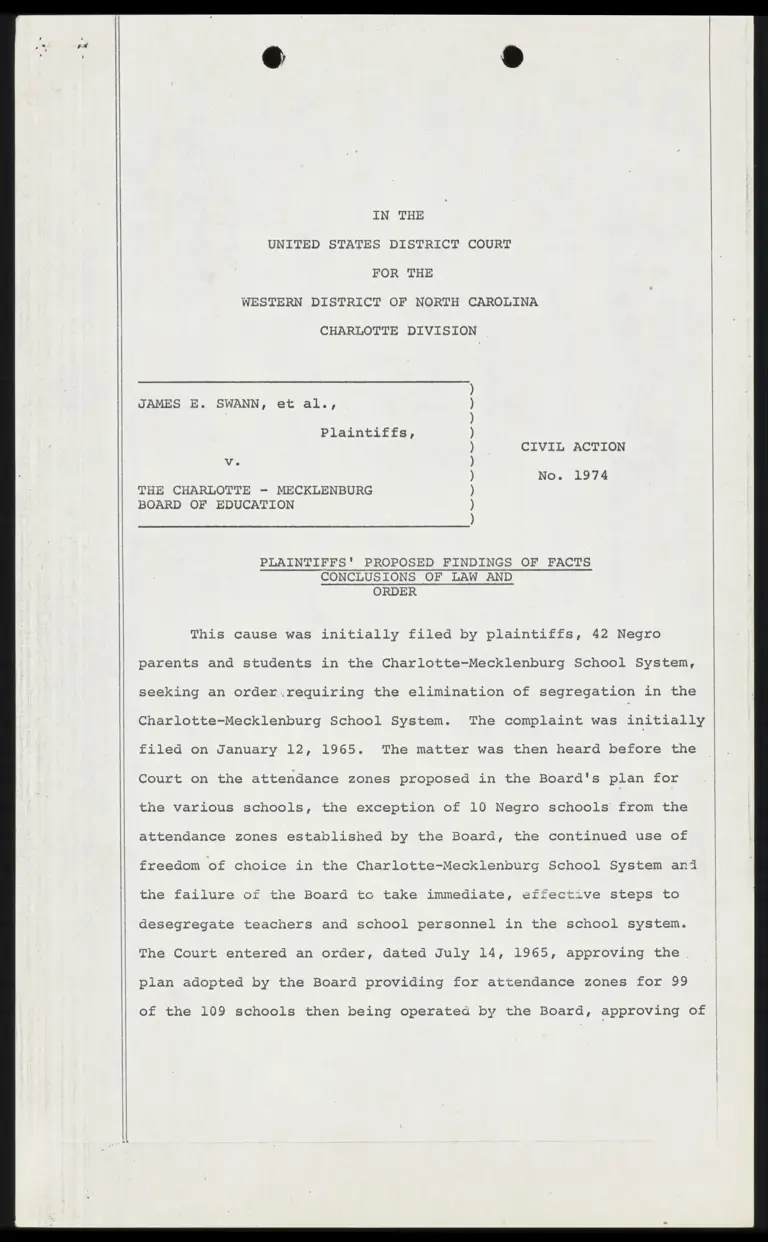
     [||fbfe56e2-1c95-4ae2-a784-bb635c1749f0||] IN THE

UNITED STATES DISTRICT COURT

FOR THE

WESTERN DISTRICT OF NORTH CAROLINA

CHARLOTTE DIVISION


JAMES E. SWANN, et al.,

Plaintiffs,
CIVIL ACTION

Ve
No. 1974

THE CHARLOTTE - MECKLENBURG

BOARD OF EDUCATION

N
s
”


N
s
”


N
a
”


N
t
”


N
m


N
a
a
”


a
”


a
i
t
’


“
w
t
”


“
u
i
”


PLAINTIFFS' PROPOSED FINDINGS OF FACTS
CONCLUSIONS OF LAW AND

ORDER


This cause was initially filed by plaintiffs, 42 Negro

parents and students in the Charlotte-Mecklenburg School System,

seeking an order .requiring the elimination of segregation in the

Charlotte-Mecklenburg School System. The complaint was initially

filed on January 12, 1965. The matter was then heard before the

Court on the attendance zones proposed in the Board's plan for

the various schools, the exception of 10 Negro schools from the

attendance zones established by the Board, the continued use of

freedom of choice in the Charlotte-Mecklenburg School System ani

the failure of the Board tc take immediate, effective steps to

desegregate teachers and school personnel in the school system.

The Court entered an order, dated July 14, 1965, approving the

plan adopted by the Board providing for attendance zones for 99

of the 109 schools then being operated by the Board, approving of


the exception of the 10 Negro schools from the geographic

attendance plan, approving of the continued use of freedom of

choice in the school system and modifying the plan with respect

wo desegregation of teachers. The District Court's order, with

the approval of the School Board, required the immediate

desegregation of teachers and non-racial employment and assign-

ment of teachers and school personnel. The plaintiffs appealed

the case to the United States Court of Appeals for the Fourth

Circuit. That Court affirmed the District Court's Order,

reasoning that the 10 excepted Negro schools had been closed,

that there was no affirmative duty on the School Board to act

affirmatively for the purpose of achieving the maximum mixture

of the races in the schools and holding further that any party

might apply to the District Court for further relief or

modification of the District Court's Order. Swann v. Charlotte-


Mecklenburg Board of Education, 369 F.2d (4th Cir. 1966).


On September 6, 1968, the plaintiffs moved the Court for

further relief contending that the Supreme Court has now clearly

imposed an affirmative duty upon the School Board to completely.

desegregate all schools in the school system. The plaintiffs

contend specifically that because of the racial housing pattern

in the City of Charlotte and Mecklenburg County, which have been

produced and perpetuated through private and public action,

that the Board is constitutionally required to go further than

the mere alleged non-racial establishment of school attendance

areas and to adopt and implement some plan which will completely

desegregate all schools within the school system. In this

regard, the plaintiffs contend that the mere establishment of

geographic attendance zones in a system with clearly defined


racial housing patterns the result of which is the perpetuation

of Negro and white schools does not satisfy the defendant's

constitutional obligation of disestablishing its racially

discriminatory school system. In support of their position,

plaintiffs cite Green v. County School Board of New Kent County,


391 U. S. 430, 2 L. ed. 2d 727; Monroe v. Board of Commissioners


of the City of Jackson, 391 U. S. 450, 20 L. ed. 24 733; Raney.


v. Board of Education, 391 U. S. 443, 20 L. ed. 24 727; Brewer


v. School Board of the City of Norfolk, 397 FP. 24 37 (4th Cir.


1968). Plaintiffs allege that not only has the School Board

perpetuated racially segregated school through the device of

geographic attendance zones imposed on a racially segregated

housing pattern but that the Board has continued to locate and

construct schools in a manner to perpetuate the racially dual

school system and has continued throught the use of freedom of

choice to allow transfer of students from integrated schools,

thus resegregating the schools.

Plaintiffs further contend that defendant has perpetuated

inferior schools in predominately or all-Negro and the less

affluent schools, that the defendant has discriminated against   Negro students within integrated schools by use of ability

groupings and has continued to plan and operate the schools and

to plan for future constructions of schools so as to perpetuaie

a racially dual school system.

Plaintiffs further contend that the defendant has failed

to implement the provisions of 1965 Order of the Court requiring

immediate integration of teachers in the school system and non-

racial employment and assignment of school personnel.

Defendant answered the motion for further relief on

September 13, 1968 contending that the defendant had completely

desegregated the school system, that defendant has fully complied
with the July 1965 Order and denying the material allegations

of plaintiffs' motion for further relief.

-3-

|
{

+}

|

|

i

|

|


This matter was heard by the Court on March 10, 11, 12, 13

and 17, during which time the plaintiffs and the defendant

introduced several exhibits, depositions, answers to interro-

gatories and oral testimony. Upon the evidence thus introduced

and the arguments of counsel for both parties, the Court makes

the following:

FINDINGS OF FACTS


l. During the 1968-69 school year, the Charlotte-

Mecklenburg School System had 82,314 students, 26,630 Negro

and 58,684 white. The School System had 13,319 Negro elementary

students and 31,630 white elementary students; 50,934 Negro

junior high school students and 14,741 white junior high school

students; there are 4,377 Negro senior high school students and

12, 313 white senior high school students.

2. There are 3,613 teachers in the school system, 907

of whom are Negro.

3. The School Board operates 107 schools, 76 elementary

schools (grades 1-6), 20 junior high schools (grades 7-9) and

ll senior high schools (grades 10-12). The school system is

organized on a 6-3-3 basis. In addition the school system

operates a Learning Academy, 4 Child Development Centers and

3 Psyco-Educational Clinics.

4, The School Board is composed of 9 Menbets seach

serving a term of 6 years. Three members are selected every 2

years.on a non-partisan basis. The Board elects its own Chair-

man and Vice-chairman annually. The Superintendent of schools

serves as Secretary to the Board.

5. During the 1964-65 school year, the School System had

23 students assigned to schools of the opposite race. These


students were assigned pursuant to the North Carolina Pupil

Assignment Act. N. C. Gen. Stat. §§115-176 et seg. Three

teachers, during that school year were assigned to schools in

which their race was in the minority. Pursuant to the July 1965

Order, the Board established geographic attendance zones for 99

of the 107 schools in the system, resulting increased integration

of students in the system. The Board also assigned additional

teachers to schools in which their race was in the minority.

With the closing of the 7 Negro schools in the County and the

assignment of Negro students in those schools pursuant to

geographic attendance zones the racial composition of students

and teachers for for 1967-68 was as follows: (SEE ATTACHED

PAGES)

The Board continued this same plan for 1968-69, resulting

in a racial composition in the schools as follows: (SEE ATTACHED

PAGES) .


1967-68

NAME OF SCHOOL STUDENTS PERCENT =~ TEACHERS PERCENT~-

AGE AGE

Alexander Street N 253 0 N 11.6 2%

W 0 WW: 0.2

Allenbrook N 54 13% N 3.4 19%

W 425 WwW 18.0

Ashley Park N O 0
Ww 949 N--2.8B 8%

W 34.7

Bain N 33 5% N22.0 8%

W 656 W 25.2

38%
Barringer N 213 N:3.0 11%

W 556 W- 27.8

Berryhill N 147 20% N 3.0 8%
W 740 W 35.8

Bethune N 280 0 N 14.2 4% 7

Ww. 0 W 0.6

Biddleville N 390 0 N-17.6 2%
W 0 W 0.4

Billingsville N 623 0 N 26.3 0
Ww 3 WwW 0.1

Briarwood N 7 6% NiiiZ2.0 9%

W 565 W 21.2

Chantilly N 3 1% N1.0 Hone
W 478 WwW 21.2

Clear Creek N "50 22% N- 1.0 9%

W 223 Ww ll.l

Collinswood N 0 0 N 2.0 15%
W 354 Ww 13.4

Cornelius N 230 97% N 4.0 23%
W 236 WwW 1l7.2

Cotswold N © 1% N.»1.5 7%

W 542 W2l.2

Davidson N 108 53% N l.4 11%

W 205 W 12.9

Marie G. Davis N 722 0 N 31.4 2%

W 0 WW: 0.7

5a ¢


NAME OF SCHOOL


Derita

Devonshire

Dilworth

Double Oaks

Druid Hills

Eastover

Elizabeth

Enderly Park

Fairview

First Ward

Hickory Grove

Hidden Valley

Highland

Hoskins

Huntersville

Huntingtowne Farms

Idlewild

Amy James

Lakeview

STUDENTS

=
2

~ Oo ul


=
=


@ Oo


P
t


E
Z


I
E


F
Z


F
Z


wn


f
o
d


(0
)

in


539

F
Z


E
r
P
o
2
z


Z
Z


00)


w

|
=

2 w

S
Z


S
Z


nN


(0
) BD


S
Z


2


o
z


e
u


BD


J
o
t


O


1967-68

PERCENT=-
AGE

27%

31%

15%

5%

30%

-5b-

TEACHERS


J


N

WwW

N

WwW

N 3

W's

N 32

W 2

N 22

Ww 0

N 1

Wo 2.6

N 2

W 19.5

N 1.4
WwW 17.4

N 22.5

W 0,2

N 29.2

A Rs

N 1

W 25.4

N 2

W._..21.3

N 1.3

WwW 1Z. 1

N 3

Woo 11.8

N 2

WwW 28.0

N 1.5

W... 239.

N 1

Ww 30.2

N 19

Ww 1

N 5

WwW. 16

PERCENT-
AGE

8%

2%

14%

X%

10%

8%

6%

9%

8%

7%

6%

3%

5%

31%


NAME OF SCHOOL


Lansdowne

Lincoln Heights

Long Creek

Matthews

Merry Oaks

Midwood

Montclaire

Morgan

Myers Park Elem.

Myers Street

Nations Ford

Newell

Oakdale

Oakhurst

Oaklawn

Park Road

Paw Creek

Pineville

Pinewood

Plaza Road

STUDENTS


2


w
=


F
Z


oO


:

N
W

N
W

N
W

N

W_447

N
W

N
W

N
W

381

:

1967-68

PERCENT~-
AGE

1%

1%


TEACHERS

N 1
Ww_38.3

N- 32.6
Ww 0

N 2
W 21.5

N 1

W...31.0

N 1
W 20.5

N 2

Ww 24.4

N co |

W._.. 37.8

N 9
W 0

N 2

W.. 20.8

N 16.9
WwW. _..o

N 1

W. 20.7

N 1.4
Ww 17.6

N 1.2

W.. 20.9

N 1
W 23.

N 23.2

W 0

N 0.5
Wo...

N 1

Ww 33

No 1.
W.._sn 0

N 1

WW. .oa.28

NN orl
W o1

PERCENT=-
AGE

3%

10%

8%

6%

5%

4%

5%


1967-68

NAME OF SCHOOL STUDENTS $i PERCENT=- TEACHERS PERCENT=-

AGE AGE

Rama Road N 0 0 N 2 8%
W 695 Ww 25

Sedgefield N 5 1% N 2 10%

W 531 WH 20.3

Selwyn N 0 0 N 1.5 7%
W 553 W_ 0.8

Seversville N 434 29%, NR lo 1%
Ww 9 Ww 0.2

Shamrock Gardens N 0 0 N 2 10%
W 538 W 20.3

Sharon N 10 1% N ] 4%
W 772 W..3n.1-

Starmount N 26 4% N 1 4%

Ww 680 W 27.4

Statesville Road N 208 38% N 3.6 14%
W_545 W=25.7

Steele Creek N22 X% N 1 10%
W. 242 Wo 10.2

Thomasboro N 0 0 N 2 8%
W 703 W 25.3

Tryon Hills N 154 45% No 1.6 8%
W 346 W 19.4

Tuckaseegee N58 X% N 1 4%

W_ 619 W 25.7

University Park N 845 0 N 32.5 4%
Ww 0 W 1.4

Zeb Vance N315 1% N 15.8 1%
Ww 3 Ww D.2

Villa Heights N 625 34% N 14 6 9%
W 214 WwW 20.2

Wesley Heights N 208 0 N. 13 2%
W 0 Ww 0.2

Wilmore N 54 17% N 1.4 8%

W 323 WW. 17.4

Windsor Park N 4 0 N 2.4 8%
W_849 WwW. 30.5

Winterfield N 0 0 N 0.0 0

W 543 WwW. 22.7

Woodlawn N 75 38% N 1.2 10%
W 198 Weld. 1


NAME OF SCHOOL STUDENTS

Isabella Wyche N 250
Ww 0

Child Dev. Cr. #1 N 97

Wo 143

Child Dev. Cr. $2 N. le?

Ww 84

Albemarle Road N 82

W 820

Alexander Jr. Hi. N. 310

W_ 753.

Cochrane Jr. Hi. N 78

W 1294

Coulwood Jr. Hi. N-129
Ww 728

Eastway Jr. Hi. N 4

W 1389

Alexander Graham JH N 14
W 1147

Hawthorne Jr. Hi. N- 356

W 517

Irwin Ave. Jr. Bio N 730

Ww 1

McClintock Jr. Hi.  N 59

W 1016

Northwest Jr. Hi. N 948

Ww. 0

Piedmont Jr. Hi. N 414

W."71

Quail Hollow Jr. Hi.N 173

W 1170

Randolph Jr. Hi. N 224
W 695

Ranson Jr. Hi. N 219
W 612

Sedgefield Jr. Hi. N 216
W772

Smith Jr. Hi. N 3

W 1384

1967-68

PERCENT-


AGE

52%

10%

41%

6%

6%


TEACHERS

N. 12.8

W..0U.2

N' 4

VW. 10

N 7
Wo 11

N 5

W_43

Nean6.
W_ 40

No 3
W_53.8

N 3

W 35.6

N 3
W 54

No 4
W 48.1

N 7

W 36

N 40

W 1.5

N13

W_ 46.5

N 41

W._ 02

N 13

w. le.

N 4

Wo za

N 3

W 40.8

N 7

W 31.8

N 5

W 40.4

N: 3

PERCENT-
AGE

3%

40%

64%

12%

14%

6%

8%

6%

8%

19%

4%

6%

22%

12%

5%


1967-68

NAME OF SCHOOL STUDENTS PERCENT=- TEACHERS PERCENT=-

AGE AGE

Herbert Spague Jr. Hi. N 158 17% N 4.3 10%
: W 944 W 42.8

J. T. Williams Jr.Hi. N 855 0 N 37.6 1%
Ww 0 W-"0.3

Wilson Jr. Hi. N 57 5% N 2 5%

W 1045 W 45

York Road Jr. Hi. N 615 0 N 29 5%
Ww 1 W i.5

East Meck. Jr. Hi. N 142 9% N 6 8%
W_ 1@28 W 78

Garinger S. H. N 141 7% NX 5 5%
w 2078 Sa 97

Harding S. H. N 130 : 14% N 2.2 4%

W 898 W 50.5

Independence S. H. N 96 11% ‘MN 5 8%
W 884 W 63.7

Myers Park S. H. N 130 11% Nb 6%
w 1800 WwW 94.3

North Meck. S. H. N: 356 35% No 11%
W 1021 W 63

Olympic S. H. N “220 40% NN: 5.5 14%
W 553 W 35.5

Second Ward S. H. N 1127 0 N 34 8%
Ww 0 Ww. 2.2

South Meck. S. H. N 113 7% Ni 2 3%
W_ 1549 WW. 76

West Charlotte S.H. N- 1642 0 N 76.6 11%
W i W 8.6

West Meck. S. H. N. lll 9% No.5 7%

W_ 1262 W 70

-5f=


NAME OF SCHOOL


Albemarle Rd. Elem.

Alexander St.

Allenbrook

Ashley Park

Bain

Barringer

Berryhill

Bethune

Beverly Woods

Billingsville

Bruns Ave.

Chantilly

Clear Creek

Collinswood

Cornelius

Briarwood

STUDENTS


=
=


nN [oe


on

=
 Z


Nn


=
=


=
=

=
Zz

=
2

EN


nN


EN
Oo


ND


WO


ES


Oo


un


=


=
z


nN


ul
 No


1968-69

PERCENT=-
AGE

0

11%

4%

20%

17%

13

1%

26%

15%

95%

13

=D

=
=


T
l


ob


TEACHERS


NB
Wis...

=
2

o


=
2

=


(e
o)


=
=


ND o


=
2

ND [os


=
=


-


(0
0)


=
2

w nN


=
=


o


=
2

- No


=
=


oO


=
2

NI


=
=


NJ


-


=
=


- No


=
Z

NY


-


PERCENT=-
AGE

46%

11%

10%

4%

72%

6%

8%

8%

5%

8%

5%

50%

14%


NAME OF SCHOOL

Cotswold

Davidson

Marie G. Davis

Derita

Devonshire

Dilworth

Double Oaks

Druid Hills

Eastover

Elizabeth

Enderly Park

Fairview

First Ward

Hickory Grove

Hidden Valley

Highland

Hoskins

Huntersville

Huntingtowne Farms


STUDENTS

N 11

W S07

N 101
WwW 186

N-705

Ww. 4

N >3165

WwW 728

N 0

w..sé3

N. 223

W__ 35950

N 800

w_ J

N 504

W 3

N 49

w 580

N- 270

w 194

N 2

W 374

N 363

W 0

N 749

W 0

N 80

WwW. 531

N 0

W 977

N 47

WwW 324

N 18

W 261

N 162

W 560

N 7

W__ 095

1968-69

PERCENT=
AGE

2%

54%

23%

63%

72%

15%

15%

7%

29%

1%

-5h~


TEACHERS

NJ]
W 21

N 1
Wl

N._ 29

Ww. 9.

Ni 3 =
W_ 37

N 24

We 37. =

No 4
WwW. 2>

N 32
W 0

N20
W 0

Nl
W 24

N23
W o1

No 1
W_ 15

N 19
W 0

N 20
W 0

Noi
v3

ae
W 35

N31
W143

Aa
> RE

N 2
wo 35

N 1
Wo 26

PERCENT=-
AGE

5%

9%

11%

10%

4%

6%

7%

18%

8%

4%


NAME OF SCHOOL


Idlewild

Amy James

Lakeview

Lansdowne

Lincoln Heights

Long Creek

Matthews

Merry Oaks

Midwood

Montclaire

Myers Park Elem.

Nations Ford

Newell

Oakdale

Oakhurst

Oaklawn

Olde Providence

Park Road

Paw Creek


STUDENTS

N — W

N_. 277
W 1

N_ 269

W__147

N 0
W 758

N_ 2817
W 2

N_ 250
W 466

N 93
W__ 742

Noo)
W 469

Nl
W. 532

N 0
W722

N 23
W__ 543

N 63
W 585

N73
W 423

N72
W 480

N 2
W 615

N 650
WO

N 10
w 434

N 0
W 3551

N 63

W__gel

1968-69

PERCENT =
AGE

11%

17%

2%

-51=-

S
Z


S
Z


2
2


S
Z


S
2


S2
2

SZ


s2
%

=2


W
w


N
D


B
Y


m
o


u
o


me
r-


wa
g

g
i


mi
e

n
N


18
7]


TEACHERS


I

PERCENT=-

AGE

5%

36%

8%

3%

43

4%

6%

5%

4%

8%

5%

3%


1968-69

NAME OF SCHOOL STUDENTS PERCENT=- TEACHERS PERCENT=-

AGE AGE

Pineville N 168 46% N.1 5%

W 363 W_ 19

Pinewood N O 0 N 1 4%

W 707 W_ 26

Plaza Road N 99 24% N31 5%
w 409 W 21

Rama Road N 2 0 N 2 7%

W ft W 27

Sedgefield Elem. N.7 1% N._2 10%
W545 W 20

Selwyn N 5 0 N31 5%
W 598 W 22

Shamrock Gardens N O 0 N i 5%
W 539 W. 20

Sharon N O 0 N 3 5%
W. 510 W 20

Starmount N25 4% N: 1 4%
Ww 713 W 28

Statesville Rd. N: 205 55% N 3 10%
Ww 534 W 29

Steele Creek N.12 2% N'1 5%
Ww 531 WwW. 20

Thomasboro N O 0 NZ 8%
Ww 705 W 25

Tryon Hills N 241 98% N 1 5%
W 245 W 20

Tuckaseegee N ol 11% N 1 4%
W 553 WwW 23

University Park NV7177 0 N 30 3%
Ww 0 Ww 1l

Zeb Vance N 257 0 N11 0
W 0 W 0

Villa Heights N 796 16% N 23° 61%
Ww 126 W 14

Westerly Hills N O 0 N 1 5%
W 569 WwW 22

Wilmore N 145 49% N 8 67%
W 293 w.l12

-57-


NAME OF SCHOOL STUDENTS

Windsor Park N 2

WwW 737

Winterfield N O

W_ 0c

Isabella Wyche N 232
Ww 0

Child Dev. Cr.$1l N 83

W X17

Child Dev. Cr.%#2 N 166
W 37

Child Dev. Cr.#3 N 174

W 26

Child Dev. Cr. #4 N 188

W 6

Albemarle Rd. Jr.Hi.N 66

W 881

Alexander Jr. Hi. N 347

W 755

Cochrane Jr. Hi. N: 76

W 1444

Coulwood Jr. Hi. N119
Ww 127

Eastway Jr. Hi. N 3
WwW 1364

Alexander Graham JH N 8
WwW 1084

Hawthorne Jr. Hi. N 492
W 447

Irwin Ave. Jr. Hi. N 666
W 0

McClintock Jr. Hi. N 46
W 1228

Randolph Jr. Hi. N 272
W 711

Ranson Jr. Hi. N 253
W 586

Sedgefield Jr. Hi. N 189

1968-69

PERCENT=-
AGE

22%

16%

91%

38%

43%

24%

-5k=-

TEACHERS


2


g
x


F
E


F
P


g
z


2
2


S
Y


3
2
z


=
z


2


g
r


5
2


®¥
¥p


F
y


S
z


B
z


o
z


X
D


v
o


Nil
l

PERCENT=-

18%

25%

25%

9%

12%

11%

12%

5%

9%

36%

3%

4%

5%

19%

13%


1968-69

NAME OF SCHOOL STUDENTS PERCENT~- TEACHERS PERCENT=-

ACE. AGE

Smith Jr. Hi. NO 0 N_ 3 5%
W 1389 W_57

Herbert Spaugh JH N_ 186 21% N_g¢ 14%
W 871 W_43.

J. T. Williams JH N 0 N. 37 0
W 0 Wego

Wilson Jr. Hi. N ¢ 5% N 4 9%
WwW 1132 W_ 45

York Road Jr. Hi. N. 727 4% N32 3%
W © WwW 1

East Meck. S. H. N 155 9% N 6 7%

W W 35

Garinger S. H N 202 9% N_6 6%
W 2157 W 102

Harding S. H. N 169 21% N 4 8%
W 814 W 49

Independence S. H. N 92 10% N 6 10%
W 962 W 59

Myers Park S. H. N 158 9% N_6 7%
W 1855 W_ 87

Olympic S. H. N 259 50% NB 13%
W 522. W_ 39

Second Ward S. H. N 1139 0 N 57 5%
W 3 W 3

South Meck. S. H. N 106 6% N 4 5%
W 1812 W 78

West Charlotte SH N 1569 0 N 74 8%
W O W 6

West Meck. S. H. N 118 9% N 4 5%

W 1340 WwW 73

North Meck . S.H. N 410 37% N 6 ; 10%
W 1109 W 63

Northwest Jr. H. N. 932 0 N 39 0
Ww 0 Ww 0

Piedmont Jr. Hi. N 428 “12% N .'13 92%
Ww 53 W 12

Quail Hollow JH N. 171 14% N 3. 5%
W. 1261 W*  6l


-5]-


The basic plan being followed by the Board provides for assign-

ment of students pursuant to geographic attendance zones as set

forth in defendant's exhibit 10 and Answers to Interrogatories

(Plaintiffs Exhibit No. 1), allowing students after initial

assignment to exercise a choice of school unless the choice

selected has reached its planned pupil capacity or unless the

school to which the student is assigned is a new school.

Defendant bases the geographic attendance areas on natural

boundaries, streets and railways and attempts to follow a

neighborhood school concept. No effort is or has been made in

the establishment of attendance zones to affirmatively dis-

establish racially segregated or identifiable schools.

6. During the 1967-68 school year 2776 students requested

reassignment to other schools after initial assignment pursuant

to defendant's geographic attendance zones. Two thousand, four-

hundred, eighteen (2418) of these requests were granted. Three-

hundred, sixteen (316) of these were Negro students assigned

to predominately white schools. Fifty (50) were white students

assigned to predominately Negro schools or schools in transition

from white or Negro. For the 1968-69 school year all but 1 of

the 2263 requests for transfer were granted by the Defendant.

One hundred, seventy-seven (177) of these were Negro students

assigned to predominately Negro schools and 53 were white students

azsiohod to ovedoninaiely Negro schools or schools in transition

from Negro to white. The resulting affect of freedom of choice

during these school years is shown in Finding of Fact No. 5 above.

7. According to the 1960 census 272, lll number of people   resided in the Charlotte-Mecklenburg community approximately |
|

24.5% of whome were Negro. Approximately 79% of the people reside

within the City of Charlotte. Current estimates are that as of
{
|
|
|
|

-lm


January 1, 1968, 263,000 resided within the City of Charlotte,

approximately 25% of whon are non-white.’ * The majority of

the non-white residents, approximately 98%, reside within the

western part of the City, Northwest and Southwest of Tryon

Street. The majority of the white residents within the City

reside within the eastern part of the City, Northeast and South-

east of Tryon Street.

8. The City of Charlotte developed principally as a mill

.town with laborers, principally,white residing near the mills

and factories. The mills and factories formed generally a line

parallel to or along Tryon Street. Negro residents clustered

principally around Johnson C. Smith University in the center

of the Northwestern part of the City. The City developed an

expanded, residentially, largely through sectional developments,

Lincoln Heights, University Park, Dalebrook, all Negro in the

Northwestern part of the City and Myers Park, Sedgefield, all

white in the Southeastern part of the City. It is apparent

that Negroes were unable to or experienced difficulty in pur-

chasing houses in all white residents. The developments were

constructed for Negro or white residents. Throught 1968, when

the Civil Rights Bill of 1968 was passed, houses, apartments and

living quarters were developed, advertised and made available

to residents on .the basis of race. In addition, city planning

and zoning contributed to and perpetuated residential separation

of the races. There is noticably different plannings and zoning

between the Negro and white residential areas. Urban Renewal

in clearing of blighted areas and relocation of residents has


i/
~ The Charlotte-Mecklenburg Board of Education operates

schools within the City and the County. The County Board of
Education and the City Board of Education were merged in 1961.

RL, -
od


further contributed to the residential segregation of the races.

All Negroes relocated by the Charlotte Redeve Lopes Commission

have been relocated in all Negro districts. Public housing,

now occupied principally by non-whites,has further contributed

to segregated housing in the City. Public housing has been

planned and located. in, principally, the all Negro residential

areas. City zoning and planning of streets and expressways

further contribute to the problem purposefully or unpurposefully,

by forming a band or buffer zone between the Negro and white

residential areas running generally from the Northeast along

North Tryon Street and along the Southern Railway tracks in

the Southern part of the City. There are clearly defined and

distinct white and non-white residential district in the City.

9. Pursuant to its philosophy of locating and con-

structing schools near the residents, the defendant has planned

and constructed several schools within the white and Negro areas.

Examples of these are Fairview, Zeb Vance, Double Oaks, Lincoln

Heights, Irwin Junior High School, Northwest Junior High School,

Second Ward High School, West Charlotte High School, located

within the Negro residential area, and Myers Park Elementary

School, Eastover, Chantilly, Coulwood, Alexander Graham, Harding,

Myers Park, located within the white section of the City.

Several of these ‘schools were planned and constructed subsequent

to the 1965 Order of the Court, resulting in new racially

segregated and identifiable schools-Albemarle Road Elementary

(white), Allenbrook (white), Beverly Woods (white), Bruns Avenue

(Negro), Dilworth (white), Druid Hills (white), Hidden Valley

(white), Huntingtowne Farms (white), Olde Providence (white),
Pineville (white), Steel Creek (white), Westerly Hills (white),

Albemarle Road Junior High School (white), Randolph Junior High

School (white), Independence Senior High School (white), Olympic |


Senior High School (white). In addition the Board has made

wg


several additions to existing schools and presently plans to

locate and construct future schools in all Negro or all white

residential areas. Clearly by locating and constructing schools

and making additions to existing schools within such clearly

racially separate areas and using geographic attendance zones

for the assignment of students to schools has resulted and will

continue to result in racially identifiable and separate schools.
10. School attendance lines for Billingsville Elementary

School follow basically the racial housing pattern of Negro

residents in the area. Billingsville is basically all Negro

in student body although the district is adjacent to several all

white schools. Alghough the attendance area follows some natural

boundary or street, there are noticable variations in the

| adjacent white attendance school districts. By moving the

| Billingsville attendance area further north or east the School

| Board could intepyate he Billingsville School as well as the

adjacent white schools. The same 1s true of the attendance

area for Marie G. Davis. The same is also true of Bruns Avenue,

  a school just opened in 1968.
The attendance areas for Marie G. Davis and Billingsville

further follow generally the census tracks, 37 and 23 respective-

| ly. |

I 12. Of the. 107 schools in defendant's system 40 are   located in residential areas with family incomes of $4000.00 or

| less. 21 of these schools are racially identifiable as Negro

and 19 are racially identifiable as white. The medium test

scores for these schools are below average all grades tested.

56 schools in the system qualify for Title I ESEA funds because

| of the income level of the families of the students enrolled.
School fees ranging from $2.00 to $12.00 have been set by the |


various schools. A greater mixture of the students at Myers

Board for all schools, in order to secure additional funds for

instructional materials, supplies and equipment. The schools

in the less affluent areas, predominately Negro are able to

collect only 50% of the school fees while the schools in the

more affluent areas collect 100% of the school fees. Students

in the more affluent areas have more money therefore for the

purchase of needed school supplies. Despite this and the low

performance of students in these schools the School Board does

not supplement the less affluent schools or attempt to equalize

the educational programs and opportunities at these schools.

Because of the reading level of the students in the less

affluent schools, they are unable to read and use the free

textbooks supplied them by the State. These schools have to use

funds allocated for other purposes to purchase supplementary

text materials for textbooks, further limiting the per pupil

funds available for the students in the less affluent schools.

Again, the School Board does not make up for this deficit. Nor

does the School Board provide enriching programs for the students

in the less affluent areas whose achievement level is lower than

that of students in the more affluent areas.

13. Because of the racial housing pattern and the use of

defendant's present geographic attendance zones, the students

in the various schools tend to represent homogeneous groupings,

racially and economically. Such groupings tend to reduce the
exposure and experience of students which further tends to |

limit the educational opportunities available, particularly to

students in the less affluent schools. Heterogeneous groupings |

would afford more opportunity and experience for students and

at the same time would further integrate the students in the

-10- a

|
|
|

|

i


1

|
|
|
|
|

[}

|

Park and West Charlotte, for example, would allow for more

electives for the students, more exposure and experiences and

integration of the student bodies.

14. Defendant uses a tract or ability grouping assignment

for students in the junior high and senior high schools. = Seven

Negro students in racially mixed schools as compared with 595

white students are assigned to the advanced group, 1660 Negro

students are assigned to the regular group and 1758 Negro students

are assigned to the basic group. Such groupings in defendant's

school system, tend to segregate students within the racially

mixed schools. Examples of these are the all Negro classes at

Myers Park High School and at Elizabeth Elementary School.

15. At the time of the Court's Order in 1965 3 teachers

in defendant's School System were assigned across racial lines.

For the 1967-68 school year approximately 237 Negro teachers and

8 white teachers were assigned across racial lines. For the

1968-69 school year, 244 Negro teachers and 51 white teachers

were assigned across racial lines. Negro schools still have no

racial integration of professional personnel. Thirty-nine

schools have only one teacher of the opposite race on the faculty

and 19 have only 2. The School Board hired 750 faculsy members

new to the system for the 1967-68 school year; 130 of these   were Negro and 627 were white. Ninety-nine of the new Negro

teachers were assigned to all Negro or predominately Negro

schools. Ten of the new white teachers were assigned to schools

in which their race was in the minority. The other new white |

teachers were assigned to white or predominately white schools. |

The School Board hired 675 teachers new to the system for the

current, 1968-69 school year: 92 of these were Negro and 583

were white. Forty-one of the new Negro teachers and 10 of the

-11- opp |


white teachers were assigned across racial lines. All others

were assigned to schools in which their race was in the majority.

16. In the assignment of professional personnel the School

| Board follows a practice of giving preference to the school

selected by .the teacher. This practice has resulted in basically

| all of the white teachers being assigned to white or

| predominately white schools and the substantial majority of

Negro teachers being assigned to Negro or predominately Negro   schools. The School Board has not adopted a plan for complete

desegregation of teachers and school personnel and, in fact,
has taken no further steps in this regard than to adopt the

language of the Court in the July 1965 Order.   I 17. The School Board assigned 2 Negro principals across

II racial lines for the 1968-69 school year the first year of any

integration of professional staff at this level. In 1965,

following the closing of the 7 all-Negro schools, the Negro

principals were assigned as assistant principals to other

schools. Some have subsequently been assighed as principals to

| all Negro schools and one remains as assistant principal at

Villa. Heights Elementary School, predominantely Negro.     18. The athletic coaching staffs at the schools remain

| racially separate with the only exception being the white

| assistant coach assigned to Second Ward High School.

19. Defendant provides lunchroom facilities and services

for all students in the system. Defendant participates in the

free lunch program under the National School Lunch Program,

42 YU. 8. C. $8175] et seq. Its use of a 14 carte services

in some schools, however, prevents it from offering free lunch

benefits to students who attend those schools. Thus some

students are afforded benefits which are denied to others.

hy er J

|
|

|

|
[|

i


CONCLUSIONS OF LAW


l. School Boards have the affirmative, constitutional

duty to desegregate the public schools under their jurisdiction

and to create a system where there are no Negro schools or white   schools or schools racially identifiably as such. Brown v.

Board of Education,347 U. S. 483; 349 U. S. 294; Green v. County
        |

|
School Board of New Xent County, 391 U. 8. 430, 20 L.ed.24,.727i

|
| Raney v. Board of Education, 391 u. 8. 443, 20 L.ed.28, 727; and


I Monroe v. Board of Commissioners of the City of Jackson, 391 U.


S. 450, 20 L.ed.2d, 733. This affirmative duty is to be dis-

|| charged by school officials at the earliest possible moment.

Green v. County School Board of New Kent County, supra. and see


Felton v. Edenton-Chowan School Administrative Unit and Boomer


Vv. Beaufort County Board of Education, U. S. _, (Opinion of


Justice Black in Chambers, August 30, 1968.)

| 2. In the discharge of its duty to desegregate, school

| officials must take account of threats and intimidations,

Coppedge v. Franklin County Board of Education, 394 F.2d 410


(4th Cir. 1968); Bowman v. County School Board of Charles City ’


County, 382 F.2d 326 (4th Cir. 1967), rev's on other grounds


sub nom. Green v. County School Board of New Kent County, supra. |

school bus routes, Kemp v. Beasley, 352 F.2d 14 (8th Cir. 1965); |


Kelley v. Altheimer, Arkansas Public School District, 378 F.24


483 (8th Cir. 1967); 1 Racial Isolation in the Public Schools,

a Report of the United States Commission on Civil Rights (1967), |

teacher assignments, and other factors which might inhibit, |

{

discourage or prohibit disestablishment of a racially segregated

system. Bradley v. School Board of City of Richmond, 382 U. S. |


103, 15 L.ed.2d 187; Rogers v. Paul, 382 U. S. 198, 15 L.ed.2d


-13- Gp


265; Brewer v. School Board of the City of Norfolk, 397 Fr.24


37 (4th Cir. 1968); United States v. Jefferson County Board


Of Education, 372 F.2d 836 (5th Cii. 1966) aff'd en banc 380


F.2d 385 (5th Cir. 1967), cert. den. sub nom. Caldo Parish


School Board vv. United States, 389 U. S. 840; United States v.


School District 151 of Cook County, 286 PF. Supp. 786 (N.D. Ill.


1968), aff'd 404 F.2d 1125 (7th Cir. 1968); Wheeler v. Durham


City Board of Education, 346 F.2d 768 (4th Cir. 1965); Board of


Public Instruction of Duval County v. Braxton, 326 F.2d 616


(5th Cir. 1964); Kelley v. Altheimer, Arkansas Public School


District, Supra.( school location and construction); Hobson v.


Hansen, 269 F.Supp. 401 (D.D.C. 1967), including racial housing

patterns. Monroe v. Board of Commissioners of the City of


Jackson, Supra; Brewer v. School Board of the City of Norfolk,

Supra; United States v. School District 151 of Cook County,


Supra; Board of Education of Oklahoma City Public Schools v.


Dowell, 375 F.2d 158 (10th Cir. 1968); United States v. Board of


Public Instruction! of Polk County, 395 F.2d 66 (5th Cir. 1968);

Wanner v. County School Board of Arlington County, 357 F.2d 452


(4th Cir. 1966); Hobson v. Hansen, Supra. Whatever plan the

| |
school officials propose to follow must be one that will work |

and will work now to desegregate the system. Monroe v. Board .


of Commissioners of the City of Jackson, Supra; Raney v. Board


|
f
|

|
|

|
{

|
|

of Education, Supra. School officials may not hide behind or


simply ignore activities and conditions which further perpetuate

|
a segregated school system. |

|
3. Where racial housing patterns, developed or contributed

|
|

|

{

|

|

|

|
{

to by private or public discrimination or practices, continue

to perpetuate racially segregated or identifiable school,

school officials may not ignore these factors and merely

wf


establish geographic attendance zones or locate and construct

I schools where the effect is to perpetuate a segregated school

system. Wheeler v. Durham City Board of Education, Supra;


| Brewer v. School Board of City of Norfolk, Supra. In such


circumstances, school officials are constitutionally required

to go further and implement a plan which will in fact desegregate

the school system.

| 4. There is a clear and distinct racial housing pattern

in the City of Charlotte, with Negroes living principally in

| the Western part of the City and whites in the Eastern part of

the City. The fee Negroes who reside in the Eastern part of the

| City are in clearly defined areas such as Grier Town which is

served by Billingsville Elementary School and the York Road

area which is served by Marie G. Davis. These housing patterns

have been developed by private discrimination and practices and

| contributed and perpetuated by various governmental action. The

use of geographic attendance zones for the school system, as a   means for desegregation of schools, is constitutionally pro-

|| hibited particularly where, as here, 21 schools remain all-Negro

or racially identifiable and 45 remain all-white or racially

identifiable.

5. Even were the School Board permitted to use

geographical attendance zones, the zones established by the Board

particularly for the Billingsville, Marie G. Davis and Bruns |

Avenue Elementary Schools would be constitutionally suspect. For |

| even were the Court to accept the lines as following natural |

boundaries and other permissable basis, the attendance Ones |

clearly do not discharge the affirmative duty of the Board to. |

take appropriate steps to disestablish the segregated school

| system.

-]15=


6. Freedom of choice as employed by the Board is

constitutionally prohibited. The clear purpose and effect of its

use in the Charlotte-Mecklenburg School System has bean to

allow white and Negro students assigned to integrated schools to

transfer out and thur perpetuate the racially dual structure. In

the face of this showing the Board has presented no evidence

to justify the continued use of freedom of choice in the school

system. Cf. Chambers v. Hendersonville City Board of Education,


364 F.24 182 (4th Cir. 1966). Its use must therefore be en-

| joined. Raney v. Board of Education, Supra; Monroe v. Board of


Commissioners of the City of Jackson, Supra.


7. The duty of the School Board to desegregate has been

| clear since 1954. Despite the Supreme Court's ruling in. 1954

| and the ruling of the Court in this case in 1965, the Board has

| continued to plan, locate and construct schools and has made

additions to existing schools which when coupled with the

|| Board's geographic attendance zones have further perpetuated

racial segregation. The Board now proposes new schools and

additions which also will further segregate the school system.

The planning, location and construction of schools under such

‘circumstances are clearly constitutionally proscribed. Brown Vv.   Board of Education, Supra; Wheeler v. Durham City Board of


Education, Supra; Kelley v. Altheimer, Arkansas Public School |


District, Supra; United States v. Board of Public Instruction


of Polk County, Supra; United States v. Jefferson County Board


of Education, Supra; Brewer v. School Board of City of Norfolk,


Supra; United States v. Greenwood Municipal Separate School


District, ,F.2d (5th Cir., No. 25714, Feb. 4, 1969).


~16~- |


8. Discrimination based on race or color or economic

condition is prohibited by the Thirteenth and Fourteenth Amend-

ments to the Constitution. In the planning and allocation of

school funds, in the design and implementation of curricula,

activities and programs and in the assignment of students the

school officials may not ignore factors which contribute to

greater educational opportunities for one race and economic

group over another. School officials are constitutionally

required to take appropriate steps to insure that all students

within the system are afforded equal educational opportunities.

Imposition of school fees, allocation of school funds, the

design of school curricula must take account of the economic

status of the children and of their educational opportunities.

Sweatt v. Painter, 339 U. S. 629; McLaurin v. Oklahoma State

Regents, 339 U. S. 337, Brown.v. Board of Education, Supra;


Griffin v. County School Board of Prince Edward County, 377 U. S.


218; Harper v. Virginia Board of Elections, 383 U. S. 663;


Griffin v. Illinois, 351 U. S. 12; Horowitz, Unseparate But

Unequal=~The Emerging Fourteenth Amendment Issue in Public

Education, 13 U. C. L. A. L. Rev. 1147 (1966); Figs, Racial

Imbalance in the Schools: The Constitutional Concents, 77 Harv.

L. Rev. 564 (1965); Racial Isolation in the Public Schools, A

Report of the United States Commission on Civil Rights (1967)

and Appendicies; Coleman, Equality of Educational Opportunity

(U. S. Department of Health, Education, and Welfare, 1966).


‘9. It has been clear, certainly since Bradley v. School

Board of City of Richmond, Supra and Rogers v. Paul, 382 U. S.


198 that school officials must desegregate teachers and school

personnel along with the desegretation of students. The

discharge of this duty requires more than pious promises of

school officials that they will henceforth employ and assign

3

-17=


| ® » |


personnel without consideration of race. School officials

are required to go further and disestablish the racially

segregated staffs crested wilor to Brown and to take affirmative

and positive steps to eliminate the racial identifiability of

the teaching and professional staffs in the school system.

Action and not mere words must be shown. Bowman v. County

ll School Board of Charles City County, Supra; Brewer v. School


|| Board of the City of Norfolk, Supra; Kier v. County School Board

{of Augusta County, Supra; United States v. Board of Education


of City of Dessemer, 396 F.2d 44(5th Cir. 1968); Kelley v.
      Altheimer, Arkansas Public School District, Supra; Kemp Vv.


| Beasley, 389 F.2d 178 (8th Cir. 1968); United States v. School


| District 151 of Cook County, Supra; Adams v. Matthews, 403 F.2d

181 (5th Cir. 1968); Clark v. Board of Education of Little Rock


School District, 369 F.2d 661 (8th Cir. 1966). Defendant has

failed to discharge its obligation in this regard and indeed
has failed to fully comply with the July 1965 Order of this |

Court. |

10. As the responsible agency for providing free lunch

benefits to the children under its jurisdiction, defendant

is constitutionally prohibited from refusing to provide such

  benefits or providing such benefits for some while denying |

those benefits to others. Griffin v. Illinois, Supra; Griffin


v. County School Board of Prince Edward County, Supra. |

-18- |


ORDER


Upon the basis of the foregoing Findings of Facts and

| Conclusions of Law, the Court hereby Orders and Decrees:

1. That defendant, its agents, servants, attorneys and

successors and all persons acting in concert or participation

with them are enjoined and restrained from further discriminating     against the plaintiffs and others of their class on the basis |
of race, color or economic condition.

2. Defendant shall present to the Court on or before

April 15, 1969, a plan for the complete desegregation of all
schools under its jurisdiction so that no school in the Syston 8

will be Negro or white or racially identifiable as such. In |

this connection, defendant's plan should provide for school |

pairing, consolidation, new geographic attendance zones, new |

| construction, reorganization of the schools on other than 6-3-3

| basis or a combination of two or more such provisions or other

| steps which will, in fact, disestablish the racially dual

school structure. Such plan must show the specific steps

defendant proposes to take for the 1969-70 school year- and

| spell out in detail the steps and time schedule for complete

desegregation of the school system so that each school in the

| system will reflect the percentage of white and Negro students

| in the school system. |

3. Along with the plan ordered in paragraph 2 above, |

defendant shall submit a plan for the complete desegregation

| of teachers, principals, coaches and all school personnel to

be effective at the beginning of the 1969-70 school year. The

plan shall provide for proportionate representation of Negro

and white teachers in each school in the school system so that

each school will reflect the percentage of Negro and white |
[3

“lO


teachers in the school system as a whole. The plan shall

further provide that no teacher or school personnel shall,

because of the desegregation herein ordered, be dismissed,

demoted, denied employment or promotion on the basis of race or

color. In any instance where staff personnel or to be dismissed

because of desegregation, all personnel in the system must be

evaluated in determining the staff personnel to be displaced.

No new personnel shall be employed prior to placing all personnel

who might be dismissed as a result of this order unless defendant

demonstrates that such displaced staff member is unqualified to

fill the particular vacancy.

The plan shall further set forth objective standards and

criteria for the employment, assignment and re-employment or

continued employment and assignment of staff personnel.

4. Defendant is further enjoined and restrained from

planning, locating and constructing and new schools, facilities

or making additions to existing schools on the basis of race
or color. In all instances of proposed new construction or

additions and in connection with all future construction, |

defendant shall demonstrate how such facilities will be |

integrated. In connection with all presently planned gongtyuction,

defendant shall submit a plan along with that ordered in

paragraph 2 above setting forth in detail how all such facilities

will be integrated. Pending approval of plan, defendant,

its agents, servants, employees, attorneys and successors and all

persons acting in concert with them are emjoined and restrained

from proceeding with the construction of any new-school or

facility or any addition to existing schools.

5. Defendant, its agents, employees, servants, attorneys

and successors and all persons acting in concert or participation |

20 ing


with them are further enjoined from planning and allocating

school funds, planning and designing school curricula, pro-

grams and activities which fail to provide equal educational

opportunities to all students in the system irrespective of

race, color or economic condition. Defendant is specifically

enjoined to equalize funds for needed school materials, text-

books, supplies and facilities the unequal distribution of

which might result from the inability of children to pay or

to utilize books, supplies and facilities provided on a per

pupil basis to all schools in the system.

6. Defendant shall present to the Court, along with the

plan directed in paragraph 2 above a plan providing for free

lunches for all students in the system.

7. Defendant shall serve upon counsel for the plaintiffs

copies of all plans directed by the Court in paragraph 2

through 6 above. Counsel for plaintiffs shall have 5 days after

service of same in which to respond if they so desire.

8. The Court shall retain jurisdiction of this juris-

diction of this cause.

This day of March, 1969.


JUDGE, United States District Court

-]- [||fbfe56e2-1c95-4ae2-a784-bb635c1749f0||]