Judge Wood's Emergency Application for Stay; Petition for Expedited Permission to Appeal; Motion to Consolidate; Exhibit List Volumes I & II
Public Court Documents
January 4, 1990
97 pages
-
Case Files, LULAC and Houston Lawyers Association v. Attorney General of Texas Hardbacks, Briefs, and Trial Transcript. Judge Wood's Emergency Application for Stay; Petition for Expedited Permission to Appeal; Motion to Consolidate; Exhibit List Volumes I & II, 1990. 6d5a9d98-1d7c-f011-b4cc-7c1e52467ee8. LDF Archives, Thurgood Marshall Institute. https://ldfrecollection.org/archives/archives-search/archives-item/bf1de9c0-a698-461d-ac70-fa7cd31d8c08/judge-woods-emergency-application-for-stay-petition-for-expedited-permission-to-appeal-motion-to-consolidate-exhibit-list-volumes-i-ii. Accessed September 26, 2026.
Copied!
    A "

PorTER & CLEMENTS
FIRST REPUBLICBANK CENTER


700 LOUISIANA, SUITE 3500

HOUSTON, TEXAS 77002-2730

ATTORNEYS


A PARTNERSHIP INCLUDING

PROFESSIONAL CORPORATIONS
TELEPHONE (713) 226-0600

TELECOPIER (713) 228-1331

TELECOPIER (713) 224-4835

EVELYN V. KEYES TELEX 775-348

(713) 226-0611

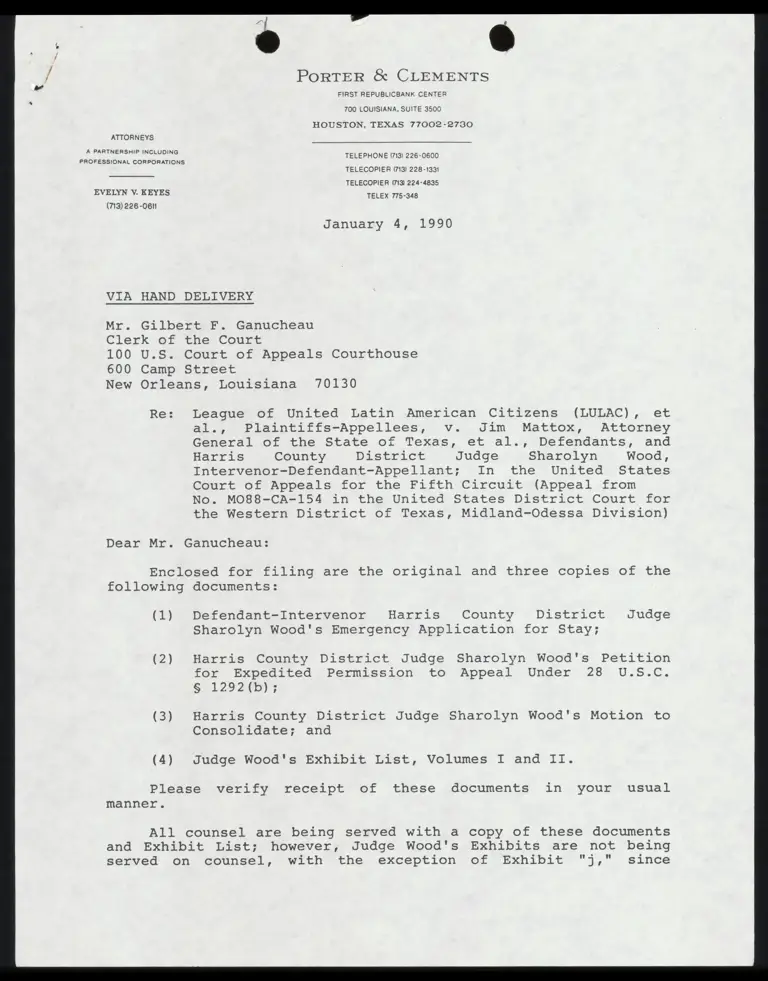
January 4, 1990

VIA HAND DELIVERY


Mr. Gilbert F. Ganucheau
Clerk of the Court
100 U.S. Court of Appeals Courthouse

600 Camp Street
New Orleans, Louisiana 70130

Re: League of United Latin American Citizens (LULAC), et
al., Plaintiffs-Appellees, v. Jim Mattox, Attorney
General of the State of Texas, et al., Defendants, and

Harris County District Judge Sharolyn Wood,
Intervenor-Defendant-Appellant; In the United States
Court of Appeals for the Fifth Circuit (Appeal from
No. MO88-CA-154 in the United States District Court for
the Western District of Texas, Midland-Odessa Division)

Dear Mr. Ganucheau:

Enclosed for filing are the original and three copies of the
following documents:

(1) Defendant-Intervenor Harris County District Judge
Sharolyn Wood's Emergency Application for Stay:

(2) Harris County District Judge Sharolyn Wood's Petition
for Expedited Permission to Appeal Under 28 U.S.C.

§.1292(b);

(3) Harris County District Judge Sharolyn Wood's Motion to
Consolidate; and

(4) Judge Wood's Exhibit List, Volumes I and II.

Please verify receipt of these documents in your usual

manner.

All counsel are being served with a copy of these documents
and Exhibit List; however, Judge Wood's Exhibits are not being
served on counsel, with the exception of Exhibit "j," since


PorTER & CLEMENTS

Mr. Gilbert F. Ganucheau

January 4, 1990
Page -2-

counsel have previously been served with copies of all other
exhibits.

Thank you for your attention to this matter.

Sincerely yours,

Zn Ve
Evelyn V. Keyes

EVK/cdf

enclosures

cC: Mr. William L. Garrett
Ms. Brenda Hall Thompson
Garrett, Thompson & Chang
Attorneys at Law

8300 Douglas, Suite 800
Dallas, Texas 75225

Mr. Rolando L. Rios
Southwest Voter Registration &

Education Project
201 N., St, Mary's, Suite 521
San Antonio, Texas 78205

Ms. Susan Finkelstein
Texas Rural Legal Aid, Inc.
201 'N. St. Mary's, Suite 600

San Antonio, Texas 78205

Mr. Julius Levonne Chambers

Ms. Sherrilyn A. Ifill
NAACP Legal Defense and Educational Fund,
99 Hudson Street

16th Floor

New York, New York 10013

Ms. Gabrielle K. McDonald
Matthews & Branscomb

301 Congress Ave., Suite 2050
Austin, Texas 78701

Inc.


PorTER & CLEMENTS

Mr. Gilbert F. Ganucheau
January 4, 1990
Page -3-

Mr. Jim Mattox, Attorney General of Texas
Ms. Mary F. Keller, First Assistant Attorney General
Mr. Renea Hicks, Spec. Assistant Attorney General
Mr. Javier Guajardo, Spec. Assistant Attorney General
P. O. Boxi'12548
Capitol Station
Austin, Texas 78701

Mr. Edward B. Cloutman, III

Mullinax, Wells, Baab & Cloutman, P.C.
3301 Elm Street

Dallas, Texas 75226-1637

Mr. E. Brice Cunningham
777 80. "R.1L. Thornton Frwy., Suite 121
Dallas, Texas 75203

Mr. Robert H. Mow, Jr.

Hughes & Luce
2800 Momentum Place

1717 Main Street
Dallas, Texas 75201

Mr..John L. Hill, Jr.

Liddell, Sapp, Zivley, Hill & LaBoon
3500 Texas Commerce Tower
Houston, Texas 77002-3095

Mr. Darrell Smith
Attorney at Law

10999 Interstate Hwy. 10, #905
San Antonio, Texas 78230

Mr. Michael J. Wood
Attorney at Law
440 Louisiana, Suite 200
Houston, Texas 77002


IN THE UNITED STATES COURT OF APPEALS
FOR THE FIFTH CIRCUIT


NO.


LEAGUE OF UNITED LATIN AMERICAN CITIZENS (LULAC) , et al.,,

Plaintiffs-Appellees,

versus

JIM MATTOX, Attorney General of the State of Texas, et al.;

Defendants,

and HARRIS COUNTY DISTRICT JUDGE SHAROLYN WOOD,

Intervenor-Defendant-Appellant.


DEFENDANT-INTERVENOR HARRIS COUNTY DISTRICT
JUDGE SHAROLYN WOOD'S EMERGENCY APPLICATION FOR STAY


PORTER & CLEMENTS
J. Eugene Clements
Evelyn V. Keyes
3500 NCNB Center
P.O. Box 4744
Houston, Texas 77210-4744

Nh (713) 226-0600

ATTORNEYS FOR HARRIS COUNTY
DISTRICT JUDGE SHAROLYN WOOD


IN THE UNITED STATES COURT OF APPEALS
FOR THE FIPTH CIRCUIT


NO.


LEAGUE OF UNITED LATIN AMERICAN CITIZENS (LULAC), et al.,

Plaintiffs-Appellees,

versus

JIM MATTOX, Attorney General of the State of Texas, et al.,

Defendants,

and HARRIS COUNTY DISTRICT JUDGE SHAROLYN WOOD,

Intervenor-Defendant-Appellant.


DEFENDANT-INTERVENOR HARRIS COUNTY DISTRICT
JUDGE SHAROLYN WOOD'S EMERGENCY APPLICATION FOR STAY


Defendant/Appellant Harris County District Judge Sharolyn

Wood ("Judge Wood") files this Emergency Application for Stay

pending appeal pursuant to Federal Rule of Appellate Procedure 8

and 28 U.S.C. §§ 1292(a) (1) and 1292(b), and in support of her

Application shows the Court the following:

I. BACKGROUND


This Voting Rights Act case was brought by the League of

United Latin .American Citizens ("LULAC") and named black and

Hispanic individuals challenging the system of electing state


district judges in certain target counties in Texas. In its

Memorandum Opinion and Order of November 8, 1989 (the "Opinion"),

the district court declared that Texas' system of electing state

district judges from county-wide districts illegally dilutes the

votes of blacks and/or Hispanics in all nine counties targeted by

the Plaintiffs. A copy of the Opinion with subsequent amendments

to correct for clerical errors is filed herewith as Exhibit "c".

1 / In that Opinion the district court took under advisement the

question of a possible injunction against future district judge

elections in the target counties under the system it had declared

illegal. The court also indicated that it would consider

granting an expedited appeal on controlling issues of law

addressed in the Opinion if the Texas legislature failed to

produce a remedy in a special session previously called for

November, 1989 to address another matter. Opinion at 93-94.

The Governor of Texas reported to the Court on December 11,

1989 that no consensus could be reached in the Texas legislature

on a remedial plan. Subsequently, Judge Wood filed a motion for

stay of all further proceedings in the district court together

with a motion for certification for interlocutory appeal. A copy

‘of Defendant-Intervenor Harris County District Judge Sharolyn

Wood's Motion for Certification for Interlocutory Appeal and


1/ Copies of all relevant documents filed with the district court are filed
herewith under separate cover, as required by Fed. R. App. P. 8 and loc.
BR. 8.


Motion for Stay is filed herewith as Exhibit "el." By its Order

of January 2, 1990 (the "Order") the district court certified the

Opinion for expedited interlocutory appeal but denied Judge

Wood's motion for stay. A copy of the Order of January 2, 1990

is filed herewith as Exhibit "f". By that Order the district

court also enjoined the

calling, holding, supervising and certifying elections
for State District Court ‘Judges in Harris, Dallas,
Tarrant, Bexar, Travis, Jefferson, Lubbock, Ector and
Midland Counties under the current at-large scheme.

Exhibit "£" "at 5.

Il. GENERAL OBJECTIONS TO THE DISTRICT COURT'S
INJUNCTION AND REMEDIAL PLAN


In general, Judge Wood objects to the district court's

injunction prohibiting any future elections under Texas' consti-

tutionally and statutorily authorized judicial election system in

the nine target counties and its imposition of its remedial plan

literally on the date of the filing deadline for state district

judge races. The district court took these actions without a

hearing, less than eight weeks after the court's November 8, 1989

Opinion finding liability, and without any prior opportunity for

the Defendants to appeal the serious and controversial issues of

‘law decided by the district court. Moreover, Judge Wood believes

and has argued repeatedly that any "interim" plan is de facto a


final remedial plan since it effectively partially dismantles the

state's judicial election system.

In addition, Judge Wood is unable to find any authority to

support the district court's imposition of any interim remedial


plan. The district court cites the Court's opinion in Chisom v.


Roemer, 853 -P.24 1186, 1192 (5th Cir. 1988), as authority for

this unprecedented action. Judge Wood's reading of Chisom is

exactly the opposite of the district court's. For example, at

the very page cited by the district court as support for imposi-

tion of an interim plan, Chisom mandates that, in the event a

district court finds a Voting Rights Act violation, the responsi-

ble state authorities [in this case the Texas legislature and/or

State Districting Board] be given an opportunity to correct any

constitutional or statutory defect before the court attempts to

draft a remedial plan. Chisom continues,

In the interim we are convinced that the system in
place for the election of the subject judicial officer
should be left undisturbed.

853 F.2d at. 1192.

IIT. SPECIFIC OBJECTIONS TO THE DISTRICT COURT'S
INTERIM PLAN


The district court's remedial plan adopts most of the

essential features of a "Proposed Remedial Plan" agreed upon by

the Plaintiffs and Texas Attorney General Jim Mattox ("Mattox"),

a Defendant in this case and counsel for the State Defendants. A

copy of the Proposed Remedial Plan is filed herewith as Exhibit
\

"d." This proposed Plan was vigorously opposed by Judge Wood and

other Defendants. See Exhibits "d2"-"d3". Judge Wood's objec-

tions to the Plaintiffs' and Mattox's Plan and her objections to

Mattox's collusion with the Plaintiffs and his dodflices of

interest in preparing that Plan are more fully discussed in her

Petition for 1Interlocutory Appeal at 6 through 9 and are


incorporated herein by this reference. Judge Wood's specific

objections to the Plaintiffs' and Mattox's Plan itself--most of

which apply to the Interim Plan adopted by the district court--

are fully set out in Exhibit "d2" and are incorporated herein by

this reference.

In addition to its injunction against the calling, holding,

supervising and certifying elections in the nine target counties,

the district court's Interim Remedial Plan, insofar as it affects

Harris County, provides as follows:

31. The ‘entire county shall be divided into ' sub-
districts.

Comment : As to ‘Harris County, ‘there’ was .no
violation alleged or proof adduced except as to
black voters. There is therefore no reason to
devise a "remedy" that cures no ill for areas of
Harris County other than those areas which satisfy
Gingles I criteria for one or more black electoral
districts.

District Court Elections shall be selected from
existing State Legislative House Districts.

Comment: The assignment of judges to legislative
districts was proposed by the Plaintiffs and
adopted by the district court. Judge Wood has
already objected to this feature of the Plan on
numerous grounds. See Exhibit "d2." Among her
objections are the following: the assignment of
judges to legislative districts blatantly allots
legislators patronage power over judges and bears
no relationship to any proof presented at trial
regarding the demographic makeup of potential
minority districts. Specifically, it bears no
relationship whatsoever to the maps of majority
black neighborhoods relied on by the Plaintiffs to
prove vote dilution in Harris County.

Thirty-six (36) [out of 59] Harris County District
Judge seats are up for election in 1990. Each
District will receive one or two judges, as set
out in Attachment A to the Interim Plan.


Comment: Attachment A was adopted from the
Plaintiffs' Plan. It assigns two district judges
to Judicial districts selected by the Plaintiffs
for their heavily Democratic partisan history and
their large minority populations. Republican and
Anglo House Districts are allotted one judge. The
result is that minority areas of Harris County are
allotted 61% of the total judgeships--a gross
departure from equity, from equal protection of
the laws, from due process, and from the principle
of one-man, one-vote. The blatant unconstitution-
ality of such a provision was pointed out by Judge
Wood in Exhibit "42."

Each candidate shall run within a designated
subdistrict and be elected by the voters within
the subdistrict.

Comment : This provision ensures that all 1990
voters will be deprived of due process and equal
protection of the laws under the Interim Plan
since they are deprived by court fiat of the right
to elect 34 or 35 judges (depending on whether
they reside in heavily Democratic and minority
legislative districts or not) out of 36 judges who
have jurisdiction over them. If this is found
unconstitutional, hundreds of judgments and
criminal convictions may become invalid, causing
chaos.

Elections shall be non-partisan. Each candidate
shall select the election subdistrict in which he
or she will run by designated place and shall file
an application for a place on the ballot with the
appropriate court officer.

Comment: This provision invokes a remedy--non-
partisan elections--not sought by any party to
this suit and bitterly opposed by the Plaintiffs
and Mattox. See "Statement Concerning Non-
Partisan Elections as an Aspect of an Interim
Remedy" and Letter from Plaintiff Jesse Oliver to
Judge Bunton, dated December 28, 1989, attached
thereto, filed herewith as Exhibit "i1." This
opposition to non-partisan elections by the
Plaintiffs is especially ironic since they argued
throughout trial that partisanship was irrelevant
to claims of vote dilution under § 2 of the Voting
Rights Act and the court agreed. See Opinion
at 80.


Judge Wood, of course, has argued from the
day she was allowed to intervene that partisanship
and not race explains state district judge
election results in Harris County (a position
given support by the Plaintiffs' voluble objec-
tions to non-partisan elections). However, Judge
Wood has also argued that, under the authority of
Whitcomb v. Chavis, 403 U.S. 124, 91 S.Ct. 1858
(1971), the inability of a minority group to elect
representatives of its chosen political party does
not support a valid vote dilution claim. Thus, if
partisanship, and not race, explains Harris County
district judge elections, the Plaintiffs have no
valid vote dilution claim and the district court's
£2inding, of : liability under § 2 of the Voting
Rights Act was error. For a fuller discussion of
this issue, see Defendant Wood's Post Trial Brief,
filed herewith as Exhibit "bl" at 34-39, .and
Exhibit "i2" at 47.


Moreover, no claim was ever made in this case
for non-partisan election districts and no showing
was ever made that such a "remedy" for vote
dilution would improve the lot of minority voters.
To the contrary, in the Attachment to Exhibit
"il," Plaintiff Jesse Oliver argues that non-
partisan elections dilute minority voting
strength.

In addition, under this provision of the
district court's plan, candidates are forced to
run for office without any knowledge of how--if at
all--Harris County's specialized court system will
function under the court's plan. Thus, either
{1) a candidate will file for office .in one
district only to discover later that he has filed
in a family court district [since voters in, say,
HD 149 will turn out to be assigned a family court
judge] while he is a sitting criminal district
judge or (2) a sitting criminal district judge
will file for office as such only to discover
later that the court-imposed plan silently
abolishes all specialized «courts, in direct
violation of Texas law.

Moreover, imposition of a non-partisan
election scheme in mini-districts is certain . to
result in the development of control over judges
by organized special interest groups. The removal
of party identification deprives most voters
(demonstratively at least 80% in Harris County) of
their only previous means of choosing judges,


party identification, without putting any way of
identifying candidates in its place, even as it
deprives candidates of the party identification
and support on which they have previously relied
to fund their campaigns. The inevitable result
will be control over judicial selection by special
interest factions with sufficient interest and a
sufficient budget to blanket their preferred
mini-districts with advertisements or direct
appeals for their slates. This feature of the
Interim Plan also provides an incentive for
factions to introduce racism into campaigns where
there is no evidence whatsoever that it previously
existed, since race can provide a means of
identifying with otherwise unknown judicial
candidates.

All terms of office shall be for four (4) vears.

Comment: This provision contradicts the express
desire of the Plaintiffs for two year terms for
judges elected under the Interim Plan. Sce
Exhibit Mal.” In Judge Wood's view it ensures
maximum disruption of the present system of
electing judges by providing that half of all
state district judges elected under the plan
cannot be removed from office for four years.
Thus, for four years, legislative districts must
remain ‘as judicial districts regardless of
attempts by the Texas Legislature or Judicial
Districts Board to devise a plan that would
satisfy the district court. Any attempt to do
away with these districts would subject the state
to charges of unconstitutionally depriving those
judges of their property interest in their
continued tenure in the offices to which they were
elected. See Williams v. State Board of Elec-
tions, 696%. Supp. 1563, 1572 (N.D, Ill. 1988).


Elections shall take place the first Saturday of
May, 1990, with Run-off Elections to take place
the first Saturday of June, 1990.

Comment: The < district court's Interim Plan
requires a special election for district court
judges, in contrast to the plan proposed by the
Plaintiffs and Mattox. Thus it provides a remedy
no one sought and which has no support in the
record as a vehicle for maximizing minority voting
strength. This provision of the Plan has at least
the additional legal and practical defects of
(1) requiring voters to go to the polls five times


to elect Judges--twice to pick district court
judges, twice to pick other county and appellate
Judicial candidates and finally to vote in the
general election; (2) requiring a special election
for which there is no provision in any county's
budget (See Appendix "B") and which jettisons the
entire legislative machinery for organizing and
financing of primary elections set out in Title 10
of the Tex. Elec. Code, subtitles B and C, and the
tabulation of results of election, Tex. Elec. Code
§ 68.001; and (3) requiring a run-off one month
later, thus leaving too little time for the county
to comply with Texas Election Code requirements
regarding canvassing of votes. S67.012.
Moreover, under the Texas Election Code, the
political parties bear these expenses. See Title
10, "Tex. . Blec. Code, § 173.001, et. seq. The
district court's plan blithely ignores the
question of who pays. It also ignores the
question of when the judges elected under the
Interim Plan take office. If immediately, their
election unconstitutionally deprives the incumbent
judges of a half-year in office to which they have
been duly elected. See Williams, 696 F.Supp. at
1572.


An application for a place on the non-partisan
election ballot must be filed by 6:00 p.m. March
26,1.1990, Except as modified by the district
court's plan, all provisions of the Texas Election
Code remain applicable.

Comment: It is impossible to determine which, if
any, provisions of the Texas Election Code
actually remain applicable under this plan since
it tramples on so many of them. For example, the
Plan leaves entirely unclear whether any filing
fee (previously paid to the county party chairman)
will be required or whether any petition will
suffice to obtain a place on the ballot and
whether previous filings of fees and petitions
with the appropriate authorities under Texas law
will count, See Tex. Elec. Code $$ 172.021
(Application Required); 162.022 (Authority With
Whom Application Filed); 141.062 (Validity of
Petition); 172.025, These problems can be
expected to generate litigation regarding the
proper filing of candidates for office.

In 1991, the Administrative Judge of the county-
wide district shall designate any courts of
specialization and the district court numbers in


10.

use ‘prior toi the Interim. Plan's . adoption.
Successful incumbents shall have preference in the
designation.

Comment: This provision of the plan allows the
Administrative Judge, apparently at his sole
discretion, to make any arbitrary decision he
wishes as to which judges are assigned to which
specialized courts, heedless of Texas Statutes
providing specifically for such designated
courts--and to make that decision in 1991, after
the newly elected judges take office, thus
ensuring maximum administrative chaos and venue
and jurisdictional disputes of horrendous propor-
tions. The provision also blatantly violates the
Court Administration Act, Chp. 74, .Tex. Gov't
Code, which provides, among other pertinent
things, that the Texas Supreme Court shall have
supervisory and administrative control over the
judicial branch (§ 74.021); that the Supreme Court
may adopt rules for the operation and management
of the court system (§ 74.024); and that the state
is divided into nine multi-county administrative
regions (§ 74.042). That Act minutely prescribes
the duties of the presiding judge of each adminis-
trative region (§ 74.046). It also sets out in
detail which judges are subject to assignment by
the presiding judge of the administrative region
(§ 74.054). All of these provisions suffer gross
abuse under the district court's Interim Plan.
See also Comment to provision 5.


Current Jurisdiction and venue remain unaffected
subject to modification by the Supreme Court of
Texas.

Comment: For the jurisdictional and venue
problems raised by the Interim Plan, see Comment
to provision 4 supra. In addition, the Interim
Plan creates grave jury selection problems. See
Williams v. Superior Court of Los Angeles County,
263 Cal. Rptr. 503, 781 P.2d 537 (1989) (In Banc)
(for purposes of the sixth amendment right to a
jury drawn from a cross-section of the community,
the relevant community is the judicial district).
Under Williams (apparently the only case decided


on the subject), the court's Interim Plan creates
an ambiguity as to whether the "judicial district"
is the mini-election district or the county-wide
jurisdictional district, hence whether the
relevant community for jury selection purposes is
the mini-district’ or the county-wide district.


Williams raises the specter that mini-communities
drawn on racial lines are perhaps the only
appropriate community for jury selection under the
district court's Interim Plan.


There shall be no right of recusal of Judges
elected under this plan, since "such a measure
would be extremely disruptive to District Court
dockets, administratively costly and could be the
source of abuse by attorneys attempting to gain
continuance of their cases."

Comment: The district court, which departs from
the Plaintiffs' and Mattox's Proposed Interim Plan
on this issue, ignores the real fear that such a
Plan as this without a right of recusal ensures
that litigants from outside the mini-districts
facing opponents from the mini-district will have
to trust to the impartiality of a judge who is
indebted for his office to the favor of his few
constituents and is, in a real sense, the "rep-
resentative" of their interests. Judge Wood has
argued since her intervention into this case that
this precise danger follows naturally on the
proposition that judges are "representatives" of
their constituents and that subdistricts should
therefore be drawn so that the votes of those
constituents in support of their own interests can
have maximum impact, a view hitherto enthusias-
tically embraced by the Plaintiffs.

IV. GROUNDS FOR INJUNCTION AND STAY


To obtain a stay pending appeal under Fed. R. App. P. 8, a

moving party must demonstrate

(1) that it is likely to succeed on the merits,

(2) that it would suffer irreparable injury if the
stay were not granted,

(3) that granting the stay would not substantially
harm the other parties, and

(4) that granting the stay would serve the public
interest. :

National Treasury Employees Union v. Von Raab, 808 F.2d 1057,


1059 (5th Cir. 1987). However, when a serious legal question is


involved, the movant "need only present a substantial case on the

merits ... and show that the balance of equities weighs heavily

in favor of granting the stay." Id. (quoting Baylor Univ. Med.


Center, 711 FP.24 38, 39 (5th Cir. 1983), cert, denied, 469 1.8.


1189, 105 s.Ct. 958 (1988)). The criteria for an injunction

prohibiting operation of the district court's Interim Remedial

Plan and for a stay of all further district court proceedings

pending appeal are fully met in this case, as set forth below.

A. Judge Wood Presents A Substantial Case Which
Is Likely To Succeed On The Merits.


In her Petition for Permission to Appeal to this Court,

filed simultaneously with this Motion and incorporated herein by

this reference, Judge Wood states more fully the grounds for her

contention that the lower court's decision was clearly erroneous

on numerous points of law, both with respect to Texas' judicial

election system in general and with respect to Harris County in

particular. In Judge Wood's view, the lower court erred in at

least the following ways: (1) it unconstitutionally applied the

Voting Rights Act to state judicial elections in violation of the

constitutional principles of the separation of powers and the

equal protection clause of the fourteenth amendment; (2) it found

that the election of independent judges from overlapping county-

wide Judicial districts constituted election from "at-large"

districts with no supporting authority and despite authority to

the contrary; (3) it held that illegal vote dilution was proved

by statistical evidence (which itself was improperly admitted) in

selected races and that all “other inquiry was "legally


incompetent" in defiance of both Supreme Court and Fifth Circuit

controlling authority directly to the contrary; (4) it held that

the principle of one-man, one-vote did not apply to judicial

elections despite Supreme Court authority that the principle of

one-man, one-vote applies to the election of all "representa-

tives"; (5) it determined the measure of "electoral success" of

protected classes according to their percentage of population,

rather than using Ward's Cove's percentage of qualified candi-


dates as the standard, thus implementing proportional representa-

tion in direct contravention of the proviso of § 2 of the Voting

Rights Act: and (6), “in Harris County, it found illegal vote

dilution without pragmatic proof of unequal opportunity for black

voters to participate in judicial elections and to elect judges

of their choice, finding vote dilution instead solely through its

reliance on unverified, unauthenticated and thoroughly unreliable

statistical data derived from census tract figures a decade old.

Moreover, as an interim remedy for the vote dilution it had

found in this case, the district court adopted for the most part

a remedial plan which was urged in the utmost cynicism by

Plaintiffs eager to implement affirmative action and restructure

Texas' judicial election system before this Court could rule on

the many grave disputed issues of law. Judge Wood has objected

to Mattox's and the Plaintiffs' Proposed Interim Plan and to the

aspects of the district court's Plan not adopted from the

Plaintiffs and Mattox's Plan on numerous constitutional, statu-

tory and practical grounds as set forth above in Exhibit "d2" and

above.


If this Court finds that the lower court's decision was

clearly erroneous with respect to even one of the questions of

law cited by Defendant Wood, the lower court's decision must be

reversed. Judge Wood's arguments and citations provide over-

whelming grounds for finding that the lower court's opinion was

clearly erroneous and that its remedial plan is similarly riddled

with error.

B. Judge Wood Will Suffer Irreparable Harm if
Her Motion Is Not Granted, Whereas A Stay
Will Not Substantially Harm The Plaintiffs.


The timing of the district court's injunction prohibiting

elections in the target counties under Texas' constitutionally

and statutorily mandated election system and its imposition of a

radically different scheme which violates numerous laws and

constitutional principles within six hours of the filing deadline

for state district judge positions presents an imminent threat of

irreparable harm to Judge Wood by its precipitate irremediable

destruction of the judicial election system she defends. By

contrast, should the 1990 judicial elections be allowed to

proceed as they have for a century, no significant damage will

have been done to the Plaintiffs in this suit, even should the

district court's opinion ultimately be upheld, and the stability

of the judicial system will be protected pending appeal.

Under very similar circumstances, this Court has held that

irreparable injury to the Plaintiffs is not automatically

established merely by a showing that a challenged electoral

standard, practice, or procedure results in a denial or


abridgement of a minority group's right to vote. Chisom wv.


Roemer, 853 F.2d 1186, 1138-89 (5th Cir. 1958) (vacating injunc-

tion prohibiting election of justices to the Louisiana Supreme

Court under election system found by the district court to

violate the Voting Rights Act). In refusing to issue an injunc-

tion in Chisom, the Court quoted Justice Black in Oden Vv.


Brittain, 396 U.S. 1210 (1969) as follows:


In awarding or withholding immediate relief, a court is
entitled to and should consider the proximity of a
forthcoming election and the mechanics and complexities
of state election laws, and should act and rely upon
general equitable principles. With respect to the
timing of relief, a court can reasonably endeavor to
avoid a disruption of the election process which might
result from requiring precipitate changes that could
make unreasonable or embarrassing demands on a State in
adjusting to the requirements of the court's decree.

chisom, 853 F.24 at 1189,

The only possible injury--if it is an injury--to the

Plaintiffs from this Court's vacating the district court's

injunction and imposition of the remedial plan and staying

further proceedings in that court is that judges will be elected

for one more election under a 100-year old system which the

district court has found to be statutorily, but not constitution-

‘ally, infirm. The Chisom court, facing just such a situation,

stated:

We consider significant the Supreme Court's action
in [Whitcomb v.] Chavis [403 U.S. 124, 91 S.Ct. 1858


(1971)]. In staying the reapportionment plan ordered
by a three-judge court, the Supreme Court permitted the
conduct of an election under the old scheme which had
been found constitutionally infirm. In dissenting from
the refusal to vacate their stay order, Justice Douglas
pointedly stated: "The State contends that without a
stay it will be forced to conduct the forthcoming


election under the reapportionment plan of the District
Court. By granting the stay, however, this Court has
equally forced the appellees to go through the election
under the present scheme which was held unconstitu-
tional by the District Court." 396 U.S. 1064, 90 S.Ct.
761, 24 L.Ed.2d 757. Nonetheless the court permitted
the election to proceed.

Chisom, 853 7.24 at 1189. For the same reasons, this Court

should vacate the district court's injunction against further

elections under Texas' present system of electing State district

judges from county-wide districts and it should stay all further

proceedings in the district court, including the promulgation or

implementation of any remedial plan, pending appeal.

C. A Stay Will Serve The Public Interest.


A stay barring implementation of the district court-ordered

remedial plan and all further proceedings in the district court

pending appeal is essential in order that the public interest be

truly served. In the short time since the district court's

declaratory judgment was entered--six weeks--this case has

generated immense controversy both in the halls of government and

in the press. Numerous interested persons--including the

Governor, the Chief Justice of the Texas Supreme Court, Tarrant

and certain Bexar County Judges, and various legislators and

‘district judges--have come forward with their own hastily

conceived proposals, each designed to protect interests the

designer perceives as paramount. None of these many proposals

has had an opportunity to generate any popular support beyond the

promulgators themselves. All will be rendered unnecessary should

this Court determine that the illegal vote dilution perceived by


the ‘district court does not, in fact, exist, that that court's

judgment was improper and that Texas' system of electing state

district judges violates no laws--a decision which Judge Wood

believes, and has argued, is fully supported by the law.

Should this Court eventually uphold the district court's

ruling, the public interest would still be served by protecting

an orderly and stable judiciary and judicial system while

permitting time for rational debate on the crucial issues of

state government involved and by permitting time for the people

of Texas to consider the proposals presented to them and to vote

on the constitutional amendment which would then be required.

The public interest is only disserved--and in the most grievous

fashion--by permitting the implementation of a radical, hastily

conceived, self-serving plan designed to "remedy" vote dilution

(which this Court may well find does not exist) at the expense of

all voters and judges in Texas' nine most populous counties.

V. GROUNDS FOR EMERGENCY RELIEF


The disastrous effects of the district court's Interim Plan

on judicial selection in the State of Texas cannot be overstated.

That Plan was issued and took immediate effect only six hours

‘before the filing deadline for the office of state district

judges on January 2, 1990. The judicial candidates had therefore

filed for election before the district court's order became

public. In effect, the district court is altering an election

already in progress. Among the many reasons for this Court to

enjoin the imposition of the district court's Interim Plan and to

i117


require that state district judge elections go forward as

previously scheduled are the following:

(1) Time is of the essence in determining whether
Texas' statutory judicial election system shall
apply. The primary election of state district
judges under Texas' statutorily decreed election
system is March 13, 1990. Under the Texas
Election Code absentee voting must begin on the
twentieth day before the election, Tex. Elec. Code
§ 85.001(a). Therefore, ballots must be prepared
and ready for absentee voting to begin on or
before January 12, 1990--a date less than ten days
away.

(2) The Texas Election Code § 142.010 requires the
certification of candidates for judicial office
not later than the 55th day before election day,
i.e., under Texas' statutory system of electing
state district judges, not later than January 12,
1990.

(3) If any candidates request a refund of his regis-
tration fee for filing in the old districts
outlawed under the district court's Plan and then
this Circuit orders a stay those candidates may be
ineligible to run for state district judge at all
because of improper registration. See Tex. Elec.
Code § 141.062.

(4) The chaos which would be created by the Court's
untried interim plan may well frustrate experi-
enced judges into early retirement or cause fluke
election victories where judges with many years of
service are cavalierly sacrificed to newcomers
with dubious reputations and credentials.

In addition, the pragmatic nuts-and-bolts problems of

‘adjusting Texas' and Harris County's electoral machinery to the

Court's unique and unprecedented interim plan, within three

months of a new filing deadline, four months of an election, and

five months of a run-off are underscored by the obstacles

presented in the letter of the Texas Secretary of State attached

hereto as Appendix A, the affidavit of Harris County Judge Jon

- 18 =


Lindsay attached hereto as Appendix B, and the affidavit of

Harris County Clerk Anita Rodeheaver attached hereto as

Appendix C.

These immediate results of the district court's injunction

prohibiting elections under Texas' constitutionally and statuto-

rily authorized judicial district election system and its

imposition of a hastily devised, unsought and untested remedy

approved by no one but itself do not by any means exhaust the

reasons for this Court to act swiftly--the overriding reason

being, of course, the inevitable day-by-day accumulation of

disastrous consequences and uncertainties from this shot scat-

tered at the Texas judicial election system by the district

court.

WHEREFORE, for the foregoing reasons, Defendant Harris

County District Judge Sharolyn Wood requests that this Court

vacate the district court's order enjoining the election of

Texas' state district judges under the present system in the nine

target counties at issue in this suit, including Harris County;

that it stay the implementation of the Interim Plan adopted by

the district court; and that it stay all further proceedings in

‘the district court, including without limitation the promulgation

or implementation of any other remedial plan, pending appeal of

the district court's Memorandum Opinion and Order of November 8,

1989 as amended.

--19 -


Respectfully submitted,

PORTER & CLEMENTS


. Bugene Clements
velyn V. Keyes
300 NCNB Center

+O. Box 4744

Houston, Texas 77210-4744

(713) 226-0600

ATTORNEYS FOR HARRIS COUNTY
DISTRICT JUDGE SHAROLYN WOOD

OF COUNSEL:

Darrell Smith
Attorney at Law

10999 Interstate Hwy. 10, #905
San Antonio, Texas 78230
(512) 641-9944

Michael J. Wood

Attorney at Law
440 Louisiana, Suite 200
Houston, Texas 77002

(713) 228-5105

CERTIFICATE OF SERVICE


I hereby certify that on the YA aay of January, 1990, a
true and correct copy of the above and foregoing document was
mailed to counsel of record in this case by first class United
States mail, postage prepaid, addressed as follows:

Mr. William L. Garrett
Ms. Brenda Hall Thompson
Garrett, Thompson & Chang
Attorneys at Law
8300 Douglas, Suite 800
Dallas, Texas 75225

20


Mr. Rolando L. Rios
Southwest Voter Registration &

Education Project
201 ‘MN. St. Mary's, Suite 521
San Antonio, Texas 78205

Ms. Susan Finkelstein
Texas Rural Legal Aid, Inc.
201 N. St. Mary's, Suite 600
San Antonio, Texas 78205

Mr. Julius Levonne Chambers
Ms. Sherrilyn A. Ifill
NAACP Legal Defense and Educational Fund, Inc.
99 Hudson Street

16th Floor

New York, New York 10013

Ms. Gabrielle K. McDonald
Matthews & Branscomb

301 Congress Ave., Suite 2050
Austin, Texas 78701

Mr. Jim Mattox, Attorney General of Texas
Ms. Mary F. Keller, First Assistant Attorney General
Mr. Renea Hicks, Spec. Assistant Attorney General
Mr. Javier Guajardo, Spec. Assistant Attorney General
P., O. Box 12548
Capitol Station
Austin, Texas 78701

Mr. Edward B. Cloutman, III

Mullinax, Wells, Baab & Cloutman, P.C.
3301 Elm Street
Dallas, Texas 75226-1637

Mr. E. Brice Cunningham
777 So. R.L. Thornton Freeway
Suite 121
Dallas, Texas 75203

Mr. Robert H. Mow, Jr.

Hughes & Luce
2800 Momentum Place

1717 Main Street
Dallas, Texas 75201

Se V. /Keyes


WO005/03/cdf

- 21.


4 3 1 ’


EXECUTIVE DIVISION
P.O. Box 12697
Austin, Texas 78711-2697
(512) 463-5701

ELECTIONS DIVISION

P.O. Box 12060

Austin, Texas 78711-2060
(512) 463-5650

Disclosure Filings
P.O. Bax 12070
Austin, Texas 78711-2070
(512) 463-5704

DATA SERVICES
DIVISION

P.O. Box 12887

Austin, Texas 78711-2887
(512) 463-5609

SUPPORT SERVICES
DIVISION
Financial Management
P.O. Box 12887
Austin, Texas 78711-2887
(512) 463-5600

Suaff Services
P.O. Bax 12887
Austin, Texas 78711-2887
(512) 463-5600

STATUTORY FILINGS
DIVISION
Corporations
P.O. Bax 13697
Austin, Texas 78711-3697
(512) 463-5555

Siatatory Documents
P.O. Box 12887
Austin, Texas 78711-2887
(512) 463-5654

Texas Register
P.O. Box 13824
Austin, Texas 78711-3824
(512) 463-5561

Uniform Commercial Code

P.O. Box 13193
Ausun, Texas 78711-3193
(512) 475-2705

Office of the

SECRETARY OF STATE
George S. Bayoud, Jr.
SECRETARY OF STATE

eLEUTICONS- 0000: ®


January 4, 1990

The Honorable Jim Mattox
Attorney General
State of Texas
Supreme Court Building
Austin, Texas 78711

RE: Vv A -88-VS-~
ULA UN + V .

UNITED STATES DISTRICT COURT, WESTERN DISTRICT
OF TEXAS, MIDLAND-ODESSA DIVISION

Dear General Mattox:

As I told you in my letter to you of December 21,
1989, I opposed the proposed agreed order which you
were negotiating with the plaintiffs. Among the
reasons were that it would be difficult to ad- minister; some citizens may effectively be dis- enfranchised in elections under the proposed plan;
and my belief that judicial selection is a matter for the Texas Legislature to address. None-the-less, you submitted the plan and the court in great part adopted the plan. Therefore, as a named defendant in the referenced cause, I am instructing you as my
legal counsel to immediately file a Motion for a Stay
of the entire Order dated January 2, 1990. This stay should be sought to be maintained until full appel-
late review on the merits. I further instruct you to make an interlocutory appeal on all available issues
from such Order. The problems mentioned in that December 21st letter continue to exist under Judge
Bunton's Order.

As Chief Elections Officer of the State, I am en-
trusted with the duty of advising and aeeisting
election authorities with regard to the application,
operation, and interpretation of the Election Code
and election matters generally. There are numerous
problems in implementing the nonpartisan judicial


The Honorable Jim Mattox
Page 2

elections in nine counties in Texas as set out in the order. 2A brief list of only some of these problems is as follows:

(1) Which authority is actually ordering the elections? It appears that Judge Bunton is ordering the elections as his order cites on page 7, Item 6:

Section 41.001(b)(5) of the Texas Election
Code which refers to "an election held under
an order of a court or other tribunal...."

(2) There are numerous other questions revolving around the answer to Question (1) above, €.g., who gives notice of the elections; who authorizes the voting systems to be used in the elections; who is the custodian of the election re-
cords; and so forth.

(3) Which election precincts are to be used for the elections?

(4) Who appoints the election judges?

(5) As the elections do not fall within the definition of a "primary election" in Section 1.005(14) of the Election Code, is it to be assumed that there will be no filing fees paid by candidates, no petitions in lieu of filing fees, and no judicial petitions as required in certain counties?

(6) How will the canvass be conducted? Under the Election Code, the Governor is to canvass the returns for a district office. Under Section 67.012 of the Election Code, this state canvass may not be held earlier than the 15th day after the election, i.e., May 20. Absentee voting for the runoff is to begin on May 14 under the provisions of the Elec- tion Code. There is not enough time for the canvass and preparation of ballots for absentee voting to begin for the June 2 runoff. J

(7) Who will be the absentee voting clerks in Ector, Lubbock, and Midland Counties as the elections will not be countywide in those counties?

(8) What will be the procedure to be used if a judge whose term is not on the ballot in 1990 resigns or dies? will the unexpired term be on the ballot in May?

(9) There could be a problem in preserving the election results from the primary runoff in that absentee voting for the May 5 election will begin on April 16 while the runoff is
April 10.


—_—n . y fe I Lr ONS=- 0000:& 4


The Honorable Jim Mattox

Page 3

(10) There is no provision in the Order for a filing of
declaration of write-in candidacy; thus, there will be an
unlimited number of write-in candidates in the elections and
all write-in votes will have to be counted.

(11) Which political subdivision will pay the costs of
conducting the elections? Harris County will have no other
elections on May 5 and the County Clerk estimates the cost for
the election will be some $1 million in Harris County alone.

There are numerous other questions and problems with the implemen-
tation of Judge Bunton's Order which I will not list in the inter-
est of brevity. I am concerned, however, that on Page 4 of the
Order Judge Bunton says:

+. An Agreed Settlement was entered into by and between
the Plaintiffs and Defendants in this matter, but was not
approved by some of the Intervenors.

I would refer you to my letter of December 21, 1989, in which I
objected to that proposed settlement and "request{ed] that you
refrain from entering into such plan and that you refrain from
entering into any other such settlement or plan without my prior
written consent."

As you know, unless the court's order is stayed by mid-January
1990, when candidates have been certified and ballots are being
prepared, the election cycle will have progressed beyond a point
at which it may reasonably be altered. Furthermore, it is impor-
tant that the legislature have a reasonable period of time to
address this issue in a special session. As a result, I need to
know whether you will seek the stay in accordance with my instruc-
tion. I need your response in a timely manner to enable me to seek
independent counsel, without cost to the state, in the event you
will not abide by my instructions. New counsel would need adequate
time to seek a stay before mid-January 1990.

I look forward to hearing from you.

Sincerely,
GSB:TH/blltrs

cc: Judge Lucius D. Bunton, III, Judge, United States District
Court, Western District, Midland-Odessa Division


SENT BY:SECRETARY OF STATE ? Y= 4-QOry Y2: Cy


4

The Honorable Jim Mattox
Page 4

Clerk, United States District
Midland-Odessa Division

Ms. Mary F. Keller
First Assistant Attorney General

Mr. Renea Hicks
Special Assistant Attorney General

Mr. Javier Guajardo
Assistant Attorney General
P. O. Box 12548, Capitol Station
Austin, Texas 78711-2548

Mr. William L. Garrett
Garrett, Thompson & Chang
8300 Douglas, Suite 800
Dallas, Texas 75225

Mr. Rolando Rios
Southwest Voter Registration &

Education Project
201 North St. Mary's, Suite 521
San Antonio, Texas 78205

Ms. Sherrilyn A. Ifill

Court, Western

NAACP Legal Defense and Educational Fund, Inc.
99 Hudson Street, 16th Floor
New York, New York 10013

Ms. Gabrielle K. McDonald
301 Congress Avenue, Suite 2050
Austin, Texas 78701 :

Mr. Edward B. Cloutman, III
Mullinax, Wells, Baab & Cloutman, P.C.
3301 Elm Street
Dallas, Texas 75226-1637

Mr. J. Eugene Clements
Porter & Clements
700 Louisiana, Suite 3500
Houston, Texas 77002-2730

Mr. Robert H. Mow, Jr.
Hughes & Luce
2800 Momentum Place
1717 Main Street
Dallas, Texas 75201


0000:® 5

District,


The Honorable Jim Mattox
Page 5

The Honorable William P. Clements, Jr.
Governor, State of Texas

The Honorable William P. Hobby
Lieutenant Governor, State of Texas

The Honorable Gibson D. Lewis
Speaker of the Texas House of Representatives

The Honorable Thomas R. Phillips
Chief Justice, Supreme Court of Texas


STATE OF «TEXAS

COUNTY OF HARRIS

AFFIDAVIT

BEFORE ME, the undersigned authority, personally appeared
JON LINDSAY, known to me, who upon being by me duly sworn deposed
and said as follows:

My name 1s Jon Lindsay. I am the County Judge of
Harris County, Texas, which office I have held since
January, 1975, I have reviewed the Order of the
United States District Court for the Western District

of Texas in Cause No. 88-CA=-154, styled LULAC Council
4434, et al v. Jim Mattox, et al, signed and entered
by the Court on January 2, 1990, and am familiar with

its terms.

I am extremely concerned, as the chief administrative
officer of Harris County, about the elections ordered
to be held for thirty-six (36) district judges on May
5, 1990, with run-off elections ordered to be held on
June 2, 1990. My concerns involve two primary areas.

First, in my experience, a county-wide election in
Harris County, Texas, costs between $750,000 and
$1,000,000. Harris County 1s not a party to the
above-described action, and the Order makes no

menticn of who is to pay that cost and from what
source of funds. If the run-off election is held,

the cost will be between $30,000 and $40,000 per
district included in the run-off. Because of the
extreme shortness of time between the second primary
election, to be held on April 10, 1990, the first
election ordered on May 5, 1990, and the second
election ordered on June 2, 1990, the costs will be
higher than usual. In order to comply with the
numerous tasks necessary to hold the elections,
overtime personnel will be necessary, and the cost
will be closer to the high end of the range I have
described. Harris County has no money budgeted or
available to hold these additional elections.


Affidavit of Jon Lindsay, January 3, 1990, Page Two

Secondly, the turn out that may be expected in an
unusual, off-date election, will be at most 5% of the
registered voters in each district. This estimate is
based on numerous experiences with county-wide bond
elections held during my time in office as County
Judge. A 5% turn out translates to less than 2,000
votes per legislative district, which means that a
winning judge will be elected with very few more than
1,000 votes. Obviously, special interest groups will
be in a position to seize district court benches by
producing a turn out of "one cause" voters. As
County Judge, I fear for the administration of
Justice in civil and criminal matters, in a system
where judges with county-wide authority, in a county
with 1.3 million registered voters, are selected by
no more than 1,000 voters.

FURTHER AFFIANT SAYETH NOT.


  INDSAY /

SUBSCRIBED AND SWORN TO befor e, m the undersigned authority,
this 3rd day of January, 1990.

ol sROw WN,

. Th. EERE 27 .

  NOTARY PU Lio, State of as

Enh Mp
ZT gn

"60 8, 3
42 TIL


STATE OF TEXAS

COUNTY OF HARRIS

AFFIDAVIT

BEFORE ME, the undersigned authority, personally appeared Anita
Rodeheaver, known to me, who being by me duly sworn, deposed and said as
follows:

My name is Anita Rodeheaver. I am the County Clerk of Harris County,
Texas, which office I have held since January 1, 1978. Pursuant to
Article 51.002(c) of the Texas Election Code, I am the Chairman of the
County Election Board of Harris County, Texas.

I have reviewed the Order of the United States District Court for the
western district of Texas signed and entered on January 2, 1990 in
Cause No. MO-88-CA-154 styled LULAC Council No. 4434, et al vs. Jim
Mattox, et al and am familiar with its terms. My review has raised
serious questions and problems with respect to the elections for
thirty-six (36) district judges, ordered to be held on May 5, 1990
followed by runoff elections ordered to be held on June 2,.1890," “1
will list my concerns, but not necessarily in order of their greatest
significance.

1. A number of routine procedures, which are established and wel]
known in the primary elections and general elections, have become
extremely uncertain under the Order. Is a filing fee required? Is a
petition, ordinarily required for district judges in Harris County,
also required? What form of application will be utilized and who will
promulgate that form? Who will certify the correctness and
completeness of those applications? The applicability of the normal
provisions of the Texas Election Code to these questions is extremely
unclear,

2. Various provisions of the Texas Election Code, too numerous to list
here, defer many decisions concerning the holding of an election to the
"authority calling the election". Who is the authority calling the
election on May 5, 1990 and on June 2, 1990. Until that is determined,
as an elections officer, I am not even able to select a voting system
to be utilized in an election.

3. The Texas Legislature established the date for the regular primary
as March 13, 1990 and the runoff as April 10, 1990. Under the Election
Code, Section 85.001, absentee voting for the May 5, 1990 district
judge election must begin on April 23, 1990, less than two weeks after
the primary runoff. 1 have held more than fifty countywide elections
in my term of office as County Clerk and I believe it will be virtually
impossible to recall all voting equipment utilized in the primary
runoff, have new ballots printed, have the equipment reconstituted and
redelivered to remote voting locations in time for absentee voting.


FURTH

3rd d

4. In my experience, the cost of a countywide election is at least
$750,000.00 and could exceed $1,000,000.00. If a runoff is necessary
in June, the cost would approach $30,000.00 per legislative district.
These estimates are minimum, because the shortness of time will require
me to utilize temporary and overtime personnel to accomplish the
tasks.The budget of my office includes no surplus funds available to be
used to hold these new special elections.

5. The Texas Election Code provides for a canvass of the vote to be
performed not before the 15th day after the election nor after the 30th
day after the election by the governor of the state. Until the canvass
is performed, drawing for positions on the ballot cannot be done nor
can the ballots be printed. The timing of the specially ordered
election and runoff election is such that absentee voting for the
second election must begin on May 14, 1990 while the canvass cannot be
performed until May 20, 1990.

6. Based on my experience with off-date special elections, I would
estimate a voter turnout in the range of 5% to an absolute maximum of
10%. In my opinion, some district judges may be elected by as few as
750 voters while other districts judges would be elected by no more
than 2000 voters. The position of district judge in a county with more
than 1.3 million registered voters is far too important to be filled by
the vote of that small a number of voters.

itis
ANITA RODEHEAVER

ER AFFIANT SAYETH NOT.


SUBSCRIBED AND SWORN TO before me, the undersigned authority, on this
ay of January, 1990.

LW: babi AL iC

  EAR i Notary Pubic, State of Teds
SSR A BN

. . ATTY Lod


IN THE UNITED STATES COURT OF APPEALS

FOR THE FIFTH CIRCUIT


LEAGUE OF UNITED LATIN AMERICAN CITIZENS (LULAC), et al.,

Plaintiffs-Appellees,

versus

JIM MATTOX, Attorney General of the State of Texas, et al.,

Defendants,

and HARRIS COUNTY DISTRICT JUDGE SHAROLYN WOOD,

Intervenor-Defendant-Appellant.


HARRIS COUNTY DISTRICT JUDGE SHAROLYN WOOD'S
PETITION FOR EXPEDITED PERMISSION TO

APPEAL UNDER 28 U.S.C. § 1292()b)


PORTER & CLEMENTS
J. Eugene Clements
Evelyn V. Keyes
3500 NCNB Center
P.O. Box 4744
Houston, Texas 77210-4744

(713) 226-0600

ATTORNEYS FOR APPELLANT

HARRIS COUNTY DISTRICT JUDGE

SHAROLYN WOOD


II.

A.

B.

C.

TABLE OF CONTENTS


The Standard of Proof of Vote Dilution
Claims Under Thornburg v. Gingles...... «+


The District Court's Controlling
conclusions ‘Of LaWiee.. see Berens vin'e vba


Disputed Questions of Law Raised
by the District Court's .Conclusions:.....


A SUBSTANTIAL BASIS EXISTS FOR DIFFERENCES

OF OPINION ON THE QUESTIONS OF LAW INVOLVED..

A. § 2 Of The Voting Rights Act Does Not
Apply To The Judiciary And Would be
Bnconstitutional 1f It Did S0.secccecevisse


§ 2 Does Not Apply To Independent
Overlapping County-Wide Judicial
EE aC tI ON DE Ctr OES. vines vmis sis no visits inns


Gingles 2 And 3 Are Not Proved By
Abstract Statistical Inquiry With
All Other Inquiry Being Irrelevant.......


Unopposed Election Contests And
White Versus White Contests Are
Germane To The Statistical Analysis
Of Vote DIIution Claim... eeossseoneovnnss


The Concept Of One-Man, One-Vote
Applies To Judicial EleChionG.v.seves esos


The Pool Of Minority Class Members
Eligible To Hold Judicial Office
Rather Than The Pool Of Minority Voters
Is The Appropriate Reference Point
For Measuring Minority Success In
JURICial ElectionS.ecesecs sre Mis sss ss vin sve


The Court's Holding That Illegal
Vote Dilution Exists In Harris County,
Texas Judicial Races Is Clearly Erroneous


® ® oo & 0° 0° 0° 0

e © oo & oo oo 0 oo

11

14

335

15

17

20

27

30

31

34


IV. AN IMMEDIATE APPEAL MAY MATERIALLY ADVANCE
THE TERMINATION OF THIS LITIGATION 38

V. “CONCLUSION


IN THE UNITED STATES COURT OF APPEALS
FOR THE FIFTH CIRCUIT


NO.


LEAGUE OF UNITED LATIN AMERICAN CITIZENS (LULAC), et al.,

Plaintiffs-Appellees,

versus

JIM MATTOX, Attorney General of the State of Texas, et al.,

Defendants,

and HARRIS COUNTY DISTRICT JUDGE SHAROLYN WOOD,

Intervenor-Defendant-Appellant.


HARRIS COUNTY DISTRICT JUDGE SHAROLYN WOOD'S
PETITION FOR EXPEDITED PERMISSION TO

APPEAL UNDER 28 U.S.C. § 1292(b)


This case has been certified for Interlocutory Appeal under

28 U.S.C. § 1292(b) by Order of the District Court dated January

2, 1990 amending the Court's Memorandum Opinion and Order of

November 8, 1989 (the "Opinion").—2/ A. “copy ©f the Order of

November 8, as amended to include certification for expedited


3/ The Opinion was previously amended to correct for clerical errors on
November 14 and 27, 1989 and December 28,1989.


interlocutory appeal is filed herewith as Exhibit "es N2/

Appellant Harris County District Judge Sharolyn Wood ("Judge

Wood"), Defendant-Intervenor in the court below, therefore files

this Petition for Permission to Appeal the District Court's Order

under 28 U.S.C. §1292(b). At ithe same time, however, Judge Wood

observes that she is also entitled to appeal as of right pursuant

to 28 U.S.C. §1291(a)(l), since the district court's Order of

January 2, 1990 enjoined the

"calling, holding, supervising and certifying elections
for State District Court Judges in Harris, Dallas,
Tarrant, Bexar, Travis, Jefferson, Lubbock, Ector and
Midland Counties under the current at-large scheme."

Exhibit "£" at 5. Therefore, she. files this Expedited Petition

for Permission to Appeal out of an abundance of caution and

respectfully shows the Court the following:

1. "FACTS

This case was brought in the United States District Court

for the Western District of Texas, Midland Division, by the

League of United Latin American Citizens ("LULAC") and certain

named black and Hispanic individuals against the Texas Attorney

General Jim Mattox and other named state officials (the "State

Defendants") challenging the election of state district judges in

47 target counties in Texas pursuant to § 2 of the Voting Rights

Act, 42 U.S.C.» § 1973. Section 2 of the Voting Rights Act


2/ All exhibits to this Petition and to Judge Wood's Emergency Application
for Stay are bound together and filed separately as Judge Wood's
Exhibits.


prohibits. voting practices which deny members of protected

classes the opportunity to participate in the political process

and to elect representatives of their choice =a The Plaintiffs,

who ultimately reduced the number of target counties to nine,

including Harris County, sought a declaratory judgment that

Texas' system of electing state district judges illegally diluted

the votes of blacks and/or Hispanics in each of the counties, an

injunction against all further district court elections in those

counties under the present system, implementation of a remedial

electoral system, costs and attorney's fees. By Order of the

Court dated March 1, 1989, the Court permitted the Houston

Lawyers' Association (the "HLA") to intervene as a Plaintiff on

behalf of blacks in Harris County; it permitted certain named


3/ (a) No voting qualification or prerequisite to voting or standard,
practice, or procedure shall be imposed or applied by any State or
political subdivision in a manner which results in a denial or
abridgement of the right of any citizen of the United States to
vote on account of race or color....

(b) A violation of subsection (a) of this section is established
if, based on the totality of circumstances, it is shown that the
political processes leading to nomination or election in the State
or political subdivision are not equally open to participation by
members of a class of citizens protected by subsection (a) of this
section in that its members have less opportunity than other
members of the electorate to participate in the political process
and to elect representatives of their choice. The extent to which
members of a protected class have been elected to office in the
State or political subdivision is one circumstance which may be
considered: provided, That nothing in this section establishes a
right to have members of a protected class elected in numbers equal
to their proportion in the population.

42 U.S.C. § 1973 (West Supp. 1989).


black individuals to intervene as Plaintiffs in Dallas County;

and it permitted Judge Wood and Dallas County District Judge

Harold Entz ("Judge Entz") to intervene, in their individual

capacities only, as Defendants.

A group of named Travis County Judges were also permitted to

appear in their individual capacities only, while intervention of

Midland County and a group of Midland County Judges was denied.

Texas Attorney General Jim Mattox ("Mattox"), a named Defendant

and counsel for the original Defendants (the "State Defendants"),

strenuously opposed all efforts by state district judges to

intervene as Defendants in their official Capacities on the

ground that he represented them and would not permit their

intervention. Mattox's efforts to prevent defense of this case

by or on behalf of Texas' state district judges are set forth in

detail in Harris County District Judge Sharolyn Wood's Response

to Attorney General Mattox's Statement concerning Non-Partisan

Elections and Supplement, a copy of which is filed herewith as

Exhibit "i2". The Travis County District Judges subsequently

withdrew their intervention when Mattox vigorously opposed their

intervention in their official capacities only, a change which

would increase the likelihood of insulation from possible

personal liability for Plaintiffs' attorneys' fees.

The case was tried to the bench in Midland, Texas beginning

September 18, 1989. At trial the HLA put on the Plaintiffs’

entire case challenging the present judicial election system in

Harris County, LULAC having dropped all claims on behalf Of


| 6

Hispanics in Harris County immediately prior to trial. The HLA

based its case on statistical analyses of Harris County voting

patterns and on the testimony of disappointed black candidates

for state district judge in Harris County.

Judge Wood defended the present system of electing state

district judges in Harris County. She relied upon exhibits and

the testimony of live, videotaped, and deposition witnesses which

showed that judicial elections in Harris County are primarily

determined by straight-ticket party voting and secondarily by a

small number of discretionary judicial voters (15-20%) whose

votes are influenced by the experience and credentials of the

candidates, judicial preference polls, newspaper and other

endorsements, publicity given the qualifications of the candi-

dates, and successful county-wide campaign strategies. She also

introduced evidence that racism plays no part whatsoever in

Harris County judicial races and has not done so for at least 15

years.

On November 8, 1989, the district court entered in its

Memorandum Opinion and Order including a declaratory judgment

holding that Texas' system of electing state district judges

illegally dilutes the votes of blacks and/or Hispanics in all

target counties. In that Opinion, the court took ‘under

advisement the question of a possible injunction against future

judicial elections in the target counties. It also granted the

State the opportunity to devise a remedial plan of its own in the

November 13, 1989, special session of the Texas legislature


previously called to consider worker's compensation; and it

indicated that if no remedial plan were devised by the legisla-

ture, it would consider allowing Defendants the opportunity for

an expedited interlocutory appeal. Opinion at 93-94. On

December 11, 1989, Governor Clements reported to the court that

no consensus could be reached by the Texas legislature regarding

a remedy in the affected counties, thus fulfilling the court's

condition precedent to the filing of an interlocutory appeal.

The district court apparently asked the Plaintiffs at the

December 11 meeting to submit a remedial plan to it by Decem-

ber 19, 1989. Upon hearing rumors that such a plan was being

devised by the Texas Attorney General and the Plaintiffs, counsel

for Judge Wood telephoned the clerk of the court on December 15,

1989. The clerk informed counsel that no notice of proceedings

had gone out but that the court had requested that the Plaintiffs

submit an interim remedial plan by December 19 and that the

Plaintiffs had indicated to the court that they were working on

an agreed plan with Mattox, which they expected to file by

Friday, December 22, 1989. The clerk also informed counsel that

if any parties had objections to the agreed plan, those

objections should also be filed by Friday, December 22, that is,

simultaneously with the remedial plan itself.

Upon confirmation of the rumors concerning the negotiations

between the Plaintiffs and the Attorney General, who is charged

by law with the task of representing the State Defendants,

including all state district judges in their official capacities,


Judge Wood filed a motion to stay all further proceedings in the

district court and a motion for certification of the district

court's Opinion for interlocutory appeal.

On December 19, the Attorney General sent Judge Wood an

agreed Proposed Interim Plan signed by himself and the Plain-

tiffs. "A copy of that plan, which was subsequently filed with

the district court and adopted almost in foto. by "the Court, is

filed herewith as Exhibit "dl." Judge Wood asks this Court to

take judicial notice that the signatures of all Defendants who

actively participated in the defense of this suit, including

those attorneys who presented the State Defendants case, are

conspicuously absent from the "Remedial" Plan. Judge Wood filed

her Objections to the Plaintiffs and Mattox's Plan on Decem-

ber 22, 1989, the deadline set by the Court for such objection.

A copy of those objections is filed herewith as Exhibit "42."

In her objections to the Plaintiffs' and Mattox's "Remedial"

Plan, Judge Wood pointed out that Mattox's "settlement" was

entered without notice to her--despite Mattox's repeated

insistence that he alone represented her and all other state

district judges--and that it was in direct opposition to her

interests, which, as her counsel, he was sworn to uphold.

Judge Wood also wrote Mattox requesting that he disqualify

himself from representing her or any of the State Defendants, and

she attached that letter an an exhibit to her Response to

Attorney General Mattox's Statement Concerning Non-Partisan

Election and Supplement filed herewith as Exhibit "i2." In that


Response Judge Wood also documented numerous other instances of

dissatisfaction with Mattox's purported defense of this case; and

she urged the district court to disqualify Mattox from represent-

ing her, any of the other district judges, and any of the State

Defendants because of his violation of the Texas Disciplinary

Rules of Professional Conduct, specifically rules 1.02(a)(2)

(settling against the wishes of the Client) and rule 1.06

(conflict of interest). Judge Wood has received no response to

her letter.

Judge Wood also argued that the Attorney General's covert

and overt activities in this case, as documented in her Response,

constituted the very "collusion, nonfeasance or adversity of

interest” deemed by the district court and by this Circuit to

constitute grounds for holding that Mattox does not adequately

represent the interests of Texas' state district judges. Exhibit

"i2" at 13. Even as Judge Wood prepared to file that document,

Mattox himself was announcing to the press that he had never

represented the district judges in this case. 2 Makei "Judicial

flap spawns oratory, not decision," Houston Chronicle, December


30, 1989 at 21A, cols. 5-6, filed herewith as Exhibit nd

Despite the vociferous opposition of numerous Defendants to

Mattox's claims to their representation, examples of which are


4/ Mattox's statements were made in response to a non-suit taken in a state
district court case filed by two Harris County district judges protesting
Mattox's betrayal of their interests in this case.


filed herewith as Exhibit "d3" and as exhibits to Exhibit Ni2:

the district court stated in its Order of January 2, "An Agreed

Settlement was Entered into by and between the Plaintiffs and

Defendants in. this matter. but ‘was not approved by some of the

Intervenors." Order of January 2, 1990 at 4. Judge Wood submits

that no "Agreed Settlement" was reached because no one who

genuinely represented the defense of this suit was consulted

about any agreement with the Plaintiffs and that Mattox indeed

represented only himself in this "Agreed Settlement" with the

Plaintiffs in gross conflict with his duties as Attorney General

and with the Texas Disciplinary Rules of Professional Conduct.

The Interim Plan, which was, in essence, devised by the

Plaintiffs and Mattox and adopted in large part by the district

court, bears little relationship to the evidence presented at

trial, has been hastily foisted upon the State after secret

negotiations to which the genuine Defendants were not privy, and

effectively dismantles Texas' system for electing state district

judges in its most populous counties and installs in its place a

jerry-built system designed to maximize minority ability to

select judges while disregarding the most fundamental interests

of due process, equal protection of the laws, the requirements

and purpose of the Voting Rights Act itself, the Constitution and

statutes of the State of Texas, and the rights and interests of

Texas' state district judges and voters.

The specifics of the Interim Plan adopted by the District

court are set forth in Defendant-Intervenor Harris County


District Judge Sharolyn Wood's Application for Stay

incorporated herein by this reference. Judge Wood would merely

note here that this destructive and unconstitutional Plan was

adopted by the district court even though that court admitted in

its Opinion and has certified for purposes of this appeal that

this case contains extremely important controlling issues of law

as to which there is a substantial basis for difference of

opinion. Opinion at 93.

II. STATEMENT OF CONTROLLING ISSUES OF LAW

The district court's opinion raises fundamental questions

about the applicability of the Voting Rights Act, 42 U.S.C.

§ 1973," to judicial ‘elections, ‘the constitutionality of such

application, the proper standard of procf. for Voting Rights Act

violations, and the adequacy of the Plaintiffs’ proof of. vote

dilution, at least in Harris County.

A. The Standard of Proof of Vote Dilution Claims
Under Thornburg v. Gingles.


The United States Supreme Court and the Fifth Circuit hold

that the appropriate test of vote dilution claims under the

Voting Rights Act is a "totality of the circumstances" test based

upon a practical, intensely local inquiry peculiarly dependent

upon the facts of the case. Thornburg v. Gingles, 478 U.S. 30,


106 S.Ct. 2752, 2781 (1986); Overton v. City of Austin, 871 F.24


529, 832 (5th "Cir. 1989), That test employs as a threshold

inquiry three factors set forth in Gingles: (1) demonstration by

the minority that: it is sufficiently large and geographically

compact to constitute a majority in a single-member district


(Gingles 1); (2) political cohesiveness of the minority (Gingles

2Y: andi (3) sufficient white bloc voting to enable the white

majority usually to. defeat the minority's candidate of choice

(Gingles 3). Gingles, 106 S.Ct. at 2766. The three "Gingles

factors" are augmented by a searching, practical inquiry into

such typical local factors as (1) historical discrimination in

the challenged political subdivision; (2) racially polarized

voting; (3) use of voting practices or procedures that enhance

the opportunity to ‘discriminate; (3) exclusion: of minority

oti dates from slating processes; (5) the extent that the

effects of past discrimination hinder the minority's ‘ability to

participate in the political process; (6) the use of racial

appeals in political campaigns; (7) the extent to which members

of the minority group have been elected to public office in the

jurisdiction; (8) responsiveness of elected officials to the

particularized needs of the minority; and (9) tenuousness of the

policy underlying the contested practice or structure. Gingles,

106 S.Ct. at 2763.->/

B.."“The Digtrict Court's Controlling Conclusions
of Law.


The district. court failed” to apply the totality of the

circumstances test correctly, if at all, and improperly found

that the Plaintiffs carried their burden of proof of vote


2/ These typical factors in proving vote dilution are often referred to as
the "Zimmer factors" after the case of Zimmer v. McKeithen, 485 F.2d 1297


(5th Cir. 1973), in which they were first set forth in detail.


dilution ‘undey that "test. Essentially, the Court rested its


declaratory judgment on the following conclusions of law:

1. Section 2 of the Voting Rights Act applies to the
Judiciary. Opinion at 81 (citing Chisom v. Roemer, 839
F.2d 1056 (5th Cir. 1988), cert. denied sub nom Chisom
v. Edwards, 109 S.Ct. 310 (198%9)). 6/


2. Section 2 applies equally to the election of state
district judges, who serve as independent decision-
makers, as it does to the election of appellate judges,
who serve in a collegial body; Chisom's extension of
§ 2 to judicial elections was not meant to be limited
to collegial judicial bodies. Opinion at 81 and n. 32.

3. Political cohesiveness of the minority (Gingles 2) and
the ability of the white majority usually to defeat the
minority's preferred candidates (Gingles 3) are usually
established by statistical evidence of racially
polarized voting. Opinion at 85.

4.. Racial bloc voting can be established by a type of
abstract statistical inquiry called "bivariate regres-
sion analysis." Opinion at 8 n. 4.

5. Party affiliation is irrelevant under the controlling
law. Opinion at 80.

6. The addition of irrelevant variables to regression and
statistical analysis distorts the equation and yields
results that are indisputably incorrect under § 2.
Opinion at 80.

7. Unopposed minority candidate election contests and
white versus white contests are not germane in this
Circuit to the statistical analysis of Voting Rights
Act violations. Opinion at 80-81.

8. The concept of "one man, one vote" does not apply to
judicial elections. Opinion at 15.


6/ The Court had previously held that the Voting Rights Act applies to
judicial elections and violates neither the principle of separation of
powers nor the fourteenth amendment guarantee of equal protection of the
laws. Order entered May 3, 1989, denying Judge Wood's Motion to Dismiss
and Motion for More Definite Statement. The relevant documents
discussing these issues are filed herewith as Exhibit "h."


held:

The “eligible pool of minority voters, rather than
eligible minority lawyers, is the appropriate reference
point for evaluating the extent of minority electoral
success. Opinion at 74-75.

In respect specifically to Harris County, the district court

10.

11.

12.

13.

The data set relied upon by Plaintiffs’ expert
Dr. Richard Engstrom to analyze Harris County elec-
tions, consisting in 1980 census counts of total black
population by precinct and computer printouts of 1982,
1984, 1986, and 1988 precinct voter registration
estimates supplied Dr. Engstrom by Dr. Richard Murray,
a non-testifying expert whose data was not authenticat-
ed in any way (Opinion at 22) and which had been
written over, Struck out or ‘crossed through, was
reliable data on which to base statistical analysis of
racially polarized voting and racial bloc voting.
Opinion at 27.

Testimony from Plaintiff's expert, ‘Dr. Engstrom, that
(1) primary elections in Harris County need not be
addressed because they do not filter out the candidate
of choice of black voters; (2) that uncontested races
do not assist researchers in their analysis; (3) that
the appropriate comparison in Voting Rights cases is
black and non-black; (4) that, although not controlled
for, the votes of Asian-Americans would be included in
the percentages of non-black votes; and (5) that the
range of absentee votes in Harris County never rose
above 13.6% was adequate to address Defendant Wood's
concerns about absentee voting, the influx of Vietnam-
ese population into Harris County and traditionally
black precincts and failure of Dr. Engstrom's analysis
t0 reflect black’ candidate successes in primary
elections and uncontested races. Opinion at 27.

Dr. Engstrom's testimony regarding correlation and
regression analysis of 17 selected races proves that
white bloc voting exists in Harris County and: is
sufficiently strong generally to defeat the choice of
the black community. Opinion at 28-30.

The testimony of Judge Wood's witness, Judge Mark
Davidson, that race and ethnicity are irrelevant to
actual voting behavior as it relates to the judiciary
in Harris County, while credible, is irrelevant under
controlling law. Opinion at 31.


14. Defendant Wood's contention that black preferred
candidates lost their judicial races because of failure
to win the Harris County bar or preference Poll ‘or
obtain the Gay Political Caucus endorsement is legally
incompetent. Opinion at 31.

15. In addition, in its brief survey of the nine Zimmer
factors, the district court concluded that among eight
factors typical of racial discrimination in voting,
Harris County exhibited only three: (1) historical
discrimination, which the court considered indisputable
in all counties; (2) illegal "enhancement" of the
opportunity to discriminate, which the court held was
established by majority voting and the fact of county-
wide elections in a large county; and (3) lack of black
electoral success in judicial elections, which was
established by the fact that of 17 black candidates for
the office of state district judge in races selectively
analyzed by the plaintiffs' expert blacks won only 2.
Opinion at 69-77. The court found no evidence of dis-
criminatory slating, racial appeals in campaigns, or
lack of responsiveness of Harris County district judges
to the needs of minorities; and it concluded that the
reasons for county-wide judicial election districts are
neither tenuous nor intentionally discriminatory. Id.
(The ninth Zimmer factor, racially polarized voting, is
subsumed under the Gingles factors and was held by the
Court to be proved by abstract statistical analysis.)

The questions of law listed above are controlling in that

they provide the conceptual basis for the district court's

determination that the present system of electing state district

judges dilutes the votes of minorities in the targeted counties,

and, in particular, in Harris County, in violation of § 2 of the

Voting Rights Act.

C. Disputed Questions of Law Raised by the
District Court's Conclusions.


The controlling conclusions of law stated by“ ithe district

court raise the following questions of law for which there are

substantial grounds for differences of opinion, and which Judge

Wood urges were wrongly decided:


i. Whether § 2 "of the Voting Rights Act applies to the
Judiciary; and, if so, whether it is constitutional if
thus applied?

2. Whether § 2 applies to independent overlapping county-
wide election districts?

3. Whether Gingles 2 and 3 are proved by abstract statis-
tical inquiry with all other inquiry being irrelevant?

4. Whether unopposed election contests and white versus
white contests are germane to the statistical analysis
of vote dilution claims?

5. Whether the concept of one-man, one-vote applies to
judicial elections?

6. Whether the pool of minority class members eligible to
hold judicial office or that of minority voters is the
appropriate reference point for measuring minority
success in judicial elections?

7. Whether the court's holding that illegal vote dilution
exists "in Harris County, Texas judicial «races is
clearly erroneous?

III. A SUBSTANTIAL BASIS EXISTS FOR DIFFERENCES
OF OPINION ON THE QUESTIONS OF LAW INVOLVED.

As the court itself acknowledged in its Opinion, "This area

©f law is not an icy certainty." Opinion ‘at 93. Indeed, the

court indicated that the questions involved were "difficult legal

questions" on which "the most distinguished experts" may dis-

agree. Opinion at 93 (quoting Chief Judge Charles Evans Hughes'

1936 address to the American Law Institute). In Judge Wood's

view, each of the issues of law listed above was wrongly decided

for the following reasons:

A. § 2 Of The Voting Rights Act Does Not Apply To The
Judiciary And Would Be Unconstitutional If It Did So.


The Court holds that § 2 of the Voting Rights Act applies to

the judiciary. Opinion at 81. While Defendant Wood acknowledges


that the Fifth Circuit so held in Chisom v. Roemer, 839 F.2d 1056


(5th Cir. 1988), cert, denied sub nom. Chison V. Edwards, 10¢


S.Ct. 310 (1989), the Supreme Court has never decided this issue.

Judge Wood urges en banc review of this important issue. As

Defendant Wood argued below in her Motion to Dismiss and Motion

for a More Definite Statement, application of the Voting Rights

Act to an independent elected judiciary imperils the separation

of powers principle of the Texas Constitution and the Constitu-

tion of the United States and violates the equal protection

clause of the fourteenth amendment. In violating the principle

of separation of powers it also violates the principle of

federalism, the Guaranty Clause, art. IV, § 4, and the tenth

amendment to the Constitution.

Section 2 of the Voting Rights Act expressly assures the

right of minorities "to participate in the political process and


to elect representatives of their choice." 42 U.S.C. § 1973 (b)

(emphasis added). At the same time, it is an axiom of law that

"Judges do not represent people, they serve people." Wells v.


Edwards, 347 F.Supp. 453, 454-455 (N.D. La. 1972), aff'd 409.U.s.

1095, 93 %s.Ct. 904+ {1973).. Thus’ by definition, judges are not

"representatives" of any constituency or special interest group.

Judge Wood submits that the holding in Roemer that judges are

representatives is without support elsewhere in the law and is

inconsistent with the principles of federalism and the separation

of powers, while the holding in Wells that judges are impartial

servants of the people and not representatives fairly presents


traditional legal thinking and is consistent with those princi-

ples.

In the instant case, the application of the Voting Rights

Act to the Texas judiciary with its concomitant concept that

judges are "representatives" of racial groups would have the

potential effect of outlawing the citizenry's right to .an

appointed judiciary, since an appointed judiciary does not

satisfy the Voting Rights Act's requirement that protected

classes be ensured the right "to elect representatives of their

choice." 42 U.S.C. § 1973(b) (emphasis added) . —2/ Thus, if the

Voting Rights Act is applied to the judiciary, the entitlement of

protected classes to "representative" officials, even judges, is

given hegemony over all other constitutional rights and guaran-

ties. For the foregoing reasons, therefore, Judge Wood believes

that there is substantial basis for a difference of opinion as to

whether the Voting Rights Act applies” to. the judiciary ‘and

whether, if it does so, it is constitutional.

B. § 2 Does Not Apply To Independent Overlapping County-
Wide Election Districts.


The district court holds "that § 2 applies equally to the

election of state district judges, who serve as independent


7/ The Plaintiffs and Mattox have already indicated that they would not
accept a merit appointment plan as a remedy for dilution of minority
votes in this case, and the question has been raised whether any such
remedial plan could receive Justice Department approval if passed by the
Texas legislature. (Texas is subject to § 5 of the Voting Rights Act, 42
U.S.C. § 1973, which requires such scrutiny of state-promulgated
redistricting plans.)


| 4

decision makers, as it does to the election of appellate judges,

who serve in a collegial body. Opinion. at "81 and n. 32. "The

court cites no authority for its conclusion. However, Judge Wood

submits that, in Texas, state district judges each run in

overlapping county-wide single-member districts and that such

single-member districts are not subject to the Voting Rights Act.

The election of independent judges from single-member

districts is distinguishable both in form and purpose from the

election of representatives under an at-large system. In ‘an

at-large system representatives of interest groups, or constitu-

encies, are elected to a collegial body in which their collabora-

tion and debate is presumed to result in the best compromise

avallable to accommodate the differing interests that they

represent. The application of the Voting Rights Act to systems

in which representatives are elected at large to represent the

interests of their constituencies makes sense, therefore, to

force single-member districts when protected minorities are

actually prohibited by racial discrimination from electing

representatives of their choice to at-large collegial bodies.

Not only is the rationale of promoting the compromise of

conflicting group interests alien to the concept of the judicia-

ry, but, perhaps even more importantly, the election of judges

from county-wide overlapping single-member districts serves

fundamental principles which are irrelevant to the election of

representatives of interest groups. The county-wide single-

member judicial election system--and that system alone=--insures


that each judge has jurisdiction over all suits brought in the

county and that each judge is elected by every citizen in the

county. The application of the Voting Rights Act to that system

to force the election of judges from mini-districts or sub-

districts drawn on racial lines entails one of two things:

either (1) the courts whose judges are elected from mini-

districts must lack jurisdiction and proper venue over parties

resident in all parts of the county other than the mini-district

and all causes of action arising in other parts of the county: or

(2) the counts must retain jurisdiction and venue over the entire

county, although only a small percentage of the citizens of the

county are entitled to vote for those judges, thereby ensuring

the disenfranchisement of the vast majority of citizens in the

election of the vast majority of the judges who have plenary

power over them.

Thus the confusion of overlapping county-wide single-member

judicial districts with at-large districts and the consequent

dismemberment of county-wide judicial districts has the necessary

effect of creating either (1) a jurisdictional nightmare in which

equal protection of the laws under the fourteenth amendment and

the right to a jury drawn from the entire community under the

sixth amendment are sacrificed to the promotion of the voting

rights of certain protected minorities or (2) a flagrantly

unconstitutional system under which the constitutional rights of

the vast majority are sacrificed to the statutory rights of the

few.


Moreover, while no authority of which Judge Wood is aware,

other than the district court in this case, holds that the Voting

Rights Act applies to county-wide single-member districts, there

is authority for the proposition that the Voting Rights Act does

not apply to any single-member county-wide district. In Butts v.


City of New York, 779.7.24 141, 149 (2é&- Cir. 1985), +he Second

Circuit held,

We cannot ... take the concept of a class’ impaired
opportunity for equal representation and uncritically
transfer it from the context of elections for multi-
member bodies to that of elections for single-member
offices. There can be no ‘equal opportunity .for
representation within an office filled by one person.

Judge Wood agrees with the Second Circuit's holding and urges

this Circuit to adopt that holding as a matter of first impres-

sion in ‘the Fifth Circuit, reversing the district court.

C. Gingles 2 And 3 Are Not Proved By Abstract Statistical
Inquirv With All Other Inquirv Being Irrelevant.


The district court held that the second and third of the

three "Gingles factors" relied on to establish vote dilution --

political cohesiveness of the minority (Gingles 2) and the

ability of the white majority usually to defeat the minority's

preferred candidate (Gingles 3) mf --are usually established by

statistical evidence of racially polarized voting. Opinion at

85. The district court further held that Gingles 3 can be

established by a type of abstract statistical inquiry called


8/ See supra at 9.


"bivariate regression analysis" and that all other factors,

including party affiliation, are irrelevant under the controlling

law and yield results that are indisputably incorrect under § 2.

Opinion at 85, 8, n. 4, and 80. It then proceeded to disregard

all Defendants' evidence as to the practical local causes of

electoral success in district judge elections--including Judge

Wood's evidence that district judge elections in Harris County

are actually decided primarily by straight ticket party voting

and secondarily by discretionary judicial voting--and to find

that the bare statistical evidence offered by the Plaintiffs

proved illegal vote dilution in all nine target counties.

As Defendant Wood argued in her Post-Trial Brief and in her

Reply to Plaintiffs' and Plaintiff-Intervenors Houston Lawyers’

Association's Post-Trial Brief, not - one justice of the Supreme

Court in Gingles supports the conclusion of the district courtiin

this case that all that is necessary to prove illegal vote

dilution is statistical evidence of minority losses in selected

white/minority races. The Supreme Court justice who comes

closest to approving the standard of proof of vote dilution used

by the district court is Justice Brennan, writing for a minority

of the Court in a plurality section of Gingles.

In the ninority section of his opinion in Gingles, cited

with approval by the district court in this case, Justice Brennan

excluded causation and intent from the proof of vote dilution,

stating,

It is the difference between the choices made by blacks

and whites--not the reasons for that difference--that


results in blacks having less opportunity than whites
to elect their preferred representatives.

£78 U.S, at 63, 106 S.Ct. ‘at i2773 (emphasis in original); see

Opinion at 8. However, in contrast to the district court. inthis

case, Justice Brennan then went on to declare that the race of

the candidate was irrelevant to proof of vote dilution, stating,

Clearly, only the race of the voter, not the race of
the candidate, is relevant to vote dilution analysis.

Gingles, 478 U.S. at 68, 106 S.Ct. at 2775. By Justice Brennan's

criterion, therefore, minority voters have no valid claim of vote

dilution when they are able to elect the representatives they

prefer, considering the race of the representative as irrelevant.

Applying Justice Brennan's standard of proof of vote

dilution to ‘Harris County, it dis ocbvious that black votes in

Harris County are not diluted. At trial Judge Wood presented

evidence from the Plaintiffs' own witnesses that blacks in Harris

County pull the straight Democratic party lever approximately 95%

of the time regardless of the race of the candidates. See, e.qg.,


Defendant Wood's Trial Exhibits No. 55, Excerpts of the

Deposition of Francis L. Williams at 22; No. 53, Excerpt of the

deposition of Bonnie Fitch at 20. Judge Wood also presented

evidence that Democrats have succeeded in electing 59% of Harris

County's state district judges. See Defendant Wood's Trial

Exhibit No. Yl. Therefore, under Justice Brennan's pure

statistical standard of proof of vote dilution, it necessarily

follows that blacks have succeeded in electing the candidate of

their choice--i.e., the Democratic candidate--59% of the time.


® »

The Plaintiffs argued and the district court agreed that blacks

constitute only 19.7% of the total population of Harris County,

and 18.2% of the voting age population. Opinion at 14. There-

fore, the proportion of candidates preferred by blacks who have

been elected state district judge in Harris County far exceeds

the proportion of blacks in the electorate and blacks can have no

valid complaint of vote dilution using Justice Brennan's test.

The district court, however, insisted that the race of the

candidate matters--not just the race of the voters--in direct

violation of the standard of proof approved by Justice Brennan,

and therefore it excluded from its statistical analysis all races

other than white/minority races. Opinion at 80-81. The result

is a skewed analysis of selected races which virtually assures

that only races in which blacks ran and lost count as relevant

races and which does not meet Justice Brennan's criterion for

appropriate statistical analysis, hence would not be acceptable

to Justice Brennan or that minority of the Supreme Court who

agreed with him in Gingles.

The district court's standard of proof fares even worse


under the majority views of the Supreme Court, since a majority

of the Supreme Court expressly rejected the view that the second


and third Gingles factors can be established by bivariate

regression analysis and that all other factors are irrelevant, as

«04 ‘uw


the district court held. ~2f Opinion. at 85." 8. n.4 ‘and’ 80.

Writing only for himself, Justice White expressly rejected Part

III-C of the Gingles opinion, in which Justice Brennan set forth

bivariate regression analysis as proof of Gingles'. 2 and. 3,

stating his disagreement that the crucial factor in identifying

polarized voting is the race of the voter and that the race of

the candidate is irrelevant, and stressing both his doubts that

this is what Congress has in mind in amending § 2 of the Voting

Rights" Act "in 1982 10/ and the irreconcilability of Justice

Brennan's standard of proof of vote dilution claims with the

discussion in Whitcomb v. Chavis, 403 U.S. 124, 149-160, 91 S.Ct.

1858, 1872-1878 (1971), which Justice White himself had authored.

Cingles, 106'S.Ct. at 2783.

As Judge Wood argued at trial and in her Post-Trial Brief

for the district court, Justice White's reference to Whitcomb is


particularly appropriate in regard to the instant case because in

Whitcomb, as here, the elections at issue were partisan elections

in which black voters invariably voted for the Democratic


9/ As the district court acknowledged, "[T]he majority which agreed with
Justice Brennan [in Gingles] that voter dilution was demonstrated by the
impact or results of the Zimmer factors and the Gingles threshold
analysis deserted him when he came to the proof of the second and third
Gingles factors." Opinion at 8, n.7.

10/ Gingles is the only Supreme Court opinion that has interpreted the Act as
amended. The Act was amended, as Justice O'Connor observed in her
dissenting opinion in Gingles, to codify the "results" test employed in
Whitcomb v. Chavis, 403 U.S. 124, 91 S.Ct. 1858 (1971) ‘and Vhite wv,

Regester, 412 U.S. 755, 93 8.Ct. 2332 (1973). 106 $.Cts at 2790, 2783.


candidate and (in contrast to Harris County) invariably lost. In

Whitcomb, the Supreme Court held that invidious discrimination

does not result from the loss of elections by Democrats favored

by blacks absent evidence that blacks are denied access to the

political system. Whitcomb, 91 S.Ct. at 1874-7¢.1L/


Justice O'Connor, writing for four members of the Court,

also expressly rejected Justice Brennan's test for vote dilution.

106 S.Ct. at 2790. Unlike Justice White, however, Justice

O'Connor did not reject bivariate regression analysis so long as

it was admitted "solely to establish that the minoritv group is

politically cchesive and to assess its prospects for electoral

success." Ida at 2793, However, she diéd reject Justice

Brennan's position that evidence that explains divergent racial

voting patterns is irrelevant. id. In her view, such evidence

"would seem clearly relevant in answering the question whether

bloc voting by white voters will consistently defeat minority

candidates." S48. In other words, assuming that the three

Gingles factors are used as part of the proof of vote dilution

under the totality of the circumstances test, Justice O'Connor

would allow the results of bivariate regression analvsis to be


1/ The district court also observed that the issue of partisan voting was
before the Supreme Court in Gingles and that the Court had no difficulty
concluding that voting polarized along racial, not partisan, lines.
Opinion at 80 d(citing Gingles, 478 U.S. at 61-62). The district court
is incorrect. 1ts citation ie to "Part I1I.C of Gingles, Justice
Brennan's minority opinion which was rejected by the majority of the
Court as argued in this section.


admitted to show political cohesion (Gingles 2), but she would

also admit evidence of the causes of racially divergent voting

patterns to determine whether any racially polarized voting was

legally significant, i.e. to prove Gingles 3. In her view, "The

overall vote dilution inquiry neither requires nor permits an

arbitrary rule against consideration of all evidence concerning

voting preferences other than statistical evidence of racial

voting patterns." 1d. at 2793.

Thus, both Justice White and the four members of the Court

Peoratented by Justice O'Connor's opinion in Gingles agree that

bivariate regression analysis is either unnecessary or insuffi-

Cilent to establish Gingles 2 and 3; and those same five members


of the Court agree that Whitcomb, which considers partisanship

among other factors in determining whether illegal vote dilution

exists, brings appropriate considerations to the determination of

vote dilution claims. See n. 10 supra. Moreover, the district

court's holding that all other factors besides bivariate regres-

sion analysis are irrelevant to proof of Gingles 2 and 3 sharply

contrasts with the observation of the Fifth Circuit that neither

the majority nor the dissenters in Gingles adopted a "talismanic

test" for § 2 violations and that the determination of illegal

vote dilution must rest upon a "fact-bound, intensely local

inquiry." Overton v. City of Austin, 871 F.2d 529, 533 {5th Cir.


1989); see also Monroe v. City of Woodville, Miss., 881 F.2d


1327, 1329-30 (5th Cir. 1989).


D. Unopposed Election Contests And White Versus White
Contests Are Germane To The Statistical Analysis Of Vote
Dilution Claims.


The district court held that unopposed minority candidate

election contests and white versus white contests are not germane

in this circuit to the statistical analysis of Voting Rights Act

violations. Opinion at 80-81. This holding expressly contra-

dicts the position of Justice Brennan in Gingles, which the

instant Court otherwise adopts, in that Justice Brennan held that

for purposes of proving illegal vote dilution, "Clearly, only the

race of the voter, not the race of the candidate, is relevant."

Gingles, 106 S.Ct. at. 2775; see supra at 22... 1t also leads the

district court to approve a statistical test of illegal vote

dilution, unique to itself, which lacks all scientific validity

in two ways: (1) it expressly excludes virtually all races in

which minority voters express a preference~-i.e., all races in

which no minority candidate runs but in which minority voters

vote; all races in which minorities run unopposed; all races in

which minorities run in the "wrong" party (these are considered

anomalies); all races that fall outside selected years (such as

the 1978 Harris County district judge races in which two black

candidates ran in contested races for state district judge and

won, so that their subsequent unopposed races do not count); all

primary races (dominated by blacks in the Democratic Party in

Harris County); and (2) it expressly rejects all factors other

than race as explanatory of voting patterns, even when there is

credible evidence that race was not a consideration at all in


actual practical local voting practices. In these ways "white"

bloc voting of racial preferences necessarily "explains" the

result every time a minority loses (since every voter except the

statistically expected number of minority voters is a "white"

voter) and "cross-over" voting necessarily explains the result

every time a minority candidate wins. Furthermore, "white bloc

voting" inevitably "exists" because most races have been careful-

ly ‘excluded. This type of "scientific. . analysis." which is

guaranteed to produce the desired results, is the antithesis of

sound scientific inquiry and contradicts the searching, practi-

cal, fact-intensive inquiry mandated by the Supreme Court.

The dissents of Justices White and O'Connor in Gingles both

evince an awareness (still inchoate in those opinions) that

reliance ion this "type of statistical analysis to prove vote

dilution claims is deeply flawed, unscientific and indeed

self-fulfilling as a standard of proof of voting discrimination.

See 106 S.Ct. at 2783-2796. It remained, however, for Judge

Higginbotham of this Circuit to point out clearly and succinctly

the pseudo-scientific character of "proof" by bivariate regres-

sion analysis in his special concurrence in Jones Vv. City of


Lubbock, 730° F.2d. 233, 234-235 (Sth = Cir. 1984). Judge

Higginbotham wrote:

The inquiry [in vote dilution cases] is whether race or
ethnicity was such a determinant of voting preference
in the rejection of black or brown candidates by a
white majority that the at-large district, with its
components, denied minority voters effective voting
opportunity. In answering the inquiry, there is a risk
that a seemingly polarized voting pattern in fact is
only the presence of mathematical correspondence of


race to loss inevitable in such defeats of minority
candidates. The point is that there will almost always
be a raw correlation with race in any failing candidacy
of a minority whose racial or ethnic group is as small
a percentage of the total voting population as here.
Yet, raw correspondence, even at high levels, must
accommodate the legal principal that the amended Voting
Rights Act does not legislate proportional representa-
tion. More complex regression study or multi-variate
mathematical inquiry will often be essential to gauge
the explanatory power of the variables necessarily
Present in.-a ‘political race. Nor will math models
always furnish an answer. A healthy dose of common
sense and intuitive assessment remain powerful compo-
hents to. this critical factual inquiry.... In sum,
detailed findings are required to support any conclu-
sions of polarized voting. These findings must make
plain that they are supported by more than the inevita-
ble by-product of a losing candidacy in a predominantly
white voting population. Failure to do so presents an
unacceptable risk of requiring proportional representa-
tion, contrary to congressional will.

The proof in this case has given me concern.
Little more has been shown than that the percentage of
votes for minority candidates in any given precinct
enjoyed a mathematical correspondence with the percent-
age of minorities living in the precinct....

The most striking aspect of Dr. Brischetto'sx2/
study is that no other variables than race or ethnicity
were tested. In other words, Dr. Brischetto did not
test for other explanatory factors than race or
ethnicity as intuitively obvious as campaign expendi-
ture, party identification, income, media use measured
by cost, religion, name identification, or distance
that a candidate lived from any particular precinct.
There are well established statistical methods, such as
step-wise multiple regressions, to test wfor the
relative importance of such multiple factors. Signifi-
cantly, the inference of bloc voting from this model
builds on an assumption that race or national origin is
the only explanation for the correspondence. 1t


12/ Expert witness for the plaintiffs in Jones as well as in the instant
case.


ignores the reality that race or national origin may
mask a host of other explanatory variables.

By modelling his study so simply in a situation
where minority voters voted overwhelmingly for minority
candidates, Dr. Brischetto's study inevitably showed
polarized voting.

Jones, 730 .F.2d at 234-235. Judge Higginbotham's concurrence in

Jones 1s sufficient by itself to establish that there are

substantial grounds in this Circuit for disagreement with the

district court on the proof of vote dilution claims.

E. The Concept Of One-Man, One-Vote Applies To Judicial
Elections.


The district court held that the concept of "one man, one

vote" does not apply to judicial elections. This rule was

established in Wells v. Edwards, 347 F.Supp. 453 (M.D. La. 1872),


as indicated supra at 455. Specifically, that court reasoned,

"Judges do not represent people, they serve
people." Thus, the rationale behind the one-man,
one-vote principle, which evolved out of efforts to
preserve a truly representative form of government, is
simply not relevant to the makeup of the judiciary.

347 F.Supp. at 455. When the Voting Rights Act, which applies

expressly to "representatives," is applied to the judiciary, as

it was by the district ‘court .in this case, Wells v. Edwards


ceases to be relevant and the one-man, one-vote principle estab-

lished in Reynolds v. Sims." 377 U.S. 533,.84 S.C. 1362 (1953),

and extended to all elected representatives by Board of Estimate


of City of New York wv, Morris, 109 S.Ct. 1433. 1437 (1989),


becomes the relevant standard. The law cannot have it both ways:

both that judges are "representatives" under the Voting Rights

Act and that the one-man, one-vote principle does not apply to


them because they are not representatives but servants of the

people, especially in a case, like the instant one, brought, to

force redistricting and thus fully within the ambit of Reynolds.


The district court's conclusion that the one-man, one-vote

principle does not apply to judicial elections is clearly subject

to question.

F. The Pool Of Minority Class Members Eligible To Hold
Judicial Office Or The Pool Of Minority Voters Is The
Appropriate Reference Point For Measuring Minority
Success In Judicial Elections.


The district court also held that the pool ‘of "minority

voters, rather than the pool of minority class members eligible

for: judicial ‘office, is the appropriate reference point for

evaluating the extent of minority electoral success in judicial

elections. ‘Opinion at 74-75. This is patently a standard for

measuring electoral success in terms of shortfall from propor=-

tional representation and, as Justice O'Connor pointed out in her

Gingles opinion, 478 U.S. at 06, +106 S.Ct at 2780. it is

inconsistent with the express proviso in § 2 which states

That nothing in this section establishes a right to
have members of a protected class elected in numbers
equal to their proportion in the population.

42 U.S.C.'§ 1973(Db).

Moreover, a much more appropriate standard has recently been

adopted by the Supreme Court, at least in Title VII cases, for

measuring minority success in attaining positions requiring

special qualifications. In such cases the Supreme Court has held

that the relevant statistical pool for purposes of demonstrating

discriminatory exclusion is the number of members of the minority


class qualified to undertake the particular task. City of


Richmond v..J.A. Crosson Co.., 109 s.CL: 706, 725 (1989); Wards

Cove v. Atonio, "108:-s.Ct. 21158, 2122 (1989). This concept cries

out for application to judicial election cases, assuming without

admitting, that the Voting Rights Act applies to judicial

elections.

The Texas Constitution imposes qualifications on candidates

for judicial office, unlike candidates for the state legislature

or other "representative" positions. Specifically, the Texas

Constitution requires that

For (each district there shall be elacted by the
qualified voters thereof, at a General Election, a
Judge, who shall be a citizen of the United States and
of this State, who shall be licensed to practice law in
this State and shall have been a practicing lawyer or a
Judge of a Court in this State, or both combined, for
four (4) years next preceding his election, who shall
have resided in the district in which he was elected
for two (2) years next preceding his election, who
shall reside in his district during his term of office,
who shall hold his office for the Period of four (4)
years,

Tex. Const. of 1876 art. 5 § 7a. These constitutional require-

ments for the office of state district judge in Texas, considered

in light of the small number of Hispanics and blacks who meet

those qualifications, as well as the small number of minority

candidates who have run for state district judge in those

counties, cast considerable doubt upon the district court's

conclusion that blacks and Hispanics are under-represented on the

bench in the target counties.

For example, it is absurd to claim that blacks are entitled

to 19.7% of the district judgeships in Harris County since blacks


make up "19.7% of the total population, even though blacks make up

only 3.8% of the eligible candidates for office and even though

only 16 blacks have run in 22 races for state district judge in

Harris County since 1978 =-- out ‘of 160 races in all. See

Defendant Wood's Trial Exhibit No. 11, "State Bar of Texas'

Membership Department Breakdown of Active Attorneys by Ethnic

Original; State Defendants' Trial Exhibit No. 4, "Survey of

Attorneys in 12 Selected Texas Counties" at Table One. Even if

every black candidate who has run for state district judge in

Harris County had won, the district court's goal of proportional

representation still could not be reached.

In such circumstances it is absurd to measure black judicial

electoral success by reference to the entire black population or

even the black voting age population. Only a Ward's Cove measure


of success makes sense. Given the requirements of judicial

office which distinguish judges from representatives, and given

the authority of City of Richmond and Ward's Cove in Title VII


cases, where the positions described as discriminatory had

similar qualification requirements, substantial grounds exist for

questioning whether the extent of minority electoral success in

judicial elections should be measured against the number of

minority voters rather than against the pool of eligible candi-

dates for judicial office.


G. The Court's Holding That Illegal Vote Dilution Exists In
Harris County, Texas Judicial Races 1s Clearly
Erroneous.


Appellate review of a finding of illegal vote dilution

requires a determination whether the district court's holding was

clearly erroneous under a totality of the circumstances test

based upon a searching, practical inquiry and an intensely local

fact-bound appraisal of the contested practice. Gingles, 106

S.Ct. at 2781. Applying the conclusions of law set forth above,

the district court held with respect to Harris County that the

data set relied upon by Plaintiffs’ expert to analyze Harris

County elections, consisting in 1980 census counts of total black

population by precinct and computer printouts’ of 1982, 19584.

1986, and 1988 precinct voter registration estimates supplied

Dr. Engstrom by Dr. Richard Murray, a non-testifying expert whose

Work was never verified by Dr. Engstrom, was reliable data on

which to base statistical analysis of racially polarized voting

and racial bloc voting in Harris County. See Opinion at 27.

Similarly, the district court accepted as sufficient for its

holding Dr. Engstrom's testimony: (1) that primary elections in

Harris County need not be addressed because they do not filter

out black candidates; (2) that uncontested races do not assist

researchers in their analysis; (3) that the appropriate compari-

son in Voting Rights Act cases is black and non-black; (4) that,

although not controlled for, the votes of Asian-Americans would

be included in the percentage of non-black votes; and (5) that

the range of absentee votes (up to 13.7%) was insufficient to


invalidate Dr. Engstrom's findings. Opinion at 27. The district

court further held that Dr. Engstrom's testimony regarding

correlation and regression analysis of 17 selected races in

Harris County proves that white bloc voting sufficient to defeat

the choice of the black community exists in Harris County.

Opinion at 28-30.

In addition, the district court concluded that the testimony

of Judge Wood's witness, Judge Mark Davidson, and other witnesses

that race and ethnicity are relatively unimportant to explain

voting behavior in Harris County, while credible, was irrelevant

under controlling law, as was testimony and evidence that black

preferred candidates lost their judicial races, e.qg., because of

failure to win the Harris County Bar preference poll or obtain

the Gay Political Caucus endorsement. Opinion at 31... All of the

foregoing conclusions of law are disputable for reasons set forth

above regarding the standard of proof in vote dilution cases.

The court also relied on the Plaintiffs' Exhibit H-04, a

chart and map of Gingles I districts in Harris County, prepared

but not testified to by Dr. Robert Brischetto to establish the

Plaintiffs' claim that at least one majority black district could

be drawn in Harris County. See discussion Supra at 6. No

predicate was laid for the exhibit and it was improperly

admitted.

Finally, the district court held that only three of the nine

"typical local" factors set out in Zimmer exist in Harris County:

(1) historical discrimination, which it held to be


"indisputable"; (2) "enhancement" of the opportunity to

discriminate, which it held was present through the mere fact

that Texas' district judges are elected by majority vote from

county-wide districts; and (3) the lack of electoral success of

black district judge candidates jin relation ‘to the. ‘total

population of blacks in Harris County] in the races selected for

analysis by Plaintiffs' expert.

The district court held that historical discrimination was

indisputable as a relevant practical local factor in Harris

County even though Judge Wood presented evidence that no dis-

criminatory practice touching on the right to vote has existed in

Harris County for at least fifteen years. See Defendant Wood's

Trial Exhibit No. 56, Deposition of Harris County District Clerk

Ray. Bardy at 110. Given the. district court's interpretation,

"historical discrimination" need never be proved: "it is simply a

fact in virtually every jurisdiction in the country, a fact which

can never be assuaged. If a given, it should cease to count as a

relevant practical local factor.

The Qistrict court-held that a majority voting requirement

constitutes enhancement of the opportunity to discriminate, even

though such a claim was denied by the Second Circuit in Butts Vv.


City of New York, 778 F.2d 141, 149 (24 Cir. 1985), which held

that a run-off requirement in an election to a single-member

office does not deny any class an opportunity for equal represen-

tation and therefore cannot violate the Voting Rights Act.

Similarly, the district court held that county-wide elections


constitute discriminatory enhancement, even though the Supreme

Court has repeatedly held that county-wide multi-member district

election schemes are not constitutionally defective .13/ Whitcomb


V.,. Chavis, 403 U.S. at 124, 91 S.Ct. at 1863.


Finally, the district court held that the extent of black

electoral success in Harris County shows discrimination despite

both the plain language of § 2(b) of the Voting Rights Act, which

expressly provides that minorities have no entitlement to

proportional representation, and the authority of Ward's Cove and


City of Richmond in similar cases, which holds that where special

qualifications are required for a position the relevant measure

of minority success is the pool of qualified minority candidates

and not the total minority population. See supra at 33.


In sum, there are obviously solid grounds for disputing

whether "proof" of vote dilution based almost entirely on

bivariate regression analysis can be established (1) when

virtually all of the statistical proof is tainted, unverified, or

ten years out-of-date; (2) when almost none of the Zimmer factors

have been found and those which have been found are themselves

disputable under sound legal authority; (3) when the court

accepted as proof of vote dilution the Plaintiffs' bivariate

regression analysis which deliberately ignored as irrelevant

almost all races in which minority voters--at least in Harris


13/ Assuming, without admitting, that overlapping single-member judicial
districts are actually disguised multi-member districts.


County--have expressed a preference for state district judge=--

including all races in which whites faced whites or Hispanics,

all races in which blacks ran unopposed, all races run in 1978

(when two blacks ran for the office of state district judge, both

successfully, only to run unopposed--hence not to count--ever

since) and all races in which blacks ran as Republicans (which

were counted as anomalies); and (4) when the court counted as

"legally incompetent" testimony which, though "credible" tended

to prove that, in fact, under practical local conditions, racism,

and Siteeh race,:plays little or no part in district judge races

and that those races are, in fact, decided primarily by straight

ticket party voting and secondarily by a small number of discre-

tionary judicial voters who base their votes on variables such as

personality of the candidates, judicial preference polls, media

endorsements, publicity accorded the candidates qualifications,

and successful campaign strategies designed to appeal to all

voters rather than selected minority groups.

Since alli of ‘the district court's specific conclusions

regarding Harris County may reasonably be disputed under the

arguments set forth above, substantial grounds exist for disput=-

ing the district court's holding that illegal vote dilution

exists in Harris County judicial races.

IV. AN IMMEDIATE APPEAL MAY MATERIALLY ADVANCE
THE TERMINATION OF THIS LITIGATION.

In the absence of immediate interlocutory appeal designed to

settle the numerous controlling issues of law which are in

dispute, the litigation of this and related cases, as well as

“38 um


imitative cases, promises to occupy the courts for years while

leaving the entire Texas judicial election system in disarray.

When the court below certified this case for expedited inter-

locutory appeal it simultaneously signed an interim plan enjoin-

ing all elections under the system it had declared illegal and

imposing a judicial election system devised in most of its

essential respects by the Plaintiffs and Texas Attorney General

Jim Mattox without any input from Judge Wood, Defendant/

Intervenor Judge Entz, the Secretary of State, the administrative

judges or the state district judges whose interests Attorney

General Mattox was bound by law to represent. That Interim Plan

took immediate effect on the day of the filing deadline for state

district judgeships. Judge Wood has filed Objections to the

Plaintiffs' and Mattox's "Remedial Plan" which point out =its

violations of numerous Texas statutes, the Texas Constitution,

the equal protection clause of the 14th Amendment, the due

process clause of the 14th Amendment, and the right to propor-

tional representation, as well as its irrevocable and immediate

effect of destroying Texas' judicial election system. Virtually

all of these objections apply to the court-ordered remedial plan.

Judge Wood's Application for Stay, filed herewith, states

additional objections to the district court's plan. The litiga-

tion of the issues raised by the district court's Interim Plan,

as well as the issues generated by  .the' district court's

Declaratory Judgment, could take years 1f this Court refuses to

hear Judge Wood's interlocutory appeal and she must await final

judgment.


In addition, so long as the scope of the Voting Rights Act

remains unclear and the standard of proof accepted by the

district court stands,” suits challenging each of Texas' courts

can be expected to proliferate. On December 22% 198%, the date

of submission of the Plaintiffs' and Mattox's plan to the

district court in this case, the Mexican American Legal Defense

and Education Fund ("MALDEF") filed suit in federal court in

Brownsville, Texas, challenging the election of judges to the

Texas Court of Criminal Appeals on the same formulaic grounds as

this suit. Also, the attorneys for the Plaintiffs have already

indicated that because of their success in this suit they expect

to bring numerous suits, one by one, challenging county-wide

regional and statewide elections to all branches of the judiciary

all over the State of Texas.

Moreover, a permanent plan has yet to be devised. Either

that plan will be as hastily conceived as the Interim Plan has

been--in which case it can be expected to generate numerous other

suits--or it will involve a drawn out and very expensive re-

assessment of the state judicial election system, requiring

evidentiary hearings by the district court, consideration by the

Texas legislature and the Judicial Districts Board of various

alternatives, amendment to the Texas Constitution, ratification

by the voters of Texas, and scrutiny and approval by the Justice

Department under § 5 of the Voting Rights Act. Thus, if. the

district court's Declaratory Judgment stands, protracted and


expensive litigation and turmoil in the judiciary is certain to

ensue over a period of years.

In the meantime, should Judge Wood be forced to endure the

implementation of the district court's Interim Plan and/or any

further proceedings designed to provide a "remedy" for the vote

dilution found by the district court before the propriety of that

court's judgment is reviewed, any right she has to elect or be

elected in an independent state judiciary under the present

electoral system may be irretrievably lost. Also, should this

Court deny Judge Wood's petition for expedited interlocutory

appeal and this case proceed to final judgment in the district

court, only to have that final judgment ultimately overturned by

this Court, a new round of chaos will necessarily ensue as the

state attempts to reconstruct Humpty Dumpty.

On the other hand, should this Court grant this petition for

expedited interlocutory appeal pursuant to §: 1292 (1), all

questions of law regarding the district court's basis for its

Declaratory Judgment can be expeditiously decided, thereby

bringing this case to an end in a more orderly and just fashion

and allowing future Voting Rights Act litigation to proceed on a

more certain footing. Nor will any of the Plaintiffs be prej-

udiced by any such appeal. To the contrary, they, like Defen-

dants, benefit from the swift resolution of the extremely

significant disputed legal questions at issue in this case.

Finally, the resolution of the controlling legal issues in this


case can only benefit the public interest, which otherwise stands

to undergo grievous and perhaps totally unnecessary suffering.

V. CONCLUSION

WHEREFORE, for the foregoing reasons, Harris County District

Judge Sharolyn Wood requests that this Court grant her petition

for expedited interlocutory appeal of the district .court's

Memorandum Opinion and Order of November 8, 1989, as amended, and

that it grant her such other and further relief in law and in

equity to which she may show herself justly entitled.

| Respectfully submitted,

PORTER & CLEMENTS

RE Wi .. av > a rN re
. Eugene Clements

velyn V. Keyes
h 3500 NCNB Center

P.O. Box 4744

Houston, Texas 77210-4744

(713) 226-0600


ATTORNEYS FOR HARRIS COUNTY
DISTRICT JUDGE SHAROLYN WOOD

OF COUNSEL:

Darrell Smith

Attorney at Law

10999 Interstate Hwy. 10, #905
San Antonio, Texas 78230

(512) 641-9944

Michael J. Wood

Attorney at Law

440 Louisiana, Suite 200

Houston, Texas 77002

(713) 228-5105


CERTIFICATE OF SERVICE


I hereby certify that on the ty 4 day of January, 1990, a
true and correct copy of the above! ‘and foregoing Harris County
District Judge Sharolyn Wood's Petition for Expedited Permission
to Appeal Under 28 U.S.C. § 1292(b) was mailed to counsel of
record in this case by first class United States mail, postage
prepaid, addressed as follows:

Mr. William L. Garrett
Ms. Brenda Hall Thompson
Garrett, Thompson & Chang

Attorneys at Law
8300 Douglas, Suite 800
Dallas, Texas 75225

Mr. Rolando L. Rios

Southwest Voter Registration &
Education Project

201 N. St."Mary's, Suite 521
San Antonio, Texas 78205

Ms. Susan Finkelstein

Texas Rural Legal Aid, Inc.

201 N. St. Mary's, Suite 600
San Antonio, Texas 78205

Mr. Julius Levonne Chambers

Ms. :Sherrilyn A. Ifill
NAACP Legal Defense and Educational Fund, Inc.
99 Hudson Street

16th Floor

New York, New York 10013

Ms. Gabrielle K. McDonald

Matthews & Branscomb
301 Congress Ave., Suite 2050
Austin, Texas 78701

Mr. Jim Mattox, Attorney General of Texas
Ms. Mary F. Keller, First Assistant Attorney General
Mr. Renea Hicks, Spec. Assistant Attorney General
Mr. Javier Guajardo, Spec. Assistant Attorney General
P. O. Box 12548

Capitol Station

Austin, Texas 78701

Mr. Edward B. Cloutman, III
Mullinax, Wells, Baab & Cloutman, P.C.
3301 Elm Street

Dallas, Texas 75226-1637


Mr. E. Brice Cunningham

777 So. R.L. Thornton Freeway
Suite 121

Dallas, Texas 75203

Mr. Robert H. Mow, Jr.

Hughes & Luce

2800 Momentum Place

1717 Main Street

Dallas, Texas 75201


Evelyn V{{Keyes
Lott V len

WOO005 /02 /cdf


IN THE UNITED STATES COURT OF APPEALS

FOR THE PIFTH CIRCUIT


LEAGUE OF UNITED LATIN AMERICAN CITIZENS (LULAC), et al.,

Plaintiffs-Appellees,

versus

JIM MATTOX, Attorney General of the State of Texas, et al..,

Defendants,

and HARRIS COUNTY DISTRICT JUDGE SHAROLYN WOOD,

Intervenor-Defendant-Appellant.


HARRIS COUNTY DISTRICT JUDGE SHAROLYN WOOD'S
MOTION TO CONSOLIDATE


PORTER & CLEMENTS

J. Eugene Clements
Evelyn V. Keyes
3500 NCNB Center
P.O. Box 4744
Houston, Texas 77210-4744

(713) 226-0600

ATTORNEYS FOR HARRIS COUNTY
DISTRICT JUDGE SHAROLYN WOOD


IN THE UNITED STATES COURT OF APPEALS

FOR THE FIFTH. CIRCUIT


NO.


LEAGUE OF UNITED LATIN AMERICAN CITIZENS (LULAC), et al.,

Plaintiffs-Appellees,

versus

JIM MATTOX, Attorney General of the State of Texas, et al.,

Defendants,

and HARRIS COUNTY DISTRICT JUDGE SHAROLYN WOOD,

Intervenor-Defendant-Appellant.


HARRIS COUNTY DISTRICT JUDGE SHAROLYN WOOD'S

MOTION TO CONSOLIDATE


TO THE HONORABLE COURT OF APPEALS:

Defendant-Intervenor-Appellant Harris County District Judge

Sharolyn Wood ("Judge Wood") moves the Court, pursuant to Fed. R.

App. P. 3, to consolidate the above-referenced cause of action

with Rangel v. Mattox, No. 89-6226, now pending before the Court.


In support of her Motion, Judge Wood would show the Court that

LULAC v. Mattox presents common questions of law and fact with


Rangel v. Mattox and that their consolidation would avoid


unnecessary expense and delay, as set forth below.


%

1. LULAC challenges the existing system of electing state

district judges in nine target counties in Texas under § 2 of the

Voting Rights Act, 28 U.S.C. § 1973, while Rangel challenges the

existing system of electing judges to the Thirteenth Court of

Appeals of the State of Texas, also under § 2 of the Voting

Rights Act. In both cases the Plaintiffs made virtually

identical claims of illegal vote dilution; and in both cases the

district court held that the existing judicial election system

illegally diluted the voting rights of minorities and ordered the

immediate imposition of a remedial plan.

2. In its Opinions of December 5, 1989 and January 3,

1990, issued in Rangel v. Mattox, this Court granted a stay of


the court-imposed remedial plan. Defendant-Intervenors Judge

Wood and Harris County District Judge Harold Entz ("Judge Entz")

have filed similar emergency motions for immediate stay in this

Court in LULAC. The same reasons for granting a stay are present

in both LULAC and Rangel. In addition, Judge Wood has filed a

Petition for Expedited Permission for Interlocutory Appeal in

LULAC, citing objections to the district court's Findings of Fact

and Conclusions of Law in LULAC virtually identical in many

respects to the district court's Findings of Fact and Conclusions

of Law in Rangel.

3. In exercising its discretion to consolidate cases, the

Court must determine whether consolidation will prejudice the

rights of the parties. St. Bernard Gen. Hosp. v. Hospital Serv.


Ass'n, 712.F.2& 978, 989 (5th Cir. 1983), cert, denied, 466 U.S.


970, 104 S.Ct. 2342 (1984). The Court's decision to consolidate

cases 1s discretionary. Oelze v. Commissioner of Internal

Revenue, 723 xP.28" 1162, 1163 (5th Cir. 1983). Judges are

encouraged, however, to make good use of consolidation to

expedite trial and eliminate unnecessary repetition and

confusion. Hendrix v. Raybestos-Manhattan, Inc., 776 F.2d 1492,


1495 {llth Cir. 1985); Dupont v. Southern Pacific Co., 366 r.24


193, 195" (5th+Cir. 1966), cert, denied, 386 -U.8., 958, 97 s.Ct.


1027 (1967). All of these criteria for consolidation are fully

met in this case.

WHEREFORE, Harris County District Judge Sharolyn Wood

respectfully requests the Court to consolidate the appeals of

LULAC .v. Mattox, No. 90- and Rangel wv. Mattox,


No. 89-6226.

Respectfully submitted,

PORTER & CLEMENTS


in Ta 5

AIRE i I y =

~~ _ J./ Eugene Clements rs
“Fyelyn V. Keyes

500 NCNB Center

P.O. Box 4744

Houston, Texas 77210-4744

(713) 226-0600

ATTORNEYS FOR HARRIS COUNTY
DISTRICT JUDGE SHAROLYN WOOD


OF COUNSEL:

Darrell Smith
Attorney at Law
10999 Interstate Hwy. 10, #905
San Antonio, Texas 78230
(512) 641-9944

Michael J. Wood
Attorney at Law
440 Louisiana, Suite 200

Houston, Texas 77002

(713) 228-5105

CERTIFICATE OF SERVICE


I hereby certify that on the SH aay of January, 1990, a
true and correct copy of the above and foregoing document was
mailed to counsel of record in this case by first class United
States mail, postage prepaid, addressed as follows:

Mr. William L. Garrett
Ms. Brenda Hall Thompson
Garrett, Thompson & Chang
Attorneys at Law

8300 Douglas, Suite 800

Dallas, Texas 75225

Mr. Rolando L. Rios
Southwest Voter Registration &

Education Project
201 N.“st, Mary's, Suite 521
San Antonio, Texas 78205

Ms. Susan Finkelstein

Texas Rural Legal Aid, Inc.

201 N. St. Mary's, Suite 600
San Antonio, Texas 78205

Mr. Julius Levonne Chambers
Ms. Sherrilyn A. Ifill
NAACP Legal Defense and Educational Fund, Inc.
99 Hudson Street

16th Floor

New York, New York 10013


Ms. Gabrielle K. McDonald
Matthews & Branscomb

301 Congress Ave., Suite 2050
Austin, Texas 78701

Mr. Jim Mattox, Attorney General of Texas
Ms. Mary F. Keller, First Assistant Attorney General
Mr. Renea Hicks, Spec. Assistant Attorney General
Mr. Javier Guajardo, Spec. Assistant Attorney General
P. O. BOx 12548
Capitol Station
Austin, Texas 78701

Mr. Edward B. Cloutman, III

Mullinax, Wells, Baab & Cloutman, P.C.

3301 Elm Street

Dallas, Texas 75226-1637

Mr. E. Brice Cunningham
777 So. R.L. Thornton Freeway
Suite 121
Dallas, Texas 75203

Mr. Robert H. Mow, Jr.

Hughes & Luce
2800 Momentum Place

1717 Main Street

Dallas, Texas 75201

rye
( Cpl > Keyes


WO005/08/cdf


IN THE UNITED STATES COURT OF APPEALS
FOR THE FIFTH CIRCUIT


NO,


LEAGUE OF UNITED LATIN AMERICAN CITIZENS (LULAC), et al.,

Plaintiffs-Appellees,

versus

JIM MATTOX, Attorney General of the State of Texas, et al.,

Defendants,

and HARRIS COUNTY DISTRICT JUDGE SHAROLYN WOOD,

Intervenor-Defendant-Appellant.


JUDGE WOOD'S EXHIBITS

VOLUME I

(Exhibits A - B)


PORTER & CLEMENTS

J. Eugene Clements
Evelyn V. Keyes
3500 NCNB Center
P.O. Box 4744
Houston, Texas 77210-4744

(713) 226-0600

ATTORNEYS FOR APPELLANT

HARRIS COUNTY DISTRICT JUDGE

SHAROLYN WOOD


o Ad

JUDGE WOOD'S EXHIBITS - VOLUME I


Exhibit "A"


[Houston Lawyers' Association's] Complaint in Intervention

Defendant Harris County District Judge Sharolyn Wood's
Original Answer to Houston Lawyers' Association

Plaintiff-Intervenor Houston Lawyers' Association et al's
Original Answer to Defendant-Intervenor Wood's Counterclaim

Plaintiffs' Second Amended Complaint

Dallas County District Judge FF, Harold 'Entz's First Amended
Answer to LULAC's Second Amended Complaint

State Defendants' Original Answer to Plaintiffs' Second

Amended Complaint

Harris County District Judge Sharolyn Wood's Second Amended
Original Answer and Counterclaim to Plaintiffs LULAC et al.

Plaintiffs' Answer to Defendant-Intervenor Wood's Second

Amended Counterclaim

Exhibit "BY


Plaintiffs! Post Trial Brief

Plaintiff-Intervenors Houston Lawyers' Association's Post

Trial Brief

Defendant-Intervenor Wood's Post-Trial Brief

Defendant-Intervenor Dallas County Judge F. Harold Entz's

Post-Trial Brief

State Defendants' Post-Trial Reply Brief

Plaintiffs' Response to Post-Trial Briefs

Defendant Wood's Reply to Plaintiffs' and Plaintiff-Inter-
venors Houston Lawyers' Association's Post-Trial Brief

Plaintiff-Intervenors Houston Lawyers Association's Reply to
Post-Trial Briefs

Defendant Wood's Response to Houston Lawyers' Association's

Reply Brief


® @®


IN THE UNITED STATES COURT OF APPEALS
FOR THE ‘FIFTH CIRCUIT


NO.


LEAGUE OF UNITED LATIN AMERICAN CITIZENS (LULAC), et al.,

Plaintiffs-Appellees,

versus

JIM MATTOX, Attorney General of the State of Texas, et al.,

Defendants,

and HARRIS COUNTY DISTRICT JUDGE SHAROLYN WOOD,

Intervenor-Defendant-Appellant.


JUDGE WOOD'S EXHIBITS

VOLUME II

(Exhibits C - J)


PORTER & CLEMENTS
J. Eugene Clements
Evelyn V. Keyes
3500 NCNB Center
P.O. Box 4744
Houston, Texas 77210-4744
(713) 226-0600

ATTORNEYS FOR APPELLANT

HARRIS COUNTY DISTRICT JUDGE

SHAROLYN WOOD


* 9

JUDGE WOOD'S EXHIBITS - VOLUME II


EXhipit "Cc"


Memorandum Opinion and Order signed and entered November 8,
1989.

Order signed November 14, 1989.

Order signed and entered November 27, 1989.

Order to Correct Clerical Errors, entered December 28, 1989.

Exzhib. tt "D"


[Plaintiffs'/Mattox's] Proposed Interim Plan

Defendant Wood's Objections to Plaintiffs' and Mattox's
"Remedial" Plan

Sample letters and Alternative Plans Filed with the District
Court by Defendants.

Exxhibie "Eg"


Defendant-Intervenor Harris County District Judge Sharolyn
Wood's Motion for Certification for Interlocutory Appeal and
Motion for Stay

Exhibit "¢"

Order signed and entered January 2, 1989.

Exhibit .."G"


Harris County District Judge Sharolyn Wood's Notice of
Appeal

Exhibit "HR"


Defendant Harris County District Judge Sharolyn Wood's
Motion to Dismiss and Motion for More Definite Statement

Brief in Support of Defendant Wood's Motion to Dismiss and
Motion for More Definite Statement


¢ ®

Plaintiffs' Response to the Motion to Dismiss or for More
Definite Statement of Defendant-Intervenor Wood of Harris
County

Defendants' Statement Regarding Disposition of Motion to
Dismiss and for More Definite Statement of Defendant-

Intervenor Wood

Order entered May 3, 1989.

Exhibit "1"


[Mattox's] Statement Concerning Non-Partisan Elections as an
Aspect of An Interim Remedy; Supplement to the Joint Motion
for Entry of Proposed Interim Plan

Defendant-Intervenor Harris County District Judge Sharolyn
Wood's Response to Attorney General Mattox's Statement
Concerning Non-Partisan Elections and Supplement

Exhibit "J"


Makei, "Judicial flap spawns oratory, not decision," Houston
Chronicle, December 30, 1989 at 212, Cols. 5-6.


it)
4


POUL win Clianitle

CECE TA badge dl ree
odlUlday, Jee 30 1989

®


»


METROPOLITAN


Local & State

Deaths, 26A

Weather, 274 »


Bureau's political action committec
— Ag Fund — paid the $18,000 filing

—emmpmts cc eme

See HIGHTOWER on Page 27A.

Judicial flap spawns
oratory, not decision


By JOKN MAKEIG

Houston Chronicle


No decision will be made before
Dext week on a judicial redistricting
plan for Texas. but the oratory about
who represents |,
whom in the ac-
tion was flowing |
fast Friday. N
Two Harris

County judges
dropped their
lawsuit against
Texas Attorney
General Jim
‘Mattox, a defen-
dant in the fed- | 4
eral ruling re- ~~ __.
quiring redis- . - Poe Tat:
tricting, and promptly proclaimed

.. victory.
“We win — that’s the bottom line.”

announced state District Judge Ted
Poe. “He doesn’t represent us or any

other judge in Texas. He oniy repre
sents himself.”

Poe said he dropped the lawsuit
because an assistant attorney gen-
eral admitted in a hearing last week
that Mattox did not represent the
judges.

In Austin. Mattox spokesman Ron
Dusek responded by saying. “What's
the beef? Of course we don't repre--
sent them: they weren't defendants
We never claimed to represer:
them.”
Whether anvone actually won or

lost in the Harris County fla; 10;
matter of interpretation. but Poe
said the path is now oper. for him to
become an official intervenor in the
federal action. Bevond that, Poe

-- said. he can appeal any decision
* «made by U.S. District Court Judge

Lucius Bunton.
Bunton found last month that the

current at-large system of electing

See JUDGES on Page 27A.


EXHIBIT


A

-7 /

i
Vv


KEY TO CONDITIONS: c=cloudy: dr=drizzle: f=tair: h=hazy: oc=partiv cioucy
SN=snow: ts=thunaershowers: w=winay.

r=rai- c=


Judges
Cottinued from Page 21A.

state district judges in Texas ille-
gally dilutes the voting strength of
minorities. The League of United
Latin American Citizens and the
National Association for the Ad-
vancement of Colored Peopie had
sued Mattox and other officials in
hopes of increasing their representa-
tion on state benches.

A settlement reached bv Mattox
and LULAC called for Harris County
judges to be elected from the coun-
ty's 26 legislative districts. Most
state district judges in the county
strongly oppose that proposal. say-
ing it would create judicial “chaos”
in major Texas counties.

To let Bunton know they disagreed
with the proposed settlement, Poe
and state District Judge Charles
Hearn sued the attorney general.

Their now-defunct lawsuit says
Mattox doesn't represent Texas’
judges in the federai court action,
only himself.

“I think it opened Bunton’s eyes to
the real situation in Harris County.”
Hearn said. “If Mattox had his way,
it would have been chaos here.”
Beyond the plan agreed on by

LULAC and Mattox, several others


Hearn Bunton

also have been presented to Bunce:
for consideration. Whether he wii
select one of them. combine parts ¢
various plans or chose one whoiiv his
Own remains unknown.

In Midland. a clerk for Bunton said
the judge won't sign any orders in the
case “until Tuesday at the soonest."

The last words in the clerk’s state
ment — “at the soonest” — brought
Joy to some judges’ hearts. The filing
deadline for state judgeship races is
Tuesday, and if nothing is signed Ie
p.m. that dav the next eiectic:.
presumably will proceed unaffected.

Also Tuesday, all 36 Harris County
state district judges facing re-elec-
tion in 1990 are to meet in state
District Judge Miron Love's court to
hold a bipartisan meeting to divide
up the county.