Brief for Appellees

Public Court Documents
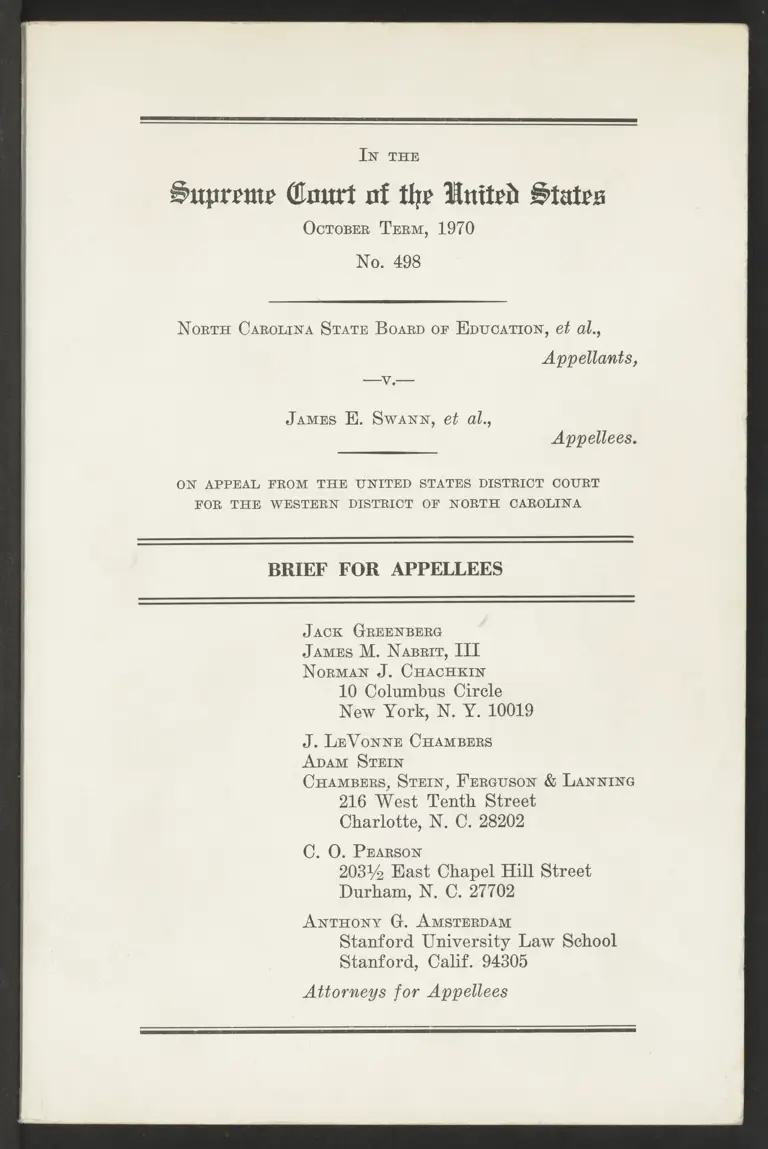
Brief for Appellees preview

93 pages

Cite this item

  • Case Files, Swann v. Charlotte-Mecklenburg Hardbacks. Brief for Appellees, 9594b287-2d34-f111-88b4-7c1e526962fd. LDF Archives, Thurgood Marshall Institute. https://ldfrecollection.org/archives/archives-search/archives-item/c0bb8fdc-5fbd-4a26-90a8-d5420e1f93dd/brief-for-appellees. Accessed June 02, 2026.

    Copied!

     [||e5e6821f-3241-4b82-9454-47f314229f85||] IN THE 

Supreme nurt of the United States 
OctoBer TrrM, 1970 

No. 498 


Norra CAROLINA STATE BoARD OF EpUCATION, ef al., 

Appellants, 
—V.— 

James BE. Swaxn, ef al, 
Appellees. 


ON APPEAL FROM THE UNITED STATES DISTRICT COURT 

FOR THE WESTERN DISTRICT OF NORTH CAROLINA 


BRIEF FOR APPELLEES 


JACK (GREENBERG 
James M. Nasrrr, 111 
NorMAN J. CHACHKIN 

10 Columbus Cirele 
New York, N. Y. 10019 

J. LEVoNNE CHAMBERS 
ApaM STEIN 
CraMBERs, STEIN, FERGUSON & LANNING 

216 West Tenth Street 
Charlotte, N. C. 28202 

C. O. Pearson 
20314 Hast Chapel Hill Street 
Durham, N. C. 27702 

AxTHONY (Ff. AMSTERDAM 
Stanford University Law School 
Stanford, Calif. 94305 

Attorneys for Appellees 


INDEX 

PAGE 

Opinions Below ................. ..... 0 . ... 1 

JUtIBRICHON oc i iin 1 

Questions Presented ...........cccoeen oo ihren hain, 2 

Statement. =o 0) tod eel a 3 

Intvoduetion ..... oii 3 

Proceedings during 1969-70 before a Single Dis- 

trict JJNdSe esis ts ements ries baess anne nt 4 

Obstruction of the District Court Orders; Conven- 

ing of Three Judge Court ........................ / 

Some Facts on Student Transportation .............. 12 

Summarvof Avgument 0000 0) 17 

ARGUMENT 

I. The Court Below Correctly Held that a 

Portion of N.C. Gen. Stat. §115-176.1, Known 

as the Anti-Busing Law Is Unconstitutional 

and in Violation of the Kqual Protection 

Clause and the Supremacy Clause of the Con- 

stitution of the Umited States... ........ 20 

A. Imtroduction—The Provisions of the 

Satvle: 20 

B. The statute unconstitutionally interferes 

with the school board’s affirmative duty 

to dismantle the dual system. ................... 26 


i1 

PAGE 

C. The Appellants’ Argument Supporting 

the Statute Rests on a rejected view that 

there is no affirmative duty to desegre- 

gate the schools... ois 30 

D. Additionally §115-176.1 is unconstitu- 

tional because it violates the principles 

stated in Hunter v. Erickson, 393 U.S. 

385 (1969) and also the doctrine of 

Reitman v. Mulkey, 387 U.S. 369 (1967). 33 

E. The Court Below correctly Concluded 

that §115-176.1 also violates the Suprem- 

acy Clause of Article VI of the Consti- 

fuliont lL. Luu. ni alam 36 

II. The Appellants Other Objections to the 

Judgment Below Are Also Insubstantial .... 40 

A. The motions to dismiss were properly 

deed... cts dtnn ane 40 

B. The District Court was empowered to 

stay State Court proceedings to protect 

or effectuate its judgments ........................ 41 

C. The Civil Rights Act of 1964 does not 

support appellants’ argument ................... 42 

III. The Court Has No Jurisdiction of the Appeal 

Under the Doctrine of Bailey v. Patterson, 

Ly hs Se Sane Se en alee 42 

CON CL ORION oo iii tlic vidtitininisnnto tts so 38 44 


iii 

PAGE 

Brier ApPPENDIX A— 

Notification and Request for Designation of Three- 
Judge Court with attached Exhibits D, E, F, and G 
(filed Pebruary 20,1970) .......oi iio oan la 

Exhibit A— 

Opinion and Order of December 1, 1969 

[omitted in printing, see Appendix in No. 281, 

D008) i rn th hn Ha 

Exhibit B— 

Opinion and Order of February 5, 1970 

[omitted in printing, see Appendix in No. 281, 

P-8I0aY Cre Gn, 5a 

Exhibit C— 

Order dated December 2, 1969 [omitted in 

printing, see Appendix in No. 281, p. 717a] .... 5a 

Exhibit D— 

Complaint, Amended Complaint and two 

Orders of Superior Court in Harris v. 

Sell. tl. 500. clini dovisdenttetteni it 6a, 14a, 19a, 21a 

Exhibit E— 

Statement by Governor Scott .....................0 23a 

Exhibit F— 

Letter by Governor Seoth ........ccoreerecinnsacarses 26a 

Exhibit G— 

Statement by Dr, Craig Phillips ...................0. 27a 

Brier ArPENDIX B— 

Opinion and Order of Three-Judge District Court in 

Alabama v. Uwited States, et al., S.D. Ala., No. 

5035-70-P, June 20, 1970 ............. cco nies 29a 

Order of DISmUSOl i ee ahaa 39a 


A Hc 


iv 

PAGE 

Table of Cases: 

Alabama v. United States, F. Supp. — (S.D. 

Ala. Civ. No. 5935-70-P, June 28, 1970) ............ 30, 39, 43 

Alexander v. Holmes County Board of Education, 396 

US 19 (109609)... gemini 43 

Bailey v. Patterson, 369 U.S. 31 (1962) .......... 2,11,19,43 

Bivins v. Bibb County Board of Education (M.D. Ga., 

No, 1926, May 220970)... ee rin 39 

Briggs v. Elhott, 132 PF, Supp. 776 (£.D. 8.0. 1955) .... 30 

Brooks v. Beto, 366 F.2d 1 (5th Cir. 1966, en banc), 

cert. denied, 3861.8. 975 (1957)... ............. 18, 32, 33 

Brown v. Board of Education, 347 U.S. 483 (1954) 

2, 26, 28, 30, 35, 36, 41 

Brown v. Board of Education, 349 U.S. 294 (1955) ....26, 29 

Brown v. South Carolina State Board of Education, 

296 F. Supp. 199 (D. S.C. 1968), judgment affirmed,   393 11.8, 222 (1908) .........coioiri saan ninioi ase ies 37 

Bryant v. State Board of Assessment, 293 F. Supp. 

1379 (BIDVR.C1968Y be 41 

Bush v. Orleans Parish School Board, 187 F. Supp. 42 

(E.D. La. 1960), stay denied, 364 U.S. 803, judgment 

affirmed, Orleans Parish School Board v. Bush, 365 

US. 889 (A001) ........ccocrocirericivsrnrsnsissssasatinsar-sisns 19, 36, 42 

Bush v. Orleans Parish School Board, 188 F'. Supp. 916 

(E.D. La. 1960), stay denied, sub nom. Louisiana v. 

United States, 364 U.S. 500 (1960), judgment af- 

firmed, 360 7.8. 569 (1961)... beni... 18, 36, 38 

Bush v. Orleans Parish School Board, 190 F. Supp. 861 

(E.D. La. 1960), judgment affirmed, New Orleans 

v. Bush, 366 U.S, 212 (1961)... cn ceed fsa 36 

Bush v. Orleans Parish School Board, 191 F. Supp. 871 

(E.D. La. 1961), judgment affirmed sub nom. Legis- 

lature of Louisiana v. United States, 367 U.S. 907 

C1I6L) o.oo eprssnnisisiss rs tessiastsniovsessiansatatinss itis antes dine ons 36 


PAGE 

Bush v. Orleans Parish School Board, 194 F. Supp. 182 

(E.D. La. 1961), judgment affirmed sub nom. Tug- 

welly. Bugh 367 10.8.907 (1961) ......... ..........._... 36 

Carter v. West Feliciana Parish School Board, 396 U.S. 

200 (1970) Litres ties itt a 44 

Cooper, Aaron, 5S US, 1. (1058) ..o..ivi i 2 36, 41 

Denny. v. Bush, 367. U:S. 908. (1961)... ................ 36 

Dowell v. Board of Education of the Oklahoma City 

Public Schools, 396 U.S. 269 (1969).............i..... 43 

Dowell v. Board of Education of the Oklahoma City 

Public Schools, 244 F. Supp. 971 (W.D. Okla. 1965), 

affirmed, 375 F.2d 158 (10th Cir. 1967), cert. denied, 

37 US OL (967) st 32 

Ex parte Poresky, 290 U.S. 30 (1933) ...........L.. 4... 43 

Faubus v. United States, 254 F.2d 797 (8th Cir. 1958), 

cert. domed, BBS US. 829,............cc0 cic cise te oe 40 

Godwin v. Johnston County Board of Education, 301 
V. Sapp. 330 (BD. NC. 1969) ......................... 40 

Green v. County School Board of New Kent County, 391 

U.S. 430 (1968) ..............co-igeca 2,18,19, 28,27, 28,29, 30, 43 

Gremillion v. United States, 363 U.8..11 (1961) .......... 36 

Hall v. St. Helena Parish School Board, 197 F. Supp. 

649 (E.D. La. 1961), judgment affirmed, 368 U.S. 515 

GEL Esashi ee ie mason Jie oh ne i DR Ber 37 

Barre wr Bell. css 3,7, 25,41 

Harvest v. Board of Public Instruction of Manatee 

Comnty, 312 F. Supp. 269. (M.D), Fla, 1970) ........... 40 

Hunter v. Brickson, 393 11.8. 385 (1939) ............. 2% 18,33, 34 

In the Matter of Peterson, 253 U.S. 300 (1920) ............ 41 


vi 

PAGE 

Katzenbach v. Morgan, 384 U.S. 641 (1966) ................... 42 

Keyes v. School Dist. No. 1, Denver, Colo., 313 F. Supp. 

61 (D. Colo. 1970) «oi. ll ns 35 

Lee v. Macon County Board of Education, M.D. Ala. 

Civ. No. 604-E, March 12, 1970, March 16, 1970, 

March 23, 1970... liebe tditivninsiionsiiasios 39 

Lee v. Macon County Board of Education, 267 F. Supp. 

458 (M.D. Ala. 1967), affirmed sub nom. Wallace v. 

United States, 389 1.8, 215 (1967) .............ice....... 36, 40 

Lee v. Nyquist, —— F. Supp. —— (W.D. N.Y. Civil 

19709, Oct: 1, 1970)... 18,33,35 

Louisiana Kducation Commission for Needy Children 

v..U.8, District Court, 390 U.S, 939 (1968) ....... ........ 27 

Marbury v. Madison (US) 1 Cranch 137 (1803) ............ 40 

Meredith v. Fair, 328 F.2d 586 (5th Cir. 1962) ........... 40, 42 

Mitchell v. Donovan, 398 U.S. 427 (1970) ....................... 11 

Moore v. Charlotte-Mecklenburg Board of Education, 

N20. Supp. 503 (WD. N.C. 1970) ........................ 1,11 

Moore v. Charlotte-Mecklenburg Board of Education, 

No. 444. OT. 1970... esi riniies 4 

Poindexter v. Louisiana Financial Assistance Commis- 

sion, 275 F. Supp. 833 (B.D. La. 1967), judgment 

affirmed 389 1.8, 571 (1968) .........ccoeeeee ee eee 37 

Poindexter v. Louisiana Financial Assistance Commis- 

sion, 296 F. Supp. 686 (K.D. La. 1968), judgment 

affirmed, sub nom. Louisiana Education Commission 

for Needy Children v. Poindexter, 393 U.S. 17 (1968) 37 

Railway Mail Association v. Corsi, 326 U.S. 88 (1945) 31 

Reitman v. Mulkey, 387 1.8, 369 (1967) ........... 2,18, 33, 35 

Rockefeller v. Catholic Medical Center, 397 U.S. 820 

E17 I Rl ee Se en eG LC 11 


PAGE 

Shapiro v. Thompson, 394 U.S. 618 (1969) .................... 42 

Sparrow v. Gill, 304 F. Supp. 86 (W.D. N.C. 1969) ...... 13 

Sterling v. Constantin, 287. U.8.378.(1932) ..... ... 1. 40 

Swann v. Charlotte-Mecklenburg Board of Education, 

No. 281, 071, 1970... 3,4 

Swann v. Charlotte- Mecklenburg Board of Education, 

243 F. Supp. 667 (W.D. N.C. 1965), affirmed, 369 

F.2d 29 (4th Cir. 1966); 300 F. Supp. 1358 (1969) ; 

300 F. Supp. 1381 (1969) ; 306 F. Supp. 1291 (1969) ; 

306 F. Supp. 1299 (1969) ; 306 F. Supp. 1301 (1969); 

306 F. Supp. 1306 (1969); 311 F. Supp. 265 (1970) 5 

Swann v. Charlotte-Mecklenburg Board of Education, 

SI2 FX. Supp. 503. (WD. N.C. 1870)... ..... ... 1 

Swift & Co. v. Wickman, 382 U.S. 111 (1965) ................ 19, 43 

Thomason v. Cooper, 254 F.2d 808 (8th Cir. 1958) ........ 42 

Turner v. Memphis, 363 U.S, 350 (1962)... .... .. 43 

United States v. Board of Public Instruction of Polk 

County, 395 1.24 66 (5th Cir. 1968). tieniini.n 32 

United States v. Jefferson County Board of Education, 

372 F.2d 836 (5th Cir. 1966), aff’d en bane, 380 F.2d 

385 (6th Cir. 1967), cert. denied, sub nom. Caddo 

Parish School Board v. United States, 389 U.S. 840 

(LOBTY coin cr isons icnsns sir dessistnmssasisbucsansansansmmatsn 31, 32 

United States v. Montgomery County Board of Educa- 

tion, 3 U8. 225 (1969) ..........cociinie i. 18, 31, 32 

United States v. Peters (US) 5 Cranch 115 (1809) ....18, 38 

United States v. Wallace, 222 F. Supp. 485 (M.D. Ala. 

kL ee ra aa ae 40 

Walker v. County School Board of Brunswick County, 

413 P2453 (dth Cir, 1989) ...............ccocooe ein 30 

Wanner v. County School Board of Arlington County, 

357 1.24 452 (4th Cir, 1966) ................................ 18, 32  


viii 
PAGE 

Youngblood v. Board of Pubic Instruction of Bay 

County, Fla. F.2d —— (5th Cir., No. 29369,   

July 24 1070) 0 LR ER 32 

Statutes: 

25. USO. 81963 us Jn on on ee 1,19,43 

28 U.S.C. 82981 ei. 6,11, 12 

28 U.S.C. 82288 vu hil Ll iL ssl 19, 42 

98 U.S.0. 30284 00 csitinnitidhoimmimncisichssssdossiinisneasinrsens 6 

New York Education Law, Section 3201(2) (McKinney 

B10) ......... ns 33 

N.C. Gen. Sat, §115-176.1 '... ......... 3.8,11,17, 20, 22, 25, 

26, 27,29, 30, 33, 34, 

35, 36, 38, 43, 44 

Other Authorities: 

1A Moore's Pederal Practice .............. ocean cieeean 49 

NEA, National Commission on Safety Education, 

1968-1969 Statistics on Pupil Transportation, 1970 _... 12 


IN THE 

Supreme Comet of the United States 
OcrtoBer Term, 1970 

No. 498 


NortH CAROLINA STATE Boarp oF EpucaTioN, ef al., 

Appellants, 
—V.—/ 

James KE. Swann, et al., 
Appellees. 


ON APPEAL FROM THE UNITED STATES DISTRICT COURT 

FOR THE WESTERN DISTRICT OF NORTH CAROLINA 


BRIEF FOR APPELLEES 

Opinions Below 

The opinion of the three-judge district court is reported 

as Swann v. Charlotte-Mecklenburg Board of Education 

(also Moore v. Charlotte-Mecklenburg Board of Educa- 

tion), 312 PF. Supp. 503 (W.D. N.C. 1970). 

Jurisdiction 

Appellees submit that the Court does not have jurisdic- 

tion of a direct appeal pursuant to 28 U.S.C. §1253 because 

the case is not a “civil action, suit or proceeding required 

by any Act of Congress to be heard and determined by a 

district court of three judges” (emphasis added). Appel- 

lees’ argument in support of the contention that a three- 

judge court was not required appears fra in Argument 

111.  


Questions Presented 

1. Whether the judgment of the court below that a part 

of the North Carolina anti-busing law is unconstitutional 

should be affirmed: 

(a) on the ground that it violates the equal protection 

clause by interfering with school boards’ affirmative duty 

under Brown v. Board of Education, 347 U.S. 483 (1954), 

and Green v. County School Board of New Kent County, 

391 U.S. 430 (1968), to eliminate dual school systems: 

(b) on the ground that it effects a racial classification 

which violates the principles stated in Hunter v. Erickson, 

393 U.S. 385 (1969), and in Reitman v. Mulkey, 387 U.S. 

369 (1967); 

(c) on the ground that it violates the Supremacy Clause 

by seeking to overturn the desegregation decisions of the 
federal courts and in particular the decisions of the fed- 
eral district court in the Charlotte-Mecklenburg case. 

2. Whether the court below properly (a) denied motions 
to dismiss various defendants and (b) restrained parties 
from seeking to enforce the anti-busing law by state court 
injunction proceedings. 

3. Whether the appeal should be dismissed on the ground 
that no direct appeal is permitted inasmuch as the statute 
involved was so clearly unconstitutional that no three- 
judge court was required under the doctrine of Bailey v. 
Patterson, 369 U.S. 31 (1962). 


Statement 

Introduction 

This case is here on direct appeal to review a judgment 

of a three-judge district court which held that a portion 

of N.C. Gen. Stat. §115-176.1, known as the anti-bussing 

law, was unconstitutional because it interfered with the 

affirmative duty of local school boards under the Four- 

teenth Amendment to desegregate racially segregated 

public schools and also violated the Supremacy Clause of 

Article VI. The court enjoined all parties “from enfore- 

ing, or seeking the enforcement of” the unconstitutional 

portion of the statute. The proceeding in the three-judge 

court was an ancillary proceeding connected with the school 

desegregation case involving Charlotte-Mecklenburg which 

is also now pending here as Swann v. Charlotte-Mecklen- 

burg Board of Education, O.T. 1970, No. 281, certiorari 

granted June 29, 1970. 

This appeal was taken by the North Carolina State 

Board of Education and four state officials.! The Charlotte- 

Mecklenburg Board of Kducation also filed a notice of 

appeal from the same order, but has not filed a jurisdie- 

tional statement or docketed its own appeal. Instead, the 

local school board has filed a motion in this Court to join 

in the appeal of the state board of education, pursuant to 

this Court’s Rule 46. 

1 Appellants herein include the State Superintendent of Public 
Instruction, the Governor of North Carolina, the Controller of the 
State Board of Education, and a judge of the Superior Court of 
Mecklenburg County who issued an order allegedly interfering with 
the federal court desegregation orders. No notice of appeal was 
filed on behalf of the additional parties defendant Tom B. Harris, 
et al., the plaintiffs in the state court proceeding of Harris v. Self; 
nor was notice of appeal filed on behalf of James C. Carson, al- 
though the state argues in its brief that it is prosecuting the appeal 
on his behalf (Brief of the Attorney General of North Carolina, 
pp. 10-12. As to the notice of appeal, however, see A. 107-108.) 


4 

Another appeal from the same judgment is also pending 

here as No. 444, O.T. 1970, sub nom. Moore v. Charlotte- 

Mecklenburg Board of Education. The Moore case was 

consolidated for hearing with the instant case in the three- 

judge district court. It began as a suit in a state court 

by parents seeking to enjoin the Charlotte-Mecklenburg 

Board of Education from carrying out the desegregation 

orders issued by the federal district court in Swann v. 

Charlotte-Mecklenburg Board of Education, No. 281, O.T. 

1970, cert. granted June 29, 1970. The Negro plaintiffs in 

the Swann case were not named as parties in the Moore 

case; only the school board is named as a defendant below 

and an appellee in this Court. The school board removed 

the Moore case to the United States District Court, but 

both below and here has agreed with and supported the 

argument of the plaintiffs-appellants Moore, et al. that 

the North Carolina anti-bussing law is valid. The Negro 
plaintiffs Swann, et al. moved in the district court for an 

order adding the plaintiffs in the Moore case as parties- 

defendants and enjoining them from interfering with the 

district court’s desegregation orders. The order issued be- 

low, as noted above, enjoins all parties in both cases, 

including Moore, et al., from enforcing or seeking enforce- 

ment of the unconstitutional portion of the anti-bussing 

statute. 

Proceedings during 1969-70 before a Single District Judge 

The school desegregation case brought by Negro pupils 

and parents against the Charlotte-Mecklenburg Board of 

Education was commenced in 1965 and there has been ex- 

tensive litigation ever since which has culminated in the 

Swann case now pending in this Court. A full statement 

of the history of the proceedings from 1965 to date is 

contained in Petitioners’ Brief in Swann, No. 281, O.T. 


5) 

1970. The case has resulted in numerous reported deci- 

sions which are cited in the note below. 

On April 23, 1969, after a plenary hearing, the district 

judge rendered a decision and order finding that the school 

system was still unlawfully segregated and directing 

that defendants file a plan for complete desegregation of 

the system (Swann, supra, 300 F. Supp. 1358; App. No. 

281, p. 285a-323a). The court specifically directed that the 

school board consider altering attendance areas, pairing or 

consolidation of schools, transportation or bussing of stu- 

dents and any other method which would effectuate a 

racially unitary system (App. No. 281, p. 315a-316a). Exten- 

sive litigation ensued as the board submitted a series of 

proposals and the court rejected them as unsatisfactory to 

disestablish the segregated system (App. No. 281, pp. 448a- 

458a; 579a-592a, 698a-716a, 819a-839a). In the midst of this 

litigation about the remedy to implement the April 23 deci- 

sion, the North Carolina legislature enacted the anti-bussing 

bill proposed by a member of the Mecklenburg delegation 

(A.63-93). The measure which was ratified July 2, 1969, 

included the following two sentences (later held unconsti- 

tutional) : 

No student shall be assigned or compelled to attend 

any school on account of race, creed, color or national 

2 The parties in this case, No. 498, have stipulated that the record 
and printed appendix in No. 281, O.T. 1970 and No. 349, O.T. 1970 
constitute and shall be used as a part of the record in this case. 
This is consistent with the view of the case taken by the court below. 
Citations to the Appendix in Nos. 281 and 444 are indicated. The 
appendix in this case is cited as “A. —. 

3 See, e.g., Swann v. Charlotte-Mecklenburg Board of Education, 
243 F. Supp. 667 (W.D. N.C. 1965), affirmed, 369 F.2d 29 (4th 
Cir. 1966) ; 300 F. Supp. 1358 (1969) ; 300 F. Supp. 1381 (1969) ; 
306 F. Supp. 1291 (1969) ; 306 F. Supp. 1299 (1969) ; 306 F. Supp. 
1301 (1969) ; 306 F. Supp. 1306 (1969) ; 311 F. Supp. 265 (1970). 


6 

origin, or for the purpose of creating a balance or 

ratio of race, religion or national origin. Involuntary 

bussing of students in contravention of this Article is 

prohibited, and public funds shall not be used for any 

such bussing (A.91). 

Plaintiffs in the Swann case promptly obtained leave to 

file a supplemental complaint which sought injunctive and 

declaratory relief against the above-quoted portion of the 

anti-bussing law; they asked that a three-judge court be 

convened pursuant to 28 U.S.C. §§2281 and 2284 (App. 

No. 281, pp. 460a-479a). However, no three-judge court 

was convened at that time and the court took no action 

on the requests for relief because the school hoard thought 

that the anti-bussing law did not interfere with the school 

board’s proposed plan to bus about 4,000 black children 

to white suburban schools (306 F. Supp. at 1295; App. No. 

281, p. 585a). 

After further hearings to consider the board’s further 

proposals during the fall of 1969 and the operation of the 

interim plan (which involved bussing black children to 

formerly white schools), the district court finally directed 

that a plan be prepared by the court’s expert consultant 

(App. No. 281, p. 698a-717a). The court consultant’s plan 

was ordered into effect in an order entered February 5, 

1970, reported at 311 F. Supp. 265 (App. No. 281, 819a- 

839a). The February 5 order provides for the alteration of 

some school attendance areas, the creation of certain “satel- 

lite” or non-contiguous zones from which pupils would be 

transported to school, the pairing and clustering of certain 

schools with the alteration of grade structures, and trans- 

portation for pupils who live more than walking distance 

(as determined by the board) from the school to which 

they are assigned. The pairing and clustering of 10 black 


7 

and 24 white elementary schools will result in pupils of 

both races being transported to schools which were for- 

merly segregated. The district court made extensive sup- 

plemental findings about the amount of transportation re- 

quired and its relation to the large school bus transportation 

system which was already in operation in the community 
(App. No. 281, p. 1198a-1220a). 

Obstruction of the District Court Orders; Convening of 
Three-Judge Court 

Following the order of February 5, 1970, numerous eciti- 

zens, under the banner of “Concerned Parents Association,” 

held meetings to protest the order, vowing to defy, delay, 

obstruct and in any way prevent its implementation. On 

January 30, 1970, they filed a proceeding in the Mecklen- 

burg County Superior Court (Harris v. Self) and obtained 

an ex parte temporary restraining order, purportedly pre- 

venting the superintendent from paying the fees and ex- 

penses of the court consultant as directed on December 2, 

1969. (Appendix A, infra 6a). They filed an amended com- 

plaint on February 12, 1970, in the Mecklenburg County 

Superior Court and obtained an amended temporary re- 

straining order which enjoined the Charlotte-Mecklen- 

burg Board of Education from expending any money for 

the purpose of purchasing or renting any motor vehicle 

or operating or maintaining such for the purpose of in- 

voluntarily transporting students in the Charlotte-Mecklen- 

burg school system from one school to another and from 

one district to another (Appendix A, infra 19a). The order 

entered by the Mecklenburg Superior Court on January 30, 

1970, was modified to permit payment of the court con- 

sultant on approval of the Board of Education (Appendix 

A, wmfra, 21a). 

On February 11, 1970, Governor Robert W. Scott issued 

a public statement to the effect that North Carolina General 


8 

Statute §115-176.1 prohibited the involuntary bussing of 

students, that he had taken an oath to uphold the laws of 

the State of North Carolina, and that he was directing all 

officials to enforce this statute (Appendix A, infra 23a). 

On February 12, 1970, Governor Scott instructed the Di- 

rector of the Department of Administration that “use of 

public funds for providing bus transportation shall be 

strictly in accordance with the appropriations made by the 

1969 General Assembly, and for no other purpose. No 

authorization will be given for use of any other funds 

to provide bussing to achieve school attendance for the 

purpose of creating a balance or ratio, religion or national 

origins” (sic.) (Appendix A, infra 26a). Copies of the 

letter were forwarded to Dr. A. Craig Phillips, the Super- 

intendent of Public Instruction; Dr. Dallas Herring, Chair- 

man of the State Board of HEducation; Mr. A. C. Davis, 

the Controller of the State Board of Education; and Mr. 

Tom White, Chairman of the State Advisory Budget Com- 

mission. Shortly thereafter, Dr. A. Craig Phillips issued 

a similar statement and further advised that he was op- 

posed to bussing (Appendix A, infra 27a). On February 

23, 1970, he wrote to Dr. William S. Self, Superintendent 

of the Charlotte-Mecklenburg Schools and advised, “No 

additional State funds will be allocated to the Charlotte- 

Mecklenburg Board of Education to provide bussing of 

students for the purpose of creating a balance or ratio of 

students in the schools.” On the same date, Mr. A. C. 

Davis directed a memorandum to the superintendent of 

each local school system in the State advising that the 

General Assembly had appropriated funds for the opera- 

tion of 9,510 buses during the 1969-70 school year and 9,635 

buses during the 1970-71 school year. The memorandum 

advised that approximately 9,443 buses were presently in 

use and that, “The appropriation does not include funds 

for the transportation of thousands of additional students 


9 

and the operating costs of hundreds of additional buses 

which might be made necessary by the reorganization of 

schools. No additional State funds will be allocated to 

school administrative units to provide bussing of students 

for the purpose of creating a balance or ratio of students 

in schools.” 

On February 13, 1970, plaintiffs moved the court (A. 

46-50; App. No. 281, p. 840a) to add as additional parties- 

defendant the Governor of the State; Mr. A. C. Davis, 

Controller of the State Board of Education; the Honorable 

William K. McLean, the Superior Court Judge who issued 

the temporary restraining order; each plaintiff in the 

Superior Court proceeding and their attorney. Plaintiffs 

also asked the court to add as additional parties-defendant 

the Honorable James Carson who initially proposed the 

statute here in question and who had made several public 

statements of his intention to file a proceeding in the state 

court to enjoin the school board from complying with the 

February 5, 1970, order of the court. Plaintiffs further 

sought to enjoin the enforcement of the state court restrain- 

ing order as modified on February 12, 1970, and to enjoin 

the defendants from further interference with the imple- 

mentation of the orders of the district court. 

On February 20, 1970, the resident district judge entered 

an order reciting the various events and requesting that 

the Chief Judge of the Circuit designate a three-judge 

district court (A. 19-22; App. No. 281, p. 845a). A three- 

judge court was designated on February 24, 1970, and addi- 

tional parties were added by order of February 25, 1970 

(A. 17-18; App. No. 281, p. 901a). 

Meanwhile, on Sunday night, February 22, 1970, approxi- 

mately 50 adults on behalf of themselves and their children 

filed another proceeding (Moore v. Charlotte-Mecklenburg 

Board of Education) in the Mecklenburg County Superior 


10 

Court seeking to restrain desegregation of the Charlotte- 

Mecklenburg schools as directed by the district court. At 

10:16 p.m. on that Sunday night, the Honorable Frank 

Snepp issued an ex parte temporary restraining order 

enjoining the Charlotte-Mecklenburg Board of Education 

and its Superintendent 

from instituting or implementing or putting into oper- 

ation or effect, or expending any public funds upon, 

any plan or program under which children in the City 

of Charlotte or Mecklenburg County are denied access 

to any Charlotte-Mecklenburg public school because of 

their race or color or are compelled to attend any 

prescribed Charlotte-Mecklenburg public school be- 

cause of their race or color. (App. No. 444, p. 19-20). 

On Thursday, February 26, 1970, the board removed the 

Moore case to the United States District Court (App. No. 

444, p. 21-22). At a special meeting of the board on F'ri- 

day, February 27, 1970, the board chose to comply with 

the order of the state court rather than the orders of the 

federal district court. The Superintendent announced that 

all planning and activities then underway for implementa- 

tion of the district court’s order of February 5, 1970, were 

terminated (App. No. 444, p. 31 or App. No. 281, p. 925a). 

On the same date, plaintiffs moved the court to add the 

plaintiffs in the Moore case, their lawyers and the Honor- 

able Frank Snepp as additional parties-defendant in this 

case. Plaintiffs further sought an order enjoining the en- 

forcement of the state court order and enjoining any fur- 

ther efforts by all of the defendants from taking steps 

which would prevent or inhibit the implementation of the 

orders of the district court. Plaintiffs also sought an order 

finding all members of the Charlotte-Mecklenburg Board 

of Education and its Superintendent in contempt and im- 

posing a fine or imprisonment for each day that the defen- 


| 11 

| dants failed to comply with the court’s orders. (App. No. 
281, p. 814a-917a). 

Judge McMillan on March 6, 1970, entered an order 
decreeing that the order by Superior Court Judge Snepp 
in the Moore case “is hereby suspended and held in abey- 
ance and of no force and effect pending the final deter- 
mination by a three-judge court or by the Supreme Court 
of the issues which will be presented to the three-judge 
court on March 24, 1970” (App. No. 281, pp. 925a-927a).* 
The three-judge court court eventually ruled in an opinion 

dated April 28, 1970, that the challenged portions of the 

anti-bussing law were unconstitutional in violation of the 
equal protection clause of the Fourteenth Amendment and 

the Supremacy Clause of Article VI of the Constitution 
(312 F. Supp. 503, 510; A. 2; App. No. 281, p. 1305a). The 

initial opinion denied injunctive relief and granted only 

a declaratory judgment. However, this portion of the 

original opinion was withdrawn® and the court enjoined 

all of the parties in the Swann and Moore cases from 

“enforcing, or seeking the enforcement of” the unconsti- 

tutional portion of N.C. Gen. Stat. 115-176.1. 

Although plaintiffs Swann, et al. originally sought a 

three-judge court, they subsequently urged upon the dis- 

trict court that it was empowered to act on the matter as 

a single judge and that a three-judge court was not re- 

quired by 28 U.S.C. $2281 because of the doctrine of Bailey 

‘ Both the attorney general and the state court plaintiffs made 
repeated efforts to disqualify or recuse Judge McMillan from sitting 
on the three-judge panel. See App. No. 281, p. 1, docket entries 
Nos. 143, 146, 148, 149, 154. On March 9, 1970, Chief Judge 
Haynsworth of the Fourth Circuit denied the motions to disqualify. 
Docket entry 155. 

5 The three-judge court determined to grant an injunction rather 
than merely a declaratory judgment after taking note of this 
Court’s decisions in Rockefeller v. Catholic Medical Center, 397 
U.S. 820 (1970), and Matchell v. Donovan, 398 U.S. 427 (1970). 


12 

v. Patterson, 369 U.S. 31 (1962). The three-judge court 

rejected these arguments that a three-judge court was not 

required.’ (312 F. Supp. 503, 507.) 

Some Facts on Student Transportation 

Student transportation has become an important, and 

indeed, an essential auxiliary service in today’s education. 

Nationally, over 18 million students were transported daily 

to public schools during the 1969-70 school year. This rep- 

resented approximately 40% of the total public school en- 

rollment. NEA, National Commission on Safety Kduca- 

tion, 1968-69 Statistics on Pupil Transportation, 1970. 

Approximately 55% or 610,760 students in North Caro- 

lina were transported during the past school year. Trans- 

portation was offered to all public school pupils who lived 

more than one and one half miles from the school to which 

they were assigned and who: (a) resided outside of the city 

limits; (b) resided outside the city limits as it existed 

prior to 1957; (¢) resided within the city limits but who 

were assigned to a school outside the city limits or out- 

side of the city limits as it existed prior to 1957; and (d) 

resided outside the city limits and were assigned to a 

school within the city limits. While local school units 

initially purchased school buses, operating costs and re- 

placements of the buses were paid by the state. 

Pursuant to state statutes, the North Carolina State 

Board of Education adopted rules and regulations to gov- 

ern transportation of students. (Plaintiffs Exh. 71 for 

8 The court below said that it rejected ‘plaintiffs’ attack upon 
our jurisdiction” (312 F. Supp. at 507). However, plaintiffs, by 
a brief filed in the trial court sought to make clear that their argu- 
ment that a single judge might properly have disposed of the case 
was not a denial that the three-judge district court had jurisdiction 
over the matter, but rather that three judges were not required to 
decide the case under 28 U.S.C. §2281. 


13 

March 1970 hearing in original record). The State Super- 

intendent of Public Instruction had to approve any addi- 

tions to the bus fleet or replacements of old buses by local 

units. Local units were also permitted to contract trans- 

portation of students who qualify under state law with 
private transportation companies in lieu of purchasing and 

operating school buses. 

On August 13, 1969, a three-judge court in Sparrow v. 

Gill, 304 F. Supp. 86 (W.D. N.C. 1969) held that the state 

statute which authorized transportation of city students 

who live in areas annexed by a city subsequent to 1957 dis- 

criminated against other city students who were denied 

transportation. The State Board then amended its regu- 

lations to authorize transportation of all public school 

children who live more than one and one-half miles from 

their school whether or not they reside within the city 

limits. This regulation has substantially increased the 

number of students transported in North Carolina. 

Even prior to the Sparrow decision, the State Board of 

Education and State Superintendent made efforts to secure 

transportation for all students who resided more than one 

and one half miles from their school. Similar recommen- 

dations had been made by a study commission appointed 

by the Governor in 1968 (App. in No. 281, 1202a; Plaintift’s 

Ex. 13 at March 1970 hearing in original record). 

The district court quoted the relevant state-wide data on 

transportation of students in its Supplemental Findings of 

March 21, 1970: 

“The average school bus transported 66 students each 

day during the 1968-69 school year; made 1.57 trips 

per day, 12.0 miles in length (one way); transported 

48.5 students per bus trip, including, students who 

were transported from elementary to high school. 


14 

“During the 1968-69 school year: 

610,760 pupils were transported to public schools by 

the State 

04.9 percent of the total public school average daily 

attendance was transported 

70.9 percent were elementary students 

29.1 percent were high school students 

3.0 students were loaded (average) each mile of bus 

travel 

The total cost of school transportation was $14,293,- 

272.80, including replacement of buses: The average 

cost, including the replacement of buses, was $1,541.05 

per bus for the school year—181 days; $8.51 per bus 

per day; $23.40 per student for the school year; $.1292 

per student per day; and $.2243 per bus mile of oper- 

ation. (Emphasis added.)” (App. in No. 281, p. 1199a) 

The Charlotte-Mecklenburg Board of Education trans- 

ported approximately 23,600 students during the 1969-70 

school year. An additional 5,000 students rode the public 

transportation system at reduced fares. To transport the 

23,600 students the Charlotte-Mecklenburg Board of Kdu- 

cation operated 280 buses; made an average of 1.8 trips 

per day per bus and carried an average of 83.2 students 

per bus daily. Each bus averaged 40.8 miles round trip 

per day and each trip took approximately one hour and 

15 minutes one way. 

The board also transported more than 700 kindergarten 

children, ages 4 and 5, from 7 to 30 miles one way each day. 

(Br. A16, A24.)" 

"The district court opinion of August 3, 1970, reprinted as the 
Appendix to Petitioner’s Brief in No. 281, is cited as “Br. A. —.” 


15 

Transportation costs in the Charlotte Mecklenburg sys- 

tem have been relatively inexpensive, less than 1% of the 

annual operating budget. The average cost for transporta- 

tion per pupil was $20.00 per year or 22 cents per day. As 

indicated above, this closely approximates the average per 

pupil cost on the state level. 

Finding this extensive transportation and its relative 

economy, the district court saw no reason why transporta- 

tion could not equally be afforded to students in order to 

desegregate the school system (App. in No. 281, 1198a- 

1209a; Br. A10-A26). The court noted that transporta- 

tion had been extensively used in order to maintain and 

to perpetuate segregated schools (1200a). Through the 

1964-65 school year, the Charlotte-Mecklenburg Board of 
Kducation maintained racially overlapping attendance 

zones in order to transport black students to black schools 

and white students to white schools (App. No. 281, p. 

1011a). Even during the 1969-70 school year when over- 

lapping bus routes had ostensibly been eliminated the school 

board had continued to arrange transportation in order to 

perpetuate segregated schools. Black schools had been 

conveniently located near black residential areas as walk-in 

schools. White schools had been located in outlying white 

areas necessitating transportation of students. Thus, of 

the 23,600 students transported during the 1969-70 school 

year, only 541 of these students were transported to black 

schools (App. No. 281, 1014a-1032a; 1203a- 1204a). 

The district court further noted that in addition to 

transportation, school district zones had been controlled 

in order to preserve segregated schools. The court stated 

in its order of June 20, 1969: 

This 1ssue was passed over in the previous opinion 

upon the belief which the court still entertains that 

the defendants, as a part of an overall desegregation 


16 

plan, will eliminate or correct all school zones which 

were created or exist to enclose black or white groups 

of pupils or whose population is controlled for pur- 

poses of segregation. However, it may be timely to 

observe and the court finds as a fact that no zones 

have apparently been created or maintained for the 

purpose of promoting desegregation; that the whole 

plan of “building schools where the pupils are” with- 

out further control promotes segregation; and that 

certain schools, for example Billingsville, Second Ward, 

Bruns Avenue and Amay James, obviously serve school 

zones which were either created or which have been 

controlled so as to surround pockets of black students 

and that the result of these actions is discriminatory. 

These are not named as an exclusive list of such situa- 

tions, but as illustrations of a long standing policy of 

control over the makeup of school population which 

scarcely fits any true “neighborhood school” philos- 

ophy (App. No. 281, 455a-456a). 

See also Reply Brief of Petitioners and Cross Respondents, 

in Nos. 281 and 349, pp. 3-17. 

The court found that transportation of students would 

be necessary in order to desegregate the schools under 

any plan that might be directed: 

“Both Dr. Finger and the school board staff appeared 

to have agreed, and the court finds as a fact, that 

for the present at least, there is no way to desegre- 

gate the all black schools in Northwest Charlotte with- 

out providing (or continuing to provide) bus or other 

transportation for thousands of children. All plans 

and all variations of plans considered for this pur- 

pose led in one fashion or another to that conclusion” 

(1208a). 


17 

The plan proposed by the Charlotte-Mecklenburg Board 

of Education would require transportation of an additional 

9,000 students. 

The court stated in its Memorandum Decision of August 

3, 1970 that although additional transportation would be 

required under the plan directed by the court, comparable 

transportation would be required under the other plans, 

with the exception of the plan submitted by the board (Br. 

A23). The court found, however, that the board had the 

facilities and personnel to implement the plan directed 

without any additional capital outlay during the first 

school year. 

No capital outlay will be needed to operate buses for 

the 1970-71 school year. The state is ready and willing 

to lend the few buses the board may need; replace- 

ments can be bought after actual need has been de- 

termined under operating conditions (Br. A23). 

As the court had previously noted, the only thing neces- 

sary for the board to implement the plan directed was the 

willingness of the members of the board to discharge their 

constitutional responsibilities to the black children in the 

school system (App. No. 281, 1219a-1220a). 

Summary of Argument 

: 

A portion of N.C. Gen. Stats. §115-176.1 was properly 

held to be in violation of the Equal Protection and Su- 

premacy Clauses of the Constitution. 

The act limits a school board’s powers to effectuate de- 

segregation of the schools in a manner which conflicts with 

the board’s affirmative duty to eliminate a dual school 

system as declared in Green v. County School Board of 


18 

New Kent County, 391 U.S. 430 (1968). School boards have 

an affirmative duty to bring about unitary systems and 

to that end they may use a variety of techniques of de- 

segregation. Remedial measures for desegregation may 

not be limited by an artificial concept of color-blindness 

which functions to enable racial discrimination to continue. 

United States v. Montgomery County Board of Education, 

395 U.S. 225 (1969); Wanner v. County School Board of 

Arlington County, 357 F.2d 452 (4th Cir. 1966) ; cf. with 

respect to jury discrimination Judge Brown’s opinion in 

Brooks v. Beto, 366 F.2d 1 (5th Cir. 1966, en banc). 

The act violates the principles of Hunter v. Erickson, 

393 U.S. 385 (1969), and Reitman v. Mulkey, 387 U.S. 369 

(1967), in that it effects an expressly racial classification 

which makes it more difficult for black citizens to achieve 

school integration, and its purpose and effect as re- 

vealed by its entire context is to encourage the main- 

tenance of segregation. New York’s similar law was inval- 

idated on these grounds. Lee v. Nyquist, — F. Supp. — 

(W.D. N.Y., Civil-1970-9, Oct. 1, 1970) (three-judge court). 

The court below also correctly concluded that the Act 

violates the Supremacy Clause by attempting to nullify 

federal court desegregation mandates. Bush v. Orleans 

Parish School Board, 188 F. Supp. 916 (E.D. La. 1960) 

(three-judge court), stay denied, Louisiana v. Uwmited 

States, 364 U.S. 500 (1960), affirmed, 365 U.S. 569 (1961) ; 

United States v. Peters (US) 5 Cranch 115, 136 (1809). 

IL. 

The various state officials were properly named as addi- 

tional defendants because the record shows that they in 

fact took actions which threatened to interfere with Judge 

MecMillan’s court ordered desegregation plan in the Char- 

lotte-Mecklenburg school case. 


19 

The district court was empowered by 28 U.S.C. §2283 

to stay state court proceedings to protect or effectuate its 

own judgments. Bush v. Orleans Parish School Board, 187 

F. Supp. 42 (E.D. La. 1960) (three-judge court), affirmed, 

365 U.S. 569; Thomason v. Cooper, 254 F.2d 808 (8th Cir. 

1958) ; Meredith v. Fair, 328 F.2d 586 (5th Cir. 1962), (en 

banc). 

The court below properly rejected appellants’ arguments 

based on the Civil Rights Act of 1964 because that Act does 

not limit the powers of the courts to remedy unconstitu- 

tional racial segregation in the schools. 

IIL 

The direct appeal should be dismissed because the three- 

judge court was not required by any Act of Congress. 

28 U.S.C. $1253. Swift & Co. v. Wickham, 382 U.S. 111 

(1965). The challenged portions of the anti-bussing act 

presented no substantial question and were plainly un- 

constitutional under this Court’s Green decision, supra. No 

three-judge court was required under Bailey v. Patterson, 

369 U.S. 31, 33 (1962). Implementation of the requirement 

that dual systems be dismantled at once is delayed by un- 

necessarily convening three-judge courts to rule on segre- 

gation laws. 


20 

ARGUMENT 

I. 

The Court Below Correctly Held That a Portion of 

N.C. Gen. Stat. § 115-176.1, Known as the Anti-Busing 
Law Is Unconstitutional and in Violation of the Equal 

Protection Clause and the Supremacy Clause of the 

Constitution of the United States. 

A. Introduction—The Provisions of the Statute. 

The North Carolina anti-busing law, N.C. Gen. Stat. 

§115-176.1 (Supp. 1969), was ratified and became effective 

July 2, 1969.2 It was entitled “An Act to protect the neigh- 

3 NORTH CAROLINA 
GENERAL ASSEMBLY 

1969 SESSION 

RATIFIED BILL 

CHAPTER 1274 

House Bm 990 

AN AcT TO PROTECT THE NEIGHBORHOOD SCHOOL SYSTEM AND TO 

PROHIBIT THE INVOLUNTARY BUSSING OF PUPILS OUTSIDE THE DIS- 

TRICT IN WHICH THEY RESIDE. 

The General Assembly of North Carolina do enact: 

Section 1. There is hereby created a new Section of Chapter 115 
of the General Statutes to be codified as G.S. 115-176.1 and to read 
as follows: 

“@G.S. 115-176.1. Assignment of pupils based on race, creed, color 
or national origin prohibited. No person shall be refused admission 
into or be excluded from any public school in this State on account 
of race, creed, color or national origin. No school attendance dis- 
trict or zone shall be drawn for the purpose of segregating persons 
of various races, creeds, colors or national origins from the com- 
munity. 

Where administrative units have divided the geographic area 
into attendance districts or zones, pupils shall be assigned to schools 
within such attendance districts; provided, however, that the board 
of education of an administrative unit may assign any pupil to 
a school outside of such attendance district or zone in order that 
such pupil may attend a school of a specialized kind including but 
not limited to a vocational school or school operated for, or oper- 


| 

| 
| 
| 
| 

| 
| 
| 
| 


= 
A
e
 

T
e
.
 
A
 

E
E
 

m
e
r
s
 

e
m
 
e
m
.
 

a
e
 

R
o
 

& e
a


21 

borhood school system and to prohibit the involuntary 

bussing of pupils outside the district in which they reside.” 

Our supplemental complaint challenged the validity of only 
the last two sentences’ in the second paragraph of the sec- 


ating programs for, pupils mentally or physically handicapped, or 
for any other reason which the board of education in its sole dis- 
cretion deems sufficient. No student shall be assigned or compelled 
to attend any school on account of race, creed, color or national 
origin, or for the purpose of creating a balance or ratio of race, 
religion or national origins. Involuntary bussing of students in 
contravention of this Article is prohibited, and public funds shall 
not be used for any such bussing. 

The provisions of this Article shall not apply to a temporary 
assignment due to the unsuitability of a school for its intended 
purpose nor to any assignment or transfer necessitated by over- 
crowded conditions or other circumstances which, in the sole discre- 
tion of the School Board, require assignment or reassignment. 

The provisions of this Article shall not apply to an application 
for the assignment or re-assignment by the parent, guardian or 
person standing in loco parentis of any pupil or to any assignment 
made pursuant to a choice made by any pupil who is eligible to 
make such choice pursuant to the provisions of a freedom of choice 
plan voluntarily adopted by the board of education of an admin- 
istrative unit.” 

Sec. 2. All laws and clauses of laws in conflict with this Act 

are hereby repealed. 

Sec. 3. If part of the Act is held to be in violation of the Con- 
stitution of the United States or North Carolina, such part shall be 
severed and the remainder shall remain in full force and effect. 

Sec. 4. This Act shall be in full force and effect upon its 
ratification. 

House Bill 990 

In the General Assembly read three times and ratified, this the 
2nd day of July, 1969. 

H. P. Tavios, Jo. 
H. P. Taylor, Jr. 
President of the Senate. 
Pamir P. Gopwin 
Philip P. Godwin 
Speaker of the House of Representatives. 

House Bill 990 

Supplemental Complaint, para. I (A. 23-24).  


22 

tion, and it is only these two sentences—quoted hereafter— 

which the three-judge court restrained and declared in vio- 

lation of the Equal Protection and Supremacy Clauses: 

No student shall be assigned or compelled to attend 

any school on account of race, creed, color or national 

origin, or for the purpose of creating a balance or 

ratio of race, religion or national origin. Involuntary 

bussing of students in contravention of this Article 

is prohibited, and public funds shall not be used for 

any such bussing. 

The first paragraph of §115-176.1 prohibits the exclu- 

sion of persons from public schools on account of race, and 

prohibits the drawing of attendance districts for the pur- 

pose of segregating persons “of various races, creeds, col- 

ors or national origins from the community.” The first 

sentence of paragraph two permits (but does not require) 

school authorities to assign pupils to schools by attendance 

zones and states that boards may assign pupils outside 

their zones to attend specialized schools “or for any other 

reasons which the board of education in its sole discretion 

deems sufficient.” The next sentence—as quoted above— 

forbids the assignment of students “on account of race,” 

ete. or “for the purpose of creating a balance or ratio of 

race, religion or national origins.” This is followed by the 

ban on “involuntary bussing of students in contravention 

of” the act, and the use of public funds to support such 

bussing. The third paragraph excepts from the act tempo- 

rary assignments due to the unsuitability of a school, or as- 

signments necessitated by overcrowding of schools or—in 

broad terms—*“other circumstances which, in the sole discre- 

tion of the School Board, require assignment or reassign- 

ment.” The fourth paragraph permits assignments on the 

basis of parental or pupil request pursuant to a “freedom 


23 

of choice plan voluntarily adopted by the board of educa- 

tion.” 

As the opinion below states, both counsel for the appellees 

Swann, et al. and the Attorney General of North Carolina 

construed the statute in much the same way (A. 7-8). As 

decribed by Judge Craven: 

The North Carolina Attorney General argues that 

the statute was passed to preserve the neighborhood 

school concept. Under his interpretation, the statute 

prohibits assignment and bussing inconsistent with the 

neighborhood school concept. Thus, to disestablish a 

dual system the district court could, consistent with 

the statute, only order the board to geographically 

zone the attendance areas so that, as nearly as pos- 

sible, each student would be assigned to the school 

nearest his home regardless of his race. ... [H]e recog- 

nizes of course, that the statute also permits freedom 

of choice if a school board voluntarily adopts such a 

plan. Thus the plaintiffs and the Attorney General 

read the statute in much the same way: that it limits 

lawful methods of accomplishing desegregation to 

nongerrymandered geographic zoning and freedom of 

choice. (A. 8.) 

Appellees believe that the act’s prohibition against as- 

signments compelling a student to attend a school “for the 

purpose of creating a balance or ratio of race . ..” forbids 

the use of a variety of desegregation techniques such as 

redesigning zones so as to promote desegregation, pairing 

schools or altering grade structures for the same end, 

closing or consolidating schools to aid integration, or con- 

trolling school sizes by new construction, expansions, or the 

use of portable classrooms, or location of school sites to 

affirmatively promote integrated school systems. The anti- 

bussing sentence forbids the use of existing transportation 

facilities to promote desegregation or the initiation or ex-  


24 

pansion of bus services for that end unless pupils volunteer 

to ride such “desegregation buses.” The effect of the pro- 

vision is to disable the board from changing assignment 

patterns of any objecting pupils who previously resided 

within walking distance (1% miles) of their schools for 

the purpose of desegregating the school system. 

The available materials indicating the legislative history’ 

of the anti-bussing law confirms this understanding of the 

legislation.’ The bill’s sponsor, Mr. Carson, an attorney, 

said the purpose of the bill was stated in its title: “to pro- 

tect the neighborhood school system and to prohibit the 

involuntary busing of pupils outside the district in which 

they reside” (A. 67). He said that “involuntary” busing 

10 Copies of the bill as originally introduced in the North Caro- 
lina House of Representatives, and the amendments made in a house 
committee substitute and by the state senate are explained in the 
deposition of the bill’s sponsor, State Rep. James H. Carson, Jr. 
who represents Mecklenburg County in the legislature (A. 64-88; 
various amendments and versions of the act appear at A. 89-93). 

11 The original proposal by Rep. Carson on May 7, 1969 (A. 69, 
74), designated House Bill DRH 255, provided that no pupils be 
assigned outside their districts of residence except upon parental 
application; that pupils be assigned to the closest school to their 
homes in multi-school districts; that boards may provide transpor- 
tation for pupils assigned within or without their districts in the 
boards’ “discretion,” but that pupils might not be bused outside 
their districts to a more distant school except by their parents’ 
choice. The bill made no mention of race or color at all. The bill as 
passed by the House and sent to the Senate (H.B. 990) appears at 
A. 90-91. This version was a committee substitute more nearly 
approximating the finally enacted bill. The committee substitute 
contained the language held invalid by the court below—the second 
and third sentences in present paragraph two. The Senate amend- 
ments added (in addition to grammatical changes) the proviso 
about assigning pupils outside their zones to specialized schools 
(first sentence of paragraph two) and the reference to freedom of 
choice plans (end of paragraph four). 

12 Mr. Carson was added as a defendant in this case not because 
of his legislative role but because he threatened to file proceedings 
in state court to prevent implementation of the court-ordered deseg- 
regation plan (A. 47, 53). 


25 

refers to the decision of pupils and parents (A. 80); that 

the bill would prevent implementation of the Finger Plan 

ordered by Judge McMillan which required clustering and 

pairing of thirty-four elementary schools and the trans- 

portation of pupils (A. 85-86). The fact that the bill was 

intended by its sponsor to conflict with Judge McMillan’s 

April 23, 1969, order in the Swann case is confirmed by the 

testimony of Mr. Carson: 

Q. Look down, the report shows a question asked 

you by Rep. Arthur H. Jones of Mecklenburg regard- 

ing any possible conflict between the bill and the de- 

cision of the Court should that become law. Would the 

quotation there coming from you be correct? A. Not 

completely, no. There could be a conflict or there could 

not be, depending on what the Local Board decided 

to do. 

Q. Do you recall whether you said: “Well, of course, 

I see a conflict. If there were no conflict IT don’t think 

there would be any need for the bill.” 

Mr. Waggoner: Objection. 

A. I don’t recall whether I said it or not. I don’t deny 

it, I just don’t recall it. 

Q. You might have said it? A. Yes. 

The state court judges who applied §115-176.1 in the two 

cases brought suit against the Charlotte-Mecklenburg 

School board (Judge McLean in Harris v. Self, supra, and 

Judge Snepp in Moore v. Charlotte-Mecklenburg Bd. of 

Ed., supra) issued temporary injunctions applying the 

law to prevent implementation of the court-ordered Finger 

desegregation plan. The Harris v. Self order (infra 19a) 

enjoins the board from spending any funds “for the pur- 

pose of involuntarily transporting students in the Charlotte- 

Mecklenburg School System from one school to another and 

from one district to another district.” Thus the order  


26 

broadly purports to block any reorganization of the sys- 

tem to desegregate the schools which involves “involuntary 

bussing.” The order makes no distinctions based on the 

distances involved, age of the pupils or any such factors. 

The Moore case order (issued ex parte on a Sunday night) 

broadly enjoins “any plan or program under which any 

children . . . are denied access to any Charlotte-Mecklen- 

burg public school because of their race or color or are 

compelled to attend any prescribed . . . school because of 

their race or color.” (App. in No. 444, pp. 20-21.) 

The school board upon being served with the Moore 

injunction, promptly determined without any inquiry of 

Judge McMillan to obey the state court order and directed 

the school staff to take no further steps to obey Judge 

MecMillan’s desegregation decree.” (App. No. 281, p. 925a; 

App. No. 444, p. 31.) 

B. The statute unconstitutionally interferes with the school 
board’s affirmative duty to dismantle the dual system. 

The court below correctly concluded that the purpose and 

effect of section 115-176.1 was to prevent school boards in 

North Carolina from performing their affirmative consti- 

tutional duties to implement Brown v. Board of Education, 

347 U.S. 483 (1954), (Brown I), Brown v. Board of Edu- 
cation, 349 U.S. 294 (1955) (Brown II), and Green v. County 

School Board of New Kent County, 391 U.S. 430 (1968). 

We believe that the court below was so plainly correct in 

applying this Court’s decisions to invalidate the section 

that the case merits either summary affirmance or dismissal 

of the appeal.* 

13 The school board in 1969 took the view that §115-176.1 did not 
affect their discretion to adopt a plan to close inner city black 
schools and bus the pupils to white schools. (Swann, supra, 306 F. 
Supp. at 1295; App. No. 281, p. 585a). 

* See Motion to Affirm or Dismiss filed herein. 


27 

The Green case held—in language applicable to Charlotte 

—that boards “operating state compelled dual systems were 

. .. clearly charged with the affirmative duty to take what- 

ever steps might be necessary to convert to a unitary sys- 

tem in which racial discrimination would be eliminated 

root and branch” (391 U.S. at 437-438). Boards are re- 

quired by Green to eliminate racially identifiable segre- 

gated schools and to “fashion steps which promise real- 

istically to convert promptly to a system without a ‘white’ 

school and a ‘Negro’ school, but just schools” (379 U.S. 

at 442). The Attorney General of North Carolina, in 

defending the anti-busing law, directly challenges the hold- 

ing in Green in his brief in this Court: 

There is no way, considering the relation of the num- 

ber of blacks to the number of whites, to establish 

schools “in which there are no white schools and no 

Negro schools but just schools.” (Appellants’ Brief, p. 

16.) 

The Attorney General argues that §115-176.1 directs the 

“establishment of reasonable attendance areas and the 

preservation of the so-called ‘neighborhood school . . . 

[with] transportation of pupils on a nonracial basis. . ..” 

(Appellants’ Brief, p. 16; emphasis added). The statute 

attempts to limit the remedies available to a school board 

or a federal court to change the dual system to freedom 

of choice plans, voluntary busing plans, or some kind of 

geographic zoning (variously called—by the appellants and 

the court below—*‘“neighborhood” zoning, “reasonable” zon- 

ing, ‘“non-gerrymandered” zoning, or zoning to the school 

nearest pupil’s homes). 

The three-judge court concluded that notwithstanding 

the federal courts’ deference to such an expression of state 

legislative policy in favor of “neighborhood schools”, such 


28 

a policy could not override the duty imposed by Brown and 

Green. Where—as in Charlotte—a “neighborhood” assign- 

ment policy cannot dismantle the state-created dual school 

system and eliminate all-black schools, a law which com- 

pels a neighborhood plan is simply a segregation law. In 

Charlotte, where all-black schools in black neighborhoods 

have been created by the acts of the school board and other 

governmental agencies, a requirement of neighborhood 

schools is simply a requirement for black schools in direct 

disobedience of Brown I. School desegregation plans must 

be designed so that they will work to dismantle state- 

created dual systems of separate white and black schools. 

A “neighborhood” policy or law which preserves the pat- 

tern of separate black and white schools is in direct oppo- 

sition to Green as the Attorney General’s brief has sub- 

stantially admitted in the passage quoted above. Similarly, 

the statutory prohibition against use of school transporta- 

tion facilities to eliminate racial identifiability of schools is 

equally in conflict with Green. 

The provision to prohibit busing to desegregate the 

schools—except where pupils submit voluntarily to busing 

——contravenes the mandate of Green that boards take 

“whatever steps might be necessary to convert to a unitary 

system” (Green, supra, 391 U.S. at 437-438). Judge Me- 

Millan found that the use of the transportation system 

was necessary in order to afford a desegregated education 

to black children in certain Charlotte neighborhoods. The 

state may not enact a law forbidding that which is neces- 

sary to be done to obey the mandate of Brown I. The con- 

tent of the statute’s ban on busing is sufficiently vague that 

it affords little guide to differentiating legal busing from 

illegal busing. The net effect is to leave the matter of 

busing to the discretion of school boards. But despite the 

normal area of school board discretion about such matters 


29 

the ultimate decision about whether facilities which are 

necessary to integrate the school will be used cannot be 

left as a matter of discretion. Green requires that the 

boards do whatever is necessary to dismantle the dual sys- 

tem of black schools and white schools and eliminate ra- 

cially identifiable schools where black pupils are set apart. 

Section 115-176.1 would prevent the use of a variety of 

assignment methods and techniques which are being widely 

used to desegregate school systems. The law threatens to 

interfere with such techniques as school closing and con- 

solidations, rezoning methods and techniques (zones de- 

signed to promote integration, non-contiguous zones), 

grade structure changes, the use of pairing and clustering 

techniques, and the control of school sizes by use of port- 

able classrooms, building sizes, and site location when these 

methods are used for the purpose of controlling the racial 

composition of school populations. The Fourth Circuit has 

decided in the Charlotte case that all such methods must 

be considered in evaluating the available alternatives to de- 

segregate the schools. We believe that the court was correct 

in viewing these techniques as appropriate remedies con- 

sistent with the “practical flexibility” mandated by Brown 

II (349 U.S. 294, 300) (App. No. 281, p. 1274a). Section 

115-176.1 seeks to deprive the boards and courts of the 

necessary flexibility to accomplish the needed reforms. 

The North Carolina Attorney General complains that 

the court below fails to define the constitutional objective 

of a unitary school system. But neither the Attorney 

(General’s Brief nor the anti-busing law suggests any prin- 

ciple of law for deciding such matters except that school 

boards be left alone to decide for themselves how much 

desegregation to accomplish. The entire appeal for a 

“neighborhood school” system—which has never existed 

in the Charlotte-Mecklenburg system—is in reality an 


30 

appeal for the courts to let the school boards use their 

control and their discretion to define school attendance. 

The “neighborhood school system” is primarily a political 

slogan, and the appellants seek to have the matter of 

eliminating school segregation resolved in the political 

process by elected school boards. The constitutional rights 

of black children under the Brown decision may not, under 

our constitutional system of protection for the individual 

rights of minority group members, be left to depend upon 

whether segregationists can win school board elections. 

A three-judge court in Alabama recently invalidated a 

statute which forbids assignment “for the purpose of 

achieving equality in attendance or increased attendance 

or reduced attendance, at any school, of persons of one or 

more particular races” ete. Alabama v. Umted States, —— 

F.Supp —— (S.D.Ala. Civil No. 5935-70-P, June 26, 1970) 

(reproduced infra, Appendix B). That statute which is 

similar in effect to §115-176.1 was rejected on the same 

grounds relied upon by the court below. The Alabama dis- 

trict court was of the unanimous opinion that the statute did 

not even present a substantial question as it was foreclosed 

by prior decisions of this Court. 

C. The Appellants’ Argument Supporting the Statute Rests on 
a rejected view that there is no affirmative duty to desegre- 
gate the schools. 

The Attorney General of North Carolina relies on the 

idea that school authorities have no affirmative duty to 

bring about integration of segregated schools. He cites the 

doctrine of Briggs v. Elliott, 132 F.Supp. 776 (E.D.S.C. 

1955), a doctrine which has been thoroughly repudiated by 

this Court’s decision in Green, supra, as well as by the 

Fourth and Fifth Circuits. See e.g. Walker v. County 

School Board of Brunswick Cty., 413 F.2d 53, 54, note 2 


31 

(4th Cir. 1969); and United States v. Jefferson County 

Board of Education, 372 F.2d 836, 846, 862-866 (5th Cir. 

1966), affirmed on rehearing en bane, 380 F.2d 385, 389 

(5th Cir. 1967), cert. denied sub nom. Caddo Parish School 

Board v. United States, 389 U.S. 840 (1967). The Green 

case made it clear that school boards must take affirmative 

action to root out segregation and “disestablish” the segre- 

gated systems. It is the result—whether a plan actually 

works to integrate the schools—that determines the ade- 

quacy of a plan to satisfy the constitutional mandate. 

The appellants seek to find support for the anti-busing 

law in the Brown case itself by arguing that Brown rests 

on the premise that schools must be run on a color-blind 

basis. They argue that the use of color-conscious techniques 

to bring about school integration offends not only the anti- 

bussing law, but the Fourteenth Amendment as well.** 

The appellants’ argument entirely ignores this Court’s 

recent holding—which must be taken as a repudiation of 

the idea that remedies for discrimination must be color- 

blind—in Uwmited States v. Montgomery County Board of 

Education, 395 U.S. 225 (1969). The case is not even cited 

in the Appellants’ Brief." The Montgomery County deci- 

sion approved a district judge’s use of specific numerical 

goals for faculty integration as a remedial technique neces- 

sary to accomplish the ultimate objective of eliminating 

the racial identifiability of faculties in a segregated system. 

14 When a litigant sought to use the Constitution to nullify a law 
against employment discrimination Mr. Justice Frankfurter wrote 
that “To use the Fourteenth Amendment as a sword against such 
State power would stultify that amendment.” Railway Mail Asso- 
ciation v. Corsi, 326 U.S. 88, 98 (1945) (concurring opinion), Mr. 
Justice Reed called the argument “A distortion of the policy mani- 
fested in that amendment.” (326 U.S. at 94) That same idea ap- 
plies to appellants’ argument. 

15 Appellants do however attack the requirement of faculty inte- 
gration. Appellants’ Brief pp. 24-25. 


32 

That decision necessarily rests on the premise that a 

remedial technique which is color-conscious does not offend 

the equal protection clause when it is used to eliminate 

school segregation. The Montgomery County decision em- 

phasized the practical problems of a district judge seeking 

to eliminate an entrenched system of segregation. That 

difficult task cannot be accomplished by self-induced blind- 

ness to the race of the people in a segregated system. The 

appellants’ argument that race cannot be considered in 

integrating the schools has been rightly rejected in a host 

of school desegregation decisions in the lower federal 

courts. 

The appellants attempt to support their argument by 

analogy from jury discrimination cases (Appellants’ Brief, 

pp. 23-24). Judge Brown’s opinion in Brooks v. Beto, 366 

F.2d 1 (5th Cir. 1966; en banc), cert. denied 386 U.S. 975 

(1967) deals with the precise problem. Holding that real- 

ism required a consideration of race in reforming a jury 

system which had previously excluded Negroes, Judge 

Brown wrote: 

“Although there is an apparent appeal to the osten- 

sibly logical symmetry of a declaration forbidding race 

consideration in both exclusion and inclusion, it is both 

theoretically and actually unrealistic. Adhering to a 

formula which in words forbids conscious awareness 

of race in inclusion postpones, not advances, the day 

16 Wanner v. County School Board of Arlington County, 357 
F.2d 452 (4th Cir. 1966) ; Dowell v. Board of Education of the 
Oklahoma City Public Schools, 244 F. Supp. 971, 981 (W.D.Okla. 
1965), affirmed 375 F.2d 158, 169-170 (10th Cir. 1967), cert. denied 
387 U.S. 931 (1967); Umted States v. Jefferson County Board of 
Education, 372 F.2d 836, 876-877 (5th Cir. 1966), affirmed on re- 
hearing en banc, 380 F.2d 385 (5th Cir. 1967), cert. demed sub nom. 
Caddo Parish School Bd. v. United States, 389 U.S. 840 (1967); 
Youngblood v. Board of Public Instruction of Bay County, No. 
29369 (5th Cir. July 24, 1970) ; United States v. Board of Public 
Instruction of Polk County, 395 F.2d 66 (5th Cir. 1968). 


33 

when this terrible blight of racial diserimination is 

exterminated. The challenge is to assure constitutional 

equality now. This often means, as it did in this case, 

eradication of the evils of the past. That evil of racial 

exclusion cannot be ignored. It must be reckoned with 

in terms which permit, indeed assure, equality for the 

immediate future. The evil and the evil practices are 

not theoretical. They are realities. The law’s response 

must therefore be realistic.” (Brooks v. Beto, 366 F.2d 

1, 24 (1966).) 

The anti-busing act’s pretended color-blindness is also de- 

signed to postpone, not advance the elimination of segre- 

gation. The assertion that it has a benign intent is entirely 

belied by its inevitable and intended consequence of dis- 

abling school boards from altering the segregated systems 

they have established throughout North Carolina. 

D. Additionally §115-176.1 is unconstitutional because it vio- 
lates the principles stated in Hunter v. Erickson, 393 U.S. 
385 (1969) and also the doctrine of Reitman v. Mulkey, 

387 U.S. 369 (1967). 

The judgment below invalidating a portion of section 

115-176.1 may be affirmed on either of two added grounds 

not previously considered in the case—the doctrines of 

Hunter v. Erickson, supra, and Reitman v. Mulkey, supra. 

A sound opinion by Judge Hays for a three-judge district 

court has recently invalidated the New York anti-bussing 

law!” on these grounds. Lee v. Nyquist, F.Supp. !     

17 Section 3201(2) of the New York Education Law (McKinney 
1970) enacted in 1969 was summarized by Judge Hays as a provi- 
sion that “prohibits state education officials and appointed school 
boards from assigning students, or establishing, reorganizing or 
maintaining school districts, school zones or attendance units for 
the purpose of achieving racial equality in attendance”. Elected 
boards continue to have such power. The law does not expressly 
mention busing. 


34 

(W.D.N.Y. Civil-1970-9, October 1, 1970) (three-judge 

court). 

Humter v. Erickson, supra, applies because the contested 

portions of § 115-176.1 make an “explicitly racial classifica- 

tion” by banning assignments of pupils, or involuntary 

busing “for the purpose of creating a balance or ratio of 

race, creed, color or national origin.” This creates an in- 

vidious racial classification which denies equal protection 

of the laws. Under the statute school boards are permitted 

to assign pupils or involuntarily bus them for any reason 

except the purpose of creating a racial balance. Pupils 

might be assigned or involuntarily bused for any of a 

variety of reasons without violating the North Carolina 

law. Boards might without running afoul of the anti- 

bussing law bus pupils to segregate the sexes, to assign 

pupils by ability grouping or assign them homogeneously, 

to economize or achieve other advantages by consolidating 

small schools, to enable schools to be built on cheaper land 

far from residential areas or for many other reasons one 

might imagine. Pupils may be bused to attend picnics or 

sports events or concerts or for any of a variety of sight- 

seeing outings considered part of the educational program. 

It is only busing to achieve racial integration which is 

effectively prohibited by §115-176.1. This classification 

treating assignments and busing involving racial criteria 

differently from other assignments and other busing makes 

it more difficult to deal with the question of racial integra- 

tion in the schools. It constitutes an invidious diserimina- 

tion against Negro citizens who have a right to have the 

segregated Negro schools designed to receive Negro chil- 

dren eliminated as racially identifiable institutions. There 

is no compelling justification for the statutory classification 

by race. It makes it more difficult for blacks to achieve a 

goal that is in their interest—racial integration of the 

schools. 


39 

Reitman v. Mulkey, 387 U.S. 369 (1967) applies because 

§115-176.1, serves to encourage maintenance of segregation 

throughout North Carolina. It is entirely obvious in the 

context of Judge McMillan’s order to desegregate the 

Charlotte schools, and the entire history of sixteen years of 

failure to implement Brown in the Charlotte-Mecklenburg 

system and many others in the state, that the North Caro- 

lina anti-busing law was designed to preserve a degree of 

school segregation. The law’s title includes a purpose to 

protect “neighborhood schools”. It was enacted in direct 

response to a decision by Judge McMillan on April 23, 1969, 

that “ ‘Neighborhood’ in Charlotte tends to be a group of 

homes generally similar in race and income.” (App. No. 

281, p. 305a), and that: 

“The manner in which the Board has located schools 

and operated the pupil assignment system has con- 

tinued and in some situations accentuated patterns of 

racial segregation in housing, school attendance and 

community development. The Board did not originate 

those patterns; however, now is the time to stop ac- 

quiescing in those patterns.” (App. No. 281, p. 312a). 

No one who realistically views this case imagines that the 

anti-busing law was anything other than an effort to re- 

pudiate such holdings and establish a basis for retaining 

segregation. The effect of the discriminatory encourage- 

ment is obviously much stronger and more blatant in the 

Charlotte-Mecklenburg context than was the discrimina- 

tory encouragement found in California’s Proposition 

Fourteen in Reitman, supra. See also Lee v. Nyquist, supra, 

and Keyes v. School Dist. No. 1, Denver Colo., 313 F. Supp. 

61 (D.Colo. 1970). 


36 

E. The Court Below correctly Concluded that §115-176.1 also 
violates the Supremacy Clause of Article VI of the Consti- 
tution. 

The purpose and effect of the disputed portions of 

§ 115-176.1 is quite manifestly an effort to prevent school 

boards from performing their obligations under the Brown 

decisions and overrule the mandates of the federal courts 

seeking to enforce the requirement of desegregation. Un- 

happily attempts by state legislatures to nullify Brown 

have not been infrequent, notwithstanding this Court’s clear 

admonition in Cooper v. Aaron, 358 U.S. 1, 18 (1958): 

“No state legislator or executive or judicial officer can war 

against the Constitution without violating his undertaking 

to support it.” 

The doctrine of legislative interposition and nullification 

of desegregation decrees has no shred of legality. Bush v. 

Orleans Parish School Board, 187 F. Supp. 42 (E.D. La. 

1960; three-judge court), stay denied, 364 U.S. 803, judg- 

ment affirmed, Orleans Parish School Board v. Bush, 365 

U.S. 569 (1961); Bush v. Orleans Parish School Board, 

188 F. Supp. 916 (K.D. La. 1960; three-judge court), stay 

denied, sub wom. Louisiana v. Umted States, 364 U.S. 500 

(1960), judgment affirmed, 365 U.S. 569 (1961); Bush v. 

Orleans Parish School Board, 190 F. Supp. 861 (E.D. La. 

1960; three-judge court), judgment affirmed, New Orleans 

v. Bush, 366 U.S. 212 (1961) ; Bush v. Orleans Parish School 

Board, 191 F. Supp. 871 (E.D. La. 1961; three-judge court), 

judgment affirmed, sub nom. Legislature of Louisana v. 
United States, 367 U.S. 907 (1961) and Denny v. Bush, 

367 U.S. 908 (1961) ; Bush v. Orleans Parish School Board, 

194 F. Supp. 182 (E.D. La. 1961; three-judge court), judg- 

ment affirmed, sub nom. Tugwell v. Bush, 367 U.S. 907 

(1961) and Gremillion v. United States, 368 U.S. 11 (1961) ; 

Lee v. Macon County Board of Education, 267 F. Supp. 458 

(M.D. Ala. 1967; three-judge court), affirmed, sub nom. 


37 

Wallace v. United States, 389 U.S. 215 (1967); Hall v. 

St. Helena Parish School Board, 197 F. Supp. 649 (E.D. 

La. 1961; three-judge court), judgment affirmed, 368 U.S. 
515 (1961); Poindexter v. Louisiana Financial Assistance 

Commussion, 275 F. Supp. 833 (E.D. La. 1967; three-judge 

court), judgment affirmed, 389 U.S. 571 (1968) ; Poindexter 

v. Louisiana Financial Assistance Commission, 296 F. Supp. 

686 (H.D. La. 1968; three-judge court), judgment affirmed, 

sub nom. Louisiana Education Commission for Needy Chil- 

dren v. Poindexter, 393 U.S. 17 (1968); Louisiana Educa- 

tion Commussion for Needy Children v. U. S. District Court, 

390 U.S. 939 (1968) (prohibition denied); Brown v. South 

Carolina State Board of Education, 296 F. Supp. 199 (D. 

S.C. 1968; three-judge court), judgment affirmed, 393 U.S. 

222 (1968). 

The decisions of the district court in this case to require 

the further desegregation of the schools and to require 

the use of bussing and other techniques were of course not 

final until appropriate appeals were exhausted. But rather 

than resorting to appeals in due course, the state officials 

in North Carolina engaged in discreditable attempts to 

review and nullify the judgments of the district court by 

resort to state legislative, executive and judicial actions. 

These assertions of power were sought to be justified by 

arguments that decisions of the district court need not be 

obeyed and were not lawful until upheld by this Court. 

Such a premise must be emphatically rejected, as it was 

in the Bush case: 

From the fact that the Supreme Court of the United 

States rather than any state authority is the ultimate 

judge of constitutionality, another consequence of equal 

importance results. It is that the jurisdiction of the 

lower federal courts and the correctness of their deci- 

sions on constitutional questions cannot be reviewed 
| 

| 
| 
| 


38 

by the state governments. Indeed, since the appeal 

from their rulings lies to the Supreme Court of the 

United States, as the only authoritative constitutional 

tribunal, neither the executive, nor the legislature, nor 

even the courts of the state, have any competence in 

the matter. It necessarily follows that, pending re- 

view by the Supreme Court, the decisions of the sub- 

ordinate federal courts on constitutional questions 

have the authority of the supreme law of the land 

and must be obeyed. Assuredly, this is a great power, 

but a necessary one. See United States v. Peters, 

supra, 5 Cranch 135, 136, 9 U.S, 135, 136. (Bush v. 

Orleans Parish School Board, 183 F. Supp. 916, 925 

(E.D. La. 1960).) 

Section 115-176.1 is all the more constitutionally vulner- 

able because it is also a legislative effort to deprive the 

black pupils who are plaintiffs in the Charlotte-Mecklen- 

burg school case (appellees) of their rights under a specific 

judgment of the district court. This Court unanimously 

rejected such an assertion of state power to set aside a 

federal court decree in an historic opinion by Chief Justice 

John Marshall delivered on February 20, 1809, and such 

assertions have been emphatically rejected ever since. In 

United States v. Peters, (US) 5 Cranch 115, 136, (1809) it 

was stated: 

If the legislatures of the several states may, at will, 

annul the judgments of the courts of the United States, 

and destroy the rights acquired under those judgments, 

the constitution itself becomes a solemn mockery, and 

the nation is deprived of the means of enforcing its 

laws by the instrumentality of its own tribunals. So 

fatal a result must be deprecated by all; and the people 

of Pennsylvania, not less than the citizens of every 

other state, must feel a deep interest in resisting prin- 


39 

ciples so destructive of the Union, and in averting 
consequences so fatal to themselves. 

The three-judge court which recently invalidated Ala- 
bama’s so-called Freedom of Choice act reached the same 
conclusion we urge here in a similar context. See Alabama 
v. United States, F. Supp. (S.D.Ala. Civil No. | 
5935-70-P; June 26, 1970) (reprinted infra Appendix B). 
The Alabama law involved was very similar to the New | 
York law discussed in part I.D. supra, except that it cov- 
ered all school boards and not merely appointed boards. | 
The Alabama court thought the North Carolina law was 

“analogous”. That opinion also cites several other unre- 

ported orders by district judges who refused to permit 
such intervening legislation to impede desegregation orders. 

See e.g. Bwins v. Bibb Co. Bd. of Ed. (M.D.Ga. No. 1926, 
May 22, 1970); Lee v. Macon Co. Bd. of Ed., M.D.Ala. 
Civ. No. 604-E, orders dated March 12, 1970 (Tuscumbia 

City), March 16, 1970 (Colbert County), March 23, 1970 
(Monroe County). 


40 

II. 

The Appellants’ Other Objections to the Judgment 

Below Are Also Insubstantial. 

A. The motions to dismiss were properly denied. 

The Attorney General’s arguments that the State Board 

of Education, the Superintendent of Public Instruction, 

the Governor'® and other state officers were not properly 

named as defendants is plainly without merit. The argu- 

ment rests on assertions that under state law these offi- 

cials have no responsibility for operating local schools or 

school buses. But the undisputed facts of record, detailed 

in our Statement supra, indicate that these state officers 

did in fact threaten interference with the desegregation 

orders issued by Judge McMillan in reliance upon the 

anti-busing law. This amply justified adding them as addi- 

tional defendants. Cf. Lee v. Macon County Board of Edu- 

cation, 267 F. Supp. 458 (M.D. Ala. 1967; three-judge 

court), affirmed sub nom. Wallace v. United States, 389 U.S. 

215 (1967) which is a state-wide school desegregation suit 

against state officials following the state officials’ actual 

exercise of power over local desegregation efforts. 

The state education officials in North Carolina have been 

held to share the affirmative duty to bring about the de- 

segregation of schools with local officials. Godwin v. Johns- 

ton County Board of Education, 301 F. Supp. 339 (K.D. 

18 Tt does not matter that one of the state officers involved is the 

Governor of the State, for governors are in no different position 
than other state officials in terms of their duty to obey and not 

impede federal court judgments. Sterling v. Constantin, 287 U.S. 
378, 393 (1932) ; Faubus v. United States, 254 F.2d 797 (8th Cir. 
1958), cert. den. 358 U.S. 829; Meredith v. Fair, 328 F.2d 586 (5th 

Cir. 1962) ; United States v. Wallace, 222 F. Supp. 485 (M.D. Ala. 

1963) ; Harvest v. Board of Public Instruction of Manatee County, 

312 F. Supp. 269 (M.D. Fla. 1970). 


41 

N.C. 1969) ; ef. Bryant v. State Board of Assessment, 293 F. 

Supp. 1379 (E.D. N.C. 1968; three-judge court). The rec- 

ord in this case contains extensive exhibits indicating the 

details of the control the state officials have over local 

school systems which might be used to aid or impede school 

desegregation. The entire school transportation system is 

basically dependent upon state financing and a state de- 

partment of education refusal to pay operating costs for 

buses engaged in promoting desegregation would directly 

impede such a busing program. 

B. The District Court was empowered to stay State Court 

proceedings to protect or effectuate its judgments. 

No appeal has been filed on behalf of the state court 

plaintiffs in Harris v. Self or their attorneys from the judg- 

ment restraining them from seeking enforcement of the 

invalid parts of the anti-busing law. However the Attor- 

ney General has filed an appeal on behalf of Judge McLean 

one of the judges of the Superior Court who enjoined the 

school board from transporting pupils pursuant to the 

court-ordered desegregation plan. 

The authority of the district court to protect its judg- 

ments adjudicating the constitutional rights of citizens 

from being reviewed or obstructed by a state court is 

fundamental. As this Court made clear in Cooper v. Aaron, 

358 U.S. 1, 17-19 (1968), it has been settled since Marbury 

19 This authority extends equally to the district court’s decision 
(since affirmed by the Fourth Circuit) ordering the school board 
to pay the expenses and fees of the court’s consultant Dr. John 
Finger. Judge McLean in Harris v. Self purported to enjoin the 
superintendent of schools from paying this fee without approval 
of the school board, which was withheld notwithstanding the fact 
that the Fourth Circuit decision on this question has not been 
stayed and no review of that decision has been sought here. See 
In the Matter of Peterson, 253 U.S. 300, 312 (1920). The issue is 
another manifestation 6f the board’s recalcitrant attitude in the 
case. 


| 
)


42 

v. Madison (US) 1 Cranch 137, 177 (1803) that the “fed- 

eral judiciary is supreme in the exposition of the law of 

the Constitution.” 

The power of the federal district court to stay state 

court proceedings where necessary to “protect or effectu- 

ate its judgments” against threatened relitigation in state 

courts is conferred by 28 U.S.C. §2283. See 1A Moore's 

Federal Practice, 2319-2320, 2614-2616. Such orders re- 

straining conflicting state court proceedings have been is- 
sued in a number of school desegregation cases. Bush v. 

Orleans Parish School Board, 187 F. Supp. 42 (E.D. La. 

1960; three-judge court), affirmed, 365 U.S. 569 (1961) 

(both the litigants and state judge were enjoined in Bush) ; 

Thomason v. Cooper, 264 F.2d 808 (8th Cir. 1958) ; Mere- 

dith v. Fair, 328 F.2d 586 (5th Cir. 1962; en banc). 

We take the point to be virtually conceded by appellants’ 

brief which states with respect to Judge McLean: “The 

District Court’s injunction as to him could be sustained 

as a protection of jurisdiction only, but, otherwise, Judge 

William K. McLean has nothing to do with the operation 

of schools and the busing of pupils.” (Appellant’s Brief, 

Pp. 11). 

C. The Civil Rights Act of 1964 does not support 
appellants’ argument. 

Appellants sought below to support the anti-bussing law 

by the argument that the Congress had enacted a similar 

prohibition. The assertion cannot withstand close analysis. 

Congress did no such thing. But, the Court below simply 

held that the Civil Rights Act of 1964 could not be inter- 

preted to frustrate the constitutional prohibition of segre- 

gated schools. This is exactly correct for as this Court has 

recently said “Congress may not authorize the states to 

violate the Equal Protection Clause.” Shapiro v. Thomp- 

son, 394 U.S. 618, 641 (1969); Katzenbach v. Morgan, 384 

U.S. 641, 651, n. 10 (1966). The appellants’ argument based 


43 

on the Civil Rights Act is essentially the same argument 

made by the Charlotte-Mecklenburg Board of Education. 

We have responded and showed that the federal courts have 

uniformly rejected the argument, and rightly so, in peti- 

tioners’ Brief in No. 281, at pp. 65-66, and in petitioners’ 

reply brief in Nos. 281 and 349, pp. 32-40. We adopt those 

arguments in this case. 

III. 

The Court Has No Jurisdiction of the Appeal Under 

the Doctrine of Bailey v. Patterson, 369 U.S. 31. 

It is submitted that the Court does not have jurisdiction 

of a direct appeal pursuant to 28 U.S.C. §1253 because the 

case was not required by any Act of Congress to be heard 

by a three-judge district court. It is immaterial to this 

Court’s jurisdiction that three judges actually sat if they 

were not required to sit. Swift & Co. v. Wickham, 382 
U.S. 111 (1965). 

In Bailey v. Patterson, 369 U.S. 31, 33 (1962), this Court 

held that a three-judge court is not required “when prior 

decisions make frivolous any claim that a state statute 

on its face is not unconstitutional.” See also Turner v. 

Memphis, 369 U.S. 350, 353 (1962); cf. Ex Parte Poresky, 

290 U.S. 30 (1933). We believe that these principles apply 

in this case because §115-176.1 is so plainly in conflict with 

Green v. County School Board of New Kent County, 391 

U.S. 430 (1968). The three judge court which recently 

invalidated an analogous Alabama law reached the same 

conclusion that the unconstitutionality of the law was fore- 

closed by this Court’s recent decisions. See Alabama v. 

Uwmted States, —— F. Supp. (S.D.Ala. Civil No.   

5935-70-P, June 26, 1970 reproduced infra appendix B. 

This Court’s decisions in Alexander v. Holmes County 

Board of Education, 396 U.S. 19 (1969); Dowell v. Board 

of Education of the Oklahoma City Public Schools, 396 U.S. 


44 

269 (1969), and Carter v. West Feliciana Parish School 

Board, 396 U.S. 290 (1970), require that dual school systems 

be desegregated at once. The mandate of Alexander re- 

quires that the lower federal courts dispose of cases in- 

volving school desegregation with dispatch. The unneces- 

sary convening of three-judge courts to dispose of state 

laws seeking to prevent desegregation is not only wasteful 

of judicial resources but a cause of delay of substantive 

constitutional rights. Sixteen years after Brown I is far 

too long a period for there to be any doubt about the in- 

validity of laws such as §115-176.1 which have the plain 

purpose and effect of retaining racial segregation in the 

public schools. 

CONCLUSION 

For the foregoing reasons it is respectfully submitted 

that the judgment below should be affirmed, or, in the al- 

ternative, that the appeals should be dismissed. 

JACK (GREENBERG 
James M. Nasrir, 111 
NorMAN J. CHACHKIN 

10 Columbus Circle 
New York, N. Y. 10019 

J. LEVonNE CHAMBERS 
ApaM STEIN 
CuaaMBERS, STEIN, FERGUSON & LANNING 

216 West Tenth Street 
Charlotte, N. C. 28202 

C. O. Pearson 
20314 Kast Chapel Hill Street 
Durham, N. C. 27702 

ANTHONY G. AMSTERDAM 
Stanford University Law School 
Stanford, Calif. 94305 

Attorneys for Appellees 


APPENDIX 


BRIEF APPENDIX A 

Notification and Request for Designation of 

Three-Judge Court 

(Filed February 20, 1970) 

Ix THE District Court oF THE UNITED STATES 

For THE WESTERN DistrRICT OF NORTH CAROLINA 

Charlotte Division 
| 
| 

Civil Action No. 1974 | 
| 


James E. Swaxn, et al, 
Plaintiffs, 

—VS.— 

CHARLOTTE-MECKLENBURG Boarp or HKEbucarion, a public 
body corporate; WirLiam EK. Por; HexpeErsoN BErLK; | 
Dax Hoop; Bex F. Hu~ntiey; Betsy Kenny; CoLEmMAN 
W. Kerry, JRr.; Juria MavipEn; Sam McNincw, III; 
Carron G. WATKINS; THE NORTH CAROLINA STATE 
Bosarp or Ebpuvcation, a public body corporate; and, | 
Dr. A. Craic Prairies, Superintendent of Public In- 
struction of the State of North Carolina, | 

Defendants, 
—and— 

HoxorasrLe Roserr W. Scort, Governor of the State of 
North Carolina; HovoraBLe A. C. Davis, Controller of 
the State Department of Public Instruction; HoNoraBLE 
WirLiam K. McLean, Judge of the Superior Court of 
Mecklenburg County; Tom B. Harris; G. Dox RoBEr- 
soN; A. BrercE BreranD; James M. PosterL; WiLLiam 
E. Rorig, Jr.; CaaLMERs R. Carr; RoseErr T. WiLson; 
and the CoNCERNED PARENTS ASSOCIATION, an unincor- 
porated association in Mecklenburg County; James 
Carson and Wirriam H. Boog, 

Additional Parties-Defendant. 


Several orders, starting April 23, 1969, have been en- 

tered by this court dealing with pending motions for 


2a 

Notification and Request for Designation of 

Three-Judge Court 

desegregation of the Charlotte-Mecklenburg schools. The 

orders of December 1 and December 2, 1969, and February 

9, 1970, are attached as Exhibits A, B and C to this motion. 

The December 2, 1969 order appointed Dr. John A. 
Finger, Jr. to assist the court in the preparation of a plan 

for the desegregation of the schools. The February 5, 1970 
order directs the schools to be desegregated according to 
various principles described or referred to in the order, 
including the requirement erroneously advertised as “in- 

voluntary bussing to achieve racial balance” which reads 
as follows: 

“That transportation be offered on a uniform non- 
racial basis to all children whose attendance in any 
school is necessary to bring about the reduction of 
segregation, and who live farther from the school to 
which they are assigned than the Board determines 
to be walking distance.” 

A suit has been filed in the General Court of Justice, 
Superior Court Division, Mecklenburg County, North Caro- 
lina, No. 70-CVS-1097, entitled “Tom B. Harris, G. Don 
Rogerson, et al, Plaintiffs, vs. WiLLiam C. Serr, Super- 
intendent of Charlotte-Mecklenburg Schools, and CHar- 
LOTTE-MECKLENBURG Boarp or Epucarion, Defendants,” and 
pursuant to allegations made in that action, Judge W. K. 
McLean, of the Superior Court of North Carolina, has 
entered an order temporarily restraining the School Board 
and the Superintendent from paying Dr. Finger’s bills 
until they have been approved by the Board of Fducation, 
and ordering that “the defendant Charlotte-Mecklenburg 
Board of Hducation and its agents, servants and employees 
be and they hereby are enjoined and restrained from ex- 


3a 

Notification and Request for Designation of 

Three-Judge Court 

pending any money from tax or other public funds for 

the purpose of purchasing or renting any motor vehicles, 

or operating or maintaining such, for the purpose of invol- 

untarily transporting students in the Charlotte-Mecklen- 

burg School System from one school to another and from 

one district to another district.” 

The complaint, the amended complaint and the two or- 

ders of Judge McLean dated February 12, 1970, are at- 

tached hereto as Exhibit D. 

The Governor of North Carolina has made a public state- 

ment, Exhibit E, and has written a letter to the Department 

of Administration, Exhibit F. 

The State Superintendent of Public Instruction, a party 

to this case, has made a public statement, Exhibit G. 

Reports received from the School Board on February 12, 

1970 and February 19, 1970 fail to mention Judge McLean’s 

order, and to indicate that the Board have appealed or 

intend to appeal Judge McLean’s order; and these reports 

also reveal no action by the Board or school staff addressed 

to the transportation problem. It appears that whether the 

action of Judge McLean and the other state officials do 

or do not directly conflict with this court’s orders, the 

practical effect of those actions is or may be to delay or 

defeat compliance with the orders of this United States 

Court. 
The plaintiffs have filed a motion to make additional 

parties, and have requested this court to enter orders dis- 

solving Judge MecLean’s restraining orders and directing 

the Governor, the State Department of Instruction and the 

“Concerned Parents Association” and their attorneys and 

others not to interfere further with the compliance of the 

School Board with the orders of this court. 

Some of the issues raised by this situation may involve 


4a 

Notification and Request for Designation of 

Three-Judge Court 

the constitutionality of a state statute and others may be 

matters, cognizable by a single judge. 

It appearing to the court that pursuant to Title 28, 

U.S.C.A., this matter should be heard and determined by 
a district court of three judges. 

Now, THEREFORE, it is respectfully requested that the 

Chief Judge of the United States Court of Appeals for the 

Fourth Circuit designate two other judges, at least one of 

whom shall be a circuit judge, to serve with the under- 

signed district judge as members of the court to hear and 

determine the action. 

This the 19th day of February, 1970. 

/8/ James B. McMiLLAN 

James B. McMillan 

United States District Judge 


Ha, 

Exhibit A 

(Opinion and Order of December 1, 1969) 

(See Appendix in No. 281, p. 698a) 


Exhibit B 

(Opinion and Order of February 5, 1970) 

(See Appendix in No. 281, p. 819a) 


Exhibit C 

(Order dated December 2, 1969) 

(See Appendix in No. 281, p. 717a) 


6a 

Exhibit D 

(Complaint) 

(Filed January 30, 1970) 

STATE oF NorTH CAROLINA 

CouNTYy OF MECKLENBURG 

IN THE GENERAL COURT OF JUSTICE 

SuprErIOR CoURT Division 

70-CVS-1077 


Tom B. Harris, G. Dox RoBersoN, A. Breece BreLAND, 
James M. PosteLL, WiLLiam KE. Rorig, Jr., CHALMERS R. 
Carr, and RoBerT T. WiLsoN, 

Plaintiffs, 
—Vs.— 

WirLiam C. SELF, Superintendent of Charlotte-Mecklenburg 
County Schools, 

—and— 

Juanita I. Capieu, Treasurer of Mecklenburg County, 

Defendants. 


The plaintiffs, complaining of the defendants, allege and 

say: 

1. That the plaintiffs, and each of them, are citizens, 

residents and taxpayers of Mecklenburg County, North 

Carolina, and the plaintiffs bring this action on behalf of 

all taxpayers of Mecklenburg County, North Carolina. 

2. That the defendant, William C. Self, has heretofore 

been duly appointed as Superintendent of the Charlotte- 


Ta 

Exhibit D—Complaint 

Mecklenburg Schools by the Charlotte-Mecklenburg Board 

of Education and is, and has at all times herein in ques- 

tion, been acting in said capacity. 

3. That the defendant, Juanita I. Cadieu, is the duly 

elected and qualified Treasurer of Mecklenburg County, 

North Carolina, and is, and has at all times herein in 

question, been acting in said capacity. 

4, That the plaintiffs are informed, believe and there- 

fore allege that the Charlotte-Mecklenburg Board of Edu- 

cation did on or before June 15, 1969, present a request to 

the Mecklenburg County Board of Commissioners for 

funds to operate the public schools of Mecklenburg County, 

North Carolina, for the fiscal year 1969-1970, which request 

was in the form of a Budget setting forth specific items 

of expenditure, and all as required and provided by the 

North Carolina General Statutes. 

5. That the plaintiffs are informed, believe and there- 

fore allege that subsequent thereto, and on or before Au- 

gust 1, 1969, the Tax Levying Authority of Mecklenburg 

County, North Carolina, to wit, Mecklenburg County Board 

of Commissioners, did approve a Budget for specific items 

of expenditure, all as required and in accordance with the 

North Carolina General Statutes. 

6. That the Tax Levying Authority, to wit, Mecklenburg 

County Board of Commissioners, did provide the public 

funds for the items of expenditure approved in the Budget, 

for the operation of the public schools of Mecklenburg 

County, North Carolina, for the fiscal year 1969-1970. 

7. That the plaintiffs are informed, believe and there- 

fore allege that on or about December 31, 1969, or shortly 


8a 

Exhibit D—Complaint 

thereafter, the defendant Superintendent, William C. Self, 

approved and signed a voucher authorizing payment of pub- 

lic funds to Professor John A. Finger, Jr. in the sum of 

$1,967.75, covering an alleged item of expenditure for a 

period from December 2, 1969 through December 31, 1969. 

8. That the plaintiffs are informed, believe and there- 

fore allege that the defendant Treasurer, Juanita I. Cadieu, 

did honor the voucher approved and signed by the defen- 

dant Superintendent, William C. Self, and did accordingly 

pay the sum of $1,967.75 from tax and other public funds 

to the said Professor John A. Finger, Jr. 

9. That since the initial approval of the 1969-1970 

Budget, the Charlotte-Mecklenburg Board of Education has 

made only one request to the Tax Levying Authority, which 

was about November, 1969, for an additional item of ex- 

penditure, over and above the approved Budget, which 

request was for compensatory education, which request was 

approved, and other than that one request, no necessity 

has been shown nor request made to the Tax Levying Au- 

thority to add items of expenditure which were not initially 

included in the said Budget. 

10. That the said payment of $1,967.75 to Professor 

John A. Finger, Jr. was not for an item of expenditure 

included in the 1969-1970 Budget presented by the Char- 

lotte-Mecklenburg Board of Education and approved by the 

Mecklenburg County Board of Commissioners, nor was it 

included in the one other additional item of expenditure 

requested and approved about November, 1969, for com- 

pensatory education. 


9a 

Exhibit D—Complaint 

11. That the act of the defendant Superintendent, Wil- 

liam C. Self, in approving and signing a voucher authoriz- 

ing payment of taxes and other public funds to Professor 

John A. Finger, Jr. was highly improper and illegal and 

in violation of the General Statutes of North Carolina and 

the Constitution of North Carolina. 

12. That moreover and in addition thereto, the plaintiffs 

are informed, believe and therefore allege that the said 

Professor John A. Finger, Jr. has never been employed by 

the Charlotte-Mecklenburg Board of Education, that the 

Charlotte-Mecklenburg Board of Education has never en- 

tered into a contract with the said Professor John A. 

Finger, Jr. for the rendering of any services by him to 

the Charlotte-Mecklenburg Board of Education nor for 

the payment of any funds to him nor authorized or re- 

quested such, and the said Professor John A. Finger, Jr. 

has never rendered any public service to the Charlotte- 

Mecklenburg Board of Education nor to the citizens and 

taxpayers of Mecklenburg County, North Carolina, and 

such payment or further payments are tantamount to ex- 

clusive or separate emoluments or privileges from the com- 

munity and in addition any voluntary acts on the part of 

Professor John A. Finger, Jr. were and are highly unnec- 

essary to the operation of a public school system in Mecklen- 

burg County, North Carolina, and all of which is highly 

improper and illegal and in direct violation of the North 

Carolina General Statutes and in violation of Section 7 of 

Article I, Section 23 of Article I, Section 38 of Article I, 

Section 6 of Article VII, Section 7 of Article VII, Section 

5 of Article IX, and other provisions of the Constitution 

of North Carolina and the Constitution of the United States 

of America. 


10a 

Exhibit D—Complaint 

13. That the act of the defendant Treasurer, Juanita I. 

Cadieu, in honoring the aforesaid voucher approved and 

signed by the defendant Superintendent, William C. Self, 

is likewise unlawful for the reasons heretofore set forth. 

14. That the plaintiffs are informed, believe and there- 

fore allege that the defendant Superintendent, William C. 

Self, is imminently about to approve and sign another 

voucher or vouchers authorizing payment of tax or other 

public funds to the said Professor John A. Finger, Jr. for 

similar illegal items of expenditures, and unless the de- 

fendant Superintendent, together with the defendant Trea- 

surer, are enjoined from making such payment or pay- 

ments, the plaintiffs and all other taxpayers and citizens 

and residents of Mecklenburg County and State of North 

Carolina will be irreparably damaged. 

15. That the plaintiff are informed, believe and therefore 

allege that the defendants are not solvent to the extent of 

being able to respond or make restitution with reference 

to the extent and amount of the aforesaid illegal payment 

that has been made and those that are about to be made 

and further that the recipient of said illegal payments is 

a non-resident of North Carolina and is not subject to the 

jurisdiction of the Courts of this State and that the plain- 

tiffs do not have an adequate remedy at law and unless 

the defendants are restrained and enjoined from making 

further such illegal payments from tax and other public 

funds, which they are threatening to do and are imminently 

about to do, then the plaintiffs and all other similarly sit- 

uated citizens, residents and taxpayers of Mecklenburg 

County, North Carolina, will suffer immediate and irrep- 

arable damage. 


11a 

Exhibit D—Complaint 

WaEREFORE, the plaintiffs respectfully pray the Court: 

1. That a temporary restraining order and injunction 

be issued against the defendants, and each of them, and 

their agents and servants, enjoining and restraining them 

from approving and signing any voucher or vouchers au- 

thorizing payment of tax or other public funds to Pro- 

fessor John A. Finger, Jr. and further restraining and 

enjoining them from making any payment to Professor 

John A. Finger, Jr. from tax or other public funds of 

Mecklenburg County and the State of North Carolina, pend- 

ing the further orders of this Court; 

2. That the defendants, and each of them, be directed 

and ordered to be and appear before a Judge of the Su- 

perior Court residing in or assigned to hold and preside 

over the Courts of the 26th Judicial District of North Car- 

olina and show cause, if any they have, why the plaintiffs 

motion should not be allowed to the affect that a prelim- 

inary injuction be continued in effect, pending the final 

determination of this action. 

3. That the Complaint be accepted and treated as an 

affidavit in this cause; 

4, That the defendants, and each of them, be perma- 

nently enjoined and restrained from approving and signing 

any voucher or vouchers authorizing payment of tax or 

other public funds to Professor John A. Finger, Jr. and 

further enjoining them from making any payment to Pro- 

fessor John A. Finger, Jr. from tax or other public funds 

of Mecklenburg County and the State of North Carolina; 


12a 

Exhibit D—Complaint 

5. The plaintiffs demand a jury trial on all issues aris- | 

ing in this cause; | 

6. For such other and further relief as the plaintiffs 

may be entitled to in the premises. 

/s/ WiLrLiam H. Book 

William H. Booe 

Charlotte, North Carolina 28202 

Attorney for the Plaintiffs 

STATE oF NorTH CAROLINA 

CouNTYy oF MECKLENBURG 

Tom B. Harris, G. Dox Roserson, A. BrercE Brenan, 

James M. Postern, Winniam E. Rorig, Jr, CuarLmers R. 

Carr, and RoserT T. WiLson, first being duly sworn, depose 

and say: 

That they are the plaintiffs in the above-entitled action 

and that they have read the foregoing CompraINT and know 

the contents thereof; that the same is true of their own 

knowledge, except as to those matters and things therein 

stated upon information and belief, and as to those mat- 

ters and things, they believe them to be true. 


13a 

Exhibit D—Complaint 

/s/ Tom B. Harris 

Tom B. Harris 

/s/ &. Dox Roserson 

G. Don Roberson 

/s/ A. Breece BRELAND 

A. Breece Brelind 

/s/ James M. PosTELL 

James M. Postell 

/s/ WiLrniam E. Rorig, Jr. 

William E. Rorie, Jr. 

/s/ CHALMERS R. Carr 

Chalmers R. Carr 

/s/ RoBerT T. WiLson 

Robert T. Wilson 

Sworn to and subseribed before me 

this 29th day of January, 1970. 

(Illegible) 

Notary Public 
| 

| 
My Commission Expires: 4-13-71 

| 


14a 

(Amended Complaint) 

(Filed February 12, 1970) 

The Plaintiffs, complaining of the defendants, for a first 

cause of action, allege and say: 

That Paragraphs 1 through 15 inclusive, as alleged and 

set forth in this complaint filed herein are reasserted and 

alleged and incorporated herein by reference as fully and 

completely as though expressly set forth herein. 

TraE PrAiNnTiFFs, COMPLAINING OF THE DEFENDANTS, FOR A 

SeEcoND CAUSE OF ACTION, ALLEGE AND SAY: 

1. That the plaintiffs, and each of them, are citizens, res- 

idents and taxpayers of Mecklenburg County, North Car- 

olina, and the plaintiffs bring this action on behalf of all 

taxpayers of Mecklenburg County, North Carolina. 

2. That the defendant, Charlotte-Mecklenburg Board of 

Education is a body corporate, and located in Mecklenburg 

County, North Carolina. 

3. That the plaintiffs are informed, believe and therefore 

allege that the defendant Board is about to expend large 

sums of money from tax and other public funds for the 

purpose of purchasing buses and other such motor vehicles 

and for renting such vehicles and for the maintenance, up- 

keep and operation of such vehicles for the purpose of in- 

voluntarily transporting pupils and students in the Char- 

lotte-Mecklenburg School system for the purpose of ul- 

timately creating a racial balance in the Charlotte-Mecklen- 

burg School system. 

4, That the General Assembly of North Carolina has 

heretofore duly enacted Section 176.1 of Article 21, Chap- 

ter 115 of the General Statutes of North Carolina which is 


15a 

Exhibit D—Awmended Complaint 

presently in effect and in part expressly provides: “No 

student shall be assigned or compelled to attend any school 

on account of race, creed, color or national origin, or for 

the purpose of creating a balance or ratio of race, religion 

or national origins. Involuntary bussing of students in 

contravention of this article is prohibited, and public funds 

shall not be used for any such bussing.” 

5. That no funds have heretofore been appropriated by 

the tax levying authority for such purposes and in addition 

thereto the aforesaid acts on the part of the defendant 

Board are in direct violation of North Carolina General 

Statutes 115-176.1 and are unlawful. 

6. That the plaintiffs are informed, believe and there- 

fore allege that the defendant Board is imminently about 

to proceed with the expenditure of said funds for the pur- 

poses heretofore set forth and unless said defendant is en- 

joined therefrom the plaintiffs and all other taxpayers and 

citizens and residents of Mecklenburg County and State of 

North Carolina will be irreparably damaged. 

7. That the plaintiffs are informed, believe and there- 

fore allege that the defendant Board is not solvent to the 

extent of being able to respond or make restitution with 

reference to the extent and amount of the aforesaid illegal 

expenditures that are about to be made and that the plain- 

tiffs do not have an adequate remedy at law and unless the 

defendant is restrained and enjoined from making such il- 

legal expenditures from tax and other public funds, which 

the defendant is threatening to do and is imminently about 

to do, then the plaintiffs and all other similarly situated 

citizens, residents and taxpayers of Mecklenburg County, 

North Carolina, will suffer immediate and irreparable dam- 

age. 


16a 

Exhibit D—Amended Complaint 

WHEREFORE, the plaintiffs respectfully pray the Court: 

1. That a temporary restraining order and injunction 

be issued against the defendants, and each of them, and 

their agents and servants, enjoining and restraining them 

from approving and signing any voucher or vouchers au- 

thorizing payment of tax or other public funds to Professor 

John A. Finger, Jr. and further restraining and enjoining 

them from making any payments to Professor John A. 

Finger, Jr. from tax or other public funds of Mecklenburg 

County and the State of North Carolina, pending the fur- 

ther orders of this Court; 

2. That the defendants, and each of them, be directed 

and ordered to be and appear before a Judge of the Su- 

perior Court residing in or assigned to hold and preside 

over the Courts of the 26th Judicial District of North Car- 

olina and show cause, if any they have, why the plaintiffs 

motion should not be allowed to the affect that a preliminary 

injunction be continued in effect, pending the final determi- 

nation of this action; 

3. That the defendant, and each of them, be permanently 

enjoined and restrained from approving and signing any 

voucher or vouchers authorizing payment of tax or other 

public funds to Professor John A. Finger, Jr. and further 

enjoining them from making any payment to Professor 

John A. Finger, Jr. from tax or other public funds of 

Mecklenburg County and the State of North Carolina; 

4. That a temporary restraining order and injunction 

be issued against the defendant Charlotte-Mecklenburg 

School Board, its agents and servants, enjoining and re- 

straining them from expending any money from tax or other 


17a 

Exhibit D—Amended Complaint 

public funds for the purpose of purchasing or renting any 

motor vehicles, or operating or maintaining such, for the 

purpose of involuntarily transporting students in the Char- 

lotte-Mecklenburg School System from one school to another 

and from one district to another district. 

5. That the defendant Board be directed and ordered to 

be and appear before a Judge residing in or assigned to 

hold the Courts of the 26th Judicial District of North Car- 

olina and show cause why a preliminary injunction should 

not be continued in effect, pending the final determination 

of this action; 

6. That the defendant Board, its agents and servants be 

permanently enjoined and restrained from expending any 

money from tax or other public funds for the purpose of 

purchasing or renting any motor vehicles, or operating or 

maintaining such, for the purpose of involuntarily trans- 

porting students in the Charlotte-Mecklenburg School Sys- 

tem from one school to another and from one distriet to 

another district; 

7. That the amended complaint be accepted and treated 

as an affidavit in this cause; 

8. The plaintiffs demand a jury trial on all issues aris- 

ing in this cause; 

9. For such other and further relief as the plaintiffs 

may be entitled to in the premises. 

/s/ WiLLiam H. Boor 

510-14 Law Building 

Charlotte, North Carolina 28202 

Attorney for the Plaintiffs 


18a 

Exhibit D—Amended Complaint 

STATE oF NorTH CAROLINA 

CouNTY oF MECKLENBURG 

Tom B. Harris, being first duly sworn, deposes and says: 

That he is one of the plaintiffs in the above-entitled ac- 

tion and that he has read the foregoing AMENDED COMPLAINT 

and knows the contents thereof; that the same is true of 

his own knowledge, except as to those matters and things 

therein stated upon information and belief, and as to those 

matters and things, he believes them to be true. 

/s/ Tom B. Harris 

Tom B. Harris 

Sworn to and subscribed before me 

this 12th day of February, 1970. 

(Illegible) 

Notary Public 

My Commission Expires: 4-13-71 


| 
| 


19a 

(Order) 

(Filed on February 12, 1970) 

Tris Cause coming on to be heard and being heard be- 

fore the undersigned Judge presiding over the February 

9, 1970, Schedule “IL” Term of Superior Court of Mecklen- 

burg County, North Carolina, upon the application and 

motion of the plaintiff, Tom B. Harris, for a restraining 

order and the Court treating the Amended Complaint filed 

in this action as an affidavit and for the purpose of this 

order, the Court hereby finds the facts to be as alleged 

and set forth in the Amended Complaint and further finds 

the plaintiffs are entitled to a temporary restraining order; 

Now, TaEREFORE, IT Is ORDERED, ADJUDGED AND DECREED 

that the plaintiff, Tom B. Harris, execute and file with the 

Clerk an undertaking in the amount of $1,000.00 running to 

the defendant Board, conditioned as provided by law and 

upon the giving of such undertaking and approval by the 

Clerk, the defendant Charlotte-Mecklenburg Board of Ed- 

ucation and its agents, servants and employees be and they 

hereby are enjoined and restrained from expending any 

money from tax or other public funds for the purpose of 

purchasing or renting any motor vehicles, or operating or 

maintaining such, for the purpose of involuntarily trans- 

porting students in the Charlotte-Mecklenburg School Sys- 

tem from ome school to another and from one district to 

another district. 

It Is FurraER ORDERED, ADJUDGED AND DECREED that the 

defendant Charlotte-Mecklenburg Board of Education be 

and it hereby is directed and ordered to be and appear be- 

fore the Judge assigned and presiding over the Civil Term 

of Superior Court of Mecklenburg County, North Carolina, 

Wednesday, the 4th day of March, 1970, at 2:00 o’clock 


20a 

Exhibit D—Order 

P.M, in the Mecklenburg County Court House, Charlotte, 

North Carolina, and show cause, if any it may have, why 

this restraining order and a preliminary injunction should 

not be continued in effect pending a final determination of 

this cause. 

It Is FurreER ORDERED that the Sheriff of Mecklenburg 

County serve a copy of this Order on the defendant, Char- 

lotte-Mecklenburg Board of Kducation, and make return 

as by law provided. 

This 12th day of February, 1970. 

/8/ WirrLiam K. McLean 

Judge Presiding 


21a 

(Order) 

(Filed on February 12, 1970) 

Tris CAUSE coming on to be heard and being heard be- 

fore the undersigned Judge presiding over the Schedule 

“D” Civil Term of the Superior Court of Mecklenburg 

County, North Carolina, upon an order, which appears of 

record, directing the defendant, William C. Self, Superin- 

tendent of Charlotte-Mecklenburg Schools, to be and appear 

and show cause, if any he might have, why the restraining 

order, heretofore entered in this cause, should not be con- 

tinued in effect pending a final determination hereof; Wil- 

liam H. Booe appearing for the plaintiffs and William J. 

Waggoner appearing for the defendant Superintendent; 

Axp from the evidence presented, and for the purpose 

of this order, the Court finds the facts to be as alleged to 

be in the complaint; the Court further finds that the item 

of expenditure in question to Professor John A. Finger, Jr. 

was not included in the 1969-70 Budget and has never been 

officially considered by the Charlotte-Mecklenburg Board of 

Education, and the Court further finds that the General 

Statutes of North Carolina contain a procedure for con- 

sideration by the Board of items of expenditure which 

arise subsequent to the adoption of the Budget. 

Now, Taererore, IT Is OrDERED, ADJUDGED AND DECREED 

that the defendant, William C. Self, Superintendent of 

Charlotte-Mecklenburg Schools, and his agents, servants 

and employees, be and they hereby are restrained and en- 

joined from approving and signing any voucher or order 

authorizing or making any payment of tax or other public 

funds to Professor John A. Finger, Jr., until such time as 


22a 

Exhibit D—Order 

the Charlotte-Mecklenburg Board of Education approves 
the same. 

The Court retains jurisdiction of this matter pending a 

final determination hereof. 

This, the 12th day of February, 1970. 

/s/ W. K. McLean 

Judge Presiding 


23a 

Exhibit E 

(Statement by Governor Scott) 

From: Governor Bob Scott 

State Capitol/Raleigh 

829-3991 

FOR IMMEDIATE RELEASE 

It has been called to my attention that the last session 

of the General Assembly enacted GS 115-176.1, which 

clearly states and provides that no public funds shall be 

used for involuntary bussing to achieve racial balance in 

the public schools of North Carolina. The law states: 

“Involuntary bussing of students in contravention of this 

Article is prohibited, and public funds shall not be used 

for any such bussing.” 

I have taken an oath to uphold the laws of North Caro- 

lina, and until this statute is declared unconstitutional, I 

shall not authorize the expenditure of any funds for such 

involuntary bussing. 

1 have always been against the bussing of students. I 

think it is disruptive. It destroys the neighborhood school 

concept. 

The irony of all this is that nobody wants bussing. 

Blacks don’t want it; Whites don’t want it; teachers don’t 

want it; parents don’t want it; students don’t want it— 

nobody wants it. Everyone wants freedom of choice to 

attend their neighborhood school. 

2/11/70 


24a 

Exhibit E—Statement by Governor Scott 

Sessions Laws—1969 

CHAPTER 1274 

In the General Assembly read three times and ratified, 

this the 2nd day of July, 1969. 

H B.990 CHAPTER 1274 

AN Acr 10 ProHIBIT THE NEIGHBORHOOD SCHOOL SYSTEM 

AND TO PROHIBIT THE INVOLUNTARY Bussineg or PupriLs 

Outsipe THE District in WaHIcH THEY RESIDE. 

The General Assembly of North Carolina do enact : 

Section 1. There is hereby created a new Section of 

Chapter 115 of the General Statutes to be codified as G.S. 
115-176.1 and to read as follows: 

“G.S. 115-1761. Assignment of pupils based on race, 

creed, color or national origin prohibited. No person shall 

be refused admission into or be excluded from any public 

school in this State on account of race, creed, color or na- 

tional origin. No school attendance district or zone shall 

be drawn for the purpose of segregating persons of var- 

ious races, creeds, colors or national origins from the 

community. 

Where administrative units have divided the geographic 

area into attendance districts or zones, pupils shall be as- 

signed to schools within such attendance districts; pro- 

vided, however, that the board of education of an ad- 

ministrative unit may assign any pupil to a school out- 

side of such attendance district or zone in order that such 

pupil may attend a school of a specialized kind including 

but not limited to a vocational school or school operated 

for, or operating programs for, pupils mentally or phy- 

sically handicapped, or for any other reason which the 


25a 

Exhibit E—Statement by Governor Scott 

board of education in its sole discretion deems sufficient. 

No student shall be assigned or compelled to attend any 

school on account of race, creed, color or national origin, 

or for the purpose of creating a balance or ratio of race, 

religion or national origins. Involuntary bussing of stu- 

dents in contravention of this Article is prohibited, and 

public funds shall not be used for any such bussing. 

The provisions of this Article shall not apply to a tem- 

porary assignment due to the unsuitability of a school 

for its intended purpose nor to any assignment or trans- 

fer necessitated by overcrowded conditions or other cir- 

cumstances which, in the sole discretion of the School 

Board, require assignment or reassignment. 

The provisions of this Article shall not apply to an ap- 

plication for the assignment or re-assignment by the par- 

ent, guardian or person standing in loco parentis of any 

pupil or to any assignment made pursuant to a choice 

made by any pupil who is eligible to make such choice pur- 

suant to the provisions of a freedom of choice plan vol- 

untarily adopted by the board of education or an adminis- 

trative unit.” 

Sec. 2. All laws and clauses of laws in conflict with this 

Act are hereby repealed. 

Sec. 3. If part of the Act is held to be in violation of 

the Constitution of the United States or North Carolina, 

such part shall be severed and the remainder shall re- 

main in full force and effect. 

Sec. 4. This Act shall be in full force and effect upon its 

ratification. 

In the General Assembly read three times and ratified, 

this 2nd day of July, 1969. 


26a 

Exhibit F 

(Letter by Governor Scott) 

[Seav] 

STATE oF NorTH CAROLINA 

GovERrNOR’S OFFICE 

RavLeica 27602 

ROBERT W. SCOTT 

GOVERNOR 

February 12, 1970 

Dr. W. L. Turner 

Director 

Department of Administration 

Raleigh, North Carolina 

Dear Dr. Turner: 

Chapter 1274, Session Laws of 1969, created a new sec- 

tion of Chapter 115 of the General Statutes, GS 115-176.1, 

which provides in part: “No student shall be assigned or 

compelled to attend any school on account of race, creed, 

color or national origin, or for the purpose of creating a 

balance or ratio of race, religion or national origins. Invol- 

untary bussing of studens in contravention of this Article 

is prohibited, and public funds shall not be used for any 

such bussing.” 

No funds will be expended in violation of this Statute. 

No authorization will be given for use of any other funds 

to provide bussing to achieve school attendance for the 

purpose of creating a balance or ratio, religion or national 

origins. 

Sincerely, 

/s/ Roserr W. Scott 

Robert W. Scott 

ce: Dr. Craig Phillips 

Dr. Dallas Herring 

Mr. A. C. Davis 

Mr. Tom White 


e
r


i
 

i 
n
s


27a 

Exhibit G 

(Statement by Mr. Craig Phillips) 

This is the text of Dr. Craig Phillips’ statement, handed 

out the same day: 

“The governor has made an important statement today 

in clarifying his stand on the proposed ‘involuntary buss- 

ing’ of children in North Carolina schools, especially as 

currently ordered by the court for the Charlotte-Mecklen- 

burg schools, to be initially effective April 1, 1970. I thor- 

oughly concur with his conclusion that until G.S. 115-176.1, 

concerned with involuntary bussing and the use of public 

funds for such purpose, is declared unconstitutional he 

cannot authorize expenditure of funds for such involuntary 

bussing which might be undertaken in the future. 

“To my knowledge, no such ‘involuntary bussing’ now 

exists in North Carolina. The mandate of the court in 

the Charlotte-Mecklenburg case and the subsequent protest 

response of many white and some black parents does indi- 

cate the possibility that an issue could arise on April 1, 

1970 which would test the validity of the current North 

Carolina law on the matter. 

“Most responsible educators are greatly concerned about 

the movement toward elimination of the community school 

as a recognizable educational institution. I firmly believe 

that the continuation of the community school concept is 

vital to the stability and effectiveness of our public school 

system in North Carolina, especially as it pertains to ele- 

mentary children. 

“I do not believe that the type of bussing of students as 

is being ordered in Charlotte-Mecklenburg is in the best 

interests of the youngsters directly involved, the Charlotte- 

Mecklenburg community or the State of North Carolina. 


28a 

Exhibit G—Statement by Mr. Craig Phillips 

“I do believe that North Carolina has made great prog- 

ress toward the physical development statewide of unitary 

school systems (probably best defined most recently in the 

decision rendered by the Fifth District Court in its Georgia 

ruling) and we are ready to get on with the task of pro- 

viding the kind of new, effective, educational programs so 

bady needed for all the boys and girls in the 152 school 

systems over the state. 

“We must not defy the law. We can not hold to a long 

departed notion that “freedom of choice” alone will pro- 

vide for unitary schools. We must find, within the frame- 

work of carefully considered legal structure, ways to forge 

ahead with a strong movement by citizens and professionals 

alike to reach levels of educational achievement not yet 

reached in North Carolina. The September 1970 establish- 

ment in all school systems of duly integrated faculties in 

a basic ratio of white and non-white in the community 

served; a constant, diligent effort on the part of everyone 

to find ways to achieve a reasonable balance of white and 

non-white youngsters in the school population (except by 

‘involuntary bussing’ to achieve such mixing); strong, im- 

mediate community movement toward the eventual elimi- 

nation of segregated housing, especially in urban areas 

and in a variety of planned activities geared toward closer 

regular communication between whites and non-whites 

leading to greater mutual understanding—all of these are 

necessary if we are to regain stability and assure quality 

in all our schools for all our children in North Carolina.” 


rr 
—
—
—
—
—
—
—
 i
 
—
—
—
—
 

e
a
r
 

29a 

BRIEF APPENDIX B 

Opinion and Order of Three-Judge District Court in 

Alabama v. United States, et al., S.D. Ala., 

No. 5935-70-P, June 26, 1970 

Ix TE Unitep STATES District COURT FOR THE SOUTHERN 

DisTricT OF ALABAMA, SOUTHERN Division 


STATE oF ArnABAMA, MACDONALD (GALLION AS ATTORNEY 

GENERAL, STATE OF ALABAMA, 

Plaintiff's, 

versus 

Unttep STATES oF AMERICA, CHARLES S. WHITE-SPUNNER, 

As UxtTtED STATES DIsTRICT ATTORNEY, OLLIE MAE Davis 

AS MotHER AND NEXT FRIEND oF BETTY ANN DAvIs, AND 

JAMES ALLEN Davis, JERRIS LEONARD, As CHIEF oF CIviL 

RicaTs Division, DEPARTMENT oF JUSTICE, AND ROBERT 

H. Finca, AS SECRETARY oF HEALTH, EDUCATION AND 

WELFARE, AND Birnie MAE Davis, 

Defendants. 
  

Before Gewin, Circuit Judge, and TrHomMAs and PirTMaN, 

District Judges. 

Per Curiam: 

A 1970 Special Session of the Alabama Legislature en- 

acted a statute entitled, “An Act, To Prevent Discrimina- 

tion on Account of Race, Creed or National Origin in Con- 

nection with the Education of the Children of the State of 

Alabama.” ' This Act was approved by the Governor of 

Alabama on March 4, 1970. In the present action the State 

1 The text of the statute is quoted infra. 


30a 

Brief Appendix B 

Opinion and Order of Three-Judge District Court 

of Alabama seeks a declaration that this enactment is con- 

stitutional. It also seeks to have this court modify prior 

judgments to conform to the strictures of this legislation, 

and to enjoin certain federal officers to conform their ac- 

tions to its provisions. 

The defendants in the present action are the parties 

plaintiff in Davis v. Board of School Commissioners of Mo- 

bile County, Alabama, S.D. Ala., Civil No. 3003-63, and 

certain officers of the United States. On 31 January 1970, 

this court entered an order in the Dawis case requiring 

forthwith implementation of a desegregation plan for the 

Mobile schools. Following the adoption of the Act in ques- 

tion, the Board of School Commissioners by resolution in- 

structed the school superintendent and staff to abide by the 

Act and to take no further steps in implementing the court- 

approved plan. The plaintiffs in the Davis case then sought 

leave to add the Governor and Attorney General of Alabama 

as parties defendant and to amend their complaint to seek 

a declaration that the subject Act is unconstitutional and 

an injunction against compliance with it. 

Following a hearing, this court denied the plaintiff’s mo- 

tion. In his order Judge Thomas, discussing the subject 

Act, stated: 

In 1809, Chief Justice Marshall said: “If the legisla- 

tors of the several states may, at will, annul the judg- 

ments of the Courts of the United States, and destroy 

the rights acquired under those judgments, the Con- 

stitution itself becomes a solemn mockery; and the 

nation is deprived of the means of enforcing its laws 

by the instrumentality of its own tribunals.” 

The School Board is required to follow the order of 

this Court of January 31, 1970, as amended, and if the 


| 
| 

| 

| 

| 
| 


3la 

Brief Appendix B 

Opinion and Order of Three-Judge District Court 
) 

| same is not followed within three days from this date, 

| a fine of $1,000 per day is hereby assessed for each 

| such day, against each member of the Board of School 

| Commissioners. 

The plaintiffs in this case, on the 10th day of May 

1970, filed a petition requesting this Court to declare 

the Freedom of Choice Act of the Legislature of the 

State of Alabama unconstitutional. This case is not 

the proper vehicle in which to test the constitutionality 

| of said Act. The said petition is therefore dismissed. 

The State of Alabama through its Attorney General then 

| instituted the present action joining as defendants the 

plaintiffs in the Davis case, the Chief of the Civil Rights 

| Division of the Justice Department, Charles S. White- 

Spunner, as United States District Attorney, and the Sec- 

| retary of Health, Education and Welfare. The present 

| three-judge court was constituted by the Chief Judge of 

| this circuit pursuant to the request of Judge Pittman, be- 

| fore whom this action was originally filed. In his order des- 

ignating the panel, the Chief Judge states: 

This designation and composition of the three-Judge 

| court is not a prejudgment, express or implied, as to 

whether this is properly a case for a three-Judge rather 

than a one-Judge court. This is a matter best deter- 

mined by the Three-Judge Court as this enables a 

simultaneous appeal to the Court of Appeals and to 

the Supreme Court without delay, awkwardness, and 

administrative insufficiency of a proceeding by way of 

mandamus from either the Court of Appeals, the Su- 

preme Court, or both, directed against the Chief Judge 

of the Circuit, the presiding District Judge, or both. 


32a 

Brief Appendix B 

Opinion and Order of Three-Judge District Court 

In California Water Service Co. v. Redding,’ the Su- 

preme Court observed that the statutory requirement of a 

three-judge court is not applicable unless the constitutional 

claim regarding a state statute or administrative order is 

substantial. The Court then stated: “It is therefore the 

duty of a district judge, to whom an application is made 

for an injunction restraining the enforcement of a state 

statute or order is made, to scrutinize the bill of complaint 

to ascertain whether a substantial federal question is pre- 

sented. . . .”% While “[t]heoretically, this solo travail 

should be the indispensable first step,” * such a procedure 

has often led to the impenetrable judicial snarl described 

in Jackson v. Choate. Accordingly, it is now the preferred 

practice in the Fifth Circuit, in all but exceptional cases, 

to initially constitute the three-judge court and allow it to 

determine the issue of substantiality and the other issues 

in the case.! The procedure, envisioned in Jackson, tends 

to assure that the decision by the district court will be the 

final trial court action in the case. Regardless of the proper 

appellate course, the Court of Appeals or the Supreme 

Court will have the entire case for determination.’ 

In light of this procedure, the duty, described in Red- 

ding, to determine the substantiality of the federal question 

devolves upon the present panel. It is an elementary prin- 

ciple of law that a federal court has jurisdiction of a case, 

2304 U.S. 252 (1938). See Bailey v. Patterson, 369 U.S. 7 (1962). 

3304 U.S. at 254. 

+ Jackson v. Choate, 404 F.2d 910, 912 (5th Cir. 1968). 

5404 F.2d 910 (5th Cir. 1968). 

tld. 

1 See Hargrave v. McKinney, 302 F. Supp. 1381 (M.D. Fla. 

1969) ; Rodriguez v. Brown, 299 F. Supp. 479 (W.D. Tex. 1969). 


33a 

Brief Appendix B 

Opinion and Order of Three-Judge District Court 

initially, to determine whether it has jurisdiction to ulti- 

mately decide the merits of the case.® As Chief Judge 

Brown observed in Jackson, “Frequently in resolving the 

threshold issue of substantiality—i.e., the need for a 3- 

Judge Court—the Court has to go to the very merits of 

the case.”” Such is the case here. After a careful study of 

the complaint and following a hearing on the question, we 

are of the unanimous opinion that the State of Alabama’s 

claim does not present a substantial federal question inas- 

much as it is foreclosed by prior decisions of the United 

States Supreme Court.'° 

The Act in question provides: 

Enrolled, an Act, To PreveNT DIsCRIMINATION ON Ac- 

coUNT OF Rack, CoLor, CREED OR NATIONAL ORIGIN IN 

Connection WitH THE KEbucATioN oF THE CHILDREN 

OF THE STATE OF ALABAMA. BE 17 ENACTED BY THE LEGIS- 

LATURE OF ArABAMA: Section 1. No person shall be 

refused admission into or be excluded from any public 

school in the State of Alabama on account of race, 

creed, color or national origin. Section 2. No student 

shall be assigned or compelled to attend any school 

on account of race, creed, color or national origin, 

or for the purpose of achieving equality in attendance 

or increased attendance or reduced attendance, at any 

school, of persons of one or more particular races, 

creeds, colors or national origins; and no school dis- 

trict, school zone or attendance unit, by whatever name 

8 C. Wright, Federal Courts § 16 at 50-53 (2d ed. 1970). 

404 F.2d at 913. 

Bailey v. Patterson, 369 U.S. 7 (1962) ; California Water Ser- 
viee Co. v. Redding, 304 U.S. 252 (1938) ; Potts v. Flax, 313 F.2d 
284 (5th Cir. 1963). 


34a 

Brief Appendix B 

Opinion and Order of Three-Judge District Court 

known, shall be established, re-organized or main- 

tained for any such purpose, provided that nothing 

contained in this section shall prevent the assignment 

of a pupil in the manner requested or authorized by | 

his parents or guardian, and further provided that 

nothing in this section shall be deemed to affect, in 

any way, the right of a religious or denominational 

educational institution to select its pupils exclusively 

or primarily from members of such religion or denom- 

ination or from giving preference to such selection | 

to such members or to make such selection to its pupils | 

as is calculated to promote the religious principle for | 

which it is established. Section 3. The provisions of | 

this Act are severable. If any part of the Aect is de- | 

clared invalid or unconstitutional, such declaration | 

shall not affect the part which remains. Section 4. | 

All laws and parts of laws in conflict herewith are 

hereby repealed. Section 5. This Act shall become 

effective upon its passage and approval by the Gov- 

ernor, or upon its otherwise becoming a law. 

The constitutional question involves only Section 2 of 

the Act. This section purports to make school administra- 

tors neutral on the question of desegregation and limits 

their tools for the accomplishment of this constitutional 

obligation to “freedom-of-choice” plans. It is clear, indeed, 

it is insisted by the State of Alabama, that such a limita- 

tion is in direct conflict with numerous desegregation plans 

approved and ordered by federal courts throughout 

Alabama." 

11 Paragraph VI of the complaint provides: 

It is further alleged by plaintiffs that the said Act if con- 


35a, 

Brief Appendix B 

Opinion and Order of Three-Judge District Court 

An unwaivering line of Supreme Court decisions make 

it clear that more than administrative neutrality is constitu- 

tionally required. “Under explicit holdings of this Court 

the obligation of every school district is to terminate dual 

school systems at once and to operate now and hereafter 

only unitary schools. Griffin v. School Board, 377 U.S. 

218, 234, 12 L.EEd.2d 256, 267, 84 S.Ct. 1226 (1964) ; Green v. 

County School Board of Kent County, 391 U.S. 430, 438-439, 

442, 20 L.Ed.2d 716, 723, 724, 726, 88 S.Ct. 1689 (1968).”1? 

Neither are “freedom-of-choice” plans the optimum tool 

for the accomplishment of this obligation. In Green v. 

County School Bd.** the Court held such a plan insufficient, 

stating, “if there are reasonably available other ways, such 


stitutional is required to be followed and applied by all courts, 
state and federal; that where conflict exists between prior 
orders of any court and the Act the orders should be amended 
or modified to conform to the provisions of the state law. 

The prayer for relief contains the following: 

2. By way of supplemental relief, if the said Act is decreed 
to be constitutional, that this court modify or amend every 
prior order relating to the public schools issued by it so as to 
make the orders conform to and not conflict with the provisions 
of Act No. 1. 

5. That defendants Jerris Leonard, as Chief of the Civil 
Rights Division, be ordered by this court to follow the provi- 
sions of said Act No. 1 in all future cases involving the deseg- 
regation of the public schools in Alabama and to apply to all 
courts in Alabama in which he has appeared for modification 
of prior decrees which now conflict with the provisions of Act 
No. 1. 

12 Alexander v. Holmes Co. Bd. of Ed., 396 U.S. 19 (1969). See 
United States v. Jefferson County Board of Education, 372 F.2d 
836, 845-46 (5th Cir. 1966), aff’d reh. en banc, 380 F.2d 385, cert. 
denied, 389 U.S. 840 (1967). 

13.391 U.S. 430 (1968). 


36a 

Brief Appendix B 

Opinion and Order of Three-Judge District Court 

for illustration as zoning,'* promising speedier and more 

effective conversion to a unitary, non-racial school system, 

‘freedom-of-choice’ must be held unacceptable.”*® 

The settled state of the law convinces us that there is no 

substantial federal question presented in this case. Where 

Section 2 of the subject Act conflicts with an order of a 

federal court drawing its authority from the Fourteenth 

amendment, the Act is unconstitutional and must fail. The 

supremacy clause of our compact of government will admit 

to no other result. Indeed this has already been the result 

in cases where this and similar legislation has been asserted 

as a bar to constitutional obligations. 

We are also of the unanimous opinion that a three-judge 

court is not required for the present action under 28 U.S.C. 

§ 2281.1" However, we are mindful that the question pre- 

14 The subject Act expressly prohibits zoning. 

15 Id. at 441. 

16 A Three-Judge Court in the Middle District of Alabama in 
Lee, et al v. Macon Co. Bd. of Ed., Civ. No. 604-E, on three occa- 
sions following passage of the Act, refused to modify prior orders 
to allow the school boards involved to continue to operate under 
Freedom of Choice: Tuscumbia City Board, order dated March 12, 
1970; Colbert County System, order dated March 16, 1970; Monroe 
County System, order dated March 23, 1970. 

In Swain v. Charlotte-Mecklenburg Bd. of Ed., et al, (W.D. 
N.C., No. 1974, April 29, 1970), a three-judge court held provisions 
of an analagous North Carolina law unconstitutional insofar as it 
interfered with the school board’s duty to establish a unitary 
school system. 

In Bivins v. Bibb Co. Bd. of Ed. (M.D. Ga. No. 1926, May 22, 
1970) the district court enjoined an action in state court which 
sought an injunction requiring the local board to comply with a 
similar Georgia statute. 

1798 U.S.C. § 2281, provides for a three-judge court where the 
plaintiff seeks, “An interlocutory or permanent injunction restrain- 


37a 

Brief Appendix B 

Opwmion and Order of Three-Judge District Court 

sented is important throughout the State of Alabama. 

Moreover, the ultimate disposition of this case on appeal 

should be free from unnecssary delay in order to minimize 

any disruptive effect on the upcoming school year. 

Out of an abundance of caution, against the possibility 

that this case might fall upon the snares described in Jack- 

son v. Choate, we remand the case for action by a single 

district judge. The judgment of the district court will be- 

come final when joined, through concurrence or dissent, by 

the other members of the present panel. This assures that, 

in the event of an appeal, the appropriate appellate court, 

whether the Court of Appeals or the Supreme Court, will 

have the entire case for decision.® 


ing the enforcement, operation or execution of any State statute 
by restraining the action of any officer of such State in the enforce- 
ment or execution of such statute . . . upon the ground of the un- 
constitutionality of such statute. . . .” It is a technical statute 
to be strictly construed. Phillips v. United States, 312 U.S. 246 
(1948) ; C. Wright, Federal Courts § 50 at 189 (2d ed. 1970). For 
2281 to apply a state statute must be challenged on constitutional 
grounds in an action in which njunctive relief is sought against 
a state officer who is a party defendant. C. Wright, supra. The 
only state officer involved in the instant case is a party plaintiff 
seeking to uphold the constitutionality of the state statute involved. 
The injunctive relief requested would operate against officers of the 
federal government. Inasmuch as the injunctive relief requestd 
against the federal officers is not related to a constitutional attack 
on any federal statute, a three-judge court is not required by 28 
U.S.C. § 2282. 

18 Rodriguez v. Brown, 299 F. Supp. 479 (W.D. Tex. 1969). See 
Hargrave v. McKinney, 302 F. Supp. 1381 (M.D. Fla. 1969); 
Jackson v. Choate, 404 F.2d 910 (5th Cir. 1968). 


38a 

Brief Appendix B 

Opinion and Order of Three-Judge District Court 

Done at Mobile, Alabama this the 26th day of June 1970. 

/s/ WALTER GEWIN 

Uxitep StAaTEs Circuit JUDGE 

/s/ Danier H. THOMAS 

Uxnitep STATES DisTrRICT JUDGE 

/s/ VireiL PrrrmMAN 

Uxttep StaTES DIisTrICT JUDGE 


39a 

Order of Dismissal 

(Filed June 26, 1970) 

Pirrman, District Judge: 

For the reasons stated in the opinion of the three-judge 

panel remanding the present case to a single judge,’ the 

same is hereby dismissed. 

Gewin, Circuit Judge, and THomAs, District Judge, con- 

cur in this order.” 

Done at Mobile, Alabama this 26 day of June, 1970. 

/s/ WALTER GEWIN 

Unitep States Circuit JUDGE 

/s/ Danier H. THOMAS 

Uxitep STATES DisTRICT JUDGE 

/s/ VIRGIL PITTMAN 

Uxttep STATES DISTRICT JUDGE 

! Opinion of Judges Gewin, Thomas, and Pittman, dated June 
26th, 1970. 

2 See note 18 and accompanying text of the three-judge opinion. [||e5e6821f-3241-4b82-9454-47f314229f85||] 

Copyright notice

© NAACP Legal Defense and Educational Fund, Inc.

This collection and the tools to navigate it (the “Collection”) are available to the public for general educational and research purposes, as well as to preserve and contextualize the history of the content and materials it contains (the “Materials”). Like other archival collections, such as those found in libraries, LDF owns the physical source Materials that have been digitized for the Collection; however, LDF does not own the underlying copyright or other rights in all items and there are limits on how you can use the Materials. By accessing and using the Material, you acknowledge your agreement to the Terms. If you do not agree, please do not use the Materials.


Additional info

To the extent that LDF includes information about the Materials’ origins or ownership or provides summaries or transcripts of original source Materials, LDF does not warrant or guarantee the accuracy of such information, transcripts or summaries, and shall not be responsible for any inaccuracies.