Memo from Alfieri to Guinier
Working File
September 29, 1983
-
Case Files, Bozeman & Wilder Working Files. Memo from Alfieri to Guinier, 1983. 16db8699-ef92-ee11-be37-6045bdeb8873. LDF Archives, Thurgood Marshall Institute. https://ldfrecollection.org/archives/archives-search/archives-item/c1968356-8c5b-4db2-97ae-7478b645192f/memo-from-alfieri-to-guinier. Accessed September 16, 2026.
Copied!
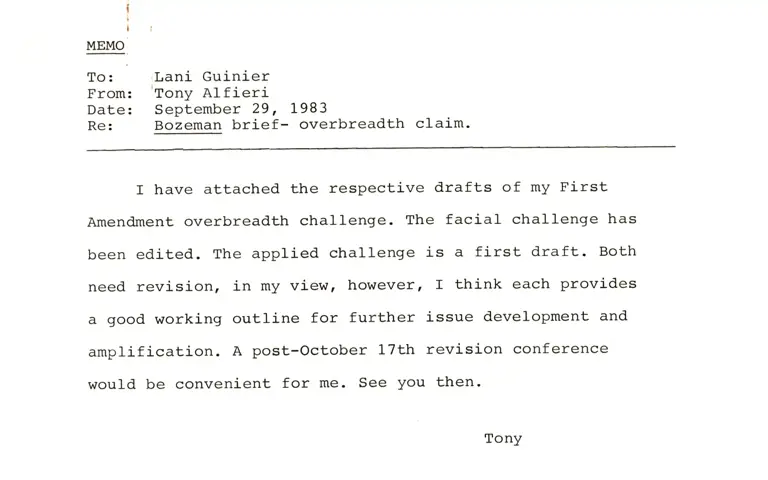
    MEMO

To: Lani Guinier
From: 'Tony Alfieri
Date: September 29, 1983
Re: Bozeman brief- overbreadth claim.

I have attached the respective drafts of my First

Amendment overbreadth challenge. The facial challenge has

been edited. The applied challenge is a first draft. Both

need revision, in my view, however, I think each provides

a good working outline for further issue development and

amplification. A post-October 17th revision conference

would be convenient for me. See you then-

Tony


I
I. SECTION L7.23.1 IS UNCONSTITUTIONAL ON ITS FACE BECAUSE

IT FAILS TO MEET THE STRICT STANDARDS OF STATUTORY PRECTSfON
REQUIRED OF I,AWS THAT POTENTTALLY OVERREACH FEDERAUL]Y

PROTECTED ACTIVTTY.

1. on lts facer s€ctlon L7-23-L prohrbits four categorles
-Ehfcd

of votlngnconduct. These categorles lnclude votlng tnore than once,
dlnosltlng ruore than one baLlot for the saue off lcgr.knowlngJ.y

partlcipo-t nq irrattemptlng to vote when not entltled to do sor and^any klid of
11Legal or f raudulent vorlngj o.ottrit5.

2. By deflnition, the exercise of the politlcal franchlse
and the effectlve provlslon of voter assistance constitute votl1g-
related conduct. Thls conduct Ls lnextrlcabl.y linked to r lre : !s
of po1ltlcal exPresslon and associatlon. These acts are protected
against abridgement under the First Amendnent. see, Shelton v.
Tucker, 364 u.s. 479,496 (1g50); NAACp v, Alabama ex re1. parrer

357 U.S. 449,460-61 (1958). Since First Amendment "freedoms are

(a) Because

actlvity and FlrsE

lnfringes upon the

of the conceptual

Amendment freedoms

personal exercise

between votlng-rel_ated

e actlon whlch potentlally

lng rights will, by

oyItreDt

the

1 lnk

, Stat

of vot

loglcal- extenslon, potentlally inplnge upon the indlvldual enJ

of Flrst Amendment freedous. Thls potentlal Lncursion vlolates
f undamental axlom that t'regulatory mea6ures no Dat ter--how
sophlstlcated, cannot be employed ln purpose or in effect to
etlfle, penalLze, or curb the exercise of First Amendment rlghts. tt

293, 297 (1r6 I ) .
Loulslana ex reL. Gremlllf E -_._\4ACp, 366 U. S.

see arso, Bates v. city of Little Rock, 361 u.s. 5]-6, 523 '(1960) .


2

(b) Since First Amendment "freedoms are delicate and

vulnerable, as well as supremely precious in our society. ",

"Ib]road prophylactic rules" in the First Amendment area are

" suspect" . @ , 3'7L U. S. 4I5, 433 , 438 (1963 ) .

To survive the rigor of heightened judicial scrutiny, statutes

abutting upon First Amendment freedoms must be drawn with

" t piec j-sion' " and must. be " narrowly ' tai Iored ' " t.o serve

Iegitimate State objectives. Dunn v. Blumstein, 405 U.S. 330,

343 (1972) (citations omitted). Hence, government may regulate

in the First Amendment area only with "narrotrr specificity".

Button, 3VL U.S. at 433.

3. sectlon L7-23-t ta , o*,W$f: directed at the ,,evll,,

of voter fraud. It ls settLed that ttthe preventlon of such fraud
ls a Legttlnate and compelllng governxoent goal." Dunn, 405 u.s.
at 345. The legltlrnacy of thts goal derlves from the importance
of preservl.ng the f'lntegrlty'r of the state electoral proce6s.

CousLns v. Wlgoda , 4L9 U. S. 471 , 49t (1975). Arguably, the Srate
of Alabana, ln promulgatlng sectlon L7-23-1, may have undertaken

to aerve thls valld sovereign interest. _ | _ \ i

In doing So, however, Alabama has erected a statute so closely

bordering upon protectecl spheres of First Arnendment liberty --that

it has violated the "allowable area" of sovereignty granted to

states. Thornhill v. Alabama, 310 u.s. BB, g7-g\ (1939). ;


3

uiolater t\e proo*r*zvo ",(a) Sectlon Ll-23-LLEAT&s ey@g(,tg t! af6>ee Alabama r s
cprrtrrturlegltlmate State lnterest because lts 11teral terns * I*r&"itr***t

,r*h the potentlal for reachlng and punishing protected Flrst
Amerrdment conduct. Courts wi11 condemn a statute as ,,irpermisslbJ;

overbroad 1f 1t permlts punishuent of activlty falrly withln the

Protectlon of the Unlted States Constitutlon.rr Florlda BusLnessrnen

for Free Enterprise v. stare of Fl-orlda, 4gg F. supp. 346, 353

N.D. Fl'a..1980)' af.f.td 673 F.2d LzL3.(1rth clr. 1982).
(b) sectlon' t7-23-L d* # ,ti.th the porentiat f or

overreaching because 1ts. ^general language Ls neither precise nor
i nlirrtritq

specif ic. This dual g*g&Wal tila,q is besr illusrrared by the
phrase "ilI-egaL or fraudurent votingr'. on its face, this phrase

contalns two operatlve term6: iLlegaL and fraudulent. Although
these terns represent core statutory conceptsr sEctlon L7. 23-L

fal1s to lnfuse then wlth meaningfuL substantive content. Thelr
undeflned quallty gives rlse to the problem of overbreadth.


(c) Sectlon L7-23-t suffers from real and substantl.al
overbreadth. Thls overbreadth 1s demonstrated i:: tlro dlstlnct
ways. F1rst, the statute is substauttally overbroad because
baslc First Amendment actlvitles are open to construction aa
ttl1Legal or fraudulent" votlng-related conduct. SLnce these
actlvltl.es encompass an inflnlte varlety of private as welL as

pubLlc forms of exPresslon end assoclatlon, the Btatuter6 potentlal
f or"'fuopermlsslbte appllcatlon 1s vlrtually unbounded. ,second,P€e0rt be, C\the statute 1s substantlarly overbroad because rdt'criminal*hctI'penaLty"ALs signiflcant in regard to severlty of punlshment.
(e.g. inPrl'sonment ln a penitentLary for not Iess than two nor
Erore than .f ive y."rr).*

(d) Furthermore, section L7-23-L ls fatally overbroad
because less drastlc alternative means of promotlng Alabamars

State lnterest exlst. "rf the state has open to it a less drastic
way of satlsfylng lts legitimate interests, it may not choose

a legislative scheme that broadly stifles the exercise of
fundamental personaL llberties.r' Kusper v. pontikes , 4L4 u.s. 51,
59 (1973). Accord, Reeves v. Mcconn, 631 F.2d 377,3g3 (5th clr.
1980); Johnson v. clry of opelousas, 65g F.2d r065, 1o7I (5th
cir- l98l). A less drastLc alternatlve means 1s.ava11ab1e r.n

o.*d tyeuhql|q en xua.*LAa more artfully drawn statute almed at a r.'rrJrArrhg" of
644e1-z{4n$ unlawf ul voting-related conduct excluslve of
g@sl/bJ lnnocent expresslon and association.

+

(

So'? rt , Sot € .:

.5r L),9.L.lnJ'413L)
)

SC, ) 5o U'.i'L'W'

ulir lL, t qr
") ) lkl-u,,a", u - La4soa

qss't h.g (0.9. May 2- ) $83)


4. The potentlal lnpact of sectlon L7-23-L on protecte.l
spheree of expressLoo and assoclatlon creates the danger cir

Flrst Amendment ch111lng effect. AppreclatLon of. the "chl11"
on prlnary conduct caused by t'toreratlrg, Ln the area of Flrst
Arnendment freedoms, the exlstence of a penal statute susceptible
of eweeplng and lroproper applicatlon. t', Button, 37L u. s. at 433,
Llee at the heart of the overbreadth doctrlne. Hobbs v. Thompson,

448" F.2d 456, 460 (5ttr clr. 1971). see also, LeFlore v. RobLnson,

434 F.2d 933, 936 (5tfr Clr. 1970). Courrs have long recognlzed

that "laws which are overbroad tend to rchil-lr the exerclse of
inportant Pirst Amendment rights.t, purpLe onlon, rnc. v. Jackson,
51f f. Supp. L2O7, L2L9 (N.D. Ga. t982).

(a) SectLon L7-23-t generates a chlLltng effecr because

lt hangsr llke the sword of Damocles, over the heads of voters
as wel-1 as indivlduals engaged in voter asslstai:ce, threatening
then wlth Prosecutlon and punlshment 1f they partlcipate ln lawful
Flrst Amendment activltLes

(b) Since the mere threat of btatute-based sanctl-on may

deter the exerclse of First Amendment

aa the actual applLcation of sanctions

the chllling effect generared by the t
punishment under the statute cinnot be

rights "almost as potently

.", Buttonr 3TI U.S. at 433,

hreat of prosecution and

gainsald.


5. The State courts of Alabana have not construed sectlon
L7-23-L Bo aa to cure it of the constltutlonal inflrnlty of
overbreadth- In fact, the Alabaua courts have left the statutera
key provlslon who1ly lritact (1. e. ttilJ-ega1 or f rauduLent votlngrt) .

The furl- extent of thelr constructLon amounts to the faciLe
observatlon that courts, where LnterpretLng the phrase "i11egal
or f raudulent votlagrr r

t'Day rely on the rernalnder of the statute
to provlde a cLear Etatement of what conduct ts proscrlbed. r

I.IlLder v. state, 401 so.2d 151, 160 (Ala. crfun App. ), cert.
denled, 401 so.2d L67 (ela. l98l), cerr. denled, 454 u.s. l057
(1e82).

(d) The remalnder of the statute does Dot provlde a

ttclear statenent" of prohtbtted conduct. The absence of such

atatement 1s attrlbutable to the uncertain mens rea eleuent
ernbedded ln the statute. Thls sclenrer-br".ll".f rrr., 6re::.rs

both from the l-nconslstent use of language in the body of the
6tatute and from the ambLguous resul-ts of tlie Alabama Supreme

courtts hlstorical efforts to construe the statute. see, €.g. r

I{l1son v. srate, 52 Ala. 2gg (1g75); Gordon v, state, 52 Ala.
308 (r875).

(b) This uncertalnty persists because recent Al_abama

court declsions have falLed to determlne whether or not a scienter
requlrement x0ay be generalLy 1mp11ed under the clrcumstancea.- of
votlng. see, e.g., wl1der v. state,401 so.2d 151 (A1a. crlm. App.)
cert. denled, 401 so.2d 167 (A1a. 1981), cerr. denled, 454 u.s.;.
1057 (1982); Bozeman v. srare, 40r so.2d r67 (A1a. crLm. App. ),,

cert. denled, 401 so.2d L7l (Ara. IggI), cerr. denLe _, 454 u.s.
l0s8 (1e82).

a


6' Because the First Amendment rlghte of porltlcaL expreBslon
and aseoclatl'on are lntlnately tled to the exercise of Ehe pollt.lca1
fraachlse and to the extenslon of voter asslstance, sectlon 17-23-L
16 ausceptlble of apPllcatlon to Flrst Amenduent freedoms, Thle
6uscePtlblltty ls a form of Btatutory autho rlzatlon enabltng the
State of Alabama to punish, by crinlnal aanction, coDstltutloaally
protected actlvLty. The potentlal- for punlshment under Bectlon
l7-i3-1 poses a real and substantlal threat to the free exerclse
of po11tlca1 expresslon and assoclatlon. slnce the threat of
pualshuent causes lndlviduaLs to refraln from engaglng in polltlcal
actE of expresslon and aasoclatl.on, sectlon Ll-23-L operates to
cbl1I the exercise of vltaL First Amendment rlghts. see, Gooding
v- rill1son' 405 u.s.519, 52L (Lg72). Because of thls srarute_
lnduced ch111lng effect, sectlon 17. 23-L 1s lmpermlsslbly overbroad
aad therefore invaLld on its face.


8

II. SECTION L7_23-I IS UNCONSTITUTIONAL AS APPLIED TO PETITIONER

BECAUSE IT OPERATES TO PUNISH THE INNOCENT EXERCISE OF PROTECTED

FIRST AMENDMENT RIGHTS IN THE AREAS OF POLITICAL EXPRESSION

AND ASSOCIATION.

* 1. Petitioner was indicted upon a three count violation of

section L7-23-L. The indictment charged petitioner wiEh voEing

i11ega11y ln the Democratic Primary Run-Off Election of September

26, 1978. Petitionerrs criminal conduct was alleged to consist

of voting more than once as an absentee voter, depositing more

Ehan one absentee ballot for the same office(s) as her vote,

and castlng i11egal and fraudulent absentee bal1ots.

2. The only evidence offered by the State to demonstrate

Ehe i11ega1 nature of petitionerrs voting conduct indicated Ehat

she: (i) picked up " Ia]pproximately 25 to 30 applications"

for absentee ballots from the Circuit Clerkts office during

the week preceding the run-off, Tr. 1B; (ii) was presenE with

three or four other women, who did not incl-ude the voters, aE

the notarLzirr:g of some absentee ballots which were cast in the

run-off, Tr. 57; (1ii) made a telephone call to the notary

"p.rtaining to bal1ots,r' Tr. 76-77; and (iv) spoke to prosecution

witness Ms. Sophia Spann about absentee voting when "it wasntt

voting ti-me, " Tr. 184. Additionally, there was evidence present,ed

to the j ury in violation of petitioner I s constitutional rights,

as alleged in para. , that; (v) in the telephone call


q

described in (iii1, supra, petitioner had requested the noEary

to notari-ze the ba1lots, Tr. 65; (vi) that petitioner aided Ms.

Lou Sommerville, with Ms. Sommervillers consent, to fitl out an

application for an absen!ee ballot, Tr. L6L-L62,169; and (vii)

that in an el-ection held prior to the run-of f , petit j-oner aided

Ms.. Sommerville, with Ms. Sommerville t s consent , to fill out an

absentee ba11ot, Tr. L7 3-L7 4, 17 6-L77 .

3. The evidence introduced by the State shows that peti-

tioner participated in a 1oca1 effort to aid and encourage

disabled,. e1derLy, and illiterate blacks to vote by absentee

ba11ot. Because petitioner is enEi.tled to the political enjoyrrrent

of basic First Amendment rights, her participation in such an

effort constitutes protected activity. Indeed, petitioner's

participaEion in the aforementioned vot.er assistance drive,

a 1awful and cooperative form of "orderly group activity"

directed towards the achievement of legitimate political ends,

merel-y reflects the exercise of protected First Amendment ri..

See, Button, 371 U.S. at 430.

(a) Petitionerr s conduct is protected under t.he First

Amendment because it involves the valid exercise of the freedom

of speech. This freedom stands among the "fundamental personal

righEs and liberties secured to all persons by the Fourteenih

Amendment against abridgement by a state." Thornhill, 310 U.S.

at 95 (footnote omitted). See a1so, Cantwell v. Connecticut, n

310 U.S. 296, 303 (1940) (footnote omitted)


lq

(b) Political expression represents a unique class of

speech. The survival of a democraEic polity hinges on the liberty

afforded political expression. See, Baggett v. Bu11itt, 377 U.S.

360, 373 n.10; Davis v. Francoi.s, 395 F.2d 730, 735 (5th Cir. 1968)

This liberty, manifested in the ability "to di.scuss publicly and

tru,thfully all matters of p.ublic concern without fear of

subsequent punishment.", is critical to the preservation of the

American Republic. Thornhill, 310 U.S. at 101-C2.

i. PetiEioner I s actions in obtaining absentee

ballots from the Circuit Clerk's office were undertaken innocently

in furthdrance of a 1awfu1 voti.ng drive i-nvolving Ehe First

Amendment rights of political expression and association.

ii. Petitioner I s telephone call to the notary

concerning the status of absentee ballots constituted a valid

exercise of First Amendment speech-rights directly related t,o

the promotion of a lawful voting drive.

iii. PetiLioner I s coaversation with Ms. Sophia

Spann concerning absentee voting reflected a valid exercise of

First Amendment speech-rights directly related to the promotion

of a 1awful voting drive.

(c) Petitionerts.conduct 4&aA is protected under the

First Amendment because it involves the valid exercise of a-l .

freedom of assembly. The right of free associat-1on derivcs fro::,

this essential freedom. See, Shelton, 364 U. S. at 486 (citations

omitted) . Cf. Patterson , 357 U. S. at 460.


tt'

(d) The "freedom to gather in assocj_ation for Ehe

PurPose of advancing shared beliefs is protecteci by the Fourteenth

Amendment from infringement by any State." Democratic Party of

U.S. v. WiscoqsLq, 450 U.S. 107, L2L (198I). See also, Grernillion,

366 U.S. at 296. The beliefs sought to be advanced by association

may pertain to "po1itica1, .economic, religious or culEural matters".

Pattersolr , 357 U. S. at 460 (citations omitted) . See a1so, A1-addi:: ' s

Castle, Inc. v. City of Mesquite,630 F.2d 1029,1038 n.13 (5tfr

Cir. 1980).

i. Petitionerrs presence, with several other

nonabsent?e voters, Bt the notarLzLng of absentee ballots involved

a valid exercise of Flrst Amendment association-rights directly

rel-ated to the advancement of a lawf u1 voting drive.

i1. Petitionerrs efforts to aid Ms. Lou Sommerville

in applying for and filling out an absentee bal1ot consEituted

a valid exerci.se of Fj-rst Amendment association-rights directly

related to the advancement of a lawfuI voting drive.

4. Because section 17-23-7 may be construed in a manner that

defines the valid assertion of constitutional rights as criminal

conduct, its application results in the punishment of individuals

who are guilty only of engaging in the faLr exercise of First

Amendment rights. See, Davis, 395 F.2d at 735. "It has long_been

established that a State may not impose a penalty upon those

who exercise a right. guaranteed by the Constitution." Harmon

v. Fors senius , 380 U. S. 528, 540 ( I 965 ) .


tL

5. The State of Alabamars expressed willingness to punish

the valid personal exercise of First Amendment rights is part of

a larger historical practice aimed at intimidating and interfering

with the exercise of black voting rights. See, United states v.

Bruce, 353 F.2d 474, 477 (5Lh Cir. 1965). Alrhough "rhrears,
intimidation or coercion" may adopt a vari"ety of forms, United

States v. Beatv, 2BB F.2d 653, 656 (6th Cir. 1961), "Ih]arassmenr

in the form of baseless arrests and prosecucions is one of the

most effective means of putting a halt to a voter drive."

United States v. McLeod, 385 F.2d 734, 747 (5th Cir. L967).

(a) Federal courts are "not blind to the effect of

baseless arrests, unjustified prosecutions and any other

acts or conduct- official or otherwise, but pariicularly officlal-

upon individuals who are 1ega11y seeking to exercise their rights.r'

United States v. C1ark, 249 F. Supp. 720, 728 (S.D. Ala. 1965).

Judlcial readiness to penetrate the veiled purpose of State

arrests and prosecutions engineered i-n "bad fai-Eh" stems from;

the recognition that " I t ] he inevitable effect of such acts

and conduct is to severely discourage, intimidate, threaten

and coerce those citizens who are seeking or might otherwise

seek to exercise Itheir] rights." Id. at 728.

(b) Since there is no sound justification for pet{.-

tioner I s arrest, prosecution, or imprisonment, there i-s no

alternative but to concl-ude that the State I s purpose herein .:

was specifically to obstruct petitionerr s efforts at marshaling


le,

an absentee voter drive and to deter others from participating

in it. See, McLeod, 385 F.2d at 743. In reference to deterrence,

it is difficult to imagine any form of concerted State action,

"short of physical violence", id. at 740, which would have a

more chilling effect on a voter drive then the prosecution at

bar. In this regard, courts. have taken judicial notice of the

f""t that "the mental anguish and the nuisance of having to

defend baseless prosecutions could well deter Negroes from

participating in the Ivoting] process. " Td. at 7 49-50.

6. Because section 17-23-l readily lends itself to

harsh and discriminatory enforcement against partlcular

individuals deemed to merit State displeasure, its mere

existence resulEs in a continuous and pervasive resEraint

on the personal- exercise of First Amendment freedoms in

Alabama. See, Thornhi11,310 U.S. at 97-98. This unconstitu-

tional- restraint is part of a general chilling effect produced

by the statute. When an overbroad statute lends itself to

selective enforcement against unpopular causes, such an effect

becomes oppressive. See generally, Button, 37L U.S. at 435-36.

In this respect, section L7-23-l itself becomes a weapon of

oppression.

(a) Petitioner is the victim of the statutory

oppression causecl by the application of section L7-23'1.

Her victi-mLzation stems from her commiEment to advancing
,j

black voting rights, a commitment that has engendered the


//

intense resentment and opposition of the politically dominant

white community of Alabama. cf. Button, 371 u.s. at 43s-36.

(b) Historl-caL fact does not permit us to close our

eyes to the reaLlty of race-based political opposition in the

state of Alabama. More importantly, history does not permit

us to deny the l-mpact of this opposition in shaping the substance .

and ln manlpulatlng the enforcement of sectlon L7-23-L. Becaase

.petltloner has been wounded by the overbroad appl-ication of

section 17-23-L, she 1s enti.tLed to constitutional- relief.

rn these circumstances, the constitution demands the total

lnvalldarlon of section L7-23-L. Simple justice demands no less.